



Abstract
This article discusses the integration of acoustic design approaches into architectural design education settings. Solving architectural acoustic problems has been for centuries one of the primary aims of theories and experiments in acoustics. Recent contributions offered by the soundscape approach have highlighted broader desirable aims which acoustic designers should pursue, fostering ecological reasoning on the acoustic environment and its perception as a whole. Drawing from the available literature, some examples are brought to show the integration of architectural acoustics and soundscape approaches into the realm of architectural design education, highlighting the significance of specific design situations and aural training techniques in learning contexts.
Keywords
Introduction
Theories and experiments in acoustics have been focusing for centuries on the explanation and solution of architectural acoustic problems, driving the technical development of the discipline and its application in the built environment design. In the last decades, the sonic imbalance deriving from the industrial development in urban settings led to the design of a series of regulations to control machine-made noise and reduce sound levels. Urban authorities as well as the construction industry became closely involved in the design and mitigation of sounds which were likely to be found in the built environment, being also responsible for potential effects on future inhabitants.
The development of regulatory measures aimed to contain excessive sound levels reflected a surge in interest in environmental matters and an increasing attention on the effects of noise exposure on health. Noise exposure can cause annoyance, sleep disturbance, cardiovascular disease, impairment of cognitive performance in children, stress-related mental health risks and tinnitus.1,2 It increases systolic and diastolic blood pressure, causes variation in the heart rate and the release of stress hormones. 3 A recent report by the World Health Organization highlighted the relationship between road traffic and the incidence of ischaemic heart disease with high-quality evidence.4,5 These focused research efforts raise awareness on health risk factors which may become a burden on our society but rarely acknowledge the positive diversity of sounds which populate everyday life, making an acoustic environment peculiar and meaningful for a community. As Adams et al. 6 state, ‘not all sounds are unwanted and many add to the sense of vitality of living in an urban area’.
Among the acoustic design objectives to be pursued by practitioners and researchers, alternative strategies to noise-oriented measures have been recently explored by soundscape scholars. The pioneers in soundscape research were musicians who reflected on the learning processes activated by listening, ultimately leading to an increasing awareness of the relationships characterising the environmental sound ecosystem – our acoustic ecology. This original approach weaved together different disciplines concerned with the built environment and its social system, marking the need for acoustic designers to assume creative responsibilities towards the world soundscape and its music. In some architectural design contexts, these approaches have been adopted as an educational method to reflect on the interactions between architectures and the sounds they activate and modulate, expanding the traditional architectural acoustic scopes to other domains, largely social and cultural.
This article aims to discuss, on the basis of an updated literature, those educational strategies engaged in defining the role of the Acoustic Designer. The questions I pose seek to identify (1) the responsibilities of acoustic design practitioners and (2) which educational approaches may lead to the development of acoustic design skills in architectural design education contexts. Before bringing educational examples, I present a series of conceptual standpoints from the disciplines Architectural Acoustics and Soundscape, to clarify what their contribution in shaping future education strategies might be.
Architectural acoustics and acoustic design
Origins of acoustic design theory
It is widely acknowledged that the first person writing about Architectural Acoustics was the architect-engineer Marcus Vitruvius Pollio.7–9 Vitruvius wrote the acclaimed 10 books on architecture, called ‘De Architectura’, between 40 and 20
Hence, the ancient architects, following the footsteps of nature, perfected the ascending rows of seats in theatres from their investigations of the ascending voice, and, by means of the canonical theory of the mathematicians and that of the musicians, endeavoured to make every voice uttered on stage come with greater clearness and sweetness to the ears of the audience. For just as musical instruments are brought to perfection of clearness in the sound of their strings by means of bronze plates or horn echeia, so the ancients devised methods of increasing the power of the voice in theatre through the application of harmonics. 12
Vitruvius introduced his famous theory on dis-sonnantes, con-sonnantes, circum-sonnantes and re-sonnantes design solutions, as reminded by Postma et al. 8 and D’Orazio and Nannini. 13 Thanks to his contribution, acoustic design through centuries largely focused on the control of the building shape and the application of the resonant tuning devices called echeia. 14
Acoustic design and medieval tradition
During the Middle Ages, we have no trace of important acoustic developments, although the echeia were found in various medieval churches, inserted into the walls, with the belief that they could improve the acoustics of the interior space and the intelligibility of the spoken word. 15 These devices were for example found in Serbian churches spanning from medieval times to the 17th century. 16 However, the measurement of these resonators showed that they would not have any effect on typical choral and preaching production which would take place in these churches, leaving space to the hypothesis that they were installed primarily for oral tradition or as a construction material. These devices were found to achieve diffusion in Swiss churches by Desarnaulds. 17
Baumann and Haggh 15 demonstrated through the geometrical analysis of reflection paths how in the 15th century the positioning of the organ in Santa Maria del Fiore in Florence might have followed specific acoustic design principles. In the 1500s and the 1600s, architectural acoustics saw a renovated interest, guided by the need to design new playhouses, such as the Elizabethan theatres in London and Opera theatres in Italy. 13 It is nowadays possible to explore this evolution through online resources, such as the website theatre-architecture (https://www.theatre-architecture.eu).
Acoustic design and modern science
Shortly after Giuseppe Biancani and Marin Mersenne laid the foundation of the modern science of acoustics, in 1650 the Jesuit scholar Athanasius Kircher published in Rome the Musurgia Universalis, followed by the similar Phonurgia Nova in 1673.8,18,19 Kircher charmingly named acoustics as the ‘magic art’ of the bent sound – Magia Phonocamptica – and drafted inventions to amplify sound through pipes in buildings (Figure 1), hydraulic organs, and theories based on geometrical projections and listening experiments with choirs, which he called Musica per Echo. (p.50) 20 In these books, he used the word Architectura Echonica to describe the study and the controlled design of architectural interactions with sounds. Further insights on the development of the science of Acoustics from its origins can be found in Hunt, 18 who remarked the importance of observation and experiments in such evolution.
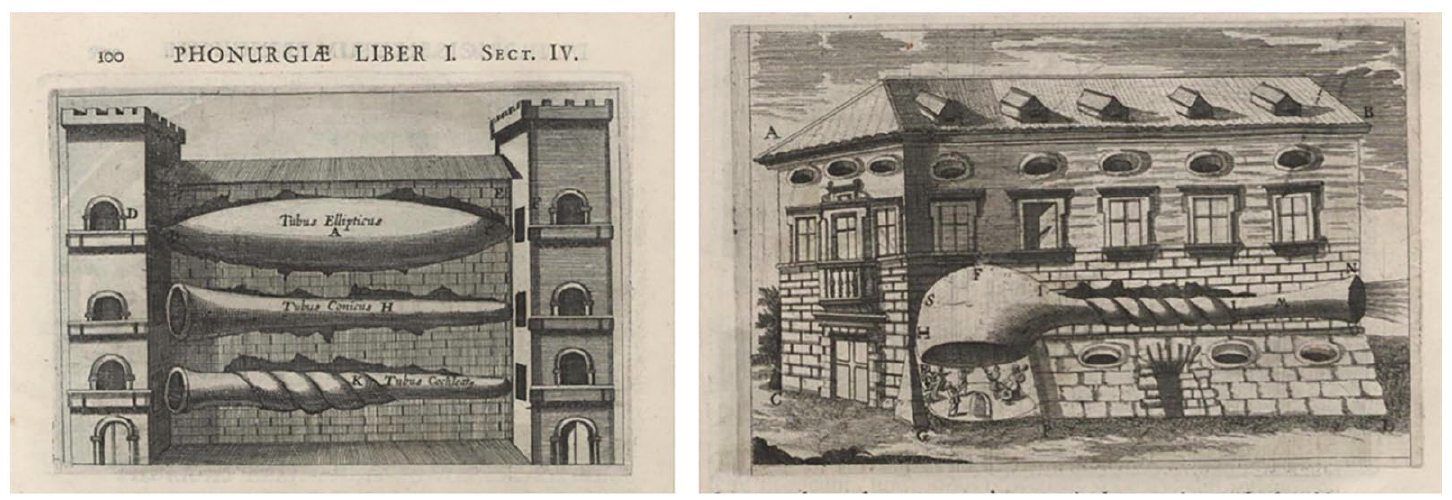
Acoustic Designs by Athanasius Kircher, 1673.
Predicting echoes and reverberation times
Architectural acoustics developed as a fundamental part of the design of performance spaces, pushing the limits of innovation.14,21,22 Recently, Postma et al., 8 D’Orazio and Nannini 13 and Postma 23 provided an examination of the main design strategies adopted before the discovery of the Reverberation Time (RT60) formula by Sabine, which took place around 1898.23,24 Pre-Sabinian strategies to solve acoustic design problems involved several methods. Postma et al. 8 differentiated in design approaches, such as copying or upscaling acoustically satisfying buildings and rooms, and physics-based design approaches, which can be divided into undulatory and geometrical acoustics. The undulatory approaches were based on the concept of circulation and obstruction of sound, which can be traced back to Vitruvius’ suggestions. 8 Vovolis 25 suggested that geometrical methods were already used in Greek open-air theatres to avoid centralised focusing effects.
According to Postma, 23 at the end of the 18th century, an alternative acoustic design guideline emerged, named echo theory, based on the ‘quantification of the perception threshold between direct and reflected sounds’. 8 Postma et al. 8 have also identified an additional acoustic guideline, based on the undulatory ‘circulation of sound’ and ‘unobstructed propagation’ approaches, which employed ‘a speaking person and human observer judging audibility/intelligibility as a function of distance and direction’, ultimately leading to limiting the size of audience areas.
Designing architectural acoustics
With the formulation of the RT60 by Sabine,26,27 explaining the influence of volume and absorbent surfaces on the time needed for sound to decay until being inaudible, a rediscovered interest in acoustics spread to the design of everyday spaces. Acoustic consultants, already operating at the time of Sabine,24,28 could test in real architectural settings their hypotheses aimed at controlling the reverberation phenomenon. In this context, the experimental application of innovative materials, also driving the manufacturing and design industry, made a large number of spaces more absorbent. 24
Over the course of time, opera houses, theatres, and concert halls had been the primary playground to compare design solutions and test innovations, leading to the standardisation of room acoustics measurement procedures, at the beginning focused mainly on performance spaces. In order to help enable research reproducibility in the field, the standard ISO 3382 was released in 1975 to uniform the measurement of reverberation time, later updated in ISO 3382:1997 to include other acoustic parameters.29,30 In the recent years, the Building Acoustics Technical Committee (ISO/TC 43/SC 2) has extended the focus of the ISO 3382 from performance spaces 31 to ordinary rooms 32 and open plan offices. 33
Simulation and auralisation
To be able to demonstrate the reliability of design solutions, practitioners were (and still are) supported by calculation strategies which need to be solid in mathematical and physical theory and guarantee the proposed design outcomes. Theatre acoustic design experimentation developed also through the analysis of sound propagation in scale models, progressively assisted by digital simulation tools, allowing to quickly compare results and organise them in tables and graphs. 34 The combination of computational improvements in both audio signal processing and computer graphics progressively led to the possibility to display information related to acoustic parameters next to the geometrical representation of the digital model. In the last few decades, practitioners have been able to visually inspect critical areas of the design by looking at heat-maps superimposed on the two- (2D) or three-dimensional (3D) views of model, as well as to study reflection paths and their spatial distribution in time.
Auralisation, ‘the creation of audible acoustic sceneries from computer-generated data’, 35 has helped in the recent years to listen to acoustic design solutions for architectural spaces and evaluate perceptually their acoustic signature, represented by a room impulse response (RIR). An RIR corresponds to the response of the room to the excitation of a given signal, emitted by a source with a given set of coordinates, as recorded by a receiver placed in a different position. Since 1980, and developing in sophistication in the 1990s, a series of innovative auralisation tools were developed in the audio engineering context.36–41 Adding another sensory dimension to the potential of computer-aided design (CAD), acoustic simulation software has largely helped through years calculating and hearing – with some limitations – how spaces might sound like, according to their volume, geometry and materials. 42
Thery et al. 43 recently studied the adoption of auralisation in consulting practices, highlighting how their adoption depends on the size of the practice. While smaller practices seem unable to afford the use of these techniques for a lack of resources which include time, money, and skills, higher budget companies adopted this technology often in combination with immersive visualisations, reporting improvements in the collaboration and communication with other stakeholders participating in the construction process. Most of these tools can be considered too expensive also for the pockets of a student, making the simulation of acoustics design choices a technique viable only in large and established professional contexts, or academic departments engaged in acoustic design research.
To meet the demand for more accessible tools which could foster education and creative experimentation in acoustic design, recent developments saw the emergence of real-time auralisation tools such as the SketchUp plug-in RAVEN,44–46 the open-source EVERTims based on Blender and Juce, 47 and the recent Project Acoustics by Microsoft.48,49 In Milo and Reiss, 42 the main technical features of these platforms were reviewed providing some details about their software architecture. Drawing from the results of a survey with 15 architects, their technical potential in educational and architectural practices was also discussed.
We should acknowledge that the more widely adopted simulation platforms, such as Odeon and CATT, have supported the study of valuable heritage buildings,50–52 as well as public squares. 53 On this hybrid terrain where architectural acoustics and public space design intersect, computer-based simulations 54 and scale-model methods 55 are often employed to research case-specific problems while testing the interplay between acoustic theory and simulation constraints.
Modelling acoustic designs
In the last decade, the construction industry has made large use of parametric design techniques to achieve digital form-finding or optimise design solutions. 56 Non-uniform rational B-spline (NURBS)-based software platform like Rhinoceros offer with the Grasshopper plug-in the possibility to construct design algorithms which create bespoke functions. Pachyderm 57 is a plug-in developed within the Foster + Partners practice to verify acoustic design solution. This tool has been employed for the design of acoustically optimised meeting rooms, as shown by Peters, based at the Architecture faculty in Toronto.58,59 Another example is Aeolus, a computational design tool used to support the acoustic design of a classical music stage shell (ReS), built every year during an architecture and music workshop. 60 This practice-based experience aims at engaging student architects in the realisation of a functional acoustic design, while teaching them the rationale behind design choices (Villa Pennisi in Musica).
Critical summary
From the review presented, we notice how the evolution of the architectural acoustics discipline was driven by the desire to design architectural spaces with adequate acoustic performance. Thanks to those spaces primarily dedicated to social listening the historical development of investigation and prediction techniques ultimately created the scientific basis of contemporary acoustic design practices. I suggest that in such cases, two main factors were jointly involved: first, the excitement for higher aesthetic scopes in the acoustic design discipline, helping the delivery of performing arts content through the design of the architectural space also by means of its significance as a sonic experience; second, the will to fulfil the expectations of the clients, together with some apprehension for the future audience judgements.
Architectural acoustic design is today as once still relying on drawing methods, although these can now be managed by a computer. Predictive tools helping solve the complexity in sound wave propagation will increasingly aid designers in imagining new spatialities and study their acoustic effects, with utilitarian as well as aesthetic purposes. Subjective evaluations are still based on listening, although we can now simulate a trial-and-error process in a virtual environment, taking into account the physical laws which were discovered while founding the science of acoustics. A plethora of new inventions in the realm of audio processing and technical design have accompanied this progress. In the next section, I will present the development of the discipline called soundscape, highlighting those cultural aspects of acoustic design which the technical nature of the architectural acoustics discipline might have neglected.
Soundscape and acoustic design
In 2014, the standard ISO 12913-1:2014 has defined the soundscape as ‘the acoustic environment as perceived or experienced and/or understood by a person or people, in context’, where the acoustic environment is ‘sound at the receiver from all sound sources’. Such sound from all sources can be ‘actual or simulated, outdoor or indoor, as experienced in memory’. 61
Nevertheless, the first to write about Soundscape was Schafer, 62 when he published The New Soundscape, followed by the more famous Soundscape. Our Sonic Environment and the Tuning of the World. 63 The New Soundscape was published as a Handbook for the Modern Music Teacher. In this book, Schafer describes vividly his experience in a classroom at the School of Communication in Simon Fraser University, also reporting sample dialogues with his students. Students were given exercises to describe and categorise sounds. Shortly after, Schafer succeeded in granting funding to the World Soundscape Project (WSP), whose ‘purpose was to study the effects of the changing soundscape on human behaviour’ beginning with this information ‘to develop the new discipline of soundscape design’ 64 (p. xii). The project achieved a large resonance globally, influencing future generations. The Soundscape 63 and the Handbook of Acoustic Ecology 65 represent some of the outcomes of this experience. This Handbook, edited by Barry Truax and accompanied by well-documented field recordings, embodied the core of the later book Acoustic Communication. 66 In both books, there are some sections covering the Acoustic Design theme, which will be briefly described in the next paragraphs.
Two perspectives on Acoustic Design
In the Soundscape, Schafer argues that the Bauhaus invented the field of industrial design bringing together the fine arts and industrial craft. 63 Similarly, the interdisciplines acoustic ecology and acoustic design can be further developed in a unified framework covering the science and art of sound. As illustrated in Figure 2, acoustic ecology studies sounds ‘in relationship of life and society’ and thus needs to consider sounds in their original place and study ‘the effects of the acoustic environment on the creatures living in it’. The study of this discipline is preliminary to acoustic design practice. For Schafer, ‘Acoustic design does not, therefore, consist of a set of paradigms or formulae to be imposed on lawless or recalcitrant soundscapes, but is rather a set of principles to be employed in adjudicating and improving them’ (p. 238). These principles, also shown in Figure 2, are listed as follows: 67
A respect for the ear and voice – when the ear suffers a threshold shift or the voice cannot be heard, the environment is harmful.
An awareness of sound symbolism – which is always more than functional signalling.
A knowledge of the rhythms and tempi of the natural soundscape.
An understanding of the balancing mechanisms by which an eccentric soundscape may be turned back on itself.
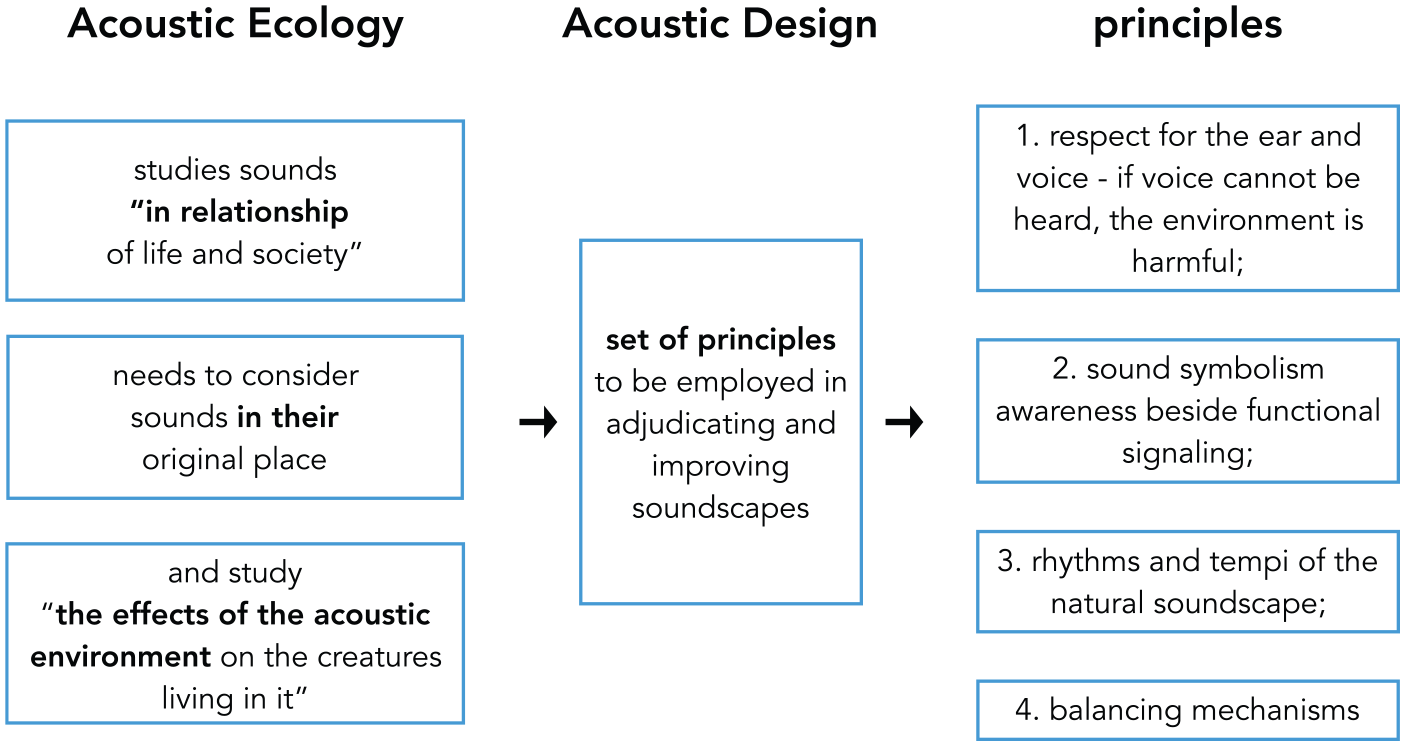
Acoustic ecology and acoustic design principles. 67
Schafer goes on to explain that the soundscape of the world unfolds around us as a huge musical composition of which we are audience, performers and composers. He advocates for Acoustic Design not to be controlled from above but to work towards the retrieval of a significant aural culture with the contribution of anyone with good ears. He sees composers as the architects of sounds, although they seem not ready for the task. Finally, he argues for the acoustic designer to have training in acoustics, psychology, sociology, music, and more, although such schools do not exist and need to be created. Basic modules in such disciplines concern the human ear and the human voice, to know the world by experience and comprehend extrahuman sounds with respect to our own. Ear cleaning exercises is the name given to listening activities in support of the aural training process. Students should be engaged in recording practices, documenting their sounds, and exploring new places to notice variations which the familiarity with a place would not trigger. Sound and listening walks can support the aural training of the students, using maps as scores for the soundscape exploration.
In the chapter Acoustic Design, from the book Acoustic Communication, Truax argues that criteria for acoustic design are obtained from the analysis of positively functioning soundscapes. 66 In addition to governmental legislation and consultants, listeners and sensitive experts can help supporting the goal in aiming at public awareness. The dualism between science and art is solved through the communication paradigm which describes the relationship of the individual and the environment as mediated by sound. Acoustic Design, therefore, ‘represents an understanding of the processes of acoustic communication and seeks to redirect the mediating influence of sound in relationships that are observed to be malfunctioning’.
Although for Schafer ‘any classification system or taxonomy is surrealistic’, he suggests that sounds can be classified according to their physical characteristics (acoustics), how they are perceived (psychoacoustics), focusing on their function and meaning (semiotics and semantics), or on their emotional or affective qualities (aesthetics) (p. 133).
67
In explaining why this activity might be beneficial, Schafer cites Truax, for whom the act of ‘disintegrating a total sound impression into its component parameters’ is ‘a skill that must be learned’, probably necessary for acoustic design. In this quoted passage, Truax clearly reminds that ‘a soundscape cannot be understood merely by a catalogue of such parameters’, ‘but only through the representations formed mentally that function as a basis for memory, comparison, grouping, variation and intelligibility’. Before detailing how different classification approaches may help qualifying soundscapes, Schafer explains the aim of these comparison activities:
67
If soundscape study is to develop as an interdiscipline, it will have to discover the missing interfaces and unite hitherto isolated studies in a bold new synergy. This task will not be accomplished by any one individual or group. It will only be accomplished by a new generation of artist-scientists trained in acoustic ecology and acoustic design.
Many classification systems have been proposed so far, one example being Krause’s 68 division in Geophony, Biophony and Antropophony. The soundscape standard ISO 12913-2 69 Data collection and reporting requirements proposes a classification system which focuses on the Urban Acoustic Environment, based on the framework by Brown et al. 70
From these two summaries, we can observe how the environment is considered as an ecosystem (an ecological system), in constant relationship with the listener. The listener, who can be considered an ever-learning open-minded and open-eared student, is invited to explore these relationships with the acoustic environment through a reflexive process which includes (1) exploration; (2) auditory observation; (3) the association with semantic constructs such as words; and (4) the documentation through the means available, including recording practices. The last step allows the experience gathered by the listener to be communicated to other human beings through further discussions which should include the perspectives of other social sciences to evaluate the perceived quality of the situations examined.
Developing acoustic ecologies
Being the founders of the acoustic ecology movement composers, soundscape composition further developed into a genre which is mainly constructed on sounds which preserve the features which make them recognisable.71–73 However, the weight of the contribution of the WSP was also felt in other disciplines. Throughout the years, the development of the soundscape community was supported by the interdisciplinary contribution of cognitive and environmental psychologists and social sciences theorists. Discussions among researchers largely pointed to ecological themes and awareness motifs, adopting co-creation processes such as participatory mapping practices, often supported by an attention to psychoacoustics phenomena.74,75
Sonic experiences and effects
In Grenoble, the interdisciplinary research group CRESSON (Centre de recherche sur l’espace sonore et l’environnement urbain), based at the school of architecture, brought forward ‘this attention to earwitness accounts in concrete contexts’ that with some phenomenological influences ‘led to an emphasis on exploring the dynamic interaction between the physical environment, the socio-cultural milieu, and the individual listener’
64
(p. xiii). Their practice aimed to ‘compare the physical characteristics of urban settings with the perceptual awareness of its inhabitants and users’ (p. xiii), developing through years a vivid discourse on concepts such as ‘atmospheres’ and ‘ambiances’
76
based on several sensorial dimensions.
77
The group, founded in 1979 by Augoyard, has collected a series of urban sound effects, published in the book Sonic Experience.64,78 This book is the outcome of an interdisciplinary collaboration and can be considered particularly helpful for those who want to approach the acoustic environment from aesthetic, sociological and geographical perspectives. Augoyard and Torgue
64
(p. 4) frame their question as follows, appearing also in Harvey (p. 27):
79
What instruments are available to technicians and researchers, administrators and users, designers and inhabitants? What is the sonic instrumentarium of urban environments?
Soundwalking and listening skills
The listening practices advocated by the WSP were chiefly aimed to rediscover our sense of hearing, making them extremely suitable in learning contexts.80,81 In particular, the soundwalking method, poetically described by Westerkamp, 82 and discussed by Drever 83 in its historical lineage, can be considered as an environmental educational practice which achieves two effects. It helps us, through listening and soundmaking, to reflect on how we relate to the environment84–87 and provides additional training in listening skills, fundamental for composers and performers.81,88 Recently, soundwalking has also been standardised as a valid and advisable way to characterise soundscapes69,89 and suggested as a form of training in acoustics for interior design students. 90
Environmental Psychology and place
Among the satellite disciplines contributing to soundscape research, Environmental Psychology (EP) seems to be close in aims. 91 This field aims to improve the understanding of the interrelationships between people and their built and natural surroundings, helping to create environments responsive to human needs. 92 The discipline gathers psychologists and architects sharing the same interests, producing research which could inform directly Architecture, Town and Regional Planning, Landscape Architecture, and Interior Design. 92 EP officially arose in Proshansky et al., 93 one year after Southworth 94 published his work on The Sonic Environment of Cities in the Journal Environment and Behaviour. From this attention to the human–environment relationship arose the idea of a Psychology of Place 95 and the field called Architectural Psychology, now considered ended. 96 On this matter, Philip 97 suggested that interactions between individuals and architectures were represented with too rigid behavioural models and there was scarce attention to the emerging scientific findings from architectural design education contexts. Similarly, Canter 98 noticed that the research attention in the architectural theoretical field moved progressively from the relationship between individuals and their environments to pure formal research.
Place attachment, qualities and expectations
At the core of EP research, there is an interest for the relationships between human beings and place. For Morgan, 99 ‘the concept of place refers to the subjective experience of embodied human existence in the material world’. The term place identity was introduced by Proshansky et al. 100 to highlight how the physical environment significantly shapes the human sense of self. 99 Place attachment, largely discussed in Giuliani, 101 can be considered for Manzo 102 the set of ‘emotional bonds that form between people and their physical surroundings’. These bonds are also related to patterns of use and their meaning for the community, providing additional interpretation layers which influence the soundscape evaluation from a semiotic point of view, as suggested by Dokmeci Yorukoglu and Onur. 103 These layers also depend on listening modes and the atmospherical qualities and the geographical character of a place, defined by Norberg-Schulz’s 104 genius loci. 103 In soundscape research, local experts are considered the principal source of information to investigate these emotional bonds with the place 69 exemplified by the work of Liu and Kang 105 with local residents in Sheffield.
Besides place attachment, EP discusses broader themes such as stress, restorative environments, and the health benefits of nature.106–109 It well integrates with soundscape approaches studying our interpretation of the soundscape and its perceived restorativeness, 110 ultimately influencing our quality of life.2,111 Researching what gives a sense of place to a location also has large implications on environmental education.112–114
Influencing factors in soundscape evaluation
In soundscape research, the attention to the context and the perception of the individual is paramount. 61 Qualitative approaches to soundscape assessment have shown that expectations and sound preference play a key role in the contextual understanding of a soundscape.115,116 Aletta et al. 117 reviewed eight soundscape descriptors involved in the perception of an acoustic environment: noise annoyance, pleasantness, quietness or tranquillity, music-likeness, perceived affective quality, restorativeness, soundscape quality, and appropriateness. Brown et al. 70 identified a large number of outcomes which might determine preference in the assessment of a soundscape. These can be divided in direct (e.g. comfort, clarity, sense of control, place attachment) and indirect or enabled by the soundscape (e.g. communication and nature appreciation).
Developing Soundscape Design
Soundscape researchers have employed simulation tools to test the human response to different soundscape scenarios. Examples are the soundscape simulators by Bruce et al., 118 Sudarsono et al. 119 and Rossignol et al. 120 and the project DeStress by Payne and collaborators (https://destress.hw.ac.uk/people/). Soundscape research has also started looking at indoor spaces, studying the correlation between acoustic parameters within buildings, the deriving soundscape, and the architectural analysis of a place.121,122 In addition to physical measurements, qualitative methods can be adopted to investigate the soundscape as perceived by the building occupants.123,124
The presence of soundscape topics among research papers in the last years has increased at an extremely fast pace, 125 allowing researchers to identify key priorities and similarities in the methods adopted.117,126 Within this field, the handbook Soundscape and the Built Environment 127 provides well-documented contributions to those approaching the topic.
Critical summary
We examined in this section the inspiration and objectives of those who started soundscape research and launched the World Soundscape Project. Mainly musicians, these pioneers raised among the public awareness on the imbalance of the sonic environment and proposed strategies to ameliorate it through an educational method based on listening and a documenting practice. The authors stress the need for interdisciplinary institutions bridging knowledge from different fields such as psychology and sociology. Acoustic designers are envisioned as artists and scientists engaged with the real world and its social collective problems. The parallel development of EP brought to the attention of the scientific community investigations on the meaning of place and our relationships with it.
The legacy of this movement, such as the CRESSON group or recent soundscape researchers, kept extending the attention from the sole analysis of the sound phenomenon itself, or its control for functional purposes, to the analysis of the sonic environment effects on society. Expectations for a given place and its soundscape influence our perception of the situation in which we carry out the listening activity. Design intentions are physically conveyed but implicitly and explicitly mediated through site-specific cultural, social, and geographical constructs. Sound preference rely on the individual’s experiential history and personality, as well as physiological responses to sound, a sort of cultural and sensorial universe always filtering the environmental scenario.
This important distinction between settings and interpretations may guide acoustic designers in identifying the priorities between controllable factors versus those which are found extremely dependent on subjective interpretations. Understanding requirements from specific communities and giving space to the individuals’ diversity might help avoid the exclusion or dissatisfaction of some categories of users.
Situated learning and design
The section introduces first an approach to situated practices in learning and design as covered by relevant literature. This grounding might help to highlight how the word design in acoustic design may carry situated implications which make it a process embedded in specific contexts and dependent from them, such as cultures, communities of practices or the domains of applications of specific policies.
The concept of situation
The term situation is key in social psychology, arising in the literature with topological psychology from Lewin between the 1930s and 1940s. 128 For Lewin, a person’s behaviour depends on two factors – the Person and the Environment – which together represent ‘one constellation of interdependent factors’. 129 In 1981, Magnusson distinguished between ‘actual environments and situations’ and ‘perceived environments and situation’. 128 From this concept derived situatedness, applied to the different but related fields of situated knowledges, situated practice, situated learning, and situating contexts (p. 4). 130
Schön
131
defined reflection-in-action the phenomenon of reshaping design concepts during the process of designing, declined according to example cases. For the case of architects, In a good process of design, this conversation with the situation is reflective. In answer to the situations back-talk, the designer reflects in action on the construction of the problem, the strategies of action, or the model of the phenomena, which have been implicit in his moves.
131
Situated knowledges
The concept of situated knowledges was introduced in 1988 by Donna Haraway, marking the particular, partial and embedded.130,132 This process allows to ground knowledge with respect to where it is produced and historical contingencies, so that claims can be more aware of partial views and contradictions and keep looking for connections and compromises with other knowledge systems. For Haraway, knowledge is re-created through communities, rather than isolated individuals. 130 In 1989, Brown et al. 133 reflected on situated cognition in learning through concepts such as tools, enculturation, activity, apprenticeship, collaborative learning, studying examples from just plain folks (JPF), students and practitioners.
Situated learning
In 1991, Jean Lave and Etienne Wenger coined the term situated learning, locating this phenomenon in the capacity of learners to access participating roles in skilled performances.130,134 For the authors, learning is a situated phenomenon since it takes place in a community of practice which allows ‘legitimate peripheral participation’, similar to apprenticeship.130,134 Participation is legitimate since the integral role of the work in contributing to the practice is acknowledged by the community. Peripheral means that tasks are initially simple and intended as learning vehicles to appreciate the complexity of the whole work.130,134
Clancey 135 expanded this concept by arguing that situated learning is a theory ‘concerned with how learning occurs everyday’. The actions of us as individuals are situated in our role as community members and knowledge is dynamically constructed when what happens to ourselves is conceived within a social matrix influencing our thinking and behaviour. 135
Situatedness in design
The concept of situatedness was later applied to design theories, science and practice. Gero 136 argued that situatedness is concerned with the ability to contextualise so that both the situation and the situation’s construction or interpretation influence the decision-making process. Designers are seen as actors who operate within existing structural constraints, such as rules, discourses and artefacts.130,137,138 To understand the extent to which design is situated, other methods can be invoked: (1) interdisciplinary methods, which help to understand the relationship between agency and structure; (2) methods to meta-design, aimed at improving healthy relationships with institutions or organisations; (3) reflective methods, to study how design approaches could be transferred to other domains. 130
Architectural design education
Architectural design can be considered a form of situated knowledge, bound to geographical regions, legislation systems and locally established working practices. Let us now consider architectural design as a discipline interested in finding design solutions for specific settings and conditions, which we can call the design situation. Kowaltowski et al. 139 highlighted how, in the context of architectural design education, the learning process mostly happens through the design studio, although the design process often does not follow rigid rules. At the basis of the design studio method there is the interaction of students with experienced professionals, allowing unstructured discussions to take place about design problems which are mostly specific and hypothetical. Kowaltowski et al. 139 identified six main teaching methods for the design process:
Studio teaching based on a given architectural programme and site for a specific design project or architectural typology.
Studio teaching based on the discussion of an architectural programme, elaborated by students and its appropriate urban setting.
Introduction into the studio of an actual, local design problem and the development of a participatory process, with problem analysis and solution justification by students.
Teaching design as a combination of architectural theory with practical design activities.
Teaching design using ‘form generation’ methods and formal architectural languages.
Teaching design to explore specific CAD design tools.
From this list, we notice that designs and related problems are never generic, but specific, originated according to sites and typologies. Lawson 140 found different approaches in design tasks between fifth-year student architects and fifth-year student scientists, with the former adopting solution focusing strategies and the latter adopting problem focusing strategies. Architectural design tasks often focus on the design of an original solution, and students are encouraged to justify their solutions, including formal ones. The adoption of CAD tools helps transfer ideas to a digital platform which allows further control on the properties of the design and its communication. From a creative standpoint, a common practice in architectural design teaching is metaphorical reasoning, defined by Welling 141 as four operations: application, analogy, combination and metaphor. 142 As found by Kowaltowski et al. 139 in a worldwide and Brazil-focused survey, analogy is considered the most appropriate method to stimulate the designer’s creativity.
Adapting acoustic design education to architectural design schools
Acoustic design handbooks
A large number of courses teaching acoustics to student architects mimics the structure of handbooks of architectural acoustics. Templeton and Saunders 143 include in their book Acoustic Design topics such as Perception of sound, Properties of sound, Sound in the built form, Noise control, and the last chapter called Design. The last chapter includes Buildings and Building Elements, such as roofs, ceilings, partitions, accompanied by design details and (outdated) UK Building Regulations.
Similar topics can be found in handbooks on architectural acoustics written in English.144–149 Some publications have a deeper focus on auditoria,9,21,150 and some others on modelling and design problems.151,152 Often, these are directed also towards architects and pre-architects to support their design practice with guidelines accompanied by formulas, calculation procedures and example illustrations.
Among these, we can take as an example the handbook ‘Architectural Acoustics’ by Marshall Long. The book, designed to support the study of the subject for an introductory academic level, undergraduate or master, is organised as ‘a step-by-step progression through acoustic interactions’ with practical applications where appropriate. Algorithms are presented to solve real-life design problems and to understand the fundamentals. 146
According to the chapter order in the book, the student shall start with the fundamentals, including the history of architectural acoustics, physical concepts and quantities, human perception (psychoacoustics), acoustic measurements, and environmental noise. After these five topics, we find a specialised chapter on wave acoustics, followed by eight different cases characterising sound propagation. Finally, we find six chapters on design cases (multifamily dwellings, office buildings, rooms for speech, rooms for music, multipurpose auditoria and sanctuaries, studios and listening rooms), interrupted in the middle by a chapter on sound reinforcement systems and followed by a chapter on computer simulation techniques.
From this overview, we can infer that the Acoustic Designer should fundamentally; (1) master the psychophysiology of hearing; (2) be knowledgeable about sound propagation; (3) understand the different acoustic requirements of common architectural spaces; and (4) be able to apply procedures to achieve acoustic design objectives. These can be considered the core pillars of the discipline regardless of the background of the aspirant designer.
In addition, there are several other topics which help to contextualise the discipline and its evolution. These topics are profoundly entangled with the development of the entire field of acoustics and an attention to sound in the design of the built environment. These can be (1) the historical development of the discipline, (2) the mathematical description of the propagation phenomena; (3) the design and control of electro-mechanical devices producing sound; (4) the design of technological elements able to show fine-tuned passive acoustic properties; and (5) the application of acoustic design knowledge to outdoor settings. Although these paths seem to diverge into many directions, an acoustic designer is expected to have a basic preparation also on each of these topics.
Documenting acoustic design education
The two main methods in acoustic design education could be identified as the analysis of existing settings and the design of new settings, based or followed in some cases by further analyses. The approach adopted by Berardi 153 belongs to the first method. He reports emergent themes from his experience of teaching acoustics in an architecture school in Canada. He suggests that architecture students have limited attention since acoustics is perceived as an engineering discipline with strong bases into physics, and students consider the course distant from the architectural profession. He introduced new learning practices to help students ‘compare different sound spaces’, in addition to room acoustics descriptions through photos and graphs, and the visit to a performance space. These new practices consisted in the following:
Asking the students to visit and describe architecturally and acoustically a performance space, with the goal to collect and share the data in an open-source e-book, accompanied by auralised impulse responses.
The in-class experience of a room acoustic simulation.
Sound-level measurements conducted in different urban sound environments through smartphone apps, to be done in pairs and from two apps. This helped showing the Sound Pressure Levels of some environments as well as how such systems are unreliable as measuring tools.
Some other researchers have supported the adoption of smartphones in environmental acoustics education.154–156 Kitapci
90
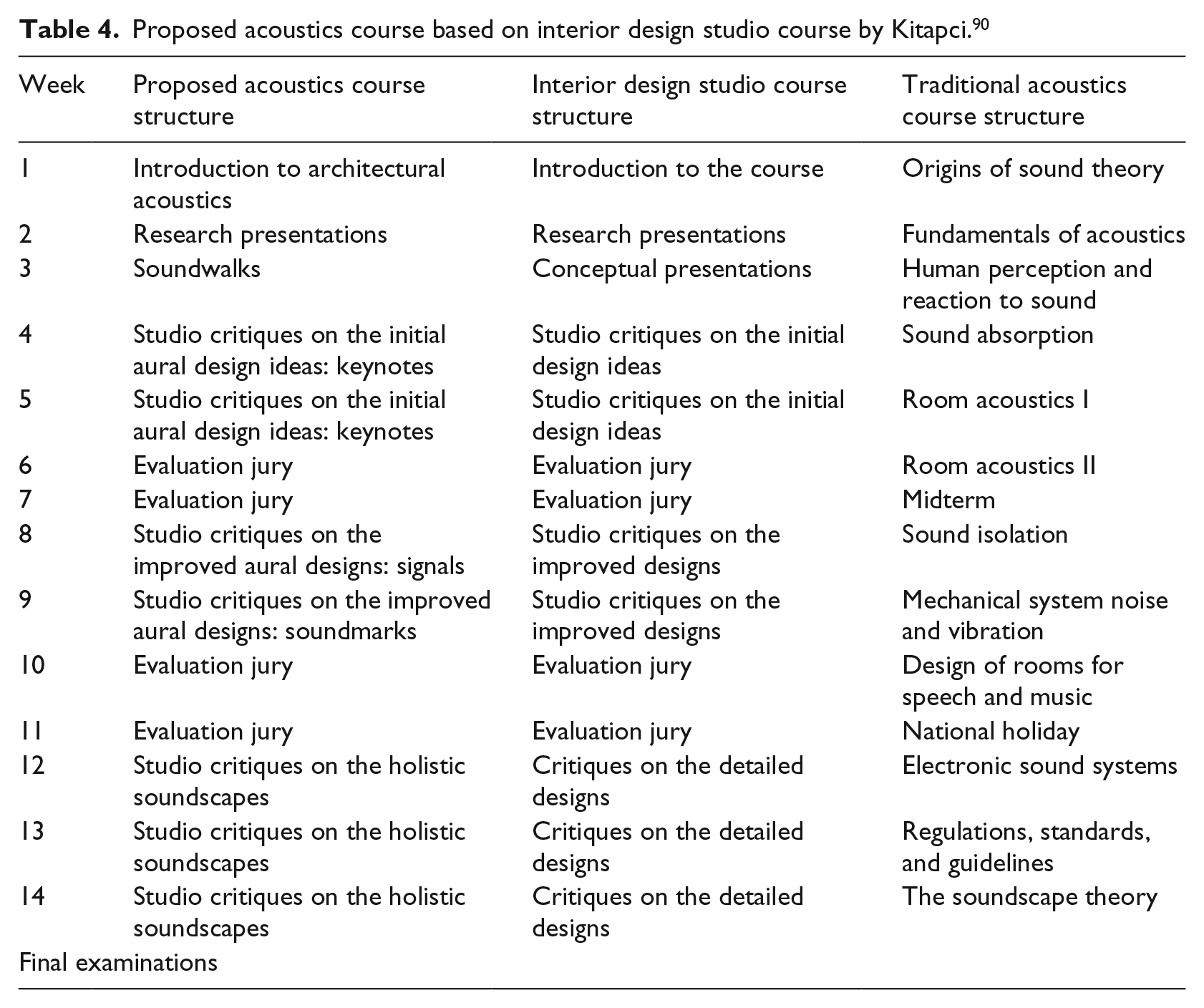
followed a different approach and argued for a teaching module in interior design schools based on four phases addressing Schafer’s principles earlier mentioned: the technical lecture phase, the preliminary research and soundwalks phase, the initial design phase, and the holistic soundscape design phase. Kitapci
90
motivates the criticism to existing courses stating that the main objective of the design-oriented architectural acoustics course is to create awareness of the students in the built and natural soundscapes. It is also crucial to emphasize the relationship between conceptual ideas and auditory environments, while delivering adequate levels of theoretical knowledge comprehendible by interior architecture students.
Interesting crossovers were recently initiated by Llorca, looking at two aspects: (1) the potential that architecture students hold in drawing soundscapes 157 and the evaluation of teaching methods for acoustic design through the bipolar ladder assessment (BLA).158,159 Llorca et al. 158 used the SketchUp plug-in RAVEN to provide an auralised listening experience to architecture students, after the delivery of a theoretical module on acoustics. Comparing theoretical teachings with the experience through the simulation software with the BLA method, Llorca et al. 158 found that the students valued especially the change of paradigm from passive learning to learning by listening. The inclusion of this method for acoustic design teaching could therefore be valuable in architecture and building engineering curricula. They also stressed the importance of covering in an adequate way acoustic theory concepts. Another recent initiative aiming to conduct applied research at the intersection of architecture and acoustics is the European project Acoutect (http://www.acoutect.eu/).
In some cases, acoustic design educators adopt approaches borrowed from architectural acoustics and apply them to architectural design contexts. Trained students can be involved in acoustic surveying to build experiential knowledge based on their perceptions while enhancing observation and reporting skills. 160 For example, Fowler 161 asked his landscape design students to record sonic excerpts from several sites, measure them and write notes in a diary. Students created visualisations of the resulting information on the geographical map showing the area explored, or on architectural drawings such as elevations, plans and sections.
Visualisations of interactions between direct sounds and reflections from architectural elements have been adopted also by Yang et al. 162 to show acoustic design rationales in Chinese listening pavilions. Schafer 63 in general discourages the practice of reducing sound to sole visual signs, as he believes there is a perceptual abyss between a sonic experience and its graphical representation. However, he also acknowledges that visual representations and notation systems such as aerial sonography maps can make it easier for the inexperienced to absorb the salient information.
From aural architecture to architectural soundscapes
In the book Spaces Speak. Are you listening?, Blesser and Salter 163 introduce the concept of aural architecture – spatial properties which can be experienced through listening. For these authors, the aural architect is usually not an individual but rather an ensemble of roles often unaware of their contributions towards our aural experience of a space, at times resembling the acoustic designer envisioned in Schafer’s and Truax’s words. Blesser and Salter 163 distinguish the aural architect from the acoustic architect, who is rather a hybrid between the architect and the acoustic engineer.
The authors state that auditory spatial awareness is the fundamental skill that aspiring aural architects should develop through listening experiences and sonic practices. They further explain that three related disciplines are involved in investigations on auditory spatial awareness, creating methodological complexity through their combination. These are ‘physical science, which represents physical acoustics with mathematical equations; perceptual psychology, which describes perceptual acoustics with subjective measurements; and cultural anthropology, which understands cultural acoustics in phenomenological terms’. Following this triadic organisation, they argue that the experience of acoustics can be categorised in physical acoustics, perceptual acoustics and cultural acoustics. 163
Sound, space, and architecture
In his doctoral thesis, Harvey 79 argues for the integration of soundscape design methods in the School of Architecture and Design in Melbourne. He achieved this goal through the development of the SIAL Sound Studios, ‘a multi-disciplinary facility, incorporating a wide range of investigations into auditory spatial awareness’. Embedding his spatial sonic practice in the department, he produced a number of installations and engagement events, providing in his research a discussion of the variegated meanings underlying the concept of acoustic design. In his arguments, Harvey 79 first mentions the work of Robyn Lines, who investigated in her Masters’ thesis the use of acoustic knowledge in architectural design practice. Lines 164 formulates six categories of acoustic design knowledge, reported in Harvey: 79
The acoustic design repertoire: known acoustic solutions or partial solutions relating to forms of construction or materials.
Experience of sound in space: prior concrete experience, which could be practical, evocative or archetypal.
Visual images of sound behaviour in space: images that depict the movement of sound in space as a wave or ray and visualising the movement of building elements in response to sound impact.
Function and sound: using knowledge of the building programme and the behaviour of users and equipment to predict possible sound events.
Spatial relations for sound management: usually involving relationships of volume to reverberation time and role of absorbent materials.
Existing design as reference: drawn from architecture, and other disciplines such as sculpture and musical noise-making artefacts.
As Harvey
79
reports (pp. 62–63), Lines’
164
conclusion (pp. 118–119) is that [. . .] didactic approaches to acoustic education have largely failed to contribute to designers’ ability to tackle acoustic design tasks. These attempts to teach a domain of design knowledge separate from design have resulted in poorly remembered learning experiences often associated with dislike, anxiety and a perceived lack of relevance. The treatment of acoustic education is indicative of its place in the shared appreciative system of architecture designers. Hearing has been the poorly regarded second sense by a visual culture working as a visual medium. An educational design experience needs to require of students that they can apprehend the design situation, make qualitative judgments about a desirable acoustic environment for the subject space, design an acoustic solution in concert with design intentions and confidently judge the success of the acoustic design. (pp. 118–119).
Harvey
79
openly poses the question: if the research into the acoustic environment, auditory spatial awareness and electroacoustic music are ways of thinking about the sounding world, then why are they not formally part of schools of spatial studies? (p. 63)
He justifies his arguments by bringing well-known examples based on a geographically co-located cross-fertilisation: (1) the WSP, part of the communications department at Simon Fraser University, now adjacent to the School of Geography; (2) the departments CRESSON and Irec51, part of architecture schools. He also argues that ‘various schools of architecture and design employ composers or sound designers, or run sound-based design studios as part of their teaching programs’. Harvey
79
further explains his position as follows: It would appear that for an auditory pedagogy to take hold in the practice of designers will require teaching and learning exercises that embody the experience of auditory space; include critical exercises through which to understand the scope of auditory perception and its relation to other sensory systems, the development and application of aural memory, and the discovery of generative acoustic design methods. (p. 66)
and the contemporary convergence of electroacoustic practices with spatial studies might be the catalyst to generate new concepts of spatial design and experiences in built and digital space. However, for such a renegotiation of spatial concepts to occur, design pedagogy must embrace the unique needs of an aural training for architects.
Six categories of design studios are brought as an example:
Sonic-based form generators: sound or music is used to generate a graphic (2D or 3D mapping). Design by parameter-to-parameter selection.
Acoustic design: sound can be understood as data/numerical-based for distinct auditory programme (e.g. signal-to-noise ratio for lecture theatre).
Acoustic communication: spatial design to achieve particular auditory communication or experience.
Heightening auditory awareness: resonant objects or materials, sound installations or wind chimes (e.g. design for blind people).
Virtual acoustic spaces: sound design for/in other media (e.g. animation, virtual reality or games engines).
Soundscape studies: analysis and documentation through recording, observation and interviews of interior, urban or natural environments.
Conversational territories between these fields are well represented by the topics of the conference ‘Architecture, Music, Acoustics’, in which Harvey was involved: (1) Acoustic Ecology, (2) Situated Sonic Practices, (3) Spaces for Performance, (4) Intersections of Music and Architecture, (5) The Poetics of Closure, (6) Sound in Architectural Education and (7) The Architectural Representation of Sound.
Lacey, another sound practitioner and researcher from SIAL, proposed a categorisation for the acoustic design of architectural soundscapes, dividing them in incidental, arising from sonic infrastructures, and intentional, creating sonic architectures. 165 Students engaged in aural training workshops are encouraged to achieve more nuanced perceptions of the site with respect to the capability of the lo-fi concept, especially in thinking how the social and the acoustic relate to each other. 166 In learning activities, Lacey 166 gives emphasis to soundmaking, researching three of the acoustic effects categorised by Augoyard and Torgue: 64
Mask: ‘the presence of a sound that partially or completely mask another sound’ (p. 66).
Drone: ‘the presence of a constant layer of stable pitch in a sound ensemble with no noticeable variation in intensity’ (p. 40).
Filtration: ‘a reinforcing or weakening of specific frequencies of a sound’ (p. 48).
Lacey 166 argues that these effects could be perceived on site and analysed, helping the students inform their interventions. Soundwalking, listening, and sound mapping are considered acoustic ecology exercises to be employed with the aim to ‘obtain a deeper appreciation of each sound effect as a site-specific visceral experience’. ‘Imaginative cues and listening exercises of acoustic ecology’ were used ‘while applying the structural analysis tools offered by CRESSON for the creation of a more diversified sound environment’. Sound art approaches were considered helpful in leading to ‘more imaginative listening environments’ than those based on shutdowns, attenuation and masking.
Hellström 167 similarly proposes the employment of acoustic design artefacts, such as sound art installations in the city, to promote specific sounds and social interactions in urban spaces. For Hellström, 168 the sound effects categorised by Augoyard and Torgue 64 are seen as ‘conceptual tools to depict the context of sound in the sense that it embraces the interaction between human, spatial and physical dimensions’. 166
Access to education and resources
In developed research contexts, students can explore, through different methods, physical, technical, psychological and cultural aspects of acoustics and be taught how to design by taking into account acoustic properties of architectural environments. The positions of Harvey and Lacey enhance the need for acoustic ecology exercises in architectural design schools and acknowledge as fundamental the contribution from CRESSON’s researchers. The student is seen as a critical thinker able to playfully explore the sonic environment and conceptualise phenomena based on situated observations. A deeper attention to music is advocated by those practitioners who see potential in the exchanges between the arts though sound and space. The coverage of topics focusing on acoustic properties of materials, insulation and basics of reverberation seems available in some architectural schools with an engineering focus, embedded in either building physics or architecture technology courses, as shown by Berardi. 153
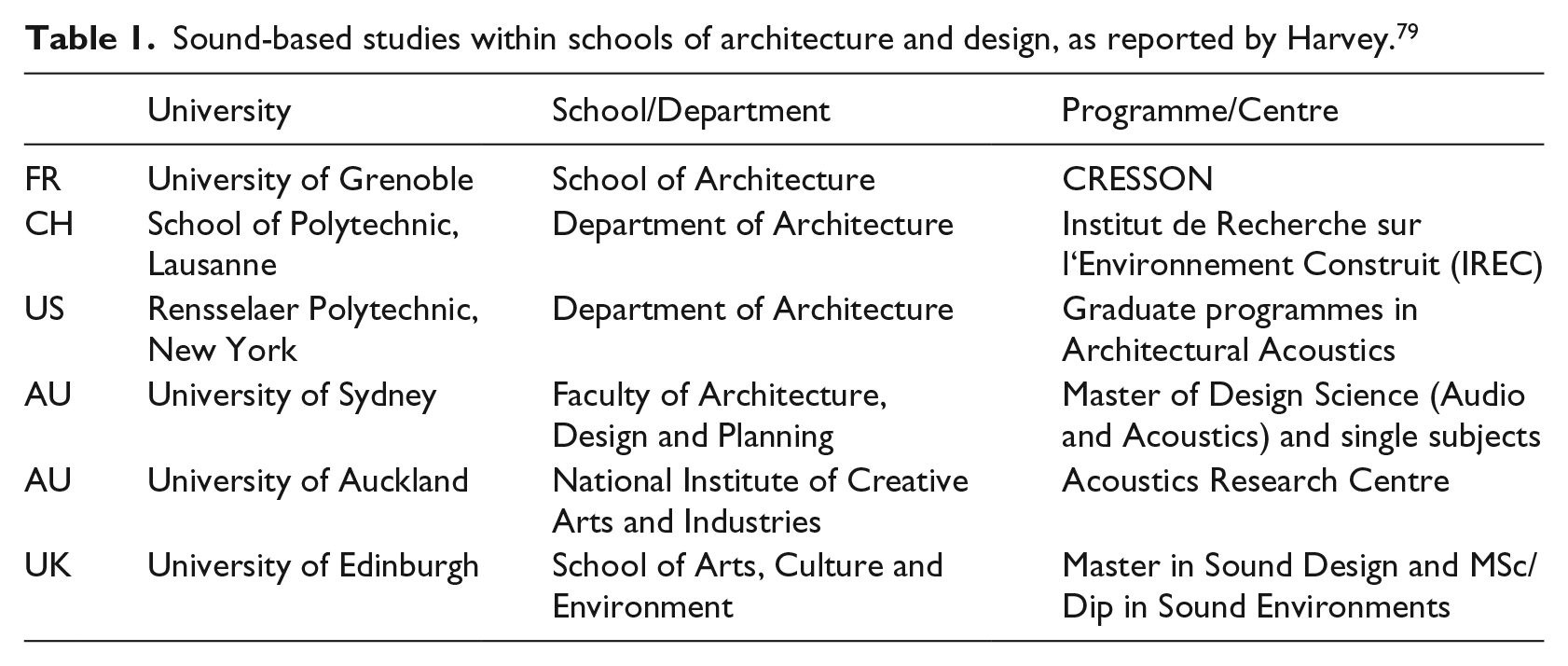
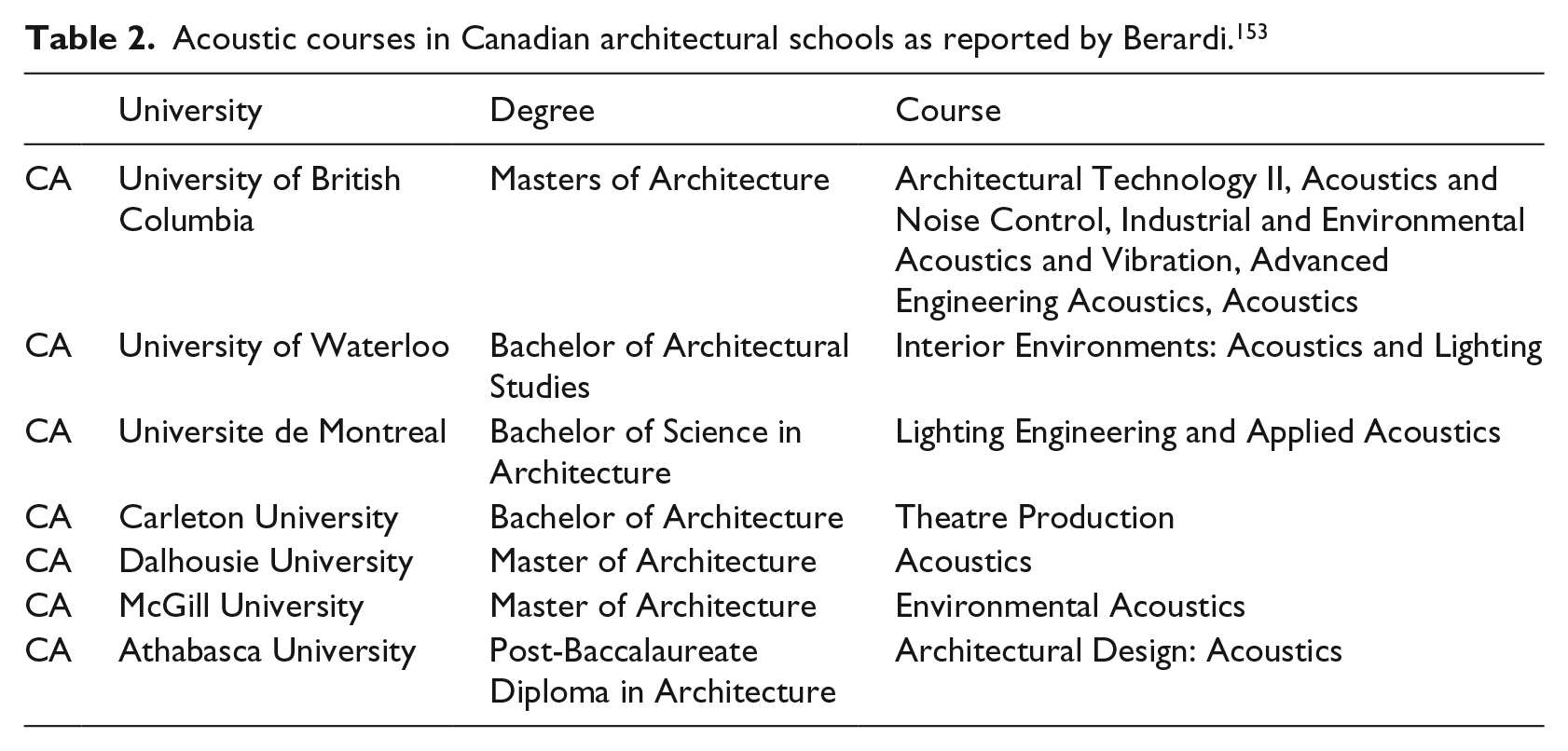
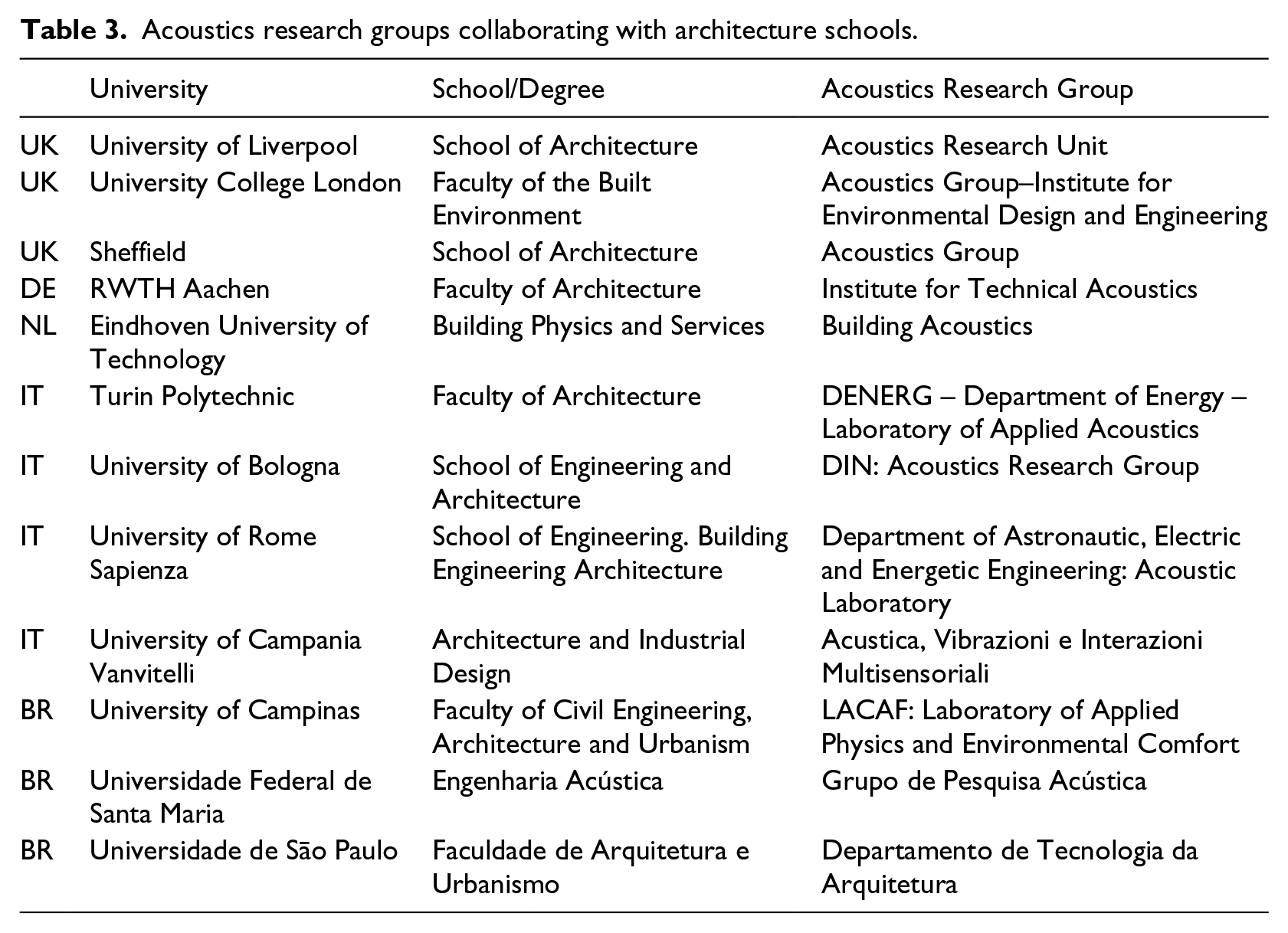
Table 1 reports a list of educational settings showing the integration of sound-based studies within schools of architecture and design, from Harvey; 79 Table 2 reports a list of acoustic courses in Canadian architectural schools, from Berardi; 153 Table 3 reports a compiled list of acoustics departments, within or outside architecture schools, teaching acoustics or providing research supervision and equipment. Table 4 shows the contribution from Kitapci, 90 who reviewed the teaching of acoustics within interior design courses in Turkey.
Sound-based studies within schools of architecture and design, as reported by Harvey. 79
Acoustic courses in Canadian architectural schools as reported by Berardi. 153
Acoustics research groups collaborating with architecture schools.
Proposed acoustics course based on interior design studio course by Kitapci. 90
The teaching of soundscape-related themes, which could be beneficial in the development of the aural awareness needed to communicate with acousticians, for now is still limited geographically and in number of examples. To our knowledge, there is no dedicated master’s programme focusing only on soundscapes, which could bridge architectural design, acoustics and recording, and social sciences, mirroring the interdisciplinary school envisioned by the WSP. A solution adopted throughout the years is to connect schools from different countries through large-scale research projects, facilitating the exchange of knowledge. Examples are (1) ‘TD0804 – Soundscape of European Cities and Landscapes’ within the COST framework (European Cooperation in Sound and Technology); (2) ‘Hosanna – HOlistic and Sustainable Abatement of Noise by optimised combinations of Natural and Artificial means’; 169 (3) ‘FP7 SONORUS – Urban Sound Planning’, aimed at discussing urban sound topics and training the new generation of researchers on urban acoustic design strategies.170–173
The outcomes of these projects are applicable design guidelines which local authorities and spatial planners or designers can adopt.174,175 Alves et al. 176 provided a systematic review of European projects which address urban sound planning topics and an overview of research results that can be applied by practitioners. With the presence of acoustics groups in architecture schools, as – for example – in Sheffield,54,105,177–179 good research synergies seem to be activated, with valuable outcomes for the civic community.
Discussion
In Figure 3, a framework is proposed to bridge the architectural acoustics scopes with the soundscape ones. This framework suggests that Architectural Acoustics is concerned primarily with the physical and technical dimensions of Acoustic Design, while the Soundscape approach offers a stronger focus on social and cultural aspects. Nevertheless, we can construct a relationship between these disciplines based on dialogue and a common vocabulary. To do so, we shall highlight common aspects, which can be in the first place analytical, for example – an attention to the perceptual and cognitive aspects of sound situations, and empirical comparison activities. Embodied practices can generate new experiential knowledge which can better support abstract theoretical concepts. At the centre of the framework proposed there is the idea of the design of architectural sonic environments. The design activity could involve traditional architectural tasks, as well as the familiarisation with added layers of sounds, such as compositions or installations.
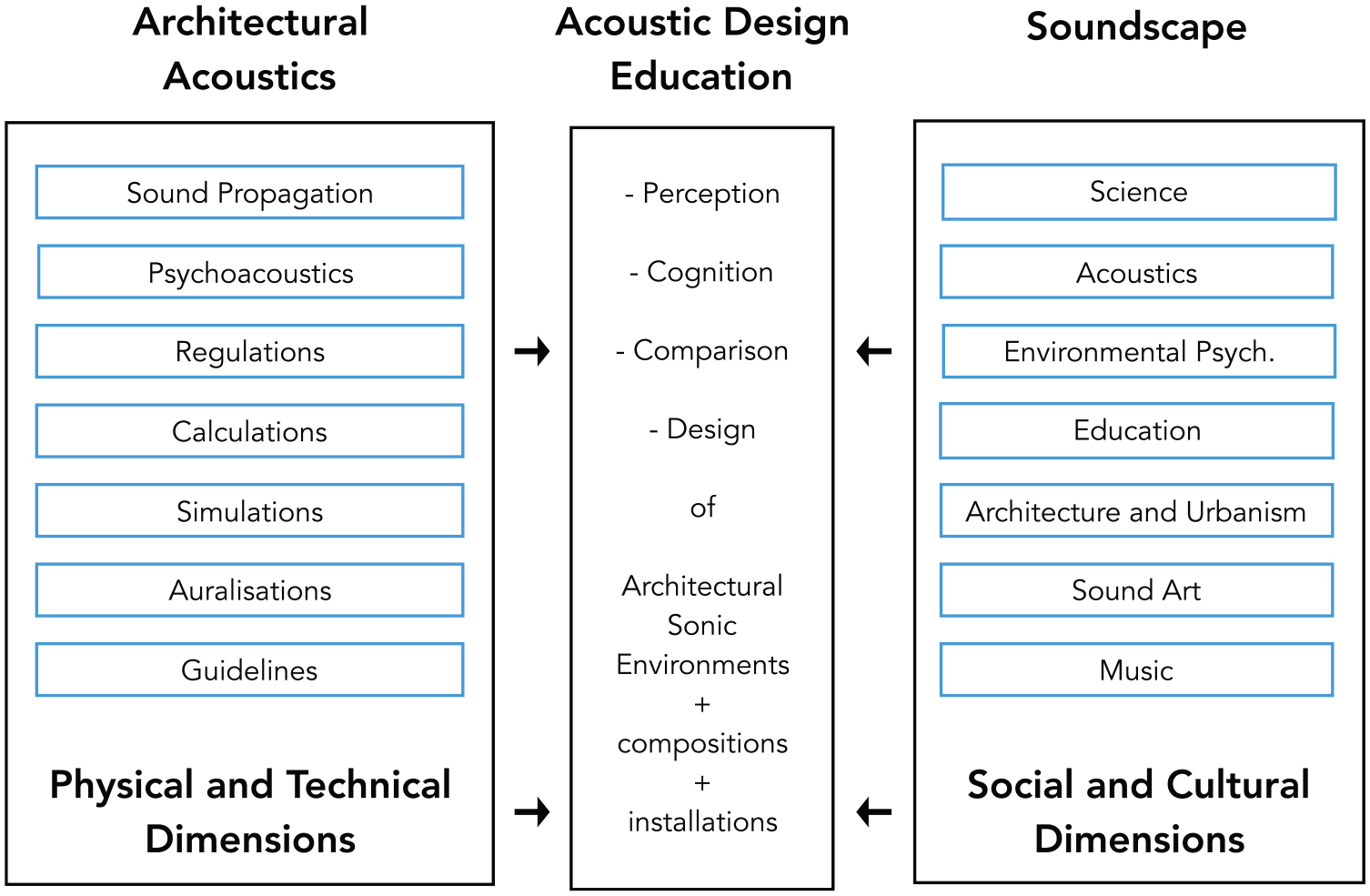
Proposal for an acoustic design unified framework.
Educational research projects could be situated in key buildings to study how different users interpret soundscapes also in a longitudinal way, helping create a database on how acoustic environments are perceived with respect to how they are acoustically designed. These projects could take advantage of existing research centres providing education on these topics. Student architects, engineers and acousticians could learn in practice to acoustically design a space by studying in a design-studio-context real-life scenarios. Figure 4 suggests a progression of topics which could be covered in an Acoustic Design module. Students could be involved in the following:
Listening practices based on both acoustic ecology principles and scientific research protocols, having as outcomes soundscape surveying and design.
Designing technical solutions to specific acoustic problems – real or hypothetical – while discovering the efficacy and the limitations of the auralisation methods.
Critical reflections on the impact of different regulatory contexts on design practices, which could ultimately lead to the improvement of design standards through a bottom-up approach.

Topics progression for an acoustic design module.
In the progression proposed, the first step is based on practices such as listening activities, soundwalks, and a design process relying on case studies. The practical study of architectural solutions should be finalised to the identification of acoustic objectives and effects, and be addressed creatively through design strategies which include soundscape design. The creative practice is supported by previous analysis of sound sources, taxonomies and atmospheres. Soundscape design can be supported by the study of acoustic effects and sound-based activities such as recording and composition. The adoption of certain strategies is researched through a simulation process based on theory and the verification of the efficacy of the design idea. Among the learning outcomes, the development of aural awareness would take place during the listening experience and the design process, eventually resulting in presentations to be shared with others, such as auralisations and sonic narratives.
To transfer research to design practice through guidance documents, the most important step is to identify what are common and shared soundscape design goals, according to use cases. The analysis and comparison of existing studies to new ones, adopting soundscape approaches together with traditional measurements, may help to define design requirements for pedestrian walkways, cafes, libraries, atria, offices and so on. Performance spaces could be studied in dedicated acoustic design modules, while other acoustic requirements could be covered in the design studio settings, which are often typology-based. Among the architecture schools, acoustic design practitioners could be involved with the role of experts in design studios, providing feedback case by case on the acoustic design strategies suggested by the students.
Future directions
The efforts from the research community are already directed towards the amelioration of critical acoustic environments as well as the protection of positive ones which locals and planning authorities consider valuable and meaningful. Outcomes produced by the large-scale projects, which combine scientific acoustic research with the identification of design requirements and the development of design tools, could be better exploited if tested in planning contexts. In professional contexts, acoustic design intentions are always situated, being their accomplishment dependent on enforced regulations which guide professionals in guaranteeing acoustic comfort standards. Design decisions are taken every day in the communication between clients, acoustic consultants and architects, contextualised in a certain policy framework.
In the professional practice, the possible synergies between acoustic engineering and architectural design still seem rather unexplored. To reduce this academia–practice gap identified also by Aletta and Xiao, 180 research outcomes need to be transformed into policies, so that design practices may become fruitfully effective in creating healthy sustainable environments and improving those which are perceived as critical. Reflective research methods should be invoked to investigate common practices in design environments and understand which rationales they follow. Studying professional acoustic design collaborations through qualitative methods may help understand what could be improved in the educational field, and from a regulatory perspective. Quantitative methods could in turn help study the impact on acoustic research centres on the development of acoustic design practices.
Conclusion
The long-lasting legacy of architectural acoustics has paved the way to provide fine techniques to simulate the propagation of sound sources in building enclosures and urban spaces. Although more recent, the soundscape framework has produced widely adopted aesthetic and scientific methods to study the effects that everyday soundscapes yield on inhabitants. I suggested that in order to train acoustic design skills these two frameworks could be combined to pursue common objectives. These include the design of acoustic environments promoting an attention to the diversity and identity of everyday sounds and the creation of high-quality sonic experiences, ultimately influencing our perceived quality of life.
In order to achieve these objectives, the key aspects that every fields could leverage were highlighted and discussed with respect to their application in architectural design education contexts. In such places, where practice-based research is developed primarily through the design studio, the adoption of creative strategies might be the key of success towards the development of an interest in acoustic design and its ecological implications. Future acoustic designers could learn to develop a sound-based vocabulary starting from listening and documenting sonic environments in combination with soundscape design tasks. These tasks could also be based on the teaching of architectural acoustics design methods, such as modelling and simulation techniques allowing to listen to imagined spatial scenarios, which could exploit the design knowledge of the students and help them in future professional tasks requiring the communication with acoustic consultants. Acoustic Design should thus be considered as a co-creative situated process shared between clients, architects, acoustic consultants, planners and policy makers, reason why – to benefit the collectivity – the education of future acoustic designers should take place also in architecture schools.
Footnotes
Acknowledgements
The author thanks her supervisor Josh Reiss, who provided insight and expertise by assisting in the research process, and those who provided feedback on the article: Thomas Wilmering, Matthew Sneezby, and last but not least the article reviewers.
Declaration of conflicting interests
The author(s) declared no potential conflicts of interest with respect to the research, authorship and/or publication of this article.
Funding
The author(s) disclosed receipt of the following financial support for the research, authorship and/or publication of this article: This research was supported by the CdT Media and Arts Technology through the EPSRC grant EP/G03723X/1.
