



Abstract
Literacy skills are essential for success in today’s society. However, classrooms often have suboptimal acoustic conditions for learning. The goal of this review was to synthesize research assessing the effect of different classroom acoustic conditions on children’s literacy. A comprehensive search of four online databases was conducted in August 2021. The search term was classroom AND (noise OR reverberation OR acoustics) AND (reading OR spelling OR writing OR literacy). Eighteen papers were deemed relevant for the review plus an additional seven from their references. The types of acoustic conditions that have been assessed, the types of measures used to assess literacy, and the effect of the acoustic conditions on children’s reading, writing, and spelling outcomes are discussed. Suggestions for the classroom acoustic conditions needed to ensure appropriate literacy development and areas for future research are also considered.
Introduction
Competence in literacy, most often defined as the ability to read and write, is essential in today’s society. Not only is it essential that children learn to read and write on printed material, but also that they have digital literacy. Literacy skills develop early in life and are highly correlated with school achievement. 1 Being able to read is important for both social and economic success. 2 People with poor literacy skills are more likely to experience unemployment, are often restricted to low-skilled casual jobs, have less work-related training, and are often paid lower wages than people with higher literacy skills. 3 Therefore, it is vital that the primary school classroom learning environment is conducive to the development of literacy skills.
Considering the acoustic environment of the classroom is important for the development of children’s literacy skills. There are two main acoustic variables to consider in the classroom: noise and reverberation. Noise can be categorized as external or internal. External noise includes traffic, aircraft, and train noise, construction, and weather noise. Internal noise can be categorized as unoccupied noise or occupied noise. Internal unoccupied noise includes noise from heating, ventilation, and air-conditioning systems, and equipment noise. Internal occupied noise includes the noise from the children, such as speech and movement. Reverberation refers to the prolongation of a sound in a space. It is measured by the reverberation time, which is the time it takes for a sound to decay by 60 dB. Other room acoustic parameters include early decay time (EDT) which is the time it takes for a sound to decay by 10 dB, speech clarity (C50) which is the relationship between early sound reflection energy and late sound reflections energy, and definition (D50) which is the energy in early sound reflections relative to all reflections.
The acoustics of primary school classrooms are often suboptimal. 4 Schools are often built in inopportune locations where there is traffic, aircraft, and train noise. The building materials are often not taken into consideration resulting in classrooms with long reverberation times. Additionally, modern child-centered teaching methods where the teacher is the facilitator rather than the instructor 5 have resulted in more of a focus on group work which makes up around 50% of teaching time.6,7 Group work activities have higher noise levels than whole class teaching or independent work due to the different groups of children talking to each other at the same time.8,9 Additionally, the past 10 years has seen the emergence of more open plan innovative learning environments 7 which have higher intrusive noise levels from the other classes sharing the space. 9
The goal of this review was to synthesize research assessing the effect of different classroom acoustic conditions (noise and reverberation) on children’s literacy outcomes of reading, writing, and spelling. In particular, this review aimed to investigate the types of acoustic conditions that have been assessed, the types of measures used to assess literacy, and the effect of the acoustic conditions on literacy outcomes. This review was undertaken with a view to determining the classroom acoustic conditions needed to ensure appropriate literacy development and to inform future research.
Method
A comprehensive search of four online databases (Education Resources Information Centre (ERIC), PubMed, Scopus, and Web of Science) was conducted in August 2021 to identify the effects of classroom acoustics on children’s literacy outcomes. The search term was classroom AND (noise OR reverberation OR acoustics) AND (reading OR spelling OR writing OR literacy). To be included in the review the peer-reviewed papers had to meet the following criteria: (i) conduct a study on the effect of classroom acoustics (i.e. noise or reverberation) on literacy outcomes of reading, spelling, or writing, via a test (i.e. not a questionnaire), (ii) be conducted with primary school children, that is, include children aged 5–12 years, and (iii) have the full text in English available. A total of 410 papers (279 after removing duplicates) were returned in the searches. These were vetted for relevance via reading the title, abstract, and when needed for clarification, the full text. Eighteen papers were deemed relevant for the review. The references of these papers were checked and an additional seven papers fitted the review criteria bringing the total number of papers to be reviewed to 25. Figure 1 shows the search and selection process.
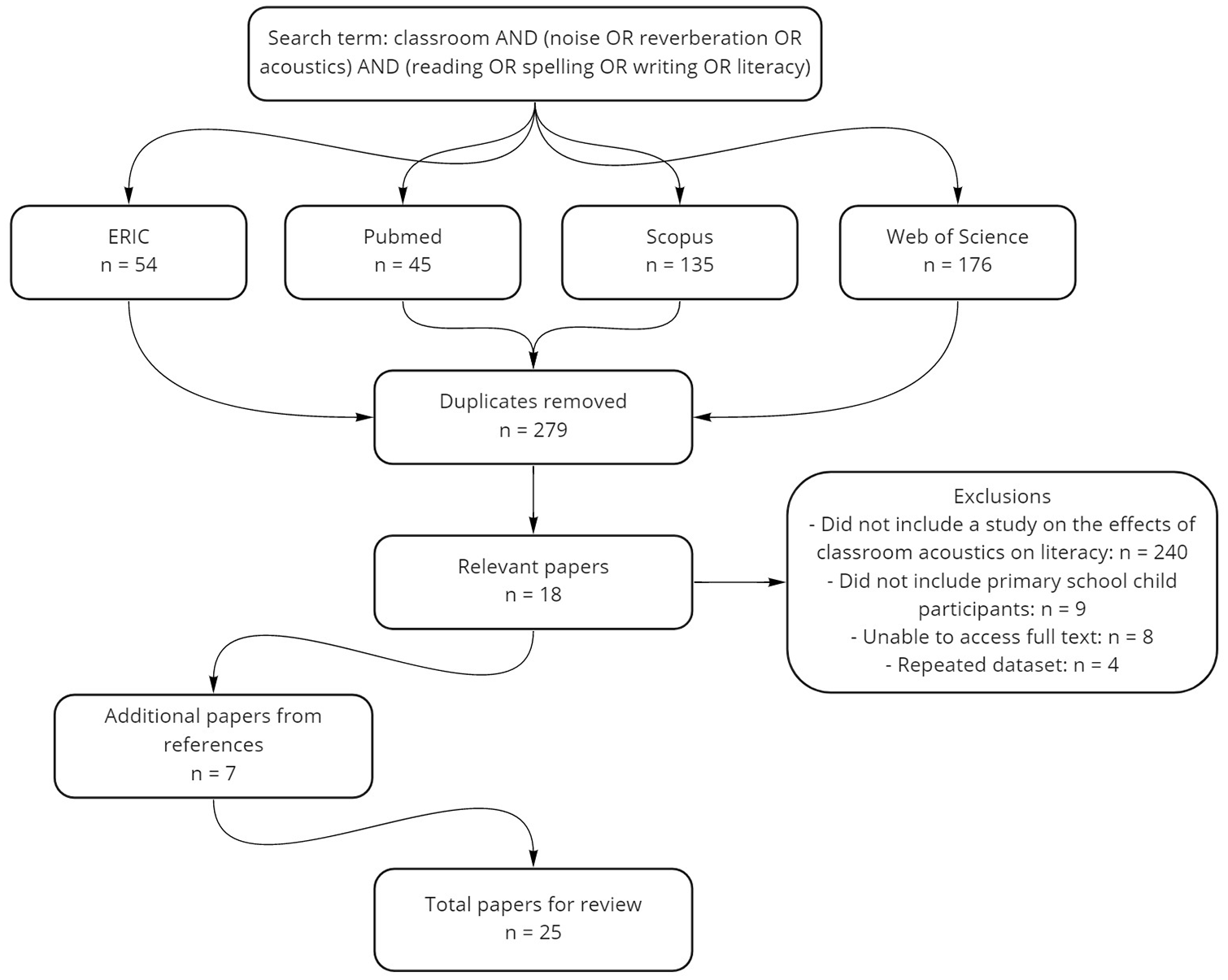
Database search results.
Results
Table 1 shows the general information for the 25 papers included in the review. The following sections describe the years of publication, the acoustic conditions, the measures and methods used to assess literacy, and the outcomes of the papers.
General information for the 25 papers included in the review.

Publication years
Figure 2 shows the publication years for the 25 papers reviewed. While there were five papers published between 1975 and 1985 and one paper published in 1997, the majority of papers have been published since 2001.

Publication years for the 25 papers reviewed.
Acoustic conditions
The acoustic conditions investigated in the reviewed papers can be split into three categories: chronic noise exposure, experimental noise exposure, and reverberation.
Chronic noise exposure
Sixteen studies investigated the effect of chronic noise exposure on children’s literacy skills. The majority of these studies assessed the effect of external noise from trains, aircraft, and traffic. The other studies investigated the effect on literacy of internal noise such as mechanical noise from heating and cooling systems, and the classroom noise from the children.
Two studies investigated the effect of train noise exposure on children’s literacy development. Bronzaft and McCarthy 10 and Bronzaft 11 investigated the reading skills of children from classrooms located next to train tracks compared to classrooms on the opposite side of the building. Around 80 trains passed by the school during school hours. The average noise level was 59 dB and reached 89 dB when trains passed for the classes closest to the tracks. 10
Seven studies investigated the effect of aircraft noise exposure only on children’s literacy. Green et al. 12 investigated children’s reading ability in schools that had average noise exposure levels of 60–68 dB Leq and peak noise levels of 85–96 dB. Evans and Maxwell 13 investigated the reading ability of children in a school with a 65 dB Leq flight contour (i.e. average noise level of 65 dBA over 24 h) and peak noise levels of over 90 dB when a plane was flying overhead. On average one flight per 6.6 min could be heard. Haines et al.14,15 assessed reading comprehension in children from schools with high aircraft noise exposure (16 h outdoor Leq > 66 dBA) and schools with low aircraft noise exposure (16 h outdoor Leq < 57 dBA).
Hygge et al. 16 explored the effect of aircraft noise exposure on reading in children from a school where the airport was going to close and a school where the new airport was going to open plus two controls schools. The noise level at the school at the original airport site was 68 dBA Leq while the airport was active, and 54 dBA Leq after it was no longer being used. The noise level at the school at the new airport site was 53 dBA Leq before the airport was active, and 62 dBA Leq once it was being used. Spilski et al. 17 and Klatte et al. 18 also investigated the effect of aircraft noise exposure on children’s reading. The schools in the Spilski et al. 17 study had average noise exposures of 39–59 dB LAeq and maximum aircraft noise exposures of 50–80 dB LAmax. The schools in the Klatte et al. 18 study also had average noise exposures of 39–59 dB LAeq.
Papanikolaou et al. 19 investigated the reading performance of children from schools with low-level road traffic noise (55–66 dB), medium-level road traffic noise (67–77 dB), and high-level road traffic noise (72–80 dB). Stansfeld et al. 20 and Clark et al. 21 investigated the effect of exposure to both aircraft and road traffic noise on children’s reading ability. The schools in both studies had noise exposures of 30–77 dBA.
Three studies investigated the effect of mechanical noise exposure from heating and/or cooling systems in classrooms on children’s reading.22–24 The noise levels in the classrooms for the studies by Ronsse and Wang 22 and Wang 24 were 36–53 dB LAeq. For the study by Ronsse and Wang, 23 the noise levels were 34–55 dB LAeq. Shield and Dockrell 25 measured the effect of exposure to internal occupied classroom noise levels during six different classroom activities on children’s literacy skills. The noise levels for the different activities ranged from 56 to 77 dB LAeq. Shield and Dockrell 26 examined the effect of exposure to external and internal noise naturally occurring in classrooms on children’s literacy skills. External noise ranged from 30 to 80 dB LAeq. Internal noise ranged from 48 to 60 LA90.
Experimental noise exposure
Six studies investigated the effect of noise on children’s literacy skills in immediate experimental conditions rather than chronic noise exposure over time. Johansson 27 used 707–1414 Hz octave band noise within the speech frequency spectrum in continuous (51 dB) and intermittent (55–78 dB) noise conditions played through loudspeakers in an anechoic chamber plus a silence condition (25 dB). Edmonds and Smith 28 used recorded classroom activity noise at 40 and 70 dBA. Dockrell and Shield 29 played recorded noise for three noise conditions: a base condition when the children are working quietly with no talking and no additional noise; a babble condition consisting of children’s babble played at 65 dBA; and a babble and environmental noise condition, combining children’s babble (at 65 dBA) with intermittent environmental noise (58 dBA LAmax). Ljung et al. 30 used recordings of road traffic noise or irrelevant speech played via loudspeakers positioned at the front of the classroom at 66 dBA (at 2 m) versus a silent condition. The road traffic noise recording consisted of continuous road traffic noise (approx. 62 dBA) and segments of trucks passing by on average once per minute (peak 78 dBA). The irrelevant speech recording consisted of background unintelligible babble (approx. 62 dBA) and segments from an intelligible conversation matching the dBA-against-time history of the road traffic noise. Fernandes et al. 31 assessed reading and spelling for children in a controlled group with only the environmental noise, a group exposed to the environmental noise plus 20 dB of noise above it, and a group exposed to the environmental noise plus 40 dB of noise above it played through loudspeakers. The type of noise used and the starting environmental noise level were not specified. Guerra et al. 32 assessed children’s reading with single-talker competing speech that was either intelligible or unintelligible, played at low intensity (45–50 dB SPL) and moderate intensity (65–72 dB SPL).
Reverberation
Three studies investigated the effect of classroom reverberation times on children’s literacy. In an experimental study, Klatte et al. 33 investigated children’s reading speed and spelling in classrooms varying in reverberation times (0.49–1.63 s). Puglisi et al. 34 investigated the reading speed of children from classrooms varying in reverberation times (0.8–1.4 s) and speech clarity (1.6–4.0 dB). Wang 24 investigated the effect of classroom reverberation times on children’s reading for children from classroom with reverberation times of 0.20–0.59 s.
Measures and methods
The measures used to assess the effect of classroom acoustic conditions can be split into reading measures, writing measures, spelling measures, and general English measures.
Reading measures
The most common measure of literacy used in the reviewed papers was reading, with all 25 papers including a reading assessment. The individual assessment used, however, varied greatly, and depended on the country and language spoken.
Bronzaft and McCarthy 10 used the Metropolitan Achievement Reading Test 35 which tests children’s word knowledge and reading comprehension, giving a score for each plus a general reading score for the two tests combined. Bronzaft (1981) assessed children with the California Achievement Test 36 which assesses children’s reading comprehension and vocabulary.
Green et al. 12 analyzed data from the New York City Board of Education standardized tests of reading ability. Johansson 27 used the Swedish standard tests37,38 to test children’s reading speed and comprehension. The child read three short stories. Reading speed was calculated by the total number of words read in 10 min. Reading comprehension was scored as the percentage of correctly identified key words in the stories.
Edmonds and Smith 28 used the Sequential Tests of Educational Progress Reading Test Form 3 (STEP III). 39 The type of reading that this test assesses was not specified, however. Evans and Maxwell 13 assessed children’s reading skills using the Woodcock 40 Reading Mastery Test where children are required to identify real words increasing in difficulty, and read nonsense words by applying phonetic strategies.
Haines et al. 14 and Haines et al. 15 measured children’s reading comprehension via the Suffolk Reading Scale Level 2 41 in which children answer 70 multiple choice questions about a text. The Suffolk Reading Scale was also used by Stansfeld et al., 20 Dockrell and Shield, 29 and Clark et al. 21 for the participants from the United Kingdom. Participants from the Netherlands in the Clark et al. 21 study were tested on the CITO Readability Index for Elementary and Special Education 42 and participants from Spain were tested on the Evaluacion Comprension Lectora. 43
Hygge et al. 16 assessed children’s reading skills via a standardized German reading test. 44 The children read paragraphs and word lists including nonsense words increasing in difficulty. Shield and Dockrell25,26 used the UK Standard Assessment Tests which include assessments for children in Year 2 in reading.
Ljung et al. 30 conducted a reading test to assess children’s reading speed and comprehension. The child read a four-page story and at different points was asked to underline which word from a choice of three words fitted with the context of the story. Reading speed was measured by the number of words underlined and reading comprehension was measured by the number of correct responses. Klatte et al. 33 assessed children’s reading speed via the Salzburger Lesescreening 45 where children read as many sentences as they could in 3 min and indicated whether the sentences were true or false.
Ronsse and Wang 22 used the children’s results from the Iowa Test of Basic Skills which includes a reading comprehension measure. Ronsse and Wang 23 used the children’s results from the Terra Nova tests and the Nebraska State Accountability tests which include reading tests. Wang 24 used the reading test results of the Iowa Test of Basic Skills, the Terra Nova tests, and the Nebraska State Accountability tests.
Papanikolaou et al. 19 assessed children’s reading comprehension on a test based on the National Curriculum for Elementary Education. Children read a passage and answered three comprehension questions on word study, written speech development, and grammar. Spilski et al. 17 assessed children’s reading comprehension via the Ein Leseverständnistest für Erst- bis Sechstklässler (ELFE 1–6) [Reading comprehension test for grades 1–6] 46 which assesses children’s fluency and reading accuracy on words, sentences, and paragraphs. This test was also used by Klatte et al. 18
Puglisi et al. 34 used a shortened version of the DDE-2, Batteria per la Valutazione della Dislessia e della Disortografia Evolutiva-2 47 to assess children’s reading speed of words and non-words. Fernandes et al. 31 assessed children’s reading accuracy using the Isolated Word Reading Test.48–50 Guerra et al. 32 assessed children’s reading comprehension and speed on four short story narrative texts.
Writing measures
Only two studies included assessment of writing performance. Johansson 27 measured children’s handwriting pressure. Shield and Dockrell 25 used the UK Standard Assessment Tests which include assessments in writing for children in Year 2.
Spelling measures
Four studies included measures of spelling performance. Shield and Dockrell 25 used the UK Standard Assessment Tests which include assessments in spelling for children in Year 2. Dockrell and Shield 29 created a 15-item spelling test from the British Abilities Scale. 51 Klatte et al. 33 assessed children’s spelling performance of words and sentences via the Hamburger Schreibprobe. Fernandes et al. 31 assessed children’s spelling using the Writing under Dictation of the International Dyslexia Test. 52
General English measures
Two studies used general English literacy measures. Shield and Dockrell 25 and Shield and Dockrell 26 used the UK Standard Assessment Tests which include assessments in English for children in Year 6.
Outcomes
Seven categories of literacy outcomes were found from the review. These are reading outcomes (reading accuracy, reading speed, reading comprehension, and reading not otherwise specified), writing, spelling, and general English.
Reading accuracy
Three studies assessed children’s reading accuracy. Bronzaft and McCarthy 10 found that children located on the side of the school building closest to train tracks had significantly poorer reading accuracy than children located on the opposite, less noisy side. Children on the noisy side tended to have reading scores 3–4 months behind the scores of the children on the quieter side. The average noise level on the noisy side was 59 dB and reached 89 dB when trains passed. Trains passed every 4.5 min and the noise lasted for 30 s. Noise measurements were not made on the less noisy side.
In the study by Evans and Maxwell, 13 children who were chronically exposed to aircraft noise had poorer reading accuracy than children from a school in a quieter neighborhood. The authors also found that this effect was partially mediated by children having impaired speech perception with noise exposure. The average noise level of the aircraft exposed school was 65 dBA with peak noise levels of over 90 dB. There was on average one flight per 6.6 min. The noise levels at the quieter school were not reported, except that it was outside of the 65 Leq contour.
Hygge et al. 16 assessed children’s reading accuracy in a school near an airport closing down and a school near where the new airport was opening as well as two control schools. Reading accuracy data was collected 6 months before the changeover, 1 year later, and 2 years later. Impaired reading was found in the new airport group after the switch-over of airports, but interestingly, reading improved for the children at the old airport site once the airport was no longer being used. The noise level at the school at the original airport site was 68 dBA Leq while the airport was active, and 54 dBA Leq after it was no longer being used. The noise level at the school at the new airport site was 53 dBA Leq before the airport was active, and 62 dBA Leq once it was being used.
Reading speed
Six studies assessed the effect of classroom acoustics on children’s reading speed. Regarding the effect of noise, Johansson 27 found no statistically significant main effects of noise type (quiet (25 dB), continuous (51 dB), intermittent (55–78 dB)) on children’s reading speed. However, less able children tended to be more affected by noise than the more able children. Ljung et al. 30 found that children’s reading speed was slower when played traffic noise, but not irrelevant speech, both played with approximate average noise levels of 66 dB compared to a silent condition. Fernandes et al. 31 found that children in Grade 3 and Grade 5 had longer reading durations when exposed to noise 40 dB above the environmental noise in the classroom, however, children in Grade 4 had shorter durations. Guerra et al. 32 found that children’s reading speed was significantly slower when distracting speech was played at a louder intensity of 65–72 dB SPL compared to 45–50 dB SPL. However, the intelligibility of the distractor speech did not affect reading speed.
Regarding reverberation, Klatte et al. 33 did not find a significant effect of reverberation time on children’s reading speed in classrooms with reverberation times of 0.49–1.63 s once sociodemographic variables were controlled for. Puglisi et al. 34 did not find a correlation between children’s reading speed and the reverberation time of the classroom they came from for reverberation times ranging from 0.8 to 1.4 s. The authors did, however, find a significant positive correlation between reading speed and speech clarity for speech clarity scores between 1.6 and 4.0 dB. The authors concluded that early acoustic reflections more than late reflections are associated with reading speed.
Reading comprehension
Two studies examined the effect of chronic train noise exposure on children’s reading comprehension. Bronzaft and McCarthy 10 found that children located on the side of the school building closest to train tracks (with an average noise level of 59 dB reaching 89 dB when trains passed, with 80 trains per day) had significantly poorer reading comprehension than children located on the opposite, less noisy side (noise level not reported). Bronzaft 11 investigated the effect of installing rubber pads and sound-treating the ceiling in the classrooms located on the noisy train track side. Bronzaft 11 found that while children on the noisy side had significantly poorer reading scores than the children on the quiet side before installation of the acoustic treatment, after the acoustic treatment was installed (reducing the noise to 81–83 dB when trains passed), there was no difference between the reading scores of the two groups of children.
Six studies examined the effect of chronic aircraft noise exposure on children’s reading comprehension. Haines et al. 14 and Haines et al. 15 found that chronic aircraft noise exposure (Leq > 66 dBA) was associated with poorer reading comprehension equivalent to a 6-month delay in reading ability. Spilski et al. 17 found significant negative effects of aircraft noise (LAmax up to 80 dB) on children’s reading performance with the children’s distraction from the noise being a mediator. In the study by Stansfeld et al., 20 exposure to chronic aircraft noise (up to 77 dB) was linked to impaired reading comprehension. An increase in aircraft noise by 5 dB was equivalent to a 2-month reading delay in the UK and a 1-month reading delay in the Netherlands. Klatte et al. 18 found that increased noise exposure from aircraft noise across the range of 39–59 dB LAeq was associated with decreased reading comprehension performance. An increase in aircraft noise exposure by 20 dB resulted in reading scores decreasing by one fifth of a standard deviation, which is equivalent to a 2-month reading delay. Clark et al. 21 found that increased aircraft noise exposure at school across the range of 30–77 dBA was significantly associated with poorer reading comprehension. A 20 dBA increase in aircraft noise resulted in a one eight of a standard deviation loss of reading comprehension score for children in the Netherlands (equivalent to a 4-month reading delay) and Spain, and a one fifth of a standard deviation loss for children in the United Kingdom. There was no significant effect of road traffic noise exposure at school on children’s reading comprehension.
Two studies investigated the effect of traffic noise on children’s reading comprehension. Papanikolaou et al. 19 found that children in schools with low-level road traffic noise (55–66 dB) had significantly better reading test scores compared to children in schools with medium-level (67–77 dB) and high-level (72–80 dB) road traffic noise. Ljung et al. 30 found that children’s reading comprehension was not affected by road traffic noise or irrelevant speech played in experimental conditions at 66 dBA compared to silence.
One study examined the effect of cooling system mechanical noise on children’s reading comprehension. Ronsse and Wang 22 found that children’s reading comprehension was significantly impacted by higher mechanical noise levels from cooling systems in classrooms across the range of 36–53 dB LAeq, and that this effect was similar for children in Grade 2 and Grade 4. To meet the state aim of having at least 76% of children proficient in reading comprehension, the unoccupied noise level needs to be below 38 dBA for children in Grade 2 and below 41 dB for children in Grade 4.
Two studies experimentally investigated the effect of distracting speech on children’s reading comprehension. Dockrell and Shield 29 examined children’s reading comprehension in three noise conditions: base (quiet), babble (65 dBA), and babble (65 dBA) plus environmental noise (58 dBA LAmax). The authors found that children performed worst in the babble condition, but best in the babble plus environmental noise condition. Children with special educational needs were more severely affected by the noise. Guerra et al. 32 found that children’s reading comprehension was significantly poorer when the distracting speech was intelligible compared to unintelligible and this effect was larger for children with poorer interference control. However, there was not a significant difference in reading comprehension when the distracting speech was played at 45–50 dB SPL compared to 65–72 dB SPL.
Reading otherwise not specified
Six additional studies investigated the effect of classroom acoustic conditions on children’s reading, but did not specify if the reading test was on accuracy, speed, or comprehension. Green et al. 12 found that an additional 3.6% of children from schools that had noise exposure forecasts from aircraft noise averaging 60–68 dB Leq and peak noise levels of 85–96 dB read at least 1 year below grade level. Edmonds and Smith 28 found that children with above average intelligence scores performed better on a reading test with low classroom activity noise (40 dBA) than with high noise (70 dBA). However, children with below average intelligence scores performed better in high noise compared to low noise.
Ronsse and Wang 23 did not find a significant relationship between the classroom noise level from heating and cooling system mechanical noise ranging from 34 to 55 dB LAeq and children’s reading scores once controlling for the children’s demographics. However, the authors do suggest that the unoccupied noise levels should be kept below 45 dBA to meet Nebraska state educational targets. Wang 24 found that the mechanical noise levels from the heating and cooling systems ranged from 36 to 53 dB LAeq which were above the recommended level for classrooms of 35 dB LAeq 53 and had a negative relationship with children’s reading scores. A maximum unoccupied noise level of 41 dBA is required to meet the minimum reading comprehension performance required by the states involved in the study. The reverberation times of the classrooms involved were between 0.20 and 0.59 s and all within the recommendation of 0.6 s 53 and so no relationships were found between reverberation time and reading achievement.
Shield and Dockrell 25 found a significant negative correlation between the occupied classroom background noise levels ranging between 56 and 77 dB LAeq (42–64 dB LA90) for different activities and Year 2 children’s reading scores. Shield and Dockrell 26 found a significant negative relationship between internal noise ranging from 48 to 60 LA90 and Year 2 children’s reading scores. The authors also found a significant negative relationship between external noise ranging from 30 to 80 dB LAeq and Year 2 children’s reading scores.
Writing
Only two studies investigated the effect of classroom acoustics on children’s writing. Johansson 27 found that children’s handwriting pressure tended to be higher in noise (either continuous or intermittent) than in quiet. Shield and Dockrell 25 found a significant negative correlation between the classroom background noise levels ranging between 42 and 64 dB LA90 for different activities and Year 2 children’s writing scores.
Spelling
Four studies investigated the effect of classroom acoustics on children’s spelling. Dockrell and Shield 29 examined children’s spelling in three noise conditions: base (quiet), babble (65 dBA), and babble (65 dBA) plus environmental noise (58 dBA LAmax). The authors found that children performed worst in the babble condition, but interestingly best in the babble plus environmental noise condition. Children with special educational needs were more severely affect by the noise. Fernandes et al. 31 found that children made more spelling mistakes during a dictation task when exposed to noise 40 dB above the environmental noise in the classroom. In contrast, Shield and Dockrell 25 did not find a significant correlation between the classroom background noise levels during different activities (56–77 dB LAeq, 42–64 dB LA90) and Year 2 children’s spelling scores. Additionally, Klatte et al. 33 did not find a significant effect of reverberation time (0.49–1.63 s) on children’s spelling.
General English
Two studies examined children’s literacy performance via standard assessment tests in English. Shield and Dockrell 25 found a significant negative correlation between the classroom background noise level (56–77 dB LAeq, 42–64 dB LA90) and Year 6 children’s English scores. Shield and Dockrell 26 found a significant negative relationship between external noise (30–80 dB LAeq) and Year 6 children’s English scores. The authors also found a significant negative relationship between internal noise (48–60 LA90) and Year 6 children’s English scores. An increase of 10 dBA in external LA90 resulted in a 5% drop in the number of children achieving the UK government target levels for children in Year 2 and a 9% drop for children in Year 6. The external LA90 level needed to obtain the UK government target for literacy was 37 dBA. For internal noise, an increase of 10 dBA LA90 resulted in a 13% drop in the number of children achieving the UK government target levels for children in Year 2 and a 12% drop for children in Year 6. The internal LA90 level needed to obtain the UK government target for literacy was 53 dBA.
An overall summary of noise types, levels, and effect on children’s literacy outcomes from all of the reviewed studies is shown in Table 2.
Summary of noise types, levels, and effect of louder noise level on children’s literacy outcomes.

Discussion
The goal of this review was to synthesize research assessing the effect of different classroom acoustic conditions on children’s literacy outcomes. A range of reading, writing, and spelling tests were administered to the children to assess literacy across the different studies. These tests were used to assess literacy in several types of acoustic conditions. The majority of studies assessed the effects of chronic noise on children’s literacy development (n = 16). Most of these studies assessed the effect of external noise. Aircraft noise was the most researched (n = 9), followed by traffic noise (n = 3), and train noise (n = 2). Three studies investigated the effect of internal mechanical noise exposure from heating and/or cooling systems in classrooms. Only two studies assessed the effect of exposure to occupied classroom noise from the children on literacy performance. Six studies investigated the immediate effects of noise on children’s literacy in controlled experiments using background speech and/or environmental noise. Three studies investigated the effect of classroom reverberation times on children’s literacy in either experimental (n = 1) or prior exposure (n = 2) studies. The effect of the classroom acoustic conditions on children’s literacy skills could be categorized into reading outcomes (reading accuracy, reading speed, reading comprehension, and reading not otherwise specified), writing, spelling, and general English.
Regarding reading accuracy, chronic exposure to train or aircraft noise resulted in poorer reading accuracy and reading delays in children in each of the three studies. In terms of reading speed, however, the results were more mixed so definitive conclusions cannot be drawn. Reading comprehension was the most researched literacy outcome with 13 papers on the topic. All studies assessing the effect of chronic train, aircraft, traffic, or heating and cooling system noise exposure found poorer reading comprehension for children exposed to higher noise levels. Ljung et al., 30 however, found that children’s reading comprehension was not immediately affected by road traffic in experimental conditions at 66 dBA compared to silence. This indicates that it seems to be the chronic exposure to external or mechanical noise that results in poorer reading comprehension. In terms of the effect of distracting speech on reading comprehension, the results were mixed. Dockrell and Shield 29 found that children performed worst in a babble condition compared to quiet, but interestingly best in the babble plus environmental noise condition. Guerra et al. 32 did not find a significant difference in reading comprehension when the distracting speech was played at 45–50 dB SPL compared to 65–72 dB SPL, but did find poorer reading comprehension when the speech was intelligible compared to unintelligible. Therefore, it appears that the type of speech distraction/noise matters when determining the effect on reading comprehension, but it is complex. The results of the six studies in the reading not otherwise specified are hard to fully interpret given the reading outcome was not specified, but overall there were negative relationships between noise levels and reading scores.
Only two studies investigated the effect of classroom acoustics on children’s writing performance. Higher noise levels resulted in higher handwriting pressure and lower writing scores indicating that noise can negatively affect children’s writing. In terms of children’s spelling performance, the results were again mixed so definitive conclusions cannot be drawn. Two studies examined children’s literacy performance via standard assessment tests in English and both of these studies found significant negative correlations between either the external or internal classroom background noise level and children’s standard assessment test English scores.
A few studies included an investigation into the effect of noise on children with special educational needs. The results however were mixed. Dockrell and Shield 29 found that children with special educational needs were more severely affected by 65 dBA noise on reading comprehension and spelling tasks. Johansson 27 found children with lower intelligence tended to be more affected by noise on a reading speed task than the more able children. However, Edmonds and Smith 28 found that children with below average intelligence scores performed better in high noise (70 dBA) compared to low noise (40 dBA) on a reading test, while the reverse was true for children with above average intelligence scores. Therefore, more research on the effect of noise on literacy skills in children with special educational needs is needed. Children with autism have been found to show more repetitive behaviors such as repetitive motor movements, repetitive speech, ear covering, hitting, loud vocalizations, blinking, and verbally complaining in higher noise conditions. 54 Adolescents aged 14–16 with attention deficit hyperactivity disorder rated reading and writing in the presence of babble noise as the most difficult condition compared to white noise and silence, however, participants took less time to read a passage and wrote more words on an essay in the white noise condition compared to babble and silence conditions. 55 Children with English as an additional language have been shown to have greater difficulty than their peers listening in classroom noise and reverberation. 56 Therefore, there is a need to understand how different types of noise affect literacy skills in primary school children with autism and attention deficit hyperactivity disorder, as well as children with other special educational needs including those with English as an additional language.
The results largely showed that chronic noise exposure has an adverse effect of children’s literacy, particularly reading accuracy and comprehension. It is positive, however, that this effect can be reversed. Hygge et al. 16 found that children’s reading improved once the airport close by was closed down and the noise levels dropped from 68 dBA Leq to 54 dBA Leq. Additionally, Bronzaft 11 found that installing acoustic treatment to reduce train noise resulted in improvements in children’s reading comprehension. This demonstrates that reducing the chronic noise exposure for children can help them to get back on track with their literacy skills if they have fallen behind. It would be beneficial for future research to assess the time period needed for children to catch up after noise exposure depending on how delayed their literacy skills are.
While most of the reviewed studies focused on the effects of noise on children’s literacy skills, there were three studies that investigated the effect of reverberation. None of the studies, however, found an effect of reverberation time on children’s reading achievement for reverberation times between 0.20 and 1.63 s.24,33,34 Puglisi et al. 34 did, however, find a significant positive correlation between reading speed and speech clarity (C50) suggesting that early acoustic reflections more than late reflections are associated with reading speed. Future research into speech clarity and its effect on children’s literacy would be beneficial to further understand this relationship. Additionally, research on the effect of other room acoustic parameters such as early decay time (EDT) and definition (D50) and how these may affect children’s literacy would be helpful.
A secondary aim of this review was to determine the classroom acoustic conditions needed to ensure appropriate literacy development in primary school children. Shield and Dockrell 26 assessed children’s literacy skills in classrooms with a range of external and internal noise levels which enabled the authors to conduct regression analyses to determine appropriate external and internal noise levels for children to achieve the UK government target for literacy. These levels were < 37 dB LA90 (< 42 dB LAeq) for external noise and <53 dB LA90 for occupied internal noise. (Note that these are LA90 values which is the noise level exceeded for 90% of the measurement period. These levels will be less than the LAeq measurements which are the equivalent continuous sound levels. Only an LA90 level was supplied for the internal noise recommendation). Ronsse and Wang 23 provided a recommendation of unoccupied internal noise from heating and/or cooling systems to be <45 dBA and this was dropped slightly to a recommendation of <41 dBA by Wang. 24 Ronsse and Wang 22 recommended that the noise level from cooling systems is below 38 dBA for children in Grade 2 and below 41 dB for children in Grade 4. These levels are in agreement with other research on the appropriate noise levels in classrooms. The Australia/New Zealand Standard (2000) AS/NZS2107:2000 57 recommends that a satisfactory unoccupied noise level is <35 dBA and the maximum should be 45 dBA. Mealings 4 who reviewed the classroom acoustic standards and research recommendations around the world suggested that “good” acoustic conditions required an unoccupied noise level of <30 dBA and an occupied noise level of <50 dBA. “OK” noise levels for unoccupied classrooms were 30–40 dBA, and 50–55 dBA for occupied classrooms.
This review focused on the effect of the acoustic conditions on children’s literacy performance for children in primary school. However, it is not just primary school children who are affected. The screening process for the review revealed that this is also an issue for high school students, although this is a less studied group. Connolly et al. 58 found that high school student’s reading comprehension was negatively affected by classroom noise played via headphones at 70 dB LAeq compared to 50 dB LAeq for students aged 11–16 years. Classroom noise played at 64 dB LAeq also had a detrimental effect on reading comprehension for students aged 14–16 years. Hygge 59 found that students aged 12–14 years had poorer text recognition and recall 1 week after reading a text in aircraft and road traffic noise. However, neither train noise or foreign speech noise affected recognition or recall. Sörqvist 60 investigated the effect of aircraft noise and meaningful speech noise on 17-year-old’s ability to remember what they had read. Sörqvist 60 found that speech noise is more detrimental than aircraft noise for remembering texts. Sörqvist 60 also found that the working memory capacity of the student influenced the effect of aircraft noise more than the effects of speech noise on text memory.
Furthermore, it is important to note that not only the acoustic conditions at school can affect literacy performance but also that the acoustic conditions at the child’s home can have an effect. Cohen et al. 61 assessed auditory discrimination and reading achievement in 54 elementary school children living in 32-storey apartment blocks above an interstate highway. The noise level on the 32nd floor was 55 dBA, on the 20th floor it was 60 dBA, and on the 8th floor it was 66 dBA. The authors found that children on the lower floors had poorer auditory discrimination and reading achievement, with auditory discrimination mediating the association between noise and reading deficits.
Future research
The results of the studies reviewed raise some areas for future research in addition to those already mentioned. Guerra et al. 32 suggests that “in future studies it would be interesting to further investigate the observed effects [of background speech on children’s text reading performance] as well as their underlying mechanisms by (e.g.) adding different types of speech conditions, including children’s voices, testing in a virtual reality set-up simulating classroom environments, and using eye-tracking methodology and/or measurements of children’s brain activity with electro-encephalography (EEG)” (pg. 85). In particular, more studies need to be conducted on the effect of classroom speech noise on children’s literacy development. Only four of the 25 papers reviewed investigated speech as the background noise—the majority of studies focused on external noise such as aircraft noise. However, considering the background noise generated by the children is highly relevant currently as modern teaching methods now emphasize child-centered methods where the teacher is the facilitator rather than the instructor. 5 This has seen more of a focus on group work which makes up around 50% of teaching time6,7 and has higher noise levels.8,9 Additionally, there has been a shift in the past 10 years to transforming classrooms into more open plan innovative learning environments. 7 These types of classrooms have higher intrusive noise levels coming into the space from the adjacent classes as there are limited walls between classes. 9 Therefore, assessing children’s literacy skills with the acoustics of these types of group work activities and innovative classrooms is important.
Additionally, more studies could be conducted on children’s writing performance as only two studies in the review examined the effects of classroom acoustic conditions on writing. The most researched literacy skill is reading, so there is space for more research on writing and also spelling given the mixed results. For these studies, it would be beneficial to assess children’s performance in a range of classroom noise levels so regressions like those evaluated by Shield and Dockrell 26 can be analyzed and the required noise levels for adequate performance on the tests can be determined.
Furthermore, it would be helpful to better understand the relationship between classroom acoustics, speech intelligibility, and literacy. Poor classroom acoustic conditions affect children’s speech intelligibility, 62 and children’s auditory processing and speech perception abilities predict later literacy skills. 63 Hence, understanding how classroom acoustic conditions affect literacy skill development via reduced speech intelligibility is important in addition to understanding how the acoustic conditions can be a distraction during literacy tasks.
With the advancement in technology, there are ecologically valid ways to conduct these future research suggestions in a controlled lab setting using an auralised classroom environment. Computer software can be used to generate different classroom acoustic conditions and these simulations could be used while assessing children’s performance on literacy tasks. The effect that acoustic modifications make can also be incorporated without the expense of setting these up in a real classroom. This can be combined with virtual reality as seen in a recent study by Doggett et al. 64 who assessed whether an intervention to reduce reverberation reduced the effects of ambient noise on cognitive performance, physiological stress, and mood in university students. The participants wore a virtual headset which gave them a 360° view of a classroom while they listened to conditions consisting of no noise, untreated room noise, and treated room noise. The authors concluded that a virtual reality set up provided an effective and efficient way of evaluating the effects of acoustic interventions on cognition.
Conclusions
This review synthesized research assessing the effect of different classroom acoustic conditions on children’s literacy outcomes of reading, writing, and spelling. The results largely showed that chronic noise exposure has an adverse effect on children’s literacy, particularly reading accuracy and comprehension. It was positive, however, that studies showed that this effect can be reversed if the noise is reduced. The noise limits recommended for children to perform adequately on literacy tasks from a review of the literature are for external noise or internal unoccupied noise to be <38 dBA, and internal occupied noise to be <53 dB LA90. Future research is needed to further explore the effect of children’s speech noise on children’s literacy development and performance especially given modern teaching methods and the growing popularity of innovative learning environments.
Footnotes
Declaration of conflicting interests
The author declared no potential conflicts of interest with respect to the research, authorship, and/or publication of this article.
Funding
The author received no financial support for the research, authorship, and/or publication of this article.
