



Abstract
This paper aims to eliminate the pneumatic noise using a muffler hybridized with a metal sintered bronzed porous material, a spiral tube, and expansion cones. In this paper three kinds of mufflers (Muffler A: with part AA (a bronze-made sintered porous inlet); Muffler B: with part BB (a casing with a spiral tube and expansion cones); and Muffler C: part AA (a bronze-made sintered porous inlet) + part BB (a casing with a spiral tube and expansion cones)) have been introduced. A finite element method run on the COMSOL software will be adopted in the acoustical analysis of the mufflers. The influence of TL with respect to two kinds of design parameters (QQ: the number of expansion cone; σ1: the acoustical flowing impedance of the acoustical wool) has been assessed. Simulated results reveal that the muffler C with acoustical components of AA and BB is superior to the other two mufflers. Moreover, the design parameters of QQ and σ1 have essential acoustical influence to the muffler C.
Notation
This paper is constructed on the basis of the following notations:
QQ: the number of the expansion cones
σ1: the acoustical flowing impedance (rayl/m2)
TL: the transmission loss (dB)
Introduction
The acoustical wool and curved have been habitually used as an acoustical element in dealing with the sound wave. For the acoustical wool, Delany and Bazley 1 began to analyze the acoustical flow resistance of the acoustical wool in 1969. Johnson, 2 in 1987, predicted the sound absorption using acoustical flow resistance, porosity, curvature, and viscous characteristics length. Champoux and Allard, 3 in 1991, developed an new acoustical parameter of the thermal characteristics length to estimate the sound absorption. Lafarge et al., 4 in 1995, predicted the sound absorbing coefficient using a Johnson-Champoux-Allard model. For the research of curved tube, Fuller and Bies,5,6 in 1978, experimentally assessed the behavior of acoustical performance when adjusting the duct shape and section area. Kim and Ih 7 estimated the acoustical performance of a curved and expansion chamber by using a four-pole transfer matrix method in 1999. The researches mentioned above indicate that both the porosity of sound absorbing material and acoustical tube have great influence to the sound reduction. Concerning about the high noise level of the pneumatic noise within a high pressure and high venting speed situation, a muffler with bronze-made sintered porous device has been habitually used. But, the acoustical performance of the bronze-made sintered porous is inadequate. In order to enhance the acoustical performance, three kinds of mufflers (Muffler A: with part AA (a bronze-made sintered porous inlet); Muffler B: with part BB (a casing with a spiral tube and expansion cones); and Muffler C: part AA (a bronze-made sintered porous inlet) + part BB (a casing with a spiral tube and expansion cones)) have been introduced. To accelerate the acoustical analysis, the FEM (Finite Element Method) simulation has been adopted in acoustical simulation of the muffler which has complicated acoustical mechanism.8 –10
Mathematical model of the FEM (COMSOL Package)
As indicated in Figure 1, three kinds of mufflers (Muffler A: with part AA (a bronze-made sintered porous inlet); Muffler B: with part BB (a casing with a spiral tube and expansion cones); and Muffler C: part AA (a bronze-made sintered porous inlet) + part BB (a casing with a spiral tube and expansion cones)) have been introduced. The boundary condition for the acoustical field of a solid boundary used in the acoustical model with the COMSOL package is

where q is a dipole sound source and is set at zero, c is the sound speed and is set at 343 (m/s), and
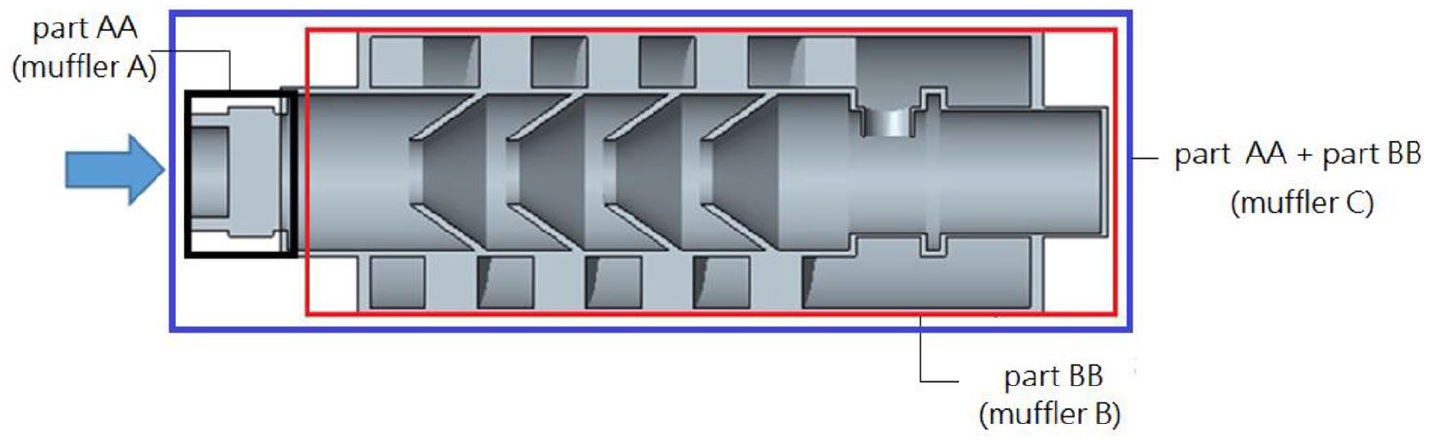
Three kinds of the mufflers (muffler A: part AA; muffler B: part BB; muffler C: part AA + part BB).
The Johnson-Champoux-Allard model used in predicting the sound absorption coefficient in the COMSOL is



where
The bulk factor (



where ∧ is the viscous character length, and

The Sound Transmission Loss (TL) is calculated as

Model check
To validate the accuracy of COMSOL used in muffler simulation, two kinds of acoustical elements (extended tube and porous material) have been simulated and compared to the experimental data. As illustrated in Figure 2, the TL of a muffler hybridized with extended tube has been simulated by the COMSOL and compared to an experimental data. 11 Simulated result in Figure 2 indicates that they are in agreement. Likewise, as depicted in Figure 3, the simulated TL profile of acoustical wool is similar to that of the experimental data. 12 Hence, the accuracy of COMSOL using finite element method is accessible in acoustical simulation and can be adopted in the acoustical simulation in the following section.
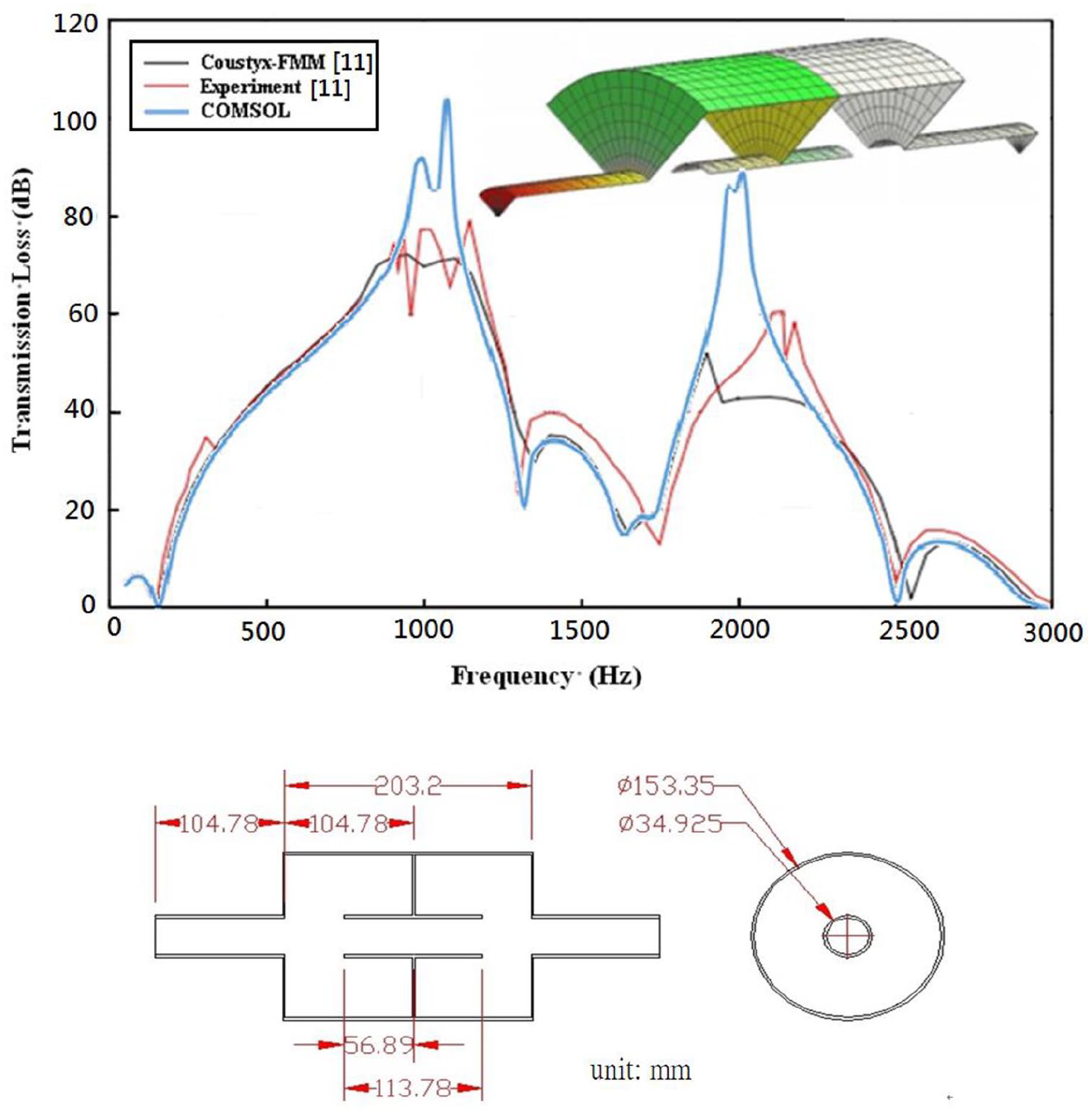
Accuracy check of sound transmission loss for mufflers internally inserted with extended tube. 11

Accuracy check of sound transmission loss for a sound absorbing material. 12
Acoustical simulation
Three kinds of mufflers (muffler A: part AA; muffler B: part BB; and muffler C: parts AA+BB) are introduced and shown in Figure 1. The venting path of a muffler C is depicted in Figure 4. Based on the dimension of the mufflers depicted in Figure 5, the simulated result of TL profiles for muffler A ~ muffler C using FEM analysis is illustrated in Figure 6. As indicated in Figure 6, the muffler C which has both AA and part BB is excellent than other mufflers. Therefore, muffler C is selected as the object of sensitivity analysis.
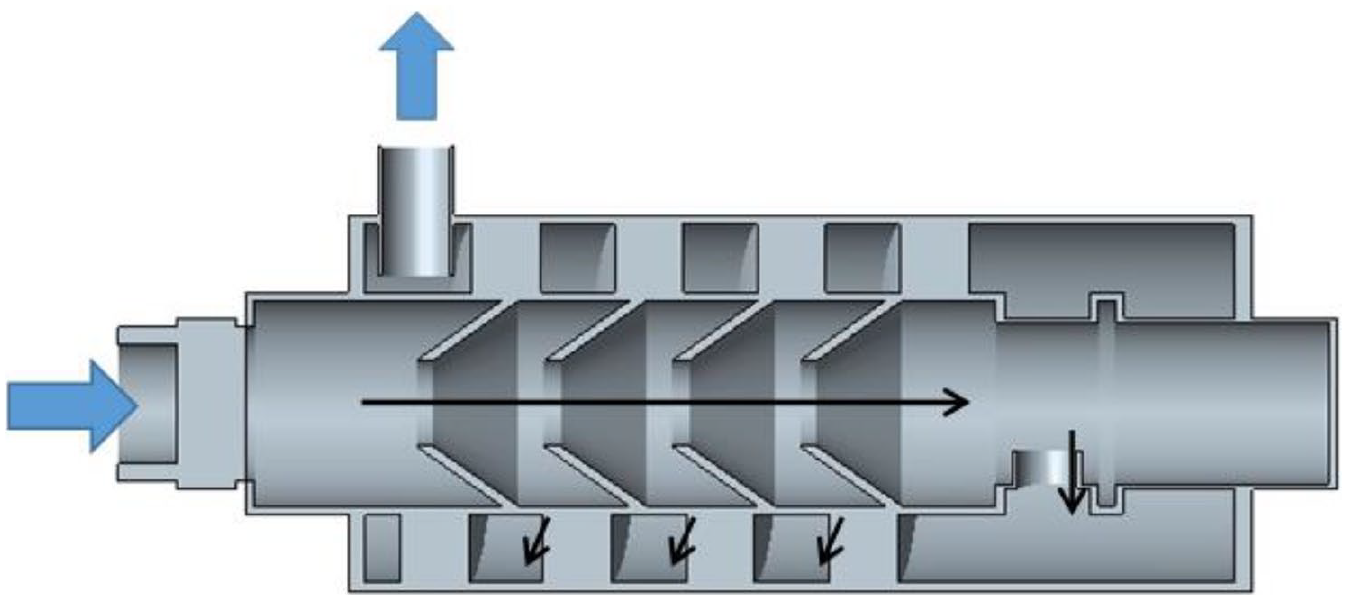
The venting path of a muffler C.
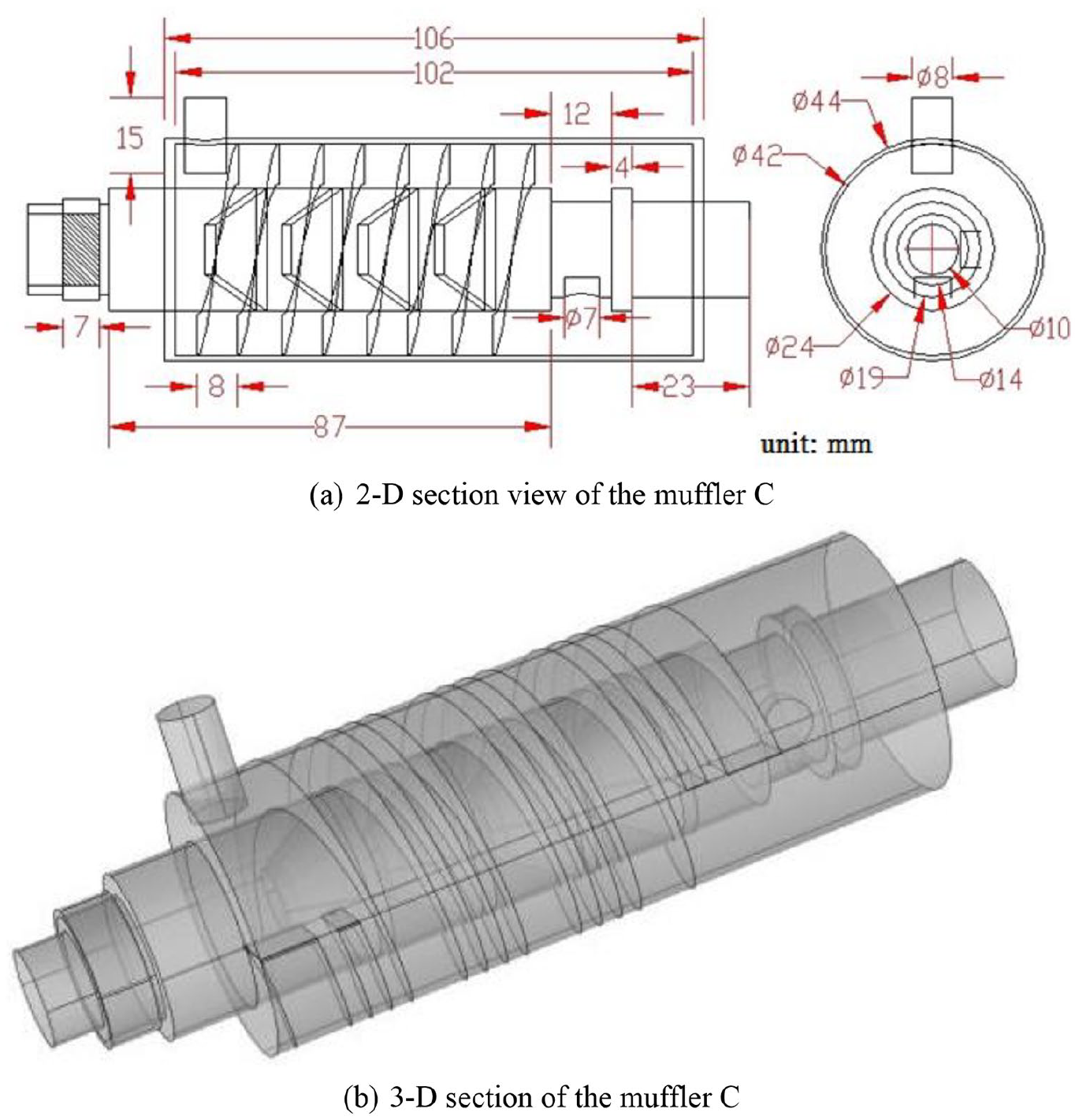
The mechanism of muffler C:

The comparison of sound transmission loss curves for muffler A – muffler C.
The sensitivity of TL with respect to two kinds of design parameters, including QQ (the number of expansion cone) and σ1 (the acoustical flowing impedance of the acoustical wool) for muffler C has been assessed. As indicated in Figure 7, QQ (the number of expansion cones) is selected as the design parameter of sensitivity analysis. Result in Figure 8 reveals the TL spectrum is proportional to the QQ. And, as exhibited in Figure 9, the parameter of σ1 (the acoustical flowing impedance of acoustical wool internally lined inside the muffler’s shell) has also been selected as the role of sensitivity analysis. The simulated result shown in Figure 10 demonstrates that the TL curve will be obviously prompted up if the σ1 increases.
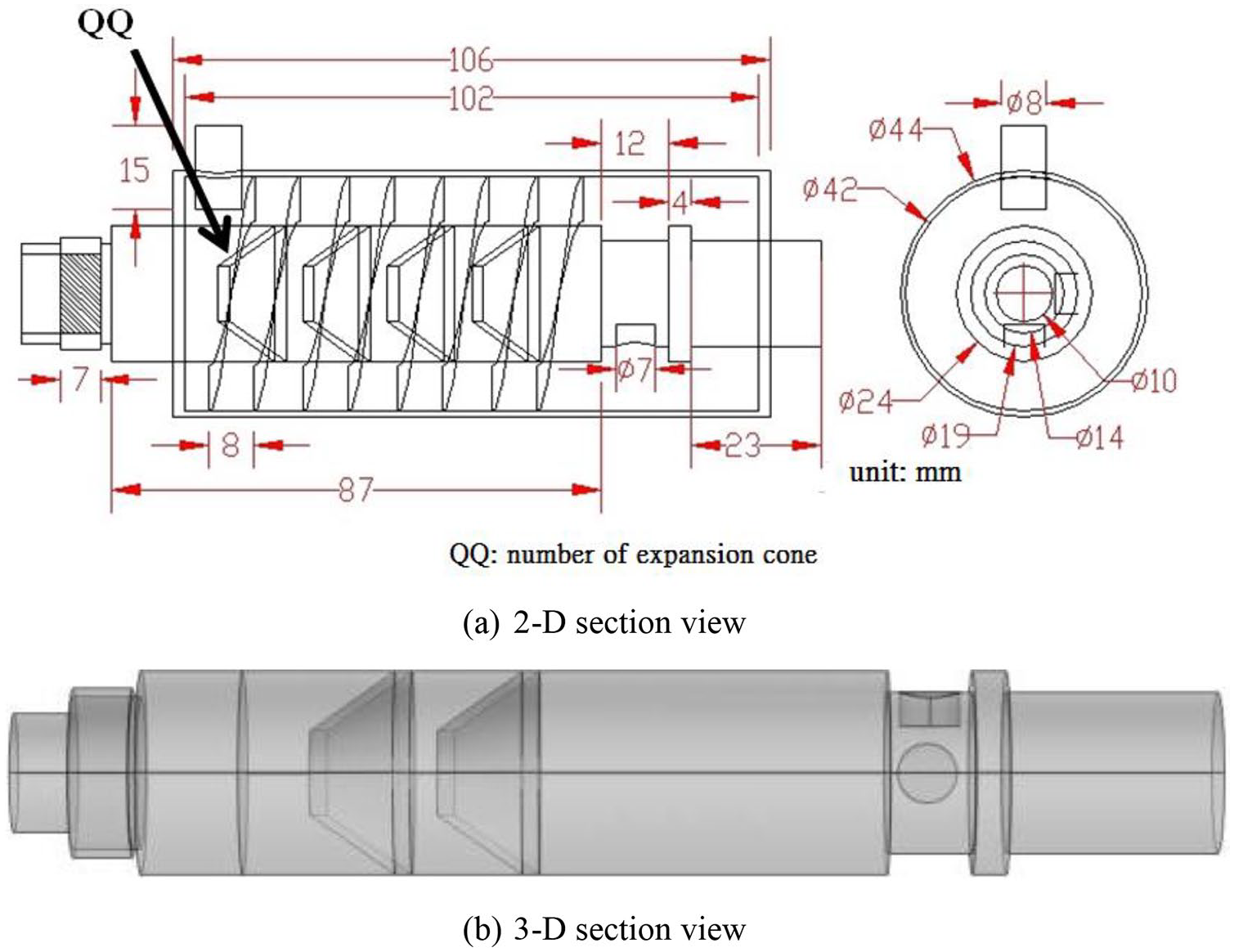
The selected design parameter of QQ (number of expansion cone).

The influence of sound transmission loss with respect to QQ.

The selected design parameter of σ1 (acoustical flowing impedance of the acoustical wool).
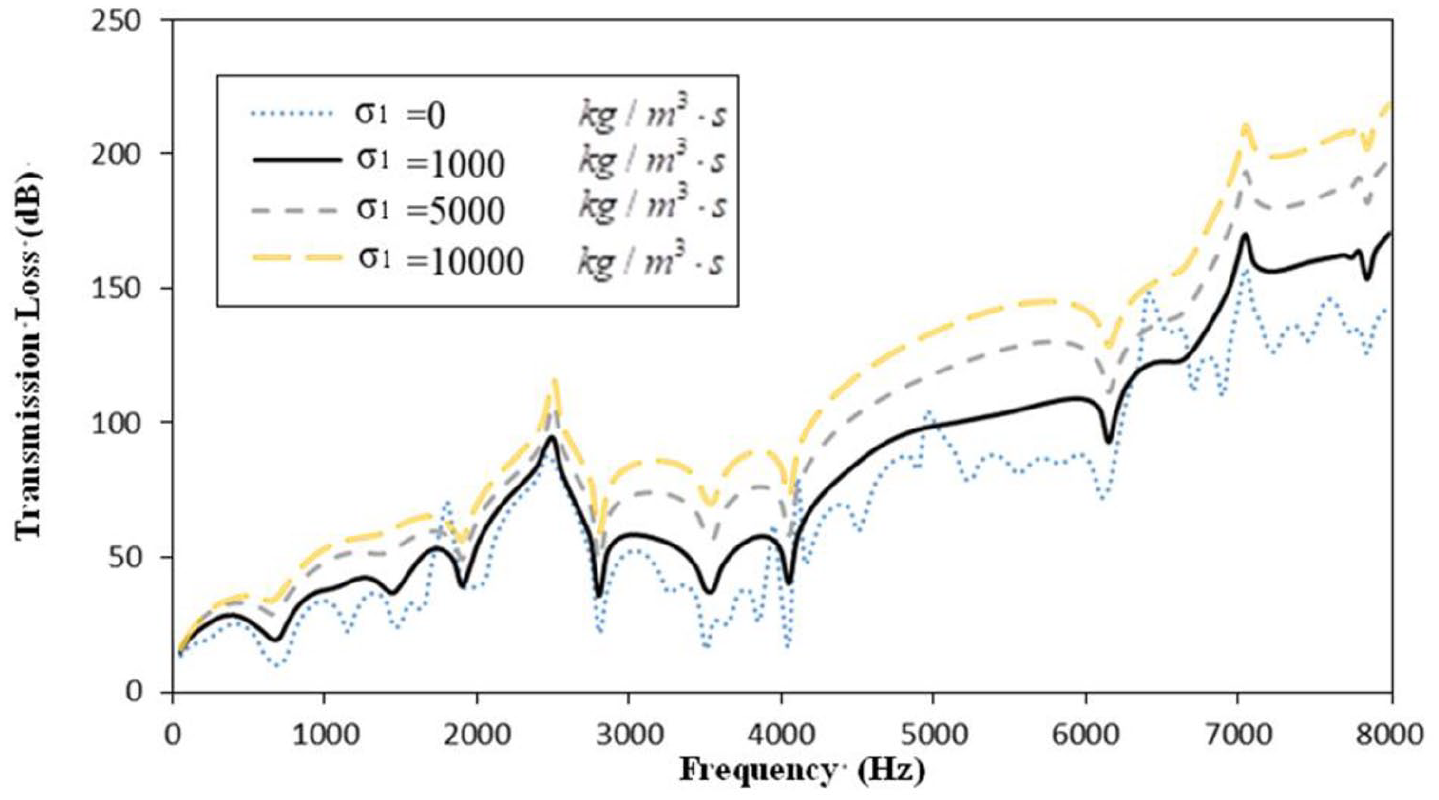
The influence of TL with respect to σ1.
Results and discussion
Results
Three kinds of mufflers (Muffler A: with part AA (a bronze-made sintered porous inlet); Muffler B: with part BB (a casing with a spiral tube and expansion cones); and Muffler C: part AA (a bronze-made sintered porous inlet) + part BB (a casing with a spiral tube and expansion cones)) are presented and acoustically simulated. The acoustical simulation of mufflers A-C has been accomplished and shown in Figure 6. The simulated result in Figure 6 reveals that the muffler hybridized with two acoustical elements (part AA and part BB) is superior to muffler A and muffler B. As indicated in Figure 8, the acoustical influence of TL with respect to the number (QQ) of expansion cones is large. The TL will increase if the QQ increases. Similarly, as can be seen in Figure 10, the acoustical flowing impedance (σ1) of the acoustical wool has essential influence in increasing the sound transmission loss of muffler C.
Discussion
As described in above section, the acoustical performance of muffler C (with two acoustical elements of part AA and part BB) is much better than other two mufflers. As illustrated in Figure 6, the broadband TL of muffler A in which the metal sintered bonze having fine perforated holes is equipped will be increased more than 20 dB. Obviously, the micro-perforated metal sintered bonze which has well sound absorbing ability plays an essential role. Similarly, because of the geometrical effect of expanded cone installed inside muffler, there is a better noise elimination at 2500 Hz. Therefore, the muffler C which includes the acoustical mechanisms of micro-perforated metal sintered bonze and expanded cone is chosen in the elimination of pneumatic noise. Moreover, as can be seen in the simulation of TL to QQ in Figure 8, the reactive noise elimination will be increased when the number (QQ) of expanded cone increases. Also, as illustrated in Figure 10, the broadband sound absorbing effect will increase when the σ1 (the acoustic flowing impedance) of micro-perforated metal sintered bonze increases. Therefore, a first design guide of increasing the acoustical flowing impedance of the acoustical wool lined inside the muffler is recommended. Moreover, the second guideline of increasing the number of the expansion cone inside the muffler to enhance the muffler’s acoustical performance is also advised.
Conclusion
In order to improve the acoustical performance for the muffler installed in the outlet of the pneumatic equipment, three kinds of mufflers (muffler A–muffler C) are introduced. For muffler C which is composed of a metal sintered/bronzed porous inlet, a spiral tube, and expansion cones, it is found to has the best acoustical performance. Based on the muffler C, two design parameters of QQ (the number of the expansion cones) and σ1 (the acoustical flowing impedance of the acoustical wool) are investigated and found to be much more efficient in improving the acoustical performance of the muffler.
Consequently, the acoustical analysis of TL to the design parameters established in this paper may provide a design guideline for the muffler designer in choosing the acoustical design parameters.
Supplemental Material
sj-doc-1-bua-10.1177_1351010X221103332 – Supplemental material for Acoustical simulation of pneumatic mufflers hybridized with metal sintered bronze porous material, a spiral tube, and expansion cones
Supplemental material, sj-doc-1-bua-10.1177_1351010X221103332 for Acoustical simulation of pneumatic mufflers hybridized with metal sintered bronze porous material, a spiral tube, and expansion cones by Min-Chie Chiu and Ying-Chun Chang in Building Acoustics
Footnotes
Declaration of Conflicting Interests
The author(s) declared no potential conflicts of interest with respect to the research, authorship, and/or publication of this article.
Funding
The author(s) received no financial support for the research, authorship, and/or publication of this article.

Supplemental Material
Supplemental material for this article is available online.
References
Supplementary Material
Please find the following supplemental material available below.
For Open Access articles published under a Creative Commons License, all supplemental material carries the same license as the article it is associated with.
For non-Open Access articles published, all supplemental material carries a non-exclusive license, and permission requests for re-use of supplemental material or any part of supplemental material shall be sent directly to the copyright owner as specified in the copyright notice associated with the article.
