



Abstract
The acoustic properties of airlaid nonwoven panels made of Posidonia and Alfa natural fibers are compared to Hemp fibers. The acoustic performance of the panels is studied as a function of density and thickness. Experimental and modeling approaches are both considered. First, porosity and airflow resistivity are determined experimentally for several densities and compared with extrapolated values. This allows predicting the acoustic equivalent fluid properties for any density. Impedance tube measurements are then performed to determine the acoustical absorption coefficient. The equivalent fluid model, together with the extrapolated porosity and airflow resistivity for a given panel density, provides a good comparison with the measurements. The sound absorption properties of 0.04 and 0.08 m thick panels for densities of 40 and 80 kg/m3 is finally compared for the three materials. We show that natural Posidonia and Alfa fibers have comparable efficiencies to Hemp fibers and can contribute to the development of more sustainable sound absorption materials.
Introduction
In recent years, the need to replace synthetic and non-renewable materials with sustainable alternatives has become a prominent challenge across various industries. Within this context, biobased materials, particularly natural fibers and polymers derived from renewable resources are gaining increasing importance across diverse sectors, notably in construction, packaging automotive manufacturing and textiles due to their ecological advantages, such as reduced carbon footprint and biodegradability. Their progressive integration into products like building insulation panels, vehicle interior components, and sustainable fashion collections highlights their versatility and performance. 1 Globally, the construction sector is a major source of pollution. According to the French Ministry of Ecology, Sustainable Development, and Energy, this industry accounts for 43% of the country’s annual energy consumption and 23% of its greenhouse gas emissions. 2 In response, biobased materials emerge as viable alternatives to petroleum-based products promoting sustainability and contributing to circular economy by reducing the embodied energy involved in buildings processes. These materials constitute a valuable resource due to their abundance, low toxicity, and low impact on the environment. However, they currently account for only 12% of materials used in buildings industry primarily due to the challenges associated with their manufacturing processes into products suitable for implementation and handling in the construction field. 3
Despite the progressive consideration of these materials in buildings, there is still limited knowledge about the sound absorption characteristics of natural and recycled materials. Some research has investigated the potential use of natural fibers for acoustic absorption, notably hessian, Hemp, bamboo, kenaf, and coconut coir fibers.4,5 Yang and Li 6 studied the sound absorption coefficient of ramie, flax and jute fibers and their composites. They showed that they presented a higher capacity of sound absorption compared to synthetic fibers. Pompoli and Bonfiglio 7 proposed analytical expressions for non-acoustical parameters based on open porosity and effective radius, validated against 2D finite element simulations for randomly-assembled symmetric and asymmetric radii distribution in fiber structures. Biboud et al. 8 developed a semi-empirical model based on the general five-parameter Johnson-Champoux-Allard (JCA) for the assessment and the optimization procedure of the sound absorption coefficient of compressed blend made of recycled Nylon. Several studies have investigated the effect of different parameters on the sound absorption coefficient of natural fibers. Gomez et al. 9 found that density and fiber size have a significant effect on the sound absorption coefficient of nonwoven materials made of fique, coir and denim fibers. Attal et al. 10 showed that the moisture of coir dust and perlite lightweight substrates has an effect on their acoustic properties. Taban et al. 11 studied the effect of thickness and density on the sound absorption performance of kenaf fibers using an experimental approach as well as a numerical model.
In this paper, three natural fibers are considered. Cannabis Sativa (Hemp) is one of the most studied natural fibers due to its availability, thermal insulation properties and its buffering properties. Hemp is a bast fiber extracted from plants growing up to 1.2–4.5 m mainly cultivated in Europe and Asia. The global volume of Hemp fiber production was around 174,027 tons in 2020. 12 Bast-fiber Hemp is used in various industries including home textiles and apparel. These fibers are used in various fields utilizing textiles, composites, animal beddings, and building thermal insulation materials. It has also been studied in construction materials for sound absorption. Several data on the acoustic properties of Hemp fibers for building construction are available. It has been observed that this fiber has a high sound absorption coefficient at medium and high frequencies, while its coefficient at low frequency is negligible.13,14 Santoni et al. analyzed the acoustic performance of loose Hemp fibers after four manufacturing stages of the process, in order to optimize their manufacturing process for sound absorption similar to synthetic fibers. It was found that an alkaline treatment after the carding process did not significantly affect acoustic properties unless followed by two combing stages, which reduce fiber radius and increase airflow resistivity. A simplified model was developed to assess sound propagation in Hemp materials, validated by comparing numerical results with experimental data. 15 The sound absorption properties of Hemp are established in this paper in order to serve as a reference material already widely used in building materials.
Posidonia Oceanica (Posidonia) and Stipatenacissima L. (Alfa) have been studied less for sound absorption applications. Posidonia is a marine flowering plant covering a quasi-continuous surface of Mediterranean coasts (between 30,000 and 40,000 km²) locally interrupted at estuaries and ports. 16 Their dead leaves are transported by wave motion and deposited along the coasts. Although they play an ecological role for coastal protection against erosion, these deposits have a negative impact on tourism and are removed from beaches. As a result, the exploitation of this renewable and low-price biomass 17 represents a potentially sustainable way of producing more environmentally friendly sound absorbers. Posidonia fibers have been studied in several researches but they still present the challenge of short fibers when it comes to producing materials suitable for installation in buildings. Barguet et al. 18 investigated the acoustical properties of a sonic crystals made of Posidonia non transformed aggregates. Pompoli 19 studied the acoustical characteristics of loose Posidonia fibers for different thicknesses and densities. JCA model parameters were calculated to asses for an analytical formulation of the acoustic performance of the fibers as function of their density. He showed that at a density of 50 kg/m3, Posidonia fibers showed lower absorption coefficient than that of polyester and mineral wool at the same density. When the density is increased to 100 kg/m3, the performance of polyester is attended and when the density is increased between 150 and 200 kg/m3, the performance of mineral wool is reached.
Stipatenacissima L. (Alfa) is a fast-growing grass that is widely distributed in arid and semi-arid ecosystems of the southern and the western Mediterranean basin. 20 In Tunisia, Alfa grass is mainly present in the Kasserine region and is composed of leaves of 1.2 m in length. 21 Currently, Alfa fibers are mainly used in high quality paper and handicraft industries as well as decoration and thermoplastic products.22,23 Arenas et al. 24 compared three types of Alfa species and determined the coefficients of a Delany-Bazley type model to fit the measured absorption coefficient.
Along with Posidonia fibers, Alfa fibers have not been studied as ready-to-install panels, adapted to industrial manufacturing processes. Fibrous materials can be obtained through diverse processes that define both their thickness and density, according to the targeted performances and intended applications. Among these methods, one originally developed for the textile industry and adapted for Hemp fibers, enables the fabrication of large, three-dimensional entangled networks with low density. The structural integrity of these networks is maintained through the incorporation of thermoplastic fibers, most commonly bicomponent polyester fibers. 25 In the aerodynamic textile process, fibers are conveyed through an air-driven system carrying them from the feeding unit to the pneumatic carding device. The resulting structure is stabilized both by the entanglement of fibers within the layered webs and by the bonding action of thermoplastic fibers activated during the heat-setting stage.
The aim of the current work is then to assess the effective feasibility of ready-to-install panels made from Posidonia and Alfa fibers using the conventional industrial process employed for the development of Hemp insulation panels and to ascertain whether the sound absorption of manufactured airlaid nonwoven panels made from Posidonia and Alfa fibers is comparable to that of Hemp fibers, which are already used in buildings. The comparison is made by evaluating their intrinsic properties, such as porosity and airflow resistivity, and also their sound absorption coefficient as a function of density and thickness, using both experimental and analytical models. The modeling procedure allows to compare and predicts the acoustic performance of panels made with each of the three natural fibers for a target density and thickness, that is beyond a pure experimental approach. This work is intended for professionals who are interested in using natural fibers in the production and use of panels having an acoustic function. To the authors’ knowledge, there is no published data on the sound efficiency of airlaid nonwoven panels based on Posidonia and Alfa fibers.
The article is structured as follows. In Section 2, we compare two intrinsic properties, that is, the porosity and airflow resistivity of the three materials for several densities. These parameters are determined experimentally and compared to those given by the analytical model to validate their variation as a function of density. In Section 3, sound absorbing properties are compared for the three natural fibers. To compare their efficiency for any density and thickness, we use the Johnson-Champoux-Allard-Lafarge (JCAL)26,27 semi-phenomenological model together with extrapolated porosity and airflow resistivity, obtained from the analytical model presented in Section 2. The results are compared with the measurements of the sound absorption in an impedance tube. Finally, the sound absorption performance predicted for the three materials are discussed for several densities and thicknesses currently used in buildings applications.
Comparison of intrinsic parameters
Material description and composition
Three types of airlaid nonwoven panels were manufactured from Posidonia Oceanica, Alfa and Hemp fibers (Figure 1). The process involves three main stages: the defibration (chemical/mechanical) of fiber bundles, the creation of a fiber network using an aerodynamic process (airlaid), and its thermal bonding in a hot air oven, facilitated by the thermoplastic fibers added prior to the formation of the fiber network. 28
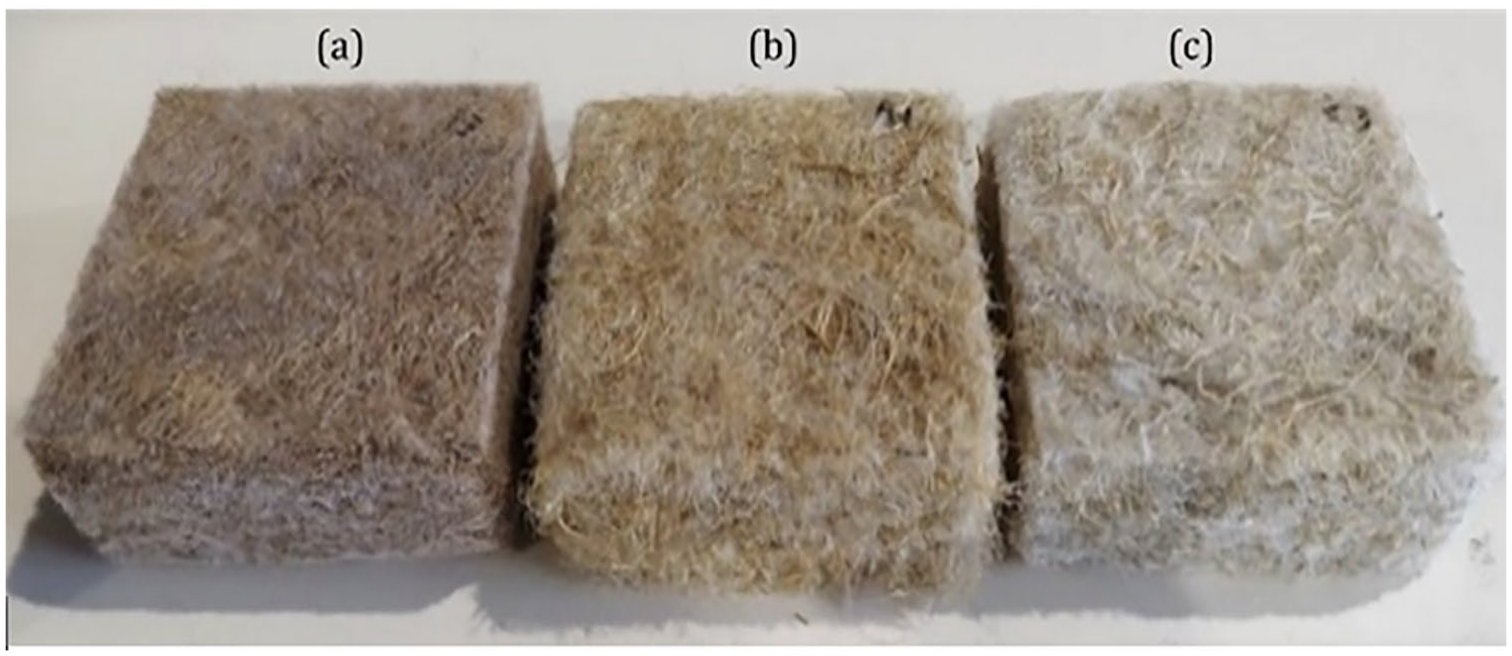
Samples of airlaid nonwoven panels with sides of 100 mm: (a) Posidonia, (b) Alfa, and (c) Hemp.
The long Alfa and Hemp fibers, which do not have length constraints and already suited the length range used for airlaid system, underwent mechanical extraction. Before this step, only the Alfa fibers underwent an additional chemical extraction process to dissolve the non-cellulosic components (lignin, hemicelluloses, pectins, etc.) from the rigid Alfa stems in order to isolate the fibers. The extraction of Alfa fibers from Alfa stems was carried out in NaOH (2.5 N) at 80°C for 3 h and then being washed with distilled water and acetic acid to neutralize excess NaOH. The chemical treatment was followed by mechanical separation of the dried fiber bundles in a fiber opening machine to better separate elementary fibers. 28 In the case of Posidonia fibers, it has been found that the mechanical opener significantly reduces the length of the fibers. Therefore, we chose to eliminate the mechanical opening step of Posidonia bales to avoid the potential loss of very short fibers through the suction system. This step was thus carried out using an air blowing system with a compressed air nozzle introduced into a closed tank, ensuring the preservation of the fibers’ original length. Prior to web formation, the fibers were mixed with 10% in weight of thermoplastic fibers to insure cohesion of the panel. We use polyethylene terephthalate (PE)/polyester core (PET) bicomponent with short fibers of 6 mm length. As an alternative to synthetic thermoplastic fibers, it is also possible to use bio-based thermobonding fibers, such as polylactic acid fibers (PLA), which makes them a more environmentally friendly option for sustainable material design.
The different densities were obtained by thermo-compression at 170°C of several plates of the initial material and then measured in the same experimental conditions. A target thickness was set at 40 mm during the manufacturing process and densities ranging from 40 to 100 kg/m3 were intended. The variability of the panels’ effective measured density was a result of the manufacturing process which requires a higher quantity of fibers for machine feeding to ensure a constant fiber distribution within the web formed. The minimal density of the materials obtained was 49.5 kg/m3 for Posidonia, 44.6 kg/m3 for Alfa, and 44.5 kg/m3 for Hemp panels. The thickness of each fibrous sample was a mean value of four measurements performed using a caliper with a precision of 0.01 mm. The measured thickness ranged from 30 to 41 mm as a consequence of the relaxation process of the panels at the exit of the oven machine.
To compare materials at iso-density, we will use an analytical model (see next section) giving the JCAL parameters for any density
Figures 2–4 show Scanning Electron Microscope (SEM) images obtained for Posidonia, Alfa and Hemp at an acceleration voltage of 15 kV. In the SEM images presented in Figure 2(d), the Posidonia fiber shows a cylindrical shape composed of an assembly of fibrils consisting of several ultimate cells and fibers presenting small cavities (lumen). It is also shown that the fibers present a rough nonporous longitudinal surface. The average diameter of the Posidonia fibers was evaluated by analyzing SEM images using digital image analysis (ImagePro Plus). From this analysis, an average diameter of 91.3 ± 37.7 μm for Posidonia was measured on 100 fibers, confirming the micrometer scale of the fiber.
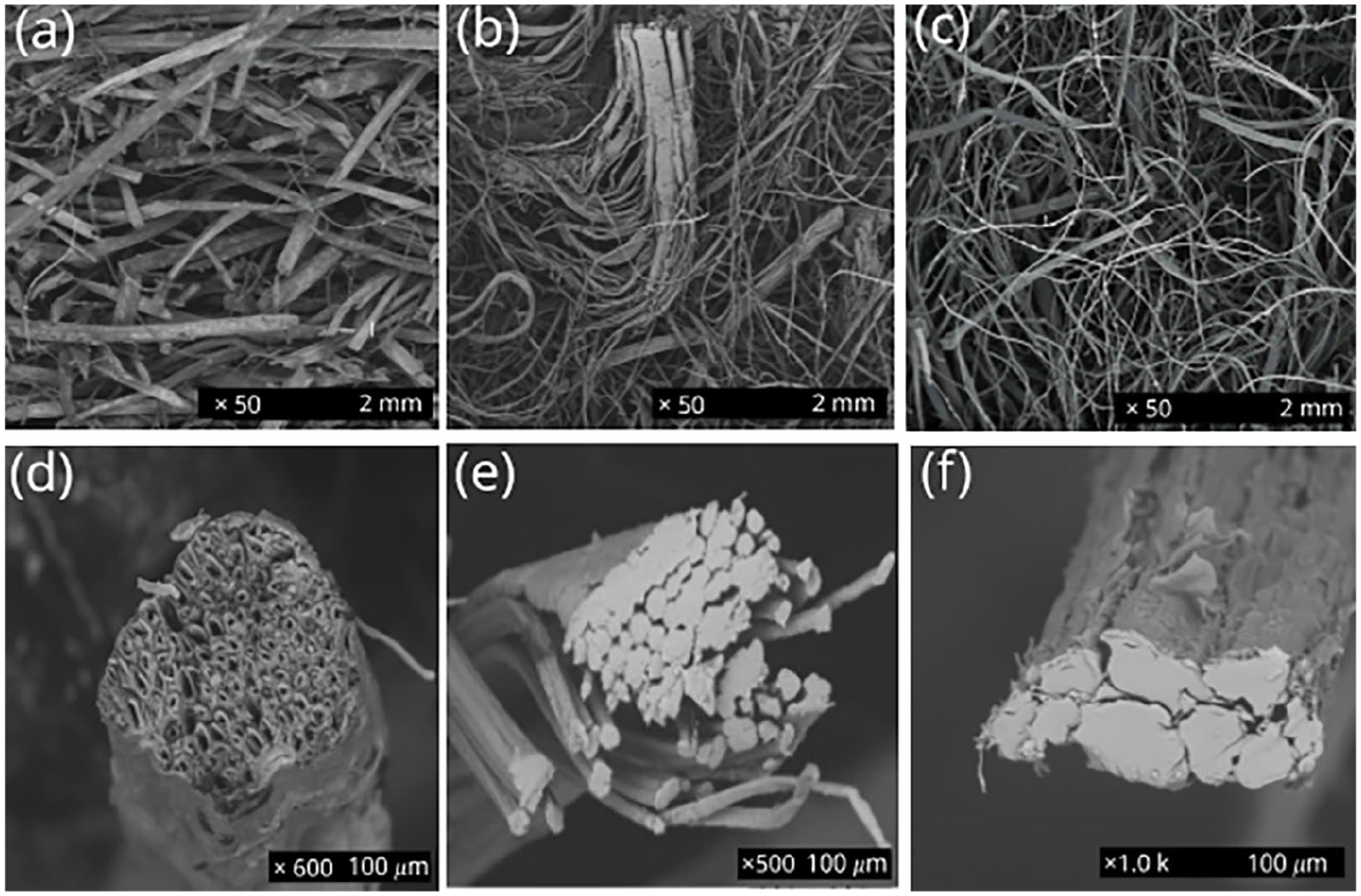
Scanning electron microscope (SEM) images of Posidonia (left), Alfa (middle) and Hemp (right) for (a–c): nonwoven panels; (d–f): fibers. Scale bar equal to: (a–c) 2 mm, (d–f) 100 µm. Magnification: (a–c) 50×, (d) 600×, (e) 500×, and (f) 1000×.
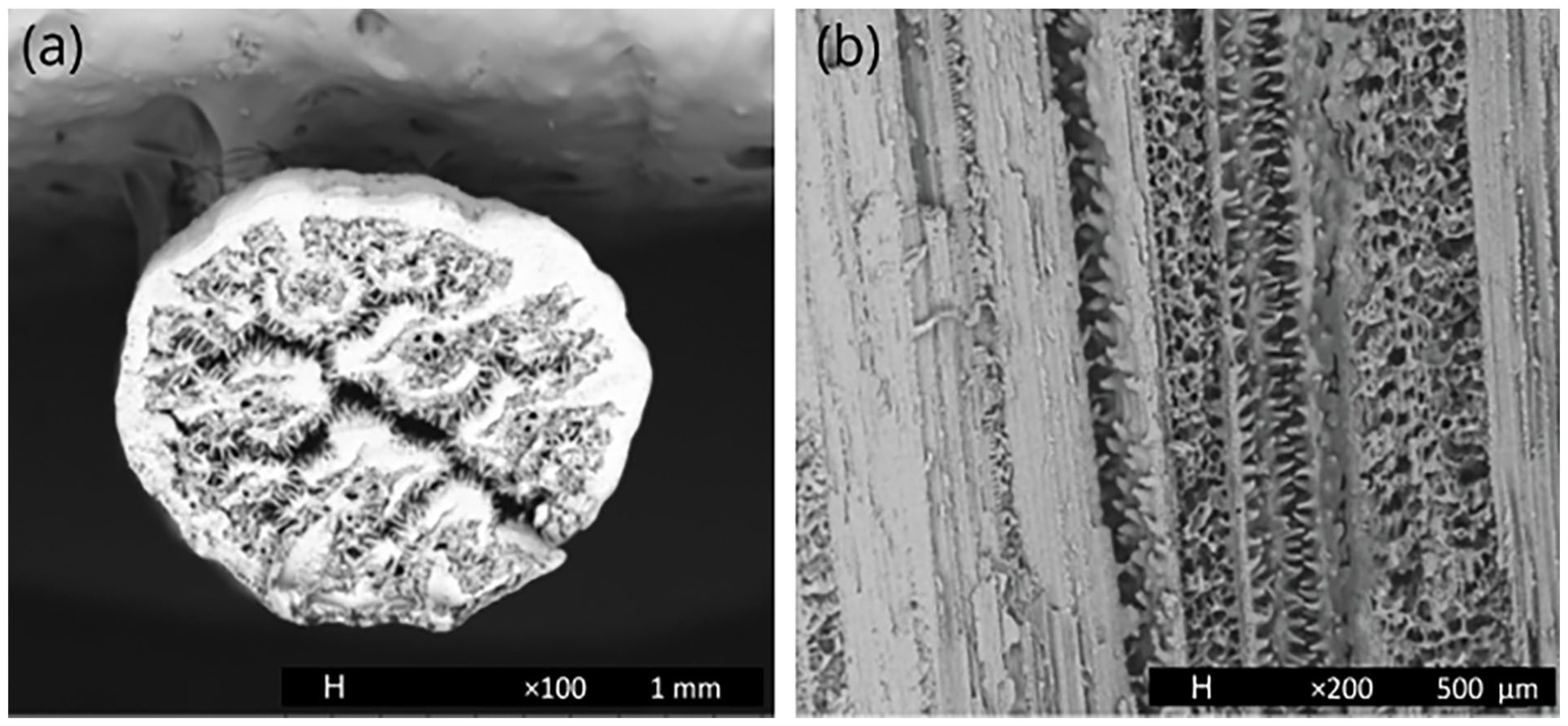
Structure of the Alfa plant stem, (a) cross section of Alfa stem, (b) longitudinal section of the fiber showing the porous epidermis. Scale bar equal to: (a) 1 mm and (b) 500 µm. Magnification: (a) 100× and (b) 200×.
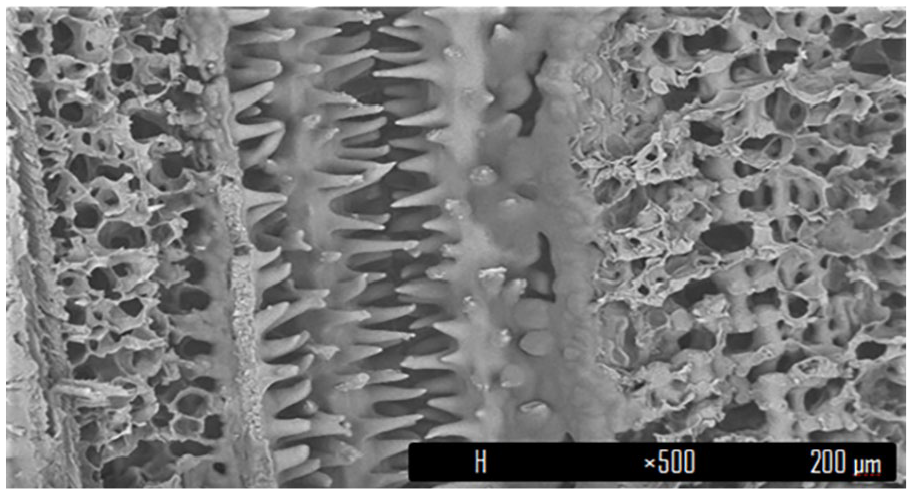
Zoom on the longitudinal porosity observed on Alfa fiber. Scale bar equal to 200
The morphological characterization of Alfa fibers (Figure 3(a)) showed a cavernous cylindrical structure made of multiple filaments spanning the length of the plant. The average diameter range of Alfa fiber is 79.0 ± 69.2 μm, indicating a high variability. The longitudinal view of the Alfa fibers (Figures 3 and 4) shows that their surface is covered with a dense hairy layer, allowing sufficient adhesion to form the plant stem and potentially creating a longitudinal microscopic porosity between the trichromes.
Figure 2(f) showed that the Hemp fiber is composed of an assembly of cells or ultimate fibers arranged in bundles presenting an average diameter of 48.8 ± 19.6 μm. The bundles are composed of several unitary fibers joined by pectin and other cementing compounds such as lignin and hemicellulose to constitute the technical fiber.
Figure 2(a)–(c) show the distribution of Posidonia, Alfa, and Hemp fibers in the nonwoven panels after consolidation. The SEM images show that the fiber layers exhibit a porous structure. The Posidonia fibers appear as straight fibers while Alfa and Hemp fibers show a more curved shape, providing more interweaving points with the bicomponent fibers. It can also be seen that the fibrous network based on Alfa exhibits several large-diameter fiber bundles, indicating insufficient fiber separation during the chemical and mechanical extraction processes.
Determination of equivalent fluid parameters
In this section, we examine the three characteristic parameters among the six of the equivalent fluid Johnson-Champoux-Allard-Lafarge (JCAL)26,27 model (see next section), that can be determined directly by independent experimental methods with confidence: porosity, airflow resistivity and tortuosity. The measurements were performed using the experimental test benches at the UTC Roberval laboratory. The principles are briefly recalled.
The open porosity
The airflow resistivity
The tortuosity
The measured parameters are given with mean values and uncertainties in Table 1. The measured tortuosity of each panel is found between 1.02 and 1.07 which is consistent with the fibrous nature of the materials, 36 with slightly higher values for Hemp.
Measured material properties. The results are given with the mean value ± the standard deviation for airflow resistivity. Standard deviation is estimated to 2% for thickness and density, 1% for porosity and 3% for tortuosity values.
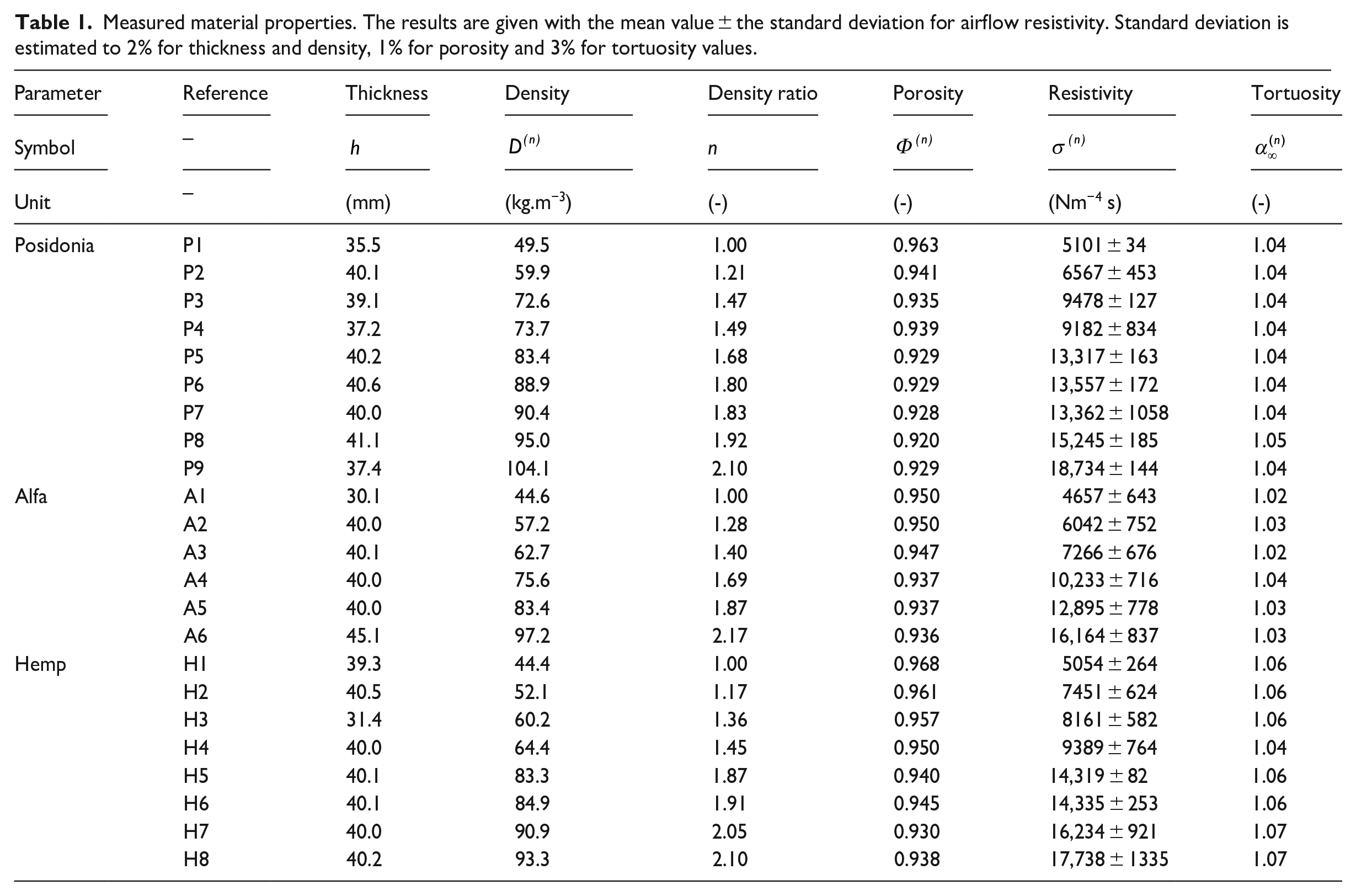
The results for porosity and airflow resistivity are plotted as a function of density for the three materials in Figure 5. Three samples of diameter 44.5 mm are used to determine the airflow resistivity, while three samples of diameter 100 mm are cut for the porosity measurement. Figure 5(a) shows that porosity decreases with density. Values range from 0.92 to 0.97, which is common for sound absorbing materials, with relatively lower porosity values for Posidonia. Conversely, airflow resistivity increases with density from 4700 to 17,700 Nm−4 s as shown in Figure 5(b). These values are higher than those of certain other studies.37,38 We note that Alfa and Posidonia show a slightly lower airflow resistivity.
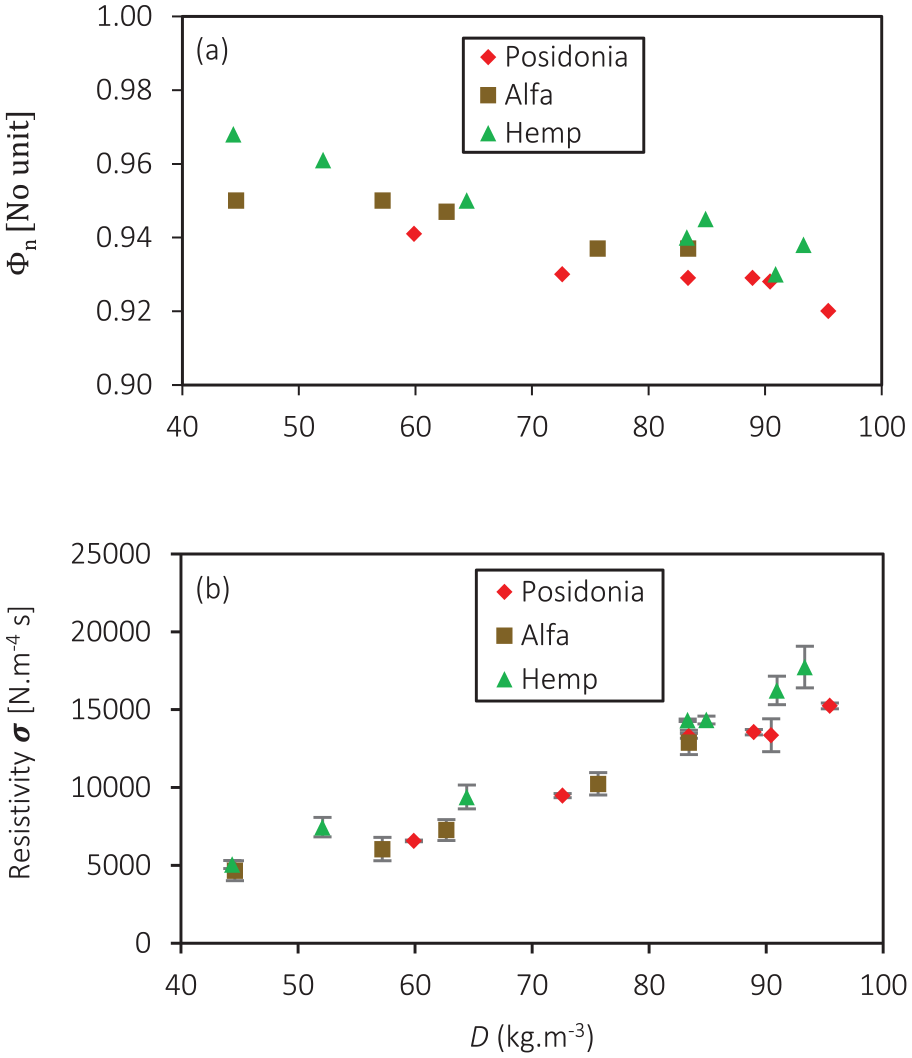
Measured porosity (a) and airflow resistivity (b) for Posidonia, Alfa, and Hemp panels as a function of density.
Variation of porosity and airflow resistivity as a function of density
During manufacturing, the natural fibers are compressed to a given thickness. Density is a function of the initial mass of raw material and its final thickness. Density will have a very significant impact on acoustic efficiency, since JCAL parameters are linked to the distance between fibers, since it is inversely proportional to density. 39 Assuming that the fiber radius does not change during compression, the porosity is expressed as in equation (1) 29 :

The airflow resistivity can be approximated by a power law (equation (2)) 31 :

where
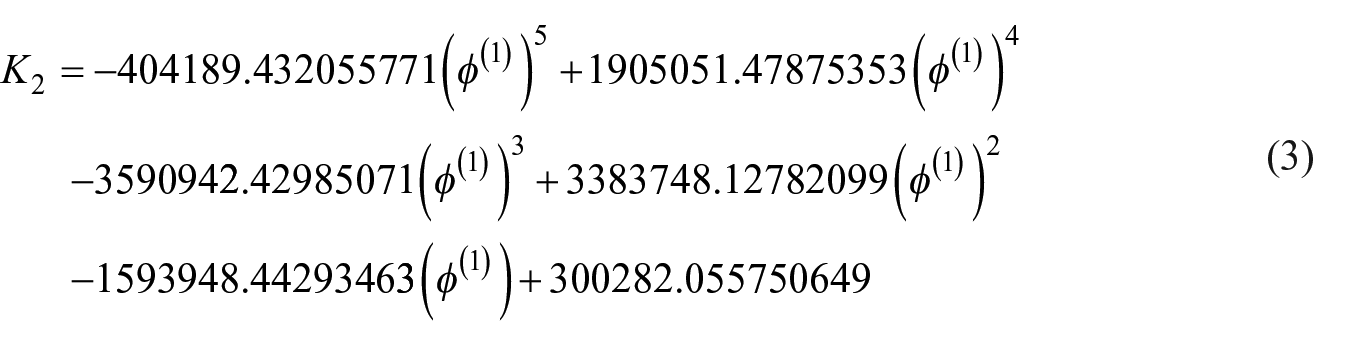
Note that
Porosity and airflow resistivity are plotted in Figure 6 against the density ratio for the three materials, ranging from 1 to 2.1. Despite the variability associated with natural fibers, good agreement for porosity is observed for Posidonia and Hemp samples between the measurements and the model. However, the porosity of Alfa panels seems to be underestimated by the model. One hypothesis can explain this result. The Alfa panels present a higher heterogeneity compared to Posidonia and Hemp, mainly because of the two-step extraction process, (chemical and mechanical) used to separate the fibers from the rigid stem (Figure 3). This process is necessary due to the challenging dense microporous structure of Alfa fibers (Figure 4), which makes them more difficult to individualize. The presence of fiber bundles, as shown in Figure 2(b), is likely to create higher resistance to the compression of coarse fibers within the panels during the thermal consolidation process: the compression is then not homothetic in the whole volume.
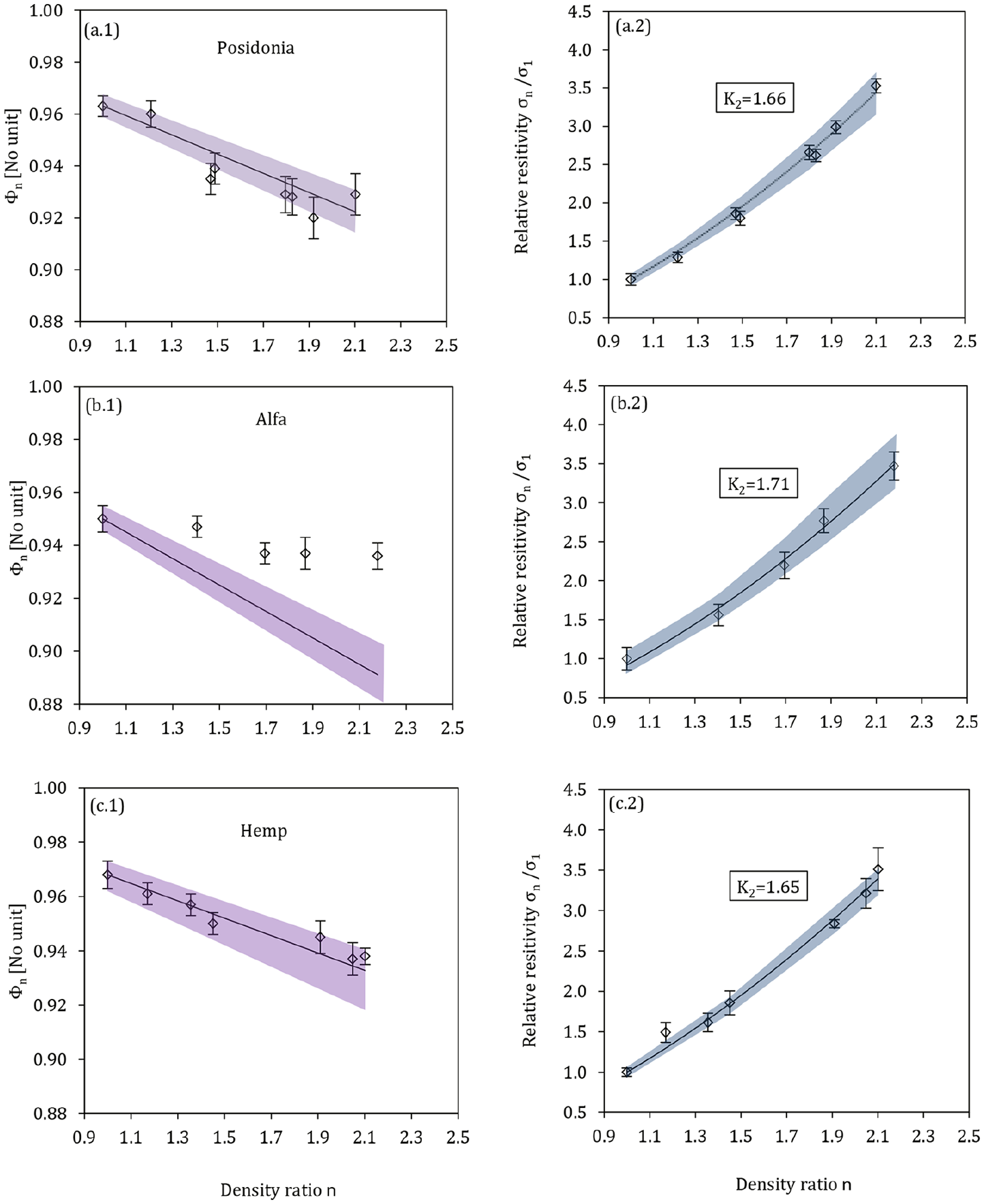
JCAL parameters measured as a function of density ratio: (a) Posidonia (49.5 kg/m3), (b) Alfa (44.6 kg/m3), and (c) Hemp nonwoven (44.4 kg/m3) as a function of density ratio n (marker), extrapolated parameters from equations (1) and (2) (solid black line). Standard deviations related to the predicted parameters are depicted with shaded zones.
Good agreement between predicted and measured properties as a function of density is observed for the airflow resistivity in Figure 6 (a.2, b.2, c.2). Power
Used properties for modeling and extrapolated properties calculated from equations (1)–(2) at different density ratio.

Comparison of sound absorbing properties
In this section, sound absorption coefficients of the three materials are compared. The experimental results are supplemented by modeling to study the influence of thickness and density parameters.
Sound absorption measurement
Sound absorption measurements are performed using the impedance tube method according to either ASTM E 1050, 40 ISO 10534-2, 41 or ASTM E 2611 standards. 42 This technique uses the transfer function method between two microphones. A tube of 44.5 mm in diameter allows determining the normal incidence absorption coefficient from 140 to 4500 Hz (Figure 7).
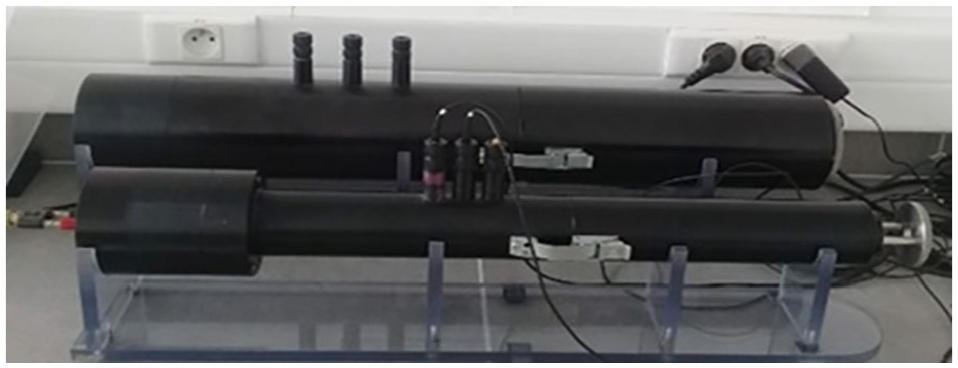
Impedance tubes at the Roberval laboratory.
Influence of density on the sound absorption coefficient
The influence of density on sound absorption is shown for samples of 40 mm thickness. As can be seen in Figure 8, the sound absorption coefficient is strongly impacted by the density of the sample: the sound absorption coefficient increases with mass density in the low frequency range. Thus, the value of the maximum is reached at lower frequencies. The difference is particularly significant for Posidonia samples P2 and P8. An increase of about 34% of the sound absorption coefficient at 1500 Hz could be seen when increasing the density. The maximum absorption occurred at 1500 Hz for sample P8 (0.98) with a density of 95 kg/m3 while a maximum (0.94) was reached at 2825 Hz for sample P2 at a density of 59.9 kg/m3. The same trends were observed on Hemp and Alfa samples. The maximum absorption occurred at 1725 Hz for sample H7 with a density of 90.92 kg/m3 while the maximum was reached at 2240 Hz for H2 with a density of 52.1 kg/m3. The maximum sound absorption for sample A4 with a density of 75.64 kg/m3 occurred at 1965 Hz, while the maximum value for A2 with a density of 57.2 kg/m3 occurred at 2387 Hz.
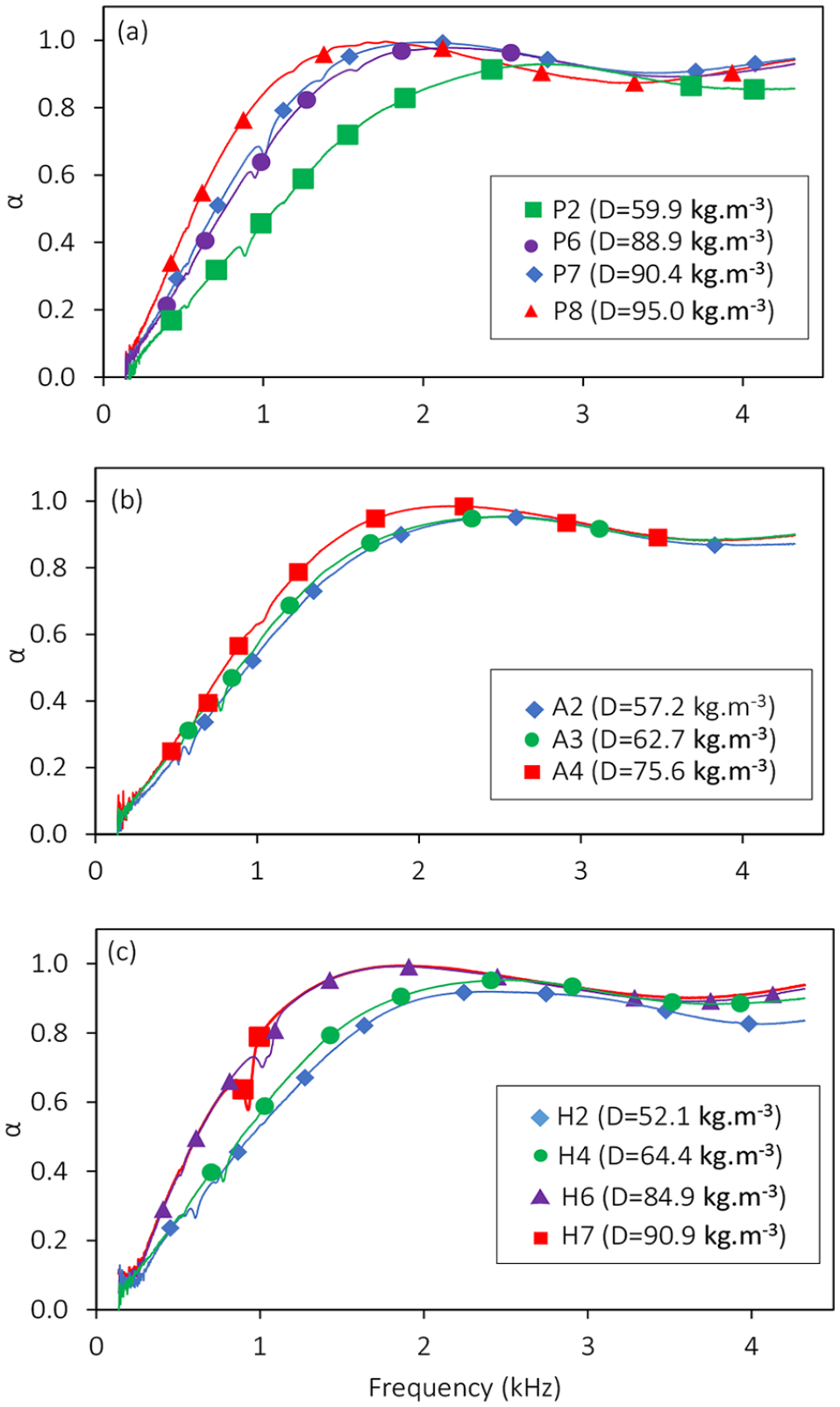
Sound absorption coefficient for a 40 mm thickness at different mass densities of: (a) Posidonia, (b) Alfa, and (c) Hemp nonwoven samples.
These results could be attributed to the increase in airflow resistivity, which were multiplied by a factor of 2.3, 1.7, and 2.2 for P8, A4, and H7, respectively, resulting in greater viscous dissipation. In contrast, porosity did not vary significantly (ratio less than 1) to impact sound absorption. These results are similar to those reported for Kenaf panels where the increase in the density from 50 to 100 kg.m−3 increased the absorption coefficient up to 0.94 in the frequency band of 2000 Hz. 11
Comparison of measured sound absorption at iso-density and iso-thickness
Of the many panels manufactured, only two triplets of about the same thickness and density was produced. Indeed, controlling both parameters is difficult at the laboratory level. These materials are samples P2, A2, and H2, and samples P5, A5, and H5 (Table 1), which have a density around 56 and 83 kg/m3 respectively, and a thickness between 40.0 and 40.5 mm. Figure 9 shows the sound absorption coefficient of three panels for each density. Alfa panel A2 shows a slightly higher sound absorption coefficient while A5 sample is around 0.1 less than the other materials. Posidonia P2 sample is below the other materials, while P5 sample is comparable to Hemp panel.
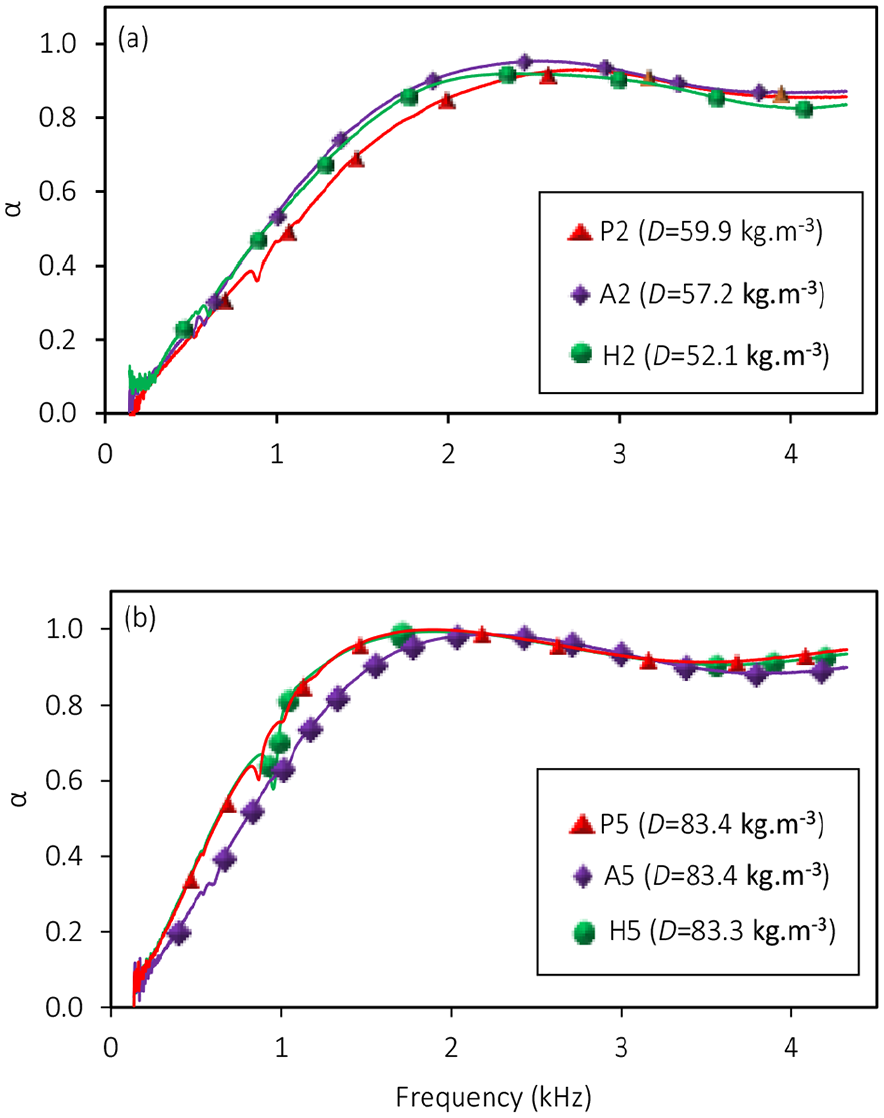
Sound absorption coefficient of: (a) Posidonia P2, Alfa A2, and Hemp H2 and (b) Posidonia P5, Alfa A5, and Hemp H5 panels 40 mm ± 0.5 mm thick obtained from Kundt tube measurements.
No clear tendency can be achieved directly with these experimental results due to properties variation among panels. A comparison based on the model, with properties determined for the all set of panels, will then be performed in the following.
JCAL equivalent fluid model
The sound absorption of the samples is predicted using the Johnson-Champoux-Allard and Atalla-Lafarge model (JCAL).
43
In the JCAL model, the equivalent dynamic density is associated with the viscous losses and the equivalent dynamic bulk modulus is associated with the thermal losses in the porous material. The JCAL model for the measurement of the acoustical properties of porous media relies on six non-acoustical parameters which are

where p corresponds to the acoustic pressure of the effective fluid at a given position and a given frequency f. The expressions of the JCAL model are used in this work to predict the sound absorption coefficient of the samples. The expression of effective density


where
In the following, airflow resistivity and porosity will be determined from direct measurements or compression law as presented above. The other parameters will be derived assuming commonly admitted hypothesis for highly diluted fiber materials (

and the relation of equation (8):

used to obtain the thermal characteristic length from the viscous characteristic length (equation (9)). The latter is estimated with the assumption that the form factor

The thermal permeability (equation (10)) is determined assuming a form factor of

Comparison between measurements and simulations
In this section, we study the suitability of the JCAL model with our assumptions for predicting the sound absorption coefficient of the three types of panels, each having four different densities. Three samples of diameter 44.5 mm were cut from the same panel for each density, and then measured in the same experimental conditions. Figure 10 shows that the predictions of the sound absorption coefficient using the JCAL model with measured porosity and airflow resistivity, are in good agreement with the data measured at different density rates for Posidonia (

Comparison of predicted and measured values of normal incidence absorption coefficients of Posidonia P1, P2, P4, P9, Alfa A1, A2, A3, A6, Hemp H1, H2, H4, and H8 airlaid nonwoven panels as a function of the frequency (Gray line). Measurement; (Discontinuous blue line) JCAL model with measured porosity, airflow resistivity and tortuosity from Table 1; (Red line) JCAL model with extrapolated porosity, airflow resistivity, and tortuosity as function of density ratio n from Table 2.
Figure 10 shows as well that the predicted sound absorption coefficient using extrapolated porosity, airflow resistivity and tortuosity as function of density ratio n from Table 2, is in very good agreement with prediction using measured parameters (Table 1). A small discrepancy can be seen for A2 and A3 Alfa samples.
This shows that knowing initial properties of the materials at a given density enables the prediction of the sound absorption coefficient of the panels using the JCAL model for any other density. This makes it possible to predict the acoustic properties for a target density.
Application to compare sound absorption properties for different densities and thicknesses
After having validated the suitability of the JCAL model together with the extrapolated porosity and airflow resistivity, we compare the sound absorption properties for nominal thicknesses of 40 and 80 mm, for densities of 40 and 80 kg/m3. The objective is to compare the acoustic performance and its variation in the same conditions, and to illustrate a procedure that could be performed in the development phase, before the materials are manufactured to the requisite specifications.
Figure 11 shows four examples of the predicted sound absorption coefficients of Posidonia, Alfa, and Hemp, obtained using the JCAL model supplied with extrapolated parameters from equations (7) to (10). First, Posidonia, Alfa, and Hemp have very similar efficiencies. The largest difference is for the smallest thickness and density, but remains well below 0.1. This configuration is also the least efficient: the maximum reached at around 2.5 kHz is 0.8. To improve absorption, it is possible either to increase the thickness or the density. The coefficient goes above 0.8 at around 1 kHz, with an advantage for a thickness below 1.2 kHz. The increase in density for a thickness of 80 mm only slightly improves absorption: in this case the three materials are indistinguishable.
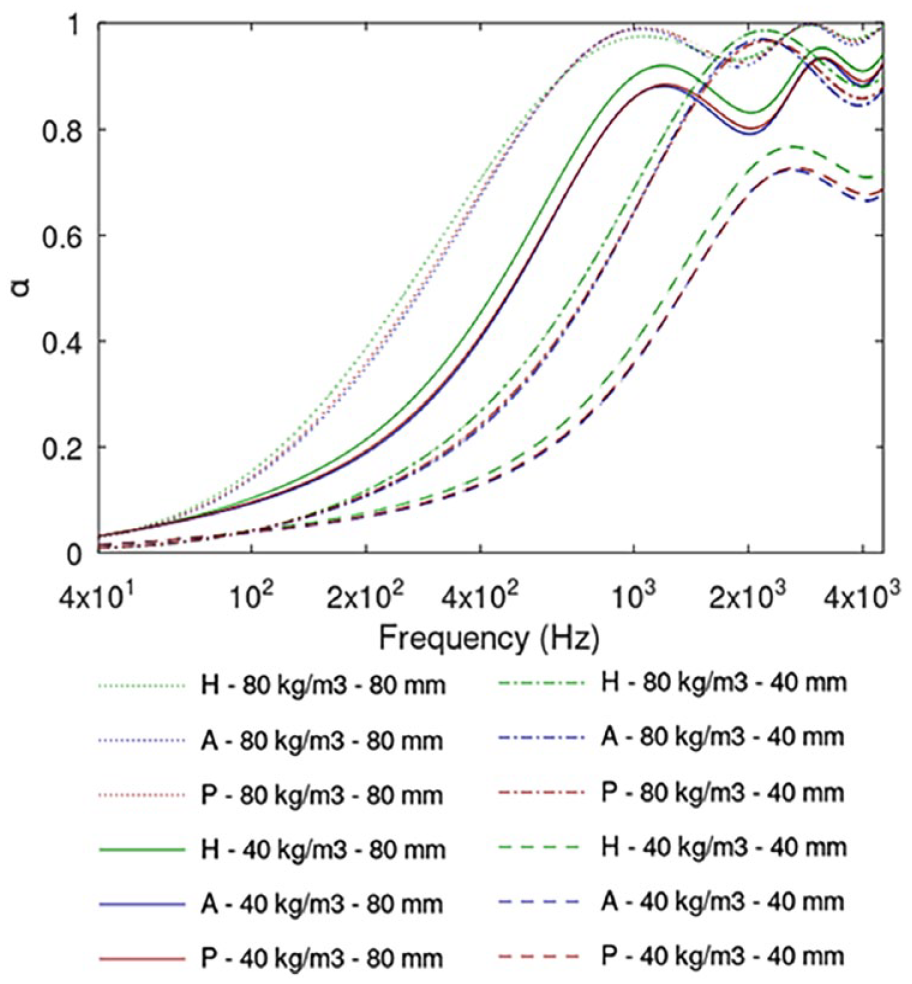
Predicted sound absorption coefficients for two thicknesses and densities.
Conclusion
The purpose of this paper was to study the acoustic performance of airlaid nonwoven panels made of Posidonia, Alfa, and Hemp natural fibers. The suitability of the analytical JCAL model, including common assumptions for fibrous materials, to predict the sound absorption coefficient was investigated and the model results were compared to experimental measurements. The JCAL model fitted well with the experimental results of the sound absorption coefficients for Posidonia, Alfa, and Hemp samples, and approved an efficient design tool for predicting the acoustic performance of airlaid nonwoven panels made with these fibers. Lower accuracy was observed for the initial Alfa sample (
Results from the current work showed that increasing the density of the sample resulted in higher sound absorption coefficients in the low and medium frequency range, for 40 mm thick samples. The application of the JCAL model using predicted porosity and airflow resistivity from the initial materials, permitted accurately predicting the sound absorption coefficient of the compressed materials. The modeling procedure enabled predicting the sound absorption coefficient of panels with different densities from the prediction of their porosity and airflow resistivity given by knowledge of the JCAL parameters at only one density, offering the advantage of limiting the number of measurements. This procedure is of great importance for identifying the acoustic parameters of these materials for different densities before their manufacture as well as making comparison possible at equivalent mass densities and thicknesses. Finally, these results show that exploiting biosourced Posidonia and Alfa natural fibers in airlaid nonwoven panels could contribute as well as Hemp fibers to a viable alternative to synthetic sound absorption materials.
Footnotes
CRedit authorship contribution statement
Melek Ayadi: Investigation. Conceptualization. Formal analysis. Writing. Nicolas Dauchez: Investigation. Formal analysis. Methodology. Validation. Writing. Riadh Zouari: Methodology. Conceptualization. César Segovia: Methodology. Conceptualization. Ayda Baffoun: Methodology. Conceptualization. Nicolas Brosse: Project administration. Supervision. Validation Slah Msahli: Project administration. Supervision. Validation.
Declaration of conflicting interests
The author(s) declared no potential conflicts of interest with respect to the research, authorship, and/or publication of this article.
Funding
The author(s) disclosed receipt of the following financial support for the research, authorship, and/or publication of this article: This study is part of the PHC Utique project (Isolation thermique et sonore par un non-tissé écologique, code 44228PK). The authors would like to thank the University of Monastir for its financial support. The authors would also like to thank Pr. Mohamed-Ali Hamdi (Université de Technologie de Compiègne) in particular for his support and instructions in conducting this project.
Ethical considerations
This article does not contain any studies with human or animal participants.
