




Abstract
Why does a re-emerging China pursue institutional strategies to expand its multilateral ties all over the world? This study explains the genesis of China’s new multilateral diplomacy toward Africa, Latin America, and the Middle East. The central argument of the study is that many strands of structural arguments drawn from realist, liberal, and constructivist insights cannot provide complete explanations about China’s multilateral activism without recourse to cognitive feedback dynamics. China fed its regional experiences of multilateralism back into its global policy formation. This experiment-based approach has been a pervasive feature in Chinese multilateral diplomacy as well as Chinese domestic reforms during the post-Mao period. The cognitive feedback model developed in this study intends to complement the prominent structural explanations by identifying micro-level dynamics and seeks to contribute to today’s debate over power transition and international order.
Introduction
China’s renaissance (fuxing) 2 is remaking the international order. Beijing has not merely joined existing multilateral institutions (e.g. the World Trade Organization and the ASEAN Regional Forum [ARF]), but also created new multilateral forums and ties in the developing world outside Asia. The Forum on China–Africa Cooperation, the China–Caribbean Economy and Trade Cooperation Forum, and the China–Arab Nations Cooperation Forum are among the new Beijing-led multilateral arrangements in the early 21st century. Why does a re-emerging power, China, actively pursue institutional strategies to expand its multilateral ties all over the world? More specifically, why did new Beijing-centered regional institutions emerge in the early 2000s (policy timing)? Why did China begin to create regional multilateral institutions to seek security and prosperity among other possibilities — revitalizing existing global institutions, reinforcing traditional bilateral relationships, or creating nothing durable (policy direction)? This is a significant departure from Beijing’s long-time emphasis on autonomy and independence. In the past, China showed its concern that it would be outvoted and its bargaining power weakened in multilateral settings (Johnston, 2008; Wu, 2001). China thus took a minimalist and passive approach to regional cooperation prior to the late 1990s. Hence Beijing’s multilateral offensive in the developing world remains a puzzle. This study explains why and how China has taken the leadership in attempting to create new regional institutions in Africa, Latin America, and the Middle East in the early 21st century.
The world is debating how China will use its new-found capacity to shape the organization of world order especially in the aftermath of the global financial crisis. Although students of world politics produced excellent scholarly works on the emergence and function of Western-centered international institutions and order after hegemony (Keohane, 1984) and after victory or major wars (Ikenberry, 2001), there is a conspicuous dearth in Western scholarship on a re-emerging power’s creation of (not participation in) multilateral institutions after renaissance. China’s approach to international institutions has not been a primary focus of Chinese foreign policy studies. Even burgeoning literature on this issue focuses mainly on China’s engagement and compliance (or socialization) with existing international institutions, such as the United Nations agencies, the World Bank, and the ARF (Chan, 2006; Economy and Oksenberg, 1999; Johnston, 2008; Kent, 2007; Kim, 1979; Lanteigne 2005). 3 A new intellectual industry may be needed that traces Beijing’s incentives to create, design, and manage the effects of new China-led institutions in world politics. An understanding of Beijing’s motivation may help us to explain and predict the future trajectory of international order.
The central argument of this study is that many strands of structural arguments drawn from realist, liberal, and constructivist insights cannot provide complete explanations about the timing and direction of Chinese policy changes without recourse to cognitive feedback dynamics. The presence of a positive feedback loop is a significant contributing cause of Beijing’s multilateral activism. Feedback can be positive when a change in one direction creates reinforcing pressures that produce further change in the same direction. China’s regional experiences of multilateralism have been fed back into Chinese global policy formation. China’s positive experiences of Asian multilateral arrangements in the last half of the 1990s contributed to increasing the legitimacy and influence of pro-multilateralism coalitions within China. The rise of Chinese multilateral activists resulted in Beijing’s multilateral offensive in the Third World in the early 21st century.
Beijing’s experiment-based approach enabled Chinese foreign policy makers to generate policy innovation for multilateral diplomacy and to gradually implement it to larger areas, namely, non-Asian developing countries. In this respect, one may claim that China has acted like a ‘reflective dragon’ during its renaissance. The ‘reflective dragon’ view implies that China is ambitious, but its policy initiatives are less hurried and more carefully implemented and reviewed. This notable feature of Chinese international behavior is consistent with that of Chinese domestic policy formation — the congruence of domestic and foreign policy processes. The feedback mechanism in Chinese multilateral diplomacy reflects the norm of pragmatic experimentation at the domestic level (‘crossing the river by groping for the stones’). Based upon the empirical findings, I undertake the challenge of developing and refining a conceptual framework for cognitive feedback dynamics.
The cognitive feedback model advanced here intends to make a contribution to academic and policy debates over power transition and international order — the rise and fall of great powers and the subsequent impact on international conflict and cooperation (Carr, 1964; Gilpin, 1981; Ikenberry, 2008; Modelski, 1978; Organski and Kugler, 1980; Ross, 1999). On the question of the re-emergence of China, much of the debate among Western international relations scholars tends to focus on macro-structural variables (Bernstein and Munro, 1997; Friedberg, 2005; Ikenberry, 2008; Kagan, 2008; Mearsheimer, 2001; Ross, 1999). On the one hand, pessimistic views — ‘systemic conflicts’ between China and the US — tend to emphasize changing interstate power disparity, different domestic regimes, and the relative absence of liberal democracies and multilateral institutions in Asia. On the other hand, optimistic views — ‘eventual assimilation’ of China into the existing liberal order — often highlight the mitigating role of geography on the security dilemma, the pacifying effects of economic interdependence, and the constraining effect of the Western complex of liberal democracies on China. However, if there are competing structural arguments, it is necessary to open the black box of micro-level process to test competing explanations. The proposed cognitive feedback model can be useful in understanding the micro-level dynamics of Chinese foreign policy making.
I utilize a process-oriented case study approach to examine the early development of institutions. 4 The process tracing method helps identify unexpected effects of institutions and minimize post-hoc reasoning that infers intentions on the basis of effects. This study treats the shifting motivation as a dependent variable (or the subject of investigation). The primary focus of this study is not on multilateral institutions (or outcomes) but on the changing preference (or motivation) of its key actor, China, about regional multilateral institutions. The empirical focus is centered on China’s multilateral approach, rather than China’s overall relations with the developing world. 5 Since this study focuses on the origin of Beijing’s multilateral activism in the developing world, two other important issues — the design and efficacy of the Beijing-centered regional institutions — which require additional in-depth analyses of other developing countries’ preferences and behaviors, are beyond the scope of this article. 6 These very significant issues warrant a separate article.
In order to illuminate the feedback dynamics, this study carefully examines the views of Chinese foreign policy elites about multilateralism and multilateral diplomacy toward the developing world during the 1990–2007 period. 7 Although the study does not assume the Chinese state to be a unitary actor, its primary focus is not on the specific arguments of particular elites, but on changes in the center point of governmental views, namely, the consensus that represents the view of dominant policy elites. It attempts to identify such governmental consensus over time by looking at white papers, government reports, the journals of government-sponsored institutes, 8 and government-controlled media editorials representing the guidelines for Chinese foreign policy. This study also carefully reviews Chinese scholarly writings about Chinese multilateral diplomacy. 9 Moreover, I also interviewed Chinese foreign policy experts in 2004 and 2008 to complement the documentary evidence. 10
The first section of the article provides a brief overview of China’s multilateral offensive in the developing world. The second section critically reviews the explanatory power and limitations of the prominent structural hypotheses. The third section discusses the cognitive feedback model as a promising conceptual tool to capture evolving social phenomena. The last section explores the applicability of the feedback proposition to the Chinese case. This article ends by briefly discussing future research agendas and the analytical and theoretical implications of my findings for the studies of Chinese foreign policy and international relations in general.
Brief overview of China’s multilateral offensive
Beijing has articulated some common principles in engaging Latin America, the Middle East, and Africa. They include: promoting political relations on the basis of mutual respect; forging closer trade and economic links so as to achieve common development; expanding cultural exchanges through drawing upon each other’s experience; and strengthening cooperation in international affairs with the aim of safeguarding world peace and promoting common development.
In Latin America, China has created new multilateral consultation mechanisms between itself and existing bodies, such as the Andean Community, the Rio Group, and MERCOSUR. For example, the Andean Community and China signed an ‘Agreement for the Establishment of a Political Consultation and Cooperation Mechanism’ in March 2000 in order to strengthen their cooperation and dialogue on trade and other international multilateral matters. The first and second meetings were held in October 2002 and September 2004, respectively. 11 China has also established new multilateral forums in Latin America. For example, the China–Caribbean Economy and Trade Cooperation Forum was initiated by China in 2004. Its first and second ministerial meetings took place in 2005 and 2007. 12
In the Middle East, China established the China–Arab Nations Cooperation Forum (CACF) in January 2004 after years of preparation and negotiation. The CACF aims to serve as a platform to exchange views between China and 22 Arab nations and step up cooperation in the areas of politics, economy, culture, technology, and international affairs. In May 2008, the third ministerial meeting adopted a communiqué, an action plan for 2008 to 2010, and two cooperation documents on environmental protection and investment. In line with the CACF agreement in 2005, China initiated human resource training programs for Arab countries in the field of the economy, energy, communications, and environmental protections which had trained about 2600 people as of 2006 (Xinhua News Agency, 2006).
The Forum on China–Africa Cooperation (FOCAC) is a flagship platform for China’s multilateral diplomacy toward the developing world. In October 1999, then Chinese President Jiang Zemin wrote to the Secretary General of the Organization of African Unity (which was replaced by the African Union in 2002) and leaders of African countries to express his intention to set up the FOCAC (Yao, 2008). In October 2000, Beijing played host to an FOCAC ministerial meeting, the first of its kind in the 50-year diplomacy of the People’s Republic of China. More than 80 ministers from over 40 African countries, and representatives of nearly 20 international organizations and African regional organizations, and African businessmen were invited to attend the FOCAC. The forum resulted in the Beijing Declaration and a Program for China–Africa Cooperation in Economic and Social Development. In December 2000, China established a follow-up action committee for the FOCAC to implement decisions made at the first ministerial meeting. The committee consisted of 21 Chinese government departments, and was co-chaired by leaders of the Ministry of Foreign Affairs and the Ministry of Foreign Trade and Economic Cooperation. Many of its follow-up actions have been well implemented. They include China’s tariff-free treatment for exports from some of the least developed African countries; the creation of the African Human Resources Development Fund in 2002 exclusively for African personnel training; and China’s cancellation of 156 matured debts totaling 10.5 billion RMB (about US$1.27 billion) of 31 African countries (Xinhua News Agency, 2003).
In April 2002, the Procedures on the Follow-up Mechanism of China–Africa Cooperation Forum passed by China and Africa officially went into effect. According to the document, China and Africa should alternately hold ministerial-level forum meetings every three years. In August 2005, China proposed the idea of upgrading the FOCAC to a ‘Summit Meeting of Chinese and African Leaders’. Accordingly, in November 2006, the Beijing Summit and the third ministerial meeting of the FOCAC were held in Beijing. Attendance included heads of states, governments, and delegations as well as ministers of foreign affairs and ministers in charge of economic cooperation from China and 48 African countries. At the Beijing Summit, China and African countries agreed to advance a ‘new type of strategic partnership’, expanding their cooperation in the United Nations, the World Trade Organization, and other international and regional organizations. They also adopted the FOCAC action plan (2007–9) for comprehensive cooperation in the economy, science, technology, international affairs, and social development. 13 More specifically, Hu Jintao declared the plan to set up the China–Africa Development Fund (zhongfei fazhan jijin) in November 2006. Accordingly, in June 2007, China established the China–Africa Development Fund Corporation in Beijing.
The new Beijing-led regional institutions can be characterized by action plan commitments, bi-multilateralism, opacity, and multilayered networks. First, it is noteworthy that Beijing has been seriously acting on its action plan commitments rather than ‘going through the motions’. Beijing’s commitment to follow-up procedures and action plans ensured that Beijing’s new initiatives would not be another dialogue process without concrete actions or results. As African observers (Shelton and Paruk, 2008: 84) note, ‘the FOCAC is thus not a Western-style donor talk-shop, but rather a robust dialogue system which produces concrete results and specific outcomes’. China has, so far, kept its promises, especially regarding the cancellation of debt and human resource development while promises made by the Group of 8 (G8) in Gleneagles in 2005 are only partially kept (Guérin, 2008; Kornegay, 2008). The Chinese promises feature some specifics that make them attractive to the developing countries. Chinese assistance has focused on infrastructure, which has for a long time been regarded as the key obstacle to the growth of the least developed countries, but paradoxically has not drawn enough attention from the traditional Western donors. Moreover, Chinese aid is largely non-conditional and delivered much faster than the so-called ‘disinterested’ aid of Westerners (Guérin, 2008: 9)
Another institutional feature is bi-multilateralism — one major power (China) interacts with a multiplicity of states. For example, African states lack ‘continental position’, or a coherent collective bargaining policy to engage China (Alden, 2007; Kornegay, 2008). Africa’s structural weakness or the absence of a consolidated continental sovereignty is associated with the continent’s post-colonial fragmentation into 53-odd sovereign states and the competitive nature of African state sovereignty. The responses by African states to China’s multilateral diplomacy have often been reactive, uncoordinated, and bilateral. Although the Chinese promises of the FOCAC were made at the continent level, the actual monitoring of the FOCAC commitments remains largely bilateral. Each individual African country appears to attend bilateral talks in China to review the situation (Guérin, 2008: 5–6).
One may also note the relatively low level of transparency in China’s multilateral initiatives, especially regarding China’s aid to the developing world. Despite calls by some African civil society organizations for access to detailed country-specific information on the progress of the FOCAC commitments (Adebajo and Fakier, 2009: 26), for instance, the Chinese government has been reluctant to release or explain Chinese foreign aid statistics. During the FOCAC’s Beijing meeting in 2006, China promised to double aid for Africa at the continent scale. However, Beijing has not defined any baseline for the doubling, not to mention its aid allocation per country. Faced with an increasing demand for greater transparency, Beijing appeared to step up efforts to address the transparency issue at the fourth FOCAC meeting in November 2009. Chinese Premier Wen Jiabao, at his press conference immediately after the opening ceremony of the fourth FOCAC meeting in Egypt, gave a specific figure for China’s assistance to Africa. Wen claimed that ‘China’s assistance to and cooperation with Africa have always been transparent and open. China’s assistance to Africa reached 76 billion yuan by September 2009 and its total sum of loans 46 billion yuan by 2008’ (FOCAC, 2009).
Another noteworthy feature of the new Beijing-centered institutions is China’s efforts to create and expand multilayered transnational government networks. Beijing encouraged functionally distinctive components of the Chinese state to increasingly interact with their foreign counterparts. 14 The FOCAC, for example, decided to strengthen contacts between the National People’s Congress of China and parliaments of African countries as well as the pan-African Parliament. They also declared the establishment of sister-province and sister-city relations, and promoted consultation among judiciaries, police, and other law-enforcement authorities. Similarly, China also proposed the launch of the ‘Inter-Parliamentary and People-to-People Cooperation’ and promoted city/local government-level cooperation with the Arab member countries of the CACF (PRC, 2008), while making efforts to consolidate sub-state cooperation in Latin America, including 57 couples of ‘friend cities’ or ‘sister cities’ (Li, 2005). Despite China’s advocacy of people-to-people relations, and calls by some African civil society organizations for incorporation of non-governmental organizations (NGOs) into FOCAC processes (Adebajo and Fakier, 2009), however, the Chinese government has not endorsed the idea of further engaging NGOs at the new multilateral forums.
Structural explanations and their limitations
In general, structural approaches explain some aspects of the puzzle, but provide incomplete answers to the questions of policy direction and timing of Chinese multilateral diplomacy toward the developing world. To the extent that the alternative structural explanations dismiss feedback dynamics, they cannot adequately explain the case. Figure 1 summarizes the main points of the structural approaches and the cognitive feedback model.
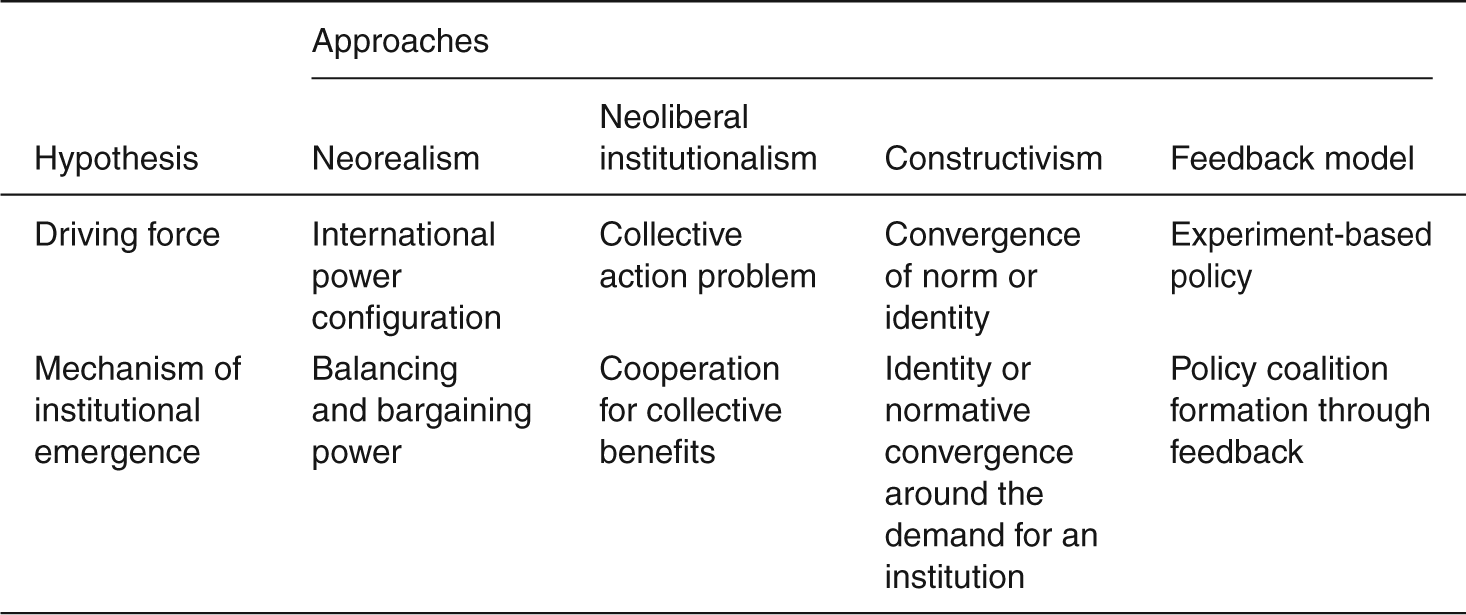
Approaches to the origin of multilateral diplomacy
Realist hypotheses
Neorealist approaches trace institutional origin to powerful states that often treat institutions as convenient tools of statecraft (Grieco, 1997; Gruber, 2000; Hurrell, 1995; Waltz, 2000). International material structure or power configuration is their primary focus. At least three neorealist arguments attempt to explain the genesis of China’s proactive multilateral diplomacy: bargaining power, balancing, and counter-containment (Christensen, 1999; Goldstein, 2005; Medeiros, 2007; Organski and Kugler, 1980; Sutter, 2005). First, the bargaining power thesis is that China’s increasing relative material power allows it to gain more self-confidence and thereby create multilateral arrangements in its favor. In other words, the increasing bargaining power vis-a-vis the developing world could provoke China’s multilateral activism. Second, the realist balancing argument maintains that China uses multilateralism to counter American hegemony or its allies’ and promote multi polarization of the international power structure. From this perspective, Beijing-centered regional multilateral arrangements are South–South coalitions against the West. Third, the counter-containment thesis stresses Beijing’s defensive move that aims to reduce the intention of other countries to contain or hinder China’s resurgence. In this view, China’s multilateral diplomacy seeks to create a favorable international environment in which the US and its allies cannot work in concert with the developing countries to contain Chinese power.
Such neorealist hypotheses have some explanatory power but are ultimately incomplete. The main problem of the bargaining power thesis is that at least conceptually the logic of increasing material power can go in two opposite directions. Increasing power might allow actors not merely to value but also to devalue multilateral diplomacy (as in the case of US unilateralism under the Bush administration). The degree of material power cannot point to any particular policy direction. In addition, both the balancing thesis and the counter-containment thesis also have problems with explaining why China chose to create new regional multilateral forums. New Beijing-led multilateralism is not the only way to counter US hegemony or the US-led encirclement against China; nor was its emergence inevitable. There are at least three possibilities: revitalizing the existing South–South multilateral mechanisms such as the Group-77, reinforcing its bilateral relationship with individual developing countries, and creating nothing durable (a passive wait-and-see approach). If several outcomes were possible, why did new multilateralism become a prominent vehicle for Chinese foreign policy? China’s long-standing preference for bilateral approaches and its deep-seated suspicion of multilateralism could have led China to focus solely on its traditional method of bilateral diplomacy. 15 China, however, pursued not only traditional bilateral diplomacy, but also new multilateral diplomacy.
Moreover, another problem with the neorealist hypotheses is that they do not solve the puzzle of the timing of policy change. It is not untrue that ‘promoting multipolarity’ and ‘democracy in international relations’ are phrases for China’s collective soft balancing against US hegemony as the balancing thesis suggests. It is also correct that some Chinese realists have been concerned about possible containment against China. It is important, however, to note that Beijing’s declaratory objective of ‘multipolarization’ and its concern about the US containment strategy have remained largely constant over recent decades. Such constant variables cannot completely explain why China’s proactive multilateral diplomacy toward the developing world began to emerge in the early 2000s but not earlier. Why was China reluctant, if not opposed, to promote regional multilateralism in the early and mid-1990s despite its declaratory goal of ‘multipolarization’ and concern about encirclement particularly after the 1989 Tiannanmen incident? 16
Neoliberal hypotheses
Neoliberal institutionalism supposes that states pursue their interests by creating institutions to deal with growing interdependence and to solve collective action problems (Keohane, 1984; Koremenos et al., 2001; North, 1981; Williamson, 1985). In the neoliberal view, institutions reduce transaction costs, enhance information about preferences, monitor compliance, facilitate issue-linkage, and offer focal points. Higher levels of interdependence or trade increase the demand for institutional solutions. Interdependence or globalization is obviously part of the answer, but exactly how this structural variable works is less obvious. Many scholars may agree that growing interdependence or globalization demands new forms of global governance. The perceived institutional vacuum created by US unilateralism and the WTO Doha round deadlock arguably heightened the need for alternative institutions. However, through a functionalist turn, the need for new institutions cannot adequately explain why China takes one particular form over another. Why did Beijing create new regional multilateral forums instead of other possibilities — such as working with existing global multilateral institutions or transnational private actors? This type of explanation also fails to explain why and how top Chinese leaders could head off realist hardliners who believed that multilateralism could constrain China in favor of potential adversaries.
Constructivist hypotheses
For constructivists, preferences for multilateralism and institutional origin can be traced to converging norms, identities, and legitimacy (Barnett and Finnemore, 1999; Elster, 1989; Klotz and Lynch, 2007). The causal role of normative and ideational structure is usually constructivists’ primary focus. While constructivist studies tend to focus on analyzing institutional design and effects (or normative diffusion through institutions), they leave unanswered the questions of whether and when normative convergence demands the creation of institutions (Solingen, 2008: 265–266). And when it comes to empirical studies, systemic constructivist approaches are more common than micro-level constructivist analyses. 17
A prominent constructivist thesis is that the collective identities of developing countries or the Third World encouraged China to create the developing (or the Third World) countries-only grouping in the form of multilateral forums. In this view, the shared experiences of being exploited under colonialism, imperialism, and lately hegemonism facilitated China’s drive to create new multilateral arrangements. While this is plausible, neither theory development nor rigorous empirical studies have been done to demonstrate the causal linkage between the collective identity of leading states and institutional genesis. 18
Another constructivist variant is that normative convergence may influence Beijing’s preference for multilateralism. What is called the ‘Beijing Consensus’ can be a good example of this. According to Joshua Cooper Ramo (2004), China began to find itself in a position of serving as a role model for other developing countries. China’s emphasis on a pragmatic, flexible, and step-by-step approach, as opposed to an ideological, universal, Washington-knows-best approach, can engage the developing world in the 21st century. However, there is little empirical evidence to support that the collapse of the Washington Consensus and the rise of the Beijing Consensus — normative structural change — has led Beijing to pursue multilateral options. Rather, one cannot rule out the possibility that new common norms or values such as the Beijing Consensus may have developed as a result (rather than a cause) of the evolution of the Beijing-centered multilateral institutions, an issue that can be settled through future empirical studies.
Cognitive feedback model
This section discusses the cognitive feedback model to complement structural explanations of the Chinese multilateral offensive. The cognitive feedback model highlights non-linear interaction processes in which causation is mutual or circular rather than one-way, as it is in most dominant IR theories (Jervis, 1998). Feedback can be positive or self-amplifying when a change in one direction creates reinforcing pressures that lead to further change in the same direction. This positive feedback is similar to the concept of ‘increasing returns’ whereby actors reinforce the dominant logic, and the costs of switching to alternatives are heightened (Pierson, 2000; Thelen, 1999). Feedback can also be negative or dampening when the change sets in motion forces that counteract the initial change and return the actors and institutions to something like their original position. 19
Cognitive feedback effects can occur on the organizational level. When the policy proposed by actors receives positive feedback, their political legitimacy and influence may increase within the government. Accordingly, their ideas are more likely to contribute to state policy. Conversely, when actors’ policy ideas are seen as responsible for failed policies, they will lose their political legitimacy and influence. Thus their ideas become less salient within the government (Jervis, 1976). In this respect, the feedback mechanism is a political as well as a cognitive process. Ideas can help determine the balance of power among competing coalitions within the government. In other words, ideas can shape policy coalitions through cognitive feedback effects as well as the distributional effects of policies. 20
As Figure 2 shows, three permissive conditions (or ‘contributing causes’ which may or may not be a necessary condition but favor an outcome) can influence the salience of cognitive feedback dynamics within the government: (1) international power (or policy autonomy from external powers); (2) interest (or distributional implications); and (3) norm (or convergence around policy experimentation). These three conditional variables can facilitate or frustrate the cognitive feedback dynamics developed in this study. First, coercive external intervention can delay or nullify cognitive feedback effects. Conversely, policy autonomy from external powers is more likely to enable the feedback model on the organizational level. One may posit that powerful states like China might be in a better position to feed their earlier experiences back into their grand strategy formation than smaller states that are relatively more vulnerable to coercive external intervention or pressure. Second, the perceived distributional effects of a particular policy can affect the prominence of cognitive feedback dynamics. When the perceived distributional implications are clear, the independent role of policy ideas would become marginal or simply a by-product of material interests. When the domestic distributional effects are unclear to most actors, however, the cognitive feedbacks become more relevant and salient. It is conceivable that the domestic distributional effects of the Beijing-led regional institutions might be relatively unclear or marginal. It is in part because less transparent information about the foreign policy of the Chinese authoritarian state makes it relatively more difficult to establish well-grounded predictions about distributional results, for example, when compared to the trade policies of liberal democracies. Greater costs of recognizing distributional outcomes might decrease overall incentives of interest groups to mobilize for (or against) particular policies, and thereby give more room for policy ideas to shape debates and coalitions. Third, the presence of domestic norms favoring experiment-based policy formation can also facilitate feedback dynamics within the government. The absence of such norms can make feedback far less prominent in foreign policy formation. As will be discussed below, the Chinese norm of the tried-and-tested novel approaches contributed to increasing the probability of feedback dynamics in Chinese foreign policy.

Cognitive feedback model
Despite similarities between the proposed cognitive feedback model and the literature on epistemic communities and constructivism, there are significant differences as well. Like constructivism, the cognitive feedback model disagrees with the rationalist assumption that preferences are structurally determined, and thus exogenous. The cognitive feedback model thus joins constructivism in emphasizing the independent role of ideas held by actors in shaping state behavior. The feedback model differs, however, in some important respects. Most of the literature on epistemic communities and constructivism tends to highlight the convergence of ideas such as ‘common or consensual knowledge’ or ‘international norms’. The cognitive feedback model, however, does not disregard the contestation of ideas within and between states. From this perspective, states can reinterpret and resist ideational teaching from the outside. Moreover, unlike other prominent ideational frameworks, the cognitive feedback model necessarily entails neither ‘exogenous shock’ nor ‘crisis-defining ideas’. 21 In the case of Chinese multilateralism, there was no obvious crisis (or setback) that could provoke a domino effect of opinions in favor of change. The cognitive feedback model envisions that institutional emergence and choice (popularly known as ‘forum shopping’) is neither always designed by far-sighted entrepreneurial agents nor preordained by exogenous crises. Incremental and experiment-based change or consolidation is more prominent within the cognitive feedback framework.
Evidence on the cognitive feedback mechanism
Assessing cognitive feedback effects in China’s multilateral diplomacy
Yan Xuetong (2005), a renowned realist and director of the Institute of International Studies at the Tsinghua University, claimed that ‘the year 1996 was a watershed [fenshuiling], in which China began to actively take part in multilateral activities. In 2000, multilateralism became dominant.’ Even realist hardliners at the People’s Liberation Army (PLA), who were skeptical of multilateralism until the mid-1990s, came to acknowledge that multilateral diplomacy gained its dominant hold in Chinese foreign policy in the 2000s. In 2001, for example, Meng Xiangqing (2001: 26–30), a senior colonel of the PLA and professor of the Strategic Studies Center at the PLA National Defense University, argued that ‘[China’s] participation in multilateral security cooperation is no longer a matter of choice [xuanze de wenti]. It is an inescapable objective reality [wufa huibi de keguan shishi] … and [China should] consider how it can contribute to multilateral institutions … take initiatives and participate in the formulation of “the rules of the game [youxi guize]”.’ This is largely consistent with the findings of some content analyses on multilateralism and multilateral diplomacy in Chinese discourse. 22
What happened to China in the second half of the 1990s? China’s positive evaluation of earlier multilateral diplomacy in the Asia-Pacific allowed China to feel more confident and comfortable with the idea of new Beijing-centered multilateral forums and ties in both Asia and the non-Asian developing world. As Tang Shiping (2004: 18), a former policy analyst at the Chinese Academy of Social Sciences, put it, China’s participation in regional multilateralism created ‘a self-reinforcing virtuous cycle propelling China’s regional strategy’. According to Tang, ‘positive policy outcomes from the ASEAN Regional Forum (ARF), 10+1/10+3, and the Shanghai Cooperation Organization have all strengthened the voice of integrationists or institutionalists, leading to calls for more active participation in regional multilateral initiatives’.
Increasing numbers of Chinese foreign policy analysts began to recognize the benefit of China’s earlier multilateral diplomacy. In the view of Yue Xiaoyong (2005), a researcher of the State Council Research Office, for instance, China’s promotion of multilateralism diffused the ‘China threat’ perception and thereby created a favorable environment for China’s development. Likewise, Yan Xuetong (2005) also emphasized that China’s multilateral diplomacy contributed to consolidating China’s reputation as a responsible great power and a favorable external environment for China’s rise. Similarly, other Chinese policy experts (Liu, 2004: 26–31; Zhang, 2006: 51–52; Zhao, 2007: 150–157) also believed that China’s multilateral activism helped to achieve its declaratory core objectives (or official guidelines for Chinese foreign policy) — maintaining a peaceful international environment; avoiding containment or isolation; securing access to markets and materials; and advocating the ‘democratization of international relations’ (or multipolarity). 23
According to some Chinese interviewees in a Shanghai-based policy community, 24 those who initially advocated the idea of proto-multilateralism gained more credit and attention from the top leadership who became increasingly convinced that proactive multilateral diplomacy would serve China’s own national interest. As these proto-multilateral activists were perceived to be responsible for policy success, they could exert even more political influence within Chinese policy circles and have been continuously encouraged to offer creative policy ideas to the Chinese leaders since the late 1990s. 25 The opinions of pro-multilateralists were also allowed to appear more frequently in the government-controlled media such as the People’s Daily, thus significantly increasing the visibility and influence of their voice in public policy debates in the 2000s (see Figure 3). There was a sharp increase in the number of the articles in the People’s Daily on multilateralism in the mid-2000s. 26 Notably, around that time, a few Chinese foreign policy experts who had been supportive of or at least receptive to multilateral activism began to take up top positions in government-sponsored (or-controlled) institutes. They include Ma Zhengang, Director of the China Institute of International Affairs; Mei Ping, President of the China National Committee for Pacific Economic Cooperation (CNCPEC); Zhang Yunling, Vice President of CNCPEC; and Yang Jiemian (brother of Yang Jiechi, the Chinese Minister of Foreign Affairs), President of the Shanghai Institute for International Studies (SIIS).
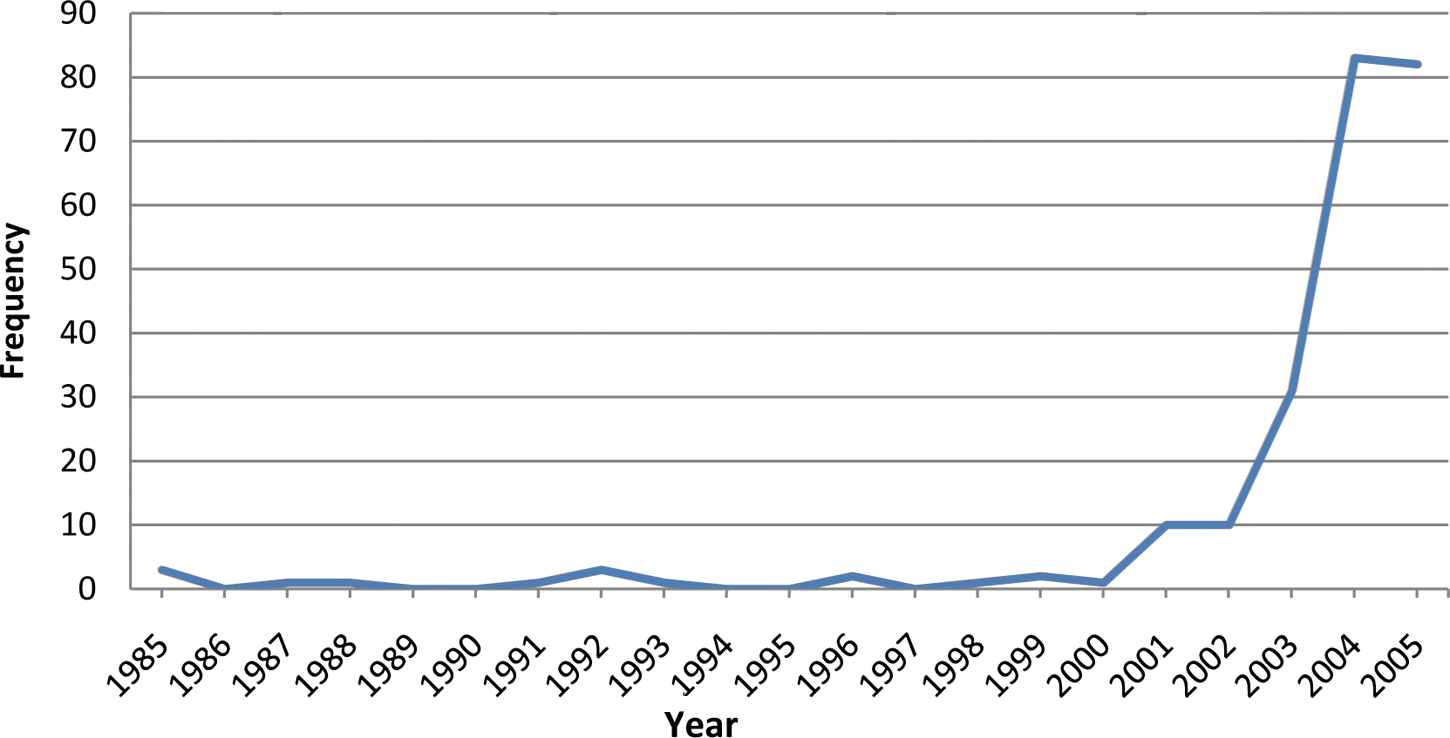
The frequency of the word ‘multilateralism’ in the People’s Daily
More specifically, China’s earlier experience of the ARF and the Shanghai Five (which became the Shanghai Cooperation Organization in 2001) were critical for the Chinese feedback on multilateralism and subsequent multilateral offensive in the developing world. China’s experimentation with multilateralism began haltingly and initially with states on China’s Asian periphery (zhoubian guojia), spilling over into other regions’ developing countries in the 2000s. In 1994, China joined the ARF, a multilateral security body. There was a considerable change in China’s attitude toward regional multilateral security cooperation from outright rejection or suspicion in the early 1990s to active support in the late 1990s through China’s positive experience of the ARF (Foot, 1998; Johnston, 2008; Liu, 2005; Zhang, 2006). Beijing’s incremental involvement in the ARF appears to have helped to produce a small community of Chinese pro-multilateralists. They included multilateral specialists in the Ministry of Foreign Affairs (MOFA) and moderate voices in the Chinese policy community. Susan Shirk, a leading China expert and organizer of some of the multilateral security dialogues in the region has provided an insider account on the emergence of pro-multilateralists in the MOFA. According to Shirk (2007: 110), after participating in ARF meetings and other multilateral dialogues, Fu Ying and Wang Yi (then head of the Asia Department in the MOFA) became leading MOFA supporters of multilateralism in China’s Asia policy. The MOFA ARF diplomats keenly recognized the usefulness of multilateralism, and sometimes even helped other states to frame ARF proposals in ways that would make these more acceptable to the Chinese leadership (Johnston, 2008: 181). The MOFA advocates of multilateralism also asked some of the leading Chinese IR scholars (including Wang Yizhou and Zhang Yunling) to prepare reports in order to make more theoretically sophisticated arguments and thereby persuade skeptics in the Chinese government, particularly in the PLA, of the value of multilateral diplomacy (Johnston, 2008: 173–175).
In addition to the ARF, the Shanghai Cooperation Organization (SCO) has also expanded the Chinese constituency of pro-multilateralists. In 1995, China initiated the Shanghai Five dialogue — including China, Kazakhstan, Kyrgyzstan, Tajikistan, and Russia — to discuss Confidence-Building Measures (CBM) along their respective borders. As many observers note, the SCO is more an unintended outcome of practice rather than design. Neither China nor the other members had foreseen the transformation of the Shanghai Five dialogue into a formal multilateral institution (Wang, 2008). The Shanghai Five was initially created to be bilateral rather than multilateral. The first two CBM agreements were signed between China on the one side and Russia and three Central Asian countries on the other side. At the summit in 1998, however, the bilateral talks formally became multilateral talks among member countries. This bilateral meeting mechanism was eventually transformed into a formally institutionalized structure in the early 2000s. This institutional evolution is related to Beijing’s policy experimentation with the so-called ‘new security concept’. This concept is characterized by notions such as ‘common security’, ‘cooperative security’, and ‘comprehensive security’ according to the Chinese official interpretation (PRC, 2002). Some Chinese analysts (Liang and Zhao, 2001) regarded Beijing’s ARF experience as contributing to a better understanding of a counter-realpolitik notion, namely, the ‘new security concept’. This new government idea, emerging in late 1997, encouraged Beijing to implement novel security policies ranging from a confidence-building bilateral dialogue and a non-governmental dialogue to a multilateral security institution (PRC, 2002). In 2000, then-Chinese President Jiang Zemin claimed that the purpose of the SCO was not merely to promote China’s friendly relationships with member countries, but, more importantly, it was an experiment to explore a ‘new interstate relations, new security concept, and new model of regional cooperation’ that goes beyond the Cold War mentality (Yu, 2003: 29). Accordingly, Beijing tried out new policy instruments, that is, the multilateralization and institutionalization of the Shanghai Five dialogue. The charter and secretariat of the SCO, the SCO Regional Anti-terrorism Structure, and the SCO Business Council and Interbank Association have been established under Chinese leadership.
This experiment-based multilateral diplomacy generated positive feedback dynamics within the Chinese government. In the Chinese view, the SCO contributed to creating a more peaceful and favorable regional environment for China’s economic development, resolving border disputes, managing new sources of threats — terrorism and separatism — reducing China threat perceptions, offsetting the influence of outside major powers, and providing a platform for China to implement its new security concept (Fang, 2004, Pang, 2001; Wang, 2008). The perceived success of the SCO could further strengthen the influence of Chinese multilateral activists and make the SCO become a model for China’s subsequent multilateral diplomacy. As Fang Changping (2004: 51) at the Renmin University of China noted, Beijing’s experience of regional multilateralism (diqu duobian zhuyi), such as the ARF and the SCO, built a solid foundation for promoting multilateralism at the global level (quanqiu cengci shang de duobian zhuyi) in the early 21st century. Some Chinese multilateralists used the positive results of the experimental policies regarding the ARF and the SCO in order to overcome opposition from realist skeptics of multilateralism. 27 Building on its experience of multilateral diplomacy in Asia, China could extend its reach beyond neighboring areas and actively pursue multilateral and institutional options in Africa, the Middle East, and Latin America (Su, 2006) — ‘having a foothold in [Asian] neighboring areas [lizu zhoubian], moving toward other continents [tuixiang gezhou], and constructing regional institutional platforms [goujian quanfangwei de quyu zhidu pingtai] all over the world’ (Liu, 2005: 40).
There is also evidence that positive feedback dynamics occurring in the early 2000s continued to reinforce China’s experiment with multilateralism in the non-Asian developing world. The origin and evolution of the China–Arab Nations Cooperation Forum (CACF) also features feedback mechanisms. Rajab Mohammed Sukayri, the former Jordanian Ambassador to China, presented an insider account of the establishment of the CACF. The initial idea of the CACF was floated by the Committee of Arabic Ambassadors, a standing consultative platform between Arab countries and Arab league representatives, in China in the fall of 2000. The preliminary evaluation of the Forum on China–Africa Cooperation Form (FOCAC) in 2000 influenced the creation of the CACF. All members of the Committee of the Arabic Ambassadors agreed on the need to have a FOCAC-like platform between Arab states and China, and that the FOCAC was a litmus test for the prospect of the China–Arab multilateral forum. Sukayri (2004: 3) said, ‘both Arab and Chinese sides shared the idea that the success or failure of the Forum on China–Africa Cooperation Forum (FOCAC) would determine the fate of the China–Arab multilateral forum’. It turned out that China and African countries made a preliminary yet positive assessment of the implementation of the Communiqué of the FOCAC and the Action Plan of the FOCAC 2000–2 (Xinhua News Agency, 2003). The perceived success of the FOCAC thus contributed to reinforcing China’s drive to create and expand its multilateral ties with other regions’ developing countries, including the CACF. In other words, actors’ evaluation of an institution at time t appears to have an effect on actors’ preference about other institutions at time t + 1.
Congruence of domestic and foreign policy processes
China’s incremental and flexible method of foreign policy innovation at the international level is largely consistent with its method of economic reforms at the domestic level. During the post-Mao period, Deng Xiaoping and other powerful leaders employed risk-minimizing and experiment-based approaches to modernization (Heilmann, 2008). The phrase ‘seeking truth from facts’ and the slogan ‘crossing the river by groping for the stones’ represent the idea of Chinese-style policy experimentation. This policy process enabled local officials to generate policy innovations and then feed local experiences back into national policy formulation. ‘Model experiences’ (dianxing jingyan) emerging from initial local experiments were disseminated through media coverage and high-profile conferences to more and more regions. Extensive experimentation was undertaken in a variety of issue areas such as private business restructuring, state-owned enterprise reforms, financial reforms, and rural de-collectivization (Chung, 2000; Naughton, 1996; Shirk, 1993; Zweig, 2002).
Policy experimentation is also an important element of the regime survival strategy of the Chinese Communist Party (CCP). That is what Kenneth Lieberthal (2001) terms ‘dynamic stability’ (as opposed to static stability) — a system whereby the leadership recognizes the need to constantly and incrementally adapt and change and thereby generates a kind of stability. This experiment-based policy making seems to date from the revolutionary experience of the CCP. According to Heilmann’s (2008: 8) finding, Mao Zedong believed that ‘policy implementation, not policy debate, provided the crucial device for learning and innovation’. Mao, who was skeptical of one-size-fits-all approaches, emphasized an experiment-based method, that is, first gaining experience in a small number of selected sites and then spreading the local experiences to larger areas. Despite the ambiguity of the Great Leap Forward and Cultural Revolution period when policy experimentation was not suffocated but distorted by standardized implementation, post-Mao leadership continued to advocate the principle of policy experimentation.
There are noteworthy parallels in policy experimentation between domestic and foreign policy processes during the post-Mao period. This point seems to be not sufficiently highlighted by students of Chinese foreign policy. Like Chinese domestic policy formulation, Chinese top leaders encouraged foreign policy makers and experts to try out new ways of problem-solving and then feed earlier experiences back into Chinese grand policy formulation. As discussed above, since the proto-multilateral activists were perceived to be responsible for policy success, they were continuously encouraged to offer creative policy ideas to the Chinese leaders and became more influential from the late 1990s. The domestic norm of Chinese policy experimentation, one of the permissive conditions for cognitive feedback, helps to explain the salience of feedback mechanisms in Chinese foreign policy. It is not inconceivable that China’s shared norm of policy experimentation provides an important ideational foundation for generating novel policy instruments, that is, Beijing-centered regional multilateralism in order to adapt to a rapidly changing international environment.
Conclusion
China’s active multilateralism is gradually evolving. Although Chinese leaders have core strategic goals in mind, they have been groping their way forward with experiment-based multilateral diplomacy. The Beijing-led regional multilateral institutions have been driven more by unforeseen cognitive feedback dynamics than sophisticated design by far-sighted agents. As mentioned above, China’s multilateral activism began to pick up momentum through positive feedback effects in the late 1990s, leading to further expansion in the developing world in the early 21st century. 28 However, the cognitive feedback model does not exclude the possibility that China’s positive feedback can be ultimately replaced by negative feedback. One may suppose that Chinese realist skeptics will become more influential and thereby China’s multilateral activism will decrease as negative feedback occurs in the future. 29 One can also imagine that positive and negative feedback could operate simultaneously. China’s multilateral offensive can set off positive feedback in one geographical or issue area and negative feedback in another.
It also remains an open question whether China’s multilateral offensive will generate counterbalancing forces at the international level. Japan’s recent efforts to bring together the heads of African countries in Tokyo might be seen as a sign of emerging soft counterbalancing forces that aim to retard or reverse Beijing’s multilateral expansion. 30 At the same time, however, there is another possibility that world politics of the 21st century will exhibit negative feedback against the rise of a hegemon but positive feedback in response to multilateral cooperation by a re-emerging power. In other words, the current global system may be stable against the force of offensive multilateralism; China’s proactive multilateral diplomacy might continue to be well received by others in world politics.
As Etel Solingen (2008: 266) aptly points out, conditions leading to the genesis of an institution may not necessarily account for its design and efficacy, which are subsequent dimensions of institutional life. Future research needs to address the design and efficacy of the China-centered regional institutions. How different are the rules and procedure of the China-led regional institutions from those of European and American ones? What is the impact of the Beijing-centered regional institutions on international stability and cooperation? Like the United States in post-war international institution building, 31 will China inject the character of the Chinese polity and worldview (or the ‘Beijing Consensus’) into international order building in the 21st century?
Built on the empirical findings presented, this study makes the proposition that cognitive feedback dynamics can be influenced by three conditional variables: power (or policy autonomy), interest (or distributional effects), and norm (or convergence around experimentation). This is not to say that the presence of these factors is sufficient for all types of cognitive feedback dynamics across time and space. Instead, this study claims that they can illuminate the probability of cognitive feedback mechanisms in foreign policy. In other words, this study aims to identify specific conditions in which cognitive feedback dynamics are more likely to be salient in foreign policy making, as well as conditions in which they are not. In general, it could be argued that the proposed cognitive feedback model can complement realist, liberal, and constructivist accounts by identifying micro-level dynamics in which social cognitive processes interact with political and material factors in preference-formation. Since the cognitive feedback mechanism alone cannot determine policy outcome, it is fair to say that the cognitive feedback model remains better at explaining process than predicting outcome. Yet, explaining process is not insignificant. It shows the causal mechanism at work when outcomes correspond to more than one theory and hypothesis. Furthermore, the cognitive feedback model can help researchers to get around the problem of tautology that assume intentions from outcome (post-hoc reasoning). By separating out intentions from policy outcome and paying attention to the unfolding of events, this process-oriented approach may reduce the tendency to tell ‘just so’ stories to justify a well-established outcome. Telling new stories about the evolving phenomena of China’s multilateral offensive would be useful for our theoretical debates over power transition. China is a moving target with strong learning or adaptation capacity.32 International structures, whether material or ideational, might condition China’s choice, but cannot determine it. The cognitive feedback model highlights the importance of research into Chinese internal debates and reflection on their own policies. Hopefully this cognitive feedback approach can contribute to a growing body of theoretically informed empirical work on the international behavior of the ‘reflective dragon’ and its implication for international order after China’s renaissance.
Footnotes
Acknowledgements
The author would like to thank Taylor Fravel, James Reilly, Jonathan Monten and several anonymous reviewers for useful comments and suggestions, and Vic Li and Arthur Wang for their research assistance. The research for this article was supported by the General Research Grant (HKU 750809H) on ‘The Genesis and Design of China-centered Regional Institutions in the Developing World’.
1
Chinese policy-makers and analysts often perceive China’s rise as a ‘renaissance’ (fuxing) or ‘rejuvenation’ (zhenxing). China’s economic resurgence is probably the most spectacular aspect of the renaissance. Until the mid-19th century, China accounted for over 30 percent of world GDP, gradually slipping and dropping to less than 5 percent of world GDP in 1950 (Maddison, 2008).