



Abstract
The academic environments of risk analysis and security studies had hardly ‘spoken’ to one another until recently. The two fields of study were defined within different academic disciplines: security studies a matter for International Relations (IR), and risk studies a matter for sociology, economics and the natural sciences. Increased focus on catastrophic events (terrorism, climate change, etc.) seems to have given the fields of security studies and risk analysis a common empirical theme and highlighted the need for a common research agenda. This article explores the intersection between these two fields of study, as it investigates how the ‘old’ disciplinary debates on risk have been translated ‘into’ security studies — to predict, criticize or evaluate the current political practice of security. Such analysis provides a much-needed overview of the risk debates within security studies and brings out the limits of this debate in light of the broader and much more historically settled risk debates within sociology, economics and anthropology.
Introduction
Since the emergence of the concept of risk in the 16th century, and especially with the much later institutionalization and professionalization of the field of risk analysis in the 1970s, companies and governments have increasingly approached prudence and threats in terms of risk. As a tool for calculation, risk analysis rendered the rationalization of fears and dangers possible. Although terrorism and war have long been considered corporate risks, the history of the concept of national security has developed largely independently of the concept of risk and risk management. While the concept of risk helped describe the market of the economic firm, the concept of security has been closely tied to the survival of the state and national politics.
The divergent histories of the two concepts are outlined in the respective academic debates on risk and security, which have hardly ‘spoken’ to one another. Until recently, the two fields of study were defined within different academic disciplines: security studies a matter for International Relations (IR), risk studies a matter for sociology, economics and the natural sciences. Nevertheless, an increased focus on terrorism, climate change and other catastrophic transnational threats appears to have brought the two fields of study closer together. The general argument is that these threats question the possibility of calculation and the means–ends rationality considered central to the concept of risk for centuries (Beck, 2003; Ericson and Doyle, 2004). 1 Accordingly, the focus on catastrophic events has given the fields of security studies and risk analysis a common empirical theme and highlighted the need for a common research agenda.
The current debate in IR journals outlines this development. As Figures 1 and 2 illustrate, there has been an almost explosive increase in published articles in which risk is a topic 2 and in the citations of these ‘risk articles’ within IR journals.
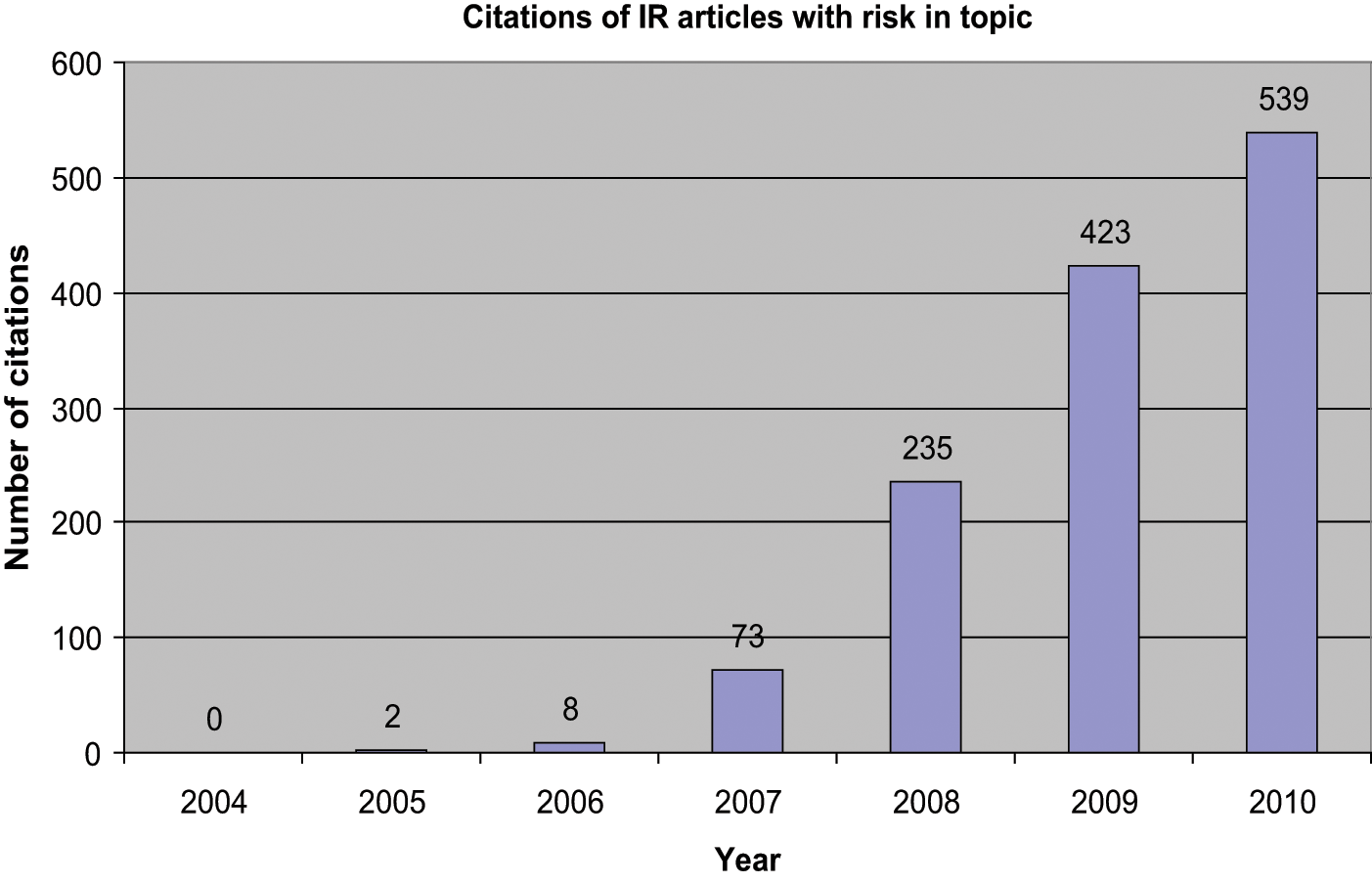
Citations of IR articles within IR journals with ‘risk’ in topic
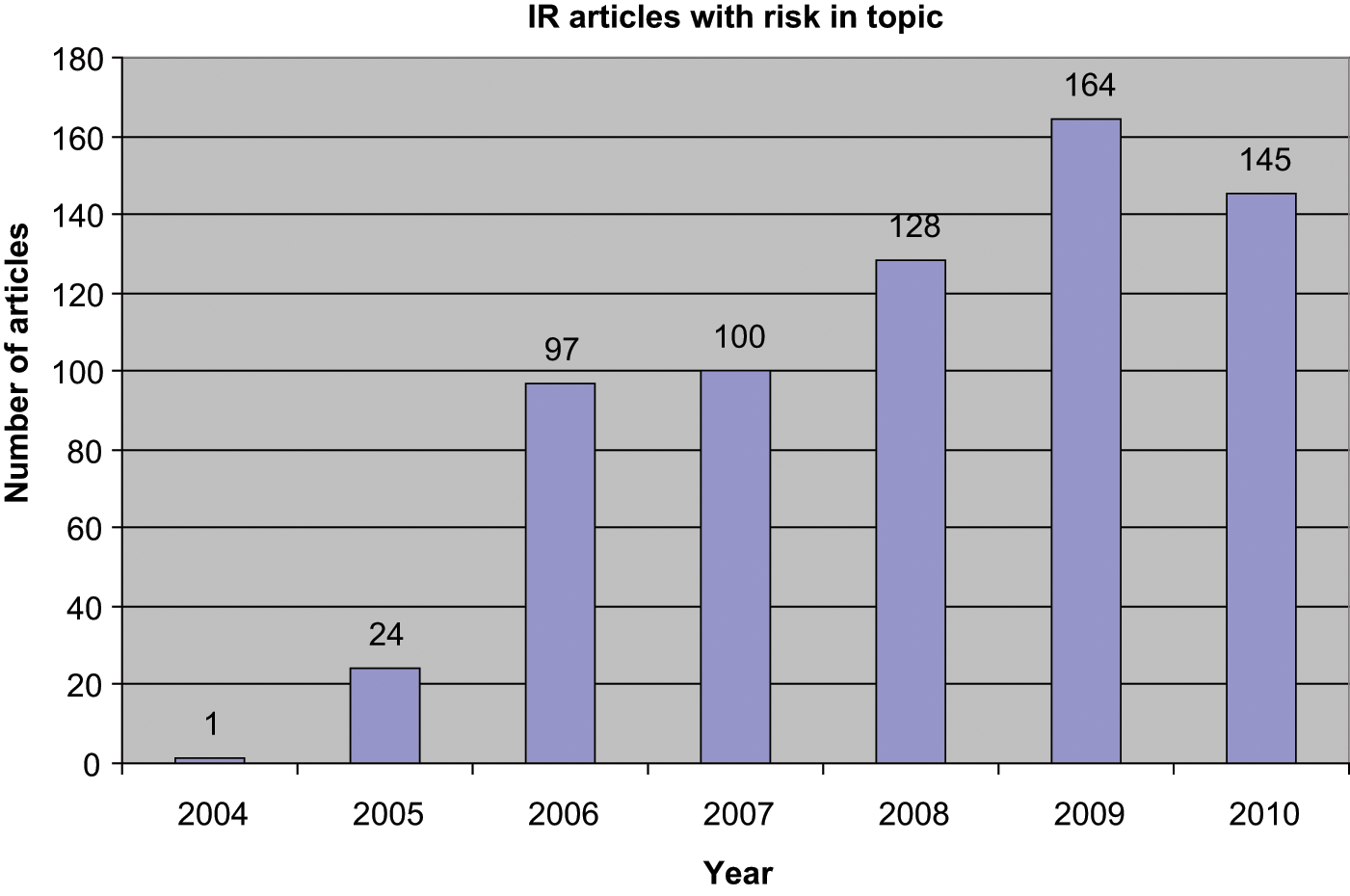
IR articles with risk in topic
Based on a systematic reading of these articles, it is possible to identify three schools. One school of thought, which I have termed ‘critical risk studies’, builds on the observation that ‘Within the academic field of international relations, the concept of risk has shifted security away from the register of war and violence generally associated with the concept of security’ (Aradau et al., 2008: 2). The alternative posed is a much broader study of risk governance and technologies that transcends the former categories of inside–outside, war–crime and military–police. A second group of scholars studies the risk practices of military establishments, claiming that risk analysis and management have come to dominate the international governance of war and catastrophes. Representing this understanding, Christopher Coker and Mikkel Vedby Rasmussen analyse how the risk management practices of calculation rule contemporary defence planning, moving it away from older, traditional ways of conceiving threats and security. Lastly, a third group of scholars studies the increasing relevance of political risk analysis, focusing on conceptualizing and mapping the risk of foreign operations, investments and markets; again having a different methodological standpoint from the two previous groups of risk scholars (cf. Jarvis and Griffiths, 2007).
What unites all of the approaches to risk within security studies is their attempt to make their particular understanding of risk and risk analysis relevant to security studies. Yet while these studies each want to represent risk studies, each approach also draws on only one small corner of the general risk literature: critical risk studies on the sociological governmentality literature; global risk management on Ulrich Beck’s interpretation of risk society; and political risk analysis on economic theory. The literature on risk in security studies does not discuss internal methodological differences and what consequences these have for science and politics. The debate on risk can thus hardly be described as a ‘debate’; to the extent that one could call it so, it is a debate occupied by positions that each ‘reads’ the general social science literature on risk in a very selective manner. 3
To show these differences and to discuss the consequences, the present article explores the intersection between risk and security studies as it investigates how the disciplinary concepts on risk have been translated ‘into’ security studies — to predict, criticize or evaluate the current political practice of security. Not only does such analysis provide the much-needed overview of the risk debates within security studies, it also discusses and brings out the claims to knowledge and politics made by each position. 4 This will be done by directing attention to the concepts of risk and the practices of definition involved in the different approaches to risk. Following British historian Quentin Skinner’s understanding of concepts as ‘mediums for shared understanding’ (Skinner, 1989), concepts not only represent but also constitute meaning and politics. The concept of risk is contingent on political action, and the practices of definition we turn to in our academic life therefore matter. In terms of security studies, this means that the concept of risk cannot be reduced to a mere description of a certain empirical political reality; rather, the concept must also be understood as a medium for defining the possibility of politics. 5
By examining the language of risk, I hope to show that the field of risk studies is broad and that each of the three main approaches to risk within security studies represents a particular interpretation of particular sociological and economic theories. Moreover, the article argues that risk studies within security studies cling to the very generalized descriptions of current social developments and trends; description such as ‘risk society’, ‘culture of fear’ or ‘risk/security dispositifs’ which tends to conceal a possibly much greater variety of conceptual understandings in the daily practices of security agents. It argues that we need a much more contextualized approach which is sensitive to the different uses of the concepts in order to grasp both new developments and potential for security politics. The relevance of such an approach is not limited to studies on risk, however, as it also extends to the Copenhagen School understanding of ‘securitization’, which suffers from a similar formal understanding of the concept of security.
In terms of structure, the article follows two paths: first, it introduces the broader academic field of risk studies within economic theory, cultural theory and sociology and discusses their respective conceptualizations of risk. The second part of the article examines the current debates on risk and security within security studies; how the traditional disciplinary debates on risk analysis have been translated and which conditions of knowledge and politics such translation prescribes. In conclusion, the article discusses the political and scientific limits of the different approaches to risk in security studies, arguing that how the discipline is currently set up constrains more than it enables the possibilities for recognizing political possibility.
Disciplines of risk — Economics, anthropology and sociology
Like most political concepts, the rise of the modern concept of risk must be understood in the light of its religious past. Where the concepts of ‘faith’, ‘sin’ and ‘destiny’ occupied the future by describing the irreversibility of present actions (moral or immoral), ‘risk’ in modern times has come to designate the possibility for change (Bernstein, 1998; Douglas, 1990: 4ff.; Giddens, 1990: 34; 2002). As American financial historian Peter L. Bernstein writes, ‘The revolutionary idea that defines the boundary between modernity and the past is the mastery of risk: the notion that the future is more than a whim of the gods and that men and women are not passive before nature’ (Bernstein, 1998: 1). Risk justifies decisions and political action; it is associated with abandoning old constraints and entering new and better futures (Douglas and Wildavsky, 1982; Luhmann, 1993). The rise of statistical methods and probabilistic thinking during the 17th century technified/ formalized the link between progress and risk; and with the rise of insurance, banking and investment risk became a calculable, quantifiable, classifiable and individualizable entity (Ewald, 1991; Hacking, 2003).
This understanding of risk as ‘measurable uncertainty’ was highly theorized in the 20th century when leading economists such as Frank Knight and John Maynard Keynes contrasted risk with the uncertainty of an everyday life characterized by events with no statistical history (Bernstein, 1998; Knight, 1921). Risk management, which was first established as normal corporate practice in the 1970s, took over the calculative scheme of insurance and aimed to estimate the probability and present economic value of future events.
Today, many risk scholars agree that ‘risk’ has come to refer to a broader range of everyday situations of uncertainty involving traffic, health, crimes, pollution and so on and subject to the regulation by governments, citizens and private companies (Adams, 1995; Beck, 1999; Dean, 1998; Giddens, 2002; Luhmann, 1993).
Although a general consensus exists with regard to the history of ‘risk’, the concept has been subject to much theorizing within a wide range of social science disciplines in current times; all emphasizing different aspects of its function in society and politics. In the following, I will concentrate on three of the core disciplines of risk. The first discipline of risk is mainly informed by economic and actuarial theory and represents what we would normally understand as the mainstream position within risk studies. In this approach, the argument is that risk can be measured and consequently controlled. The second discipline is the cultural theory represented by the British anthropologist Mary Douglas. For this approach, risk is a matter of selections which largely depend on cultural perceptions and worldviews. Finally, the radical constructivists within sociology argue that risk represents a modern discursive construction which is ever-changing due to constant political struggle and decision-making. It is obviously impossible to provide a complete picture of the disciplinary perspectives on risk. 6 The following presentation will also only highlight the central assumptions and claims about risk made in the literature. In the subsequent analysis of how these disciplinary perspectives have been translated within security studies, the single tenets and arguments will be thoroughly explained.
Economic approaches to risk analysis
The main concern in the economic approaches is how to anticipate and control future risks by taking the necessary preventive action. The methods associated with these approaches are statistical methods and economic models of risk (mostly cost–benefit analyses). Accordingly, it is a given in such approaches that risks can be classified, quantified and to some extent predicted, and that rational behaviour can help us manage — or perhaps even eliminate — risk. Risk perception studies have more recently come to occupy a central place in many of these economic risk analyses to better account for insecurities — to contextualize and thereby attain a fuller understanding of the means–ends relationship by, for example, including psychological explanations on human expectations or studies on different perceptions of probability (Covello, 1983). Likewise, the precautionary principle has been applied to describe a situation where the means–ends relationship is uncertain and decision-making is based on the idea of a pervasive uncertain future rather than an anticipated or known one (Fisher, 2001; Sand, 2000).
The economic approaches to risk assessment and management are far and away the predominant approaches within the so-called ‘practical field’ of risk analysis — practised by insurance companies, larger companies, consultancy firms and governments. Broadly speaking, two logics in particular define the practice of economically defined risk analysis; one represented in the actuarial literature and another relating to the practice of corporate or governmental decision-making (Cohen, 1996; Kolluru, 1995). 7
Insurance companies basically depend on statistics for settling the probability (frequency and severity) of an event and thereby setting premiums. They base their risk analysis on the many similar, past and ‘independent’ events 8 — on statistical methods and probability theory (Huber, 2002; Knight, 1921). In an insurance calculus, the criterion of success is the ability to trade and transfer risk. The main analytical work lies in representing the present and past as accurately as possible by registering the past developments for the purpose of future avoidance. Such statistical analysis tends to presuppose that the reality of the past will be reflected in the future (Knight, 1921: 225) and assumes a rather linear interpretation of the relationship between past and future.
Risk analysis conducted by companies, organizations or governments in their everyday decision-making, on the other hand, is often based on an investment logic aimed at assessing whether a given project or action is sensible and beneficial (Adams, 1995; Kolluru, 1995). Here, the concept of risk is positively related to the possibility of profit, but the central criterion of success is a good estimate of utility. A comparison of utilities is, as Ortwin Renn states, ‘the exchange rate’ enabling acompany or organization to compare different options with different benefit potentials; and thereby provides the background for the common risk decision-making tool: ‘cost–benefit analysis’ (Renn, 2008; Rowe, 1979, 1980). In these analyses, it is the unique events that possibly can happen due to the corporate operations and investments which are accounted for by categorizations of events and their probability. 9 Thus, similar to the insurance logic, the possibility of measurement, management and control prevails.
The 2001 terrorism events have been perceived as a major challenge to the economic logic of calculability, as it questioned the possibility of seeing future risk as a mirror of past events. The insurance industry was met by the challenge of how to calculate the premiums on terrorism insurance, not knowing what the future would bring (Huber, 2002; Knunreuther and Heal, 2003). In the same period, large companies became increasingly concerned by ‘thinking the unthinkable’ — trying to grasp the economic impacts of an uncertain business environment. In this context, Nassim Nicholas Taleb’s book The Black Swan became extremely popular (2008). Together these debates on new threats did challenge the calculus scheme of risk management, yet the aim remained one of organization, control and calculability — a question of how to preserve and develop the models of risk analysis to fit the new threat environment. Thus, unlike Ulrich Beck, this debate does not question the ontology and epistemology of risk in the economic discipline: risks are still out there to be tamed.
Cultural approaches to risk analysis
Whatever objective dangers may exist in the world, social organizations will emphasize those that reinforce the moral, political, or religious order that holds the group together. (Rayner, 1992: 87)
This quotation very precisely describes where the contribution of the cultural approach to risk lies. The cultural approach to risk is first and foremost associated with the works of British anthropologist Douglas, though Scott, Thomson, Lupton and Wildavsky have also been authoritative in defining this approach. Building on her earlier work in Purity and Danger, Douglas argues that risk presents itself as a neural decision-making instrument but works as a moral classification in the modern society that ensures and creates order and cultural identity. The approach is ‘cultural’ in the sense that how people select risk is considered to be socially embedded — depending on the world perspectives of social groupings, identity or institutions.
The object of analysis is culture and the shared meaning of risk and not, as argued in the economic approaches, some measured high or low probability. The aim is to understand how we select something as an irreversible risk, and the moral and political judgement involved in such selection (Douglas, 1966, 1992; Douglas and Wildavsky, 1982). According to Douglas, it is the institutional and social structures that shape risk perceptions, not any ‘actual’ amount of risk. As indicated by the subtitle of Douglas and Wildavsky’s book (1982), it is ‘the selection of technological and environmental dangers’ that matters politically — not how probable technical experts assess them to be (Douglas, 1992: 44). Although the claims to knowledge are defined within the paradigm of constructivism, many of the studies on cultural theory aim to explain patterns of risk behaviour. By creating a typology (a group-grid structure) on how different cultures and social groupings act differently towards ‘the same’ risk, for example, nuclear energy, climate change or GMOs, possibilities for political regulation and management are suggested (Gaskell and Allum, 2001; Kahan et al., 2010; Wildavsky and Dake, 1990: 42). Thus, unlike the sociological approaches treated below, cultural analysis explicitly aims to improve and manage our socially and culturally defined risks. Risk is not primarily a general description of modern society but is rather a description of local political choices and identities.
Sociological/radical constructivist approaches to risk
The sociological and radical constructivist approaches to risk tend to see risk as the most powerful contemporary concept in modern history, an essential part of the modern understanding of decision, progress and politics. As in cultural theory, risk is linked to the idea of political steering, yet the sociologists I will mention here are not occupied with cultural diversity and local practices, but focus on the risk practices of modern industrial and capitalist societies.
Studies inspired by Michel Foucault’s idea of governmentality, Niklas Luhmann’s study on risk, Ulrich Beck’s idea of risk society and Anthony Giddens’ analyses of modernity are all examples of such radical constructivist approaches in sociology (cf. Beck, 2002; Foucault, 1991; Giddens, 2002; Luhmann, 1993). The governmentality literature on risk is greatly influenced by the school of thought mainly associated with the writings of François Ewald, Richard Ericson, Mitchell Dean and Nikolas Rose. 10 Here, risk is considered a technology or practice that disciplines behaviour through the disciplinary means of calculation. Although Ewald’s studies of insurance and precaution do show how the political rationality of risk analysis has changed in modern times, the focus of most governmentality studies on risk is the increasing marketization and invidualization of political life (Ewald, 2002). These analyses often critically aim at revealing the more or less subtle neoliberal power structures at play in practices of risk analysis and management (Dean, 1999; Ewald, 1991; Rose, 2002).
Although Luhmann is best known for his system theory, his contribution to the sociological field of risk studies is primarily his historical analysis of the modern risk discourse, which he argues is defined by an economy of control, individualism and progress (Luhmann, 1993). Beck and Giddens are admittedly inspired by Luhmann’s analysis of the modern concept of risk, but argue that we have moved beyond such modernity and the strong belief in the opportunity to control, thereby adding a historical dimension to the understanding of risk. According to Beck, we have moved from a first to a second modernity; from a society with a perception of risks as calculable and manageable to a society based on uncontrollable and incalculable dangers that are direct effects of human action and technology (Beck, 1999). Thus, the risk society ‘designates a developmental phase of modern society in which social, political, economic and individual risks tend to escape the institutions for monitoring and protection in society’ (Beck, 1992: 5). Similarly, Giddens describes the transition from traditional to manufactured risks. Beck and Giddens argue that contemporary society acknowledges the limits of knowledge and science and that we have become reflexive in relation to our own risk production — something that is also envisioned in a precautionary rather than preventive approach to risk management (Ewald, 2002).
These different academic understandings of risk testify to the fact that risk studies are not a coherent discipline, but rather a pluralistic debate on the status of the concept (analytical or descriptive/constituting); on what constitutes the core features of the concepts of risk (measurable/non-measurable); and on the extent to which it is possible to grasp new socio-political developments and critically engage with society and politics without going beyond the ‘traditional’ scheme of management provided by economic theory. Within the economic literature, the concept has mainly been approached as an analytical category as defined by a clear distinction between risk as calculable events and other non-calculable dangers; risk is an academic or analytical tool for capturing future threats. In the cultural and sociological literature, on the other hand, the concept of risk is not an analytical category, but rather a political term used to capture socio-political developments.
Risk in security studies
During the 1980s and 1990s, the so-called security debate appeared more or less settled in the division between traditionalists and wideners (Buzan and Hansen, 2009; Buzan et al., 1998). This debate focused on the number and quality of the issues possibly constituting a security threat at a time where concerns about environmental degradation, the effects of globalization, drug trafficking and so on found their way to the top of the political agenda (Buzan et al., 1998: 2–5; Nye, 1988; Tickner, 1992; Ullman, 1983). As argued in greater detail later, ‘risk studies’ can be understood as taking place within this widening debate. However, one must recognize that these risk studies aspire to say something about social and political life in general — not international relations in particular. The debate on risk aims to broaden the scope of security studies and to go beyond the classical lines of division between political science, sociology and economics. Yet such interdisciplinary aims make it of principal importance to understand how the wider field of risk studies in the social sciences has been translated into security studies.
The following section will place and discuss how the field of risk studies places itself within the disciplines of economics, cultural studies and sociology and discuss the claims to knowledge and politics following from each such conceptual practice. The section is structured around the three dominant schools of risk in contemporary security studies: critical risk studies, global risk management and political risk studies. 11
Critical risk studies
Using the events surrounding 9/11 as the main starting point, the so-called critical risk studies seek to show how risk management decisions and security policies establish certain meanings of politics and political power. Unlike the two other approaches, which will be treated in greater detail below, the aim of these studies is not problem-solving, but rather to be critical. As the editors of a special issue of Security Dialogue on risk, Aradau, Lobo-Guerrero and van Münster set out to define this school of thought. The editors pose ‘the risk perspective’ as an academic and analytical alternative to the well-known, ‘old-fashioned’ studies on security — which are claimed to be stuck in ‘simple binary dichotomies of normality/exception and politics/security’ (Aradau et al., 2008). The alternative posed is a much broader study of risk governance and technologies that transcends the former categories of inside–outside, war–crime and military–police. Thus, these scholars have an overall political aim to liberate security studies from its focus on states and exceptional threats.
The empirical focus is on risk governance in the daily practices of governments and companies (Amoore, 2004; Aradau and van Münster, 2007, 2008; Kessler and Werner, 2008; Lobo-Guerrero, 2006, 2008; Salter, 2008). Examples are trafficking in women, terrorism insurance, migration, kidnapping and molecular biology. Highly inspired by the governmentality literature on risk, the critical focus is often directed towards the economic and neoliberal practices of risk analysis involved in contemporary security policies (see Salter’s work on airport security, Aradau and van Münster’s article on terrorism insurance and Amoore’s work on private security companies). By showing how the management of security is governed by neoliberal practices in the insurance market or private companies, these studies generally produce a number of insightful and provocative claims about how technologies of risk have come to take up increasing space in the struggle over how to define the field of security.
Seen from the perspective of the classical risk disciplines, the Foucauldian governmentality approach is taken as a baseline for the analytical strategy, often pointing to the disciplining power of the neoliberal logic ruling in the economic practice of risk assessment (Amoore, 2004; Amoore and De Goede, 2005; Salter, 2008). While these scholars engage critically in the risk society debate, they also share Beck’s critical perspective on the practice of ‘economizing’ risk in their critique of security studies and their attempts to envision new forms of political power. 12 Characteristic for most of this literature is that it constructs a concept of risk dispositif that works as a yardstick for comparing current risk practices and discourses. This ‘risk dispositif’ designates certain practices and discursive elements as fundamental to the modern understanding of risk (see e.g. Salter, Lobo-Guerrero, Muller, 2008), for example, calculability and present control of future uncertainties (Foucault, 2007 [1977]). In the descriptions of this dispositif, the authors draw heavily on Foucault’s (1977) work on security and Ewald’s work on risk (Ewald, 1991, 2002; Foucault, 2007 [1977]).
Such a conception of risk creates some methodological problems. First of all, the understanding of risk as counter-concept to security renders many of these studies non-responsive to shifting conceptions of either security or risk in the discourses of practitioners. The aim is not one of studying change in the current perceptions of security, but rather to explore the expansion of certain kinds of risk thinking (namely, modern risk thinking or precautionary logics). These predefined concepts of risk become like ‘frameworks for analysis’ or categories that are prescriptive for any possible envisioning of politics and change. The price is, however, an analytical blindness towards current political struggles, paradoxes and political alternatives. Political potential and alternatives remain instead an object of philosophical-theoretical judgement and not part of an active political engagement with current political struggles. 13 In the final part of this article, I argue that we must recognize that the governmentality of risk is not necessarily linked to neoliberalism as many critical risk studies tend to assume when taking on Foucault’s notion of security dispositif. By recognizing diversity in conceptual understandings, we can avoid privileging one discourse on risk and instead recognize the ‘imbrications of resistance and rule’ and thereby the contradictions and tensions present in any official neoliberal discourse (O’Malley, 1996: 311). Thus, an alternative way forward for critical risk studies would be to search for potential and possibility; to go beyond philosophical criticism and enlarge our horizons to the existence of different concepts, different cultures and different histories of risk (see Skinner, 2002).
A second and related critique of the so-called critical risk approach relates to the understanding of politics. At a superficial level, these scholars take the not-very-controversial, well-known standpoint that science is also politics and therefore that nothing is apolitical. Yet the normative aim is not only the post-structuralist aim of opening up what has already been closed — by, for example, confronting the naturalized distinctions of inside–outside, security–politics (Cochran, 1999). These scholars relate explicitly to the political strategy implied in any critical approach to security and point to the political performativity and responsibility of the security scientist. However, they do not have the same anti-foundational stance either, as they tend to define a priori the main political stakes in today’s world (Aradau, Münster, Lobo-Guerrero and Salter in particular). To declare that we must do away with the dividing line between inside and outside and the idea of the exceptional is to position oneself as having the authority to decide where the political stakes lie in today’s world (for a similar critique of Beck, see Douglas, 1992). By taking such a position, the role of science becomes one of prior political/philosophical judgement and not one of showing where the political stakes lie.
Global risk management
‘Global risk management’ is particularly inspired by Ulrich Beck’s Risk Society thesis and is represented in security studies by, for example, Christopher Coker, Yee Heng, Mikkel Vedby Rasmussen and Michael J. Williams. Despite their differences, these scholars agree that the concept of risk has taken over how we think about security; particularly our thinking on war and strategy. Coming from the perspective of strategic studies, they show how risk management practices have become a new means for dealing with a constantly changing security environment. Thus, also for these scholars, risk is defined through its relation to its counter-concept: security.
The understanding of risk expressed in this approach is greatly inspired by the works of sociologists Ulrich Beck and Anthony Giddens. Similar to the arguments of Beck and Giddens, history and transformation plays a major role in the argumentation of these scholars. Temporality appears in two ways: first, the past and future are articulated as a macro-historic transition from modernity to the second modernity — a move from security and nation state to risk and globalization. This development is inherently given by the modern form of organization (Beck, 1999). 14 Second, today’s risks are understood as self-generated. They are an intentional or unintentional effect of our own decisions (Beck, 1996: 11). This latter understanding of temporality closely relates to a particular understanding of history, as risk is understood as the driving force behind the transition from first to second modernity — the latter being characterized by the unintended effects of previous decisions. Like Beck, Rasmussen and Coker argue how reflexivity (a concept taken from Beck) has come to describe the post-9/11 world; a world in which ‘there is no one to give authoritative answers’; a world that ‘ceases to be modern and becomes reflexive about its own modernity’ (Rasmussen, 2004: 386). Altogether, the analytical aim of this approach is to describe the transition from one form of governance to another in order to understand the conditions of risk management as opposed to (as in critical risk studies) revealing the power structures implied in the everyday practices of risk (governmentality).
Similar to the position of critical risk studies, however, the concept of risk is argued to be becoming increasingly important to security studies — overtaking ‘security’ and ‘threats’ as the ruling concepts. Analysing NATO, Christopher Coker writes: ‘when we conceptualize security we do so in terms of risk itself. The language of danger has now turned into the language of risk’ (Coker, 2002: 60). And Williams writes, ‘The problem is that unlike a threat-based system, where obvious capabilities and intent make it easier for policy-makers to determine where threats lie, a risk-based mindset means that policy-makers must act with far less information’ (Williams, 2008: 66). Hence, a distinction between threat and risk is the baseline for understanding this approach; threats being quantifiable, specific and about intentions and means–ends rationality, while risk is about the unforeseen and not related to a specific incident (Heng, 2006: 12; Rasmussen, 2006: 1; Williams, 2008: 65–68). Thus, these scholars claim that we are now faced with risks that are less tangible than former ‘threats’; threats that are dealt with by taking pre-emptive or precautionary action This is the context in which Coker, Heng and Williams study how risk practices and techniques are increasingly pursued when dealing with new security issues (Coker, 2002; Heng, 2006; Williams, 2008).
The argument that the concept of risk has taken over security is somewhat similar to the concept advanced in ‘critical risk studies’ (treated above). Yet the claims to knowledge are very different. Coker and Rasmussen argue that the concept of security has become obsolete: that the new reality of global fears has rendered the concept of risk increasingly relevant to security/strategic studies. It has pushed the concepts of security and threat into the background (Coker, 2009; Rasmussen, 2006). Such claims rest upon empirical observations. For the global risk management scholars, research is aimed at contributing to a better understanding of contemporary threats and thereby assisting practitioners in their daily risk decisions. Although the main inspiration is undoubtedly Beck’s thesis on risk society, there are also aspects of the writings that are influenced by the claims to knowledge made in the economic literature, as the aim of these global management studies is often to optimize the decision-making process in the military establishment (see Heng, 2006). Risk studies should aim to ease the management of the risks that are less quantifiable and identifiable than before. As Rasmussen argues, reflexive security studies must focus on the management of new and constructed risks that do not respect state borders and cannot be dealt with by applying the means–ends rationality normally associated with security policies (Rasmussen, 2004, 2006).
Transformation is the ruling concept designating the concept of risk; the transformation from known to unknown futures, from measurable to non-measurable threats and from security to risk. The epistemology expressed in this approach may seem somewhat paradoxical, as it claims to be social-constructivist while sharing the problem-solving aim found in the economic approaches. Yet this position may reflect one particular reading of social constructivism — a reading which is also present in the writings of Beck. 15 Both Beck and Rasmussen defend a historical interpretation of constructivism, arguing that ‘we are living in an age of constructivism’ (Beck, 1999: 133). Constructivism not only represents a philosophy of science, but is also a historical phenomenon that can be dated (Rasmussen, 2001). Hence, constructivism (and reflexivity) is viewed as a cultural phenomenon characterizing the late-modern society — a society with a specific rationality differing from earlier and modern society. By applying this interpretation of constructivism, they expose themselves to the same criticism as has been directed at Jean-Francois Lyotards’ interpretation of post-modernity in particular, 16 as they ultimately argue that the social world is intersubjectively constituted but that they can view this ‘intersubjective constitution’ from a point outside history. By holding on to such a macro-historical interpretation of constructivism, however, these scholars are able to observe ‘risk’ as a social construction that must be solved by participating (politically) in its construction; for example, by pointing out new tools for management. Reflectivism becomes a matter of constructing a better security order; the aim of problem-solving can therefore be maintained. Thus, constructivism is more than an analytical strategy; it is a political strategy of engaging in the world of risk.
But there is also a more profound critique to be raised in relation to such a macro-historical and transformative approach to risk — a critique related to the political consequences of accepting the argument. Such a transformative approach raises the fundamental question about what (political and critical) role academia plays in this debate on shifting conceptions of risk and security. To quote Beck: ‘The decision whether to take a realist or a constructivist approach is for me a rather pragmatic one, a matter of choosing the appropriate means for a desired goal’ (Beck, 1999: 134). This can obviously be read as the ultimate consequence of recognizing that the selection of risks is a political affair as opposed to something to be carried out scientifically or objectively (Douglas and Wildavsky, 1982). Accordingly, the selection of risk is always an ongoing matter involving political and moral choices; choices that academics also make.
When adopting such a pragmatic approach to risk, however, we must remind ourselves that a study on risk and security is hardly ‘innocent business’. As Buzan et al. warned when considering the methodology behind an analysis of security: ‘Transformation is one but not always the most reasonable strategy for improving security’ (Buzan et al., 1998: 204). The transformative element at the core of the claims made by Beck, Rasmussen, Coker and Heng may (unintentionally) be politically problematic. These global risk management studies clearly argue that we are living in a risk society in which the character of the threat (or catastrophe) leaves us with no choice but to dramatically change how we conceive of security. In making this argument, however, they leave the normative questions of democracy and authority unanswered and unproblematized. 17 The ‘practice of constructivism’, which science ultimately also represents, is not followed by reflections on what we are doing in talking risk; or what use it has.
Political risk studies
Unlike the two other approaches, ‘political risk studies’ is not solely an International Relations approach, but is also commonly associated with business studies and theories. Moreover, contrary to the two other approaches, this approach openly aims at problem-solving and therefore does not attempt to critically read the practices of risk management.
‘Political risks’ (also sometimes referred to as ‘country risks’) refers to a special kind of risk that companies or governments run when making a direct investment in a foreign country. A political risk is often defined as ‘changes in the operating conditions of foreign enterprises that arise out of a political process, either directly through war, insurrection or political violence, or through changes in government policies that affect the ownership and behavior of the firm’ (Haufler, 1999: 204). 18 The political stability and situation in the host country are subject to scrutiny and are exactly what renders the risk political. Expropriation, import restrictions, rigid bureaucratic systems and corruption are examples of so-called political risks.
Political risk has been a topic of business enquiry for a very long time, but has only recently shown up as a topic in the security debates. The end of the Cold War and the ensuing academic and political focus on general political violence, including interstate wars and terrorism, is often mentioned as that which spurred this intellectual development; leaving place for political risk studies in IR. Yet as Jarvis and Griffith point out, ‘Political risk is normally understood as a function of IR and as a product that grows out of border activities. Indeed, political risk is intimately connected to the state-system and its organizing principle of sovereignty’ (Jarvis, 2007: 7). It therefore also seems ironic that this school of thought is taking form in an age of globalization. This development is not justified as an intellectual choice, however, but rather as reflecting increased corporate capital flows to developing economies after the Cold War as well as an increasing corporate focus on financial crisis and terrorism. 19 Yet compared to the global risk management and critical risk studies, political risk studies are generally occupied with the spatiality and territorial dimensions of risk and do not — as do the two other approaches — rest their main argument on temporality and historical change.
Although most political risk scholars acknowledge the difficulty of measuring and quantifying political risk (Jarvis, 2004, 2007), they do try to fulfil the aim of measurement by suggesting a variety of methods available for assessing these risks: some list all of the political events which may create imperfect competition or limit the ability of companies to act as they otherwise would (Hashmin and Guvenli, 1992; Weston and Sorge, 1972); others regard political risk as directly correlating with the type of regime in a host country and the level of modernization (Green, 1972); while yet others evaluate the risk situation in a host country by interviewing experts and subsequently create scenarios on the basis of those interviews (Coyle, 2003). As Jarvis and Griffiths argue, there are two traces of political risk literature in IR: one concerned mostly with corporate strategies, investment and insurance, the other concerned with conflict avoidance and state failure (intra-state issues).
Yet that which unites these positions is their aim to improve how these risks are measured and categorized in the risk and scenario models. Due to the problem-solving aim of the theoretical work, the debate within these deliberations has predominantly focused on the empirical or theoretical gains of adapting one or the other — more or less inclusive — concept of political risk. Similar to the economic approaches to risk analysis, these scholars aim to keep the analysis as objective as possible by developing methods to define the criteria for observation and the classification of risk. These methods are based on the assumption that observations and reality mirror each other perfectly; and, consequently, that the reality is unaffected by these analyses (Renn, 1992: 61). Moreover, the relationship between past and future is generally formulated as a question of reality versus possibility (Renn, 1992: 56), as political risk management is conceptualized as a matter of controlling the future by mapping or analysing past political developments. Hence, although these studies rarely make claims regarding history, the power of such risk analysis lies in its claims on temporality; in that of ‘making the future present’. The present insecurity about a future political situation is that which is expressed in the formulation of political risk. It sets out to define the concept of the political in order to improve practice, earn money or save lives and thereby make progress.
Critics of such an understanding of risk have pointed out the inherent instability of such a calculable approach to risk. As reasoned by the sociologists (Adams, 1995; Rayner, 1992), in any modern discourse, risk is something that must be acted upon; every time a risk level is assessed, action therefore follows (shifts in behaviour, engaging in public debate, etc.). The basis for the risk calculation therefore also changes in this process of action. Thus, risk is not, as assumed in this approach, something that we are passive in relation to, but every risk communication involves an active agent in the creation of those risks. One example is if a private security company such as G4S, which makes risk-level assessments, raises the political risk level of a British corporate investment in Sierra Leone to 8 from 5 (out of 10), it may possibly alter the behaviour of a number of companies and possibly alter the risk level of the single company keeping their business in the country. Hence, risk levels are not static; they are constantly changing due to continuous action and assessment; the distinction between the observed and the observer becomes impossible to establish.
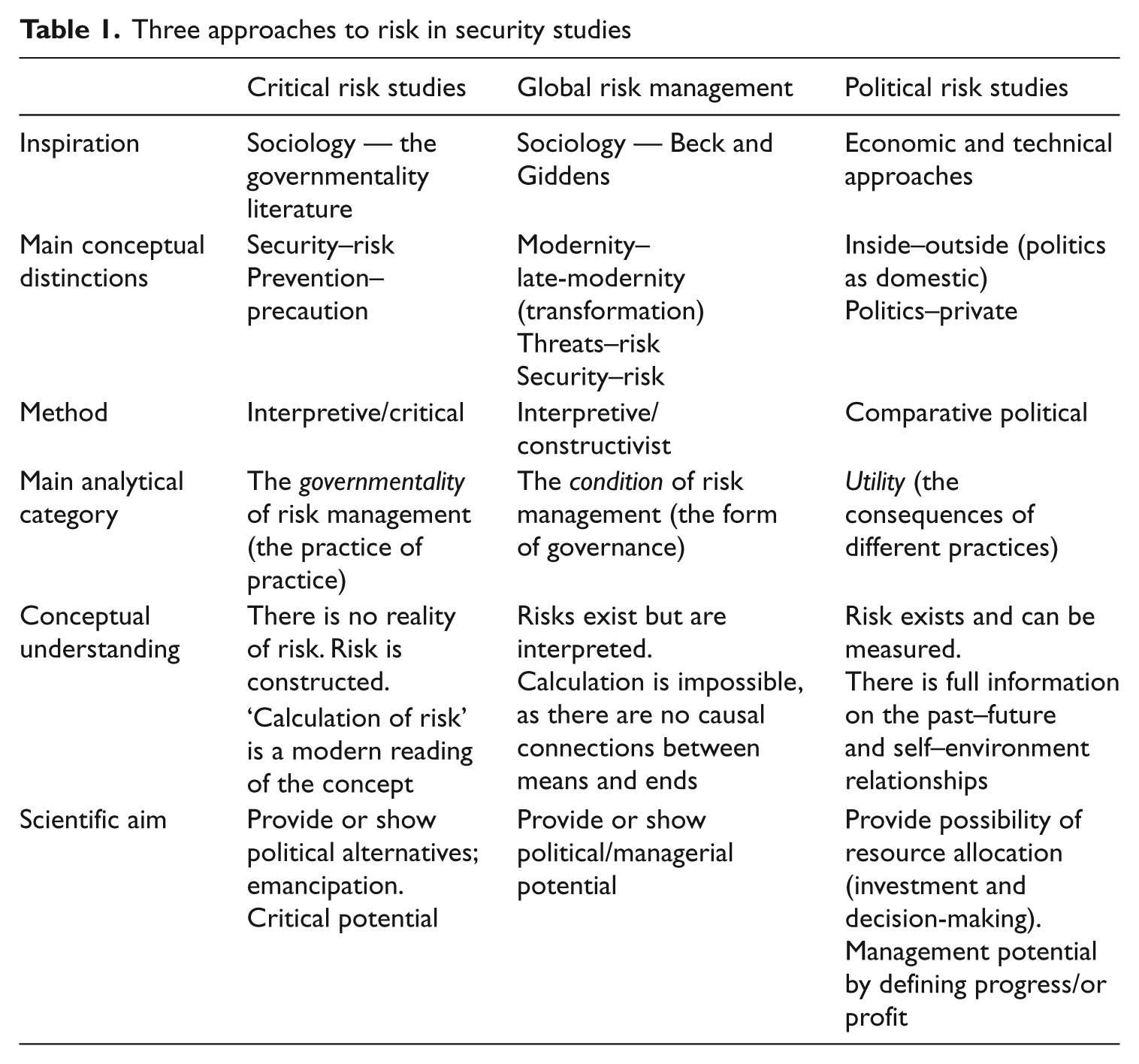
A second critique relates to the understanding of political. Politics is not only understood as spatially connected to the foreign nation state, but also intrinsically external to the actors who run risks, and make decisions and investments. Politics proceeds outside of the private sphere of the risk-taker, and a clear distinction between the private undertaking and political sphere is thereby established. However, such a distinction discloses the possibility of conceptualizing the risk-taker (company or another government) as a political actor, for example, when a company or government organization finds it too politically risky to invest or intervene in new markets or countries and therefore refrains from doing so, it may contribute to a changing political situation in the host country. Thus, such an understanding of politics addresses how politics — as a formal entity — is acted upon, yet these scholars fail to recognize what Mary Douglas, for example, has repeatedly stated: that political logics (ideologies and visions) are internalized in the corporate decisions and that the company is therefore a political player in society in its risk-thinking. Table 1 sums up the main differences in the three approaches to risk in security studies, showing how these approaches differ with regard to inspiration, conceptual understanding, method, analytical categories, conceptual distinctions and scientific aim.
Three approaches to risk in security studies
Conclusion: Analytical Challenges
Understanding the interface between risk and security practices seems more relevant than ever. Risk analysis and risk management practices are increasingly occupied with issues that were formerly national security concerns, and since the borderline between national intelligence, emergency management and crime control is becoming increasingly difficult to establish, the domestic government risk practices also become security practices. Neither risk nor security alone can be considered an analytical or theoretical concept. In order to understand current affairs, however, we must also recognize that concepts generally both reflect and condition socio-political development and change. We should therefore not turn to risk because we think that it would provide us with better analytical tools in an already-existing toolbox (than e.g. the concept of securitization). Rather, we should attempt to understand the socio-political meaning given to the concept in the practices of the military establishment, in the emergency response agencies and in the PSCs — agencies which today tend to assume that terrorism, immigration and war (traditional security issues) can be approached in terms of risk management. Without taking the concept and its socio-political meaning seriously, we ‘risk’ ignoring important political changes.
Despite the relevance of studying the relationship between risk management and (national) security practices, risk studies remains an undeveloped sub-discipline within security studies. In the foregoing sections, the article has evaluated the different concepts involved in risk studies by showing the claims to knowledge and politics being made; how these debates translate the more settled economic and sociological approaches to risk into their own language of ‘critical theory’, ‘history’, ‘transformation’, ‘management’, ‘politics’ and ‘private’. However, it also became clear that each position has imported some of the more methodological problems known from sociology and economics, including a lack of conceptual sensitivity.
This concluding section will explain why conceptual sensibility must be taken seriously within risk studies and relate this debate to the only (major) approach to security which claims to be sensitive to concepts and social constructions of threats: securitization theory.
The level of generalization and need for conceptual sensitivity
Like much social science theorizing on risk, the risk studies in security studies often appear to say something general about where international politics and security studies are heading. Aradau, van Münster, Salter, Muller, Lobo-Guerrero and others talk about a dispositif of risk, and Rasmussen and Coker about which rationalities characterize different historical epochs (Rasmussen, 2006: 1–11). 20 Yet as both cultural theory and security-identity studies in IR have argued on several occasions, risk and security are culturally or contextually defined concepts (Campbell, 1992; Hansen, 2001) and addressing such diversity is methodologically important if we want to better understand current security/risk identity practices. 21 Nikolas Rose makes a somewhat similar critique in his evaluation of Ulrich Beck’s risk society thesis. He writes, ‘I think this notion of risk society, though suggestive, is misleading. It implies something homogenous and all embracing, an array of effects that are amenable to an epochal sociological explanation’ (Rose, 2002: 213). Yet while Rose urges us to study the spread of a particular risk thinking — one associated with calculability and economic control — I propose that we start with a more conceptually sensitive approach: one which recognizes that other concepts of risk — than this particular modern liberal concept — also work as governmentality in political life. One example can be found in the US management of the risk of terrorism (counterterrorism), where management is not always understood as a matter of calculating the threat, but also of patriotism and belonging to the ‘homeland’. American counter-terrorism rests largely on an understanding of risk management as a matter of protecting vulnerable sectors and values in society — on a valuation of what we have and must preserve — rather than on the idea of calculable probability and technical control (Petersen and Tjalve, 2009). An analytical approach sensitive to conceptual change and diversity would enable us to identify innovations in political language (see Skinner, 2002), and provide us with the ability to grasp new developments in the corporate, governmental or organizational conception of risk. A conceptual discourse does not exist by itself; rather, it will always be defined in interaction with other discourses (e.g. liberalism versus republicanism, or differences between national discourses). Thus, there will always be competing language systems in the sense that no single discourse can dominate totally (Pocock, 1975, 1996). Yet such recognition of change, diversity and counter-discourses would also identify political potential.
Thus, an analytical sensitivity attentive to the constitution of conceptual meaning is generally missed. I would argue that we should begin elsewhere. The debate should not focus on whether some philosophically or theoretically defined concepts fit reality or not, but instead on what kind of reality these concepts convey and prescribe. We should bring concepts back into a conceptual debate on risk and security; an attempt at taking concepts seriously and showing how they shape our political reality by constituting authority, identity, time and function.
The wider impact on security studies
Seen in a historical disciplinary perspective, there are parallels between the contemporary risk debate and the debate on the widening of security in the 1980s and 1990s. 22 As for the so-called wideners, the argument for bringing in risk is based on current developments in world affairs — on the changing understanding of threats. In particular, the political attention to crises and catastrophes such as terrorism, global economic crises and climate change have demonstrated the relevance and have empirically legitimated the rise of risk studies. Moreover, like the widening perspective, the contemporary debate on risk is spurred by the aim of opening up the perspective of security studies beyond the agency of the state; freeing it from the historically loaded concept of security by installing the concept of ‘risk’. However, there are also arguments against seeing this risk debate as part of the widening debate. The widening perspective did build in the idea that ‘security’ was increasingly relevant to a broader empirical field as well as disciplines; going beyond the military domain; and was therefore important to the study of a wider range of sectors (economics, environment and society). The widening debate thus aimed at studying what one roughly speaking could call ‘the expansion of security’. The starting point of risk studies is not the same. 23 Risk studies want to approach threats that do not respect the ‘old’ dividing lines between foreign and international, crime and security, normal and exceptional political life and so on — threats including terrorism, climate change and financial crises that often cannot be considered to be solely a matter of security in the traditional sense of the word (as a securitization).
This brings me to the question of why securitization theory cannot fill the gap and the need for an approach which is sensitive to concepts while taking new and emerging threats into account. The answer is straightforward: because securitization theory is not sensitive enough to conceptual change. As Wæver indicates in his conceptual analysis of security, securitization as a speech act is closely tied to modern understandings of necessity, state and raison d’état. Most studies on risk in security studies argue that such an understanding of security is under pressure, which can be observed by studying the security/risk thinking of emergency agencies, insurance companies, intelligence agencies and so on.
The problem is not solved by calling a speech act on risk ‘a riskification’, as some have suggested (see Corry, 2009; and supported by Ole Wæver). 24 An understanding of risk practices as riskification may sound appealing but encounters the same problem of discursive fixation as securitization theory (Huysmans, 2006), as such an analytical concept would require a description of the exact character of such a speech act. Instead of seeking to reach a better understanding of how security influences risk management practices, for example, such a position would simply close the debate — make the possibility of grasping current changes in the meaning of risk and security (e.g. due to new understandings of crime, intelligence police, etc.) not viable.
One could of course argue that suggesting a wider perspective of risk and security comes with a price, as it opens up the possibility that everything can be constructed as a security issue; a route which we, following Wæver, for normative/democratic reasons do not want to take. Such a position, however, shows very little trust in democracy and tends to conceal the place of normativity/democracy in a widening approach. A conceptual analysis can point out the possible emancipatory strategies; may help us to consider and find promise, without assuming prior superior knowledge about the political stakes. As O’Malley argues: ‘Risk may take a wide diversity of forms’, some of which may not be as oppressive, individualist and polarizing as often assumed in the critical risk literature (O’Malley, 2008: 453–454). Risk studies (science) should be experimental and aimed at rewriting old vocabularies, thereby opening up critique by suggesting new forms of social and political practice (see Cochran, 1999; Murphy and Rorty, 1990). And the exact same can be said about security. In similar terms, there is no reason to assume that the political rationality of security cannot be inclusive or democratic.25 One way to treat such potential, however, would be the sensitive study of the changing conceptual understandings.
Footnotes
Acknowledgements
I would like to thank Barry Buzan, Anna Leander, Rens van Münster, Vibeke Schou Tjalve, Trine Villumsen and Ole Wæver for their comments on earlier versions of this article.