



Abstract
International Relations theory about East Asia has increasingly argued that East Asia before Western penetration enjoyed a protracted peace. As explanations, a Chinese military hegemony would fit realist theory fairly well, while a cultural peace based on shared Confucian norms would be a significant anomaly. A Confucian Long Peace challenges widely held, albeit Eurocentric, realist presumptions including the perils of anarchy, the arms-racing and misperception of the security dilemma, and the regularity of power balancing. This article therefore investigates, first, whether such a peace did in fact exist, and, second, whether this might be attributed to Confucianism. A cultural peace theory requires a strong anti-war cultural norm and a shared sense of community. Skepticism is established by examining three comparative cultural spaces that nonetheless did not enjoy a culturally informed peace: the classical Greek city-state system, early modern Christendom, and the contemporary Arab state system. All were deeply riven and competitive. Nevertheless, empirical investigation of the last Chinese (Qing) dynasty before the Western arrival (1644–1839) demonstrates that it was remarkably peaceful toward its Confucian neighbors, while more ‘normally’ exploiting its power asymmetry against non-Confucian ones. Process-tracing specialized Chinese practices toward fellow Confucians suggests that the low Confucian war finding emanates from cultural restraint.
Introduction
The question of Asia’s distinctiveness is growing in International Relations theory (IR), perhaps as Asia’s weight in global politics increases. The study of Asian IR is increasingly theoretically informed (Hui, 2005; Johnston, 1995, 2007; Kang, 2007, 2010a; Kim, 2008; Zhang and Zhang, 2010), and consequently challenges from newly examined data are arising against theories built primarily on modern, North Atlantic cases (Archarya, 2003/4; Kang, 2003, 2003/4, 2010a). One element of this increasing discussion is a ‘Long Peace,’ possibly rooted in shared, war-reducing Confucian ideals, in East Asia before the arrival of the West in force with the Opium War (1839–42) (Moon and Suh, 2007).
This article examines this question, which to date has only been vaguely drawn and mildly IR-theoretically informed. A growing number of IR scholars have noted that East Asia’s pre-Western history generally seems less violent and its wars less epochal than early modern Europe’s (Chanda, 2006; Kang, 2008, 2010a; Tang, 2010). Historians have noted that East Asia was never racked by the extremes of religious conflict both within and between the Abrahamic monotheistic faiths. ‘All-in’ systemic wars, inquisitions, and genocides were rare. Nor did China pursue ocean-going imperialism despite a capability (Spence, 1999; Wommack, 2010; Woodside, 1998). Given China’s long and well-known struggles with its northern and western ‘barbarians,’ neighbors, notions of a peaceful character in East Asian foreign relations have turned to China’s relations with its Confucianized periphery — Korea, Japan, and Vietnam (Kang, 2008, 2010a). A cursory overview of East Asian history does suggest that imperial China’s use of force was much more common and brutal toward non-Confucian populations (Johnston, 1995). Hence the notion of a Confucian Peace. And given that China’s best-managed dynasties kept a general peace in the Confucian space for centuries, there may be several ‘Confucian Long Peaces’ in East Asian history.
This article continues with a brief examination of IR’s paradigms regarding a ‘peace,’ and why moments of ‘long peace’ appear so distinctive. I next elaborate a theory for a cultural Confucian Peace, based in a strong anti-war norm and shared sense of in-group distinction from outsiders. I then propose the method to examine whether such a peace existed: counting war years of inter-Confucian state conflict between the Qing dynasty’s founding (1644) and the arrival of the West in force (1839). I apply my theory of cultural peace to Qing China and three other comparative cases — the classical Greek city-state system, early modern Christendom, and the contemporary Arab state system. Confucian Asia is found to have just one war year out of the 195 considered — a far better ratio than the others. I conclude with several methodological ‘prebuttals’ and suggestions for future research on why East Asia enjoyed such quiet while early modern Western Europe especially did not. IR theory, too heavily built on modern Western cases, struggles with that question.
Theory of a pax
The idea of a pax or ‘peace,’ modified by some relevant adjective, is now a common one in IR. Well-known examples include a Pax Britannica and Pax Americana (Carr, 1946; Kennedy, 1987), a Democratic Peace (Brown et al., 1996), a Liberal Peace (Doyle, 2005), a Nuclear Peace (Rauchhaus, 2009), a Long Peace (Lebow, 1995), and even a Geriatric Peace (Haas, 2007). East Asian IR’s proposition of a Confucian Peace fits this growing literature.
The notion of a ‘peace’ as distinct and noteworthy comes from the, broadly realist, expectation that war is quite common, even normal, in world politics. War functions as a tool to maintain balance among autonomy-preferring actors. Power-seekers or revisionists will face sovereignty-jealous opponents. Should they push their demands, resistance in the form of war is likely. Hence, war is a ‘natural,’ even ‘mechanical,’ product of anarchy (Eilstrup-Sangiovanni, 2009: 352–355; Wohlforth et al., 2007, 2009). As Eilstrup-Sangiovanni notes (2009: 372), war is ‘normal’ because stability, not peace, is the primary goal of states in the realist paradigm underlying so much IR writing on war: ‘While many see the balance of power as a means to maintain peace or preserve the status quo, there is broad agreement that these goals are incidental to the more fundamental aim of preserving the independence of major powers by forestalling hegemony.’ In short, if ‘war is a legitimate tool of statecraft’ (Jervis, 1985: 60), then any protracted peace is worthy of investigation.
The grounds of these episodes of peace vary across the big paradigms of IR. Pax Britannica and Pax Americana fit realist notions of hegemony and power preponderance. In the 19th and 20th centuries, the US and Britain, sometimes in tandem, sometimes at odds, mixed international economic hegemony with a security role of offshore balancing (Gilpin, 1981; Kindleberger, 1996; Layne, 2007). Together they defeated or contained various Eurasian revisionists for two centuries (Kelly, 2010). A Nuclear Peace too would fit here. Technology is a part of the structural background against which states move. Realism can theoretically integrate the war-reducing value of nuclear weapons, because nuclear weapons dramatically rebalance the cost–benefit equation of war (i.e. war no longer pays; Waltz and Sagan, 2002).
Liberal versions of a peace stress domestic characteristics. The Democratic Peace has fractured into a democratic and liberal school, the latter drifting toward social constructivism. Both seek to explain the fairly robust empirical finding that democracies do not make war on one another. Neo-liberal institutionalists stress the war-slowing features of democratic decision-making, while more normatively inclined liberals stress the sense of community or ‘we-ness’ that democracies feel for each other (American Political Science Review, 2005; Moaz and Russett, 1993). Doyle (2005) currently refers to a Liberal, rather than Democratic, Peace.
A Confucian Peace would fit social constructivism, as it is a cultural explanation. 1 Constructivist approaches are popular in Asian IR given the paucity of European-derived realist or liberal behaviors (Acharya, 2008: 61, 69–73). For example, Kang notes (2003/4, 2010b) that counter-Chinese balancing is thin in Asia, despite twenty years of predictions of China as a threat (Friedberg, 1993/4; Mearsheimer, 2006; Medeiros, 2005/6). Asian regionalism too violates European-derived notions of institutions’ roles (Jones and Smith, 2007), focused as it is on sovereignty-reinforcement and prestige-taking rather than integration and binding rules (Kelly, 2007). Kang (2008: 4) argues that ‘between 1368 and 1841 — almost five centuries — there were only two wars between China, Korea, Vietnam, and Japan.’ As such, the notion of a Confucian peace has merged with the post-1945 notion of the Long Peace (Gaddis, 1989).
Oren and Hays (1997: 494) note the propensity to examine ‘peaces’ that reflect US preferences for liberalism and democracy, but:
if we were to classify states by categories borrowed from non-Western cultural or socioeconomic settings, we might discover cross-national variations in conflict propensity that are no less substantial than those uncovered by studies of democratic foreign policy .… A more general proposition about the peacefulness of countries that are similar relative to some normative benchmark … [would note] a variety of attributes — linguistic, religious, socioeconomic, political, geographic, etc — by which countries can be classified into groups.
Analytically, there is no reason that episodes of peace might not exist, based on other ‘normative benchmarks,’ such as culture, and Oren and Hays in fact discovered a ‘Socialist Peace.’ The following effort to theorize a possible Confucian Peace fits this analytical opportunity.
Theory of a Confucian Long Peace
The notion of cultural peace suggests that a shared collection of lifestyles and habits — shared ‘logics of appropriateness’ (March and Olson, 1989) or Oren and Hays’ ‘normative benchmark’ — ethically or emotionally bond the peoples of independent states together into a security community. An underlying substrate of shared ethnicity, religion, or other ethical values unites a population and builds an ‘imagined community,’ even though the actual political one is fractured (Anderson, 2006). As Figure 1 suggests, although the states are distinct polities, the underlying citizenries of a cultural peace space do not feel themselves culturally distinct. They share a pan-state community; modern examples might include the Islamic transnational umma or Hispanic Latin America. In this model, the states are seen as somewhat artificial, perhaps even a foreign imposition (the pan-Arab system today, for example). The ‘real’ (ethical/religious/ethnic) community is that below the passing configurations of ephemeral politics. The argument here parallels established IR literatures on security communities and the Democratic Peace in identifying a shared variable as generating ‘we-ness,’ which slows the choice for war.

Model of a politically divided cultural community
Traditionally, the security community literature has stressed democracy, liberalism, or modernity as the basis for a shared sense of underlying ‘we-ness’ (Adler and Barnett, 1998; Deutsch et al., 1968), but this is not available in Asia or much of the world’s past. Acharya (2009), for example, argues that ASEAN is struggling to craft a security community based on shared diplomatic norms (the ‘ASEAN Way’) and a shared, albeit rickety, culture (postcolonial ‘Asianism’). Hence, Confucian ‘we-ness’ would not have the overtly philosophic or institutional texture of a liberal or democratic sense of community. Bull (1995: 13) famously describes such a ‘society of states … [as] a group of states, conscious of certain common interests and common values, [that] form a society in the sense that they conceive themselves to be bound by a common set of rules in their relations with one another, and share in the working of common institutions.’ These societal norms build on top of the already existing established interaction capacity of a system. 2 This article expands this to examine Confucian culture as a source of Bull’s ‘common values’ in pre-Western East Asia.
A cultural version of a long peace must specify ‘logics of appropriateness’ as causal mechanisms for the retardation of war and the creation of a security community (Hui, 2005: 18ff.). As a ‘second image’ explanation, a cultural peace theory looks inward for state attributes (in this case cultural, but possibly any of Oren and Hays’ ‘normative benchmarks’) as independent variables to drive the war/peace dependent variable (Oren and Hays, 1997: 493, 496). I propose two.
First, are the culture’s ethics inherently anti-war? Does it define war as a sin, immoral, unethical, a betrayal of principle, and so on? The well-known pacifism of Buddhism, for example, would suggest that committed adherents would be less likely to use violence. Similarly, Christianity’s ‘turn-the-other-check’ New Testament ethic broadly encourages peace, and sanctions only ‘just war’ when absolutely necessary. Devout Christians should hardly be expansionists or revisionists, at least among their own. Conversely, it is possible to conceive of Homeric or ‘Jacksonian’ social ethics on war — noble war in service of honor, revenge, glory, or masculinity (Gat, 2009; Mead, 2001: ch. 7) — or even war-encouraging cultural matrixes (Mosse, 1966).
Second, does the culture have specific war-retarding diplomatic norms that co-culturalists would recognize and follow? In other words, does the sharing of the culture across citizenries — not its inherent anti-war character of the first point above — encourage them to self-perceive a community among the sharers (we-ness) within which warfare would be an inappropriate diplomatic choice? For example, for much of the Middle Ages, the papacy tried to provide an (albeit self-aggrandizing) framework for Christian diplomatic relations. Muslim polities on Europe’s fringe did not enjoy access to these conventions and were considered barbarians against whom Crusade was permissible. Nineteenth-century European states notoriously applied a civilized–uncivilized dichotomy that legitimized extreme force overseas (Keene, 2002). Conversely, failed imagined communities are equally possible. Would-be participants in an international society may reject purported common values, such as the American response to Vincente Fox’s proposed ‘North American community’ (Hawkins, 2006; Public Broadcasting System/Newshour, 2000). Self-perception as a cultural community is logically necessary for a cultural internal peace to exist. A Confucian version would utilize specific Confucian attributes to answer these two questions affirmatively.
First, Confucianism was ethically opposed to the use of force, both at the individual level and as a tool of statecraft, especially between Confucianized peoples (Dreyer, 2002: 22–23; Higham and Graff, 2002: 13–16; Johnston, 1995: xi; Kang, 2010a: 8–11; Woodside, 1998). This is a central ethical and political maxim of Confucianism. Wright (1960: 4, 8) notes Confucius’s:
vision of perfected men living in a stable and harmonious sociopolitical order.… The well-ordered patriarchal family is the microcosm of the order that should prevail in state and society.… The values implicit in the Confucian vision are those of harmony, stability, and hierarchy. Moral force is held to be superior to coercion, and morally perfected men are the only ones entitled to manage the affairs of society and the state.… Undesirable change is violent, precipitated by uncultivated men [and] will lead society away from the moral order and into chaos and ruin.… Chinese politics finds all questions of state policy — domestic reform, foreign policy … and military matters — argued in terms of moral principles.
Miyakawa (1960: 43) quotes an early Qing official who lists the proper virtues as ‘filial piety, fraternal love, faithfulness, sincerity, propriety, righteousness, integrity, and sense of shame.’ This is hardly the package for robust imperialists like the Mongols or Napoleonic French; rather, it recalls Edward Gibbon’s famous complaint that pacific Christians sapped the martial strength of the late Roman empire.
Ceteris paribus, adopting such values slows the march to war; that is, Confucianism will have a war-dampening effect. States that adopt it as an ideology are less likely to be war-like because of Confucianism’s strong condemnation of violence as a tool for conflict resolution (among those who accept it). The specific war-retarding causal mechanisms (intervening variables) are Confucianism’s emphasis on (1) respect for the older and more educated, (2) social harmony, and (3) social hierarchy (de Bary, 1991; Fisher, 2008: ch. 6; Kang, 2010b: 42; Smith, 1994: 139–150; Swope, 2011: 10, 12, 18; Tu, 1996; Wang, 2011: 7–8). These mechanisms concretize Confucian-specific, contextual intervening variables out of the broad independent variables sketched above.
Confucianism promoted a patriarchal rather than competitive (or realist) understanding of regional, ‘non-barbarian,’ relations. China, as the oldest, most culturally ‘advanced’ state in the region, enjoyed formal ‘virtuous superiority’ to Korea, Japan, and Vietnam, but allowed them substantial informal leeway in the tribute system (Fairbank, 1968; Kang, 2010a; Nakajima, 2010; Wommack, 2010: chs 1, 7). War would violate harmony and order, by showing disrespect to the patriarch or senior (China), or by improperly abusing of the juniors (Korea, Japan, Vietnam) (Smith, 1994: 137–150; Swope, 2011; Tu, 1996; Wade, 2011). Even Sino-Japanese tension was read within this Confucian framework, resulting in only one major, pre-Westphalian conflict (the Imjin War of the 1590s). Confucianism stressed filial piety, not autocracy, and, while hierarchic, it included two-way obligations (Bell, 2006; Chow, 1960: 303–305). The sage Confucian king’s role was to discipline and control (especially the rambunctious Japanese ‘child’), but not to tyrannize or conquer those already within the enlightened fold; respectful juniors who followed the rituals and recognized the Chinese sun should be left more or less alone (Johnston, 1995; Wright, 1960: 9).
Second, Confucianism created a unique diplomatic language for Confucian states (Johnston, 1995; Kang, 2010a, 2010b). Imperial China handled its relations with Confucian polities through a distinct portion of the imperial bureaucracy (the Ministry of Rituals). Spence (1999: 117–118) notes that ‘relations with non-Chinese people were instead conducted by a variety of bureaus and agencies that … implied or stated the cultural inferiority and geographic marginality of foreigners.’ The Confucian practice of investiture — the Chinese emperor’s legitimization of vassals’ kings (most importantly in Korea and Vietnam) — guaranteed a measure of non-interference not enjoyed by ‘barbarians’ (Lee, 2011: 4). The ritual surrounding this practice was time-consuming and manifested the patriarchal, rather than competitive, understanding of relations, which Confucian peripheral states (least of all Japan though) accepted as culturally proper. China took its ‘paternal’ obligations seriously (Swope, 2011). China also administered its own non-Confucian provinces separately from its Han ones (Peterson, 2002: 8).
The more Confucianized the polity, the greater the respect accorded it in the Sinocentric world. Confucianization, not power, incurred China’s respect (Fairbank, 1968; Kim, 2008: 37–39; Nakajima, 2010; Woodside, 1998). Korea, for example, enjoyed pride of place in the tribute system (Lee, 2011) because she was, in the words of traditional Korean historiography, ‘more Confucian than China herself’ (Cumings, 2005: 78). Yet Korea’s military power was negligible compared to others in the tribute system. Nor did Korea and other tributaries necessarily understand their position in the system to mean hegemonic reduction or bandwagoning out of fear; Chinese cultural superiority was generally accepted, even if resentfully in Japan (Kang, 2010a; Lee, 2011). While Korea, Vietnam, and Japan were distinct polities from China with coherent borders dating to the end of the first millennium, they were bound within the Sinocentric society of states, geopolitically defining themselves in relation to a Chinese center (Kang, 2010a: 33–49). Contemporary political theory often codes Confucianism as ‘communitarian’ rather than despotic (Bell, 2006).
China’s Confucian neighbors shared a Chinese-based language family that smoothed communication and provided distinct in-group cultural artefacts, such as envoy poetry, from which the others were excluded (Kelley, 2005; Wright, 1960: 6). Very similarly trained and examined Confucian bureaucrats and intellectuals used the tribute system to interact among the four countries, so building a distinct literary space (Elman et al., 2002). Finally, Confucian we-ness did encourage a sharp distinction between in- and out-groups. Out-group non-Confucians could be Confucianized by force for their own good by ‘righteous war’ (Miyakawa, 1960: 22–27; Spence, 1999: 96; Wang, 2011: 9; Woodside, 1998; Wright, 1960: 10).
A Western parallel would be ‘feudalism that works’ — unlike Europe’s actual experience where vassals routinely rebelled. The shared Confucian ethic strongly discouraged the use of force against those who had adopted the enlightenment (unlike the ‘barbarians,’ especially in the north and west). And Confucianism provided a shared cultural matrix of speech and practice within which rituals Confucians could practice peaceful interchange (Lee, 2011; Purdue, 1996: 783ff.). Lesser Confucian states recognized China’s formal superiority, but were de facto independent and unmolested (Kang, 2010a; Swope, 2011). So the causal arrow would run from shared anti-war culture (independent variable) to the specific war-dampening cultural aspects of Confucianism (intervening variable) to peace (dependent variable). However, non-Confucians would not fall into these categories. A common misunderstanding of the Democratic Peace is that democracies never war. In the same way that democracies continue to war on non-democracies, so a theory of Confucian Peace does not predict peace with non-Confucians (Wade, 2011: 7ff.).
Methodology
I operationalize the ‘Confucian space’ as China, Japan, Korea, and Vietnam (Elman et al., 2002). They are widely understood to share a common cultural heritage dating to the beginning of Confucianism in the last few centuries BC. Confucius (551–479 BC) and his most important disciple Mencius (390–305 BC) generated the basic tenets of Confucianism that spread throughout this space in the millennium after Mencius’s death. With its spread came the Chinese language and other socio-political attributes that built a self-perceived cultural space — including shared norms of foreign relations — among Japan, China, Vietnam, and Korea no later than the second millennium AD (Fisher, 2008: chs 6–7; Krasner, 2001; Wright, 1960).
The maximum possible dates for a Confucian Peace would be from Confucianism’s first spread beyond its birthplace (China) to a second polity, until the collapse of the second-to-last Confucian polity in Asia. I say second-to-last, because the last one must have at least one other Confucian polity with which to interact in order for there to be a possible Confucian Peace between them.
Confucianism became the state ideology of the Chinese Han dynasty around 100 BC, with the first state examinations based on the Confucian Classics. It spread first to Korea during the Three Kingdoms period (mid-first millennium AD). This bookmarks the beginning of a possible Confucian Peace. At the other end, Japan turned away from traditional rule with the 1868 Meiji restoration, and Vietnam lost its independence to France by 1884. In 1910, Japan eliminated through annexation the second-to-last Confucian state, Korea’s Choseon dynasty. (A year later the last Confucian emperor of China would abdicate, and East Asia became fully a part of the Westphalian system.)
Hence, the longest possible timeline runs from c. 500AD to 1910, providing some 1400 possible years of Confucian Peace. However, conclusion from most of this history could be contested as impressionistic and indeterminate. For the following reasons, I focus on the 195 years between 1644 and 1839:
First, traditionally, Confucianism arrived, lastly, in Vietnam in 1070. China, Korea, and Japan were Confucianized by then, and therefore a Confucian Peace was analytically possible between 500 and 1070. But a more robust test of a Confucian Peace would include as many actors as possible. Retaining Vietnam therefore limits the time frame to 1070–1910 (Anderson, 2011: 24).
Second, to examine whether China, Japan, Vietnam, and Korea did not war on each other requires that they perceive themselves to be in a system together. If not, then a finding of ‘peace’ between them might simply confuse inability to project power, a lack of interaction capability, with a peace. For example, one might posit a Transatlantic Peace between Britain and the Native Americans before 1492. But this is obviously flawed because they were incapable of interacting.
In this article, I accept the standard IR, strategic definition of a system. Units belong to an international system if ‘the behavior of each is a necessary factor in the calculations of others’ (Bull and Watson, 1984: 1), and this is, ceteris paribus, more likely later in history due to improved technology. To avoid the counter-argument that the earliest Confucian states simply could not reach each other for serious conflict, I focus on the final years of Confucian diplomatic history. For example, in 1683 the Chinese Qing dynasty seized Taiwan, suggesting that a major water borne assault on Japan was also technically feasible. Better technology means higher interaction capability (Buzan and Little, 2000: chs 9, 13); distant Vietnam and Japan especially would be more capable of interaction later in history. Specifically, the cheaper the cost of power projection, the more likely war is between the system components. An easier loss of strength gradient should make war a more attractive option (Lemke, 2002). As such, the last years of the Confucian system should be the toughest test case of a Confucian Peace.
Third, the most modern cases are also the most likely to be well documented, unless some particular catastrophe intervenes. Eilstrup-Sangiovanni (2009) argues that IR theory reaching far back into poorly documented history, plagued by gaps in records, can easily become impressionistic. It is easy to misunderstand how and to what extent polities interacted with each other when the data are thin or heavily biased — for example, by the existence solely of Chinese dynastic records that may wish to whitewash intra-Confucian conflict in order to support imperial claims of universal acceptance and rule (Krasner, 2001). There will be exceptions, such as heavily researched classical Greece, but projecting IR theory onto poorly understood civilizations such as pre-Columbian America or early Mesopotamia may court endless controversy over the historical data rather than the IR theory.
If the ‘world historical approach’ can create false positives, then the more recent the case, the more likely the history is understood. More recent cases are more likely to have surviving diplomatic records, and literacy should be higher. These records are more likely to come from multiple sources, including foreigners. Archeological evidence is likely richer. Archives are fuller and better understood. Ideally, historians are in greater agreement about the empirical record even if their interpretations conflict. So later Confucian history is a sounder test.
Fourth, given China’s enormous comparative strength and geographic centrality, it was most likely to be involved in any intra-Confucian wars. Hence, China’s dynasties frame the relevant time-series. Imperial China’s history is extraordinarily long by the measures of time common in IR. The first entity to coherently approximate integrated ‘China’ is the Qin dynasty, founded in 221 BC. 3 Before this, political entities in Chinese space were so small and so multitudinous that it is a historiographic reach to speak of ‘China’. The Qin created the title ‘emperor’, and their successors, the Han, formally adopted Confucianism as the state ideology. In accord with the second and third points above, this article examines solely China’s last dynasty, the Qing, from its founding in 1644 until the Opium War (began in 1839). The Opium War so undermines the Confucian system (Kang, 2010a, 2010b; Krasner, 2001) throughout Asia that I stop with it. The post-Meiji Restoration Japan of the First Sino-Japanese War (1894–95) had so radically ‘de-Confucianized’ from the previous Tokugawa Shogunate that this war is hardly a violation of a Confucian Peace.
Fifth and finally, of China’s many Confucianized dynasties (15–20, between the Han and Qing), the Qing were among the most warlike. In the possible universe of a Confucian Peace (500–1910), China repeatedly fought wars with its northern and western ‘barbarian’ or nomadic neighbors. Under the Qing, the empire engaged in a major, decades-long effort to finally crush them. Enormous resources were marshaled to project hundreds of thousands, perhaps even millions, of soldiers and support staff thousands of miles into central Asia and Mongolia in the 18th century (Hui, 2010; Lococo, 2002; Perdue, 1996, 2005). For a pre-industrial military (without motorized transport or refrigeration) this was an astonishing mobilization of power, which, turned eastward, would easily have crushed China’s Confucian neighbors. Nor were the Qing gentle in their treatment of the newly conquered. The Zunghar Mongolians were exterminated completely in a deliberate genocide and enslavement (approximately 600,000 people) in the 1750s (Perdue, 1996). In short, the Qing were quite expansionist in preference and possessed the power to impose their will decisively and brutally. If they did not attack the low-hanging fruit of weaker, closer, wealthier Confucian states, as they often did their non-Confucian neighbors, that is strong evidence for a differentiation of foreign policy based on Confucian ideals. 4
History: Four would-be cultural peaces
Cultural peace periods do not appear common in international relations, and skepticism of a Confucian Peace is justified. Hence, I first examine three other systems divided by space and time with a strong similar claim to a common cultural base. Nonetheless, classical Greece, early modern Christendom, and the contemporary Arab state system have all fallen into frequent, intense violence. Cultural calls for unity have failed or hypocritically served the geopolitical purposes of imminent losers or would-be hegemons. This material provides a baseline by which to judge Confucianism’s success as a war-retarding cultural force.
Classical Greece is a well-known, heavily researched case in IR. As an independent system with full interaction capability, its least disputable dates stretch from the defeat of the second, large Persian invasion at Plataea (479 BC) to Philip II of Macedon’s success at the battle of Chaeronea (338 BC). Plataea ensured the Greeks’ independence to war or not against one another, while Philip’s victory led to the coerced League of Corinth, whose members agreed not to war on each other. Although the classical period of Greek history is usually dated to Alexander’s death in 323, the years 338–323 do not verify a ‘Hellenic Peace’, because that peace was coerced by Macedonian power, not shared ‘Greek-ness’ (Hornblower, 2002). This provides 141 years of Greek diplomatic history.
The Greeks clearly thought of themselves as distinct from those around them. The great political thinkers of classical Greece, including Herodotus, Thucydides, Aristotle, and Plato, routinely and unselfconsciously refer to non-Greeks as ‘barbarians,’ and the great geopolitical slur of the age was to ‘medize’ — to cooperate with the Persians. States that did not medize during the Persian Wars enjoyed great prestige, and Athens, which was razed by the Persians in 480 and led the anti-Persian coalition, morally justified its hegemonic Delian League on the basis of this acclaim. Crane (1998) speaks of an ideology of ‘Hellenism’ built on the notion of Greek cultural difference, if not superiority, captured most famously in Pericles’ speeches in Thucydides’ and Herodotus’ depictions of the ‘East’. However, this shared Hellenistic ideology was not coupled with an anti-war ethic. If anything, classical Greeks viewed military competition for glory as ethically acceptable if not desirable. The desire for excellence frequently conflated moral and physical virtue into a Homeric cult of the strong, whose most obvious geopolitical expression was the Melian Dialogue (Hamilton, 1930; Lebow, 2003; Lebow and Kelly, 2001; Renault, 1956).
This period was one of almost constant systemic wars between the biggest Greek actors. Despite a shared cultural substrate, there was no end to the plotting, skirmishes, aggrandizement, treaty violation, and extended large-scale conflict on both land and sea. For this reason, ancient Greece is so frequently seen as the emblematic case for realism (Lebow and Strauss, 1991). A brief military history of those 141 years shows that 73 of them were spent at war. 5
After the defeat of the Persian invasion, the Delian League rapidly morphed into an empire. Within 20 years, Athens and Sparta collided in the First Peloponnesian War (461–446), which included a five-year truce (454–449). Skirmishes, mostly involving unhappy Athenian ‘allies,’ continued in this interwar period, but the underlying tensions did not dissipate. The Second Peloponnesian War (431–404), documented by Thucydides, pulled all of the major systemic actors, from as far away as southern Italy, into a general war. But the post-war peace was short-lived. Spartan hegemony was contested by a broad counter-hegemonic coalition in the inconclusive Corinthian War (395–386). The wars against Sparta resumed in 378 under Theban leadership, and Sparta was eventually dethroned in 362 in the wars covered by Xenophon. No state filled the gap, but the Second Athenian Confederacy tried, provoking the Social War (357–355). Further confusion and competition result in the also inconclusive Third Sacred War (356–346). In the succeeding years, the Greeks finally stopped warring against one another as the menace of Macedon rose. This list of wars includes only intra-Greek wars involving at least one great power, frequently vying for systemic dominance (Hui, 2005: 64–65). This continual sequence of conflict among Athens, Sparta, Thebes, Corinth, and Argos concludes only in the final elimination of Greek international politics by Philip.
Early modern Christendom provides another example of a failed cultural peace. Bull (1995: 26–31) argues that a Christian international society emerged from the collapsing medieval order of the Catholic Church. Again, this time period is heavily researched by IR theory, with the final emergence of the state from conflicting, overlapping medieval ties dated to 1648. At the other end, by the 19th century, the ‘notion of Western Christendom came almost to disappear from the theory and practice of international politics’ (Bull, 1995: 31). So the 1789 onset of the French Revolution and the consequent explosion of secular nationalism bookend this period well. The period 1648–1789 provides 151 years of diplomatic history.
The ancient Greeks are a mixed test of cultural peace, because while sharing a culture, that culture encouraged striving and competition, including a lust for geopolitical glory. But New Testament-based Christianity communicates a much clearer anti-war ethic, and, as Bull notes, Western Christendom saw itself as distinct from Islam most obviously, but also Orthodox or Eastern Christianity. This difference was clearly expressed in the rationalizations for both overseas colonialism and frequent pressure on the Ottoman Empire.
Yet it did not stop the Christian states from warring on each other. The years 1648–1789 are so heavily researched in IR, unlike Greece 404–338 BC, that a diplomatic history is unnecessary. Levy (1982: 284–285; 1983) usefully lists all the conflicts of this period, finding 92 years of intra-Western Christian war involving at least one great power (wars against the Ottomans are excluded). Intra-Christendom ‘highlights’ include: the Franco-Spanish War, the Great Northern War, the Dutch War of Louis XIV, the War of the League of Augsburg, three wars of succession (Spanish, Polish, and Austrian), the Seven Years War, and the American Revolution. Given the frequency with which the ‘English School’ employs early modern Europe as an example of Gemeinschaft versus Gesellschaft (Bull, 1995; Buzan, 1993; Buzan et al., 1993; Watson, 2009), this is an awkward finding. Despite a resolutely anti-war cultural matrix and shared diplomatic Christian protocols, Europeans were quite content to violently strive against one another. Indeed, Levy’s data suggest far more war among Western Christians than between them and others. Hui (2005: ch. 3) finds the same, asserting that ‘a norm-based system did not exist in … early modern Europe’ (Hui, 2005: 18).
A final case that suggests skepticism for the notion of a cultural peace is the experience of the modern Arab state system. This case most easily fits the image of Figure 1 (Mellon, 2002). Arab and non-Arab analysts alike perceive the current political division of Arab cultural space to be artificial and externally imposed. Colonial powers, the Ottomans included, literally drew lines in the sand to accord with external interests, not local cultural integrity. The magnetic pull of pan-Arabism has its roots in this plain artificiality. This cultural unity is institutionally enshrined in the Arab League. The Arab League member states are the relevant Arab state community.
Less clear is the existence of an anti-conflict norm among the Arab states. Smith (2010) and Ajami (1978/9, 1992, 1997, 1998) argue that modern Arab culture has a cult of the strong, and Lewis argues that this stems from the tribalism of pre-modern Arab life and the deep influence of fascist ideologies at the birth of pan-Arabism (2004: ch. 17; also Boroumand and Boroumand, 2002; Fattah and Fierke, 2009). Much other research blames radicalization on the Arab–Israeli dispute (Hinnebusch, 2005; Kamrava, 2005; Milton-Edwards, 2006: chs 2, 4; Smith, 2005). Regardless of the cause, it seems inappropriate to attach a strong anti-war norm to the Arab cultural matrix (as might be for Islam’s clearer anti-violence religious dictum to the umma).
The modern Arab state system emerges with decolonization and the first Arab–Israeli conflict, and ends with the second US invasion of Iraq (Kamrava, 2005: 171, 192–196). The period 1948–2003 provides 55 years of diplomatic history. The Correlates of War (CoW) data set lists only the 1990–1 Gulf War as an inter-Arab state war. 6 The North Yemen War (1962–9) is coded as intra-state war, but I double-code it here to be an inter-state war as well, given its protracted and extensive Egyptian and Saudi involvement (Kamrava, 2005; Levy, 1982: 283, fn. 9). This analysis returns eight war years, although an inclusion of the Libyan invasion of Chad (1978–87) — because Chad is an Arab League observer with a 25 percent Arab minority and Arabic as an official language — would lift that count to 17 (Burr and Collins, 1999). 7
By contrast with these other cultural spaces, the Confucian one was remarkably peaceful between 1644 and 1839. Only one intra-Confucian war occurred: the Chinese invasion of Vietnam (1788–9). The invasion lasted only two months, and the Chinese quickly withdrew in early 1789. At no other point did China war on its Confucian neighbors, despite its manifest ability to generate both large fleets and land armies. In 1683, the Qing built a 300-ship fleet to capture Taiwan, then a haven for pirates inhabited by non-Han tribal peoples. As Spence (1999: 56) notes, this expeditionary force demonstrates what a naval power China might have become had it chosen to reduce Japan as well.
Even more impressive are the long, resource-demanding land conquests in the northwest, west, and south-west — all launched against non-Confucian peoples (Hui, 2010; Perdue, 2005). In the 17th century, the new Manchu leadership was most concerned with stamping out Ming resistance and state consolidation (Spence, 1999: ch. 2).This included an early invasion of (Buddhist) Burma (1661–2), the 1683 conquest of (aboriginal) Taiwan, and the 1696 conquest of (Buddhist and Muslim) Outer Mongolia. The 18th century brought further imperialism that gave China its current borders. Emperor Kangxi reduced (Buddhist) Tibet to tributary status in 1720–1, and the long-serving emperor Qianlong (r. 1736–99) launched what he later referred to as the ‘Ten Great Campaigns’ (十全武功). In the 1750s, Qianlong finally crushed the long-standing Mongol threat to China, pushing as far west as Tashkent and exterminating the Zunghars. The Qing then invaded Burma again in the 1760s. Next were the Jinchuan hill peoples of Sichuan (1740s, 1770s). Finally, the Gurkhas of Tibet/Nepal were reduced in 1792. In this immense four-decade expansion that doubled the land size of China, only one brief conflict occurred with a Confucian state — Vietnam (December 1788–January 1789) (Hui, 2010; Loccoco, 2002; Spence, 1999: ch. 5).
This brief history leaves no doubt that the Qing possessed the martial spirit and resources to disrupt the Confucian Peace to the east. The Manchus were another of China’s conquest dynasties, with a highly organized, formidable, and enormous military by global, much less regional, standards. Unlike the Ming dynasty, which suffered from extenuated state decay in the 16th and 17th centuries, the Qing retained powerful state capacity in the 1644–1839 time frame. (State capacity only became a critical issue after the West’s arrival.)
In short, the Qing had both an established history of martial expansion, as well as deep capability to project power. Local, eastern targets would have been more easily subdued — Tashkent is twice the distance (2500 miles) from Beijing as Tokyo, and no East Asian military came even close to the Qing’s capabilities. Further, the Confucian periphery would likely have been absorbed more easily given pre-existing cultural similarities between it and China. (Woodside, 1998). The nearby Confucian periphery was a richer target too — demographically and economically. It was more literate, monetized, dense, and proto-industrial than anything across the vast Gobi desert. War against other Confucians would have paid, and probably much better than in the more backward western interior (Wohlforth et al., 2007). Worse, Confucian under-balancing against China — that Korea, Japan, and Vietnam never allied to balance the Qing — should have made the Confucian periphery a yet easier target (Hui, 2005: 16). That the Qing sought a lower pay-off to the west, but not a better one (closer, less costly, more rewarding) to the east, evidences the differential understanding of Confucian, from non-Confucian, foreign relations.
Findings and methodological prebuttals
Table 1 summarizes the findings of the historical overview, indexed against the expectations generated by the theory of a cultural peace proposed above.
Empirical summary of cultural peace cases
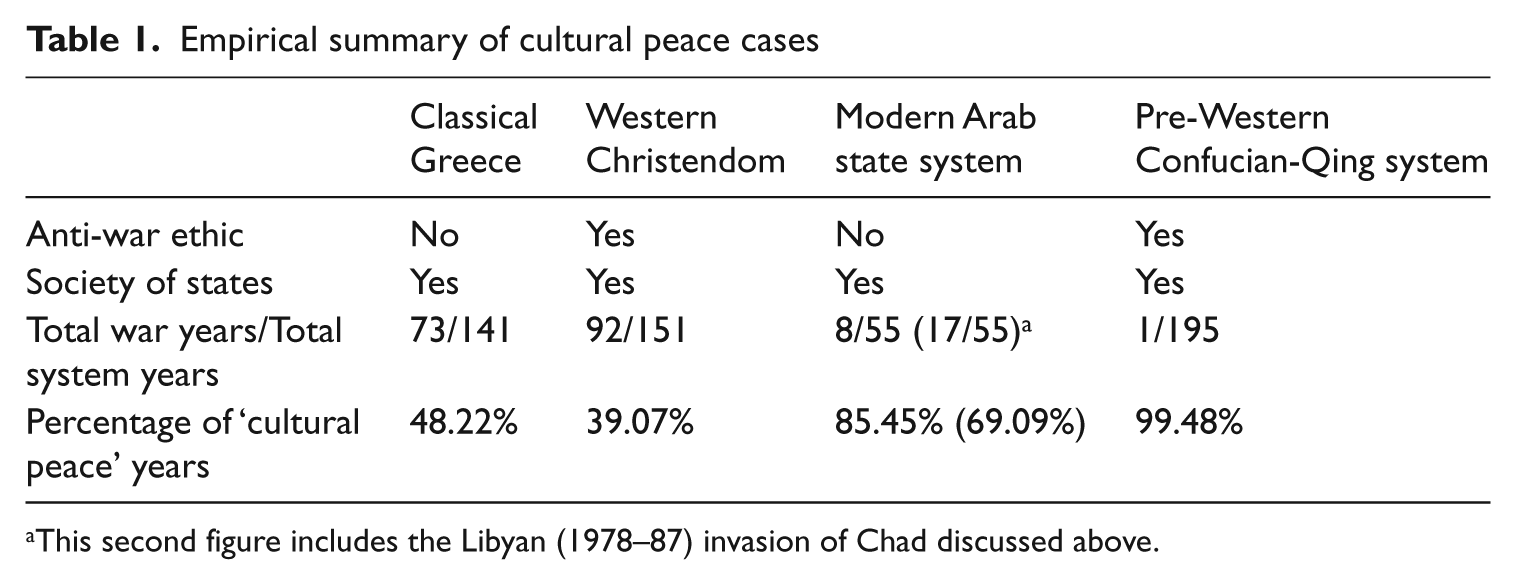
This second figure includes the Libyan (1978–87) invasion of Chad discussed above.
Table 1 returns somewhat contradictory, counter-intuitive findings. This research posits two cultural variables that would inform a notion of a ‘cultural,’ rather than hegemonic, peace. First, by definition, ‘Jacksonian’ cultural values that endorse conflict as glorifying, macho-masculine, Darwinistically or eugenically necessary, vitalist, exciting, a competition, a coming-of-age process, and so on, are unlikely to return a cultural peace. In the pre-modern period discussed here, the Mongols are an obvious example; they were entirely content to war on each other as well as others (Lhamsuren, 2010). Fascists, the classical Greeks, or the tribalized Arabs of T.E. Lawrence’s famous experience fit this mould. Second, peace-preferring values can generate an in-group peace if the culture is shared and if the space’s inhabitants self-perceive as a distinct ‘imagined community.’ Early Christian Europe is the example most touted in IR literature, especially from the English School.
Yet Table 1 provides only limited support for this proposed, bivariable causal pathway to peace. It appears to work in the Confucian and Arab spaces. Confucianism’s anti-war ethic and in-group–out-group distinction paved the way for a long peace among Confucian states. The Arab space was also fairly peaceful. Clearly Arabs share a transnational community, while the contestedness of the claim that Arabs lack an anti-war cultural ethic helps bring their middling Table 1 results in line with my theoretical prediction. The Greek case is the most indeterminate, because the opposition between the classical Greek understanding of conflict as morally edifying, and a clear cultural consciousness, cancels out culture as a war-reducer. Most damaging to my posited independent variables, however, is the Christian case. Despite a clear anti-war ethic rooted in the New Testament, and a distinct sense of ‘Christian international society,’ these states easily warred on one another. The obviously falsely named Christendom smacks of Krasner’s ‘organized hypocrisy’ (2001).
The methodology employed here can be disputed. However, I have tried at all times to bias my choices against the Qing ‘Confucian Long Peace’ returned here, in order to make the test of the Qing more difficult.
First, I have excluded intra-state conflicts that would have significantly reduced the peace percentage of the Greek and Arab cases. It would have reduced the Qing percentage as well, as much of the second half of the 17th century focused on suppressing Ming pretenders and the Three Feudatories Revolt. But with the revolt’s defeat in 1781, intra-Confucian state war ended for the period considered. Conversely, intra-state conflict in the Arab and Greek cases is far greater. Hence, Table 1 returns the curious result of an ‘Arab Peace’.
Second, one might object that these gross figures do not capture the intensity of the conflicts (Levy, 1983). Qualified by battle-deaths, resources expended, civilian casualties, one or another might be more or less violent. This is so, but again this would rebound most harshly against the non-Confucian cases. There are zero Confucian wars between Korea, Vietnam, and Japan in this period, and only one between China and any of these three. The Vietnam conflict lasted less than two months, with only 5000 battle deaths; it is so minor that neither Lococo (2002) nor Swope (2005) cover it. By contrast the Peloponnesian War (Hanson, 2005: 296), the Seven Years War, and Desert Storm all saw 20 times that number of casualties.
Third, similarly Kang (2008, 2010a) similarly argues that an East Asian Peace reaches back to the Ming foundation (1368). However, because systemic interaction capacity improves with technology, I have chosen a later start date. Perhaps Vietnam could not muster the fleet in the 14th and 15th centuries to actually interact with Japan, hence creating a false positive. Nor does Kang code the 1788 Qing invasion of Vietnam as a war. If one accepts Kang’s more generous numbers, the Confucian Long Peace runs for 473 years!
Fourth, another objection would more deeply specify a Confucian Peace against a Sinic Peace (Acharya, 2003/4; Eilstrup-Sangiovanni, 2009; Hui, 2010; Kang, 2003, 2003/4, 2007, 2008; Wohlforth et al., 2007; Wommack, 2010). A Sinic Peace, like Pax Britannica and Pax Americana, would be rooted in hegemony, not culture. It would propose that China’s neighbors bandwagoned with it because it was simply too large to balance (Eilstrup-Sangiovanni, 2009: 375; Schweller, 1994). But such an ‘interest-based explanation’ (Sweeney and Fritz, 2004) cannot elucidate (a) the obvious distinction the Qing dynasty made between Confucian in- and out-groups in its diplomacy, (b) the missing opportunistic balancing (the logical inverse of bandwagoning) by the Confucian periphery during difficult moments for the Qing (the long 17th-century consolidation and extremely resource-demanding 18th-century western wars), (c) the lack of any detectable anti-Chinese alliance coordination among Korea, Vietnam, and Japan, both among themselves and/or with China’s other peripheral targets (extreme anti-Sinic ‘underbalancing’ [Schweller, 2004]), and (d) China’s manifest, 200-year disinterest in invading the Confucian periphery despite ample opportunity and gain to be won. 8
A realist/interest-based approach better fits China’s relations with non-Confucians. The Qing were quite comfortable attacking neighbors including powerful ones like Russia and Mongolia, just as they were willing to conduct what IR would regard as ‘normal’ diplomatic practice with non-Confucians, such as the border treaties of Nerchinsk (1689) and Kiakhta (1727) with Russia, or the colonization of the western territories (Spence, 1999: 97). Confucian states by contrast were treated differently both militarily and diplomatically. Given that China so willingly waged wars on its neighbors, a Sinic Peace is a theoretical bridge too far. China was clearly not that peaceful. But the data do show a fairly clear direction in that warring away from Confucian neighbors. Hence a Confucian Peace.
Fifth, in a similar vein, a ‘Buddhist Peace’ must also be rejected. 9 Buddhism was indeed shared among China, Japan, Vietnam, and Korea, and it has arguably a deeper, more explicit anti-war ethic than any other major religion (Fisher, 2008: ch. 5). But Buddhism never held the enormous sway in these four countries that Confucianism did. As late as 845, Buddhism in China was outlawed and persecuted. As such, it was never a state ideology to rival Confucianism, which had such deep roots in and across Confucian bureaucracies because of the common testing system, the same ‘Confucian Classics’ texts, and the shared Chinese language family (Muramatsu, 1960). Finally, Buddhism, perhaps for internal theological reasons, never structured East Asian diplomacy or provided a shared diplomatic language as Confucianism did. As a result, the data of China’s wars show no Buddhist Peace or diplomacy. Buddhist peoples along the Himalayan tier were reduced repeatedly in the 18th century, including mostly importantly Tibet.
Prospects: Future research in East Asian IR
The findings of this study are mixed. I did find that the proposed Confucian Long Peace is real. Despite a stricter test than Kang’s (2008, 2010a), I found a lengthy period of peace among Confucian states, plus strong evidence that this peace was based on their shared Confucianism.
Two other comparison cases — Greeks and Arabs — for culture’s effect on war-making provide some evidence that my proposed independent variables are generalizable. However, my effort to establish a more general theory of a cultural peace stumbled badly on a third, Christian comparison case. Despite a clear anti-war ethic and sense of shared community (we-ness), Christendom (1648–1789) warred against itself relentlessly, achieving the lowest ‘peace score’ of the four cases examined. Only Confucian Asia came out with a strong, uncontestable claim to a cultural long peace (Moon and Suh, 2007).
This suggests that either the East Asian case is unique or that other variables are necessary, because culture is just too indeterminate a causal factor (Clark, 2009; Grove, 2010; Lebow, 2009; Mendelsohn, 2009). Insofar as social science strives for universal, generalizable findings, an inexplicable Confucian Long Peace is a frustrating finding. Kang’s work repeatedly notes how badly IR theory responds to Asian data that do not ‘fit’ or otherwise ‘do what they are supposed to,’ according to our Eurocentric theory. This article bolsters that contention by finding a very robust and very lengthy peace isolated around a non-European, non-modern cultural space. This should not simply be ignored (Hui, 2005; Oren and Hays, 1997: 515).
A second issue for future research is improving the specification of war-retarding cultural variables. My two propositions work reasonably well in three cases, but fail in the fourth. One possibility reaching into political psychology is in-group competition for dominance. Perhaps shared culture encourages competition of like against like, as various states claim leadership of the cultural space as a whole. For example, every Continental would-be hegemon from Charles V to Hitler claimed that they were ‘uniting Europe’ — usually to battle some outsider (Protestantism, Islam, czarism, Bolshevism). Further, insiders may save their worst fury and anger for dissenting insiders, not outsiders; perhaps inquisitions fire the martial spirit more than crusades (Hui, 2005: 165, fn. 237). Plutarch and Thucydides both lamented that the ancient Greeks, despite their shared culture, were far more zealous in destroying each other than uniting against their common foes, the Persians, Macedonians, and Romans. Nasser’s claims to lead an Arab bloc should have fit the dream of pan-Arabism, but instead provoked the 30-year radical–conservative Arab division. Why did this not happen in Asia? Finally, is there something specific in Christianity that ethically excused so much defection on ‘Christendom,’ and, conversely, does Confucianism have some particularly powerful ethical bind? One could imagine that Christianity’s overtly divine dicta would more strictly bind its adherents than Confucianism’s more secular-statist texture, but this was not so. Religion’s impact on IR is vastly understudied in favor of national interest-based accounts (Sandal and James, 2011; Warner and Walker, 2011), but there is such a glaring contrast between Christian hypocrisy and Confucian integrity in Table 1’s findings that it calls out for significant further research (Hui, 2005: 18).
A final avenue of future research would pull open my posited intervening variables (Warner and Walker, 2011: 119–125). I argued that the general theory of a cultural peace find its contextualization in the Confucian (1644–1839) space as three intervening variables: (1) respect for the older and more educated, (2) social harmony, and (3) social hierarchy. Together these limited the aggression of the ‘senior’ (China) and the pretensions of the ‘junior’ (the Confucian periphery). At least two concerns arise: first, these variables push far from the typical mechanisms of IR theory and rely heavily on the secondary literature from religion and sociology. They are open to dispute, most obviously from a realist position that they are soft or simply cover up ‘real’ power relations (‘comforting fictions’: Larsen, 2011; also Wade, 2011; Wang, 2011). Second, is there anything analogous to these in Christendom (most especially) whose lack explains its low peace score? My convenient Westernization was ‘feudalism that works,’ raising the obvious question why it worked in Asia but not in Europe.
East Asia is a rich case in IR theory that is only recently receiving sustained theoretical attention in the field. Various states such as Japan (Johnson, 1994) and South Korea (Amsden, 1992), and now of course China (Kynge, 2006), have enjoyed a robust case literature, frequently focusing on their remarkable growth, or in a journalistic vein. But East Asia as a source for IR theory is a new moment in the discipline. IR theory is heavily built on the European, and later transatlantic, experience after the Middle Ages. These Eurocentric models — the state, balance of power, legalistic treaty-making, ‘interest’ — have then been all-too-easily generalized to the whole planet and all history. This has led to growing criticism in Asia, especially as the ‘cockpit’ of world politics increasingly drifts from the North Atlantic area (Wohlforth et al., 2007; Mahbubani, 2008). Stretching our theories and tests more widely across time and space is an obvious next step for IR to grow.
Footnotes
Acknowledgements
This study was supported by the Fund for Humanities & Social Studies at Pusan National University, 2011. I would like to thank David Kang, David Leheny, David Lake, Stephan Haggard, Joe Philips, and two EJIR reviewers for their helpful comments. Earlier versions of this paper were presented to conferences at the China Foreign Affairs University in 2010 and the University of Southern California in 2011. I am grateful to both institutions for their support and to the conference participants for their many insights.