



Abstract
The United Nations Peacebuilding Commission was created in 2005 to have oversight of United Nations peacebuilding operations. In the foundational resolution, adopted simultaneously by the United Nations Security Council (S/RES/1645) and the United Nations General Assembly (A/RES/60/180), the Peacebuilding Commission is mandated to encourage meaningful participation in peacebuilding-related activities by civil society actors. This article investigates the construction of ‘civil society’ as a subject of United Nations peacebuilding discourse, drawing on both policy documents and interview data. The inclusion of civil society actors in peacebuilding-related activities is currently considered central to the success of these activities; if it is taken for granted that the meaningful participation of civil society actors ensures that United Nations programmes build better peace, and I argue that it is, then it is important to understand what is meant by ‘civil society’ and to comprehend the kinds of actions that are prescribed and proscribed by the meanings attached to the concept. Specifically, I map out a peacebuilding discourse that (re)produces the United Nations — as representative of ‘the international community’ — as the architect/legitimate knower of peacebuilding practice, and the communities working on building peace as the labourers/known objects. This has significant implications for the ways in which civil society organisations, and the forms of knowledge that these organisations represent, are encountered and engaged in peacebuilding practices; ‘local’ knowledge is at once valued (in the process of extraction) and yet subordinated.
Civil Society is an important actor in peacebuilding and the PBC’s [Peacebuilding Commission’s] enabling resolutions encourage its active participation. Civil society representatives have been invited to make presentations at several PBC meetings and there are established mechanisms in place which should ensure that serious and field-based civil society organizations receive a seat and a voice in the Commission’s deliberations. (UN Peacebuilding Support Office, n.d.) Civil society … is the realm in which the existing social order is grounded; and it can also be the realm in which a new social order can be founded. (Gramsci, cited in Cox, 1999: 4)
Introduction
The United Nations Peacebuilding Commission (UN PBC) is the formally recognised advisory body that oversees peacebuilding strategies and operations under the auspices of the UN. Through the simultaneous adoption of resolutions in the UN General Assembly (A/RES/60/180) and the UN Security Council (S/RES/1645) in December 2005, this body was established to develop outlines of best practice in post-conflict reconstruction, and to secure the political and material resources necessary to assist states in transition from conflict to peace. In 2010, under the direction of the founding resolutions, a number of permanent representatives to the UN coordinated a review of the UN peacebuilding architecture; the review’s final report was presented to the General Assembly and the Security Council in July 2010. The report notes with regret that ‘despite committed and dedicated efforts, the hopes that accompanied the founding resolutions have yet to be realized’ (UN GA/SC, 2010: 3). This article engages with two of these ‘hopes’: the hope that the PBC, as a principal actor in the UN peacebuilding apparatus, would ‘integrate a gender perspective into all of its work’ (UN GA, 2005a: Art. 20; UN SC, 2005: OP 20); and the hope that the PBC would ‘consult with civil society, non-governmental organizations, including women’s organizations, and the private sector engaged in peacebuilding activities, as appropriate’ (UN GA, 2005a: Art. 21; UN SC, 2005: OP 21).
This article interrogates the ways in which competing representations of civil society in UN peacebuilding discourse cohere according to different logics of gender, space, legitimacy and authority. These representations are then (re)produced and acted upon, such that the construction of ‘civil society’ as a subject is contested. The article proceeds in five parts. First, I offer a brief discussion of my research design, drawing out the ways in which this project contributes to methodological debates in the study of global politics. Second, I interrogate the academic literature on civil society organisations (CSOs) and their roles and functions in global politics. In this section, I am not aiming to arrive at one true definition of civil society or to establish with certainty how CSOs exert influence or effect change. Rather, I intend to locate the emergence of debates about civil society in a particular disciplinary and historical context and to show how civil society as a concept is represented in these debates. In the third section, I analyse the representation of civil society in the policy architecture of the UN PBC. Investigating the representation of civil society in these documents allows me to explore the ways in which the discursive terrain of the PBC permits certain kinds of knowledge of, and engagement with, civil society, while precluding others. Specifically, in this section, I argue that the way in which civil society as a concept is constructed and made meaningful changes over time in the corpus of documents I analyse, moving from a subject from which knowledge is to be extracted to an active partner in peacebuilding-related activities.
In the final substantive section, I undertake a similar discourse analysis, although the body of text is different: here, I analyse interviews undertaken with key actors inside and outside of the UN system working in the sphere of peacebuilding, peace and security. The ways in which civil society is represented in UN peacebuilding discourse matters because it is through these representations that the subject of ‘civil society’ comes to be known, and therefore can be acted upon. As outlined later, the inclusion of civil society actors in peacebuilding-related activities is considered central to the success of these activities; if it is taken for granted that the meaningful participation of civil society actors ensures that UN programmes build better peace, and I argue here that it is, then it is important to understand what is meant by ‘civil society’ and to comprehend the kinds of actions that are prescribed and proscribed by the meanings attached to the concept. Specifically, I map out here a peacebuilding discourse that (re)produces the UN — as representative of ‘the international community’ — as the architect/legitimate knower of peacebuilding practice, and the communities working on building peace as the labourers/known objects. This has significant implications for the ways in which CSOs, and the forms of knowledge that these organisations represent, are encountered and engaged in peacebuilding practices; ‘local’ knowledge is at once valued (in the process of extraction) and yet subordinated.
The process of discursive construction: A note on method
Alongside the empirical contribution I seek to make with this article, I make the more general methodological argument that a discourse-theoretical approach (Torfing, 1999) can reveal significant shifts in the way in which these organisations make meaning, which, in turn, has profound effects for policymaking and governance in the international system. Discourse analysis can draw attention to the conceptual apparatuses that structure knowledge in any given society and investigate not only how we (think we) know what we (think we) know — and mostly take for granted — but also what this means for who ‘we’ are and where we exist in the world in relation to others. This type of research has a rich history in International Relations, which demonstrates its utility for understanding the processes of construction in discourse that create the semblance of stability of meaning, such that we might make sense of our worlds (see, inter alia, Campbell, 1992, 1998; Der Derian, 2009 [2001]; Doty, 1993, 1996; Hansen, 2006; Milliken, 1999; Walker, 1993; Weber, 1995). The categories we use to think with, those categories that are frequently assumed to be descriptive, such as ‘white’, ‘female’, ‘heterosexual’ and so on, are constituted politically and are constitutive rather than reflective of identity. That is to say, such categories are always normative, rather than purely technical. This conceptualisation of the world, and of being in the world, requires that I think carefully about how the ‘conceptual apparatus’ regulating knowledge is produced and reproduced.
Discourse analysis is concerned with the production and reproduction of knowledge, and the iterative practices through which ‘things’ (whether those things are concepts, organisations, objects or, indeed, subjects) become meaningful. The analytical process exposes texts — broadly conceived — to scrutiny, to interrogate the ways in which different representational practices within the text work together to make that text meaningful. In International Relations, techniques of discourse analysis have been applied to an enormous variety of textual sources: state communications, reports and memorandums (see Doty, 1993; Jackson, 2005; Jarvis, 2009; Weber, 1995; Weldes, 1996); reports, resolutions and policy documents issued by international institutions (see Griffin, 2009; Methmann, 2010; Shepherd, 2008); and popular cultural artefacts, including film and television shows (see, e.g., Der Derian and Shapiro, 1989; Nexon and Neumann, 2006; Shapiro, 2009, 2013; Shepherd, 2013; Weber, 2006; Weldes, 2003) and news media (Debrix, 2008; Robinson, 2002), to name but a few. It is not unexpected, therefore, that I include the UN PBC policy architecture in the corpus of data I analyse in order to deconstruct the representations of ‘civil society’. Where this research perhaps differs from other discourse-theoretical projects is in the inclusion of interview material.
There are few discourse-theoretical works that integrate interview material, specifically, into the analytical frame. One particularly good example is Penny Griffin’s (2009) analysis of World Bank discourse on gender and global governance. In her research, Griffin undertook 10 interviews with World Bank staff in Washington and used the resulting data to ‘draw attention not only to the stability and sedimentation but also to the potential mutability of institutionalised discourse’ (Griffin, 2009: 26). Griffin engages with the interview data (in the form of transcripts) as discursive artefacts in and of themselves, rather than reinforcing a hierarchy between documentary sources and interview data; in Griffin’s analysis, interview data are not seen as more legitimate, credible or truthful than the documentary sources. The transformation of interview data into discursive artefacts and their treatment as representational practice rather than individual ‘truths’ about a given context creates a unique opportunity to demonstrate the ways in which a commitment to post-structuralism and a desire for methodological rigour need not proscribe personal engagement with the research environment. While there are notable studies in International Relations that employ ethnographic approaches to research and produce rich and nuanced analyses of their specific contexts (see, e.g., Cohn, 1987, 2006; Gusterson, 1996; Moon, 1997), there is a difference between visiting ‘sites of power’ with the express intention of conducting necessarily brief interviews and immersing oneself as a researcher in a specific environment. It is the immersive quality of ethnography that distinguishes it from interviewing as a research method.
An interview, by contrast, is a limited encounter. Even loosely structured interviews have a beginning, a middle and an end, at which point the research participant is thanked for their time and the researcher leaves the building. The boundaries around the research encounter, therefore, produce a text that it also bounded, which lends itself well to discourse analysis. Once the interview has been transcribed, discourse-analytical techniques can be used to deconstruct the text and explore the construction of meaning in interview data in the same way as documents can be analysed. We can explore, for example, the way in which the text at hand is organised, asking which subjects or issues are given priority in the text, termed by Foucault (1972: 63) the ‘rhetorical schemata’ of a text, and we can investigate the ways in which the subjects of the text are not only positioned in relation to each other (and to objects), but also ascribed characteristics through mechanisms of presupposition and predication (Doty, 1993, 1996; Foucault, 1972: 55–61). Of particular significance in a multi-modal discourse analysis is the investigation of what Foucault (1972: 73, emphasis in original) refers to as the ‘points of diffraction of discourse’, the ambiguities and tensions that emerge across the discursive terrain; these contestations illuminate the instability of meaning and the fact that meaning itself is constituted through discursive practice. In this research, therefore, the interview texts I produced are treated not as authoritative sources of truth based in lived experience, but as discursive artefacts of a status similar to the policy documents I analyse.
Methodologically, the inclusion of interview data alongside policy documents and resolutions allows for the exploration of a wider range of discursive practices, and the analysis of discourse as a constellation of meaning-in-use in a very literal way, providing a set of representations with more immediate relevance than those accessible through the analysis of documentary sources. The constructions of civil society evident in interview data, therefore, might be differently configured than those constructions found in the corpus of documents I analyse; these variances are themselves useful and interesting findings. While it would have been both feasible and justifiable to present here the findings of a discourse analysis drawing solely on documentary sources, the integration of interview data produces a different, more nuanced and complicated picture of UN peacebuilding discourse that recognises both agents and structures, both interpersonal and institutional politics. In short, the integration of interviews as forms of discursive artefacts permits a more holistic account of the discursive terrain of the institution with which I am concerned here and its treatment of ‘civil society’.
Theorising civil society
International civil society works to remind us of the transient nature of political legitimacy. (Baker, 2002: 940)
Theorising civil society in International Relations literature emerged in the context of late 1980s/early 1990s disciplinary debates about the form and function of international institutions and global governance (Caparaso, 1992; Keohane and Martin, 1995; Kratochwil and Ruggie, 1986; Mearsheimer, 1995; Ruggie, 1982, 1992). Ultimately, these were debates about the character and constitution of the ‘international’ as a spatial domain: where does it exist? How is it organised? What are its internal dynamics and where does power lie? In the then-contemporary landscape of global politics, the ‘certainties’ offered by the bipolar system endured during the era of ‘Cold War’ (with due acknowledgement of the fact that this period of world history was characterised by conflicts that were anything but ‘cold’ for much — if not most — of the world’s population) dissipated when the ‘cold’ thawed and the war ‘ended’ (for a feminist critique of the linearity and paucity of this narrative, see Enloe, 1993). Scholars scrambled to account for the ‘new’ distribution of power in the international system and the implications of the ‘end’ of the war for the order of (and order in) international affairs (see, e.g., Gaddis, 1992; Hoffmann et al., 1990; Lebow and Risse-Kappen, 1995; Mearsheimer, 1990; Waltz, 1993). As some sought better theories of why states build international institutions with more explanatory power (possibly enhanced by an interpretive approach to ‘practice’), others began to theorise not international institutions, or even international organisations, but ‘global governance’. Theories of ‘global governance’ sought to shift the conventional orientation of the study of international relations away from state practice (Barnett and Duvall, 2005: 5; for broader discussion of the concept of ‘global governance’, see Murphy, 2000; Rai and Waylen, 2008; Rosenau, 1995; Rosenau and Czempiel, 1992; Weiss, 2000; Wilkinson and Hughes, 2002).
Recognising, albeit belatedly (see Enloe, 1989), the complexity of global politics and the inability of a statist ontology to capture or even adequately represent this complexity, theorising ‘global governance’ emerged as a way of attending to political practices associated with formal government but also ‘the many other channels through which “commands” flow, in the form of goals framed, directives issued and policies pursued’ (Rosenau, 1995: 15). Crucially, according to James Rosenau (1995: 15), the use of his term ‘command’ should not be interpreted to mean that governance structures are hierarchical: ‘governance refers to activities backed by shared goals … [and] is a system of rule that works only if it is accepted by the majority’ (Rosenau, 1992: 4). In practice, organisations began to operationalise the concept of governance in order to flatten previous state-centric hierarchies and to involve non-state actors in the practices and processes of global politics (Barnett and Duvall, 2005: 5), which brought along with it questions about which actors should be included, how much influence these actors should have and on what basis these questions should be resolved. As noted by Michael Barnett and Martha Finnemore (2005: 182), ‘[t]hese developments speak directly to the question of the authority and legitimacy of international organizations’. In more conventional International Relations scholarship, non-state actors became salient, indeed visible, during these discussions about governance only insofar as they influenced state behaviour: The predominant way of thinking about NGOs [non-governmental organisations] in world affairs is as transnational interest groups. They are politically relevant insofar as they affect state policies and interstate behaviour … [but they] have political relevance beyond this. They work to shape the way vast numbers of people throughout the world act … using modes of governance that are part of global civil society. (Wapner, 1995: 336)
This approach to civil society, however, takes the meaning/character of the subject to be objectively identifiable and stable across different contexts. If we are considering ‘civil society’ from a discourse-theoretical perspective — not as a pre-given entity that has (or does not have) specific capacities, but rather as a ‘floating signifier’ that is given meaning in and through the exercise of power (Laclau and Mouffe, 2001 [1985]: 113) — then this requires a different set of enquiries into its form and function in global politics. Such an approach pushes us to consider the ways in which ‘civil society’ is differently articulated in different socio-political and historical contexts and to investigate how these articulations of civil society function to (re)produce particular configurations of power, including the relational configurations of gender and space that motivate this project. Ronnie Lipschutz (2000: 18, emphasis added) moves in this direction when he comments that civil society ‘includes those political, cultural and social organizations of modern societies that are autonomous of the state, but part of the mutually-constitutive relationship between state and society’. We can see here a focus on the ways in which the ‘identity’ of civil society is produced through its relationship with the state (see Mohan, 2002), just as all subjects of discourse are produced, in part, through their positioning in discourse relative to other discursive subjects and objects (see Doty, 1993: 306; Laclau and Mouffe, 2001 [1985]: 93). Civil society, then, is not a ‘thing’, the influence of which on state action or institutional policy can be charted and measured, but a discursive construction or a ‘field of power relations’ (Cox, 1999: 25) that is filled with meaning through the reiteration of discursive practices ‘that systematically form the objects of which they speak’ (Foucault, 1972: 49).
As noted by Jan Arte Scholte (2002: 19), ‘civil society’ as a concept ‘carries connotations of civility and virtue’: it is both ‘civil’ and related to the realm of the social, as distinct from the realm of the political, with its attendant wrangling for power, or the economic, with its residual invocation of greed and accumulation. Importantly, the representation of any given subject or object is never singular, and within any discursive terrain, there are always tensions. Discursive practices maintain, construct and constitute, legitimise, resist, and suspend meaning, and it is these practices that we can analyse using a discourse-theoretical approach, as Lipschutz (1992, 2000, 2005) and others (Baker, 2002; Cox, 1999; Hopgood, 2000) have begun to do in their interrogations of ‘global civil society’ (for a particularly insightful analysis of how the concept of ‘global civil society’ functions in global political discourse, see also Bartelson, 2006). I diverge from these valuable critical interrogations of global civil society, however, in my focus on the construction of ‘civil society’ in UN peacebuilding discourse. In the discourse that I analyse, ‘civil society’ does not have the transnational dimension to which theorists of global civil society attend: the term most frequently refers to the non-government/third sector/community organisations working alongside the PBC in New York, and the organisations that work within the countries on the agenda of the PBC (Burundi, Sierra Leone, Guinea, Guinea-Bissau, Liberia and the Central African Republic). In the following two sections, I analyse two sets of discursive artefacts that offer different constructions of ‘civil society’, and draw out the political implications of these representations.
Civil society in the policy architecture: From consultation to implementation
The ‘family tree’ of documentation relating to the UN PBC is derived from a review of the PBC’s foundational resolution, which was passed simultaneously by the Security Council (S/RES/1645) and the General Assembly (A/RES/60/180) in December 2005. The two resolutions are identical and can be treated as one for analytical purposes. This foundational resolution cites the 2005 World Summit Outcome General Assembly resolution (A/RES/60/1), which, in turn, cites the three documents shown above it in the diagram in Figure 1 (the United Nations Millennium Declaration (A/RES/55/2), the Monterrey Consensus of the International Conference on Financing for Development (hereafter, the ‘Monterrey Consensus’) and the Johannesburg Plan of Implementation of the World Summit on Sustainable Development (hereafter, the ‘Johannesburg Plan’)). For clarity, the UN Charter has been left out of the diagram in Figure 1, although it is also cited in the foundational resolution; this branch of the ‘family tree’ permits the inclusion of early representations of civil society at the UN in the form of the Charter itself (Art. 17), which endows the Economic and Social Council (ECOSOC) with the responsibility for making ‘suitable arrangements for consultation with non-governmental organizations which are concerned with matters within its competence. Such arrangements may be made with international organizations and, where appropriate, with national organizations after consultation with the Member of the United Nations concerned’ (United Nations, 1945: Chapter 10, Art. 71). 1
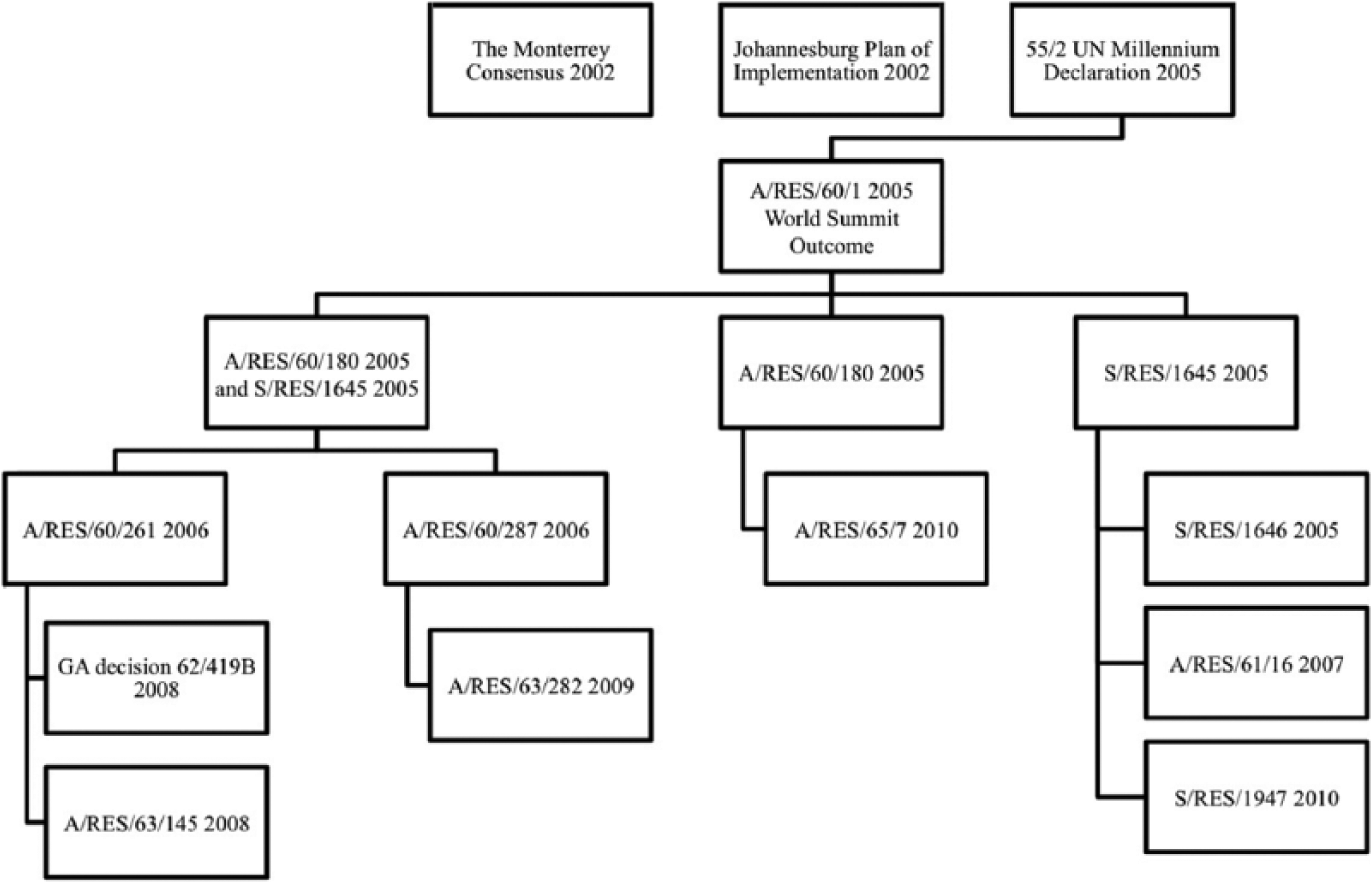
‘Family tree’ of UN documents pertaining to the PBC.
Two further documents relevant to the Charter branch of the family tree are ECOSOC resolution 1296 (1968) on ‘Arrangements for consultation with non-governmental organizations’ and ECOSOC resolution 1996/31 (1996) on the ‘Consultative relationship between the United Nations and non-governmental organizations’.
In these three texts, it is notable that the UN does not refer to civil society at all. Provisions are made in relation to ‘non-governmental organisations’, which is different. As noted by Nora McKeon (2009: 11), ‘[t]he original physiognomy of NGOs was that of a well-established non-profit … and the first generation of INGOs [international non-governmental organisations] that interfaced with the UN were almost exclusively headquartered in Europe and North America’. In the early textual representations, first, the internal coherence of the NGOs is assumed and, second, their role in UN practice is that of consultant. On the first of these points, ECOSOC resolution 1296 specifically notes that to qualify for inclusion in the procedure of establishing consultative relations with the UN, an organisation ‘shall be of representative character … it shall represent a substantial proportion, and express the views of major sections, of the population or of the organized persons within the particular field of its competence’ (UN ECOSOC, 1968: OP 4). This representation constructs NGOs as unitary and homogeneous in character, and representative of a particular constituency; those NGOs that are not unitary in this way are to be excluded from consultative processes. Almost three decades later, however, ECOSOC passed a subsequent resolution that recognised the complexity of the politics and dynamics of NGOs. In ECOSOC resolution 1996/31, ECOSOC suggests that: Where there exist a number of organizations with similar objectives, interests and basic views in a given field, they may, for the purposes of consultation with the Council, form a joint committee or other body authorized to carry on such consultation for the group as a whole. (UN ECOSOC, 1996: OP 9)
This construction still requires the NGO (or meta-NGO) to speak to ECOSOC ‘as a whole’, but it does at least recognise the possibility of a multiplicity of actors in a single political space, all of whom might legitimately claim expertise in a particular issue area.
These early documents depict a unidirectional exchange of knowledge between the UN and the NGOs: consultative arrangements are to be made, on the one hand, for the purpose of enabling the Council or one of its bodies to secure expert information or advice from organizations having special competence in the subjects for which consultative arrangements are made, and, on the other hand, to enable international, regional, subregional and national organizations that represent important elements of public opinion to express their views. (UN ECOSOC, 1996: OP 20)
By 1996, in the institutional representations of the UN, NGOs may ‘express their views’, but, as shown in the excerpt from the Charter above, initial constructions situated NGOs in relation to the UN organisation as a consultative entity only (and it should be remembered that the title of the 1996 ECOSOC resolution still focuses on ‘consultative relationships’). There is a qualitative difference between a process of consultation, where knowledge is extracted from one entity by another, the expression of views (which may or may not be acted upon) and the meaningful participation of civil society actors in formulating policy responses to particular issues. Books are consulted; people are involved. I draw attention to these constructions to illustrate how, by contrast, the policy architecture pertaining to the PBC represents civil society (for this is the prevalent construction in the relevant documentation) differently, as part of a ‘partnership’ in programme planning and implementation (UN GA, 2000: para. 20).
Neera Chandhoke (2002: 37) notes that ‘civil society in classical political theory is conceptualized as the space where ordinary men and women through the practices of their daily life acquire political agency and selfhood’. In the early constructions of NGOs in UN discourse, as shown earlier, there is very little sense of agency or even the involvement of ‘ordinary men and women’ in the NGOs with which the UN was prepared to consult. By contrast, in the UN Millennium Declaration (UN GA, 2000), which represents the beginning of the shift towards the use of the signifier ‘civil society’ rather than ‘non-governmental organizations’, ‘civil society’ is to be given ‘greater opportunities … to contribute to the realization of the Organization’s goals and programmes’ (UN GA, 2000: para. 30). The Millennium Declaration is an aspirational statement endorsed by every member of the UN General Assembly, the entity which Inis Claude (1966: 372) referred to as ‘the best available facsimile’ of the ‘voice of all mankind [sic]’, and thus carries great normative significance. It is part roadmap, part wish list, relating to the ‘values and principles’ of the UN system at the turn of the millennium. The inclusion of a specific reference to civil society, in a section of the Declaration titled ‘Strengthening the United Nations’, is significant. It is also significant that we see in the Declaration the early establishment of associative chains between civil society and ‘the private sector’ (UN GA, 2000: para. 20), enterprises or initiatives that are not run by the state and that are usually reliant on generating profit to continue operations.
In these three documents (the Millennium Declaration, the Monterrey Consensus and the Johannesburg Plan), it is possible to identify the emergence of three types of actor: civil society (including, but not limited to, formal NGOs); international organisations (including, but not limited to, the UN entities and the UN organisation as a whole); and ‘the private sector’. These representations are particularly prevalent in the Declaration and the Monterrey Consensus, where they are reminiscent of theories of the emergence of civil society at the national level, formed in the space left by the ‘rolling back’ of the state in the mid-1980s; civil society thus represents the residual entities not captured by the state (political institutions) or the economy (business institutions), hence the description of civil society as the ‘third sector’ within national boundaries (Chandhoke, 2002: 43). These ‘civil society organisations’ (and they are still ‘organisations’ at this historical juncture, not yet supplanted by the more inclusive ‘civil society’ in general terms) are hailed into working relationships with the UN ‘in pursuit of development and poverty eradication’ (UN GA, 2000: para. 20) and are conceived of as capable of providing ‘financial and technical assistance’ (Johannesburg Plan, 2002: para. 86d) and of ‘active involvement’ in the implementation of UN-led programmes (Monterrey Consensus, 2002: para. 71). In short, CSOs are constructed as subjects with agency in these documents.
The resolution that founded the UN PBC (S/RES/1645; A/RES/60/180) was made possible by the General Assembly resolution pertaining to the 2005 World Summit Outcome (A/RES/60/1). The 2005 World Summit Outcome document, as it is widely known, outlines a number of agreements made by the heads of state present at the summit itself and endorsed by the UN General Assembly, including the creation of ‘a Peacebuilding Commission as an intergovernmental advisory body’ (UN GAb, 2005: para. 97). In the paragraphs related to the creation of the PBC, however, it is notable that CSOs are not included in the enumeration of the ‘relevant actors’: while ‘all relevant actors within and outside the United Nations’ are invited to participate in the processes of the new commission (UN GA, 2005b: para. 98), the text directly cites ‘international financial institutions’, ‘countries in the region’, ‘financial, troop and civil police contributors’, ‘senior United Nations representatives’, ‘the World Bank, the International Monetary Fund and other institutional donors’ (UN GA, 2005b: paras 99–102). It is significant, therefore, that in the foundational resolution, the PBC is ‘encouraged’ to ‘consult with civil society, non-governmental organizations, including women’s organizations, and the private sector engaged in peacebuilding activities’ (UN SC, 2005: OP 21). Textually, however, the inclusion of civil society is far removed from the centre of peacebuilding power: the resolution reproduces the list of key actors from the World Summit Outcome General Assembly resolution in its specification of the entities that should comprise the country-specific configurations (CSCs) and civil society is again absent from this list (UN SC, 2005: OP 7).
Prior even to the constitution of the CSCs, the management of the PBC itself is laid out, and in this paragraph, the UN Security Council is given primary responsibility for deciding the composition of the standing Organizational Committee of the Commission (UN SC, 2005: OP 4). The PBC is made up of 31 UN member states: first, the UN Security Council chooses seven members; second, ECOSOC chooses a further seven; third, the five ‘top providers of assessed contributions’ to UN funds (UN SC, 2005: OP 4c) automatically become members; fourth, the five top contributors of personnel to UN missions also have membership status; and, fifth, the General Assembly selects seven additional members ‘giving due consideration to representation from all regional groups … and to representation from countries that have experienced post-conflict reconstruction’ (UN SC, 2005: OP 4e).
It is significant that the Security Council is listed first here. On the one hand, having the PBC bear the imprimatur of the Security Council lends it authority within the UN system and in global politics more broadly given that the Security Council has considerable legislative and institutional powers. On the other hand, the close association with the Security Council renders the PBC vulnerable to the critiques that have been levelled at the Security Council, related to the centralisation of power in the hands of the five permanent members and the unequal representation of the majority world on the Security Council more broadly (see, e.g., Carpenter, 1997; Malone, 2000; Sutterlin, 2003). In the hierarchy of the foundational resolution, then, priority is given to the UN (cited in the preambular material) as the most significant actor, with subordinate non-state actors appearing in order: the Security Council, ECOSOC, the General Assembly, the World Bank, the International Monetary Fund, ‘other institutional donors’ (UN SC, 2005: OP 9), ‘regional and subregional orgnisations’ (UN SC, 2005: OP 11), ‘regional and local actors’ (UN SC, 2005: OP 19), ‘civil society, non-governmental organizations, including women’s organizations, and the private sector engaged in peacebuilding activities’ (UN SC, 2005: OP 21). It is at least a little heartening that consultation with civil society is given textual priority over consultation with the private sector, although the positioning of ‘civil society’ in this list, 10th in a list of 12 potential sites of authority, does not suggest the construction of ‘civil society’ as a meaningful agent of change such as is represented in earlier relevant documentation.
David Chandler’s (2010: 385) analysis of the incorporation of civil society into peacebuilding discourse suggests that, within this discourse, ‘[c]ivil society is seen as the sphere capable of generating the solutions to problems of conflict or to the barriers to development or democracy’. 2 Within the policy architecture of the PBC, at least, this does not seem to be the case. This conclusion is echoed in the terms of reference of the 2010 Review of the United Nations Peacebuilding Architecture (UN GA/SC, 2010), which implies authority beyond the state and beyond the UN system in three of the six ‘key issues’ driving the review process: the ‘imperative of national ownership’ (UN GA/SC, 2010: para. 17); the ‘importance of women’s contribution’ (UN GA/SC, 2010: para. 29); and the ‘need for connection with the field’ (UN GA/SC, 2010: para. 31). While ‘civil society’ is not explicitly articulated as a meaningful concept in these paragraphs, related signifiers feature prominently, and in interesting subject positions relative to the UN system and the ‘international community’ as a whole. Evaluating the success of peacebuilding-related activities must be based on ‘how much it matters in the field’ (UN GA/SC, 2010: para. 31); the use of ‘the field’ evokes images of rural pastures, far removed from the urban setting of the UN’s headquarters in New York, and associative chains link urban living with development, modernity and progress (for the classic exploration of these ideas, see Mohanty, 1988). It is even explicitly articulated in the text: ‘perspectives on the ground can differ quite radically from those in the corridors of New York’ (UN GA/SC, 2010: para. 31). The developed world, the site of peacebuilding ‘strategic planning’, has corridors, while the site of peacebuilding practice is just a field.
Quite rightly, the 2010 review comments with some pride on the fact that ‘The Peacebuilding Commission has the distinction of being the first United Nations body to have the gender dimension explicitly built into its founding resolutions’ (UN GA/SC, 2010: para. 29). Apart from the textual representation of ‘the gender dimension’ as a singular aspect of peacebuilding processes, and also bracketing for a moment the critique of the implicit hierarchy of knowledge in the foundational resolution that situated ‘the gender dimension’ (in the guise of consultation with ‘women’s organizations’) as a subset of broader concerns about the inclusion of civil society, which, in itself, is gendered (see Campbell, 2005; Einhorn and Sever, 2003; Howell, 2005), this is indeed something to celebrate. The review’s determination that five years of operation have seen ‘some successes in involving women’s organisations, but their voices are insufficiently heard, especially in the field’ (UN GA/SC, 2010: para. 29) and its insistence that the PBC should be ‘at the forefront’ of shifting the perceived role of women in peacebuilding ‘from a niche concern to the mainstream’ (UN GA/SC, 2010: para. 29) is welcome. There are, however, a number of internal tensions in the review on this issue, not the least of which is its persuasive representation of the importance of women’s active contribution to peacebuilding processes on the one hand, and its usage of a birth metaphor to describe peacebuilding practice on the other: ‘The international community must understand the limits of its role as midwife to a national birthing process’ (UN GA/SC, 2010: para. 18).
In this representation, the international community — the collective term for the member states and all the other ‘relevant actors’ cited in the foundational resolution and discussed earlier — serves as a midwife, while the nation effectively gives birth to itself. There are multiple oppositions at work in this metaphor: the international versus the national; the midwife versus the labouring woman; and the detached versus the involved. All of these oppositions are gendered and, as such, hierarchical. Derrida (1972: 41) reminds us that there are few (if any) neutral dichotomies, or sets of binary opposites: ‘we are not dealing with … peaceful coexistence … but rather, a violent hierarchy. One of the two terms governs’. Dichotomies represent and perpetuate relations of power; one half of the binary is always privileged within any particular culture: ‘Polarities (right versus wrong, rational versus emotional, strong versus weak) forestall our consideration of nonoppositional constructs (right in relation to plausible, persuasive, possible, coherent; rational in relation to consistent, instrumental, logical; strong in relation to effective, principled, respected)’ (Peterson and Runyan, 1999: 38). Further, the use of such a metaphor is not a mere ‘figure of speech’: ‘synonymy, metonymy, metaphor are not forms of thought that add a second sense to primary, constitutive literality of social relations; instead they are the primary terrain itself in which the social is constituted’ (Laclau and Mouffe, 2001 [1985]: 30).
UN discourse constructs ‘the international community’ as ‘the repository of knowledge concerning the procedures and practices necessary to achieve and consolidate … authority’ (Shepherd, 2008: 166–167). The ‘role’ of the international community, in this metaphor, is to support, nurture and generally make possible (read: act like a midwife) the ‘national birthing process’, which it can only do if it has the relevant knowledge and expertise. Just as conventional medical discourse strips pregnant women of their agency in the birthing process, in representing the international community as midwife and the national community as a labouring woman, the review document depicts the national community as lacking this knowledge and expertise. Further, while midwives are traditionally female, which resists the easy interpretation of a masculine knowing subject (the international community) versus a feminised known subject (the national community), hierarchies of knowledge still exist in this imagery through the suggestion that a midwife is necessary to allow a trouble-free birth: this is a depiction of hegemonic and subordinate femininities rather than masculinities, as per Raewyn Connell’s (1987) influential formulation. Such a construction resonates again with Chandra Mohanty’s (1988: 65) analysis of development discourse and the discursive creation of ‘the average third world woman … ignorant, poor, uneducated, tradition-bound, religious, domesticated, family-oriented, victimized, etc.’. The national community is hailed into this subject position in this excerpt from the review, intimately involved in the messy, bloody labour of peacebuilding to bring in to being a new political life. The international community, while acting as the authority, is facilitator rather than participant.
The emphasis on ‘national ownership’ and the construction of the national community as agent of its own renaissance is in keeping with the construction of civil society actors as agents of change. Civil society resides within the national community, at least in ‘the field’, where we are not engaging with ‘global civil society’, which is a qualitatively different form of subject. According to the review, the PBC seeks to facilitate engagement with ‘civil society’: ‘more must be done to ensure that these groups are in a position to engage meaningfully in the peacebuilding process. The record regarding women’s organizations is particularly thin’ (UN GA/SC, 2010: para. 53). The stated desire to see ‘greater civil society involvement’ (UN GA/SC, 2010: para. 172) in the processes and practices of the PBC is in keeping with Chandler’s (2010: 371) analysis of ‘external intervention as an act of empowerment or capacity-building, consciously disavowing colonial discourses of fixed distinctions of superiority’. It is external intervention, but of a different sort: it is intervention to which the national community must consent and from which (sectors of) the national community will benefit. It is external intervention that does not lend itself easily to the types of critique normally levelled at intervention.
Civil society in speech acts: From homogeneity to Hydra
This section draws on interviews I conducted during a period of fieldwork in New York during June–July 2013. I spoke with a number of individuals (and some teams) that occupy key roles in UN activities related to peacebuilding, peace and security. I was able to visit the offices of the UN PBC, the UN Development Program, UN Women, the UN Department of Political Affairs, the NGO Working Group on Women, Peace and Security and the Women’s International League for Peace and Freedom, and conduct interviews at most of these offices. Where I have interviewed the same person more than once, these are accounted for in the reference with lower case letters appended to the interview number. All research participants agreed to speak to me on the grounds that I would provide them with full anonymity, extending to their institutional affiliation; hence, the data analysed in this section is attributed anonymously, with no mention of their institutional location. This section draws out two core themes from the interview data I collected: first, tensions in the representation of ‘civil society’; and, second, the construction of a ‘common sense’ discourse on the need to include CSOs in the planning and implementation of peacebuilding-related activities.
Across the different UN organisations, different representations of civil society emerge from the interview data.
3
One interview was particularly striking in this regard, strongly reflecting the representations of civil society in the Monterrey Consensus (2002: para. 69) and the Johannesburg Plan (2002: para. 73), both of which articulate civil society as an undifferentiated whole. It was notable that this interviewee constructed civil society in this way; during conversation, I was told that: ‘civil society sits on the steering committee’ of operations in peacebuilding contexts; ‘civil society can attend … meetings’; and UN staff ‘always make a very important point of meeting with civil society not only in meetings, more formal meetings, but also separately and to hear their views’ (Interview 1a, NYC, 2013). Here, civil society is represented as a coherent and unitary entity, and there is tension in the construction of the subject: on the one hand, civil society ‘sits on the steering committee’, which is active; but, on the other hand, UN staff ‘hear their views’, which is passive. There is also no guarantee that a seat on the steering committee translates into meaningful opportunities for influence; feminist political scientists have demonstrated beyond doubt that having access to decision-makers and being present during debates, while important, does not, in itself, enable meaningful participation (see Karl, 1995; Phillips, 1991, 1995; Randall, 1987 [1982]: 15–49). This lack of agency is also present in the construction of civil society and ‘local communities’ as ‘beneficiaries’ first: I’m sure that UN entities and UN missions in the UN always have a very active dialogue with civil society and local communities. I mean they are the beneficiaries, they are the implementing partners, they are the owners of the process. (Interview 1a, NYC, 2013)
Situating ‘civil society and local communities’ in this way functions, first, to create an equivalence between civil society and local communities such that they become the same kind of actor (an entity functioning at the ‘local’ (read: sub-national) level) and, second, to ascribe three types of identity to that actor. The first of these is ‘beneficiary’, which is a passive subject position: a beneficiary receives, largely at the whim of the benefactor, they are not active in the process and it is not a relationship of equals. A ‘partner’, conversely, is an actor of equal status in a venture, while the subject position of ‘owner’ elevates civil society and local communities to the top of the peacebuilding hierarchy: owners have both agency and authority. These discursive constructions reflect multiple tensions in the ways in which civil society as a concept is made meaningful — and can therefore be acted upon — in the peacebuilding context.
When asked to elaborate on which CSOs are most closely involved in peacebuilding activities, strong emphasis was placed on the importance of ‘local level’ participation. For example, one interviewee noted that their office would ‘rather have those [CSOs] engage through the local structure of the discussion on peacebuilding at the local level’ (Interview 2, NYC, 2013). It is notable that this fragment of discourse uses the word ‘local’ twice in one sentence, reaffirming the importance of the ‘local’ affiliation of CSOs. The assumption here is that transnational or even international NGOs lack an appropriate understanding of the peacebuilding context. This was reinforced by another research participant, who created a strong link between local context and legitimacy: ‘It [UN activity] should complement the engagement at the field. Of course, that is where the action is. That is where the knowledge is’ (Interview 1b, NYC, 2014). The idea of localisation also came through powerfully in the discourse of another research participant, who identified the ‘local’ as the domain of agency and activity: ‘We’re [CSOs are] not going to wait while a national government drags its feet to develop a national action plan, we will develop our own local action plan’ (Interview 9, NYC, 2014). In peacebuilding-related activities, there is a ‘very vocal civil society component but all from the local level’ (Interview 2, NYC, 2013).
Another research participant commented that ‘at country level, for this work, I mean you just cannot do it without civil society’ (Interview 3, NYC, 2013). The legitimacy of civil society therefore rests on its association with the local level and the function of this discursive construction is to delimit the authority of those CSOs to the local context. Put simply, CSOs may be invited to have a seat at the table during deliberations over peacebuilding plans, but the influence that they are likely to have from that seat is curtailed by the association of their knowledge with their local — and thus highly specific — context. The same legitimacy (their association with the local level) that gets them into the room with decision-makers may function to delegitimise their contribution when they are in that room. This was emphasised by one research participant, who created a clear articulation between local knowledge and informal power: ‘It is common knowledge that women are in the communities doing negotiation roles, but then when it becomes official and formal, they disappear’ (Interview 9, NYC, 2014). As Chandhoke (2002: 47) argues: people are disempowered rather than empowered when highly specialised, professional, and more often than not bureaucratised civil society actors tell them what is wrong with their daily existence and how they should go about resolving the problems of their collective lives.
Then there is the question of who speaks, and on behalf of whom. My fourth interview engaged someone who was very clear about the danger of making assumptions regarding the representational capacity of CSOs: You go to Sudan, you think that these advocacy-focused NGOs are a lot closer to the citizens, and the beneficiaries, and the people, but they’re not necessarily. Part of the reason why they have access is because they’re different, they speak English, they know how to speak to donors, they know how to speak to the UN. That’s why they’re the interlocutors of the UN. And the reason why they speak English is because of the life they’ve had, their class, their race, and as a result of having lived outside of the country for long periods of their lives. And when they are in country, they have to spend a lot of their time fundraising and lobbying and trying to access the house of power in a way. So they don’t necessarily have that much contact with ordinary women and girls. (Interview 4, NYC, 2013)
This interviewee clearly sees internal variation in CSOs, and questions their ability to represent ‘ordinary women and girls’. In this construction, the subject group of ‘women and girls’ is the most marginalised, the most disenfranchised. In the hierarchy of authority, there is: ‘the house of power’, which is the domain of the UN that the NGOs are trying to access; the NGOs that enjoy privilege based on their language capacity, their collective class, their collective race and their collective experience outside the country, which is the ‘local context’ so valued in the discourse analysed above; and, finally, the ‘women and girls’. This is interesting not only because the legitimacy afforded to the NGOs is a function of their having transcended the local context, at least for a time sufficient to enable them to learn ‘how to speak to the UN’, but also because this legitimacy is also contested by the interviewee, who recognises a ‘gap’ and a ‘disconnect’ between the CSOs that access ‘the house of power’ and the everyday lives of people involved in and affected by the peacebuilding activities. This was reinforced by other research participants, who drew attention to the problematic nature of representation in civil society and formal politics: ‘among civil society actors, those who were able to participate are also mostly civil society groups based in the capital … we need to bring on board the local actors’ (Interview 9, NYC, 2014). This implies a disconnect between ‘civil society’ and the ‘local actors’ that complicates the question of civil society involvement in peacebuilding activities.
Deniz Kandiyoti (2004: 135) comments on this theme in her scholarship on development: [as] donors, UN agencies and NGOs compete for their share in the ‘gender’ market, often draining limited local capacity to staff their own projects in the process, there is a risk that local voices (especially non-English speaking ones) may be drowned out.
Although Kandiyoti does not specify which ‘local voices’ are heard and which are drowned out, this resonates with concerns expressed by the research participant: ‘for some reason, people assume that women’s NGOs are all going to get along, and they’re all going to have the same priorities and, you know, they’re political animals just like everybody else and have different priorities as well’ (Interview 4, NYC, 2013). Recognising civil society actors as ‘political animals’ is to recognise different, competing, interests and agendas that may or may not map on to the concerns of their constituent communities, if, indeed, they can be said to represent a constituency. One interviewee commented that, in some contexts, CSOs represented: traditional and customary structures … when there is no other organised structures to talk to … and their role … might not be rooted in human rights and founded on agreed rules and regulations that protect the most vulnerable groups. (Interview 8, NYC, 2013)
In sum, it cannot be assumed a priori that CSOs represent the population in any given peacebuilding context, nor can it be assumed that civil society actors are able to effect change even when they are included (see Kabeer, 1999). Further, the construction of CSOs as ‘political animals just like everybody else’ is interesting, going against the grain, as it does, of constructions, particularly of women’s organisations, as selfless saints and ‘superheroines’ (Cohn et al, 2004: 136; see also Shepherd, 2011). This has important implications for the funding and governance of resources, as well as reinforcing the idea that civil society is a contested space/concept.
More than one research participant commented on the competition for resources and access within communities: money ‘gets stuck at the UN level, or gets stuck with the three or four big NGOs that are well-known’ (Interview 4, NYC, 2013); when disbursing funds, ‘you pick the NGOs with the biggest mouth and the well-known’ (Interview 1, NYC, 2013); ‘Resources have also proven to be one of the factors that divide women’s organisations generally, or civil society generally, including those who are involved in peacebuilding initiatives, because there is huge competition for resources’ (Interview 9, NYC, 2014). There are hierarchies of NGOs, with bigger, more vocal, organisations with visibility and profile receiving funds and others being ignored. One interviewee used the phrase ‘civil society tokenism’ as a comment on ‘the issue of what counts as civil society representation … if you happen to be the lucky person that gets to get counted, then great. But, other than that, it’s not always so inclusive or transparent’ (Interview 5, NYC, 2013). By this logic, the distribution of funds may be similarly exclusive or opaque: if an organisation is ‘lucky’ enough to ‘get counted’, then they may receive funds, access or advice. Others that are not so lucky (are smaller, quieter, not so well-known) will be excluded from the peacebuilding process, and there is little in place to ensure that the decision-making around this process of inclusion and exclusion is transparent and equitable.
All research participants commented on the extent to which contemporary peacebuilding-related activities take for granted the need to involve — not only consult with — CSOs. One interviewee said bluntly that ‘NGO engagement is central to everything we do’ (Interview 4, NYC, 2013) and another commented that there has been a slow realisation in the UN system that ‘if we actually want to achieve results, we have to do it A) together with other UN agencies but B) through civil society partners’ (Interview 6, NYC, 2013). It is notable that the UN is still the primary actor in this construction, with the agenda of the UN being achieved through not with civil society partners; this positions the subject of civil society in a subordinate relationship with the UN and does function to reaffirm the supremacy of UN/international knowledge over civil society/local knowledge. There is a sense in which the inclusion of civil society in peacebuilding practices leads to a form of extractive legitimacy, such that the UN activities in the peacebuilding context are legitimised through association with CSOs, and the CSOs are, in turn, legitimised through association with the UN. In this account, everyone benefits.
The sticking point, however, is in the value ascribed to knowledge across the different spatial domains. As argued earlier, ‘local’ knowledge is constructed as both essential to the success of peacebuilding activity and marginal to the governance of that activity. Ultimately, civil society actors are not ‘owners’ first, they are ‘beneficiaries’ (Interview 1, NYC, 2013); CSOs are not ‘partners’ first, but conduits for the UN to work ‘through’ (Interview 4, NYC, 2013). ‘NGOs in civil society … play a really important role in creating peacebuilding processes and are agents of change at the country level’ (Interview 1b, NYC, 2014). Those that ‘play a role’ are not usually the scriptwriters. These constructions reinforce a peacebuilding discourse that (re)produces the UN — as representative of ‘the international community’ — as the architect/legitimate knower of peacebuilding practice, and the communities working on building peace as the labourers/known objects. This has significant implications for the ways in which CSOs, and the forms of knowledge that these organisations represent, are encountered and engaged in peacebuilding practices; ‘local’ knowledge is at once valued (in the process of extraction) and yet subordinated. I am in no way suggesting that the people I spoke to think poorly of civil society actors, or are dismissive of the work that these actors do; quite the opposite is true. The research participants were, without exception, committed to ‘local’/civil society ownership of peacebuilding activities and often critical of the ways in which UN entities can fail ‘in country’; they were (and no doubt still are) good people trying to do good things in difficult, frustrating, challenging, circumstances. Nonetheless, the tensions in their representations of civil society are worthy of exploration. 4
Conclusion: Civil society, legitimacy and power
I have raised many issues for consideration here. I have sketched out a potentially innovative and rewarding approach to discourse-theoretical scholarship, integrating interview transcripts into the data corpus for analysis using discourse-theoretical techniques. I have reviewed academic literature on civil society with a view to arguing that attention should be paid to its contextual construction in specific discursive terrains. In this article, the terrain is the UN, more specifically, the UN entities involved in some way with peacebuilding-related activities. I have applied the tools of discourse analysis to two different sets of data on the same phenomenon in order to comprehend how these different discursive terrains construct civil society as both a meaningful concept and a spatial domain. Through my examination of these data, I have drawn out various representations of civil society to argue that the data evidences a shift in the way in which the UN system conceives of civil society over time, from consultant to implementing partner. The discourse further constitutes civil society as a legitimating actor for UN peacebuilding practices as CSOs are the bearers/owners of certain forms of (local) knowledge. The inclusion of CSOs in peacebuilding processes therefore becomes ‘common sense’; this move is reflected in both policy documents and interview data. The ‘common sense’ of civil society participation, however, should be interrogated more closely; Stuart Hall (1985: 105) famously called the formation of common sense ‘a moment of extreme ideological closure’, arguing that the ‘regime of the “taken for granted”’ should be the target of all critical investigations, and this is what I have tried to achieve here.
The logics informing the construction of civil society in UN peacebuilding discourse are both gendered and gendering. It is notable that the foundational resolution that brought forth the UN PBC specifically identifies ‘women’s organizations’ — and only women’s organisations — as a part of ‘civil society’ with which the PBC is encouraged to consult (UN SC, 2005: OP 21). This articulation, as discussed earlier, not only feminises CSOs, but also reproduces the association between women and civil society (as opposed to the realm of formal politics). Further, the discursive construction of civil society as a feminised subject in peacebuilding discourse relies on assumptions about women’s capacity to engage meaningfully in peacebuilding-related activities by virtue of their femininity and the concomitant assumption of pacifism and peacebuilding potential. Both of these constructions are problematic in limiting the ways in which they make sense of women’s lived experiences in conflict and post-conflict situations. This research has highlighted the sense of a gendered gap between local peacebuilding-related needs and activities and the UN as a ‘house of power’, which perpetuates the subordinate positioning of ‘local’ civil society actors in relation to the ‘international community’.
In substantive terms, it matters how UN documents represent civil society’s role in peacebuilding and it matters how UN staff think and talk about civil society as a concept, a space and an entity because these discursive structures are the conditions of possibility for peacebuilding practice. As Roxanne Doty (1996: 6, emphasis added) explains, ‘[a] discourse delineates the terms of intelligibility whereby a particular reality can be “known” and acted upon’. Through the case study of civil society participation in UN peacebuilding-related activities, I have tried to show the broader benefits of a discourse-theoretical approach to the study of international organisations. This study examines the texture and quality of the discursive terrain of UN offices involved in peacebuilding operations, and offers insights far more finely grained than can be gleaned by ‘taking for granted’ any element of UN peacebuilding discourse. Through understanding the discursive terrain of an institution, it is possible to identify, problematise and challenge the ways in which certain ‘realities’ become accepted as ‘real’ in contemporary global politics. The policies and procedures that are then built upon this foundation of ‘reality’ or ‘common sense’ certainly have profound implications for the everyday lives of people building peace in post-conflict societies.
Footnotes
Acknowledgements
I am very grateful to Caitlin Hamilton, Research Associate and doctoral researcher at UNSW Australia, for her assistance on this project, and particularly for the UN PBC ‘Family Tree’ in Figure 1. Versions of this article were presented throughout 2014 at the International Studies Association annual convention (Toronto, Canada), the Oceanic Conference on International Studies (Melbourne, Australia) and the Australian Political Studies Association annual conference (Sydney, Australia). The article was much improved through feedback provided at these venues and I am grateful to the participants for their engagement. I would also like to thank all research participants and the European Journal of International Relations reviewers and editors. Mistakes and oversights, of course, remain solely my responsibility.
Funding
This article forms part of a larger project investigating logics of gender and space in UN peacebuilding activities. Funding for this research is provided by the Australian Research Council (DP130100707).