




Abstract
What are the origins of global regulation? This article proposes that the developmental state — the state investing in economic development — can be a source of global environmental regulation. Through industrial policy, the developmental state can promote structural economic change in polluting sectors that supports global regulatory policy in two ways: first, providing state support to green industries creates economic interests in support of global regulation; and, second, driving down the cost of technology through government subsidies alters the pay-offs of global cooperation for other states. This article examines the two mechanisms in the case of climate change: the global leadership of the European Union; and international cooperation on the Paris Agreement. The argument advances our theory of the state in global regulatory politics as both a developmental and a regulatory force. This article identifies significant scope for the developmental strategies of major economies to change the interest and cost structures of polluting sectors to support global environmental regulation.
Keywords
Introduction
Global regulatory policy has grown rapidly over the past few decades. Yet, the extent of regulatory cooperation varies significantly across issue areas. In global environmental politics, for instance, the 2013 Minamata Convention on Mercury achieved international cooperation, while efforts to cooperate on climate change faced gridlock for more than a decade. Research shows that the success or failure of global regulation depends on the interests of powerful states, notably, the US and the European Union (EU) (Drezner, 2007; Vogel, 1996). The literature offers two predominant explanations for the global regulatory policy of these states: government officials with a high degree of autonomy formulate policy, or powerful business interests shape policy (Falkner, 2008; Hopgood, 1998; Mattli and Woods, 2009). These explanations of global regulatory policy build on a theory of the state as regulator: state officials either impose global rules on business, or business interests capture the rule-making process.
This article extends our understanding of the state in global environmental regulation to include the developmental state — the state that intervenes in economic sectors to promote structural economic and technological change. While scholars have historically understood the regulatory and the developmental state as two distinct state forms (Evans, 1995; Johnson, 1999; Wade, 1990), I argue that regulatory and developmental strategies coexist in modern economies. 1 The governments of the US, Europe, and China engage in both environmental regulation and green industrial development, though their industrial policy styles and apparatus differ from those of the classic developmental states in East Asia. Modern industrial policy is not dirigiste state planning, but focuses on providing policy direction and support for innovation-oriented private sector activity (Rodrik, 2007; Stiglitz et al., 2013). Importantly, the developmental state’s ability to intervene in the economic structure of polluting sectors 2 with industrial policy can support global regulatory policy through two mechanisms: first, providing government support to clean technology industries grows business interests that are in favor of global regulation, which helps to overcome opposition to regulation; and, second, incentivizing the development and use of clean technology lowers technology costs, which alters the pay-offs of global regulation for other states. The developmental state can thus reconfigure business interests and reduce the adjustment cost of global regulatory cooperation. The argument advances our understanding of agency in global environmental regulation, highlighting the role of developmental state actors and sets of states championing new technologies. It also contributes to the growing debate on the dynamic interaction of market and technology development, on the one hand, with global environmental regulation, on the other (Kim and Urpelainen, 2013; Vormedal, 2010).
This article examines the argument with regard to global climate politics, which was widely considered a failure (Hale et al., 2013; Victor, 2011) as fossil fuel interests largely captured the domestic and international regulatory process (Ciplet et al., 2015; Levy and Newell, 2002). As a result, a fragmented regime of weak market-based governance emerged (Meckling, 2011; O’Neill, 2017). Within this picture of regulatory failure, two policy successes stand relatively tall: the persistence of global leadership by the EU; and global cooperation on the Paris Agreement of 2015. This article argues that the developmental state enabled these two outcomes by changing the economic structure of the global energy sector. The notion of economic structure, here, refers to the relative weight of clean technology and polluting business interests and the relative costs of clean and polluting technologies. This emerging structural economic change has affected regulatory outcomes in two ways: first, the creation and growth of clean energy interests in Europe has helped fuel the EU’s global regulatory leadership on climate change; and, second, the decline in the cost of renewable energy technologies — as a result of the developmental strategies of the EU and China, in particular — lowered the cost of regulatory cooperation for other states, as reflected in the Paris Agreement.
This argument holds implications for policy because it identifies scope for industrial policy intervention by major economies to change the interest and cost structures of polluting sectors to support global regulation. Strategic agency in regulatory politics extends beyond regulators and regulated businesses to include developmental actors and agencies. It thus complements recent analyses that highlight the role of the developmental state in environmental governance (MacNeil, 2013; MacNeil and Paterson, 2012; Schmitz et al., 2015).
This article proceeds as follows. First, I engage with the debate on the origins of global regulatory change to suggest the need for theory that examines the interactions between the regulatory state and the developmental state. Second, I hypothesize causal mechanisms between developmental state action and regulatory state action. Third, I examine the link between developmental and regulatory policies in climate governance in the case of the EU and in the case of the Paris Agreement. I conclude with implications for theory and policymaking.
Explaining regulatory change in global environmental politics
Two lines of thought shape the debate on the sources of regulatory change in global politics in general, and global environmental politics in particular (Mattli and Woods, 2009; O’Neill, 2017): state-centered and business-centered views. A state-centered view assumes that state officials are relatively autonomous in formulating global regulatory policy (Ikenberry et al., 1988). In this view, the state is conceptualized as “a set of roles and institutions having peculiar drives, compulsions, and aims of their own that are separate and distinct from the interests of any particular societal group” (Krasner, 1978: 10). For instance, research demonstrated how officials in the US State Department engage with societal groups but retain the capacity to make autonomous decisions in foreign environmental policy (Hopgood, 1998). In the study of environmental regulation, the notion of a relatively autonomous state extends to its ability to drive economic and technological change. The state is seen to have the capacity to formulate and implement “technology-forcing” regulation domestically and globally (Jänicke and Jacob, 2004). Stringent environmental regulation can result in the emergence of clean technology industries.
A business-centered view, instead, conceives of international environmental policy as the result of industry influence. A significant body of research showed that the support or opposition of international environmental regulation by industry groups matters in global environmental regulation (Falkner, 2008; Levy and Newell, 2005; Vormedal, 2010). The strategies of firms, including their decisions on technology investments, shape the policy space for regulatory cooperation. In this view, economic and technological change is a function of corporate decisions and market competition, as opposed to policy. A business-centered approach to global environmental regulation assumes that the state responds to economic interests, a rationale redolent of the private interest theory of regulation (Stigler, 1971). The private interest theory of regulation qualifies a business-centered view by examining the conditions under which regulation is likely to occur. James Wilson (1980) argued that regulation is a likely outcome when it defers concentrated benefits to powerful groups such as firms, while imposing diffuse costs on many actors. For instance, scholars have shown that DuPont’s investments in a substitute for ozone-depleting chlorofluorocarbons shifted its preference toward global regulation on ozone as it secured a long-term competitive advantage (Oye and Maxwell, 1994). Other researchers have shown how economic interests exposed to global trade are likely to support the internationalization of domestic environmental regulation as they benefit if competitors face similar compliance costs (DeSombre, 2000; Vogel, 1995).
In situations with concentrated costs for a few powerful actors and diffuse benefits, however, regulatory capture of the state by industry is likely (Wilson, 1980). Climate regulation, for example, imposes concentrated costs on a number of industries, including the energy sector and energy-intensive manufacturing. These powerful actors are incentivized to organize collectively and to oppose global regulation. The structure of economic interests is such that no powerful group benefits from regulation, largely incapacitating the state as regulator. This is where the dual regulatory and developmental nature of the modern state comes in.
The duality of the state: Regulatory and developmental
State-centered and business-centered perspectives on global environmental regulation and policy-induced technological change rely on a theory of the state as regulator. The regulatory state is either autonomous in rule-making or it is captured by powerful industrial interests. Governing through regulation means to supply and to enforce rules. The regulatory state provides the rules for efficient market operations and addresses the negative externalities of markets through social regulation (Braithwaite and Drahos, 2000; Levi-Faur, 2005). The notion of the state as regulator is the dominant conception of the state in global environmental politics.
The notion of the regulatory state is insufficient to describe state agency in global regulatory politics. The modern state is polymorphous: the regulatory state coexists with the developmental state within the same jurisdiction (Levi-Faur, 2013; see also Table 1). The primary concern of the developmental state is the promotion of economic growth through sectoral intervention (Johnson, 1982). The developmental state supplies industrial policy rather than regulatory policy. It relies more on instruments of distributive policy, such as subsidies and tariffs, rather than regulatory mandates. Through these tools of distributive policy, the developmental state provides concentrated benefits to select industries and can change the structure of the economy. This economic restructuring increases the capacity of the regulatory state to impose rules and costs on polluting industries.
The regulatory and the developmental state.
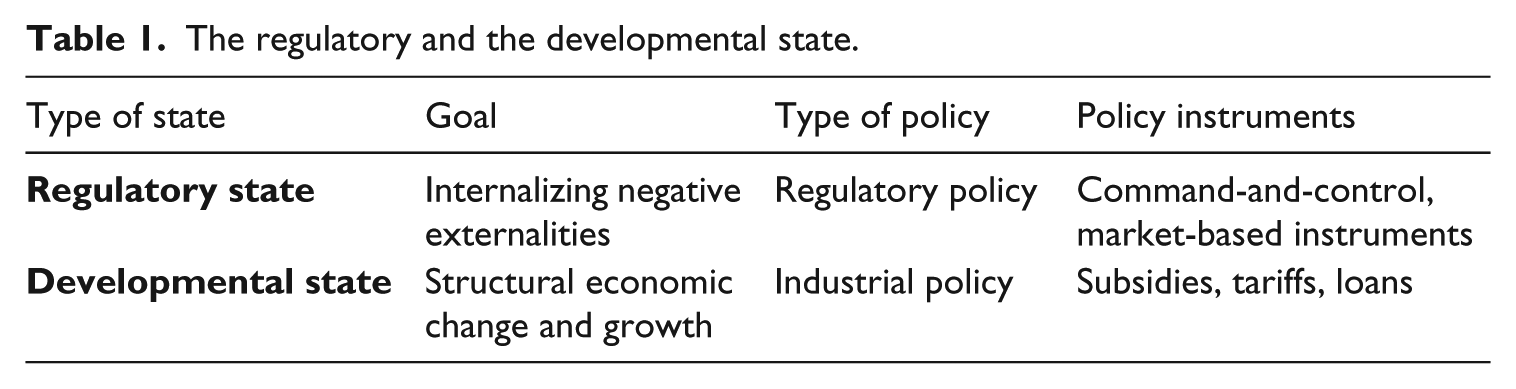
Historically, scholars have understood the regulatory and the developmental state as two distinct state forms: the US represents the ideal regulatory state, while Japan reflects the developmental state (Johnson, 1999). In industrialized Western economies, the regulatory state was seen to have replaced the developmental state. As states adapted to higher economic integration and increased international competition in the 1970s, they shifted in focus from taxing and spending to rule-making (Majone, 1997). The developmental state, however, thrived in East Asian economies (Amsden, 1989; Evans, 1995; Wade, 1990). A centralized and powerful bureaucracy developed domestic firms to enter and catch up with global industries such as information technology.
More recent work demonstrates that the developmental state is not limited to late-industrializing countries in East Asia, but extends to industrialized countries and recently emerging economies, albeit in a distinctly different form. This includes Europe and the US, where the state takes an entrepreneurial role as an investor and developer of technologies and industries. This “neo-developmental” state differs from the classic developmental state in that it operates more through decentralized agencies embedded in networks rather than through a centralized and autonomous bureaucracy (Ansell, 2000; Block, 2008; Breznitz and Ornston, 2013; Mazzucato, 2015; Ó Riain, 2004). For instance, in the US, the developmental apparatus is highly decentralized, including a wide range of agencies such as the Department of Defense and the National Institutes of Health (Block, 2008). Such a neo-developmental network state is also prevalent in the US energy sector (MacNeil, 2013; Meckling and Nahm, 2017). In China, the developmental state is fragmented and rests on state–business alliances at various levels of policymaking (Nahm, 2017; Nölke et al., 2014).
After the 2008 financial crisis, states expanded their role in developing green industries, key growth sectors in the global political economy (Ougaard, 2015). Green industrial and innovation policy — through research and development support, subsidies, tax cuts, tariffs, and other industrial policy measures — has since attracted the attention of scholars (Aggarwal and Evenett, 2012; Craig, 2014; Jänicke, 2012; Karp and Stevenson, 2012; Rodrik, 2014; Zysman and Huberty, 2014). Importantly, research demonstrates how the US developmental state has expanded its activities to promote low-carbon technologies in order to address climate change, while regulatory action failed (MacNeil, 2013; MacNeil and Paterson, 2012; Schreurs, 2012). The Japanese state also redeployed parts of its developmental state apparatus to transform the energy sector (Hughes, 2012). A number of case studies show how countries beyond the triad economies pursue green industrial policies, including emerging economies such as Brazil, China, South Africa, and South Korea (Baker et al., 2014; Chen and Lees, 2016; Death, 2014; Dent, 2012; Gallagher, 2014; Hochstetler and Tranjan, 2016; Mathews, 2012; Pegels, 2014). The broader uptake of green industrial policies across industrialized and emerging economies suggests a nascent green developmental state in the global economy.
The state in global regulatory politics is thus both a regulatory state providing rules and a developmental state investing in industrial development and structural economic change. Actual environmental policy suites often reflect the two state strategies as they employ multiple types of policy instruments, including command-and-control regulation, research and development support, and subsidies for the deployment of clean technologies.
The developmental state, economic change, and global regulation
If the regulatory state and the developmental state coexist in modern economies, how do they relate to each other in global regulatory politics? David Levi-Faur (2013) suggests: “We need to ask how the regulatory capacities of the state promote development, and how does development allow or prohibit the extension of the regulatory state.” The regulatory state and the developmental state are interdependent in global environmental regulation. This relationship, thus, works in two directions.
First, regulatory policy can promote developmental goals. As scholars of regulatory capitalism point out, the regulatory state provides “regulation-for-capitalism.” For instance, regulatory mandates for biofuels help develop new markets (Breetz, 2013). In a similar vein, market-based environmental policy such as emissions trading embeds a developmental strategy — growing commodity markets for emissions credits — into regulatory policy (Newell and Paterson, 2010). This line of thought has shaped much analysis of global environmental politics. Second, industrial policy can promote regulatory goals, which is the focus of this article for two reasons. The literature overlooks this relationship, ignoring important developmental sources of regulatory change. In addition, the dependence of global regulatory outcomes on industrial policy is empirically highly relevant, as I will demonstrate in the case of climate change.
The dependence between the regulatory and the developmental state operates through economic change. As discussed earlier, the main constraint to regulatory policy is that it imposes concentrated costs on politically powerful groups such as industry. If powerful industry groups stand to lose from regulation, regulatory capture is a likely outcome. The economic structure of targeted industries thus constrains regulatory policy. The policy tools of the developmental state — such as subsidies and tariffs — allow it to change the structure of the economy more directly than regulatory policy tools. Industrial policy is largely distributive policy, providing benefits to powerful constituencies rather than imposing costs on them. It is thus more likely to mobilize political support than regulatory policy. Given this lower political threshold, industrial policy allows policymakers to reconfigure the economic structure of targeted industries to support regulatory efforts.
The developmental state and global environmental regulation
This article focuses on two outcomes in global environmental regulation: the global regulatory leadership of powerful states; and global regulatory cooperation. It employs a process perspective on global environmental regulation that considers the foreign environmental policies of both leader and follower states.
I propose that developmental investments can support global environmental regulation by altering the interest and cost structure of regulated industries through two distinct, causal mechanisms: (1) the developmental state can support global regulatory leadership by developing business interests in favor of regulatory action; and (2) the developmental state can alter the pay-offs of global regulatory cooperation for other states by reducing the cost of clean technology, thus reducing the cost of adjustment to global regulation (see Figure 1).
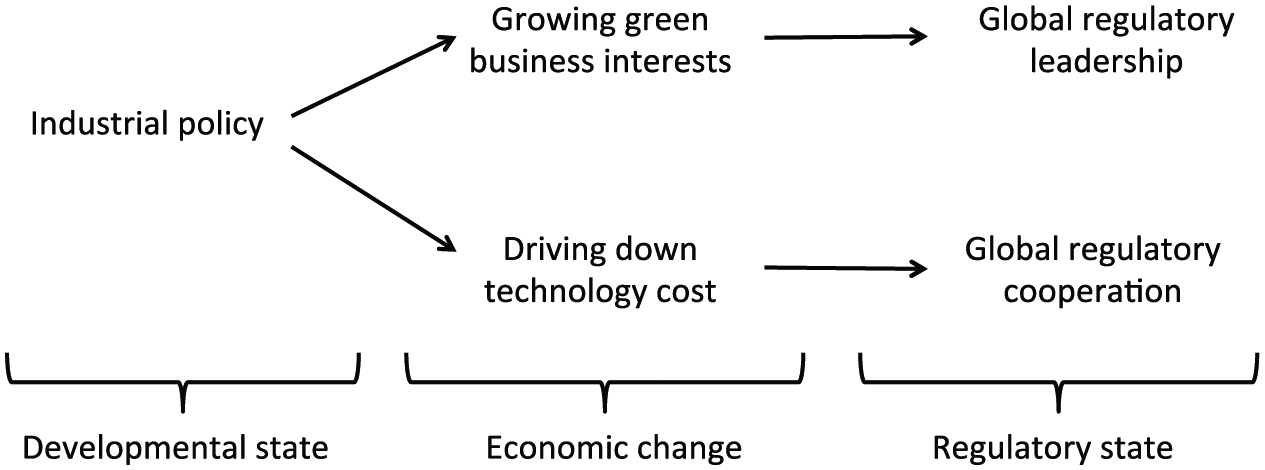
The developmental state and global environmental regulation.
The developmental state, business interests, and global leadership
A major obstacle to the adoption of environmental regulation — and its associated technological change — is its adjustment cost for regulated firms. In particular, when costs are imposed on a few powerful actors while the benefits of policy are diffuse, enacting regulation is a challenge. The powerful losers of regulation are likely to engage in collective action to oppose the policy. The interests of incumbent firms thus pose a major obstacle to policy-induced technological change, including toward clean technologies (Moe, 2009, 2010). In the words of Mancur Olson (1982: 74): “distributional coalitions slow down a society’s capacity to adopt new technologies and to reallocate resources in response to changing conditions.”
In such cases, industrial policy can begin to change the economic structure of polluting sectors to allow for shifts in the politics of regulation. The developmental state can develop countervailing political forces by growing challenger firms. It does so by providing economic rents to the producers and users of clean technologies. In other words, it provides concentrated benefits to a set of actors (Hughes and Urpelainen, 2015; Schmitz et al., 2015). Evidence suggests that industrial policy tools may be better equipped than regulatory instruments to provide targeted benefits (Kelsey, 2014; Zysman and Huberty, 2014). Policy measures such as feed-in tariffs — a type of subsidy for renewable energy — offer concentrated benefits to political constituencies (Bayer and Urpelainen, 2016). Such policy incentives are likely to lead to capital investments in the production and deployment of environmental technologies. Capital investments tend to result in “sticky” new economic interests (Kelsey, 2014). In the case of climate change, developmental policies have thus helped to create and grow a nascent “clean energy industrial complex” (Keohane, 2014).
The growth of clean energy industries shifts the balance of power between clean technology firms and polluting firms. Clean technology firms tend to support subsidies and environmental regulation that create and grow markets for their technologies. For the same reason, clean technology firms are likely to support global leadership for international environmental regulation. International agreements can create and expand markets for clean technologies that are needed to meet international regulatory commitments. Clean technology firms in lead markets that adopted early unilateral regulation benefit from these export opportunities and are likely to support international regulation (Meckling, 2015; Oye and Maxwell, 1994). They may also support international regulation because it creates the pressure to expand domestic environmental policy to meet international standards. This, in turn, expands domestic market opportunities for clean technology firms.
Industrial policy, then, creates and grows economic constituencies with an interest in domestic and international environmental regulation. It thus contributes to the global leadership of countries with environmental lead markets. While clean energy business interests are likely to be a source of unilateral regulatory leadership, they can also affect the regulatory strategies of other countries and the international negotiation process. Over time, government support for the development and deployment of environmental technologies alters not only the structure of economic interests, but also the relative cost of clean versus polluting technologies, creating positive spillovers for other countries.
The developmental state, technology cost, and global cooperation
The cost of technology required for compliance with new regulations is a significant barrier to international environmental cooperation (Barrett, 2006). Investment in the development and deployment of clean technologies is crucial to lowering compliance cost, but private firms are likely to underinvest in environmental technologies for three reasons. First, clean technologies produce positive environmental externalities that firms cannot reap. In the absence of environmental regulation, firms are thus unlikely to invest in green technology. Second, investments in new technologies create technology spillover effects — knowledge benefits from research and development — that cannot be fully captured by the original investors (Karp and Stevenson, 2012; Rodrik, 2014). Third, technological lock-in creates barriers to technological change through, in particular, the entrenchment of polluting industries (Seto et al., 2016; Unruh, 2000). Given these market failures and barriers, economists argue for state investments in clean energy technologies (Barrett, 2006).
Green industrial and innovation policy can spur cost reductions of environmental technologies through economies of scale and through learning effects. Economies of scale refer to decreasing production costs as production volume increases. Learning effects refer to decreasing per unit costs as a result of learning-by-doing and research (Gillingham et al., 2008). Importantly, economies of scale and learning-by-doing both suggest that significant cost reductions stem from the large-scale production and deployment of environmental technologies. This implies that developmental policies need to go beyond support for research and development to include production- and deployment-related incentives. It also suggests that the domestic markets of developmental leaders need to be large enough to achieve the economies of scale and learning-by-doing effects that will together drive down the costs of new clean technologies. State investments in environmental technologies can thus reduce compliance costs and potentially level the playing field between dirty and clean technologies. Such investments produce a global public good: low-cost environmental technologies. Barrett (2006) differentiates between “type Y” technologies that come at lower cost than polluting technologies and “type X” technologies that are more costly than current technologies but exhibit increasing returns. For example, a solar technology that produces energy at lower costs than fossil fuels would be a type Y technology in the case of climate change. Electric vehicles, considered a key component of a technological response to climate change (Williams et al., 2012), are currently a type X technology — they are more costly than conventional vehicles but their cost is declining rapidly. The availability of low-cost technologies or technologies rapidly declining in cost lowers the barriers for policymakers in follower countries to promote the adoption of those technologies (Hale and Urpelainen, 2014). The political effect is reduced compliance costs of global regulatory cooperation, which improves the pay-offs of global cooperation for follower countries. In the ideal situation, the investments of developmental leaders lead to type Y technologies, which offer follower countries immediate economic benefits, in addition to future environmental benefits. As a result of immediate positive pay-offs, the number of countries incentivized to cooperate on global regulation increases. In the case of type X technologies, developmental states demonstrate increasing returns of technological substitutes, while these remain more costly than current technologies. Increasing returns suggest that the compliance costs of international regulation will decline over time, improving the pay-off of global cooperation. The development of type X technologies is thus likely to incentivize some follower states to cooperate internationally, albeit to a lesser extent than type Y technologies.
Taken together, the developmental state intervenes in the structure of the economy, promoting economic and technological change. Here, I argue that its intervention in both the interest and the cost structure of economic sectors can contribute to greater regulatory discretion. If these two mechanisms — reconfiguring business interests and reducing technology cost — are at work, the resulting dynamic can be one of co-expansion. The growth of developmental policy enables the expansion of regulatory policy by increasing support from economic actors and by lowering compliance costs. The regulatory state, in turn, may foster the growth of the new industries by setting more stringent environmental standards. An iterative process of co-expansion is the potential result. Over time, the green developmental or accumulation regime becomes interdependent with the regulatory regime.
The developmental state and global climate regulation
This section examines the argument in the case of climate change in three steps. First, I show in the aggregate how industrial policy for clean energy largely preceded regulatory policy on climate change. Second, I examine the regulatory leadership of the EU, demonstrating how developmental strategies on clean energy created business interests for global regulatory leadership. Third, I examine how the international climate policies of follower states — as expressed in the Paris Agreement — were to some extent driven by the decline in the cost of renewable energy.
The growth of industrial and regulatory policy
Scholars have captured the political dynamics of global climate governance by examining, in particular, the interaction of states and markets (Vormedal, 2010) and the interaction of public and private authority (Bulkeley and Schroeder, 2011; Green, 2013). Here, I examine global climate governance through the lens of industrial policy — supplied by the developmental state — and regulatory policy — the output of the regulatory state. Developmental policies supply incentives for research, the development or deployment of low-carbon technologies, or prescribe a certain level of deployment. Such policies are oriented toward the growth of particular industries. I consider policies to be regulatory in nature if they prescribe reductions in greenhouse gas (GHG) emissions or impose punitive costs on industry. I show that in the majority of jurisdictions, industrial policy preceded regulatory policy on climate change.
Industrial policies in global climate governance, notably, support schemes for renewable energy, emerged primarily in Organisation for Economic Co-operation and Development (OECD) countries in the 1990s (Rabe, 2007). They then spread to non-OECD countries. After the financial crisis of 2008, governments in both industrialized and emerging economies further expanded their investments in clean energy sectors (Moe, 2015). By 2014, at least 132 countries and subnational entities had enacted either a feed-in tariff or a renewable portfolio standard as industrial policy in the power sector (REN21, 2015). 3
Regulatory policy exists at various levels in climate governance (Hoffmann, 2011; Keohane and Victor, 2011). The core of the regulatory regime is emissions reduction targets and carbon pricing systems. Here, I focus on carbon pricing as a key regulatory instrument in climate governance. Carbon pricing has been spreading globally since 2003, when the EU Emissions Trading System (ETS) was adopted. By 2014, 54 carbon pricing systems had been implemented or were scheduled for implementation. In total, carbon pricing systems covered 9% of global emissions in 2016 (World Bank, 2015).
Industrial policies are much more widespread than regulatory policies. More than twice the number of countries and subnational entities had adopted industrial policies than had adopted carbon pricing by 2014. Furthermore, in the power sector, green industrial policy preceded carbon pricing in two-thirds of all cases. The majority of outliers, where green industrial policies did not precede carbon pricing, fall into two categories: countries that joined the EU after it had adopted carbon pricing; and Scandinavian countries that adopted carbon pricing systems in the early 1990s (Meckling et al., 2015b). If developmental intervention in the energy sector preceded regulatory climate policy, did the former enable the latter? The following two cases examine global regulatory leadership by the EU and global regulatory cooperation on the Paris Agreement.
Global regulatory leadership: The EU
Global leadership has proven to be a pivotal force in global climate governance (Karlsson et al., 2011). Among countries and regions, the EU is recognized to have demonstrated the greatest leadership role, though to different degrees over the course of global climate politics (Kelemen and Vogel, 2009; Kilian and Elgstrom, 2010; Schreurs and Tiberghien, 2007; Selin and VanDeveer, 2015). It adopted a leadership role in the 2000s, while recently both China and the US are contending for a leadership position (Meinshausen et al., 2015).
The EU emerged as a regulatory state in championing market-based climate regulation by adopting the EU ETS in 2003 (Skjaerseth and Wettestad, 2008). Its unilateral adoption of climate policy and push for global cooperation kept the international process alive and precipitated the expansion of international cooperation to areas such as aviation emissions (Kelemen, 2010; Lindenthal, 2014). The EU also led in actual emissions reductions. Under the Kyoto Protocol, it had agreed to reduce emissions by 8% between 1990 and 2012, but achieved a reduction of 19% (Dupont and Oberthür, 2015).
The EU ETS was, however, preceded by and embedded in targeted developmental policies by key member states and EU agencies. Early developmental strategies of member states in the 1990s laid the ground. Germany’s adoption of renewable energy policy and of “eco-industrial policy” shaped European developmental strategies in the energy sector (Cox and Dekanozishvili, 2015; Schreurs, 2008; Wurzel, 2010). Within Germany, in turn, a strong alliance of green groups and renewable energy firms was driving the expansion of policies supportive of renewable energy (Jacobsson and Lauber, 2006; Laird and Stefes, 2009). The 2001 Directive on Electricity Production from Renewable Energy Sources mandated the deployment of renewables for all EU member states. By the time the EU decided to put a price on carbon emissions in 2003, 14 out of 17 member states had already adopted renewable energy support policies in the power sector. In the same year, the EU held 78% of wind and solar photovoltaic (PV) generation capacity in the OECD (IEA, 2016).
Green industrial and innovation policies extended from the power sector to the transport sector. A number of member states adopted biofuel mandates and, later, incentives for electric vehicles. In 2003, the EU agreed on the Directive on the Promotion of the Use of Biofuels and Other Renewable Fuels for Transport, thus expanding the developmental push at the EU level from the power to the transport sector. Much of these industrial policies for clean energy had political appeal because they provided benefits to producers and linked the goal of emissions reductions to other issues, such as export-led growth and energy security, which further created and stabilized political support for mitigation policy (Huberty, 2013). In 2004, for instance, 53% of global renewable energy investment took place in the EU alone. The EU continued to lead investments in renewable energy until 2012, when it was outpaced by China (Frankfurt School–UNEP Centre and BNEF, 2016). In the early 2000s, the EU thus emerged as a nascent green developmental state, in particular, through the promotion of renewable energies. As a result, renewable energy industries grew significantly throughout the 2000s. By 2013, the total turnover of renewable energy industries in the EU was about €142 billion, compared to €1.3 trillion for the European electricity sector as a whole. By 2014, the industry employed 1.11 million people in the EU, compared to 2.3 million people in the entire European energy sector (EU, 2015; Eurobserv’er, 2015).
Evidence suggests that clean energy industries emerged as a major lobbying group in EU politics (Gullberg, 2013). In particular, they supported the EU’s domestic and international climate ambitions, often opposing other industrial interests. The latest major climate regulation of the EU is the 2030 Climate and Energy Package, which was agreed upon in 2014 (European Council, 2014). It set targets for GHG emission reductions, renewable energy development, and energy efficiency increases. It was developed prior to the Paris summit and in the midst of the Eurozone crisis (Van Renssen, 2012). A major lobbying battle ensued around the proposed legislation, with fossil fuel and energy-intensive manufacturing firms on the one side, and clean energy firms and environmental groups on the other. BusinessEurope, the umbrella association of European industry, opposed unilateral climate action by the EU in the absence of key emitters also adopting emission reduction targets. The organization, along with sectoral associations of energy-intensive manufacturing sectors such as the chemicals industry, rejected efforts to reform the ETS to increase permit prices (Fagan-Watson et al., 2015).
On the other side, the European Renewable Energy Council, the umbrella organization of renewable energy industries until 2014, called for ambitious long-term targets for GHG emission reductions, energy efficiency, and renewable energy for 2030 (EREC, 2013). Renewables firms also pushed for a more stringent ETS (EWEA, 2014). The final conclusions of the European Council in October 2014 reflected some accommodations of the demands of the opposition, including the share of free allowances given to polluters and targets that are only binding at the EU level (Neslen, 2015; Van Renssen, 2014). However, it continued the EU’s unilateral strategy of regulatory leadership by adopting binding targets for GHG emission cuts. It also continued to set a target for renewable energy deployment despite major pushback from fossil fuel producers.
The business support for domestic regulation extended to international climate regulation. In a joint communiqué of various trade associations, the European power sector called for an ambitious global agreement at Paris in 2015. Key signatories included Eurelectric (the umbrella organization of the European power sector), the European Wind Energy Association (EWEA), and Solar Power Europe (the association of the solar sector) (CEDEC et al., 2015). Statements of representatives of renewable energy groups explicitly supported international climate cooperation and framed it as an export opportunity for European producers: “The pledges from emerging markets in Asia, Africa and Latin America should read like an investment brochure for the wind industry in Europe,” said Giles Dickson, chief executive officer of EWEA (EWEA, 2015). Oliver Schafer, president of Solar Power Europe, said: “We commend world leaders for the ambitious pledges made, which is sure to accelerate deployment of solar and boost investor confidence — sending a strong message that the low-carbon economy is real and already well underway” (Clover, 2015).
The EU could not reap the benefits of lower compliance costs as a result of developmental policies in the early 2000s when it also started to implement regulatory policy. Throughout the 2000s, the cost of electricity from wind and solar PV remained significantly above the cost of electricity from conventional sources. However, developmental policies for the deployment of low-carbon energy technologies shifted some of the compliance costs outside the ETS (Gawel et al., 2014; Lehmann and Gawel, 2013). This, in turn, may have contributed to limiting opposition from regulated entities to the policy.
In a way similar to the EU, California emerged as a leader for global cooperation, though among subnational jurisdictions. In the run-up to the Paris summit, California, along with the German state of Baden-Württemberg, championed global cooperative action by subnational entities. It led to the “Under 2 MoU,” a memorandum of understanding (MoU) on ambitious emission reductions. A total of 128 jurisdictions from 28 countries endorsed the MoU. All signatories agreed to reduce their GHG emissions 80–95% below 1990 levels or limited to two metric tons CO2-equivalent per capita by 2050. The agreement includes commitments to reporting. It thus resembles the pledge-and-review model of the Paris Agreement, in which parties pledged nationally determined emissions reduction commitments and agreed to a review process. California’s rise as an international climate leader builds on a similar domestic policy sequence and logic as in the EU: the state shifted from developmental action for low-carbon energy technologies to regulatory action that limits GHGs, building supportive economic constituencies (Biber, 2013; Knox-Hayes, 2012). The EU and California could take and sustain international leadership roles in climate governance because they had begun to restructure their energy sectors. Early developmental strategies around clean energy developed constituencies for such global regulatory leadership. Neither the EU nor California is a weak regulatory state. Yet, even given their high regulatory capacity, they were dependent on state investments to restructure energy interests to allow for domestic regulation and global leadership roles.
Global regulatory cooperation: The Paris Agreement
The Paris Agreement of 2015 represents the latest milestone in international climate negotiations. It is a form of shallow international cooperation that is unlikely to be sufficient to address climate change (Keohane and Victor, 2016). Yet, it emerges from a period of stalemate in international negotiations and after the failure of the climate summit in Copenhagen in 2009 (Hale et al., 2013). Against this backdrop, the Paris Agreement is a relative success in regulatory cooperation on climate change. Analysts have turned to the question of why Paris produced cooperation after international climate negotiations had been locked in stalemate. Explanations include shifts in the institutional design of climate negotiations toward a bottom-up pledge-and-review model, the resolution of gridlock between China and the US, and decreases in the costs of renewable energy technologies (Liebreich, 2015; The Conversation, 2015). Building on the latter, I propose that investments in low-carbon energy technologies such as wind and solar PV by a small set of states reduced mitigation costs, thus altering the cooperation pay-offs for third countries.
The main outcome of Paris was the Intended Nationally Determined Contributions (INDCs) of the parties. INDCs list priority areas for mitigation. The most frequently mentioned priority area is the deployment of renewable energy, which 90% of INDCs listed as a priority (UNFCCC, 2015). The Paris commitments could reduce the carbon intensity of electricity generation by 40% between 2010 and 2030, with renewable energy providing 36% of the electricity demand of major economies (MILES, 2015). The strong embrace of renewable energy at Paris builds on rapidly growing political support and investment for renewable energy since Copenhagen. In 2009, renewable energy capacity additions were still smaller than fossil fuel capacity additions in the power sector. By 2013, global renewable energy capacity was 38% greater than fossil fuel capacity additions. Investment in renewables has outpaced investment in non-renewables since 2009 (Climate Council, 2015). In 2014 and 2015, the rapid growth of CO2 emissions from fossil fuels slowed globally, largely as a result of the deployment of renewable energy (Jackson et al., 2015).
Between the Copenhagen and Paris summits, the cost of solar PV dropped by about 75%, and the cost of onshore wind power dropped by 30% (IEA, 2015a). Over the same time period, the median price of non-renewable energy plants such as gas, coal, and nuclear has increased (IEA, 2015b). Those two developments have led to renewable energy becoming competitive with fossil fuel sources in electricity generation. In many parts of the world, onshore wind capacity was more cost-competitive than coal-, oil-, and gas-fired power stations (IRENA, 2015). Cost reductions are likely to continue: between 2010 and 2020, solar PV costs are expected to fall on average by 36–60%, and wind costs by 12–22% (IEA, 2015a).
The decline in the cost of solar PV and wind technologies is the result of both economies of scale and technological innovation. Demand-side and supply-side investments by a small set of lead states in Europe, China, and the US enabled both (Deutch and Steinfeld, 2013). The three countries and regions accounted for 75% of cumulative investment in renewable power and fuels between 2004 and 2014 (REN21, 2015). Demand-side industrial policies in Europe, in particular, feed-in tariffs, created the market for renewable energy and led to the entry of Chinese producers. Supply-side industrial policies by the Chinese government drove the expansion of production capacity and economies of scale, especially in solar PV. As a result, the cost of solar declined substantially.
Much of the state investments in renewable energy pre-dated the financial crisis of 2008. Yet, developmental policies for clean energy were significantly expanded through stimulus packages responding to the recession (Aggarwal and Evenett, 2012; Rodrik, 2014). In total, 15% of global stimulus spending went toward investments to address climate change, with China contributing 51% of global climate-related stimulus investments. The US spent US$112 billion on climate-related investments, predominantly between 2009 and 2011 (HSBC, 2009). To put the US spending into context, it compares to the about US$122 billion that Germany spent through its feed-in tariff over the 14-year period between 2000 and 2013 (Bryant, 2013). This demonstrates the order of magnitude of the developmental push for clean energy in stimulus packages. Crisis-related state interventions through industrial policy thus boosted renewable energy industries, leading to further cost reductions through economies of scale and technological innovation. The recession turned out to be an environmental opportunity.
Emerging evidence suggests that declines in the cost of renewable energy technologies encouraged follower states to adopt emission reduction targets and helped ensure the relative success of Paris (Falkner, 2016). In Paris, a focus on green technology emerged that had been largely absent from negotiations within the United Nations Framework Convention on Climate Change (Haas, 2015). Cooperative initiatives on the sidelines of the Paris Agreement reflected this new focus on renewables for the implementation of INDC commitments. The government initiative ‘Mission Innovation’ and the business initiative ‘Breakthrough Energy Coalition’ together strengthened clean energy research and development, and the International Solar Energy Alliance launched by France and India zeroed in on deployment. Shifts in the technology cost and interest structure of domestic energy sectors allowed for progress at Paris. Christiana Figueres, then executive secretary of the United Nations Framework Convention on Climate Change, writes: “International negotiations don’t cause change, they mark it. The change has already been happening in the ‘real economy’ through a series of mutually reinforcing and increasingly powerful drivers” (Figueres, 2015). She continued to reference the decline in technology cost. In a similar vein, Michael Liebreich, Chairman of Bloomberg New Energy Finance and a prominent analyst, argues: “The falling cost of clean energy technologies gave policy-makers growing confidence that shifting to a low-carbon future is not an unaffordable pipe dream, but something that can, over time, be delivered” (Liebreich, 2015).
The relative success of global regulatory cooperation in Paris is at least partially fuelled by the rapid decline in the cost of renewable energy technologies, which became increasingly competitive with conventional sources of electricity. This is not to say that follower countries are not also driven by business interests to participate in emerging growth sectors. Rather, it suggests that the decline in technology costs following early renewable energy development and deployment by international leaders drew follower nations to make emission reduction commitments.
Conclusion and implications
In this article, I proposed that the developmental state can be a major source of global environmental regulation by reconfiguring the interest and cost structure of polluting industries. Industrial policy can create and grow green business interests in support of global regulation and it can drive down the cost of the clean technology needed for compliance.
In the case of climate change, early industrial policy on renewable energy fueled both global regulatory leadership by the EU and global cooperation on the Paris Agreement. In the EU, developmental strategies on renewable energy created green business interests in support of the EU’s global regulatory leadership. Developmental strategies of the EU and China drove down the cost of wind and solar PV internationally, lowering the cost of global climate regulation for follower states, whose participation contributed to the successful negotiation of the Paris Agreement. To be clear, I am not suggesting a deterministic relationship between developmental strategies and subsequent global regulation. My argument is rather probabilistic, suggesting that structural economic change in polluting sectors — here, the global energy sector — increases regulatory discretion as political support grows and costs decline.
The promises of the developmental sources of environmental regulation come with three main caveats. First, a country or coalition of countries needs to be politically powerful enough to be able to assume a global regulatory leadership role. Second, the domestic markets of developmental leaders need to be large enough to drive the economies of scale that lead to technology cost reductions. In the case of climate change, it was a set of lead countries that undertook developmental investments that resulted in the rapid cost declines. Third, the expansion of the developmental state in climate governance is conditioned by global competition between national economies. The rise of “state-permeated market economies” and the broader resurgence of economic nationalism suggest that such neo-mercantilist competition is likely to continue to shape the global economy (Meckling et al., 2015a; Nölke et al., 2014). In particular, the global “clean energy race” has captured the minds of policymakers in industrial policymaking. Major economies, including the US, EU, China, and Japan, all vie for a share of the global market for renewable energies, electric vehicles, and storage technologies (Gallagher, 2014; Schreurs, 2012). Competition between economies with significant asymmetries in market size and capacity is a potential source of conflict. Generally speaking, we can envision two outcomes: upward competition and an expansion of green developmental states; or downward competition and a contraction of green developmental strategies.
We would observe upward competition if states engaged in a global subsidy race for clean energy industries. The entry of China into the solar market after Germany’s initial investment promises such a dynamic (Nahm and Steinfeld, 2014). In like fashion, early investments by Denmark in wind technology were followed by California’s support for the technology (Mazzucato, 2015). A similar dynamic is emerging in the market for electric vehicles, with a number of countries offering purchase incentives in addition to support for research and development (R&D) and manufacturing. Research suggests that countries are likely to cooperate if they have similar capacities to capture new markets (Kim and Urpelainen, 2013). At the same time, downward competition has also been emerging, in particular, through the rise of trade barriers in renewable energy markets (Lewis, 2014; Meckling and Hughes, 2017; Wu and Salzman, 2014). In an attempt to protect the manufacturing of solar PV and wind, countries have entered trade remedy disputes that have increased the cost of, in particular, solar PV (Hughes and Meckling, 2017). Such measures slow the decline in the cost of low-carbon energy technologies by increasing its cost through tariffs. The loss of domestic green industries as a result of developmental competition — for example, bankruptcies among solar module manufacturers in both the EU and the US — may influence the extent to which policymakers are willing to invest in green technologies. Developmental competition may also create political obstacles to regulatory cooperation. The US and China were negotiating the US–China climate agreement of 2015 while, at the same time, being engaged in a major trade dispute over solar modules. The extent to which global technology competition strengthens or impedes the co-expansion of industrial and regulatory policy remains to be seen.
This article’s findings contribute to both theory and policy. Theoretically, I demonstrate internal dependence between the regulatory and the developmental state in global regulation. This advances our understanding of agency in regulatory politics beyond firms and regulators. Developmental agencies and strategies can lay the groundwork for global regulation. In addition, the findings shed light on the co-evolution of technologies and global cooperation. I observe a set of developmental lead states driving technological change, thus contributing to global collective action. This contrasts with the idea that global collective action in international agreements drives technological change. While I examined the developmental sources of global regulation in the case of climate change, my argument likely extends to other areas of business regulation. In cases in which the regulation of trans-boundary problems depends on the availability of technology, an initial developmental push may well facilitate global regulatory cooperation. This is also the case in, for instance, the fight against epidemic diseases, which requires the development of low-cost drugs (Kapstein and Busby, 2016).
Future research may examine the scope conditions for developmental state investments supporting global environmental regulation. First, if the developmental state is a source of global environmental regulation, we should explore variation in developmental strategies and capacity across countries and sectors. Under what conditions are governments likely and capable of driving green industrial change? For instance, Germany has adopted a leading role in driving structural change in the power sector and developing solar and wind technologies. Yet, the country lags in developing alternative transport technologies, such as electric vehicles (Meckling and Nahm, 2017). Second, it is unclear at what point new green economic interests help drive regulatory leadership. This is a question of tipping points (Vormedal, 2010). Case studies suggest that new green interests do not have to outweigh incumbent interests in terms of structural power to have an effect on regulatory policy. Finally, lead times for reductions in technology costs may depend on the type of technology. For instance, wind technology became competitive more quickly than solar PV (Hale and Urpelainen, 2014), which raises questions as to how long state investment needs to be sustained to achieve cost reductions.
This article suggests that policymakers can leverage domestic industrial policy tools to, over time, support global regulatory leadership and global regulatory cooperation. This is not suggesting the notion of industrial policy as state planning. Rather, it refers to innovation-oriented industrial policy that is widely practiced by both industrialized and emerging economies (Rodrik, 2007; Stiglitz et al., 2013). Restructuring economic sectors is a long game, depending on the investment cycles in regulated industries, but it nevertheless offers a strategic lever to promote global environmental governance. It is an irony of history that the Great Recession led to stagnation and retrenchment in regulatory climate policies but presented a long-term opportunity for climate policy by driving large-scale government investment in clean industries. In 2009, the US Congress failed to pass comprehensive climate legislation while, at the same time, the Obama administration implemented a major green stimulus package. So far, we have observed significant cost reductions of alternative technologies in the power sector, with wind competitive in a number of places, while solar is likely to require continued policy support for a number of years. The transport sector is much less advanced. Developmental strategies for low-carbon transport technologies are still more nascent, including support for electric vehicles. Maintaining post-crisis government support for clean energy technologies is pivotal to driving down technology costs (Sivaram and Norris, 2016). Only then will deeper global regulatory cooperation and emission cuts likely materialize.
Footnotes
Acknowledgements
I am grateful for valuable comments by Kate O’Neill, Espen Moe, Jonas Nahm, and Llewelyn Hughes on an earlier version of this article. I thank the reviewers and the editors, whose comments greatly improved the article. Dan Willis provided excellent research assistance.
Funding
This work was supported by the Winkler Family Foundation.