



Abstract
Identity is an important factor in international conflicts. As it is a crucial part of the problem, some scholars argue, national identity should be an important part of the solution. Parties to the conflict, they recommend, should negotiate their national identities so as to reach a “narrative equilibrium” that will allow them to overcome national stereotypes, build trust, and sustain peaceful relations in the future. This article evaluates not the merits of these negotiations, but the tools that social scientists have employed to analyze them. Its main purpose, therefore, is methodological. It argues that attempts to theorize the negotiation of identity fall short of their goal because they focus heavily on the notion of negotiation and very little on the concept of identity. To remedy this shortcoming, the article turns to the structural theories of narrative to conceptualize the negotiation of identity as a negotiation of literary plots. It argues that the negotiation of identity is the attempt to move away from two mutually exclusive romantic plots, and toward tragic, comic, or satiric plots in counterpoint. The introduction of plots, the article concludes, provides important insights that help theorize the negotiation of identity in post-conflict scenarios.
Introduction
“All wars are fought twice,” notes Viet Nguyen (2013: 144), “the first time in the battlefield, the second time in memory.” This rings true in Israel/Palestine, Northern/Southern Cyprus, and other cases where disputes over history are an inherent part of entrenched conflicts. The corollary of this observation is equally valid. Like war, peace is negotiated twice: the first time to stop the bloodshed on the battlefield; the second time to reconcile the resentful memories that flow from this bloodshed. We observe these negotiations when historians meet in bilateral historical commissions to review their respective nations’ textbooks (Barkan, 2009; Durand and Kaempf, 2014; Falk, 2008; Karn, 2006), when rival governments discuss conflicting interpretations of the past (Lustick, 2014; Rosoux, 2001a, 2001b), and when members of divided societies deliberate about their traumatic past (Torpey, 2001).
In this article, I am interested in the conceptual frameworks that scholars have employed to examine these attempts. For example, Lisa Strömbom (2014) and Karl Gustaffson (2015) build on theories of recognition to examine the Israeli–Palestinian and Sino-Japanese conflicts over identity as struggles over recognition. Strömbom then uses the same theories to examine how narratives of thick recognition can possibly reverse such conflicts. Susanne Buckley-Zistel (2008) draws on Gadamer’s fusion of horizons to capture the construction and reconstruction of identity after the civil war in Uganda. Farid Abdel-Nour (2015) employs the Rawlsian notion of overlapping consensus to conceptualize a solution to the conflicting narratives of Israelis and Palestinians, while Bashir Bashir and Amos Goldberg (2014) examine efforts to bridge the collective memory of the Jewish Holocaust and the Palestinian Nakba as deliberations on memory.
I want to contribute to these discussions by focusing on a line of research that employs theories of negotiation. The latter has been developed by scholars of conflict resolution, such as Herbert Kelman (1997), Valérie-Barbara Rosoux (2001a, 2001b), and Karina Korostelina (2007), who recast the aforementioned efforts as negotiations over identity. Negotiating identity, writes Kelman (1997: 335), is a “process of give and take between groups whose ideas about their respective national identities conflict with one another.” This process entails “reciprocal adjustments in the two groups’ self-definition that might help to resolve the conflict between them” (Kelman, 1997: 335). Kelman developed this notion of negotiating identity amid attempts to encourage unofficial diplomacy between Israelis and Palestinians. Social scientists, he concluded, can contribute significantly to such attempts through “the reconceptualization of national identity and the development of a methodology for negotiating identity” (Kelman, 1997: 340).
As a scholar and practitioner, Kelman is interested in a methodology to study these negotiations and to help actors potentially succeed in them. My goal in this article is more limited. I focus solely on the conceptual tools that scholars use to study these negotiations. I do not offer advice to mediators engaged in actual processes of negotiating identity, nor do I subscribe to the idea that these negotiations will necessarily transform identity into a constructive force for peace. The questions that I am interested in are: how have social scientists responded to Kelman’s call to develop a methodology for negotiating identity? What contributions did they make and what obstacles did they face? Finally, what tools are best fitted to develop this methodology?
My answer proceeds as follows. I begin by reviewing existing attempts to develop a methodology for negotiating identity. These attempts typically borrow insights from negotiation and bargaining theory and apply them to processes of identity formation. I argue that such attempts fall short of their goal because they focus heavily on the notion of negotiation and little on the concept of identity. I address this shortcoming in the second section by turning to the structural theories of narratives. Seen through the prism of narrative theory, I theorize the negotiation of identity as an attempt to move from two opposing romantic plots toward tragic, comic, or satiric narratives in counterpoint. Finally, I show how these changes in plots provide useful insights for developing a methodology for negotiating identity.
Negotiating identity: From metaphor to process
Following Kelman’s suggestion to develop a methodology for negotiating identity, journals such as International Negotiation and Négociations set out to further examine the idea. What intrigued the editors of these journals was the frequent use of the expression “negotiating identity” in the social sciences and the humanities. The expression is used to refer to many things. At a basic level, it refers to a conception of social identity that is dialogical and open-ended rather than monological and fixed. “Cultures are not internally homogenous,” writes James Tully (1995: 11); instead, “they are continuously contested, imagined and reimagined, transformed and negotiated, both by their members and through their interaction with others.” The expression also appears in works that explore how individuals and collectivities navigate their way between different social identities (Pavlenko and Blackledge, 2001). Finally, negotiating identity is used in the sense that I described earlier — that is, in situations where national groups seek to overcome conflict by readjusting their interpretations of the past. Marina Cattaruzza and Sacha Zala (2007) designate historians’ attempts to rewrite history in post-conflict scenarios as a process of “negotiating history.” Ian Lustick (2014) describes Israeli and German discussions on West Germany’s acknowledgment of the Holocaust as a process of “negotiating truth,” and Valerie Rosoux (2001a, 2001b) describes the symbolic rapprochement of the French and German narratives after the Second World War as a shift from mutual exclusion to “negotiation.”
For the contributors to International Negotiation, however, the use of negotiation in most of these cases is imprecise and vague. “On closer examination,” writes William Zartman (2001: 137), “the term turned out to have no conceptual meaning, serving only as a metaphor … often synonymous with a range of more neutral terms ranging from ‘forming’ to ‘navigating.’” However, negotiation, objects Zartman, has a specific meaning; it refers to a “process of combining conflicting positions into a joint decision” (Kissinger, 1969). Moreover, there is a whole literature — typically focused on bargaining and game theory — that is dedicated to studying it as a process. For most of these scholars, negotiation is held to be a universal process that uses a finite number of behavioral patterns (Zartman and Berman, 1982). The challenge for these scholars, then, was to apply their knowledge of these patterns to processes of identity formation. Doing so, the editors argued, would benefit research on social identity and negotiation theory. Negotiation theory could inform studies of social identity by providing it with a set of tools such as tacit bargaining, negotiating for side effects, ripeness, and others. In return, the field of negotiation theory could benefit by moving into “an area of study where it had previously served as a label but not an analytical tool” (Zartman, 2001: 138).
I accept the objection that a methodology for negotiating identity should move beyond the metaphorical meaning of negotiation. I turn to narrative theory to respond to this objection. However, I disagree with the suggestion that we should apply existing models of negotiation to processes of identity formation. There are many problems that arise from doing so. To begin with, and as Dean Pruitt (2001: 277) acknowledges, “negotiation theory is limited … because it almost always focuses on the development of a singular solution.” It is impossible to conceive a singular solution to identity formation, which is an open-ended process with a wide range of permissible options. Moreover, identity cannot be reduced or conflated to a series of interests to be prioritized and negotiated. As constructivist literature in the field of International Relations has rightly shown, identity precedes and informs interests, not the other way around (Finnemore and Sikkink, 2001; Wendt, 1992). Third, identity and memory are affected by larger discourses and meta-narratives that impose symbolic terms for negotiations on identity (Khoury, 2016), and these cannot be well accounted for by turning to rationalist models of bargaining.
Finally, and this is the objection that I want to focus on, Zartman’s suggestion focuses mainly on the process of negotiation, rather than on identity. This is problematic because the concept of identity is riddled with ambiguity and cannot be taken for granted (Brubaker and Cooper, 2000). Understanding the negotiation of identity must therefore account for what is being negotiated. As Kelman noted earlier, social scientists should develop a methodology for negotiating identity, but doing so requires that they also reconceptualize national identity. In this article, I want to shift the focus to what is being negotiated in order to better understand how we negotiate. As will become evident in the pages that follow, doing so requires that we change methodological gears, moving away from negotiation theory and closer to literary criticism. This shift, however, is useful to understanding negotiation as a process. What you give and what you get when negotiating identity, I will show, are a series of narrative moves and countermoves that involve changes in plots. These changes entail different identity-costs and identity-gains that, once identified, can help us better appreciate what is at stake when nations engage in such negotiations. I will turn to this last point at the end of the article.
It should be specified that the limits identified earlier apply to the suggestion that we should apply negotiation theory to processes of identity formation. There is still, in fact, little research on identity as an object of negotiation (Block and Siegel, 2011; Druckman, 2001), despite a robust body of scholarship that examines the effects of identity on conflict (Gartzke and Skrede Gleditsch, 2006; Horowitz, 1995; Huntington, 1993; Mälksoo, 2015) and mediation (Bercovitch and Elgström, 2001; Zartman, 1993). This article is an attempt to fill this gap and draw a connection between the scholarship on national identity and that of international negotiation.
In the section that follows, I will shed light on what is being negotiated by turning to the structural theories of narratives and, more specifically, the study of plots. Two questions motivate this inquiry. First, what plots do nations employ to narrate their collective story? Second, what is happening at the level of plots when nations negotiate their identity? Scholars have already addressed the first question (Berenskoetter, 2014; Hogan, 2009; Morden, 2016; Ringmar, 1996; Scott, 2004; Wertsch, 2008). My main focus is answering the second. Of course, both questions go hand in hand since national narratives are always constituted in dialogue with, rather than independently of, one another (Subotić, 2015). Negotiation is a specific kind of dialogic constitution whereby nations jointly work out aspects of their narratives so that they no longer conflict, but coexist, with one another. These negotiations can be direct and indirect; they take place in face-to-face encounters, or in a series of moves and countermoves without direct communication, similarly to what Thomas Schelling (1960) called tacit bargaining.
The narrative grammar of national narratives
A fundamental premise of structuralist theories is that all narratives share a common grammar (Barthes, 1975; Frye, 1957; Propp, 1977; White, 1973, 1987). The anecdote I tell my friend, the movie I watch in the cinema, the bedtime story I read to my son, and the history book I assign to my students all share a set of rules about how events are linked in a narrative sequence. The purpose of a structural analysis is to bring this grammar to light. “Faced with an infinite number of narratives and the many standpoints from which they can be considered,” writes Roland Barthes (1975: 238), “the analyst … seek[s] to extract, from the apparent anarchy of messages, a classifying principle and a central vantage point for his description.”
Besides sharing a common grammar, another basic feature of narratives is that they cannot be all-inclusive (Ricoeur, 2005: 448). To be meaningful, narratives must select, organize, and prioritize events taken from the raw, unprocessed, and potentially endless list of past and present events. Crucial to this selection are the inaugural moments that begin the story, transitional moments that move it forward, and ending moments that finish it (White, 1987). What applies to fictional narratives applies equally to national narratives. In this case, the inaugural moments are the equivalent of the founding moments like a declaration of independence. Transitional moments are events that move the story forward, such as civil wars or territorial acquisitions. Ending moments are more difficult to identify since national stories are ongoing stories. Even if they have not chronologically ended, however, these stories are still directed toward ends. These ends can be ideals like socialism, freedom from tyranny, the protection of the Jewish people, Arab unity, and so on. National stories can be narrated as stories where the nation successfully meets these goals, or temporarily fails to do so (Carroll, 2007).
Beginnings, middles, and ends, however, do not suffice to constitute a narrative. To weave all three into a story, one must have a plot. Plots are the most important elements of any narrative grammar. Aristotle (2002) identified them as the first principle of drama, which means that they have logical priority over other elements, such as characters and music. Within the Aristotelian system, the relationship of plot to story in the Poetics is similar to the relationship of form to matter in his Physics, and of constitution to city is his Politics: it is an organizing principle, the literary equivalent of a soul. Without a tragic plot, a tragedy loses its essence, leaving its components to crumble into a disparate sequence of events. In their attempt to extract classifying principles from the endless array of narratives, structuralists have championed the study of plots. The literary critic Northrop Frye (1957) famously identified four basic types of plots: romantic, satirical, comic, and tragic. Frye’s typology became a reference in the humanities and the social sciences after Hayden White (1973) used it to elucidate the historical writing of 19th-century historians. Since then, Frye’s typology has been used in the field of International Relations (Alker, 1996; Kuusisto, 2009; Ringmar, 2006), political theory (Scott, 2004), and other disciplines. I build on Frye’s typology to understand the role of identity in conflict transformation. 1 As mentioned earlier, I focus specifically on cases where nations fight and negotiate their identities. 2 The examples of Germany/France, Israel/Palestine, and Northern/Southern Cyprus are cases in point, and I will refer to them in the pages that follow. For reasons of scope, I will not address other forms of identity, such as religion, ethnicity, and gender.
The romantic plot
Hayden White (1973: 8–9) describes the romantic plot as: a drama of self-identification symbolized by the hero’s transcendence of the world of experience, his victory over it, and his final liberation from it. … It is the drama of the triumph of good over evil, of virtue over vice, of light over darkness.
Romantic plots are the stuff of fairy tales, epics, and myths — stories of heroes set on a mission to accomplish good and conquer evil. They are also, and importantly for our topic, the stuff of politics, a feature already identified by Frye, who noted that those in power typically project their ideals in the form of a romance (Frye, 1957: 186). This is especially true of national narratives where independence movements represent themselves as the hero that awakens the nation from its ancestral slumber and helps it to realize itself, typically by fighting off imperial domination and becoming a nation-state. From the chains of bondage and the horrors of war, the nation typically emerges as victorious. If the nation is still under foreign rule, the romantic plot functions as a motivational tale, a call to continue the struggle until the collective hero is triumphant. 3 Not surprisingly, the romantic plot saturates the symbolic mediums of national identity (Young, 1992), be they monuments, anthems, museums, or history textbooks.
Mary and Kenneth Gergen (1997: 164) distinguish plots based on their trajectory in an evaluative space and their capacity to structure events so that they move in an orderly way toward a given good. Following this definition, the trajectory of the romantic plot is represented as a progressive one (see Figure 1). From the beginning to the end, its course goes forward — teleologically driven to culminate in the triumph of the hero. Of course, there are ups and downs. Heroes are injured, righteous people die, and mistakes are made. However, these setbacks, which work as transitional motifs, are only meant to emphasize the uphill march toward transcendence.
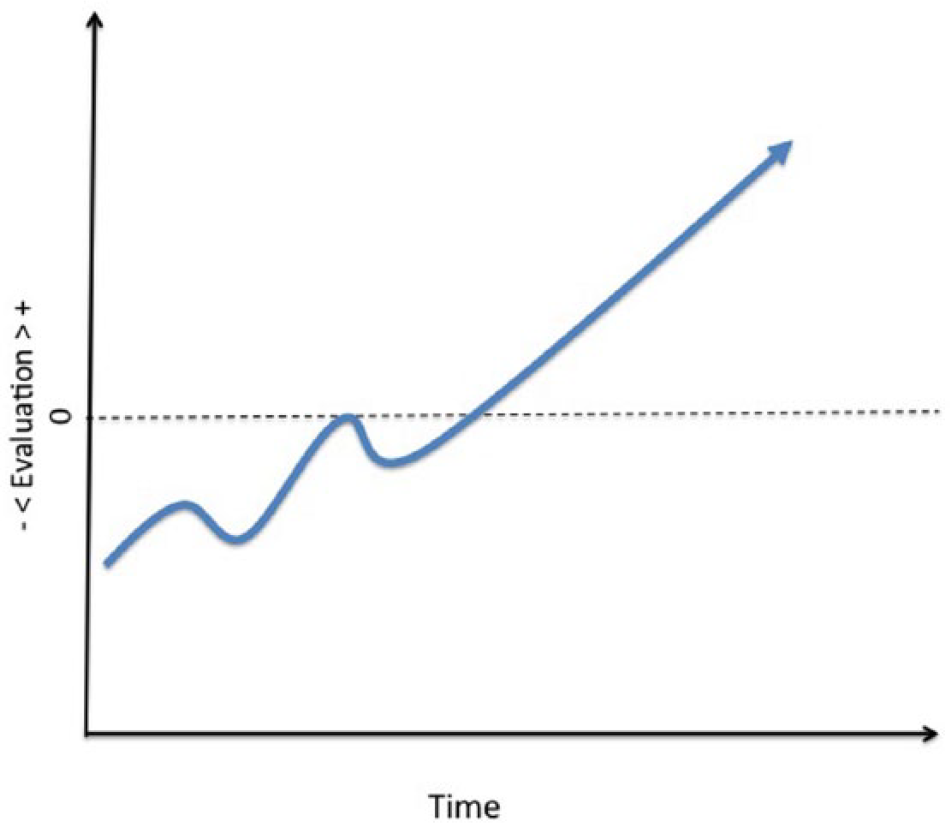
The romantic plot.
Since the romantic plot is the national plot par excellence, the conflicts over history with which I began this article can be represented as two romantic stories pitted against one another. While both refer to the same events, they do so from conflicting perspectives that cast one’s hero as the other’s villain and vice versa (Rotberg, 2006). To illustrate these dueling plots, consider the following passages taken from Turkish and Greek Cypriot textbooks. The following is a passage from a Turkish Cypriot textbook that depicts the Ottoman conquest of the Island in 1571: Our ancestors conquered Cyprus in 1571 at the cost of 80,000 martyrs’ lives. The Turks ruled Cyprus until 1878 … [they] treated the native population in a very good manner. They brought freedom and justice to the island. The Turks developed Cyprus and built many monuments, which gave Cyprus its Turkish character. (Cited in Kizilyürek, 2002: 436)
The Ottomans are represented as enlightened rulers that brought civilization to the island. Despite the immense cost in human lives, they behaved justly toward the indigenous population. The same section later situates Cyprus “as historically, geographically, strategically and economically tied to Anatolia and is a part of Asia Minor” (cited in Kizilyürek, 2002: 436), thus creating natural and organic links with the Ottoman Empire. The same, however, does not apply to Greece: Cyprus is 600 miles away from Greece. Therefore, Cyprus has neither geographic nor strategic importance for Greece. The Greeks who exist in Cyprus today are not Greek. They are, as many foreign historians have asserted, descendants of different nations that invaded Cyprus throughout history. (Cited in Kizilyürek, 2002: 438)
Greece is represented as having no authentic or natural ties to the island. Greek claims over the island, therefore, are the result of greed and power that extend beyond Cyprus itself: In the past, [Greece] wanted the whole of western Asia Minor from Turkey. Now, she demands Cyprus. One should not be surprised if she demanded Egypt tomorrow because of some Greek element in it. … In order to defend our rights and freedoms we will resist her … if we don’t find a piece of stick or stone, we will use the bones of the 80,000 martyrs who died for this land. (Cited in Kizilyürek, 2002: 441)
Here, we have classic tropes of the romantic plot, where one party is canonized as civilized and having authentic ties to the land, while the other is deprecated as greedy and having imperial ambitions. This depiction of the past sets the stage for the narration of contemporary tensions on the island. Seen through this light, the Turkish military intervention on the island in 1974 is celebrated as a moment of salvation that ties it back to the heroism of the Ottomans. “For 307 years, Cyprus was under Turkish rule, but never under Greek rule,” states one textbook, “in the morning of July 20, 1974, the Turks of Cyprus united with their motherland, which they missed passionately for all these years” (cited in Kizilyürek, 2002: 440).
The Greek textbooks provide a symmetrically opposite narrative. Here, Greece is the hero while Turkey is the villain. “Cyprus is and has been Greek and nothing but Greek,” reads the front cover of a primary-level textbook; “Many people passed over Cyprus or conquered her,” we read in another passage, “but her inhabitants safeguarded her Hellenic character created since the Mycenaeans settled in Cyprus” (cited in Papadakis, 2008: 132). Greek presence on the island is authentic and permanent. It forms a continuous chain that stretches through time, and anyone severing this chain is an intruder. In his study of Greek Cypriot textbooks, social anthropologist Yiannis Papadakis notes how that the suffix -kratia (domination) is used to refer to all the imperial powers that ruled over the island in the past — Crusader (Frangokratia), Venetian (Enetokratia), Ottoman (Tourkokratia), and British (Agglokratia) — but not to the Greek and Byzantine empires since they are depicted as the rightful owners of the island (Papadakis, 2008: 132). Furthermore, among the hundred negative references to these national others, a study employing content analysis shows that the vast majority are aimed against Ottomans and Turks (Papadakis, 2008: 134).
The romantic plot paints the opposition between friend and foe with broad strokes. As it glorifies the former and vilifies the latter, it brushes over differences within nations themselves. Leaders and citizens, ancestors and descendants, women and men all belong to the same homogeneous whole, and an attack on one is depicted as an affront to all (Auerbach, 2009: 299; Ignatieff, 1999: 177). This reification of national groups is a major reason why romantic plots inhibit narrative negotiation. Proper princes do not cut deals with evil wizards, just like righteous nations do not negotiate with invaders (Kuusisto, 2009). Quite the contrary, the collision between romantic plots leads to a memory–security dilemma (Mälksoo, 2015), where the increase in one nation’s sense of ontological security — that is, the confidence that it has in the continuity and righteousness of its narrative — comes at the concurrent expense of its neighbors’ sense of ontological security.
What I describe as conflicting romantic plots are typical of the ethno-national conflicts that have characterized the 20th century, many of which are still raging today. Scholars that study these conflicts insist that the clashes over identity cannot be ignored. The transformation of national identities, they argue, is a necessary step in a larger process of transforming conflict (Auerbach, 2009; Kaufman, 2001; Kelman, 1997; Kriesberg, 1993; Lederbach, 1996; Miall et al., 1999; Ross, 2007). While this body of scholarship makes extensive use of narrative theory to examine these changes, it has not used the insights of structural narratology. 4 I want to show the promise of this conceptual framework by recasting the transformation of identity as a change of plots. This is where the tragic, comic, and satiric plots come in.
The tragic plot
Unlike its romantic counterpart, the tragic plot begins as a progressive story, but ends as a regressive one (see Figure 2). The change of events is brought about when the hero recognizes his hubristic act, which eventually brings about his downfall. “Tragedy has no festive occasions,” writes White (1973: 9), “except false or illusionary ones.” To be considered tragic, a plot requires an inflective moment in which the protagonist recognizes wrongdoing. Aristotle (2002) calls it anagnorisis (recognition), which is the tragic transitional event par excellence. Oedipus’s recognition of the twice-hubristic crime of incest and patricide is perhaps the best example of anagnorisis. It is the transformative moment in which the protagonist recognizes wrongdoing and becomes aware of his condition as a tragic hero. From there on, there is no return. Oedipus is condemned to wander outside the city walls of Thebes, blind and forever remorseful.

The tragic plot.
The plots that Sophocles and Shakespeare utilized so well in their plays have equivalents in national stories, namely, when nations acknowledge and express remorse for past wrongdoings. This has become so common that our era is now referred to as an age of apology and regret (Gibney et al., 2008; Olick, 2007). A political apology shares at least two things with a tragic anagnorisis. First, both acknowledgments are public. As Thomas Nagel (cited in Anne Borer, 2006: 23) points out, acknowledgment is what happens to knowledge “when it becomes officially sanctioned” and “made part of a public cognitive scene.” In the case of tragedies, the hero acknowledges his crime in front of the other characters and the audience. In the case of nation-states, political officials publicly express guilt and inscribe it in the mnemonic practices of their society. Second, in both cases, recognition comes after the fact (Muldoon, 2005). It is tragic specifically because it cannot reverse the crimes of the past.
Germany’s apology and its efforts to atone for the Holocaust are a prototypical example of such practices. The acknowledgment of German guilt was a crucial aspect of Israeli and German reconciliation. In the 1950s, Israel wanted the German government to apologize with “the consciousness that the German people in its entirety is responsible for the killing and plunder inflicted by the former regime on the House of Israel” (Lustick, 2014: 56). Konrad Adenauer did acknowledge the “immeasurable suffering brought to the Jews in Germany” and assured the Jewish victims of Nazi Germany that such crimes “required moral and material restitution”; however, he exculpated the majority of Germans, who “abhorred” these crimes (cited in Herf, 1997: 282).
Adenauer’s lukewarm apology, even in the face of the horrendous crime of genocide, points to the general difficulties of publicly acknowledging guilt and plotting one’s national story as tragedy. “The category of the tragic,” suggests Harry Anastasiou (2008: 73), “does not exist in nationalism’s view of interethnic conflicts.” This does not mean that national narratives preclude tragic events. Quite the contrary, and as the Cypriot case Anastasiou is referring to evidently shows, national stories are replete with occasions of suffering and war. These tragic events, however, are never plotted in the tragic mode, but rather in the romantic one. Nations mourn their dead, not the other’s, and the narration of their death is meant to strengthen unity and encourage sacrifice (Renan, 1990), not to express regret and ask for forgiveness. This is perhaps why acknowledging past atrocities and opening up one’s national narrative to the other’s suffering is said to indicate a shift from nationalism toward post-nationalism (Durand and Kaempf, 2014; Habermas, 2001; Pappe, 1997; Pupo, 2008; Ram, 1998).
The difficulties of adopting a tragic plot are echoed by recent scholarship in international studies. Jennifer Lind (2008, 2009) points to the dangers of domestic backlash that can result from apologetic forms of remembrance, as in the case of Japan. This backlash had the adverse effect of reactivating romantic plots domestically and, as a reaction, in the victim country itself, thus triggering a cycle of mistrust rather than a process of reconciliation. Scholars working on ontological security suggest other difficulties. A coherent and continuous narrative, they argue, plays a crucial rule for a state’s sense of ontological security (Kinnvall, 2004; Mälksoo, 2015; Steele, 2008; Subotić, 2016; Zarakol, 2010). The recognition of past wrongs has the potential of disrupting such narratives and a state’s sense of continuity. “Accepting responsibility about a past atrocity is not simply a verbal act,” argues Ayşe Zarakol (2010: 7), “it is nothing short of a reformulation of state identity.” For Zarakol, the source of insecurity is largely determined by exogenous factors, namely, how states relate to one another with regard to modernization. For Brent Steele (2008: 3), on the other hand, the source of ontological insecurity is, in large part, endogenous. What triggers insecurity is the sense of shame that comes from expressing remorse for the past troubles and disrupting a national narrative.
It is these same difficulties that also explain why adopting a tragic plot can potentially dissipate conflict. Issuing an apology, argues Lind, is sending a signal, and the signal is most likely to be perceived as credible because it is costly. “If contrition is costly for aggressive countries,” Lind (2008: 11) writes, “it will convey credible evidence that a country is no longer aggressive.” This, of course, does not mean that all forms of apologetic remembrance are costly since some apologies are cheap, and the costs for issuing them vary from context to context.
The comic plot
The third plot that I want to examine is the comic one. Its trajectory moves from regressive to progressive, taking the opposite route to tragedy (see Figure 3). Essential to the comic plot is its progressive redress that culminates in the festive occasion so typical of Shakespearian comedies — lovers get married, family members reconcile, and everybody lives happily ever after. “The movement of comedy is usually a movement from one kind of society to another,” writes Northrop Frye (1957: 163): At the beginning of the play the obstructing characters are in charge of the play’s society, and the audience recognizes that they are usurpers. At the end of the play the device in the plot that brings hero and heroine together causes a new society to crystallize around the hero.
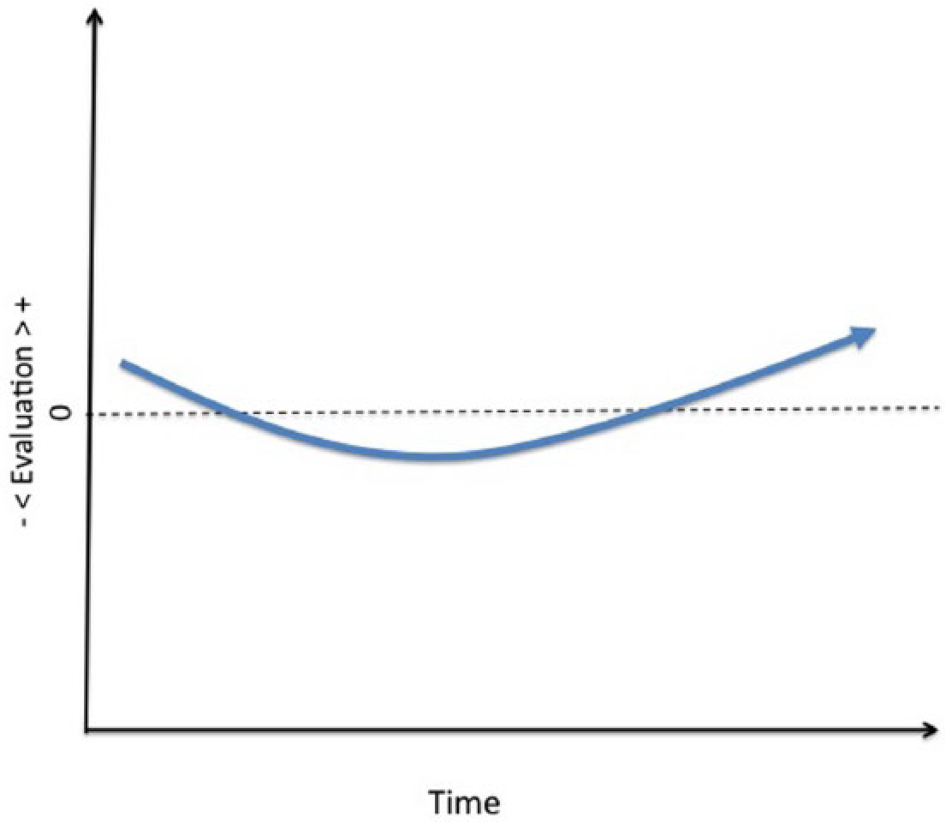
The comic plot.
The promise of a new and reconciled society is the primary reason why comic plots are typical of history writing in times of peace. The anticipation of a happy ending moves both narratives toward a reconciled horizon. Retrospectively, it alters the past by stressing new features about us and them.
To illustrate this, consider the statement made by Charles de Gaulle in 1962 on French and German rapprochement: The French and the German people must become brothers. … The French still see the Germans as a hereditary enemy. The truth, however, is that they have been our enemies since 1870. This only amounts to three wars and three quarters of a century for the Germanic peoples and the Gauls whose relationship extends over many more centuries. (Cited in Rosoux, 2001a: 153 own translation)
De Gaulle is not asking his audience to overlook the dark chapters of Franco-German relations — after all, he led the resistance against Germany 20 years before asking his countrymen to consider them as brothers. Rather, he is asking his audience to balance the dark sides of history with brighter ones, and he does so by stretching the timeline of their relations further than 1870. While harking back to an ancestral past is a classic leitmotif of ethno-national conflicts, De Gaulle employs it to cultivate peace. The oscillation between good and bad times is meant to portray the characters in a different light: they are not heroes or villains, but range somewhere in between (Kuusisto, 2009: 614).
Another example of such comic plots can be found in the revised Turkish Cypriot textbooks published in the early 2000s. These revisions coincided with the negotiation of the Annan peace plan and the election of left-wing administrations on both sides of the island. Although the Annan plan was rejected by referendum — the Greek Cypriots rejecting it by 76%; the Turkish Cypriots accepting it by 65% — it inaugurated a new and transformative era on the island. The revised Turkish Cypriot textbooks bore signs of this transformation. Unlike the previous textbooks that were plotted in the romantic mode, the revised versions no longer represented both nations as homogeneous and virtuous, but as internally divided and self-critical (Papadakis, 2008). For example, the Turkish Cypriot nationalist paramilitary group Turk Mukavamet Teskilati that fought for the partition of the island (taksim) in the 1960s is no longer celebrated as a resistance army, but described as having been used for divisive goals and the settlement of personal scores. It is also described as a force used by the right to brutalize left-wing journalists and intellectuals. In the same vein, the Greek Cypriots are no longer represented as homogeneous. In one Turkish Cypriot textbook, a drawing shows a member of the Greek Communist Party getting beaten by a Greek Orthodox priest bishop (Papadakis, 2008: 145), thus emphasizing ideological differences within the Greek Cypriot community.
Adopting a comic plot does not mean making fun of human suffering or mocking one’s opponent. What comedy does is recognize that both parties are vulnerable to wrongdoing, that none is truly evil because none can be absolutely good. Both parties make mistakes, misunderstand each other, and try different solutions (Kuusisto, 2009). This moral oscillation gives the comic plot certain advantages. It is more flexible and less deterministic than the romantic or the tragic plot (Kuusisto, 2009; Lehti et al., 2008), making it easier for two parties to negotiate their identities. On top of that, comic plots are more inclusive of the other. Romantic plots, as we saw earlier, are highly exclusive, clearly demarcating friend and foe. Comic plots portray the other side in a better light and create a sense of commonality (“we were once neighbors before we became enemies,” “they fought for the same principles, but happened to be on the other side,” “we both suffered at the hands of the right-wing militias”).
Comic relief, however, is not for everybody. While they might be more inclusive of the other, they trigger a new dynamic of exclusion that depicts some parties of the in-group as spoilers. These are the obstructing characters that Frye referred to in the aforementioned quote and they now stand in the way of a story that is meant to unravel in a peaceful denouement. In the case of the revised Turkish Cypriot textbooks, this role was attributed to right-wing nationalists on both sides of the divide. The problem is that these parties are not likely to respond positively to being cast in this new role. Quite the contrary, their exclusion might cause backlash. Another potential problem is the way in which comic plots portray characters as a mix of good and bad and thus distribute blame equally among both parties. This is potentially an advantage since the negotiating parties are more likely to accept an equal distribution of the blame. However, this could be a problem in the case of asymmetrical conflicts. For example, a common critique of the Oslo peace process among Palestinians is that it created a narrative that presented the Israeli–Palestinian conflict as one of two opposing states with equal armies and territories, similarly to the wars between France and Germany (Khalidi, 2014). The situation in Israel/Palestine, however, is very different. The timid comic plot that emerged after the Oslo accords imposed symmetry on a situation that is highly asymmetrical (Hilal and Pappe, 2010; Roy, 2007) and thus created new forms of narrative disagreements.
The satiric plot
The final plot that I want to examine is the satiric plot. As opposed to romance, tragedy, and comedy, satire is characterized by a lack of agency. The protagonists of a satiric plot are driven by the forces of nature, rather than by their own will. White (1973: 9) describes satire as “a drama of diremption, a drama dominated by the apprehension that man is ultimately a captive of the world rather than its master.” Satiric plots are satiric by virtue of inverting traditional plots. They create satire by robbing the agency from the tragic or romantic protagonists, deflating their heroism and puncturing their pretension. In this sense, they are parasitic plots (Ringmar, 2006), and for this reason, they cannot be visually represented in a diagram in the way the other plots were.
To demonstrate how the satiric plot works in national narratives, let us go back to the example of France and German rapprochement, more specifically, their representation of the First World War. Textbooks written after the Great War were plotted in the romantic mode, where each party blamed the other for instigating the war. A French textbook issued in the 1920s reads: While the Great Powers of the Triple Entente strived for European peace and stability, Germany, under Wilhelm II, pursued hegemonic policies that led it to war. … Drunk with military and economic power, Germany exhibited an imperialist and belligerent temperament unmatched by any other nation. This German spirit — made of greed, pride, and an insatiable appetite for domination — combined with an adoration of violence, was, in the final instance, the primary cause of war. (Cited in Krapoth, 2004: 4, own translation)
The passage is mirrored in a German textbook published in the same period: The enemy’s statesmen led a skillful diplomatic game to force Germany into the mistake of declaring war on France and Russia. … The people of the enemy states were tricked into believing that Germany was the aggressor, while in fact, she was the one being attacked. (Cited in Krapoth, 2004: 6, own translation)
The passage recognizes that declaring war was a mistake. This, however, does not plot the story as a tragedy since the mistake was an error in diplomatic maneuvering, not a moral or legal wrong. The correct course of action would have been to wait for the French to show their true colors and to declare war.
In the 1960s, and after the Treaty of Rome, this discourse would change with both opting for satiric plots. Consider this excerpt from a German textbook used in the 1960s: The war between Germany and France followed inevitably from the conflict with Russia. France was bound by its alliance with Russia, and Germany by its treaty with Austria.… The entanglement [Verstrickund] of European alliances is what led to the conflict between Germany and France. (Cited in Krapoth, 2004: 10, own translation, emphasis added)
The use of the passive voice perfectly captures the shift toward a satiric plot. Instead of blaming the other for starting the war, the French and German protagonists are depicted as suffering from the same circumstances that, in the summer of 1914, cast their soldiers into the trenches. As a narrative strategy meant to defuse conflict, the satiric plot can be quite successful. Like the comic plot, it allows for a higher degree of inclusivity because it portrays the warring parties as victims of larger and uncontrollable forces (“we are all victims of this war”), thus eliciting a sense of human fragility and solidarity.
There are also risks, however. If actors are robbed of their agency, does that mean that no one is responsible for the crimes committed during war? Is war akin to a natural disaster that befalls us? These questions are not trivial, but can constitute new forms of narrative disagreements. Take, for example, the Israeli representations of the Palestinian Nakba — the forced migration of 800,000 indigenous Palestinians in 1948. Traditionally, the official Israeli narrative depicts this event in the romantic form. In 1948, the state of Israel was created amid a brave war of independence that reconnected the Jewish people with its ancestral land. The state of Israel bears no responsibility for the Palestinian refugee problem. In fact, the Arab armies are responsible because they ordered Palestinians to leave their homes while they sought to destroy the Jewish state in its infancy. In contrast, the soldiers of the Yishuv are said to have begged their Arab neighbors to stay (Podeh, 2000: 88). In the 1980s, this romantic plot was challenged by a group of new historians that stressed Israeli’s central role in the forced migration of Palestinians (Pappe, 1997; Ram, 1998). While critical of the romantic depiction of 1948, these new historians remained divided. Some insisted that there was a deliberate plan to uproot the indigenous Palestinians, while others claimed that there was not. The first is represented by Ilan Pappe (2006b), who accuses the Israeli state of ethnic cleansing; the second by Benny Morris (2001), who maintains that the refugee problem is an unfortunate consequence of war, not the result of a systematic plan. Although complex in its details, this disagreement can be recast as a disagreement over plots. Both want to revise the romantic depiction of Israel’s founding, but the first opts for tragedy and the second for satire. Not surprisingly, Pappe (2005) calls on Israel to apologize and deal with the historical injustice of the Nakba, while Morris endorses no such apology.
The four plots examined earlier exhaust a wide range of strategies that are employed in national narration. There are other plots that I did not explore in this article. For example, there is the epic plot that surges and falls in aeternum. Epic narratives never really end because the hero always re-embarks on another adventure to defeat the ills of the world. Epic plots, however, are derivative of the romantic plot in that they still differentiate between hero and villain, so I do not treat them separately. Moreover, there are stable plots that remain steady at either ends of the evaluative continuum. In these stories, things are constantly good or constantly bad. Since (good) stability is a desired political goal, one might expect stability narratives to receive more attention. Stability narratives are rare, however, because stories that begin and end well do not conjure the same dramatic pathos as a story where stability is secured by defeating external and internal enemies. In theory, we can envision a vast amount of other plot structures. In practice, however, the number of plots that make their way into our social and political repertoire is determined by their social utility, their aesthetic desirability, and our cognitive capabilities as tellers of and listeners to stories (Gergen and Gergen, 1997). Given these limitations, the four plots, and possible combinations between them, exhaust a wide range of narrative strategies deployed by nations to make sense of their existence through time and space. 5
Toward a methodology for narrative negotiation
In the preceding section, I examined the different plots that nations use to weave key historical events into a national biography. I purposely focused on the dynamics of emplotment in times of war and peace, showing how some plots are used to heighten conflict, while others are used to alleviate it. 6 Building on this analysis, I want to return to the question with which I started this article: what do we gain by turning to the analysis of plots? How is narrative theory helpful to developing a methodology for negotiating identity? The analytical gain, I want to conclude, is fourfold. The typology of plots allows us to conceptualize: (1) the conflicting positions that are to be solved through identity negotiations; (2) the currency in which these negotiations occur; (3) the joint outcomes that result from these negotiations; and (4) what narrative counterpoints are more likely to emerge from such negotiations. The first two points have been addressed; I will briefly discuss them before elaborating on the last two points.
Conflicting romantic plots
At a basic level, negotiation is a process of combining conflicting positions. Given this definition, the typology of plots offered earlier is useful because it reduces the conflicting positions to a basic scenario, namely, one in which romantic plots are opposed to one another. In the battlefield of memory, romance is the weapon of choice because it celebrates the in-group as a virtuous protagonist, while branding the out-group as an antagonist to be vanquished. This is why romantic plots are typical of the Israeli–Palestinian, French–German, and Northern–Southern Cypriot conflicts over history. This does not mean that all romantic plots are bound for war. Romantic plots typically collide only when nations fight over the same history and territory.
Conflicts over identity can take more extreme forms. In some cases, the very fact that the other has a narrative is denied. Instead of being portrayed as an antagonist to be vanquished, the other does not even exist. This is typically the case of indigenous and colonized peoples, who are often portrayed as existing “outside of history” (Duara, 1995; Veracini, 2014). For example, before the Oslo peace process, the mainstream Zionist narrative never acknowledged the Palestinian people as a nation with its own narrative. In such cases, a primary condition for the negotiation of identity is the recognition of the other’s nationhood and their narrative agency (Strömbom, 2014).
Plots as a currency of negotiation
Second, if negotiation means to give something and get something back, then plots constitute the currency in which nations negotiate their identities. What one gives and what one gets when negotiating narratives is essentially an exchange of plots. Parties give up on previous plots (romantic) and opt for new narrative strategies. This plays out in different ways. For example, rather than narrate their history as one that will end when one side triumphs over the other, they will tell a story that is geared toward a peaceful denouement. Narrative compromises affect not only what events are included and how they are included, but also who will be included and how. National heroes, for example, can lose their status, while others can be rehabilitated as visionaries of peace. In his analysis of the revised Turkish Cypriot textbooks, Yannis Papadakis (2008) examines such a shift by turning to the example of Kutlu Adali. Adali was a famous Turkish Cypriot journalist who advocated peace between Turkish and Greek Cypriots. In 1996, Adali was assassinated by Turkish right-wing militias for his political views and subsequently depicted as a traitor in the mainstream narrative. In 2003/04, however, Adali appeared in a new light. In the revised textbooks published by the Republican Turkish Party (which supported the peace process), he was rehabilitated as an exemplary and visionary figure. This change is indicative of a larger shift from a romantic to a comic plot.
What causes these narrative changes and exchanges? What motivates nations to revise their romantic plots through a process of negotiation? The cases mentioned earlier provide us with a list of enabling factors. Key among them is the end of actual violence and the engagement in a peace process. Peace processes tend to desecuritize historical narratives and open them up for discussion (Mälksoo, 2015). This was the case in Northern/Southern Cyprus (Papadakis, 2008), Israel/Palestine (Khoury, 2016), and France/Germany (Rosoux, 2001a, 2001b). Another important factor is the political orientation of the negotiating parties as some are more amendable to narrative changes than others. In the case of Cyprus, the Left on the Turkish and Greek sides of the island have traditionally endorsed bi-national narratives of the island, setting them apart from the ethno-nationalist Right (Papadakis, 2003). The fact that both were in power during the peace talks in the early 2000s facilitated their attempts to plot their stories differently. The same applies to Israel/Palestine, where the signatories of the peace accords — the Israeli Labor Party and the Palestinian Liberation Organization (PLO) — were amenable to geographic and symbolic concessions along the 1949 armistice line (Kelman, 2005; Khoury, 2016; Pappe, 2005; Shenhav, 2012). One could also point to top-down regional processes, such as European integration, that facilitated Franco-German reconciliation (Rosoux, 2001a, 2001b), as well the Cypriot peace process. Finally, there are bottom-up efforts within civil society, such as the work of the new Israeli historians who contributed to breaking a taboo on the Nakba in Israeli society (Ben-Yosef Hirsh, 2007; Pappe, 1997; Strömbom, 2014).
Narrative counterpoint as a joint outcome
Third, the preceding typology of plots helps us conceptualize the joint outcomes that result from identity negotiations. In the examples studied earlier, we saw a variety of such outcomes. In the case of French and German rapprochement, both moved away from romantic plots and settled for a combination of satiric plots. Rather than blame each other for starting the First World War, they represented each other as victims of larger forces that eventually pushed their soldiers into the trenches. With the development of the European Union, further concessions were made, and these satiric plots progressively moved in the direction of two comical plots. In the case of the German and Israeli negotiations, the Israelis wanted an arrangement where a romantic Israeli narrative coincided with a tragic German narrative. Israel wanted Germany to acknowledge its full responsibility for the Holocaust while portraying itself as the savior of the Jewish people. In practice, it got less than it asked for. Konrad Adenauer’s apology did include a public declaration of contrition. Rather than depict the German people as guilty, however, he painted them as a victim of the Third Reich. The plot he opted for was more satiric than tragic.
Susan Dwyer calls these joint outcomes “narrative equilibria.” The core idea of reconciliation, she writes, “is that of bringing apparently incompatible descriptions of events into narrative equilibrium”; “It is not required that all parties settle on a single interpretation,” she adds, “only that they are mutually tolerant of a limited set of interpretations” (Dwyer, 1999: 86). The term “equilibrium” is borrowed metaphorically from game theory. While it might be appealing, it is also misleading because it conveys a static dimension that does not sit well with processes of identity formation that are dynamic and ever-changing. Instead of narrative equilibrium, therefore, I suggest the concept of narrative counterpoint, which I borrow from Edward Said. 7 In music, counterpoint is the relation between different musical lines that move independently from each other (point against point), but still create harmony when played simultaneously. Applied to our case, what we have are not ascending and descending musical lines, but ascending or descending plots, punctuated by different key events, and responding to one another. The notion of narrative counterpoint is more capacious than that of equilibrium. Counterpoint “promises no overarching resolution … [but] values the dynamic interplay of tensions and contradictions”(Lachman, 2010: 167). Moreover, the harmony of counterpoint does not necessarily mean harmoniousness (De Groot, 2005: 222); rather, it covers a wide spectrum that ranges from the classic counterpoint of Bach to the atonal counterpoint of Schoenberg. When nations negotiate their narratives, the result is most likely to resemble the latter than the former.
Determining what narrative counterpoints are most likely
Finally, plots are useful because they can help us determine the narrative counterpoints that are more likely to result from identity negotiations. This has to do with the way plots gauge the identity costs and gains involved in narrative negotiations. Identity costs are the costs that social actors incur when they divest themselves from their traditional story and negotiate it with others. “Real understanding,” writes Charles Taylor (2002: 295), “always has an identity cost. … Taking in the other will involve an identity shift in us. That is why it is often resisted and rejected. We have a deep investment in the distorted images we cherish of others.” Paraphrasing Taylor, one could say that negotiating identity always entails identity costs. It also leads to identity gains when the other side reciprocates and offers narrative concessions. Plots help us gauge these costs and gains in at least two ways: they distribute different degrees of responsibility for wrongdoing; and they express different political emotions. I will elaborate on both points in the following.
Who is responsible for past wrongs is a critical point of contention when nations negotiate their identities after war. The choice of plot is crucial to establishing this responsibility. Romantic plots, as we saw, split innocence and guilt along the lines of protagonists and antagonists. As a result, they relegate responsibility for wrongdoing to others and release the hero from any accountability. Tragic plots, on the other hand, put the blame on the protagonist. Comic plots distribute responsibility more evenly. Rather than take full responsibility (tragic) or no responsibility (romantic), both parties are portrayed as being co-responsible for wrongdoing. Finally, satiric plots consign wrongdoing to factors that are beyond human agency. Nations incur different identity costs depending on what plot they opt for. Shifting from a romantic to a tragic plot can involve heavy identity costs because it turns something that is typically celebrated (a nation’s war of independence, its civilizing mission, etc.) into a source of guilt. These symbolic changes become even more costly when they form the basis for material reparations. The costs are lowered, on the other hand, if nations adopt a satiric plot. Here, they must acknowledge wrongdoing, without taking responsibility for it.
Another way in which plots allow us to gauge identity costs and gains is by looking at the political emotions that they express and generate. Aristotle (2002) famously established the link between emotion and plot by linking tragedy with catharsis — that is, the arousal of pity and fear. These emotions, he specified, were triggered specifically by plots, not by other components of drama, such as actors. One can generalize Aristotle’s idea and tentatively draw a typology of political emotions that correspond to the four plots we examined earlier: romance inspires pride; tragedy awakens shame and guilt; comedy arouses relief; and satire brings about a fatalistic attitude. These political emotions can lead to different identity costs and gains; by evoking shame in a speech, for example, a politician incurs some identity costs because he departs from traditional speeches typically given to engender unity and pride. By identifying these costs and gains, one could potentially determine what kinds of narrative counterpoints occur and why. If nations enter processes of identity negotiation with the idea of maximizing gains and minimizing costs, then one can say that they will most likely settle for comic and satiric plots. If the point of these negotiations is, on the other hand, normative and concerned with the just distribution of identity costs and gains, then we might have other combinations.
It is not possible to determine these costs and gains a priori because they are context-specific. For example, tragic plots are, prima facie, very costly. A politician apologizing on behalf of his nation can lead to a lot of resentment within his constituency. Yet, apologies can help reintegrate states into the international family of nations. In this sense, there can be a lot to gain by apologizing (Zarakol, 2010). Moreover, identity costs are relative. When two parties negotiate their narratives, what they lose and gain depends on where they stand. The winners and losers of history do not necessarily relate to the past in the same way. The victors who write history, observes Peter Burke, can typically afford to forget it. The losers, on the other hand, “are unable to accept what happened and are condemned to brood over it, relive it, and reflect on how different it might have been” (Burke, 1989: 106). Finally, the value of identity costs and gains depends on how they relate to other costs and gains. Adopting a tragic narrative by taking responsibility for past atrocities is, in principle, costly because it requires changing national identity, paying material reparations, and restructuring political relations. If one apologizes without paying reparations and restructuring political relations, however, then the costs decrease (Rouhana, 2004: 46).
Conclusion
This article contributes to research on the transformation of identity in post-conflict scenarios. It focuses specifically on attempts to develop a methodology for the negotiation of identity, and argues that such attempts have focused mainly on how to negotiate, and less on what is being negotiated. In order to study identity as an object of negotiation, it turns to the structural analysis of narratives and Northrop Frye’s typology of plots. It argues that a careful examination of romantic, tragic, comic, and satiric plots give us a better understanding of how nations narrate their story and the shifts they make when negotiating.
Footnotes
Acknowledgements
I would like to thank Lawrie Balfour, Colin Bird, Jeffrey Olick, Hilde Restad, Stephen White, and two anonymous reviewers for their invaluable advice and suggestions. I would also like to thank the organizers and participants of the following conferences and workshops for their comments and questions: “The Politics of Memory: Victimization, Violence and Contested Narratives of the Past,” Columbia University (December 2015); the research workshop at Bjørknes University College (December 2015); the American Political Science Association annual meeting (September 2016); the practical philosophy working group workshop at the University of Oslo (October 2016); the Nordic Network in Political Theory annual meeting (November 2016); and the Pluralism, Democracy, and Justice workshop at the University of Tromsø (November 2016).
Funding
This work was supported by the Globalizing Minority Rights (GMR) project (NFR 259017).