



Abstract
The militant group known as the Islamic State has become notorious for its public displays of violence. Through slick high-definition videos showing beheadings, immolations and other forms of choreographed executions, the Islamic State has repeatedly captured the imagination of a global public and provoked vehement reactions. This article examines the Islamic State’s public displays of violence. Contrary to the public constitution of the Islamic State’s violence as an exceptional evil, the article argues that the group’s staging of killings and mutilations is not an unprecedented phenomenon, but a contemporary version of a distinct type of political violence that has been mobilized by various political agents throughout centuries. However, what is new and significant about the Islamic State’s choreographed executions is the public visibility of the acts and the global spectacle that the group has created. Thus, if the Islamic State is introducing a new dynamic in global politics, it is not a new form of violence or brutality, but rather a transformation of how spectacles of violence unfold on the global stage. Subsequently, the article highlights three dimensions of the Islamic State’s public displays of violence that have facilitated the creation of the global spectacle: the Islamic State’s technological skills and professional use of media (technology); the Islamic State’s mobilization of acts of violence that transgress prevailing sensibilities (transgression); and the violent acts’ function as not only a form of terror, but also an integral element of a state project and a visual manifestation of an alternative political order (politics).
Introduction
I say to you: that we are in a battle, and that more than half of this battle is taking place in the battlefield of the media. (Letter from Ayman al-Zawahiri (al-Qaeda) to Abu Musab al-Zarqawi (al-Qaeda in Iraq) (Al-Zawahiri, 2005))
One of the most remarkable political phenomena of recent years has been the way in which the militant group known as the Islamic State 1 has captured the imagination of a global public and positioned itself at the centre of contemporary security debates. With astonishing speed, the Islamic State has gone from being dismissed as a ‘JV Team’ 2 by then US President Barack Obama to being named a threat ‘beyond anything we have seen’ (Department of Defense, 2014) and ‘unlike those we have dealt with before’ (House of Commons, 2014). Suddenly described as an ‘imminent threat’ (Department of Defense, 2014), ‘a network of death’ (Obama, 2014a; House of Commons, 2014), a ‘cancer’ (Obama, 2014b) and an ‘ugly, savage, inexplicable, nihilistic, and valueless evil’ (Kerry, 2014), the militant group quickly surpassed al-Qaeda as the main public enemy and terrorist foe in many — particularly Western — states, prompting a US-led international counterterrorism campaign aimed at ‘degrading and destroying’ the Islamic State (Obama, 2014b). 3
The Islamic State’s dramatic rise in the public consciousness has spurred a wave of literature devoted to analysing the group. Scholars and experts have examined the origin and evolution of the Islamic State, often focusing on how the group emerged from Abu Musab al-Zarqawi’s al-Qaeda in Iraq during the chaotic years following the US-led invasion and occupation of Iraq, as well as how the group exploited the rapidly escalating conflict in Syria to seize large swathes of territory on both sides of the Iraqi–Syrian border (Erslev Andersen, 2015; Hosken, 2015; Napoleoni, 2014; Stern and Berger, 2015). Others have conducted strategic assessments of the Islamic State’s military capabilities (McFate, 2015) or explored the group’s relationship with other jihadist movements (Crone, 2016; Zelin, 2014). Finally, a growing literature has focused on how the Western counterterrorism strategies and policies adopted during the War on Terror failed to address — if not directly facilitated — the issues and conditions that allowed the Islamic State to emerge and spread (Kilcullen, 2016; Erslev Andersen, 2016).
However, the case of the Islamic State is significant not just because of the group’s territorial conquests and organizational evolution. From a broader security perspective, the case is also noteworthy because of the Islamic State’s ‘symbolic-expressive’ power (Euben, forthcoming), and the global spectacle that the group has managed to create through carefully choreographed public displays of violence. Although the rise of the Islamic State is a multifaceted phenomenon, it hardly seems debatable that the group’s tech-savvy use of violent imagery and professional staging of killings and mutilations — what I term the Islamic State’s ‘public displays of violence’ 4 — have played a central role in the group’s global campaign. As the Islamic State seized numerous social media platforms and caught the attention of almost every international media institution during the summer of 2014, distant audiences were continuously confronted with images of the Islamic State’s advances in Iraq and Syria, including the group’s mass shootings of Iraqi men and boys. During the autumn of 2014, screen-grabs from a number of beheading videos, produced by al-Furqān Media, 5 were shown repeatedly across various media platforms, establishing the images of the kneeling, orange-clad hostages next to the black-clad executioner ‘Jihadi John’ as ‘instant icons’ and almost unavoidable topics in public debates about contemporary security threats (Friis, 2015; Hansen, 2015). Since then, shootings and crucifixions, burning and drowning hostages in cages, executions performed by children, decapitations with explosive necklaces, crushing bodies by running them over with tanks, hurling victims from rooftops, and other forms of violence staged, perpetrated and disseminated by the Islamic State’s various media outlets have become recurrent motifs in the mediatized global public sphere.
In short, the Islamic State is not only a militant group operating in a territorial battlefield, but also a visual phenomenon operating in a representational, ‘virtual’ battlespace (Der Derian, 2013; Kaempf, 2013) — and the group’s ability to shape political representations and public imaginaries does not necessarily depend on its military performance. In order to achieve a deeper understanding of the political power of the Islamic State phenomenon, it is thus imperative to explore the communicative and — most crucially — the visual dimensions of the group’s activities.
The significance of the Islamic State’s messaging and imagery has not completely escaped the attention of terrorism experts and International Relations (IR) scholars. A number of studies have conducted strategic assessments of the Islamic State’s use of social media and identified the prevailing themes of the group’s overall media output (Ingram, 2015; Milton, 2016; NATO StratCom, 2015; Nissen, 2015; Winter, 2015; Zelin, 2015). However, despite its momentous public attention, the politics of the Islamic State’s public displays of violence has only received scarce theoretical attention within the field of IR. 6 This article seeks to fill the gap in the literature by examining the Islamic State’s public displays of violence, focusing on what kind of political practice a public display of violence is, and how the Islamic State is introducing a transformation of the way in which this type of violence functions in contemporary security politics.
My aim is to present the following two-step argument. First, the Islamic State’s orchestration of public displays of violence is neither random brutality nor exceptional evil, but a contemporary version of a distinct type of political violence that has been mobilized by various political agents throughout centuries. However, what is new and significant about the Islamic State’s choreographed killings is the public visibility of the acts and the global spectacle that the group has created. Thus, if the Islamic State is introducing a new dynamic in global politics, it is not a new form of brutality or a new violent technique, but rather a transformation of how spectacles of violence unfold on the global stage and who has the ability to control when, where and how violence is seen.
In making this argument, I draw upon and address several broader streams of inquiry into the complex relations among political violence, power and visual politics. For over a decade, scholars such as Lene Hansen (2011, 2015), Roland Bleiker (2001, 2003), Michael C. Williams (2003), David Campbell (2003, 2004, 2007) and James Der Derian (2002, 2013) have called for IR to consider the power of visual representations and practices in global politics. A substantial body of work has risen to the occasion, including a number of important studies that explore the significance of visual representations of violence. Scholars have examined the way in which violence is represented through mainstream media, art and documentary photography, particularly focusing on how dominant ways of seeing violence shape the public understanding of war (Campbell, 2003, 2004; Jabri, 2006; van Munster, 2015; Weber, 2014), as well as how (iconic) images of violence may become embedded in official foreign policy discourse (Friis, 2015; Hansen, 2015; Mackenzie, 2017). However, videos of executions and perpetrators’ deliberate staging of killings and mutilations have not received appropriate attention within IR, nor has the visual power of the act of displaying violence been properly theorized. This is problematic considering that the political use of public displays of violence not only pervades contemporary world politics, but has also played a significant role in political thought throughout centuries (Williams, M, 2016). Thus, through my examination of the Islamic State’s public displays of violence, I seek not only to contribute a new empirical case study, but also to theoretically explore an aspect of visual politics that has so far received insufficient attention within the field of IR.
The argument presented in this article is based on a two-year study of the Islamic State’s orchestration of public displays of violence, including a screening of 985 videos from the Islamic State’s main and provincial media outlets and an in-depth analysis of 185 of the group’s execution videos. It is important to emphasize that the article is explicitly focused on the Islamic State’s public displays of violence and not the group’s entire media output. As a number of more quantitative analyses of the Islamic State’s media campaign have shown, the group’s media output is incredibly extensive and encompasses a wide variety of themes, ranging from choreographed executions, to depictions of military conquests, to the promotion of civil order and life in the Caliphate (Milton, 2016; Winter, 2015; Zelin, 2015). Thus, I do not claim to capture all aspects of the group’s communication and media campaign. Rather, what I offer in this article is an in-depth theorization and analysis of a particular aspect of the group’s messaging that has played a defining role for the group’s global campaign and status. Essentially, this lengthier, immersive and more focused approach allows me to move beyond the simple observation that a number of the Islamic State’s videos consist of staged executions, and instead provide a more thorough and historically grounded discussion of what kind of political practice the orchestration of a public display of violence is, and how the Islamic State’s mobilization of this practice is transforming the way in which this type of violence functions in contemporary security politics.
The article is divided into two main sections. In the first part of the article, I seek to explicate the politics of the Islamic State’s public displays of violence by placing the group’s acts in a broader historical and interpretative context. Departing from the public constitution of the Islamic State’s violence as an exceptional evil, I argue that what is new and significant about the Islamic State’s public killings is not the brutality of the acts or the technique of staging violence per se, but the public visibility of the acts and the global spectacle that the group has created. Following this argument, the second part of the article discusses why the Islamic State’s violent acts have received such a high level of public visibility. More specifically, I highlight three dimensions of the Islamic State’s public displays of violence that have facilitated the creation of the global spectacle: the Islamic State’s technological skills and professional use of media (technology); the Islamic State’s mobilization of acts of violence that transgress prevailing sensibilities (transgression); and, finally, the violent acts’ function as not only a form of terror, but also an integral element of a state project and a visual manifestation of an alternative political order (politics).
Contextualizing the Islamic State’s public displays of violence
All social questions achieve their finality around that blade. (Victor Hugo, Les Misérables)
Examining the acts of a group that many consider a network of evil madmen is not uncontroversial. As the Islamic State emerged as the new depoliticized public enemy, political leaders and commentators lined up to condemn and interpret the group’s violent acts. On several occasions, the Islamic State’s choreographed executions have been described as a form of nihilistic barbarism and exceptional evil. Following the beheading of the American photojournalist James Foley, then US Secretary of State John Kerry officially stated that: ‘There is evil in this world, and we all have come face to face with it once again. Ugly, savage, inexplicable, nihilistic, and valueless evil. ISIL is the face of that evil’ (Kerry, 2014). Referring to the Islamic State’s beheading videos in a speech at the United Nations’ General Assembly, then US President Barack Obama argued that ‘[t]here can be no reasoning — no negotiating — with this brand of evil’ because ‘the only language understood by killers like this, is the language of force’ (Obama, 2014a). The group’s videotaped executions are ‘the most horrific crimes imaginable’ (Obama, 2014a) and have ‘shocked the conscience of the world’ (Obama, 2014a; see also Cameron, 2014).
At first sight, these reactions may appear commonsensical. Faced with the triumphal display of deliberate cruelty against unarmed hostages, it is tempting to conclude that the individuals producing this kind of material must be either raving mad or pure evil. However, the description of the Islamic State’s acts as an exceptional form of evil may not provide the strongest basis for comprehending or responding to the group’s violence. As both Roland Bleiker and Roxanne Euben have argued, a rhetoric of ‘evil madmen’ ‘advances neither understanding of [terrorist] horror nor, for that matter, the capacity to combat or prevent it’ (Euben, 2002: 4; see also Bleiker, 2003: 430). Moreover, because it prohibits any serious investigation into the phenomenon, a discourse of good versus evil risks establishing a sense of black-and-white certitude, which may impede democratic deliberation and make the adoption of certain emergency measures appear as the only sensible response to the group’s acts (Bleiker, 2003: 436; Friis, 2015). Accordingly, it is the task of academic research to problematize the politically convenient, yet potentially dangerous, constitution of the Islamic State’s violence as an exceptional evil by making room for a variety of inquiries that can increase our understanding of violence and our options in responding to it (Hutchison and Bleiker, 2008). As James Der Derian argued following 9/11, it is a public responsibility to place these kinds of spectacular, violent events ‘in a historical context and interpretive field that reaches beyond the immediacy of personal tragedy and official injury’ (Der Derian, 2002). Otherwise, they will be remembered not for the attacks themselves, but ‘for the increasing cycles of violence that follow’ (Der Derian, 2002). Thus, despite the brutality of the acts, it is necessary to move beyond the public constitution of the Islamic State’s choreographed executions as an exceptional evil in order to explore the politics of the phenomenon — and this requires asking the more general question of what kind of political practice a public display of violence is.
Displays of power
When perpetrators carefully stage killings and display them for an audience, we are dealing not with random brutality, but with a particular type of political practice. While the individual militants taking part in the performances may be driven by their own combination of personal, psychological motives — which are often hard to access and more complicated than is popularly assumed (Asad, 2007) — the overall practice of deliberately displaying cruelty against individual human bodies is a political technique with a distinct logic and not a symptom of a purposeless rage. For some, this point may not seem particularly surprising. Terrorism researchers have frequently drawn attention to the tactical dimension of staged killings and mutilations (Campbell, 2006; Lentini and Bakashmar, 2007; Stern and Berger, 2015). Yet, despite the obvious tactical dimension of the acts, what is perhaps more important to emphasize is that we are dealing with a predominantly visual practice, which is why the political dynamics of a public display of violence, such as the production and circulation of an execution video, is never entirely legible in terms of an instrumental rationality, but requires a careful consideration of the more visual and performative — perhaps even aesthetic — dimensions of the act (Bleiker, 2003; Euben, forthcoming).
At the most basic level, a staged act of violence is characteristic in that it is the display and publicity of the violence rather than the scale of injuries inflicted on the victim that constitute the most central aspect of the deed. Unlike an act of violence in a conventional military contest, a public display of violence is not about defeating an enemy through material force. Rather, the political efficacy of the acts predominantly depends on the visual impact of suffering and death on a target audience. As Michael Humphrey (2002: 91) argues, the public display of violence always involves a triadic structure: perpetrator, victim and audience. Through his bodily destruction and public agony, the victim is an integral part of the performance. Yet, the direct victim is not the ultimate target of the violence. In fact, the perpetrators do not have to care about whether the victim lives or dies. The victim is merely a symbolic target while the actual targets are the spectators, who witness the act either by being present during the killing or through various forms of visual media. When a beheading or a burning is staged, when it is essentially a piece of theatre, the power of the deed comes not from the acts in and of themselves, but from the reception that the perpetrator receives as he performs. Thus, the violence performed is never about the victim as individual, but as politically selected victim or ‘political sign’ (Humphrey, 2002: 8). The victimization merely serves as an amplifier to convey a message. Accordingly, the public display of violence is not, strictly speaking, instrumental violence as in a conventional military contest of out-injuring an enemy. Rather, it is first and foremost a form of ‘political speech’ (Grindstaff and DeLuca, 2004), which is currently being amplified by modern electronic and digital media. More specifically, the public spectacle created by the deliberate display of cruelty against human bodies is a powerful rhetoric designed to produce stubborn memories in victims and witnesses alike and make them acquiesce in a new reality (Humphrey, 2002: 11). It is a type of violence that not only destroys and deconstructs bodies, but also seeks to communicate and assert a particular political reality through inscribed bodies (Appadurai, 1998: 119–120). 7
Thus, a public display of violence is a form of ‘symbolic-expressive’ or ‘performative’ violence (Euben, forthcoming) that depends on the visual impact of suffering and death on a target audience, which is why the political effects of a public display of violence are intimately tied to the public visibility of the act. However, this description is also valid for terrorist violence more broadly. Terrorism is often conceptualized as a form of ‘violence-based communication’ (Schmid, 2005: 140) that depends on the spectacular display of violence to instil terror in designated spectators — just as it has often been highlighted that it is the public spectacle and the escalatory spiral, rather than the scale of injuries inflicted on the direct victims, that constitute the most central aspect of the deed (Ignatieff, 2004). Yet, what separates the ritualized, carefully choreographed executions in the Islamic State’s videos from other forms of terror violence, such as suicide bombings and attacks on civilian hotspots, is the way in which the individual victim is forced to actively participate in the performance — and how this active participation enacts a particular power relation.
An execution is not merely an act of killing; it is a punishment. Unlike vengeance or feud, where parties may be equal, a punishment requires that the person upon whom the penalty is inflicted is clearly subordinate. If there is no subordination, there is no punishment (Spierenburg, 1984: 2). Accordingly, a public execution is an act of violence that besides materially destroying and deconstructing bodies, also enacts the perpetrator’s political superiority over the victim (and the identity he/she is said to represent) by publically displaying a ‘right to punish’ — and this display of the ‘right to punish’ requires the victim’s active participation.
The victims in the Islamic State’s videos are not only killed; they are also forced to actively participate in the performance before their execution. More specifically, the producers of the Islamic State’s videos repeatedly mobilize the victims to speak and act on their behalf by making them perform carefully staged confessions. Through the confessions, the victims are forced to assume, only later to denounce, a particular political identity:
I call on my friends, family, and loved ones to rise up against my real killers, the US government, for what will happen to me is only a result of their complacency and criminality … I guess all in all, I wish I wasn’t American. (James Foley, in ‘A message to America’, al-Furqān Media) And a message directed to the Jordanian people to tell them that our government is a puppet Zionist government. If it was true that we wished to defend Islam, why are we not sending our aircrafts to the forces of al-Nusayriyyah,[8] the forces of Bashar al-Assad, who kill millions of Muslims? (Moaz al-Kasasbeh, in ‘Healing the believers’ chest’, al-Furqān Media)
9
As Michel Foucault (1995 [1975]) has argued, a confession is a performance of truth. A confession transforms an act of violence from a process carried out against the victim into a performance with a form of ‘voluntary affirmation’ and ‘consent’ — or, to be more precise, a public appearance of consent and affirmation is produced through what Elaine Scarry (1985) has termed the ‘distortion’ or ‘illegitimate appropriation’ of the victim’s voice. For the victim, the confession has the cruel effect of betrayal. Through the confession, the victim is forced to betray himself and all those aspects of the world that the self is made from (Scarry, 1985: 29). Instead, he becomes complicit in his killers’ narrative — a mere tool to authenticate their words and actions. As such, the victim is silenced through pain, but still speaks through words attributed to him by his killers. Crucially, the victim does not have to believe in the words he is forced to utter. The perpetrators’ mere ability to compel the victim to ‘act as if’ (Wedeen, 2015 [1999]: 67) he believes his own words and to visually perform a prescribed political self is sufficient to communicate the message. Thus, by making the victim confess, the producers of the Islamic State’s videos invoke the distortion of the victim’s voice to establish their political superiority and create a macabre form of ‘truth’. This use of the victim to perform a particular power relation is, in many ways, what truly separates a choreographed execution from other forms of terror violence.
Thus, contrary to public discourse, the choreographed executions in the Islamic State’s videos are not acts of random brutality, but manifestations of a distinct type of political violence that relies on the visual impact of suffering and death on a target audience for its political impact and that mobilizes the victim to enact the perpetrators’ political superiority. Moreover, it is equally important to emphasize that the Islamic State is far from the first political agent that has mobilized this form of violence.
Old practice, new spectacle
Responses to violence considered ‘terrorist’ are often characterized by a form of obligatory amnesia: we tend to describe each major outburst of terror as an exceptional event meriting a new — and often tougher — approach (Thorup, 2010: 2). The response to the Islamic State’s videos has been no different. Political leaders and officials rarely fail to remind their constituencies that Islamic State fighters are ‘beyond anything we have seen’ (Department of Defense, 2014) and ‘a greater and deeper threat to our security than we have known before’ (Cameron, 2014).
Yet, what has often been neglected in the public debates on the Islamic State’s choreographed violence is the longer history of the technique. The practice of producing and disseminating videos of executions is far from unprecedented, nor is the Islamic State the only contemporary group mobilizing the technique. During the war in Bosnia and the war in Chechnya in the 1990s, combatants produced several videotapes showing various forms of staged killings and mutilations (Lentini and Bakashmar, 2007; Stern and Berger, 2015). Perhaps more well known is the video showing the beheading of Wall Street Journal columnist Daniel Pearl, which was produced and disseminated by Pakistani militants in 2002 (Grindstaff and DeLuca, 2004). Moreover, during the early years of the Iraq War, a steady flow of videotaped executions emerged from the conflict zone — many of which were staged by the infamous Abu Musab al-Zarqawi’s al-Qaeda in Iraq (Campbell, 2006). 10
During the ongoing conflict in the Middle East, the practice of producing and disseminating videos of choreographed executions has become an increasingly prevalent element of the fighting. Although it is primarily the Islamic State’s professional, high-definition videos with Western hostages that have received international attention, a more systematic review of this type of material reveals that the typical victims are not Western hostages, but Iraqis and Syrians (Friis, 2015). Furthermore, the Islamic State is far from the only political agent currently operating in Iraq and Syria that mobilizes the practice of staging violence. The numerous videos of executions carried out by Shiite militias and pro-Assad groups reveal that other parties of the conflict also take part in the competition to show their enemies and the wider international community how ruthless they can be.
However, perhaps more importantly, the deliberate display of cruelty against human bodies is not a technique employed exclusively by jihadist and rebel groups. Throughout the ages, public torture and executions have recurrently been employed by the state as a judicial punishment and a very public display of sovereign power. As both Charles Tilly (1985) and Colin Wight (2015) remind us, the consolidation and preservation of state power has often been a blood-stained business. During the ‘reign of terror’ that followed the French Revolution, France’s revolutionary government publicly beheaded an estimated 30,000–40,000 individuals — all in the name of liberté, égalité, et fraternité (Brooks, 2015). Likewise, public torture and executions were recurrent events in the Middle Ages and during the early-modern period (Euben, forthcoming; Foucault, 1995 [1975]; Spierenburg, 1984). As Michel Foucault (1995 [1975]) argues in his seminal work Discipline and Punish, the public dismembering of bodies on the scaffold for centuries functioned as a mechanism to manifest and sustain the absolute power of the ruler by making visible the triumph of sovereign justice and truth. According to Pieter Spierenburg (1984: 201), the frequent use of public executions in late medieval and early-modern Europe was connected to the fact that the power of the state was not entirely taken for granted at that time. Thus, based on the logic that contracts are constantly in danger of being broken by the contracting parties ‘when there is no visible Power to keep them in awe and tie them by fear of punishment to the performance of their covenants’ (Hobbes, 2008 [1651]: 129), the monarch’s right to punish had to be made concretely and repeatedly visible for the public.
While the use of public dismembering of bodies has been aborted in many modern states, in parallel with the emergence of other technologies of power, such as the disciplining of bodies and the biopolitical control of populations (Foucault, 1995 [1975], 2004), some contemporary state authorities still mobilize the public display of violence as a political technique. As an example, both the Kingdom of Saudi Arabia and the Islamic Republic of Iran have publicly executed numerous prisoners in 2015 (Amnesty International, 2015). Moreover, online video-sharing sites such as NowThatIsFuckedUp and YouTube have facilitated the emergence of soldier-generated images and videos showing a less sanitized version of what some Western state representatives and Western-backed groups are doing in the battlefield — including the parading of decapitated insurgent heads (Andén-Papadopoulos, 2009: 927).
In short, the deliberate display of cruelty against human bodies is far from unprecedented, nor is it a technique employed exclusively by jihadist and rebel groups. Against this background, dismissing the Islamic State’s staged killings as an exceptional form of evil might be politically convenient, yet it obscures the politics and the history of the violence and prohibits a deeper understanding of the group’s actions and appeal. As Rosa Brooks (2015) puts it “If we ignore the historical continuities between the current behavior of the Islamic State and the past behavior of dozens of other states we now consider exemplary global actors, we risk misunderstanding the logic behind the group’s seemingly senseless violence”.
Thus, understanding the politics of the Islamic State’s public displays of violence requires acknowledging that the group’s choreographed killings and mutilations are not exceptional phenomena, but contemporary cases of an age-old political practice.
However, although the Islamic State’s public killings and mutilations are not unprecedented, there may be an aspect of the group’s public displays of violence that is introducing a transformation of how this type of violence functions in contemporary security politics, more specifically, the public visibility of the acts and the global spectacle that the Islamic State has created. The media and communication revolutions of the 21st century have introduced a number of significant changes in how images and videos circulate. In the era of new visual technologies and increased interconnectivity across borders, the speed with which an act of violence can reach a global audience has been greatly accelerated, making spatial distance seem increasingly irrelevant. Due to digital media’s ‘spatio-temporal intensivity’ and ‘capacity to intensify global effects through a collapse of time and distance’ (Der Derian, 2003: 442), the effects of filmed atrocities are no longer confined to local or even national arenas, but are visible through the global reach of media communication.
The Islamic State’s public spectacle provides a critical case for exploring the potential power of carefully choreographed acts of violence in an increasingly interconnected world. Many contemporary combatants conduct horrific killings and mutilations but few — if any — have received the level of publicity and visibility that the Islamic State’s violence has received. From the mass shootings of Iraqi men, to the beheadings of Western hostages, to the immolation of a Jordanian pilot and the use of children as executioners, the Islamic State’s public killings have been recurrent motifs in the mediatized global public sphere. Moreover, despite intensified content moderation on social media platforms and new forms of censorship from governmental authorities, the Islamic State’s ability to creep into the collective consciousness of multiple publics across national and linguistic borders has proven remarkably persistent. Since the launch of Operation Inherent Resolve, the Islamic State has suffered significant military defeats. The group has lost large territorial areas, including valuable resources and strategically important cities, from Fallujah and Tikrit to Palmyra and Kobani. Yet, despite these defeats, the Islamic State’s ability to shape public imaginaries and create spectacles of violence has not necessarily diminished. In fact, as the public debates following the attacks in Orlando (12 June 2016), Nice (14 July 2016) and Wurzburg (18 July 2016) seem to indicate, the Islamic State may have established such a powerful ‘brand’ that the group no longer needs to do much — let alone have an actual link to the perpetrator of an attack — to be associated with violent acts.
In short, it is the Islamic State’s ability to exploit the contemporary communication environment to increase the public visibility of their deeds and create a more global spectacle — not their brutality and willingness to mobilize violence per se — that makes the group’s public displays of violence truly exceptional. Thus, if the Islamic State is introducing a new dynamic in global politics, it is not a new form of violence, a new level of brutality or a new strategy, but rather a transformation of how spectacles of violence unfold on the global stage, including who controls when, where and how violence is seen. And it is these dynamics that necessitate that the Islamic State’s visual techniques are subjected to further scrutiny.
Creating the spectacle: Understanding the power of the Islamic State’s public executions
In the preceding section, I made the argument that what is distinct about the Islamic State’s orchestration of public displays of violence is neither the brutality of the acts nor the technique of staging violence per se, but the public visibility of the acts and the global spectacle that the group has created. However, this argument raises the question of why the Islamic State’s public displays of violence have received this high level of public visibility and global attention. In a world with no shortage of violence, why do the acts of this particular group captivate, fascinate, horrify and shock so many across national, cultural and linguistic borders? The remainder of this article is dedicated to exploring this question. I highlight three dimensions of the Islamic State’s public displays of violence that have facilitated the creation of the global spectacle: the Islamic State’s technological skills and professional use of modern media (technology); the Islamic State’s mobilization of acts of violence that transgress prevailing sensibilities (transgression); and, finally, the public killings’ function as not only a form of terror, but also an integral element of a state project and a visual manifestation of an alternative political order (politics).
Technology
It is impossible to understand the global spectacle created by the Islamic State without considering the group’s technological skills and professional use of modern media. The Islamic State is, obviously, not the first militant group that relies on the global media and visual forms of communication to advance their cause. Militant groups have been making slick propaganda videos and magazines for decades, including videos of executions (Bolt, 2012; Kirke, 2015). However, the Islamic State’s professional use of modern communication technology in the production and circulation of their violent acts does introduce some transformations in how public spectacles work.
Internal documents from the Islamic State’s predecessors, al-Qaeda in Iraq and Islamic State in Iraq, show that Islamic State strategists have been working on developing the group’s media campaign for over a decade (Milton, 2016). Today, the group has designed a professional communication approach, relying on a sophisticated understanding of the modern media and networked communication. Unlike previous militant groups — whose videos have often been described as rather boring 11 — the Islamic State has been very skilled at producing material suited for our contemporary fast-paced communication environment. By mixing techniques from professional film production with modern cross-media marketing strategies, the Islamic State’s media outlets have managed to make the group’s deeds widely publicized across media platforms (Nissen, 2015). Stories about the Islamic State consistently rank highly on lists of the most read and viewed news items in the mainstream media (Williams, L, 2016). Moreover, Western media organizations often rely on the Islamic State’s material as a primary source, illustrating Lauren Williams’s (2016) argument that the Islamic State has successfully enlisted the traditional media as a prime disseminator of its products. As such, the Islamic State paradigmatically demonstrates how modern militant groups can use ‘the weight of the media against the media’ to achieve their goals (Bolt, 2012: 257; Zelizer, 2016: 6066).
However, what is truly significant about the Islamic State’s media campaign is the group’s relative independence from traditional communication elites. While previous militant groups depended on larger media organizations to publicize their deeds (Bolt, 2012), modern multiple media is allowing the Islamic State to present their violent acts to a public without having to rely on being noticed by newspapers or television networks. Rather than dispatching their videos to embassies or larger news stations, the Islamic State’s media outlets engage in their own distribution and staging on online platforms (Zelizer, 2016: 6068). Thus, due to the ‘heteropolar’ nature of the contemporary media landscape (Euben, forthcoming; Kaempf, 2013: 599), the Islamic State can bypass traditional communication elites and present their deeds to an audience in a more direct and interactive way.
Moreover, by abandoning the closed forums previously favoured by jihadist groups in favour of mainstream social media platforms (Stern and Berger, 2015), the Islamic State has launched a more public and immersive spectacle. As Charlie Winter (2015) argues, drawing on Jacques Ellul’s seminal work on propaganda, the social media platforms used by the Islamic State are the optimal vehicles for fostering a symbiosis and blurring the boundaries between audience and producer. Due to the fuzzy relationship between sender and receiver on these platforms (Kaempf, 2013), spectators of the Islamic State’s violence are only a few clicks away from becoming disseminators of the violence — and thereby co-producers of the spectacle. As the spectators are launched into a more active role in the creation of the spectacle, the individual spectator’s immersion in the spectacle may intensify. In addition to this, the audience is becoming both larger and more diverse as the violent acts rapidly circulate between platforms, and popular social media services are transformed into digital town squares.
Finally, the Islamic State’s technological skills are manifested not only in how the group’s media outlets circulate their material (i.e. dissemination), but also in how they discursively and visually frame the killings in their videos (i.e. content). The videos produced by the Islamic State’s central and provincial media outlets rarely just show acts of physical violence. Rather, the producers of the Islamic State’s videos recurrently contextualize their violence in a larger narrative and iconography. Through narrations, digital graphics, cross-editing, text boxes and long documentary-like presentations, the producers of the Islamic State’s videos visually and discursively frame the significance of their deeds. Although the overall narrative of ‘the righteousness of the Caliphate’ is consistent throughout all videos, the specific legitimization of each killing varies slightly from video to video, depending on who is the intended audience. In the videos aimed at a more local audience, the viewers are told that the killings are meant to restore order and justice after civil disobedience, betrayal or spying in the Caliphate. In the videos aimed at a more global audience, it is made explicit that the victims are killed as designated subjects of a political community in opposition to the Islamic State and as political symbols in a global confrontation between ‘the Muslims’ and ‘the Crusader army’, which eventually will culminate with a battle in Dabiq in the northern countryside of Halab (Aleppo) in al-Sham. Moreover, it is frequently shown that the killings are in retaliation for other acts of violence, such as the Syrian regime’s slaughter of its own population or the material and bodily damage caused by the international coalition’s airstrikes in the areas controlled by the Islamic State.
A prominent example of the amount of energy that the producers of the Islamic State’s videos put into discursively and visually framing their deeds is the video ‘Healing the believers’ chests’ from January 2015, produced by al-Furqān Media and ending with the immolation of the Jordanian pilot Moaz al-Kasasbeh. In the 22-minute video, the immolation of Kasasbeh is first preceded by a documentary-like, special effects-driven presentation of the Jordanian regime’s participation in the international coalition against the Islamic State, including clips showing Jordan’s King Abdullah II shaking hands with North Atlantic Treaty Organization (NATO) leaders. Second, the video includes a nine-minute sequence showing Kasasbeh discussing the international coalition’s air campaign against the Islamic State, including the Arab states’ (and his own) involvement in it. Interestingly, Kasasbeh’s statements are constantly supplemented with digital graphics, providing ‘facts’ and ‘data’ meant to authenticate the pilot’s words (see Figure 1). Third, Kasasbeh’s confession is followed by a montage of video clips and digital graphics, showing victims of airstrikes — allegedly civilians killed by the international coalition. Finally, in the minutes leading up to the actual immolation of Kasasbeh, the producers use cross-editing to abruptly interrupt a sequence of clips showing Kasasbeh walking towards a group of armed Islamic State fighters in burning sunlight with short clips of dark, grainy footage of the destruction and human suffering caused by airstrikes. In this way, the producers seek to stabilize the significance of the execution and visualize a very clear message: ‘If you burn us, we burn you’.

Screen-grab from ‘Healing the believers’ chests’ (al-Furqān Media, January 2015).
Transgression
Identifying the Islamic State’s technological skills and professional use of modern media is an important step in understanding the power of the group’s public executions. However, technology is rarely, if ever, an independent driver of political events (Hansen, 2011). If we are to understand why the Islamic State’s videos have managed to repeatedly captivate audiences across the globe, it is necessary to likewise consider the group’s ability to shock by deliberately transgressing cultural sensibilities and prevailing discourses on law and morality.
Although the political effects of a public display of violence primarily depend on the publicity of the acts rather than the scale of injuries inflicted on the direct victim, the character of the act of violence is not insignificant. In order to create a spectacle of violence, that is, a visually striking performance that will attract attention and have an effect on designated spectators, the perpetrators cannot rely on displaying just any form of physical violence. Rather, they must display transgressive violence, that is, an act of violence that is beyond victims’ and witnesses’ comprehension because it transgresses contemporary sensibilities and violates prevailing discourses of law and morality.
Here, it is important to emphasize that I am not arguing that some acts of violence are more horrific and atrocious than others objectively. There are no universal, ahistorical criteria by which one can evaluate the atrocious nature of an act of violence, and there is no objective reason why killing a person by burning him in a cage should be more horrific than killing a person by burning and blowing his body to pieces in a drone strike. Yet, in every given historical and cultural context, certain acts of violence and certain forms of killings are discursively constituted as particularly incomprehensible, disturbing and horrific. As an example, beheading, which used to be a punishment reserved for the nobility, is today seen as an unusually horrific form of killing in many Western societies (Tracy and Massey, 2012). Consequently, beheadings — especially when the victim is from a Western state — easily capture headlines and spur outrage in contemporary Western societies, while other forms of violence, such as airstrike casualties and the bodily violence caused by drone strikes, tend to disappear from view (Butler, 2010; Scarry, 1985; Woods, 2015).
In short, the ‘shocking’ and ‘horrifying’ nature of an act of violence lies not in its inherent characteristics, but in its transgressive character. In the words of Michael Humphrey (2002: 7), an act of violence will be perceived as atrocious and horrific by particular audiences if it ‘exceeds the normal mechanisms — political, legal, and ritual — that contain and incorporate violence within certain politico-juridical orders’. Because it transgresses the cultural discourses of law and morality that manage the circulation of everyday violence, an act of transgressive violence can be mobilized to horrify and shock those who see it and cause disbelief in particular audiences. Put differently, it is the transgressive nature of an act of violence that facilitates the creation of a spectacle of violence, which is why perpetrators who wish not just to kill, but also to communicate through violence, often go for the ‘unthinkable’.
The producers of the Islamic State’s videos explicitly rely on the power of transgressive violence to increase the public visibility of their acts. The death toll alone hardly constitutes the Islamic State’s filmed atrocities as major events. In Syria, the regime-inflicted civilian casualties dwarf the number of civilians killed by the Islamic State. Moreover, despite a number of attacks on Western territory, the risk of being beheaded, burned or blown up by the Islamic State is still comparatively small for citizens in Europe and the US. Yet, by exhibiting modes of killing perceived as particularly horrific and incomprehensible by specific target audiences, such as beheadings for an American audience and immolations for a Jordanian audience, the producers of the Islamic State’s videos effectively mobilize the power of the transgressive — and, thus, the spectacular.
Moreover, by constantly introducing new ways of killing and making their videos increasingly graphic, the producers of the Islamic State’s videos continue to shock and spur outrage. The beheading videos with British and American hostages that originally captured international attention during the second half of 2014 12 did not display acts of killing. They displayed what Barbie Zelizer (2010) has termed ‘about to die’ moments and the post mortem decapitated bodies, while the actual beheadings were replaced by a black screen. This was originally shocking enough. However, the producers of the Islamic State’s videos have subsequently refined and accelerated their public display of dismemberment and killing. In the high-definition video entitled ‘Though the unbelievers dislike it’ from November 2014, the beheading of one person is replaced with a carefully staged mass beheading, and in this video, the censorship is gone. The actual process of beheading is made excessively visible to the spectator using slow motion features and close-ups to linger over each detail. Moreover, a pause is introduced halfway through the mass beheading, where ‘Jihadi John’, the only executioner wearing a mask, unexpectedly looks directly into the camera, while the colours of the scene brighten, giving the viewer the feeling that he is looking directly at you — the person watching the beheading. As such, the producers create a new shock by combining recurrent motifs with new elements of surprise.
The Islamic State continued to transform and develop their public displays of violence throughout 2015 and 2016. As the initial shock over the beheadings and the mass shootings began to fade, the Islamic State’s media outlets gradually introduced new ways of killing, such as: drowning a group of hostages by slowly sinking them into a pool, using GoPro cameras to get a close up of the victims as they suffocate; beheadings performed with explosive necklaces instead of knives, using reverse motion to allow the viewer to see the head blow off multiple times 13 ; executions performed by children as young as four 14 ; hurling prisoners accused of homosexuality from rooftops 15 ; and executing a hostage (allegedly a former tank driver) by running him over with a tank, zooming in on his head as it crushes and cerebral matter streams out of his skull. 16 In this way, the producers of the Islamic State’s videos constantly cross the boundaries of what kind of violence is expected and accepted, thereby retaining their ability to captivate audiences and spur vehement reactions.
Politics
Thus, the Islamic State’s spectacle has been facilitated by the group’s professional use of modern technology and mobilization of acts of violence that transgress prevailing sensibilities. Yet, there is one final dimension of the Islamic State’s public displays of violence that cannot be ignored if we are to understand the public spectacle that the group has created, namely, how the group’s public killings function not only as a form of terror, but also as an integral element of a state project and a visual manifestation of an alternative political order.
The deliberate display of cruelty against human bodies is almost always related to questions about political power and public consent. When perpetrators carefully stage acts of violence and display them for an audience, it is rarely just about manifesting superiority over the victim. Often, it is about contesting or asserting a particular political reality.
At first sight, the political message of the Islamic State’s filmed atrocities appears to have some affinities with the disruptive, terrorist violence that many states have struggled with throughout decades — a form of violence that seeks to undermine an existing political order by targeting the state’s ability to protect the life of its citizens (Fromkin, 1975). Through public, spectacular executions of individual citizens, the Islamic State contests the political power of sovereign states that the group otherwise has little chance of defeating in a conventional military contest of out-injuring an enemy. By producing wounded and mutilated bodies as political signs, the Islamic State’s videos are designed to create a spectacle of violence that will confront their enemies with the fragility of their individual, but also their political existence. The executions of James Foley, Steven Sotloff, David Haines, Alan Henning and Moaz al-Kasasbeh were executions of ‘American’, ‘British’ and ‘Jordanian’ citizens. With a British accent so central to his performance, ‘Jihadi John’ addresses President Obama directly: ‘The life of this American citizen, Obama, depends on your next decision’. 17 In this way, the Islamic State seeks to convert the group’s relative military weakness into strength by hitting the enemy at its most vulnerable point, the individual citizen, thereby challenging modern political sovereignty based on the care of the life of the citizenry.
Yet, the Islamic State’s remarkable ability to shock and captivate lies to a large extent in the fact that the group’s public displays of violence do far more than instil terror. The public killings in the Islamic State’s videos are not just a disruption of a given order and a way of undermining a stronger enemy. Indeed, the Islamic State’s staged violence is as much a way of founding a state and enforcing an alternative political order through the visual display of strength and authority. There is a strange dichotomy of transgressive violence and civil order in the Islamic State’s videos. The video of the immolation of Moaz al-Kasasbeh is as much about displaying the disciplined, well-trained and orderly Islamic State fighters as it is about displaying the actual burning of the Jordanian pilot (see Figure 2). ‘You are no longer fighting an insurgency — we are an Islamic army and a state that has been accepted by a large number of Muslims worldwide’, the black-clad executioner ‘Jihadi John’ claims before beheading Foley. 18 Combined with the fact that a large part of the Islamic State’s overall media output consists of videos and photo-series promoting military affairs, governance, civil order and ‘life in the Caliphate’, the Islamic State’s visual narrative ends up being a strange synthesis of brutal violence and a vision of a comprehensive society — chaos and order in chorus — destruction and creation at once.
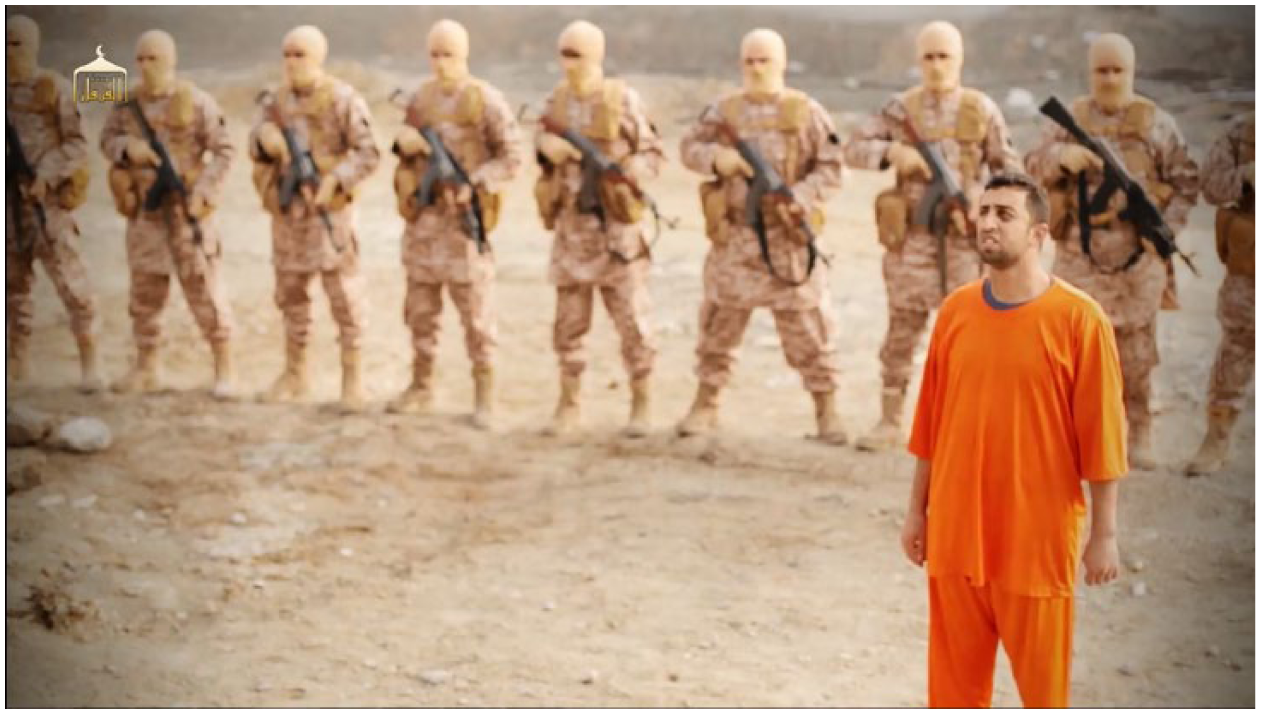
Screen-grab from ‘Healing the believers’ chests’ (al-Furqān media, January 2015).
The synthesis of transgressive violence and a vision of a comprehensive society is perhaps most clearly visualized in the videos of the Cup of the Caliphate — child soldiers, who undergo military and religious training and perform executions (see Figure 3). Through these videos, spectators have witnessed ferocious scenes, such as a four-year-old blowing up four alleged spies in a car, a three-year-old shooting a man point-blank in a playground and a group of children entering a maze in search for prisoners, whom they subsequently execute one after the other either by shooting them in the head or by slicing their throats. These videos certainly have the potential to terrify, seeing that the display of children carrying out executions is considered transgressive in many, if not most, societies. Yet, the presentation of a committed army of child soldiers also communicates the strength, persistence and order of the Caliphate. The message that these videos seek to convey is clear: not only has the Islamic State conquered territory and established a de facto state, but the group is already training the next generation to ensure the continuation of the project.

‘But if you return [to sin], we will return [to punishment] #3’ (Wilāyat Nīnawā, September 2016).
The combination of transgressive violence and a vision of a comprehensive (actually emerging) society, visualized in the Islamic State’s videos, is considered something new in the world of jihadism (Stern and Berger, 2015). It is also consistent with the fact that the Islamic State has expressed critique of groups like al-Qaeda, who they see as ‘frozen in the phase of nikayah attacks,[19] almost considering the attainment of power to be taboo or destructive’. 20 While al-Qaeda never believed in an Islamic state at this moment in time and predominantly discussed a caliphate as a utopian goal well into the future, a territorial caliphate is something that already exists for the Islamic State. The Islamic State is not only a terrorist organization; it is a (totalitarian) state project (Erslev Andersen, 2015; Napoleoni, 2014). This is reflected in how they mobilize and display violence. The Islamic State’s violent acts may, indeed, instil terror. Yet, the group’s careful orchestration of public killings and mutilations is also an integral element of a state project and a visual manifestation of an alternative political order that fundamentally challenges the contemporary Western-dominated international order. Thus, as many times before, the desecrated body is mobilized as a principal sign in founding a state, as political authority is made real in the wounds of the body, and individual pain is made a spectacle and projected as power.
Recognizing how the violence functions not only as a form of terror, but also as an integral element of a state project and a visual manifestation of an alternative political order is essential for understanding the global spectacle that the Islamic State has created. The synthesis of transgressive violence and a vision of a comprehensive society is what makes the group’s videos both so shocking for the established order and so fascinating and attractive for particular groups and individuals. The public killings in the Islamic State’s videos are not just acts of random brutality, nor are they merely acts of terrorism; they are political, order-building acts par excellence. This is what makes them horrifying, as well as attractive.
Conclusion
From the Roman gladiatorial spectacles, to the fascist rallies, to modern-day terrorism, the mimetic mix of image and violence has often proven to be more powerful than rational discourse (Der Derian, 2002). At a time when processes of globalization have fundamentally altered the relationship between time and space, and where the global media and new visual technologies can provide acts of violence with an instantaneous global dimension, the need to examine the more communicative, visual and aesthetic dimensions of political violence is becoming increasingly urgent (Bleiker, 2003; Hansen, 2015). This article has sought to contribute to the study of visual politics and political violence in an increasingly globalized age by examining the Islamic State’s public displays of violence.
Departing from the public constitution of the Islamic State’s choreographed executions as an exceptional evil, I have sought to re-evaluate the phenomenon by placing the violent acts in a broader interpretative and historical context. More specifically, I have argued that the Islamic State’s orchestration of public displays of violence is neither random brutality nor exceptional evil, but a contemporary version of a distinct type of political violence that has been mobilized by various political agents throughout centuries. What is truly significant about the Islamic State is not their brutality or willingness to mobilize violence per se, but the group’s ability to exploit the contemporary communication environment to increase the public visibility of their deeds and create a more global spectacle. Thus, if the Islamic State is introducing new dynamics in global politics, it is not a new form of violence or a new level of brutality, but rather a transformation of how spectacles of violence unfold on the global stage and who has the ability to control when, where and how violence is seen. To develop this argument further, I have highlighted three dimensions of the Islamic State’s public displays of violence that have facilitated the creation of a global spectacle: the Islamic State’s technological skills and professional use of media (technology); the Islamic State’s mobilization of acts of violence that transgress contemporary sensibilities (transgression); and, finally, the violent acts’ function as not only a form of terror, but also an integral element of a state project and a visual manifestation of an alternative political order (politics).
The discussion of the Islamic State’s public displays of violence illustrates that not just states, but also insurgents and militant groups, are becoming remarkably adept at establishing their presence and manipulating their impact through imagery. Thus, the preceding argument introduces a number of further questions for the field of IR. One of the most pressing questions relates to the discussion of what role the Islamic State’s — and other militant groups’ — messaging and imagery play in relation to what is popularly termed ‘radicalisation’ and the process of ‘turning violent’. The Islamic State’s professional media campaign has prompted intense public debate about whether and how the group’s visual products may accelerate or even be a cause of radicalization. On the one hand, this debate has been dominated by many unsubstantiated claims. The widespread assertion that individuals can be ‘radicalized over the Internet’ has so far not been supported by research and in many ways seems to be a crude simplification of the phenomenon (Gemmerli, 2015). On the other hand, it is important to recognize that there are many unexplored aspects of the Islamic State’s messaging and imagery, and, thus, denying that this type of visual material may have any form of mobilizing effect — before these effects have actually been properly studied — is equally problematic. In particular, the effects of the increasingly immersive nature of the Islamic State’s virtual universe and the more emotional aspects of watching the group’s videos are in need of further research (Duncombe and Bleiker, 2015; Hutchison and Bleiker, 2008).
An associated question in need of further research relates to the initiatives aimed at countering the Islamic State’s communication. The Islamic State’s sophisticated use of media has led to increased focus on the perceptual and virtual dimensions of contemporary wars. ‘Information warfare’, ‘strategic communication’ and ‘propaganda war’ have returned to the lips of policymakers and strategists from Washington to Brussels, and numerous counter-communication initiatives have been introduced (Aistrope, 2016). These initiatives call for academic scrutiny for the following two reasons: first, because there is currently little research on the effectiveness of these types of campaigns; and, second, because it is not unthinkable that the initiatives may have (damaging) consequences beyond their immediate aim of countering the Islamic State’s communication, particularly related to questions about freedom of speech/censorship and diversity/normalization — because how do you counter propaganda without becoming a propagandist yourself?
Footnotes
Acknowledgements
Earlier versions of this article have been presented at conferences and seminars over the past two years and I am grateful for the comments, questions and suggestions offered on these occasions. I particularly wish to thank the following for their helpful feedback: the two anonymous reviewers, the editors of the European Journal of International Relations, Rebecca Adler-Nissen, Timothy Aistrope, Claudia Aradau, Roland Bleiker, Constance Duncombe, Kathryn Fox, Chiara de Franco, Lene Hansen, Megan H. MacKenzie, Helle Malmvig, Iver B. Neumann, Johan Spanner, Alexei Tsinovoi and Michael C. Williams. Finally, I am grateful to Matthew Cronin and Sari Saadi for outstanding research assistance.
Funding
Research for this article was carried out as part of the project on ‘Images and International Security’ funded by the Danish Council for Independent Research — Social Sciences, Grant number DFF-1327-00056B.