




Abstract
What are the effects of strategic surprise on foreign policy? We apply mechanisms from cognitive psychology and foreign policy analysis — the hindsight bias and policy engagement — to theorize about how political leaders attribute blame for strategic surprises and the consequences for their foreign policies. We argue that leaders who are hardly engaged with policy matters related to a surprise will tend to believe that it should have been foreseen, attribute blame to domestic culprits and favour significant changes in foreign policy. Conversely, those more involved with policy planning will blame an adversary’s deception and resist policy change. We illustrate these hypotheses empirically by examining the cases of the Truman administration’s reaction to the 1949 Soviet nuclear test and the Johnson administration’s reaction to the 1967 Chinese thermonuclear explosion. Despite their similar international and domestic political environments, the two presidents reacted quite differently to the two surprises. Truman, who was weakly engaged with nuclear matters prior to 1949, authorized major policy changes and reorganized the Central Intelligence Agency. Conversely, Johnson’s deeper involvement in nuclear matters led him to attribute blame for the surprise to Chinese deception. He sought to use the 1967 test to advance his ongoing efforts to secure the nuclear non-proliferation treaty. The findings suggest that the variables of policy engagement and the hindsight bias can predict how leaders’ foreign policies will respond to surprises regarding nuclear weapons proliferation and potentially other shifts in the balance of power.
Keywords
Introduction
What are the consequences of strategic surprise for foreign policy? A strategic surprise is an unexpected event initiated by an external political actor that substantially harms the interests of the target. The example most often invoked is an unexpected military attack, but rapid advancements in a state’s military capabilities are also important. ‘Nuclear surprises’ in which states obtain or augment a nuclear weapons arsenal are an important subset of such events, and are particularly likely to occur under a veil of secrecy that makes them difficult to anticipate. Nuclear surprises have major implications for the security and international influence of state actors, but what is the effect of the surprise side of the ledger? This article examines the effects of weapons proliferation surprises by asking how leaders attribute blame for unexpected nuclear weapon developments, and examines how these attributions affect their subsequent policy choices. Although a plethora of causes of strategic surprise have been debated and examined empirically (Betts, 1982; Byman, 2005; Dahl, 2013; Handel, 1981; Wirtz, 2006), research on the causes of strategic surprise is not matched by a similarly rigorous investigation of the effects of surprises. Theorists have argued that shocks are catalysts for foreign policy change. We qualify such arguments by showing how actors’ understanding of the causes of a surprise moderates their propensity to make policy changes.
After developing the definition of strategic surprise, this article outlines a theory of how policymakers are likely to attribute the cause of surprises based on an interaction between the mechanisms of ‘hindsight bias’ and ‘policy engagement’. Drawing on theories of foreign policy change and cognitive psychology, it offers hypotheses on how subsequent policy responses will vary according to the types of attribution that policymakers reach. We contend that substantive policy engagement motivates leaders to resist the hindsight bias and continue with extant policy given the greater perceived costs of change. Such leaders will also be less likely to engage in significant intelligence reform due to an increased awareness of the difficulty of intelligence assessment and an inclination to blame external foes for surprises. We illustrate how our theoretical mechanisms produce these outcomes using the Harry Truman administration’s response to the 1949 Soviet nuclear test and the Lyndon Johnson administration’s response to China’s test of its first thermonuclear weapon in 1967. Both Democratic administrations were similarly surprised and faced comparable domestic and international political environments, yet exhibited strikingly different policy responses to their communist adversaries. We argue that this divergence resulted from Truman’s lesser engagement with nuclear policy prior to 1949 compared to Johnson’s before 1967. This made Johnson less vulnerable to the hindsight bias, less likely to attribute blame to domestic sources and more committed to his existing policies on nuclear proliferation. Lack of engagement with the Soviet nuclear weapons programme, on the other hand, made Truman accelerate changes to the US nuclear arsenal and fundamentally reorganize US intelligence agencies. The article concludes with a review of the argument and further implications for policy.
Strategic surprise and the hindsight bias
Strategic surprise occurs when an actor’s expectations do not align with an opponent’s actual capabilities, intentions or behaviour, resulting in harm to the actor’s valued interests (Chan, 1979: 171; Kam, 1988: 8–9). Such surprise could result from an opponent’s deception or concealment of intent, or the unintended effects of its actions. Surprise is multifaceted rather than a dichotomous variable. Erroneous judgements about an upcoming attack may be due to not only uncertainty about whether the event will occur, but also questions of ‘when, where, and how’ (Parker and Stern, 2002: 603). Surprises are related to intelligence failures in that a state’s intelligence services may not accurately anticipate the details or probability of an event. However, intelligence failures are not necessary for strategic surprises to occur. Surprise may come about if, for instance, top decision-makers ignore credible reports from their intelligence agencies or politicize intelligence such that analysts are wary of reporting information that will upset their superiors (Rovner, 2011).
Dozens of sources of strategic surprise have been identified, but for our purposes, these can be reduced to domestic and foreign sources of surprise. The former includes psychological biases that lead individuals or small groups to be overly confident about their security or neglect relevant pieces of information (Janis, 1962: 55–92; Johnson, 2004). Governmental organizations responsible for national security may be significantly limited in their ability and willingness to share vital information with one another, among other limitations (Zegart, 1999). Friction between civil officers and political leaders may further prevent effective coordination and awareness of potential threats throughout government (Jervis, 2010: 157–167). Alternatively, foreign sources of surprise most often relate to an adversary’s ability to conceal its plans and deceive opponents (Pillar, 2011: 217–219). Furthermore, if an adversary’s own expectations about the way in which international events will unfold are not met, they may respond in an ad hoc fashion or implement plans to which they had not given much prior consideration. If an external actor is not certain of its own plans until the last moment, it is quite difficult for potential targets to anticipate them.
Our dependent variable is the extent of change in a state’s foreign policy towards its primary adversaries following a surprise. Foreign policy is the political, military and economic objectives that a state has regarding other international actors, the type and amount of resources being channelled to achieve these aims, and the methods by which the acquisition of resources and the management of these efforts are organized. Foreign policy change is purposeful variation in any of these, which can range from slight adjustments, to programmatic shifts, to a fundamental rethink of the nature of a problem and corresponding policy objectives (Hermann, 1990: 15–17). Foreign policy change may involve intelligence reform, or reform of any agency with jurisdiction over foreign affairs, but need not. We conceptualize the makers of foreign policy as not only the chief executive, but also the ‘ultimate decision-making unit’, the small group of actors that formulate policy and whose decisions cannot be easily reversed after implementation (Hermann and Hermann, 1989).
Hindsight bias, policy engagement and foreign versus domestic attributions
Arguments from International Relations related to political and security ‘shocks’ have made mixed assessments about what the effects of surprises will be with respect to foreign policy. Some theorists have argued that surprises can promote change by demonstrating that extant strategies are ineffective (Gustavsson, 1999; Keeler, 1993; Stern, 1997). Others, however, have posited that policymakers’ prior commitments and engagement with a policy can make them resist change, even in the face of negative information regarding a policy’s feasibility. Hermann (1990: 15–17) claims that the more political actors there are in government who feel personally committed to a policy, the more resistance there will be to acknowledging failure. Stern (1997: 78) uses the term ‘defensiveness’ to refer to the avoidance of blame for policy failures, and notes that defensiveness is especially common as a psychological and political coping strategy among policymakers in the aftermath of crises. We argue that post hoc defensiveness, along with a greater appreciation of uncertainty prior to a surprise, is moderated by policy engagement. The extent of subsequent policy change depends on leaders’ susceptibility to the hindsight bias and the corresponding attributions that they make with respect to a surprise’s cause.
Experts on strategic surprise have asserted that political leaders are more likely to attribute such events to domestic failings than the cleverness or unpredictability of foreign actors (Betts, 2007: 10; Pillar, 2011: 177). Why would leaders tend to lay the blame at home? One possibility relates to a ubiquitous feature of human psychology, the hindsight bias. After an event occurs, individuals interpret the information that was available before it happened as indicating that the outcome was virtually inevitable, and that the result should have been obvious to anyone in possession of the facts. Conversely, before an event occurs, the same people report much less certainty as to whether any particular outcome will arise (Fischhoff, 1975; Slovic and Fischoff, 1977). Knowing the outcome makes it much clearer what prior information was noise and what was signal. According to Pillar (2011: 228), ‘hindsight … has played a huge role in misperceptions about the performance of intelligence because almost everything that is known about an event becomes known only after the fact’. Zegart (2007: 7) likewise criticizes the ‘creeping determinism’ that can take hold during the post hoc analysis of events. If the alleged causes of surprise events often appear obvious after the fact, then political leaders will believe, unrealistically, that intelligence services should have easily been able to provide advanced warning.
Studies have found that the prevalence and effect of the hindsight bias tends to be moderated when subjects are familiar with issues related to the source of surprise: ‘the hindsight bias reduces when people are experienced in the domain under investigation’ (Fiske and Taylor, 2013: 202). Experience familiarizes people with the often unpredictable nature of the connection between antecedents and ultimate outcomes in a given area (Cohen, 2017). Furthermore, having a sense of responsibility for a surprising outcome triggers defensiveness (Pezzo, 2003), and negative outcomes especially lead people to claim that the end results of their decisions could not be foreseen (Mark et al., 2003). People strive to protect their self-image when reasoning about events (Kunda, 1990), and it is thus uncomfortable to accept that one should have predicted an unwanted surprise as doing so casts doubt on one’s own abilities and judgement. People whose prior knowledge had familiarized them with what ultimately proved to be the cause of an unwanted surprise are thus likely to believe that the outcome could not have been foreseen in order to deflect blame away from themselves (Bradley, 1978; Louie, 1999).
In line with these findings, we argue that policy engagement, or simply ‘engagement’, should be a key variable mitigating against the hindsight bias in the policymaking realm. Engagement involves the formulation and implementation of policy. It is informed by, but distinct from, an actor’s political beliefs or level of interest in particular policies. Someone may be very interested in a policy area, in that they strongly prefer a specific outcome or course of action, but may have very little involvement in the process of formulating the substance of said policy or facilitating its enactment. Having authority or jurisdiction over a set of policies facilitates engagement but is neither necessary nor sufficient for it. In the following, we further operationalize engagement in terms of information search in the process of policy formulation.
We contend that there are both ‘cold’ cognitive reasons and ‘hot’ motivational reasons as to why engagement should moderate political leaders’ susceptibility to the hindsight bias after surprises. Cognitively speaking, engagement with policy formulation and implementation requires decision-makers to be cognizant of the inherent uncertainty involved in anticipating events that could disrupt the policymaking process, especially in comparison to individuals performing an analysis after a surprise has occurred. As previously engaged actors have access to a different and typically more extensive set of information compared to unengaged individuals performing a post hoc analysis, the former are able to construct different and more complex causal explanations for events. Political leaders’ policy engagement may familiarize them with information that turns out to be relevant to a nuanced understanding of how a strategic surprise occurred. Leaders who were less engaged with the relevant policy area prior to surprise events will be less sensitive to uncertainty surrounding prior estimates of how the policy process might succeed or fail, which will promote the hindsight bias.
In regards to hot, motivated reasoning, political actors’ public roles may make them more interested than most in avoiding blame for strategic surprises. Even when political experts act anonymously, with little at stake in terms of the accuracy of their predictions, they are motivated to explain their errant forecasts as having been ‘almost right’ except for the occurrence of unusual, unpredictable events (Tetlock, 1999). In line with the findings discussed earlier, individuals who have been very engaged with a given policy area may be defensive and deny that a surprise could have been foreseen rather than exhibit hindsight bias. They might intuitively suspect that they will be held responsible for failing to anticipate negative events because, ex ante, they had more information relevant to the surprise than did less engaged political actors. Correspondingly, they are motivated to arrive at causal explanations for the surprise that cast responsibility elsewhere, rather than impugn their own competence or beliefs.
We argue that the self-interested motivated reasoning that we expect to accompany extensive prior engagement with policy related to a surprise will also discourage engaged leaders from attributing blame for that surprise to domestic sources. The more involved a leader was with the domestic policymaking apparatus relevant to the surprise, the more difficult it will be to attribute blame to domestic institutions and simultaneously dismiss personal culpability. Instead, it will be more appealing to believe privately, and perhaps declare publicly, that it would have been difficult or impossible for any government official to have foreseen the surprise event. The conclusion that the foreign perpetrator of the surprise was guilty of treachery and deceit thus becomes more attractive than pointing the finger at domestic failures. By itself, attributing blame to an external adversary would not necessarily stymie foreign policy change: new beliefs about an opponent’s capabilities might lead actors to adopt a more confrontational or conciliatory stance depending on the status of other relevant factors. However, attributing responsibility for a surprise to a foreign opponent while concomitantly seeking to avoid personal culpability for that surprise does tip the scales towards policy stasis for the reasons related to defensiveness: the greater the change in policy, the greater the tacit admission that the prior policy that an actor had laboured over was ill-suited to the actual state of the world.
Conversely, we contend that relatively unengaged leaders can be less defensive, and are more likely to attribute strategic surprise to domestic sources, which may be a catalyst for substantial policy and organizational change. This assertion raises the question of whether political actors can ‘pass the buck’ so easily. Leaders at the very top of a political hierarchy may technically have jurisdiction and responsibility over all policy areas, which complicates their efforts to deflect blame for surprises that occur on their watch. At the same time, because chief executives have authority over a broad range of policy, they can more readily claim the need to delegate day-to-day responsibility for managing the details of any given area to subordinates in specialized departments. Unlike engaged actors who had familiarized themselves with a policy domain relevant to a surprise, less involved leaders can argue that they had reasonably delegated the task of preventing strategic surprises to intelligence and diplomatic agencies, and could not be expected to have developed a response to an adverse event without the proper warning from their subordinates. Even when given explicit warnings about the possibility of an attack, unengaged leaders may be able to avoid culpability at the ballot box, as President George W. Bush did following the terrorist attacks of 11 September 2001.
If the hindsight bias encourages leaders to point the finger at domestic culprits after strategic surprises, they should also be more likely to view intelligence and national security organizations as unreliable when it comes to making predictions about the foreign perpetrator of the surprising act. If the consequences of strategic surprise are dire, leaders will find worst-case thinking and aggressive policy actions meant to circumvent future events of a similar nature more appealing: the less forewarning an actor expects before another adverse event, the fewer defensive actions they will anticipate being able to take in response to new threats. Policymakers of this mindset will be less willing to wait for clear evidence of danger to emerge, perhaps coming ‘in the form of a mushroom cloud’, as Condoleezza Rice said after the shock of the 11 September attacks (Suskind, 2006). Those who blame domestic agencies for strategic surprises will be prone to make significant changes rather than take the chance that their intelligence will give them better advanced warning next time.
Additionally, an oft-cited source of policy continuity is bureaucratic inertia: the tendency of bureaucracies to adjust policy actions slowly given entrenched interests, a reliance on standard operating procedures and ponderous rules and chains of command. Inertia makes changing institutionalized policies a difficult task (Breuning, 2013: 311; Goldmann, 1988: 55–57; Welch, 2005: 32–33), especially if policymakers do not think that their constituents will reward them for pushing bureaucratic change and reform (Zegart, 2005: 97–98). However, the more blame bureaucratic agents receive for surprises, the more motivation elected leaders will have to increase oversight and possibly restructure the governmental organizations responsible for implementing foreign policy. Conversely, if leaders have engaged extensively with policy relevant to the source of a surprise, this experience, combined with their related political and psychological motivations to avoid culpability, should reduce their susceptibility to the hindsight bias and instead attribute blame to the characteristics of the foreign adversary who caused the surprise. We expect these types of leaders to be less hostile to the intelligence community and other bureaucratic agents. Combined with the desire to avoid the appearance of culpability, such leaders will find minor policy alterations or the continuation of existing courses of action more appealing than major policy changes. Given their prior engagement, major alterations of policy represent the implicit admission of personal failure following a surprise, whereas for leaders without such engagement, a policy change instead represents a needed intervention to correct others’ mistakes.
This framework, illustrated in Figure 1, also allows us to flesh out the effect of political pressures and specific psychological biases in causing foreign policy change after strategic surprises. Against a baseline expectation of strategic surprise causing foreign policy change, we argue that the psychological logic of policy engagement causes engaged leaders to stick with prior policies and that of hindsight bias to cause policy change.

Prior engagement moderates the effects of strategic surprise.
Policy engagement
Our case studies focus primarily on presidential policy engagement given that presidents have primary authority over national security policy as commanders-in-chief; major surprises such as nuclear proliferation by an adversary are virtually certain to command the attention of presidents and others in the upper echelons of government. As in Figure 1, we sometimes refer to actors as either engaged or unengaged for the sake of simplicity; in reality, engagement is continuous rather than binary. We expect engagement to affect susceptibility to the hindsight bias monotonically: greater engagement progressively decreases the bias’s influence on decision-making, whereas lesser engagement increases its influence.
We primarily conceptualize ‘engagement’ as policy formulation, and adopt information search as the main criterion for assessing an actor’s involvement with policy formulation as it is key to every step in the policy-formulation process. Access to information is necessary to acquire expertise, identify and understand problems, oversee the creation and implementation of policy according to one’s preferences, manage the expectations of other political actors and constituencies, and predict likely policy outcomes (Gailmard and Patty, 2012: 1, 11; Mitchell, 2005: 183; Rudalevige, 2002: 26–29). Although engagement is not easily quantifiable, it can be assessed by qualitatively documenting actors’ efforts to gather information during the policymaking process, a method that Mahoney (2010: 125–128) refers to as establishing an ‘independent variable causal process observation’.
Case selection
Understanding decision-makers’ reactions to unexpected nuclear proliferation has significant implications for foreign policymaking in response to surprise shifts in the balance of military power more generally. We illustrate the theoretical processes described earlier using the Truman and Johnson administrations’ policy responses to surprising adversary nuclear advances. Moreover, the cases that we examine have much in common but differ on our key variable of interest — a leader’s prior engagement with policy relevant to the strategic surprise. Presidents Truman and Johnson presumably had similar ‘nuclear intelligence’ available to them but Johnson was much more engaged with it. This is combined with different outcomes across the two cases in terms of post-surprise foreign policy. At most, Johnson made slight adjustments to his existing counter-proliferation policy after China’s thermonuclear test. In contrast, Truman’s response to the Soviet nuclear test entailed a significant programmatic shift in US nuclear policy and systemic reform of the intelligence services. Truman turned to new policy instruments, such as enabling recommendations from National Security Council paper 68 (NSC-68) that his administration had previously forgone, and would embrace more fully after the Korean War, as well as reorganizing parts of the Central Intelligence Agency (CIA). Linking our independent variable with variation in the outcome of interest increases analytical leverage according to the logic of the method of difference (George and Bennett, 2005: 153–157) and increases confidence that our theoretical expectations have wider validity in other cases of nuclear tests and shifts in a state or non-state adversary’s military capabilities more broadly.
In terms of comparability, the 1949 Soviet atomic test and 1967 Chinese hydrogen bomb test were technological breakthroughs by the USA’s two major Cold War opponents, and both tests occurred much sooner than US leaders expected. By comparison, leaders were much less surprised by China’s first nuclear weapons test in 1964 (Burr and Richelson, 2000: 89–90). In both 1949 and 1967, the USA’s adversaries in question had small or non-existent nuclear arsenals. Nevertheless, the unexpected tests sent shockwaves through the US policymaking community and exacerbated fears of communist aggression. Moreover, both the Soviet Union and China pursued a nuclear proliferation strategy that Narang (2017: 120, 126, 134) classifies as ‘sprinting’, whereby Stalin and Mao were suspected of harbouring expansive nuclear ambitions for which Washington had little cost-effective military or economic options of rolling back.
The two cases are different on a number of other metrics. China’s 1967 test was a hydrogen bomb, was not the country’s first nuclear test and occurred after the Cuban Missile Crisis provided a terrifying example to the US policy community of the threat of nuclear proliferation. The arms race and missile gap debates occurring in the 1960s were not salient in 1949. One could reasonably expect these differences to affect Truman’s and Johnson’s respective engagement with nuclear policy, with Johnson more firmly embedded in the ‘nuclear age’ than Truman. Nonetheless, by the late 1940s, the question for US grand strategists was when — not whether — the Soviet Union would end the US nuclear monopoly. Along with the fact that he was (and still is) the only president to have ordered the wartime use of an atomic bomb, one might expect Truman to have been at least as engaged with nuclear policy issues as Johnson was in the 1960s. For the purposes of our theory, however, the reasons why a president is more or less engaged with policy in a given area are irrelevant unless that factor also influences policy change as engagement prior to a strategic surprise serves as an explanatory variable rather than outcome of interest. We address several rejoinders along these lines in the conclusion.
For our purposes, the question of how much flexibility each president had in crafting a response to the surprise nuclear tests is crucial as it impinges directly on the capacity to change policy. If Truman or Johnson had greater political support than his counterpart, this might plausibly explain variation in their responses to surprise nuclear tests better than their prior policy engagement or the hindsight bias. Fortunately, Truman’s and Johnson’s political environments prior to the 1949 and 1967 tests resembled each other closely. Truman’s approval rating in 1949 was hovering near 50% when the Joe-1 test took place, just as Johnson’s approval was immediately before China’s thermonuclear explosion (Gallup, 2018). Of further importance for the comparability of both cases, Truman and Johnson faced friendly Congresses inclined to support presidential policy. The Democratic Party held 60% of the seats in the House and 56% in the Senate in 1949, and 57% of the House and 63% of the Senate in 1967. Congressional Democrats were similarly unified under both presidents: the 81st and 90th Congresses were practically identical in terms of the potential for a president to enact policy given his party’s cohesion and share of seats in Congress. 1 Moreover, as we will show later, in both cases, bureaucratic pressures pushed in more than one direction.
The 1949 Soviet nuclear test
The Soviet nuclear test of 1949 may not have played a significant part in convincing Truman to adopt several core recommendations of NSC-68; for instance, the document’s recommendation for major military spending increases was not implemented until the Korean War. However, NSC-68 was written in no small part as a response to the Soviet test, as well as the Chinese communist revolution and slow post-war European recovery, and the surprise likely caused Truman to authorize other programmatic changes in US nuclear policy recommended by NSC-68. 2 He drastically sped up the production of US nuclear weapons and ordered increased efforts to develop a hydrogen bomb. Consistent with our theoretical expectations, Joe-1 also resulted in a reorganization of the CIA. In the following, we show how Truman’s understanding of the causes of the strategic surprise of 1949 produced this outcome: increased nuclear weapons production and an almost ramshackle intelligence reorganization are hard to understand without accounting for Truman’s lack of extensive policy engagement in these areas before 1949.
Nature of the surprise
The US intelligence community was uncertain of the extent of Soviet espionage efforts to penetrate the Manhattan Project, and the qualifications of Soviet nuclear physicists were unclear (Barrett, 2005: 59–60; Richelson, 2006: 92). The CIA and Joint Staff analysts expected the that Soviet Union would not acquire an atomic bomb until several years after 1949, and there was significant variation in estimates of when the Soviets would acquire sufficient stocks of enriched uranium to break the US atomic monopoly (Steury, 2005; Valero, 1999). In 1945, Manhattan Project director Leslie Groves thought that it would take 20 years for the Soviet Union to obtain a weapon, whereas in 1948, Defense Secretary James Forrestal estimated that it would be between five and 10 years (Gordin, 2009: 66, 70–71). The Joint Chiefs of Staff (JCS) Joint Intelligence Committee estimated mid-1950 as the earliest date by which the Soviets might explode their first bomb and mid-1953 as ‘the probable date’, conceding that uncertainty regarding Soviet industrial development rendered it ‘impossible to determine the [nuclear programme’s] exact status or to determine the date scheduled by the Soviets for the completion of their first atomic bomb’ (Richelson, 2006: 76–77). This confusion did not stop the US from conducting air-sampling missions to detect spikes in radioactivity that might indicate a Soviet breakthrough.
Some officials underplayed the shock of the Soviet test. Under Secretary of State James Webb telegrammed US diplomatic and consular offices that ‘it has been no secret that such efforts were in progress in USSR’ (Petersen et al., 1976: Doc. 195). Director of Central Intelligence (DCI) Roscoe Hillenkoetter rejected assertions that ‘we were taken by surprise’, arguing that his intelligence was wrong by only a ‘few months’ (Burr, 2009). Still, State Department aide Gordon Arneson admitted that the Soviet test was deeply troubling, revealing the widespread conceit that ‘our vaunted industrial capacity and organization could not possibly be duplicated in performance by the Soviet Union, peopled as it was by wild-eyed bomb-throwing Bolsheviks and peasants’ (Leffler, 1992: 326). Most US military planning had assumed that US ‘atomic supremacy would be enduring’ (Herken, 1988: 285–301).
The extent of the surprise caused by the Soviet test is revealed by the fact that Truman and several high-level officials, including Defense Secretary Louis Johnson and National Security Adviser Sidney Souers, thought the event so unlikely that they initially refused to believe that Stalin had broken the US atomic monopoly (Richelson, 2006: 90–92). The President had once told Robert Oppenheimer that the Russians would ‘never’ be able to build the bomb (Herken, 1988: 303). After the surprise, Truman pressed his top atomic adviser, David Lilienthal, insisting that ‘we could not really be sure the Soviets had tested an atomic bomb’ (Thompson, 2009: 99). For weeks, the President stubbornly maintained that the radioactivity might have originated from a reactor explosion (Thompson, 2009: 99). 3 Similarly, House Republican leader Joseph Martin responded to news about the Soviet test as a ‘scare story’ where ‘some new [budget] request is going to be sent to the Hill’ (Barrett, 2005: 54).
Truman’s prior policy engagement
Truman’s normal approach to foreign policy is best described as informal, decentralized management (Mitchell, 2005: 189–190). Despite notable successes such as the Marshall Plan and the creation of the North Atlantic Treaty Organization (NATO), Truman did not do much to install an orderly, hierarchical system to screen and channel foreign policy information upward into the Oval Office, nor did he seek to exercise much control over policy formulation. He did not like working with the National Security Council (NSC) and was often absent from its meetings (Gailmard and Patty, 2012: 216–217; Walcott and Hult, 1995: 160). Rather than carefully deliberating over information, Truman ‘listened to advisers and often quickly made decisions on the spot’ (Mitchell, 2005: 189). Until the onset of the Korean War, he preferred to rely on ad hoc decision-making structures and delegated heavily to trusted officials, using ‘improvisational governance’ and ‘temporary expedients’ to handle national security policy (Walcott and Huth, 1995: 160–167).
Truman’s relative detachment from foreign policy formulation extended to nuclear policy. Truman’s belief in 1949 that the Soviets were years from acquiring the bomb was not baseless: even before the creation of the CIA, he received daily classified briefings on international security that would have included information on Soviet nuclear progress (Warner, 2014: 142) — though the details of those reports are obscure. However, the aftermath of Joe-1 supports our hypothesis that a lack of policy engagement promotes the hindsight bias and the attribution of surprise to domestic sources. NSC meetings on nuclear matters were held frequently from 1947 onward but Truman rarely attended. His information search pertaining to policy formulation was limited. According to Gordin (2009: 260), he was not ‘fully aware of how many American bombs were actually ready … early war plans were characterized by two features: obliviousness to nuclear scarcity and the presumed existence of a monopoly’. The administration’s longest recorded cabinet meeting on nuclear proliferation concerned the Baruch Plan to share atomic energy with Moscow (Gordin, 2009: 33–34). In Truman’s usual fashion, rather than tightly managing the policy’s formulation, he took a somewhat hands-off approach towards the Baruch Plan, leading the diplomatic endeavour to flounder (Craig and Radchenko, 2008; Gordin, 2009: 50–51, 59). Aside from the issue of proliferation, nuclear intelligence in Truman’s administration was, according to Atomic Energy Commission (AEC) head Lewis Strauss, ‘nobody’s child for over two years after Hiroshima’ (Gordin, 2009: 181–182).
Truman could have tried to block hearings into US intelligence services following the Soviet test. Compared to Congress, the unitary nature of the presidency gives the White House an advantage in influencing oversight of the foreign policy bureaucracy (Clinton et al., 2013: 389–390; Zegart, 2005: 98–99), including leeway to enable or deflect hearings on foreign affairs. This is especially so under conditions of unified government. However, as our theory expects, Truman blamed the CIA for failing to provide sufficient forewarning of the Soviet test, and signalled to members of Congress that he would welcome an interrogation of US intelligence. When the ‘atomic senator’ Brien McMahon asked Truman about the surprise test, the President informed him that US intelligence and security policy was being reassessed specifically because of Joe-1 (Gordin, 2009: 272). In the congressional hearings that followed, Hillenkoetter and the CIA’s Office of Reports and Estimates (ORE) became ‘a scapegoat’ for the surprise. From 1947, US intelligence agencies were pervaded by reform attempts and recriminations (Durbin, 2017; Immerman, 2014). However, the Soviet test was clearly the catalyst for dismantling the ORE, which was subsequently replaced by three distinct functional units (Gordin, 2009: 255). On 29 September, a memo from Assistant Director for Scientific Intelligence Willard Machle to Hillenkoetter lambasted the performance of the intelligence agencies in predicting Joe-1, concluding that ‘inadequacies in present national scientific intelligence exist because of conditions both inside and outside CIA’ (Thorne and Patterson, 1996: Doc. 399). However, those variables outside the CIA mostly boiled down to interference by other US intelligence agencies in CIA initiatives. There was no mention of Soviet deception of the US government. A May 1950 State Department memo on improving national intelligence estimates pointed the finger at Hillenkoetter and ‘interdepartmental friction’ by claiming that ‘the production of national intelligence remains at an ineffective level largely because of a continuing misunderstanding on the part of the DCI as to the legal connotations of his responsibility for producing national intelligence’ (Thorne and Patterson, 1996: Doc. 420).
Consistent with our hypothesis about the effects of policy engagement, officials like Hillenkoetter who were deeply involved with assessing the Soviet Union’s nuclear capabilities defensively pointed the finger at Soviet secrecy, not their own failings. During congressional hearings, Hillenkoetter defiantly emphasized the difficulties in providing forewarning and attributed the surprise to the capabilities of the Soviet Union, saying that ‘any time we take the view here that the Russian scientists are dumb or something, we are just deluding ourselves’ (Goodman, 2007: 51). The Ad Hoc Committee on Atomic Energy Intelligence, with officials from the Departments of State and Defense, the AEC, and the CIA, noted several organizational difficulties but emphasized that these were ‘common to all categories of intelligence’ (Ad Hoc Committee, 1950: 3, 5). The implication was that Soviet secrecy was to blame: ‘even a radical increase in intelligence production personnel would probably not permit a higher degree of certainty’ (Ad Hoc Committee 1950: 10). Hillenkoetter lamented that ‘I couldn’t take the responsibility of saying … that we would definitely know what they were going to do, and when they were going to produce a bomb’ (Barrett, 2005: 59–62).
Policy alternatives
In order for significant policy change to take place, policymakers must perceive the existence of a set of feasible alternatives (Goldmann, 1988: 26). There were several apparent policy options available to the Truman administration after the Soviet test (Herken, 1988: 327–329). One possible response was to renew efforts at the international control of nuclear materials, the policy of the status quo ante. In support of our hypothesis on policy inertia, this course was favoured by previously engaged officials who attributed surprise to the Soviet Union rather than domestic culprits. Charles Barnard, from the committee that formulated the Baruch Plan, was a primary proponent of re-pursuing international control. Barnard was supported by the CIA, which held that Joe-1 did not signify fundamental changes in the Soviet Union’s policy or tactics (Kuhns, 1997: 334). This policy was rejected, however. The possible alternative of seeking an agreement to not test an H-bomb was also ultimately rejected (York, 1976: 25). Not only was there doubt that the Soviet Union would accept a robust inspections regime; in line with our theory, the surprise and subsequent domestic attribution of blame by less engaged actors, including President Truman, also meant that nuclear intelligence was seen as a weak foundation for strategy by policymakers in a ‘panic’ (Kuhns, 1997: 334, 345).
Referring to the process that produced NSC-68, Secretary of State Dean Acheson (quoted in Beisner, 2006: 157) recalled that ‘the immediate cause of the review of our military and foreign policies was the Russian atomic explosion’. He said that US leaders were left thinking ‘we have now got to pull our socks up, and be in for a long matching of strength and power with the Soviet Union’ (Acheson, quoted in Beisner, 2006: 157). Paul Nitze replaced George Kennan as head of policy planning in January 1950. Nitze had extensive experience in nuclear matters, having surveyed the damage inflicted by the atomic bombing of Japan as Director of the Strategic Bombing Survey after the Second World War (Nitze 1989). Given this policy engagement and his long-standing hawkish preferences with respect to nuclear policy, our theory would expect Nitze to have taken the early Soviet test as an affirmation of his prior inclinations, rather than adopting the defensive stance of figures who had offered more conservative estimates of Soviet nuclear progress or backed international sharing arrangements.
Nitze wasted no time in urging Acheson and Truman to authorize a review of US diplomatic and strategic posture after the Soviet test was detected (Leffler, 1992: 330). As chief author of NSC-68, he made numerous references to the approaching end of the US atomic monopoly and increasing risks of a nuclear war, advocating substantial nuclear and conventional rearmament. The Soviet test strengthened Nitze’s prior conviction that Stalin could not be trusted to forgo using nuclear weapons for aggressive purposes. In February 1950, he challenged the CIA’s conclusion that the test did not signify that the Soviet Union was dramatically changing its foreign policy, countering that ‘recent Soviet moves suggest not only a mounting militancy but a boldness that is essentially new’ (Glennon et al., 1977: Doc. 59). He insisted that Truman must prevent Stalin from neutralizing the US advantage in atomic weaponry (NSC, 1950: 24).
Accordingly, the surprise Soviet test facilitated the adoption of some policies outlined in NSC-68 (Wells, 1979: 138). Truman approved a substantial increase in fissile material acquisition and weapons production requested by the JCS in the months after the Soviet test, before the outbreak of the Korean War (Rosenberg, 1983: 22). Truman had been planning to develop a hydrogen bomb before Joe-1, but the Soviet test substantially sped up the US programme (Gaddis, 2005: 77; Glennon et al., 1977: Doc. 173; Herken, 1988: 304–305, 319–321, 329–330). The Soviet test did not cause Truman to authorize a new nuclear posture, but rather to more speedily operationalize ‘massive retaliation’ (Gavin, 2012; Rosenberg, 1983). The NSC special committee concluded that the US thermonuclear weapon programme was ‘a matter of the highest urgency’, and Truman approved their recommendations regarding testing, carrier development and quantity production in early March 1950 (Rosenberg, 1979: 62). The President asked Congress for US$1.4 billion for increased uranium enrichment capacity such that, for the first time, the AEC budget exceeded that of the wartime Manhattan Project (Gordin, 2009: 251). The Soviet test also sped up NATO integration and spurred a formerly reluctant US Congress to put more money into European military assistance (Gordin, 2009: 270).
China’s 1967 H-bomb test
In June 1967, the People’s Republic of China (PRC) successfully tested its first thermonuclear device. The space between China’s production of fission- and fusion-powered weapons was the shortest in any country’s history. Unlike Truman’s response in 1949, Johnson’s surprised administration stayed its foreign policy course and pushed on to achieve an international non-proliferation agreement (the Nuclear Non-Proliferation Treaty (NPT)). This was not a foregone conclusion, but rather reflected Johnson’s deep involvement with non-proliferation. Johnson had neither political nor psychological incentives to change and effectively undermine his approach to the PRC nuclear programme or proliferation more generally. He accepted the intelligence community’s assessment that China’s test could be attributed to the extraordinary amount of resources that Beijing had devoted to the programme, rather than pointing to any flaws in the US intelligence or policymaking processes.
Nature of the surprise
China’s thermonuclear test was ‘a dramatic and upsetting event’ in the US (Liu, 1972: 36). The JCS concluded from it that China was moving ‘toward a strategic capability at a faster rate than had been anticipated’ (Patterson et al., 2002: Doc. 184). National Security Adviser Walt Rostow told Johnson that ‘we now have to take the Chinese Communist [nuclear] threat more seriously’ (Patterson et al., 2002: Doc. 187). Many US officials and pundits saw the PRC as considerably more aggressive and risk-acceptant than the Soviet Union given Mao’s assertion that if ‘half of mankind died’ in nuclear war, ‘the other half would remain while imperialism would be razed to the ground and the whole world would become socialist’ (Gavin, 2005: 100–101).
As with Truman, Johnson could have acquiesced to the intelligence community being used as a scapegoat for its failure to accurately predict the thermonuclear test but ultimately did not do so. The Democratic Congress held no hearings on the failure to predict the test even though the PRC made progress much more quickly than had been expected by officials on Congress’s Joint Committee on Atomic Energy (JCAE), or in the CIA, the AEC or the Departments of Defense and State (Finney, 1967; Liu, 1972: 38). After China’s first atomic explosion in October 1964, the chairman of the AEC told Johnson and congressional leaders that the PRC would likely develop a thermonuclear device in four or five years. The most pessimistic CIA estimate from November 1965 had held that China could perhaps have deployable fission weapons ‘before 1970’ but usable thermonuclear weapons would come later (CIA, 1965: 36). Further exacerbating the surprise of 1967 was that the test took place in the midst of the Cultural Revolution, which was supposed to impose ‘obvious if temporary limitations’ on PRC military programmes (DCI, 1967: 64, 70–71). In August 1967, a National Intelligence Estimate (NIE) admitted that ‘we have considerably underestimated the Chinese’ (NIC, 2004: 501).
Johnson’s prior policy engagement
Compared to Truman, Johnson adopted tighter control over policy information. He regularly met with the NSC, and held ‘highly centralized’ sessions with top foreign policy advisors such as his ‘Tuesday Lunches’ (Burke, 2000: 84–88; Haney, 1997: 70, 133). He also set up numerous task forces when formulating policy to increase his access to individuals with expertise (Burke, 2000: 95; Rudalevige, 2002: 56–57). 4 Even critics of Johnson’s handling of policy during the Vietnam War note that he ‘surrounded himself with able aides, pumping them for political intelligence and bombarding them with instructions’, and tended to ‘dominate’ meetings (Greenstein, 2000: 87–89).
Another way of comparing Johnson’s and Truman’s engagement with nuclear issues is to look at the policy content of their State-of-the-Union addresses (SOUs). SOUs are prominent events that allow presidents to set policy agendas before Congress and members of the public simultaneously. They are a ‘scarce resource’ in that they come once a year, so subjects mentioned therein are likely to be indicative of the most valued parts of the president’s agenda (Cohen, 1999: 28; Walcott and Hult, 1995: 216–217). The Comparative Agendas Project (CAP) (see Baumgartner and Jones 2019) codes each ‘quasi-sentence’ of an SOU for its policy content, allowing researchers to calculate what proportion of an address was dedicated to a particular issue in a given year. Johnson dedicated more SOU content to addressing nuclear arms in the years prior to China’s thermonuclear test than Truman did in the years before the Soviet test. Notably, Johnson devoted a relatively large amount of space to nuclear arms in 1967 before China’s test, whereas Truman did not discuss nuclear arms at all in his SOU in the year of the Soviet nuclear test (see Figure 2).
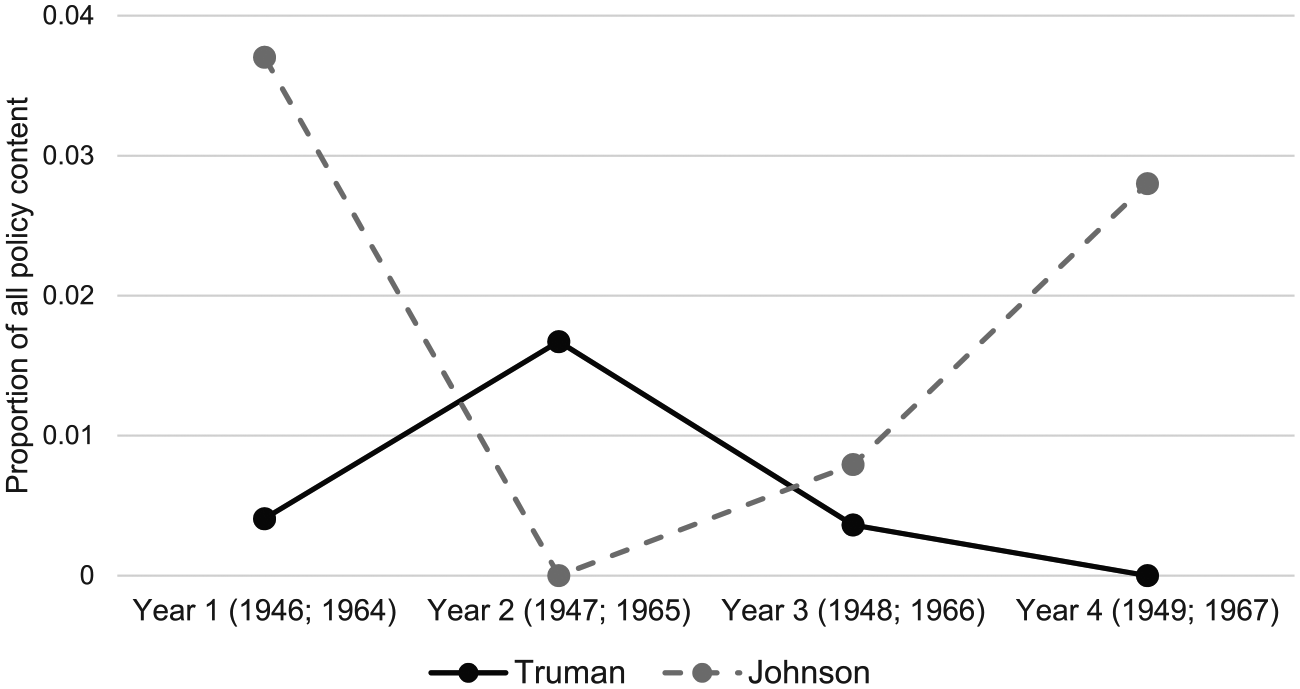
Discussion of nuclear arms in SOUs.
The Johnson administration issued 13 National Security Action Memoranda (NSAM) regarding nuclear defence or proliferation prior to the Chinese test (LBJL, 2019). By 1966, Johnson had become earnestly involved in shaping the details of US non-proliferation policy (Seaborg, 1987: 183). The January 1966 Pastore Resolution that praised Johnson’s non-proliferation agenda passed the Senate 84–0 and was ‘the real breaking point’ for the direction of the Johnson administration’s policy. Secretary of Defense Robert McNamara and Secretary of State Dean Rusk made it clear during the hearings preceding the vote that the US was going to forgo sharing nuclear weapons with its allies and concentrate on international agreements promoting non-proliferation (Mulhollan, 1968: 4). Johnson ‘made the change at great risk and some political cost’ (Gavin, 2005: 130).
Johnson was less directly engaged with China’s H-bomb than the NPT but, as we will show, the former was intimately related to and gravely threatened the feasibility of the treaty. Johnson worked avidly towards nuclear non-proliferation via diplomacy. This was evident in his intensive processing of relevant information. Rusk recalled how Johnson ‘followed the negotiations on the Nonproliferation Treaty very closely and had to make some of the key decisions about how far we would go’, particularly regarding the sensitive issue of NATO allies’ demands for the multilateral force (Mulhollan, 1970: 13). Johnson’s first National Security Adviser, McGeorge Bundy, agreed, saying that there was ‘no doubt’ that by 1967, the President had ‘arms control in his head’ (Dallek, 1993: 27–28). According to correspondence between the West German Ambassador and Secretary of State Karl Carstens, in June 1966, Johnson had ordered the Arms Control and Disarmament Agency (ACDA) and Departments of State and Defense to further refine their non-proliferation proposals. Upon encountering ‘significant differences of opinion’, the President ‘entered [into] a long chain of advisory discussions and wrote memoranda with his own hand — an action that is unique in substantive questions about foreign affairs’ (Gavin, 2005: 128).
It was clear that a non-proliferation treaty might not stabilize international security in the event of a Chinese thermonuclear test, making continued pursuit of such a treaty a risky proposition (Maddock, 2010: 261). ACDA Director William Foster argued that the US would have to reassure India and other states threatened by China if non-proliferation diplomacy was to be a success (Lambert, 1969: 37). In 1966, the ACDA and other departments advised that the US reassure India by emphasizing that its superior nuclear ‘strike-back power’ would deter Chinese aggression (Lambert, 1969: 101). After China’s third nuclear test, Johnson issued NSAM-351 ordering Rusk, McNamara and Foster to study the problem of Indian proliferation further, emphasizing the question of how far the US should go in providing India with security assurances (NSAM-351, 1966). Having publicly committed the US to supporting Asian states, and aware of the damage that China could do to his non-proliferation initiative, in May 1966 Johnson charged Ambassador John Gronouski to discuss arms control with China, even though the US did not officially recognize the PRC at the time (Schwar, 1998: Docs 152, 155).
Policy alternatives to the NPT
China’s nuclear progress created pressure to adopt programmatic policy changes. Two policy alternatives to a non-proliferation treaty stood out. One option was to take risky military action against PRC nuclear facilities. Johnson inherited John F. Kennedy’s senior advisers McNamara, Rusk and Bundy, all of whom had been hawkish about striking Chinese nuclear weapons (Burr and Richelson, 2000: 54–55; Lumbers, 2008: 36–37, 61). Johnson further recognized that direct PRC military participation with North Vietnamese combat forces would provide a justification for the US to attack China’s nuclear facilities and expected to order such attacks in that event (Lumbers, 2008: 72; Maddock, 2010: 234).
A less risky but expensive policy option was to pursue a ‘heavy’ anti-ballistic missile (ABM) system to defend against nuclear attack. Johnson had publicly assured India and other states that the US would protect them from Chinese nuclear coercion while privately hearing administration officials recommend the US emphasize its willingness to strike a nuclear-armed China. Although not fully tying his hands, Johnson’s decisions had arguably made pursuit of a heavy ABM system more compelling in the wake of China’s thermonuclear test. If the US could defend its mainland against a thermonuclear attack by China, this could make extended deterrence appear more credible to Asian states, thus increasing the chances that they would adhere to a non-proliferation treaty rather than seeking their own nuclear arsenals. The JCS believed a heavy ABM system would enhance the deterrent capacity of US strategic forces (JCS, 1967).
Before China’s thermonuclear test, McNamara had advised that an ABM system could be effective against China, and recommended to Johnson a system aimed solely at the PRC threat, costing US$3–4 billion (JCAE, 1966: 99; Patterson, 2002: Doc. 160). Despite the significant obstacles to adopting a more substantial system, a greater financial investment was a real possibility. For instance, shortly after taking office, the Nixon administration outlined the significant technical challenges, command-and-control problems and strategic vulnerabilities involved with getting an ABM system to work (Kissinger, 1969). Still, the same memorandum concluded that ‘the Soviets and the Chinese will have to take the system seriously even if it doesn’t work, and the additional complications this will pose for them are worth the $12–20 billion we will end up spending on the system’ (Kissinger, 1969: 6); that was roughly the dollar amount that the army called for during debates over an ABM system in 1969–1970 (Finney, 1973). The JCS under Johnson called for an even greater investment of US$30–40 billion to defend against both the Soviet Union and the PRC. The JCS backed down in the face of strong opposition from McNamara but still proposed a US$10 billion programme that could be expanded to US$20 billion to protect additional US cities (Patterson, 2002: Docs 150, 158).
Aside from the pressure being applied by the military, Johnson further recognized the difficulty of justifying a ‘cheap’ ABM system to Congress and the public (Patterson, 2002: Doc. 160). Even before China’s thermonuclear test, McNamara told Johnson that there would be a ‘hell of a political crisis’ if the President did not pursue an ABM system, noting that ‘the forces pushing you to do something are very strong indeed’ (Johnson, 1967a). Most prominently, the normally loyal Senator John Pastore, who had pushed Johnson to pursue the NPT and was not known as a military hawk, publicly criticized the Johnson administration and vowed that in light of China’s new thermonuclear capacity, he would fight for a ‘serious and urgent … reappraisal of our defense posture’, including ABM defences (Clark, 1967). Before the Chinese test, Johnson had written to the Soviet Union’s Alexei Kosygin to tell him that ‘I face great pressures from the Members of Congress and from public opinion’ to deploy ABM defences, a message reiterated by the US embassy in Moscow in 1967 (Gerakas et al., 1997: Doc. 207). This was likely meant to pressure the Soviets into accepting the NPT to pre-empt US defensive measures (Johnson, 1967a). Nevertheless, Johnson was accurately describing the real force that the public and Congress was placing on his administration. What is more, prior research has argued that Johnson was ‘particularly sensitive’ to potential military attacks by foreign adversaries, and inclined towards spending on defensive rather than offensive military technologies (Whitlark, 2017: 564). Combined with previous assurances to Asian states and domestic pressures, these dispositions might have made Johnson susceptible to calls for large expenditures on ABM defence.
Staying the course
Despite pressure to alter US strategy, Johnson’s previous engagement with nuclear proliferation policy made dramatic policy changes unattractive. Johnson’s engagement with nuclear matters made it unlikely for him to have acknowledged that he should have foreseen or prepared for China’s thermonuclear test or passed culpability onto the intelligence community. Spending huge sums on ABM systems, or striking PRC facilities, would likewise have been an admission that Johnson’s prior policy programme was a failure, even though both options had been considered by Johnson and had influential backers in the government. Instead of blaming intelligence services to defend his chosen non-proliferation strategy, Johnson appears to have accepted the intelligence community’s explanation for the surprise PRC test: China’s zealous pursuit of international prestige and security had led the country to expend an unexpected amount of its scarce resources on its nuclear weapons programme. In short, Johnson attributed the surprise to the nature of the adversary, not US domestic failings. Although intelligence had been flawed in many ways, NIEs — especially those of 1967 — had pointed out the possibility that the PRC might be willing to absorb unusually prohibitive costs to advance its nuclear programme. The April NIE estimated that advances in China’s nuclear arsenal would be ‘pushed hard for political reasons and with less regard to practical military and economic considerations’ (NIC, 2004: 430–435).
Further evidence that Johnson blamed China rather than domestic sources for the surprise test was that he believed that the Soviet Union would also attribute blame to China. Johnson told former President Dwight Eisenhower after the test that the Soviets ‘better understand that they’re [the Chinese are] very dangerous people, we better start talking about they’re [sic] exploding these nuclear weapons’ (Johnson, 1967c). He further calculated that because Moscow seemed ‘terribly worried about China’, this could help him persuade the Soviets to commit to a non-proliferation treaty. 5 Kosygin had written to Johnson three days after China’s test expressing his interest in exchanging views on arms control ‘more concretely’. The President told Senator George Aiken that ‘Kosygin had an obsession about China’ and was ‘scared to death’ by the test they had conducted (Dallek, 1998: 432–433). The day before Kosygin’s message, Johnson told Senator William Fulbright that China was ‘eating them [the Soviet Union] up’, ending the telephone call by saying that he thought he was very close to getting the Soviet Union to agree to a non-proliferation treaty (Johnson, 1967b).
The belief that China’s pursuit of more powerful weapons reflected an almost fanatical drive was reflected in the sentiments of the most engaged senior figures in Johnson’s administration. McNamara recalled that China’s attitude towards nuclear war ‘disturbed [him] immensely … the implication [being] that the Chinese believed nuclear weapons could be used in their interest’ despite the horrendous destruction that would follow. Consequently, at the 1967 Glassboro summit held the week after China’s test, McNamara insisted that US and Soviet officials watch a film portraying Chinese attitudes towards nuclear weapons as decidedly cavalier (Rostow, 1975: 483–485). Rostow recalled that the Soviet guests were deeply alarmed (Dallek, 1998: 436; see also Johnson, 1971: 483–485).
At best, the surprise PRC test shifted US policy incrementally. In September 1967, McNamara announced that the administration supported spending US$3–4 billion on the Nike-X ABM system. As discussed, a light ABM system had been seriously under consideration in 1966 before China’s thermonuclear test. Johnson may have approved of it largely to protect himself and other Democrats in anticipation of the 1968 election (Reston, 1967; Seaborg, 1987: 414).
Conclusion
The empirical illustrations of the Truman and Johnson administrations lend strong support to our hypotheses about how policy engagement moderates the hindsight bias, the attribution of blame and policy change following strategic surprises. Truman was minimally engaged with nuclear matters leading up to the Soviet test, even taking a hands-off approach while the US pushed a nuclear-sharing plan at the United Nations (UN). As a result, Truman had little appreciation of the uncertainty in intelligence estimates prior to Joe-1. Thus, he and other senior members of his administration did not resist efforts to blame the CIA, and, in fact, signalled support for the intensive scrutiny and reorganization of the agency. Truman’s distrust of intelligence was accompanied by his elevation of the previously engaged Nitze’s hawkish preferences on nuclear and military matters. The implementation of much of NSC-68 was made possible by the Korean War, but the drafting of the document itself, the sudden expansion in the US nuclear stockpile and extensive intelligence reform after Joe-1 was largely the product of Truman’s response to the Soviet test.
Johnson, conversely, was significantly engaged with nuclear matters and showed an awareness of the difficulties that China posed to his non-proliferation agenda prior to 1967. Despite his weak support for non-proliferation efforts prior to assuming the presidency, he persisted with his prior policies in the face of Beijing’s strategic surprise and domestic and international pressures to alter course. Johnson capitalized on his attribution of the surprise to China’s unexpectedly ardent nuclear drive to leverage his insight into an international nuclear agreement with Moscow. Whereas Truman’s hindsight bias made relying on the intelligence community appear to be a risky prospect in 1949, the lack of such a bias in 1967, along with the psychological and political implications of a substantial change in US policy, made a shift away from the NPT and intelligence reform appear the greater risk.
Theories of foreign policy change offer several factors other than psychological dynamics that can affect policy shifts. Some alternative explanations are entirely inconsistent with the case evidence here. For instance, it has been argued that the more decentralized the policymaking process, the larger the number of actors who can effectively veto changes, and the more stable the status quo as a result (Goldmann, 1988: 61). However, decision-making was actually more decentralized under Truman than Johnson, which would indicate that policy change should have been more likely under the latter. Alternatively, coalitions trying to promote new policies in the aftermath of crises may vary in terms of their skills of persuasion and access to positions of power, leading to different chances of success in advancing favoured programmes (Stern, 1997: 75). In both 1949 and 1967, there were prominent voices in Congress, the bureaucracy and the press who were advocating for foreign policy changes following the surprise nuclear tests, and it is difficult to say that one set of policy entrepreneurs was necessarily more skilled at persuasion than another.
It is also possible that US policy on nuclear proliferation was more ‘bureaucratized’ by 1967, making change more difficult in Johnson’s case due to bureaucratic inertia. However, inertia can be overcome if high-level government officials are as motivated as Johnson was to intervene to shape policy. Prior to mid-1965, the US bureaucracy had no settled non-proliferation policy. Rusk and the State Department were still heavily invested in creating a multilateral nuclear force (MLF) within NATO. The ACDA opposed the MLF and favoured international arms control agreements like the NPT (Brands, 2006: 86–90). It was not until 1965, when McNamara and the Department of Defense endorsed the strong anti-proliferation line put forward by Roswell Gilpatric’s committee, that the ACDA’s pro-NPT position became the dominant administration approach, though, as noted, Johnson was still encountering ‘significant differences of opinion’ among government agencies in 1966. Although Johnson ended up endorsing the broad outlines of the non-proliferation approach that Gilpatric and the ACDA favoured, he was not willing to have the bureaucracy dictate his interests or policy to him. The primary insight from the bureaucracy about China was that its nuclear progress would endanger the NPT by making Asian states fear the consequences of forgoing their own nuclear programmes. This arguably should have created more pressure to develop a robust ABM system as it could allow the US to make more credible security assurances to potential Asian treaty members.
Another plausible alternative to our argument is Goldmann’s concept of third-party stabilizers: one state serves to promote continuity in relations between two others. Goldmann (1988: 33–34) cites China as a third-party stabilizer vis-a-vis the US and Soviet Union, and the PRC’s inclusion in the US calculus on nuclear proliferation was clearly an important difference between the situations that Truman and Johnson faced. Despite China’s stabilizing role, Beijing’s nuclear menace in the late 1960s was by no means sufficient to guarantee that the US would persist in seeking the NPT. Instead, the deep concern that the Chinese test placed in the minds of Asian states about the credibility of the NPT as a means of protecting them put the viability of an international treaty in doubt. If it had not been for China’s thermonuclear test, the pressure from Congress, the military and the public for an advanced ABM system would not have been nearly as great. The moderating influence that Johnson’s prior policy engagement with nuclear proliferation issues had on his susceptibility to the hindsight bias following the surprise test and his subsequent inclination to cast blame away from himself and domestic national security agencies are critical factors explaining why China’s action stabilized US policy rather than disrupting it.
China, North Korea, Russia or Iran will soon either develop particular weapons platforms, authorize foreign policies or engage in diplomacy that many in the US and elsewhere will find surprising. Will a North Korean intercontinental ballistic missile (ICBM) test cause a US policy change towards preventive war? Would a Russian power grab in the Baltics cause military escalation along NATO’s northern flank? Would President Donald Trump’s response to these challenges also be surprising and cause dramatic policy changes by US adversaries and allies? The findings here suggest that the answer likely lies in the degree of policy engagement by the President or foreign leaders with such matters. Even though surprise may be inevitable in international affairs, understanding how state actors are likely to respond to surprises need not be an imponderable.
Footnotes
Acknowledgements
The authors would like to thank Jeffrey Friedman, discussant Ketian Vivian Zhang and participants in a panel at the American Political Science Association 2015 Annual Meeting in San Francisco, Professor Christopher Andrew and participants at the Cambridge Intelligence Seminar, and the anonymous reviewers for their very helpful and productive feedback.
Funding
The author(s) received no financial support for the research, authorship and/or publication of this article.

Notes
Author biographies
Obituary
Aaron Rapport died peacefully in Cambridge on 27 June 2019, surrounded by his family. He had been ill for four years with metastatic cancer which he fought with characteristic bravery and remarkable good humour. 6 He kept working throughout his long illness. Aaron was a strong, drily witty, vibrant and warm presence wherever he went, whether teaching in his department, supervising students in College or lunching at High Table. He was a fine scholar. He won Cambridge’s 2018 Pilkington prize for his excellence in teaching that ‘reshaped and reinvigorated International Relations teaching in POLIS across the board.’ 7 His deep intellectual curiousity matched by his good humour and humility are rarely seen. He will be deeply missed by his wife Joyce, family, Cambridge and other colleagues and this co-author. This article is dedicated to his memory.