




Abstract
States often fight side-by-side on the battlefield. As detailed in our new dataset, Belligerents in Battle, 178 of the 480 major land battles fought during interstate wars waged between 1900 and 2003 involved at least one multinational coalition. Though coalition partners fight battles together to increase their odds of securing specific objectives, they vary significantly in their capacity to do so. Why? Drawing on organization theory insights, we argue that coalitions’ variable battlefield effectiveness is a function of interactions between their command structures and the resources each partner brings to the fight. Coalitions adopting command structures tailored to simultaneously facilitate the efficient use of partners’ variably sized resource contributions and discourage free-riding, shirking, and other counterproductive actions will fight effectively; those that employ inappropriate command structures will not. Evidence from Anglo-French operations during World War I and Axis operations during World War II strongly supports our claim. For scholars, our argument and findings about the importance of military organizational dynamics for the operation and performance of coalitions raise important new questions and provide potential insights about coalition formation, duration, and termination. For practitioners, it is significant that, since 1990, 36 of 49 of major battles in interstate wars have involved at least one coalition and the majority of those coalitions have been, like the cases we study, ad hoc in nature. Understanding how command arrangements affect performance and getting organization right at the outset of wars is increasingly important.
Introduction
States frequently go to war with partners. Since 1815, 40% of all interstate wars involved at least one coalition—an amalgamation of officers, troops, and materiel brought together by multiple sovereign actors for the purpose of jointly waging war (Wolford, 2015). While coalition membership does not oblige co-belligerents to fight side-by-side on the battlefield, many partners do. In the 480 major land battles fought during interstate wars between 1900 and 2003 detailed in our new dataset, Belligerents in Battle (v1.0), 37.1% (178) involved at least one coalition. 1
Though coalition partners fight together in the same battlespace to increase their odds of achieving battlefield objectives (Riker, 1962), they are not always effective in doing so. Variable coalitional effectiveness on the battlefield reverberates beyond the confines of war. It conditions coalition formation as well as its duration and disintegration (Leeds, 2003; Long, 2015; Powell, 2004; Ramsay, 2008; Weisiger, 2016); signals strength and resolve to current and future adversaries (Long, 2015); affects potential partners’ willingness to participate in a conflict (Leeds, 2003; Weisiger, 2016); and drives human and financial costs of war (Ramsay, 2008; Sullivan, 2007).
Given the theoretical and practical implications of this variation, it is critical to understand why some multinational forces are more effective—better able to create fighting power from their combined resources—than others. 2 Conventional wisdom suggests coalitions are most effective when they adopt the principle of unity of command—when coalition members subordinate their forces to a single state’s commanding officer and staff. By bestowing vast authority on a discrete set of officers, such arrangements are believed to facilitate the coordination and use of disparate national capabilities, management of principal–agent problems and free-riding, and smoothing of transaction costs inherent to coalitional warfighting (Leighton, 1952: 401–402, 422; Moller, 2016; Weitsman, 2003a: 104; Wilkins, 2006: 1122–1123). Unity of command’s purported virtues grow when one notes that coalition members often seek ends beyond securing collective battlefield objectives. 3 Such a strong hand, it is thought, prevents coalitions comprised of variously motivated and capable members from succumbing to inefficiencies.
This contention is unpersuasive. States, seeking to minimize their individual costs incurred during the pursuit of collective goods, strive to retain as much autonomy as possible. As a consequence, coalition members rarely accede to unity of command in a battle (Altfeld, 1984; Auerswald and Saideman, 2014; Bearce et al., 2006; Fonck et al., 2019; Frost-Nielsen, 2017; Mello and Saideman, 2019; Moller, 2016; Morrow, 1991, 2000; Saideman and Auerswald, 2012; Snyder, 1997; Weitsman, 2003b). Yet coalitions are effective in combat. Battlefield outcomes are an imperfect measure of our variable of interest, coalition effectiveness, but it notable that coalitional capacity to generate sufficient fighting power to win is not rare: such collectives won 53.4% (118/221) of their battles between 1900 and 2003. The degree to which coalitions implement unity of command is neither clearly correlated with, nor obviously an independent cause of, variation in their effectiveness.
We offer a new theory of coalition effectiveness. We begin with two premises common to the study of coalitions: (1) coalition members are sovereign, rational actors working to effect their desired battlefield objectives while minimizing their individual costs and (2) maximizing coalition effectiveness requires both the collective exploitation of individual members’ comparative warfighting advantages and the suppression of individual members’ cost-minimizing behaviors. Drawing on insights from organization theory, we argue that only under certain conditions does unity of command maximize coalition effectiveness. When coalitions feature asymmetrically endowed co-belligerents, unity of command permits the groups’ predominant actors to use their resource advantages to direct all forces with the goal of promoting each member’s comparative advantage, provide leadership, discipline attempts to rationally pursue cost-minimizing behaviors like shirking and free-riding, and absorb transaction costs inherent to collective action. We then theorize coalition effectiveness in the absence of unity of command. We argue that, when coalitions feature relatively symmetrically endowed co-belligerents, employment of what organization theorists refer to as a multidivisional command structure will facilitate effectiveness. Such structures, which rely on a collaborative command authority engaged in monitoring more than direction, allow co-belligerents to jointly determine how to exploit members’ comparative advantages, decrease incentives to shirk and free-ride, and spread reduced transaction costs across the collective. Finally, we theorize the conditions under which coalitions will be ineffective. We argue that symmetrically endowed coalitions adopting unity of command organizational structures and asymmetrically endowed coalitions adopting multidivisional command structures will struggle to exploit members’ comparative advantages and overcome members’ incentives to shirk and free-ride; as a consequence, they will be ineffective in combat.
Our theory offers several original insights. In addition to correcting conventional wisdom and illuminating dynamics central to the political behaviors mentioned above, our claim provides novel guidance on best practices for contemporary security challenges. Specifically, our theory offers insight into best practices in the establishment of command structures to facilitate fighting with new state and nonstate partners, revision of command structures within wars when established systems prove detrimental, and ensuring equitable burden-sharing among disparately endowed partners. As the geographic space of combat, diversity of domains in which fighting occurs, and tempo of combat operations increase, the states’ need to maximize their coalition effectiveness from the outset of hostilities grows more essential.
We divide our discussion into five sections. First, we review the existing literature on coalition effectiveness. Second, we explicate our theoretical framework. We then present our research design. Fourth, to test our theory, we examine the Anglo-French coalition operations on the Western Front in 1914 and the Axis coalition operations in North Africa in 1940 and 1941. These cases are bolstered and expanded upon in Appendices I and II in the supplementary material, which present primary source documents illuminating British thinking and behavior in 1914 and an additional case study drawn from the Eastern Front during World War I. We conclude with a discussion of the implications of our argument for the study and practice of contemporary multinational warfare.
Understanding coalition effectiveness
Coalitions are amalgamations of officers, troops, and materiel provided by multiple sovereign actors that are brought together for the purpose of jointly waging war. Their effectiveness—their capacity to create fighting power from their combined resources—is conditioned to some degree by each constituent military’s characteristics. Accordingly, features of individual states and militaries comprising coalitions like regime type, economic development, human capital, civil–military relations, culture, ideational motivation, force employment, and command structure condition such actors’ effectiveness. 4 Yet the collective also matters. Depending on how well coalitions ensure consistency in military activity across multinational units, create synergies among their disparate actors, and exploit each member’s comparative advantages, coalitions can fight as less than, equal to, or greater than the sum of their parts (Brooks, 2007: 9–15).
The literature on coalition effectiveness is dominated by the above-noted arguments for establishing the unity of command. Such arrangements purportedly allow for efficient management of the disparate capabilities, varied political motivations, and myriad organizational pathologies that accompany the combination of forces drawn from multiple sovereign states, thereby facilitating their effectiveness in combat (Leighton, 1952: 401–402, 422; Moller, 2016; Weitsman, 2003a: 104; Wilkins, 2006: 1122–1123). There are, however, two other types of arguments made regarding the sources of coalition effectiveness.
The first emphasizes institutionalization. Coalitions in which co-belligerents have pre-war agreement on strategic aims, strong checks on cheating and free-riding, and well-integrated systems for sharing command responsibilities and resource management are thought to be more cohesive, and therefore effective, than those without (Resnick, 2013; Weitsman, 2003b). 5 This argument is intuitively plausible and, at least with respect to commonly studied coalitions like the North Atlantic Treaty Organization (NATO), well-supported (Auerswald and Saideman, 2014; Daalder and O’Hanlon, 2004; Weitsman, 2013). Its general utility is circumscribed, however. Coalitions formed around institutionalized pre-war agreements are rare. Only 1.8% (4/221) of the coalitions that fought major interstate battles between 1900 and 2003 were NATO forces. Coalitions of militaries from states with any preexisting defense commitments fighting a war between 1900 and 2003 comprised only 36.7% (81/221). Even if all institutionalized coalitions are effective in combat, arguments highlighting that particular variable are silent on the drivers of (in)effectiveness in most coalitions fighting since 1900. 6
The second argument considers the influence of regime type on coalition effectiveness. Democracies, due to their relative transparency and preference stability, should cooperate particularly well with one another and, consequently, operate more effectively in coalitions than non-democracies (Choi, 2004). 7 Additionally, democracies are especially likely to share war aims with other democracies, permitting greater levels of trust, cooperation, and effectiveness (Cappella Zielinski et al., 2019; Graham et al., 2017; Morrow et al., 2006). Finally, democracies enjoy civil–military comity, permitting forces in the field greater latitude to fight effectively (Pilster, 2011). As with the institutionalization argument, this claim’s general utility is circumscribed. Only 18.1% (40/221) of coalitions that fought wars since 1900 were made up of solely democratic members. Even if democratic coalitions are particularly effective, the argument sheds no light on the sources of performance in non-democratic coalitions—the vast majority of collectives waging battle since 1900. 8
The existing literature, rich in ideas and insight, remains insufficient for systematically explaining variation in coalition effectiveness. Even if unity of command, institutionalization, and regime type arguments are all correct, they are each severely limited in their broader applicability. Even after acknowledging that combat outcomes are imperfect proxies of coalition effectiveness, explanations that offer theoretical predictions for the performance of significantly fewer than half of coalitions that have fought since 1900 cannot provide the analytical traction needed to understand why 53.4% were able to coordinate their disparate units and resources, overcome collective action problems, generate considerable fighting power, and win.
Organizing coalition effectiveness
We seek to explain coalitions’ effectiveness—the capacity of multiple sovereign actors with disparate capabilities to translate their combined resources into fighting power—in discrete battles fought during wars. However, there is little in the existing literature to indicate what effective coalitions look like. Accordingly, we stipulate that coalitions will be effective in battle when they approximate operationally and tactically effective single-nation forces (Millett et al., 1988: 10–11). 9 At the operational level, effective coalitions will integrate their various weapons, combat arms, and units to take full advantage of each component’s strengths while mitigating their weaknesses; exhibit intellectual and physical mobility and flexibility on the battlefield; and place their total strengths against their enemies’ weaknesses (Millett et al., 1988: 13–19; Talmadge, 2015). At the tactical level, effective coalitions will integrate all weapons, arms, and units at the locations needed; surprise the enemy and exploit opportunities; and employ approaches to fighting consistent with the abilities of the soldiers involved (Biddle, 2004; Millett et al., 1988: 21–24). In short, effective battlefield coalitions will approximate effective single-nation forces by ensuring consistency in military activity, creating synergies within and across co-belligerents, and avoiding counterproductive actions (Bensahel, 2007: 186–206; Brooks, 2007: 9–15).
Achieving coalition effectiveness is difficult. First, co-belligerent forces vary in their individual effectiveness and one member’s severe shortcomings can diminish the collective’s effectiveness (Bensahel, 2007; Schmitt, 2018: 28–31). Second, coalition members are sovereign, rational actors that desire to achieve their preferred ends while minimizing combat’s blood and treasure costs (Kreps, 2011; Riker, 1962; Wolford, 2015). Accordingly, each is incentivized to engage in a wide range of behaviors beyond those geared toward coalitional warfighting—like shirking and free-riding—that can preclude coalitions’ approximating of effective single-nation forces (Cappella Zielinski et al., 2019). For example, a coalition member may rationally choose to shirk its obligations and not pursue emergent battlefield opportunities in order to preserve its forces, thereby under-providing effort and undermining collective performance. Alternatively, a co-belligerent may rationally attempt to free-ride by resisting operational or tactical level integration of its units with those of others to avoid shouldering what it believes to be excessive fighting costs, again under-providing effort and undermining collective performance.
To maximize effectiveness, coalitions must therefore organize forces of varying individual capability contributed by rational, cost-minimizing actors. Specifically, they must arrange their command structures such that members’ comparative advantages are exploited and predilections for collectively deleterious behavior are discouraged. Failing to do so will almost inevitably result in co-belligerents under-providing effort, acting at cross purposes, and fighting ineffectively.
Given the crucial role of collective organization in facilitating coalition effectiveness, we turn to organization theory to explain variations in the capabilities of multinational forces. 10 Specifically, we draw upon Alfred Chandler’s (1962) classic, widely employed categorization of ideal-type organizations: those employing unitary form (U-form) management structures and those employing multidivisional form (M-form) management structures. U-form structures are familiar to proponents of unity of command, featuring tightly controlled hierarchies in which all subunits are tasked with specific functions that, when carried out in accordance with directions issued by a central executive authority, combine to achieve the organization’s ends (Williamson, 1975: 133–136). They are ideal for organizations that, due to asymmetries in member capability, require tight informational ties between top management and frontline actors and the former’s exertion of strong control over the latter. U-forms assist collectives made up of variably interested and capable subcomponents with the task of “harmonizing” combined efforts and ensuring compliance with organizational standards and processes (Cooley, 2005: 51–56). In U-form military coalitions, one of the co-belligerent’s top officers acts as the supreme manager of combined activities for all the forces: they set operational goals, develop plans to combine and exploit co-belligerent contributions, issue orders to variously capable units, and enforce execution of plans through strong oversight mechanisms. This arrangement, when operating as intended, enables coalitions to smooth interest, informational, and capability discrepancies across co-belligerents, use resources well, and operate effectively.
U-form structures are costly, however. Establishing and maintaining a hierarchy that both facilitates the positive direction of collective efforts and forestalls or diminishes member shirking and free-riding is time-, energy-, and resource-intensive (Weber, 2000: 16–20; Williamson, 1975: 150). Additionally, because subunits coordinate through the central executive rather than one another, the requisite information transmission and relay functions of U-form structures tend to retard responsiveness to changing environmental conditions (Williamson, 1975: 134–135). Finally, U-form structures create internal friction as subunits compete for resources, prestige, and influence (Argyris, 1964: 207; Williamson, 1975: 134; Wilson, 1989).
Received organization theory suggests U-form structures will only facilitate coalition effectiveness when such arrangements are both necessary and capable of mitigating the transaction costs inherent to collective warfighting and the management system itself. With respect to necessity, the strong hand of control that U-forms afford is often required to coordinate the warfighting efforts of sovereign, rational, cost-minimizing actors with disparate interests. U-form arrangements are not always capable of managing transaction costs, however. Mitigation of such costs is most feasible for “privileged-group” U-form coalitions: collectives in which co-belligerents provide disproportionate amounts of resources and officers from the preponderant partner are afforded command powers (Olson, 1971: 49–50). When one military provides a substantial majority of the coalition’s resources, it will necessarily have considerable affirmative and veto power in deciding the group’s goals and directing collective actions (Sikett, 1993). It will also be more capable of monitoring partners to guard against shirking and free-riding. 11 Consequently, the preponderant partner can work to harmonize co-belligerents’ comparative advantages and disparate efforts more easily than can smaller partners. Additionally, the preponderant partner can minimize disaffected members’ chafing by offering side payments while simultaneously absorbing the consequences of any shirking and free-riding that cannot be forestalled (Argyris, 1964: 198–200; Henke, 2019; Wolford, 2015: 52–96).
Coalitions do not always resemble privileged groups. Absent a preponderant power, U-form arrangements are unlikely to facilitate effectiveness. Relative symmetry in co-belligerents’ resource contributions permits multiple actors to both make credible claims to coalition leadership and powerfully condition coalition operations through employing or withholding their national forces (Moltke, 1993: 36–37). Competition for coalition leadership in a U-form system undermines the ability of any rational cost-minimizing member to direct its similarly endowed and incentivized sovereign partners. Resources that could otherwise be dedicated to the fight are required to maintain whatever U-form arrangements can be established. The relative symmetry in contribution then creates additional problems by fostering a second-order competition to shift the costs of fighting through shirking or foisting the transaction costs of coordination onto others. In short, without a preponderant partner, U-form arrangements make harmonization more difficult and factionalism more prevalent, decreasing effectiveness (Riley, 2002: 110).
When coalitions are not privileged groups, M-form management structures best facilitate their effectiveness (Chandler, 1962). Such structures do so because U-form arrangements are not as necessary to ensure exploitation of members’ comparative advantages and are often unhelpful in managing transaction costs. Turning first to necessity, U-form arrangements are not required when co-belligerents make relatively equal contributions to the battlefield: their symmetry renders cooperation both easier to monitor and more consequential. In a coalition of three similarly endowed partners, for example, any attempt by one to shirk or free-ride will likely become immediately apparent because it will have a significantly more detrimental effect on collective performance than a similar attempt by a small partner in a privileged-group coalition.
On the matter of transaction costs, noting the features and associated challenges of M-from structures is instructive. M-form arrangements feature collaborative central authorities that monitor, rather than direct, semiautonomous subunits tasked with carrying out specific organizational operations (Williamson, 1975: 136–141). In coalitions, M-form arrangements will feature general staffs comprised of officers drawn from the various partner militaries that, through consultation and collaboration, develop broad plans that are then individually implemented by sovereign national forces fighting either in discrete sectors or to achieve discrete objectives (Weitsman, 2003b: 84–85). M-form arrangements are less costly to establish and maintain than U-form structures; they do not require the creation and conservation of strong hierarchies and information flows tend to be quicker (Williamson, 1975: 150). Accordingly, there are fewer specific costs for each sovereign, rational, and cost-minimizing partner to absorb or shift onto others. Additionally, M-form structures empower sovereign members to negotiate and advocate for positions and missions that allow them to make the best use of their particular resources during collective operations, reducing the friction and chafing likely to occur after the elevation of one co-belligerent’s officers over others (Lake, 2001: 137–138; Thompson, 1967: 70–73). Finally, as noted above, in spreading responsibility for specific operations across the co-belligerents, M-form arrangements make it easier for co-belligerents to detect shirking or free-riding that circumstance does not prove sufficient to check, further decreasing the likelihood that such pathologies will manifest (Olson, 1971: 50, 62–63).
M-form arrangements are not cost-free panaceas, however (Olson, 1971: 34; Pfeffer and Salancik, 1978: 144–145). By virtue of their empowerment through M-form management, and despite circumstance and monitoring, partner forces may deviate from the wishes and instructions of the central executive (Bendor et al., 2001; Falk and Kosfeld, 2006; Gailmard and Patty, 2012). They may do so for a variety of reasons, including the desire to improve performance in their own sector. By deviating from collaborative plans, such empowered forces could create problems elsewhere on the battlefield, undermining the collective’s overall performance. Such problems will be pronounced when co-belligerents are not relatively similar in their resource contributions. Given their rational, cost-minimizing nature, smaller sovereign partners’ incentives to shirk and free-ride grow as their relative contribution to the fight shrinks. Absent strong management tools to monitor and discipline such rational, cost-minimizing attempts, members’ capacities to detect pathological behaviors and discipline transgressing co-belligerents will decline, undermining the overall coalition effectiveness (Olson, 1971: 35; Riley, 2002; Weitsman, 2013).
The danger of mismatching M-form structures with asymmetric co-belligerent resource contributions is unlikely to be as perilous as that of mismatching U-form arrangements with symmetric resource contributions. The impact of smaller partners shirking and free-riding under M-form arrangements on overall levels of coalition effectiveness will likely be less than that of competition for supremacy in a U-form structure among relatively equal co-belligerents: larger partners can compensate in the former scenario while the similarly sized partners waste time, energy, and resources that can be better used in combat in the latter. Accordingly, we expect asymmetric co-belligerents employing a M-form structure may still be moderately effective in their operations. However, any combat victories achieved by such coalitions will be attenuated and marked by the considerable expenditure of energy in mitigating principal–agent and free-riding problems.
In short, and consistent with research on the role command structure plays in conditioning single-nation forces’ combat capabilities, different coalition command structures’ utility in facilitating the effective integration of arms, battlefield mobility and flexibility, exploitation of emergent opportunities, appropriate employment of variously capable forces and placing collective strength against enemy weakness depend on the context in which they are used (Grauer, 2016). Our theoretical expectations are summarized in Figure 1.
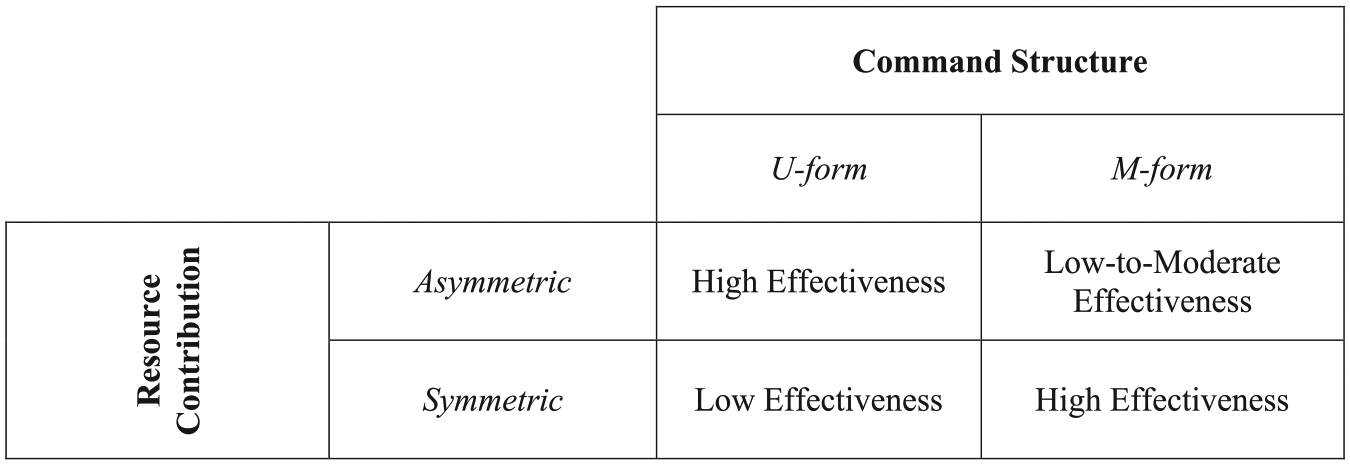
Organizing coalition effectiveness.
Testing coalition effectiveness
To test our theory, we conduct a structured focused comparison of two ad-hoc interstate multinational collectives that exhibit within-case variation: the World War I Anglo-French (Entente) coalition in the fall of 1914 and the World War II German–Italian (Axis) coalition in North Africa in 1940–1941. 12 The findings reported here are bolstered and expanded upon in Appendices I and II in the supplementary material, where we present primary source evidence underpinning our analysis of the Entente coalition and an additional case study of German and Austro-Hungarian coalition performance during the Gorlice–Tarnow offensive on the Eastern Front during World War I.
These cases, beyond offering substantively important tests of our theory, allow us to speak to broader questions of inference and our claim’s general causal validity. First, they permit isolation and examination of the impact of multiple combinations of command structure and resource symmetry on coalition effectiveness. While consistently employing a M-form structure, the British and French began World War I as highly asymmetric contributors to their coalition and, over time, grew more symmetric. The Axis was consistently asymmetric in co-belligerent contributions, but its command structure shifted from M-form toward U-form. These cases thus allow the examination of coalition effectiveness in three of our four ideal-type cells, as depicted in Figure 2. 13 Because each case involves change along one dimension over time, they highlight that adoption and retention of different types of command structures in various settings are discrete choices made by coalition members, not a naturally occurring phenomena. They also represent ideal circumstances for checking whether shifting abilities to promote comparative advantages of member contributions and changes in our identified mechanisms—shirking, free-riding, and internal friction—condition coalition effectiveness in the manner expected. 14 Additionally, because each case features ad hoc, non-institutionalized collectives comprising forces drawn from states that maintained their form of governance during the period examined, we can be confident than any within-case variation explained by our theory is not confounded by existing explanations of coalition effectiveness.
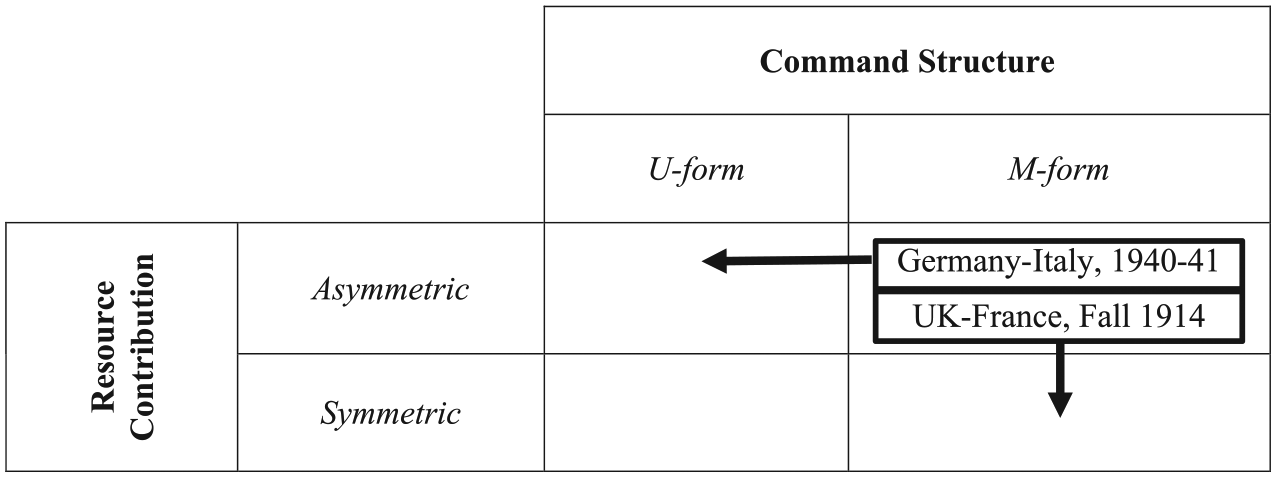
Entente and axis coalition forms.
Second, while our cases do not permit explicit examination of a symmetric, U-form coalition, findings from the Entente and Axis investigations will be suggestive. 15 If, as our theory expects, the Entente M-form coalition was most effective when the co-belligerents’ contributions were relatively symmetric, there will be indirect evidence that a more hierarchic, U-form structure would have undermined its performance. Similarly, if the Axis’ effectiveness when it employed a U-form structure arose largely because of the asymmetry in their resource contributions, there will be indirect evidence that balanced contributions of resources would have undermined its performance. Combined, these results would suggest a symmetric, U-form coalition would be ineffective.
Two final methodological points are worth noting. First, these cases facilitate concentration on the way in which relative symmetry in the number and quality of soldiers and materiel brought to the battlefield interact with different command structures. This commonality is crucial for inference, as resource asymmetries may be understood in at least two ways. The first is that considered here: one actor brings more, or higher quality, forces and weapons to the battlefield than its partner(s). A second arises from co-belligerents making different types of contributions to the battle (Morey, 2016: 538). For example, one or more partners may contribute ground forces while another provides only air support. While there is no a priori reason to believe the two types of resource asymmetry might interact with management structures in different ways, we avoid the possibility of conflating them by focusing exclusively on the former here and reserving the latter for future work. 16
Second, though it is not the focus of our article, these cases permit a provisional assessment of whether factors conditioning the selection of coalition management structure also drive coalition effectiveness. This is because there is a temporal variation in Entente and Axis coalition effectiveness. For any factor driving the selection of coalition management structure to also be driving coalition effectiveness, that variable must move in lockstep with each. Because these cases hold a range of variables constant over time—including those thought to condition military effectiveness in national forces, the relative power of the adversary, and the stakes of the combat actions—we can ascertain whether our explanation might be spurious.
Coalitions at (World) War
Of the 129 major battles fought during the world wars, 52 featured co-belligerents sharing battlespace. During World War I, 35.6% (21/59) of major battles involved at least one coalition; in World War II, 44.3% (31/70) did. Co-belligerents in the Entente during World War I and the Allies during World War II shared battlespace more often, and in greater number, than did members of the Central Powers and Axis. Combined, the Entente and Allies fought four battles with four coalition members, eight with three members, and 23 with two members. By contrast, the Central Powers and Axis together fought only two battles with three coalition members and 15 with two members. The fights investigated here are representative of the most common types of coalition battles in the world wars.
Northeastern France in World War I
Between September and November 1914, German forces sought to envelop the northern flank of the Entente forces and capture the ports of Dunkirk and Calais. Their plan was to pierce the Entente line and then turn southwest to outflank and roll up enemy forces on their way to the sea (Edmonds, 1929: 128). The Entente sought to turn the German flank. The Anglo-French experience during this “Race to the Sea”—particularly its genesis during the First Battle of the Marne (5–9 September) and conclusion during First Ypres (20 October–24 November)—highlights how command structures interact with resource distribution to condition coalition effectiveness. 17 The Entente M-form structure was moderately effective when resource contributions were asymmetric, suffering from redundant and slow communications and free-riding at the First Battle of the Marne, and more effective, ensuring members did not shirk battlefield responsibilities, when they grew more symmetric.
As noted, the existing explanations of coalition effectiveness offer little analytical leverage. The Entente, comprising two democracies, was not well-institutionalized at the outset of the war. Britain and France had a history of enmity that inhibited close relations before and after the signing of L’Entente Cordiale in 1904 (Doughty, 2005: 38; Philpott, 1993, 2013: 1178). The few efforts made to improve relations before the war could not absolve the legacy of animosity and unfamiliarity that stained British and French forces (Greenhalgh, 2014: 25; Philpott, 2013: 1165–1168; Prete, 2009: 9).
Compounding the Entente’s internal tensions was its relative parity with the German force. During the Battle of the Marne, the Entente fielded one million soldiers while Germany fielded 900,000; during First Ypres, the Entente fielded 200,000 soldiers while Germany fielded 250,000 (Gray and Argyle, 1990: 281). In neither battle did either side employ substantially superior warfighting hardware or operational approaches. Hence, by existing theoretical terms, there is little reason to think either that there would be significant variation in Entente effectiveness in the early months of the war or that the Entente would consistently perform well enough to fend off the German onslaught.
Our theory, emphasizing the interaction of the co-belligerents’ resource contributions and command structure, sheds light on variation in the Entente’s effectiveness. Turning to resources, Britain and France contributed the same type and quality of troops and materiel to the fight and were initially quantitatively asymmetric but grew more symmetric over time (Beckett, 2006: 40–45; Edmonds, 1929: 8; Greenhalgh, 2005: 18; Herrmann, 1996: 199–224; Krause, 2016: 38–41; Simkins, 2007; Spiers, 1985). The British Expeditionary Force (BEF) never intended to commit an equal number of forces to the continent as its partner and the French anticipated the British would send, at most, six infantry divisions and one cavalry division to join France’s 72 divisions (Prete, 2009: 19, 32). The Entente did move toward local symmetry in individual battles later in 1914, however. In the first battle for Ypres, the BEF committed 22 cavalry and four yeomanry regiments, 88 regular and seven territorial battalions, and 95 artillery batteries (Beckett, 2006: 226; Farrar-Hockley, 1998: ix). These forces compare favorably with the two French corps that fought in the battle (Clodfelter, 2007: 419).
While the relative balance of British and French troop contributions varied over time, with one brief exception discussed further below, the Entente consistently employed a M-form management structure. The British, seeking to maintain their autonomy, preferred a weak executive, consensus-based, M-form structure. In 1914, Secretary of State for War Lord Kitchener’s instructions to BEF Commander-in-Chief Sir John French were: “I wish you distinctly to understand that your command is an entirely independent one, and that in no case come in any sense under the orders of any Allied General” (Greenhalgh, 2005: 17). In October 1914, Secretary of State for Foreign Affairs Sir Edward Grey reiterated Kitchener’s instructions, writing to the British Ambassador in Paris that the British government “must have the right to send troops for separate operations against the Germans under whatever command seems to them most desirable” (Greenhalgh, 2005: 21).
The French understood that a U-form structure, however operationally desirable, was politically unfeasible and battlefield cooperation had to be voluntary (Greenhalgh, 2005: 78, 83; Prete, 2009: 39). When the war began, neither Joseph Joffre, the French Commander-in-Chief, nor Ferdinand Foch, the French Ninth Army commander who most closely abutted British forces, could direct non-French Entente units. They could do no more than forward copies of orders issued to their own troops to their British counterparts and make suggestions for cooperation (Edmonds, 1929: 127).
Battle of the Marne
Given the Entente’s change in resource symmetry and constancy in M-form management during the fall of 1914, our theory expects the coalition to be less effective at the Battle of the Marne and more effective during First Ypres. Turning to the Battle of the Marne, where 51 French divisions fought alongside five of the British divisions, the M-form structure stymied the coalitions’ ability to develop sensible battle plans to reverse German advances and incentivized British free-riding, forcing the French to invest considerable time and resources into preventing shirking (Clodfelter, 2007: 419; Perris, 1920: 104).
Joffre envisioned the battle as an offensive operation in which British and French troops would draw German forces into a salient between Paris and Verdun before surrounding and destroying them (Doughty, 2005: 86). The British, fearing high casualties, did not want to participate. Britain’s hesitancy to fight at the Marne stemmed from the coalition partners’ asymmetry. In addition to having few reserves on the continent, the British had just suffered grievous losses of soldiers and materiel at the Battle of Mons (Beckett, 2006: 53; Prete, 2009: 104). On 29 August, when Joffre asked the British commander to remain on the front line and support the French Fifth Army, Sir John French replied,
I consider it absolutely necessary to inform you that the British Army will not be in a state to take its place in the line for ten days. I am short of men and guns to replace losses. . .You will understand in these circumstances that I cannot comply with your request to fill the gap between the Fifth and Sixth Armies. (Maurice, 1942: 10)
That same day he wrote to Kitchener, explaining his decision:
I feel most strongly the absolute necessity for retaining in my hands complete independence of action and power to retire on my base circumstances render it necessary. I have been pressed very hard to remain, even in my shattered condition, in the fighting line; but I have absolutely refused to do so. (Maurice, 1942: 10)
Joffre’s plan called for a combined attack in which the BEF would join the French Sixth and Fifth armies in assaulting the German right flank (Greenhalgh, 2011: 27). Sir John French preferred to continue the British retreat and reengage the Germans at some later time. To force the BEF’s hand, Joffre appealed to the British government though France’s Minister of War, Alexandre Millerand (Prete, 2009: 109). Negotiations proceeded through this circuitous route until, on 1 September, Kitchener directed the BEF commander to remain on the line as Joffre requested, but noted he should act “with caution to avoid being in any way unsupported” on his flanks (Prete, 2009: 111).
Sir John French remained tentative, forcing his ally to invest ever-more resources in coalition maintenance. On 3 September, Joffre sent another missive explaining the virtues of his plan, noting the British placement between French forces would provide greater protection to the BEF than that force might have elsewhere (Doughty, 2005: 86). Partially persuaded, on 4 September, Sir John French ordered shifts in the BEF line enabling cooperation with the French Sixth Army near the Marne (Prete, 2009: 113). In an attempt to further ensure British participation, the French military then made two parallel, but unconnected, efforts. First, Commander of the French Fifth Army, Louis Franchet d’Espèrey, worked with BEF Sub-Chief-of-Staff, Henry Wilson, to craft an agreement committing British forces and the French Sixth Army to attack in an easterly direction toward Montmirail and Chateau-Thierry while the French Fifth Army attacked northward toward Montmirail. The plan differed slightly from Joffre’s, imposing additional requirements on the Sixth Army to maintain “close and absolute cooperation” with the BEF as the latter worked to minimize casualties (Prete, 2009: 114). Simultaneously, French General Joseph Gallieni traveled to British Headquarters to secure a tentative agreement for a joint action with BEF Chief-of-Staff Sir Archibald Murray. This plan allowed the British additional time to complete their retreat from Mons before committing to an attack at the Marne, setting 6 September as the launch date for the offensive (Prete, 2009: 113). Gallieni’s concession to the British also conflicted with Joffre’s standing plans, which called for an attack on 4 September. Apprised by his subordinate that a delay was the only way to secure British cooperation, Joffre acceded and changed the date.
Despite this already considerable investment in time and energy in achieving consensus on the French plan, Joffre’s job cajoling his ally continued. Sir John French, exploiting his ally’s double-pronged attempt to secure British compliance, ordered his forces to occupy two different positions to comply with both agreements: one facing north and another east (Doughty, 2005: 90). The BEF commander then attempted to further free-ride by ordering his forces to continue retreating to occupy a position 25 km to the rear of where Joffre intended them to be (Doughty, 2005: 90–91). Joffre, believing that if he did not personally intervene the British would continue retreating past Paris, traveled to see Sir John French to convince him once again to commit to the original line (Doughty, 2005: 91). Joffre was ultimately forced to sandwich British forces between two French armies to ensure that—though the fighting position was not what he would prefer—Sir John French’s troops would not be abandoned if the battle went poorly (Prete, 2009: 114).
Prior to the battle, the Entente’s M-form structure enabled the recalcitrant British to shirk their commitment, delay, and reshape the battle plans of their much larger partner; the coalition struggled to effectively ensure consistency within military activity, create Anglo-French synergies, and forestall counterproductive British actions. Once they joined the battle, however, Britain fully committed to the combat. Sir John French relinquished considerable operational independence and voluntarily took direction from Joffre, setting British objectives and zones to conform to the larger Entente attack (Prete, 2009: 117–118). In effect, the coalition partners temporarily employed a U-form coordinative system while fighting. The end result was an effective coalition performance in combat for the Entente; the BEF and a portion of the French Fifth Army pierced the German line, crossed the Marne on 9 September, and helped push the Kaiser’s forces back to Aisne (Prete, 2009: 118). Joffre and many historians note, however, that the performance was not as strong as it could have been. The ineffectiveness prior to battle that forced the French commander to expend time and energy mitigating their smaller partner’s efforts at free-riding, cheating, and shirking delayed the launching of the offensive, allowing the Germans more time to prepare for the fight (Doughty, 2005: 90, 96; Tuchman, 1994: 521).
First Battle of Ypres
The first Battle of Ypres began six weeks later. The British and French, now more symmetric in their contributions, were better able to exploit the benefits of their reinstated M-form command structure and perform effectively. At First Ypres, both the Germans and the Entente sought to turn the flank of the other before running out of space in the Race to the Sea (Edmonds, 1929: 126–128). While neither side was able to achieve a flanking maneuver, the Entente was able to ensure consistency in the military activity and avoid free-riding and shirking, ending the mutual push toward the English Channel.
Prior to First Ypres, the balance of British and French resources shifted toward local parity. In mid-September, the British doubled their forces on the continent (Prete, 2009: 121). By the end of the battle, France engaged four army corps, two cavalry corps, and two territorial divisions, while Britain engaged three corps and equivalent cavalry (Farrar-Hockley, 1998: 40; Liddell Hart, 1963: 67; Prete, 2009: 183). To manage this increasingly symmetric coalition, the Entente retained its M-form structure. The BEF, previously sandwiched between two French armies during the Battle of the Marne, moved to the far left of the Entente line, bolstering its independence and freedom of action (Farrar-Hockley, 1998: 39–40). Far from exacerbating the kinds of tensions evidenced prior to the Battle of the Marne, the changing circumstances improved the effectiveness of the Entente’s M-form structure prior to and during the battle: Ferdinand Foch, commander of French forces in the Ypres area, reported to Joffre on 13 October that “my relations with the English Army are marked by the greatest cordiality and the most perfect mutual confidence” (Prete, 2009: 154).
Unlike prior to the Battle of the Marne, Entente planning and preparations for First Ypres were smooth. As British troops arrived in-theater, they streamed toward their designated place on the left flank. Sir John French, less concerned about casualties and tasked with defending land vital to British interests, displayed none of his prior hesitancy about committing troops to battle (Liddell Hart, 1963: 68; Prete, 2009: 155). Rather, he underscored British willingness to fight, noting, “. . .the stakes for which we [were] playing at the Battle of Ypres were nothing less than the safety, indeed the very existence, of the British Empire” (Philpott, 1989: 474).
During the battle, the British and French retained their M-form structure and fought together effectively, each force working to defeat the Germans in its own sector in furtherance of the common plan. Occasionally, the co-belligerents’ troops were intermixed. In the British sector, Sir John French’s forces worked to hold their position as the German offensive intensified but, because their portion of the front extended over 45 km and they were unable to resist everywhere, French units plugged holes in their line (Prete, 2009: 164). On 24 October, the British and French launched a combined attack toward Courtrai (Prete, 2009: 162). These efforts were decidedly non-hierarchic throughout the fight; French and Foch made decisions through consensus. The British second-in-command, Henry Wilson, emphasizes the point: “I am spending a good deal of time these days with Foch on this curious hill on the way between Ypres and St. Omer. We have got our troops so much mixed up with his that no order can be issued without the other’s approval etc. I think we are going to beat this attack with the aid the French have given us” (Greenhalgh, 2011: 68).
At First Ypres, the Entente’s M-form structure functioned effectively. Pre-battle plans were agreed upon without the pushing and pulling required to get the coalition partners on the same page at the Marne and, during the battle, local commanders worked to support each other’s efforts while Joffre continued to send reinforcements to both British and French positions (Doughty, 2005: 104). Though the battle at Ypres was costly in casualties, the effectively operating M-form structure facilitated the steadfastness of Entente in the face of the German advance and helped it secure its position in Flanders (Gray and Argyle, 1990: 281; Liddell Hart, 1963: 68).
North Africa
The fighting in the North African desert in 1940–1941 exhibits how asymmetrically endowed coalition partners function more effectively when employing a U-form rather than M-form structure. As is true in the Entente case, existing theories of coalition effectiveness cannot account for the variation observed in Axis effectiveness. The Axis coalition comprised non-democratic actors that had spent little time preparing to fight together (Gordon, 1991; Toppe, 1991). Additionally, the Axis outnumbered the Allies on the ground, though its quantitative advantage dwindled as the campaign progressed. By the time the Allies launched Operation Crusader (18 November–30 December 1941), the Axis fielded 119,000 men—65,000 Germans and 54,000 Italians—while the Allies deployed 118,000 men (Clodfelter, 2007: 474). In both artillery and armor, the Allies held a numerical advantage while the Axis fielded qualitatively superior machines (Playfair, 2009a: Appendix 8). Neither preponderance of troops nor regime-type claims cannot explain why there was variation in the Axis’s effectiveness over the course of the period considered.
The Axis co-belligerents’ resource contributions were consistently asymmetric. The most significant imbalance was not the number of forces employed—the Italians contributed more troops; the Germans contributed more tanks—but the quality of forces and weapons. The Germans consistently outclassed the Italians (Carrier, 2015: 510–518; Sweet, 1980: 151–166). Italian troops were underfed and trained in tactics emphasizing fire and frontal attack—a fighting style wholly inappropriate to desert warfare (French, 2001: 213; Knox, 2000: 113, 153; Rommel and Liddell Hart, 1953: 126–127). Their tanks were light, poorly armed, and lacked radios until 1941 (Kitchen, 2009: 17; Knox, 2000: 55–57). The Germans fielded well-provisioned troops trained in the employment of a maneuver doctrine ideal for desert fighting and equipped with formidable tanks and anti-tank weaponry (Playfair, 2009a: 28–30, Appendix 7, 2009b: 13; Toppe, 1991: 4–7).
While Axis co-belligerent resource contributions were consistently asymmetric, they employed multiple management structures. Initially, the Axis used a M-form structure, with the partners doing little to coordinate with one another at any level of operation (DiNardo, 2005: 46–48; Kitchen, 2009: 3; Rommel and Liddell Hart, 1953: 138). To the extent the German and Italian forces did work together, their efforts were ad hoc; “there was no combined planning mechanism that joined the two staffs on a permanent basis” (DiNardo, 2005: 48–49). As our theory anticipates, the Germans and Italians struggled to plan, create synergies, and exploit their comparative advantages and fought ineffectively at the outset of the campaign (Carrier, 2015: 504; Kitchen, 2009: 37–38; Playfair, 2009b: 13; Sadkovich, 1989: 39–41).
To bolster Axis capabilities and effectiveness, the Germans deployed a larger armored force to the region—Afrikakorps—and used their relative strength vis-à-vis the Italians to force the latter to accept something closer to U-form arrangements (DiNardo, 2005: 52–53). Afrikakorps and many Italian units in North Africa were operationally commanded by German Field Marshal Erwin Rommel (DiNardo, 2005: 59; Playfair, 2009b: 13; Rommel and Liddell Hart, 1953: 98). At Italian dictator Benito Mussolini’s insistence, however, the German contribution and commander were to be embedded in the larger combined Italian North African Command (INAC) system headed by an Italian—first General Rodolfo Grazini, then General Ettore Bastico (Kitchen, 2009: 43–44).
The new command arrangements were not perfectly U-form (DiNardo, 2005: 60–61). First, a number of Italian units, including the armored Ariete and motorized Trieste divisions, were placed directly under INAC rather than Rommel and commanded by Italian General Gastone Gambara (Kitchen, 2009: 151). Second, while Rommel was nominally subordinate to INAC, a clause in the Axis’ command agreement allowed him to appeal to Berlin for direction if he disagreed with operational orders (Kitchen, 2009: 50). Third, in non-operational matters, Rommel was answerable to Berlin (Kitchen, 2009: 50; Rommel and Liddell Hart, 1953: 99). This structure was mixed in terms of our theoretical model. It functioned as a relatively coherent U-form system when the co-belligerents agreed on operational and tactical matters. When they did not, the leeway afforded to Rommel and Gambara allowed the commanders to both undermine the hierarchic system and fight as though they were coordinated through a M-form structure (Playfair, 2009b: 84, 145; Rommel and Liddell Hart, 1953: 100, 111, 150). Our theory expects the asymmetric co-belligerents to work together effectively in the former case and, because the Germans were insufficiently empowered to discipline their partner, ineffectively in the latter.
With this new command structure, the Axis was better able to plan, reduce free-riding by the weaker Italian partner, and exploit comparative advantages. The increased hierarchy afforded by the quasi-U-form structure and asymmetric resources allowed Rommel to make more effective use of the Axis’ manpower preponderance vis-à-vis the British by employing units according to their comparative advantage—Italian units in static defensive roles and German units conducting flexible maneuver strikes (French, 2001: 219; Kitchen, 2009: 57). Using this approach, Rommel struck eastward in March 1941 with Afrikakorps and took El Agheila. The German commander then brought his Italian troops up to the new frontline so as to release his armored units for further offensive operations. In this stair-step fashion, the Axis continued its eastward advance and, by 4 April, took Benghazi (Kitchen, 2009: 73–76).
The organizational roots of these successes were then recognized at higher levels. The Italian Comando Supremo acknowledged the need for increasing hierarchy and, in June, gave Rommel command of Italian corps at Tobruk and Sollum (Kitchen, 2009: 146). In October, Italy’s Savona Infantry Division was also placed under Rommel’s command. This move toward U-form management was incomplete, however. Italy’s Ariete and Trieste divisions remained under the control of INAC and Gambara. Rommel, for his part, used his multiple lines of subordination to appeal to various superiors and play them off against one another (Rommel and Liddell Hart, 1953: 173–174, 181). These elements of M-form management in the coalition, vestiges of the prior, ineffective command system, remained benign while the disparate Axis commanders held a considerable manpower advantage over, and agreed on how to fight, their Allied foe. They turned malignant when Italian and German forces were barely more numerous than, and disagreed on how to confront, their adversaries in the fall of 1941.
Since the summer, the Axis had successfully besieged the Allied garrison at the port of Tobruk. Rommel deployed the Italian Brescia, Trento, Bologna, and Pavia infantry divisions for this task while reserving several armored divisions for mobile operations against incursions into the area (Carrier, 2015: 507; Rommel and Liddell Hart, 1953: 134–135). In November 1941, the Allies launched Operation Crusader to relieve Tobruk, advance to Tripolitania in the west, and set up the eventual destruction of Axis forces in North Africa. To relieve Tobruk, the Allies sent XIII Corps northwestward toward the city from their Egyptian base and XXX Corps on a similar advance from the south. The highly mobile armored battle saw the Axis and Allied forces repeatedly flank one another while attacking from multiple directions. Rommel’s initial focus was on the stronger XXX Corps, and his forces swiftly inflicted grievous casualties on the unit. XIII Corps was more successful, reaching the city. Over the next several weeks, maneuver and countermaneuver offered the Axis multiple opportunities to destroy XXX Corps, but its failure to do so eventually forced Rommel to consolidate his forces and withdraw to positions west of Tobruk. The operation was the first major Allied victory in North Africa and, as intended, set the stage for elimination of Axis forces in the theater.
The Axis’ imperfect U-form structure played an important role in diminishing the coalition’s effectiveness and facilitating the Allied victory in Crusader. When Rommel attacked XXX Corps, he needed the Ariete division to assist in a strike carried out by German elements to push British forces into the 21st Panzer division (Kitchen, 2009: 158–159). General Gambara, the ultimate commander of Ariete, refused. The link-up was not realized until Rommel diverted considerable time and energy from management of operations to appeal to Mussolini to temporarily place the division under his command. As a consequence of the organizational wrangling required under the quasi-U-form command structure, the strike, though eventually successful, was significantly delayed (Kitchen, 2009: 159).
The Axis command structure’s shortcomings were not always overcome. In December, after the Allies maneuvered into positions outside of Tobruk, an Axis counterattack at Bir el Gobi fell apart because Rommel could not control all the forces needed to surround and destroy a temporarily isolated British force. Rommel’s assault envisioned the Afrikakorps striking from the south while the Ariete and Trieste divisions, once again controlled by Gambara, attacked from the northeast. The latter failed to attack, with Gambara claiming his troops were exhausted. Consequently, Rommel’s forces were able to drive the Allied force from the position but could not inflict decisive damage on the British units. After Rommel’s organizational inability to order the Italian general into action, the phrase “Where’s Gambara?” became a darkly ironic witticism among Germans in North Africa (Rommel and Liddell Hart, 1953: 171–172).
Similar miscommunications and small failures snowballed, causing the battle to slip from Rommel’s control (Rommel and Liddell Hart, 1953: 137–138, 182). After the Axis defeat was apparent and its forces were withdrawing toward Gazala, the coalition’s management structure again undermined German and Italian effectiveness. The Italian Pavia division, although directly under Rommel, cited a Comando Supremo order to hold its position at Cyrenaica and refused to withdraw in line with other Axis forces. Rommel’s appeal to Mussolini and the subsequent reversal of the order took so long that the division was decimated before it could be extracted (Kitchen, 2009: 174).
During these two years of fighting in North Africa, the Axis’ effectiveness varied considerably. When the asymmetric Axis partners employed a M-form structure, they were ineffective. When they increased hierarchy, they increased in effectiveness. Crucially, when German and Italian operational disagreements laid bare the shortcomings of the Axis’ imperfect U-form structure, the vestigial M-form elements—specifically Rommel’s lack of control over some Italian forces—prevented the German commander from employing Axis units in ways that would create synergies and exploit comparative advantages.
Conclusions and implications
Battlefield coalitions comprise rational actors working to simultaneously achieve their desired results and minimize their individual costs. Consequently, maximizing coalition effectiveness requires both the exploitation of members’ comparative advantages and the suppression of individual members’ cost-minimizing behaviors. Coalition effectiveness, therefore, is a function of the suitability of multinational forces’ organizational arrangements. Asymmetrically endowed coalition partners will perform most effectively when using a hierarchic, U-form command structure. More symmetrically endowed co-belligerents will perform most effectively when coordinating through a M-form command structure and permitting relative autonomy for individual forces in the field. When coalitions mismatch their resource distributions and command structures, they will struggle to exploit comparative advantages; face mounting transaction costs, free-riding, and chafing among dissatisfied partners; and, very likely, fight ineffectively. The findings from the Entente and Axis cases, and the lengthier empirical discussion in the supplementary material, support our contention.
One might ask at this point whether our theory extends beyond the cases reported in this article. There are at least two reasons to think it does. First, though our cases do not explicitly consider the experience of symmetrically endowed U-form coalitions, they do indirectly shed light on the effectiveness of such arrangements. The British and French were effective at Ypres because they employed a loose, collaborative M-form structure; evidence from the Battle of the Marne suggests the British would have bristled—and potentially revolted—had the French attempted to enforce a more hierarchic arrangement, endangering the Entente position. The Axis was effective during the North African campaign when it employed a more hierarchic structure that maximized its ability to exploit the comparative advantages of the asymmetrically endowed co-belligerents. Italian resistance to German leadership would have undoubtedly been greater, and complicated operations far earlier than it did, had the coalition adopted a structure affording each partner more equal footing.
Second, many contemporary conflicts feature coalitions whose effectiveness is impervious to explanation by the existing theories of effectiveness. Since 1990, 73.5% (36/49) of the major battles fought have involved a coalition fighting on at least one side; 24.5% (12/49) featured coalitions fighting other coalitions. The majority of those coalitions are ad hoc; only 31.3% (15/48) involved co-belligerents with preexisting defense obligations. Only 18.8% (9/48) of the coalitions were comprised solely of forces drawn from democracies. There were few symmetrically endowed coalitions after 1990: 60.4% (29/48) were comprised of both state and nonstate actors while the United States was a member of all 12 coalitions that were comprised solely of states (6 coalitions were comprised solely of non-state actors). Yet there is considerable variation in performance. Recalling that combat outcomes are an imperfect measure of coalition effectiveness, it is nevertheless telling that 60.4% (29/48) of coalitions fighting since 1990 have won their battles. Something other than institutionalization and regime type has been driving coalition performance. These patterns of variation suggest that further investigation into the command structures adopted by coalitions fighting battles during contemporary wars is likely to be revealing.
Our argument has important implications for scholars and policymakers. Scholars of coalition formation, duration, and disintegration would do well to consider the implications and consequences of negotiations and conflicts over the distribution of power and authority within multinational forces. Kreps (2011), Wolford (2015), and Henke (2019) have begun to work along these lines, but their investigations do not probe as deeply into organizational dynamics as our argument and findings indicate is necessary. Similarly, scholars of coalitions’ signaling capacities could uncover important new dynamics by assessing the extent to which adversaries and potential co-belligerents consider (to their benefit or detriment) the command arrangements of multinational forces when assessing balances of strength and resolve or the relative merits of joining an ongoing conflict. Coalitions, and the militaries comprising them, are not black boxes, and theorizing belligerent behavior as though they were likely masks important dynamics and variation in outcomes. Finally, scholars seeking to explain variation in the human and financial costs of war are likely to improve their understanding if they incorporate the role organizational arrangements play in facilitating the effective, efficient, and intentional use of force by coalitions in war. 18
Though contemporary policymakers confront a security environment distinct from that of their predecessors, our argument and findings from the world war case studies have important implications. As new threats arise in geographic areas and conflict domains that have received relatively little attention in the past, policymakers must determine with whom and how they should form coalitions as they seek to improve their security. Established, institutionalized coalitions may not always be appropriate for confronting emergent challenges and, if new arrangements must be made, thinking carefully about which partners bring to the battlefield and arranging decision-making and authority structures appropriately will be essential. Especially if coalitions must be formed with nonstate actors—an increasingly common occurrence—states would do well to bring such forces firmly into a U-form arrangement to prevent free-riding and shirking, both of which pose significant threats to the larger collective in combat. As changes in weapons, communications, and logistical technologies increase operational tempo, getting coalitions structures right from the outset is essential. If initial command structures prove inadequate for facilitating the effective use of coalition members’ comparative advantages and reducing the inherent challenges of collective action, our model provides a guide for making alterations to power and authority arrangements to smooth coalitional operations, ensure appropriate burden-sharing, and increase collectives’ chances for effective performance. In short, heeding the warnings of scholars of organizations should have profound consequences for the creation and application of military force by multinational coalitions.
Supplemental Material
Organizing_for_Performace_-_Appendices – Supplemental material for Organizing for performance: coalition effectiveness on the battlefield
Supplemental material, Organizing_for_Performace_-_Appendices for Organizing for performance: coalition effectiveness on the battlefield by Rosella Cappella Zielinski and Ryan Grauer in European Journal of International Relations
Footnotes
Acknowledgements
We would like to thank Michael Aklin, Luke Condra, Michael Poznansky, Dan Reiter, Kaija Schilde, William Spaniel, Caitlin Talmadge, Alex Weisiger, Meredith Wilf, two anonymous reviewers, and the editors for their helpful comments on earlier versions of this paper. We would also like to thank participants at the 2016 American Political Science Association Annual Meeting, the 2016 Peace Science Conference, and the 2017 International Studies Association Annual Convention, where the earliest versions of our argument were beginning to take form. The order of the authors’ names is alphabetical; they contributed equally.
Funding
The author(s) received no financial support for the research, authorship, and/or publication of this article.

Supplementary material
Supplemental material for this article is available online.
Notes
Author biographies
References
Supplementary Material
Please find the following supplemental material available below.
For Open Access articles published under a Creative Commons License, all supplemental material carries the same license as the article it is associated with.
For non-Open Access articles published, all supplemental material carries a non-exclusive license, and permission requests for re-use of supplemental material or any part of supplemental material shall be sent directly to the copyright owner as specified in the copyright notice associated with the article.
