



Abstract
International Relations scholars are certain about two facts: power is the defining concept of the discipline and there is no consensus about what that concept means. One explanation for this problematic state of the field is that most International Relations scholars freight their analyses of power with hidden assumptions about time. Temporality is an essential component of political analysis, as a burgeoning literature has begun to explore. This paper argues that there are two latent presumptions about time that fundamentally affect how scholars conceptualize power in world politics. First, scholars are rarely explicit in defining the temporal scope of their key causal processes. The longer the implicit temporal scope, the more expansive their definition and operationalization of power can be. Second, there is considerable variation of beliefs about the temporal returns to power: does exercising or accumulating power generate positive or negative feedback effects over time? Relying on canonical works in the field, this paper examines the hidden assumptions that different paradigms make about power and time. Illuminating these assumptions clarifies the root of cross-paradigmatic disagreements about international politics and suggests some interesting pathways for future theoretical and empirical work.
Introduction
International Relations (IR) scholars do not agree about much, but they are certain about two facts: power is the defining concept of the discipline and there is no consensus about what that concept means. This dissensus over the basic underpinnings of IR is problematic for scholars interested in the cumulative construction of knowledge. Lake (2011: 472–473), one of the biggest proponents of abandoning grand theorizing, argues that, “To enhance understanding, we need to be able to communicate across theoretical traditions, compare assumptions, and interpret findings. . . . we need a lexicon that allows translation across theories.” If there is no inter-paradigmatic agreement about the concept of power—one of the conceptual building blocks of the discipline—Lake’s notion of progress is a chimera.
The centrality of power to the study of IR is uncontested. Is it possible, however, for scholars operating in different paradigms to agree on what they are talking about? This paper attempts to reconceptualize the role that power plays in IR theory. I argue that the underlying source of disputed concepts of power is that most scholars freight their analysis with hidden assumptions about time. Drawing from a burgeoning literature on time and world politics, I argue that there are two key assumptions about time that fundamentally affect how scholars think about power. First, scholars are rarely explicit in defining the temporal scope of key causal processes in their area of inquiry. The longer the time required for significant causal processes to play out, the more capacious the definition and operationalization of power must be. Second, there is considerable variation of beliefs about the temporal returns to power. Does the exercise or accumulation of power in the present generate positive or negative feedback effects over time?
There are multiple conceptual and theoretical rewards from this exercise. Illuminating these assumptions makes it easier to understand a key source of inter-paradigmatic disputes about power. As with other recent conceptual research on power (Reed, 2013), however, this is not merely a typological exercise. This paper also demonstrates the ways in which implicit temporal assumptions form an important part of each paradigm’s internal logic. Clarifying the core assumptions, or negative heuristic, of each model allows for more progress in theory building (Lakatos, 1971), enables more inter-paradigmatic debate, and suggests key empirical questions for future research.
This paper is divided into five sections. The section “Power and IR theory” briefly discusses the state of the power literature and why a conceptual rethink is needed. The section “A temporal perspective on power” considers the ways in which an explicitly temporal perspective affects how one should think about power. The section “Time, power, and IR theory” applies this perspective to the major IR paradigms, utilizing the canonical texts in each school of thought to reveal their assumptions about power and time. The final section summarizes and concludes.
Power and IR theory
The centrality of power to the study of politics is beyond dispute. In Power and Society, Laswell and Kaplan (1950: 75) state: “The concept of power is perhaps the most fundamental in the whole of political science; the political process is the shaping, distribution, and exercise of power.” Classical texts ranging from Thucydides’ History of the Peloponnesian War to Kautilya’s Arthashastra to Ibn Khaldûn’s Muqaddimah focus even more on the centrality of power. Morgenthau (1948: 31) wrote in Politics Among Nations that, “International politics, like all politics, is a struggle for power. Whatever the ultimate aims of international politics, power is always the immediate aim.” Leading introductory textbooks on IR start with a discussion about power (Goldstein and Pevehouse, 2016; Nau, 2017). Guzzini (2017: 739) notes, “Power seems to be an explanatory concept nobody in IR can do without.” Even IR scholars who have questioned the assumption of anarchy (Mattern and Zarakol, 2016: 625) nonetheless agree that the international system is “deeply implicated with power.”
Power may be the central concept of the discipline, but scholars cannot agree on how to define or measure it. The most widely cited definition in political science is Dahl’s (1957: 202–203) “A has power over B to the extent that he can get B to do something that B would otherwise not do.” Most scholars, however, cite Dahl’s definition only to critique it. Almost immediately after Dahl offered his concept of power, scholars and theorists layered on additional dimensions to the term. Depending on whom one reads, there are three or four different faces of power (Digeser, 1992; Lukes, 2005). Gilpin (1981: 13) writes, “The concept of power is one of the most troublesome in the field of international relations and, more generally, political science.” Guzzini (2000: 53) concurs stating, “Power is ubiquitous. . . at the same time, power is one of the most under-researched concepts in the discipline.”
A historiography of the literature highlights the difficulties of this topic. Many of the pioneering works on this subject—Morgenthau’s Politics Among Nations (at least seven editions), Dahl’s Modern Political Analysis (at least six editions), Lukes’ Power: A Radical View (two editions) —have muddied the conceptual waters. The authors of these iconic texts have either revised them multiple times or published follow-on work that altered their conceptual definitions. Joseph Nye has written about soft power (Nye, 2004), smart power (Nye, 2009), and sharp power (Nye, 2018). One recent text to survey this ground (Baldwin, 2016) devotes the bulk of its pages to relitigating Dahl’s definition.
Offering a new conceptual definition of power will not solve the problem. The adjectives that precede the noun “power” in the IR literature speak to the degree of conceptual confusion: hard power, soft power, smart power, sharp power, network power, social power, ideational power, discursive power, productive power, protean power, symbolic power, structural power, relational power—the list is endless. To infer that power suffers from some conceptual fuzziness seems like an understatement. Some scholars go even further, arguing that a single definition of the term is impossible. The most widely cited IR article on the topic in this century (Barnett and Duvall, 2005: 41) asserts that, “power works in various forms and has various expressions that cannot be captured by a single formulation.” There are serious scholarly debates about whether it will ever be possible to create a common conception (Guzzini, 2005, 2009; Pansardi, 2012). This problem has been compounded by the enormous gap between theoretical debates about power and efforts to operationalize the concept. Guzzini (2005: 502) correctly diagnoses the power literature when he warns, “faced with the difficulty of pinning down a concept, scholars decide to go for its more easily operationalizable aspects but they thereby incur the risk of neglecting its more significant aspects.”
Having a central concept so poorly defined is a problematic state of affairs for the discipline. It contributes to intellectual monocultures (McNamara, 2009) and partially explains the current consensus (Dunne et al., 2013: 406) that there has been “less and less inter-theoretic debates across paradigms (or isms).” Conceptual confusion is problematic for practitioners as well as scholars (Strange, 1987: 551–552). In theory, if actors share the same assessments of relative power, the likelihood of violent conflict would be dramatically reduced (Fearon, 1995; Guzzini, 2009). In a world where the very term lacks consensus, disagreements about perceived power can spill over into real-world disputes.
For example, even with incommensurate definitions, the USA was commonly perceived to be the most powerful actor in the world a generation ago. In the decade since the Great Recession, however, there have been an extraordinary series of debates about the precise distribution of power. Scholars and commentators have fiercely debated the relative power of the USA and China (Allan et al., 2018; Khong, 2019; Kitchen and Cox, 2019; Quinn and Kitchen, 2019). Some argue that the 2008 financial crisis did not dislodge the USA as the most powerful actor in the world (Beckley, 2018; Brooks and Wohlforth, 2015/2016; Drezner, 2014); others argue that it is now China (Kirshner, 2014; Layne, 2018). Some argue that the nature of power itself has diffused so rapidly that no actor or concert of actors can credibly wield authority anymore (Naím, 2013; Schweller, 2014). The COVID-19 pandemic has amplified these debates anew (Cooley and Nexon, 2020). Quantitative efforts to operationalize power have not provided much clarity (Rauch, 2017). If scholars cannot agree on the distribution of power, neither policymakers nor publics are likely to share a consensus view.
A temporal perspective on power
One way out of this conceptual tangle is to think seriously about how IR theorists perceive the relationship between power and time. Temporality is an essential component of political analysis, but rarely discussed explicitly in 20th century IR scholarship. 1 Most mainstream IR scholarship, when it explicitly discusses time at all, focuses far more on how time affects interest rather than power. Axelrod (1984) suggests that temporal preferences for a long shadow of the future will foster greater cooperation in mixed-motive games. Fearon (1998) suggests that the shadow of the future can increase the intensity of bargaining in the present.
A burgeoning literature has emerged on time’s role in IR theory (Hom, 2018; Hom and Steele, 2010; Hutchings, 2007, 2008; Krebs and Rapport, 2012; McIntosh, 2015). McIntosh (2015: 466) cogently observes that a hidden source of fragmentation within IR theory is implicit assumptions that different paradigms make about time:
“Each set of approaches in IR – be they statistical, critical, rational, or otherwise – resolve issues of time and temporality largely for themselves rather than treating it as a separate issue that affects IR scholarship as a whole. . . . All scholars, regardless of method or question, inevitably address time in their work, and thus are implicitly offering a conception and approach to time.”
This “temporal turn” has addressed multiple facets of time’s role in IR. Some of this work explores variation in time horizons and whether actor perceptions and valuations of the future affect their current strategy (Edelstein, 2017; Streitch and Levy, 2007; Toft, 2006). Others focus on temporal processes of causality (Büthe, 2002; Grzymala-Busse, 2011). The bulk of this scholarship operates in a more critical vein. While these scholars all center time in their analysis, they diverge in which dimensions of temporality to deconstruct. Some scholars focus on the social construction of time in world politics (Hutchings, 2008). Others focus on the role that timing plays in dynamic processes (Hom, 2018). Still others consider how actors use temporal framing to augment their legitimacy (Lazar, 2019).
With few exceptions (Steele, 2010), however, the temporal turn has not directly addressed the relationship between time and power. This paper extends McIntosh’s argument by focusing specifically on how implicit assumptions about time affect each paradigm’s approach to power. These temporal assumptions act as constraints about how theorists explicitly think about the concept of power.
What are the key temporal assumptions that would affect a political scientist’s concept of power? The most direct assumption a theorist can make is about temporal scope. All theories privilege particular causal or constitutive processes in their negative heuristic. As Hom (2018) observes, “timing” is premised on how social agents think about these dynamic processes. Paradigms assert or deduce temporal assumptions for the actors operating in their world. What is the expected duration of time for a theory’s key processes to take effect? Does the theory stress political dynamics that take days or decades to unfold? These assumptions, in turn, have a pronounced effect on the time horizons of the actors operating within these paradigms. Social constructivism, for example, offers a theory of norm formation that can ostensibly cover centuries. 2 This affords actors operating within that paradigm the capacity to theorize on a longer-term scale. Open economy politics, on the other hand, takes as given so many aspects of the international environment that its explanatory power focuses on a much smaller time frame (Lake, 2011; Oatley, 2011). Almost by definition, middle-range theories presume smaller time apertures in their explanatory domain. 3
Temporal scope affects a theorist’s concept of power by constraining or multiplying the capabilities that actors can deploy. As Hall (1997: 594) notes, “[Analysts] must apprehend a situationally specific or historically contingent structure of coconstituted identities and interests before they can apprehend what constitutes a power resource in a given context.” Foucauldian analyses of power acknowledge that there is a distinction between “day-to-day” actions and practices and the deeper background conditions that shape preferences—which obviously take longer to form (Digeser, 1992; Solomon and Steele, 2017). When the temporal scope is limited—that is, in perceived moments of crisis—the fungibility of resources is constrained. The types of power that can be brought to bear are sharply constricted. While each pillar of power is important over the long run, the ability to quickly convert the power of ideas into the force of arms or the use of treasure is difficult at best in the short run (Baldwin, 2016). This is not to say that nonmaterial sources of power cannot be deployed in a coercive manner. In a crisis situation, however, some sources of influence are, at best, adjuncts to more proximate sources of influence. Certain components of power are simply less fungible (Art, 1996). Processes of power that are intended to reconstitute identities or worldviews are less likely to kick in when the temporal scope is limited.
The longer the temporal process, however, the less important the fungibility constraints. Forms of Foucauldian power—like the definition and acceptance of the concept of “property rights” or “prohibition regimes”—shape the distribution of hard power resources (Keeley, 1990). Soft power can be used to defuse potential crises before they ever emerge (Khong, 2019; Nye, 2011). As the fungibility of resources increases, so does the ability for preferences and identities to change. “Facts on the ground” are more plastic. Baldwin (2016: 72) states explicitly that “time is crucial with respect to determining the fungibility of resources,” in that time increases the liquidity of power. As will be discussed in the next section, Cox’s (1981) distinction between “problem-solving theory” and “critical theory” is useful to consider on this point. In the short term, when power is less fungible, scholars are better off relying on problem-solving theory. Critical theory becomes more useful if the time horizon is long enough for different sources of power to become fungible. This parallels the way to think about power. “Problem-solving power” consists of the forms of influence that can be brought to bear in a crisis. “Critical power” consists of the forms of influence that can be used to transform all that is assumed to be given during a crisis period.
The second hidden assumption included in most IR theory involves the temporal returns to exercises of power. Are the feedback effects of the accumulation or exercise of power positive or negative? It is useful to compare and contrast disciplinary perspectives on spatial and temporal returns to power. Most IR scholars share a common assumption about the spatial decay of power—the further the physical distance between a state’s borders and where an actor is attempting to exercise power, the weaker the ability to influence outcomes. Boulding (1963) dubbed this a “loss of strength gradient.” Even in an era of hyper-globalization, scholars have demonstrated that the loss-of-strength gradient exists (Mearsheimer, 2001; Porter, 2015). All significant IR paradigms implicitly or explicitly presume a negative relationship between distance and power.
IR scholars do not share a common assumption about the temporal returns to power. This reflects the state of the social sciences more generally (Reed, 2013). While much of the social sciences presume that the effects of actions today fade over time, some approaches believe the reverse to be true, that positive feedback effects magnify the impact of present actions (Jervis, 1997; Pierson, 2000). 4 With some theories, time enables the generation of a multiplier effect on the current exercise of power. Scholars who stress path dependence and historical institutionalism (Fieretos, 2011; Pierson, 2000, 2004) note that actions at time (t) constrict choice at time (t + 1). This is also at the core of the “second face of power,” in which institutions and agendas constrict the range of possible choices that any actor can make (Bachrach and Baratz, 1962a, 1962b). Other foreign policy theories, such as neoconservatism or the domino theory, presume positive feedback effects to the present exercise of power (Jervis, 1997: 146–174).
There is considerable debate about how widespread path-dependent phenomena are in politics. Some scholars (Pierson, 2000, 2004) believe that increasing returns dynamics are actually more prevalent in politics than in markets. Most scholars who believe in increasing returns to power focus on norms and institutions as the causal pathway. Because institutions are sticky, the increasing returns to institutionalization and “lock in” are manifestly clear. Other IR theorists (Gilpin, 1981; Wohlforth, 1999) argue that a unipolar world—a natural outcome of increasing returns dynamics in world politics—is the most stable systemic outcome. If these dynamics are present, path dependence and increasing returns generate powerful feedback effects on the exercise of power. Indeed, if path-dependent properties exist, the influence of power increases over time. There is temporal strengthening rather than temporal decay. As Pierson (2000: 259) suggests, “positive feedback over time simultaneously increases power asymmetries and renders power relations less visible.”
Other scholars believe path-dependent phenomena are less pervasive or less common than is commonly perceived (Leibowitz and Margolis, 1995: 2006). If one thinks about power beyond institutions, it is not obvious that a path-dependent logic will apply. Classical scholars from Ibn Khaldûn to Edward Gibbon have argued that power decays over time. Modern scholars of world politics have identified a variety of mechanisms that would cause a reaction to any agglomeration of power. Whether it is the security dilemma (Herz, 1950), balance-of-power behavior (Waltz, 1979), imperial overstretch (Kennedy, 1987), or weapons of the weak (Scott, 1990), there are phenomena in which the exercise or amassing of power generates negative feedback as well (Jervis, 1997: 131–145). This is why many scholars argue, contra hegemonic stability theory, that unipolar orders are actually quite fragile (Mearsheimer, 2001; Schweller and Pu, 2011).
Time, power, and IR theory
Mapping the two implicit assumptions that IR theorists make about power and time leads to a simple typological schema to categorize different IR paradigms (see Figure 1). This section reviews each of the major schools of thought to demonstrate how their temporal assumptions affect their thinking about power. It does so by looking at the canonical works of each of the major theories to divine their assumptions about time and power. 5 The results suggest that the variation of time horizons and beliefs about power’s feedback effects is at the root of paradigmatic debates about international politics.
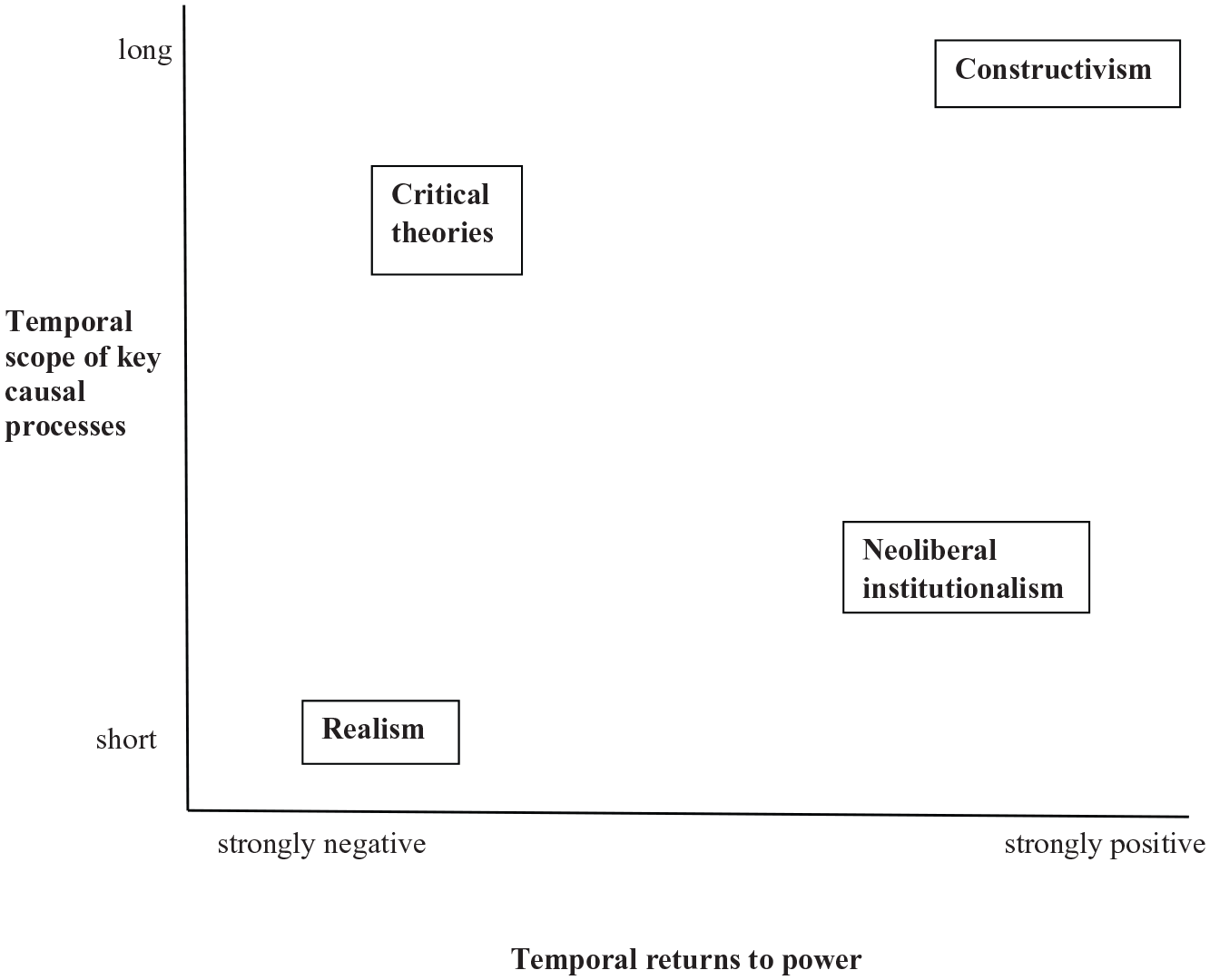
A temporal typology of International Relations paradigms.
To be clear, I am not saying that all scholars operating within the same paradigm make identical assumptions about power and time. Precisely because many temporal assumptions are implicit, it is difficult at times to locate them in the literature. As will be discussed in the concluding section, some scholars have more sophisticated takes on the temporal qualities of power. To use Lakatos’ (1971) formulation, my concern is with whether the assumptions delineated below fit within each paradigm’s “negative heuristic.” By focusing on the canonical works within each paradigm, such as Waltz (1979), Keohane (1984), or Wendt (1999), I can avoid debates about which text is realist or which scholar is constructivist.
Realism
Realists focus on causal processes with limited temporal scope. This is necessitated by the realist emphasis on anarchy as a structural constraint, which necessitates short time horizons for most actors. As an ontological given, realists share a Hobbesian definition of anarchy as a state of nature in which life is nasty, brutish, and short. The absence of a legitimate global authority means that the threat or use of force is a constant presence in world politics. States, even great powers, can be wiped out because there is no authority structure to prevent it. For realists, anarchy focuses the mind of actors on survival first and foremost. Waltz (1979: 126) states, “only if survival is assured can states safely seek such other goals as tranquility, profit, and power.” Gilpin (1984: 290–291) explains, “What the realist seeks to stress is that all. . . noble goals will be lost unless one makes provision for one’s security in the power struggle among social groups.” Mearsheimer (2002: 31) concludes, “survival is the primary goal of great powers. . . . Survival dominates other motives because, once a state is conquered, it is unlikely to be in a position to pursue other aims.” Critical interpretations of the paradigm observe that the “temporal horizon of neorealism” is limited by the possibility of catastrophic great power war (Lundborg, 2019: 244).
For realists, anarchy necessitates focusing on the short term. There can be no planning for the far future if one’s ability to survive in the near future is in question. The structure of anarchy necessitates a crisis mindset, which mandates short-term thinking for actors operating within the realist paradigm. Indeed, even realists who research the global political economy argue that the possibility of not surviving constrains any kind of international economic cooperation. For example, Grieco’s (1990: 28–29) book on the Tokyo round of GATT trade negotiations begins by explaining:
“states in anarchy must fear for their survival and their independence. According to realists, states must worry at the extreme that today’s friend may be tomorrow’s enemy in war, and this states fear that achievements of joint gains that advantage a friend in the present might produce a more dangerous potential foe in the future.”
For most realists, the causal processes that matter the most are fast acting and kinetic because state survival is never a given. This is why the threat or use of force is paramount in this paradigm (Waltz, 1979: 113). Even realists that argue fears of war are likely exaggerated nonetheless acknowledge that heightened fears of war are potent enough to independently affect actor behavior (Krasner, 1978: 15–16). Van Evera (1999: 6) explains, “the structure of power per se is benign and causes rather few wars, but the structure of power as perceived is often malignant and explains a good deal of war.”
Another sign of the paradigm’s narrow temporal scope is revealed in assessments of the fungibility of power. Some realists have argued that military power plays a role beyond the security realm (Art, 1996; Waltz, 1979); others emphasize the economic foundations of military power (Gilpin, 1981; Kennedy, 1987) Most realists, however, presume limited fungibility and the preeminence of military power in their empirical work. Mearsheimer (2001: 57) explicitly states that, “wealth cannot be used as a substitute measure for military might.” Press (2005: 24) argues that the significance of credibility and reputation has been overstated in IR theory, because “decisionmakers are not interested in abstract measures of national power.” He concludes that what matters is an adversary’s capacity to execute its threats, which in turn rests on “the specific instruments of military and economic power that will determine whether the threats can be carried out successfully, and at what cost.”
Limited fungibility is the assumption in empirical realist research. In discussing the causes of war, Van Evera (1999: 8–9) emphasizes the “fine-grained structure of power.” This kind of operationalization allows Van Evera to parse whether certain forms of military power are offensive or defensive in nature, or whether there are first-strike advantages. Similarly, Brooks and Wohlforth (2015/2016: 18) argue that “analysts of international politics can treat military capability just as economists treat supply in some of their models: as a relatively inflexible external constraint in the short term, and even in the medium and long term in some sectors.” The short time horizon of realist theory necessitates an extremely narrow definition of useful power in statecraft, in which most power resources have limited fungibility. Lobell (2018: 594) states explicitly, “aggregate power is hardly ever fungible across issue areas.” Realists, therefore, tend to emphasize military forms of power to the exclusion of other types.
Realists also share a belief in the temporal decay of power. This is true even though realist scholars ranging from Morgenthau (1948) to Mearsheimer (2001) posit that states are incentivized to be power maximizers. Even scholars who stress the maximization of security concur that the accumulation of power capabilities gives governments greater latitude of choice (Waltz, 1979: 194–195). At the same time, realists describe an array of causal mechanisms that generate negative feedback effects as an actor attempts to acquire more power. Gilpin (1981: 156–185), for example, describes the negative returns to exercising power that weaken a hegemon: the diffusion of technological innovations from the lead economy to the rest of the world, the growth advantages that come from free riding off of hegemonic protection, and the waning appetite for investments in protection. All of these factors conspire to mean that “in time the costs of protection of the status quo rise faster than the economic benefits of the status quo” (Gilpin, 1981: 169).
Realists posit that the security dilemma generates powerful negative feedbacks to any actor that accumulates more power. Herz (1950: 157) first articulated the security dilemma as a negative effect on actors acquiring more power and influence:
“[States] are driven to acquire more and more power in order to escape the impact of the power of others. This, in turn, renders the others more insecure and compels them to prepare for the worst. Since none can ever feel entirely secure in such a world of competing units, power competition ensues, and the vicious circle of security and power accumulation is on.”
The most important negative feedback mechanism for realists, however, comes through the balance of power. Waltz (1979: 116–127) stresses balance-of-power politics as the one international political theory, arguing that the desire to survive will lead states to choose balancing over bandwagoning almost every time. Mearsheimer (2001: 45) echoes this formulation. Walt (1987: 18) states, “the belief that states form alliances in order to prevent stronger powers from dominating them lies at the heart of traditional balance of power theory.” Schweller and Pu (2011: 45–46) argue that balancing behavior is a system-maintaining function in a multipolar world. 6
The tragedy, according to realists, is that the pursuit of power is both necessary and self-defeating. Power cannot be denied through abnegation in the international realm, an idea that Herz (1951: 173) declares is “bound to fail.” Nonetheless, the pursuit of greater capabilities causes other actors to react with strategies that trigger escalating costs to the accumulation of power. As Waltz (1990: 743) concludes:
“Recurrently in modern history one great power or another has looked as though it might become dangerously strong. Each time, an opposing coalition formed, if belatedly, and turned the expansive state back. The lesson would seem to be clear: in international politics, success leads to failure. The excessive accumulation of power by one state or coalition of states elicits the opposition of others (my italics).”
The sum effect of realism’s temporal assumptions is that the accumulation of power is an absolute imperative that nonetheless creates both powerful and immediate negative feedback effects.
Neoliberal institutionalism
The neoliberal institutionalist paradigm’s assumptions about time differ from those of realism. Liberal institutionalists argue that the structure of anarchy does not constrain states to the limited temporal processes that realists stress. Much as the Lockean take on the state of nature was more sanguine than the Hobbesian one, modern liberal scholars (Nye, 1990: 159) presume that “survival is not the most pressing issue,” and therefore, actors will value the future as well as the present. Keohane (1984: 75–82) explicitly notes that in international politics, “for cooperation to take place, of course, future rewards must be valued” and that in world politics, “states rarely disappear.” Similarly, Oye (1986: 12) stresses the importance of the shadow of the future: “The distinction between cases in which similar transactions among parties are unlikely to be repeated and cases in which the expectation of future interaction can influence decisions in the present is fundamental to the emergence of cooperation among egotists.” Liberals assume that under expectations of repeated interactions, cooperation can emerge under anarchy. 7
At the same time, however, this paradigm does not presume a time horizon as long as more critical approaches. The reliance on game theory to model international interactions is one indicator (Snidal, 1985). Iterated games permit the prospect of a longer time horizon, but they also impose powerful limiting constraints on the structure of any model. They are, to use Jackson and Nexon’s (1999) terminology, “substantialist” models in which ontologically given actors cannot change. It is difficult for these models to introduce new actors, and it is next to impossible to introduce new strategic options. With so much of these models remaining fixed and frozen, their temporal scope for causal processes is limited.
A modest time horizon is also assumed in Keohane and Nye’s (1978) interdependence theory. A key aspect of their description of complex interdependence is that the fungibility of power is restricted; power resources are limited to specific issue areas. They not only explicitly acknowledge that military power dominates economic power in the security realm, but also note that military power is of limited utility at best in arenas outside the security sphere. In a follow-up assessment, Keohane and Nye (1987: 730) write: “The key point was not that interdependence made power obsolete – far from it – but that patterns of interdependence and patterns of potential power resources in a given issue area are closely related.” 8 Similarly, Keohane (1984: 178–179) points out that domestic interests force governments to adopt a more short-term view about foreign policy. Liberals do posit a wider temporal scope than realists, but at the same time assume a time horizon that is short enough for power resources to lack fungibility. In accordance with those temporal assumptions, institutionalist theories tend to focus on forms of power that presume actor preferences are fixed and frozen. Material incentives and sanctions, whether through economic or military statecraft, are the principal tools of power in this family of theories (Martin, 1992). This is one reason why, during the formulation of the neoliberal institutionalist paradigm, critical scholars viewed it as simply a variation of realism (Ashley, 1984).
Where the neoliberal institutionalist paradigm deviates strongly from realism is in its assumptions about the temporal returns to power. Realists hypothesize that the accumulation of power almost always generates negative feedback effects. Neoliberal institutionalists clearly believe that power, properly institutionalized, can yield increasing returns over time (Keohane, 1984: 24). Ikenberry (2011: 105) expresses the institutionalist assumption about how power can yield long-run returns in his stylized explanation of the liberal international order’s origins:
“When a state is sufficiently powerful to shape the organization of international relations, rules and institutions can serve quite useful purposes, becoming tools for managing international hierarchy. In the broadest sense, rules and institutions provide the leading state with instruments of political control. They are useful in shaping and entrenching a favorable international environment.”
For liberals, institutions are the mechanism through which actors can amass more power without triggering negative feedback. Because institutions are difficult to create in the international system, their mere existence helps to serve as a focal point for key actors (Ikenberry, 2000; Keohane, 1984; Martin, 1992). They also function as an arena of contestation, but any bargaining is taking place under rules designed by the great powers to preserve their preferences (Goldstein, 1993). International institutions function like Bachrach and Baratz’s (1962a, 1962b) second face of power; once created, they devalue and delimit other possible outcomes.
Institutions generate path-dependent limits on the range of possible outcomes in the future; as Barnett and Duvall (2005: 52) phrase it, “Long-standing institutions represent frozen configurations of privilege and bias that continue to shape the future choices of actors.” This characterization sounds normatively distinct but positively identical to Riker’s (1980: 445) rational-choice description of institutions as “congealed tastes.” Similarly, Lake (2013: 575) argues that international institutions condition how bargaining takes place in world politics, structuring the possible range of outcomes. If less-powerful actors accept the bargain and participate in shared decision-making, it confers even greater legitimacy on these institutions. This, in turn, makes the exercise of hegemonic power easier. Deudney and Ikenberry (1999: 186) note that this legitimacy is enhanced if international institutions engage with a wide variety of actors: “This in turn reduces the tendency for subordinate powers to resist and, correspondingly, diminishes the need for the hegemon to exercise coercion.” For liberals, the ability of institutions to activate the second and third faces of power makes them a force multiplier. 9
Contrary to the standard realist critique, liberal scholars are quite aware of the role that power plays in the creation of institutions. Keohane (1984: 71–72) notes the significance of both relative power and path dependence in explaining the long-run effect of international regimes: “Regimes can be more or less “imposed”; that is, decisions to join them can be more or less constrained by powerful actors. . . the importance of prior constraints, and of the inequalities of power that lie behind them, reminds us that the results of voluntary bargaining will not necessarily be entirely benign.” Similarly, Ikenberry (2011: 98) argues: “the more the leading state is capable of dominating and abandoning weaker states, the more that weaker states will care about restraints on its exercise of power – and the more they are likely to make some concessions to obtain the restraint and commitment. 10 ”
Where realists and liberals disagree is on the returns to institutionalized power over time. As previously noted, realists believe in negative or decreasing returns and regard institutions as epiphenomenal to state power (Mearsheimer, 1994/1995). Liberals believe that the successful creation of international institutions generates increasing returns for the creators. The processes that liberals stress—focal points, transaction costs, legitimation, credible commitment—are all predicated on the preservation of institutions over time. These regimes help to lock in both policy preferences and the legal distributions of power. Furthermore, the components of liberalism create further increasing returns through mutual complementarities. It is easier for democratic regimes to credibly commit to international regimes; it is also easier for economically interdependent states to want supranational institutions to govern the externalities of cross-border trade and exchange (Ikenberry, 2011). As Deudney and Ikenberry (1999: 195) note: “The overall liberal order is a complex composite in which these elements interact and mutually reinforce each other. It is the overall pattern of these elements and their interaction that constitute the structure of the liberal political order; the whole is greater than the sum of its parts.”
Liberals who focus on complex interdependence also rely on positive feedback effects. Rogowski (1989) posits that globalization rewards those sectors who benefit the most from liberalization, empowering them at the expense of less-productive sectors. Over time, that increases the power of those groups with a vested interest in openness. Hathaway (1998) observes a similar positive feedback effect on how trade liberalization affects the policy preferences of tradable sectors. Grewal (2003: 91), in discussing the regulation of globalization, notes that coordinated policy “progressively eliminates the alternatives over which free choice among standards can effectively be exercised.” These kinds of dynamics are consistent with the logic of positive returns to power.
Another way in which liberals believe in positive temporal feedback is through the concept of “soft power.” As Nye (2004) defines it, soft power is the product of several components, including the execution of wise policies. For Nye, successful policies beget even more attractive forms of power, getting others to want what the actor wants. This is in sharp contrast to realism’s balance-of-power dynamic. Furthermore, Nye (2011: 21) argues that soft power can build on hard power capabilities. Soft power has a multiplier effect in Nye’s rubric, extending the temporal reach of hard power: “the resources often associated with hard power behavior can also produce soft power behavior depending on the context and how they are used. Command power can create resources that in turn can create soft power at a later phase—for example, institutions that will provide soft power resources in the future.” All the liberal paradigm’s explications of power assume increasing returns and a positive trajectory for the institutionalization of power relations.
Constructivism
The constructivist paradigm is explicit about the duration of its primary causal processes. In comparison to both the realist and neoliberal paradigms, it presumes a much longer scope of time under examination. This is largely because constructivists focus on social processes that require considerable amounts of time to change. As Wendt (1999) notes repeatedly in Social Theory of International Politics, concepts like culture, norms, interest, and identity possess powerful inertial properties. Constructivists simultaneously argue that change in socially constructed variables is possible, but difficult and slow-moving. 11 Guzzini (2005: 516) explains that “constructivism de-naturalizes the status quo” and therefore “the concept of power is not only put into a political context, but in a further contextualization is also placed in a wider historical one.” The transition from a Hobbesian culture of anarchy to a Lockean culture, for example, took centuries (Wendt, 1999: 279). It is, therefore, not surprising that constructivists are likely to use a longer temporal aperture when defining their scope of analysis.
To be clear, constructivist research is not limited to long time horizons, but a focus on longer-lasting phenomena makes this paradigm distinct from either realism or liberalism. Indeed, Wendt (1999: 367) is explicit about constructivism’s need for a longer time horizon in comparison to “rationalist” approaches like realism and neoliberalism: Rationalist models would be most useful when it is plausible to expect that identities and interests will not change over the course of an interaction, and constructivist models would be most useful when we have reason to think they will change. Since change is more likely the longer our time frame, this suggests a temporal division of labor: rationalism for today and tomorrow, constructivism for the longue durée.
It is commonly and casually asserted that constructivists do not prioritize power in their theories (Adler, 2013: 125; Baldwin, 2016: 144–145; Berenskoetter, 2007: 22). This is a misnomer, as power politics is shot through the content and trajectory of any social construction. Wendt (1999: 342) says explicitly, “a powerful state engaging in prosocial policies will have more impact on the identities of weak states than vice-versa.” Hurd (1999: 402) notes, “It is well known that the process of internalizing community norms is rife with considerations of power, both in determining what norms exist in the community and which norms a particular actor might latch on to.” This is consistent with subsequent constructivist work that emphasizes the power politics at work behind identity formation and norm diffusion. Goddard and Nexon (2016: 6–8) argue that “norms, rules, and other favorite topics of liberals and constructivists are not ‘alternatives’ to a power-political model of global politics. They are means, medium, subjects, and objects in the struggle for influence.” They conclude, “actors in global politics deploy norms and meanings to influence the behavior of others, and often in ways to serve power-political ends.” 12 Because the time horizon of key causal processes can last a long time, constructivists have a more capacious definition of the instruments of power. Material sources of power matter, but so do sources grounded in identity and ideas.
For constructivists, the focus on norms reveals the paradigm’s assumptions about the power of path dependence and the path dependence of power in world politics. A great deal of constructivist research has concentrated on the emergence and diffusion of norms and how those norms constitute and reconstitute actor identities (Finnemore and Sikkink, 1998; Keck and Sikkink, 1998). As Finnemore and Sikkink (1998: 894) put it, “Norm shifts are to the ideational theorist what changes in the balance of power are to the realist.” Their canonical description of how norms diffuse is premised on an increasing returns logic. In their model, a “cascade effect” occurs when a critical mass of actors embraces the adherence of a new norm, leading to a tipping point of rapid acceptance. In their final phase, actors pledge fealty to a norm even if they do not completely believe it, in order to maintain their status and identity as “responsible” actors. They conclude that norm diffusion is an example of “strategic social construction” in which actors rationally deploy norms to reconfigure preferences and identities (Finnemore and Sikkink, 1998: 888). When successful, the globalization of a norm does not generate balancing norms—indeed, the very definition of the “logic of appropriateness” is that actors do not want to be viewed as inappropriate. As March and Olsen (2006: 689) note, a powerful logic of appropriateness means that “rules are followed because they are seen as natural, rightful, expected, and legitimate.”
Over time, norms become so ingrained in actor beliefs and identities that they go unchallenged. As the third face of power kicks in (Lukes, 2005), they become legitimated. Constructivists explicitly acknowledge that these kinds of identity formation are durable and long-lasting. Wendt (1999: 255) notes that “the more deeply shared ideas are internalized – the more they ‘matter’ – the stickier the structure they constitute will be.” Hurd (1999: 388) concurs: “Legitimacy as a device of social control has long-run efficiency advantages over coercion in in reducing some kinds of enforcement costs.” More recent constructivist scholarship has problematized the idea of self-reinforcing norms and identities. Even scholars who have researched norm resistance, however, acknowledge that as they spread widely and deeply, the range of feasible opposition strategies becomes ever more constrained (Cloward, 2014; Dixon, 2017).
Constructivists are more catholic than realists in their evaluation of which actors possess the power to be successful norm entrepreneurs. As Hurd (2005: 524) suggests, “actors with little material power may have leverage in the symbolic field against those with greater material capabilities.” Nevertheless, most constructivists acknowledge that power can be an important source of norm legitimation (Hurd, 1999). Finnenmore and Sikkink (1998: 906) note, “Norms held by states widely viewed as successful and desirable models are. . . likely to become prominent and diffuse.” As with Nye’s soft power, actors that are perceived as successful are likely to have even greater success at exporting their norms and values across the world. Like neoliberal institutionalists, constructivists believe that there are positive returns to acquiring normative power.
Critical theories
Critical theory is not a singular paradigm akin to realism or liberalism, but this family of approaches relies on a similar negative heuristic when it comes to power and time. Critical theorists share the wider time horizon of social constructivists for causal processes. Indeed, Cox (1981: 129) defined critical theory in contradistinction to “problem-solving theory” which is “non-historical or ahistorical.” 13 Like social constructivists, critical theorists focus on norms and identities, which take time to be created. Critical theorists also focus on what Barnett and Duvall (2005) label “productive power”—the discourse, social processes, and organization of knowledge that, to them, produces all social meanings. Foucault (1977: 27) understands power as imbricated within the collective state of knowledge, which in turn is an exercise of power: “power and knowledge directly imply one another. . . there is no power relation without the correlative constitution of a field of knowledge.” Ashley (1984: 225) concurs, quoting Pierre Bourdieu as saying, “The theory of knowledge is a dimension of political theory because the specifically symbolic power to impose the principles of the construction of reality—in particular, social reality—is a major dimension of political power.”
Needless to say, altering these kinds of ontological givens takes time and critical theorists are keenly interested in changing them. 14 Cox (1981: 135) gets at this when he notes, “critical theory is conscious of its own relativity but through this consciousness can achieve a broader time-perspective and become less relative than problem-solving theory.” Critical theorists are distinctive among the paradigms discussed here in focusing on discursive forms of power. To be clear, it is not that critical theorists are unaware of the material sources of hegemony. Rather, they argue that focusing on discursive power reveals more embedded power structures. For them, criticism is the first and most important step of any resistance to hegemony.
Critical and constructivist scholarship share a focus on the role that ideas, norms, and identity play in constituting international politics. The difference between the two, however, is their assumption about the temporal returns to power. Most constructivists assume that norms and identities, while social constructions, are also difficult to change. Constructivists have also tended to focus empirically on the formation and diffusion of new norms that become hegemonic in nature. They believe that such norm creation is possible and, once internalized, difficult to transform or challenge (Checkel, 2001; Finnemore, 1996; Finnemore and Sikink, 1998; Risse et al., 1999; Wendt, 1999). As Hopf (1998: 180) notes, “one aspect of constructivist power is the power to reproduce, discipline, and police. When such power is realized, change in world politics is very hard indeed.”
Critical theory recognizes how power informs and structures social relations. In contrast to constructivists, however, critical therosists believe that the more powerful the norm, the likelier it will engender critical feedback. Hopf (1998: 185) explains: “Critical theory’s approach towards identity is rooted in assumptions about power. Critical theorists see power being exercised in every social exchange, and there is always a dominant actor in that exchange. Unmasking these power relations is a large part of critical theory’s substantive agenda.”
Critical theorists highlight and problematize hegemonic forms of discourse for precisely this purpose. Keeley (1990: 99) states, “What [critical] analysis does not do, especially by its attitude, is encourage particularly regime-supporting perspectives or prescriptions; if anything, its bias is in favor of resistance.” Similarly, Hutchings (2007: 72) explains: “Although critical theory takes many different forms, it always distinguishes itself from other forms of theorizing in terms of its orientation toward change and the possibility of futures that do not reproduce the patterns of hegemonic power in the present.”
Their very hegemonic status makes them ripe for resistance (Ashley, 1987; Ashley and Walker, 1990; Howarth, 2010: 317). Carstensen and Schmidt (2016: 323) explain, “Ideational structures continually evolve through agents’ unconscious use of them, but will come to be recognized consciously when critics contest them.”
Critical theorists explicitly seek to discursively problematize hegemonic normative structures—and, through that problematization, subvert those privileged power structures. This might sound implausible to more mainstream power theorists, but Ashley (1984: 259) notes that the critical foundations of an actor’s power rely on a collective acceptance of that social fact: The power of an actor, and even its status as an agent competent to act, is not in any sense attributable to the inherent qualities or possessions of a given entity. Rather, the power and status of an actor depends on and is limited by the conditions of its recognition within a community as a whole. To have power, an agent must first secure its recognition as an agent capable of having power, and, to do that, it must first demonstrate its competence in terms of the collective and coreflective structures. . . . Thus, too, the power of an actor always has its limits.
Critical theory believes that the act of criticism itself can disrupt and refashion previously accepted power structures. One could say that critical theorists engage in “ideational realpolitik”; they focus on those power structures that are viewed as hegemonic and create discursive coalitions of the willing to resist them. As Keeley (1990: 97) observes, resistance actors possess a range of stratagems to resist these structures, including “developing alternative analyses, invoking discourses against their holders, linking issues, creating or hindering the creation of alternative networks, and labelling themselves and their opponents.”
If constructivists emphasize the social construction of identity, then critical theorists emphasize the dialectic between construction and deconstruction. Cox (1981: 144) explains: “one must beware of ignoring the principle of dialectic by over-emphasizing the power and coherence of a structure, even a very dominant one. Where a structure is hegemonic, critical theory leads one to look for a counter-structure, even a latent one, by seeking out possible bases of support and elements of cohesion.” A dialectical process implies that if a thesis becomes too dominant, it triggers the creation of its own counter-thesis.
The initial heterogeneity of critical theory emanated from which part of the discourse is deemed the most hegemonic and, therefore, worthy of subversion. Feminist IR scholars, for example, focus on exposing heretofore accepted forms of gendered power (Tickner, 1992). When feminists highlight the gendered state of IR, for example, they are trying to subvert it in the process. Tickner (2005: 4) explains: “Much of feminist scholarship is both transdisciplinary and avowedly political; with the goal of bringing about change, it has explored and sought to understand the unequal gender hierarchies, as well as other hierarchies of power, which exist in all societies.” She goes on to stress that empirical feminist scholarship aims at exposing previously unobserved power hierarchies with the idea that such exposure makes them more likely to erode (Chin, 1998; Moon, 1997). As this scholarship has evolved, however, critical theorists ranging from feminists to postcolonialists (Seth, 2011) have forged a stronger consensus on the nature of hegemonic discourse. All critical theorists share a desire to challenge privileged forms of neoliberal power. The common root of critical scholarship is that questioning privileged discourse is the principal way to denaturalize legitimate forms of authority (Krebs and Jackson, 2007).
Where do we go from here?
This paper has argued that disagreements about the concept of power in world politics are partially rooted in hidden assumptions about time made by the different paradigms. Some paradigms—realism and neoliberal institutionalism—focus on causal processes that are of limited temporal scope. This narrows the kinds of power that might affect actor behavior and reduces the fungibility of existing resources. Other paradigms—constructivist and critical approaches—look at causal and constitutive processes that demand longer temporal processes. This concomitantly opens theoretical possibilities for alternative kinds of power to be exercised.
The other power question on which IR scholars diverge is whether they believe that there are positive or negative returns to power over time. Some approaches—realism and critical theory—view the accumulation of power as self-defeating. Actors that amass power inexorably trigger their own resistance. This resistance can come from balancing coalitions or the critical deconstruction of hegemonic discourse. Other approaches—neoliberal institutionalism and constructivism—implicitly assume an increasing returns trajectory to power. Hegemonic actors can enjoy increasing returns to power through legitimation. Enshrining power in institutions or norms can cause other actors to bandwagon rather than balance, leading to stable orders.
What does this typology of IR theory gain us? The most direct conclusion to draw is that all the major paradigms in IR take the dynamics of power seriously. A stylized fact of the discipline is that realism is the paradigm that privileges power as a key causal driver in its models (Baldwin, 2016); this paper concludes that stylized fact is wrong. Other paradigms clearly privilege power in their causal processes. They do so in ways, however, that diverge from the realist assumptions of limited temporal scope or negative temporal returns to power. Another conclusion to draw is that some paradigms have more in common than has been previously understood. Most mainstream IR scholarship notes how both the realist and liberal perspectives are rationalist while constructivist approaches are reflexivist. Looking at their approaches to power and time, however, one can see the common affinity between realist and critical perspectives. 15 Similarly, the liberal and constructivist approaches to global order share a common perspective on how power can generate positive returns.
Another conclusion to draw is that most IR theories make monotonic assumptions about the relationship between power and time. For most realists and critical theorists, negative feedback effects predominate; for liberals and constructivists, a logic of increasing returns dominates. Very few IR theorists explicitly consider the possibility of more contingent or more complex relationships between power and time. Future theoretical work should focus more on the conditions under which actors trigger increasing returns to power. This work could build on past scholarship that recognizes non-monotonic relationships between power and time. Within realism, the power transition school offers a more cyclical approach to temporal patterns of power. Organski (1958) and Gilpin (1981), for example, assume a parabolic relationship in which hegemons encounter positive returns to power followed by negative returns to power. More critical forms of scholarship (Hom and Steele, 2010; Solomon and Steele, 2017; Steele, 2010) also have suggested more complex temporal effects from shifts in power.
A related consideration is that hidden temporal assumptions can stack the deck in empirical work toward one’s preferred paradigm. A shorter temporal scope makes it harder to observe constructivist power processes at work, for example. A longer time horizon might cause scholars to overlook realpolitik microprocesses. Excessive attention to temporally specific causal processes can blind a researcher to the possibility that there are substitutable causal processes at work (Most and Starr, 1984). This insight also offers a cautionary warning about the turn to middle-range theories and processes. Lake (2013: 574) suggests that “good” theory tightly links the entire causal chain of action. The preference for tight causal links over constitutive, substitutable, or macrohistorical processes, however, can create blind spots for slower-moving sources of change (Abbott, 1988; Jervis, 1997). Focusing on a narrow temporal scope privileges middle-range theories like open economy politics over more ambitious paradigms (Oatley, 2011). Even Lake (2013: 575) acknowledges that if actor preferences and identities change, it “shakes the foundations of [open economy politics], threatening to topple the entire superstructure.” The temporal link between paradigmatic assumptions and methodological approaches makes it far too easy to exclude rival explanations (Abbott, 1988; Pepinsky, 2014).
Another promising area of research is to explore whether an actor’s ability to have a long time horizon is, in and of itself, a source of power. The longer it takes for the causal or constitutive process to operate, the more expansive the definition of power can be. Actors with longer shadows of the future can invest more variegated sources of power (Brooks and Wohlforth, 2015/2016). Actors with shorter shadows of the future care less about abstract distributions of power and focus on more concrete here-and-now capabilities (Krebs and Rapport, 2012). This is one reason why rising hegemons are more likely to invest in the global public goods necessary to create an international order and why fading hegemons will underinvest in those same goods (Edelstein, 2017; Gilpin, 1981). Rising hegemons can afford a longer shadow of the future; fading hegemons become consumed by crises and care less about the long-term benefits of investing in the rules of the global rules of the game.
Asking different paradigms to share common assumptions about time horizons is unrealistic. Fortunately, it is also unnecessary. This paper suggests there is a common research question on which paradigms will generate disparate predictions: the returns to power over time. Even as scholars quarrel over the precise definitions and operationalizations of power, they can recognize the divergence of their predictions about the effects of amassing power. This offers researchers the opportunity to empirically test differing predictions about the effect of power in IR. This, in and of itself, will neither resolve the conceptual definitions of power nor lead to theoretical synthesis. It might, however, promote more substantive inter-paradigmatic debates.
Footnotes
Funding
The author received no financial support for the research, authorship, and/or publication of this article.
