



Abstract
Informal groupings of states – either as stand-alone entities or as part of formal international organizations (IOs) – are playing an increasingly important role in sustaining multilateralism and global governance. But what is it about the informal nature of these groupings that makes them such a critical and increasingly popular fixture of international cooperation? To answer this question, the paper focuses on the role of informal groupings in European Union (EU) foreign policy negotiations. Within the EU, informal groupings provide a key venue for coordination, information-sharing, learning and consensus-building. As a result, these groupings are critical for the functioning of the formal decision-making process, providing necessary building blocks for the success of multilateral diplomacy. The proposed argument is explored in the case of two distinct instances of informal groupings, one extra- and one intra-EU grouping, by means of document analysis and elite interviews with national diplomats. First, the paper examines the role of the G7 contact group in the formulation of the Russian sanctions back in 2014. Second, it assesses the role of the PESCO 4 in driving the establishment of the Permanent Structured Cooperation (PESCO). In both instances, informal groupings provided important venues for coordination, as well as information-sharing, learning and consensus-building, which, in turn, enable and sustain multilateral negotiations among 27 member states. Critically engaging with the role of informal groupings in formal IOs, the paper sheds light on the dynamic relationship between informality and minilateralism, on the one hand, and formal multilateral institutions, on the other.
Keywords
Introduction
When Russia illegally annexed Crimea in February–March 2014, allies on both sides of the Atlantic were famously slow to form a united front (MacFarlane and Menon, 2014; Schult et al., 2014). Both the then European Union (EU)-28 and the Obama White House came to an impasse. In Europe, ministers of foreign affairs could not find an agreement on the best way forward, and in Washington D.C., the National Security Council debated whether the US even had stakes in the game in Ukraine. As it turns out, an informal solution provided the way out of this standstill. The American negotiators suggested that an informal contact group on sanctions be set up among members of the G7 Plus. The group would offer a confidential space for states to sound out each other’s positions and test possible compromise solutions without necessarily committing to anything. What started as an informal, low-stakes venue soon turned out to be an instrumental channel towards a consensus within the G7, which, in turn, allowed for a compromise between the EU-28 themselves.
Three years later, in the early months of 2017, EU member states were embarking upon the daunting task of activating the Permanent Structured Cooperation (PESCO) provision. Included in the 2009 Lisbon Treaty, PESCO would allow any able and willing member state to set up a defence cooperation framework to pool resources and strengthen their defence capabilities. Previous attempts to activate the provision, however, had been unsuccessful. Even in 2017, negotiations appeared complicated, not least because of strong disagreements between France and Germany, as well as concerns from Atlanticist capitals. Once again, however, an informal grouping is what ultimately led member states out of the quagmire. The group – known as the PESCO 4 and made up by France, Germany, Italy and Spain – worked out an initial proposal and then actively campaigned to bring as many other EU capitals on board as possible, forging a successful compromise. These are but two examples of the critical role that informal groupings as a consensus-building tool can play, in the EU as much as in any other international organization (IO). This paper contends that it is precisely by focusing on the informal nature of these groups that we can appreciate their added value to formal, multilateral negotiations.
Informal groupings are a fundamental part of the day-to-day work of several IOs, including the United Nations (UN; Prantl, 2005), the North Atlantic Treaty Organization (NATO; Pouliot, 2016) and, indeed, the EU (see, e.g. Aggestam and Bicchi, 2019; Delreux and Keukeleire, 2017; Gegout, 2002). More generally, global governance has progressively moved away from (solely) multilateral coordination fora and has come to embrace minilateralism (Brummer, 2014; Falkner, 2016; Kahler, 1993; Moret, 2016; Tow, 2019) and ad hoc coalitions (Reykers et al., 2023). Against this backdrop, the study of informal groupings of states, both as part of formal IOs and as stand-alone forms of cooperation, has become a key prerequisite for a comprehensive understanding of European and global governance. The existing literature readily recognizes the informal nature of these groupings, as well as their added value to the decision-making process (e.g. Delreux and Keukeleire, 2017; Pouliot, 2016; Prantl, 2005; Tow, 2019). However, not enough attention has been paid to exactly how informal groupings work and help reach consensus in formal IOs.
This paper takes the EU as a case study to expand on what it is exactly about the informal nature of these groupings that makes them particularly effective cooperation tools. Allowing for sustained interaction among actors in an insulated setting, informal groupings help speed up the negotiations, creating the ideal conditions for coordination, learning and consensus-based decision-making. I illustrate the proposed argument by examining two EU foreign policy negotiations where informal groupings played a crucial role: the 2014 negotiations on Russian sanctions, as well as the PESCO negotiations, which took place between 2016 and 2020. The Russian sanctions negotiations are an emblematic case of an extra-EU informal grouping. The contact group on sanctions made up of G7 Plus countries, first established in the wake of Russia’s annexation of Crimea, provided a critical coordination forum between some EU member states and their allies, while also serving as springboard for France, Italy, Germany and the UK to help hash out a compromise at 28 in the European Council. The PESCO negotiations, in turn, provide an equally insightful example of an intra-EU informal grouping: Four capitals – Berlin, Paris, Rome and Madrid – led the effort in the negotiations, agreed on an initial proposal for the launch of the initiative and then worked together to bring progressively more capitals on board. As I will show, it is the very informal nature of these groupings that made them such effective consensus-building tools. Naturally, consensus for consensus’ sake and swift policy action at all costs are not inherently desirable. This is particularly true if consensus is borne out of groupthink dynamics or lowest-common-denominator solutions or if the agreed-upon measure turns out to be ineffective or harmful. However, as I will argue, a shallow consensus or faulty policy is not directly tied to the presence of informal groupings. Furthermore, policy failures can be a significant learning opportunity, and informal groupings are an ideal setting for decision-makers to learn together and from one another – as the more comprehensive response to Russia’s full-scale invasion of Ukraine shows.
This paper contributes to our understanding of informal groupings not only in the context of EU foreign policy negotiations but also for the functioning of formal IOs more broadly. For one, it shows that informal groupings can play a critical role beyond crisis situations, when incentives to set up low-cost, flexible arrangements are especially high (Abbott and Faude, 2021; Hardt, 2014; Reykers et al., 2023). As the PESCO case study will illustrate, informality can also be instrumental in negotiations pushing for long-term reform, helping reduce the distance between actors’ positions. As such, the paper’s findings have implications for our assumptions of when and why informal groupings emerge. In addition, while some informal arrangements are established only for a short period of time (Reykers et al., 2023; Reykers and Rieker, 2024), it is not always the case. In some instances, they can become durable fixtures of global governance that enable and sustain policy learning, as was the case for the various contact groups set up under the G7 in response to Russia’s annexation of Crimea. Moreover, the paper nuances the notion that informal modes of cooperation necessarily imply compromising on the accountability, transparency and legitimacy of the decision-making process (Herz and Ribeiro Hoffman, 2019; White, 2022). The case studies will show not only that other member states – including smaller ones – feel that the efforts of informal groupings can be more transparent and less burdensome than those steered by supranational actors/centralized secretariats but also that they have (in)formal ways of holding these groupings accountable. In this sense, the paper calls into question the idea that informal groupings are illegitimate and even potentially divisive problem-solving mechanisms (Amadio Viceré and Sus, 2023; Gegout, 2002; Prantl, 2005: 561; White, 2022). To be sure, the recognition and acceptance of these groupings by the rest of the member states is instrumental to their success. If their efforts are perceived as self-serving or opaque, they will be quickly shut down. What is more, any preliminary consensus reached in informal groupings is often reviewed, further debated and formalized in multilateral settings (such as the EU’s Foreign Affairs Council (FAC) and/or national legislatures). Finally, by placing the International Relations (IR) and EU foreign policy literatures in conversation with one another, this paper shows that instances of informality in EU decision-making can and should be examined within the broader universe of cases of informality in global governance. From this perspective, one can see how informal arrangements are not necessarily indicative of differentiated integration or fragmentation of EU governance but merely of a functional ‘division of labour’ among states (Buzan and Albert, 2010; Delreux and Keukeleire, 2017; Zürn and Faude, 2013).
The paper starts with an overview of the literature on informal groupings in international cooperation, which will show how the informal component of these groupings makes them particularly relevant decision-making arenas. As I argue, their small, confidential and flexible nature allows for learning, coordination and consensus decision-making. Next, the proposed argument is explored empirically in the context of the Russian sanctions and PESCO negotiations. The paper then turns to a critical discussion of the findings from the two case studies, questioning whether the consensus and responsive policy action enabled by informal groupings are inherently good or desirable. The conclusions underscore the relevance and broader implications of this paper for the study of informal groupings in formal IOs.
Informality in formal IOs: what is it and why it matters for EU foreign policy
Informality – understood here as the uncodified modes of cooperation that states rely on to make up for the weaknesses (or complement the strengths) of formal institutions – is on the rise in world politics (Roger, 2020; Vabulas and Snidal, 2013, 2021). This includes informal groupings of member states operating within formal IOs, such as the UN (Prantl, 2005), NATO (Gegout, 2002; Vabulas and Snidal, 2013) and, of course, the EU (see, e.g. Aggestam and Bicchi, 2019; Amadio Viceré, 2024; Amadio Viceré and Sus, 2023; Delreux and Keukeleire, 2017; Justaert and Keukeleire, 2012). Indeed, informal groups – that is, sub-groups of member states that emerge on an ad hoc basis and that do not operate according to formal rules – have long been a reality of EU decision-making, particularly in the realm of foreign and security policy (Amadio Viceré, 2024; Hayes-Renshaw and Wallace, 2006: 147). These groupings come in many different forms and perform a variety of functions. They can represent the EU in negotiations with third parties, as was the case of the E3 + 3 format for the Iran nuclear talks (Alcaro, 2018; Helwig, 2020) or the Normandy format after Russia’s annexation of Crimea (Fix, 2021). They help with the division of labour in the decision-making and implementation phases of the EU’s Common Foreign and Security Policy/Common Security and Defence Policy (CFSP/CSDP): Member states with strong vested interests, as well as the necessary capabilities and expertise, can take the lead over a particular issue area (Aggestam and Bicchi, 2019; Delreux and Keukeleire, 2017; Delreux and Van den Brande, 2013). In addition, informal groups allow member states to reach a consensus in internal negotiations (Amadio Viceré and Sus, 2023: 6–7). They can also provide a coordination forum between EU member states and their allies, as is the case of the Quint group (Gegout, 2002).
Scholars have acknowledged that these groupings often operate informally, that they influence the decision-making process (Elgström, 2017) and, as such, contribute to the functioning of EU foreign policy (see, e.g. Alcaro and Siddi, 2021; Amadio Viceré and Sus, 2023: 14; Bassiri Tabrizi and Kienzle, 2020; Delreux and Keukeleire, 2017). However, we have yet to grasp exactly what is it about the informal nature of these groupings that is particularly relevant for multilateral negotiations at the EU level. How do member states navigate these informal arenas to build a consensus, react promptly to crisis situations, push for reform and shape the decision-making process? The IR literature on informality provides some helpful building blocks to start addressing these questions.
States are increasingly relying on informal modes of cooperation to influence the workings of formal organizations, including by establishing informal venues, which can be stand-alone or part of Formal Intergovernmental IOs, or FIGOs (see, e.g. Gegout, 2002; Pouliot, 2016; Prantl, 2005; Vabulas and Snidal, 2013, 2021). Contrary to formal institutions, informal groupings – be they within or outside a formal organization – do not have a permanent secretariat, 1 are characterized by loose membership criteria and do not rest on a legally binding international treaty, but rather on shared expectations or a tacit agreement (Koremenos et al., 2001; Roger, 2020; Vabulas and Snidal, 2013). Moreover, the light bureaucratic structure of informal groupings makes them flexible decision-making instruments that can more easily adapt to changing circumstances. They are also more agile instruments than formal IOs, whereby decisions are taken and implemented at a faster pace. In addition, they afford a level of confidentiality that formal – and generally more publicly accessible – institutions cannot guarantee (Roger, 2020). Informal groupings also tend to be more task-specific and crisis-contingent than FIGOs. In particular, ad hoc coalitions are generally created at short notice to deal with a specific crisis or policy issue and can just as easily be dissolved once they have fulfilled their function (Reykers et al., 2023; see Table 1).
Institutional and functional characteristics of informal groupings.
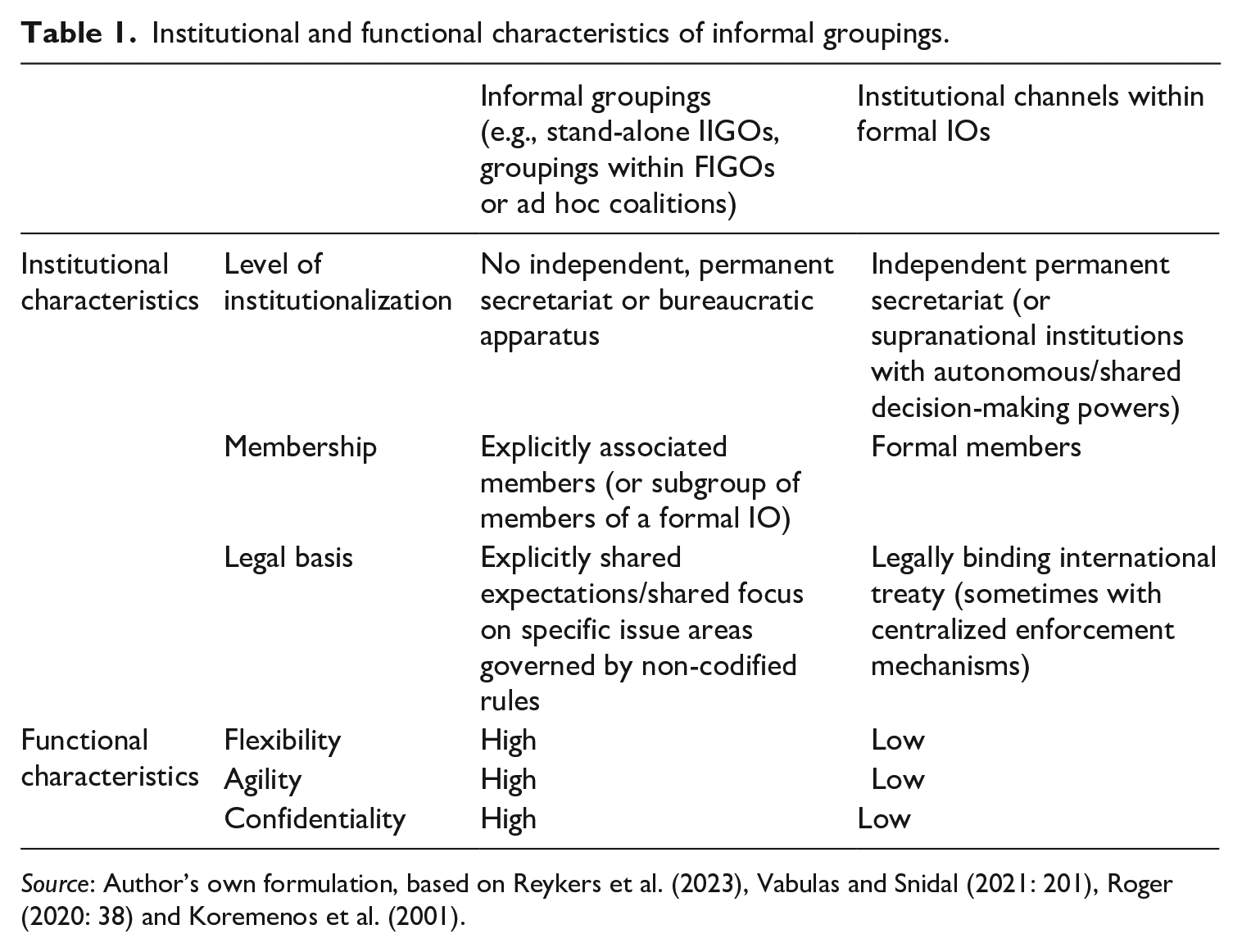
Source: Author’s own formulation, based on Reykers et al. (2023), Vabulas and Snidal (2021: 201), Roger (2020: 38) and Koremenos et al. (2001).
However helpful in identifying informal groupings, the IR scholarship primarily focuses on the reasons why states might choose to set up informal institutions – be they ad hoc coalitions, informal intergovernmental organizations (IIGOs) or other kinds of low-cost institutions (Abbott and Faude, 2021; Roger, 2020; Westerwinter et al., 2021). 2 For its part, the EU (foreign policy) literature has successfully mapped instances of informality (see, e.g. Aggestam and Bicchi, 2019; Christiansen and Neuhold, 2012, 2013; Delreux and Keukeleire, 2017), but has not specifically explored how the informal nature of these groupings allows them to play such a significant role in the decision-making process. Bridging the gap between these two bodies of scholarship, the following section disentangles the relationship between the informal, minilateral nature of these groupings and their contribution to formal, multilateral negotiations.
Emphasis on informal: how minilateralism sustains the formal, multilateral process within formal IOs
By virtue of their particular institutional and functional characteristics, informal groupings have become essential for the functioning of the formal decision-making process. In the context of EU foreign policy negotiations, their informal nature enables coordination (Allen and Wallace, 1982; Nuttall, 1992; Smith, 2004; Tonra, 2001), information-sharing (Elgström, 2017), confidentiality (Smith, 2004), consensus (Juncos and Pomorska, 2006), policy learning (Levy, 1994; Radaelli, 2022) and quick policy action (Hardt, 2014; Juncos, 2013). These dimensions, in turn, are all conducive to successful multilateral diplomacy. Let us briefly touch on each of them in turn.
Providing a confidential space where actors do not feel pressured to posture or pander to domestic audiences (Cross, 2013; Lipson, 1991; Stasavage, 2004), informal groupings allow for unconstrained information exchange and the frank sounding of each other’s positions (Elgström, 2017). This closed-door coordination of national positions has been critical for the functioning EU foreign policy since the very early days of the European Political Cooperation (Smith, 2004), not least because it promotes cooperation and consensus in decision-making (Juncos and Pomorska, 2006). Size is a particular advantage in this sense. Informal groupings tend to work efficiently because small groups of countries with homogeneous preferences are more likely to reap the benefits of informal cooperation than larger groups with diverging preferences (Eilstrup-Sangiovanni, 2009: 205–206). Facilitating intense, confidential contacts among diplomats, these groupings allow a small subset of member states to build a consensus among themselves first and then progressively to bring more and more capitals on board. In addition, even though these informal groupings emerge on an ad hoc basis, they are often sustained over time (e.g. Quint group, E3, PESCO 4, the G7 contact group on sanctions). As a result, they come to provide more or less stable ‘channels of socialisation’ (Juncos and Pomorska, 2006: 7), where member states (and, to some extent, non-EU countries too, in the case of extra-EU groupings) can learn together or from one another over time. In this context, policy learning refers to any belief change about policy as a result of sustained interaction between actors who have shared a collective foreign policy experience and/or drawn lessons from the experience of others (de Flers and Müller, 2012; Levy, 1994). Free of bureaucratic or formal constraints, the flexible format of informal groupings can also accelerate the pace of negotiations. These groupings can thus offer a practical solution to deal with time-sensitive issues, bypassing potential deadlocks in formal channels and helping formulate ‘an effective response to crisis situations’ (Prantl, 2005: 559; see also Abbott and Faude, 2021; Westerwinter et al., 2021).
In short, the informal nature of these groupings allows them to perform several critical and mutually reinforcing functions: by providing a confidential, insulated venue for information exchange, coordination and frank discussions, informal groupings make it easier for actors to come to an agreement at a rapid pace and to learn from one another (see Figure 1). As such, they play a critical role in sustaining the more formal, subsequent phases of multilateral negotiations at the EU level.
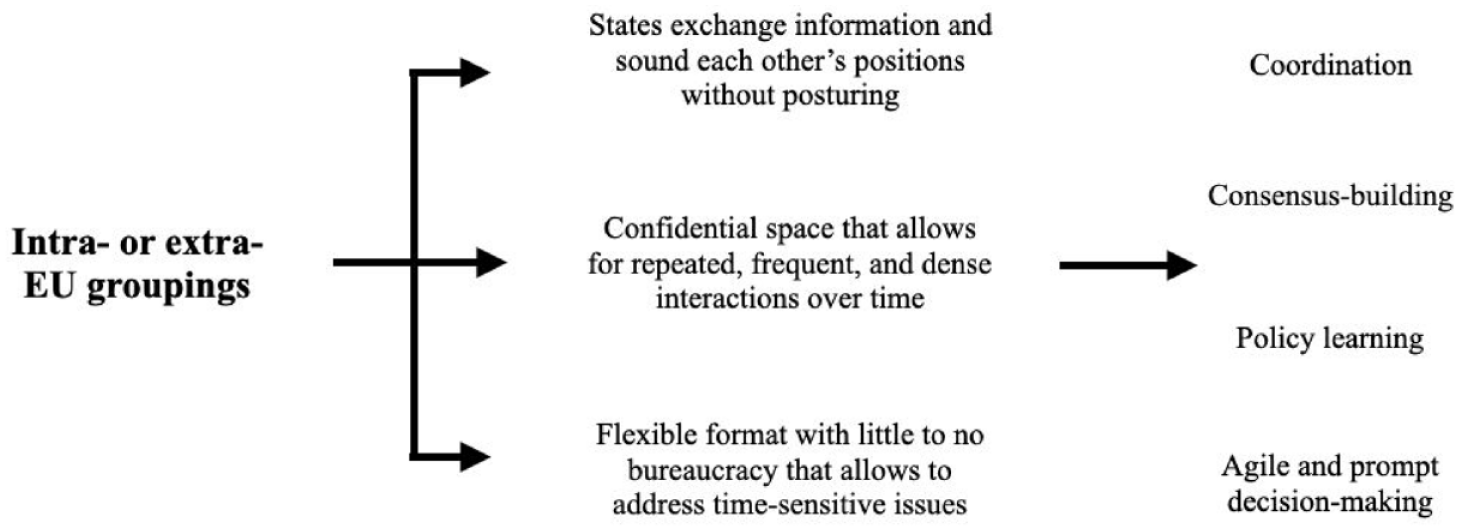
How informal groupings influence and sustain formal EU foreign policy negotiations.
Research design and methodology
The two case studies discussed in this paper – the 2014 Russian sanctions negotiations as well as the PESCO negotiations – are especially well suited for the study of informal groupings. For one, they illustrate a case of extra- and intra-EU informal grouping, respectively. The informal contact group on sanctions, created after Russia’s annexation of Crimea, provides an example of a grouping made up of EU member states as well as third countries coordinating in a different IO (the G7). The PESCO negotiations, in turn, concern a subgrouping including exclusively EU countries. As such, the paper shows how multilateral negotiations within a formal IO can be supported both by external, stand-alone IIGOs with overlapping membership (such as the G7) and groupings made up exclusively of IO members (the PESCO 4), shedding light on the significance of informal governance within and outside formal IOs (cf. Westerwinter et al., 2021: 3). In addition, the two cases help explore the role of informality not only in crisis response and management (Russian sanctions), when a rapid reaction is needed, but also in more incremental policy reform (PESCO negotiations). Furthermore, in both cases, the informal groupings outlasted the specific negotiation they were created to address, allowing us to explore over-time dynamics such as policy learning (especially evident in the case of the Russian sanctions negotiations). Finally, the two negotiations deal with two distinct and highly salient cleavage issues in EU foreign policy: European strategic autonomy versus the primacy of NATO, in the case of PESCO, and the EU’s approach towards Russia, in the case of the sanctions negotiations. As a result, the two cases were most salient to a different set of member states, ensuring variation in the composition of the informal groups under examination.
By their very nature, informal groupings are intended to remain confidential and leave as thin a paper trail as possible, which comes with specific methodological challenges, as one sets out to find evidence that is not supposed to exist (Christiansen and Neuhold, 2012: 2). Therefore, confidential semi-structured interviews with diplomats from national Ministries of Foreign Affairs and Defence, officials based in Brussels (either in national Permanent Representations or the European External Action Service (EEAS)) as well as close advisors to EU leaders (presidents and prime ministers), provided an invaluable source of information. These were actors with firsthand knowledge of the negotiations, diplomats and officials who were in the proverbial ‘room where it happens’, or had in-depth knowledge of the negotiations. I also strove to ensure geographical variation across the EU and to include the perspective of capital-based officials as well as diplomats posted in Brussels. Interviews were conducted between 2020 and 2022 and were held online due to travel restrictions during the Covid-19 pandemic. 3 The identity of the participants was kept anonymous upon request. These interviews were then triangulated with official documents (minutes, conclusions and press releases from the European Council and FAC), news sources, parliamentary reports and secondary literature.
The Russian sanction negotiations: the informal way out of the FAC’s deadlock
Following Russia’s illegal annexation of Crimea in March 2014, the EU-28 coordinated with the White House to impose a progressive harsher set of punitive measures against Russia. EU leaders came up with a three-tiered sanctions regime, which would start with diplomatic and political measures and include economic sanctions as a last resort (European Council, 2014a). By late June, it became painfully clear that Russia was not, in fact, willing to meet the conditions set by the European Council (2014b) and de-escalate. If anything, the situation grew worse. The downing of the Malaysia Airlines MH17 flight on 17 July – and Russia’s reprehensible behaviour over the following days – was a ‘game changer’, not least because it turned the Netherlands from a rather passive actor to a supporter of economic sanctions (Interviews 15, 16, 17). By the end of July, the European Council was calling for an accelerated implementation of the restrictive measures laid out in previous European Council (2014c) conclusions. This latest round of economic sanctions was the most comprehensive and consequential, as it involved sectoral sanctions concerning capital markets, dual-use goods, defence, sensitive technologies and even the energy sector.
Despite the gravity of the crisis, an EU-wide agreement on sanctions against Russia caught many by surprise, leading policy experts and scholars alike to wonder how European capitals had managed not only to agree on but also systematically to renew sanctions after 2014 (see, e.g. Portela et al., 2020). To be sure, when the crisis in Ukraine started to pick up steam, there was no guarantee that a concerted response from the transatlantic alliance would take place at all. The White House decided that they would implement sanctions only if the EU did so too, so that any inaction on the part of the US could be blamed on the Europeans (Interview 15). On the other side of the Atlantic, negotiations in the FAC quickly reached a standstill. Apart from divisions between capitals calling for a more cautious approach (Cyprus, Greece, Hungary, Italy, Bulgaria and Slovakia) and those advocating for a punishing sanction regime (especially the UK, Sweden, the Baltics and Poland), there were also divisions within member states. Germany was the most blatant case, with then Chancellor Angela Merkel favouring a more severe response and the Foreign Affairs Ministry, led at the time by Frank-Walter Steinmeier, pushing for dialogue with Moscow (Interviews 12, 14; see also Forsberg, 2016).
So how did the EU-28 not only manage to agree on a common set of comprehensive and costly sanctions against Russia but were also able systematically to renew them despite clear tensions among capitals? Informal groupings played a key role in overcoming (some of the) dissensus among EU member states, allowing them to reach an agreement on the sanctions package. The contact group on sanctions made up of the G7 Plus countries was key for negotiators to gain a good understanding of everyone’s bottom line, test the waters for what would be acceptable solutions, and learn from one another. Relying on the contact group to coordinate with their allies and among themselves, Germany, France, Italy and the UK used it as a springboard to secure an agreement in the European Council and, subsequently, the Council.
Early on in the process (February–March 2014), the American diplomatic team proposed a very informal, consultative, negotiation format, whose participants included members of an enlarged G7 group (US, UK, France, Germany, Italy, Canada, Japan, as well as Poland, Norway, Australia). The format became known as the contact group on sanctions. After an initial meeting in London, the group met regularly across Europe over the next few months, including in Paris, Rome, Berlin and Brussels (Interviews 16, 18; see also House of Lords, 2017). The set of national delegates participating in these meetings was rather fluid. A couple of negotiators from each country would attend every meeting, and depending on the agenda, they would be seconded by different colleagues from specialized units within their respective Foreign affairs, finance and other relevant ministries, the national Central Bank or their Permanent Representation (Interview 16).
American negotiators invested much in this informal forum, which they saw as the perfect venue to coordinate more efficiently. The key for the American team was to make this a ‘totally informal, un-empowered, consultative group’ with ‘no decision-making power whatsoever’ (Interview 15). The complete lack of formal powers of the group meant that negotiators came to the table without strict instructions to defend, so that ‘when Putin escalated, the Americans and the Europeans were actually able to consult on what we would do, without the horror of everyone having to read talking points and having to go back to capitals for instructions’ (Interview 15). Despite some initial hesitation, European negotiators soon recognized the merit of this informal format. One diplomat recalled finding it ‘astonishingly helpful’ (Interview 18), and another referred to it as the ‘main battlefield’ for the negotiations on the sanction regime (Interview 16).
Among other things, the contact group proved instrumental to reach a consensus on sanctions among the EU-28. This informal venue is where close cooperation between the bigger EU member states first emerged. Before every meeting of the contact group, the Italian, French and German diplomats met separately to coordinate their positions vis-à-vis their American counterparts (Interview 16). These preparatory meetings were all the more critical because they allowed to smooth over differences between Italy and France, on the one hand, and Germany and the UK, on the other. If the former two member states took a much more cautious stance on sanctions, Berlin and especially the UK sided more closely with the American position (Interview 12). Even though France and Italy maintained, at least until the downing of MH17, a more careful approach to sanctions, the informal contact group certainly facilitated their cooperation with Berlin and London ahead of European Council meetings. In addition, some of the harsher measures suggested by the Americans led Italy, France and Germany to form a united front to rebuff those proposals (Interview 16). Cooperation in the contact group, in turn, helped sustain internal EU negotiations, which, given the deadlock in the FAC, primarily took place in and around the European Council. In particular, the UK and Germany worked closely together, using the discussions held in the contact group as springboard to build a consensus with the other EU countries. It took two-three European Council meetings to finalize the EU’s three-staged sanction policy. Thanks to the close coordination with the US in the contact group, then British Prime Minister David Cameron and German Chancellor Angela Merkel had a clear sense of ‘what needed to happen’ and turned out to be ‘a very effective double-act’ (Interviews 12, 14).
This highly informal, extra-EU, grouping proved indispensable for the EU’s response to Russia’s annexation of Crimea. It was because the contact group provided a confidential, insulated and flexible venue that member states were able to coordinate as efficiently and come up with a compromise in a relatively short period of time. Close cooperation between the EU member states and the US in the contact group not only provided Germany and the UK with arguments to build a consensus in the European Council, but it also allowed for US expertise on sanctions to strengthen the substance of EU policy. The contact group helped negotiators exchange information and valuable expertise, ultimately forging an EU-wide agreement on sanctions. The informal grouping thus ensured both a coherent and responsive reaction on the part of the EU-28, allowing for a greater degree of effectiveness than would have been possible solely through formal channels. Significantly, the contact group has proven a durable forum, allowing for mutual learning as the EU and its allies progressively expanded the sanction regime against Russia and implemented sanctions against Belarus starting in 2020 (House of Lords, 2017, 2024). Already in early 2014, the US and UK – both countries with considerably more developed sanction policies – lent their expertise and capabilities to other EU member states and the European Commission, including through the contact group (House of Lords, 2017). After February 2022, informal groupings – going beyond the contact group to include the Sanctions Coordinators Forum, the Russian Elites, Proxies and Oligarchs Taskforce and the G7 Sanction Enforcement Mechanism – have remained a critical avenue for knowledge exchange, policy transfer and mutual learning (House of Lords, 2024: 11, 26).
To sum up, the case of the Russian sanctions negotiations helps better understand the added value of extra-organizational informal groupings to the formal negotiation process within IOs. Due to their informal, flexible and confidential nature, these groupings can help overcome the shortcomings of formal, multilateral procedures, all the while allowing the latter to function and fulfil their non-negligible role in global governance (e.g. reducing uncertainty, locking states’ preferences, lowering the costs of cooperation). Allowing for a functional division of labour and helping foster a consensus among EU member states, these groupings do not appear to pose a ‘threat to CFSP decision-making’ (Gegout, 2002: 338), nor do they seem to result in the fragmentation of EU foreign policy governance (Amadio Viceré and Sus, 2023). Certainly, negotiations were led by larger member states with greater capabilities. The ability to even be part of an extra-EU grouping is generally precluded to smaller EU countries, who do not have as extensive a diplomatic reach and are not members of groupings like the G7. However, larger countries can also represent the positions of smaller members in these extra-EU venues: In the Russian sanctions negotiations, for instance, the UK was an important advocate for the concerns of Central and Eastern European countries (Interview 11). What is more, the informal, preliminary consensus reached among G7 countries was then taken back to the European Council and FAC to be discussed by all EU countries. Finally, serving as a forum to cooperate with the US (and other relevant partners), extra-EU groupings make measures like sanctions more effective than they would be if the EU-28 operated alone. To be sure, the close cooperation with the US proved instrumental to inform the EU decision-making process. As with other areas of EU foreign and security policy, Brussels benefits from ‘the support of, and action by, the US to implement its policy’ (Gegout, 2002: 340).
The next case study will illustrate how the functional and institutional features of intra-organizational (i.e. intra-EU) informal groupings can be equally effective in promoting consensus, facilitating coordination and accelerating the speed of the negotiations.
The PESCO negotiations: a tale of four capitals
Events taking place in and around Europe throughout the 2010s alerted policy-makers to a rapidly changing security environment. From the annexation of Crimea in 2014, to the Paris terrorist attacks, not to mention the outcome of the Brexit referendum, the EU was traversing turbulent times. As a result, EU member states and institutions engaged in a significant effort to increase common security and defence capabilities, an effort that received its first major impetus with the 2016 EU Global Strategy on Foreign and Security Policy. Soon afterwards, member states took it upon themselves to activate PESCO. According to a Lisbon Treaty provision, any ‘willing and able’ member states who wanted to reach a greater level of defence cooperation could create a bespoke policy space to pursue their ambitions. The negotiations over the adoption of PESCO began in mid-2016 and carried on well into 2020. The initiative was officially launched in December 2017 (Council of Ministers, 2017), but subsequent negotiations were necessary to flesh out the rules concerning PESCO governance (Council of Ministers, 2018) and the accession of third countries (Council of Ministers, 2020).
As for the Russian sanctions, an agreement on PESCO was far from a foregone conclusion. Much to the dissatisfaction of both France and Italy, Germany wanted the initiative to include as many member states as possible, at the expense of its ambitiousness. PESCO also stirred concerns in many Atlanticist and pro-NATO capitals, who feared that it would threaten NATO as the primary security provider in Europe. The Atlanticist camp was further pitted against France when it came to deciding whether and under what conditions third countries should be allowed to participate in PESCO projects. So how did the EU-27 not only launch PESCO but subsequently agree on governance rules and criteria on third-country participation? Once again, the answer lies in the role of an informal grouping, this time an internal one. France, Germany, Italy and Spain – or the PESCO 4, as the quartet would later become known – negotiated an initial compromise on the setup of this new instrument, which they then sold to a progressively larger group of member states. By November 2017, when the High Representative was officially notified of the member states’ decision to establish PESCO, 25 out the 27 EU countries had joined the initiative.
Soon after the publication of the EU Global Strategy in June 2016, France and Germany initiated bilateral talks on concrete actions to jump-start European defence and security cooperation (Interviews 8, 9, 13). These early efforts – which were being ‘turbo-charged’ by Italy’s complementary initiatives 4 – gave way to an open letter jointly issued by the two countries’ Defence Ministers in September 2016, laying out a proposal to revamp the EU’s Common Security and Defence Policy (Eder, 2016). In November 2016, Paris and Berlin entered in more structured discussions on the specifics of the instrument, setting out to find a compromise among themselves first. They started coordinating bilaterally at the level of Political Directors, Defence Policy Directors and ambassadors sitting in the Political Security Committee (PSC), holding exchanges ahead of every meeting at 27. The main issue was to strike a compromise between two radically different views on the nature of the initiative itself. France (and Italy) initially envisioned PESCO as an ambitious avant-garde of willing and able member states (Interviews 3, 8, 9), an exclusive group with significant military capabilities and the political will to take part in operations. Germany, instead, was set on taking a more inclusive approach that would allow as many countries as possible to participate (Interview 4). It was key for Germany that the EU makes a show of unity after the Brexit vote. France was battling to convince Berlin not to deplete the prerequisites needed to join PESCO for the sake of making it inclusive (Interview 13). Germany, for its part, stressed the importance of the political weight the initiative would have if backed by as many member states as possible (Interviews 7, 13).
Already during this phase, the informal grouping offered a critical venue to overcome the non-insignificant differences between Paris and Berlin, thanks to the moderating role played by Italy and Spain. Unsurprisingly, Germany would sometimes struggle to find a common ground with France, turning to Italy to help them persuade the French to adopt a more accommodating stance (Interviews 3, 7, 6). Paris adopted much the same strategy, sharing proposals at four rather than just with Berlin, knowing that they might benefit from Italy and Spain’s moderating presence. Ultimately, Berlin’s approach prevailed (Interview 8), with Italy and Spain supporting the German position.
After the European Council formally agreed, on 23–24 June 2017, to launch PESCO and draw up a common list of accession criteria within 3 months, the negotiations sped up considerably and were progressively enlarged to involve as many member states as possible. On 13 July 2017, France and Germany held a bilateral ministerial meeting (so-called Conseil des ministres franco-allemands), followed by a PESCO 4 conference on the sidelines, where the four capitals hashed out a proposal on the commitments that member states would have to honour to join PESCO. A week later, the quartet shared their proposal, which was co-signed by Belgium, the Netherlands, Finland and the Czech Republic. The initiative, orchestrated by Germany (Interview 3), aimed to show that member states with different positions on European defence – from the more Atlanticist Netherlands to the more staunchly pro-European integration Belgium, from East to Western Europe, including non-NATO member states – all supported the compromise reached by the PESCO 4. Following the circulation of this 4 + 4 letter, the rest of the EU-27 were progressively drawn in the negotiations, with discussions extending to the FAC, to involve the Politico-Military Group and the PSC (Interviews 5, 9). While the quartet had initially worked behind closed doors, they made sure to circulate their proposal early enough to leave ample time for discussions at 27 and to allow other member states to debate domestically. Despite the fact that the negotiations thus far had taken place among the PESCO 4, the other capitals did not report feeling excluded (Interviews 1, 19, 10). Even officials from smaller EU countries appreciated how the PESCO 4 had managed the process and felt that they could make their voices heard by approaching this or that member of the quartet individually (Interviews 1, 19). If anything, this informal, capital-led negotiation process was contrasted with what officials described as a closed-door working method of the EEAS, which, they reported, tends to give capitals little time to process information and consult at the domestic level (Interviews 1–6, 19). The Service had unsuccessfully tried to launch PESCO earlier in 2016 before member states took over.
Moreover, between the summer and fall of 2017, the PESCO 4 worked intensely to assuage the outstanding concerns of the other member states, which came primarily from the strongly pro-NATO countries (the Baltics, Poland, the Netherlands) as well as neutral member states, such as Ireland and Austria. PESCO’s value added with respect to NATO proved particularly delicate. Poland and the Baltics were wary that PESCO might jeopardize the primacy of NATO as the key security provider on the Eastern flank. To address these concerns and work towards a consensus, the PESCO 4 engaged in a dense series of bilateral and multilateral outreach efforts with the other member states, at all levels. Defence and foreign affairs ministers, political directors, defence policy directors and even embassies in other member states were all in the loop on the latest state of the negotiations and would sponsor the initiative at their own level. PESCO would be regularly brought up whenever a defence minister from the PESCO 4 met with her counterparts (Interview 7). Germany and, to a lesser extent, Italy worked to reassure Poland and the Baltic countries that PESCO would allow to develop capabilities aimed at strengthening the European contribution to NATO. In this sense, the fact that Italy, a traditionally pro-NATO member state, supported PESCO helped considerably (Interview 3). More generally, the show of unity by the PESCO 4 on the NATO issue allowed them eventually to persuade even the more sceptical member states (Interview 9). Germany and France also engaged with Ireland and other neutral member states to make sure that the Notification, and subsequent Council Decision, would be firmly anchored in the treaties and the UN Charter (Interview 1).
The efforts of this informal, intra-EU grouping bore their fruits: In December 2017, 25 member states signed onto Council Decision (CFSP) 2017/2315, officially joining PESCO and subscribing, at least on paper, to the commonly agreed benchmarks. Much like the contact group on sanctions, the PESCO 4 outlived the specific negotiation context in which it was created. The grouping was not only pivotal during the height of the negotiations in 2017, but it has served a long-lasting function even after the establishment of PESCO, allowing capitals to overcome divisions over highly polarizing issues, such as third-country participation in PESCO projects (Interview 13).
The case study has illustrated the added value of informal, intra-organizational groupings for EU foreign policy decision-making. Indeed, the PESCO 4 allowed member states to coordinate, exchange information and expertise, build a progressively larger consensus, overcome reservations and speed up the negotiations. For one, the grouping helped the PESCO 4 coordinate internally and develop a workable proposal to negotiate with the rest of the EU-27. During these early discussions, the informal, confidential nature of the grouping helped overcome divisions between France and Germany, providing a venue for Italy and Spain to act as moderators. Even after the PESCO 4 reached a preliminary consensus among themselves, the coordinated action of all four capitals enabled them to persuade progressively more member states to join. Finally, the leadership of the PESCO 4 helped accelerate a decision-making process that had been stalling for years, salvaging the latest unsuccessful attempt at kick-starting the negotiations by the EEAS.
The case study bears broader implications for the role of informality in formal IOs. First, the evidence shows once again that informal arrangements do not necessarily lead to the fragmentation of EU foreign policy. Informal groupings can make up for the weaknesses of formal institutions and propel them into action when their rigidities bring the decision-making process to a standstill. Specifically, the PESCO negotiations effectively illustrate an informal division of labour – or ‘functional differentiation’ (Buzan and Albert, 2010; Zürn and Faude, 2013) – among member states. Capitalizing on the relative expertise and capabilities of a few highly motivated capitals, informal groupings allow a small subset of member states to invest the necessary resources and put in the initial, preparatory, work – a costly but necessary effort to lay the ground for multilateral negotiations (Delreux and Keukeleire, 2017). Second, while it is generally assumed that informality and accountability are mutually exclusive (White, 2022), oversight mechanisms, both formal and informal, are in place even when capitals cooperate informally. Once again, even though the process was launched informally and initially steered by a subgroup of countries, the final agreement was negotiated at 27 and was formally ratified by all willing member states (with some of those ratification processes involving national parliamentary oversight). Furthermore, the PESCO 4 certainly did not present the other member states with a fait accompli. In practice, countries that take the lead within formal organizations through such informal initiatives have to navigate a very careful balancing act. Their leadership role must be recognized and accepted by their counterparts, lest internal negotiations break down. In this sense, the case study sheds light on the informal ‘checks and balances’ that reign in what might be perceived as self-serving uses of informal groupings by the more powerful members of an IO. Showing that early efforts by the EEAS to kick-start the negotiations not only came to naught but were even criticized by EU countries, the case study also calls into questions widespread assumptions concerning the default legitimacy of formal institutions (White, 2022). Beyond that, it nuances the notion that smaller states necessarily prefer formal institutional channels because of the disproportionate power they gain by means of formal rules or the added resources afforded by institutional structures (Thorhallsson and Wivel, 2006). Not only do smaller countries not necessarily prefer formal/centralized actors, but negotiations steered by those formal actors are not always perceived as more transparent than informal arrangements. 5
Discussion
Before turning to the broader implications of this study, I would like to reflect on two notions that, at least thus far, have been treated as an almost inevitable – and positive – implication of informal groupings: consensus and responsiveness. As discussed, in both negotiations, informal arrangements were instrumental in allowing EU member states to find a consensus and act swiftly. However, consensus around a policy that could prove ineffective or even harmful might not necessarily be desirable. Similarly, the ability to take quick policy action is no guarantee of policy success. In this sense, informal groupings might simply help accelerate the adoption of an ineffective or even bad policy. 6 Let us address each of these points in turn.
The downsides of consensus at all costs
The assumption in both academic and policy circles is generally that consensus and commonality of purpose among the EU-27 are a net positive because they are critical preconditions for EU foreign policy effectiveness (Toje, 2008). We know that this is not necessarily the case, however. Often the search for consensus at all costs results in a slow response, watered-down policy solutions, or ambiguous declarations (Juncos, 2013; Missiroli, 2001; Thomas, 2012). To be sure, informal groupings back in 2014 played a key role in securing an unlikely consensus, but that consensus was still very close to a lowest-common-denominator solution (Schult et al., 2014). Furthermore, high cohesion within a group may be detrimental to the quality of decision-making, as shown by Irving Janis’ seminal work on groupthink. As he argued (Janis, 1972), members of tightly-knit and powerful decision-making groups come to value being part of the group over anything else. As a result, when confronted with crises, they strive for quick unanimity at the expense of deliberation and thoughtful decision-making (Janis, 1972). In facilitating cooperation between an even smaller set of actors than formal channels would, informal groupings may increase the risk of these inward-looking tendencies among decision-makers. Such groupings in foreign, security and defence policies could be especially prone to these tendencies, since there is generally a lower involvement of non-state and outside actors than over climate, trade or development policy – where informal NGOs, transnational networks and other non-state actors abound (Westerwinter et al., 2021: 8). As such, informal groupings in foreign and security policy tend to be intergovernmental ones, and the circle of actors influencing the decision-making process is smaller.
Having said that, whether members of a group of decision-makers feel compelled to act and think with the group very much depends on group norms (t’Hart, 1991: 252). While EU decision-making norms do emphasize the importance of joint action and consensus, they also encourage dissent and the rights of individual member states, particularly over traditionally intergovernmental issues such as defence and security (Tsebelis, 2013). Moreover, the informal, secluded, nature of these groups encourages, rather than dissuades, disagreement (Cross, 2013; Stasavage, 2004). If anything, it is institutionalized, regular interaction at the national level in much more homogeneous groups (e.g. cabinets, national security councils, inner circles of advisers to individual leaders), that run a higher risk of groupthink, as the sense of shared identity and the strength of group norms are even greater in those settings (t’Hart et al., 1997). Indeed, the cases discussed in the paper show little evidence of groupthink: Both in the case of the Russian sanctions and PESCO negotiations, informal groupings included countries with vastly different positions and policy outlooks. The insulated and confidential nature of these settings prompted actors to be more forthcoming about their disagreements and have little qualms about challenging one another’s positions. This does not mean that the negotiation process was without biases or limitations. In the case of the Russian sanctions negotiations, for instance, certain capitals still disregarded – or at least treated with some scepticism – some of the information coming from other member states or allies, such as intelligence or economic data on the effects of (counter)sanctions (Interview 16). However, those biases are not an inherent feature of informal groupings themselves. Overall, there was little evidence to suggest that diplomats suppressed personal doubts and refrained from advocating for their country’s position or interests, that dissenting views were silenced or negotiators blindly followed any one putative leader – all observable implications of groupthink (Janis, 1972; t’Hart, 1991). Moreover, even though foreign policy tends to be restricted to a small circle of decision-makers and state actors, there was a significant degree of domestic oversight, with parliamentary debates on sanctions and the ratification of the PESCO agreement, which ensured a certain level of external input and debate. 7 As for informal groupings contributing to a shallow consensus, those types of compromises result from a lack of political willingness on the part of the member states, rather than from the presence of informal groupings themselves. If, for whatever reason, there is no appetite for a constructive solution, then informal groupings, if set up, will indeed likely contribute to lowest-common-denominator outcomes. If, on the other hand, (a group of) capitals are greatly invested in a specific issue, then informal groupings can help support a constructive negotiation process and substantive policy change.
In short, consensus for consensus’ sake, particularly when policy agreement is the result of lowest-common-denominator solutions or shaped by groupthink, is arguably a less than desirable outcome. Having said that, informal groupings of member states do not seem to offer fertile ground for groupthink: When they do succeed in promoting consensus, their informal nature appears to foster a frank exchange of ideas among a fairly heterogenous, if small, range of actors and does not necessarily preclude outside inputs. Therefore, group decision-making should not automatically be equated with groupthink, since this is rather a ‘contingent phenomenon, rather than [. . .] a general property of foreign policy decision-making in high-level groups’ (t’Hart et al., 1997: 11). Similarly, a watered-down consensus results from the lack of political willingness on the part of the member states and thus does not depend on – nor is fostered by – informal groupings themselves.
We must act, but should we?
Informal arrangements can help states find policy solutions to address time-sensitive issues or crisis situations, but those policy solutions might well prove ineffective (as some argued was the case for sanctions against Russia in 2014) or downright counterproductive. In other words, to the extent that informal groupings facilitate and speed up decision-making, they might still be contributing to policy mistakes, rather than enabling successful and effective policy solutions. To be sure, when discussing the policy options available in response to the annexation of Crimea, negotiators themselves were rather clear-eyed about the limited effect that sanctions alone would have in stopping Putin over the short term (Interviews 11, 12).
At the same time, policy failures, or at least, unsatisfactory policy outcomes, can be crucial in allowing for institutional reform and policy learning (Kamkhaji and Radaelli, 2017; Radaelli, 2022). 8 Building on the lessons learned and expertise accumulated since 2014, informal groupings proved instrumental in securing a significantly more ambitious consensus following the full-scale invasion of Ukraine. In 2022, EU countries and their allies agreed not only to boost the scope of sanctions but also to accompany those sanctions with other positive measures, such as humanitarian and economic assistance to Ukraine, lethal weapon provision, military training, support with internal reforms and more (European Commission, 2024). Marrying positive and negative measures to contain and deter Russia is proving arguably more effective than relying solely on sanctions, and a limited set of sanctions at that (Mulder, 2022).
Moreover, while it is of paramount importance to critically assess the implications of any EU foreign policy initiative, it is also worth considering the various alternatives to EU member states’ failure to act collectively. Provided that there is enough political will among a sizable or powerful-enough group of countries, they might pursue their goals outside of EU channels altogether (e.g. without even going to the trouble of formalizing an informal agreement in EU institutions) or by taking unilateral action. This first set of alternatives might have its own adverse consequences, such as delegitimizing EU institutions or lowering public confidence in multilateral solutions. Similarly, failure to act altogether comes with its own costs. From the perspective of EU policy-makers, inaction is often considered ‘the worst case scenario’ (Juncos, 2013: 44), particularly in crisis or emergency situations, when delays or failure to respond cost lives (Hardt, 2014). From the wars in former Yugoslavia to the botched response to the crisis in Libya in 2011, experience teaches that failure to act collectively and decisively has steep costs for the EU’s standing as a foreign policy actor.
Ultimately, informal groupings are but a means to an end, one of the available options in the diplomatic toolkit that can allow decision-makers to find an agreed course of action. So long as rapid and concerted responses to crisis situations remain a key parameter by which an IO’s effectiveness is assessed (Hardt, 2014; Juncos, 2013), policy-makers are likely to rely on informal groupings to (try to) get the job done.
Conclusion
The proliferation of informal groupings in EU foreign policy and global governance more broadly has attracted a significant level of scholarly interest, and deservedly so. However, relatively little attention has been devoted to the informal nature of these groupings and its effect on the decision-making process within formal IOs. Taking the case of informal groupings in EU foreign policy negotiations, the paper contends that the flexible, confidential, small setting provided by these groupings allows for critical information exchange, coordination, learning and consensus-building. The paper has made several contributions to the literature on informality within formal IOs and the role of informal groupings more specifically.
For one, it has shown that informal groupings can play an important role not only in crisis situations or to deal with short-term problems but also to advance longer-term institutional reform, as was the case for the establishment of PESCO. In addition, informal as they are, they can be ‘sticky’ and turn into durable fixtures of the European (and global) governance landscape, even becoming the default coordination venue, as in the case of the G7 when it comes to support for Ukraine.
Furthermore, the paper has shown that informality is not necessarily indicative of a lack of accountability, transparency or legitimacy (Gegout, 2002; White, 2022). In this sense, the paper has sought to provide a nuanced perspective on the implications of informal groupings on accountable rule. In some policy areas, such as foreign, security and defence policy, informality and a certain degree of insulation from domestic audiences during the negotiations are not just desirable but necessary (Cross, 2018; Labasque, 2020). In these policy fields, diplomats and government officials uphold a certain level of ‘functional secrecy’, a ‘politically neutral yet necessary’ type of secrecy that allows the system to function and decision-makers to come to an agreement (Cross, 2018: 918, 920). The need for some degree of informality in EU-level negotiations is attested by the fact that transparency reforms in the name of accountability have generated more, not less, informality, as negotiators revert to informal arrangements to avoid the type of posturing and negotiation breakdown induced by greater public scrutiny (Coremans, 2020). What is more, the paper has shown that informal groupings do answer to accountability mechanisms. These do not just refer to the post hoc legitimation of the informal negotiation process (e.g. through the formal adoption of a Council decision). They also encompass various social sanctions that other capitals might direct at the informal group if they perceive its actions to be self-serving or even damaging to their own national interests. These findings are in line with the recent studies on legitimation strategies undertaken by informal groupings (Bassiri Tabrizi and Kienzle, 2020), including efforts towards greater transparency aimed at earning other capitals’ trust (Coremans, 2020: 597–598). Therefore, informal groups of states help address the limitations of multilateral cooperation (e.g. struggle for consensus among a large group with heterogeneous preferences), while formal, centralized structures provide the ‘procedural legitimation of member states’ actions’ (Prantl, 2005: 564).
More broadly, the paper has made the case for treating instances of informality in EU foreign policy as part of a broader universe of cases of informality in global governance. This has several advantages. First, it allows to challenge the notion that informal groupings and minilateralism necessarily threaten institutional fragmentation or differentiated integration (Amadio Viceré and Sus, 2023; Haugevik, 2023; Rieker, 2021). If anything, informal subgroupings are often instrumental in supporting the multilateral decision-making process, and thus the EU’s cohesion, not least by allowing for a division of labour (or ‘functional differentiation’) in negotiations (Buzan and Albert, 2010; Zürn and Faude, 2013). Second, treating informal groupings in EU foreign policy as just another instance of informality in global governance allows to make comparisons with – and draw lessons applicable to – other contexts. Do informal, minilateral groupings work in the same way in other IOs or cooperation settings? Is minilateralism more or less likely to succeed in environments where cooperation is not as institutionalized and actors not as socialized into common norms or ways of doing things (e.g. in the Indo-Pacific)? At the same time, the institutionalization of EU foreign policy cooperation over the decades can convey important lessons to policy-makers who might wish to formalize informal cooperation elsewhere (e.g. the G7). The institutionalization of EU foreign policy has had its significant benefits, creating the position of the High Representative and the EEAS, among other things, which provide the EU with its own institutional expertise and diplomatic reach. But it has also had some downsides, such as the disenfranchisement of member states from Council negotiations, now largely chaired by the EEAS (Juncos and Pomorska, 2023).
Informal, minilateral modes of cooperation are no cure-all for the crisis of multilateralism and the dysfunctionalities of formal IOs. However, these informal groupings allow members of formal IOs to achieve – or, at least, approach – their foreign policy goals in a way that would not be possible through exclusively formal, multilateral channels. Furthermore, to the extent that these informal groupings still operate behind closed doors and are, by definition, restricted to a smaller subset of states, it is all the more important to investigate their role in the EU and other IOs to appreciate both their added value and potential shortcomings.
Supplemental Material
sj-docx-1-ejt-10.1177_13540661241269782 – Supplemental material for How informality keeps multilateralism going: the role of informal groupings in EU foreign policy negotiations
Supplemental material, sj-docx-1-ejt-10.1177_13540661241269782 for How informality keeps multilateralism going: the role of informal groupings in EU foreign policy negotiations by Marianna Lovato in European Journal of International Relations
Supplemental Material
sj-docx-2-ejt-10.1177_13540661241269782 – Supplemental material for How informality keeps multilateralism going: the role of informal groupings in EU foreign policy negotiations
Supplemental material, sj-docx-2-ejt-10.1177_13540661241269782 for How informality keeps multilateralism going: the role of informal groupings in EU foreign policy negotiations by Marianna Lovato in European Journal of International Relations
Supplemental Material
sj-docx-3-ejt-10.1177_13540661241269782 – Supplemental material for How informality keeps multilateralism going: the role of informal groupings in EU foreign policy negotiations
Supplemental material, sj-docx-3-ejt-10.1177_13540661241269782 for How informality keeps multilateralism going: the role of informal groupings in EU foreign policy negotiations by Marianna Lovato in European Journal of International Relations
Footnotes
Acknowledgements
I am very grateful to the EJIR’s editorial team and reviewers for their constructive and helpful feedback. I would also like to thank Karolina Pomorska and Ben Tonra for their comments on earlier versions of this paper, as well as participants to the panel ‘Differentiation in EU Foreign Policy’ at the 2023 SISP annual conference. Finally, I am greatly indebted to the diplomats and officials who took time out of their busy schedules to help with this research.
Funding
The author(s) received no financial support for the research, authorship, and/or publication of this article.

Supplemental material
Supplemental material for this article is available online.
Notes
Author biography
References
Supplementary Material
Please find the following supplemental material available below.
For Open Access articles published under a Creative Commons License, all supplemental material carries the same license as the article it is associated with.
For non-Open Access articles published, all supplemental material carries a non-exclusive license, and permission requests for re-use of supplemental material or any part of supplemental material shall be sent directly to the copyright owner as specified in the copyright notice associated with the article.
