




Abstract
What if the notion of the state was not first conceived of in political theory, nor traceable to Thomas Hobbes, but gradually articulated through humdrum statutory formulations? Through a study of treason statutes in the wake of the English Reformation of the 1530s, this article traces how the state was first framed as an abstract, impersonal entity against changing notions of treason. Thus, the article challenges established narratives that trace the state’s conceptual origins to Hobbes (or, more obstinately, Westphalia). Through Tudor treason statutes, I show how allegiance was gradually transposed from the person of the ruler to the state or realm itself, thus bringing about the state as a subject of loyalty long before it appeared in canonical texts. Methodologically, the article advances an embedded or relational approach to conceptual change in that it demonstrates how key transformations in political authority often arise from peripheral concepts and sites, such as administrative practices, rather than from innovations in core theoretical categories. In doing so, I contribute to recast the conceptual foundations of International Relations by foregrounding the everyday practices and state utterances through which political authority became thinkable—long before it was rationalized in political theory.
Introduction
On 20 January 1649, king Charles I was charged with high treason “against the realm of England.” He was sentenced to death seven days later and beheaded three days after that. A king convicted of treason against the state marked a dramatic departure from the medieval understanding of treason as a crime against the person of the ruler, which had been codified through the Great Treason Act of 1352, which for more than two centuries had provided the basis for treason prosecutions and convictions in England. What made Charles’ conviction logically possible was a novel understanding of the concept of treason as a crime against an abstract and impersonal entity—the state—now conceptualized as distinct from both ruler and ruled. 1 This transformation is conventionally associated with the emergence of an abstract notion of the state, most notably in the writings of Thomas Hobbes (see Skinner, 2002: 411). 2 But as I argue here the reconceptualization can be traced to much earlier than the mid-17th century. Moreover, the abstraction making this conceptual leap possible did not emerge from political theory alone, nor was it solely driven by changes in the (core) concept of the state. Instead, turning to earlier conceptual rearticulations in Tudor statutory discourses on treason, I show how evolving understandings of treason generated the conceptual pressures that necessitated a reconfiguration of the notion of the state. 3 This reinterpretation unsettles dominant International Relations (IR) accounts of how the notion of the modern state emerged, as these narratives typically anchor the abstraction of the state in a decisive Hobbesian rupture. By taking this familiar origin story as primary point of contrast, my account of changes in the concepts of treason and state in Tudor statutes challenges the assumption that the state’s emergence can be traced to a single theoretical innovation or canonical text by showing how the conceptual conditions for an abstract state were already being articulated close to a century before the publication of Hobbes’ Leviathan.
As such, this article reopens and contributes to complicate the conventional IR narrative in which the Hobbesian state reigns as the paradigmatic marker of conceptual modernity. To do so, my argument relies on a broader methodological reorientation that foregrounds what might be called peripheral concepts and sites of inquiry, rather than locating conceptual change only political treatises and in basic or core concepts (Grundbegriffe) such as the state. 4 This has significant implications for how conceptual change is understood in IR, where conceptual histories have long clustered around a familiar canon of thinkers and core concepts which are often assumed to be self-contained loci of innovation. 5 Yet this conventional view is not without pitfalls. At best, positing the explanatory centrality of core concepts leads to the assumption that change originates from within these concepts rather than through and from their relation to other concepts and practices. At worst, it risks reifying what it seeks to historicize. However useful such a notion is as an analytic shorthand, the distinction between core and peripheral (or supporting) concepts breaks down when confronted with the empirical complexities of conceptual transformation. Finally, to the extent that entire corpora of texts are sidelined, we veil the often diffuse and incremental processes through which conceptual change takes shape. Hence the broader lesson is that to understand how change occurs, we must look beyond IR’s established vocabulary and sites of inquiry. A focus on more marginal concepts and sites allows us to grasp how concepts are stretched, contested, and made to speak anew, and compels a rethinking of core concepts as master concepts uniquely empowered to produce conceptual change.
This has important implications for IR, where scholarship on the emergence the abstract notion of the modern state is typically accounted for with reference to the theoretical innovations of canonical thinkers or broader ideological shifts in early modern Europe. From classic accounts (Kratochwil, 2010; Onuf, 1989; Walker, 1993) to more recent ones (Boucher, 2015; Epstein, 2021), Hobbes is the common reference marking the decisive moment when the abstract, impersonal state was first conceived of. It is this account, which arguably constitutes IR’s dominant narrative of the conceptual emergence of the state, that my argument here challenges. As the title of this article alludes to, we must attend to the state’s own utterances as generative statements of rule. Doing so allows us to capture conceptual change as taking shape through the cumulative force of political acts and the institutional languages that sustain them, rather than being confined to the commentaries of great political thinkers. The implications of this is that not only do we need to rethink how we make sense of and narrate our conceptual foundations, but we also need to reassess Hobbes’s place as the fons et origo of the modern state. Instead of focusing on core concepts such as the state as ruptural engines of change, we need to foreground more peripheral concepts such as treason. Moreover, if concepts do not evolve in isolation or follow neatly tiered hierarchies, we must also understand how concepts respond to practical problems, interact with each other, and shift meaning across different registers; be they historical, analytical, or practical.
I address these issues by turning to conceptual rearticulations in Tudor statutory discourses on treason from the Henrician Reformation in the 1530s to the last parliament of Elizabeth I in 1601. Drawing on these statutes, I show how conceptual changes in the state did not trickle down to treason, as is often argued (Skinner, 2002: 411), but that evolving understandings of treason generated strains within the conceptual field that ultimately contributed to a reconfiguration of the idea of the state itself. The argument takes empirical shape in the shifting language of Tudor governance, where I trace changes in conceptualizations of state/realm in the state’s own acts of legislation—the statutory language of treason. By turning to the practical language of Tudor governance and the sedimentation of the notion of an abstract state in statutory language, I foreground the statements of the state as important sites of political imagination—as opposed to commentaries about it. 6 Importantly, in terms of the locus of conceptual change, I seek to redress the limited attention pronouncements of the state itself have received as sites for tracing shifts in political practice. Attending to practical sources invites a reversal in how we conceive conceptual change: not descending from theory to practice, but ascending from practice to theory. 7 In this sense, the transformation of treason illuminates how political practice could itself drive conceptual change, rather than simply follow from it.
I focus on the concept of treason because it is especially telling in this context. The crime of treason is not only the political crime par excellence, but it also presupposes a subject and an object of loyalty, that is, someone who betrays, and something that is betrayed. Studying treason, then, is not simply a way to trace legal developments, but a window into how the very object of political allegiance was gradually being reimagined and how this mirrors changes in the political order itself. 8 Rather than treating the abstract state as a settled endpoint, then, I trace the process of abstraction. In other words, how an impersonal conception of political authority abstracted from the ruler and the ruled was articulated gradually, unevenly, and often indirectly through statutes, administrative language, and political practices. Taken together, the arguments here suggest a more complex picture of conceptual change than what is typically assumed in IR. For while historical work in the field has grown (de Carvalho et al., 2021), it continues to be largely shaped by assumptions inherited from intellectual history and the contextualist tradition associated with the Cambridge School. 9 And as has been noted (see notably Vergerio, 2019), in spite of its methodological postulates, the contextualist approach has nevertheless tended to privilege great thinkers when accounting for conceptual innovation. By questioning the attribution of a novel conception of treason to Hobbes through the Tudor treason statutes, I bring together a discussion of conceptual history in IR on the one hand, and the role ascribed to great thinkers in the conceptual transformation of treason and state on the other hand. 10 By shifting attention from political theory to legal and political practice, I show that what is often represented in IR as a decisive philosophical rupture may in fact be better understood as a gradual rearticulation taking place through statutes and governance.
To summarize, and building on this article’s broader ambition to recover peripheral concepts and sites of inquiry, I make three interrelated claims. First, drawing on Tudor treason statutes, I argue that key features of the modern, abstract notion of the state appeared well before the theoretical consolidation typically associated with Hobbes’ Leviathan in 1651. Second, I show how supposedly peripheral concepts such as treason and allegiance were not downstream from the state (or the realm), but co-constitutive of it. Third, I argue that treason law played a key role in shaping the transformation of political authority: as the definition of treason expanded to include betrayal of the realm, political allegiance was reimagined as directed not only to the person of the ruler, but to an abstract entity beyond the ruler. 11
The article proceeds as follows. First, I situate the argument within the broader debate on conceptual change in IR. In so doing, I show how the discipline’s focus on canonical thinkers and key concepts has veiled the importance of political practice in shaping conceptual transformation. Second, I connect the theoretical and methodological framework for tracing conceptual change through peripheral concepts to the emergence of the state through treason statues. Third, I turn to more practical sites of inquiry and the changing language of treason from the Henrician Reformation to the end of Elizabeth’s reign. In doing so; I trace how an abstract notion of the state emerged through legal innovations that gradually detached treason and loyalty from the person of the ruler and grafted it to an increasingly abstract notion of the realm. I conclude the article by suggesting that when attending to international concepts, which are often shaped as much by political practice as by political philosophy—to recall Martin Wight’s (1966) now famous diagnosis —conceptual change may take a less revolutionary form than what is often assumed in philosophical discussions, and unfold more like an erosion by a thousand cuts. 12
Conceptual change and IR
Conceptual change has been central to IR theory since early constructivist strikes against the neorealist understanding of historical concepts as immutable (de Carvalho and Leira, 2025). As historical approaches have gained traction, so too has the importance of studying political and international thought in historical context (de Carvalho et al., 2021). Such a contextualist approach, largely inspired by Skinner and the Cambridge School, is now widely used across IR, political science, and history (as demonstrated by, for example, Armitage, 2002; Bartelson, 1995; Bell, 2016; Pitts, 2006). Recent work has extended this to international concepts themselves (Kessler and Leira, 2024a), building on Koselleck’s ideas of conceptual change (notably Koselleck, 2002). However, as noted above, these studies often retain a focus on core concepts or foundational terms—war, diplomacy, balance of power—while relying on models of change drawn from political thought (Kessler, 2021). 13 But, as Vergerio (2019) and Wallenius (2019) have observed, studies of conceptual change in IR nevertheless often remain bound to classical texts and thinkers, focusing on how their writings shaped the conditions of possibility for IR. 14 Accordingly, the temporal boundaries of IR are largely set by political theorists and their conceptual innovations. 15 More than anything else, these seminal thinkers, as Amorosa and Vergerio (2022: 469) write, “operate as crucial anchors within disciplinary narratives,” legitimizing “the credentials of a particular worldview.” In IR, paradigmatic thinkers from political theory anchor disciplinary narratives and uphold a view of international order rooted in timeless principles and linear progress (Amorosa and Vergerio, 2022: 469, 475), often obscuring how core concepts emerge and interact, and neglecting the broader political discourses from which they arise.
While IR lacks a stable corpus of international thought it frequently imports political and social theory to fill the gap. Although exceptions exist (see notably Armitage, 2012; Devetak, 2014; Keene, 2005; Moyn and Sartori, 2013), much of the field continues to draw on figures like Hobbes and Thucydides. As Bell (2016) observes, they are often treated “as if, stripped of their context, they could unproblematically speak to current concerns” (p. 116). This canon importation brings with it a particular theory of conceptual change—one focused on doctrinal innovation rather than political practice. This tendency reinforces the assumption that international thought mirrors political thought in both form and content. Yet the distinction is not merely disciplinary, but conceptual. Whereas political thought has long been concerned with domestic order and the legitimation of authority within bounded polities, international thought has historically grappled with the absence of overarching authority, the instability of borders, and the normative ordering of inter-polity relations. As Martin Wight (1966) famously observed, international theory is not a branch of political theory but a distinct field grounded more in practice than doctrine. Political theory and international theory are not entirely commensurable. In consequence, it is far from given that an approach to the study of political theory in historical perspective will yield the same results when transposed to IR and international theory. Furthermore, this risks obscuring international thought’s discursive specificity—its proximity to practice, reliance on legal and administrative genres, and embeddedness in institutional rather than purely philosophical traditions. Thus, in order to recover the conceptual history of international thought on its own terms, we must identify the historically distinct sites and forms through which international concepts are articulated. 16
In an effort to respond to that challenge here, I turn our attention to the state—not as a theorized object in orthodox political thought, but as a producer of discourse in its own right. While few would dispute the need to historicize the state as a political concept, this is usually done through political theorists’ writings about the state rather than by studying the state’s own statements. Put differently, the state has been theorized without its self-representations being systematically examined. Surprisingly little work has treated the state itself as a primary source for understanding its conceptual development. In this way, political thought has remained largely exempt from the critique of practice. While the Cambridge School has stressed the need to situate texts within their discursive milieu, it often limits “context” to other privileged interlocutors and avoids engaging the social or institutional settings in which ideas circulate. Despite its postulates, then, the context in contextualist approaches is often limited in scope. To address the tendency within contextualist approaches to adopt overly narrow frames of reference, I suggest widening the lens. Concepts, after all, are shaped not only by argument but also by authority, institutional practice, and rhetorical form. Turning to political statements thus allows us to see how conceptual innovation can emerge through engagement with concrete political circumstances rather than purely through philosophical debate.
Such an approach resonates with a parallel tradition in social and cultural history that challenges doctrinal or elite-centered narratives by emphasizing the material and discursive textures of rule (e.g. Hill, 1965: 17; Thompson, 1975). 17 This approach has made the case for more “practical” sources in order to trace early modern state formation (see discussion in de Carvalho and Leira, 2021). Crucially, following such an approach, the state did not emerge fully formed from philosophical texts, but was instead assembled through conflicts over law, custom, labor, and belief. 18 Legal and administrative texts, then, do more than reflect authority; they help constitute it. As Thompson (1975) argued, “The law may also be seen as ideology, or as particular rules and sanctions which stand in a definite and active relationship (often a field of conflict) to social norms [. . .]” (p. 260). Building on this tradition, I aim to offer a conceptual history that treats (more practice-oriented) statutory language as a site of theorization in its own right. Rather than reducing legal texts as (mere) practice in relation to theory as abstraction, I treat the boundary between them as porous. By tracing how treason was redefined through statute my approach also aligns more with a (conceptual) “history from below” as championed by Thompson (1966) and Hill’s (1984) legal-radical approach—seeing law as a terrain of political and ideological struggle—than with Skinner’s strictly linguistic model.
Similarly, historical scholarship in IR has pushed for foundational engagement with the conceptual building blocks of political order (see Kessler and Leira, 2024b). Bartelson (1995, 2001) has drawn attention to the under-theorization of the state in IR, not as an institutional constant but as a contingent historical construct (see also de Carvalho, 2021). My contribution to this project is to foreground the state not as a fixed structure, but as a concept shaped by abstraction in process. This conceptual repositioning sets the stage for a more focused engagement with key interlocutors who have likewise sought to denaturalize the state by foregrounding its discursive and conceptual conditions of possibility. Jens Bartelson’s Critique of the State (2001) offers a particularly important point of departure for such an endeavor. His genealogical approach to statehood foregrounds the recursive logic through which the state becomes thinkable—how it is constructed through the very discourses that claim to describe it. Rather than attempting to define what the state “is,” I follow Bartelson in asking how it became possible to speak of the state as a distinct and authoritative entity in the first place. 19 Rather than approaching the state as a self-evident institutional object, Bartelson (2001) argues that its emergence as a distinct entity—possessing its “own immanent rationality” (p. 175)—must be understood through the shifting “modes of enunciation” that make such a concept speakable in the first place (Bartelson, 2001: 8). My concern is similarly not with the ontological status of the state, but with the forms of language and practice that allowed it to appear—initially not as a subject, but as an object of loyalty, rule, and violation. Hence, I approach the state not through explicit arguments about its nature, but by attending to the implicit logic of legal categories such as treason, which index political authority even when the concept, or term, of the state remains unspoken.
“A rose by any other name would smell as sweet”: the realm as the state
Although it is well established that the statements of the state are one of its main modes of governance, these statements are seldom the object of much scrutiny by political theorists or conceptual historians (notable exceptions include Andersen, 2018; Ihalainen et al., 2016; Leira, 2019). Yet as Philip Corrigan and Derek Sayer have established, states state: “States, if the pun be forgiven, state; the arcane rituals of a court of law, the formulae of royal assent to an Act of Parliament, visits of school inspectors, are all statements.” (Corrigan and Sayer, 1985: 3) As speech acts, texts can describe phenomena, but they can also define them (Kratochwil, 1989; Onuf, 1989). Understanding the practices of the state requires us to take into account the state’s statements as these “define, in great detail, acceptable forms and images of social activity and individual and collective identity; they regulate, in empirically specifiable ways, much [. . .] of social life” (Corrigan and Sayer, 1985: 3). Yet, studying the transformation of the state through its statements poses a number of conceptual and linguistic challenges. If we are to follow Skinner, for instance, then the term “state” became firmly established in western European political discourse only at the end of the 17th century (Skinner, 1989: 123, 2002) and referencing the state as an actor in early 16th century would therefore be greatly exaggerated and misleading (Skinner, 1989: 102). 20 This raises the problem of whether one can speak of a concept for which no settled term yet existed, or whose meaning differed. As Skinner reminds us, attributing to actors ideas they lacked the means to articulate risks anachronism (Skinner, 1988). Can we then speak of a discourse of the state at a moment when it was still, in many respects, under construction?
Keeping in mind our discussion of Bartelson (2001) above, our prospects are less bleak than what transpires from the above paragraph. Not all political change is legible through shifts in vocabulary alone. As Collinson also reminds us, “you don’t have to know that you have a medical condition to have one” (Collinson, 2009: 90). Furthermore, as Gad Prudovsky (1997) has argued, an anachronism can in some cases be a plausible and legitimate historical interpretation, despite the lack of linguistic means to express the concept being used (see also de Carvalho, 2015). 21 For, as he notes, there is also a danger coupled with the linguistic turn: that one may come “to discard all historical descriptions of conceptual developments if they are not coupled with linguistic ones” (Prudovsky, 1997: 31). 22 Although I refer to the “state” in the title and throughout this article, it should therefore be noted that there are few references to “state” in the documents examined. But the absence of the term should not be taken as the absence of the concept. What concerns us here is not the term “state” per se, but the presence of the concept of an abstract, impersonal polity—what Ferguson and Mansbach (1996) have elsewhere described as the “modern differentiated political unit.” The entity of interest is not the ruler, nor the realm as royal estate, but a political community increasingly conceived as existing independently in its own right, distinct from the person of the ruler.
The term that appears to have most often fulfilled this conceptual function in the period under examination is the realm. 23 Early modern usage reveals a term capable of accommodating overlapping and sometimes contradictory ideas of power, place, people, and polity. Indeed, the variety of terms used to describe political order in the period (realm, commonwealth, kingdom, polity, government, even regime) is, as Collinson observes, “suggestive of conceptual confusion, even evasion.” Notably absent is the term state, which appears “never [. . .] in the vocabulary of contemporary English political analysis” (Collinson, 2009: 90). Instead, Collinson identifies realm and commonwealth as the terms most frequently deployed to denote an entity increasingly imagined as distinct from the monarchy—“capable of expressing and exerting what were believed to be its own interests, exclusive of the monarchy, and even self-perpetuating” (Collinson, 2009: 91). That realm carried political significance beyond royal ownership is further reinforced by comparisons between king and household, and the realm and body politic (Alford, 1999: 546), as well as by Marsilius of Padua’s early 14th-century claim that a realm was defined by territory and people “willingly being ruled” (Hybel, 2017: 304). Similarly, diplomatic language from the early Tudor period routinely referred to “states, realms, countries, lands and lordships” (statuum, regnorum, patriarum, terrarum, and dominiorum suorum), treating state and realm as synonyms (Harding, 1994: 67). 24
The instability of realm thus created a semantic hinge: flexible enough to accommodate older “feudal” notions of land and lordship, yet sufficiently malleable to give rise to emerging conceptions of an impersonal political community. As Skinner notes, even as “state” became more established “some writers preferred to speak of the realm, some even spoke of the nation,” and the “body politic” remained widespread (Skinner, 2009: 327). Given the terminological diversity and multiple usages, it is important not to insist that conceptual history must follow terminological evidence, as doing so is to risk overlooking what might otherwise be identified as conceptual drift or transformation. 25 In this light, realm emerges as the placeholder through which the abstraction of political authority could be expressed, even if only obliquely. As Wood notes, realm, more so than commonwealth, seems to have carried the semantic burden of what we today would call the state, and was frequently used interchangeably with kingdom to denote the body politic (Wood, 1970: 49, 78). And although later efforts like Kersey’s Dictionarium Anglo-Britannicum (1708) would define realm simply as “kingdom,” this flattening of meaning came after a period in which realm increasingly came to function conceptually as an abstract, impersonal, yet collectively imagined political order. For the purposes of this article, then, I bracket the terminological question—whether realm, commonwealth, or body politic best approximates the modern notion of the state—not to diminish its importance, but to shift focus to the evolving relationship between ruler and the “polity.” It is this relationship, and how it was articulated in legal and political texts, that offers insight into emerging conceptions of an increasingly impersonal and abstract notion of political authority. What matters is not the consistency of terminology, but the ways in which allegiance, obligation, and treason were being redefined. By attending to how realm functioned in practice, we gain access to a conceptual history written not in abstract treatises, but in the language of rule itself.
Political innovation as conceptual change: Hobbes, the state, and treason
As I have argued above, to track conceptual emergence requires us, as Bartelson (2001) has noted, to have “provisional access to a vocabulary that itself does not presuppose the presence of the state” (p. 6). Turning to the treason statutes below, I show how these offer precisely such a vocabulary. Although they represent a discourse of rule that functions without relying on a fully articulated theory of the state, they nevertheless gradually allude to it. Thus, rather than assuming the concept of the to be state foundational or constitutive, the approach here explores the relational positioning and changes of a range or related concepts (see Bartelson, 2001: 5–6). Hence, the analytic distinction between core and peripheral concepts, while heuristically useful, nevertheless struggles under empirical scrutiny, as the distinction risks reproducing a teleological logic in which the “master” status of a core concept like the state is retroactively imposed by virtue of its later prominence. Through the analysis of Tudor treason laws, I suggest that such concepts do not stand above others, but emerge through concrete reconfigurations of often seemingly subordinate categories. Concepts assumed to be fundamental to political thought thus emerge as historically contingent and relational constructs that take shape not a priori but within concrete discursive and institutional contexts. Before turning to how this assumption may obscure the more gradual and scattered ways in which new meanings can take shape within existing vocabularies, it is worth pausing on the relation between conceptual change and core concepts.
Because peripheral concepts are typically understood to derive their meaning from the core concepts with which they are entangled in a broader conceptual web (Berenskoetter, 2016: 7), the latter are often treated as the main source of semantic authority. 26 Such an assumption underlies much of the theorizing on conceptual change, both in political theory and IR, and perhaps most notably in discussions of the state. As a case in point, building on Clifford Geertz, Skinner characterized the state as “that master noun of modern political discourse” (Geertz, 1980: 121; Skinner, 1978: 112). 27 Martin Loughlin takes this even further, writing that “the state should be conceived as the foundational concept from which the grammar, vocabulary, and syntax of political right (i.e. public law) is derived. The state is the entity which offers access to the nature of modern political reality: the state is, in short, a scheme of intelligibility” (Loughlin, 2010: 205).
Within such an analytical framework, change is assumed to flow from the top down, and institutional transformations are understood as effects of prior conceptual realignments in the understanding of the state. As Stephen Krasner put it, “Institutional change is episodic and dramatic rather than continuous and incremental” (Krasner, 1984: 234). Accordingly, conceptual change in related terms—such as, in this case, treason—rely on paradigmatic reconfigurations of the concept of the state. As a case in point, Skinner dates the new understanding of treason to Hobbes’s works in the 1640s and 1650s, where the state is defined as “an entity which is at once distinct from both rulers and ruled” (Skinner, 1978: 112). According to Skinner, then, we owe much of our understanding of the abstract notion of the state to Thomas Hobbes, and treason changed as a consequence of these changes: “Once the term state came to be accepted as the master noun of political discourse, a number of other concepts and assumptions bearing on the analysis of sovereignty had to be reorganised or in some cases given up” (Skinner, 2002: 410).
Unsurprisingly, Skinner states that it was political theorists who, “untrammeled by the need to wrestle with precedents, arrived by a more direct route [than judges] at the familiar view of treason as a crime not against the king but against the state” (Skinner, 2002: 411). 28 “As so often,” Skinner writes, “it is Hobbes who states the new understanding most unequivocally” (Skinner, 2002: 411). This shift, he claims, broke decisively with existing legal practice since England was “still bound by the [Great Treason] Statute of 1352 in which treason had been defined to include the crime of compassing or imagining the king’s death” (Skinner, 2002: 411). In consequence, Skinner claims, “The aim in almost every case was to establish a view of treason essentially as an offence committed against the king in the discharge of his office” (Skinner, 2002: 411). 29 The position Hobbes had adopted in De Cive was that those guilty of treason were those refusing to perform the duties “without which the State cannot stand” (quoted in Skinner, 2002: 411). This is further elaborated in Leviathan, where Hobbes states that those who commit treason “suffer as an enemy of the Commonwealth” and that a spy should be understood as an “Enemy of the State” (quoted in Skinner, 2002: 411). According to such a view, not only should the modern understanding of treason be dated to the 1650s, but it also rests on conceptual innovations in the writings of great thinkers. Treason thus only becomes conceptually possible as a crime against the state once the state has been defined as “an entity which is at once distinct from both rulers and ruled” (Skinner, 1978: 112). Hobbes therefore not only articulates a new understanding of treason, but does so on the basis of a newly abstract conception of the state—what Skinner takes to be the linchpin of modern political vocabulary. Similarly, Lisa Steffen insists that treason as a crime against the state community was not fully articulated until the 1640s (Steffen, 2001). In short, the prevailing view holds that without an abstract concept of the state, it is logically and legally impossible to speak of treason against the state. These interpretations hinge on a particular understanding of conceptual change: it is episodic, philosophical, and depends on the emergence of new master concepts. As Vergerio has noted, Skinner treats Hobbes as an “innovating ideologist,” whose significance lies in his ability to reconfigure the conceptual terrain that defines modern political thought (Vergerio, 2019: 119).
This view of Hobbes as a key innovator in the understanding of the state as an abstract entity, grounded in his argument that the state is an artificial person (Hobbes, 1996 [1651]), resonates strongly in IR and has shaped much of the discipline’s conception of the nature of states. 30 Hobbes’ discussion of the abstract notion of the state continues to inform debates about the ontological status of the state and has generated an extensive literature on the personification of the state in IR. 31 As Colin Wight (2006: 177) has observed, however, the issue remains fundamental, since ascribing agency to the state is the logical precondition for a discipline preoccupied with relations among states. But where taking Hobbes as a point of departure for theorizing agency is largely unproblematic, issues arise with works in IR that treat Hobbes’s conception of the abstract commonwealth as a watershed moment in the history of thinking about the state. Charlotte Epstein (2021) has recently argued, with reference to Hobbes, that his thought “augured an age of inventions, the possibility of genuine innovation, of creating something ex nihilo that was no longer a copy of a thing that already existed in nature. The state was one of these inventions” (p. 9). A similar, if less dramatic, claim is advanced by Boucher (2015: 47), who maintains that “[Hobbes’] place in international thought as a foundational theorist rests” on his “ingenious suggestion of seeing the sovereign as an artificial person.” These assessments find echoes in classic constructivist engagements with Hobbes. R. B. J. Walker (1993), for instance, portrays him as “the theorist of political community as architecture, as the embodiment of sovereign and geometrical reason” (p. 43). In a similar vein, Nicholas Onuf (2018) contends that, in his framing the commonwealth as an artificial person, “in one decisive move, Hobbes jumped from the Renaissance to the classical age” (p. 79). Finally, Friedrich Kratochwil (2010), who generally avoids broad generalizations, makes the same point when he identifies “this abstract institutionalised power of the sovereign” as “Hobbes’ new ‘authority’” (p. 72).
As I have noted in the introduction, the Tudor treason statutes challenge this logic of individual ideological innovation. Through the following analysis of conceptual changes in legislation an alternative chronology and a different structure of conceptual transformation emerge, challenging the underlying established conceptual hierarchy between core concepts and how they relate to other (peripheral) concepts. While Reinhart Koselleck’s Begriffsgeschichte recognizes the evolving and contested nature of core concepts, it still grants them a privileged position in organizing historical understanding (Koselleck, 2002, 2004). As I argue here, and show through Tudor treason statutes, peripheral concepts such as allegiance or treason were co-productive of change in core concepts, not derivative. They were not simply shaped by changing ideas of the state; they shaped those ideas. If the state was historically “founded,” it was through a cumulative process involving concepts traditionally considered peripheral. In this light, the core/peripheral distinction becomes analytically unstable. Concepts acquire meaning in relation to each other and through the historically situated practices that deploy them.
Stating the state into existence: Tudor treason law and the state
In what follows, I examine how the state came to be conceivable as an abstract, impersonal entity—conceived as distinct from both ruler and ruled through the evolving articulation of treason. Rather than offering a full legal history of treason (see Bellamy, 1979; Elton, 1968a; Orr, 2002; Ward, 1985), I treat treason law as a discursive site in which the state was gradually constituted, not through direct definition but through repeated enunciation. As noted above, these enunciations did not rely on the term “state,” but mostly invoked the “realm.” In contrast to the “Hobbesian moment,” I argue that such a transformation was already underway in the Tudor period—not through a single moment of abstraction, but through a slow rearticulation of loyalty, punishment, and authority across a body of legal texts. In the statutes examined, I show how treason was gradually reframed in law: from a crime against the ruler’s person to a crime against the polity itself. Treason thus offers a particularly revealing vantage point: a legal and rhetorical space where shifting notions of political authority become legible. The shift from treason as a personal betrayal of the ruler to an offense against an increasingly impersonal polity suggests that statutory language actively shaped notions of political community. By naming the realm as an object of loyalty and criminalizing disloyalty to it, treason law did more than marking the existence of the state—it helped bring it into being.
In fact, 16th-century statutes had begun to treat “the realm” or “the commonwealth” as collective referents of loyalty and as emerging sites of political allegiance, illustrating how political concepts can crystallize through legal practice often before they are articulated in political theory. As I show below, the vocabulary of statehood was being produced through repeated legal and rhetorical rearticulations that redefined the relations between ruler, subject, and polity. Thus, the articulation of treason law played a central role in constituting and enforcing new modes of political obligation, helping to define the boundaries of membership within the political community (see de Carvalho, 2025). As Elton observed, “the ultimate legal defense of Crown and realm depended on the treason law. High treason was regarded as the final denial of the divine order of things as established in the body politic and defined in the oath of allegiance” (Elton, 1968b: 59). Due to over a century of dynastic wars and rivalry, the treason law in the 1530s was still largely defined by the Great Act of Treason of 1352 (25 Edward III, st. 5, c. 2), passed under Edward III (Elton, 1972: 263). This statute made it treason to compass the king’s death, to levy war against him, or to adhere to his enemies (Elton, 1968b: 59). The purpose of the Great Treason Statute had been just as much to codify existing practice as to provide a new understanding of treason, as is illustrated in the preamble of the act itself: “whereas until now there have been various opinions as to which cases should be called treason” (25 Edward III, st. 5, c. 2). Treason was understood as a crime against the person of the ruler: “these cases [. . .] are to be adjudged treason against our lord the king and his royal majesty.” Between 1352 and the Reformation, there were only few minor changes in treason laws, the main one being Henry VII’s Statute of Treason of 1495 (11 Henry VII, c. 1.).
After the English Reformation of the 1530s, treason was gradually rearticulated to reflect emerging notions of impersonal, territorial rule and collective political identity. Under Henry VIII and Edward VI, treason increasingly targeted both ruler and realm. This trend was briefly reversed under Mary I, although it was reinstated through a more abstract framing under Elizabeth I. While these shifts were not linear, and hybrid forms persisted, the discourse on treason consistently worked to legitimize state authority and cast dissenters as threats to the realm. This was achieved through the intertwining of political loyalty with religious conformity. Changes in the law of treason were therefore intimately intertwined with the political consequences of the Reformation, often making use of and rearticulating existing statutes, such as the statutes of Praemunire of 1352 and 1393—to exclude foreign authority by making it treasonable to appeal the decisions of the king of England to Rome (Richardson, 2002).
One of the first acts to be passed after the break with Rome was An Act whereby Divers Offences be made High Treason (26 Henry VIII, c. 13). The passing of this act was largely made necessary by the change of religion, which made Henry not only head of state but also supreme head of the church in England. As this break from papal authority and the assertion of the king as supreme head of the church provoked widespread resistance from both religious conservatives, foreign actors, and domestic opponents, the treason law became one of the primary tools of repression used in securing the reformation (Loades, 1999: 143). The said treason act criminalized not only actions against the king but also verbal expressions and written statements denying his supremacy over the Church, enabling the suppression of dissent from clergy, nobles, and commons alike.
Further legislation made it possible to punish dissenters without formal trial. This contributed both to deterring rebellion as well as securing the dissolution of the monasteries. As Loades (1999) has observed, these were not legal innovations so much as an intensification of enforcement: “the aim of the state had been to enforce the law as it stood” (p. 143). Yet, this does not mean that the enforcement was clement. As Coffey (2000) has emphasized, “[e]very hint of treason was pursued” (p. 79). As a case in point, the Act for the King’s Succession (25 Henry VIII, c. 22) broadened treason’s definition considerably, declaring that anyone who by writing or imprinting or by any exterior act or deed maliciously procure or do [. . .] deed or act whereby your Highness might be disturbed or interrupted of the crown of this realm, or [. . .] any thing or things to the prejudice, slander, disturbance or derogation of the said lawful matrimony [. . .] for every such offence shall be adjudged high traitors, [. . .] and the offender [. . .] being lawfully convict of such offence [. . .] shall suffer pains of death as in cases of high treason.
Although the Act expanded the categories of high treason, it did so within the conceptual frame of loyalty to the monarch. Treason remained an act against the ruler, and not yet against the abstract state or polity. Yet treason law remained crucial to defending the Henrician settlement, as indicated by the fact that whereas most statutes were not engrossed until after debate in Parliament, in the case of the first Henrician treason statute, “the King’s order plainly envisioned engrossing before parliament assembled” (Elton, 1972: 272).
New iterations of treasons introduced new conceptual shifts. An Act whereby Divers Offences be made High Treason introduced and entirely new principle (Elton, 1972: 287), namely that it was to be considered treason to “slanderously and maliciously publish and pronounce, by express writings or words, that the King our sovereign lord should be heretic, schismatic, tyrant, infidel or usurper of the crown” (26 Henry VIII, c. 13). While treason remained defined in relation to the ruler, the scope of the crime now extended to include religious transgressions. The act thus fused political and spiritual authority, suggesting that loyalty to the ruler entailed conformity to a broader ideological order. Although elements of the statute still reflected a “feudal” conception of treason, others began to articulate a new relationship between ruler and territory (see de Carvalho and Paras, 2015; Ruggie, 1993). Treason became not merely a crime against the person of the ruler, but a betrayal of their function as guarantor of the realm’s unity and peace: “upon which dependeth the whole unity and universal weale of this realm” (26 Henry VIII, c. 13). The realm was not yet dissociated from the monarch, but it was increasingly conceptualized as something distinct.
Only a few years later, however, the state—albeit still linked to the ruler—was mentioned as an entity against which the crime of treason can be committed. In An Act concerning the forging of the King’s Sign Manual, signet and Privy Seal high treason was no longer construed solely as a crime against the person of the ruler, but as a crime also against the political community as a whole: “the offenders [. . .] being convicted of any such offence [. . .] shall be deemed and adjudged traitors against the King and the realm” (27 Henry VIII, c. 2, emphasis added). The understanding of treason which, as seen above, had been linked only implicitly to the peace and unity of the realm, now became explicit (see the discussion in Orr, 2002: 31). These statues seem to indicate that the idea of treason as a crime against the abstract notion of the state was already part of the conceptual arsenal long before the Hobbesian conceptual revolution. 32 This was further emphasized in a statute linking treason to the Reformation, by which non-conformity became a felony: “diversities of minds and opinions especially in matters of Christian Religion” were forbidden, “to the common wealth of this [. . .] realm[.]” (31 Henry VIII, c. 14). Subsequent Henrician treason acts did not see any drastic changes in the understanding of treason but gave more precise applications of pre-existing legislation procedure (see 32 Henry VIII, c. 4; 33 Henry VIII, c. 23; 33 Henry VIII, c. 20).
This development continued during the reign of Edward VI. During the years 1547–1553 treason laws were central enforcing Protestant reform and securing religious loyalty. And although the Treason Act of 1547 repealed some of Henry VIII’s harshest measures, the most severe penalties (e.g. denying the king’s supremacy or supporting papal authority) remained in vigor. Thus, in spite of reforms, there were clear continuities in conceptions of treason. Protestant reforms and opposition went hand in hand, as witnessed by the 1549 Book of Common Prayer and the Act of Uniformity, which both sparked rebellions that were violently suppressed. Thus, under Edward VI, treason law became increasingly politicized, tying loyalty to religious conformity and the survival of the Protestant regime.
For our present purposes, though, the crucial point is that the conceptual shift from treason as a crime against the person of ruler to treason against the realm was reinforced. An Act for the punishment of Unlawful Assemblies and rinsing of the King’s subjects made the distinction even more explicit than in previous statutes, as offenders were to be “adjudged a Traitor to the King and to the Realm and shall suffer execution of death as in case of high Treason” (3 & 4 Edward VI, c. 5, emphasis added). The second treason act under Edward, An Act for the Punishment of Divers Treasons denounced “shameful slanders” against the king, but also emphasized the realm as an entity related to—yet distinct from—the king’s person, as the king was articulated in a position “upon whom dependeth the whole unity and universal weal of this realm” (5 & 6 Edward VI, c. 11). Although gradual and uneven, such a formulation marks a shift from earlier phrasings—like “subjects of this his Realm” (32 Henry VIII, c. 16)—toward a more abstract notion of the polity as something more than and separate from the person of the ruler.
In spite of the religious upending under Mary I (1553–1558), this trend persisted. Treason law remained central in enforcing regime loyalty and curbing religious resistance, this time from the Protestant side. Illustrative of this continuity is the extent to which legislative reversals such as the 1554 Act of Repeal went hand in hand with new treason statutes that criminalized corresponding opposite offenses. These included opposition to Catholic orthodoxy, refusal to acknowledge Mary’s legitimacy or the Pope’s authority, or the promotion of Protestant worship. The scope of religious and political executions also signals the extent to which treason law had become central in securing confessional conformity as a condition of political loyalty (de Carvalho, 2025). Despite the shift in religious orientation, the legal articulation of treason in relation to the realm remained consistent. A 1555 statute described “their Majesties, upon which dependeth the whole unity and universal wealth of this realm” (1 & 2 Philip and Mary, c. 9, emphasis added), showing conceptual continuity with Edwardian formulations. The statute also reinforced the link between religious unity and political order: anyone who “by writing, printing, teaching, preaching, express words, deed or act” defended foreign spiritual authority was to forfeit goods and offices (1 & 2 Philip and Mary, c. 10). The connection between religious unity and political order is further manifested in the suppression of collective threats, as treason law under Mary targeted broader Protestant insurrections and threats and not only individuals. Thus, although the deployment of treason law under Mary was framed as necessary to preserve both national and religious unity, it intensified confessional divisions.
Treason laws continued to be central Under Elizabeth I (1558–1603), albeit this time to enforce the change of religion away from Catholicism and toward a new Protestant settlement. Facing threats from Catholic powers, recusants, and conspiracies to restore Catholicism, treason laws were used in a dramatic fashion to suppress Catholic resistance. The 1559 Act of Supremacy reasserted Elizabeth as supreme head of the Church of England and made it treasonable to refuse to take the Oath of Supremacy. The 1571 Treason Act criminalized support for Mary, Queen of Scots, as well as any challenge to the legitimacy of Elizabeth. Moreover, in the wake of the 1570 Papal Bull Regnans in Excelsis which excommunicated Elizabeth and urged her removal, treason laws were extended further, now targeting anyone defending papal authority. These developments were indicative of a shift in treason law, from aiming to defend loyalty to the person of the ruler to now include the defense of the broader political and religious order of the realm. As tensions with Catholic powers heightened, treason laws became a tool not only for enforcing religious conformity, but also for countering perceived foreign threats. The second treason act under Elizabeth mentioned the “surety and preservation of the Queen’s most Royal Person, in whom consists all the Happiness and Comfort of the whole State and Subjects of the Realm” (13 Elizabeth I, c. 1) as well as the fact that “there might happen to grow the subversion and ruin of the quiet and most happy State and present Government of this Realm, (which God defend)” (13 Elizabeth I, c. 1). The realm became further distinguished from the ruler in that Elizabethan treason laws also constructed treason as a crime against the realm itself, as witnessed the fact that offenders committing high treason “shall be deemed, declared and adjudged Traitors to the Queen and the Realm” (13 Elizabeth I, c. 1). The realm, again, figured as distinct from the ruler. The act further declared it treasonable to harm or kill the ruler, deny the rightfulness of her claims to the realm, to levy war against the ruler, or to “move or to stir any Foreigners or Strangers with Force to invade this Realm” (13 Elizabeth I, c. 1). Importantly, it should be noted that the impersonal bounds of loyalty between state and subjects were further entrenched in that changes of political loyalty now became treason: [A number of subjects] do secretly and in great numbers without license of the Queen [. . .] depart this Realm of England [. . .] into foreign Parts and Dominions of other Prices, under whose Obeisance and Protection they submit themselves and become their Subjects [. . .]. (13 Elizabeth I, c. 3)
While staying short of a conception of national interest, the act mentioned that these subjects departing the realm “do not only unnaturally discover the secret of this Realm their native Country as much in them lies, but also do convey with them great sums of Money, being naturally a part of the common Treasure of the Realm [. . .]” (13 Elizabeth I, c. 3, emphases added). Bringing money outside of the realm was constructed not only as detrimental to the “common Treasure of the Realm” but associated with treason and rebellion. For the people in question were practicing “in those foreign Parts divers traitorous, rebellious, seditious and slanderous Things, as well by writing as otherwise”—thus not putting only the Queen in “great Peril and Danger,” but also the “State of this whole Realm of England” (13 Elizabeth I, c. 3, emphasis added). Treason was constituted as a threat to both ruler and the state, legitimized through what benefited the state, and associated with the “outside.” Legislation passed toward the end of the reign of Elizabeth further indicates that the concept of the state had changed from being the estate of the ruler to—albeit still linked to the ruler—an entity in its own right: “Sedition, Rebellion and Open Hostility” was stated to be “to the great dangering of the safety of her most Royal Person and to the utter Ruin, Desolation and Overthrow of the whole Realm [. . .] (27 Elizabeth I, c. 2). From the 1580s onward, legislation grew increasingly severe toward Catholic priests and those who sheltered them. The 1585 Act Against Jesuits and Seminary Priests made it high treason for Catholic clergy to enter England. A series of major plots led to widespread arrests and executions, culminating in the execution of Mary, Queen of Scots in 1587. Treason laws played a key role in helping consolidate power, suppress Catholic dissent, and counter foreign threats—particularly from Spain.
Treason was thus not only the gravest crime against the ruler and the state, but it also became the primary legal mechanism through which political and religious innovations were defended. Over time, as subjects came to be bound more closely to the polity than to the ruler, treason gradually shifted from a crime against the person of the ruler to one against the realm—and, increasingly, the abstract state. While it is beyond the scope here to pinpoint the moment the state concept emerged in full, the statutes studied here show that treason law gradually came to articulate a political community whose unity and continuity were no longer reducible to the ruler alone. As I have shown, the development of treason law contributed to reconfiguring the relationship between ruler, subject, and state. Understanding conceptual change, then, requires attention to the discursive and institutional sites through which new political logics took hold.
Hence, it follows that conceptual change may be better understood as a more distributed and dialogical reordering rather than a process which cascades from above, from core concepts to peripheral ones. As a case in point, it was through repeated legal rearticulations that ideas such as the state acquired their “modern” contours in sites such as the statutes examined here, which often have been dismissed as peripheral. Far from being a dependent variable of state abstraction, then, treason helped to state the state. Taken together, these findings suggest an alternative model of conceptual change; one that is not episodic but incremental; not top-down but distributed; not driven by master concepts alone, but by historically situated and discursively embedded and evolving concepts that shape one another in context. The state, in fact, far from being a fixed starting point, was itself an outcome of these conceptual and institutional entanglements. Treason was not simply redefined by the state; it helped state the state into being.
Conclusion: conceptual change by a thousand cuts
Through tracing changes in the concept of treason, I have sought to reframe conceptual change and the emergence of the state. I have done so by tracing a conceptual transformation through statutory enactments rather than foundational texts or philosophical works; through the state’s own statements. Through a focus on the evolving language of treason in Tudor statutes, I have shown how legal texts worked as active sites in which those concepts were constituted, contested, and embedded over time.
I have sought to make the argument on three parallel fronts. First, I have made a temporal argument in relation to when we assume that key features of what we now associate with the modern state (its abstractness, impersonality, and continuity) emerged. Rather than taking the conceptual revolution of the mid-17th century for granted, I have argued that there are good reasons to believe that these features were already becoming thinkable in the 16th. In contrast to established readings that locate the state’s abstraction in the writings of Hobbes or later theorists—not to mention Westphalia—I have argued that this change took shape gradually and long before the mid-1650s, and that this unfolded in part through the redefinition of treason as a crime against the realm. Rather than through discrete moments of philosophical innovation, the Tudor statutes reveal conceptual change as a slower, more iterative process unfolding through legislative and administrative language which, importantly, prefigured the theoretical formulations of figures like Hobbes.
Second, I have advanced what might be called a constitutive argument: that treason law was not just shaped by emerging conceptions of the state but helped shape them in turn. Treason statutes did not merely express an already existing idea of the state as an impersonal political entity; they contributed to constructing it. In this sense, treason served as a constitutive discourse: it drew the boundaries of legitimate authority, named the objects of political loyalty, and identified the enemies of political order. Through this function, treason law was one of the mechanisms by which the state came to be “stated into existence.” And crucially, the concept of treason, often treated as secondary or derivative, proved instrumental in making the state imaginable as a discrete, abstract entity. In short, the state was not only defined through theory; it was enacted through the conceptual rearticulations of more “mundane” or practical texts rather than treatises of political theory. Treason came to signify betrayal of a political order that was more than the person of the ruler. And it did so not through a single act of innovation, but through small, cumulative adjustments—conceptual change by a thousand cuts.
Third, in terms of the approach to conceptual history advanced here I have proposed what I term a relational argument. Rather than through episodic change, conceptual change takes place through a process more akin to drifting, where small, incremental changes in one concept can lead to broader shifts in related concepts. In the case of treason, changes in how treason was defined had significant implications for the concept of the state. As treason came to be understood as a crime against the political community rather than just the ruler, the state itself began to be conceptualized as a distinct entity, capable of being betrayed. This shift, while subtle and gradual, contributed to the emergence of the modern state as an abstract political concept. But in contrast to approaches that treat the state as a core concept from which other conceptual innovations necessarily follow, I have argued that it was precisely through peripheral concepts such as treason and allegiance that the state gradually acquired its modern form.
Together, these arguments challenge the assumption, often implicit in both political theory and historical IR, that concepts evolve in hierarchies, with core concepts standing above and organizing the conceptual field. But while the category of a core concept may serve as a helpful analytic device, the empirical analysis here suggests that it does not hold up to historical scrutiny. Concepts such as the state, which are assumed to govern the direction of conceptual change, do not necessarily stand at the zenith of the conceptual architecture. In fact, as I have shown here, they often rise from shifts in the conceptual periphery. What appears as conceptual centrality in retrospect may, in fact, be the sedimentation of prior changes in less obviously foundational terms. In this sense, there are no core concepts—only contingent and shifting constellations of meaning whose coherence is provisional and whose authority is often retroactively imposed. This perspective also offers a response to a broader methodological challenge in conceptual history. How can we trace the emergence of abstract political concepts in periods when the relevant terminology had yet to crystallize? As I have shown, terms like “realm,” and “commonwealth,” served as conceptual placeholders through which emerging ideas of political abstraction were articulated. Turning to the practical language of Tudor governance, I suggest that the abstraction of the state was not simply theorized in political philosophy but enacted in practice, contested, and sedimented in statutory language. These were the statements of the state—not commentaries about it—and they mattered because they named, structured, and regulated political reality.
The implications of my argument about the long and winding road to conceptual change extends beyond the history of political thought and into IR. Notably, it offers a methodological alternative that is both modest and generative. Modest, first and foremost because it highlights the need to resist the temptation to locate conceptual breakthroughs only in great texts or grand theories. Generative, because its aim is to broaden our scope of inquiry by opening up new archives of political meaning in legal, bureaucratic, and administrative practices that are often overlooked. Nevertheless, the implications should be stated carefully. The developments traced here are not offered as decisive turning points. Rather, they are meant as illustrative episodes within the wider abstraction of the state. My purpose has been to highlight the extent to which the humdrum of governance and practical texts—sometimes alongside, but not necessarily dependent on, intellectual treatises—can themselves be drivers of conceptual transformation. Yet these examples remain significant, their modest scope notwithstanding, not least because they demonstrate how conceptual change can emerge from legal and political practices—from concepts of practice rather than analytical concepts.
Thus, the implication of my three arguments about conceptual change it is that we must place political treatises within the broader discursive and political contexts that shaped them and gave them meaning. For IR, this matters in three ways. First, it further undermines the realist edifice that continues to treat Hobbes as foundational. Second, and more importantly, perhaps, it cautions against recent attempts to restore Hobbesian premises as the basis of contemporary IR theory. Such efforts not only risk obscuring the role of Hobbes, but also misdiagnosing the present by mistaking a contingent moment for an origin. Finally, the study of conceptual change in IR cannot remain confined to its traditional focus on core concepts. Such an attention may reveal that change is occurring, but also risks concealing the processes through which it unfolds. To understand why and how concepts change, we may need to look instead to the margins—to the peripheral ideas, practices, and vocabularies where innovation first takes root.
Footnotes
Acknowledgements
This article has been long in the making. Above all, its careful and slow reading of statutes which (sadly) began long before they were digitized, owes a profound debt to Quentin Skinner. Not only did he in late 2000 allow me to participate in his class on Hobbes, where I first encountered Leviathan in a first edition and rather painfully learned the art of slow reading, but he also revealed to me the enduring allure of thinking historically about how we make sense of the world. If this artricle strays from the strict contextualist path, I hope he will forgive the deviation. Later drafts were presented at the ISA (2023) in Montreal and EISA in Potsdam (2023). I am grateful for the engagement from audiences, panelists, and discussants at those events. Throughout the long and winding development of this argument, I have also had the very good fortune of relying on the excellent counsel and advice of many colleagues and friends. Special thanks are due to Morten Skumsrud Andersen, Jens Bartelson, Julia Costa Lopez, Stefano Guzzini, Charles A. Jones, Torbjørn Knutsen, João Pontes Nogueira, Andy Paras, Brent Steele, Erik Skare, Jelena Subotić, Ann Towns, and Rob Walker. The two anonymous reviewers were constructive, enthusiastic, and generous beyond the call of duty—as were the editors.
Funding
The author disclosed receipt of the following financial support for the research, authorship, and/or publication of this article: The Research Council of Norway (grant 288639, CHOIR; grant 335381, REGEND).
Statutes cited
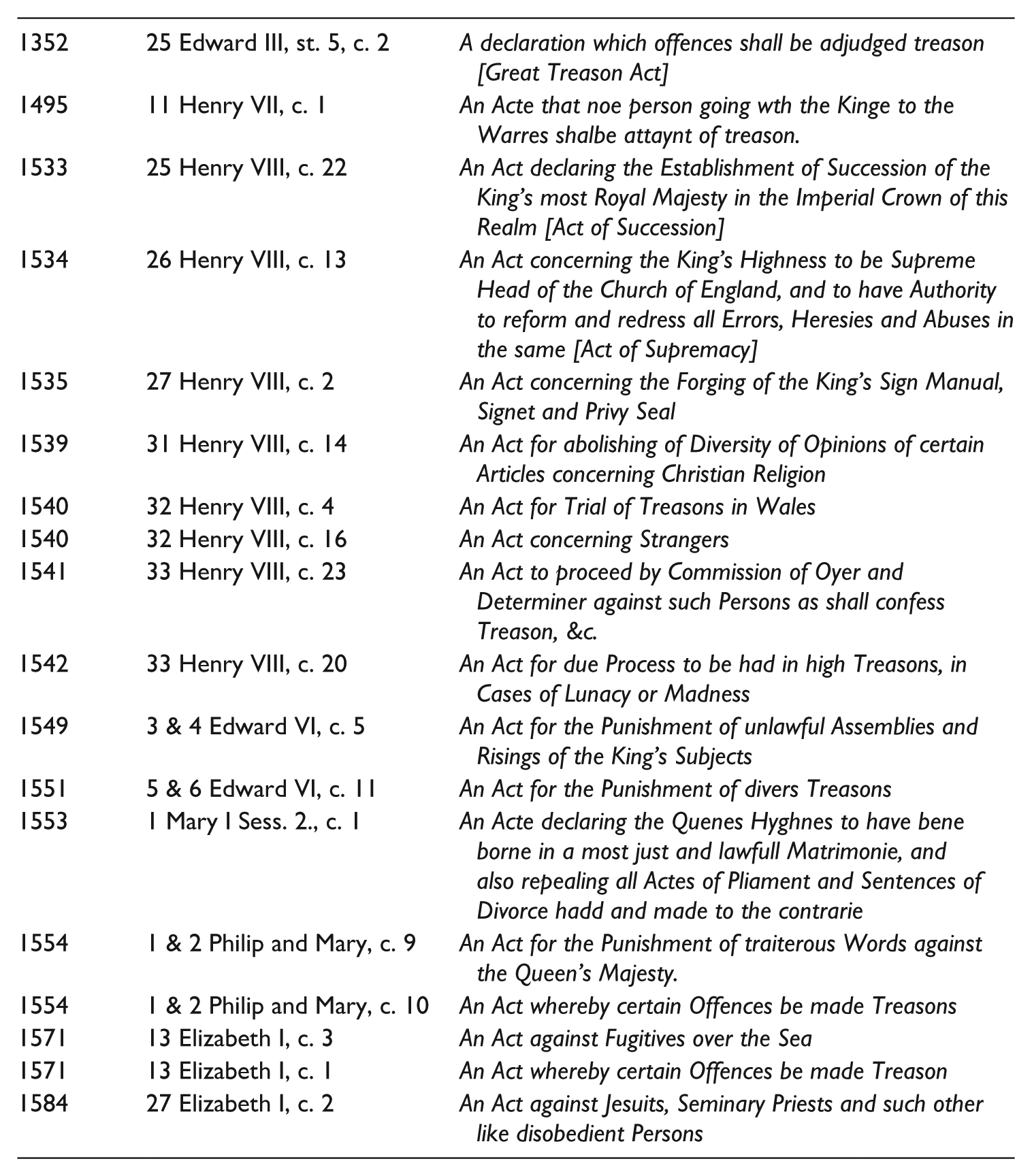
| 1352 | 25 Edward III, st. 5, c. 2 | A declaration which offences shall be adjudged treason [Great Treason Act] |
| 1495 | 11 Henry VII, c. 1 | An Acte that noe person going wth the Kinge to the Warres shalbe attaynt of treason. |
| 1533 | 25 Henry VIII, c. 22 | An Act declaring the Establishment of Succession of the King’s most Royal Majesty in the Imperial Crown of this Realm [Act of Succession] |
| 1534 | 26 Henry VIII, c. 13 | An Act concerning the King’s Highness to be Supreme Head of the Church of England, and to have Authority to reform and redress all Errors, Heresies and Abuses in the same [Act of Supremacy] |
| 1535 | 27 Henry VIII, c. 2 | An Act concerning the Forging of the King’s Sign Manual, Signet and Privy Seal |
| 1539 | 31 Henry VIII, c. 14 | An Act for abolishing of Diversity of Opinions of certain Articles concerning Christian Religion |
| 1540 | 32 Henry VIII, c. 4 | An Act for Trial of Treasons in Wales |
| 1540 | 32 Henry VIII, c. 16 | An Act concerning Strangers |
| 1541 | 33 Henry VIII, c. 23 | An Act to proceed by Commission of Oyer and Determiner against such Persons as shall confess Treason, &c. |
| 1542 | 33 Henry VIII, c. 20 | An Act for due Process to be had in high Treasons, in Cases of Lunacy or Madness |
| 1549 | 3 & 4 Edward VI, c. 5 | An Act for the Punishment of unlawful Assemblies and Risings of the King’s Subjects |
| 1551 | 5 & 6 Edward VI, c. 11 | An Act for the Punishment of divers Treasons |
| 1553 | 1 Mary I Sess. 2., c. 1 | An Acte declaring the Quenes Hyghnes to have bene borne in a most just and lawfull Matrimonie, and also repealing all Actes of Pliament and Sentences of Divorce hadd and made to the contrarie |
| 1554 | 1 & 2 Philip and Mary, c. 9 | An Act for the Punishment of traiterous Words against the Queen’s Majesty. |
| 1554 | 1 & 2 Philip and Mary, c. 10 | An Act whereby certain Offences be made Treasons |
| 1571 | 13 Elizabeth I, c. 3 | An Act against Fugitives over the Sea |
| 1571 | 13 Elizabeth I, c. 1 | An Act whereby certain Offences be made Treason |
| 1584 | 27 Elizabeth I, c. 2 | An Act against Jesuits, Seminary Priests and such other like disobedient Persons |
1.
J.H. Shennan, for instance, described the modern state as emerging when it became “an abstract entity above and distinct from both government and governed” (Shennan, 1974: 114).
2.
See, for example, Jaede (2015) and  .
.
3.
I do not claim that treason was the sole or primary origin of an abstract concept of the state. Such an argument would disregard the wider intellectual, institutional, and imperial developments that shaped early modern political authority, including the 16th-century assertion that the realm of England “is an empire.” My argument is more focused insofar as I show that within the domain of treason conceptual change moved not from an already abstract notion of the state into practice, but in the opposite direction.
4.
Although I follow Koselleck’s broader conceptual framework as interpreted by , esp. 5–7), the overall argument here makes the use of the category of a “supporting concept” difficult to sustain for treason (in relation to the state). Instead, I suggest the notion of a peripheral concept—situated within the same conceptual web, but without any a priori determination of whether it stands in a supporting, cognate, or contrasting relation to the core concept. In a similar vein, I move beyond Berenskoetter’s translation of Grundbegriffe as “basic concepts,” opting instead for core concept in order to better contrast it to peripheral concepts.
5.
These include, for example, sovereignty (Bartelson, 1995; Onuf, 1991), diplomacy (Leira, 2016), war (Bartelson, 2017), power (Guzzini, 2005, 2016), peace (Richmond and Berenskoetter, 2016), security (Stritzel and Vuori, 2016), hegemony (Colás, 2016), and empire (Jordheim and Neumann, 2011).
6.
On the statutes as statements of the whole polity, see Smith (1984). By the 1530s, the Crown had become integral to Parliament, and under Henry VIII statutory authority expanded dramatically (von Mehren, 1947), as the Tudor state came to rule largely through law (Elton, 1981). In the Statutes of the Realm collection, 300 years of statutes up to the beginning of the reign of Henry VIII in 1509 fill approximately 1,000 pages, the same space filled by the acts passed during the reign of Henry VIII alone. While the Statutes of the Realm contain most acts of Parliament, they are nevertheless acknowledged to be incomplete (Corrigan and Sayer, 1985: 212). The statutes are classified according to the year of the reign of the monarch they were enacted in, the monarch, as well as which chapter number in the said session of Parliament, for example, 22 [year of the reign] Henry VIII [monarch], c. 12 [chapter].
7.
As I discuss below, such an understanding has implications for how scholars in IR, following Koselleck, have tended to understand not only how conceptual change takes place, but how it relates to the social world. A distilled example of such a take is the claim that “In the beginning was the word, the word took on many meanings and became a concept. The concept went on to create the social world.” (Neumann in Berenskoetter, 2016: back cover) Instead, I turn this playful aphorism on its head and proceed in the opposite direction, tracing how worldly practices press upon our language, generating new meanings and compelling the revision of established concepts.
8.
As Orr (2002) has argued, the development of treason law and the idea of the state were “coterminous and interdependent” processes (p. 2, 45). To charge someone with treason, then, more than a description of a crime. In fact, it is also an implicit assertion of a political entity that can be betrayed (see de Carvalho, 2025).
9.
11.
As the discussion of the state as an abstract entity may be less familiar to an IR audience, it is worth dwelling on before proceeding further. As Shennan observed, “The idea of the state as an abstract entity, representing neither government nor governed man, but standing outside of both, is a familiar one to twentieth-century man. It was not always so.” (Shennan, 1974: 9) The key conceptual shift Shennan points to is the abstraction of political authority. As van Creveld puts it, “The state [. . .] is an abstract entity which can be neither seen, nor heard, nor touched. This entity is not identical with either the rulers or the ruled [but] includes them both and claims to stand over them both.” (van Creveld, 1999: 1; see also Devereaux, 2010: 843) This abstraction of the state allowed it to be imagined as separate from its individual constituent parts—an entity that is both impersonal, autonomous, and capable of commanding loyalty not on the basis of lineage, religion, or charisma, but by virtue of its own legitimacy as a political form (see the discussion in Anter, 2014).
12.
As the editors of the seminal Political Innovation and Conceptual Change wrote, even though the relationship between politics and discourse is as intimate as it is crucial, making sense of the precise relationship between political and linguistic change is not a straightforward matter: “the political dimension of conceptual change and the conceptual dimension of political change” are intimately intertwined (Farr et al., 1989: ix).
13.
Recent attempts (most notably by Zarakol and Heiskanen, 2025) have sought to draw attention away from innate and ahistorical understandings of concepts toward their transformation and diffusion, emphasizing what they call “travelling concepts.” While such a reconceptualization of how ideas move and acquire meaning across contexts is important, I take this focus on change a step further by examining how concepts emerge in the first place. In this sense, conceptual change here is treated as embedded rather than itinerant.
14.
15.
Bertrand Badie is a good illustration of this orthodoxy. According to him, the international system was “progressively theorized by political philosophers such as Jean Bodin [1576], Hugo Grotius [1625], and Thomas Hobbes [1651], and overall formalized by the Westphalian Peace, in 1648” (Badie, 2020: 18).
16.
Recent IR scholarship has called for deeper engagement with historical sources and conceptual history (de Carvalho et al., 2021). Kessler and Leira (2024a, 2024b), for instance, have argued that IR’s so-called “tempocentrism” (see Hobson, 2010) has led to a shallow relationship with its own past—often reading history through the lens of the present. To counter this, they advocate for the use of conceptual history to better understand the evolution of international thought. I share that impulse, but suggest we need to be more attentive to the forms of historical material we bring into our analyses.
17.
See also Thompson (1978), Christopher Hill (1967, 1990), and ; but also 2008).
18.
19.
This line of inquiry also resonates with Inside/Outside, which situates the state as a spatial and conceptual boundary marker. Instead of Walker’s focus is on the modern sovereign state as a spatial project, however, I seek to explore the earlier processes through which such bounded imaginaries began to emerge.
20.
21.
This point dovetails with an early critique of Skinner’s position by Jens Bartelson, who observed that “in his history of the term state and its terminological predecessors, Skinner seems to demand that an amount of ‘self-consciousness’ is necessary on the part of a given writer, if we are to be entitled to speak of him as expressing a specific concept of the state by using the very term or one of its equivalents” but noted that “if we want to answer the more intriguing question of how the notion of the state as an abstract entity, detached both from ruler and ruled became a logical and ontological possibility, it is difficult to see why the self-consciousness of an author should be vested with this privilege” (Bartelson, 1995: 68).
22.
While Prudovsky discussed the ascription of the concept of “inertial mass” to Galileo, noting that although Galileo does not employ the term, “it nonetheless true that he constantly makes use of this concept in his arguments” (Prudovsky, 1997: 15–16).
23.
The etymology of realm points toward this duality. Derived from the Old French reaume (later realme, royaume), and ultimately from the Latin regalis (“royal”), realm originally denoted a domain under sovereign authority—a kingdom. However, its meaning was far from fixed. As Julia Costa Lopez has shown in the case of late medieval governance, there was little agreement as to terminology, as categories were often vague and overlapping (Costa Lopez, 2020). We also find this conceptual malleability in Tudor legal and diplomatic sources. A statute from the 1553, for instance, speaks of “the state of every king, ruler and governor of every realm, dominion or commonalty” (1 Mar. Sess. 2 c. 1). As we see from that statute, state is conflated with rank or estate, while realm and commonalty are also listed as distinct political categories.
24.
Alford reflects over this terminological ambiguity, noting that “‘State’ is problematic. It was used, but generally in the sense of ‘condition’ or, principally, royal estate and royal governance.” Although not in any consistent way, the terms commonwealth, body politic, polity, and public weal were also in circulation, though inconsistently (Alford, 2002: 86).
25.
As Hindle rightly argues, “comparative discussion of changes in the nature of the state over time have been inhibited by an over-emphasis on the terminological problem of providing an agreed definition of what the state was at any given point in the past” (Hindle, 2002: 65).
26.
Laclau and Mouffe, for instance, argue that as “privileged signs” master concepts perform the important task of organizing broader discourses which are made up of a network of interrelated concepts (see Laclau and Mouffe, 1985: 112).
27.
Nick Onuf (1991: 428) notably praised this as an “exceptionally perceptive judgment,” thereby reinforcing its authority within early constructivist IR. Such an understanding also resonates with how Westel Willoughby described the state close to half a century earlier, namely as “the fons et origo of all those laws which condition its own actions and determine the legal relations of those subject to its authority” (Willoughby, 1924: 1162, emphasis original).
28.
These passages, published in Skinner (2002) also figure in his contribution to .
29.
Skinner is right to draw attention to the Great Treason Act of 1352 and to the longevity of its judicial application. However, there are important qualifications to such an argument. As J.G. Bellamy and Leslie J. Ward have shown (Bellamy, 1979; Ward, 1985), Elizabethan prosecutors often preferred to frame indictments using constructions derived from the Great Statute of Treason (1352), rather than invoking newer acts with more explicitly religious overtones. This observation, however, overlooks the important distinction between the enforcement of treason laws and their enactment. If we are to make sense of conceptual change, that is, how new ideas of political authority emerge and circulate, then we must cater to the production of legal and political vocabulary as well as its juridical consumption. After all, Hobbes himself is not recognized for enforcing conceptual change, but having produced a novel political grammar.
30.
Hobbes’ influence on IR is considerable, extending beyond his account of the nature of the state to his theorization of the state of nature. It should be noted that his account of the state of nature, and the subsequent analogies between the international system and a state of nature, has likely been far more consequential than his abstraction of the state as witnessed by, for example, early realist theorizing, and the English School. That issue, however, lies beyond the scope of this article.
31.
While it would be misleading to suggest that this has been an active debate across the discipline, the state as an abstract actor was a central concern for early IR theorists (see, notably, Wolfers, 1962) and until recently was largely regarded as settled. Wendt (1999; see also Ringmar, 1996) largely reignited the debate, followed by Jackson (2004a, 2004b), Neumann (2004), Wight (2004), Wendt (2004), Lomas (2005), Kustermans (2011), and .
32.
As Alford notes, “Elizabethan privy councillors felt that their (e)state was worth protecting,” could “the notion of a mystical relationship between the person of the monarch and the body politic [. . .] be broken?” (Alford, 2002: 86–88) If so, this would signal a conceptual shift in which state power and political authority were increasingly imagined as separable from the ruler’s person—a step toward abstraction.