




Abstract
All revolutionaries seek to remake their domestic orders, but only some pursue transformative change beyond the state. Those revolutionaries that are transformative at home and abroad have challenged imperialism (Nicaragua 1927), exported revolution (Iran 1979) and upset international alliances (Cambodia 1975). However, there is another category of revolutionaries who want to transform international order(s), but refrain from doing so. For these revolutionaries, survival of the revolution limits their ability to effect international change. I call this disjunct between revolutionary aspirations and actions “strategic acquiescence.” Using a novel dataset of revolutionary pragmatism, this article conceptualizes, maps and typologizes the phenomenon of strategic acquiescence in the period between 1900 and 2020. Doing so not only shows the different ways in which revolutionaries have navigated the trade-off between survival and transformation, but also widens our understanding of the difficulties facing those seeking to effect radical change in world politics.
Keywords
Introduction
Revolutionaries face a dilemma. On one hand, they often seek radical transformation of the international status quo. On the other hand, in order to effect this radical transformation, they need to survive. These two objectives pull in different directions: transformation antagonizes powers that threaten the revolution’s survival, while ensuring survival threatens revolutionaries’ internationally transformative agendas. This is the revolutionaries’ dilemma. One way in which revolutionaries navigate this dilemma is to moderate their international ambitions in an attempt to secure the revolution’s survival. This occurred when Mexican Constitutionalist revolutionaries backtracked on their challenge to US economic domination; Korean communists accepted subordination to the Soviet Union in exchange for military support; and Syria’s Jabhat al-Nusra (now Hay’at Tahrir al-Sham) dropped their transnational ambitions. In these (and other) cases, a process of “strategic acquiescence” occurred where revolutionary movements chose domestic survival over international transformation. They acquiesced to the strictures of the international system in which they found themselves, moderating their agendas accordingly.
The phenomenon of strategic acquiescence is the focus of this study. Using a new dataset of revolutionary pragmatism, this study is the first to globally map the contours of strategic acquiescence over the past 120 years. An analysis of 135 revolutions with international ambitions in the period between 1900 and 2020 shows that a significant minority of revolutions – nearly one in four – engaged in strategic acquiescence. 1 Furthermore, these new empirics unsettle the view that revolutionaries follow relatively similar pathways in navigating their external environments. Such a view is evident in accounts of revolutionaries following radical to moderate trajectories (e.g. Armstrong, 1993; Waltz, 1979), moderate to radical trajectories (e.g. Halliday, 1999), and revolutionaries following moderate or radical trajectories (e.g. Levitsky and Way, 2022). Instead, this study empirically demonstrates how revolutionaries might moderate a small portion of their programme or all of their programme, in different sequences and for different amounts of time. Four dispositional configurations of survival versus transformation are identified in the analysis below. These varied patterns foreground the role of revolutionary agency in navigating their external contexts, contra structural theories of revolutionary moderation (see, for example, Armstrong, 1993; Waltz, 1979).
Strategic acquiescence is important not just because it is essential to understanding the dynamics of a quarter of revolutions with international ambitions in the past 120 years, but also because it allows us to understand the interrelationship between revolutions and other important phenomena. For example, revolutionary moderation is a crucial part of the puzzle in understanding authoritarian durability (see Levitsky and Way, 2022), the relationship between revolution and war (Walt, 1996), the emergence of “color” revolutions (see Goldstone, 2009), as well as the international impacts of revolutionary foreign policy (see Halliday, 1999). Strategic acquiescence is therefore of direct relevance to the functioning of world politics. In contrast to those revolutions that engage in export, pursue territorial expansion, upend international hierarchies, and shift geopolitical alliances, revolutionaries that strategically acquiesce tend to have far less tumultuous outcomes. The self-moderating Mexican Constitutional Revolution (1910–1920) was a very different prospect to the non-self-moderating Iranian Constitutional Revolution (1905–1911) – the former generated little opposition from the United States, while the latter elicited Soviet–British military intervention and war. While the radical dimensions of revolutionary foreign policy have received sustained academic attention, particularly by the first three generations of revolutions scholars (more on this below), the phenomenon of revolutionary pragmatism is still catching up.
This article proceeds in five parts. First, it introduces the theory of strategic acquiescence. Second, it situates strategic acquiescence within existing accounts of revolutionary radicalism and pragmatism. Third, it outlines the methodology used to map patterns of strategic acquiescence in the period between 1900 and 2020. Fourth, it identifies four different configurations of strategic acquiescence, based on different approaches to the revolutionaries’ dilemma. Fifth, it reflects on the implications of strategic acquiescence for theories of revolution and transformation in world politics.
The argument
Strategic acquiescence occurs when revolutionaries seek to transform the international system, but self-moderate their ambitions in an attempt to ensure survival. Strategic acquiescence has four manifestations: (1) pursuing some dimensions of international transformation while shelving others; (2) pursuing international transformation and then backtracking at crucial moments; (3) failing to pursue international transformation objectives altogether; and (4) delaying the pursuit of international transformation until circumstances are more propitious. Despite their different approaches to navigating the revolutionaries’ dilemma, a common thread is the mismatch between revolutionary ambitions and actions because of real or anticipated great power counterrevolutionary reversal. 2 Revolutionaries have good reason to be wary of great powers given the role that they can play in revolutionary failure and success. 3 In some cases this moderation went beyond the negative goal of avoiding counterrevolution to include the positive goal of winning great power support. Security guarantees, trade relations, and weapons transfers can be crucial in shoring up fledgling revolutionary regimes. For example, Nicaragua’s Sandinistas (1978–1979) initially moderated their revolutionary export ambitions not only to avoid US counterrevolution, but also for the purposes of securing US economic and military aid (Pastor, 2002: 165, 168).
While revolutionaries that engage in strategic acquiescence are prioritizing survival over transformation, this is not necessarily to say that they are pursuing survival instead of transformation. Revolutionaries engaging in strategic acquiescence can be placed along a survival–transformation continuum, with different weightings of one impulse versus the other. For example, the Bolshevik October Revolution (1917) pursued export of the revolution (international transformation) while also attempting to make peace with the Entente powers (for the purposes of survival). By contrast, China’s Ping-liu-li revolutionaries (1906–1907) shelved all of their ambitions for international change. Their foreign policy was wholly about survival. While the Bolsheviks between 1918 and 1920 sat somewhere closer to the middle of the survival–transformation continuum, the Ping-liu-li revolutionaries sat closer to the survival end. Although both sets of revolutionaries engaged in strategic acquiescence, the Bolsheviks pursued international transformation while the Ping-liu-li revolutionaries did not. In other words, strategic acquiescence exists in degrees, with some revolutionaries wholly moderating their agenda and others moderating a proportion of their agenda for a short period of time.
Of course, not all revolutionaries face the survival–transformation dilemma. It is only faced by those with ambitions to alter the international system. Indeed, some revolutionaries accept the international status quo. Nepal’s Jana Andolan protests (2006) and Tunisia’s “Jasmine” Revolution (2010–2011) are cases in point. In the case of Nepal, no transformative international ambitions were detected in the Seven Party Alliance’s 23-point agreement (Koirala et al., 2007). In the case of Tunisia, analysis of banners, graffiti, and chants shows that demands centred on the domestic Tunisian context: “The slogans are characterized by their multilingualism; they were chanted in the full verbal repertory of Tunisians, without any reference to western imperialism, pan-Arab ideology, or Islamism, and most surprisingly, with no reference to the Palestinian cause” (Jerad, 2013: 241–242). Other examples in this category include “negotiated revolutions”, whose projects are “rooted in the underlying principles, norms and practices of the international system itself” (Lawson, 2005: 488). These revolutionaries did not have to balance survival versus radical transformation, because they were not aiming to pursue radical transformation in the first place. 4 The pool of cases analysed in this article therefore only includes revolutionary movements that expressed desires to transform the international status quo.
Strategic acquiescence is a process that operates largely in the international domain. It concerns revolutionary attempts to balance survival at the hands of international actors versus desires to engender international change. A specific subset of international actors is the focus of this study: the great powers. 5 Revolutionary self-moderation therefore concerns policies with international implications in an attempt to win great power toleration. Having said that, strategic acquiescence likely applies in domestic revolutionary contexts too. Revolutionaries may moderate their domestic policies in an effort to prevent domestic counterrevolution (a point examined by Levitsky and Way, 2022: 25–26; see also Clarke, 2025). The advantages of studying strategic acquiescence as an international phenomenon are twofold. First, it responds to long-standing and increasingly heeded calls to study the neglected international dimensions of revolution (see, for example, Halliday, 1999: 6; Lawson, 2011, 2019: 36; Ritter, 2015: 21). Second, studying strategic acquiescence as an international phenomenon allows greater analytic granularity in disaggregating domestic and international revolutionary ambitions. These two dynamics have tended to be lumped together. Halliday (1999: 3) argues that major social revolutionaries have aspired “to change the world both within and beyond frontiers,” while for Bisley (2004: 50), they “construct radical foreign policies which seek to reinforce and advance their domestic social programmes.” By contrast, strategic acquiescence shows that revolutionaries use domestic and international policy in not only complementary, but also differential, ways. They can pursue radicalism at home, but moderation abroad.
The concept of strategic acquiescence contains within it two causal directionalities. The first is the impact of great power counterrevolution, real or anticipated, on revolutionary self-moderation. The second is the impact of revolutionary self-moderation on their approach to the international system. For example, in the case of Mexico’s constitutionalist revolutionaries (1910–1920), fears of US opprobrium led to revolutionary moderation, while this moderation in turn led to an altered international programme (and ultimately an absence of US counterrevolution). These two directionalities make the implications of strategic acquiescence multifaceted. On one hand, strategic acquiescence is a story of revolutionary agency in their manoeuvring to ensure the survival of their fragile gains. It is a delicate game to eke as much change out of the international system as possible without fatally overstepping. Instead of resistance via transformation, these revolutionaries engage in resistance via survival. On the other hand, strategic acquiescence is a story of the limited prospects of effecting radical change in world politics. The spectre of counterrevolution, and the need to negotiate survival and transformation imperatives, means that it is a difficult task for revolutionaries to transform the world in the ways, and to the extent, that they hope for.
The existing literature on revolutionary pragmatism
There are three ways that revolutionary pragmatism is understood in the International Relations and Comparative Politics literatures. The first sees radicalism versus accommodation as two alternative routes a revolution can take (Levitsky and Way, 2022: 12–13, 25–26). Hypothesized reasons for why the radical path is pursued include a strong-willed and risk-tolerant leadership, an unambiguous ideology, and external power support (Levitsky and Way, 2022: 27–28). While this framework provides a compelling explanation of their phenomenon of interest – authoritarian durability – it is less useful when repurposed to understand how radical versus pragmatic impulses play out within the same revolution. For example, the pragmatic elements of Lenin and Mao’s foreign policies are not readily theorized using this framework.
A second approach, advocated for by several International Relations scholars, posits that while revolutions are initially radical, they become increasingly moderate overtime as they are socialized (or normalized) by systemic forces. English School variants of this argument highlight the role of international society in compelling moderation (Armstrong, 1993: 7). Neorealist variants see systemic competition (Waltz, 1979: 63, 127–128), anarchy, increasingly realistic threat assessments, and the waning importance of ideology as driving revolutionary conformity to international practices (Walt, 1996: 33, 43, 208–209, 267–268, 340, 342). The assumption that revolutions tend to follow radical-to-moderate trajectories limits theorization of those revolutions that are initially moderate (e.g. Poland’s Solidarity Revolution, 1981–1990); and those that pursue some radical and some moderate policies simultaneously (e.g. Korea’s Communist Revolution, 1948–1953). The dominant role of systemic forces also leaves limited space for theorizing about revolutionary agency.
A third view is that revolutions cycle through internationally moderate and then radical phases. According to Goldstone (1991: 426), “most revolutions often follow a similar course – moving from initially moderate to more extreme positions . . . despite having ideologies of diverse content.” Similarly, in his discussion of the internationalist-accommodationist antinomy of revolutionary foreign policy, Halliday (1999: 134–139) identifies an initially moderate “period of grace,” followed by radical internationalism, a return to moderation, and then “longer-run . . . conflict with other states in the international system.” The reasons given are factional and structural. Both scholars highlight the role of inter-factional competition in driving radicalism (Goldstone, 1991: 436; Halliday, 1999: 138). Halliday (1999: 136, 138–139) also emphasizes “domestic structural factors,” whereby the different domestic constitution of states drives confrontation.
Two related points can be made about these existing theories. First, they each possess a relatively uniform view of how revolutionaries navigate their international contexts. Socialization theorists posit that the main trajectory is one of radicalism to moderation. Cyclical early moderation theorists posit that the main trajectory is one of moderation to radicalism, in successive phases. The two-track approach of Levitsky and Way (2022), while foregrounding more than one revolutionary approach to the international system, nonetheless sees each of these two tracks as relatively stable, that is, revolutionaries tend to follow the ideal-typical radical path or the accommodationist path. 6
A second point is that these existing theories emphasize structural or quasi-structural factors, including anarchy, interstate competition, external state support, factionalized ruling elites, the differential domestic constitution of states, and the presence of diverse ideological coalitions. Agential explanations – for example, threat perceptions (Walt, 1996) and risk-tolerant leaders (Levitsky and Way, 2022) – occupy less causal space. Given the flattening effect of structural explanations, it makes sense that structure-heavy theories will show relatively regular patterns across time and place.
Strategic acquiescence
This study – and its examination of strategic acquiescence – makes five contributions. First, in contrast to structural and quasi-structural approaches, this study foregrounds strategic agency in its examination of how revolutionaries approach the international status quo. Moderation is not just a given response to structural pressures or specific ideologies, but a strategic decision that can be made at different times, to different degrees, and in different ways when faced with the common spectre of counterrevolution. Relatedly, mapping the revolutionaries’ dilemma destabilizes the idea that revolutionary pragmatism is a singular category. Differential weightings of survival versus transformation impulses allow the parsing of revolutionary pragmatism into four distinct types. This is in keeping with calls by Goldstone (2009, 2023) to highlight variation within revolutionary processes (and broader moves within Comparative Politics and International Relations scholarship to better articulate variation within democratization processes, peacebuilding processes and justice claims). 7 The revolutionaries’ dilemma, and the patterns of acquiescence it generates, provide a framework for highlighting such variation.
Second, strategic acquiescence challenges the assumption that revolutionaries tend to pursue their radical agendas in a hasty and ill-conceived fashion, throwing “rational caution to the wind” (Weyland, 2016: 218). With reference to the revolutions of 1848, Weyland (2016: 218–220) shows how protesters engaged in cognitive shortcuts and “deviations from standard rationality” in their attempts to topple incumbent regimes. Similarly, according to Levitsky and Way (2022: 14–15), nonrevolutionary governments tend to be pragmatic about their vulnerabilities, whereas revolutionary governments often riskily pursue ideological prescriptions. Mapping the phenomenon of strategic acquiescence instead highlights instances where revolutionaries have been prudent and calculating, weighing up survival versus the implementation of their international ambitions. Sohrabi (2002) has demonstrated how the “Young Turks” (1908) agonized about how and whether their revolution would survive before launching it. Kurzman (2008: 240) similarly shows how decision-making by the early 20th-century constitutional revolutionaries was influenced by the need to secure great power support. This article attempts to show that such strategic calculations are far from an anomaly, comprising a significant minority of cases.
Third, strategic acquiescence highlights the usefulness of syncretic approaches to theorization in order to understand complex phenomena such as revolution (on the value of theory synthesis, see Braumoeller, 2009; Levy, 1998: 144–145; Moravcsik, 2003; on eclectic theorizing, see Katzenstein and Sil, 2009). The theory of strategic acquiescence advanced in this study draws on elements of multiple International Relations paradigms. It accords with the neorealist emphasis on security and survival as motivators of action, but not the determinative role of international structures in conditioning state behaviour. 8 It adopts a constructivist lens in examining the co-constitution of structures and agents; alongside its concern with the ways in which revolutionaries interpret the world (and the threat of counterrevolution) around them. 9 It is in keeping with English School syntheses of idealist and materialist factors, while rejecting English School assumptions about the homogenizing effects of international society and the role of shared norms, rules and institutions in guiding state behaviour. 10
Fourth, this study contributes to fourth-generation theories of revolution. 11 It rejects the structural determinism of third-generation approaches by examining the strategic agency of revolutionaries and the multiple ways they interact with the international system. It shifts focus away from social revolutions which have received the lion’s share of academic attention by first-, second- and third-generation scholars. Overreliance on a handful of social revolutionary cases has led to assumptions about the international radicalism of revolutions (see, for example, Armstrong, 1993; Bisley, 2004; Skocpol, 1979: 3–4). Finally, like many fourth-generation approaches, this study foregrounds the international dimensions of revolutionary processes. 12
This study also builds on fourth-generation approaches. While strategic agency has been an important feature of fourth-generation scholarship, this has mostly been examined in relation to unarmed movement tactics, coalition building, and mobilizational strategies (Beck et al., 2022: 8, 10). 13 This study, in contrast, brings strategic agency to bear on questions of international radicalism (or otherwise). Furthermore, it attempts to overcome the analytical bifurcation between structure and agency that has been a feature of some fourth-generation accounts (Lawson, 2019: 61). According to Beck et al. (2022: 12), in such accounts “there is little analysis of how structural conditions may shape strategic choices or how human action might bring about structural shifts that create state vulnerability.” This article’s examination of how international structures influence revolutionary programmes, and how revolutionary programmes seek to remake international structures, highlights the integrative, rather than bifurcated relationship between structures and the agents that are contained within them.
Fifth, this article makes empirical contributions concerning the unit of analysis and data breadth. Regarding the unit of analysis, it examines both revolutionary movements, and, when successful, revolutionary states, noting that survival is a concern of both. Revolutionaries do not only use pragmatism to cling on to power, but to win power in the first place. This is a departure from existing studies of revolutionary foreign policy which are largely concerned with states (e.g. Armstrong, 1993; Halliday, 1999). Regarding scope, this study systemically detects the presence of strategic acquiescence within a pool of 135 revolutions with international ambitions in the period between 1900 and 2020 – including political and social, attempted and successful, autocratic and otherwise. This wide temporal and geographic scope allows variation within the category of revolutionary pragmatism to be discerned. Such variation is not always visible when only a handful of cases are examined. It also allows the insights generated from existing cases (1 in the case of Sohrabi, 2002; 7 in the case of Walt, 1996; and 20 in the case of Levitsky and Way, 2022) to be tested, refined, and further developed. The limitations of large comparative studies such as this, specifically the difficulties of capturing the nuance and richness of specific cases, means that detailed case analysis continues to be an important, complementary approach in the study of revolutionary pragmatism.
Methodology
To understand how revolutionaries self-tame their international ambitions in response to the revolutionaries’ dilemma, I constructed a dataset of revolutionary pragmatism in the period between 1900 and 2020. The first steps were to apply a consistent definition of revolution to a pool of potential candidates generated by combining eight existing datasets, encyclopaedias, and other compendia of revolution (Hirst, forthcoming). These were as follows: Beissinger (2022), Chenoweth and Shay (2020), DeFronzo (2006), Foran (2005), Goldstone (1999), Lachapelle et al. (2020), Ritter (2015: 5), and Wickham-Crowley (1992). A revolution is defined here as mass mobilization using extra-constitutional means, for the purpose of bringing about a new principle of political authority in a sovereign state (adapted from Beissinger, 2022: 3; Goldstone, 2001: 142; Lawson, 2019: 5). This definition includes both attempted and successful revolutions, but excludes anti-colonial/independence revolutions. 14 See the codebook (Supplemental Appendix 1) for the rationale behind, and operationalization of, these definitional criteria.
The result of this application of a consistent definition of revolution was a pool of 182 cases. To analyse revolutionary pragmatism, I then excluded those revolutions without ambitions to transform the international status quo and those unable to be coded due to missing information. The remaining 135 revolutions were then assessed to determine whether the revolutionaries engaged in strategic acquiescence. The presence of strategic acquiescence was gauged by comparing each revolution’s international ambitions against their actions. Strategic acquiescence was present when there was a discrepancy between the two, and there was sufficient evidence that this discrepancy was, in part, due to fears of great power backlash.
To be considered a case of strategic acquiescence, winning over the great powers had to be a prominent, but not necessarily the only, reason for moderation. Other reasons why revolutionaries may moderate include a genuine evolution of beliefs, catering to domestic constituencies, the ascendence of moderates in factional struggles, and adaptive preference formation (Elster, 2014[1983]). 15 Multiple pressures towards moderation can be exerted simultaneously. For example, initial moderation dynamics within the Cuban Communist Revolution (1956–1959) were in part to reap the benefits of US toleration (Boughton, 1974: 445), and in part because of the dominance of liberals in the new government (who would later be replaced by communists) (Prevost, 2007: 22–23). The Cuban Communist Revolution is considered an instance of strategic acquiescence because moderation was, in part, for the purpose of placating the United States. By contrast, cases where placating the great powers does not feature as a reason for moderation are not considered instances of strategic acquiescence. For example, the initial moderation of Congo-Brazzaville’s Trois Glourieuses Revolution (1963) was due to the prominent role-played by trade unions in steering the revolution, who were subsequently eclipsed by the more radical student organizations (Swagler, 2017: 371, 468). The crucial point is that for strategic acquiescence to occur, moderation must be motivated by a desire to temper great power responses (whether in combination with other factors or not).
Revolutionary ambitions versus actions were assessed along three dimensions of revolutionary challenge to the international status quo: reconfiguring international power hierarchies, challenging great power ideologies, and upending established relationships with other states. For example, Bolivian revolutionaries (1952) engaged in strategic acquiescence by backtracking on their attempts to end their country’s dependency status (international power hierarchy). Ethiopia’s Tigray People’s Liberation Front (TPLF, 1975–1991) engaged in strategic acquiescence by abandoning Marxism in favour of “revolutionary democracy” to appease the US (ideology). The “Young Turk” revolutionaries (1908) engaged in strategic acquiescence by attempting to strengthen Türkiye’s alliances with Britain, France and Germany despite evincing “a marked hostility and suspicion towards all the Great Powers” (Ünal, 1996: 31–32) (interstate relationships). These three dimensions of international transformation are derived from the revolutions literature. 16 Details of how these three dimensions of revolutionary challenge were operationalized are contained in the codebook (Supplemental Appendix 1).
Revolutionary ambitions have been gleaned from manifestos, lists of demands, protest slogans and banners, interviews, speeches and secondary source analyses. Revolutionary actions and motivations have been gleaned from secondary source analyses, newspaper archives and diplomatic cables. For example, the Haitian revolutionaries of 1946 outlined their objectives to transform the international status quo along leftist and anti-imperialist lines in their publication La Ruche (1946a: 7, 1946b: 1). Evidence that attempts were made to this effect – via a draft constitution limiting the economic rights of foreigners – and then abandoned under great power pressure, are contained in the Foreign Relations of the United States series and secondary source assessments (US Office of the Historian, 1969a, 1969b; see also Smith, 2009: 115). Details of each case of strategic acquiescence, and the underpinning research, are contained in Supplemental Appendix 2.
The period for assessing the presence or absence of strategic acquiescence was from the start of the revolutionary episode until either the date of revolutionary defeat or up until 3 years after revolutionary seizure of power. This temporal window is crucial for three reasons. First, in keeping with the aims of this study, it allows close analysis of revolutionary agency as they begin to confront the international system, rather than long-term, structural pressures for revolutionaries to conform. Second, the chosen temporal window captures revolutionary pragmatism both before and after the seizure of power. This departs from the literature to date which has focused on how revolutionaries have approached the international system after they have captured the state. Third, this temporal window is crucial in shedding light on the debate between socialization theorists (e.g. Armstrong, 1993; Waltz, 1979) and early moderation theorists (e.g. Halliday, 1999). Whereas the former argue that revolutionaries are initially radical and become increasingly moderate, the latter posit that revolutionaries go through a “period of grace” before radicalizing. Understanding how revolutionaries behave during the crucial early stages of their campaigns is essential in adding to these debates.
This empirical exercise parsed revolutions with international ordering objectives into two categories: those that engaged in strategic acquiescence, and those that did not. Non-acquiescing revolutions include those radical revolutions that prioritized transformation over survival; 17 as well as those that moderated their programmes for reasons other than survival. The result is that nearly one in every four revolutions with international ordering objectives between 1900 and 2020 engaged in some form of strategic acquiescence.
The proportion of revolutions engaging in strategic acquiescence is likely an undercount. More cases of strategic acquiescence could be identified if looking at revolutionary pragmatism vis-a-vis other international actors including corporations, regional powers, and neighbouring states. There is also the issue of undetected cases of strategic acquiescence: instances where there is an absence of evidence, rather than evidence of absence. For example, instances where the reasons for revolutionary pragmatism are unknown are excluded from the category of strategically acquiescing revolutionaries. As such, this article is an initial reconnoiter of the strategic acquiescence field, with other cases to be identified with the expansion of the study’s parameters in future work.
Typologizing strategic acquiescence
Mapping the phenomenon of strategic acquiescence shows that there are four different types that can be distinguished in terms of the relationship between survival and transformation. Common to all these pathways is that the revolutionaries make clear their objectives to alter the international status quo. Their pathways then diverge. Revolutionaries can prioritize (1) survival, (2) transformation and then survival, (3) survival and then transformation, (4) transformation. In-built within these pathways is the notion of strategic acquiescence by degrees. In the case of the first pathway, the revolutionaries are predominantly self-moderating in the window being examined. In the case of the second pathway, the revolutionaries are predominantly radical, and then switch to being predominantly self-moderating. In the case of the third pathway, the revolutionaries are predominantly self-moderating, and then switch to being predominantly radical. In the case of the fourth pathway, the revolutionaries are predominantly radical in the window being examined. 18
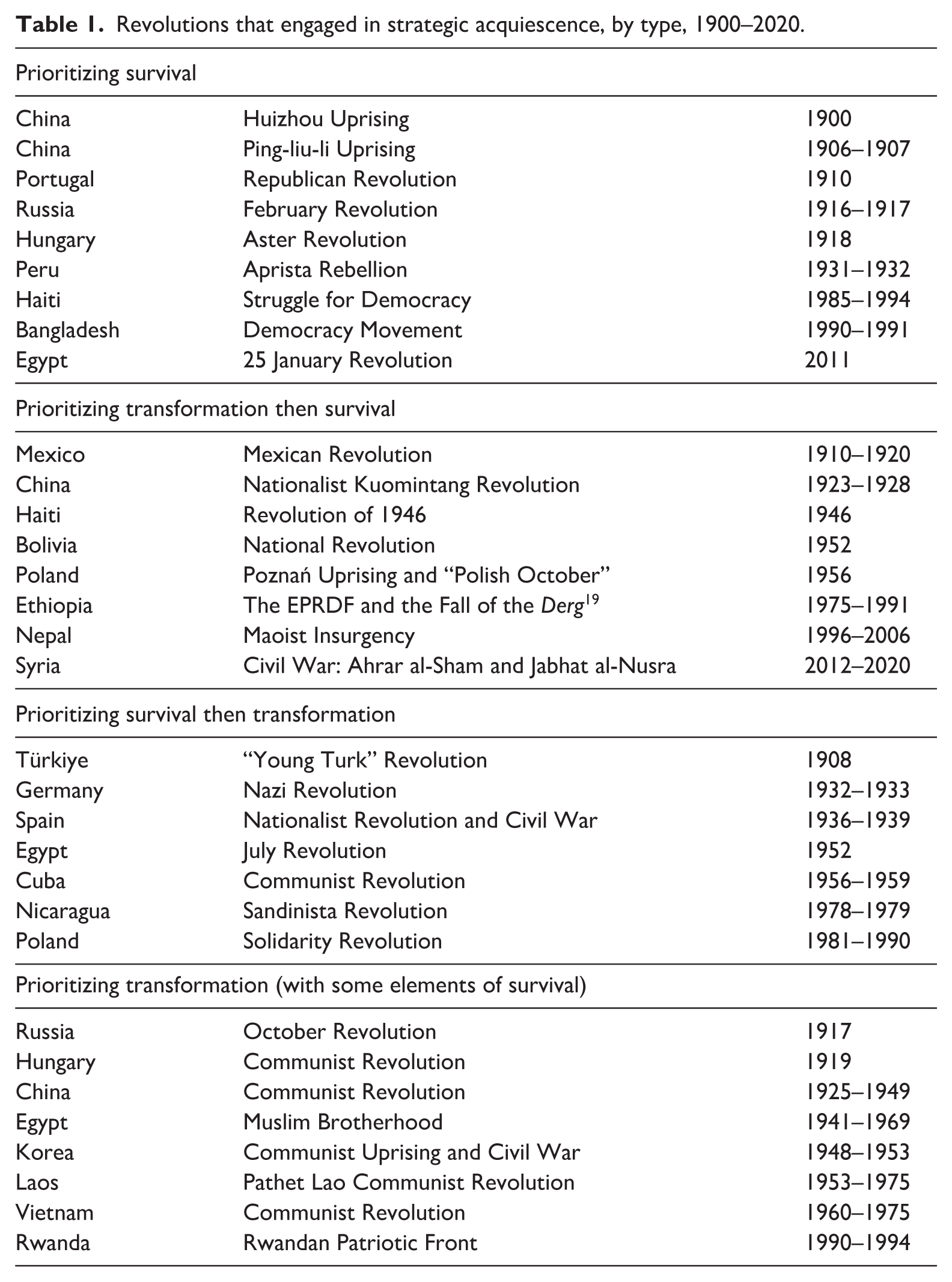
These four pathways reflect different approaches to the revolutionaries’ dilemma (see Figure 1). Revolutionaries following the first and second pathways adopt a pessimistic outlook. They jettison transformation in favour of survival, believing that the two are incompatible. Revolutionaries following the third and fourth pathways are more optimistic. Instead of accepting the revolutionaries’ dilemma, they try to overcome it. They do this by pursuing their survival and transformation goals sequentially (Pathway 3) or concurrently (Pathway 4). The revolutions that follow each pathway are detailed in Table 1. The features of each of the four pathways are outlined in greater detail below.
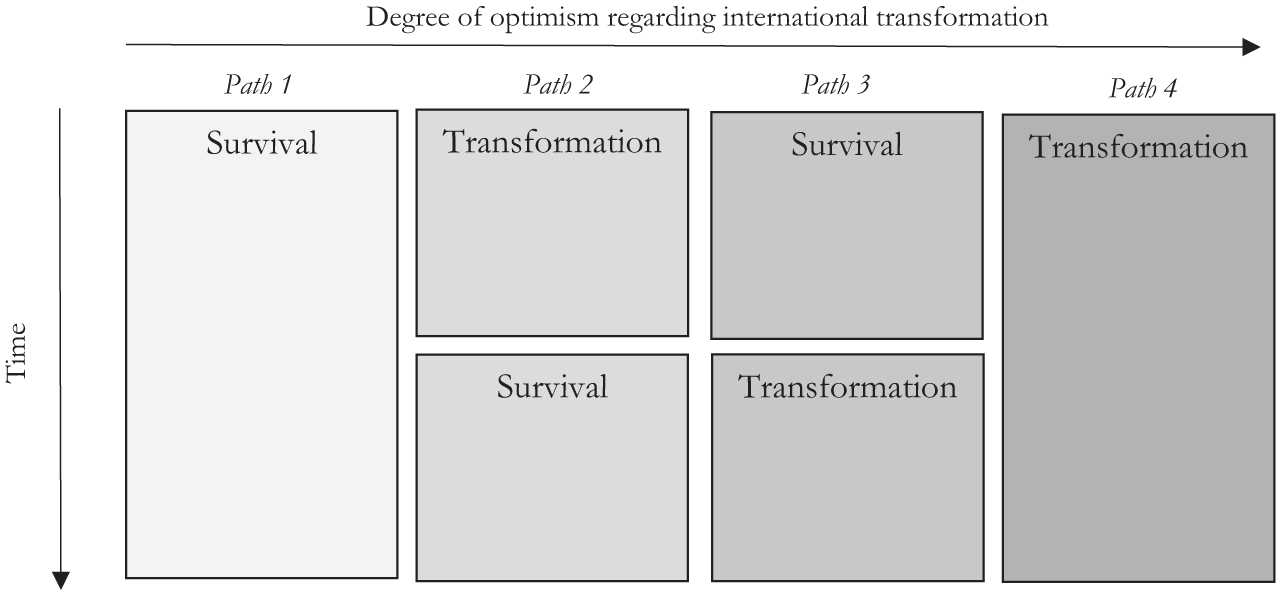
The four pathways and the revolutionaries’ dilemma.
Revolutions that engaged in strategic acquiescence, by type, 1900–2020.
Prioritizing survival (Pathway 1)
The first pathway involves revolutionaries jettisoning their international ambitions shortly after launching their campaigns. Revolutions fall into this category when they do not attempt to pursue their internationally transformative ambitions in practice. In most cases their internationally transformative ambitions are moderated within 1 year of launching their campaigns, and remain moderate for the 3 years after seizing power in cases of successful revolution. This pattern of strategic acquiescence was the most common in the period under analysis (see Figure 2). There are several common features of the revolutions that fall into this category. All bar one are ideologically liberal, and within this liberal category, nearly two-thirds are republican. With two exceptions, all managed to avoid great power counterrevolution (meaning their efforts were focused on preventing, rather than halting, counterrevolution).

Revolutions engaging in strategic acquiescence, by type, 1900–2020.
In four cases moderation happened upon seizing power, highlighting the disjunct between revolutionary movements and revolutionary states: the realities of governing the latter are very different from the ambitions motivating the former. These cases were Russia’s February Revolution (1916–1917), Hungary’s Aster Revolution (1918), Bangladesh’s Democracy Movement (1990–1991), and the powerholders that emerged from the Egyptian 25 January Revolution (2011). In five cases, revolutionaries moderated their goals as part of their efforts to secure power in the first place. For example, both China’s Huizhou (1900) and Ping-liu-li (1906–1907) revolutionaries were aggrieved by foreign territorial and economic exploitation of their country (Hornibrook, 2015: 185; Kayloe, 2017: 44–45). Yet, in the case of the Huizhou Uprising, Sun Yat-sen “negotiated with foreign powers for whose protection he was prepared to pay with many territorial and political concessions” (Bergère, 1998: 80). In the case of the Ping-liu-li Uprising, Gong Chuntai was quick to guarantee that foreign interests would be respected (Connelly, 1990: 54). While the Huizhou (1900) and Ping-liu-li (1906–1907) uprisings were unsuccessful, moderation preceded the successful Portuguese Republican Revolution (1910). Although Portuguese Republican Revolutionaries (1910) had long-standing desires to exit the Anglo-Portuguese Alliance, 3 weeks before seizing power they sent a delegation to London to promise the continuation of the alliance under a republican regime (Sardica, 2022: 308–309).
Another common feature of the revolutions that followed this pathway is that they operated in geopolitically and economically vulnerable states. The Huizhou (1900) and Ping-liu-li (1906–1907) uprisings took place in a China exploited by the great powers. Portugal (1910) was reeling from colonial humiliations at the hands of Britain. Russia (1916–1917) and Hungary (1918) had been weakened by World War I. Peru’s Aprista Rebellion (1931–1932) and Haiti’s overthrow of the Duvalier dictatorship (1985–1994) unfolded in countries geopolitically and economically vulnerable to US exploitation. At the time of Bangladesh’s Democracy Movement (1990–1991) the country faced high rates of poverty and had grappled with a decade of slow economic growth and recurrent natural disasters (Zaman et al., 2012: 5, 21). Egypt at the time of the 2011 revolution was militarily dependent on the United States and had limited room for manoeuvre given cross-cutting Middle East conflicts. In short, the countries these revolutionaries were attempting to rule were in a position of weakness (or “dual dependence”: geopolitical and economic). This served as a motivating factor for revolution, whether acting “against Yankee imperialism” or preventing “the imminent danger of dismemberment and disintegration.” 20 But it also served as a reason not to pursue these goals in practice given their inability to withstand the repercussions. This very weakness both motivated and constrained.
Transformation then survival (Pathway 2)
The second pathway entails radicalism giving way to strategic acquiescence. At the outset of their campaigns, these revolutionaries had ambitions to transform the international status quo and took steps to act upon them. It was in the pursuit of their radical objectives that they feared their survival was at risk, so they backtracked. Whereas the first pathway comprises revolutions that had ambitions that were never pursued, these revolutionaries had ambitions that were pursued, but then were abandoned. Ultimately, both groups of revolutionaries reached the same conclusion that transformation threatened survival, and so prioritized survival. It is just that the second pathway took longer than the first to reach this conclusion.
The revolutions in this group are ideologically eclectic: liberal, leftist, and religious. Despite this ideological variation, there are several commonalities. All have strong nationalist undercurrents, whether defending their country against US economic exploitation (Mexico, Haiti, Bolivia), great power territorial concessions (China), Soviet domination (Poland and Ethiopia), Indian and US imperialism (Nepalese Maoists), or Western encroachment (Jabhat al-Nusra). These nationalist dimensions coalesce around the common themes of ending dependency, foreign interference, and their countries’ inferior status. Half of these revolutionaries were in power at the time of their acquiescence, facing the challenge of being at the helm of highly dependent states but also having strong nationalist goals (Mexico, China, Haiti, Bolivia). The other half acquiesced while operating as revolutionary movements struggling to win power (Poland, Ethiopia, Nepal, Syria). In both cases, this backtracking configuration was the result. The illustrative example of China (1923–1928) is outlined below.
For China’s Kuomintang revolutionaries, the revision of unequal treaties was a core objective (US Office of the Historian, 1943). These treaties had subjected China to both economic and territorial exploitation by the powers, and their renegotiation was seen as a sine qua non for China’s equal treatment in international affairs (Ku, 1994: 79–80). At least two attempts were made by the Kuomintang – in 1923 and 1927 – to unilaterally abrogate unequal treaties (Fung, 1987: 804, 806–807). However, under pressure from the powers, this bellicose approach to treaty revision was replaced by a peaceful, negotiated approach (Fung, 1987: 806–807). Cognizant of the lengths to which the powers would be prepared to go to defend their treaty rights against unilateral denunciation. . . the Nationalists could not in practice bring themselves to repudiate any of the existing treaties because it would only unite all the powers against them. (Fung, 1987: 804)
Pragmatism ensured great power toleration, but at the cost of the unequal treaty system enduring. It was only in 1943 that the unequal treaty regime was abolished, with the United States and the United Kingdom renouncing their rights to extraterritoriality (Chiu, 1967: 119–120).
The final three cases in this category reflect their post-Cold War contexts, and the importance of wooing the victorious United States. Ethiopia’s TPLF shifted from implementing a Marxist–Leninist agenda in the areas under its control to pursuing a liberal programme of economic and political development from 1990 (Gebregziabher, 2019: 474). The reasons for this ideological transformation were “mainly to please the Cold War winning West” (Gebregziabher, 2019: 474). Nepal’s Maoists similarly tempered their radical communist and anti-imperialist ideology, given that “there are no revolutionary movements going on internationally as in the 1950s or 1960s,” making “the goodwill of our immediate neighbours and the international community [necessary] . . . to sustain the revolution in Nepal” (Bhattarai, 2005). Finally, Syrian rebel groups Jabhat al-Nusra and Ahrar al-Sham both moderated their transnational ambitions: the former by distancing itself from Al-Qaeda, and the latter by emphasizing its moderate Islamist, as opposed to jihadi Salafist, credentials (Jonsson, 2016: 2; Lister, 2016: 20). The pragmatic motives behind this shift were emphasized by Jabhat al-Nusra spokesperson Abu Ammar al-Shami (2016): “We in Jabhat al-Nusrah stress that, in the interest of keeping the Syrian jihad ongoing and strong, all other desirable interests, including targeting the West and America, fall away and disappear.”
Survival then transformation (Pathway 3)
The third pathway involves the prioritization of survival before entering a radical phase. Although there is evidence that these revolutionaries wanted to alter the international status quo at the outset of their campaigns, they largely trod a pragmatic course by playing the international rules of the game, before becoming increasingly radical. This group of revolutionaries comprise multiple ideologies: liberal, leftist, and right-wing. There are two versions of this moderation-to-radicalism story: the time-biders, and those whose prioritization of survival does not pay off.
First, the time-biders are those revolutionaries that tried to overcome the survival–transformation dilemma through sequencing: prioritizing survival, which would then help them prioritize transformation. These revolutionaries strategically bided their time until they felt the survival of their regimes was secure enough to launch the more internationally radical elements of their revolutions. The Nazi regime spent the period between 1933 and 1936 establishing cordial relations as well as economic and military ties with the other great powers while the country militarized and industrialized (Weinberg, 2008: 197). Acquiescence began shifting to greater international belligerence from the mid-1930s: the Saar region was absorbed by Germany in 1935, the Rhine demilitarization provisions of the Locarno Agreements and Versailles Treaty were breached in 1936, Austria was annexed in 1938, and Czechoslovakia and Poland were invaded in 1939 (Weinberg, 2008: 198–199, 203–204, 214).
Francisco Franco’s Nationalist Revolution in Spain followed a similar trajectory. Despite his chaffing at Anglo-French hegemony, both during and immediately after the civil war Franco was careful to cultivate friendly relations (Moradiellos, 1999: 46, 49–50; Preston, 1999: 5). This was for the dual purpose of preventing Anglo-French intervention against his forces and rebuilding Spain’s shattered economy (Bowen, 2000: 57; Moradiellos, 1999: 50). It was only after June 1940 that Franco officially ended Spain’s neutrality status, adopting a belligerent posture towards to Allies in his logistical support to the Axis (Preston, 1999: 6).
Distinct from the time-biding revolutions outlined above, the second part of the story concerns revolutionaries whose prioritization of survival does not pay off. These revolutionaries follow a similar moderate-to-radical trajectory, but for different reasons. When the benefits of pursuing a moderate course did not materialize, these revolutions shifted to more bellicose foreign policies as the relative costs of pursuing a radical course reduced. If moderation does not bring the hoped-for survival benefits, then the radical trajectory becomes more appealing. The “Young Turks” (1908) and Nicaragua’s Sandinistas (1978–1979) are used as illustrative examples below.
Upon seizing power, the “Young Turks” (Committee of Union and Progress (CUP)) immediately set about forging a great power alliance to ensure their survival, despite their deep opposition to the powers (Ünal, 1996: 31–32, 36). Although the United Kingdom was viewed with particular enmity, it was the first power to be approached (Hanioğlu, 2008: 84–85). When their attempts to prioritize survival went unfulfilled – the United Kingdom and France rejected a formal alliance – the CUP shifted gears and began pursuing transformation (Ahmad, 1966: 3). Polite requests for an end to the capitulatory system were replaced by its unilateral abrogation in 1914 (Kayali, 1999: 486).
In Nicaragua, the Sandinista’s initially refrained from supporting Salvadoran rebels in an attempt to prevent US counterrevolution and win US economic and military aid (Pastor, 2002: 165, 168, 170, 176–177, 180–181). This was despite the fact that the Sandinistas “felt a camaraderie and supported the Salvadoran revolution morally” (Pastor, 2002: 180); and had a declared opposition to “American imperialism, the rabid enemy of all peoples who are struggling to achieve their definitive liberation” (Frente Sandinista de Liberación Nacional, 1986[1979]). Disappointed with the extent of military aid provided by the United States and under increasing pressure from Cuba, the Sandinista revolution took a radical turn (Edelman, 1988: 53; Pastor, 2002: 168, 184). They signed a security agreement with the Soviet Union in March 1980, and started arming Salvadoran rebels from November 1980 (Edelman, 1988: 53; Pastor, 2002: 184).
Both the time-biding and unsuccessful pragmatist revolutions are united in their transition from prioritizing survival to prioritizing international change. They attempted to overcome the revolutionaries’ dilemma, albeit in different ways. The time-biders hoped that via sequencing, they could put pragmatism and transformation in service of each another: pragmatism would build a strong state which would then be able to withstand the international reactions that transformation would bring. The unsuccessful pragmatists attempted to overcome the dilemma in a different way. Pragmatism did not yield the hoped-for benefits in terms of survival, so transformation could then be pursued without sacrificing survival imperatives. Instead of a survival–transformation dilemma, these revolutionaries found themselves facing threats to their survival whether they pursued transformation or not.
Prioritizing transformation (Pathway 4)
The fourth pathway involves revolutionaries being predominantly internationally transformative, with some limited elements of self-moderation. These revolutions were by-and-large communist: Russia (1917), Hungary (1919), China (1925–1949), Korea (1948–53), Laos (1953–1975) and Vietnam (1960–1975). The exceptions are Egypt (1941–1969) and Rwanda (1990–1994), which were religious and liberal, respectively. These revolutionaries attempted to overcome the survival–transformation dilemma by pursuing both simultaneously (albeit to varying degrees).
This two-track approach – one of radicalism and one of moderation – is exemplified by the Russian Bolshevik revolutionaries. The Bolsheviks had clear objectives to upend the international status quo by bringing about world communist revolution, and in the process, toppling capitalist governments (Walt, 1996: 208–209). Between 1919 and 1921, these goals were pursued: arming dissidents in Europe and establishing the Communist International (Gregor, 1967: 570–572; Halliday, 1999: 135–136; Walt, 1996: 208). However, at the same time and along a different dimension, the Bolsheviks showed a degree of strategic moderation (Gregor, 1967: 569–572). Despite their ideological animosity towards the capitalist powers, the Bolsheviks pursued working relations with them once in power. The Soviets began negotiating a trade agreement with the United Kingdom, signed the Treaty of Brest-Litovsk with Germany, and negotiated an (ultimately unsigned) peace treaty and armistice with the US Bullitt delegation (described by Lenin as an agreement which was “most disadvantageous to us”) (Lenin, 1965[1920]; Halliday, 1999: 135). A policy of offering concessions to the imperial powers was pursued for the purposes of smoothing relations, facilitating trade agreements, and allowing the purchase of much needed railway and industrial machinery (Lenin, 1965[1920]). The weakened position of Russia – “surrounded by imperialist countries that are far stronger than us . . .” (Lenin, 1965[1920]) – necessitated seeking accommodation with Moscow’s avowed state enemies.
This two-track approach is a common feature of the other revolutions in this class. While shifting international alliances and espousing world communist revolution, Hungarian Communist revolutionaries (1919) moderated their ambitions to capture parts of Czechoslovakia (Molnár, 2001: 254; Current History, 1919). For the Chinese Communists (1925–1949), the 1940s was a “period of active cooperation” with “the Anglo-American powers” as well as one of revolutionary export to Southeast Asia (Zhai, 1992: 472–473). While attempting to expand their revolution southward, Korean communists (1948–1953) nonetheless jettisoned aspirations for greater national independence in exchange for Soviet military support (Becker, 2005: 90–91, 94). After 1975, Vietnamese and Laotian communists sought normalized diplomatic and economic relations with Western states, including the United States, while simultaneously promoting revolution in Thailand (Duiker, 1978: 321–323; Stuart-Fox, 1979: 339, 1981: 50). The Muslim Brotherhood’s (1941–1969) early revolutionary strategy in Egypt entailed both export of revolution to Palestine, and attempts to cooperate with their imperialist enemies the United States and the United Kingdom (Frampton, 2018: 108, 120–122, 147, 464, 451). Once in power, the Rwandan Patriotic Front showed pragmatism in accepting large amounts of Western aid despite their goals of ending neo-colonialism and making Rwanda self-reliant (Chemouni and Mugiraneza, 2020: 117, 132, 137). At the same time, Rwanda pursued a bellicose foreign policy, twice invading the Democratic Republic of Congo and toppling the Mobutu regime in 1997 (Donelli, 2022: 11).
Moments of pragmatism in the otherwise internationally transformative communist revolutions coincided with external military interventions: the Entente campaign in support of the Whites (the Russian October Revolution), armed Romanian and Czech incursions into Hungary (the Hungarian Communist Revolution), the Japanese invasion of China (the Chinese Communist Revolution), US participation in the Korean War (the Korean Communist Revolution), and the damaging consequences of the US military campaigns against the Pathet Lao (Laotian Communist Revolution) and Vietnamese Communists (Vietnamese Revolution). Whereas the radical international demands of communist ideology propelled transformation along some dimensions, counterrevolutionary pressures urged acquiescence along others.
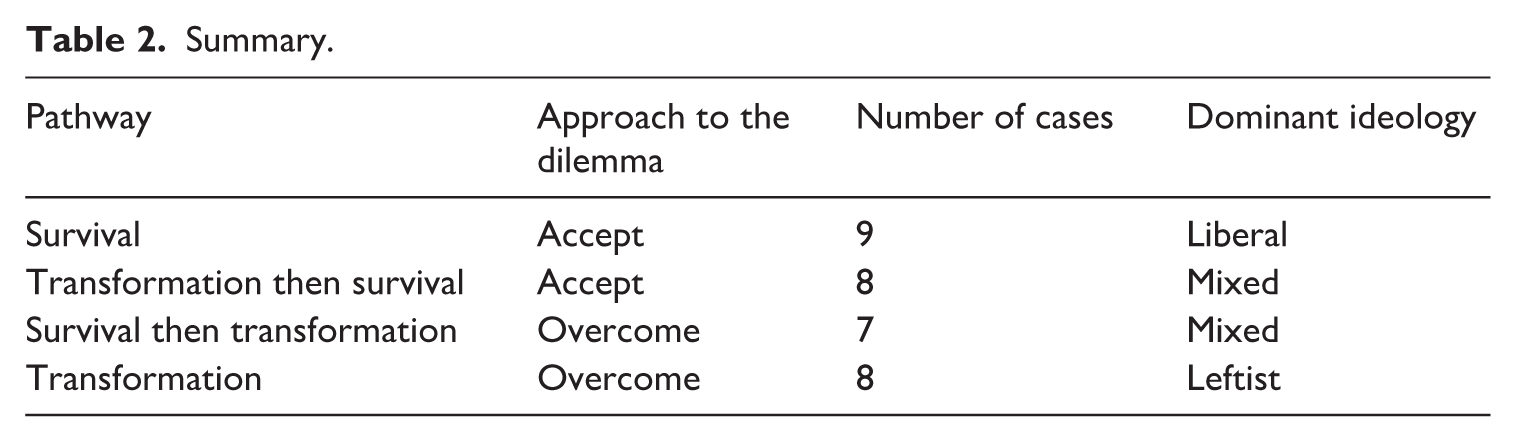
The four pathways are summarized in Table 2. Despite their differences, these four types are united in moderating their international revolutionary agendas in order to survive.
Summary.
Theorizing strategic acquiescence
How can we make theoretical sense of these empirical patterns? Four points emerge from the empirics. The first concerns the diversity of revolutions that engaged in some form of strategic acquiescence. Revolutionaries across the ideological spectrum engaged in strategic acquiescence, including leftist, liberal, religious, and right-wing revolutionaries. 21 Strategic acquiescence was most prevalent among right-wing revolutions (40%), followed by leftist (32%), liberal (21%), and then religious revolutions (13%). This ideological heterogeneity is exemplified by the diverse cast of characters grouped together in the category of strategic acquiesers. Both the Bolshevik and Russian February revolutionaries self-moderated (1916–1917), although to different degrees and for different amounts of time. The same is true of both the Kuomintang and Chinese Communist Party (1923–1949), as well as Hungary’s liberals and communists (1918–1919). The significant proportion of leftist revolutions that engaged in strategic acquiescence show that even radical ideologies, when implemented, can be responsive to survival concerns.
Strategic acquiescence also has a wide geographic reach, with revolutionaries in Asia, Europe, Latin American and the Caribbean, the Middle East and North Africa, and sub-Saharan Africa self-moderating their ambitions. Furthermore, strategic acquiescence is a feature of revolutions unfolding in states of all sizes. Revolutionaries in Russia, China, and Türkiye acquiesced, as did revolutionaries in the smaller states of Haiti, Nepal, and Peru. This diversity shows the difficulties of uncovering a unified framework, in which one or several factors would explain most cases of moderation. Rather than being compelled to acquiesce, revolutionaries choose to acquiesce. This is a choice that can be made by a range of revolutionaries and for different reasons.
A second point concerns the diverse trajectories of revolutionary moderation, which unsettle assumptions about relative uniformity. For Armstrong (1993: 1, 242–243, 270–271), revolutionaries are initially zealous in pursuing their radical agendas, becoming less utopian and more pragmatic over time. For Halliday (1999: 135–139), the dominant pattern is one of early moderation, or a “period of grace,” before cycles of international radicalism unfold. That we see different responses to the structurally similar spectre of great power counterrevolution suggests that structures underdetermine the possible pathways an agent might take. The four pathways outlined above show the significant scope for agent preferences, aims and deliberative processes to shape outcomes.
A third point concerns the reasons why revolutionaries choose one strategy of acquiescence over the others. Instead of drawing on a list of factors, such as elite polarization and external power support, the agential frame of this study highlights the more contingent roles of revolutionary forecasting, learning, experimentation and radical dormancy. For example, the prioritization of survival (Pathway 1) by Russia’s February Revolutionaries (1916–1917) and the powerholders that emerged from the Egyptian 25 January Revolution (2011) was the result of similar forecasts regarding the fatal consequences of great power counterrevolution. Failed experiments with radicalism resulted in the moderation of China’s Nationalist Kuomintang Revolution (1923–1928) and Haiti’s Revolution of 1946 (Pathway 2). Both the “Young Turks” (1908) and Nicaragua’s Sandinistas (1978–1979) reassessed the benefits of a radical course after trialling a more moderate approach (Pathway 3). The Bolsheviks (1917) and Muslim Brotherhood (1941–1969) reached similar assessments that relations with despised “imperialists” were essential in moments of precarity (Pathway 4). Beyond these processual explanations, ideology plays a patterning role as well. This is evident in the clustering of liberal revolutions in the first group, and communist revolutions in the fourth. Although all revolutions included in Table 1 had international goals, these goals varied in their extremity and scope. The degree of international transformation envisaged by revolutionaries in the first place affects transformation-survival calculations. 22
A final point concerns the relationship between revolutionary radicalism and counterrevolution. It has been argued that counterrevolution can radicalize revolutionary trajectories (see, for example, Bukovansky, 1999: 209–210 on the French Revolution; Halliday, 1999: 135 on Bolshevik Russia; and Walt, 2015: 49 on both). The cases of strategic acquiescence analysed in this study show the operation of the inverse logic: counterrevolution (threatened or otherwise) as leading to revolutionary moderation. The complex relationship between counterrevolution and radicalism (a point made by Goldstone, 2009: 26) highlights the contingency and complexity of revolutionary processes, as well as the role of the agents driving them.
Conclusion
This article has anatomized the phenomenon of strategic acquiescence. To this end, it has defined the phenomenon in conceptual terms; mapped its prevalence in the period between 1900 and 2020; and parsed strategic acquiescence into four different types. The theoretical implications are several. The different patternings of revolutionary pragmatism show how the common spectre of great power counterrevolution can lead to diverse agential responses. That strategic acquiescence occurs across ideologies, geographies, and temporalities highlighting the importance of a processual approach to understanding its causes (in contrast to one or several factors that cause acquiescence across time and place). Furthermore, strategic acquiescence highlights the ambiguous relationship between great power counterrevolution and revolutionary radicalism. This article has shown that the threat of counterrevolution, real or perceived, can dampen revolutionary ambitions, rather than stoke them. What strategic acquiescence means for the prospects of effecting radical change in world politics is varied. On one hand, it foregrounds revolutionaries’ agency in their attempts to pre-empt and influence great power responses. On the other hand, strategic acquiescence points to a conservatism in the global system which puts up multiple barriers to change. The first is strategic acquiescence via revolutionary self-moderation. The second is successful international counterrevolution. The third is socialization over time.
In this way, this study lays out the groundwork for further work on revolutionary pragmatism more broadly, and strategic acquiescence specifically. Two avenues for future investigation follow. First, the taxonomy developed in this paper allows new questions to be asked that were not previously available: Which type of strategic acquiescence is the most successful? Why are some types of strategic acquiescence more prevalent in some eras rather than others? Second is the question of whether strategic acquiescence works. Are revolutionaries who strategically acquiesce more likely to survive than their more radical counterparts? Important dimensions of this question include the ability to win power as well as long-run regime durability over decades (on this latter point, see Levitsky and Way, 2022). These and other lines of future inquiry stand to continue growing the relatively neglected but crucial field of revolutionary pragmatism, and its implications for transformation and stability in world politics.
Supplemental Material
sj-pdf-1-ejt-10.1177_13540661261438669 – Supplemental material for Strategic acquiescence: revolutionary survival versus international transformation
Supplemental material, sj-pdf-1-ejt-10.1177_13540661261438669 for Strategic acquiescence: revolutionary survival versus international transformation by Catherine Hirst in European Journal of International Relations
Supplemental Material
sj-pdf-2-ejt-10.1177_13540661261438669 – Supplemental material for Strategic acquiescence: revolutionary survival versus international transformation
Supplemental material, sj-pdf-2-ejt-10.1177_13540661261438669 for Strategic acquiescence: revolutionary survival versus international transformation by Catherine Hirst in European Journal of International Relations
Footnotes
Acknowledgements
For their comments and critique, I am indebted to George Lawson, colleagues in the International Relations Department (Coral Bell School) at the ANU, audiences at the ISA Annual Convention 2023, the OCIS biennial conference 2023, as well as two anonymous reviewers and the editors of this journal.

Funding
The author received no financial support for the research, authorship and/or publication of this article.
Declaration of conflicting interests
The author declared no potential conflicts of interest with respect to the research, authorship and/or publication of this article.
Supplemental material
Supplemental material for this article is available online.
Notes
Author biography
References
Supplementary Material
Please find the following supplemental material available below.
For Open Access articles published under a Creative Commons License, all supplemental material carries the same license as the article it is associated with.
For non-Open Access articles published, all supplemental material carries a non-exclusive license, and permission requests for re-use of supplemental material or any part of supplemental material shall be sent directly to the copyright owner as specified in the copyright notice associated with the article.
