



Abstract
Discourse plays a crucial role in determining how both persons and communities shape social reality and attribute meaning to experience (Edwards, 1997). This potential is mostly evident when the contended object of discourse is history itself, which is a peculiar area of the cultural mind. Hence, the discursive management of the collective tends to generate interpretations which in turn might mould personal and social identities. Sharing the spirit of the “innovations” brought about by cultural psychology (Valsiner, 2009), the present paper is intended to highlight how institutional and public discourses communicate different degrees of responsibility for the history of their own national group and, at the same time, how individuals construe historical identities with different degrees of guilt towards past events. Through a qualitative approach—the “diatextual analysis” (Mininni, 1992, 2001, 2005)—this paper proposes to investigate the rhetorical strategies adopted on occasion of some important commemorative events by the institutional spokesmen, as well as by the public opinion, to elaborate both positive and negative histories of their ingroup.
History as a discursive culture
Historical identity is a dialogical resource for human communities since it requires a dialectical positioning of the “self” to the “other”. As a research object, it might be usefully studied within the framework of the epistemological confrontation between the voices of realism and social constructivism. As a consequence, historical discourse might be considered as an enunciative modality of events that truly happened. Barthes (1967) highlights how the “facts,” which are supposed to be the subject matter of history, reveal an evident dependence on the process of attribution of meaning, and so take on a discursive nature. Historical data gain relevance thanks to sense-making procedures: the comprehension of events and their organization into a textual format demands a complex cognitive elaboration that, through the “dialogue” between different types of documents, allows the formulation of an evaluation and/or a judgment that specifies the meaning of the reconstructed events. Historical facts are a genre of reality that cannot reveal themselves: rather, they are discursively constructed, as long as the analysis of different sources shapes a series of events into a “form of life.”
Besides having a “side,” history is also necessarily “partial;” that is both “under-determined” as well as “over-determined.” It invests with novel, emergent facts and elaborations as a consequence of the interpretative process. Moreover, it comes to be understood according to the emotional and affective resonance that individuals retain of past events, thus keeping them alive within collective memory (Halbwachs, 1950). But the selectivity of historical discourse also originates from its own semiotic nature (Uspenskij, 1988), since its enunciator is conscious of having the task of keeping a world of signs alive, thus contributing to an unending chain of interpreters. Historians know that their understanding of the real world cannot be experiential, but rather is inferential since they proceed by following clues. Nonetheless, historians’ discourse anticipated the obsession for “data” and for the “explanation” that scientific discourse has, pursuing unique certainties of the senses. A basic distinction, which has also been assimilated by public opinion, places “chronicle” in the debatable dimension of subjective interpretations of events, while “history” is placed in the solid dimension of a more objective representation of how things have “actually” gone.
In this vein, the discursive nature of history has been overtly recognized by professional historians as well as by experts in the epistemology of history, according to whom “history exists only within discourse” (Lozano 1991, p. 129). As such, in the last decades, the postmodern turn has brought about a reinterpretation of the traditional conception of “history”: more than a mere recording of the past, history has become a dissemination of heterogeneous and conflicting “stories” (Martin & Wodak, 2003). Past time has disintegrated into a wide range of possible memories, which are continuously reconstructed by individuals and by experts through the communicative act of remembering, which is part of many contexts of social life as, for instance, institutions (schools, universities, etc.), media, political debates and many other different contexts of cultural elaboration (Fetzer & Weizman, 2006; Manuti, 2005).
The most important feature of these “stories” is not their loyalty to what has actually happened but rather the meaning that “collective pasts” acquire for the different social communities that have experienced them, and through which individuals “interpret” them. This is why they become a most important source of their culture (Wertsch, 2000, 2002, 2008, 2009).
Even with its fragile interpretations and narratives, historical discourse manages to penetrate the cultural background and act as an identity resource for a more or less wide group of people. The theories elaborate on a communal sense of history and allow us to think about history as the autobiography of a community (Leone & Curigliano, 2005). The narrative features of the historical text justify its utility as an identity resource for the personal and collective self. For instance, in the same way that the self narrative is generally focused on the production of the peripeteia, or the breakdown of the narrative balance which abruptly interrupts daily routine, the historical narrative also organizes different turning points and puts epochal transitions in order. In addition, similarly to the way narrative allows the renewal of experience and thus demands detachment from the course of events, history is marked by the greatest detachment and interest in what is no more.
Therefore, history furnishes both concreteness (widely recognized people and events) and temporality (a compelling form of narrative structure), both of which are powerful tools in constructing narrative about identity, and have dynamic implications for action. These narratives contain other descriptive components such as category systems that embody the collective experience and wisdom of the group, as well as their emotional implications. In this sense, the historical narratives of a group contain not only stereotypes but explanatory scripts, which often form analogies that guide responses to present situations (Feldman, 2001). They also contain narratives that create roles, confer legitimacy and prescribe policies. In this sense, they have both descriptive and prescriptive components that include, but are richer than, simple stereotypes and self-images. Finally, they also play a very significant role in the process of identification with one’s own group. Hence, groups produce and consume ingroup self-serving narratives concerning history which could be connected with a partial knowledge of history, as well as with a motivational process of ingroup identification (Doosje & Branscombe, 2003).
Ultimately, belonging to a national history is a very strong tie in and of itself. People may change nationality and social collocation but they cannot change the order of history, leaving their own generation and epoch. Actually this tie is not only a chronological one, nor does it assess simply the duration of personal existences. The history of a social group engages the group in identification since history is made up of public events, that is, situations and processes that—both for expert constructions as well as the common view—set up a compact and significant whole (Halbwachs, 1925). Therefore, the historical identity of a person and/or a community implies a sort of recapitulation of the meanings attributed to one’s own past, and it is adopted as a repertoire of interrelated symbols and representations that guide present choices which will lead the future (Liu & Hilton, 2005; Liu & Liu, 2004).
The cultural value of historical revisionism
As previously argued, history is a discursive culture as it is linked to recollections (Middleton & Edwards, 1990), namely to an enunciative network which is made up of “revisions” of past experiences, reorganized with the intention of constructing the present and planning the future. This dynamic nature of history allows it to become a discursive act—a semiotic artifact which produces meaning only within social communication (Rosa, Travieso, Blanco, & Huertas, 1999).
Nonetheless, the revision of history might be considered to be intrinsic to its nature: the past does not actually exist per se; rather its existence relies upon memory, sources, monuments, documents, witnesses and remains. On the one hand, these souvenirs can be partially manipulated, concealed, destroyed, counterfeited, while on the other hand, they are subject to a technical and philological reading which changes continuously along with the changes in both the perspectives and the technological media for investigation. The maxim according to which “the past cannot change” is a purely theoretical one, since its interpreters actually change it continuously. So, the ethical parameters which are most strictly linked to the political ones change together with the new acquisitions of data relative to the past (Wertsch, 2011).
Political arguments often involve the necessity to “pay historical debts.” Actually, both to make decisions in the present and to make plans for the future, a socio-cultural community must rely on a sufficient level of agreement on the interpretation of one’s own past (Curigliano & Mininni, 2004). This temporal continuity of identity within a socio-cultural community demands a continuous re-elaboration of collective memory. A certain mobility in the “public use of history” (Gallerano, 1995) is the effect of the change in perspective produced by the succession of narratives. For instance, the relationship between the reports on the past given by individuals and the production of history have been fruitfully investigated thorough the analysis of the intergenerational narratives about the adhesion to nazi-socialism by German families (Tschuggnall & Welzer, 2002).
Together with the changing of the stated situation, the narrative of experience underwent a perspective adaptation aimed at renegotiating the moral justification and the cultural framework. Debate among political parties contains reciprocal accusations of unfaithfulness to the truth, and/or a lack of interest in continuing to “remember” specific collective events from the past. The accusations are at their extreme when one party accuses the other of wanting to cloud the picture, making it necessary to intervene to stop the removal of social memories. This is what revisionism concretely aims at—that stream of historiography whose objective is to affirm the necessity to reread and modify the interpretation of past events. A strong version of revisionism is represented by an attitude of denial according to which some events (such as, for instance, the Shoah) have been amplified or even invented. Sometimes the historical past weighs so much on the identity of a social group that it can represent a possible explanation for all the prejudices that create problems in contemporary life (Curigliano, 2006).
Thus, historical situations, which are apparently overcome, might contribute to fostering grudges so entrenched that they leave open wounds, with very significant implications for intergroup relations. Collective memory can produce longings for peace, and tensions that create conflict, pride of having acted for good, and grudges for having both undergone and inflicted evil (Ensink & Sauer, 2003). If it is the historical inheritance which generates (at least partly) contemporary conflicts, then any investigation into the modalities through which individuals elaborate the meaning of their past in order to graft it on the present time acquires a highly relevant pragmatic importance, and is in consonance with the “critical” perspective of discourse analysis.
Accordingly, only a critical discourse analysis allows for the investigation of the needs which are intrinsic to the different interpretations of the past, and also responding to the demands of the present. Therefore, the memory of the “dead” is not profaned but rather constantly renewed, mutating under the formats which are best suited to contingent purposes. The issue of revisionism, traditionally reserved to the academic experts’ debate within historiography, has recently gained public attention in Italy, mostly because of the co-occurrence of certain political events and of the interest manifested by the media toward the debate about the history texts used in high school courses, judged to be not very objective, leading to the necessity of rewriting entire chapters.
The historical context of revisionism in Italy
The current Italian historical political situation can be better understood if one knows about the consequences of World War II and the ideologies that were inherited from it. After the fall of Mussolini (July 24–25, 1943), power was retaken by King Vittorio Emanuele III. A new government was created, directed by Marshal Badoglio, which asked the Allies for an armistice, which was made public on 8 September. More or less simultaneously Mussolini (who had been arrested and then liberated by the Germans) created a new fascist government, called the Italian Social Republic (RSI), with their protection. This government was located in the north of Italy, in the city of Salò. After the announcement of the armistice, some Italian forces that were in the area of the Balkans united with the partisan forces, while others remained loyal to Mussolini. At this point the Resistance began; groups of partisans attempted to definitively destroy Italian fascism. The results were tragic: to limit the actions of the partisans, enormous numbers of people were searched in various areas of northern Italy and numerous reprisals were committed (e.g., Fosse Ardeatine, Marzabotto). The Resistance developed a huge moral and political significance because it worked for the affirmation of new political and social institutions. However, this worried the Allied commanders who feared socialist theories, and for this reason the Allied forces helped the Resistance during the struggle against Nazis and fascists, but also asked them to give up their fight when Italy was completely freed from the Nazi occupation and a new democratic government was being created.
After the Resistance period, the National Committee for Freedom (CNL), which organized the political and military leadership of former partisans, wrote in collaboration with some of the most eminent intellectual leaders of the time, the Italian constitution, and this was taken as a basis for the new democratic life of Italy after the long fascist dictatorship. Nevertheless, the controversial issues of moral responsibilities for the bloody reprisals caused by partisans’ military actions and, more generally, the revisionist arguments about the version of the facts that should be found in the history books, were not bound to cease in time. On the contrary, the two ideological blocks, right and left, still argue today about the interpretation of this history, creating a situation of inter-group conflict which shows no signs of resolution. Actually, the present Italian political panorama is characterized by an articulated network of political parties which could be represented by two main stances, embodied by Casa delle Libertà and Partito Democratico, which roughly correspond to right-wing and left-wing arrays. Each array encompasses a variety of parties ranging from radical to moderate positions.
The study
Objectives
The main objective of the paper is to analyse how individuals and communities define their historical identity through discourses and narratives produced during public celebrations. These are often characterized by a selective procedure between what is considered better to be recalled and what is thought better to be forgotten (Ensink & Sauer, 2003).
Furthermore, two different discursive options are expected to be observed with reference to the reinterpretation and revision of the past, and to the allocation of the responsibility for such a discursive act. The first option blames the ingroup and depicts it as carrying the main responsibility for the consequences of past actions, thus inviting an active public recognition of such a role (self-focused revisionism). Conversely, the other option concentrates on the outgroup, thereby shifting the blame and, consequently, the responsibility to take decisions about the necessity to reinterpret the past (other-focused revisionism). These two historical and political orientations are expected to be constructed through totally different interpretative repertoires accounting for interlocutionary dynamics which push the speakers to exploit collective memory both as a symbolic resource useful for the construction of identity and as a weapon to keep “otherness” at a distance. Hence, the risk underlying the process of revision is “manipulation” of historical identity. This risk can assume two forms: glorification and trivialization (Todorov, 2004). Glorification is used in the construction of heroism, isolating some elements of an event and taking them out of their context and space. Trivialization consists of overlapping the past with the present through a simple process of homogenization, producing a double distortion of both the past and the present.
The two discursive options will be further explained thanks to the adoption of the semiotic square, that is a semiotic support which will help to organize meanings according to specific discursive profiles of historical identity.
Methodology
A qualitative methodology which is particularly suited to the analysis of the questions posed by historical revisionism is the diatextual approach (Mininni, 1992, 2005). As the etymology suggests, the prefix “dia” recalls both the dialogical and the dialectical process of meaning production which characterize each communicative act. From this perspective, sense is not conceived as a static category, rather it passes through texts by defining, shaping, negotiating and talking about identities and contexts. The diatext is a pragmatic instrument useful for a critical discourse analysis (Fairclough & Wodak, 1997; Van Dijk, 1998), which is aimed at grasping the dynamic and negotiable nature of any semiotic event.
By introducing the notion of “diatext,” we aim at conciliating the realist and constructionist views, in that context is assumed to be a productive force outside the text and within the text enunciators. What is talked about, in whatsoever discursive practice, gets its diatextual meaning from the dynamically sustained context of multiple-voiced and actively constructed relations occurring between ourselves and others. More specifically, the diatext is a psycho-pragmatic device useful for understanding the context as it is perceived by the enunciators of the text, as they imagine it, and show that they take it into account (Mininni, 2001). By this, the diatextual analysis may be a very precious and useful resource for cultural psychology in order to grasp, to understand and to explain the relationship between interlocutors, meaning, text, and context (Manuti, 2005).
From a methodological point of view, as a specific perspective within the frame of critical discourse analysis, diatextual analysis draws on the assumption that the meaning which emerges from text and discourse could be captured by the researcher if he/she questions him/herself on three basic questions: Who says that? Why does he/she say that? How does he/she say that? These questions together constitute the subjectivity argumentativity modality model (SAM) which guides text/discourse analysis.
The first question (who says that?) aims at clarifying the complex construction of sense production which is part of every communicative event, because the text speaks of its interlocutors, thus revealing the complex nexus between the representation the interlocutor has of him/herself and the representation he/she has of its ideal addressee. The subjectivity trait becomes more recognizable within discourse through the analysis of some pragmatic indicators such as, for instance, agent markers (i.e., active or passive grammatical formats etc.), emotion markers (i.e., proximity, evaluation, specificity markers, etc.) and embrayage/debrayage markers (i.e., the use of personal pronouns).
The second question (why does he/she say that?) identifies a dimension of pragmatic relevance which allows discourse to “articulate motives,” that is, to organize the “meanings-why,” to give voice to the objectives pursued by the interlocutor saying what he/she says. Adopting the perspective of normative pragmatics to investigate argumentation both dialectically and rhetorically (Jacobs, 2000), diatextual analysis pays attention to discursive cues such as “enjeu” markers (stakes, interests, etc.), networks of logoi/antilogoi emerging from different narrative and argumentative programs, and meta-discursive markers (attenuating markers, intensifiers, etc.).
The third question (how does he/she say that?) highlights the articulation of the “modus” of discourse according to which meaning is shaped acquiring a gestaltic nature which enables comparisons and evaluations such as “good or bad,” “beautiful or ugly,” “efficient or inefficient,” etc. Pragmatically speaking, the traits of discourse modality are recognizable through the analysis of narrative markers (i.e., uncertainty, intentionality, and coherence), markers of discursive genre (i.e., epic, comic, tragic, romantic) and opacity markers (i.e., frame metaphors).
Being semiotic signs, the traces of subjectivity, argumentativity and modality revealed by the texts allow the organization of a coherent profile, which emerges from the analysis of the “semiotic square” (Greimas & Courtés, 1979), 1 that is a means of refining oppositional analyses by increasing the number of analytical classes stemming from a given opposition of semantic categories. Such methodological option, as well as the data analysed in the following sections of the paper, should be read as a pragmatic proposal attuned with the main aims of the study, i.e., to consider history not in its academic dimension (historiography) rather as discourse about the past (popular history), as collective memory, thus focusing on its limited linguistic and rhetorical dimensions.
Therefore, the three basic questions posed by the diatextual approach, as well as the attempt to organize meanings into a semiotic square, have to be considered valid only in this limited range of today’s recorded history.
The corpus of data
The corpus of data is made up of a sample of public speeches and of letters sent to various Italian newspapers. The common topic is that of two historical commemorations relevant for both the European and the national scenario: the “Day of Memory,” celebrated on 27 January, and the “Celebration of the Italian Liberation,” celebrated on 25 April.
The choice of these two events has been motivated by the peculiarity of the commemorations implied. Though representing very relevant public celebrations sharing a common goal (i.e., the construction of a common historical identity), they actually differ from each other mainly with respect to the type of emotional states they might awaken, and for the kind of event they commemorate—the extermination of Jews and the liberation of Italy from the fascist dictatorship.
In more detail, the objects of investigation were:
Nineteen discourses of public officials in the Italian political and institutional scene. Specifically, six institutional officials (President of the Republic, judges and prefects), three representatives of the Italian Jewish community, five politicians belonging to the right-wing (radical or moderate), and five politicians belonging to the left-wing (radical or moderate). All of them were asked to take part in, and make a speech during, the several celebrations which took place on occasion of the 60th anniversary of the liberation of Auschwitz on 27 January 2005; Sixteen letters on the topic of the Day of Memory, published in some well-known Italian newspapers with different political orientations (e.g., La Repubblica, Il Corriere della Sera, L’Unità, Il Tempo, La Stampa, Il Manifesto, etc.), from January and February 2005; Twelve discourses by public officials in the Italian political and institutional scenario. The specific allocation of discourses was the following: two institutional officials, three politicians belonging to the right-wing (radical or moderate); five politicians belonging to the left-wing (radical or moderate). All of them were asked to take part in, and talk publicly during, the several celebrations which took place on occasion of the 60th anniversary of the liberation of Italy from the fascist dictatorship, on 25 April 2005; Eleven letters on the topic of the Celebration of the Italian Liberation, published in some of the most well-known Italian newspapers with different political orientations (e.g., La Repubblica, Il Corriere della Sera, L’Unità, Il Tempo, La Stampa, Il Manifesto, etc.), from 2001 until to 2005.
The composition of the corpus was intended to allow the comparison between the institutional opinion and the public opinion with reference to the meanings attributed to these two public celebrations. By the term institutional opinion, we mean what might be said by individuals with the responsibility of representing socio-cultural groups (State organs, political parties, trade unions, ethnic associations, religious associations, etc.). The institutional opinion becomes a part of social discourse through the filter of the obligation to give voice to a delegation or representative. On the other hand, the public opinion has no such limitation, rather it (re)produces itself through social interaction.
Nonetheless, the institutional opinion and the public opinion have many reciprocal relationships—although with different discursive patterns. A point of connection between them which is particularly transparent can be found within the “Letters to the Editor,” (or the “readers” column) which characterizes the discursive organization of both the daily and the periodical press system. The interest for this discursive genre is recognizable not simply in its dialogical attribute (reader’s letter–editor’s answer), but mostly within the possibility to unmask the reciprocal influence between what might/should be said on a given subject matter to represent the interests of a specific institutional claim and what can be said openly in the confrontation between opinions which answer to biased interests competing with each other.
The data have been analysed using diatextual analysis so as to trace, through the adoption of the SAM model, the interpretative repertories (Potter & Wetherell, 1987) of historical identity and the rhetorical strategies used by the interlocutors and by the readers to understand and frame the history of their national group’s object of commemoration.
Results
The distorted pathos of the Day of Memory
Detaching from a guilty past: The institutional discourses.
Diatextual analysis aims at identifying the pragmatic aspects implied within the processes of meaning production and consumption, thus highlighting how interlocutors posit themselves reciprocally through discourse. With reference to the specific part of the corpus linked to the commemoration of the Day of Memory, the analysis of meanings’ production has been organized into a semiotic square which has allowed the recognition of four argumentative patterns. These are connected with specific identity profiles (or enunciative positions), and thus with different interpretative repertoires used by the interlocutors to cope with guilt and to frame historical identity as the object of discourse (see Figure 1).
Semiotic square of the discursive positions within the commemorative texts.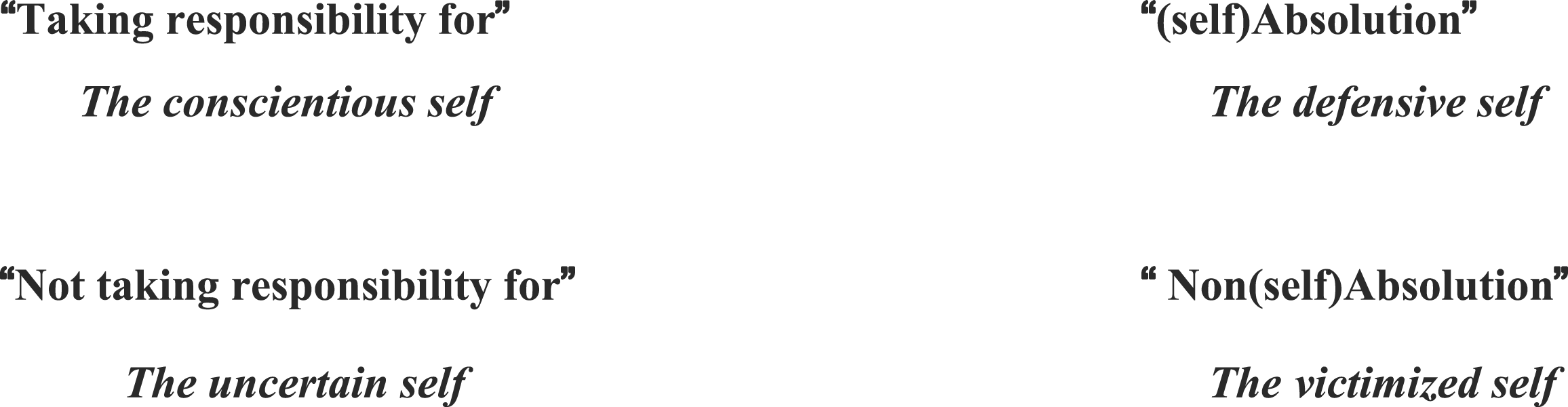
The discourses which refer to the Day of Memory use meanings which define the elaboration of a guilty past first of all through the semantic opposition between “taking responsibility for” and “self absolution.” The first category (taking responsibility for”) shows the necessity to manifest personal engagement and to make public acknowledgment of the immoral behavior displayed by the ingroup in the past. Discursively speaking, it moulds a “conscientious self.”
On the other side of the square, the second category (“self absolution”) takes a distance from a personal involvement into the ugly historical episodes, which are the object of commemoration, defining the interlocutor’s identity in terms of a “defensive self.”
A third and a fourth category emerge as sub-oppositive dimensions to the first ones. These are, respectively, “not taking responsibility for,” when the interlocutor tends to attribute the cause of the events to external sources such as, for example, fate, and “non self absolution,” when responsibility is shared at a higher level (European or international) rather than denied, thus discursively surfacing as the adoption of compensation and expiation strategies. As for the identity profiles defined by these last two categories, the fourth category depicts a “victimized self” while the fifth an “uncertain self.”
The complex nature of the texts analysed makes difficult a neat definition of the discursive contributions in terms of categories, as long as a single discourse might draw in the meantime on different positions of meaning according to very complex modalities. Hence, the texts might be constructed both with strategies which are completely focused on one of the four poles of elaboration of the negative past and with strategies that alternate the different patterns aiming at orienting the public need for identification, thus making certain patterns more salient than others. Nonetheless, diatextual analysis has contributed to the investigation of the discursive cues which are distinctive of the four identity profiles.
More specifically, the discursive category “taking responsibility for” organizes meanings that focus attention on the absurdity of undermining the active role of one’s own group within the negative episodes which are recalled. The interpretative repertoire is made up of words and locutions which recall the “moral duty to remember” and the “engagement in building a society of free people,” drawing an argumentative profile which is compatible with the conscientious self. Through affect markers (“ugly events”) and embrayage procedures (“our country”) the institutional speaker invested with national institutional responsibilities (i.e., the President of the Republic) enhances a strong identification with the past and acknowledges the responsibility for what has happened. This kind of discourse highlights how the recognition of mistakes and faults might lead to the redemption of the whole community. (1) Questi terribili eventi hanno temprato l’identità della nostra nazione lasciando una traccia indelebile nella coscienza collettiva. Nacque allora la volontà di riscatto, l’impegno per costruire una società di uomini liberi, votati alla costruzione di un mondo di fratellanza fra i popoli che, in tutti questi decenni non abbiamo dimenticato. (C. A. Ciampi, presidente della Repubblica, discorso pronunciato in occasione della premiazione del concorso “I giovani ricordano lo Shoah” presso il Vittoriano) These ugly events have strengthened the identity of our country leaving an indelible trace in the collective conscience. Then a will for redemption was born, the commitment to build a society of free people, devoted to the maintenance of a world of brotherhood among different populations, which we have not forgotten in all these decades. (C. A. Ciampi, President of the Republic, discourse given on occasion of the prize “Young people recalling the Shoah” at the Vittoriano)
The discursive category of “self-absolution” organizes meanings which reveal the attempt to push back the faults that the public opinion attributes to the group which is speaking. In this case, the interpretative repertoire is characterized by expressions which manifest doubt (“we expressed perplexities”) and denial of guilt (“has never had the responsibility for”). The rhetorical construction of the text enhances the identification with an honest past and with a “fair” historical group, through debrayage procedures (“Italians attempted (…),” “the fascist regime promulgated racial laws”) which allow the interlocutors to distance themselves from the choices made by their ideological group, which, in a certain sense, were unavoidable (“forced by the agreement with Germany”). This pattern of argumentation is coherent with the defensive self. (2) Io, Storace e altri esprimemmo perplessità perché ritengo che la destra italiana non abbia avuto responsabilità nello sterminio di massa degli ebrei. Gli italiani tentarono di salvare molti ebrei e il regime fascista fece leggi razziste trascinato dall’accordo con la Germania. In realtà l’Italia anche fascista non condivise queste leggi e ricordo sempre quello che diceva Almirante che, dopo aver salvato molti ebrei, fu aiutato a sopravvivere negli anni ’45 e ’46 proprio da un ebreo che lui aveva salvato. (Domenico Gramazio, politico centro-destra, discorso pronunciato in occasione della visita allo Yad Vashem) Me, Storace and others expressed perplexities because I think that the Italian right-wing has never had the responsibility for the mass extermination of Jews. Italians attempted to save many Jewish people and the fascist regime promulgated racial laws, forced to by the agreement with Germany. Actually, Italy, even fascist Italy, never agreed with those laws and I always remember that Almirante said that, after having saved many Jews, he was helped to survive in 1945 and 1946 by a Jew he saved. (Domenico Gramazio, radical right-wing politician, discourse given on occasion of the visit to the Yad Vashem)
The category of “not taking responsibility for” organizes meanings which shift the emphasis to the factual nature of the commemorative practice. Then, the speakers who adopt such strategy aim at liberating their group from the responsibility for the events, which are seen as an unavoidable fate, implicitly attributing guilt to the outgroup. Through ontological metaphors, such as a “beating heart,” historical memory is represented as still being alive, but the rhetorical construction of the text enhances a low identification with a guilty past, thus making more salient the presence of the wounded national group rather than attributing a necessary historical causality to events. The argumentative pattern reveals a victimized self which is typical of Italian Jews: the speaker in Extract 3, being himself a Jew, tends to mark the mistakes of his national group (“Italians”) and to side with the victims (“Jews”). (3) Fossoli è stato il cuore pulsante della deportazione degli ebrei dall’Italia, e chi ha avuto a che fare con Fossoli in qualsiasi modo e poi con Bolzano Gries dopo il suo trasferimento, è corresponsabile della Shoah, qui gli storici devono indagare il livello esatto delle persone coinvolte, ma la responsabilità è data oggettivamente dagli avvenimenti. (Michele Sarfatti, giornalista ebreo, discorso pronunciato presso la Scuola Superiore dell’Amministrazione dell’Interno) Fossoli was the beating heart of the Jews’ deportation from Italy, and those who worked with Fossoli and then Bolzano Gries after the deportation, are co-responsible for the Shoah, here the historians should investigate the exact degree of responsibility of the involved people, but anyway the events objectively show the responsibility. (Michele Sarfatti, Jewish journalist, discourse given at the High School of Internal Administration)
Finally, the category of “non self-absolution” organizes meanings that depict history as an object to store in a museum, therefore all the attempts performed to compensate the evoked evil are listed in detail. This argumentation pattern is mostly displayed by the high institutional officials (i.e., prefects) when they do not directly avoid responsibility but rather propose alternative solutions to the sense of guilt. The detachment from personal involvement and responsibility is discursively constructed through the use of debrayage strategies and cut off passive forms (“to not forget many monuments have been built”). (4) Per non dimenticare sono stati eretti monumenti—per esempio lo Yad Vaschem,—diffusi antichi e tristissimi filmati, soprattutto in questi giorni, raccolte testimonianze di superstiti dell’olocausto, perchè chi ascolta diventi esso stesso testimone. Sono stati altresì assegnati dallo Stato italianoriconoscimenti ufficiali per episodi di eroismo compiuti da singoli e da intere comunità—facciamo gli esempi di Palatucci, di Perlasca, ricordato presso il Museo di Carpi (Modena). (A. M. D’Ascenzo, prefetto, discorso pronunciato presso la Scuola Superiore dell’Amministrazione dell’Interno) To not forget many monuments have been built—for instance the Yad Vaschem,—many old and sad films have been broadcast and, especially in these days, many witnesses’ narratives have been collected, so those who listen to them might become witnesses as well. Much official recognition has been assigned by the Italian State for many heroic episodes accomplished by individuals and whole communities—some examples are those of Palatucci and Perlasca, remembered at the Museum of Carpi (Modena). (A. M. D’Ascenzo, prefect, discourse given at the High School of Internal Administration)
In each of the four categories, though the argumentative patterns differ, the aim of the speaker is to detach from a disgraceful past. Hence, the degree of responsibility taken for this ugly page of history is explicated through the identification with one of the four main actors of this historical episode: the victim, the fair, the unfair, and the indifferent (the distracted).
When the aim is to define one’s own identity profile through the identification with “the fair,” responsibility is projected toward the outgroup taking a distance from it or rather being in opposition with it. Even if the embrayage strategies (“our territories”) evoke the involvement of the whole national group taking the responsibility for what has happened, the outgroup is explicitly depicted as salient (fascist Italy) to avoid blame on the whole country for this ugly event. As a consequence, the discourse aims at attenuating the sense of guilt which is generally brought about by the memory of such historical episodes. Actually any decision was undertaken by the dominant political party of the time. (5) E grande fu anche la responsabilità dell’Italia fascista in questa tragedia, per i campi di concentramento costruiti nel nostro territorio, per le persecuzioni, le uccisioni, ledeportazioni di migliaia di cittadini italiani di origine ebraica. (Luciano Neri, politico centro-sinistra, discorso pronunciato presso la sede del partito) Fascist Italy was also hugely responsible for this tragedy, for the concentration camps built in our territories, for the persecutions, the murdering, the deportations of thousands of Italian Jews. (Luciano Neri, moderate-left politician, discourse given at the siege of the party)
When the construction of the historical self goes through the identification with the victims the discourse focuses on the denouncement of the sufferings produced by the events. (6) Siamo qui per ricordare che ci sono state tante persone coinvolte e travolte dalle atrocità delle leggi razziali anche nel nostro paese. Per ricordare che questa è una memoria viva, come viva è l’esigenza della libertà. La libertà non è un’acquisizione oggi e per sempre, ma è sempre a rischio. (Francesco Rutelli, politico centro-sinistra, discorso pronunciato presso il Museo del Vittoriano) We are here to remember that many people have been involved in the atrocities of the racial laws even in Italy. To remember that such a memory is still alive, as long as the need for freedom is alive. Freedom is not an acquisition today and forever, rather it is always at risk. (Francesco Rutelli, moderate-left politician, discourse given at the Museum of the Vittoriano)
The speaker in Extract 6 justifies his institutional presence at the commemoration on behalf of the Nation, not only to take the responsibility for the events, but rather to highlight how also “our” country has been victim of the others’ deeds. Conveying a heavy sense of responsibility, the discursive construction of the self is connected with the identification with those who have been unfair, thus eliciting the recognition of the faults performed both at a national and international level. This intention is particularly evident in the discourses given by institutional officials, as in the following example. (7) Sul nostro Paese pesa l’ignominia delle leggi razziali, che furono approvate nell’indifferenza dei più, lacerando la coesione morale della comunità nazionale: un fatto grave, di cui l’Italia porta dinanzi alla storia una responsabilità che non può essere né sminuita néignorata. (Pierferdinando Casini, presidente della Camera, discorso pronunciato in occasione di un concerto durante il Giorno della Memoria) The ignominy of racial laws weighs on our country. Most people were indifferent about their approval, although they tore the moral cohesion of the national community: a serious event, for which Italy has a responsibility which cannot be undermined nor ignored. (Pierferdinando Casini, President of the Chamber, discourse given at the opening of a concert celebrating the Day of Memory)
The political rhetoric of the institutional officials devises more vividly a clear identification with a guilty past, while the rhetoric of politicians often moves between accusations and defences. Thus, the rhetoric of politicians is aimed at attenuating the responsibility, either by highlighting the negative aspects of the unfair political group or by siding with the wounded party.
Defending the community from a negative history: The letters
The dialogue (and the dialectics) between institutional opinion and public opinion on the topics of collective memory within the frame of the Day of Memory marks a particularly relevant pathway within the construction of historical identity.
A first element of distinction between the institutional discourses of commemoration and those reported in the letters consists in a strategy of extensive expression. Generally, the readers tend to underline how the “negative pages” of our history are more numerous than those which are officially recalled. This option is concretely aimed at delegitimizing the discursive acts performed by the institutional actors and in the meantime at collectively acknowledging the faults and mistakes which in good and evil would always be part of a common historical identity.
In this vein, the authors of the letters consider the Day of Memory as a precious occasion to “pay back” the misfits which have characterized this page of the past and for which their own national group is recognized as the main one responsible. Recalling one of the most tragic events of this guilty past (the Shoah) is not sufficient to erase the many other aspects of negative history which should also be remembered. This discursive trait marks the features of the conscientious self already identified in the institutional discourse and focuses on the necessity to take the responsibility for the negative past. (8) La memoria non è soltanto l’olocausto, la memoria è fatta di tanti piccoli e grandi drammi umani, di disperati alla deriva, di bambini sfruttati, di emarginati di ogni genere (…) la tragedia che si compie giorno dopo giorno ci deve richiamare alla nostra coscienza di uomini. (Il Manifesto, 27 gennaio 2003) Memory is not simply the holocaust, memory is made up by many little and huge human dramas, by desperate people at the shoreline, by exploited children (…) the tragedy happening day after day should awaken our consciences as human beings. (Il Manifesto, 27 January 2003)
Therefore, by enlarging the range of ugly events which need to be accounted for, the authors of the letters aim at keeping out the sense of guilt due to the crimes for which their own national group is responsible: “We are responsible for what has happened as well as for many other similar events.” Through the association of the memory of the Holocaust with other similar tragedies, the individuals defend their historical identity. Memory is described by the reader (and exploited by the newspaper) as a container which collects human dramas of different degrees of relevance, thus avoiding the risk of justifying the unfair behavior of one’s own ingroup.
Actually, the letters also bear witness that the authors might place themselves in a position which allows them to choose different degrees of responsibility. Discursively speaking, higher degrees of responsibility are generally constructed through a frequent use of embrayage strategies (“our conscience of men”) which find resonance in the strategic use of metaphors such as that of the “weight on the conscience,” which allows the explanation of “difficult breath” due to the past (Zamperini, 1998). (9) La memoria è un dovere. E il ricordo delle sofferenze e delle persecuzioni che il popolo ebraico ha dovuto subire pesa ancora come un macigno sulle coscienze di noi europei. (Il Manifesto, 28 gennaio 2003) Memory is a duty. And the memory of sufferings and persecutions that the Jewish population has undergone still burdens as a boulder on the conscience of us Europeans. (Il Manifesto, 28 January 2003)
Moderate levels of responsibility are found in the argumentations which do not explicitly declare responsibility for the negative historical episodes which are discussed. For instance, extract 10 shows such a position, which is discursively conveyed by the alternate use of embrayage (“our community”) and debrayage strategies (“all the Jews”). Guilt cannot be fully expressed until the ingroup makes the effort to recognize the relevance and consequences of other similar human tragedies (“it is not fair to forget”). (10) E’comprensibile che la nostra comunità ebraica appoggi incondizionatamente questa campagna per il Ricordo, ma non è giusto che dimentichi i tanti ebrei, dirigenti e popolo perseguitati, inviati nei gulag, uccisi nell’Urss comunista. (Corriere della Sera, 31 gennaio 2005) It is comprehensible that our Jewish community support unconditionally this campaign for the memory, but it is not fair to forget all the Jews, institutional charges and persecuted people, sent to the gulag, murdered in the communist USSR. (Corriere della Sera, 31 January 2005)
A similar demand for completeness in the reconstruction of historical identity is not free from political ambivalence since it might be meant both as an improvement and as an attenuation (“a watering down”) of the degree of “responsibility” which depends on the political position of the speaker, right- or left-wing.
When the texts of the letters define a profile of the speaker which is coherent with the “defensive self” then they make reference to argumentative patterns which highlight lower degrees of responsibility suggesting a tendency to (self)absolution from any past faults. This desire results from the enhancement of a recurrent analogy, which depicts “history” as if it were a “book.” (11) Espressioni come “male assoluto” nei confronti del regime fascista e “pagina vergognosa della nostra storia” nei confronti della Repubblica di Salò, mi sembrano eccessive e persino concettualmente insostenibili (…) Di quella infelice pagina di storia italiana, insomma, si può non generalizzare il giudizio negativo: malgrado tutto, non mancava qualche sprazzo di prestigio. (La Stampa, 30 gennaio 2003) Expressions of “absolute evil” toward the fascist regime and “shameful page of our history” talking about the Republic of Salò are excessive according to me and sometimes conceptually unsustainable (…) The negative evaluation about that sad page of Italian history cannot be generalized because despite everything Italy experienced also brief moments of prestige. (La Stampa, 30 January 2003)
If the pages of the “book of history” that need to be erased are very few, it is because the general evaluation of history is more or less positive. Both “shame” and “sadness” are negative emotions, but they differ with respect to the degree of responsibility taken toward the event.
Another marker which reveals the different enhancement which can be given to this strategy can be found in the use of another metaphor adopted to frame the meaning attributed to the Day of Memory—the “chain.” If the link with the past is seen as a chain then the speaker implicitly expresses the desire to avoid taking the responsibility of negative history. (12) La giornata della memoria sembra una catena che obbliga a pensare a ieri impedendo di guardare all’oggi e al domani. (Il Tempo, 29 gennaio 2004) The day of memory appears to be a chain which pushes us to think of yesterday and blocks us from looking at today and tomorrow. (Il Tempo, 29 January 2004)
The use of the third person inclusive, an interpersonal meta-discursive marker, allows the introduction of public opinion as a thought which is largely shared by the readers. Therefore, it argues against those who bring up the “duty to remember.”
The “divided memory” about 25 April
The rhetoric of heroism: The institutional discourses
Every year on 25 April, Italy celebrates the “Italian liberation,” thus remembering 25 April 1945, when a great part of the national community denied the fascist regime, choosing democracy. From 8 September 1943, Italy was divided into two sectors: south and central Italy were occupied by Anglo-Americans (who supported the old “Realm of Italy”) and part of the middle and northern regions were occupied by the Germans (who supported the fascist regime of the “Republic of Salò”).
In turn, the identity of the national community still shows evident wounds of such an event, which mirror the several difficulties experienced in thinking about one’s self in terms of a unique historical and cultural identity. Then, the “war of liberation” (and of recomposition of national unity) became a sort of “civil war” between Italians who were “faithful” to fascism and Italians who were “opponents” to fascism (or “resistant”). The birth of the State through the promulgation of the new Constitution in 1948 (still valid in Italy) was not sufficient to facilitate the reconciliation between the two ideological groups and the tear in the national identity has not been completely mended today; rather, it has been translated into a political debate between the moderate left-wing (which identifies with the winning partisans) and the moderate right-wing (which tends to identify with the motives of the “pure” fascists).
Consequently, even if the Celebration of the Liberation (or the 25 April Celebration), represents a relevant support to collective memory (Dei, 2004; Dei & Clemente, 2005) and functions as a sort of official ritual for Italy, this event still has not succeeded in becoming a solid collective memory of its citizens (Brockmeier, 2010; Rusconi, 1995; Tulviste, 2011).
The period of the “civil war” has fostered two separate routes of interpretation: a “red” memory (of the winners) and a “black” memory (of the losers). Actually, this opposition of memory refers mostly to the active minorities which are interested in the political debate. Therefore, a third category of interpretation of memory might be taken into account, a “grey” memory, which can be applied to the “passive majority” (Chiarini 2005, p. 13) of the community, which tends to attribute a non-significant meaning to those events. The social discourses that commemorate the Celebration of the Liberation every year give these memories the chance to be debated, thus renewing the conflict in light of the changing political conditions which frame the national community.
The celebration of 25 April 2005 has received special attention since the 60th anniversary of the liberation. The official discourses given on such occasion might be classified as belonging to the discursive genre of “commemoration.” In such a discursive context, the higher institutional officials tended to interpret the meaning of the commemoration as an occasion to emphasize the founding values of the country. In this case, the discursive construction of memory appeals to the rhetoric of heroism. The commemoration should be seen as recognition of the heroism of those who fought to give freedom to an entire community, thus giving birth to the Italian identity. The analogical frame through which the image of memory is projected is that of a living organism. Memory has never been as alive as on this occasion, where memory is not simply past, but also present and future for the younger generations. (13) Possa la memoria dei sacrifici dei padri della repubblica rimanere viva tramandata di generazioni in generazione guida e monito ad essere sempre vigili nella difesa della libertà riconquistata. (C. A. Ciampi, presidente della Repubblica, discorso pronunciato in occasione della cerimonia di consegna delle medaglie d’oro al merito civile presso il palazzo del Quirinale) That the memory of the sacrifices of the fathers of the republic might be kept alive and be handed down from one generation to another, as a guide and warning to be always watchful in the defence of the recaptured freedom. (C. A. Ciampi, President of the Republic, discourse given on occasion of the Gold Medals’ assignment for civil value at the Qurinale)
In this case, the rhetorical strategies adopted by the institutional speakers are characterized by an almost exclusive use of embrayage markers, aimed at creating involvement and consent. In such a context, sharing a common view of the event commemorated appears to be a strategic option within the construction of historical national identity. With reference to the semiotic square presented above, these texts mould the conscientious self. (14) Se dunque guardiamo in avanti nella direzione indicata dai nostri martiri vediamo vicina la meta che Lei signor Presidente della Repubblica interprete scrupoloso della resistenza ci ha sempre additato. (Giuseppe Pisanu, ministro dell’interno, discorso pronunciato in occasione della cerimonia di consegna delle medaglie d’oro al merito civile presso il palazzo del Quirinale) If we look forward in the direction shown by our martyrs we see we are nearing the goal towards which You Mr President scrupulous interpreter of the resistance, have always led us. (Giuseppe Pisanu, Home Office Minister, discourse given on occasion of the Gold Medals’ award for civil merit at the Qurinale)
The statement contained in extract 15 is particularly important since generally moderate right-wing politicians, such as the Home Office Minister who delivered this talk, tend to ignore the celebration of this event. In this case, the celebration of the glorious events which have contributed to shaping our national historical identity constantly appeals to the political conflicts which characterize the present scenario. Discursively speaking, this example contributes to shaping the victimized self. (15) Da diversi anni ormai correnti politiche sono interessate ad annacquare la memoria ed il valore dell’antifascismo, cercano di minimizzare il significato della resistenza e di relativizzare le scelte dei protagonisti di quel tempo. Si tratta di tendenze che vanno contrastate. Chi combatté contro i nazisti e contro la Repubblica di Salò (garibaldino, azionista, democristiano o soldato del Regio Esercito) non potrà mai essere considerato allo stesso modo di chi combatté magari in buona fede per una Italia serva e vassalla del III Reich. (Romano Prodi, politico di centro sinistra, discorso pronunciatoin occasione di una celebrazione pubblica del 25 aprile) In recent years, some political groups are interested in watering down the memory and the value of antifascism, thus trying to minimize the meaning of the resistance and to make the choices of its characters relative. These are trends which need to be contested. Those who fought against the Nazis and against the Republic of Salò (Garibaldians, Actionists, Democratic-Christians or Soldiers of the Royal Army) should never be considered in the same way as those who fought, possibly in good faith for the sake of Italy, a servant and vassal of the Third Reich. (Romano Prodi, moderate left-wing leader, discourse given on occasion of the public celebration of 25 April)
Despite the emotional and rhetorical tones largely shared by each discourse, the commemorations pronounced by the political representatives reveal how liberation still remains an event, whose interpretation and intrinsic value are reserved only to a small group of people. The axis of modality which emerged by the diatextual analysis of these discourses accounts for the opacity of communication marking the actual social divisions which still exist within the same national group. Therefore, the analysis of these speeches, though apparently aiming at celebrating a common national commemoration, highlight discursive positions which are ideologically oriented and that base their rhetorical power on the salience attributed to a particular political group (Van Dijk, 1998; Wodak, 1989; Wodak, de Cilla, Reisigl, & Liebhart, 1999) thus revealing the actual difficulty of any kind of reconciliation, since strongly anchored to the features of the defensive self.
Pride as the matrix of historical identity: The letters
The analysis of the corpus of letters collected on occasion of this commemoration clearly reveals the cleft between two memories: a right-wing memory and a left-wing memory. The commemoration of Italy’s liberation from the Nazi-Fascist yoke becomes an occasion to put the spotlight on the political battle between ingroup and outgroup. In this case, memory is defined as imperfect since it is told only by the voice of the outgroup. More simply, the author’s identity is shaped through their belonging to a specific social group (“Me as a left reader”). Probably, this is more than a stylistic option: it is a discursive strategy aimed at constructing one’s own identity in terms of similarity with the ideal reader of the newspaper.
From a rhetorical point of view, this psychological urgency emerges clearly in the use of specific allocutions (“Dear companions” or “Open letter to all who see 25 April as a special day”) that beginning with the introduction tend to mark the boundaries of identity thus signaling to the reader not only the polemical tone of the letter but also the web of positions and the enjeu (issues) that the authors would like to put at stake.
On the one hand, memory acquires an ontological value as long as it is considered as the root of the Italian identity; on the other hand, memory represents a further occasion to reflect on and to keep watching against the violation of the values that belong to any democracy. In this perspective, remembering and commemorating become vital discursive acts in order to avoid the repetition of injustices and at the same time to understand, and make others understand, the relevance of this event, especially for the younger generations, who have not directly experienced such events. (16) La memoria è vitale, ha costruito l’uomo (…) Il progresso fatto in un secolo non è ancora stato metabolizzato dalla maggior parte delle persone che stentano a riconoscerlo. Da questo nasce la critica non obiettiva al presente ed il desiderio di tornare indietro. Sono convinto però che nessuno sarà felice qualora gli venissero negate le conquiste fatte in questi decenni per cui sono tranquillo pensando che la destra potrà occupare solo una breve parentesi nell’Italia di oggi. (L’Unità, 26 aprile 2001) Memory is vital, it has created man (…) the progress accomplished within a century has not been metabolised yet by the majority of people who still have difficulties recognizing it. From this the non objective critique of the present is born, as well as the desire to return to the past. Nonetheless, I am convinced that nobody will be happy if the feats accomplished within these decades are erased, so I remain calm, thinking that the right-wing may only be a short phase in today’s Italy. (L’Unità, 26 April 2001)
This last extract shapes a discursive position which is often present in this part of the corpus: the nostalgia for the past. Generally speaking, to recall past history means to associate contexts and events with the regret for what has been. In this case, to recall and to commemorate events, such as the liberation, become communicative practice which are fundamental for a coherent recording of the past and for the reconstruction of the meaning which need to be attributed to things and events, in view of a more lucid reading of the present. Memory is represented as a mirror in which present national identities are recognizable through the light of the past. Basically, the present cannot be translated without the past. Nonetheless, this interpretation and sense-making process loses its meaning if objectivity is missing and if the reading of history is marked by a critique which is aimless. This discursive position is enhanced by the reference which is quite explicit to the political outgroup (the government’s majority) that takes distance from this celebration and from its intrinsic meaning.
According to the analysis of this part of the corpus, memory is thus divided: on the one hand, there are those who think they have contributed to writing history; and, on the other hand, there are those who feel they have undergone it. As for the categories organized in the semiotic square these texts show the uncertain self.
An example of such a discursive dynamic is given by the following extract, where the rhetorical strategy of embrayage (“Why do they not celebrate with us in Bologna one of the most glorious historical moments of the country?”) is used to underline how incoherent the behavior of the government is, thus further marking the opposition between good and evil and at the same time highlighting the need for a common history which could overcome any political barriers and be shared by all. The argumentative option in this case highlights the dialogical dimension of the debate that is discursively constructed by evoking shared positions which aim at explaining how such a political option is not justifiable at all. It does not fulfill either the governmental program or the sharing of the fundamentals of national identity. (17) Perché il gruppo di partiti della casa delle libertà che rappresenta milioni di elettori non si presenta alle manifestazioni a Bologna? Perché non festeggiano con noi bolognesiuno dei momenti storici più gloriosi del Paese? Eppure è il momento in cui migliaia di persone unite hanno lottato e sono morte per la libertà per costruire i fondamenti di questo stato e della costituzione. La parola libertà è sempre sulla bocca della maggioranza di governo e di essa ci si è serviti più di una volta per la propaganda di partito. La domanda che vorrei porre è: ciò che l’Italia ha espresso con la Resistenza è forse di sinistra? (La Repubblica, 26 aprile 2005) Why does the group of political parties of la casa delle libertàa representing thousands of voters not attend the manifestations in Bologna? Why do they not celebrate with us in Bologna one of the most glorious historical moments of the country? Despite the fact that this was the moment where thousands of people fought together and died for the freedom and the birth of this country and of the constitution. The word freedom is always on the tongues of the government majority and it has been useful for them many times in political campaigns. The question I would like to pose is: Is what Italy expressed with the resistance something of the left? (La Repubblica, 26 April 2005)
In accordance with the opposition between political arrays, the most frequently adopted analogical framework to describe the game of positions which characterizes the divided memory is that of a “battle,” a typical metaphor of political language (Chilton & Ilyn, 1997; Cortini & Manuti, 2007; Masci & Semino, 1996).
In closing
In the negative utopia depicted by George Orwell in 1984 (Orwell, 1949), the activity of the main character, Winston Smith, is to modify the contents of the articles of the Times so that they could better suit the version of history desired by the Big Brother and expressed in the neo-language of Socing. The expressive practice of this literary figure evokes the horror of the serious immorality which covers the excesses of a revisionist tension that human beings express in talking/writing about their history.
The analysis of the commemorative discourses has revealed the link between a common feeling manifested by individuals and the historical identity of the community (Curigliano, 2006; Leone & Curigliano, 2009). The issue of reconciliation with historical identity is one of the most complicated problems that the Italian community must face. The schism which occurred during World War II still feeds the political debate and impedes planning for the future. The commemorative discourses which periodically focus attention on such a necessity foster lively dialectics (texture of motives) between institutional opinion and public opinion, thus shaping the historical identity which is the entire set of discursive practices through which individuals and communities re-elaborate the meaning of those events in which they took active part and/or which are highly relevant for their own existence.
The question we pose in the face of the risk of the oblivion is based on the idea that historical consciousness (Miegge, 2004) can help social communities to understand that they are part of a process for which they are all responsible. This assumption of responsibility includes the effort to understand the genesis of traumatic events as well as that of using such comprehension as a patrimony for orientation in the future. Moreover, it permits listening to the voice of the defeated, thus including certain events within the shared history and thereby saving them from oblivion.
The commemorative acts presented have showed that individual and collective memories are distributed between social actors and texts (Wertsch, 2002). This has led us to focus on the way in which social actors and cultural tools interact in a specific social context, rather than on examining how cultural tools, such as textbooks or public ceremonies construct discursive representations of the past or, on the other hand, the way in which people perform the same action. Then, in contrast to other approaches in collective memory (Jelin, 2002; Olick, 2008), which mainly focus on public and collective representations of the past, the interaction between cultural tools and individuals indicates how important individuals are as memory carriers. Nation states are not the only entities responsible for supplying the modern world with collective memories. However, it should be pointed out that they do play a central role in shaping what should be remembered and what is better to forget due to their power and the amount of resources devoted to this issue.
Collective remembering can be thought of as a mediated action, which implies the interaction between social actors and cultural tools. It is not an action performed only by isolated individuals, or only by cultural tools. Both elements must be related to each other, always taking into consideration that perhaps that relation is in tension. This process has several implications, among which, perhaps, the most important are that cultural tools reflect a socio-cultural setting, and mediated remembering is situated in a socio-cultural context.
Footnotes
Funding
This research received no specific grant from any funding agency in the public, commercial, or not-for-profit sectors.
1
Actually, the authors have derived this notion from Aristotle’s thought, according to whom the conceptual world is organized as to allow the comparison of meanings in terms of contrast or valorization. Consequently, meanings cannot exist without the individuation of (at least) one difference among them. Thus, the semiotic square is the figurative representation of the process of meaning production implied in each pragmatic communicative event. The semiotic square is based on two assumptions: (a) each claim of meaning is validated thanks to its opposite (i.e., white versus black); and (b) each opposition of meaning implies its negation (i.e., white and not white). More simply, for the interlocutor something is “white” since it could be distinguished from something which is “black,” “not black” and “not white.” Therefore, any distinctive feature which contributes to produce meaning could be situated on the axis of contrariety (“white” versus “black”), of contradiction (“white” versus “not white”) and sub-contrariety (“not white” versus “not black”).