




Abstract
This Editorial is a “leftover”—or maybe a “dessert”—from my recent treatise on how cultural psychology can lead the rest of the discipline out of the loops of “dust-bowl qualitative empiricism”1 that is beginning to take form in the social sciences. Cultural psychology of today operates at the intersection of these social tendencies, running the risk of being caught in the middle. One of the results of active “positivism-bashing” and witch-hunt on “dualisms” that has gone on for the past half-century is a “qualitative turn” in the social sciences. While that turn restores the focus on context-bound original phenomena as its empirical object, it remains as uninventive in the theoretical realm as its declared opponents ended up being. It has simply replaced the focus of the inductive generalization exercise from the field of quantified phenomena (as data) to that of qualitative descriptions (some “rich,” some “poor”) that leave the illusion of understanding based on our common sense, but do not lead the field into new theoretical breakthroughs. The unique feature of cultural psychology—in all of its various versions—is the focus on complex human meaning systems. Analysis of such systems requires a new look at methodology. It is demonstrated how this new look is actually a historically old one—replacing the primacy of inductive generalization by the dynamics of generalization that takes place between deductive and inductive lines, with a special hope for the use of abductive processes.
Newer modes of manifestation cannot be stated in atomic terms without doing violence to the more synthetic modes which observation reveals. The qualities of flower or fruit, for example, cannot be accounted for, much less predicted, from the chemical formulas of processes going on in the tissue of the fruit tree.
A method is therefore called for which will take account of this something left “over and above” the quantitative, something which presents new phases as the genetic progression advances.
(Baldwin, 1930, pp.7–8)
James Mark Baldwin was wise. Trying all his life to understand the developmental complexity of higher psychological functions—from the perspective of his generic logic (Baldwin, 1915, 2010), he understood acutely the utility of the use of quantification in psychology as a social panacea for appearing “scientific.” Now—almost a century later—we in psychology have actively failed to listen to his voice. Instead, we play the game of creating ever new “measures” of ever-complex (and ephemeral) psychological “variables,” analyze the results of such “measurements” through ever-new (and increasingly modular) standard packages of data analyses (where we do not precisely know what happens in these packages), and publish the results in peer-reviewed “high impact” journals. Psychology has become an arena for a complex social game of a fashion of appearing “scientific” at the expense of alienation of the data from the phenomena and the data makers from the theoretical and philosophical issues that were fundamental concerns for their predecessors at Baldwin’s time.
Baldwin’s understanding of the misfit between psychological phenomena and the operation of “assigning numbers” to these was based on two aspects of his heritage—systematic emphasis on development and the recognition of the holistic systemic nature of the developing systems. His contemporary traditions of Ganzheitspsychologie (Diriwächter, 2013) provided him with further support in the rejection of the whole systems that develop into their constituent elements. It was in the very end of his life—after two decades long enforced exit from the academic life—that in 1930 he reached the seemingly devastating conclusion that quantification—at least in the form of assigning real numbers to qualitative phenomena (Rudolph, 2013)—is invalid for the science of psychology.
Of course nobody listened to the musings of the old and morally discredited man, and psychology since 1930 has become increasingly quantified. Yet, the problems of that favorite pastime—assigning numbers and using increasingly sophisticated (read: alienating) data analyses techniques—of “normal science” (in Kuhnian sense) has its clear limits that have been pointed out in elaborate ways (Michell, 1997; Molenaar, 2004; Toomela & Valsiner, 2010). However, the empirical enterprise of contemporary psychology moves ahead in its usual locally reflective ways, so the constructive critiques of the epistemic practices in the field are easily passed by.
The impassé of “measurement” in psychology
In psychology, we can often observe the construction of the superordinate qualities on the basis of consensual selection of some common language terms as relevant “variables,” followed by their quantification. The process of such construction is simple. It starts from a social consensus that the study of a particular common sense phenomenon using the scientific approach is important. It continues to create a “measure” (“scale”—in analogy of weight measurements), which is calibrated through standardization by way of yet another social consensus.
An example: Let us “measure” cheating
Human beings like to talk in moral terms. Our contemporary social discourses the notion of cheating becomes highlighted—spouses cheat upon each other, politicians cheat the public, bankers cheat the shareholders, athletes cheat as they use drugs, drug-sellers cheat as they smuggle the drugs, and so on, as if the whole world lives in the panic of being cheated.
Developing a “measure of cheating” can be a hypothetical example. We do not know precisely what cheating is—but we do know it is something morally bad that deserves punishment—and guarantees income to the ever-increasing army of lawyers. So—psychologists will be asked to develop psychological know-how about cheating. As scientists, they are led to believe in the primacy of inductive generalization and importance of measurement—so they start from constructing methods that to them—consensually—seem to capture the common language meanings of “cheating.” They may create a pool of statements about “cheating” and quantify it by a consensual rule (e.g. considering the number of “cheating responses” as the index of how much cheating the give respondent accepts to be the case). Note that the vague common language encoded quality—denoted by the word “cheating”—is now translated into a concrete “measure”—quantified accumulation of the set of items, consensually accepted as representations of the phenomenon.
As a result of such constructed (“measured”) characteristic—cheating—we have arrived at an illusory clarity of the notion. Cheating on psychological science becomes defined through the very instrument that we have constructed to “measure it.” 2 We call this act that of operationalization of the concept and fuse it with the phenomena. In reality, we have not “operationalized” the concept—that does not exist other than in common language—but we have created the concept based on our common sense, through the “objective” act of “measurement.” The process is precisely the reverse—we have entified a common language notion, turned it into a thing—and projected as a presumed entity into the minds of the ordinary persons. Now, one can accumulate data on “measures on cheating” and develop “theories of cheating.” In reality, we have cheated ourselves—through inventing a new personality characteristic supposedly located in the human mind. The quality— “cheating”—is presumed to be present, but its “quantity”—how much does this person do it?—is presumed to vary.
In terms of quantity<>quality relationship—this construction of illusory generalized qualities (cheating) out of common sense involves a sequence of dominance shifts. First, the (common sense) quality becomes represented by a quantity. Then, the quantity—now dominant (“measured”) becomes presented as if it were a quality that stands behind the quantity as a given, and governs quantity—allowing different “amounts” of it to occur under different circumstances. Through that act—second reversal of the dominance within the sign pair (quality<>quantity)—we arrive at a new quality—which is that of “being high” (or “low”) in the given quality (cheating). Quantitative gradations become qualitative entities— “high cheaters” are “morally wrong” and “low cheaters” can become “morally right” if they repent and restrict their “cheating tendency.” As a result, a framework of new essentialist characters projected into the human mind is created.
Psychology is filled with constructed entities believed to be essences of the human mind. In reality, psychology here has only demonstrated its capacity to generate new signs—the common sense term (cheating) becomes substituted by a “measure of cheating” that is supposed to be scientific. Such making of science is akin to making narratives about miracles. Such narratives look realistic and are functional in our everyday lives. Yet they are cultural constructions—made available through our use of signs. Our pet dog—no matter how she or he wags her or his tail—is unlikely to interpret us in terms of our personality characteristics. But we ourselves do.
Where psychology stands in relation to culture
Psychology is filled with problems that have no solutions and solutions for which it is unclear to what problems they pertain. How to capture the emergence of new phenomena is one of the basic issues that both developmental and cultural orientations in psychology share. The latter has some specific focus—that on signs, their construction, use, and maintenance. Each new instant of sign construction is new, each sign hierarchy that becomes constructed in new and unique, and each act of demolishing it—or its mere abandonment—is a part of the general feature of human living (Valsiner, 2014). We are always moving toward the unknown future, using the experiences of the past to prepare to make the not-yet-familiar into the known, the remembered, and—eventually—the forgotten.
Hence, cultural psychology needs to clarify some of these issues by elaborating how methodology in science is a culturally set-up framework for producing new knowledge. Here, the human beings bet dramatically on the future—what is valued is the discovery of something the value of which is not yet clear. Our focus on the search for this—ambiguous—new knowledge is itself highly valued. We value science—but science, at the frontiers, is never giving us full knowledge. Knowledge is always partial—relative to the historical conditions of its emergence, and always in tension with efforts to generalize it beyond its place of birth. 3
The snares of psychology: It can discover what was in the past
William James—largely a disciple of mid-19th century German scholar Hermann Lotze (Valsiner, 2012)—was an astute observer of the changes in psychology that were going on in the second half of the 19th century. In his Principles of Psychology (published first in 1890), he both overviewed the knowledge of his time and pointed to a number of critical features of that knowledge. His concerns remain valid also in our times.
First of all, James observed, psychologists of his time trusted the use of common language, to the point where the meanings of the words were taken as if these were the phenomena to which these words commonly refer. The naming of a psychological state is not the same as the state itself—“I feel angry” is not the same as the feeling that triggered such signification, but a state of “saying-I-feel-angry” (James, 1950, p. 190). This feature is captured in the minimal hierarchy of sign construction—the sign that represents some experience is of meta-level relative to the experience, and succeeds the experience in irreversible time. 4
James formulated this methodological concern as “psychologist’s fallacy” concisely. It is … the confusion of his own standpoint with that of the mental fact about which he is making his report. (James, 1950, p. 196)
A corollary to this fallacy is …the assumption that the mental state studied must be conscious of itself as the psychologist is conscious of it. (James, 1950, p. 197)
This fallacy of psychologists has led to various efforts to overcome it, all of which have failed. The behavioral credo—of creating the clear distinction of the observed from the observer (the observed behaves, the observer describes the behavior) was a sincere but naïve effort to solve James’ (and psychology’s) problem. Borrowing computer metaphors for the description of mental processes—as cognitive science has perfected—maintains the distinction allowing for mentalistic description of phenomena but keeping to distanced mechanical description in the explanations. Projecting the computer metaphor into the human mind reverses the history of the precedence—minds created computers, not vice versa.
In contrast, a new effort to develop methodology that would match the complexity and dynamicity of human psychological phenomena is the next frontier for the science of cultural psychology. We need to honor William James’ critiques of the psychology of his time by solving the problems that have remained with us over a hundred years—in new ways. A way to it is explicit acceptance of the complexity of the phenomena, and adjusting methodology to it, rather than forcing the phenomena to fit our consensually validated methods: If we take seriously the notion of holistic empirical investigation, then we must begin holistically, re-establishing the indissoluable ties between theory, method and procedure and resisting the manualization of research procedures. We must also learn to develop theories of relations and not simply of elemental properties. Such theories must concern particular units, fields, or systems of relations and not to be reduced to, or interpreted in the terms of, other systems. Methodologically, this kind of unit analysis requires a research situation that is functionally equivalent to the phenomena being modeled and thus also requires more contextualized and dynamic observational techniques and environments. (Clegg, 2009, pp.174–175)
The meaning of objectivity
Science is aimed at producing objective knowledge—yet from the perspective of cultural psychology one would need to begin from the question—what is the meaning of that general term, and what role does it play in different sciences.
In the European societies by the end of the 19th century Purity and objectivity became watchwords of professional social science, and as moral values they helped to shape it, but the social sciences did not, indeed could not, cut their links to politics and administration. (Porter, 2003, p. 254)
If we were to claim that objectivity involves reliance on facts, the same question remains—what is a fact? What is the meaning of the data? A refreshing answer for this is: Historically the concepts of data and facts came into language around the 16th century. Although they are generally used synonymously today, data and facts are derived from different etymological roots. Datum means literally a thing given or granted—‘les données’ in French. Factum means things done or performed. The German word for fact implies a thing done—‘Tatsache’. The Latin verb ‘facere’, to do, is the root of factum as well as of feat, manufacture, factory. Data are thus given to things, not thoughts. Datum and factum are past participles, referring to the finished past. (Kvale, 1976, p. 91)
Frames of reference as axiomatic starting points for theory construction
Frames of reference are meta-cognitive models through which researchers reconstruct the phenomena into intelligible explanatory narratives. They are “intellectual telescopes” that allow us to bring different features of the depths of psychological phenomena to our ways of understanding them. These frames are “windows” of opportunity to see some features of the object more clearly than others. By focusing researchers’ orientation, they also delimit it.
If we look at psychology from the historical viewpoint, it is the intra-individual (intra-systemic) reference frame that has been used in the emerging discipline since the 18th century. Psychology is a discipline that has focused on the psychological functions and faculties that are projected to be inside of the persons. Our thinking, feeling, and perceiving we consider to be “in” us—using the body as the boundary of the “in”/”out” distinction. Beyond that the efforts to localize different psychological functions have been widely and wildly dispersed, ending up with phrenology of localizing such characteristics in the form of the skull, or in the functional magnetic resonance (fMRI) images of the brain (see Figure 1(a)).
Intra-individual (a) and inter-individual and (b) reference frames.
Starting from approximately the 1920s, psychology at large adopted the inter-individual (inter-systemic) reference frame that radically changed the social practices of research. Instead of analyzing psychological phenomena within individual cases—over time (i.e. relying on comparisons within the given person), the differences between persons became the axiomatic domain for study. The hope for generalization was now delegated to comparison of samples selected by some criteria and turned into “random” ones. The belief was that through sufficiently large number and randomly selected set of subjects would warrant the treatment of the obtained differences in averages of the samples as if these would represent the generic individuals of the compared classes (see Figure 1(b)).
Considering individuals as mutually replaceable “tokens”—in space and time— required the axiomatic acceptance of ergodicity 5 —which has been proven mathematically unwarranted (Molenaar, Huizenga, & Nesselroade, 2003). This proof renders the overwhelming accumulation of psychology’s data mute to any generalization as the differences between averages of samples cannot represent the differences between individuals. It is impossible to assume that an average difference in parameter X between samples of “males” and “females” can tell us something conclusive between the real gender differences between Jim and Jill.
Both intra-systemic and inter-systemic reference frames are similarly context-free. Comparisons that are made do not include any relation of the systems involved with their contexts. Yet, we know that all biological, psychological, and social systems are open systems—they depend in their existence upon the exchange relation with their environment. Hence, the use of both intra-individual and inter-individual reference frames is inadequate for psychology at large, and for developmental and cultural psychology. Alternatives are needed.
Among the alternative reference frames, two context-inclusive ones bring us closer to an adequate look at developmental and cultural phenomena. The Individual-Ecological frame entails the look at the ongoing exchange relations of the organism with the environment. This frame fits all biological phenomena and the study of most nonhuman species in comparative psychology (Figure 2). As it does not presume the constructive focus on something that modifies that relationship—tools or signs—it is not usable in cultural psychology.
Taking environment into account: the Individual-Ecological frame.
Having eliminated the first three reference frames from use in cultural psychology, we are left with the fourth one—the Individual-Socioecological frame (Figure 3). It is an extension of the Individual-Ecological frame as it adds to its structure the role of external guidance by goals-oriented others—persons, institutions, etc. It fits the human condition, and complicates the elaboration of methodology.
The focus in cultural psychology: the Individual-Socioecological reference frame.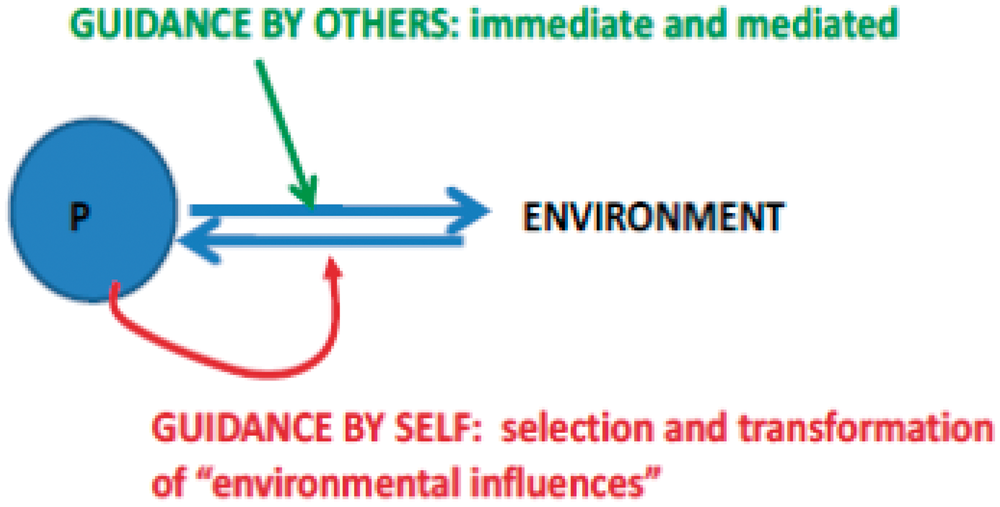
Figure 3 indicates how in the construction of any method in cultural psychology—based on the Methodology Cycle (Figure 4)—four (rather than one) conditions have to be considered. In each and every research project, the researcher needs to specify the following:
The nature of the System (person, social group, community, institution) as it relates with the environment. The “being” (=ontological status) of the system is viewed from its functional extension (how it establishes ties with environment). Not establishing such ties is impossible for an open system, but selective ways of establishing these are the relevant information about the system. The nature of the environment (structured, quasi-structured, random, etc.)—what it could afford the system that is establishing relations with it? The expectations—encoded both into the psyche and the environment—of different “social others” that are expected to orient the System<>Environment relations. These can include immediate actions by others (e.g. mother to child in a church “be quiet!”), set-up explicit signs in the environment (e.g. an instruction “Silence!” at the entrance to a church), or historically formed signs that guide the relation with the environment in macro-time (e.g. the architectural features of a church that emphasize the notion of it being a special place and other social representations encoded into multiple sign forms). The goal orientations of the given person, dealing with oneself (1), the structure of the environment (2), and the social guidance (3). The Methodology Cycle.
Thinking through the implications of the Individual-Socioecological reference frame leads us to the clear need for re-conceptualizing psychology’s habits of collecting data and their analysis efforts. The usual mode of data derivation in psychology happens with the Intra-Systemic reference frame implied (e.g. these data—X, Y, Z—refer to the person who has given these answers that we proceed to analyze). The following inductive generalization comes with the shift of reference frames—into the inter-individual one. The answers of persons in category A are now compared with those in category B, and the inter-individual variability is used to arrive at conclusions—which are subsequently back-projected into the image of a generic case (Valsiner, 1986).
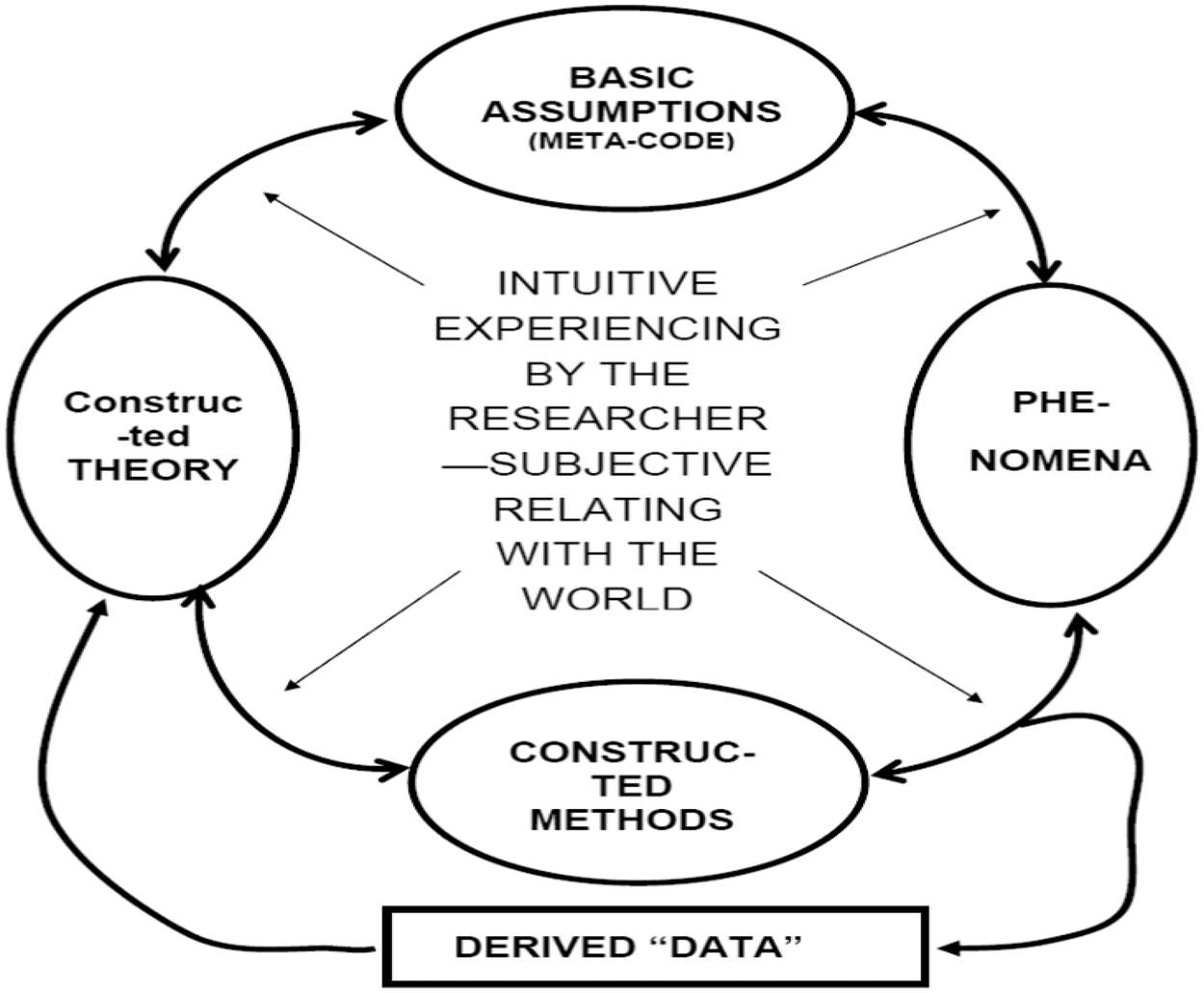
The cycle of methodology
There are different ways of looking at methodology: “toolbox of methods” versus strategy for generalization (Toomela, 2009, 2012). The former is simple—methodology is a set of methods that the researcher may elect to use—or not use—at one’s will, depending upon current fashions in the discipline, or perceived validity value. Thus, quantitative methods have been prioritized as “scientific” in psychology—without anybody ever proving that these are that. Furthermore, proof of their “scientific nature” is in itself impossible within the realm designated as science. Statements about something (“X is scientific”) do not belong as members of the set {the something: e.g. “method X,” “method Y,” etc.}.
By insisting upon a method as if it is “scientific” is a nominalist solution to the problem of knowledge (Wissenschaft) in the given area of expertise. It does not change the nominalist solution if further characteristics are added to it (e.g. “standardized,” i.e. coordinated across contexts and approved by a standardizing institution). The frames of reference described above guide the actions of the researchers within the Methodology Cycle, rendering some moves meaningful and others meaningless. They are located at the level of the relation of the meta-codes (General Assumptions) with theory building (Figure 4).
Science starts from intuition—albeit one that is educated in the process of initiation into social practices of science (see center of Figure 4). The ways how such initiation works differs across disciplines. The educated intuition is in the very core of all science. The first question for a researcher is—what research questions are worthwhile to ask in the first place. Intuition here comes first—yet it is educated, not naïve, and—not “pure.” There are many layers of personal–cultural needs that turn an ordinary person into a scientist. Here, the scientist and artist function similarly—the emergence of an idea is hidden somewhere in the internal infinity of our mind.
Methodology is in the center of our knowledge creation. Yet it is an ambiguous term—often considered to be a synonym of “method.” I keep strict—but inclusive—separation of the two—“method” is part of methodology, but the latter cannot be reduced to it. Figure 4 presents a model of methodology that has been the core in my building up the system of semiotic cultural psychology (Branco & Valsiner, 1997). It is not a new idea—rather, it restores the basic notion of methodology as a system of generalizing thought to psychology at large and cultural psychology in its unique form. The latter is of holistic kind—disallowing the breakdown of the whole into elements. Instead, we will examine particular mutual relations within the cycle and spell out their implications.
Basic assumptions <> Phenomena relation
The intuitively tuned researcher assumes some—explicit or implicit—axiomatic position in taking a stance toward the field of phenomena. The four frames of reference, outlined above, are examples of such meta-codes. Basic decisions about the focus—inside (of a system), outside, or in-between—are axiomatic.
As the researcher selects one’s axioms on the basis of how these relate with the phenomena, the move to construction or adoption of theoretical frames proceeds in parallel. Every theoretical proposition that is constructed must coordinate well with the basic assumptions. It is usual that intellectual ruptures happen precisely in carving out this relation. For example—at the level of Basic Assumptions, the notion of human psychological functioning as an open system is declared—but then in the building of theory, all propositions are made in terms of inherent properties of the persons. 6 This constitutes a mismatch of reference frames—substitution of the Individual-Socioecological frame by the intra-individual one—with the result that all subsequent empirical work rendering data that fail to represent the phenomena, and are therefore useless.
The step at which misfits between Basic Assumptions and Theory are revealed most visibly is the construction of hypotheses. Hypotheses lead from the Basic Assumptions <> Theory relation to the next step within the Methodology Cycle—the Theory<>Method Construction relation. For example, the symbolic meaning attached to randomization (in random sampling of subjects or randomization in every aspect of setting up the study) is a frequently used hyper-generalized sign that legitimizes the researchers’ thinking of the move to empirical investigation. A general paradox is involved in the use of that sign: …to speak of a ‘random individual’ is not to speak of an individual at all. When one introduces random individuals, one can do so meaningfully only subject to the self-denying ordinance represented by the convention that: Nothing is to be said about a random individual that is not intended about ALL of the individuals of the domain at issue. A random individual is therefore not a thing but a linguistic principle, a shorthand device for presenting universal statements. (Rescher, 1968, p. 137)
A similar difficulty in the trajectory Basic Assumptions <> Theory <> Methods in the Methodology Cycle is in the conceptualization of quality<> quantity relationships. Here, sociopolitical rules interfere—quantification is a political credo that has dominated the social sciences over the past century (Porter, 1995). In reality, the philosophical underpinnings of that relation are highly complex—qualities can include quantity as a sub-part of a quality (e.g. the general quality temperature includes sub-qualities determinable quantitatively on any used measurement scale—Celsius, Fahrenheit, or Kelvin). Quantity—as a form of quality—cannot exist without its superordinate quality. The quantitative quality “today’s air temperature is + 20℃” cannot exist without the qualitative notion of temperature in general.
Theory <> Methods Construction relation
As a theory is constructed and hypotheses—qualitative rather than quantitative—set, the issue of constructing an appropriate set of methods comes to the fore (see Figure 4). It is here that the researcher—based on one’s educated intuition—needs to coordinate the method construction with the relation on the other side of the Methodology Cycle (The Phenomena <> Methods line).
The three general ways of looking at knowledge generalization in science—inductive, deductive, and abductive—set up this relationship in vastly different ways. In the case of the inductive approach, the methods have an authoritative existence on their own, and evidence will accumulate on the basis of the use of the methods—generating data. Theories here are either used as external delimiters of the inductive generalization enterprise or mere nominal “umbrellas” (see Valsiner, 2000, pp.64–65) that provide external legitimacy to the inductive generalization process.
Smedslund has been criticizing this aspect of psychology’s methodology—its pseudo-empiricism—systematically over the past 40 years (Smedslund, 1978, 1980, 1997, 2009, 2012)—but to no avail. The factory of “measurement” in psychology guarantees its continued pseudo-empiricism well into the 21st century. Cultural psychology has the chance—of course at the risk of being socially excluded from being “a science”—to bypass this semiotic/social trap. The completely deductive scheme—exemplified in psychology by Smedslund’s efforts to define theorems of common sense (Smedslund, 1997)—is the mirror image of the inductive approach, in its “top-to-down” determination of the whole set of psychological phenomena. Here the notion of method becomes replaced by the fully deductive theory—theoretical work, based on educated intuition and observation of phenomena—becomes the method.
Obviously, cultural psychology would be ill served by both of these directions. The third alternative—the abductive way—remains fitting for areas of science where the object is constantly changing, despite difficulties of making its meaning clear (Pizarroso & Valsiner, 2009). It is exemplified by Albert Einstein’s treatment of empirical evidence—dismissing its accumulation as irrelevant, while remaining constantly on the watch for the crucial experimental work that could introduce the need for major modifications in theory (Hentschel, 1992). The primarily theoretical work requires empirical verification—but only once in a while, at specific theoretical bifurcation points. Yet—at those points, and only there—that input of empirical work acquires absolute relevance. The adequacy of the methods used to gain empirical evidence at those points is crucial—and any empirical finding requires careful post-factum scrutiny of whether it might have been an interference by the method that was used. 7
Phenomena <> Methods Construction relation
While corresponding to the theoretical structure of argumentation, the constructed methods cannot violate relevant aspects of the phenomena. Checking whether the phenomena are not violated by the artificial steps of method construction is a crucial task at every moment.
Sometimes there are enormous gaps between the phenomena that are claimed to be studied and the methods applied. For example, the use of fMRI techniques has become popular in psychology in the recent decades. The persuasive value on the readers of reports who observe beautiful color images of the brain—with some parts showing heightened activity—has been shown (McCabe & Castel, 2008). Yet such persuasiveness is not equal to knowledge. When it comes to the actual representation of neural processes, the method of magnetic resonance showing blood flow changes is inferior to traditional methods of electronic on-scalp recordings (Chelnokova, 2009; Miller, 2008). The neuronal processes proceed with speeds of two biological processes—that of nerve impulses and of the speed of blood flow in the cardiovascular system. These speeds are drastically different—the nerve impulses proceed 50–100 times quicker than the blood flow. 8 Trying to study the functioning of the nervous system in all of its speed, using a method based on a functional system that is slower by its functions, would not fit—the speed of the phenomena under study renders the use of the magnetic resonance techniques mute when these are used beyond specifying the stable intensity of processes in static parts of the brain. The MRI technique is highly productive in providing the researchers and clinicians the best view possible to the anatomical structures of the body and even into their functioning—yet in cases of relatively slowly proceeding processes.
Methods <> Data relation
At the very bottom of our Methodology Cycle, we find the Data. It becomes clear that the data are constructed—or derived—entities that are not “facts” (that stand alone). Data require an interpretive framework within which they become informative. That framework is provided by one or another configuration of the Methodology Cycle. The usual—deeply impoverished—configuration that is used in empirical psychology consists only of Methods<>Data relation, perhaps with the Theory kept at a distance as an “umbrella” of convenience. In such case, the only interpretability of the data is within the method discourse—leading to evaluative claims (“I have good data”—which may mean anything: many data points, approximated by the normal distribution curve, etc.).
The important feature of this book—inviting its readers to cultural psychology—is the absence of the data in most of my elaborations of key issues of science. This is deliberate. I have tried to present the selected abstract issues of emerging cultural psychology in ways that are as near to the phenomena as possible, turning some of these phenomena into de facto data. These data are qualitative in their nature, which fits the systemic nature of cultural–psychological phenomena. There is no quantification imperative in cultural psychology—yet there is a quest toward abstract formalization of its general principles (Rudolph, 2013).
The art of science
The ways of the artist and those of the scientist meet in the middle of Figure 4. Both rely on the intuition—be it educated in the scientific lores or artistic in grasping the crucial features of human existence. An artist without such penetrating subjectivity could perhaps devise advertising billboards, and a scientist without intuition may successfully write review articles. It is very unlikely that a person with full knowledge of what others have done in the given science could arrive at breakthroughs to arrive at new knowledge. In order for new knowledge construction be triggered, there need to be “holes,” or unfinished tasks, in it.
Albert Einstein, when queried about his self-view of thinking by Jacques Hadamard, set the affective imaginative meaning-making into the center of the creative process: The words or the language, as they are written or spoken, do not seem to play any role in my mechanism of thought. The psychical entities which seem to serve as elements in thought are certain signs and more or less clear images which can be “voluntarily” reproduced and combined. There is, of course, a certain connection between those elements and relevant logical concepts. It is also clear that the desire to arrive finally at logically connected concepts is the emotional basis of this rather vague play with the above mentioned elements… The above mentioned elements are, in my case, of visual and some muscular type. Conventional words or other signs have to be sought for laboriously only in a secondary stage, when the mentioned associative play is sufficiently established and can be reproduced by will. (Hadamard, 1954, pp.147–148)
However, not every kind of feeling into one’s experience leads us to science. The art of intuitive grasping of relevant problems becomes streamlined in the process of theory construction by creating a frame of reference.
Where psychology fails: Trust in correlations
The invention of the notion of correlation in the history of statistics by Francis Galton, Charles Spearman, Felix Krueger, and Karl Pearson at the end of the 19th century has done a major disservice for psychology to transpose real relationships into formal ones. Psychological generalization becomes moot—any discovery of “relationships” between “variable X” and “variable Y” in a correlational analysis reveals little about the actual functioning of the system in which whatever X and Y represent are systemically linked. Correlational data do not explain—they need explanation themselves! This claim has dramatic implications for the standard practices in psychology of our days where correlational evidence—generalized to discourse about “significant relations” between “variables”—is usually viewed as the final result of investigation.
An example from regular practice of data derivation would make it clear how the specific tactics of data analysis create new hurdles for understanding, rather than new understanding. Let us consider an item from a personality questionnaire—a method set up explicitly within the intra-individual reference frame—and look at the different interpretations that could be given to the very same item that seems to be a straightforward statement about the respondent’s self: I am easily bothered by people making demands on me. (Valsiner, Bibace, & Lapushin, 2005, pp.284–285)
However, if we now shift to the Individual-Socioecological reference frame, the seemingly simple statement about oneself becomes quite complex. Different emphases and contextualizations can be given to different parts of the statement:
I am easily bothered by people making demands in me (P → E); I am easily bothered by people making demands on me (P ← E); I am easily bothered [BUT I WANT—OR NOT WANT—TO BE!] by people making demands on me (P → {P<>E}]; and I am easily bothered [BUT OTHERS SAY I SHOULD—OR SHOULD NOT—BE!] by people making demands on me (O → {P<>E}].
A quadruplet structure like the one shown here replaces a unitary question of a regular questionnaire. Either outcome answer—“true” or “false” (or—even worse—quantification of that opposition on a scale) is a result of a microgenetic process that involves all four foci.
So, instead of a study of personality, we have here a study of the adaptation process of a person as a whole to the structure of one’s environment. Traditional personality psychology makes the attribution of causality for human conduct to some imaginary “personality characteristics”—psychology’s equivalent to ether or phlogiston in physics or chemistry. The cultural psychology of semiotic mediation would turn the research question from ontological statements (“I am bothered by X, Y, Z”) into under what conditions would the meaning “I am bothered” emerge at all in one’s encounter with the social world. And, furthermore, once it emerges—how is it circumvented—after all, we create meanings that make our encounters unpleasant, but we learn to neutralize these.
From causality to catalysis
Psychology has been trapped by its adherence to causal attributions—while its neighboring disciplines of chemistry and biology have already long time moved into a noncausal systems of explanation. These systems are catalytic—emphasizing the relevance of presence of different conditions in the emergence and development of phenomena. The idea of catalysis is old—in chemistry, it goes back to 1830s—but for psychology, it is very new (Cabell & Valsiner, 2013).
History of psychology includes earlier efforts to bring the notion of catalysis into the discipline. Back in 1927, Kurt Lewin emphasized the notion of conditional-genetic nature of unitary complex phenomena (konditional-genetische Zusammenhänge—Lewin, 1927, p. 403) where through the study of varied conditions of functioning (Bedingungsstruktur) of the system its potentials for transformation into a new state—as well as conditions of its breakdown—could be revealed. Lev Vygotsky’s use of the same epistemological mindset led him to the elaboration of the Method of Double Stimulation as the methodological tool for developmental psychology (see Valsiner, 2000, pp.78–81, 2007; van der Veer, 2009; Wagoner, 2009). That method is in the very core of Vygotsky’s methodological credo—coming out from his primary focus on esthetics, interest in child development in educational settings, and the prevailing atmosphere of dialectics of social turmoils in the world surrounding him in the 1920s and early 1930s.
The crucial feature of Vygotsky’s method was the construction of means (“stimulus-means”)—in the form of action tools or signs to make sense of the given setting. This entails a new look at methods construction—the method for developmental and cultural analysis needs to focus on the emergence of those functional aspects of the situation that are called for by the setting, and created by the intentional and goal-oriented agent. The notion of “measurement” applies not to what is, but to what is not yet, and to conditions that might bring it into being. The centrality of the whole of the Methodology Cycle makes the construction of such methods—of the study of nothingness (that may become something) scientifically interesting.
Methods of movement
What our Methodology Cycle—as applied to cultural phenomena—leads to is the focus on human activities in constant movement. Our psychological functions operate as we move—walk, run, drive, dance, or even sleep. We move between home and workplace or school. We go on a pilgrimage (Beckstead, 2012)—or to a psychologist, which itself is also a kind of a pilgrimage. Rarely are we in a static position—sit down and act in ways expected from us in psychology laboratories or classrooms. Such periods of staying in one place are pauses between movements—they are the context within which innovation—an act of movement—occurs.
If method construction in cultural psychology were to remain fitting psychological phenomena, the primacy of the persons-on-the-move would need to be encoded into the ways in which methods are constructed. In cultural psychology, the key feature is the regulation by signs—and hence the methods need to demonstrate how the presence of signs organizes the psyche. This is best observable when the previous organizational form is either demolished or made difficult to be put to work in real life. The testing conditions start from the top.
Figure 5 illustrates the basic focus of empirical investigative tactic in cultural psychology of semiotic dynamics. The subject is given—or is discovered to have one’s own—specific goal direction (“moving
11
from” position A to position B).
The epistemological master scheme in cultural psychology.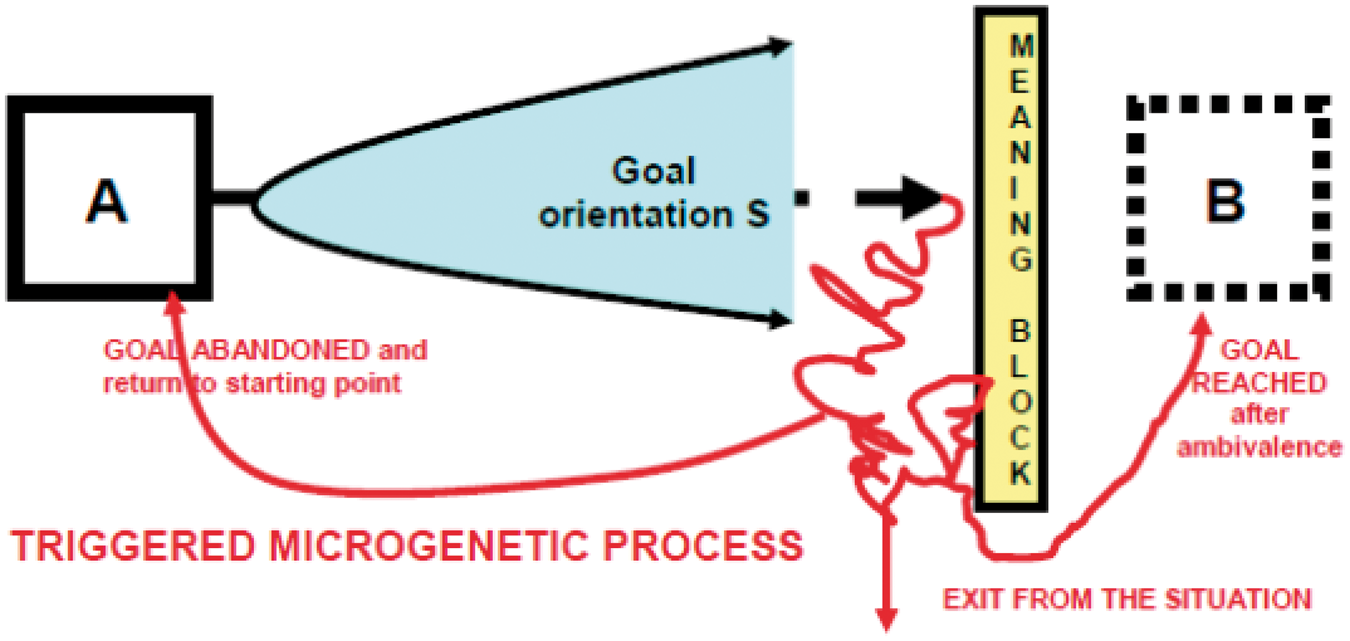
Once the subject has begun the move, the researcher either detects (in natural conditions) or inserts (in experimental conditions) a meaning that suggests or demands the opposite to the suggested and started move. This conflict—between established and sought-for goal, and the border that prohibits access to it (“meaning block” in Figure 5) triggers the microgenetic process of adaptation to the changed situation. 12 It can entail “boundary behavior”—struggling against the border, trying to “break through” the barrier; or exiting from the setting, or, likewise, bypassing the barrier reaching the goal. The process of meanings-based construction is expected to reveal the basic psychological processes that are involved in human ways of adapting to the environment and of the environment to oneself. In that process, semiotic mediating devices—signs and cultural tools—come into use in specific time moments.
Methods of re- and pre-construction (post-factum and pre-factum)
As is obvious from the premises of considering irreversible time to be the inevitable delimiter of our experiences and our study of them, methods that cultural psychology can create are always time dependent. The effort to capture the processes as these unfold necessarily turn into post-factum (i.e. the currently observed process, when recorded, is already part of the past) or pre-factum (i.e. the process is imagined as if possibly taking place in the near or not so near future, but it has not become actualized)-based methods.
History of psychology provides us with a number of accounts of the post-factum focused methods—the introspection of the “Würzburg School” of early 20th century (Humphrey, 1951), the “Second Leipzig School’s methods of Aktualgenese expanded into idiographic microgenesis (Abbey & Diriwächter, 2008; Diriwächter, 2009, 2012), Heinz Werner’s focus on microgenesis (Wagoner, 2009), the thinking aloud methods from Otto Selz and Karl Duncker to contemporary cognitive science (Ericsson & Simon, 1993; Simon, 2007), and Frederic Bartlett’s method of repeated reproduction with its contemporary extension into conversational repeated reconstructions (Wagoner, 2007, 2009, 2012), and the use of microgenetic techniques in personality research (the “Lund school” of personality research of Ulf Kragh and Gudmund Smith).
Psychology’s method building has been remarkably poor about clarity about the pre-factum-based methods. Lev Vygotsky’s notion of zone of proximal development (Valsiner & van der Veer, 1993, 2014) poses the need for developing pre-factum methods—so far that need is not fulfilled. Different modeling efforts to look at development—those of Paul van Geert’s Experimental Theoretical Psychology, and Tatsuya Sato’s Trajectory Equifinality Model (TEM) touch upon the potential for developing pre-factum-based methods. Of course, any study of creativity—if seen from the perspective of cultural psychology of semiotic dynamics—needs to belong here (Tanggaard, 2014). Any act of creativity belongs to the pre-factum line when it unfolds but becomes recognized as such only post-factum. The difficulty of planning to “be creative” (move from internal infinity to external infinity in the pre-factum mode) is formidable since that state cannot be pre-determined because it need the post-factum comparison for discovery of “the creative act.”
Introspection and extrospection
For psychology, the parallel processes of introspection and extrospection remain central for method construction. The combination of pre-factum and post-factum foci of methods with that of introspection and extrospection gives us a mapping onto the tetradic scheme that is covering all of its four sides (Figure 6).
Method construction mapped onto the tetradic scheme of infinities.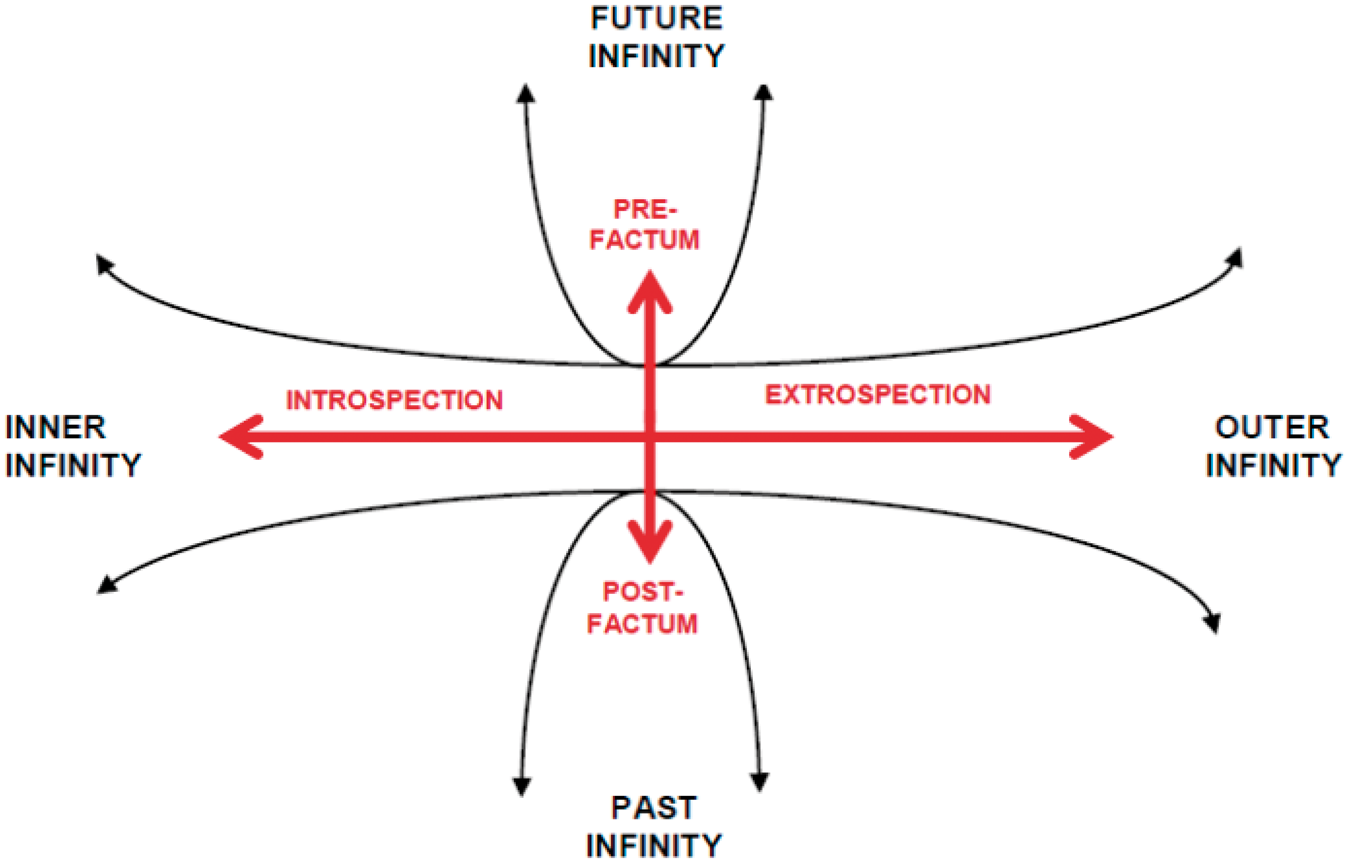
Every method in psychology that is ever constructed finds its own place within the coordinates of the scheme (Figure 6). The researcher’s position—suggested usually to the subject—is located in the center, at the intersection of the four arrows. Method-building in cultural psychology—dependent on the goals of the research project—needs to include at least some of the four movement directions, and/or their relation. An instruction to extrospect—“look outwards” from oneself—in a study setting needs to be directed inwardly, toward the introspection line. Likewise, the act of externalizing the results of introspective contemplation indicates the move into the extrospective line. Whatever form of methods—introspective experiment, interview, questionnaire, analysis of everyday activity settings or narratives or discourses, etc.—is used in method construction, all these forms need to bring out to the open the processes of coordinated movement, challenged by various obstacles that trigger tensions (Figure 3).
Trajectory Equifinality Model
This pre-factum-focused method (Sato et al., 2012) innovates our method construction realm, particularly as it unites the post-factum search and the contrast between possible and actual trajectories considered as possibilities, in irreversible time. It is a method that is aimed at revealing the processes of construction of a trajectory of movement of a system as it is happening. In order to do that, the method needs to consider what has already happened up to now, in the light of what could happen in the next step into the future, and what should happen—as determined by the person and the social demands upon the person.
TEM breaks up the backbone of contemporary psychology—its reliance upon inductive generalization and its practical elaboration conventionally called “measurement.” TEM works with structural qualitative units of analysis that belong to both sides of the border of the present. TEM involves careful investigation of relevant phenomena and our basic assumptions about them. Its basic structure (Figure 6) is centered on the distinction between FUTURE and PAST in the consideration of actual and potential trajectories. Both kinds of phenomena, real (what happened) and post-factum imaginary (X, Y, Z) and future imaginary (A, B, C) are treated as relevant in TEM. Consider the following comment given to Pierre Janet by one of his patients who commented upon the simple act of opening a book: This book must be immoral, since, opening it, I have the same feeling I used to have when I was secretly reading forbidden books in boarding school (Janet, 1928, p. 300) The Trajectory Equifinality Model.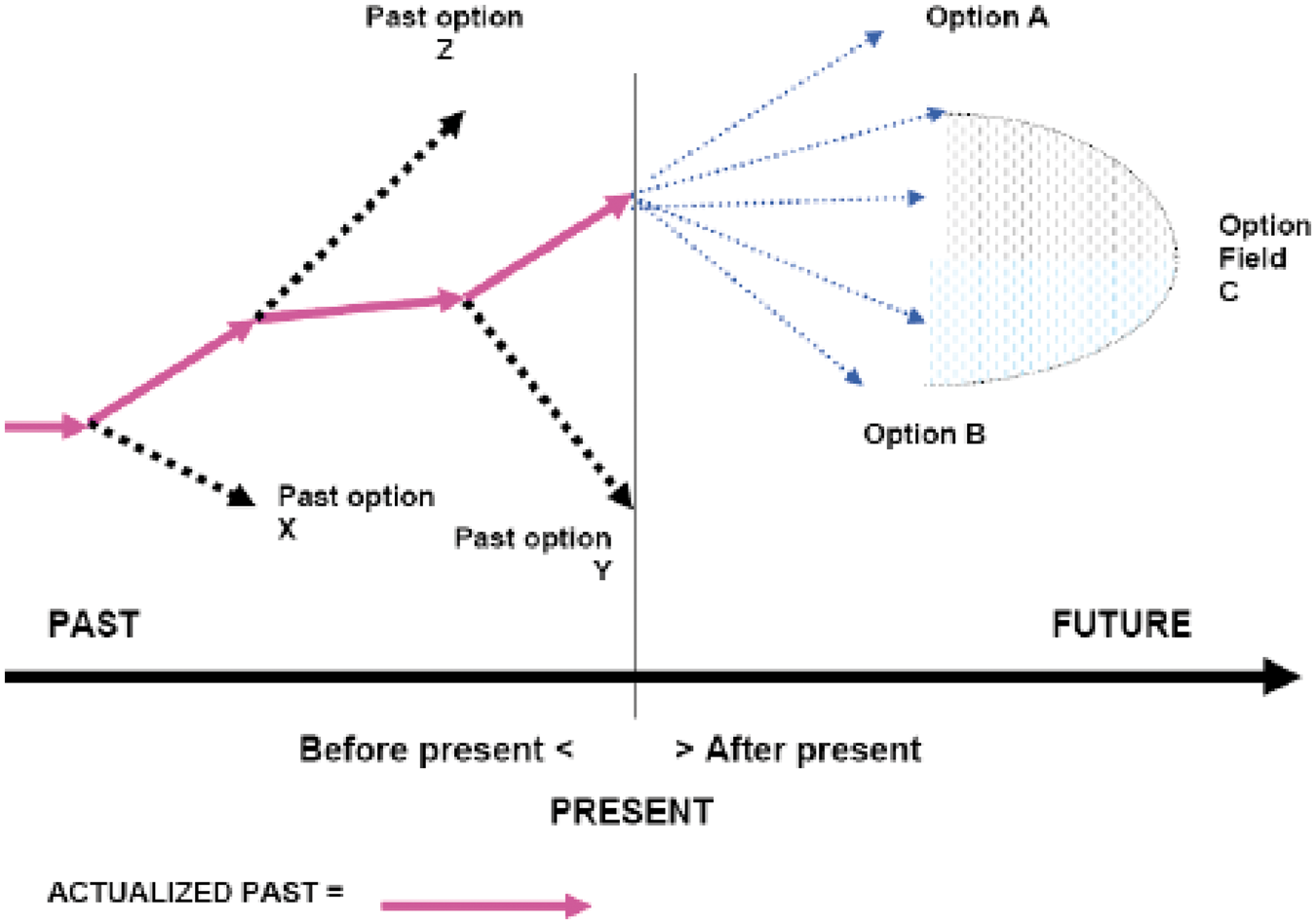
The consideration that the real and the imaginary are equal—yet distinguished—sources for psychological data derivation. This feature keeps the TEM method apart from other ways of looking at life-course trajectories. The latter take stock of the actualized pasts, or—if looking into the future—about the expected to be actualized future (e.g. any inquiry into adolescents’ future life plans). Furthermore, descriptions of life course trajectories of the actualized past (and future) fail to consider the central point of the immediate present—where the future is being negotiated. The TEM model does, it is located in the present (however miniscule time moment it may be—a microsecond or a year), querying people’s looking forward (pre-factum) and backward (post-factum) in their subjective lives (inquiry into internal infinity) through their social life events (external infinity).
Since all moments of the present are those of an individual person, the TEM model is an example of application of idiographic science (Salvatore & Valsiner, 2010). It is universal in its scheme—TEM model captures any process of negotiation of past and future, for any individual person in the World, being centered in the movement onwards from the here-and-now state. Yet, its material is unique—the phenomena of the vanishing present are not only individual features of the person but also transient events within the life of the person. We here have a unity of the universal model that maps onto the absolute uniqueness of every life moment. Generality is expressed in the constant production of novelty—a point that Magoroh Maruyama understood well in his development of “second cybernetics” in the 1960s.
At the level of the meta-code, it is reasonable to assume that all biological systems (and derivations from them—psychological, social, and historical systems) work under the conditions of variability amplification (Maruyama, 1963, 1988). 13 If this axiomatic point is taken, the traditional reliance in psychology on average or prototypical cases loses its centrality and becomes merely an anchor point in relation to which the unique innovations are being judged. It is precisely the supposed “nonnormality”—the deviance from the average that takes the form of a novel synthesis—that is in the focus of attention. Development is possible only in the case of open systems. Methodology of open systems needs to analyze that process of amplification—just the opposite to the reduction of variability to averages or prototypes.
Conclusion: Methodology as movement
Methodology cannot be reduced to method. The data are subservient within the whole of the Methodology Cycle. They become crucial only in theoretically relevant moments. Einstein’s focus on looking for the experimentum crucis is brought here into cultural psychology as a prevailing credo. This is in stark contrast to the notion of accumulation of the data that, at some expected yet indeterminate future point, would resolve our problems in psychology and its practical application. The inductive pathway to generalization is necessarily limited—it requires combination with the opposite, top-down pathway of deductive guidance of where empirical investigation can be crucial. Together, the two pathways can meet in the abduction process (Pizarroso & Valsiner, 2009).
When seen from the centrality of key empirical evidence—experimentum crucis—it becomes clear that methodology cannot be manualized. This includes segregation of the methods from the Methodology Cycle and giving different methods different social value by consensus (e.g. “objective” methods). All methods in science are a part of a deeply subjective—sometimes exaggeratedly affective—efforts of knowledge construction. In line with this, I am purposefully avoiding addressing (and answering) pragmatic questions usually asked about methods (e.g. “how should I create a valid questionnaire?”). Answers to such questions come from the asker’s own thinking within the frame of the Methodology Cycle. If that thinking fails, psychology would be impoverished by yet one more empirical study that produces irrelevant data.
Cultural psychology has a chance to restore the focus of psychology to that of humanly relevant phenomena. This chance is based on its systemic look at the methodology as a whole—as a process of generalized meaning-making. The scientist in that process is central—the intuitive grasp of phenomena can turn in the hands and minds of creative scientists into general knowledge. The complexity of psychological phenomena includes self-reflexivity of the meaning-maker as a complicated condition that needs to be considered explicitly. Psychology has avoided doing so for a century—but cannot continue that practice any longer.
Footnotes
Acknowledgement
I am grateful to Pina Marsico for inspiration—both caffeinated and intellectual—in bringing this paper to its conclusion.
Funding
The writing of this Editorial was supported by the Niels Bohr Professorship grant from the Danish Ministry of Science and Technology.
1
To appear as Valsiner, J. (2014) Invitation to cultural psychology. London, England: Sage.
2
A real life example of this process is the fate of the notion of intelligence—since the 1920s, it has become defined through the method that is devised to measure it.
3
This tension has led to the post-modernist denial of the possibility for generalization and consideration of knowledge as always “local” (e.g. Geertz, 1983).
4
While it is true that James allows for temporal co-existence of the experience and its naming (1950, p. 190, footnote)—in the case of enduring experience (e.g. feeling depressed can last long, including in time the claim “I feel depressed”)—the meta-level nature of sign mediation relative to the object of such mediation remains in place. Hundred years and more have not changed the situation in psychology—the displacement of the original phenomena by the labels (words, ratings, etc.) attributed to them remains the confusing hindrance for psychological science.
5
Ergodicity presumes that inter-individual and intra-individual variations in a set are isomorphic. It fits to all phenomena that do not undergo change or development—in that case, the simultaneity or successivity of phenomena are equal. Ergodicity fits time-free world. In the case of all phenomena that undergo transformation in irreversible time, ergodicity does not apply.
6
A concrete example of such misfit is the history of attachment theory. Started—by John Bowlby—from an axiomatic focus on attachment as a bond—relation of mother and child—in the 1950s–1960s, it became empirically studied after 1970s as a characteristic (types) inherent to the child. The enormous accumulation of data in attachment research has little to say about the bonding process as such.
7
There exists a curious difference in the way physicists and psychologists look at their data—generated by some methods—after the data are obtained. Physicists spend around 90% of the time checking whether the results could have been artifacts generated by the methods themselves (Knorr Cetina, 1999) while for psychologists—especially after considering their methods “standardized”—that percent approaches zero. This difference can be explained by the abductive approach of the physicists and inductive approach by the psychologists.
8
Speed of neural impulses in the nervous system: in muscles—119m/s, in passive touch—76.2m/s, in the case of pain—0.61m/s, as compared with the speed of blood flow in the cardiovascular system, range of 0.28–1.78. m/s in carotid artery, range of 0.1–0.45 m/s in vena cava; approximately 0.001 m/s in capillaries.
9
Einfühlung in die Erfahrung. Theodor Lipps’s focus on Einfühlung was described above. Furthermore, the holistic nature of the central feeling is emphasized by Kitaro Nishida: “…the feeling of harmony (Harmoniegefühl) is not a mere combination of feelings, but constitutes one feeling in itself. Feeling is the fundamental unit, in which we discriminate an indefinite number of qualitative differences” (Nishida, 1979, p. 224). Science is a passionate form of human activity where feelings lead the differentiation of rational analyses.
10
As Strum ( , p. 492) commented: “Empathy is part of standard practice in the Kyoto tradition of Japanese primatology, while for North American traditions it is considered “bias.” However, the “status” of empathy is unstable even among North American primatologists. It is not unusual for a scientist to accept empathy and anthropomorphism in one context like the study of nonhuman primate cognition while rejecting it as “bias” in others.”
11
“Moving” here entails not only physical movement in space but also “movement” in one’s mind (e.g. “imagine situation X” or “remember episode Y from your past”).
12
The history of the various versions of microgenesis/Aktualgenese is best overviewed by Carl Graumann (1959) and in The Social Mind, chapter 7 (Valsiner & van der Veer, 2000). It is the general method of tracing the emergence of novel phenomena in irreversible time, starting from very short time spans (hence the focus on “micro”) or focusing on the emergence of the actual state of a phenomenon in time (the “actual” in Aktualgenese). For contemporary extensions of the microgenetic procedures, see Abbey and Diriwächter (2008) and .
13
In contrast to variability constriction—the assumption that has been inserted into the social sciences through the axiomatic insistence of the “natural order”—of normal, Gaussian distribution as a given. All the habit of homogenization of heterogeneous classes is based on the consideration of the average as the representative of the constricted version of normal distribution. Variability amplification is the opposite process that moves outwards from the normal distribution and generates ever-new forms that may expand the distribution and alter its form.
Author biography
Jaan Valsiner is the Niels Bohr Professor of Cultural Psychology at Aalborg University in Denmark, and Professor of Psychology and English at Clark University, USA. He is the founding editor (1995) of the Sage journal, Culture & Psychology and Editor-in-Chief of Integrative Psychological and Behavioral Sciences (Springer, from 2007). In 1995 he was awarded the Alexander von Humboldt Prize for his interdisciplinary work on human development.