




Abstract
This paper discusses the interface of dialogical self-theory and institutional context with reference to the schooling of ethnic minorities. It proposes a more nuanced approach to identifying cultural resources within institutions that contribute to dialogical movements and positioning, thereby advancing the application of dialogical self-theory within institutionalized spaces. Drawing on sociocultural concepts of identity construction, the discussion outlines how I-positions are tethered to social practices, relationships, power, and relations within institutions. These cultural resources are highlighted because they foreground how dialogical tensions occur and transcend opposing voices within an institution itself. In providing a textual analysis of Edward Said’s encounter with a school rule that tended to suppress his Arab identity, the integrated dialogical self-theory and sociocultural approach can highlight the contours of dialogical frictions as a result of negotiation with power across an institution to arrive at a desired I-position.
Introduction
Research into schooling and identities has highlighted cultural chasms in dialogical positioning. Dialogical self-theory (DST) has gained momentum in identity research over the two decades, particularly in multicultural settings. In particular, DST offers a basis to conceptualize how individuals negotiate cultural positions internally (as self-characterizing acts) and externally (as self-characterizing acts with reference to other individuals). The promise of understanding ethnic minority (EM) students’ development of compounded identity stimulated the application of DST in different cultural contexts. But traditionally, the key focus has been on the gap between home and school environments that contributes to identity negotiation (e.g. Crafter & Abreu, 2010; Prokopiou, Cline, & Abreu, 2012). In advancing DST’s implications on learning environments, this paper illustrates how institutional structures, as cultural resources, prompt shifts in dialogical positions. The goal here is to highlight the contours of dialogical frictions in institutional settings. While it is clear that dialogical frictions are fuelled by power (Hermans, 2012), dialogical movements do not simply conform toward a dominating position unidirectionally, but traverse across contextual layers, or even sidestep oppressing voices, to arrive to an I-position. I illustrate this process by integrating DST and sociocultural concepts of identity construction. This paper is organized around the tenets of DST and a sociocultural framework. I begin with an overview of Hong Kong’s multicultural schooling context to show the theoretical approach’s usefulness in describing the cultural sources associated with the shifts in the “temporal organization of the self” (Hermans, 2013, p. 87) with reference to external positions in institutional settings. In articulating the conceptual tenets of DST and sociocultural concepts, I propose a framework that typifies external I-positions emerging from cultural resources in institutional settings. I end with an analysis drawing on Edward Said’s encounter with his school’s English-only speaking rule.
Cultural disjoints in multicultural learning context: Hong Kong’s situation
Hong Kong is often known as a city where “East meets West,” reflecting its past colonial ties with the British and the city’s international image arising from its financial standing in Asia. However, part of this international landscape, yet less discussed, is those EM students who had migrated, born and/or educated in Hong Kong. Although home to a majority of ethnic Chinese (93.6% of Hong Kong’s population of about seven million), the presence of a considerable number (6.4%) of expatriates, domestic helpers and immigrants is gradually shaping Hong Kong into a culturally diverse city. Of the 6.4%, the population is made up of Filipino (1.9%), Indonesian (1.9%), Caucasian (0.8%), Indian (0.4%), Nepalese (0.2%), Japanese (0.2%), Thai (0.2%), Pakistani (0.2%) and other Asians (0.2%) (Census and Statistics Department, 2011).
In terms of EM students’ education before 2004, the Hong Kong school placement allocation system was charged for its segregating effects. EM students were systematically allocated in a number of designated schools 1 (Shum, Gao, & Ki, 2015). As such, designated schools are generally populated by students of Pakistani, Filipino, Indian, and Nepalese descent, often with few ethnic Chinese students (Erni & Leung, 2014). Designated schools receive additional financial and pedagogical resources to support EM students’ Chinese language 2 learning, often labeled as Chinese as a second language. Such a support mechanism includes providing a supplementary guide to the Chinese language curriculum, grant for professional school support, extended learning activities in Chinese language, educational information in ethnic languages, and professional development programs (Education Bureau, 2013).
While the above provisions for EM students are visible in the educational discourse, they are not necessarily supported by a multicultural policy (Jackson, 2013). From this perspective, many Hong Kong schools still espouse a “monoculture mindset” (Connelly & Gube, 2013, p. 122)—a phenomenon that underlines the need for cultural responsiveness in classrooms (Hue & Kennedy, 2015). Thus, if a schooling system is to cultivate “appropriate cultural contexts” (McInerney, 2010, p. 22) for EM students, examining the shifts in dialogical position in multicultural and institutionalized learning environment is crucial because of the convergence of different ethnicities and changing support systems. This is when EM students generally identify Hong Kong as their home, but emplaced in a learning environment that does not effectively facilitate their Chinese language learning (Yang, 2013, March 10).
Hong Kong’s sociopolitical milieu described above makes the dialogical shifts associated with EM students, where cultural gaps often exist between their cultural background and the Hong Kong education system, an interesting case for identity research in DST context. In responding McInerney’s (2010) call to understand EM students’ sociocultural communities, one can examine how the intermeshing of discourses in designated schools and EM students’ identity construction hinge on their integration into Hong Kong education environment. In this light, I propose an integration of DST and sociocultural concepts that can highlight not only the external positions that individuals can develop, but also how these external positions are negotiated within the power structure of institutions. As a result of social interactions in institutional spaces, these external positions are accounts prompted by others (e.g. teachers, peers), which could explain how individuals associate their identities with other people and the dramatic movements in the temporal organization of the dialogical self.
Temporal organization of dialogical self and institutional space
To speak of the temporal organization of the self within institutions, one needs to regard institutions not as a structural site but as a space for systems of relations. Although institutions can be represented as spaces of cultural (re)production, wherein social discourses are maintained, altered, and negotiated by different institutional members, the discourses within such spaces are not without recipients; they are negotiated by the individuals in the institution and have transformative capacities on personal level. Consider this description of De Haan (2005): “Institutional settings do not automatically produce the institutional scripts, positions and norms they are associated with; rather, they need to be authored by participants who ‘instantiate’ these scripts, positions and norms” (p. 267). De Haan draws our attention not to the physical setup of the institution but to the discourse enacted by its members. This discourse, a host of communicative means, is one that individuals interact with as they socialize in a cultural setting over time. That is, institutions are not only bases for social others, but also a conceptual plane (Phillipson & Renshaw, 2013), an analytical focus on how individuals respond to their institutionalized cultural environment. In what follows, I shall describe the key components of DST and discuss its integration with the sociocultural concepts of identity construction.
DST
DST describes how individuals develop multiple positions in dialogical relations with each other through social interaction across social milieus both internally and externally. Its core component includes I-positions as a result of multiple voices (Hermans, 2001), such as the ways in which one recalls how (s)he was characterized by other individuals. This notion highlights that social others are not simply “outside the skin” (p. 245) of an individual. Hermans argued that they (e.g. parents, teachers, peers) can exist in thought processes as one recalls experiences of interaction with those people and actions. Accordingly, DST can account for both interior and exterior properties of cultural positioning. Shifts in cultural positioning are enabled by self-defining acts through in-the-head processes and external factors that trigger thinking processes within the self. Self, in this sense, is constituted in relation to others. It is a composite of both internal and external positions; they are not mutually exclusive and do not necessarily negate each other. Briefly, internal positions are self-characterizations without evoking exterior entities, which can be thought of as “I am who I am” (e.g. I am young). External positions refer to self-characterizations in consideration of others’ perceptions of oneself, a general idea comparable to “I am who others see me to be” (e.g. I am young in my partner’s eyes). These notions can be summarized as follows:
Internal relations refer to a strand of internal positions (e.g. I am graduate student; I am a diligent person; I like reading). External relations refer to voices related to oneself but not necessarily lead to self-characterization (e.g. my mom and my teacher are good friends). Internal–external relations refer to the intermingling of internal and external positions which lead to self-characterization (e.g. my teachers think that I need to work harder).
Understanding these dialogical relations can help develop links between cultural positioning and environment. Related to this function are the notions of continuity and discontinuity (Hermans, 2001). Continuity is when a person links different people related to him or her (my teacher and my classmate)—note the focus on italicized “my”; the two entities are linked and become possessed in oneself. Discontinuity is the disparity between “teacher” and “classmate” as they do not necessarily represent homogenous voices of a person. For example, a teacher describes Peter as playful, whereas a classmate sees him as a sociable peer. Attending to these dialogical relationships enables the depiction of the disparate properties within the self and cultural elements that defines an individual, such as how a student talks about both his teachers and peers in his classroom experiences. While teachers and peers are two different entities, they become unified dialogically as the student narrates his experiences.
Shifts in the dialogical self as a result of person–culture contact in institutional discourse can be discerned through a three-pronged process as outlined by Grossen and Salazar Orvig (2011). This process involves personal, interpersonal, and transpersonal dimensions in a dialogical contact. Personal dimension refers to an institution member’s individuality or personal character. Interpersonal dimension is linked to collective actions stemmed from interactions with other members. Transpersonal dimension is expected actions on how members should project themselves in a given institution, such as code of practice. A premise of this process is that institutions are not mere constituents of norms and rules, but are spaces where individuals can define the personhood of individuals through collective practices and interactions. This conception is in line with the semiotic mediation processes described by Joerchel (2012), in which cultural tools are simultaneously transformed at intrapersonal, interpersonal, and societal levels. These cultural processes are in tune with one another that form a sociocultural trail of shifts in cultural positions (e.g. how cultural messages (or rules), embedded in a cultural setting (i.e. school), are actively internalized by individuals that contribute to shifts in positioning).
The conceptual illustrations of Grossen and Salazar Orvig (2011) and Joerchel (2012), when combined, foreground a meso-level institutional layer. This meso-level institutional layer is underpinned by a collective discourse within a social arena. It assumes that a person is not merely out there experiencing the social world. Rather, institutional discourses are nested within a broader societal framework in which individuals interact with (e.g. expectations in a school to use a particular language, say Chinese, a cultural practice consistent with those of the ethnic majorities or “locals”). Though, this societal–institutional link is not always consistent (e.g. the misalignment between the institutional arrangements in Hong Kong and the goal to facilitate EM students’ Chinese language learning). In sketching the dialogical response of the self in institutional environments, I suggest that expanding the DST framework can make explicit semiotic exchanges in the dialogical self resulting from knowledge exchanges in school systems. Put differently, “knowledge always has a specific time and place where it came from and always carries this historic dimension within it” (Joerchel, 2012, p. 308, emphasis added). Such incarnation is relevant when one analyzes how EM students are “Caught Between […] Two Systems” (Yang, 2013, March 10) as they attempt to “fit in” a schooling system that contradicts their cultural background, or in DST lexicon, sociocultural processes that contribute to dialogical tensions. In what follows, I present an integration of DST and a sociocultural framework to illustrate how external positions are established in an institutional setting.
Sociocultural perspective on identity construction
Contemporary sociocultural scholarship regards identity construction in terms of micro and macrogenetic accounts of cultural practices (Nasir & Cooks, 2009), such as the inscription of values and knowledge that are culturally embedded in institutions (Vadeboncoeur, Vellos, & Goessling, 2011). Within this institutional arena, the semiotic exchanges across person and culture also imply how social interactions in schools broaden and shape individuals’ identity. The task here is not to see what schools are per se, but how dialogical accounts arising from classroom experiences are (partly) informed by broader structures (e.g. curriculum, policies, school philosophy). This conceptual process is illustrated more fully by Vadeboncoeur et al. (2011, p. 230) through a sociocultural perspective on identity construction (SPIC) with the following components: (1) individual acting with mediational means, (2) social relationships that constitute Zone of Proximal Development (ZPD) and social practices, and (3) social relations constituted dialectically through institutional contexts:
Individual acting with mediational means (or cultural tools). Identity is a “moment to moment” (p. 230) interaction in a cultural setting. A primary means of negotiation is through the interaction of individuals with cultural tools (e.g. language, gestures, actions, etc.). Analytically, this process involves mapping out discursive practices (e.g. language use), discourses, and even spatial arrangements of a setting in question. Social relationships that constitute ZPD and social practices. Two points can be made here. First, social relationships draw attention to interactions in classrooms. Interactions between students and teachers do not occur in a vacuum in that both parties are to achieve a defined set of learning goals. Accomplishing these goals means that teachers and students exchange cultural tools (e.g. when teachers ask questions to check students’ understanding of the lesson content). Often, in subtle ways, these interactions could be a reflection of the values and beliefs of teachers and students, which result into particular practices in classrooms. Second, embedded in such a relationship is power that forms asymmetrical relationships between teachers and students. Teachers generally have more authority in terms of the ways of learning that take place in classrooms, such as exercising their right to control students’ disruptive behaviors. Actions as such can condition students’ experiences in classrooms, which may carry transpersonal features. Social relations constituted dialectically through institutional contexts. This layer draws attention to membership and grouping of individuals (e.g. ethnicity, role, position). Social relations are rooted in values foregrounded by institutional arrangements. It is concerned with the relationship the organization of membership of an institution and those members’ “implicit patterned practices” (Vadeboncoeur et al., 2011, p. 232) in accord with a particular social grouping. As individuals become a member of a particular institution, there are explicit and implicit interactions that define the role of its members. Furthermore, material, political discourse, and financial resources are also important consideration in this layer because they enable various types of provisions in the institution (e.g. computer and multimedia learning facilities). Altogether, the ramifications of this layer on identity are traceable by understanding the institution’s history, background, and how its sociohistorical values are manifested on the daily practices of the school members.
SPIC is introduced because it acknowledges the matrices of cultural tools arising from the ways in which individuals respond to this environment. These engagement patterns represent a dynamic exchange of semiotic activities intrapersonally and interpersonally as an individual appropriate cultural tools emerging from interactions in a given context.
Integrating DST in institutional spaces
The interface of the DST and SPIC reveals the possibility of integrating external positions in relation to the contextual layers in the institutions. This integration is possible because of both theories’ attention to function of cultural tools, collectivity, and power. Cultural tools bear mediating function that “organize and constrain the meaning systems that emerge from dialogical relationships” (Hermans, 2001, p. 262). Collective voices are enabled by cultural tools at different contextual layers, forming dialogical relationships. Meanwhile, dialogical relationships are not equally potent because voices carry varying levels of power. Unequally formed power among conflicting voices results in dialogical frictions and power struggles (Hermans, 2012). The integration of DST and SPIC framework consists of five contextual domains for external I-positions within institutional contexts. These positions are summarized in Table 1.
Internal positions are self-characterizing acts without reference to other cultural artifacts or people. These characterizations do not invoke others in their thought processes, i.e. what a person thinks about him or herself. Nevertheless, in an institutional or social context in general, internal position is not removed from “other positions or groups of positions” (Hermans, 2001, p. 553). This notion points to the extension of internal positions as a result of social relationships with external others that calls for negotiation “through several contextual layers” (Vadeboncoeur et al., 2011, p. 235) through the different forms of cultural tools that may be used by individuals to assert a particular position. Relationship points to dialogical references to other people. This dialogical reference becomes an extension of internal positions as one invokes others in establishing cultural positioning. This positioning is, however, not neutral. While multiple voices may constitute different possible external positions, one may accept, resist, or negotiate a particular position. This shift in temporal organization of the dialogical self is prompted by power, or the exercise of authority, in an institutional context. In a schooling environment, teachers usually have more authority than students. Such a gap in power is conceptualized through ZPD, often marked by the distance of knowledge gap between individual and the other. When power is exerted, this voice may become more prominent, constituting a “powerful external position” (Hermans, 2012, p. 15) that moves a dialogical position toward a projected direction by the prominent other. Depending on the ways people position others and themselves, individuals and groups can receive the space to express themselves from their own original point of view and become involved in an interchange that stimulates a learning process at both sides. (Hermans, 2012, p. 12)
Dialogical self in institutionalized spaces.

A projected outcome would then be for students to be more competent in a particular subject matter, emerging as a voice spoken by the teacher through various class activities.
Relations focus on the patterns of experiences with others on the basis of their bodily or social commonalities, be it ethnicity, gender, or language (Vadeboncoeur et al., 2011). In DST, relations can be paralleled with within-group (interaction within members of a group) and between-group dynamics (interaction with other groups) (Chaudhary, 2012). Attention to such groupings can draw out semiotic exchanges attached to certain group(s), which may transpire into a sense of we-ness, invoking collectivity in semiotic practices that define particular social groupings that enables identification with a particular group. For instance, a student relating themselves to a particular ethnic or gender group when referring to a common social practice, such as speaking Hindi with Indian students (e.g. I am like them). Institutions consist of member groups and social relations. Institutional memberships, practices, and relationships are underwritten by “[n]ormative assumptions” and “ideological discourse” (Vadeboncoeur et al., 2011, p. 233) that reflect an ethos or “superordinate knowledge system” (Hermans, 2012, p. 16). Aside from the sociopolitical orientation of institutions, a meta-system may constrain or enable institutional resources, such as the provision of educational funding, curricular texts, and policy mandates that directly influence the participation and activity of institutional members. Therefore, this meta-system’s capacity to constitute social relationships and practices that form collective voices provides basis for dialogical relationships to occur. That is, as members of an institution, individuals may carry values associated with the institution and its cultural tools. For example, pupils may be identified as elite students or high achievers when they are admitted in Ivy League schools.
In harnessing DST’s multiplicity of I-positions, the integrated framework conceptualizes dialogical activity in relation to institutional spaces. Thus, the external positions outlined above are not mere interlocutions in a sense that “dialogues can take place between different people engaged in communication but also between different parts of ‘positions’ in the self” (Hermans, 2012, p. 6). While interlocution with others forms internal positions, they also form a sociocultural trail in the external positions that may reveal cultural coherence or disjoints of individuals within institutional spaces. As I will illustrate below, the cultural (in-)coherences are represented by dialogical frictions as individuals negotiate and/or subjugate a dominating dialogical position exerted upon them drawing on institutionally informed cultural tools.
Institutionalized spaces in the dialogical self: An illustration
I shall use Edward Said’s account of Rule I in his British school in Cairo quoted from Bhatia (2002) and Hermans (2012) to illustrate his dialogical reaction to the institutional space of his school on how he resisted its English-only speaking environment. This analysis shows how dialogical movements are invoked by a range of cultural tools within a specific setting. As minority individuals are reminded of the tensions (i.e. competing voices) when claiming particular identities, I-positions move not only when one physically traverses across different cultural settings, but also within a cultural setting. Said’s account is not only triggered by his diasporic background, but also his encounter at his English-only speaking school. In what follows, I draw on the proposed framework to describe Rule I. Then, I shall detail Said’s reaction to such an inscription of his school (see Figure 1 for illustration) and briefly discuss its implications for Hong Kong. Rule I stated categorically: “English is the language of the school. Anyone caught speaking other languages will be severely punished.” So Arabic became our haven, a criminalized discourse where we took refuge from the world of masters and complicit prefects and Anglicized older boys who lorded it over us as enforcers of the hierarchy and its rules. Because of Rule 1 we spoke more, rather than less, Arabic, as an act of defiance against what seemed then, and seems even more so now, an arbitrary, ludicrously gratuitous symbol of their power. (Said, cited in Bhatia (2002, p. 68))
Schematic representation of Said’s dialogical account.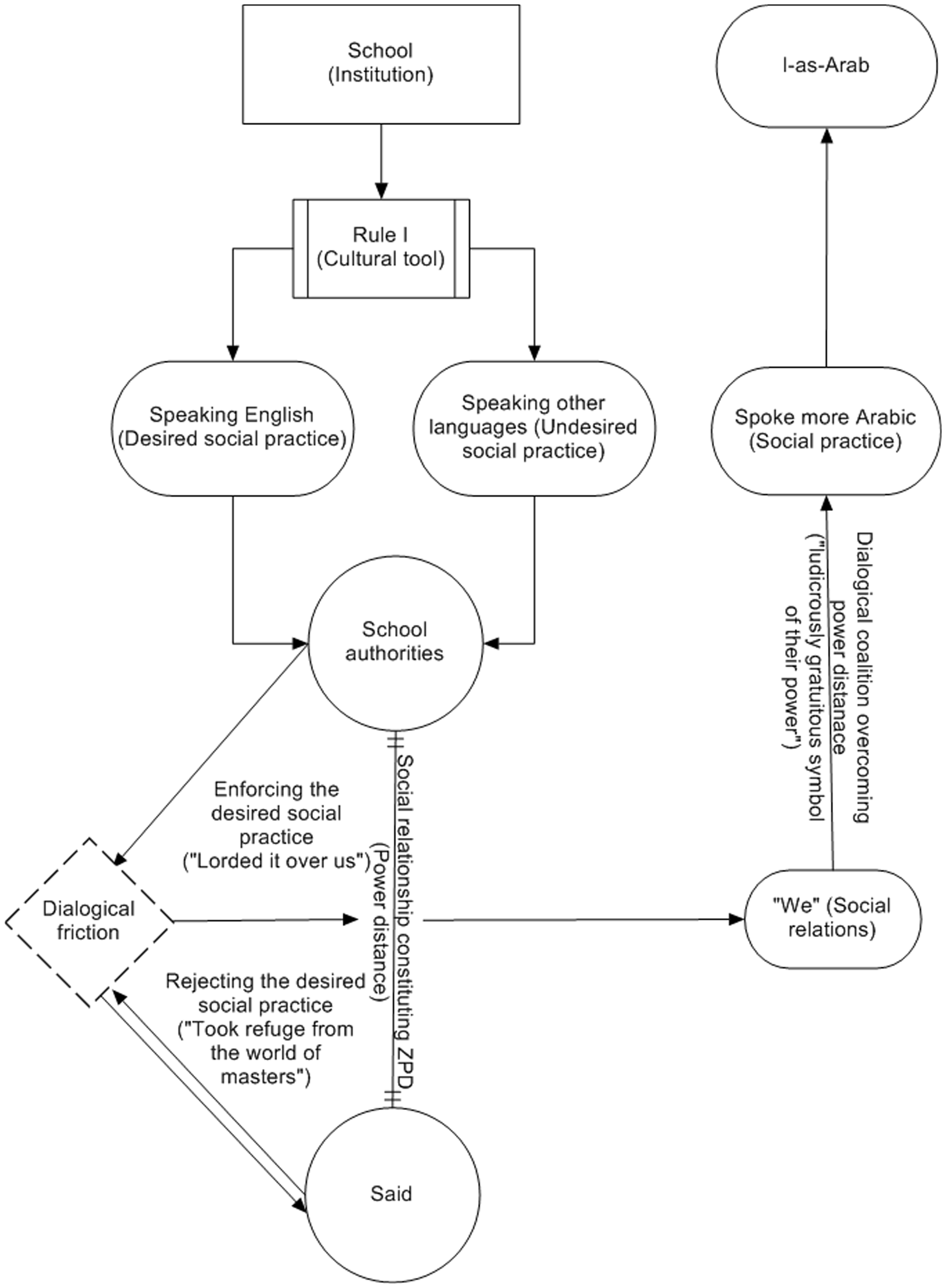
Central to Said’s account was Rule I, an institutional inscription represented via the school handbook (cultural tool) “English is the language of the school” and “Anyone caught speaking other languages will be severely punished.” In the first sentence, one can infer that Said’s school preferred speaking English as social practice. Upon the signifying the enforcement this preferred social practice, the school (institution) rejected other forms of social practice by demonstrating a consequence: punishing (power) the students who do not conform to the desired social practice. In this sense, the school (institution) asserted a social practice that would initiate a dialogical shift among students toward a more British position by speaking English. To witness how such a dialogical activity had impacted upon Said, I shall consider his dialogical reaction to Rule I.
Here, Said asserted an I-as-Arab position by accentuating Arabic as a form of social practice (describing it as a “haven”) he sought. Note his use of “our,” which indicated social relations with his fellow schoolmates who shared the same language background. Said knew that speaking Arabic (social practice) was despised by his school (institution), describing it as a “criminalized” practice. In reasserting his I-as-Arab position, he again invoked a form of social relations—“we”—with his fellow Arabic-speaking peers to indicate his dialogical opposition toward an external powerful position represented by the school authorities (using the metaphors world of masters, complicit prefects, and Anglicized older boys). Said’s satirical portrayal of the school authorities underlined a knowledge distance (ZPD) between the Arabs (learners of English) and the authorities (“experts” of English), which represented a tensioned social relationship. At the upper end of this social relationship was a powerful external position that attempted to subjugate (power)—“lording it over us”—causing a dialogical friction toward Said’s I-as-Arab position. Such a role enabled the school authorities to foster a speak-English-only-environment among its members (social practice) by enforcing Rule I (cultural tool) on behalf of the school (institution).
To claim his I-as-Arab position, Said invoked his social relations (“we”) with his Arab school fellows to reaffirm their social practice by speaking Arabic. Although seen as an opposing social practice, Said strategically used Arabic as both a cultural tool and social practice. Note the shifts in power over time (“what seemed then, and seems even more so now”). This contrast summed up how Said sidestepped, by counteracting and subduing (through using descriptions like “arbitrary” and “ludicrously gratuitous”), the powerful external position exerted (power) by the school authorities through Rule I (cultural tool).
In analyzing Said’s above excerpt, Bhatia (2002) showed the intensity of emotions and historicity attached to Said’s I-as-Arab position. In this paper, however, the analysis highlighted not only the dialogical frictions, but also the cultural tools, relationships, and relations that foregrounded his I-as-Arab position. The dialogical movements were multidirectional, in which he claimed and reclaimed his Arab identity, a process that somewhat resembled a battlefield. In showing his contempt toward the school’s institutional ethos of speaking English, Said did not only speak Arabic to show his defiance but he also invoked a “we-ness” through identifying himself with an Arabic-speaking practice, a cultural armory that he and his fellow Arabic-speaking students would collectively engage in, that is, forming a “dialogical coalition” (Barani, Yahya, & Talif, 2014, p. 763) to overthrow the powered position of his school. In mollifying this power, Said’s I-as-Arab position resurfaced as he, along with an imagined “we,” counter-subjugated the school authorities.
Addressing what makes the social relations—collectivity associated with his fellow Arabic-speaking individuals—a strong cultural armory in Said’s context is an aspect beyond this paper’s scope. Nevertheless, the analysis calls for a closer inspection of Said’s account empirically. To determine how power took place in his school, one can ask how the school authorities imposed their position. What punishments were in place? What cultural tools were involved? What actions took place as Said protested against punishments? What cultural or institutional references outside the school could Said have drawn upon? What out-of-school dialogical factors had impelled him to cling to a shared Arab we-ness that ultimately became his cultural armory? Had it not been the presence of his Arabic-speaking schoolmates, would Said still reassert his I-as-Arab position the same way?
As discussed earlier, the educational support measures for EM students in Hong Kong showed a preference on developing their Chinese language proficiency. This preference at a policy level has implications for EM students’ schooling environments. The implication of Said’s account is that cultural positioning is actively negotiated through different cultural tools within an institutional setting. If one is to investigate how schools contribute to EM students’ identity, the proposed framework could help outline school factors that prompt movements in I-positions across different contextual layers. In other words, EM students negotiate identities not just when they move between their ethnic homes and schools, but also within schools. If there is a preference on using Chinese language in Hong Kong schools, then how does it manifest on the discourse at a school level? To this end, future analytical efforts can focus on exploring how such a schooling discourse underpins dialogical movements. This is because schools are grounds for a variety of social relationships that can trigger movements in I-positions, a process that underscores their “putatively hybrid identities” (Gube, 2015, p. 147).
Conclusion
The paper illustrates how institutional structures emerge as multifaceted cultural resources for shifts in dialogical movements and positions. Following the DST tradition, institutional structures are not monolithic spaces, but a trope for negotiation with a range of relationships, practices, and relations in an institution. This consideration offers a nuanced examination of the nexus between internal and external positions. Experiences in these spaces permeate the dialogical self, which can initiate dialogical shifts with reference to (counter) external positions. In doing so, I highlighted the socioculturally embedded external I-positions of DST in institutional settings. The intention is to account for the dialogical frictions that occur within an institutional setting to provide a sociocultural trail of such temporal organization. As illustrated in Said’s Rule I encounter, when faced with dialogical frictions, I-positions do not necessarily react in a push-and-pull fashion as if it was a simplistic decision-making process on whether or not to conform to a particular position. Rather, the recursive I-positions involved mustering supportive collective voices and “fight against” oppressive and powered external positions. For instance, the proposed framework may help develop accounts on what voices enable dialogical movements to accept, negotiate, reject, or overthrow other positions, particularly on how power underwrites different I-positions. The analysis here can help probe how EM students respond to a schooling environment that may contradict their cultural background, such as the language environment of Hong Kong EM students. While minority students often struggle with their schooling and identity because of home–school cultural environment gap, cultural disjoints can occur within institutions that may require appropriate pedagogical responses both at classroom and institutional levels.
DST is a promising epistemological agenda that draws out the effects of globalization and multiculturalism. In arguing that social discourses are cultural emblems that cut through cultural borders and institutions (Gülerce, 2014), DST researchers are typically concerned with individuals’ multiple identification through socialization in local and global cultures. Yet, a closer inspection of the acculturation challenges of EM students, there is a need to reframe the understanding on how these individuals (re-)present themselves in institutional spaces to better account for their development of hybrid culture and identities. Dialogical self in multicultural contexts is not simply an interanimation of I-positions emerging from local and global environments. Rather, within this local–global continuum are institutions that define what it means by being “local”—how I-positions conform, coalesce, and subjugate others through negotiating a set of cultural tools in a given space. In reiterating the interface of institutional discourses and the temporal and spatial organization of the dialogical self, the temptation at times is to simply understand “the inside from the outside” through examining one’s cultural environment. But by probing one’s dialogical reaction toward a culture, one can understand “the outside from the inside” by examining how a sociocultural environment is mirrored within the self.
Footnotes
Acknowledgements
I extend a special thanks to Sivanes Phillipson for her comments on a draft of this paper. I am also indebted to Amrei Joerchel, Dany Boulanger, and two anonymous reviewers for their substantive and helpful suggestions.
Declaration of Conflicting Interests
The author declared no potential conflicts of interest with respect to the research, authorship, and/or publication of this article.
Funding
The author(s) disclosed receipt of the following financial support for the research, authorship, and/or publication of this article: The author was supported by Tasmania Graduate Research Scholarship and Tuition-fee Scholarship at the University of Tasmania during the writing of this article.