



Abstract
Since the Second World War, the dominating paradigm of societal development has focused on economic growth. While economic growth has improved the quality of human life in a variety of ways, we posit that the identification of economic growth as the primary societal goal is culture-blind because preferences for developmental pathways likely vary between societies. We argue that the cultural diversity of developmental goals and the pathways leading to these goals could be reflected in a culturally sensitive approach to assessing societal development. For the vast majority of post-materialistic societies, it is an urgent necessity to prepare culturally sensitive compasses on how to develop next, and to start conceptualizing growth in a more nuanced and culturally responsive way. Furthermore, we propose that cultural sensitivity in measuring societal growth could also be applied to existing development indicators (e.g. the Human Development Index). We call for cultural researchers, in cooperation with development economists and other social scientists, to prepare a new cultural map of developmental goals, and to create and adapt development indexes that are more culturally sensitive. This innovation could ultimately help social planners understand the diverse pathways of development and assess the degree to which societies are progressing in a self-determined and indigenously valued manner.
Keywords
All peoples have the right to self-determination. By virtue of that right they freely determine their political status and freely pursue their economic, social and cultural development.
– United Nations, General Assembly Resolution 1514, 1960
Those attempting to guide the economy and our societies are like pilots trying to steer a course without a reliable compass. The decisions they (and we as individual citizens) make depend on what we measure, how good our measurements are and how well our measures are understood.
– Stiglitz, Sen, & Fitoussi, Report by the Commission on the Measurement of Economic Performance and Social Progress, 2009
Growth for the sake of growth is the ideology of the cancer cell.
– Edward Abbey, The Journey Home, 1977
Introduction
The development of contemporary societies is implicitly most commonly understood as, and sometimes exclusively measured with, economic growth (Stiglitz, Sen, & Fitoussi, 2009; cf. Barro & Lee, 2013). Although unequal distributions of wealth are still prevalent, economic growth in the last 200 years has allowed many countries to largely escape the problems of poverty. At the current point in human history, the richest societies can be considered post-materialistic. They have secured the basic needs of most of their members and are economically prosperous enough to deprioritize economic development and place a greater emphasis on other societal goals, such as egalitarianism (e.g. Marx), openness (e.g. Popper), harmony (e.g. Confucius), freedom (e.g. Locke), justice (e.g. Rawls), and/or well-being (Diener, Oishi, & Lucas, 2015). Furthermore, societies that are economically less prosperous may also wish to harmonize economic growth (as a tool of securing basic needs) with other important social issues. So, each society may harmonize societal developmental aims in its own indigenous way, and various aims may be prioritized in each culture to a different degree.
In the current paper, we argue that greater cultural sensitivity (CS) in measuring societal growth is needed in contemporary societies. We call for social scientists to prepare a new cultural map of developmental goals that will account for the variety of goals among societies and ultimately help track each society’s progress towards their desired outcomes. In particular, we propose elaborating methods for identifying (1) the list of possible developmental goals pursued by contemporary societies, (2) the scores measuring preferences of societies towards various developmental goals, and (3) the measures of performance of a society on a given developmental goal. Such a ‘map’ will help social planners understand the diverse pathways of development and will let policy-makers guide our societies in a self-determined and indigenously valued manner.
Although the current paper is directed at cultural psychologists, the CS idea is addressed to all those interested in the question of how to (re)conceptualize societal development. For readers curious about the broader context of our CS idea, we offer an extended version of this paper online as supplementary material. In it, we also briefly discuss (1) the rise of economic growth as a dominant societal development goal, (2) the benefits and shortcomings of economic growth (and GDP in particular) as an indicator of societal progress, (3) the proposed alternative indexes of societal progress, (4) the theory and research on cross-cultural differences regarding societal preferences, and (5) the diverse ways in which culture is conceptualized. Readers who wish to learn about the CS idea from this broader perspective should turn to the extended supplementary material version of this paper. Readers who are familiar with the aforementioned topics and wish to focus on the novel aspects of our proposition can carry on with reading the current main text.
Beyond an economic conceptualization of societal development
According to Sen (1988) – a societal development researcher and Nobel Prize winner – the integral part of the concept of societal development is the ‘enhancement of living conditions’. Although various pathways of enhancement of living conditions are possible, and their diversity across societies is imaginable, contemporary governing bodies almost universally conceptualize societal development as economic development. Interestingly, this overwhelming concentration on the economic goal of development likely started no earlier than post-Second World War (see Figure 1).
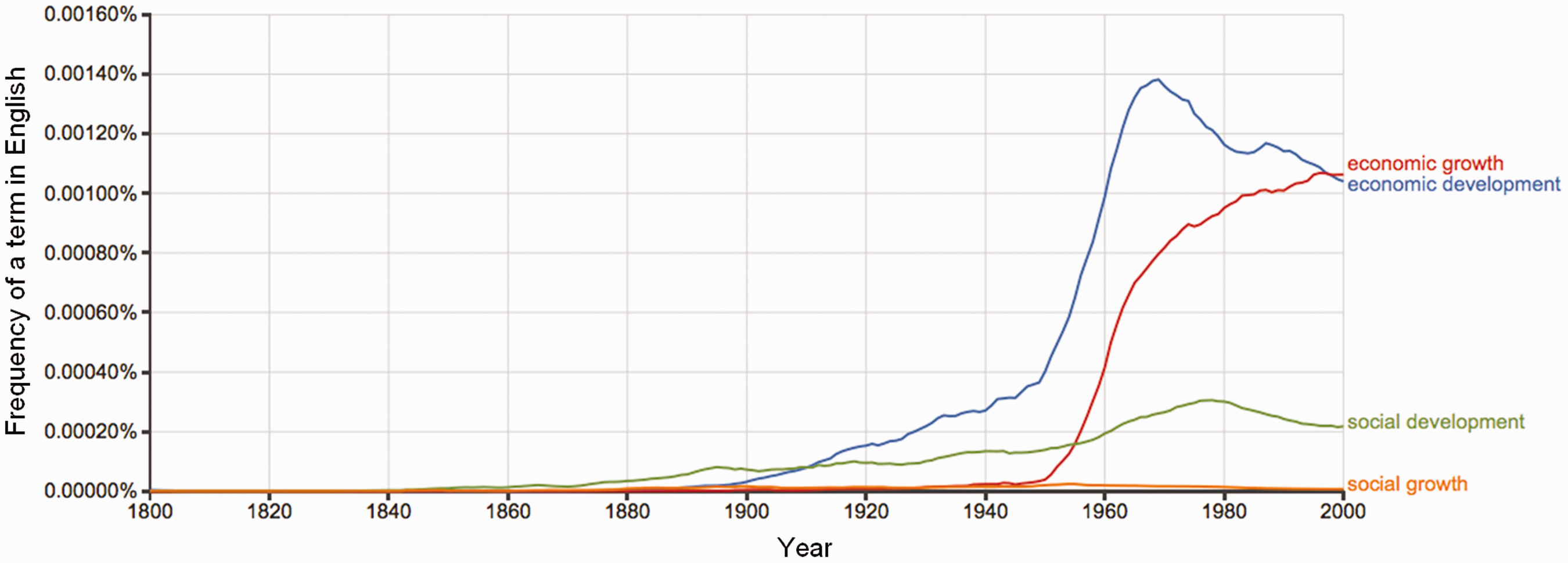
Relative frequency of economic and social development terms in English literature across the last 200 years. The vertical axis represents the relative frequency (per cent) of use of a given term in the whole (digitized) English-language literature. The horizontal axis shows the year of publication. Source: https://books.google.com/ngrams.
Increases in economic prosperity brought materialistic security to those societies that successfully entered the pathway of economic development, and many of these societies have been recently labelled WEIRD societies (i.e. Western, Educated, Industrialized, Rich, and Democratic; Henrich, Heine, & Norenzayan, 2010). At the beginning of the 21st century, WEIRD societies have been the most influential in terms of economic, technological, cultural, and military power (Henrich et al., 2010), but face the problem of ‘lacking a compass’ on where to go next after they have become prosperous (Stiglitz et al., 2009).
For societies that still face the problem of extreme scarcity, the economic conceptualization of societal development is understandable because increases in the economic standing of poor societies bring about significant improvements in their members’ well-being (Diener & Biswas-Diener, 2002; Diener, Lucas, Schimmack, & Helliwell, 2009). But poor societies may also wish to harmonize their economic progress with other societal aims – aims that are indigenously defined and conceptualized. Bhutan may serve as an example and we briefly discuss its Gross National Happiness (GNH) index in the extended supplementary material version of this paper.
The dominance of economic aspects in defining societal development may come from the failure to identify a viable competitor to economic goals. There is probably no single and universally good alternative; different societies may prioritize different aims to different degrees. At the current point in human history, many societies have achieved sufficient materialistic support to begin expressing other concerns, like environmental protection, equality in resource provision, broad-based health provision, or freedom of movement and expression (e.g. see Welzel, 2013, who documented the spread of emancipative values in the recent century). This process may resemble a Maslowian-progression from satisfaction of basic to higher needs, but at the societal level and with higher needs organized complementarily (not hierarchically).
Economic growth matters, but it is not the only pathway and aim of development (presently, economic growth frequently serves as both). We argue that searching for a single pathway of development for all societies may actually result in the continuation of economic development as the main societal developmental goal (e.g. if an alternative pathway of development cannot be universally agreed upon, then the status quo may be seen by some as being the least worst option). By proposing the CS approach, we hope to show that various pathways are possible and needed, and that harmonization of economic development with other social issues is possible for poorer societies, and necessary for post-materialistic societies.
Societal development indexes from the perspective of cross-cultural psychology
With this paper, we wish to add the voice of cross-cultural psychology 1 to the ongoing academic, political, and social debate on the shortcomings of currently used development indexes, viz. all the currently used development indexes are blind to the cultural diversity of societal developmental goals. The development indexes assume implicitly that (1) every society has the same set of developmental goals, (2) every society pursues these goals with equal intensity, and (3) every society follows the same developmental pathway to satisfy these goals. We claim that societies are likely to vary in (1) their set of preferred developmental goals, (2) the intensity with which they wish to pursue specific goals, and (3) their preferred pathways leading to these goals. Thus, we advocate that the philosophies underlying development indexes could also reflect the cultural diversity of contemporary societies in terms of their preferred developmental goals and the pathways leading to these goals.
Similar ideas have been advocated in the Social Indicators Movement (SIM). In the SIM’s founding document, Bauer (1966) declared that social development indicators should enable societies to assess whether they are developing with respect to their values and goals (Land & Michalos, 2015). Later on, Solomon et al. (1980) suggested that the SIM should recognize cultural differences in social development indicators (Shek & Wu, 2018). In particular, Solomon and collaborators recognized that quality of life itself should be defined in various ways from culture to culture, that projects on social development indicators should recognize that cultures may have different value systems, and that we should learn from these differences and try to systematize this knowledge (Land & Michalos, 2015). However, Shek and Wu (2018) conclude that this proposition: … is a neglected aspect in the movement. Social indicators researchers have commonly assumed that the indicators are universally valid, and can be used in different cultures. Even though some social indicators researchers recognize cultural differences, the related reflection is not substantial. (p. 977)
Descriptive and evaluative approaches to culturally sensitive development indexes
There are many approaches imaginable for incorporating cultural factors into development indexes. Two broad types of approaches that may have the greatest importance for future studies are the development of indexes using either (1) a descriptive approach that ignores the individual, societal, and environmental consequences of developmental goals or (2) an evaluative approach that focuses on developmental goals that are beneficial for individuals, societies, and the planet. These two approaches have different potentials. And in both cases the corresponding cultural map will change across time as societies evolve and new prescriptive goals are defined (Marsico, 2015).
The descriptive approach would describe people’s preferences as they are without assessing whether a given developmental pathway is beneficial or harmful. Demographic growth, for instance, is likely not the most desirable pathway of development for a well-populated planet. However, some governments and people still find demographic growth important; the descriptive approach would recognize demographic growth in its list of developmental aims. This approach involves describing people’s actual expectations (without imposing preliminary assumptions about whether a given pathway is good or bad) and would help us understand them. It could also describe past pathways of development (e.g. policy-makers often fostered demographic growth in the past).
The evaluative approach, in contrast, may help shape a better future. In indexes crafted with the evaluative approach, the ‘goodness’ and ‘badness’ of developmental pathways for contemporary and future societies will have to be taken into consideration. This approach is not without a fundamental limitation however – all evaluations are themselves culturally biased. Therefore, the evaluative approach may raise methodological and axiological problems.
The Sustainable Development Goals (SDG) – the collection of 17 global developmental goals set by the United Nations in 2015 – can help illustrate the complementarity of both approaches. Each society may wish to follow its own indigenous pathway of sustainable development, and studies on cultural preferences towards each of the 17 SDG can help shape these pathways. Such studies will fall within the aforementioned evaluative approach. However, studies that focus exclusively on SDG will remain blind to people’s actual preferences towards development. Some people and societies wish to follow pathways that science recognizes as harmful and unsustainable (e.g. demographic growth). By studying ‘harmful’ preferences, one can elaborate a comprehensive map of actual preferences. Such a comprehensive mapping is necessary if we want to understand not only what we wish to happen, but also how to change priorities that we wish did not drive people’s behaviour. The latter is possible only with a descriptive approach.
Towards mapping culturally sensitive development
Statistical indicators are important for designing and assessing governmental policies, which in turn influence the functioning of societies and their members. It is both possible and reasonable to formulate development indexes that give consideration to the cultural diversity of preferred developmental goals (descriptive CS indexes) that, at the same time, will not be harmful to the long-term prosperity of humankind (evaluative CS indexes). The cooperation of cultural researchers and development economists, along with other social scientists, is needed to elaborate the theories and resultant maps of societies’ developmental goals.
In order to craft descriptive or evaluative CS indexes, researchers need to elaborate the methods for identifying:
the list of possible developmental goals pursued by contemporary societies; these lists should take a culturally inclusive approach in their development as with the values identified by Schwartz (2009) or the social axioms identified by Bond et al. (2004; see Berry, 2013 for more on the concept of pan-cultural universals), the scores measuring preferences of societies towards various developmental goals; as with values or social axioms, the scores will be attributed to societies and will allow for the assessment of the diversity of preferences towards a given developmental pathway, and the measures of performance of a society on a given developmental goal, for example GDP per capita could be a measure of the economic component of the CS index.
The set of pan-culturally identified developmental goals (point 1 above) will probably remain relatively stable over time and will reflect the diversity of possible developmental pathways. The selection of potential developmental goals is broad. Classical topics, such as egalitarianism, openness, harmony, freedom, justice, or spirituality may be included in the list of desirable societal aims. One may also consider emphasizing areas researched more contemporarily, such as happiness in its various forms (e.g. Krys, Uchida, Oishi, & Diener, 2019; Uchida, Ogihara, & Fukushima, 2015), meaning in life (e.g. Oishi & Diener, 2014), protection of the dignity of a community (Jaskiewicz & Besta, 2018; Mies, 2014), environmental protection (O’Neill, Fanning, Lamb, & Steinberger, 2018), gender egalitarianism (Krys, Capaldi, et al., 2018), democracy (Ernø, 2016), family well-being (Krys, Capaldi, et al., 2019; Krys, Zelenski, et al., 2019), or low wealth inequalities (Piketty & Saez, 2014). These are only a few examples of potentially beneficial developmental aims, and qualitative research could help with determining the comprehensive list of societal development aims.
The scores measuring preferences of societies towards developmental goals (point 2 above) would probably need to be refreshed (e.g. a moving average would likely help) as societies evolve and their preferences towards specific developmental pathways slowly change over time. The tracking of societies’ preferences for developmental pathways could be based on measures incorporated into projects like the World Values Survey (WVS) or the Gallup poll (e.g. socializing goals measured by the WVS; Bond & Lun, 2014; Lun & Bond, 2016).
Finally, the scores of measures tailored to track the performance of societies on a given developmental goal (point 3 above) would change on a yearly basis (e.g. every year the World Bank delivers estimates of GDP per capita), although the selection of these measures should probably remain relatively stable over time (e.g. GDP per capita would be consistently used to track economic development over time).
In crafting CS indexes, top-down and bottom-up approaches can be applied. After the king of Bhutan declared that GNH is more important for Bhutan than GDP, Bhutanese scientists started elaborating the methodology for GNH according to the Bhutanese king’s ideas. This is an example of a top-down approach (see Diener & Tay, 2016 for other top-down examples relating to well-being). Explicitly taking the preferences of citizens of a given country into consideration, like it has been done in the Better Life Initiative (BLI), is an example of a bottom-up approach. The BLI was launched in 2011 by the Organisation for Economic Cooperation and Development in order to involve people in discussions on well-being and to learn what matters most to them. This initiative uncovered cultural differences in preferences towards different aspects of well-being: education, jobs, and civic engagement are rated as being especially important in South America; personal safety and work–life balance are highly rated in Asia-Pacific; health matters most for Europeans; and life satisfaction matters most for North Americans 2 (Balestra, Boarini, & Tosetto, 2018). The BLI also offered the Better Life Index, in which the authors weighted a country’s outcomes by people’s preferences towards the 11 specified aspects of well-being. Both top-down and bottom-up approaches have their advantages, and CS indexes that combine results of scientific studies (e.g. on the hampering effects of inequalities) and explicitly take into consideration people’s preferences may be the most fruitful line of CS indexes (in an evaluative approach).
One benefit of traditional indexes of societal development is their between-country comparability. However, one will still be able to compare societies using the CS approach. Instead of comparing societies based on their performance on societal aims that are weighted the same for all societies (i.e. the approach of traditional cultural diversity-blind indexes of societal development), CS indexes will weigh societal aims differently for each society depending on the degree to which individuals in each society value that aim. Thus, the unit of comparison for CS indexes will be the level of progress on indigenously valued aims of development. With CS indexes, one will be able to compare how close each society’s actual experiences are to indigenously defined ideals (and the latter may, of course, change over time).
Preparing the CS methodology may seem challenging, but the methodology for calculating GDP also took time and a lot of studies before it became a ‘universal’ index of societal progress. The first version of an international standard system of national accounts (i.e. the GDP measurement manual) was published in 1953 and has since undergone major revisions in 1968, 1993, and 2008 (United Nations System of National Accounts, 2009). A similar manual can be imagined for CS indexes, and similar revisions will probably be necessary.
CS can be applied to existing indexes
One route to CS of development indexes is the implementation of the CS idea to already known, and presently cultural diversity-blind, indexes. For example, the Human Development Index (HDI), the most popular alternative to GDP, is constructed as the geometric mean of three sub-indexes – education, longevity, and economics (

Thus, the HDI implicitly assumes that each of its three components is equally important for each society. However, there is no empirical evidence that every society prefers each of these three pathways of development with equal strength. By collecting or accessing relevant data, researchers could weigh longevity, education, and economics by the actual preferences of each society and then assess how well each society is meeting its own goals in a culturally sensitive HDI (CS-HDI;

As a result, this adapted CS-HDI would place relatively more significance to the dimensions that a given society aspires to attain and would thereby become more culturally sensitive.
Research on differing societal preferences for developmental goals has practical implications – governments do face the question of which pathways to prioritize: to invest in healthcare, to facilitate the availability of education, or to foster economic growth. Although these three pathways do not have to be mutually exclusive, some societies find them to be competing (e.g. the discussion about the Affordable Care Act in the USA), and governments face decisions where to place limited finances. Either consciously (like Scandinavian governments), or as the indirect result of decisions, governments differently promote each of these three pathways.
Canada and USA may illustrate the potential utility in employing the CS approach to the HDI. In the HDI ranking for 2015, Canada and the US shared exactly the same level on the HDI (i.e. .920). Whereas Canada and the US shared moderately high levels of education (16.3 versus 16.5 years, respectively), they differed in their life expectancies (82.2 versus 79.2 years) and in their economic performance (purchasing power parity US $: 42,582 versus 53,245). Do Canadians prioritize health more than US citizens? Do US citizens prioritize economic prosperity more than Canadians? If yes, their ranking matched their societal desires and values for progress. But what if the answer is no and their societal goals are actually similar, and both countries prioritize, for example, longevity over economic prosperity? In such a case, both countries would be ranked differently in the CS-HDI approach, with Canada occupying a higher position.
The original HDI may remain objective and universal, but as we showed above the CS approach can be complementary without replacing existing indexes. Currently, weights used in the original HDI are arbitrarily selected (i.e. the three sub-indexes are given the same weight). It is unclear whether this is the best possible distribution of weights between longevity, education, and economic prosperity. Most likely, specific weights may fit different societies better than others. With the CS approach, we can also check how well the current weights in the original HDI match the preferences of citizens in different countries (i.e. the equal weights, and thus the original HDI, may be more appropriate in some countries than others).
Weighing developmental pathways by cultural preferences will probably realign the order of countries in the CS-HDI rankings. Most importantly, data about cultural preferences for developmental pathways may be a useful tool for individual agents and governmental agencies responsible for creating and implementing policies. Currently, governments arguably select the pathways of development somewhat arbitrarily, or according to some implicit perspective of what constitutes progress. A culturally sensitive measure could help them select the best solutions for their own societies.
Risks of the CS approach
The CS approach should not be used as a justification for oppressive practices. Although judging the developmental aims of governments is uncomfortable from a cultural relativistic position, we would like to explicitly articulate our disagreement with potential abuses of our presented idea. If any governing body would like to justify its oppressive practices with the CS approach, we will recognize it as an abuse of the CS idea and as a betrayal of the members of its own society. Economic security facilitated emancipation in various forms (Welzel, 2013), and the potential next step of development from economization towards culturally diversified concepts of societal growth may only be welcomed if accompanied by further emancipation from scarcity, poverty, and oppression.
Furthermore, we consider human rights as inalienable to every human being in every society. 3 Human rights are a non-negotiable core of every developmental pathway. The process of societal change that disrespects human rights is not a development, but retrogression. Thus, the oppression of people based on their ethnicity, religion, sexuality, gender, etc. should not be justified as a societal preference and an indigenous way of development. A society that discourages any single group to fully benefit from every aspect of social life is a violation of basic human rights and limits human flourishing. Prejudice and intolerance should have nothing in common with following an indigenous way of development.
We recognize the risk that some governing bodies may try to abuse our presented idea to justify their oppressive practices. We hope, though, that misuse of the CS idea, if appears at all, will be an exception and rare. The CS approach has, on the contrary, the potential to undermine oppressive regimes if the actual values and desires of their citizens are being ignored and not being actualized. The CS approach could help highlight discrepancies between what people in a society really wish with what is being delivered/argued by a governing body.
It is also possible that if we develop studies on people’s preferences towards societal development, we may obtain directions that undermine social welfare overall (e.g. military expansion over neighbouring countries or further improvement of economic standing without respect to environmental boundaries). An evaluative approach (see ‘Descriptive and evaluative approaches to culturally sensitive development indexes’ section of this paper) may be a solution to this threat. Future studies may also need to deal with within-country cultural differences. Ideally, a culturally sensitive approach should recognize and respect variations across social groups and individuals within a society. This is relevant when thinking of cultural minorities, but applies also to other qualities differentiating people (see Fleurbaey & Blanchet, 2013).
Future directions
We hope that the CS approach towards societal development will be recognized as an urgent topic for the majority of societies (for similar signals, see Balestra et al., 2018; Shek & Wu, 2018). We do not pretend that the current paper, or its extended supplementary material version, is a full description of the proposed idea and the concrete steps towards its implementation. Such a description requires further empirical studies. With this paper we hope to stimulate efforts in this direction.
Future papers will need to grapple with and provide answers to basic questions on how to determine societal preferences. For example, whose preferences (e.g. lay people’s, political bodies’, elites’) will be tracked? What is a societal preference? What about preferences that some people recognize as good and others recognize as bad for individuals, society, the whole of humanity, and/or the planet? Even if we assume that all citizens have well-defined preferences, it may be impossible to aggregate them in a clear and acceptable way (see Arrow’s 1950 possibility theorem). How the various preferences should be negotiated into societal preferences is another question requiring an answer. Answers to these questions may resemble answers to questions about the nature of democracy, the source of democratic will, and the method of aggregation of democratic votes – there will probably be numerous studies and ongoing debates.
In addition, how should we conceptualize a culturally sensitive approach? In our current initial proposition, we equate culture with ‘country-level culture’, but a culturally sensitive approach could go beyond such a narrow conceptualization of culture (i.e. culture is more heterogenized, dynamic, and fluid than ‘country-level cultures’ can be – for a discussion, see the extended supplementary material version of this paper, but also Jahoda, 2012; Matusov & Marjanovic-Shane, 2017; Toomela, 2003). Here, we simply wish to introduce the idea of CS in measuring societal development, and leave comprehensive and detailed discussion of solutions for future work. A substantial body of research on GDP was conducted before it became an international standard; similar rigorous theoretical and empirical studies are needed to develop CS indexes.
Conclusions
Globalization has forced us to question what aspects of the human experience are universal and what aspects are culturally shaped. The lack of complex understanding about the influence of cultural context on the thoughts, feelings, and behaviour of individuals can lead to intercultural conflicts and impede their successful resolution. Psychology emerged largely as a discipline aimed at healing individuals. With scientific rigor, psychology has documented individual differences and revealed the variety of pathways leading to individual flourishing (Seligman & Csikszentmihalyi, 2000). Cultural/cross-cultural psychology has the potential to offer support in healing societal systems by documenting cultural differences and shaping solutions that are sensitive to the cultural diversity of contemporary societies.
Stiglitz et al. (2009) noticed that those attempting to guide our societies are like pilots. The decisions they make depend on what they measure and how good their measurements are. Introducing CS to growth measurement will help social scientists understand the culturally diversified pathways for the development of societies, and in effect may influence governmental policies. For the vast majority of societies, it is a necessity to start conceptualizing post-materialistic growth in a culturally sensitive way. Otherwise, without good compasses on how to develop next, they will likely continue to degrade planetary (and human) health in the pursuit of endless economic progress. Furthermore, CS in defining growth will help us understand humankind, and cross the boundaries and the potential fault lines that culture imposes on each of us.
In the contemporary world, sensitivity to cultural diversity is an issue of high societal, practical, and political importance. We argue that cultural researchers have an important role to play in addressing this issue. WEIRD societies also have a responsibility as these societies were the ones that attempted to apply their developmental goals in a one-size-fits-all approach to the rest of the world. This way, contemporary societies may fulfil the United Nations ‘decolonisation’ resolution from 1960 that states, ‘All peoples have the right to self-determination; by virtue of that right they freely determine their political status and freely pursue their economic, social and cultural development’.
The Golden Rule (Kant, 1785/2002) is a fundamental moral code across cultures. The Confucian Analects, the Christian Bible, and the Buddhist Udanavarga teach us that we should treat others the way we would like to be treated, or at least, not to treat others as we do not wish to be treated. By steering global development towards economic paths of development, WEIRD societies applied the golden moral principle to non-WEIRD societies. Since the Second World War, this golden moral code also implicitly guided global institutions to the most common, economic way of measuring development that is, however, blind to cultural diversity of preferred development paths or goals. Popper (1945/1966) suggested that the golden rule is a good standard which ‘can perhaps even be improved by doing unto others, wherever possible, as they want to be done by’ (p. 386). Philosophers called this concept the platinum rule, and the platinum rule may be applied to measures of societal development as well.
Supplemental Material
Supplemental material for Psychologizing indexes of societal progress: Accounting for cultural diversity in preferred developmental pathways
Supplemental Material for Psychologizing indexes of societal progress: Accounting for cultural diversity in preferred developmental pathways by Kuba Krys, Colin A Capaldi, Vivian M-C Lun, Christin-Melanie Vauclair, Michael H Bond, Alejandra Domínguez-Espinosa and YukikoUchida in Culture & Psychology
Footnotes
Acknowledgements
We thank Janusz Reykowski, John W. Berry, and Kasia Cantarero for offering feedback on the presented idea.
Declaration of Conflicting Interests
The author(s) declared no potential conflicts of interest with respect to the research, authorship, and/or publication of this article.
Funding
The author(s) disclosed receipt of the following financial support for the research, authorship, and/or publication of this article: We thank the Japanese Society for the Promotion of Science for offering financial support to help with the development of this article (grants numbered P17806 and 17F17806).
Supplemental material
Supplemental material for this article is available online.
Notes
Author Biographies
References
Supplementary Material
Please find the following supplemental material available below.
For Open Access articles published under a Creative Commons License, all supplemental material carries the same license as the article it is associated with.
For non-Open Access articles published, all supplemental material carries a non-exclusive license, and permission requests for re-use of supplemental material or any part of supplemental material shall be sent directly to the copyright owner as specified in the copyright notice associated with the article.
