



Abstract
Dialogical single case studies involve mutually interdependent relations between humans in their real locations and in real time (here-and-now). Mikhail Bakhtin explored such relations in terms of chronotopes, i.e. as indivisible units serving as analytical tools for the study of dynamic processes in literature. We argue that chronotopic thinking also serves as an epistemological and ethical organising principle of human activities in daily thinking, knowing, actions and communication. This article explores different types of chronotopic thinking in dialogical single case studies, such as routines and changes; bildungsromans and heteroglossia; and values, meanings and intensities of these chronotopes in different time-scale situations. Considering ethical and dynamic interdependencies between the participants, this article suggests in what ways knowledge obtained in dialogical single case studies could be transferred (extended, generalised, resituated) to other kinds of studies.
Keywords
Dialogical single case studies involve by definition some kinds of mutually interdependent relations between humans in their real location and in real time (here-and-now). Focusing on time–space relations, we shall explore different types of such interdependencies in dialogical single case studies and suggest in what ways knowledge so obtained could be transferred (extended, generalised, resituated) to other kinds of studies.
Human life in and through temporality
In order to fully comprehend the vital role of chronotopes in dialogical single case studies, we need to address Mikhail Bakhtin’s conviction that the human life must be primarily considered through the concept of temporality. From his earliest writings Bakhtin searched for understanding of the nature of the Self and the Self’s responsibility in relation to Others. Already in his first known published article Bakhtin (1919/1990) distinguished between three domains of human culture: science, art and daily life (Marková, Zadeh, & Zittoun, 2020). Humans may combine these domains mechanistically and superficially as something external to them. Alternatively, they may internalise the meanings of these domains, integrating them organically as part of their Selves by acting responsibly. In acting with ‘through and through responsibility’ all of the individual’s ‘constituent moments must not only fit next to each other in the temporal sequence of his life, but must also interpenetrate each other in the unity of guilt and answerability’ (Bakhtin,1919/1990, p. 1). In this very early fragment, we already witness Bakhtin’s preoccupation with the nature of the Self, temporality and ethics – the concepts that he was dialogically developing throughout all his career.
Temporality in the experience of the Self and Others
Preoccupation with the nature of the Self and self-consciousness in relation to the Other was specific not only to Bakhtin’s concerns, but it was a problem that was hugely discussed by the 19th and early 20th centuries’ social scientists and philosophers (for reviews, see e.g. Marková, 1982, 2003, 2016; Todorov, 1998, pp. 116–118). Bakhtin’s concept of the Self was from the beginning framed in the context of time and space. Young Bakhtin was preoccupied with the double nature of the Self, constituted of two oppositional components: bifurcation and indivisibility. The bifurcated Self reveals itself through perception: observing the other person means that the individual moves simultaneously in two worlds: in his/her own and in that of the other person. Looking at the Other from the Self’s perspective, the Self can see what the Other person cannot not see. As Bakhtin states, the Self can see parts of the Other’s body that the Other does not see. In and through perception the Self is aware that he/she occupies ‘in a given set of circumstances this particular place at this particular time; all other human beings are situated outside me’ (Bakhtin, 1920–1923/1990, p. 23). However, this is only the first half of Bakhtin’s argument, which concerns the bifurcated Self, and it has been sometimes interpreted as ‘Bakhtin’s individualism’. The second half of his argument refers to the other feature of the Self, to indivisibility. While for perception individuals are bifurcated, ‘for cognition, “I and the other”, inasmuch as they are being thought, constitute a relationship that is relative and convertible’ (Bakhtin, 1920–1923/1990, p. 23, Bakhtin’s emphasis). There is no single I, but only the I in relation to Others and to the world. The I needs Others and the outside world in order to develop selfhood and self-consciousness. Thus Bakhtin (1920–1923/1990, p. 24), already in his earliest work arrives at the triangularity: I-for-myself, I-for-other and other-for-me. Within this relation the Self’s and the Other’s lived experience is unique and concrete, and Bakhtin conceives it as an aesthetic contemplation and ethical action. Throughout all his book on Author and Hero in Aesthetic Activity, written in the early 1920s, we repeatedly find references concerning the Self–Other interdependencies, such as, for example ‘we evaluate our exterior not for ourselves, but for others through others’ (Bakhtin, 1920–1923/1990, p. 33, Bakhtin’s emphasis). These evaluations take place within the author’s and the hero’s temporal and spatial relations. We suggest that these early ideas about the bifurcated and indivisible Self, and the I-Other-World interdependencies, pre-empt the manner in which Bakhtin later on conceives chronotopes, multivoicedness, double languages, ambivalence, open and hidden polemics, parody, irony and other concepts. All these double-edged concepts are filled with controversies and tension; they form integral elements of dialogical thinking in novels, and in life: ‘Such motifs as meeting/parting (separation), loss/acquisition, search/discovery, recognition/nonrecognition and so forth enter as constituent elements into plots’ in literature and by their very nature they are chronotopic (Bakhtin, 1981b, p. 97). These double-edged concepts strongly feature in Problems of Dostoyevsky’s Poetics (Bakhtin, 1984a) and perhaps even more in Rabelais and His World (Bakhtin, 1984b). In the latter, the contradictions between official and unofficial languages are shown, on the one hand, in their extreme separation from one another, and on the other hand, with the boundaries between them being removed; such movements between polarities are ridden with tension and clashes expressing different points of view and enabling diverse interpretations. These Bakhtin’s concepts presuppose that the Self employs them in the unique way with respect to relations with Others, to their conduct, time and location. It is in and through concrete and single cases that we acquire the sense of events, of precise things and of responsible actions, as well as of to whom actions are directed (Bakhtin, 1993).
Temporality of the Self and Other through dialogical thinking and language
Language and the search for meaning in communication are fundamental features of humans not only in literary products but, above all, in daily life. Bakhtin (1981b) concluded his essay on chronotopes by emphasising that humans give to all phenomena that they experience some kind of meaning, that is they ‘incorporate them not only into the sphere of spatial and temporal existence, but also into the semantic sphere’ (pp. 257–258). Meanings are part of our social experience and they must take on the form of a sign that is audible and visible for us (a hieroglyph, a mathematical formula, a verbal or linguistic expression, a sketch, etc).Without such temporal-spatial expression, even abstract thought is impossible. Consequently, every entry into the sphere of meanings is accomplished only through the gates of the chronotope. (Bakhtin, 1981b, p. 258, Bakhtin’s emphasis)
Second, how could we go beyond this claim to make chronotopic thinking relevant to dialogical generalisation? We suggest that chronotopic thinking is vital for generalisation in several ways: it defines epistemic and communicative genres, it generates dynamic concepts, it plays the fundamental role in transmission of genres and concepts over generations. All these suggestions will be discussed in this paper. We may note the etymological similarity between terms such as ‘generalisation’, ‘generic’, ‘genre’ and ‘generation’, which all refer to some common and socially shared experiences. These terms are frequently used in human and social sciences (language studies, communication, sociology, anthropology, etc.), but their meanings are vastly different from ‘statistical generalisation’.
While in social psychology, the focus on language, its semantic and grammatical features has been traditionally quite minimal, for some linguists and communication specialists, human subjectivity and its temporality constitutes the very nature of language and its use. According to Benveniste’s (1958/1971) structuralist perspective, temporality is built into the formal structure of language, and it provides the possibility for human subjectivity. It is the personal pronoun ‘I’ that forms the first step in bringing out subjectivity, which is possible only through ‘You’. The ‘I’ determines that ‘I am the speaker’, and through the use of other pronouns, adverbs and adjectives, the ‘I’ organises special and temporal relationships around him-/herself by using words such as ‘this’, ‘here’, ‘now’, ‘yesterday’, ‘tomorrow’, etc. These basic temporal relations make sense only because the ‘I’ speaks to ‘You’, and this provides ‘the conditions of intersubjectivity, which alone makes linguistic communication possible’ (Benveniste,1958/1971, p. 230).
Similar ideas were developed by the social psychologist Ragnar Rommetveit (1974) who, too, defined the dialogue within temporal dimensions, such as the here-and-now, before and afterwards, there, and so on, referring to them as the spatial–temporal–interpersonal coordinates of the act of speech. Rommetveit goes beyond Benveniste’s position by defining the coordinates of the Self–Other in terms of real time and real location in the temporarily shared social world. These coordinates are mutually interdependent and cannot be meaningfully broken into separate components. They are components of an open-ended whole in the act of communication (Figure 1).
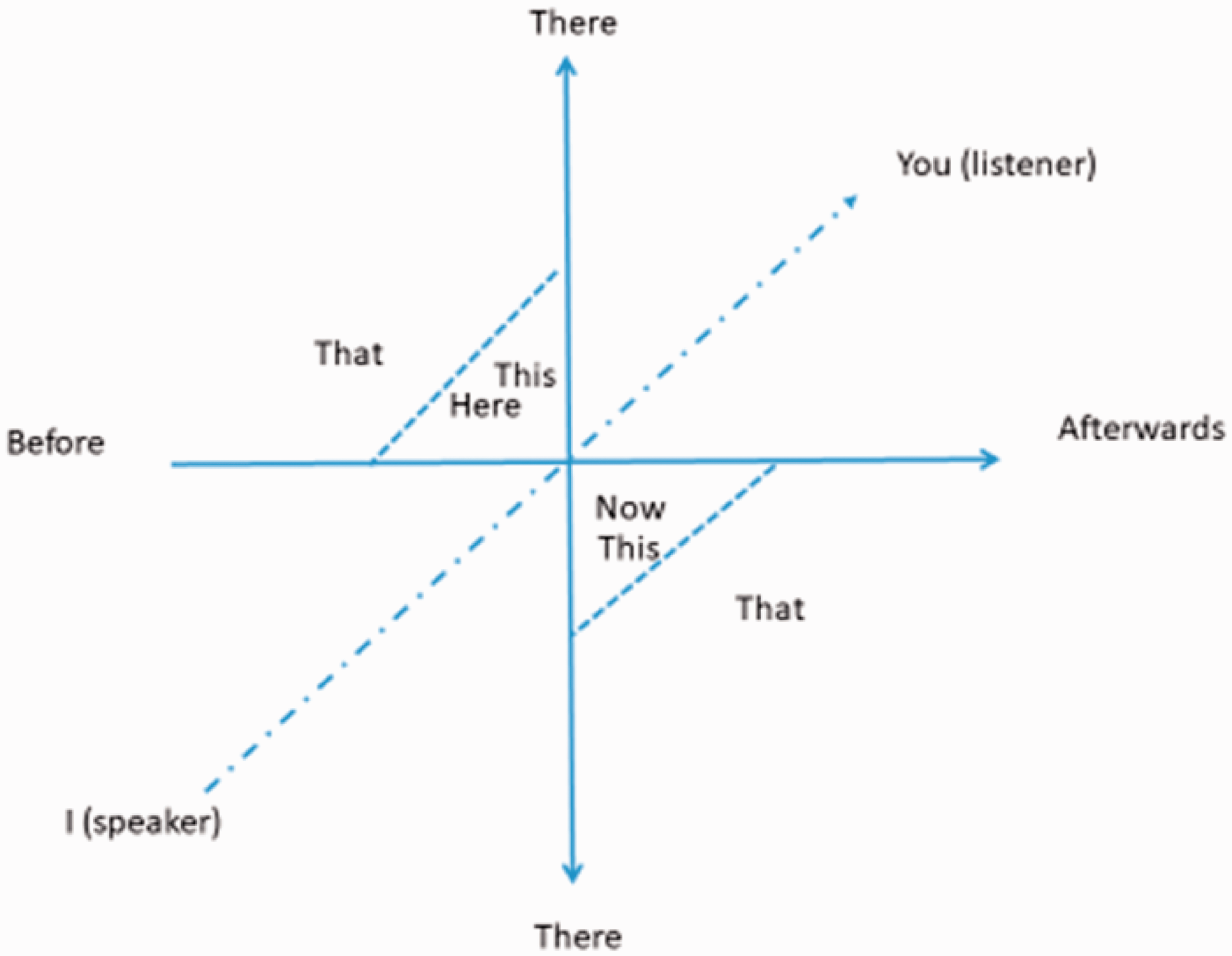
The spatial–temporal–interpersonal coordinates of the act of speech.Source: From Rommetveit (1974, p. 36).
More recently, temporality built into the structure of language and dialogue has been a subject of intensive exploration by interactionist linguists (Linell, 2009, 2016). These very important linguistic and interactionist findings, which show that temporality is built into the structure of language and conversation, provide extensive potentialities for exploring them in chronotopic approaches. These, as already emphasised, go far beyond the time–space relations, whether in language or in any kind of human interaction.
Chronotope and genre
While philosophy deals with abstract and universal concepts, artistic creations are designed as original and unique pieces. This is why Bakhtin (1920–1923/1990) argued that literary creations, and novels specifically, elucidate ethical issues and moral actions far better than philosophy. Ethics and morality are features of the single Self and cannot be understood as static and universal phenomena. Single cases in novels are concerned with the life of concrete human beings and with their actions. Humans are ethical in sense that they evaluate their own and others’ actions, and take and avoid responsibility.
Although Bakhtin’s conviction that human actions in daily life, aesthetics and artistic products must be understood in terms of temporality was apparent in his writings in 1920s, he developed the concept of chronotope only in the 1930s. While the chronotope literally means time–space, i.e. an indivisible unit serving as an analytical tool for the study of dynamic processes in literature, Bakhtin (1981a, 1981b) conceives the chronotope broadly (e.g. Bemong et al., 2010; Steinby, 2013).
In this article, in building on Bakhtin’s ideas, we shall define the chronotope as follows. The chronotope
is an epistemological and ethical organising principle of human activities involves a set of specific dialogical features that are temporarily and spatially interconnected not only in literary and artistic creations, but also in daily thinking, knowing, actions and communication
In his analysis of literature, Bakhtin strongly connected chronotopes with genres. Chronotopes have intrinsic generative significance (Bakhtin, 1981b, pp. 84–85). It is due to the generative nature of chronotopes that the image of a human being is chronotopic (Bakhtin, 1981b). In totally embracing human nature, chronotopes generate specific genres. By genres Bakhtin meant conventionalised styles of acting and communicating, whether through talking, writing, painting and making music, film, and so on. A genre is recognised as a style of communicating belonging to a particular social group or subgroup, community or a historical period. It is due to the conventionalised nature of genres that we recognise Renaissance paintings from modern paintings, Mozart’s music from that of Wagner and Dante’s writings from novels of Jane Austen. In a novel, a dominant genre becomes the epistemology of a hero as he/she thinks and acts in a specific time and location. Indeed, it is the chronotope that ‘defines genre and generic distinctions’ in novels (Bakhtin, 1981b, pp. 84–85). Literary genres transform in and through societal changes in history, politics and culture (Bakhtin, 1979/1986a, 1979/1986b; Marková et al., 2020).
In conclusion, while the image of a human being is chronotopic in the most general sense (thinking, language and communication, actions), within different chronotopes we discern different genres, i.e. styles of thinking, communicating and acting that are shared and understood by relevant social communities. The genre is based on accumulated social knowledge, on accepted routines and the established forms of communicating and yet, all these capacities are open to changes and generate further possibilities for sense-making and actions.
In view of the fact that chronotopes and genres are analytical tools in the study of arts, literature and language studies, how can we justify our attempt to re-conceptualise chronotopes and genres in the analysis of dialogical phenomena in daily life? Moreover why can we claim that they play the fundamental role in the advancement and generalising (resituating) knowledge in dialogical single case studies?
Dialogical phenomena in daily life
Just like novels, single case studies explore concrete life events. There are two main reasons that enable us to consider chronotopes as appropriate analytical tools in exploring the advancement of knowledge in dialogical single case studies. First, the concept of chronotope can ‘enable us to identify diverse streams or arrangements of time-space dynamics, of different scales’, e.g. sociogenesis, ontogenesis and microgenesis (Marková et al., 2020). These different scales characterise concrete life situations as they appear, merge and shift in subparts of time–space trajectories. Second, these analytical distinctions between different scales require specific epistemic genres (in thinking, language, actions) that are adapted to concrete life situations, for example to teacher training, or to the formation of identity of a nation. Such enquiries involve chronotopes that are pertinent to topics of different scales, and to genres in their unique cultural contexts.
Both these chronotopic issues have been well explored in the literature, whether in novels, or dramas. In contrast, social psychology using single cases has been only exceptionally inspired by such literary creations. Among exceptions to this negligence is Ragnar Rommetveit’s (1991) analysis of Henrik Ibsen’s Doll’s House. Here Rommetveit shows the heroine Nora freeing herself from the constraints of the doll’s house that social norms imposed upon her. Rommetveit’s analysis of this drama discloses the interconnections between microgenesis, ontogenesis and sociogenesis. The use of linguistic genres plays a substantial role in Rommetveit’s analysis. In the first act of the drama, the microgenesis of dialogues shows that Nora is treated either as her husband’s pet (e.g. ‘Is it a squirrel skipping about?’ ‘Is that my lark twittering there’? ‘a sweet little lark’, ‘sweet little song-bird’) or as his irresponsible ‘little spendthrift’. Using this pet-genre, Nora’s husband Helmer deprives her of epistemic responsibility and of her freedom to act as an agent. However, in the last act of the drama, Nora’s ontogenetic development shows that she has freed herself when she realised her own humanity and left her husband, and with him the constraints of the doll’s house that was imposed upon her through societal sociogenesis. In the last part of the drama, the speech genre of both participants shifts to that commonly used by two adults disputing each other’s perspective.
In his analysis of Jane Austen’s Sense and Sensibility, Moghaddam (2018) explores the interdependence between societal constraints and the individual’s search for freedom. He focuses on the heroine’s actions that are ‘structured and confined by, first, societal values and, second, scripts that function to regulate interpersonal relations’ (Moghaddam, 2018, p. 290). In this case, we witness ontogenetic changes that take place in the experience of Marianne over months and even years, as well as the changing roles of societal constraints that co-determine her actions.
These social psychological analyses of two magnificent literary pieces show the interconnectedness between the time–space dynamics of different scales, that is of personal experiences and societal constraints within which the individual’s story develops. Although these literary cases are not exactly the cases taking place in ordinary life, they are the products of careful observation, creative talent and imagination of the dramatist and the novelist as they existed during specific historical life-times. In these literary pieces, Rommetveit (1991) and Moghaddam (2018) provide examples of social psychological analyses of human actions, their motives and socio-political and cultural conditions. They could inspire other kinds of in-depth analyses of dialogically based single case studies in real-life situations.
Examples of chronotopic thinking in dialogical single case studies
A dialogical single case study is characterised as having the following features:
ethical and dynamic interdependencies between the Self–Other(s) in real-life problems or situations it concerns the whole situation (as defined by the researcher) rather than its fragments or elements the whole is an open-ended event existing in the real-life environment it is concerned with multidimensional relations among elements of that whole uses diverse methods aiming at a coherent pattern of findings it ties together different kinds of evidence concerning that case.
Chronotopic thinking defines dialogical epistemic genres involving
styles of thinking, communicating, producing knowledge and acting in a concrete time–space situation their distinctions and shifts results in the transformation of intersubjective knowledge and experience of participants
Without attempting to be exhaustive, using examples of chronotopic thinking, we shall outline some types of dialogical single case studies. We need to emphasise that these examples are not full accounts of single case studies and do not provide their full contextual settings. They are no more than brief abstractions from these studies enabling us to claim that different kinds of chronotopes emphasise diverse features of dialogical thinking (e.g. intensity of feelings, values, images) in specific single case studies. We have chosen to illustrate here the types of chronotopes that are focused primarily on the following dialogical features: routines and changes; bildungsromans and heteroglossia. Within each main chronotope, we may also discern co-existing subsidiary or minor chronotopes, which generate particular communication genres. The co-existence of main and subsidiary chronotopes and genres at various stages of the single case study results in complex networks challenging the researchers’ analytical capacities.
The chronotope of routines and changes
Inspired by the French philosopher Bergson (1889/2001), who argued for a ‘human’ conception of time against the perspective that reduces time to space, Middleton and his colleagues have been exploring over a number of years the indeterminacy of time and space, and uncertainties of events, taking place in an intensive neonatal care unit (e.g. Brown & Middleton, 2005; Middleton, 1997; Middleton & Brown, 2005; Middleton & Curnock, 1995). In exploring routines and changes in the practices of an intensive care neonatal unit, Brown and Middleton (2005) focused on the collaboration of a multidisciplinary team of medical and health professionals, parents and the technicians operating medical machinery. The authors show that the Self–Other interdependencies between these participants contain both continuities and discontinuities, traditions and novelties, and static and dynamic relations. These oppositional interdependencies are often ambiguous, and they constantly adapt to new situations; under no circumstances could they be understood in terms of a linear progression of time as it passes on clocks. High commitment and co-operation among all participants was essential for maintaining the order in management of routines, as well as for achieving the baby’s wellbeing. The participants continuously questioned the correctness of these routines and of their possible changes. As the authors commented, the health of the baby was dependent on balancing the verge between realities and potential realities, because the boundaries of the unit were constantly changing and often were ambiguous with respect to who belonged to the practices of the unit. Despite this obscurity, it was possible to discern ‘the production of stabilities in practice’ in face of ‘ambiguity and uncertainty’ of the situation. Knowledge and actions were constantly adapting to the changing situation ‘in the spaces between multiple sets of constraints’ (Brown & Middleton, 2005, p. 698). Routine meetings addressed the radical uncertainties as the authors showed in dialogues between senior and junior staff. The individual child often required a specialised treatment and it was through discussions concerning the relation between routines and the implementation of changes in the neonatal care that new forms of coordination of practices took place.
Several kinds of ethical relations could be observed in this study: in discourses between senior and junior doctors (e.g. junior doctors questioned the medical treatment of the baby), between staff and parents (e.g. offers of counselling), between pathologists and consultants, and so on. Some of these discourses used only specialised terminology, in which ethical concerns became ambiguous as the child’s status turned to be uncertain. This meant that the child’s status could range from that of a biological object or a previable foetus (i.e. not mature enough to survive outside uterus) on the one hand, to that of a human being to be cared for, on the other hand. Uncertainties with respect to the child’s status, ethical issues, staff’s and parents’ responsibilities, as well as to the kind of required medical treatment were continuously involved. They were reflected in speech genres and in their shifts appropriate to the problem in question. In the following example the senior and junior doctor discussed uncertainties in the unit due to multiple sets of constraints in the practice with respect to the baby’s post-natal care. The junior doctor questioned the existing routines, which he considered inefficient, because they required the paediatrician, rather than the obstetrician, to sign the prescription to administer the baby vitamin K: Junior doctor: why can’t the obstetricians - I mean? Senior registrar: because we’ve already had that debate … well they won’t I mean that’s already been explored… and er they’re prescriptions for babies and we’re paediatricians that’s the argument Junior doctor: but they’re doing more to see every mother routinely without bias Senior registrar: well if you want to pursue that argument I think it’ll be much more tortuous and erm probably eventually unsuccessful because the babies because we’re paediatricians. (Adapted from Brown & Middleton, 2005, pp. 698–699)
While the main chronotope is concerned with routines and changes, we can suggest that this conversation is part of a subsidiary or minor chronotope which concerns the distribution of responsibilities among different medical professionals. The baby’s welfare is dependent on the professionals taking the appropriate kind of responsibility. ‘The virtual baby’ in this subsidiary chronotope is conceived as a human being and the others (professional, parents) have ethical obligations towards him/her. This obligation determines the kind of speech genre in the above extract. The junior doctor argues and provides the reason as to why should an obstetrician, who has a greater routine contact with babies and mothers (‘but they’re doing more to see every mother routinely without bias’), rather than a paediatrician, be in charge for administering vitamin K.
In another situation the professionals discuss the baby’s body as a biological object or as a previable foetus: Pathologist: so I think that that this child was probably previable … Consultant: and I am sure you are right I am sure you are right it was probably previable then the course of survival at 24 weeks then the brain just couldn’t stand the intensive care needed for the lungs could it? Pathologist: well I think that’s right that’s absolutely right . now the other interesting thing about it is is that this child was responding the child was trying physiologically because the thymus showed tremendous stress involutionary action and in those cases where you have them die um (.) and you don’t have a blown brain very often you do not find any thymic reaction at all and the child just sort of gave up without without a fight but it’s where they are fighting and they’re trying to survive that’s when you get er the the blown brain. (Adapted from Brown & Middleton, 2005, p. 711)
Another subsidiary chronotope in this study involved relations between the parents, the baby and professionals when the question arose whether the baby should be moved from a high-dependency unit into a low-dependency unit, or from hospital to home care. Such decisions involved not only the change of space and time, but also the change of responsibilities, in this case, from professional to parental responsibility. Correspondingly, the status of the baby and the ethical involvements changed: no longer was the unit concerned with a bundle of biological functions, but with the social care for a human being. The care at home is more fluid, and is established in and through personal contact rather than through technologies and through the medical and biological expertise. All this ‘involves crossing a boundary between “social topologies”’ (Brown & Middleton, 2005, p. 709).
In conclusion, the authors’ questions in this study were focused on routines and changes in the intensive neonatal unit, where various kinds of uncertainties were due to a number of factors: tensions between routines and changes, questions about different kinds of responsibilities of professionals, the medical and social status of the baby, and discursive mediation of meanings, among other issues. These questions provided a rich spectrum of responses and insights into the relations among the phenomena in question.
In contrast to the abstracted example from Brown and Middleton, this special issue involves studies that could be re-interpreted in terms of chronotopes of routines and changes. Pernille Hviid (2020) provides a very detailed account of the situated dialogical case study in the Danish child day-care, which she presents as a struggle between the established routine ontology and epistemology, and the newly proposed processual ontology and epistemology. As she shows, uncertainty, a strong ambivalence and a lack of confidence are inescapable features of this open process of change. Part of these problems were due to the difficulty to synchronise the staff’s and children’s perspectives in dialogues. For example, the Centre leader saw that ‘We cannot do it this way any longer; we have to do it in a new way’, but the gap between the established way of communication and the envisaged ‘new way’, which yet had to be invented, was too big to overcome and it caused a deep frustration for the involved staff. In Hviid’s study, uncertainty became a collective challenge to realise the potentials of change that would lead to novel day-care practices.
Following her processual epistemology without failing, Hviid (2020) applies processual methodology to her empirical research. It is apparent in her study again and again that the considerable obstruction to changing the static epistemology into processual epistemology was the staff’s difficulty to modify their communicative style. The ‘new way’ was imagined but hard to put into practice. The internalised communicative genre based on the established presuppositions, such as ‘I am a professional, therefore, I know better’; or ‘I am an adult, therefore I know better than a child’ placed child into the position of I-It (Buber,1923/1962). In a very different kind of study, Clare Coultas (2020) too, shows the lack of communicative synchrony between the ethical intentions of monitoring and evaluations of international development programmes and the perspectives of people at whom those programmes were directed. As Coultas makes it clear, the I-You relations in these programmes were substituted by I-It relations degrading Others to Objects.
Perhaps one can already visualise some possibilities of resituating knowledge in these studies to other single case studies in which the main chronotopic thinking is dominated by struggles between routines and changes. In the discussed studies, we could observe similar kinds of uncertainties expressing strong emotional affects, and vigorous fights between the established routines and the images of novel approaches. These dialogical single case studies are far away from the so-called scientific studies pretending neutrality of information and of separate categories of cognition and emotion respectfully measured by the in-advance constructed measures and questionnaires. Instead, in real-life situations, in which life and death, dignity and ignominy are at stake, decisions are made in and through ethical concerns, whether for good or bad. In such situations, the intensity of beliefs and feelings is expressed directly through language and action, in which they obtain, in diverse studies, new values and meanings. In view of these findings, we suggest that while dialogical features and concepts are resituated or generalised in other studies of routines and changes, they obtain new meanings and intensity depending on the problem in question.
Bildungsroman
In chronotopes of a bildungsroman (Bakhtin,1979/1986a) too, we can identify diverse streams or arrangements in different scales of time–space dynamics. By definition, a bildungsroman involves sociogenesis as its strongest trend, although ontogenesis and microgenesis, depending on the kind of a dialogical single case study, also play their roles and stimulate specific genres. Consider some examples, once again abstracted from single case studies and from their full contexts:
Teachers’ subjectivity
One of the important educational projects in Brazil concerns the study of psychological processes involved in professionalisation of teachers at various levels of teaching practice. A number of politicians and educators in Latin America have demanded a change in the nature and quality of teacher training. The Argentinian minister of education Juan Carlos Tedesco (2004) argued that two fundamental issues in educational policies must be observed: first, scientific and technical skills, and, equally important, values and ethical principles – and it is the latter that must be incorporated into educational policies. In a similar manner, António Nóvoa (2009) has been insisting that teachers must be treated as the whole persons: it is necessary that they are viewed both as persons-teachers and as teachers-persons.
A large project on the professionalisation of primary school teachers was carried out in several centres in Brazil and abroad and it explored the subjective experience in primary school teaching (Novaes, 2015). The theoretical idea behind this project is the concept of ‘bildung’ (‘bildung’ as it comes from German, means formation, education or self-cultivation; it is different than the English word ‘building’), that is conceived to be preferable to that of ‘training’. As we have seen in the introduction to this special issue, ‘bildung’ is an open-ended process aiming at the development of creative activities of humans who are fully equipped to deal with life-experiences and with their problems in specific chronotopic situations. ‘Training’, in contrast, is a process defined by the authorities of the State or by educational institutions that aim at training teachers to achieve correct skills and activities as prescribed by the accepted norms. In this project, subjective experiences of teachers as professionals were explored by interviews and Q-method (Novaes, 2018). The study of subjective experience in the professionalisation of teachers is meaningful only in relation to teachers’ social, political and cultural locations in their here-and-now.
We present here two abstracted examples, one from Salvador in Bahia (Brazil) and the second from Buenos Aires (Argentina). In both cases time–space interdependence is a major force in the shift of loyalties in teaching experiences.
The population in Salvador is mostly of African origin, where syncretic religion (a mixture of Catholic and African religions) is dominant. Cooking of traditional food (shrimps, fish, quiabo, caju) often has a symbolic significance associated with religion and devotion. Bahia is a very poor country, but devotion is part of students’ life. In Novaes’s (2018) study students expressed their intense motives for teaching and their pride of being educators of others. They vocalised their subjective experiences by making the following claims:
I feel victorious over the success that some students can achieve. I’m proud to be a teacher. I want to improve my profession. This profession is the basis of so many others. I can contribute to the formation of the other. Education has taught me that I can be the author of my own story. I feel responsible for the formation of the next generation.
But also:
Greater recognition on the part of the government is indispensable.
In contrast to Salvador, Buenos Aires, the capital of Argentina, is a cosmopolitan centre of business, of international banks, culture, tango and music. Many immigrants come from Italy; religion is mostly Catholic; the most common food is pasta, beef (eaten often almost raw) and vine. Buenos Aires is a rich city, but corruption dominates the market and frequent currency crises, and poor people live in favelas. In contrast to teachers in Bahia, where they primarily expressed their pride of being in the profession, teachers in Buenos Aires chose items chiefly referring to their responsibilities for students’ performance:
I feel responsible for the formation of the next generation. I continue in the profession because I am committed. I continue in this profession because it is more than a way of life. I continue in the profession because I love the students.
But also:
Salaries do not value teaching work.
Adelina Novaes (2018), who focuses on the concept of ‘bildung’ in contrast to ‘training’ also found that teachers’ loyalties in both centres changed with respect to the length of time in their teaching experience. Loyalties of teachers with less than five years of teaching experience tended to be to their institutions (compare to Harré’s model below), while those with more than five years of teaching experience directed their loyalties to students (Novaes, 2018). These two single case studies showed that the length of teaching experience was a major factor in the shift of teachers’ loyalties from institutions (sociogenesis, ontogenesis) towards their students. We can observe that students from Salvador, who on the whole came from poor economic backgrounds, expressed their pride in becoming teachers and in having the freedom to be ‘authors of their own story’, and helping students to achieve their success. Students from Argentina, coming from a different cultural background, and from relatively richer educational environments, viewed their teaching profession primarily as responsibility and commitment. Students from both centres were dissatisfied with the lack of recognition of their work by their institutions and by the government. Chronotopic thinking in this study draws attention to the relations between the economic situation, cultural background, the time spent in teaching and the change in students’ loyalties. As young teachers realise their potentials, they tend to free themselves from the rules imposed by authorities and they search for own paths.
Rom Harré’s positioning theory
While the point of departure of the above single case studies was an empirical investigation, in this section we shall refer to Rom Harré’s (2012; Harré, Moghaddam, Pilkerton Cairnie, Rothbart and Sabat, 2009) positioning theory, in which the idea of ‘bildung’ is implicit. Harré explores the interdependence between the Self and Other (Harré & Moghaddam, 2003) in language, communication and action. Harré’s positioning theory basically refers to the recognition of morality in terms of rights and duties as a guiding epistemological principle in daily activities. His presuppositions are derived from the speech act theory, which emphasises the ways in which humans express promises, duties, obligations and rights.
In developing his model, Harré (1983) started with the dimensions public–private and collective–individual. He defined four quadrants, the content of which, during the personal development of professional identity, transforms from one form into another. Identity, therefore, is not a fixed phenomenon, but its development is the product of the changing interdependence between the Self and Others. In this culturally based project, Others may confirm or disconfirm the Self’s transformation. For example, Harré refers to Japanese culture, in which the role of Others in the process of identity formation is very important. The Japanese pay much more attention to the Self’s evaluation by Others than do the British or the Australians. Harré’s identity project aims to show how the individual strives for uniqueness and subjectivity, and for social recognition (Figure 2).
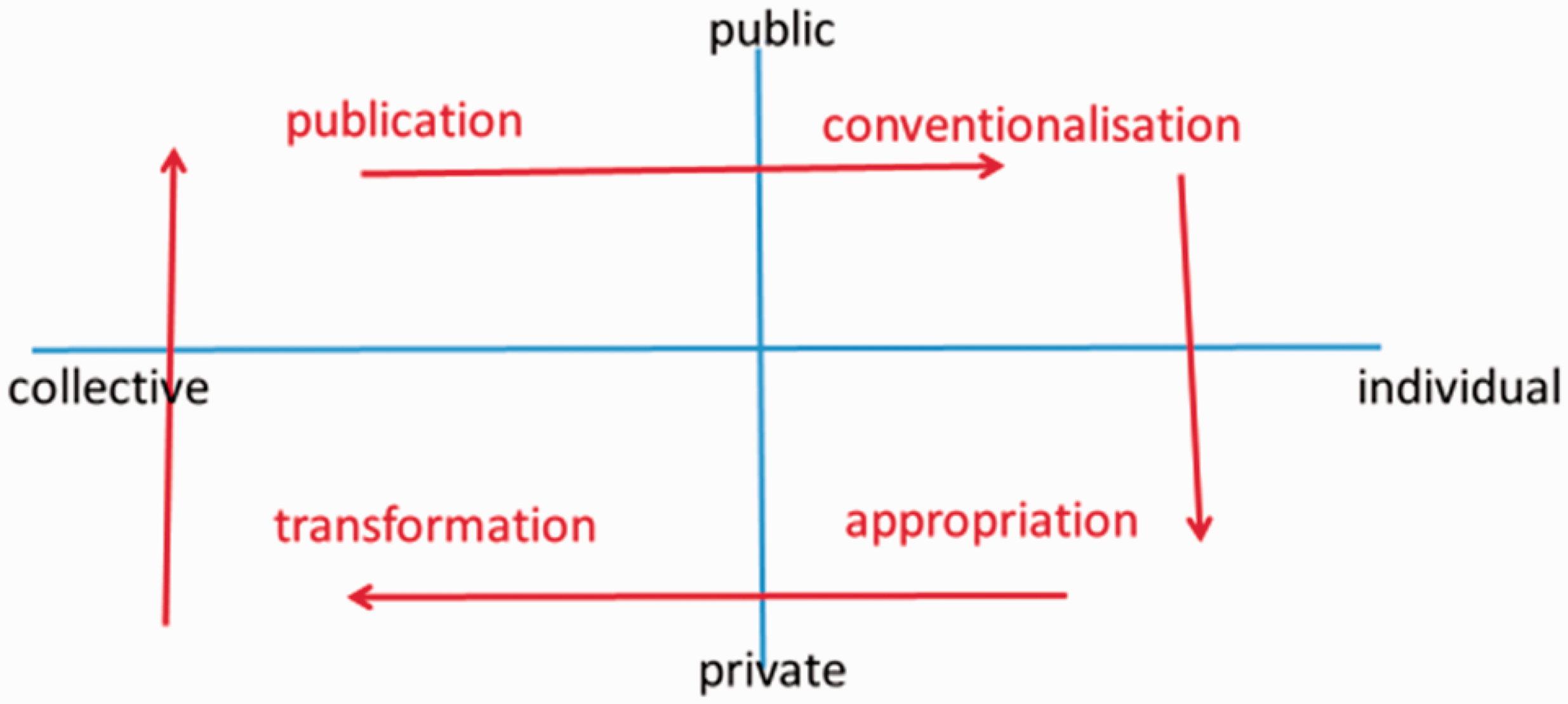
Rom Harré’s personal identity project.
The first stage of this process starts with the individual’s ‘appropriation’ of socially and culturally accepted legitimised identities (the bottom right quadrant). In the second stage the individual makes sense of these identities. These identities are legitimised by the educational authorities, but the individual transforms them into personalised understandings through his/her experience. The third stage is ‘publication’, that is making these transformed personal identities public and available to Others; the individual expresses them explicitly. Finally, if these new identities are accepted by the public (whatever ‘the public’ may mean), they become part of the conventionalised and generally recognised moral order.
During this process, individuals may experience tension and conflict as their responsibilities may be split between loyalties to different kind of Others, e.g. to the institution, students, personal matters and to their own conscience. For example, the individual may feel obliged to carry out a task as part of his/her duty, but it clashes with his/her personal convictions. Such clashes of responsibilities could be both real and imagined. Imagination and reflexivity are constructive parts of the process of ‘bildung’.
We may suggest that this model involves all time–space scales. The process of identity formation may be considered as an ontogenesis. Simultaneously, the changing relation between the individual and institutions has the character of sociogenesis. Institutions function in specific cultures and historical events, and these impose demands on activities and on ascriptions of moral beliefs. Finally, changes in each individual are likely to be due to microgenesis as the individual attains experience in concrete situations. Everyday episodes develop into unique story-lines in which the distribution of rights and duties is specific to situational demands.
Positioning theory is concerned not only with assignments of rights and duties to act but also with ‘epistemic positioning’, that is with the ways in which knowledge, beliefs and ignorance are distributed and contested. These are issues which, as Harré (2012) observes, have hardly ever been explored despite their far reaching societal implications. They raise questions as to who has rights and access to knowledge, why certain kinds of knowledge are concealed, how ignorance is imposed through false beliefs, and so on.
Further exploration of ‘epistemic positioning’ is likely to bring up questions about ‘epistemic trust’ and ‘epistemic responsibility’ (Marková, 2016) as well as questions about the manipulation of knowledge and beliefs for political purposes, whether in totalitarian regimes or in modern democracies.
Harré’s ideas (Davies & Harré, 1990; Harré, 1983; Harré & van Langenhove, 1999) on personal being have been particularly influential in education in different parts of the world. Harré’s followers attempted to understand the transition from being a student to becoming a teacher. Among Harré’s followers, Fawns, Jaques, Redman, Sadler and Rodrigues (2005) argued for a return to the teacher as a person and the authors suggest that proper conversational settings contribute to the development of opportunities for the formation of personal identity. Specifically, the authors asked questions about the transition from being a listening, quiet and a self-absorbing individual in relation to a specific subject matter, to becoming a competent teacher who copes simultaneously with the many dimensions of teaching experience in class and with its contingencies.
In this process the student obtains the sense of professional purpose of social identity, or in terms of this article, we could refer here to a process of ‘bildung’.
Heteroglossia
Another type of dialogical single case study employs as the main chronotope polyphony or the chronotope of heteroglossia, in which argumentation, transformation of genres and of simultaneous inner and outer voices mutually struggle with one another. We may suggest that this chronotope might be most fruitfully applied in the present climate of political crises all over the world in which opposing points of view divide citizens and nations, transform loyalties into conflicts and produce images of a total collapse of society. It may be also applicable to disasters such as Grenfell Tower’s ‘unprecedented’ tragedy (Cornish, 2020) where, again, heterogeneous and opposing perspectives argue their respective positions.
Sandra Obradović’s (2017, 2018) study, which explored the question of Serbia’s identity as a nation will be taken here as an abstracted example of this type of chronotope. She observed that Serbia is a country ‘in-between’ with historical influences both from the West and the East, and so involving considerable cultural contrasts. These issues enter the public awareness with respect to the question as to whether Serbia should become a member of the European Union (EU). Since this is an issue that divides the nation (like Brexit or Trumpism), heteroglossia permeates public discourse on the level of conflict in which speech of one party denies that of the other party. Bakhtin (1981a, p. 349), who was preoccupied with profound and unresolved conflicts as they were expressed in daily language of living experience (‘another’s word about me’), related such never-ending struggles to ethics, judgment, social recognition versus non-recognition and to ideology.
One of the examples in Obradović’s (2017, 2018) study is the dispute about recognition of the Kosovo region as an independent state considering that Kosovo plays an important role in the mythology and identity of Serbia. On the one hand, ‘Kosovo … is the cradle of today’s national identity, and from there, that was, how do I put this … a key territory which was Serbian, from where, no matter how much Serbia expended or narrowed, it originated’. Other voices argue the meaning of sentences such as ‘Kosovo is not Serbia’ and ‘Kosovo is lost’ and suggest that the current constellation of Europe cannot be considered as definite. Other examples of heteroglossia refer to the issue as to whether or not the membership in the EU presents benefits or detriments to Serbia, and whether it poses a threat to the national identity of the Serbs.
Bakhtin’s analysis of dialogical imagination in the struggle of the Self-reliance in Dostoyevsky’s novels shows that the anti-heroes’ discourses are totally consumed by anticipation of the response from others. Likewise, the participants of Obradović’s (2017, p. 72) study imagine how other nations imagine the Serbs: W2: And the Brits, Swedes and those [countries] look at us, not as second-class citizens, but as tenth-class. M3: Well when they think that we’re savages […] M6: But see, that image will never change because we’ve literally, 20 years, been presented as poor, miserable and guilty for everything in this region, and that image will never change unless someone comes to this country and meets people.
What do we generalise from dialogical single case studies?
With this in mind, what do we gain by focusing on chronotopes? In what ways may the focus on chronotopes enable us to contribute to the question of generalisation of knowledge gained in a single case study? The chronotope, as we have characterised it, involves dialogical features which enable us to explore them systematically in a single study in question. For example, we observed that routines and changes were embedded in diverse time–space trajectories (microgenesis, sociogenesis) and kept shifting in the dependence on sub-problems in the here-and-now. Sub-problems involved specific ethical and dynamic interdependencies between the Self and Others in the real-life situation; chronotopic thinking was directed at the whole situation as an open-ended event, in which multidimensional relations among elements took place, tying together different kinds of evidence concerning that case. We could observe that chronotopic thinking involves the network of interrelated dialogical concepts, and it is to these that we shall turn attention, in the final part of this article, with respect to the possibility of generalisation/resituating knowledge.
In this article we have (a) specified the features of dialogical single case studies and (b) defined chronotopic thinking as dialogical epistemic genres. It is therefore in terms of these issues that we need to pose the question about generalising/resituating knowledge to other dialogical single case studies. As we have seen in the examples of different types chronotopes, and specifically those of routines and changes, bildungsromans and heteroglossia, both kinds of features (a) and (b) acquire different values, meanings and intensities in different dialogical single case studies. For example, practices in the neonatal unit involved the deep commitment and responsibility of professionals, which led to tensions and ethical questions about routines and changes. The principal role in these practices, activities and genres played the profound engagement of professionals, either because the life of the baby was at stake, or because, in the case of the dead baby, the question of correct medical procedures was in question. Such intensity of feelings and responsibilities was a fundamental value in this study.
Let us consider another single case study, involving a long-term interaction between administrative institutions in Switzerland and a foreign individual demanding the Swiss citizenship (Zittoun, 2017). Here Tania Zittoun observed the long series of repetitive behaviours of bureaucrats which turned into dramatic events only if the authorities decided to make a move. Routines of bureaucrats, in repeating themselves during the period of 10 years did not show any urgency, responsibility or commitment to the applicant for citizenship. At the same time, Tania Zittoun outlined the progressive development of experiences and changes over time of the individual, and the changes that took place from the time of his original assumptions on which he based his application, imaginations and wishes. During this long process, the individual’s expectations and emotions changed. From ‘feeling integrated’ and wanting to share experiences of living in the country that originally was welcoming, the individual no longer felt integrated but instead, his existence became a matter of honour and obedience, when he had to constantly prove that he deserved to be recognised as a valuable citizen.
Routines and changes in the dialogical single case studies discussed in this article differ in many ways, yet they all display chronotopic thinking. We defined the latter as epistemic genres in terms of styles of thinking, communicating, producing knowledge and acting in a concrete time–space situation, their distinctions and shifts, and the transformation of intersubjective knowledge and experience of participants. These epistemic genres existed in all studies but they
displayed different values, intensity and meanings for the participants took place in different time–scale situations (microgenetics, ontogenetics, sociogenetics) were bound to different ethical and dynamic interdependencies between the participants, and to different kinds of communication genres and actions.
Yet we can suppose that perhaps all concepts that constitute these epistemic genres can be resituated in other dialogical single case studies where they will obtain certain values and intensity (e.g. the degree of engagement, of responsibility), and meanings (as expressed in speech and other communicative media). Just like in chronotopes of routines and changes, the same questions about generalising/resituating concepts can be raised about other types of chronotopes, i.e. in bildungsromans, heteroglossia and in other types that might be suggested.
In conclusion, we do not ask questions about inductive generalisation, or questions about generalisation to theories, but about generalising or resituating specific dialogical features/concepts in their chronotopic networks, or in their subsidiary or minor chronotopes in other studies.
Footnotes
Declaration of Conflicting Interests
The author(s) declared no potential conflicts of interest with respect to the research, authorship, and/or publication of this article.
Funding
The author(s) received no financial support for the research, authorship, and/or publication of this article.
