




Abstract
Economic theory propagates a model of the human being commonly known as homoeconomicus; an individual with a rational orientation directed towards maximizing his/her preferences. However, our everyday lives involve many altruistic acts. These can range from small gestures of kindness such as holding a door open for another person, to heroic feats such as risking one's life to save a child from drowning. During our lives we also meet certain people that instantly induce our kindness. Our nicety in these moments is not based on a pursuit to optimize our material desires. Rather, we allow our feelings and intuitions to guide the course of our actions. How do we reconcile these experiences against the economic conception of human nature as inherently selfish? Addressing this contradiction, the paper will deconstruct the economic view and repositioning it as the product of an epistemological stance that distorts our view of altruism. An alternative model on altruism will then be developed by merging anthropological theories on value with insights from cultural psychology and grounded cognition. Through this process, a passage will be shown from static and universalizing perspective towards an emergent and dynamic theory on altruism.
Keywords
Introduction
At the heart of this paper is an attempt to provide a dynamic and emergent account on altruism. The emphasis on dynamism and emergence positions this inquiry against the universalizing and static conception of altruism presented by economic theory. In short, economic theory propagates a model of the human being commonly known as homoeconomicus; an individual with a rational orientation directed towards maximizing his/her preferences (Urbina & Ruiz-Villaverde, 2019). Albeit with a tinge of exaggeration, the dispositions of homoeconomicus and to a larger extent modern economic theory, can be exemplified through classic Hollywood action movies. Consider a typical ransom exchange scene that occurs in just about every such movie. Two parties meet at a disclosed location to exchange a kidnapped person for ransom. As they tentatively move closer and closer to make the exchange, the antagonist always finds a way to defect with both the ransom and hostage. In doing so, the antagonist masterfully exemplifies the nature of homoeconomicus by ruthlessly seeking to maximize desired outcomes.
Contrary to the relentless pursuit of self-interest depicted above, our everyday lives involve many altruistic acts. These can range from small gestures of kindness such as holding a door open for another person, to heroic feats such as risking one's life to save a child from drowning. During our lives we also meet certain people that instantly induce our kindness. Our nicety in these moments in not based on a pursuit to optimize our material desires. Rather, we allow our feelings and intuitions to guide the course of our actions. How do we reconcile these experiences against the economic conception of human nature as inherently selfish? To address this contradiction, the paper will deconstruct the economic view and repositioning it as the product of an epistemological stance that distorts our view of altruism. An alternative model on altruism will then be developed by merging anthropological theories on value with insights from cultural psychology and grounded cognition. Through this process, a passage will be shown from static and universalizing perspective towards an emergent and dynamic theory on altruism
Deconstructing the economic view
To understand how economic theory distorts altruism, one must observe how the discipline reacts to altruistic acts. This process can be witnessed through the explanations offered by behavioral economists regarding the results of zero-sum games. Zero sum games such as the dictator game study conflict and cooperation by constructing scenarios during which one person's gain is another's loss (Neumann et al., 2018). To play the dictator game a certain amount of money is put on the table, after which the individual assigned the role of the dictator decides how the cash will be split with the other participant. During simulations of the game, dictators on average share 28% of the reward and many split the cash down the middle (Neumann et al., 2018). By choosing to be altruistic by giving away some of their rewards, these participants violate the tenets of homoeconomicus.
As should be evident, these results do not match the hostage exchange scenario described earlier. However, rather than modify their fundamental assumptions, economists use the concept of utility to fit the results within their existing framework through a pattern of circular logic. Utility refers to the total satisfaction received from participating in an act such as consuming a good or service (Mankiw, 2018). Economists assume that by being perfectly rational, homoeconomicus will think through all possible outcomes and choose the course of action leading to maximum utility (Urbina & Ruiz-Villaverde, 2019). From this perspective, sharing half your spoils when you can walk away with everything makes no sense. The pattern of circular logic becomes evident when we see that the rationality implied by homoeconomicus is not limited to utility derived from material gain. Therefore, a case can always be made that some other form of utility is being extracted (Ng & Tseng, 2008). For example, by giving away their money it can be claimed that participants were maximizing utility by enhancing their self-image. Moreover, economic theory has in built assumptions that label behavior that goes against its tenets as irrational. For example, most courses in the area of behavioral economics offer a module on irrational behavior which covers several theories that explain suboptimal decisions. These include cognitive bias, herding effect, irrational exuberance, discrimination, sunk cost fallacy, and lack of control. Implicit in all these theories is the assumption that anything other than self-interest is not rational.
The underlying assumptions of economic theory tend to be positioned as universal laws (Urbina & Ruiz-Villaverde, 2019). However, when analyzed through a critical lens, they lose their universal lure. In particular, the assumption of homoeconomicus can be shown to be a byproduct of an epistemological stance based on the drive to view human nature through statistics. To see this, one must take a historical detour to the mid nineteenth century when the ideas of modern economics were just emerging. This period has been described by the philosopher Ian Hacking as a time when “the world became numerical and measured in every corner of its being” (Hacking, 1990). Elaborating on this, he describes how between the years 1820 to 1840, European states established offices to collect and publish statistics about various forms of deviance including: suicide, vagrancy, madness, prostitution, and disease. As a consequence of this surge in numerical data, it was now possible to compare such statistics across time (Hacking, 1990). The printing and distribution of this kind of information constructed a particular perception of reality. For example, it became evident to the naked eye that year after year the same proportion of people were committing suicide using the same methods, in the same regions (Hacking, 1990). In turn, the astonishing regularity of these statistics made it possible to conceive that perhaps human nature was also governed by statistical laws (Hacking, 1990). Data about averages and dispersions had the additional effect of engendering the idea of normal people. The use of probability distributions on numerical data, allowed for people to be categorized in terms of their relation to the said data. While previously the word normal had stood synonymous for ordinary, with the arrival of numerical data ‘normal' was now something to be strived for. People were normal if they conformed to the central tendency of statistical laws (Hacking, 1990).
This was the backdrop of the emergence of modern economic theory known as neoclassical economics; it carried with it a penchant for statistical information and a strong idea of normativity (Ekelund & Hébert, 2002). This transition is depicted in the work of William Stanley Jevons, a man considered the pioneer of neoclassical theory. In the preface to The Theory of Political Economy, Jevons describes his work as an attempt to treat the economy as a calculus of pleasure and pain. Jevons (1871/2013) explains that rational people base decisions on extra marginal utility and seek to obtain the greatest amount of what is desirable. While the concept of utility was used by earlier thinkers, it was viewed more as a conceptual tool. However, starting with Jevons, neoclassical economists began to conceive of homoeconomicus as an accurate description of human nature (Mele & González-Cantón, 2014). Humans were termed normal if they were rational. Rationality in turn implied a constant drive to obtain the greatest amount of what is desirable. In sum, Hacking shows us that ideas do not emerge in a vacuum; they are formed under a particular context. In the case of homoeconomicus, the rational calculating conception of the human mind emerged at a time when the world was already becoming numerical and calculable.
Economic theory continues to add layers of complexity in its attempt to study rationality through quantification. This is exemplified through the development of behavioral economics, which builds upon the assumptions of the neoclassical doctrine by adding experimental testing. The rise of behavioral economics has paralleled developments in the discipline of cognitive psychology (cognitivism) which in itself is influenced by the invention of the microcomputer (Michaels & Palatinus, 2014; Shastitko, 2017). Therefore, cognitive psychology constructs the mind as an information processing device that goes through life solving problems (Thompson, 2007). To arrive at a decision, we take in data points and code them through symbolic representations. These representations are then manipulated by our computer like brains to arrive at the optimal decision (Thompson, 2007). The discipline’s influence on economic theory is exemplified by the studies of economists Daniel Kahneman and Amos Tversky who demonstrate that people choose between different alternatives based on how information is presented. By altering the manner in which information is phrased, individuals can be made to violate the tenets of perfect rationality (Tversky & Kahneman, 1981). The way these studies conceive the mind is akin to a game of chess. To arrive at a decision, our job is to take in the right kind of information and compute it efficiently to come up with our best moves; any distortions occurring during this process may lead to suboptimal decisions. This perspective has reached such dominance that we see it in the use of everyday metaphors. Utterances such as my wiring has gone wrong or I did not process things correctly exemplify this.
Rather than leading to a universal insight on human nature, experimental studies conducted by behavioral economists show how theoretical frameworks work as umbrella systems that restrict the phenomenon under study (Valsiner, 2017). For instance, to develop explanatory accounts for altruism, behavioral economists start their research under the assumption of a computational mind. Resultantly, the theoretical frameworks they use to guide their experiments favor an information processing approach. This in turn feeds into their experimental design, exemplified in the use of simulations such as the dictator game which attempt to replicate the interactions of the mind through quantitative data. This data is then subjected to inductive reasoning to develop further frameworks advancing the same computational view. In each step of this process the phenomenon under study is being restricted in order to fit the underlying assumptions of the researchers.
Moreover, conceptualizing the mind as a computer does not do justice to its dynamic and emergent nature. This dynamism is essential for our survival as it enables us to internalize stimuli and make situated meanings. In a looping process, these meanings prepare us for the future by influencing how we perceive subsequent stimuli. This is not a novel perspective. Philosophers such as Heidegger (1927/2018) have commented on the unique and situated nature of human existence. Heidegger's notion of thrownness, for example, posits that we are thrown into dealing with a particular set of entities, into a particular life, and into a particular culture or tradition. By virtue of this, our sense making abilities are partially determined by prior experiences (Withy, 2014). To illustrate, suppose that before being recruited to play the dictator game, a participant dropped his wallet on the streets of a crowded urban neighborhood riddled with inner city crime and poverty. Disillusioned with what has happened and with no hope for retribution, he is approached by a homeless man who hands him over his wallet. He is now elated with a renewed trust in humanity. He carries with him this experience when he participates in the dictator game. The manner in which he internalizes the game and the meaning he creates is a dynamic outcome mediated by his unique history. However, this phenomenon cannot be captured on a quantitative instrument which seeks to frame his mind as a computer. No matter how he answers, his perspective will always be viewed in terms of a superimposed concept of rationality driven by the mind's computational powers.
Attempts have been made to challenge the notion of utility maximization presented by homoeconomicus. This has led to the development of two alternative perspectives: homo sociologicus (Dahrendorf, 2006) and homo socioeconomicos (Rolle, 2005). The former assumes that the individual behaves according to the expectations related to the societal roles assigned to him or her. Homo sociologicus is guided by the expectation that if behavior fulfils social expectations, he/she will be rewarded with approval. On the other hand, if the behavior violates norms, he/she will be socially marginalized. In contrast, homo socioeconomicos is understood as an individual who is cognizant of these restrictions and attempts to balance desires with societies expectations. Consequently, while still seeking to maximize his or her benefits, homo socioeconomicos takes into consideration the social consequences of various actions to come up with the best course of action (Rolle, 2005).
Neither of these theories are able to capture the dynamic and situated nature of the human mind as reflected in Heidegger's notion of thrownness. Rather, each perspective projects a negotiated process as a predefined outcome. Both homoeconomicus and homo socioeconomicos assume that we are maximizing self-interest, albeit the latter is more aware of social pressures. In contrast, homo-sociologicus is responding to societal norms without displaying any agency. In this manner these theories propagate what anthropologist Margaret Lock calls the body proper; the assumption that we all have the same bodies and minds (Lock & Farquhar, 2007). In doing so they leave us blind to how human minds vary over time and the contribution of various discourses, institutions, practices, technologies, and ideologies in shaping them. Rather than an imposed idea of rationality, a theory that allows us to understand the process through which individuals come to construct their own rationalities is more useful for understanding altruism. This calls for a theoretical framework that positions the mind as a dynamic entity that always creates meaning in relation to its unique position in the world.
Towards an alternative
In order to develop a theory on altruism that captures the dynamic and emergent nature of the mind, several aspects are needed. Such a theory must take into consideration the specificity of human bodies and how they impact the mind. This is essential if we are to move beyond the static conception of altruism put forth by economic theory that promotes the body proper. For this purpose, the notion of affordances described by James Gibson in his ecological theory of mind is a good starting point (Gibson, 1966). Affordances refer to the opportunities for action offered to us by our environment. For example, a chair affords sitting when an observer needs a place to rest, and a tree affords climbing if an observer needs to flee. An object can only be perceived as an affordance if a person is capable of interacting with it (Riener & Stefanucci, 2014). Therefore, to perceive an object such as a knife, one must know what to do with one. Our history of environmental interactions influences what we perceive as an affordance (Casasanto, 2014). This was illustrated in a space valence experiment during which right-handed students were asked to perform a motor fluency task while wearing a cumbersome glove on either their left or right hand. After twelve minutes of lopsided motor experience, participants removed the glove and performed a test of space-valence associations. Participants who had worn the left glove still thought “right” was “good,” and participants who had worn the right glove similarly showed a left-is-good bias, even when they were right-handed (Casasanto & Chrysikou, 2011). A few minutes of acting more fluently with the left hand changed right-handers' implicit associations between space and emotional valence, causing a reversal of their usual judgments (Casasanto, 2014). The experiment affirms that despite sharing the same experience, people may perceive different affordances based on their history of environmental interactions.
The results of the space valence experiment have strong implications for our understanding of altruism. They show that our lived experience constructs our reality and determines our affordances by framing our interactions. When we meet someone, we do so under a particular context. The representations we form do not exist in the world outside, they are enacted during the interaction. An approaching stranger in a dark alley will be perceived very differently by a trained police officer than a corporate executive. Having interacted with this kind of setting on many occasions, the police officer may become more attentive and vigilant. By internalizing the situation as a potential threat, he will unlock a unique set of affordances; he may unbuckle his holster and grip his gun. In contrast, the corporate executive may also recognize the situation as a threat. However, unlike the police officer he will be more likely to retreat as his environmental interactions would unlock affordances that would encourage flight rather than fight. In each case the external object remains the same, but the internal representation varies.
Furthermore, an emergent and dynamic account of altruism must also bring emotion back to the forefront. From the perspective of behavioral economics, cognition is viewed as a purely logical process free from emotion (Strejcek & Zhong, 2014). The pervasiveness of utterances such as the ‘best decisions are made on a cool head’ exemplify this perspective. However, the importance of emotions in decision making has been depicted in case studies of patients with damaged orbitofrontal cortices (Damasio, 1996). Individuals with lesions in this area become devoid of emotions. Rather than improve their reasoning, as the ‘cool head’ analogy suggests, these lesions cause individuals to lose the ability to make basic life decisions. Pertinent to our understanding of altruism is the fact that these individuals are able to reason and make logical decisions in an experimental setting, but lose this capacity in real life (Damasio, 1996). In particular, their interpersonal skills suffer, and they are unable to maintain friendships. These results point towards the idea that we need emotions to understand each other and maintain relationships. This notion is captured by the term affective framing which emphasizes the way emotions and feelings permeate our interpretations and patterns of attention and thereby enable us to make sense of the world (Maiese, 2014). Affective framing attunes individuals to their environment and allows them to recognize which factors are relevant given the current situation. Valsiner (2014) adds more depth to the notion of affective framing by highlighting how certain acts of communication evoke a field of memories and productive fantasies in the personal world of the hearer. For a person who has been subjugated to emotional abuse, an assertive instruction may evoke feelings of nervousness and anxiety. Conversely, the same tone may alert another person and galvanize them. Therefore, every interaction has the potential to evoke a unique set of feelings which permeate our thoughts and direct our actions. Taking this into consideration, emotions are likely to play an important role in acts of altruism.
Constructing an emergent model on altruism
While trying to account for the existence of altruism, evolutionary biologist William Hamilton made a simple argument. He hypothesized that since being altruistic puts people at a disadvantage, humans must have developed a genetic marker that enables people with altruistic dispositions to recognize each other (Hamilton, 1964). This would allow them to direct their altruistic acts towards others with similar dispositions and ensure mutual survival. Richard Dawkins (2006) later renamed these hypothetical genes green beard genes in light of the physical marker through which bearers would recognize each other (a green beard). While Hamilton was making a mere conjecture, his idea is nonetheless thought provoking. We encounter people on a daily basis that strike us in ways that make us want to be nice to them; there is a certain feel to these interactions. Perhaps the marker Hamilton was searching for is not overt but comes in the form of an embodied feeling.
Hamilton’s conjecture provides a passage into the model of altruism proposed by this paper. The model explains altruism as a dynamic interaction between three facets in any given situation: an individual's lived history, the affordances offered by the interaction, and the emotions evoked by the interaction (Figure 1).
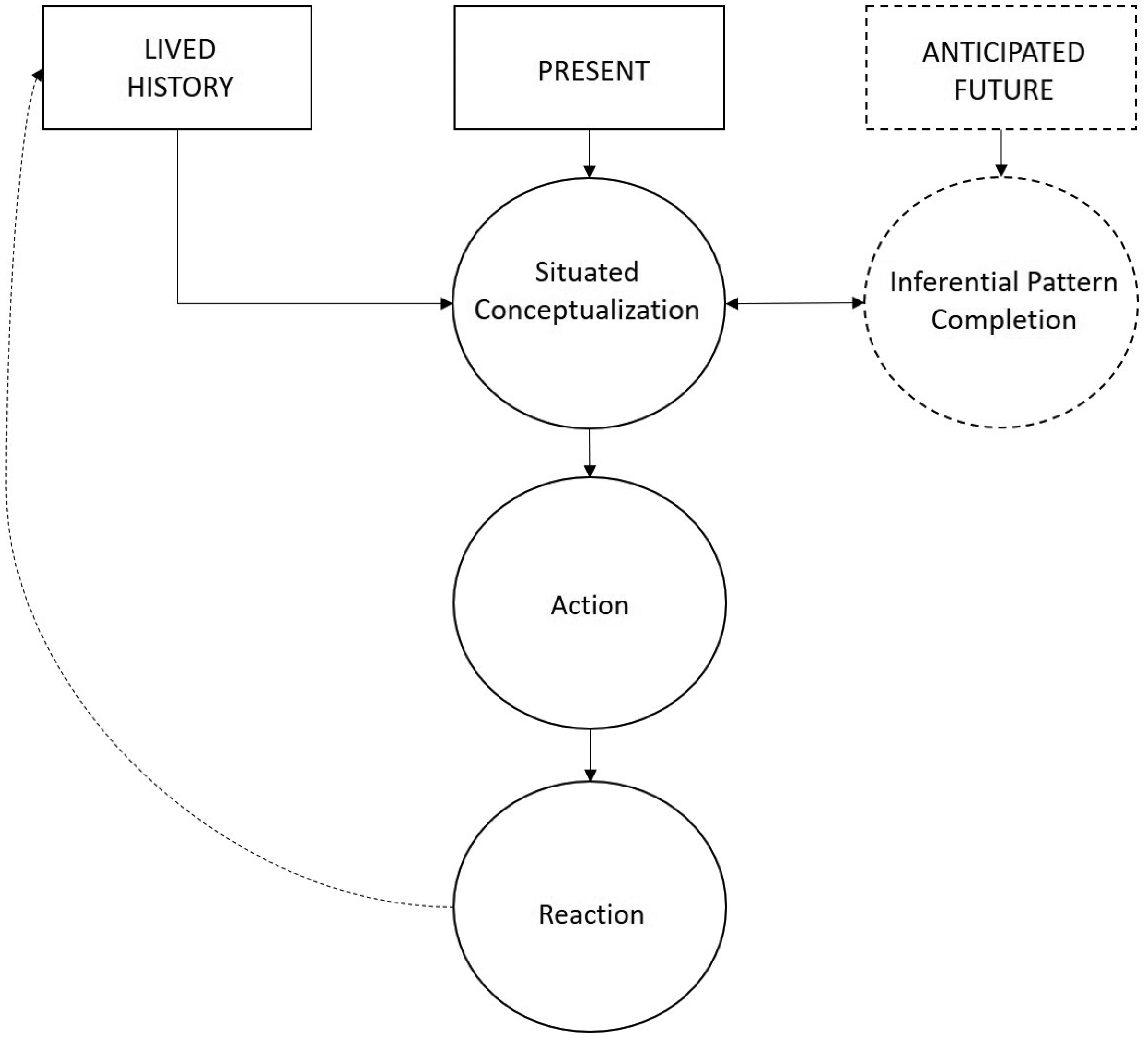
Dynamic model on altruism.
The linkages between these facets become visible when we cease to view the mind as a computer and see it as a function of the whole human being in intersubjective relations with others in the environing world (Toren, 1999). Simply put, the contents of our mind including our dispositions, schemes of thought, and emotional attunement are all formed in the course of our lives through our relations with others and the meaning we construct out of these experiences (Toren, 1999). Consider our early interaction with a parent or an older sibling that informed us about the appropriate behaviors that a boy or girl must follow. These interactions structured the conditions of our lives including what we wore, what was said to us, what toys we played with, how we sat, how we walked, and so on (Toren, 1999). Our brain played a mediating role by solidifying these experiences and resultant meanings into unique dispositions (Fuchs, 2018). To illustrate, research has shown that newborn babies are able to imitate the facial expressions of others (Meltzoff & Moore, 1989). By virtue of this mimetic capacity they are also able to transpose the gestures and expressions of others onto their own proprioception and movement. Bodily mimesis evokes corresponding feelings as well, and so a mutual affective resonance gradually develops; infants learn how to understand themselves through others (Gallese et al., 2004). The mirror neuron system supports this process by solidifying these interactions into dispositions and skills. As we go through life, the plasticity of our brains allows us to continuously assimilate further layers of experience into our interactive schemes and dispositions (Fuchs, 2018). This process never ends.
Toren (1999) and Fuchs (2018) highlight the role our lived history plays in developing our patterns of interactions, emotional attunement, and schemes of thought. In his book Towards an Anthropological Theory on Value, Graeber (2001) posits that the value of an object lies in its ability to convey a history of actions. For instance, the value of an heirloom is really that of actions whose significance has been absorbed into the object’s current identity whether the emphasis is placed on the inspired labors of the artist who created it, the lengths to which some people have been known to go to acquire it, or the fact that it was once used to cut off a mythical giant’s head. While Graeber (2001) refers to inanimate objects, his theory can be applied to humans. Simply put, given that our historical interactions and experiences form our mental constructs and worldview, a reversal of this process would enable us to peer into people's histories through the clues they offer us in the present. It would allow us to grasp their nature in a manner akin to the green beard gene.
The link that enables us to understand how we look into the past to guide the present comes from grounded cognition, a field that proposes that modal simulations, emotions, and situated action underlie thinking (Barsalou, 2007). In particular, the notion of situated conceptualization provides a mechanism through which we can use our lived history to guide our interactions with others (Barsalou, 2016). Situated conceptualizations enable us to predict what incoming sensory input stands for, which properties are salient, and what to do with the input (Oosterwijk & Feldman Barrett, 2014). To illustrate how this works, consider the case of our interactions with dogs. When we close our eyes and imagine a dog, the kind of image each of us conjures is different. In the past, whenever we interacted with a dog, or heard a story about dogs, different areas of our brain were activated to capture the experience. These included distributed associative patterns across the fusiform gyrus (shape), premotor cortex (action), inferior parietal cortex (spatial trajectory), and posterior temporal gyrus (visual motion) (Sakreida et al., 2013). In addition, information related to the context under which we interacted with dogs and the emotions we felt were also captured (Barrett et al., 2014). In our present lives, this bank of memories and experiences are used to generate situated conceptualizations to guide our current interactions (see Figure 1). When we now meet a dog, our brain categorizes the type of situation currently being experienced in terms of what was experienced in the past. On many occasions, the best fitting conceptualization may come from a familiar repeated situation; on others, it may come from a specific memory of a relatively unique situation. On rare occasions, no relevant situated simulation may be available in our memory, and the situated conceptualization constructed to represent the current situation functions on its own. Regardless of where it comes from, when the best fitting situated conceptualization is found, it becomes active and guides us in the current situation (Barrett et al., 2014). This concept is supported by Kriz (2009) who highlights how meaning in conversations is created according to the cognitive ordering processes in an individual's own head. These ordering processes have more to do with the person's own biography rather than the message. Along the same lines, Valsiner (2014) states that the individual references the past and adapts it in the service of what might come. In this sense, looking back is actually looking forward.
When we meet someone and are compelled to be altruistic towards them, it is likely that we have generated a situated conceptualization favorable to this kind of action. To see how this model works, imagine a situation where two people meet and develop altruistic dispositions towards each other. The encounter carries a certain feel that makes one or both individuals benevolent towards the other. This feeling is often difficult to articulate but individuals often allude to aspects such as the other person's energy, vibe, or aura. What exactly happens during this process? When we meet the other person, we first take them in through our senses. Different aspects of their physical being including but not limited to: clothes, smell, muscular definition, and gait are internalized and given a unique meaning. This sensory information is coupled to a vast array of stored simulations. In turn, these simulations enable us to connect our present to instances from our past where similar patterns led to certain outcomes. We come up with a tailored situated conceptualization which gives meaning to the stimulus in the present. We may experience a positive or negative affective state depending on the generated conceptualization.
At the same time this process is shaping our affordances by enabling us to anticipate the future. This has been alluded to by Valsiner (2014), Kriz (2009), and Barsalou (2016) who dubbed this process inferential pattern completion. In short, we get hints about what is likely to happen in the present situation based on what we have experienced in the past, and our behavior is modified accordingly (see Figure 1). For example, a woman sitting in a cafe on a blind date may connect the sound of a particular accent to a memory from her previous dating experience. If this accent is connected to a pleasant experience, it may evoke a positive situated conceptualization. This could potentially result in a more open body language and a hormonal release of endorphins as she primes herself for an engaging conversation. However, if this particular accent is associated with a terrible dating experience or a narrative indicating that people who speak in similar ways are ‘pretentious’, it will have the opposite effect. Her body language may close, and the conceptualization may trigger the release of stress hormones. This process will remain dynamic and evolutionary. The initial sensory information is used to generate a situated conceptualization. Through inferential pattern completion we predict what is likely to happen in the future and structure our behavior accordingly. The person at the receiving end of the resultant behavior will respond with their own situated conceptualization in turn creating a new round of stimulus. This process will ensue through a looping mechanism. As illustrated in Figure 1, the dotted line going from reaction to lived history highlights the looping mechanism, depicting how the present moment ultimately becomes part of our lived history and guides the emerging moment.
General systems theory posits that when input and output are interconnected through feed-back certain stable patterns can emerge (Kriz, 2009). These patterns can also be seen in our interactions and are referred to as a meaning attractors (Kriz, 2009). The meaning attractor emerges after multiple rounds of stimulus exchange at a junction when our situated conceptualizations become highly refined. At this junction we have come to a stable understanding on our stance towards the other person. What the meaning attractor will gravitate towards cannot be predicted beforehand but is an emergent product of the interaction. From this standpoint, an altruistic disposition is one trajectory the meaning attractor can take. Whether we choose to be nice to each other is not a matter of rationality or irrationality. It is a process that each one of us takes as we go through life attempting to make sense of the world, we find ourselves thrown in. Life is not chess.
Way forward
This paper will conclude with a brief discussion on how the proposed theory can be further developed. A dynamic theory requires a dynamic research approach. This tenet is captured in the microgenetic method which seeks to trigger, record and analyze the processes behind the emergence of new phenomena (Wagoner, 2009). Rather than forcing phenomena to fit consensually validated methods, the microgenetic approach seeks to understand the complexity of the phenomena, and adjust methodology to it (Wagoner, 2009). Therefore, to study the dynamic processes of altruism, we must move away from our reliance on large sample sizes, standardized methods, and quantitative data. Rather, we need to see how variables systematically relate and function together in particular individuals. The starting point for an empirical approach should therefore come from single case analysis. This would enable researchers to access contextualized qualitative data including observations, knowledge of lived histories, and comments on the experimental process (Wagoner, 2009). In addition, a two-way interaction between theory and experimental design will also be facilitated. For example, rather than being filtered out variations, cases that deviate from the theoretical assumptions would serve as quality control measures to refine the theory further (Wagoner, 2009).
In terms of actual experimental design, studies could use the technique of Aktualnese as a template. The technique which was used by the second Leipzig school to study perception involves a carefully crafted process that slows down perceptual processes and catches them in their intermediate stages (Wagoner, 2009). Following a similar pattern, experiments based on the proposed theoretical framework can be designed to slow down the process of situated conceptualizations. Interpersonal encounters can be recreated in controlled environments and participants can be presented stimulus in a stepwise manner. At each junction, their precepts can be recorded to capture the constructive steps that go in altruistic situated conceptualizations.
In sum, the computational approach to altruism proposed by economic theory imposes a forced order on the human mind. It reduces what is a unique and situated process into a static entity. Our lived experience tells us that we can be indeed altruistic and that our rationale for doing so can vary from person to person. In response, this paper has laid the groundwork for a dynamic theory outlining the processes that lead to altruistic dispositions. It is hoped that through further studies based on the microgenetic method, initiatives will be taken to refine this theory so that it may do justice the richness of our lived experiences.
Footnotes
Declaration of Conflicting Interests
The author(s) declared no potential conflicts of interest with respect to the research, authorship, and/or publication of this article.
Funding
The author(s) received no financial support for the research, authorship, and/or publication of this article.
