



Abstract
Objective
Based on the assumption that the cultural image at the level of experience is the collective and individual psychological reality expressed by cultural narrative and individual narrative, to study the timeless Tales of Nezha (“Natch”) in China as an experiential cultural image of child development and parent-child relationship.
Method
We adopted the narrative analysis method which focused on qualitative content analysis, covering religion, folklore, literature, entertainment, education and other fields.
Result
Our exposition articulates a cultural narrative framework of diachronic and contemporary cultural image of “Nezha”, the iconic child deity. This framework refers to our academic research discipline of describing the image characteristics, plots and interpersonal relationship, and conceptualizing the theme as psychological meaning units of personal identity and parent-child relationship. By analogizing and comparing this framework with the “Nezha” of personal narratives in consultation, we found the interactive clues of the case’s identity and parent-child relationship. We then combined these with specific elements unique and particular to each individual case in order to achieve a meaningful case conceptualization. This process enabled us to apply psychotherapeutic intervention at opportune moments during a counselling session.
Conclusions
The cultural image emerging from the counseling is not only a personal narrative of resource and a tool for the client to externalize the problem and identity representation, but also a cultural narrative reference point for the counselor to understand the case and to engage in further in-depth work. The personal narrative qualitative data can be obtained by referring to four dimensions: external—internal, event—image, narrative—interpretation, and experience—reflection. With the narrative identity of client, the “Nezha” of personal narrative led to the theme that parent-child relationship impedes the development of personal identity. The counselor was thereby enabled to construct a new meaning and new identity with the client by providing appropriate information and knowledge of the cultural narrative.
Introduction
We define the “cultural image” as a collection of iconic images, themes and meanings belonging to a specific shared cultural group. When we use the term “cultural” we imply a collective or culturally assimilated set of archetypes, and, in the particular context of the Nezha narratives, we refer to the broadly shared metaphorical imagery found in the collective consciousness (or perhaps in the “collective unconscious”) of the Chinese people of Mainland China. This collection occurs not only in the cultural narratives of social and historical public spaces, but also presents itself in the personal narratives of private spaces. So, in this paper, we distinguish between (a) “cultural” or “collective” image and (b) “personal” image drawn from or derived from the collective or “cultural” corpus of metaphorical archetypes.
Personalized cultural images (such as the depictions of cultural heroes) that have been around for a long time have rich psychological significance; especially when these cultural images evolve and show up in the personal narrative of a client during psychological counseling, they will turn into possibly useful metaphors in the field of personal psychology. From the perspective of narrative psychology, an individual can carry out a personal narrative of identity construction and self-development through the identification and modification of a certain personalized cultural narrative. Roesler (2010) believed that identity necessarily has a narrative form. Personalized cultural images is an excellent form of identity narrative. Especially in the contemporary era, these cultural images are spread by various media stories; these provide opportunities for contemporary individuals to identify themselves with and thereby to construct their own sense of personal identity. Sarbin (1997) found that the arts and media may provide the “raw material” for the development of the self. John Mcleod (2004, p.354) pointed out that countries and culture communities provide narrative reference points through published fictional literatures, including oral traditions and written literatures (also other media such as movies and television). These are, generally, resources that people use to build their lives. Adler et al. (2017) believed that narratives are deeply embedded in sociocultural interactions across the course of a person’s life. Breen et al. (2017) explored “the intersections of cultural stories communicated through the media and identity”; from two qualitative studies of narrative interviews, they found that the cultural stories interact with identity processes, through the media these cultural stories influence the development of personal identity, and they suggest promising directions for future research at the intersections of self and culture. Professionally, we accord more attention to the intersection of cultural narrative and personal narrative in psychological counseling. Through previous research (Guo, Shen, et al., 2019; Guo, Zhang, et al., 2020), we found that by using the interpretive framework of a certain psychological theory, the conceptualization and analysis of individual personalization of classical cultural images can provide insights into certain aspects of collective cultural psychology, and enable us to usefully assemble and structuralize the resources for psychological analysis found in collective culture.
This paper focuses on “Nezha”, the most popular and classic cultural image of child personification in the literature of China, also a narrative representation of child development and parent-child relationship. During the historical period of classic narratives of “Nezha” story, we identify two main plots that are contrary to the master narrative of Chinese traditional ideology. One is “Nezha” fighting and killing the Chinese dragon. The Chinese dragon is called Long (龍) in China, it's metaphor is a totem of Chinese nationality. As a fictional beast, it is an auspicious animal said to be possessed of invincible power and holiness. The story of dragon slaying is an exception to the norm in Chinese literature; In Nezha’s story, the Long (龍) king of the sea is a divinity class higher than humans. The Longs (龍) can change into human form, possess divinity, magic and power, and need to be worshiped by humans, but Nezha goes into trouble on their territory and fights them when they issue warnings to him. It violates the mainstream belief and is rare among Chinese legends.The other main theme of the Nezha narrative is the suicide plot. Self-inflicted injury to the body was strictly prohibited in Chinese tradition, because the cardinal principle of “filial piety” advocated by Confucianism declared that “Everything we have including our body and hair are all from our parents”. The narrative of Nezha’s suicide violates the mainstream of traditional Confucian ethics. However, Nezha is the most beloved child image in China’s legends since it began during the Tang Dynasty and is well known across China. As a child deity, Nezha is accepted by folk beliefs—such as Buddhism and Taoism, two belief systems followed by a large number of believers. As a cultural icon and a popular child hero in Chinese folk culture, Nezha also shows up across a wide range of artistic expression: in literature, painting, drama, and so on. At the present time, with the impact of popular culture such as entertainment, movie and music, the Nezha persona has become even a fashion symbol by which many young Chinese people express their inner emotions. Nezha also occurs in the field of moral education – the Nezha narrative is modified for teaching children after restatement. The Nezha image presents itself in various fields covering folk beliefs, literature, education, and entertainment, and so on.
Regarding the active cultural image of the Nezha narrative, the first question we raise in this paper is: What specific psychological significance has been constructed around the Nezha image in the cultural narrative framework formed by the diachronic public and local spaces? The existing diachronic researches on Nezha cultural narrative are evidences for its image and beliefs, from origin to evolution (Jiao, 1998; Liu, 2009; Yang, Che, 2015). The psychological interpretation on Nezha is limited to the interpretation of psychoanalytic theory on certain work or phenomenon—id, ego, superego (Sangren, 2012, pp. 339–357). Besides, studies of the Nezha narrative in relation to the Oedipus Complex (Sangren, 2012; Shahar, 2017; Luo, 2006), mainly involved work done in the fields of sociology, anthropology, culture or literature --- not in the discipline of psychology.
In 2019, the movie Nezha: Birth of the Demon Child was screened in China and the box office was more than 4 billion yuan within two months of the summer vacation.This movie is a leading exponent of the culture of the Nezha archetype; it had widespread influence in awakening the living “Nezha” deep down in the psyche of an ordinary Chinese individual. During consultation some clients use this movie story to construct a personal narrative of their own. The second question we raised in this paper is:What is the meaning of Nezha’s cultural narrative in the context of its usefulness as a framework for metaphorical understanding of one’s own self-image or psychological reflection in the part of clients and the counselor? What aspects of the collective cultural experience of the Nezha archetype can be used or creatively applied to help clients gain empowering insights during a session of psychological counseling?
In this paper, we study the narrative content of Nezha’s cultural image from the perspective of history and experience. First, based on narrative psychology, we use qualitative content methods to describe the narrative framework of personal identity and parent-child relationship contained in social cultural narratives. Then, we explain the psychological significance of the Nezha experience while combining these insights with illuminating concepts from psychological theory. Finally, by taking the theme and significance of cultural narrative as the reference point, comparing these with the individual client’s personal narrative, we give an example of how we arrive at a framework for case conceptualization.
Methodology
With a constructive view of knowledge, we focused on the psychological meanings of the figure, plot, and interpersonal theme of Nezha’s cultural image throughout the cultural and individual narratives. Janos Laszlo (2008) pointed out that narrative psychology is about meaning (p.69), as well as a tool used to reinterpret the historical development of human psychology and ontogeny (p.54). Therefore, it is suitable to explain the manifested psychological meaning of cultural image to discovery its diachronic context. We followed from collective to personal narration, aiming to apply the theoretical framework of intersection of personal and collective cultures when engaged in a psychological counseling process.
Materials
Cultural Narrative Materials List.
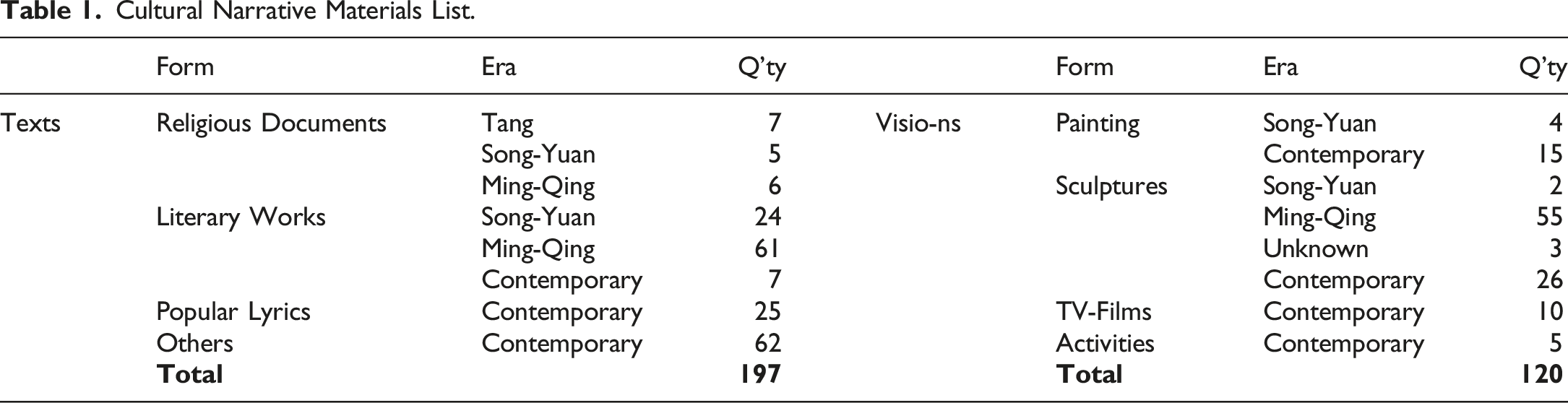
Qualitative content analysis
Since the data for this study was various media types, involving literature and art, folklore, archaeology, and individual psychology, we used Amia Lieblich’s et al. (1998) combine model, which takes the view that “category”, “entirety”, “content”, “form” can be combined with each other, and among these models, the “category-content” model is most suitable for our research purpose. The “category-content” model uses a type of definition framework to classify narrative content. That framework of definition required us to code and analyze the data into key categories, themes and terms. And we emphasized the need for interpretation of psychological theory, which refers to a method of interpreting narrative contents through the systematic classification process of coding and identifying the theme. Compared with traditional content analysis, it not only retains its own advantages by quantitative processing on counting words, but also excavates text data to explain meaning so as to effectively classify a lot of texts (Hsieh, H.-F, 2005).
Procedures
First, since cultural images come from cultural heritage and contemporary culture products, narrative coding of cultural images needs to refer to folklore in order to describe its narrative framework in social history and culture. It is a subject system that includes image characteristics, story lines and interpersonal relationships. It requires two researchers working in tandem to code separately in order to find out second or third narrative topics. Secondly, we need to properly interpret psychological theories, which can be seen as a process of conceptualizing the psychological theory in cultural narratives, to form a framework of psychological significance. Thirdly, we need to increase samples quantity to verify the information saturation of cultural narratives and psychological significance frame. Afterwards, we engage in making revisions until the coded information is saturated. Fourthly, we need to refer to the cultural narratives and its framework of psychological significance so as to identify the image characteristics, plots and interpersonal relationship of “Nezha” in personal narratives when engaged in psychological counseling. Lastly, we need to look for analogies when we compare personal narrative texts with cultural type, coding other elements in personal narratives and conceptualizing specific cases through psychological development theory.
Analysis on “Nezha” cultural narratives
When we engage in analysis of a “Nezha” cultural narrative from a diachronous perspective, it typically originates in religious texts, from the translated texts of Indian Buddhist scriptures to localized texts and visual depictions of Buddhism, Taoism, and folk beliefs, and it prevails in the fields of literature and folk arts such as dramas, novels, folklore, and so on. Two novels popularized during the Ming Dynasty, The Legends of Deification and The Journey to the West are iconic texts for Nezha’s secularization, which identifies “Nezha” figure and theme, especially the first novel, which has a wide-spread readership and has been most frequently adapted. Contemporary literature texts and visual materials have more metaphorical narratives about “Nezha”, which eliminate mythological and historical backgrounds to suit modern times. Although some main characters (protagonists) in certain narratives are not named Nezha, they do describe Nezha’s age, personality, behavior and other typical characteristics of the iconic Nezha. Besides, a number of differing plots pay more attention to the clues of narrative units of psychological significance. The cultural images condensed in social culture generate meanings of collective mental states, including cognition, feeling, will, and development. We find that the plot and interpersonal themes in the extant Nezha cultural narrative are rich with psychological significances for the methodical exploration of their potential clinical usefulness as tools to understand or analyse the concepts of personal identity development and resources for the psychoanalytical study of issues of trauma in the collective Chinese experience of the traditional Chinese or Confucian parent-child relationship.
Typical characteristics of Nezha
In the extant materials and the literature, Nezha is usually 3 or 7 years old, but he is portrayed as a teenager in Chinese folklore in Xinjiang province. In the cultural narratives before 1990s, the gender of Nezha was all male, while in contemporary narratives, it can sometimes also be female. Nezha has a chubby face, wearing his hair in two buns (the most common appearance).
Nezha is depicted in two main forms: one is the figure armed with a device and adorned with a seven-foot red silk sash around the body, wearing a loose metal ring (a hoop) around his neck, shoulder and torso or holding a circle weapon that can contain the universe, his feet firmly placed on two separate fiery spinning wheels, holding a fire-tipped spear (Figure1). Some Nezha narratives invest him with the supernatural power of transfiguration, so that he is described as having three heads and six (or eight/nine) arms when engaged in battle. Drawing version in True Image of Deification (Qing Dynasty).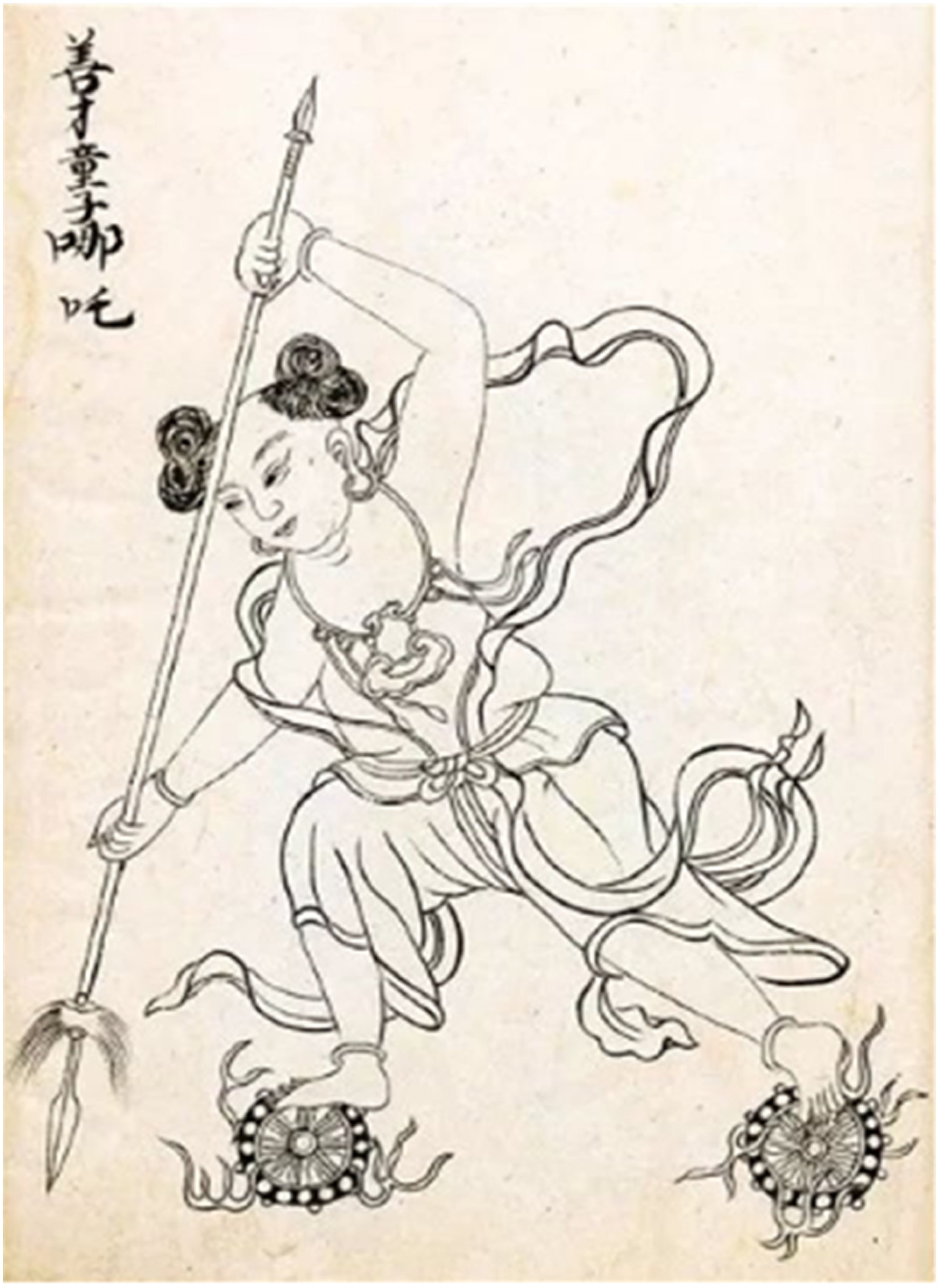
Another form depicts Nezha as a gentle figure, sitting or standing on a lotus flower, endowed with the features of a strong body, vigorous spirit and chubby face. In narratives of his capabilities or descriptions of his superpowers, Nezha is said to be not only invincible, but also has supernatural power, including high-speed running and transfiguration. Therefore, in some religious narratives, Nezha is given the nickname “ever-victorious boy”. However, Nezha has poor psychosocial ability because fighting is his/her only way to deal with interpersonal conflicts. From the perspective of character depiction or description, the main features of his/her personality are that he/she is described as mischievous, impatient, agile, rebellious, resolute, and courageous; his/her subordinate characteristics are that he or she is described as clever and adorable. The narratives focused on emotional states displayed by Nezha include episodes of anger, irritation and grievance. In narratives before 1949, Nezha was also called “Irritated Nezha”. In contemporary narratives, “irritation” or “vexation” were replaced by “anger” or “rage”, because the former refers to forbearing anger and the latter refers to expressing anger. In the narratives of Nezha’s actions, the child’s aggressive behaviors towards others and towards himslef are most common. It is obvious that Nezha has typical features found in children, both positive and negative. Positive features: foremost among his attributes, he is described as cute, well-behaved, and thriving in vibrant good health, which is consistent with Chinese New Year paintings (Figure2). This is also the most widespread set of culturally homogeneous characteristics embraced as cultural values by the Chinese people in general--- and these straddle three different eras, reflecting the stereotype of lovely (lovable) children in the Chinese collective consciousness or encapsulating the Chinese cultural values. The other is righteousness and conscience, qualities propagated and extolled in the field of moral education during the era of reform after 1949. Negative features: Nezha was described as impulsive, reckless and even cruel. Corresponding to the realities, these features are possessed by children who have social development obstacles such as aggressive behavior and parent-child relationship problem, or other issues faced by children who going through the phase of impulsiveness during the process of self-development. Four New Year Paintings with One Theme on Same Paper in1985.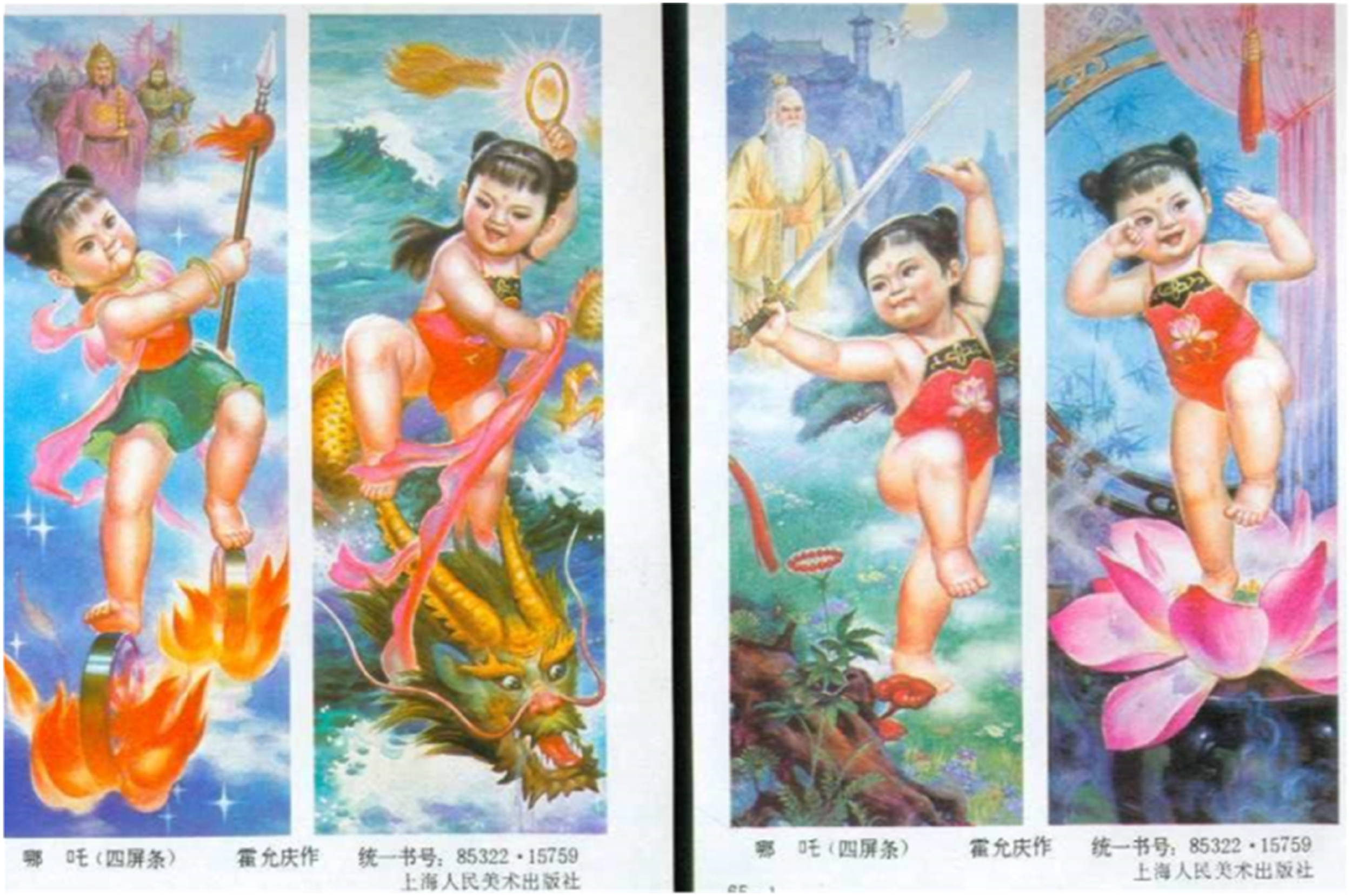
Plots and Identity Figures
Sarbin (1986, p.3) pointed out “The story is held together by recognizable patterns of events called plots. “ Judging from the existing historical narrative documents, Nezha’s killing of demons and evil spirits is the most commonly narrated theme. From the perspective of Nezha’s cultural narrative system, the plot is constituted by five themes: birth, troubles, suicide, resurrection, and accepting the mission. The complete story originally started with novels circulated in the Ming Dynasty, and later generations deepened their focus on various different themes, after that there were different secondary themes introduced and these now form different versions of the Nezha narratives.
Part 1--Unusual birth: Hero and freak
The birth theme includes three secondary subjects: (i) extraordinary background, (ii) godsent mission and (iii) extraordinarily lengthy period of his mother’s pregnancy and strange phenomena during his birth. It is said in The Legends of Deification that Nezha was the reincarnation of a Spirit Bead of an immortal named Taiyi (太乙) who lived in a cave called Golden Cave of Qian yuan Mountain—this has become the most quoted content about Nezha’s origin in later generations. In the movie, Nezha: Birth of the Demon Child (2019), Nezha is said to be a spirit orb, but has been secretly replaced with an evil bead just before the birth. Regardless of which version is regarded as authentic, they both illustrate and emphasize Nezha’s extraordinary background. The Origins of Three Religions records that “Because there are so many demons among the world, the Jade Emperor (supreme deity of Taoism) commanded Nezha to be reincarnated as the child of Li Jing (in later times,Li Jing becomes deified as one of the deities of Taoism who holds a pagoda as his weapon)”, demonstrating that Nezha was born with the mission of expelling demons. The twelfth chapter of The Legends of Deification stated that Nezha’s mother, Yin, was pregnant for 42 months. One day, she dreamed that one person with Taoist hairdo, wearing Taoist clothes, placed an object in her arms and said ‘Maiden, please be ready to welcome your son’. After waking up, she had abdominal pain and had to prepare for a birth delivery. When Nezha was born, you could see a mass of red vapour and smell an extraordinary fragrance in the room. Besides, there was a meatball in the room, spinning like a wheel. All these unusual scenes (unnatural pregnancy, delivery of a baby consequent upon a dream, and birth accompanied by extraordinary phenomena) are typically in line with the hero birth motif in folk literature, highlighting Nezha’s unusual conditions of birth, all conforming to the classic narrative topic of hero myths. On the one hand, it shows a heroic identity with extraordinary talent and great mission. On the other hand, it also presents a freak identity that is difficult for social ethics to accept.
Part 2--Constant troubles: Troublemaker and rebel
In the historical and cultural narratives found in novels since the Ming Dynasty, the troubles described mainly centre on the grudges and fights with the Long (龍) King and Empress Shiji. Grudges with the Long (龍) King include rolling the East China Sea (where the Long (龍) King lives), killing Yaksha (the follower of the Long (龍) King) and slaying the son of Long (龍) King as well as torturing the Long (龍) King himself. According to historical narratives, the East China Sea was tossing and rolling because Nezha bathed here. The Long King dispatched his follower Yaksha and his third son Ao Bing to find out the cause. By the end, Nezha killed Yaksha, plucked out Ao Bing’s sinews, prevented the Long (龍) King from indicting him to the Jade Emperor by pulling out his scales and beating him. Furthermore, The Journey to the West described that Nezha’s bath in the East China Sea caused the Crystal Palace where Long (龍) King lives to collapse. In The Legends of Deification, Nezha went out to play and sat on a rock by the sea to bathe with his red silk (his magic weapon called “Huntian Ling”) because of the hot weather, resulting in the tremors shaking up the Crystal Palace. The Lon (龍) g King sent out Yaksha Li Gen to investigate the cause, who yelled “What strange thing is it that the child holds? What causes the sea to turn red and shakes up the palace?” Nezha called Yaksha a beast by reason of his ugly face. This annoyed Li Gen, who proceeded to assault Nezha with an axe. Nezha beat him to death with the Qiankun hoop (a magic circle weapon), which led to a fight with Ao Bing (the third son of Long (龍) King), and Nezha also killed Ao Bing and pulled out his sinews to make a belt for his own father, Li Jing. The feud was begun when Empress Shiji came to blame Nezha who killed her doorman accidentally by pulling the Qiankun bow (a mighty bow that only gods had been able to bend) and pointing the Zhentian arrow (three arrows matched with the Qiankun bow, a magic weapon), an accidental death caused purely by reason of childish curiosity.
Nezha represents the identity of troublemaker because of constant trouble making. There is a long-standing saying in China, “Even dogs are tired of children of seven or eight years old” (Wen, 2011) That means everyone, even dogs, dislike children at this age because they are a mischievous nuisance, and their naughty behaviour always leads them into trouble. And Nezha is a seven-year-old in many narratives, which is in line with the age-related characteristics of children’s stages of social development. This phenomenon is caused by the increase and expansion of children’s capacity for resource acquisition and exploration without sufficient social knowledge and guidance.
Modern narratives describe Nezha’s troubles as justice-seeking actions to repel evil figures like the Long (龍) King and Empress Shi Ji. Since 1949, Nezha’s child image was included in the national ideology as a moral symbol of heroes. In order to meet the needs of moral education for that time, the folk mythology of Nezha was re-interpreted to exalt Nezha as a role model, together with the other cultural heroes who also have a rebellious spirit. The glorious figure of a hero killing evil Longs (龍) to protect collective interests made Nezha a representation of rebels, while the aggressive behavior was seen as a representation of children’s spontaneous righteousness and conscience. This conforms to the ethical concept of “Benevolence and Righteousness” for heroes, which is promoted by Confucianism. For example, the animation Prince Nezha’s Triumph Against Long (龍) King in 1979 and the drama Nezha in 1983 (directed by Fangqian Chen) both portrayed Longs (龍) as greedy and cruel Demons and the reason why Nezha killed them is to protect humanity. In the fifth Chinese textbook for elementary schools, published by Jiangsu Education Publishing House, the Chapter 10, Prince Nezha’s Triumph Against Long (龍) King, these words appear: “Because the Long (龍) King of the East China Sea and his son are bullies of this area, humans are too afraid to go fishing. Nezha decides to repel them to help local people…” Which also was the reason for Nezha to destroy the Crystal Palace, kill Yaksha and the Long (龍) prince. In 1992, the movie Youth Nezha of Director Cai Mingliang, a teenager named Xiao Kang pretended to be Nezha’s reincarnation to evade responsibilities. He dropped out and was idle all the time, and he got it into his mind to regard a thief named Aze as an arch enemy of justice. He smashed Aze’s motorcycle in the middle of the night and sprayed the words “Done by Nezha” to show his so-called righteousness. The truth was that he used his misconceived sense of so-called justice to cover up his evasion of responsibility. In the movie Nezha: Birth of the Demon Child (2019), even without the troubles of causing havoc by killing Longs (龍), Nezha still was regarded with hostility by everyone because of his origin—the incarnation of an Evil Bead. Therefore, Nezha’s good deeds were seen as bullying behaviour by mistake or prejudiced misconception, a form of unjust misperception, which irritated Nezha, and motivated him to want to take revenge.
Part 3--Suicide in grief: Victim and sacrifice
The plot of Nezha’s death is full of anger, hatred, grievance and sorrow. Nezha is the representation of the identity of a victim (a sense of victimhood) because of the failure on his part to have a positive, healthy interaction with his family (his father, in particular) and his society. During the early period of the New China, Nezha was described as a victim and placed into the category of a victim, based on a narrative containing secondary topics such as cause, form, purpose and process. In ancient literature, most narratives about suicide are characterized as “dissection of flesh and bones to return to parents”. Buddhist scriptures state that this action is to destroy original noumenon to show parents the significance of their parental loving kindness and to express the gratitude owed by children to their parents. The Origins of Three Religions and Journey to the West record that Li Jing was very angry at having to bear the consequences of his son Nezha’s troubles and wanted to kill him. So Nezha dissected his flesh and bones to return them all to his mother, Yin and his father, Li Jing. The Legends of Deification describes that the Long (龍) King of East China Sea aligned with other Long (龍) kings to arrest Nezha’s parents. Nezha committed suicide in front of the Long (龍) kings to plead for the absolution of his parents. Nezha cut off one of his arms with a sword, then committed hara-kiri and dissected his flesh and bones. The whole process is bloody and cruel. In this kind of narrative, Nezha did not plead guilty but responded with self-destructive masochistic suicide to atone for the troubles he had created by his violent actions. In modern times, suicide has been regarded as the representation of victimhood since 1949 in China. This line of reasoning states that the reason for Nezha’s suicide was to prevent the Longs (龍) from bringing the threatened deluge to the people, and to appease the anger of the Longs (龍) , Nezha committed suicide with the sword and sacrificed himself to protect the whole community of innocent humans living in that area. This is a typical example of an individual sacrificing personal interest to safeguard the collective good. For example, shot No. 432 in the 1979 version of Prince Nezha’s Triumph Against Long (龍) King, the scene of Nezha’s suicide with tearful eyes is classic. In this new century, this shot is used by “Miserable Faith (Tong Yang)”, one of the most popular rock bands in contemporary China, as their important LOGO and promotional poster (Figure3). Girl Nezha (2014) tells a story about a good girl Wang Xiaobing, who was not understood by her parents. After encountering numerous social rejections, she ended her life by committing suicide, reflecting the then popular representation of her situation as that of a tragically misunderstood victim. The LOGO of rock band Miserable Faith.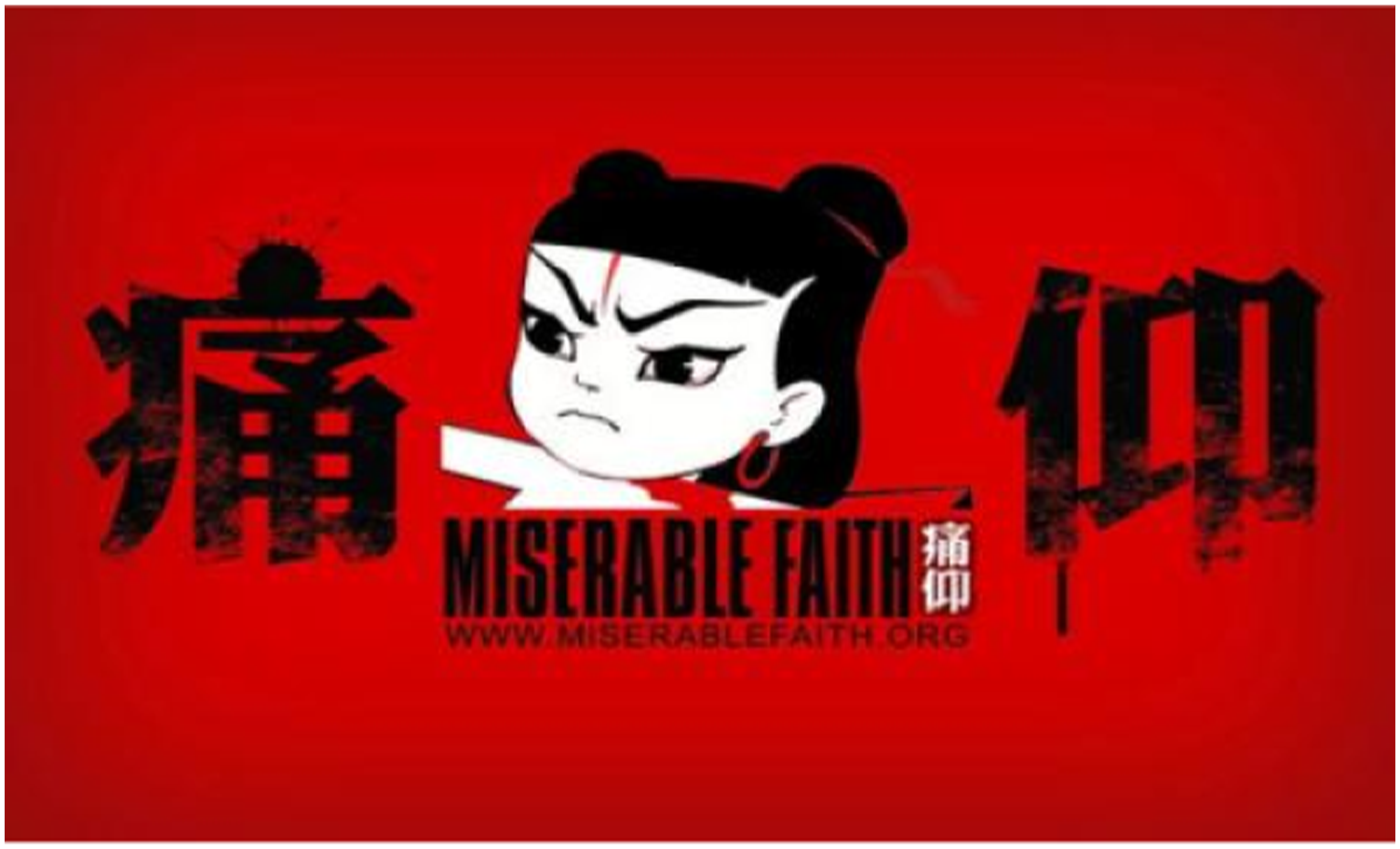
Part 4--Divine rebirth: A new self
There are two versions of Nezha’s resurrection narrative. One is based on The Origin of Three Religions and The Journey to the West, which describes how the Buddha revived Nezha with lotus root and lotus leaf. The other is based on The Legends of Deification, in which the legendary Taoist Taiyi resurrected Nezha with lotus flowers. Nezha with the lotus, is adopted most often in the texts of modern narratives.Therefore, Nezha is also called the Lotus Boy, well known among adherents of Buddhism and Taoism. In the history of Oriental culture, the lotus has always been regarded as a divine and reproductive symbol. Brahma, the Indian god of creation, was born from a lotus flower, and Sakyamuni Buddha sat on it to preach. Chinese Taoist folklore records that Chen Tuan, the most influential Taoist priest, was also born in a lotus. In these legends, the lotus flower is used as a vessel for birth, or is associated with rituals. In the story of Nezha, the lotus flower is also used to create the new Nezha, giving him a divine character and a sense of splicing and integration (a total severance from past conduct and previous behaviour). It is the religious deities or personages that revived Nezha through sacred rituals and offered him the opportunity of coming back to society. Therein lies the psychological significance of the “re-involvement” ceremony, referring to the process of shaping a new self through ritual practice and the conduct of formal ceremony, advocated by narrative psychotherapy.
Part 5--Mandate and return: Adaptive self
This theme is about the identity representation of the adaptive self after returning to social justice and accepting the prevailing ethical order. In ancient literature, the resurrected Nezha returns back to society and accepts the mission given by Buddhism or Taoism or other deities--- and accepts the duty to serve as a religious protector of the law. Nezha is mandated by Buddha and the Jade Emperor to expel demons, or by Jiang Ziya to help the King of Zhou Dynasty beat the king of Shang Dynasty. Nezha was deified because of his military exploits. In the ancient cultural narratives of “Nezha”, the “mission” refers to the orders from gods/deities, a situation in which the child hero lacks autonomy. In 2019, Nezha: Birth of the Demon Child subverts the traditional connotation of “mission”. Although Nezha is an evil bead, he still takes actions for justice to help humankind. In the end, Nezha sacrifices himself in exchange for social harmony and peace, and his death makes him re-accepted by the society. When he is struggling to withstand the falling sky, he yells out “My life is up to me!”, a battle-cry which resonates with many adolescents and a heroic affirmation that is highly respected. Besides, it is the most frequently quoted sentence in Nezha-related film review online. This sentence also expresses the view that destiny is held by each of us in our own hands, containing the quintessential psychological meaning of youth’s pursuit of independence. In the first school assembly held upon the resumption of the school term of the middle school in September 2019, many principals used the narrative of Nezha’s autonomous command to encourage students to work with might and main (to study diligently), and never to give up. For example, Xiang Xionghai, the principal of Changsha No. 6 Middle School, said in his opening speech: “In the movie (Nezha: Birth of the Demon Child), Nezha is born as a demon. He is disgusted by the world, but he is so brave to fight against his destiny. Only you can decide who you are…What you should do is to live out your own life” 1 . Educators use modern narrative texts to awaken students’ sense of autonomy – their power to take independent action, their inborn agency.
Interpersonal themes and parent-child relationship
The interpersonal narrative mainly presents the parent-child relationship beyond blood ties, among which the father-son relation is highlighted.
There are two kinds of father for Nezha: physical father and divine (spiritual) father. Li Jing is Nezha’s biological father in all the literatures reviewed. He sired Nezha and provided biological genes and family space for the child’s nurturing. However, in terms of emotion, he showed hostility and conditional love to Nezha. When he witnessed the strange scene of Nezha’s birth and delivery, he denied the necessity of Nezha’s existence until he found that Nezha was normal – that is to say, like other children. The Shakyamuni Buddha or the Taoist sage Taiyi who helped Nezha to be resurrected are both religious figures. They each are said to have given Nezha a second life. So, in the context of each of the two faith traditions, respectively, each of these religious figures could be regarded as Nezha’s divine father. And they can be regarded as a representation of psychological significance as physical father because Nezha has more attachment and accords greater parental recognition to them than to his natural father, Li Jing. In ancient narratives, there was only the role of biological mother, but in contemporary adaptations of Nezha stories -- such as the TV series Lotus Boy (1999), and the animation film, Legend of Nezha(2003) of Director Zhang Li, both add the role of a divine mother, Nuwa, who helped Nezha become reborn.
The plot theme includes treatment of such issues as the development of the parent-child relationship. In the birth episode, parents share anxieties due to the unnatural pregnancy and wondrous childbirth. The father, Li Jing, sees Nezha as a monster. As described in The Legends of Deification, Li Jing believes that “the child must be evil because the pregnancy lasts for more than three years”. The mother also says: “this is not a good omen, which worries me day and night.” When the mother delivers a meat ball, Li Jing rushes to the delivery room, and slashes it “… with a sword; the meat ball is separated with an audible sound, and a glowing child jumps out, having pink cheeks, wearing a golden bracelet on his right hand and a piece of glittering red silk around his belly. Li Jing is shocked when he sees such a child running all over the place on the ground. Li Jing holds the child up and finds that he is so cute. Li Jing could not bear to kill him as an evil thing. Li Jing passes the child to his wife, both of them love the child so much”. In the Peking Opera of 1983, even though Li Jing witnessed the ball of flesh turning into a lotus flower and giving birth to a baby with a red bellyband, he still wanted to kill this baby until he was dissuaded by Nezha’s mother. The Taoist legendary figure Taiyi is said to have visited the perplexed parents the next day to celebrate the birth of the child and he told Li Jing that “this son is born during 1am∼3am, so he is destined to commit one thousand and seven hundred killings”. Taiyi named the child Nezha and accepted him as an apprentice, playing the other role of father figure for Nezha. In traditional Chinese teaching culture, the teacher is like a surrogate father and there is a saying “a day as a teacher, a lifetime as a father”. In the narratives which regard Taiyi as a divine (or spiritual) father, he is described as having accompanied Nezha during the boy’s entire childhood; it is he who has granted Nezha skills to adapt to social life; it is he who responds to Nezha’s needs and always rescues him in a timely manner.
In those narratives which focus on Nezha’s troublous life, the most common theme is that Li Jing blames and scolds Nezha all the time; Li Jing hates Nezha because he is afraid of being involved in or being made to suffer the consequences of the troubles caused by Nezha, while Taiyi is depicted as patiently teaching Nezha how to solve problems and always protects Nezha (sometimes going so far as to protect him even in an excessively indulgent way).
In those narratives focusing on Nezha’s suicide, most of the descriptive passages are about Nezha maltreating himself as an expression of his desire to break the blood relationship with his parents, implying the psychological meaning of children who desperately want to get away from their parents in an extreme way.
In the resurrection plots, The Legends of Deification and Journey to the West describe scenes to show that after death, Nezha appeared in a dream to request his mother to build a temple for his soul to live in. His mother woke up and built a temple, which came to be regarded as a shrine by the people. When Li Jing saw the temple, he resented the thought that Nezha still unduly influenced people even after he had died. Li Jing thus resentfully chopped down the statue of Nezha, which infuriated Nezha, who proceeded to hunt Li Jing after his resurrection.
In mandate plots, the religious deities (the references are to the Buddha or, alternatively, to the Taoist sage Taiyi in most of the narratives) mediate the father-son relationship by giving Li Jing a miniature tower (a pagoda) that he could hold; Nezha needs to behave well when he sees the tower. Then the grievances between father-son are eventually dissipated.
In those narratives in which the Buddha is regarded as Nezha’s divine (or spiritual) father, it is the Buddha who helps Nezha by performing the resurrection ceremony after Nezha’s death as a consequence of his horrific suicide. Nezha regards the Buddha as a surrogate father, who is far more important than Li Jing. Su Zhe, a famous poet of the Song Dynasty, wrote a poem entitled “Nezha” in the winter of 1107 AD: “The king of the North has a mad son, who only worships Buddha instead of his father… The son visits Buddha with his head bowed down, which is similar to worshiping his father” (Yu, et al., 1997). In The Journey to the West, it is stated that each storey of the golden pagoda houses one buddha/boddhisattva and, in that recounting of the Nezha legend, the Buddha told Li Jing that “if Nezha is not convinced, you can use the pagoda to punish him”. In The Legends of Deification, Nezha admitted that he is afraid of the tower (the golden pagoda) but does not fear or honour Li Jing.
In most narratives of reconciliation, the father and son unite and are reconciled because they were both given a common task, issued by deities or kings, to expel the monsters.
The two different father figures (the birth father and the divine or spiritual father) actually represent the unit of psychological meaning of negative or positive father roles. In ancient narratives, especially the plot narratives after birth, Nezha’s mother shows more love and maternal protectiveness than the father. The maternal role is positive but weak. The psychological nurturing performed by the divine (spiritual) father shows positive fatherhood such as forgiveness, acceptance and love, providing strong support for Nezha. However, Taiyi attributes the troubles to Nezha’s destiny, lacking the education of children’s reflection on themselves, which builds a “good dad” image for the spoilt child Nezha. Li Jing (who, according to classical Confucianist teachings, must be regarded as the highest authority in any family), mainly punishes Nezha by angry accusations, hacking him with a sword and by other offensive (and often violent) behaviors, evincing a blatantly negative parenting style. When Nezha gets into trouble, Li Jing always blames his wife and berates her for giving birth to an evil boy. Li Jing neither reflects on himself about his responsibilities as a father nor teaches Nezha to do the right thing, showing a pattern of tyrannical paternal behaviour ---persecution, rejection and violent expressions of extreme parental power, which builds up a “bad dad” image of Li Jing in Nezha’s mind. After the reconciliation, the two rely on the dictates of an ethical order instead of the emotions of natural affection to maintain a relationship. Li Jing’s style of parenting is also a literary representation of the normal pattern of father-son relationship in traditional Chinese culture, praising “filial piety” and social order rather than natural affection, emotional warmth and love.
This ethos prevailed until the New Culture Movement in 1919, when modern scholars in China started to break this pattern by putting father’s love and tenderness above filial piety under the influence of the emerging principle of equality. At that time, the cultural elites like Lu Xun, Shen Xuanlu, and Yu Pingbo all emphasized the quality of love in a father-son relationship through articles, with the intention of turning the grace of collective moral order to the love of humanity. Traditional Chinese families take intergenerational relations as the main axis to describe the “grace” and “piety” in the parent-child relationship, which are undoubtedly the key words of Chinese family ethics. “Grace” describes the nature of the parent-child relationship, pointing to the level of meaning and value, while “piety” is about a behavior, inclined to conform to social norms. It is about the conversion of “order type” ethics to “emotion type” ethics (Jiang, 2020).
In the contemporary parent-child narratives, the narrative units of “unconditional love” of a positive paternity are added to Li Jing to achieve the consistency between physiological and psychological (or spiritual) fathers. For example, in the animated film A Hundred Thousand Lame Jokes(2014), Nezha is born with a Lolita face and muscles. He was always in trouble because of his great strength. Even like this, his father loved him so much, such as the lyrics of the ending song, To Father: I am always in trouble, but you have never stopped me/because you don’t want to prevent my happiness of growing up… other children are all studying well and progress every day/they are obedient, they are models for all children/I am different /I am Nezha/born as a nine-foot high Macho Queen/I know, you worried, doubted, and quarreled with mom/But you never gave up…
The father in the lyrics has the image of accepting and loving his “weirdo” child without condition.
The parents in the movie, Nezha: Birth of the Demon Child, are more like the Mother and Father in an ideal modern Chinese family, who form an alliance with their child. When Nezha was born, though they know his origin as an evil bead and troublemaker, they still love and accept him unconditionally, providing him a safe place to grow up in. They try their best to accompany and teach Nezha. In the face of unknown disasters, the father is willing to exchange his life for the survival of his child, which is a representation of positive paternity. This unconditional love is also the main motivation for Nezha to do good things. The negative paternity in the movie is represented by Shen Gongbao, who constantly persecutes Nezha to death in order to contend for power against Taiyi, the legendary Taoist figure.
Personal narrative cases in counseling
Sarbin (1986, p.3) pointed out “A story is a symbolized account of actions of human beings”. Professionally, we consider cultural imagery as one of the forms of story expression. Narrative psychologists have found that stories play an important role in counseling. Clients can achieve the therapeutic effects of psychotherapy by narrating their stories (Neimeyer, 2006; Sarbin, 1986, p. xiii.), and personal stories are influenced by cultural stories. “Life stories are the epitome of social culture because stories originate from culture” (Angus et al., 2011). Adler et al. (2017) pointed out that “the individual’s story, is a rich source of information about the culture and context of personality and development. Narrative questions are concerned with the explicit content of stories (e.g., emotional language), the implicit content of stories (e.g., psychological themes), and/or the structural aspects of stories (e.g., coherence)”.
The following case attempts to conceptualize individual narratives by cultural narrative texts, providing clinical examples of the intersections of personal and collective cultures, and it is here published with the permission of the client.
Case background
Lan, a psychotherapy client in a psychological counseling center of a university. She is a 26-year-old female; as a master’s degree candidate, she comes to ask for help due to depression. She speaks softly, is very gentle, even looks a little weak. According to Lan’s own description, she was a sensible little child, thus when her parents quarreled, they would count on her to mediate. They always told her bad things about each other and clamored for a divorce. When Lan grew up, she went to university far away from home to get away from her parents. However, her parents would often call to complain about each other, expressing despair and sadness. Although client knew that this is a normal (or at least, a common human) situation and they won’t really take legal action to get a divorce, it is really exhausting to be caught in the middle and placed in such a dilemma. She can not escape herself. Sometimes she did not call her parents for a long time – just so that she could “catch a breath”. But her parents would call and accuse her of having a good life and forgetting about them, her very own parents. Such a statement often troubles and depresses the client. She feels unhappy about their relationship.
Emerging nezha image
During her 13th consultation session, Lan first talked about her First of all, there is a fire in the middle of the picture. On one side of the fire, there is a chubby baby of a Chinese New Year Picture, an infant who is about 2 years old. She thinks this baby is Nezha. On the other side of the fire, there is an adult man, whose face may change, sometimes looking like Nezha’s father, Li Jing, in the movie Nezha: Birth of the Demon Child, sometimes like Shen Gongbao who wants to kill Nezha. • When the active imagination recollection narrative was over, she told the counselor that she was envious of Nezha for having such a father in the movie, one who was so caring and so willing to give up his own life in exchange for Nezha’s survival. She felt very sad when she thought about Nezha’s death for rescuing the world (
Case conceptualization and narrative identity
Lan constructed the identity of troublemaker, victim and self-sacrifice by recalling an image of the two-year-old Nezha. Lan has already entered the individualization stage of adolescents’ separation (Blos, 1979). However, the emotional bondage has made it difficult for her to separate from her parents and it is difficult to continue self-differentiation. Therefore, she is still in the stage of identity crisis. Wang (2006) pointed out that in Chinese culture, the self is largely defined by one’s place in a matrix of social networks, and individuals tend to perceive themselves by focusing on their social roles and relationships. Parents are the dominant power with great influence on children’s social network. They constrict children’s original identity expectations for themselves. Murray Stein (2020) pointed out that “parents are the earliest provider of social identity”. From the consistent external events described in the case, Lan’s parents regarded her chronic childhood illnesses as being troublesome, providing and burdening her with a “troublemaker” identity since she was a little girl until her adulthood. And she utilized the imagery of Nezha, who was also regarded as troublemaker by his father, to carry out her own personal narrative. This shows that even though she had chosen to go far away from home to study and deliberately kept a long distance between her and her parents, she had not separated from her parents at the psychological level, and she had not completely gotten rid of the “troublemaker” identity given to her and impressed on her mind by her parents. On the other hand, her parents have been unable to deal with the problems of their own husband-wife relationship. They neither have the ability to take up the responsibility of serving as her psychological parents nor the capacity to give her “unconditional love” such as is to be expected from one’s natural parents. On the contrary, they asked for more from her and they placed her in a dilemma, asking her to take on the role of mediator, which made it necessary for her to sacrifice her need for care and love as a child. In the movie, the 3-year-old Nezha rescued the world by himself, and the client performed the responsibilities of parentification. Both of them (Nezha and Lan) were required to shoulder responsibilities that are far beyond the capacity of children of their age. She thinks about herself from the perspective of (or the narrative aspect of) Nezha’s sacrifice and constructs for herself the narrative identity of the victim.
Furthermore, Lan’s father is the typical male parent who possesses high authority in Chinese cultural tradition, using negative parenting methods like using derogatory, accusatory and other verbal assaults, which are similar to the persecutory father/negative paternal image described in the cultural narratives of Nezha. This image is represented by the image of Shen Gongbao in the contemporary movie Nezha: Birth of the Demon Child. In the relationship between the two-year-old Nezha and Shen Gongbao, the narrative identity of “victim” and destroyer is constructed. Another positive image of paternity in the movie is represented by the image of Li Jing, who (in the client Lan’s version of the Nezha story) is her ideal father figure and provides her with protective space and affirmative evaluation—one of Lan’s main needs for psychological counseling—getting the functions of psychological parents (receiving the parental nurturing from psychological or divine/spiritual father/parents) from the counselor. By emphasizing the narrative themes of Nezha’s resurrection and return, the counselor adds the narrative identity of Nezha’s “new-self” (Part 4--Divine Rebirth) and “adaptive-self” (Part 5--Mandate and Return) to the therapeutic framework offered to Lan. At first, her knowledge of Nezha’s story only stopped at Part 3-- Suicide in Grief, and she stressed that she wanted to be like Nezha and had no relationship with her parents, and that she felt sad to identify with Nezha as the victim of a suicide. Although she took the initiative to separate from her parents in physical space, her parents' constant emotional demands on her through the phone still placed her in the position of parental separation, making her unable to carry out psychological separation, indulging in helplessness and sadness that she could not be independent and individualized.When the counselor emphasized the fourth and fifth parts of Nezha’s cultural narrative, the theme and meaning of the imagery became more multi-dimensional and emphasized the importance of Nezha to realize his own mission, expanding the clients' cognitive scope and imagination and breaking through the limitations of the original framework. In addition, the consultant chose to narrate Nezha’s resurrection by splicing the parts of a lotus flower, highlighting the vivid image that rebirth needs to be integrated. In a word, the counselor shook her feelings and triggered her psychological development by using richer narrative and meaning, as well as multi-oriented vivid presentation of images to loosen her rigid cognition and identification of Nezha.
For her, the emergence of the image of Nezha is the central turning point in the consultation, and from then on, the power and energy absorbed from the narrative plots of Part 4 to 5 are absorbed into her life.
This image is just a beginning of a real self-differentiation and resolution to the issue of identity crisis. During her 14th consultation session, Lan described a dream after the last one, dreaming of her familiar middle school classmate who looks like a chubby and healthy Nezha. In her dream, Nezha grew up healthily instead of being a weak baby (like herself), which represents Lan’s self-growth. Later, after another 20 consultations, Lan gradually developed independence and separated psychologically from her parents.
In real life, she gradually learned to exercise autonomy, to live on her own terms, to reject her parents' emotional blackmail, to let them manage their own relationships without her having to involve herself as a judge between them. She also developed intimate relationships of her own. She had a boyfriend, but her parents rejected their request for parental consent to their proposed marriage. The client eventually insisted on staying with her boyfriend and they got married before graduation. They live a happy life and the entanglement with her parents has also weakened considerably. Half a year after the counseling, she chose a job that filled her with passion and that she was willing to continue to devote herself to. She enjoyed it, became more purposeful and found her mission.
Lan’s trajectory shows how – constructed at the intersection of personal and collective culture in her psyche or mind, it was possible to facilitate her pychosocial growth and to bring about a reframing of her identity and self-development. This was achieved through her willingness to embrace narrative changes of a previously-held Nezha image.
Comment, conclusion and discussion
From the analysis on cultural narratives of the diachronic “Nezha”, we find that the five plot themes contain eight units of psychological meaning for identity, and the interpersonal theme includes two psychological meaning units of paternal interaction. The changes and modifications made to the themes and motifs of cultural stories like the Nezha legends emphasize different narrative plots and identities. Narratives in the imperial period of ancient China emphasize Nezha’s identity as a battle hero who accepts a god-given fate (a fate mandated by Heaven), submits to imperial or divine power and upholds justice. Stories from the 1950s to the 1980s emphasize his status as a collectivist hero and a child victim who sacrificed his life for the benefit of the people -- still to achieve the goal of justice. Parent-child relationships, especially emotional narratives, are relatively neglected in the ancient literary works. But in contemporary times, people in China attach increasingly greater importance to the parent-child relationship; and so, gradually, the societal focus shifts to the father-son relationships between Li Jing and Nezha, and recent adaptations introduce an emotional narrative. The film Nezha: Birth of the Demon Child, predominantly continues to focus on the plots of “Unusual birth”, “Constant troubles” and the theme of justice. It implies or hints at the concept of “Divine rebirth”, but avoids the theme of “Suicide in grief”; continues to portray the identity of “Hero and Weirdo” and “Troublemaker and Rebel”, but avoids the identity of “Victimhood and Sacrificial Object”. Its two main content changes are the mapping of the contemporary cultural values, which has aroused wide cognitive and emotional resonance among contemporary people. In the arena of cognition, it rewrites the concept of destiny defined by the ancient emperors -- passive obedience to the arrangement of Heaven. The famous slogan in the film suggested the supremacy of human autonomy over the will of heaven. Although his fate has been sealed by reason of his origin as an “evil bead”, which will be killed by lightning on his third birthday, Nezha’s individual self is not waiting to die passively, but choosing actively to stop the scourge of lightning befalling his hometown. He rewrites the script of his fate. What is he? Devil or hero, it is all decided by himself. Finally, his soul is saved in the lotus, so he gets a chance to be reborn. The people who were saved by his good deeds recognized him as a hero, and knelt in gratitude and worship. In the realm of emotion, the touching parent-child relationship is placed at a central position in the narrative. Nezha is the only child in the new story. Even if he is a bad or naughty boy, always causing trouble, the parents still always give him unconditional love --- which is depicted in the film as the fundamental motivation for him to choose to do good deeds bravely, evincing nobility and courage. It reminds us of a similar theme in Hellboy: Rise of the Blood Queen (2019). Hellboy is born a demon from hell. Raised by his human father with love, Hellboy finally chooses the path of righteousness after being called by his Lord of Destruction. So, love and autonomy are the common code of self-salvation for Nezha and Hellboy.
In the snapshot of consultations, the counselor combined Nezha cultural narratives with the qualitative data of personal narratives, regarding the cultural narrative framework as a reference point, which can be applied to the case conceptualization and the initiation of new narrative identity.
The purpose of this case presentation is to demonstrate how to use Nezha image analysis, integrate personal and cultural aspects, and promote the growth of the client’s mind, rather than describe a complete psychological treatment process. We focus on this framework and its coding practices in the hope of providing other counselors with knowledge and practical professional tips to use in similar situations.
According to the fundamental priciples of cultural psychology, we are the product of culture (Steven, 2015). The cultural narratives of individual identity development affect the identity of personal narratives. In this paper, we regard cultural narratives as important references for the formation of a personal narrative identity so as to conceptualize a case, and we treat classical folk tales in social culture and cultural narratives in myths and legends as textual psychological experiences. Michael White and David Epston (2013) disapproved the empiricism of understanding life through lived experience, and pointed out that people can turn experiences into orderly stories to create meaning, that is to narrate experience as a story to achieve meaning and continuity (pp.9–10). Narratives also can be the collective and individual experiences. For example, the cultural narratives of “Nezha”, with the feature of time continuity and space multidimensionality, form a Chinese-specific shared knowledge of child development related experiences. Our analysis on Nezha’s cultural narratives is like a cultural “archaeology” of meaning (McLeod & Balamoutsou, 2001), discovering and acquiring psychological insights from related fields of knowledge.
Furthermore, the counselor carries out the counselling work with a historical consciousness, trying to provide clients with knowledge that has new meaning, so as to achieve “fusion of horizons” (Gadamer, 2013). The counselors, placed at the intersection of collective and personal culture, can utilize the perspective of collective culture to interact with clients to co-construct new narratives. The case also uses the modern representation of figure and plot about Nezha’s image to externalize the difficulty of forming one’s self-identity and the problem of parent-child relationship. This not only provides an excellent opportunity for the client’s self-recognition and reflection, but also provides a window for the counselor to carry out the case conceptualization work, as well as offers the framework and direction for further work. Next is the stage in which the counselor provides new meaning for the joint construction of meaning (Mishler, 1986). The “fusion of horizons” and the joint construction of meaning in consultations require the negotiation and consensual agreement of both parties. In this case, with the help of the knowledge of cultural imagery, the counselor took advantage of the “turn time” which emerged in imagery to build an exploratory way for client to undertake client’s self-differentiation and self-identification.
The “archaeology of meaning” refers to the method of cultural anthropology, and the interpreted narrative content by psychological theories is like a kind of literary criticism. Many of the concepts and procedures of qualitative narrative analysis are borrowed from fields such as linguistics and literary criticism (McLeod & Balamoutsou, 2001). In order to avoid excessive interpretation, the researcher’s professional self-restraint is emphasized. Furthermore, the purpose of psychological interpretation on cultural narratives is to provide psychological practitioners with a preliminary narrative and conceptual framework, in order to correspond to the clients’ personal narratives in cultural images, but it is not the only intellectual structure for this work, nor is this a rigid template.
Once cultural images appear in personal narratives, they become narratives of internal experiences featured by private and individualized. There are various meanings in them and the determination of meaning depends on the adopted explanatory theoretical framework. The key words in this paper are “self-identification” and “parent-child relationship”, but the subject matter is not confined to just these concepts. In order to ensure the case conceptualization and the validity of interpretation are of practical professional usefulness in consulting, an exploration of other dimensions of the case (like client’s personal external events, experience and interpretation) is necessary. In order to obtain qualitative data from personal narratives that contain cultural images, in this paper, we initially establish four dimensions: external-internal, event-image, narration-interpretation, experience-reflection. Then, we apply the processes of analogy; we compare; we engage in analysis of the themes in cultural narratives framework with psychological meaning units. Such a kind of coding method still needs to be verified and practiced in future research work and in actual consultations. This is the direction of future research and exploration.
Footnotes
Declaration of conflicting interests
The author(s) declared no potential conflicts of interest with respect to the research, authorship, and/or publication of this article.
Funding
The author(s) disclosed receipt of the following financial support for the research, authorship, and/or publication of this article: This work was supported by the 2022 Yunnan Provincial Department of Education Science Research Fund Project (2022J0400).
