



Abstract
Citizenship as an object of study goes beyond the mere recognition of formal rights and responsibilities and includes cultural and social practices in different spheres. In this sense, the exercise of citizenship is linked to different forms of political participation. Recent studies show that young people are distanced from traditional political participation and prefer alternative civic practices. Within this framework, the present study aims to investigate the social representations of citizenship of Argentinean adolescents (N = 32) aged between 16 and 18. To this end, participants were asked to elaborate a narrative about their experiences with citizenship in the framework of semi-structured interviews guided according to the Piagetian clinical method. The results obtained allow the construction of four analytical categories intended to describe how these adolescents represent citizenship: civic engagement, rights, nationality and voting. It is concluded that there is a plurality of social representations of this object, and it is necessary to elucidate their development, maintenance and transformation processes in future research.
Introduction
In the last few decades, phenomena such as globalization and post-modernity, the processes of multinationality, multiculturalism, emigration and immigration together with the formation of supranational and transnational organizations (e.g. European Union) have questioned the understanding of citizenship as a singular membership of a nation-state, revealing the existence of different types of dual or multiple membership (Jaramillo Echavarría, 2014). In this vein, national belonging as a source of rights and duties of individuals is contested by the groups within multicultural societies that have strong links with the states where they reside without belonging to the political community of reference, as well as enjoying a range of rights very similar to those of citizens, despite not having such status (López Sala, 2002). Therefore, these phenomenon shows the tension between some traditionally intertwined spheres such as territory and belonging, with the new sphere of citizenship being much more complex than in previous times (Pérez Luño, 2002).
In this framework, although there is much debate in the Social Sciences about how to conceptualize citizenship, people in daily live use a common meaning to refer to this object and guide their daily interactions around it. Precisely, the theory of social representations (hereafter SR) aims primarily at explaining how objects of the social world are communicatively understood in people’s everyday exchanges (Markova, 2017; Sammut et al., 2015). Therefore, this theoretical perspective is devoted to the study of common sense knowledge, defined as the set of available knowledge that is spontaneously used by subjects in their everyday practices (Wagner, 2015). It is important to point out that SRs are constructed and expressed in social practices, forming a system of anticipations and social expectations that facilitate individuals' selection of relevant information and interpretation of their context (Moliner & Abric, 2015). Furthermore, SRs are dynamic structures, which are constructed and transformed in interactions with others, allowing the same object of knowledge to acquire a plurality of meanings (Moscovici, 1979). In sum, SR are overarching structures across different patterns of social interaction, and they must comprise of one’s particular behavior as well as that of the others. In this vein, SR can be defined as dynamic units because they are fuzzy and they can be inferred by individual -and by researchers- from stable patterns of correlation across the elements of the unity. These elements could not be defined out of their social context. Hence, SR as emergent meaning creates the social object that only exists as the outcome of interactions over time in a specific context “people represent social objects in and through action” (Wagner, 2015, p. 22). Within this framework, the purpose of this study is to investigate the SR of citizenship in adolescents, as a way of advancing in the understanding of the practices in which they are expressed.
Cithizenship as an object of collective understanding
As it was stated in the previous section citizenship is a polysemic conceptual object i.e. constantly being redefined by specialists from different disciplinary, technical and political areas (e.g. Ramis & Rodríguez Rivas, 2018; Shapiro, 2020). Therefore, what the social sciences have understood as citizenship, that is its characteristics and modes of application, has varied according to the historical-cultural context in which it is analysed (Gómez Contreras, 2017, Silva-Nova et al., 2015). In an attempt to provide a broad definition of citizenship, it is even possible to establish an overview 1 of this topic from classical Greece to the present day (Baca Olamendi et al., 2000; Di Tella et al., 2001). However, its delimitation in terms of the feeling of equal belonging to a political community is a product of modernity. Thus, the Greek conception of citizenship was very restricted in the scope of its status as it excluded most of individuals (slaves, women, etc.), showed the hierarchies of the political community (Baca Olamendi et al., 2000; Jaramillo Echavarría, 2014). At the same time, systems of representation became a distinctive feature of modern societies, as citizens could not be face-to-face as in the Athenian or Roman assembly (Cheresky, 2006). Therefore, with the emergence of nation states, there were established universalist standards of legal equality and criteria of homogeneity, which formed the basis of the modern conception of citizenship (Baca Olamendi et al., 2000). On the one hand, the concept of citizenship was intrinsically linked to nationality, that is being a citizen was equivalent to the communal membership of the nation-states (Pérez Luño, 2002). Moreover, from an individual level of analysis, nation is conceptualized as the feeling of belonging to an imagined political community constructed on the basis of a set of common features and ways of doing things together (Anderson, 2021). On the other hand, the concept of state is defined as any political organization that claims (successfully), within a specific territory, the monopoly of legitimate physical violence (Weber, 1991). In this vein, the categories of state and nation are not comparable, since they differ from each other in terms of their conceptual frameworks, their fundamental characteristics, their origin and essence (Justafré García and Rodríguez Suárez; 2014). In other words, citizenship was understood in terms of the juridical-political status assigned to all those subjects who were members of a nation-state, comprising the possession of a set of rights granted to people under its authority and jurisdiction (López Sánchez, 2019; Pérez Luño, 2002).
In addition, the different rights are classified into generations according to their historical temporality and normative content (Gamboa-Bernal, 2019; Navas-Camargo & Cubides Cárdenas, 2018). However, these are not autonomous rights that occur once the precedent has occurred because the overlaps are evident (Sojo, 2002). First-generation rights originated in the 18th and 19th centuries focused on individualistic values and basically include the protection of classic freedoms (e.g. freedom of thought). The 20th century saw the development of second-generation rights, whose purpose is to guarantee the protection of individuals in their social dimension (e.g. health), as well as third-generation rights, which include quality of life and the environment, among others. In recent decades, as a result of the influence of new information and communication technologies, fourth-generation rights have emerged that concern personal issues such as gender identity or the protection of personal data (Gamboa-Bernal, 2019; Navas-Camargo & Cubides Cárdenas, 2018).
Today, the recognition of cultural diversity as the foundation of contemporary citizenship is contradictory to the historical process of the formation of modern nation-states, based on political unification, the claim of cultural homogeneity and universalism (Di Tella et al., 2001; Pérez Luño, 2002). In this way, it has become necessary to think that the fundamental features of citizenship lies in the peculiarity of identity traits that denote complexities and heterogeneities within societies. Thus, new definitions of citizenship were developed, encompassing concepts such as transnational citizenship, recognizing immigrants’ overlapping political affiliations, which inevitably increases the links between home and host states, or post-national citizenship, a universal category of membership, which sets aside territorial considerations to focus on the rights of individuals (López Sala, 2002).
Furthermore, at present citizenship is a concept that goes beyond the recognition of different rights and duties and includes cultural and social practices in different spheres (e.g. community) (Carretero et al., 2016; Ramis & Rodríguez Rivas, 2018). In this sense, the exercise of citizenship is linked to diverse political and civic practices (Alacio García and Rodríguez Alonso, 2020; Haste et al., 2017).
What does citizenship mean in the everyday lives of Argentine adolescents?
Democracy is the majority form of government that has been practiced in almost all Latin American countries for approximately four decades, creating an unprecedented situation in the regional scenario (Zovatto Garetto, 2018). However, in general, Latin American countries have high levels of poverty, inequality, and insecurity. At the same time, different studies show that citizens express rejection and dissatisfaction with the mode of functioning of the main democratic political institutions (e.g. political parties, parliament) because they consider it corrupt (Latinobarómetro, 2021; Mainwaring & Pérez-Liñán, 2015; Morlino, 2018). In this sense, Latin America is one of the regions in the world with the lowest levels of trust in the institutions elected by popular vote (Latinobarómetro, 2021), a phenomenon that is replicated among young Argentines (Barreiro & Ungaretti, 2020; Barreiro et al., 2022). In this way, the existence of a crisis of governance at the regional level is posited, which is showed in the early end of the constitutional mandates of more than 15 presidents between 1978 and 2016 (Zovatto Garetto, 2018).
In particular, Argentina’s history is characterized by long periods of institutional discontinuity with six military coups during the course of the 20th century (Maina & Carrizo, 2021; Quiroga, 2021). Finally, democratic continuity was installed in 1983, after seven years of civil-military dictatorship responsible for the kidnapping, torture and systematic “disappearance” of 30,000 Argentines, the bloody and ferocious repression of any kind of political demonstration and social protest, censorship and the suspension of constitutional guarantees for all citizens (Ministerio de Educación de la Nación Argentina, 2020). In 1983 presidential elections were foundational, as they began the construction of a stable democratic order based on political competition and massive citizen participation in electoral commissions.
Almost two decades later, in December 2001, an unprecedented social, political, and economic crisis resulted in the resignation of five consecutive presidents representing Argentina’s two main political parties - the Radical Civic Union and the Justicialist Party- (Sorribas & Brussino, 2017). In these circumstances, citizens’ dissatisfaction with the country’s system of political representation was so high that in 2002, political leaders could not walk the streets or go to public places without fear of being attacked or repudiated, and the National Congress was fenced off for a long time. Citizen reaction calling neighborhood assemblies and banging pots and pans and chanting massively in the streets the slogan “All [politicians] must leave” was a forceful demonstration of the collapse of the system of representation (Cheresky, 2019). However, in 2003 presidential elections were a fundamental act for democratic life as they were effective in restoring institutional legitimacy through citizens’ political participation. In this vein, voting has become in Argentina the instrument that represents the most organic and institutionalized participation of citizens in the framework of a recent democratic political culture (Quiroga, 2021). In this sense, a previous study of the SR of democracy in adolescents in the Autonomous City of Buenos Aires (hereafter CABA) showed that they linked it with a specific mechanism (voting) through which political representatives were elected and with certain citizen rights - mainly the right to free expression - but did not consider it as a form of government (Bruno & Barreiro, 2019).
For their part, research based on SR theory dealing with citizenship is scarce. However, there are some studies in different socio-political contexts: Europe (Bowman et al., 2022), Latin America and the Caribbean (Caballero Davila et al., 2020; Chávez Herting & Mieres Chacaltana, 2017; Gómez Cuevas & Pizarro Cerda, 2017; Lagos Velasco, 2018) with students from different educational levels (primary, secondary, university), that converge in showing that students represent citizenship in terms of the fulfilment of rights, duties and values in a given geographical space.
Much more evidence is available on the forms of political participation linked to the exercise of citizenship. Recent studies on the SRs of politics show that young people in Latin America think of it as an activity related to traditional modes of political participation (e.g. political parties), whose evaluation is negative because they consider it inherently corrupt and characteristic of certain specific leaders, disassociating it from their daily lives and the possibility of action (Bruno & Barreiro, 2021; Sandoval & Carvallo, 2017; Torres Stöckl & Zubieta, 2017). This negative assessment of politics would explain their distancing from traditional political practices of representative democratic systems and their preference for alternative civic practices (Bruno & Barreiro, 2019, 2021; Carretero, et al., 2016; Haste et al., 2017; Stacchiola, 2016; Whesteimer, 2015). For example, in the most important Argentine cities, there has been a reactivation of students’ movements at the high school level of education to claim for better schooling conditions through occupation of schools (Bruno & Barreiro, 2021).
In this sense, developmental psychology studies have shown that adolescents frequently participate in public interest causes that help to improve their community, such as activities aimed at protecting the environment (Carretero et al., 2016; Flanagan, 2020; Kim et al., 2015), based on their awareness of the social and economic inequality of the poor and racial/ethnic minorities (Flanagan, 2020; Flanagan et al., 2015, 2019). These actions enable young people to develop a sense of social belonging as citizens committed to their community, as well as feelings of solidarity, since they feel that they are respected and that their voice is heard (Carretero et al., 2016; Flanagan, 2020; Flanagan et al., 2019). Participation in such practices has therefore been referred to as civic engagement, a concept closely related to three important elements of the notion of citizenship: community membership, prerogatives by virtue of that membership, and responsibilities resulting from being part of that community (Flanagan, 2020).
Method
Participants
We conducted a study with 32 adolescents aged between 16 and 18 (M = 17.31, SD = .471) attending secular secondary schools located in CABA, the main political centre of Argentina. This social group and this age range were established because, in 2012 with the passing of the Argentine Citizenship Law Number 26.774, it was established the right of 16- and 17-year-olds to participate in elections and elect their representatives. In this way, adolescents were included as a new sector of society entitled to exercise the political right to vote in the representative system.
To select the participants, we used the theoretical sampling procedure proposed by Corbin and Strauss (2008), which is based on the simultaneous collection, analysis and categorization of empirical data. This process was carried out until saturation was reached, that is, when no new information was obtained (Corbin & Strauss, 2008). The study was conducted in 2019 in the educational institutions attended by adolescents. Of these, two were public and one was privately. Specifically, three schools of low, medium, and high socioeconomic level were selected and then students aged 16–18 who wanted to participate were asked to register on a list and a lottery was carried out respecting quotas for gender identity. In this way, 50% of the participants defined themselves as female and the rest as male. In relation to the educational level of the participants’ parents, the maximum level of education attained by either of them was taken into consideration and the distribution of the sample was as follows: 21.9% (n = 7) had primary education, 25.0% (n = 8) had secondary education and 53.1% (n = 17) had tertiary/university/postgraduate education.
Instruments and procedure
Before beginning data collection, we requested informed consent from the participants and their legal guardians, providing information about the purposes of the research. The adolescents participated voluntarily and it was guaranteed that the information collected would be used only for research purposes, preserving their anonymity.
As an instrument for information gathering, we conducted semi-structured interviews following the guidelines of the Piagetian clinical method (Delval, 2012; Duveen & Gilligan, 2013; Piaget, 1984). This instrument consists of a particular way of conducting the interviews in which, while starting from a pre-established script, all the questions necessary to clarify the meaning of the interviewees’ answers are asked. Its fundamental characteristic is that the dialogue between interviewer and interviewee takes the form of a dialectical process of exchange in which the interviewer explores the meanings expressed in the interviewee’s answers, asking further questions, and requesting justifications or explanations. In this vein, the interviewer formulates interpretative hypotheses about the interviewee’s representations and constructs the framework of the interview based on them, without, however, departing from the object of enquiry (Delval, 2017; Piaget, 1984). The basic interview script followed the model used by previous studies that resorted to the Piagetian clinical method for the study of SR (Barreiro, 2013a, 2013b; Bruno & Barreiro, 2019, 2021). At the beginning of the interview, we asked participants to elaborate a narrative about their everyday experience with citizenship. Specifically, we used the following question: “Please, tell me about a time when you have had an experience that in your opinion has to do with citizenship,” as it allows us to access more spontaneous and immediate responses, and then delve deeper into the arguments and beliefs of the participants that support them. It should be noted that, the use of this type of interview for SR research is based on the approach to the object of study, since the emphasis is placed on understanding the subjects’ point of view and their justifications, asking all the questions necessary to achieve this. In addition, the request for narratives about the everyday life of the participants allows an indirect approach to the practices in which SR are expressed collectively and in the framework of which they are inferred by the subjects (Barreiro & Castorina, 2017). Also, the way in which the question is posed emulates the technique of word association frequently used in SR research, moving away from what is traditionally done in Piagetian studies, which seeks to obtain conceptual knowledge about the object of study (Barreiro, 2013a, 2013b; Bruno & Barreiro, 2019, 2021).
The interviews were conducted in Spanish and lasted approximately 30 min. There were transcribed in their entirety and the analyses presented below were carried out on the basis of these transcripts.
Results
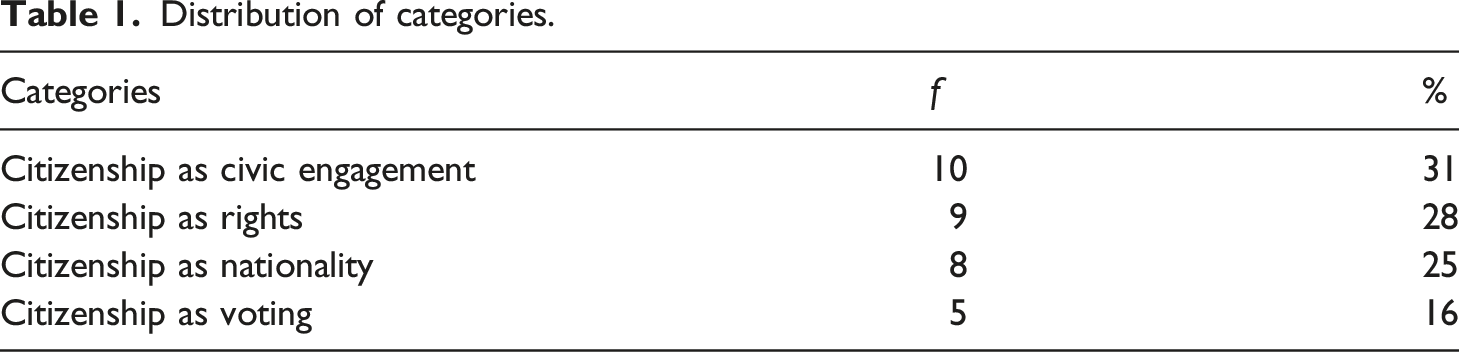
We analysed the interviews using the constant comparative method of grounded theory (Corbin & Strauss, 2008), which allows the systematization of recurrences, similarities and differences in each subject’s responses throughout the interview. According to this strategy of analysis, one of the ways to delimit the identified categories is by comparing the incidents of converging information with scientific concepts that resemble to the meanings converging in the category called theoretical comparison (Corbin & Strauss, 2008). From this analysis, we created the following categories: A) Citizenship as civic engagement, B) Citizenship as rights, C) Citizenship as nationality and D) Citizenship as voting. Below, we define each of these categories and illustrate them with interview excerpts that illustrate them.
A) Citizenship as civic engagement: We name this category based on Flanagan’s ideas (2020, Flanagan et al., 2015; Flanagan et al., 2019) as it encompasses the interviewees’ responses that show that they think of citizenship in terms of developing a sense of belonging to a community and their commitment to help improve society (community, neighbourhood, etc.) by carrying out some kind of social activity.
Valeria (17 2 ): [Request for narrative on experience linked to citizenship] 3 In the summer I went on mission to Barrio Nuevo 4 (...), it is like many poor cities in the country, there are so many of them and we are living in a bubble and we never think about what other people are doing or what it is like living in those cities (...) [What is citizenship for you?] It is belonging to a community and helping people, bringing them satisfaction, giving them joy. Being supportive is also very important.
B) Citizenship as rights: Corresponds to respondents’ answers expressing meanings in which citizenship consists of a set of rights that each subject enjoys equally and to which they have to have access. Such rights include the so-called first-generation rights (civil and political) as well as those that make up the second generation (economic, social and cultural) (Gamboa-Bernal, 2019; Navas-Camargo & Cubides Cárdenas, 2018). Specifically, it refers to the idea that a citizen has to enjoy these basic rights, which should be guaranteed.
Santiago (18): [Request for narrative on experience linked to citizenship] The right to study, that comes to mind. It’s like now most people have the opportunity to study, but others don’t have the opportunity (...) [What is citizenship for you?] I think it’s the right to study, as I told you, also to be treated in a hospital, to security, I don’t know, maybe to work, and housing as well (...) Also, citizens have the right to vote, to express themselves in that way.
C) Citizenship as nationality: In this category, we include subjects’ responses in which citizenship is understood as a community constructed from a set of shared traits and ways of doing things together. Therefore, we call this category nationality, inspired by the concept developed by Anderson (2021) who defines it as an imagined political community with certain customs, traditions, flags and anthems in common.
Tomás (17): [Request for narrative on experience linked to citizenship] What comes to mind with citizenship is sport, football. I went to a football World Cup in 2010 in South Africa (...) I remember Argentina-South Korea, the moment they played the anthem I got goosebumps, it was like a feeling that the best thing I could listen to at that moment was the anthem, you know what I mean? And it happens to me now when they show the World Cup on TV. And when I hear the anthem at a school event I remember that moment (...) It’s like I felt from the stands that I was representing my country as well. [What does citizenship mean to you? Yes, I feel it as being Argentinian. [Why?] Because I feel it more like, I would say, being part of the people, belonging in this case to the country. I think of it more in that way, it’s how it comes to me. It’s mainly because I grew up here. A place (...) And also attitudes, beliefs, thoughts, experiences, customs, traditions, a lot of things (...)
D) Citizenship as voting: In this category, we include the responses of interviewees who understand citizenship as a traditional form of political participation, specifically, voting (Disi Pavlic & Mardones Arévalo, 2019). It should be clarified that the interviewees do not mention that voting is a right, but rather that they think of it specifically as a mechanism for electing those who represent them, which they consider very important because it allows them to participate actively in the decision-making process.
Francisco (18): [Request for narrative on experience linked to citizenship] Citizenship is when I went to vote for the first time (...) I went on a certain day to vote for a representative and senator of the city (...) [What is citizenship for you?] For me, citizenship is the vote, I choose those who represent me, so that those representatives make the relevant decisions (...) Because voting is to participate in an active way. It means to be part of a process, of decision-making. It is important (...) I was born and currently live in a time when voting is very important. Voting is the main means of political representation (...) For me, citizenship automatically means voting. There is no other way.
Distribution of categories.
Discussion
The results of this study allowed us to identify four categories that make it possible to describe the way in which this group of adolescents from CABA think about citizenship. Citizenship understood as “civic engagement” refers to the feeling of belonging to a community and the commitment to contribute to its improvement. In this sense, we consider that this SR is in line with previous work that indicates that adolescents frequently engage in practices that have to do with a way of thinking about citizenship based on community membership, prerogatives by virtue of that membership and obligations resulting from belonging to that community (Flanagan, 2020; Flanagan et al., 2019).
In contrast, citizenship as “nationality” is thought of as a community that shares certain characteristics and ways of acting (traditions or customs). In this sense, it is important to note that while the categories citizenship as ‘civic engagement’ and citizenship as ‘nationality’ may be related in that they refer to the sense of belonging to a community, there is a key difference between them. What we call ‘civic engagement’ contains responses that express meanings about citizenship that relate it to the implementation of actions ‘for the other,’ while the category ‘nationality’ includes responses that refer to carrying out practices ‘with the other.’
In turn, citizenship represented as “rights” refers to the exercise of certain rights: political and civil (first generation), as well as economic, social and cultural (second generation). It should be noted that interviewees did not mention other types of rights such as third and fourth generation rights, which is striking given that these rights are the result of current phenomena with which adolescents coexist on a daily basis, such as new communication technologies. Another example is the right to recognition of gender identity, which, in recent years, has been demanded in the demonstrations made by Argentinean students. In this case, it could be thought that this generational model of rights extension that has been developed in contemporary debates has not yet been perceived in actual practice as “rights” by the interviewed subjects, so they didn’t mention it.
Finally, citizenship represented as “voting” is circumscribed to such traditional political practice. In this sense, for the particular case of Argentina, it could be thought that the possibility of voting acquires a particular meaning due to its essential place in democratic processes, after a political history characterized in the 20th century by bloody dictatorships, coups d’état and the proscription of the most popular political parties (Maina & Carrizo, 2021; Quiroga, 2018). This interpretation is consistent with the equating of voting with democracy identified in a previous study of Argentine adolescents (Bruno & Barreiro, 2019).
It should be noted that the responses that were categorized as “rights” and “voting” could be subsumed under a more general category referring to rights and duties, in line with the findings of studies carried out in European and Latin American countries (Bowman et al., 2022; Caballero Davila et al., 2020; Chávez Herting & Mieres Chacaltana, 2017; Gómez Cuevas & Pizarro Cerda, 2017; Lagos Velasco, 2018). However, we do not place them in the same category because the way citizenship is understood in terms of voting relates exclusively to a modality of political participation and not to a right.
Based on the above, we conclude that we could be dealing with a plurality of SRs of citizenship, that is, there would be different meanings of the same representational object. Therefore, taking into consideration that SRs are psychosocial constructions that cannot be thought of independently of a social group situated in a specific cultural and historical context (Castorina & Barreiro, 2006), we believe that further research is necessary in order to elucidate their constitution process from an ontogenetic and sociogenetic level of analysis of SRs (Duveen & Lloyd, 2003) which provides a better understanding of the historical-social processes that gave rise to them and the process by which adolescents reconstruct them when they appropriate them. As this study has tried to show, it is also necessary to take into consideration the importance of reconstructing the historical memory of the SR.
On the other hand, it should be noted that the data collection instrument used in this study was discursive, so it would be necessary to go beyond this level of analysis to observe the civic practices of adolescents, taking into account that SR are constructed, expressed and sustained in everyday social practices (Jodelet, 2011).
Finally, we consider that the results of this study would be a suitable heuristic guide for the orientation of new research devoted to the study of citizenship among adolescents or other generational groups, which take into consideration conceptualizations of citizenship which endorse that it is not only limited to the rights and duties of citizens, as shown in previous SR studies 5 (Bowman et al., 2022; Caballero Davila et al., 2020; Chávez Herting & Mieres Chacaltana, 2017; Gómez Cuevas & Pizarro Cerda, 2017; Lagos Velasco, 2018), but also to the practices that adolescents carry out in their daily lives to help improve the society in which they live, as identified in this study.
Footnotes
Acknowledgements
This work was possible thanks to the support of the following grants: UBACYT [20020170100222BA]: Constraints to concept construction processes in the social knowledge domain: Possibilities and limitations for the constructivist research program” Secretary of Science and Technology, University of Buenos Aires and PICT [2019-0047]: Construction of social justice: development of system justification, civic engagement and critical consciousness in adolescents and young adults. National Agency for the Promotion of Research, Technological Development and Innovation.
Declaration of Conflicting Interests
The author(s) declared no potential conflicts of interest with respect to the research, authorship, and/or publication of this article.
Funding
The author(s) disclosed receipt of the following financial support for the research, authorship, and/or publication of this article: This work was supported by the Agencia Nacional de Promoción de la Investigación, el Desarrollo Tecnológico y la Innovación (Grant number PICT [2019-0047]) and Universidad de Buenos Aires (Grant number UBACYT [20020170100222BA]).
