



Abstract
To understand new facets of situated freedom, this study explores the socio-cultural process of ‘freedom’ in everyday situations from the trajectory equifinality approach (TEA) perspective. The concept is important for TEA, which describes aspects of ‘free’ choice as constructed through communication between self and society. This study elaborates on and enriches the argument of the situated freedom by considering the authors’ shared experience (bifurcation point; BFP) using the three layers model of genesis (TLMG). Consequently, we depict that freedom is not only located within a situation but also in semiotic communication. Situated freedom for the authors in BFP involves semiotic communication, including imagining the hyper-generalised affective semiotic field for others, represented by the flow of feelings ‘comfort for all’. Amanogawa (the Milky Way), an organic metaphor for the TLMG mountain range, extends this idea. This study demonstrates how freedom-related feelings experienced by the authors emerge in the communication of their socio-cultural context. The Amanogawa metaphor in the TLMG, which bridges the self and society, provides a richer illustration of the semiotic communication between systems in the BFP.
Keywords
Introduction
The study was conducted on career development and second language education using the trajectory equifinality approach (TEA; Sato, 2017), which is grounded in cultural psychology. TEA provides an understanding of life trajectory within the irreversible time. To comprehend new facets of ‘situated freedom’, this study explores the socio-cultural process of ‘freedom’ in the everyday situation from the perspective of the TEA.
The concept of ‘situated freedom’ (Ernö & Birk, 2024) is important for the TEA which describes aspects of ‘free’ choice as constructed through communication between self and society. Regarding the TEA, the event wherein an individual makes a particular decision within socio-cultural communication is identified as a bifurcation point (BFP) 1 . This means that the choice is not entirely free but rather semiotically constrained and guided. The BFP is considered the moment of sign generation, and the three layers model of genesis (TLMG) is a possible model for understanding such moments. However, empirical studies on freedom of choice in BFP are limited, and TLMG has not received sufficient attention regarding its theoretical development. Therefore, this study elaborates on and enriches the argument introduced by Ernö and Birk (2024) by considering the authors’ shared experiences (BFP). We depict that freedom is not only located within a situation but also in semiotic communication.
This effort has the potential to develop the concept of the TLMG from an intrasystem to an intersystem model. This study possibly makes a step towards shifting the focus from metaphysical free will to the interaction between the self and society.
Three layers model of genesis: The self as a dynamic and multi-dimensional process
This study used TLMG, one of the triad components of the TEA (Figure 1), to examine the notion of ‘freedom’. The TLMG is a model of the self that views the emergent process of the system as the self. This model presents a distinction between three layers of ‘genesis’, namely ‘value-sign-action’. Here, the action layer is related to what Heinz Werner called microgenesis (actualgenese), and the value layer is related to ontogenesis. The sign layer in the middle corresponds to mesogenesis, during which regulation between the upper and lower layers occurs. However, this distinction is not fixed. A dynamic boundary is assumed between each layer, similar to that of a membrane. This model largely corresponds to the liminal model of message Triad component of TEA.
The TLMG should be elaborated further because much empirical research is still limited to the classification of events. We argue that the emergent nature of TLMG should be emphasised. The TLMG’s novelty lies in its view of culture as a process of relating (Valsiner, 2014) regarding constructive internalisation and externalisation, which considers the self to be a dynamic Gestalt. This goes beyond the classical epistemology of the self as a single, given entity and holds the potential for a new understanding of the self as a multidimensional genetic process. Particularly, not only values but also signs and actions can be seen as the self.
Although the TLMG is commonly used as an intra-self (intra-system) model, developing this model as an inter-system model is essential for understanding the communication process. If the self is considered an open system, we should contemplate its relationship with its environment (i.e. between the self and society), which co-generates the systems’ novelty. The first development of such inter-system TLMG is the concept of the ‘mountain range self’ (Kosokabe, 2016; translated by the author from the Japanese word ‘山脈的自己’). The mountain range self is a fusion concept between the TLMG and dialogical self-theory (Hermans & Kempen, 1993). The TLMG is a model wherein the self is represented by a mountain metaphor, and the ‘mountain range self’ implies that multiple selves are in a dialogical relationship. Kosokabe (2016) examined the developmental process of childcare workers’ views on childcare and organisational identity through dialogical relationships in self-society relations, including senior staff, family members, childcare practice communities, and residents.
Communicating freedom between systems in bifurcation point
We conducted collaborative research and had weekly meetings. The following conversation reflects the situation at that time: This conversation helps understand the contexts of specific situations. By examining this conversation using the TLMG, we consider a ‘free’ choice in the BFP. This conversation was conducted five times during the authors’ meetings (approximately 1 hour each) and developed through the following steps: Step 1: Conduct three meetings in preparation for the conversation (first to third meeting). Step 2: Discuss which aspects of the shared experience (BFP) should be highlighted. The conversations were recorded (fourth meeting). Step 3: Prepare a transcript based on the recording. Step 4: Review and reconstruct the transcript. Finalise the conversation (fifth meeting).
For ethical reasons, the personal information of individuals has changed. The conversations were as follows:
An understanding of the above situation of the BFP is deliberated throughout the modelling process of the TLMG diagram (Figure 2). We discuss how the process of seeking ‘freedom’ emerged during our three additional meetings. In Step 2, an important concept of ‘freedom’ was verbalised as the emotional flow of ‘comfort for all’, which ultimately guided our actions and signs in the situation. This concept is highly generalised and is an (imagined) common feeling for most people; therefore, it is positioned above the TLMG mountain range (hyper-generalised affective semiotic field) (Valsiner, 2014; Valsiner et al., 2023). Although the concept of the hyper-generalised affective semiotic field ultimately assumes a field for one person, we could regulate our signs to increase the similarity between this field for others and for ourselves by ‘feeling into’ (Einfühlung) (Valsiner, 2014) this field for others. This seems to be the process of communicating about freedom, as described by the term ki wo tsukau. TLMG diagram representing communicating freedom in the BFP.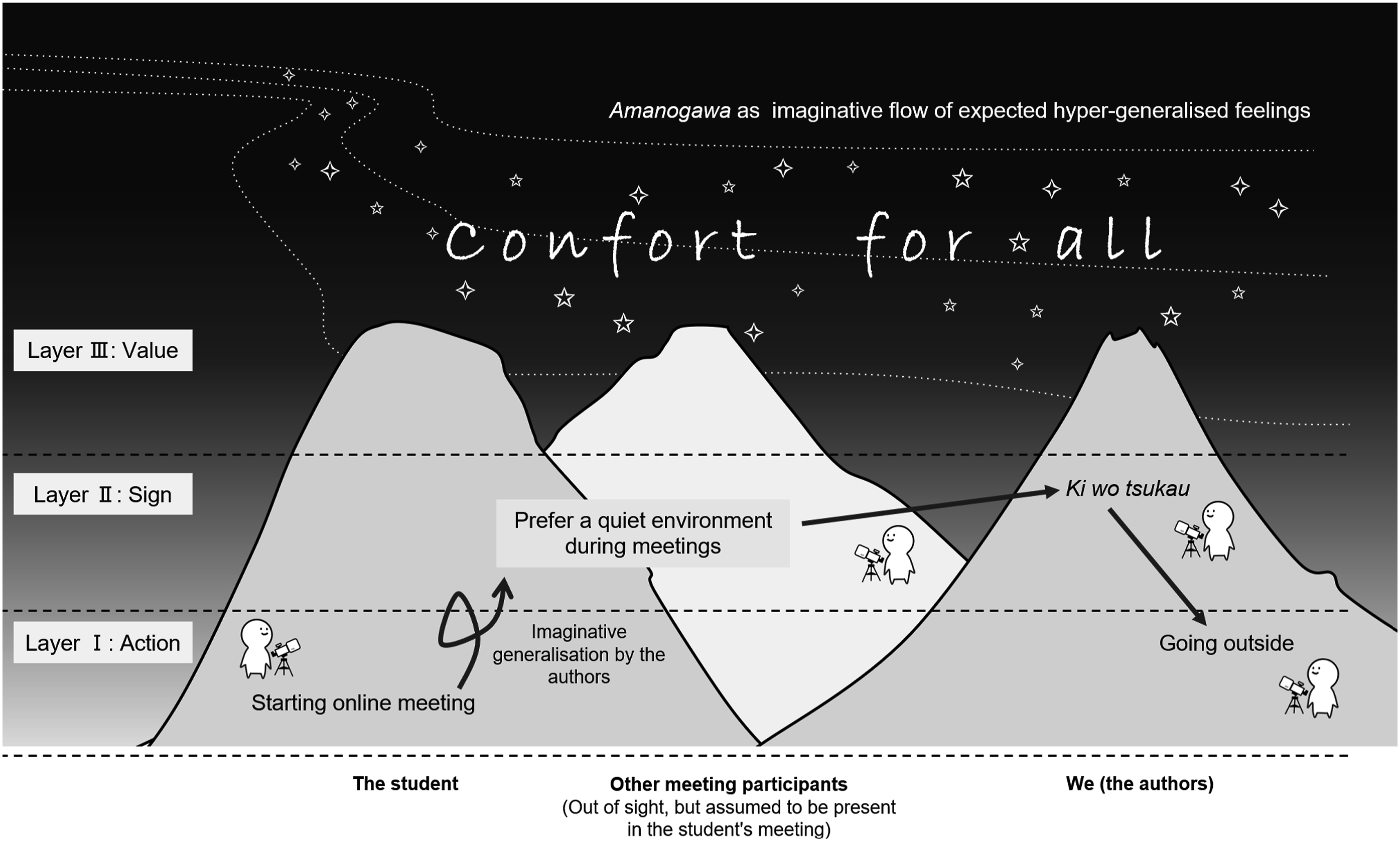
Furthermore, from the perspective of the ‘organic metaphor’ (Campill, 2023), such a flow of feelings, which is on a high level and can be seen similarly with others, can be represented as the Amanogawa (the Milky Way). In astronomical terms, the Milky Way has a band-like appearance of stars in the galaxy to which Earth (in the Solar System) also belongs.
In the BFP situation, social norms such as hyper-generalised imaginative flow and the various feelings associated with ‘comfort’ were important. They formed abstract flows and guided the authors’ actions and signs. In Japanese, the Amanogawa means a river flowing through the sky or heaven. The river is the main arena in the Tanabata legend, originating in China, and widely known in Japan. Every year, the night of 7th July (Tanabata) is the only one when the two lover gods, Orihime (Ms) and Hikoboshi (Mr), separated by the Amanogawa, can be reunited. Fortunately, Amanogawa generally does not have the meaning of an object that separates people. Rather, it is an appropriate metaphor for a hyper-generalised affective semiotic field because it carries the meaning of bridging the separated other, evoking romantic feelings and aesthetics.
Conclusion
‘Situated freedom’ for the authors in the BFP involves semiotic communication, including imagining the hyper-generalised affective semiotic field for others, represented by the flow of feelings of ‘comfort for all’. Here, ‘all’ does not just mean the people in the common space, but includes society. At the microgenesis level, spatial limitations were present, as finding a new meeting place after deciding to leave the common space was difficult. This study demonstrates how freedom-related feelings experienced by the authors emerge in the communication of their socio-cultural context. The Amanogawa metaphor in the TLMG, which bridges the self with society, provides a richer illustration of the semiotic communication between systems in the BFP.
Footnotes

Declaration of conflicting interests
The author(s) declared no potential conflicts of interest with respect to the research, authorship, and/or publication of this article.
Funding
The author(s) disclosed receipt of the following financial support for the research, authorship, and/or publication of this article: Financial support for English editing was received from Ritsumeikan University.