




Abstract
We study the degree of formal influence that rank-and-file members have on the selection of party leaders in the five English-speaking Westminster countries: Australia, Canada, Ireland, New Zealand and the United Kingdom. We find that in recent years there has been a general, though not universal, trend towards granting party members greater influence in the choice of their leader. We observe that the decision to broaden the selectorate has been made by most parties in the UK, Canada and Ireland, while parties in Australia and New Zealand have generally resisted reform. We set out a series of four hypotheses explaining the decisions made by parties in the first three countries. We show that this organizational reform is adopted by parties in opposition, in the aftermath of an electoral setback and by new parties. We also find a strong contagion effect within party systems. Finally, we offer an explanation for why the Australian and New Zealand cases have resulted in less change.
Introduction
In this article, we examine who selects the leader in contemporary political parties. Finding that many parties are engaging in organizational innovation by expanding the leadership selectorate beyond the parliamentary caucus, the analysis identifies the factors that result in this change. The article addresses the literature on both intra-party democracy and party organizational change and innovation.
Adopting the phrase ‘presidentialization’ of party politics, Poguntke and Webb (2005) argue that party leaders are becoming increasingly important. They suggest that leaders are accumulating power and influence in all three phases of party activity: legislative, electoral and organizational. Whether or not one accepts this argument, there is no denying that party leaders occupy a central place in Western democracies (Leduc, 2001; Marsh, 1993a; McAllister, 1996).
This study is about who selects party leaders. We are particularly interested in ascertaining the degree of influence given to rank-and-file party members in the choice of ‘their’ leader. The starting point for most of the parties included in this study is that party members have nothing to say in the selection of the leader. The question then becomes: Under what circumstances is the party elite willing to grant some influence to the rank and file?
Questions relating to the internal distribution of power date back to the earliest literature on political parties (Michels, 1962). Every model of party organization, be it the cadre, mass, catch-all, electoral professional, cartel or franchise model, highlights the relative strength of different groups of party actors (Carty, 2004; Katz and Mair, 1995; Kirchheimer, 1966; Panebianco, 1988). Most of this literature highlights candidate selection (Katz, 2001; Rahat and Hazan, 2001) and pays less attention to leadership selection. This likely results from there being less change in the distribution of power in this area of party decision-making until relatively recently.
We find that in recent years the three faces of party organization identified by Katz and Mair (1993) – on the ground, in central office and in elected office – have in many Western democracies been involved in a struggle for authority in leadership selection. And, while not nearly universal, there is clear evidence of an ongoing shift in authority away from the parliamentary party towards grassroots members (Cross, 1996; Kenig, 2009a; Leduc, 2001; Wauters, 2010). This is consistent with suggestions that declining rates of party membership (Mair and van Biezen, 2001) and public confidence (Dalton and Wattenberg, 2001) lead parties to provide more internal decision-making authority to their grassroots as an incentive to membership and to present a public image of being open and ‘democratic’ (Ignazzi et al., 2005; Mair, 1994; Seyd, 1999; Scarrow, 1999; Scarrow et al., 2001).
However, as Scarrow et al. (2001) suggest, in the absence of other considerations the party elite would generally prefer to preserve as much power as possible for themselves, so their initial reaction is to resist movements to give members more influence. Consistent with this are the conclusions of Harmel and Janda (1994) that change within parties does not ‘just happen’ and that parties are essentially conservative organizations that are inclined to resist innovation (Panebianco, 1988).
We start with the following two assumptions. We suppose that the party elite generally prefer to keep as much power as possible for themselves, so they resist movements to give members more influence (Michels, 1962; Scarrow et al., 2001). We also suppose that for the same reason most of the party members would like to have a say in important party decisions such as leadership selection (Cross, 2004; Scarrow, 1999; Seyd, 1999). The question then is: Under what conditions is the membership able to extract concessions granting them this authority?
We focus our study on the five principal English-speaking Westminster countries: Australia, Canada, Ireland, New Zealand and the United Kingdom, and we cover the period from 1965 onwards. Our purpose is to identify the factors that foster or hinder the adoption of a broader leadership selectorate.
Theoretically, on a continuum considering the inclusiveness of the leadership selectorate, one endpoint is one or a small group of party elites anointing the leader, while the other is all supporters of the party in the general electorate making the choice (Kenig, 2009a; Leduc, 2001). The first method was in place in many of our cases in earlier times, but is not found in any of them since 1965, the point at which all parties in our sample that were then in existence had established rules governing leadership selection. Prior to this period, many parties did not have formal rules and the processes were often shrouded in secrecy and mystery (thus, UK Conservative leadership selection was said to be done by ‘magic circle’; Denham and O’Hara, 2007). The most expansive method, something akin to a US style primary, is not in use in any of the Westminster parties. We find that the answer to the question who selects the leader primarily involves consideration of the relative influence exercised by the parliamentary and extra parliamentary parties. As the movement has been in the direction of empowering the grassroots, we structure our analysis around the relative degree of influence that regular members exercise in the leadership choice. We classify party processes into one of three categories: party members have full authority, they have some but limited authority and they play no formal role in the selection of the leader. The ‘some’ category masks significant differences in selection methods; for example, the degree of influence granted to parliamentarians varies dramatically, as does whether grassroots members participate directly or through conference delegates, and in a few parties supporters such as trade unions participate. These differences reflect the democratic values of each party and whether it favours a representative or plebiscitary style of party decision-making (Seyd, 1999; Young and Cross, 2002). While these are important distinctions, for the purpose of better understanding motivation for reform we simplify the classification into three categories that generally reflect the role of party members.
We agree with Harmel (2002), Wilson (1980) and Panebianco (1988) that party organizational reform is best explained by considering both changes in a party’s environment and internal circumstances. Panebianco (1988: 242) suggests that ‘organizational change is, in most cases, the effect of an external stimulus … which joins forces with internal factors which were themselves undermining the power structure’, and Harmel (2002: 128) concludes that: ‘Both the environment and internal party politics produce important stimuli which result in discrete organizational change only when relevant party actors allow them to do so’. We contend that it is the interaction between the external and internal environments that facilitates (or hinders) organizational reform.
In identifying change in the external environment that sparks organizational reform, most look to a party’s competitive position. As Frantzich (1989: 91) suggests, ‘as a basic rule, winners seldom innovate’; thus, it is a negative change in competitive position that stimulates change. Panebianco (1988: 243) suggests that ‘electoral defeat and deterioration are pressures leading to organizational change’, while Deschouwer (1992: 9) argues that electoral defeat is ‘the mother of change’. Our first hypothesis is that parties will only expand their leadership selectorate after an electoral setback. We agree with Deschouwer (1992) and Harmel and Janda (1994) that electoral success and failure are relative phenomena best determined by the expectations of the party itself.
The second hypothesis is that parties are more prone to broaden their selectorate when in opposition. Courtney (1995: 262) suggests that the opposition status of the Canadian parties at the time of adopting change in the leadership selectorate helps to explain their openness to reform as ‘in opposition, a party’s lines of authority are weakened and its degree of freedom to experiment with new forms of intra-party arrangements are increased’. We find that parties are more amenable to change while in opposition because of two factors: a reluctance to expand the selectorate when choosing a prime minister and a shift in the balance of power away from the parliamentary to the extra parliamentary party with removal from government.
The adoption of a selectorate beyond the parliamentary caucus is also more easily managed by new parties. These parties typically have small parliamentary caucuses, and so the extra parliamentary party has more influence and faces less opposition from an entrenched parliamentary group protecting what it sees as its natural turf. New parties are trying to differentiate themselves from their established competitors and adopting organizational innovation is one way to do so (Gauja, 2009). Thus, our third hypothesis stipulates that new parties will more easily adopt rules that allow a greater role for rank-and-file members.
Another relevant factor is contagion. There are two dimensions of this. First, parties live in a competitive environment and internal party democracy is generally viewed positively by voters and activists as a sign that a party is inclusive and responsive (Seyd, 1999). Parties may engage in these types of organizational change in order to trumpet them as evidence that they are becoming more ‘democratic’ as they are ‘demonstrating a commitment to openness and participation’ and ‘at least within their own organizations they are seen to be addressing the issue of the democratic deficit’ (Seyd, 1999: 385). Secondly, as Harmel and Janda (1994: 264) suggest, when one party innovates in a way consistent with public expectations, pressure will rise on the others to mimic them. Success of reformers in one party encourages their counterparts in others and provides them with additional ammunition. Our fourth hypothesis is that parties will be more inclined to move to an expanded selectorate when one of their competitors has already moved in that direction.
The data
As already mentioned, this study covers the five principal English-speaking Westminster countries. We choose these countries for a number of reasons, including the centrality of leaders, the common structure of party authority and organization, and their similarities in terms of political culture and development.
The term ‘party leader’ has essentially the same meaning in all of these countries. As Bille (1997: 382) suggests, in many systems it is difficult to identify a single party leader: ‘Is it the chairman of the extra parliamentary organization, the chairman of the party in parliament, the political spokesperson of the party, the prime minister when the party is in office …?’ In the Westminster cases, party leaders are easily identified, as there is unity in the leadership of the party both within and outside of parliament, and the same individual leads the party during and between election campaigns. As Heidar and Koole (2000: 258) suggest, there is almost ‘complete fusion’ between the leadership of the parliamentary and extra parliamentary parties. Weller (1985), King (1994), Norton (2000) and O’Malley (2007) all find that leaders in governing parties in these systems are particularly dominant. This is important to our analysis because it raises the saliency of who participates in the selection of leaders and thus increases the likelihood that different groups within the party will desire to participate in the selection process. The fact that the same individual exercises significant control over all aspects suggests that our cases should provide a good test of the factors influencing who has the upper hand in the struggle between the parliamentary and extra parliamentary parties.
These five countries also have relatively similar political cultures and traditions of democratic development. Universal suffrage has long been a widespread public norm and there is increased support for more direct, participatory, democratic procedures (Abramson and Inglehart, 1995; Butler and Raney, 1994; Dalton, 2004; Nevitte, 1996). We are comparing countries with similar views about the appropriate roles of the rank and file in democratic decision-making (as opposed to less developed democracies or those with consociational arrangements). While the party elite would like to keep things as they are, they are on the defensive because the public mood is generally favourable to the democratization of public decision-making.
We include in our study any party that finished in the top five (in terms of legislative seats won) or received at least 5 percent of seats in either of the two most recent elections (as of January 2008) to the lower house of parliament. We limit our analysis to these parties as we are interested in understanding the dynamics of leadership selection in parties with an ongoing parliamentary presence where we can expect to find tension between the parliamentary and membership organizations.
There are two exceptions to this selection rule. First, regionally based parties that contest some constituencies in national elections but whose leaders sit in regional legislatures (such as the Scottish National Party) are excluded. Second, we include the Australian Democrats. Although this party has not elected members to the lower house, it was successful in consistently electing members to the Senate for a period of several decades and thus they meet our criteria of having a parliamentary presence. The Democrats are also important to consider as they are the only Australian party to have expanded the leadership selectorate beyond the parliamentary caucus.
In some cases, parties have merged and splintered and we are required to make judgment calls regarding whether to include an earlier party operating under a different name as essentially the same party. In total, we have 23 parties meeting our criteria. An additional three parties are included as predecessor parties of currently existing ones. This means that we consider the cases of 26 parties in all.
In recent years there has been an increase in the academic literature on party leadership selection, particularly in the United Kingdom and Canada, much of it driven by interest in the expansion of the selectorate. Almost all of this has been restricted to studies of individual parties or individual countries (see, for example, Quinn (2004), Norton (1998), Alderman (1999), Alderman and Carter (1993), Denham and Dorey (2006), Denham and O’Hara (2007) on the United Kingdom; Courtney (1995), Cross (1996), Carty and Blake (1999), Stewart and Carty (2002) on Canada; Fitzgerald et al. (2004) on Ireland and Wauters (2010) on Belgium). An important exception is the recent comparative work of Kenig (2009a, 2009b). The comparative approach taken in this article allows us to look for common explanations for change cross-nationally; and, the inclusion of parties that have not reformed their leadership selectorate permits consideration of the factors supporting resistance to change.
Both secondary and primary data sources are used. We have systematically reviewed contemporary and historic party statutes, newspaper accounts of leadership contests and party rules changes, analyses (both academic and journalistic) of specific parties and leaders’ biographies. We also conducted a series of semi-structured elite interviews with approximately 40 party officials, academic experts and political journalists.1 Current and former party leaders, members of parliament, party secretaries and senior party staff were among those interviewed. Data from the interviews are used primarily in the discussion regarding motivations for, and resistance to, change, particularly in Australia, New Zealand and Ireland, where the literature on this subject is less extensive. In order to preserve confidentiality individual interviewees are not identified.
The article proceeds in the following fashion. We first examine who has the leadership selection authority in each of our parties and highlight changes in this regard. In doing so, we document a general trend in the expansion of the selectorate. We then test our hypotheses relating to factors that influence whether a party does or does not engage in this form of organizational change. We briefly examine the context under which each decision to give party members a greater say was made and find that our theory does predict behaviour of parties in the United Kingdom, Ireland and Canada. The last section considers the cases of Australia and New Zealand, where most parties have not expanded the role of the rank and file.
How much influence do party members have in selecting the leader?
Table 1 identifies the points in time at which changes in the selectorate have taken place for all 26 parties.
Role of grassroots members in party leadership selection
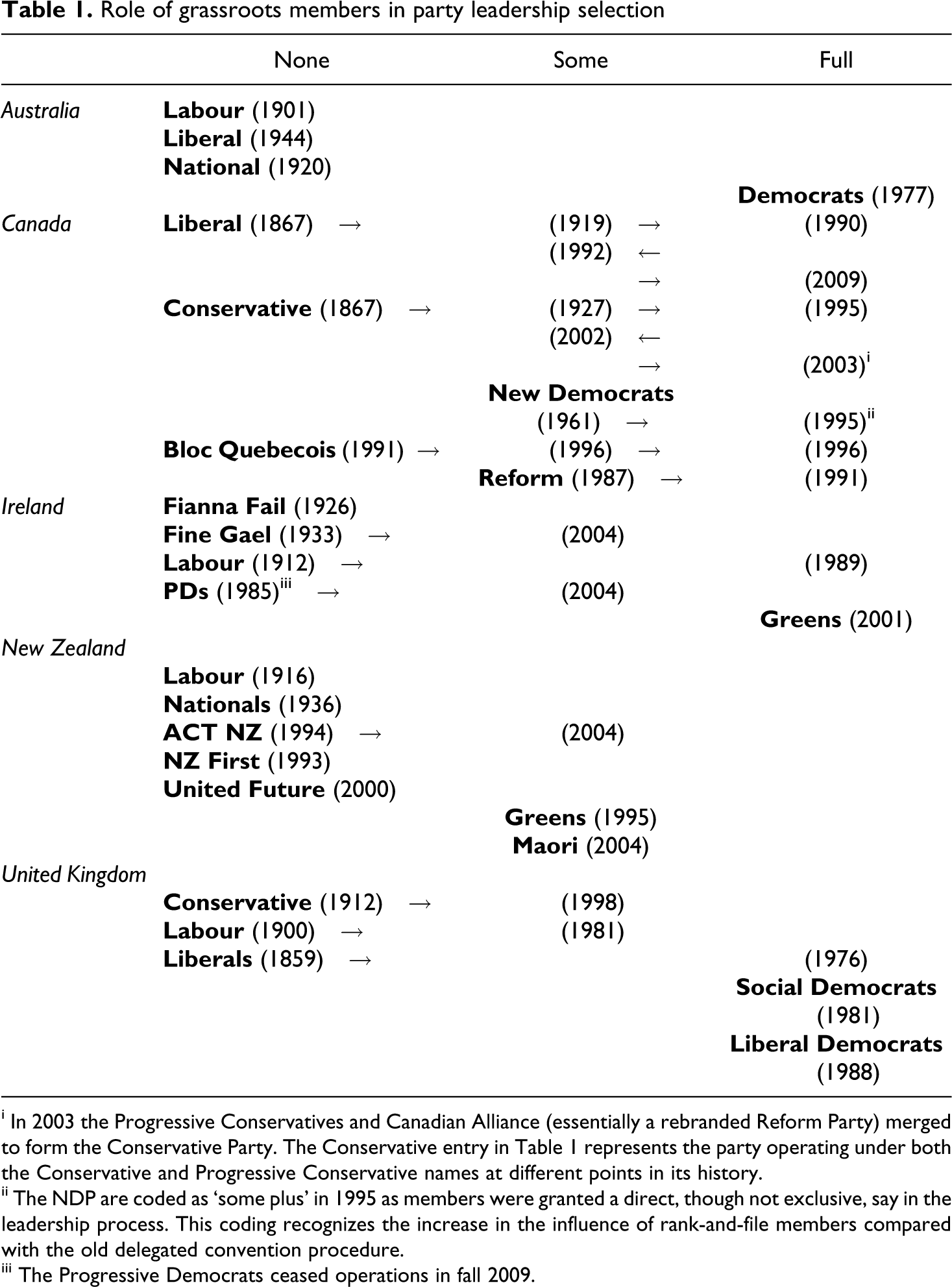
i In 2003 the Progressive Conservatives and Canadian Alliance (essentially a rebranded Reform Party) merged to form the Conservative Party. The Conservative entry in Table 1 represents the party operating under both the Conservative and Progressive Conservative names at different points in its history.
ii The NDP are coded as ‘some plus’ in 1995 as members were granted a direct, though not exclusive, say in the leadership process. This coding recognizes the increase in the influence of rank-and-file members compared with the old delegated convention procedure.
iii The Progressive Democrats ceased operations in fall 2009.
Prior to the UK Liberals expanding their leadership selectorate in 1976, only the Canadian parties granted any formal role in the leadership choice to their extra parliamentary party. This has changed dramatically in the years since. Of the 26 parties in Table 1, eight continue to restrict the leadership franchise to their parliamentarians, while seven share the authority between the parliamentary and membership parties; eleven have granted full authority to their members. This shift results from the adoption of the innovation by new parties and from older parties changing their selection methods. No party in our study currently provides less say to their members than they have at any point in their existence. While the change is not universal it is all in one direction.
Table 1 indicates that the aggregate picture does not reflect the stories of individual party systems, which clearly fall into two groups: significant change occurring in the UK, Ireland and Canada and little change in Australia and New Zealand. We focus initially on the first three countries in examining the reasons why parties have adopted reform. We then examine why parties have been less inclined to broaden their selectorate in Australia and New Zealand.
Expanding the selectorate: UK, Ireland and Canada
Table 2 gives each party’s context preceding the decision to expand their leadership selectorate in these three countries.
Status of parties at time of increasing the relative influence of party members in leadership selection: UK, Ireland and Canada (1965 to 2009)

* Parties that contested at least two elections prior to changing their leadership rules are considered ‘old’.
** As the Irish Greens were selecting their first leader, we code them as ‘new’ even though they had contested earlier elections.
We find strong support for the hypothesis that parties are more likely to expand the selectorate when they are in opposition than when they form the government. In fact, this is the case for 15 of the 16 cases in Table 2. Parties in government desire to remain there and thus assume that the selection of their next leader will also be the selection of a prime minister. Some party officials in Fine Gael, the Canadian Conservatives and the UK Tories suggest that their parties would not have made the change if in government, and some express doubt as to whether their party will use the current expansive selectorate rules in the future should they find themselves selecting a prime minister (interviews with party officials). The UK Labour case may be instructive in this regard. While the party formally used its electoral college process for the selection of Gordon Brown as leader and prime minister in 2007, the parliamentary caucus essentially made the choice itself. There were several potential challengers to Brown and in early leadership hustings he was joined by fellow MPs McDonnell and Meacher. Ultimately, neither was able to garner sufficient support from MPs to stand.
The hypothesis that change is particularly likely to take place after an electoral setback is also confirmed. Among the nine cases in which a party ran candidates in at least two elections prior to adopting reform, in seven the party’s share of seats declined in the most recent election. Furthermore, the ‘exceptions’ may be deceiving. In the case of the Canadian Liberals in 1990, despite the gain in seats, the electoral outcome was a disappointment as the party was hopeful of winning the 1988 election at mid-campaign and the result was well below their historic norm. We would thus argue that eight of the nine cases offer support for the argument that organizational change follows disappointing election results.
Our evidence suggests that an electoral setback highlights the need within a party for organizational rebuilding. Particularly after a defeat resulting in the loss of government, the leadership often acquiesces to arguments that the membership party was allowed to wither and needs to be revitalized in order to again succeed electorally (interviews with party officials and Cross, 1996). Party officials suggest that expanding the leadership selectorate is a way of being responsive to activists and providing them with a greater role in party decision-making. These factors were particularly important for the Canadian and UK Conservatives and Ireland’s Fine Gael (interviews with party officials). While virtually every party that has expanded the leadership selectorate advertises it as a way of involving their members more fully in party decision-making, they differ significantly in terms of whether they use these contests to attract new members (as do the Canadian parties) or if they establish significant length of membership requirements, sometimes as long as a year, as in the UK and Irish cases, as a way of preventing new recruits from participating, while instead aiming to increase the authority of their long-time activists (Cross and Crysler, 2009).
There is also support for the hypothesis that new parties are more likely to adopt a wider selectorate. Four of the new parties granted full authority to their members from the start, and two others (Reform and the Bloc in Canada) did so shortly after their creation. The only new party that resisted for some time was the Progressive Democrats in Ireland.
The evidence is also consistent with the view that there is a contagion effect. For example, young members of Fine Gael advocating for change pointed to the expanded leadership selectorate in other Irish parties and parties abroad (interviews with party officials). Similarly, activists in the UK Conservative Party used Labour’s earlier extension of the franchise to bolster their case, and activists in the Canadian parties drew support from earlier adoption of member votes at both the provincial and federal levels (interviews with party officials). We show below that once one competitive party in a system expands its leadership selectorate it becomes more difficult for the other parties to resist change.
While our data generally support these hypotheses, they appear to be necessary but not sufficient conditions. For example, we can say confidently that parties will only make the change when in opposition and after an electoral setback. However, many of these parties had earlier electoral setbacks when they did not adopt this change (though they may well have adopted other forms of organizational change). What appears to be essential is to understand which organizational changes are at play and thus on a potential reform agenda. Particularly relevant here is the contagion factor. The adoption of a wider leadership selectorate by one party within a system is evidence that this is on the menu of potential reforms.
Missing from this explanation is a belief that the grassroots will pick ‘better’ leaders. Our evidence suggests that this is not an explicit argument typically made by reformers. In this way, explicit criticism of prior leaders is avoided. There also is no general consensus of what a ‘better’ leader is – someone who achieves better electoral results, listens more to the grassroots or is ideologically more closely aligned with activists. Party officials argue that dissatisfaction with recent leadership choices is sometimes a factor in activists demanding a say in the selection process, but that, at least overtly, the argument is cast in terms of wanting to democratize the party (interviews with party officials). While advocates for reform do not use this argument when pushing for change, outright rejection of the claim is one of the key reasons why the parliamentary party often resists a broadening of the leadership selectorate. They argue that they are better situated than the party’s rank and file to judge the relative competencies of the leadership aspirants and that self-interest alone will lead them to choose the candidate with the greatest electoral potential (interviews with party officials).
In the following section, we briefly examine cases of change and non-change in the United Kingdom, Ireland and Canada beginning with the first party to adopt reform in each country. Space permits only a brief overview of the context surrounding reform. The evidence suggests that while we cannot always explain the first innovation we can generally predict the behaviour of the remaining parties. After the first party adopts change, others initially resist, notwithstanding occasional pressure to reform, until they are in opposition and suffer an electoral setback. The first time they meet all three conditions – the availability of a contagion, being in opposition, suffering an electoral defeat – they adopt reform. New parties adopt the reform early on, with the exception of those created around a powerful parliamentary figure. This pattern is observed in all three countries. In this sense our conditions appear to be both necessary and sufficient.
United Kingdom
The Liberal Party was first to formally include members in the leadership choice. A special party assembly held in 1976 adopted provisions for leaders to be chosen through a vote of the entire party membership. The party’s most recent leadership selection process, in 1967, was criticized on the grounds that it was conducted too quickly to allow for any input from the constituencies, and that the small parliamentary caucus (12 MPs) was dominated by members from rural constituencies and the Celtic fringe and thus was not representative of the party’s several million voters, many of whom lived in urban centres in the south (Denham and Dorey, 2006: 29; Punnett, 1992: 136; Stark, 1996: 72). These criticisms, together with growing support among the membership for greater democratization of party decision-making and often portrayed as a way of revitalizing a party long in decay, led to efforts to expand the leadership selectorate. That the parliamentary party was initially resistant to the change was evidenced by their issuance of a memorandum in 1975 reiterating their right to select the leader (Stark, 1996: 73).
Labour first adopted rules including grassroots members in its leadership selection process in 1981. Supporters began organizing for change during Wilson’s second government (Russell, 2005: 36–7; Stark, 1996: 41), and despite the introduction of several conference resolutions nothing came of these efforts until the party was defeated in the 1979 election. Russell (2005) describes these efforts as part of a broader participatory movement underway in the party, and Stark (1996: 45) suggests that it was the extraordinary determination and mobilization skills of the reformers and the stinging electoral defeat that ultimately led to change. At the party’s 1980 conference a resolution to expand the leadership franchise was narrowly passed along with a motion to hold a special party conference in January 1981 dedicated to the selection of a new process. Delegates to this conference voted overwhelmingly in favour of the ‘electoral college’ proposal that divided leadership votes among the parliamentary party, the constituency membership and trade unions (Drucker, 1987: 286; Punnett, 1992: 106–8; Russell, 2005: 37–8; Stark, 1996: 56).
Both the Social Democrats and the Liberal Democrats adopted membership votes for their leadership at the time of their formation. Labour’s adoption of the electoral college was a motivating factor for some MPs to bolt from the party and form the Social Democrats (Russell, 2005: 38). They objected to what they saw as a handing over of authority to radical elements of the party and many of them supported a full membership vote as a preferred alternative to the electoral college. The parliamentary party made an early effort to select the leader themselves, but this was rejected by party members who, while opposed to the electoral college formulation, were influenced by Labour’s decision to expand the selectorate beyond the parliamentary party (Punnett, 1992: 140; Stark, 1996: 75–9). Since both the Liberals and Social Democrats were choosing their leaders through membership ballots, this method was adopted with little debate when the two parties merged in 1988.
The Conservatives were the last of the major UK parties to expand their leadership selectorate. After winning four consecutive general elections they adopted this reform shortly after returning to the opposition benches in 1997. The party adopted rules under which the parliamentary party selects the two finalists from whom the membership selects the leader (Quinn, 2005: 804). Discussion in the party concerning the involvement of the membership in the leadership choice had taken place occasionally ever since the selection rules were formalized in 1965 (interview with party official and Alderman, 1999: 264). These resulted in varying requirements for consultation between the constituencies and MPs; however, suggestions to actually grant a share of the vote to the extra parliamentary party had never received serious consideration (Alderman, 1999: 264–5). When the Conservatives were defeated in 1997 and their leader resigned, there were ‘widespread demands for an immediate change to give the extra-parliamentary party a share of the votes in deciding the succession’ (Alderman, 1999: 265). These were ignored by the parliamentary party (Alderman, 1998: 3–4), which not only selected the next leader itself, but in choosing William Hague ignored the clear preference of the party membership for Kenneth Clarke (interview with party official and Alderman, 1999: 265). The need to rebuild the extra parliamentary party after a long run in government and the 1997 electoral defeat, a demand for greater party democracy among activists and the view that leadership selection should not be decided by a minority parliamentary party with no representation from Scotland and Wales came together to make the demands for change unstoppable (interview with party official; see also Heppell, 2008: 132; Alderman, 1999: 260; Norton, 1998: 10; McSweeney, 1999: 471).
Ireland
Labour was the first Irish party to expand the leadership selectorate beyond the parliamentary party. The issue of expanding the selectorate was first debated at the party’s 1987 conference in the wake of the party suffering the loss of nearly 50 percent of its voters and one-quarter of its parliamentary seats in that year’s general election (Lyons, 2003). The party also found itself back on the opposition benches after a term in government. The reform proposal was seen as a sharp attack on the current leadership and the direction of the parliamentary party in the previous Dail. Evidencing the divide within the party, supporters of the leader managed to have the matter referred to a committee only by agreeing that it would prepare a precise proposal for a new method of leadership selection by the extra parliamentary party (Marsh, 1993b: 309). This proposal, recommending that the leader be chosen through a ballot of the entire membership, was adopted at the 1989 conference. Marsh (1993b: 309) suggests that support for change resulted from dissatisfaction with the current leadership, dissension over having joined a coalition government, anger over the independence of the parliamentary party from constituency supporters and a more general demand for an increase in intra-party democracy.
At the time of their founding in 1981, the Greens rejected the notion of having a leader. This resulted primarily from a desire to focus on policy and not personality (interview with party official), but changed in 2001 when the party amended its constitution to provide for the selection of a leader. For our purposes, because this was the selection of their first leader, we can consider the Greens as a new party with a largely extra parliamentary base – having never elected more than two TDs. Consistent with our expectations for new parties, the Greens, with little internal debate, opted to vest the authority for leadership selection with their rank-and-file membership (interview with party official).
Fine Gael expanded formal influence beyond the parliamentary party in 2004. This followed one of the party’s worst ever electoral results in the 2002 general election, in which it saw its number of TDs drop from 54 to 31 and its share of first preference votes decline from 33 to 19 percent (Gallagher and Marsh, 2002). The reform process had its origins at the party’s 1993 conference, at which a party commission recommended expansion of the leadership selectorate (Rafter, 2003: 110). The parliamentary leadership had no interest in this proposal and the issue largely lay dormant as the party was in government from 1994 to 1997 (interviews with party officials). Though it found itself in opposition after the 1997 election, its seat total increased by 9 and share of the popular vote by 4 percentage points in that year’s general election. At the party’s 2002 pre-election ard fheis Young Fine Gael members pushed to have the party immediately adopt an electoral college mechanism (interviews with party officials and Rafter, 2003: 111). The party leadership was again opposed and manoeuvred to have the ard fheis instead adopt a more general motion supporting the principal of broadening the leadership selectorate to include the extra parliamentary party. Pressure for reform mounted dramatically after that spring’s electoral debacle and the immediate resignation of the leader (interviews with party officials). Young Fine Gael, now supported by other reformers, pushed to have the choice of a new leader delayed to allow time for the party to adopt a new process. Nonetheless, the parliamentary party quickly moved to select a new leader (Rafter, 2003: 112–13). Many party activists were upset with this manoeuvre (interviews with party officials). Ultimately, and still without enthusiasm from the parliamentary party, a 2004 party conference adopted an electoral college system with the parliamentary party, the party membership and local public office-holders all having a share of the vote. The arguments advanced in support of the move included a desire for greater intra-party democracy, a sense that the now relatively small group of parliamentarians was not representative of the party as a whole (with particular concern regarding the under-representation of Dublin), a view that the parliamentary party had grown distant from constituency activists and support for the proposition that the party was in need of revitalization at the grassroots (interviews with party officials).
The Progressive Democrats adopted a similar form of the electoral college method in 2004. The party made the change while in government as a junior member of successive Fianna Fail administrations. In the 2002 general election, the party’s first preference vote declined from 4.7 to 4 percent, but its number of TDs increased from four to eight. There is some suggestion that pressure for change in the leadership selectorate was brought by supporters of a particular leadership hopeful who believed a wider franchise would favour their candidate (Sheahan, 2003). A committee established by party conference subsequently recommended the electoral college process and this was approved at a special conference open to all party members (Brennock, 2004; Collins, 2004). Our hypotheses would suggest that the PDs should have made the change earlier – after the 1997 election in which the party fell from 10 to 4 Dail seats and saw its share of the popular vote decline significantly. However, the incumbent leader Mary Harney was determined to maintain the position and may have resisted any rules discussion as a way of minimizing any potential movement against her. Officials in many parties suggest that incumbent leaders, intent on staying in position, are reluctant to open up discussion of selection rules (interviews with party officials). It was only after Harney’s decision to resign following the 2002 election that this discussion ensued.
Fianna Fail is the sole Irish party to resist broadening its leadership selectorate. The party has won the most seats in every election it has contested and has not suffered a significant electoral setback since the introduction of a broader selectorate in the Irish party system insofar as it has formed government after each election since 1987.2 Officials suggest that the party is unique in that when choosing a leader it is also choosing a Taoiseach and that as such the choice should be restricted to the parliamentary party (interviews with party officials). Others suggest that Fianna Fail members see the party as one of government and are accordingly deferential to the parliamentary party in all internal party decision-making (interviews with party official and political observers). Thus, there are no official records kept of motions passed at the party’s annual ard fheis, as these are viewed as advisory and not directive. Having not been removed to opposition as a result of an electoral defeat since the introduction of this reform in Ireland, we would not expect Fianna Fail to have adopted this reform.
Canada
While all of the Canadian parties included their membership in the selection process through delegated leadership conventions for many decades, we focus here on the round of reform that began in the last decade of the twentieth century. The Liberal Party was first to endorse selection through an unmediated ballot of members in 1990. The party was influenced in its decision by the experiences of several provincial parties which had already adopted membership votes (see Cross, 1996). Support for a membership vote in the federal party first materialized in a meaningful way in 1985 (Courtney, 1995: 260). This followed on the heels of the party’s electoral drubbing in the 1984 election when it was removed from government, losing 107 of its 147 seats as its popular vote-share declined from 45 to 28 percent. The mandate of a party task force on organizational reform included consideration of universal membership suffrage in leadership contests. The party again suffered a stinging defeat in the 1988 general election. At the 1990 party conference, called for the purpose of selecting a new leader, the party approved a recommendation to select subsequent leaders through a universal ballot of members. A key rationale for this reform seems to have been a desire to be the first federal party to adopt a direct membership vote and thus be able ‘to make the claim that they were at the forefront of intra-party democracy in Canada’ (Courtney (1995: 262) and interview with party official). When the party next met in convention in 1992, delegates reversed this decision and replaced it with a system permitting party members to vote directly for their favoured leadership candidate, but to maintain selection by convention, awarding convention delegates to the candidates based on the proportion of votes received from the membership.
The party was in government from 1993 to 2006 and, consistent with our expectations, did not seriously consider reform during this period (interview with party official). After losing the 2006 election a group of party activists organized a movement to adopt an every member vote procedure. Such a motion was voted upon at the party’s 2006 convention and failed to receive the necessary two-thirds support. While the party was in opposition at the time, it had narrowly lost the preceding election and the governing Conservatives were in a precarious minority position with many Liberals believing their return to government was imminent. Nonetheless, the party was badly beaten in the 2008 election, realizing one of its worst ever electoral drubbings. With only slightly more than half as many parliamentary seats as the Conservatives, the party was eager to signal its desire to democratize and to revitalize at the grassroots. These were among the principal arguments made in the debate leading to easy passage in 2009 of a one-member one-vote system.
The Reform Party adopted a direct membership vote as its method of leadership selection at its 1991 conference. The party was formed, outside of parliament, in 1987 and at its founding convention adopted provisions for its leader to be chosen at a delegated convention (Courtney, 1995: 258–9). One of the pillars of Reform’s electoral message was an appeal to populist and participatory sentiments as part of an anti-elite message (Flanagan, 1995). The party was a champion of direct democracy and was completely consistent with this ethos when it amended its constitution in 1991 to adopt a direct vote of party members for future leadership selections. The decision was made by party members at an annual conference and there was little opposition as the party wished to emulate the more inclusive processes being introduced at the time at the provincial level and adopted a year earlier by the federal Liberals (interview with party official).
The Progressive Conservatives suffered an unparalleled electoral drubbing in the 1993 general election seeing their seat total fall from 169 to 2 and their vote-share from 43 to 16 percent, as they fell from government to fifth party status. In the aftermath of this defeat, the party engaged in a comprehensive reform process centred around a ‘restructuring committee’ travelling the country to meet with party activists. One message the committee heard repeatedly was that the parliamentary party while in government had grown too detached from the constituencies and that there was a strong desire from grassroots members to play a more central role in party decision-making (interviews with party officials and Carty et al., 2000: 119). The process culminated in a ‘reform’ convention held in 1995 to consider organizational changes aimed at empowering the party’s grassroots supporters. Among these was a proposal for a universal membership ballot for leadership selection (Courtney, 1995: 255). The arguments advanced in favour of this change included that it was a more ‘democratic’ process and that it would help revitalize the party in the constituencies (interviews with party officials).
The party selected Joe Clark as leader using a membership vote in 1998. Finishing second to Clark on the final ballot was David Orchard. Orchard’s candidacy was highly controversial as he had no history in the party, opposed many of its key policy planks and was supported primarily by new recruits to the party. Clark referred to Orchard and his supporters as ‘tourists’ in the party (Stewart and Carty, 2002). When Clark resigned the leadership in 2002, delegates to a party conference decided to revert to a delegate convention for the selection of his successor. Two primary reasons were advanced for this decision. The first was a belief that the convention method would protect the party from being taken over by a candidate such as Orchard, while others argued that a leadership convention provided a focal point for excitement and media coverage that was lost in a membership vote (Cheadle, 2002; Curry and Alberts, 2003). When the party merged with the Canadian Alliance to form the new Conservative Party in 2003 it reverted to a process of leadership selection via membership vote.
The Bloc Québécois (BQ) was formed in 1991. The party was created when a small group of MPs left the Progressive Conservative and Liberal parties during a crisis over constitutional reform. As the most prominent MP to join the group, Lucien Bouchard was unanimously endorsed as leader by a vote of delegates at the party’s inaugural conference. Likely a result of it being unclear how long the party would last, and particularly if it would outlast Bouchard, the conference did not adopt formal rules for leadership selection. When the leadership unexpectedly became vacant in 1996, the party was not prepared for a contest and had not thought through a process for selection of a successor (Cornellier, 1996: A1). The party’s General Council (made up of 167 party elites) chose the new leader arguing that a drawn-out process of waiting for the next party convention, or agreeing on a new selection method and conducting a more open contest, would result in a political vacuum. There was also some suggestion that the outgoing leader favoured the closed process as it allowed him greater influence in the choice (Johnson, 1996). This change in leadership focused members’ attention on the question of an appropriate selection process and within months the party adopted a one-member one-vote formula. The party’s provincial cousin, the Parti Québécois (PQ), was the first major Canadian party to select its leader through a membership vote (Latouche, 1992), so it seemed logical that BQ activists, the vast majority of whom were also PQ party supporters, would favour this option.
The New Democrats changed their selection process several times during this period in an attempt to grant more influence to their rank-and-file members while preserving influence for organized labour (interview with party official). Reform efforts began following the party’s worst ever electoral drubbing in 1993 when its vote-share declined by approximately two-thirds. Archer and Whitehorn (1997: 237–8) suggest that, ‘a new leadership selection method was seen by some … as one of the more promising ways of revitalizing the party’. In 1995, the party introduced ‘primaries’, in which all members were able to vote for their preferred leadership candidate. Candidates needed to receive 15 percent of the vote in order to stand at a subsequent delegated party conference called to select the new leader. The party again expanded the role of members after the 2000 election, when it saw both its seat and popular vote-share decline, by doing away with the delegated convention and adopting an electoral college-type process in which members are allocated 75 percent of the vote and organized labour 25 percent. This decision was strongly influenced by demands from local activists for the party to follow the lead of others and democratize its processes (interview with party official).
Little change: New Zealand and Australia
Table 1 indicates that things have been quite different in New Zealand and Australia. Most of the parties in these two countries still grant no formal role to the grassroots in the selection of the leader. There has been some movement, and that movement has come from new parties (the Democrats in Australia and the Maori in New Zealand) or ‘young’ parties in opposition (ACT and the Greens in New Zealand). These exceptions are consistent with our hypotheses. Still, the fact that none of the major parties has ‘democratized’ the selection process, even though they have sometimes been in opposition and have suffered some severe electoral setbacks, warrants further investigation.
The most common reason offered by elites in these parties is that the condensed, three-year, electoral cycle does not allow a major party the luxury of being ‘leaderless’ for any extended period of time (interviews with party officials). While elections in all Westminster systems can occur at any time, particularly in minority parliaments, the expectation in the other three cases is that they are held once every four to five years. Party officials point to the length of time membership votes take in the UK and Canada and argue that this would not be practical in a system with elections every two-and-a-half to three years. The dispatch with which the Australian and New Zealand parties move to choose leaders when a vacancy occurs provides evidence of the strength of this sentiment. During the period of our study there are many examples of new leaders being chosen within a day or two of the removal of the incumbent (and sometimes on the same day).
An illustrative example of the importance these parties place on filling leadership vacancies quickly occurred in the Australian Liberal Party following the party’s defeat in the 2007 election. John Howard announced his resignation on election night (24 November), and a party meeting for the purpose of selecting his successor was called for 29 November. Because so little time had passed, not all final counts were completed and it was uncertain which Liberal MPs had been re-elected when caucus convened. This led to discussion in the party room over whether the contest should be postponed until it became clear who had been re-elected and was thus eligible to vote (interview with party official). Senior caucus members spoke against this idea, noting that it would be unacceptable not to have a leader in place immediately to hold the new government accountable. The party room agreed with the urgency of selecting a leader and decided to allow all those deemed ‘likely’ to be returned to vote in the contest (interview with party official). In the end, at least two MPs who voted lost their seats.
While there is little doubt that this is how the party elite feel in both countries, the explanation is not entirely compelling, for the simple reason that the overall frequency of elections is only modestly higher in these two countries; on average, since 1945, a national election was held every 33 months, which is not all that much different from the mean of 42 months in the other three countries.
We would rather attribute the lack of reform to two other factors. The first is the electoral system, which mitigates the regional consequences of electoral setbacks. As noted above, in quite a few cases in Canada, Ireland and the UK, one of the arguments put forward by proponents of reform was that the parliamentary caucus was largely confined to a few regions. This has seldom been the case in Australia and New Zealand.
Representatives to the federal Australian Senate are elected via the single transferable vote within each state. This guarantees representation from each state within the parliamentary caucuses of the major parties. And as the Australian parties allow senators to participate in the selection of leaders, they have not faced situations like those outlined above in the Canadian, British and Irish cases, in which key geographic regions were not represented in the parliamentary caucus. Both the Liberals and Labour have had representation in the party room from all states for leadership elections in recent decades. Similarly, the use of closed national lists in the New Zealand form of MMP allows the major parties to ensure some representation from all parts of the country in their parliamentary caucuses. For example, both Labour and the Nationals have had representation from the North Island, the South Island and the city of Auckland in every recent parliament.
The contagion effect also worked in reverse in both of these systems. In Australia, leading officials in the major parties all point to the experience of the Australian Democrats, the only party to experiment with a wider leadership selectorate, as evidence of the system being fatally flawed (interviews with party officials). The Democrats, a new party formed in 1977, presented themselves as a more inclusive, democratic, alternative to the more hierarchical established parties. According to founding leader Don Chipp, providing members with ‘a greater say in the decisions that affect them’ was fundamental to the new party (quoted in Gauja, 2004). Membership balloting for key party decision-making, including the selection of leaders, was presented as a key reform in the empowerment of the rank and file (Economou and Ghazarian, 2008; Gauja, 2005; Warhurst, 1997). While Chipp served as leader for nearly a decade in the following two decades the party seemed to be constantly undergoing crises in leadership as it had eight ‘permanent’ leaders and two interim ones (Economou and Ghazarian, 2008). Officials in the other parties point to the selection method as creating a ‘chaotic’ situation with constant instability in the leadership (interviews with party officials). They believe that this in-fighting and the selection of electorally weak leaders by the membership contributed to the decline in the party’s electoral position, with it ultimately having no parliamentary representation following the 2007 elections. Whether this criticism is well founded is unimportant for our purposes, rather what matters is the perception that the more inclusive selection rules were widely portrayed by leaders in the other parties as partially responsible for organizational chaos and ultimately the electoral demise of the party.
The New Zealand Green and Maori parties have included party members in all of their leadership contests. Both parties have opted to have co-leaders – one male and one female. The Greens were formed in 1990 but did not select their first leaders until 1995. The decision to have party leaders was contentious, but the method of selection was not (interview with party official). The party’s democratic and egalitarian ethos dictated that the decision be made by all party members. The Maori Party was formed in 2004 and chose its first leaders at the party’s 2004 conference, formally known as a ‘hui’. The party constitution calls for subsequent leaders to also be chosen by ‘consensus’ at the hui.
Two other new parties in New Zealand have not expanded their leadership selectorate, United Future and New Zealand First. Both of these parties were created as essentially parliamentary parties formed by experienced parliamentarians with, at least initially, little in the way of extra parliamentary organization. In this way they differ from new parties that are formed initially outside of Parliament (Green parties for example) and are more like the Irish Progressive Democrats and Canadian Bloc Québécois. Both the PDs and BQ initially provided no role for their grassroots members in leadership selection and only made the change after their founding leaders, and experienced parliamentarians, had resigned. United Future and NZ First are still led by their original leaders (Peter Dunne and Winston Peters) and, consistent with the other cases, our expectation is that they will not consider reform of the selection rules until after the retirement of these leaders.
The experiment with an expanded leadership selectorate that captured the most attention in New Zealand was that of the ACT Party in 2004. While formal party rules called for the parliamentary caucus to make the choice, the party’s outgoing leader, Richard Prebble, proposed that a ‘consultative’ ballot of the party membership be held and the party’s press release announcing the process stated that: ‘While not waiving its right to select the next leader … the ACT caucus has asked the party membership to be involved’ (ACT NZ, 2004). The party highlighted the innovativeness and openness of the process as no other NZ party had ever balloted its membership in a leadership contest (interview with party official), and both party and media reports referred to it as a ‘US style primary’ (Wellington Dominion Post, 2004). The party did not publicly release the vote totals, instead announcing that since the process was consultative they would only be made known to the parliamentary caucus to assist them in their choice. When the caucus met to make the choice it was deadlocked four to four. After many hours of deliberation, and public speculation of a divided party, one MP ultimately abstained allowing Rodney Hide to emerge victorious (The Dominion Post, 2004). Some officials with other parties point to the deadlocked affair and the public dissension they claim it created within the party as a reason to ‘keep the lid on’ leadership politics by restricting it to the parliamentary party. Some also point to the poor showing of ACT in the subsequent election, in which its complement of MPs was reduced from nine to two, as evidence that the new leadership process was not successful (interviews with party officials).
A final reason offered by several senior party officials for the lack of interest in this change by the major New Zealand parties was a concern with too much institutional change too quickly (interviews with party officials). They suggest that in the course of the past decade and a half the parties have been preoccupied with adjusting to the norms of a new electoral system and the resulting coalition-style governments and thus have not had the luxury to seriously countenance other reforms. Of course, the persuasiveness of this argument should diminish over time.
Conclusions
Leadership selection is one of the most important activities engaged in by political parties. In all of our cases leaders are key figures both in the electoral and organizational activities of parties and in the legislative and executive spheres. The influence leaders have within their parties, and more broadly on public decision-making, makes the question of who selects them crucial to any enquiry about who wields democratic influence. Given changing norms of intra-party democracy and the growing influence of party leaders, it is not surprising that we find significant change in selection methods in recent years. While not universal, the trend is away from selection by a small group of party elites towards empowerment of a party’s rank-and-file members.
Expansion of the leadership selectorate is nearly universal among parties in the UK, Ireland and Canada. We have identified a series of internal and environmental conditions that explain the adoption of this reform. Once one party has adopted change others will do so after they suffer a significant electoral setback and find themselves on the opposition benches. Consistent with this, party elites resist reform as long as they are in government. Then after an electoral defeat the balance of power shifts away from the parliamentary party in favour of grassroots activists wanting a greater say in party decision-making. The disappointing electoral result produces a perceived need to revitalize the party at the grassroots level and tends to weaken opposition to the reform from the parliamentary party. A geographic imbalance in the parliamentary party resulting from loss of marginal seats also leads to greater demands for a more inclusive selectorate. New parties, wishing to appear more ‘democratic’ and less hierarchical than their old-line opponents, make the change early on. The lack of a significant parliamentary group in most of these parties makes adoption of the wider selectorate less conflictual. As described above, there is an important exception here for parties formed around experienced parliamentarians.
The Australian and New Zealand cases differ and suggest the contagion effect, and the unrepresentativeness of the parliamentary parties following electoral defeat, may be key factors fuelling reform in the other systems. The perceived organizational chaos and electoral struggles of the New Zealand ACT and Australian Democrats after including their membership in leadership politics, along with avoiding the regional imbalance found in the other countries and their shorter electoral cycles, have all contributed to the reticence of the major parties to adopt reform.
This study has focused entirely on why parties do or do not grant their members a greater say in the selection of the leader. We have not addressed the many issues that result from this change, such as whether it leads to different types of leaders being chosen, how it subsequently affects the balance of power within the party and whether it makes leaders more or less secure. There is also the question of whether democratizing the process fosters a better electoral performance. These are the next crucial questions in understanding the impact of this reform on party organization.