




Abstract
Parties often have to campaign for two or more levels of office at the same time. However, declining levels of organization means that the demands of concurrent elections can potentially increase the demands on volunteer party organizations considerably. These demands are multiplied by the concurrent use of different electoral systems which provide party organizations with different incentives. The article examines how party organizations deal with such circumstances through a study of constituency party organizations in the 2007 Scottish parliamentary and local government elections. Parties were forced to campaign concurrently at three levels – local council, Scottish Parliament constituency and regional list – under two different electoral systems, STV (single-transferable vote) and MMP (mixed-member proportional). I argue that: there may be economies of scale for party organizations in fighting concurrent elections; while there may be evidence of vote-maximization activity at each level, local organizations are likely to give priority to their efforts towards higher level institutions and those on which their efforts potentially have a direct effort; and that the degree of local campaign effort is mediated by the extent of party organization and previous success in the area concerned.
Introduction
Parties often have to campaign for two or more levels of office at the same time. For instance, American Presidential elections are combined with contests for both Houses of Congress, while British general elections have regularly been combined with elections for local government. While much is known about how the efforts of party organizations on the ground impact upon electoral outcomes (Denver et al., 2004; Pattie and Johnston, 2003; Whiteley and Seyd, 2003), very little is known about how local organizations deal with campaigning for different levels of office at the same time, not least when new and different electoral systems are used. This is important because the concurrent use of different electoral systems can give very different incentives to party organizations in their attempts to communicate with voters.
Exploring these issues provides four main insights into how parties behave more generally. These include: whether party organizations act in a rational, vote-maximizing manner where they are campaigning at local level under more than one electoral system at the same time; whether there might be any relationship between the intensity of local campaigns at different electoral system levels; how party organizations prioritize between the contradictory incentives offered by electoral systems; and whether concurrent elections under different and newly introduced electoral systems complicate matters for local party organizations.
This article assesses these issues through a survey of party organizations carried out in the aftermath of the 2007 Scottish elections. These elections provide an excellent lens through which to approach these questions. Scottish Parliament and local government elections were held concurrently between 1999 and 2007. In 2007, this was complicated by the introduction of the single transferable vote (STV) for local government elections. Introducing STV meant that Scotland’s parties had to campaign concurrently at three levels – local council, Scottish Parliament constituency and regional list – under two different electoral systems, STV and MMP. Discussion proceeds in five sections. The first outlines some theoretical and contextual considerations, while the second part introduces the data used and sets out a range of expectations. The third part assesses how constituency organizations campaigned under the constituency and regional list elements of MMP for the Scottish Parliament elections. The fourth section examines how party organizations adapted to the demands of STV. The final section discusses the relationship between both campaigns, and whether running them together made local parties’ efforts more, or less, complicated.
Party organization, local campaigning and multi-level electoral systems
Parties are regularly assumed to be rational, vote-maximizing actors. One location where party activity can have a direct impact upon the number of votes parties get is the local level. Depending on the intensity of local efforts, local campaigning is now acknowledged to benefit both parties electorally and the political system by increasing turnout. Despite using different approaches, the consistent message from scholars is that local organization and campaigns do make a difference (Denver et al., 2004; Karp et al., 2008; Pattie and Johnston, 2003; Whiteley and Seyd, 2003).
Most work on party organization and local campaigning has examined individual elections held under single-member plurality (SMP) electoral systems, such as British general election campaigns. This is not always the situation that party organizations find themselves in, however. Local organizations often have to adapt to a much more complex situation. Three points underline this. First, in a number of countries, parties have to campaign under mixed-member (MM) electoral systems consisting of two tiers – an SMP tier and a proportional tier. Such systems are increasingly popular, offering the ‘best of both worlds’ as institutional designers attempt to ameliorate the worst consequences of both SMP and PR (Shugart and Wattenberg, 2001).
Second, party organizations often also have to deal with different electoral systems being used for election to another level of government. Van der Kolk (2007) observes that it is common for sub-national and local electoral systems in Western Europe to differ from those used for parliamentary contests. For example, he points to the variations in PR list systems in German Länder, which differ from the MMP system used for Bundestag elections. Understanding the impact of different electoral systems at lower levels of government is particularly important when a new electoral system is introduced (van der Kolk, 2007: 176). Indeed, Johnston and Pattie (2002: 598) argue that such a situation places greater demands on parties than voters, since it involves them in decisions about where and how to campaign.
Third, elections to different levels of institution are often held concurrently. For instance, Swedish municipal elections are held at the same time as national elections (van der Kolk, 2007: 174), while Jeffrey and Hough (2001) note an increasing number of concurrent national and sub-national elections in Germany. Such concurrent elections are also evident in many other countries. Gschwend (2008: 230) indicates the need for understanding how, or even if, such multi-tier and multi-level complexity shapes behaviour at different levels. This is particularly true in relation to party organizations. While some knowledge about candidate, legislator and voting behaviour exists (Bawn and Thies, 2003; Jeffrey and Hough, 2001; Johnston and Pattie, 2004; Karp, 2009; Zittel and Gschwend, 2008), there is little knowledge of how the intensity of local party campaigns might be affected by such complex circumstances. Each level of electoral system can be conceived of as an incentive structure for parties (Cox, 1999; Crisp, 2007; Zittel and Gshwend, 2008: 982). These incentives can impact upon how local party campaigns are conducted. However, different electoral systems impose very different logics and incentives upon party organizations. Campaigning under a multi-member preferential system such as STV can lead to intra-party conflict between party candidates standing in the same constituency, while also requiring parties to be aware of the potential for preference transfers from other parties’ voters. This necessitates different, and often contradictory, disciplines to campaigning under SMP rules, where the campaign is a straight contest between different parties and their candidates. Similarly, whether or not the proportional element of an MM system aims to compensate for disproportionality may also impact upon how parties campaign locally.
While the benefits of local campaigning are regularly underlined, party organization and activism are nevertheless in consistent decline (Mair and van Biezen, 2001; Whiteley, 2009). Learning to adopt new campaigning techniques due to concurrent elections under different electoral rules has the potential to complicate matters considerably for local party organizations. Declining organization means that volunteer party organizations are less able to plan extensive local campaigns, undertake the necessary canvassing activities and run local get out the vote and contacting efforts. How local organizations prioritize their efforts between the competing dynamics of multi-tier and multi-level electoral systems is important, since it goes to the heart of a key question of representative democracy, namely that of how parties relate to their electorates.
The 2007 Scottish elections provide an excellent lens through which these issues can be examined. The Scottish Parliament is elected every four years. Elections to select the 129 MSPs are held under an MM electoral system. First, 73 members are elected from SMP constituencies. However, the majoritarian basis of this tier can lead to unrepresentative outcomes with, for instance, the Labour Party dominating most constituency seats from 1999 until 2007. In the second tier, a further 56 members are elected from eight closed proportional regional lists. This second tier is compensatory, thereby classifying the Scottish Parliament electoral system as MMP. The regional list ultimately aims to ensure a degree of proportionality to electoral outcomes to the Scottish Parliament, compensating parties for unrepresentative outcomes at constituency level.
Since devolution in 1999, parties had been faced with concurrent local government and Scottish Parliament elections. Until 2007, two of the three levels of representation were based on SMP constituencies and wards, with only the regional list element of the MMP system adding an unfamiliar element. In 2007, these elections were still held concurrently. However, complications for party organizations were increased by the introduction of the more complex STV for local government elections. STV necessitated large-scale redistricting to facilitate the shift from 1,222 SMP wards to 353 new multi-member constituencies with either three or four councillors. STV allows the voter to rank-order their preferences for either parties or candidates, meaning that parties not only had to campaign for first preference votes, but also potentially second and lower preference transfers from supporters of other parties. The introduction of multi-member wards added a new level of complication with which party organizations were unfamiliar.
Running campaigns under these circumstances were challenges likely to be keenly felt by Scotland’s party organizations. As Scottish Labour’s General Secretary put it in the party’s advice to local organizations, the introduction of STV represented ‘the biggest political, organisational and strategic challenge we have ever had to face’ (Scottish Labour Party, 2006: 4). Party organizations met these challenges in a less than optimal state. Levels of membership of the four main parties as a proportion of the electorate (M/E) have demonstrated consistent decline in the post-devolution period and, at around 1.26 percent, would put Scotland close to last in Mair and van Biezen’s (2001) list of 20 democracies. 1 Membership levels are also considerably lower in Scotland than in the rest of Britain (Clark, 2008). Scotland, then, can be argued to provide a tentative insight into how party organizations deal with the complexity of holding concurrent elections under newly introduced electoral systems. The key questions are therefore: to what extent can local party organizations be said to act in a rational, vote-maximizing manner; is there any relationship between the intensity of local campaigns at different levels; how do party organizations prioritize between the different demands of electoral systems used concurrently; and does the complexity of concurrent multi-level elections under different and newly introduced electoral systems complicate matters for running and organizing local campaign efforts?
Data and expectations
Data are drawn from a postal survey of constituency party election agents for the four main Scottish parties in each of the 73 Scottish Parliament constituencies carried out in the immediate aftermath of the 2007 elections. The response rate was overall 42 percent. By party, response rates were: Labour 47 percent; Scottish National Party 45 percent; Liberal Democrats 45 percent; and Conservatives 32 percent. Respondents were asked about a range of local campaign activities including campaign preparation and organization in relation to both the parliamentary and local government campaigns. Constituency agents were ideal respondents since they were situated between the national and the council campaigns, and their efforts had an impact on both, not least since a number of them were also candidates in the local government elections. To provide further depth, 14 follow-up interviews were held with agents and campaign organizers across the parties.
Expectations of how party organizations might campaign can be organized by the incentives offered by the different levels of electoral system in use. The main tier of Scotland’s MMP system is the SMP constituency level. If parties are vote-maximizing actors under SMP, the competitiveness of the seat should impact upon the intensity of local campaigns. In general, parties will put in more effort where the seat is classified as marginal because it is either potentially winnable, or the party is defending the seat by a small margin. Incumbency can also impact upon local campaign efforts, with stronger campaigns associated with constituencies where the party already has a representative. By contrast, parties should be expected to make less of an effort where the seat is classified as hopeless (Denver and Hands, 1997). 2 However, it can be rational for parties to put in some degree of effort where they are not competitive. In such situations, it is likely that campaign effort is as much about gradually building up a vote over time in an attempt to gain credibility (Russell and Fieldhouse, 2005: 255–256). Campaign intensity can also be dependent upon the party’s performance at previous elections and the membership size of the local organization. Patterns will vary by party, with parties such as the Liberal Democrats and Conservatives having fewer winnable constituencies and incumbents and therefore being likely to run less intense campaigns than Labour and the SNP.
Less is known about how parties campaign locally under proportional electoral rules. Karp et al. (2008) suggest a range of reasons why strong local party campaigns may theoretically pay off under PR. For instance, if every vote counts under PR, they argue that parties have an incentive to mobilize everywhere. Moreover, there is likely to be a direct pay-off for parties because of the more proportional translation of votes into seats. While highlighting the effectiveness of party contacting activity under both types of electoral system, they find that such activity is considerably lower under PR list rules than under SMP.
In Scotland, the compensatory nature of the proportional tier means that parties with fewer constituency MSPs must rely on the regional list to achieve representation. The only party not historically reliant on the regional list vote is Labour, given its domination of constituency seats. In 2007, competition for list seats was given added impetus since the regional list element of the ballot paper was presented to voters before the constituency element. 3 Some parties, notably the SNP’s focus on their charismatic party leader, were very evidently highlighting the regional list as an area where seats could be won. Moreover, regional list seats are clearly being seen as a launch pad to contest constituency seats in subsequent elections (Carman and Shephard, 2007). Where constituency parties are not in competitive contests for constituency seats, if they are vote maximizers they should therefore be spending campaign effort and time in their locality campaigning for the party’s regional list candidates, thereby attempting to maximize the party’s representation.
Marsh (2004) highlights high levels of local activity under STV. Because voters can express preferences for both parties and candidates, parties encourage early selection of candidates and early preparation of their campaigns in multi-member constituencies. This allows a head start on other parties, and, because parties can stand more than one candidate in wards, also on candidates from the same party. Indeed, whether to stand more than one candidate per constituency is a key decision for parties under STV (Gallagher, 1980; Lijphart and Irwin, 1979). Doing so can help get additional members elected where the party has enough support and is able to attract both intra- and inter-party transfer preferences. Managing campaigns between more than one party candidate can be difficult, however, as candidates can aim to promote themselves over their party’s interests.
Parties attempt to manage this through ‘vote management’. This aims to produce an even spread of votes between all the party’s candidates in a constituency. The first step involves party strategists dividing the area into smaller campaigning areas. Each candidate is allocated to a specific area within the constituency, normally their locality, which is essentially exclusive to them. The second is when local parties’ election literature clearly directs voters to rank candidates in a precise order. Local parties may advise the electorate in one part of the ward to vote for candidate A with their first preference vote, and use their second preference for candidate B who is standing in another area of the ward, while in this second area the advice is reversed (Farrell, 1997: 132). Ideally, this produces an even spread of votes between the party’s candidates; ensures that transfers stay within the party; and results in a maximum number of elected representatives.
A final element which parties can exploit under STV is the potential to either solicit preference transfers from other parties’ voters or recommend that voters use their preferences to also favour another party. This may happen if parties wish to promote potential coalition partners and thereby increase their chances of participating in government. Such forms of campaigning have been a feature of Irish elections under STV for example.
Expectations about how local organizations might campaign derive from studies examining different electoral systems in isolation from each other. However, it is also possible that a relationship exists between local party activities at each of the different levels of electoral system in use. The idea of a ‘coat-tails’ effect is evident in the scant literature on concurrent elections, while notions of ‘contamination’ and ‘spillover’ effects between different tiers and levels in multi-level elections are also evident in discussions about voters and candidates (Crisp, 2007: 1468; Gschwend, 2008; Hainmueller and Kern, 2008; Karp, 2009; Samuels, 2000). These ideas suggest that outcomes at one electoral level, normally a higher level such as for a president or parliament, but also potentially the constituency tier of MMP systems, will have a positive impact on outcomes at a subsidiary level, such as local government or the proportional tier of MMP.
It is possible to adapt this idea to local party campaign strength. Consequently, it might be expected that where strong constituency campaigns were fought in 2007, greater effort should also be found in relation to the two other levels being contested. The relationship can also work in the opposite direction, either from the local to national level (Samuels, 2000) or from the proportional tier to the constituency tier under MMP (Hainmueller and Kern, 2008: 214).
Assessing the direction of such effects is difficult. It raises the question of how party organizations might prioritize between the different electoral system levels in use. Two points are pertinent. First, Cox (1999: 388) suggests that greater levels of effort will depend upon how effort translates directly into votes. Due to the smaller size of the local and constituency electorates, this ought to be most obvious to local party organizations at those levels by comparison with the much larger regional list electorate. If so, it should be expected that they might give priority to campaigning for constituency and local government levels over campaigning for the larger regional list level. There should also be some degree of variation in these priorities. Organizations are likely to give priority to the level at which they have some hope of winning. Thus, where organizations face uncompetitive constituency contests, it should be expected that they give priority to the local elections over the constituency campaign.
Second, Reif and Schmitt (1980) distinguish between first and second-order elections. First-order elections are those for a country’s national parliament. These typically have more powers than institutions such as the European parliament or local government, and consequently electoral outcomes tend to differ in these second-order contexts. This can be adapted to concurrent multi-level elections. Gschwend (2008: 235), for example, suggests that the national arena is likely to dominate in concurrent elections. Since the first-order institution in this case is the Scottish Parliament, it might therefore be expected that party organizations would give priority to campaigning for it above their efforts for local government.
Finally, to what extent did the introduction of STV complicate planning and running local party campaigns? Since STV has more elements for party organizations to work with, it should be expected that this would complicate local campaign efforts. This is likely to vary by party. A key aim of STV was to break Labour’s domination of local government. It might therefore be hypothesized that the main incumbent party of government, at both levels the Labour Party, might find preparing and running such multi-level campaigns most problematic because it had most to defend and potentially lose. Attitudes towards electoral reform may also play a part, with the pro-STV Liberal Democrats unlikely to feel its introduction had complicated matters, and the sceptical Conservative Party having the contrary view. As the party best placed to benefit from STV, SNP organizations might be expected to feel that its introduction had not complicated matters extensively.
Constituency organization and campaigning under MMP
An initial indicator of local campaign intensity is the size of constituency campaign organization. Agents were asked to estimate the number of workers constituency campaigns had working for them at three stages of the campaign: at the start, at the end and on polling day. The numbers of activists involved in electioneering should be expected to increase as the campaign builds in momentum. Figure 1 reports the mean number of constituency election workers by party. Such a pattern is evident with all four parties between the start and end of the campaign. Labour and the SNP show similar levels of campaign organization, with both parties recording their highest number of election workers on polling day. By contrast, Liberal Democrat and Conservative campaigns, while increasing in size during the campaign, had fewer activists on polling day than towards the end of the campaign. Across all parties, the picture evident in Figure 1 is that these were not sizeable campaign organizations; only the Conservatives recorded a mean of 35 or more activists campaigning towards the end of the election, and no party had an average campaign organization size of 40 or more.

Mean number of election workers by party. (Source: 2007 Survey of Scottish Local Parties.)
To provide greater analytical purchase on levels of constituency campaign effort, respondents were asked to indicate on a 5-point scale the level of effort put into 15 different elements of constituency campaigning. These included traditional aspects of campaigning such as delivering leaflets, door-to-door canvassing for voter identification purposes, holding street stalls and public meetings. They also included newer aspects, such as maintaining a website, telephone canvassing and organizing postal votes. To provide an estimate of the overall level of campaign intensity, these indicators were combined into an additive index of campaign effort. This has been subdivided into three categories, little or no effort, medium effort and high effort. 4
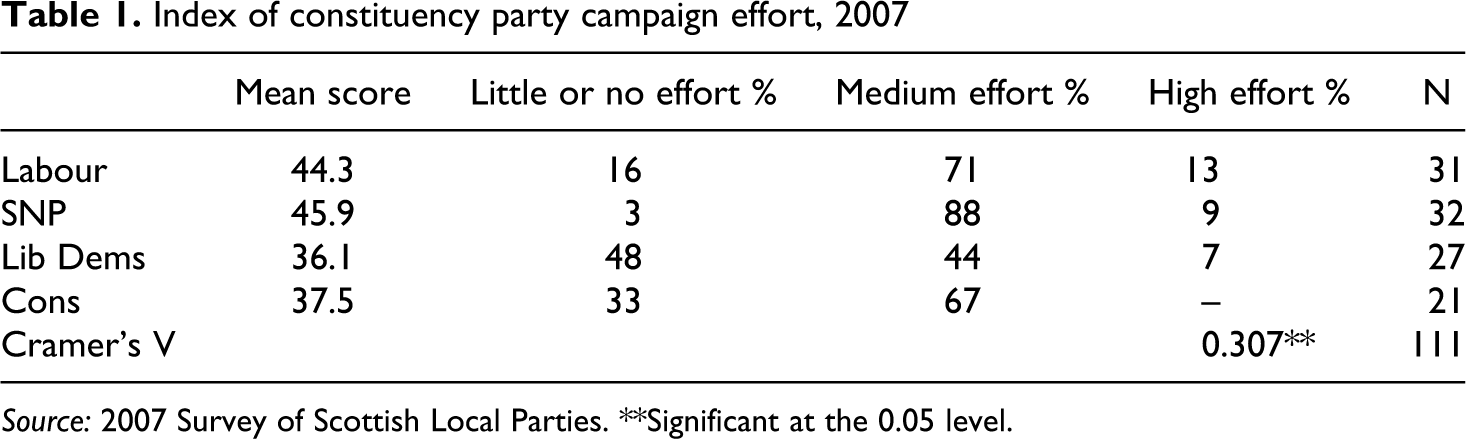
Table 1 indicates that only small proportions of constituency organizations put a high level of effort into the campaign. While both Labour and the SNP’s constituency campaign effort is above the overall average, both parties had the vast majority of their constituency campaigns in the medium effort category, with Labour having both a greater proportion of its organizations in the little or no effort and high effort categories than the SNP. Two-thirds of Conservative campaigns were medium effort, while the remaining third can be classified as expending little or no effort. In a pattern almost identical to the party’s performance in 2003, the Liberal Democrats had almost half of their constituency organizations falling into the little or no effort category (Clark, 2007, 2008).
Index of constituency party campaign effort, 2007
Source: 2007 Survey of Scottish Local Parties.
**Significant at the 0.05 level.
If parties are vote-maximizing actors, the competitiveness of the seat should impact upon the level of effort local organizations put into their campaigns. Figure 2 assesses to what extent the four parties ran stronger campaigns in different types of constituency. This indicates a variable relationship between constituency competitiveness and the level of campaign activity depending on the party. Labour appears to have run its strongest campaigns in marginal constituencies, with the party’s next strongest campaigns occurring in very safe constituencies. The SNP appear to have run relatively strong campaigns across all types of constituency, with the strongest being in constituencies classed as comfortable for the party, closely followed by very safe constituencies and then those classified as marginal. By contrast, the strongest Liberal Democrat campaigns were fought in possible constituencies, although the Conservatives did expend their greatest level of effort on a marginal contest. With both parties, the typical constituency, however, is one which is classified as hopeless. For the Liberal Democrats, this is a matter of building up credibility in the seat (Clark, 2007; Russell and Fieldhouse, 2005), and a similar dynamic exists for the Conservatives.
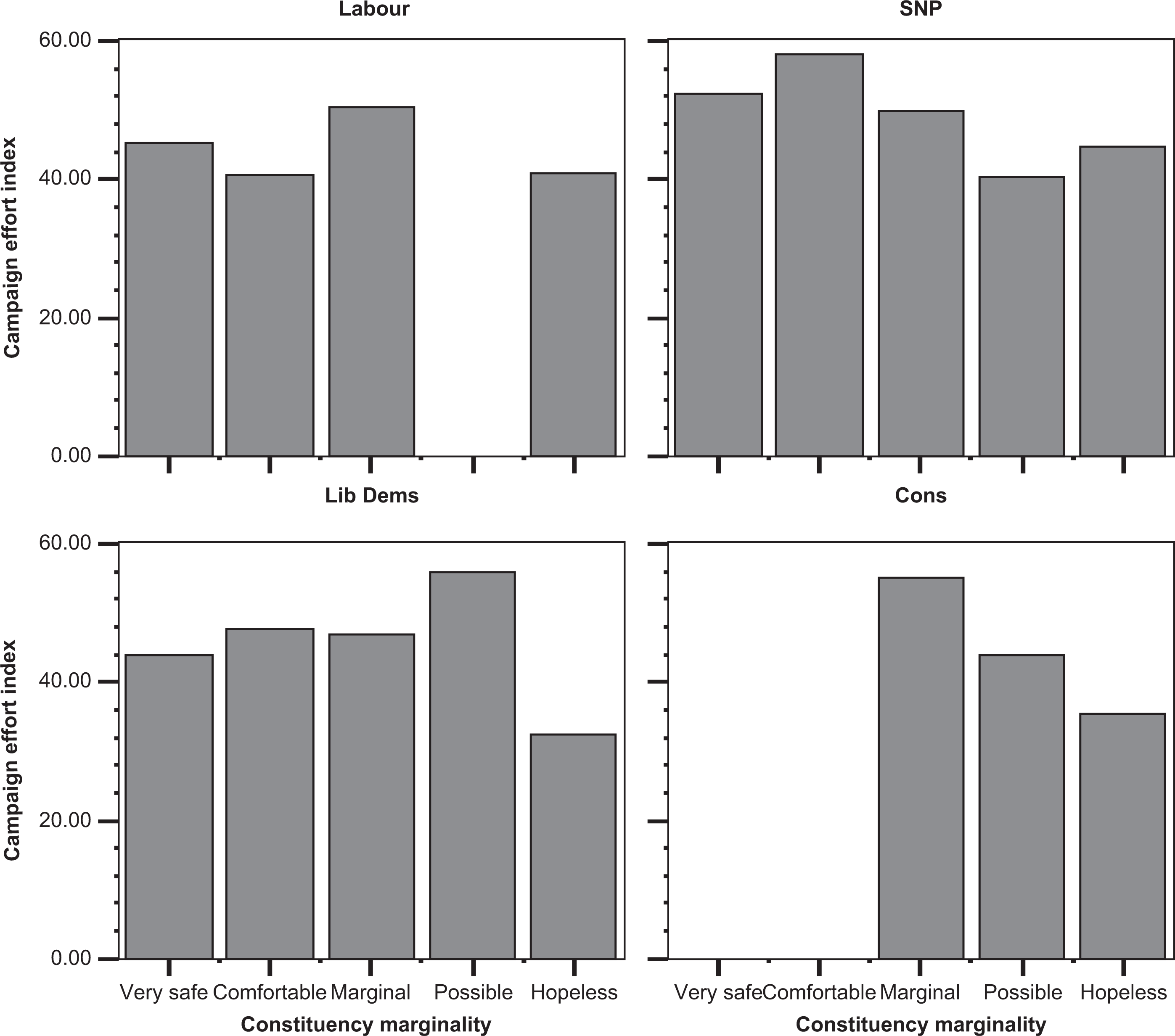
Index of campaign effort and constituency marginality 2007. (Source: 2007 Survey of Scottish Local Parties.)
Similarly, having an incumbent constituency MSP should be positively related to greater constituency campaign intensity. This was confirmed. Labour, the SNP and the Liberal Democrats all ran stronger constituency campaigns where they had an incumbent. 5 Eta measures of association between incumbency and campaign effort for the three parties were of moderate to medium strength at between 0.275 for Labour and 0.492 for the Liberal Democrats. While the relationship between Labour incumbency and campaign intensity was not statistically significant, the relationships for the SNP and the Liberal Democrats were at the p < 0.05 and p < 0.01 levels of significance, respectively.
Party efforts at different levels are positively related to either the level of party organization in the area or levels of previous electoral success. Taking all parties together, the Pearson correlation between a local party’s share of the electorate in 2003 and the level of constituency campaign effort in 2007 is 0.512 and this is significant at the 0.01 level. The correlation between local levels of membership and campaign effort in 2007 is weaker at 0.364, but also significant at the 0.01 level. When broken down by party, strong positive correlations and significance remain with both the Liberal Democrats and Conservatives in relation to both analyses, while the correlations are positive but weaker and not significant with Labour and the SNP.
The constituency contests are only one part of the MMP system. However, parties’ campaigns at the regional list level are seldom assessed. There are a number of reasons for this. First, there is no easy way of relating local effort to electoral outcomes. Second, in previous elections, the regional list campaign has been seen as something managed by parties’ central campaign HQs. Nevertheless, given the compensatory nature of the Scottish regional lists, there is a clear trade-off between constituency and regional list seats. As Zittel (2009: 6) argues, since the compensatory proportional tier of MMP largely determines the overall distribution of seats, party campaigns should be mainly interested in maximizing their vote at this level.
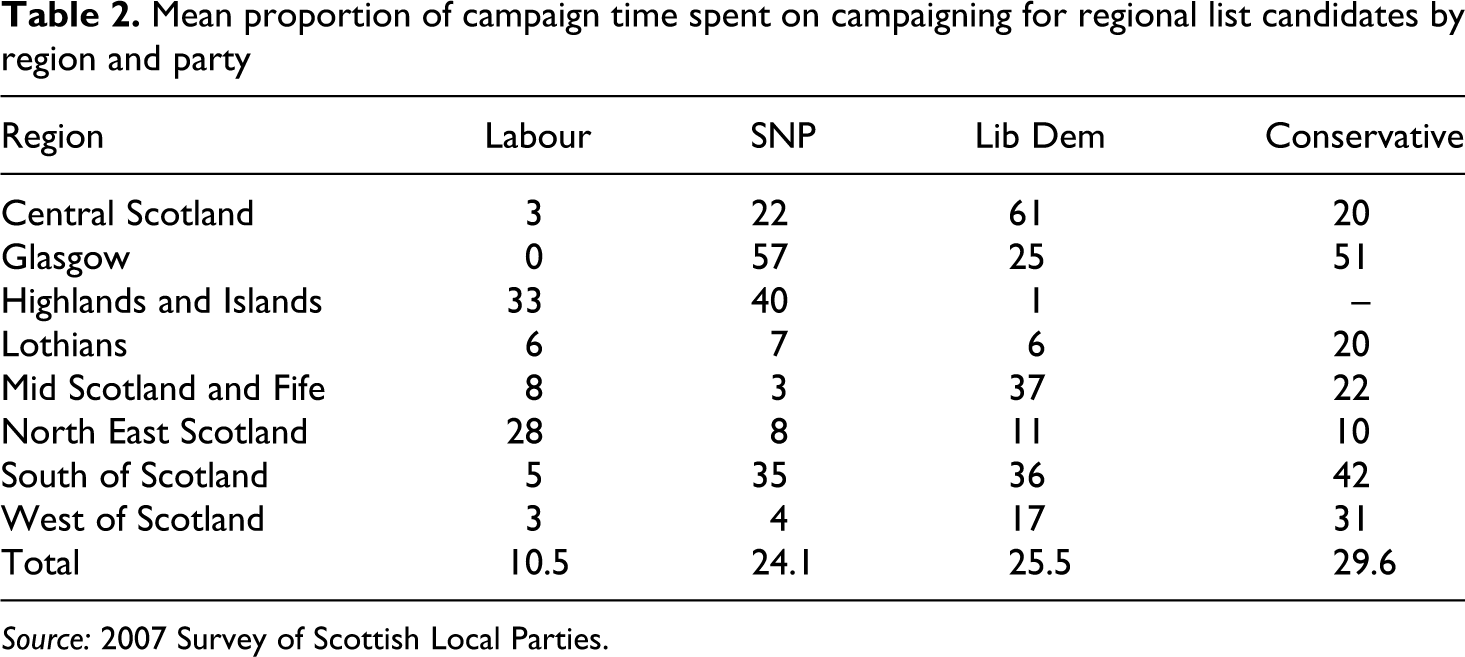
To estimate the extent of grassroots campaigning for regional list candidates, the survey asked respondents to estimate what proportion of their organizations’ campaign time was spent campaigning for their party’s regional list candidates. Labour’s domination of constituencies means that the party might be expected to spend least time on this. Indeed, the mean proportion of campaign time spent by Labour organizations on the regional list campaign was 10.5 percent. By comparison, the other three parties spent more time on regional list campaigning at local level, since they had potentially more to gain. SNP organizations report a mean of 24 percent of campaign time spent on the regional list, while the Liberal Democrats and Conservatives report averages of 25.5 percent and 29.6 percent, respectively.
Table 2 analyses these proportions by region. Labour most clearly appears to have spent more time on local campaigning for regional list candidates in those areas where the party has few constituency seats, such as the Highlands and Islands and North East Scotland, where the party’s position has been in decline over the past two elections. The SNP has traditionally found it difficult to break into Labour’s central belt strongholds and consequently SNP associations spent just over half of their time promoting their regional list candidates on the Glasgow list, just over a third in South of Scotland and 22 percent in Central Scotland. The SNP, however, also appear to have spent a sizeable proportion of time campaigning for list candidates in the Highlands and Islands, despite holding two constituency seats there. 6
Mean proportion of campaign time spent on campaigning for regional list candidates by region and party
Source: 2007 Survey of Scottish Local Parties.
In total, neither the Conservatives nor Liberal Democrats held many constituencies, and therefore should be expected to spend a sizeable proportion of time campaigning for their regional list candidates. The pattern for both parties is variable, however. The Liberal Democrats appear to have spent little time on average campaigning for the party’s list candidates in Highlands and Islands, North East Scotland and Lothians, primarily because the party already held a number of constituency seats in each region. The Liberal Democrats therefore spent some time campaigning for list candidates in areas where the party had little constituency representation, such as the 61 percent it allocated to list campaigning in Central Scotland and 37 percent in Mid-Scotland and Fife. Less explicable is the amount of time spent campaigning for regional list candidates in West of Scotland, where the party held no seats and only spent on average 17 percent of their time on regional list campaigning. However, this is likely to be due to organizational weakness in the region (Clark, 2007). The Conservatives held only three constituency seats in the 2003 parliament. Most time appears to have been spent on local campaigning for Conservative list candidates in Glasgow, South of Scotland and West of Scotland, while the least proportion of time was spent in North East Scotland, Lothians and Central Scotland.
While these patterns partly conform to expectations, spending time on something is not necessarily the same as putting in a large amount of effort into it. To assess the amount of effort expended on the regional list campaign, the survey also asked respondents to indicate what level of effort constituency parties put into campaigning for their regional list candidates. Despite the amount of time spent on the regional list campaign, the majority of all four parties’ organizations fall into what can be termed the ‘little or no effort’ category. This accounts for 77 percent of Labour organizations, 70 percent of SNP associations, 55 percent of Liberal Democrats local parties and 61 percent of Conservative associations. At the other end of the spectrum, only 9 percent of Labour organizations, 12 percent of SNP associations, 21 percent of Liberal Democrat local parties and 22 percent of Conservative associations could be classified in the high effort category. Even where constituency parties claim to have spent a sizeable proportion of time on their regional list campaign, the amount of effort put in by constituency parties to this level of campaigning should not therefore be overestimated. These figures suggest that very little campaigning directed towards list candidates actually takes place at local level, an interpretation confirmed by interviews and a statistically significant (p < 0.01) Cramer’s V correlation of 0.625 between low levels of effort and low amounts of time put into list campaigning. Moreover, encouraging regional list voting appears to have been low down the list of priorities for local parties. In only 6 percent of responding party organizations overall was encouraging regional list voting the first priority for their campaign, while it was only the second priority for less than a fifth (17 percent). Even under MMP, this underlines Karp et al.’s (2008) suggestion that party mobilization efforts are likely to be lower under PR rules than where local parties are contesting SMP seats.
Campaigning under STV for local government
The third electoral system level was the newly introduced STV for local government. Party organizations had to learn a range of new campaigning techniques to be able to compete under the new system. Parties produced comprehensive advice for local organizations (Scottish Labour Party, 2006; Scottish Liberal Democrats, 2006), and this was complemented by independent advice (Electoral Reform Society, 2005).
Advice was clearly to select local government candidates early, so that they had a chance to get themselves known in their locality. On the whole, local campaigns appear to have selected their local government candidates in advance of the formal commencement of the campaign itself. Thus, 76 percent of Labour organizations report that local government campaigns in their area were fully prepared in candidate selection under the new multi-member circumstances, by comparison with 85 percent of SNP organizations and 65 percent of Liberal Democrat local parties. The Conservatives appear to perform worst here, with only 57 percent indicating that local campaigns in their area were fully prepared in candidate selection.
This requires qualification. A consequence of the move to 353 larger multi-member wards meant that parties had to find considerably fewer candidates in order to stand at least one candidate in a ward. Numbers of candidates therefore fell substantially across all parties. Only Labour put forward significant numbers of multiple candidacies, essentially because it had the greatest number of incumbent councillors. Labour stood more than one candidate in 180 wards, compared to only 96 for the SNP, 57 Liberal Democrat and 43 Conservatives. Such multiple candidacies tended to be forwarded in areas of previous electoral strength (Clark and Bennie, 2008a, b). Intra-party difficulties occasionally intervened in candidate selection processes. Challenges were made against some selection decisions by prospective Labour candidates in the West of Scotland which delayed the selection process. Similarly, the decision to stand more than one candidate was sometimes dictated by the need to ameliorate intra-party conflict by letting the electorate, rather than pre-election party selection, choose between candidates. However, in the majority of cases where parties only stood one candidate per ward, this undoubtedly enabled parties to be well prepared in selecting their candidates; some party organizers were clear that having just one candidate simplified matters for them considerably.
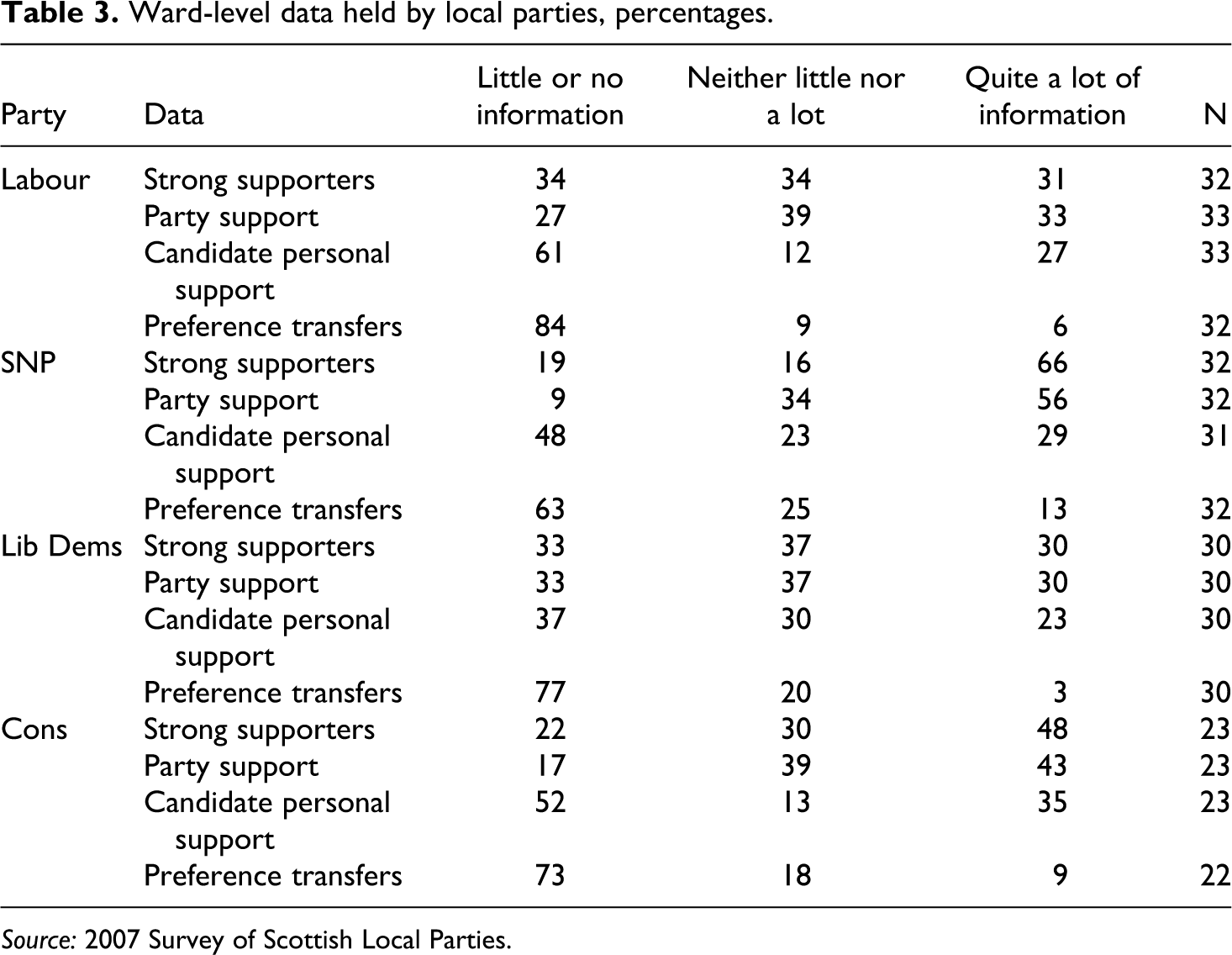
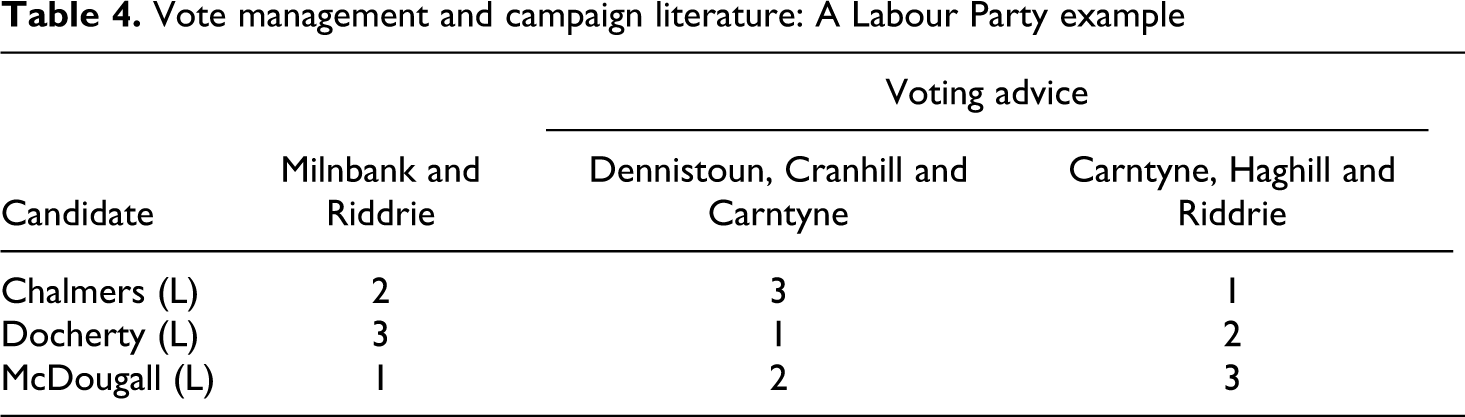
Although parties had some information on strong identifiers and the distribution of party support from previous elections, a key issue was that party organizations often did not have comprehensive data on individual candidate support and potential patterns of transfer preferences necessary to optimize party strategy (Clark and Bennie, 2008a, b). Table 3 indicates, across all parties, a lack of extensive information on candidates’ personal support, and little or no information on preference transfers. Where parties claimed to have such information, interviews indicated that this was not based on hard canvass returns. Instead, it tended to be based on candidate ‘hunches’ about where support lay, and some, albeit reasonably educated, guesswork from agents. Where parties stood multiple candidates, there is some evidence that their local government STV campaigns did divide up wards and provide advice on how voters should vote throughout the ward. Campaign literature from some local campaigns is indicative of quite sophisticated vote management efforts. Table 4 demonstrates how one Glasgow ward (East Centre) was organized by the Labour Party. In this ward, a previous Labour stronghold, the party stood three candidates for a four-member ward. Each candidate was allocated to separate areas within the ward. In each area the advice to voters was different; each candidate was to be ranked first in their local area and second and third in other areas. In this case, all three candidates were elected. However, the vote management strategy was not wholly effective at keeping the candidates’ totals roughly equal; Chalmers achieved 1792 first preferences, by comparison with Docherty’s 1277 and McDougall’s 1039. Evidence from other STV campaigns points to similar efforts to undertake vote management strategies albeit with varying levels of success (Clark and Bennie, 2008a, b).
Ward-level data held by local parties, percentages.
Source: 2007 Survey of Scottish Local Parties.
Vote management and campaign literature: A Labour Party example
To what extent did efforts to encourage intra-party transfers succeed? Although difficult to attribute transfers directly to local ‘vote management’ efforts, parties clearly think such activity is important where they have multiple candidates. It should therefore be expected that most preference transfers are between candidates of the same party. If not, then such local efforts arguably have little impact. Analysis of transfer patterns suggests that, where parties had multiple candidates, by far the largest number of second preference transfers went to co-partisans. Two-thirds of Labour’s second preference transfers went to other Labour candidates, while the proportions for the other parties were 71 percent for the SNP, 49 percent for the Liberal Democrats and 57 percent for the Conservatives (Denver et al., 2009).
Did the mainstream Scottish parties attempt to exploit the opportunities offered by STV to give transfer preferences to other parties? In Scotland’s highly conflictual political environment this was unlikely. Indeed, almost universally Scotland’s local parties did not advise voters to give their preference transfers to other parties. Interviewees explained this by indicating that they did not want to inculcate in voters’ minds the idea that they could actually use their vote for other parties in case this weakened what support they currently had.
‘Contamination effects’ and complications?
Discussion has so far treated each of the three electoral system levels separately. However, these levels do not necessarily work in isolation but can have a ‘contamination’ effect on each other. To what extent were such effects evident between party organizations’ campaign efforts at the three different levels? Although the pattern of time spent on the regional list campaign might be broadly as expected from a vote-maximizing perspective, local parties clearly put little effort into the campaign at that level. Moreover, only very small and non-significant correlations exist between constituency campaign intensity and local parties’ efforts to campaign for their list candidates. This suggests that while standing a constituency candidate may have a contamination effect in terms of votes across the tiers in MMP, there is not necessarily the same contamination effect under MMP when local campaign intensity is considered. Consequently, the regional list level can effectively be discounted from analysis.
If there was a contamination effect between local campaign intensity at the different levels, this therefore primarily took place between the constituency and local government level. The relationship between constituency and local government campaign effort in the 2007 Scottish elections should therefore be positively related, not least since local government activists will also be out campaigning for council elections. This will potentially give the parliamentary constituency campaign an added boost, and vice versa, which may not be evident if the elections were held at separate times. Directionality is difficult to assess, however, and Samuels (2000: 3) indicates that ‘the concept is typically operationalised as a correlation’ between the higher and lower levels in a given constituency.
A statistically significant (p < 0.01) correlation of 0.440 between indices of constituency and local government campaign activity suggests that such contamination effects do exist between party organizations’ campaigns at different levels. 7 This positive relationship remains when parties are considered individually, although the relationship is strongest and statistically significant at the 0.01 level with the Conservatives and Liberal Democrats. In practice, this relationship manifested itself in efforts by some local parties to integrate the two campaigns. In some places this took the form of combining leaflet delivery and voter identification activities. In other seemingly well-organized campaigns, it took the form of integrating the parliamentary and local government campaign together on the literature that was sent to voters.
There is clear evidence that some local parties gave priority to the parliamentary constituency level over the local government campaign. Aggregating all responses, 42 percent of respondents indicated that winning the constituency seat was their most important campaign objective, while only 21 percent indicated that mobilizing voters for the council elections was their main priority. This pattern holds across three of the four parties. While 63 percent of Labour organizations had winning the constituency seat as their first priority, only 16 percent indicated that mobilizing for the council elections was their main priority. For the SNP the respective proportions were 58 and 10 percent, respectively. The Liberal Democrats had 31 percent giving priority to the constituency campaign over 22 percent preferring council mobilization. The exception was the Conservatives, with 41 percent giving priority to council mobilization over 5 percent focusing on winning the constituency seat. This is unsurprising, since the party had few winnable constituencies available to it. Such a dynamic also explains variation in the other parties’ pattern of prioritization; where local parties gave priority to local government campaigning, they were in a highly uncompetitive position in the parliamentary constituency. Underlining the lack of local campaigning for regional list candidates, in all parties encouraging voting on the regional list was well down the list of priorities, with at most only 13 percent of Liberal Democrat organizations saying it was their priority.
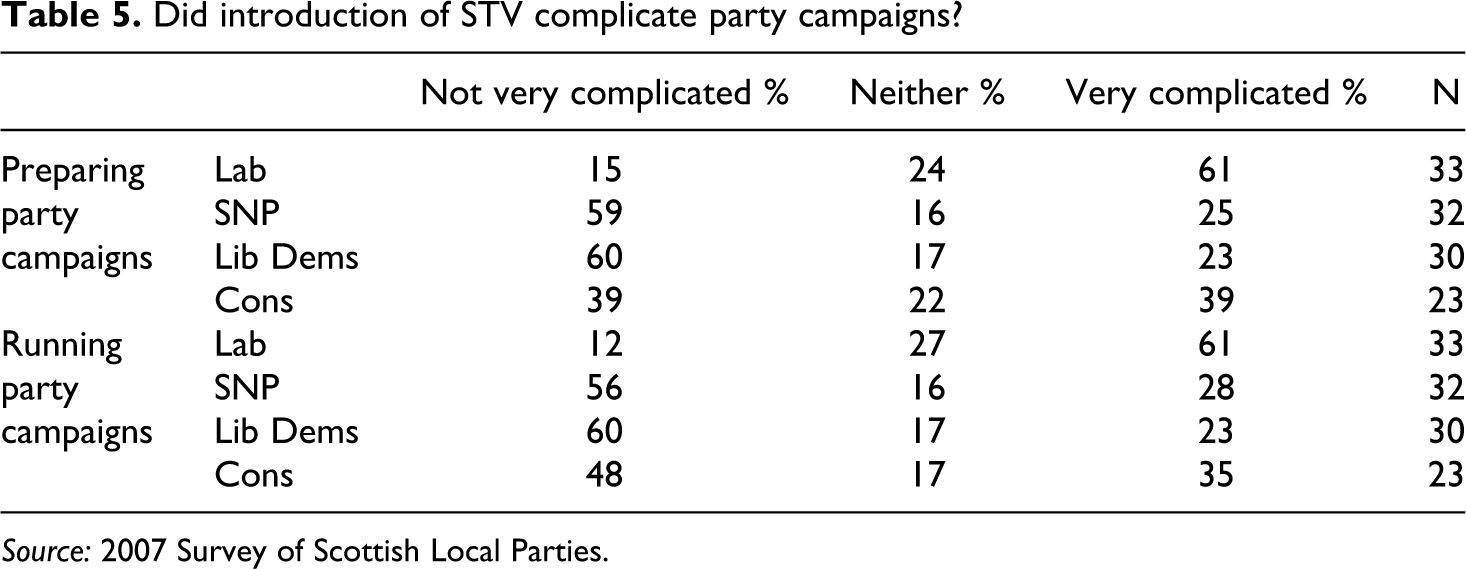
Pre-election, there was much concern about the extent to which holding concurrent elections with the complex new STV electoral system would confuse voters. Table 5 confirms the idea that the dominant incumbent party of government, at both levels the Labour Party, might find preparing and running such a campaign most problematic. Three-fifths of Labour organizations found that running the new electoral system concurrently with MMP complicated preparing and running their campaigns. This is because Labour ran most multiple candidates in the local government elections, adding the complication of vote management within local areas to having most constituency seats to defend. By contrast, the SNP and Liberal Democrats appear to have experienced least complication in both preparing and running their local campaigns, while the Conservatives appear to have sizeable proportions in both the very complicated and not very complicated categories.
Did introduction of STV complicate party campaigns?
Source: 2007 Survey of Scottish Local Parties.
Conclusion
What do these findings suggest about parties? Four points can be tentatively forwarded. First, while there is some evidence of vote maximization activity by party organizations under the different electoral systems, particularly under SMP, this is ultimately mediated by previous success and party organization. With STV, some local organizations made considerable efforts to adapt to the new system, primarily in areas of previous electoral success and strong organization. Others appear to have made limited efforts, often only standing one candidate, due to limited organization, insufficient data on voters or lack of previous success in the area, even where they might have benefited from having another candidate to mop up transfers. Considerable efforts did not extend to the regional list element of MMP; local party efforts at this level appeared largely tokenistic. This confirms the finding that local activity is lower under PR rules (Karp et al., 2008) but extends it to an MMP setting. This highlights a second point: that party organizations have apparently not, even after three elections using MMP, wholly learned how to attempt to maximize their advantage under both elements of the MMP system. When combined with the STV evidence, this suggests that local organizations are unlikely to immediately be strategic vote maximizing actors under new electoral systems. Instead, they go through a lengthy period of learning how to adapt to new electoral systems.
Third, due to significant proportions of spoilt parliamentary ballots in the 2007 Scottish elections, the parliamentary and local government elections have been separated, with the MMP parliamentary elections continuing to be held on their four-year cycle, and the STV local government elections delayed by a year and then also continuing on a four-year cycle. Although theoretically providing accountability for local government, running such elections separately nevertheless has a cost for volunteer local party organizations both in time and effort. Indeed, this article suggests that ‘contamination’ effects are not just evident in electoral outcomes as previous research has indicated (Crisp, 2007: 1468; Hainmueller and Kern, 2008; Karp, 2009; Samuels, 2000; Zittel and Gschwend, 2008), they also appear evident in local party campaign efforts; strong campaigns at one level are positively related to strong party campaigns at the other level. This suggests that there may be economies of scale for parties in fighting concurrent elections. Instead of increasing the constant demands on local organizations presented by regular separate elections, concurrent elections potentially actually ease such demands, an important suggestion given the decline in party membership and activism across advanced democracies. Finally, although managing such concurrent elections can be complex, parties on the ground deal with this by prioritizing between different levels, with the higher level institution largely given priority over the lower level institution, except in a few cases where the local party is in an uncompetitive situation. In this sense, local elections might be seen as ‘second-order’ not only in voters’ minds, but also in the priorities of local party organizations when elections for both levels are held concurrently. Further research is of course necessary to corroborate these ideas in future concurrent elections.