



Abstract
Despite a vast pan-European literature on extreme right parties (ERPs), few studies speak convincingly to questions of party membership and activism. This article draws on a unique membership dataset to examine contextual predictors of membership of the British National Party (BNP), currently the dominant representative of the extreme right in British politics. We operationalize and test for the impact of both demand-side and supply-side factors, including the seldom examined effects of historical legacies, and of party activism and electoral success on membership levels. Aside from congregating in urban areas that are more deprived and have low education levels, we also find evidence of a ‘legacy effect’, whereby membership levels are higher in areas with a historic tradition of extreme right activism. This research is the first ever systematic investigation of national extreme right party membership.
Introduction
There is now a substantial literature on populist radical right and extreme right parties (ERPs) (Mudde, 2007). 1 Much of this research examines the socio-attitudinal profile of their voters or cross-national variations in support. In contrast, less is known about the most committed supporters of ERPs, the grassroots members. 2 What factors encourage membership of these types of parties? The lack of research on this question is often attributed to the problem of accessibility or authoritarian models of organization that allow scant involvement from the grassroots (Carter, 2005). Despite these obstacles, however, the dearth of empirical research on ERP members remains striking for several reasons.
First, in the wider study of party politics the fact that members fulfil important and beneficial roles is well documented. Aside from a loyal electoral base, members provide finance, labour, access to wider networks of supporters, linkage to grassroots opinion and can help foster an image of legitimacy (Scarrow, 1996). For parties that lack resources for capital-intensive campaigns or are excluded by political and media elites, these roles are especially important. Investigating the factors that encourage some citizens to join ERPs is therefore an important prerequisite to understanding their continual evolution. Second, aside from documenting declining rates of membership across Western democracies (Scarrow and Gezgor, 2010; Van Biezen et al., 2011; Whiteley, 2011), studies also reveal important differences between members and voters. 3 In Britain, for example, it has been shown how members of the Conservative, Labour and Liberal Democrat parties often differ from their voter-counterparts in important respects (Seyd and Whiteley, 2002; Whiteley et al., 2006). There is, similarly, qualitative evidence suggesting that ERP members are not simply a ‘mirror image’ of ERP voters (Klandermans and Mayer, 2006). This leads us to question whether ERPs recruit members from similar contexts as their voters, and the extent to which theories developed in the electoral sociology of ERP support remain relevant when studying membership.
Drawing on a unique dataset, we begin to address these gaps by examining contextual predictors of membership of the British National Party (BNP), the primary representative of extreme right politics in Britain. Despite recent electoral setbacks, over the period 2001–2010 the BNP became the most successful ERP in British history, and recruited a significant membership. Studies of BNP support in elections have revealed a distinct regional pattern, suggesting that local contextual effects may be decisive to explaining these variations and support for the party (see below). Yet it remains unclear whether the same contextual variables remain salient in the case of membership and, more generally, what factors encourage recruitment to the party. In this article, we build and expand on existing research in two ways. First, we test for the impact of context on membership and standard demand-side explanations that emphasize economic deprivation and ethnic diversity. Second, we expand on extant studies by operationalizing and testing supply-side explanations which instead stress the importance of party-centric variables. In the wider study of party membership, these party-centric factors such as electoral success and activism are often considered important, yet in the study of ERPs they have received less attention (Carter, 2005; Lubbers et al., 2002; Van der Brug et al., 2005). By adopting an integrated framework that tests for the impact of both demand and supply-side variables, we provide a more complete understanding of the factors that encourage ERP membership, while also contributing to broader debates within this literature.
Theorizing ERP membership
Numerous theories identify factors that might encourage membership of the extreme right, but three are particularly important. The first ‘losers of modernization’ approach interprets the act of joining an ERP foremost as a response among members of specific social groups to the effects of rapid socio-economic change, and actual or perceived social disintegration (Betz, 1994). Seen from this perspective, membership is likely to be most heavily concentrated within areas where there are large numbers of unskilled workers, unemployed, poorly educated and lower middle class citizens, on the basis that these groups are more economically insecure, feel threatened by rapid socio-structural change and resentful toward mainstream elites. Though research on ERP voting has produced mixed findings on the effects of deprivation (e.g. Arzheimer, 2009; Bowyer, 2008), studies of the contextual determinants of racial prejudice provide stronger evidence that negative economic conditions encourage intergroup hostility (Quillian, 1995). For example, within ‘low status settings’ where education and employment rates are low, citizens are more likely to encounter a range of social problems and exhibit heightened hostility toward out-groups (Oliver and Mendelberg, 2000; Skogan, 1990). It might be expected, therefore, that citizens who reside amidst more deprived socio-economic contexts fall more responsive to ERPs that promise to curb these changes, defend the position of the in-group and punish the established main parties.
An alternative, although not inconsistent demand-led explanation, is the ‘racial threat’ model, which puts stronger emphasis on the impact of intergroup conflicts and the way in which subjective perceptions of competition and threat lead some citizens to endorse exclusionary campaigns, such as by joining an ERP (Sniderman et al., 2000; Tolsma et al., 2008; also Olzak, 1994). While there are diverse strands within this approach, the racial threat model interprets support for ERPs as an instrumental attempt to defend the economic resources or cohesiveness of the in-group from threatening out-groups (Arzheimer, 2009; Esses et al., 2001). Life-history interviews with ERP members, for example, suggest that perceptions of threat to the collective in-group are a major motive in the recruitment process (Goodwin, 2010, 2011; Klandermans and Mayer, 2006). Importantly, research on contextual predictors of ERP support at the sub-national level also underscores the importance of disaggregating different groups when exploring the target of this hostility (Bowyer, 2009). High support for ERPs in Belgium and Britain, for example, is positively associated with the presence of large Muslim communities, whereas this relationship does not hold for other minority groups (Bowyer, 2008; Coffé et al., 2007; Ford and Goodwin, 2010; see also Cutts et al., 2011). This leads us to expect that, like electoral support for the BNP, membership will be positively associated with Muslim communities but that this relationship will not hold for other minority groups.
The literature, however, also makes clear that when examined in isolation demand-side explanations provide an insufficient explanation for what motivates some citizens to shift support behind ERPs (Carter, 2005). Rather, studies advocate an integrated approach that also takes into account the role of political mobilization and supply-side variables, such as organization, activism and electoral success, which are routinely included in the wider study of party politics. In terms of membership, three supply-led explanations appear particularly important. The first centres on the impact of electoral success, and draws on evidence of the way in which this can impact on membership by triggering a ‘spiral of mobilization’ (Fisher et al., 2006; Whiteley and Seyd, 1998). A similar process is found in qualitative research on ERP members, who often identified local election success as an important ‘triggering’ event during the recruitment (Goodwin, 2010). Clearly, this requires careful examination given the endogeneity inherent in this relationship. While success in elections may encourage feelings of efficacy, an image of legitimacy and attract new recruits, recruitment might also be a prerequisite of success, or both processes may be operating.
A second supply-led account centres on political context. Though few studies endorse the older ‘protest model’ of ERP support, political dissatisfaction remains a key characteristic of the ‘typical’ ERP voter (Arzheimer and Carter, 2006). Yet, there are also good reasons to expect political context to be especially important at the local level. In the British case, for example, BNP support is often traced to the ‘Labour disaffection hypothesis’, which posits that the party has recruited strongest within areas where politics has historically been dominated by Labour (Ford and Goodwin, 2010). Seen from this perspective, within ‘Labour heartlands’ the BNP has benefited from a declining quality of local governance, stagnant grassroots campaigns, limited choice and high levels of political dissatisfaction (Wilks-Heeg, 2009). In some of these areas, for example, there is evidence that voters have experienced higher levels of face-to-face contact with activists from the extreme right than those from mainstream parties (JRCT, 2004). Seen from this perspective, we might expect members to be most heavily concentrated in areas with a long history of Labour incumbency.
A final and previously untested supply-led explanation centres on what we term ‘legacy effects’. This builds on the observation that support for ERPs is often concentrated heavily in historic bastions, such as support for Flemish Interest (VB) in Antwerp, the Austrian Freedom Party (FPÖ) in Carinthia or British ERPs in the East End of London and West Midlands (Husbands, 1983; Mudde, 2007). It also draws on detailed qualitative research which reveals the extent to which ERPs often depend heavily on members who have a long history of activism within the extreme right (Art, 2011; Goodwin, 2011). Such studies provide some anecdotal evidence that, in path-dependent fashion, membership support for contemporary ERPs may be positively related to earlier cycles of activism by their predecessors, and suggests that this legacy effect may have rendered some areas particularly responsive to the exclusionary campaigns of their successors. Therefore, we hypothesize that a legacy of ERP campaigning and activism will have a positive effect on current BNP membership.
Studies of ERP support in Britain
The BNP was formed in 1982, but holds its roots in the National Front (NF), which was established in 1967 and contested elections during the 1970s. The NF recruited support primarily from urban, working-class districts in Greater London and the Midlands, and close to New Commonwealth immigrant populations (Harrop et al., 1980; Husbands, 1983; Whiteley, 1979). In 1982, a combination of factionalism and declining support led prominent NF organizers to establish the BNP. The influence of these ex-NF activists was noticeable in London districts such as Hackney and Tower Hamlets, where some of the earliest and most active BNP branches emerged (Goodwin, 2011). The BNP subsequently focused electoral campaigns on areas which had previously provided elevated support to the NF, though mainly the East End of London, areas of outer-London such as Broxbourne and Epping Forest, and enclaves within Bristol, Bradford, Leicester, Sandwell and Wolverhampton.
Since 2001, and under a new leader, the BNP has sought to downplay these organizational origins as part of its strategy of ‘modernization’. However, like the earlier NF the party continued to poll strongest in urban, working-class districts where education levels are low, and also areas where there are ageing populations and large numbers of skilled workers (Bowyer, 2008; Ford and Goodwin, 2010). These findings lead us to expect that deprivation and low education levels will similarly have positive effects on BNP membership. Turning to ethnic diversity, research on BNP support also reveals the importance of separating out different ethnic categories. Ford and Goodwin (2010) find a significant positive relationship between support for the party and Muslim communities of Bangladeshi and Pakistani heritage, no relationship with the presence of non-Muslim Asians and a negative relationship with Black Britons. Bowyer (2009) similarly finds that higher levels of racial hostility among modern Britons are related to residential proximity to Pakistani and Bangladeshi communities, and (2008) that BNP voting is similarly positively related to the presence of Muslim populations. This leads us to expect that membership will similarly be concentrated most heavily in more ethnically diverse areas, and that we will find a specific positive relationship between membership and the presence of Muslim communities.
To be clear, our article builds on the above research in several respects. First, we examine the impact of demand-side explanations that emphasize deprivation and ethnic diversity on membership. Specifically, we hypothesize that (H1) members will be more likely in urban, deprived areas where education levels are low, and (H2) members will be more likely in ethnically diverse areas and where there are large Muslim communities. Second, we also operationalize and test for the impact of three supply-led explanations, namely electoral success, political context and legacy effects. We hypothesize that membership will be more likely (H3) in areas where the BNP has achieved electoral success, (H4) where there is a history of Labour incumbency, and (H5) a legacy of ERP activism.
Data and methods
In this article, we utilize data from the membership list of the BNP that were leaked on to the Internet in November 2008. Clearly, there are good reasons to be cautious over the validity of these data. Given that members can help foster an image of legitimacy, minor parties are likely to artificially inflate the size of their membership (Mair and Van Biezen, 2001). In this case, however, the number of members included on the list was consistent with data self-reported to the Electoral Commission (Goodwin, 2011), while its authenticity was not disputed by BNP elites (whereas the authenticity of a second list leaked in 2009 was disputed by the party). The list utilized in this article was described by the BNP leadership as genuine, and was attributed to disgruntled activists who ‘didn’t like the direction the party was going’. 4
The document includes a list of over 12,000 names and addresses. While there is little data on individual members, such as their socio-economic characteristics, the inclusion of postcodes enables an examination of the influence of contextual factors on membership. 5 To examine the predictors of membership, the dataset was first anonymized and postcodes were used to match individual members to data on local contextual conditions. The membership list was subsequently combined with three sources of data: (i) 2001 Census data aggregated at the ward level for all 7969 England wards, 6 (ii) specially constructed measures of ERP (i.e. NF) activism in the 1970s derived from internal party literature and coded at the level of local authorities, and (iii) a measure of current BNP activism and electoral success which is operationalized as the presence of BNP branches in the post-2000 period and winning seats in the last set of local elections, all of which are coded at the local authority level.
BNP membership policy holds the potential to complicate our analysis. Until changes in 2010, the party operated a restrictive and ethnically defined membership. Eligibility to join was restricted to the ‘indigenous British’ ethnic group, which was defined ‘within the terms of … the legal ambit of a defined “racial group”, this being “Indigenous Caucasian” and defined “ethnic groups” emanating from that Race …’. 7 Thus, the relevant population of potential recruits to the party is not the whole population of a local ward but rather the white British population. Failure to correct for this could potentially bias our results. 8 In order to generate unbiased estimates of BNP membership among the white population, we calculate adjusted membership counts by dividing the raw count in each ward by the proportion of the ward that is white. The resulting corrected counts are rounded to the nearest whole number to permit modelling using count methodologies.
Descriptive findings
As noted above, since 2001, and in an attempt to downplay its organizational origins and broaden its appeal, the BNP embarked on a strategy of ‘modernization’. This has included strong emphasis on community-based activism as a prerequisite to building a national base of support, targeting deprived working-class areas, and establishing an electoral presence in areas traditionally dominated by Labour (Goodwin, 2011). Also integral to this strategy was a concerted attempt to expand membership. As detailed in Figure 1, over 2001–2009 membership increased seven-fold, rising from 2,000 to over 14,000 recruits.

BNP membership, 2001–2009.
Our focus is on England, where according to the list there were over 12,000 BNP members in 2008. Three of the five local authorities with the highest memberships are located in West Yorkshire, namely Leeds, Kirklees and Bradford, with neighbouring Barnsley in South Yorkshire. Birmingham has the second highest membership with nearly 200 party members. Table 1 shows BNP membership per 100,000 of the local authority population. Of the top 15 local authorities, the highest ranked are Pendle and Burnley, which are in Lancashire. It is also evident that members cluster in the East Midlands, where the NF was particularly active, including Leicestershire (Melton, Charnwood, North West Leicestershire, Hinckley and Blaby) and Nottinghamshire (Ashfield and Broxtowe). Epping Forest is the only local authority in the Southern regions of England to feature in the list of the highest membership rates.
BNP Membership per 100,000 of the local authority population.

Dependent and independent variables
Our unit of analysis is the electoral ward and our dependent variable is the ethnically adjusted number of members in this ward, which varies from zero to 47 (see Table 2). To operationalize demand-side measures of social conditions we carried out a factor analysis of a wide range of census data, measured at ward level. This suggested clear latent factors which capture neighbourhood differences on the factors that are of most interest, namely economic deprivation, education, urban or rural character and ethnic diversity. As these factors were to some extent intercorrelated and the meaning of changes in a factor score is difficult to interpret, we selected a predictor of each factor and employed these as indicators in our model. 9
Model descriptives.

Our measures of economic conditions at the ward level are the share of residents who are long-term unemployed; of pensionable age; in paid employment; and employed in the more economically insecure manufacturing sector. 10 The decline of manufacturing may be one contributory factor to economic insecurity in areas that have long depended on this sector (Bowyer, 2008). As these areas are more supportive of the BNP in elections, it is plausible to expect they will also contain disproportionately high numbers of BNP members. Our measure of education at the ward level is the share of the population with no formal educational qualifications. 11 To determine whether, like ERP voters, members concentrate in urban areas, we examine the population density of the local authority based on the number of people per hectare. 12 The percentage of the ward population that reside in an owner-occupied household is also included as a measure of economic prosperity. As the racial threat suggests that membership will be more likely in ethnically diverse areas and/or areas with large Muslim communities, we include the percentage of the ward population that is Black, non-Muslim Asian and Muslim, respectively.
On the supply side, we develop our measures by utilizing a combination of electoral data and measures of BNP activism derived from internal party literature. BNP election success at the local level is measured as winning at least one council seat in the local authority since 2005. To some extent, using local authority rather than ward helps disentangle the endogeneity in this relationship, as we are testing whether success encourages membership recruitment across the authority, including in wards where the BNP has not stood candidates. BNP activism in the contemporary period is measured as whether the party has established branches in the local authority since 2000. We also include a measure of whether there is a legacy of ERP activism. This ‘legacy effect’ variable is a binary measure of wards that are located within parliamentary constituencies where the BNP’s main predecessor – the old NF – stood candidates at general elections during the 1970s. Our final supply-side measure operationalizes local Labour hegemony as local authorities where, prior to 2001, Labour held majority rule for an unbroken period of 20 years or more.
Table 3 gives the bivariate relationships between each of our predictors on membership counts. 13 On the demand side, membership is strongly associated with urban areas and all three measures of ethnic diversity. Education levels and long-term unemployment also have an impact in the expected direction. The data reveal strong supply-side effects, both from BNP activism and local election success: wards that are located within authorities where the BNP has won elections are likely to have significantly more members than the overall average. Furthermore, wards that are located within authorities where there is a BNP branch are also more likely to have a higher than average number of members. Clearly, electoral success may trigger recruitment or, alternatively, it may be that grassroots activism encourages success. It is difficult to separate out these dynamics, and it may be that both are contributing. Nonetheless, this provides further circumstantial evidence that the party’s post-2000 grassroots philosophy of targeted activism has yielded dividends, with success at local elections potentially fuelling the recent membership growth. In contrast, there is only weak evidence in the bivariate comparisons that the BNP is drawing support from areas where the earlier NF stood candidates at elections in the 1970s. Similarly, there is weak evidence that local Labour hegemony encourages membership. While there are more members in wards that are Labour-dominated, the difference is not large compared with the effects of other supply-side variables.
Impact of individual predictors on BNP membership levels.
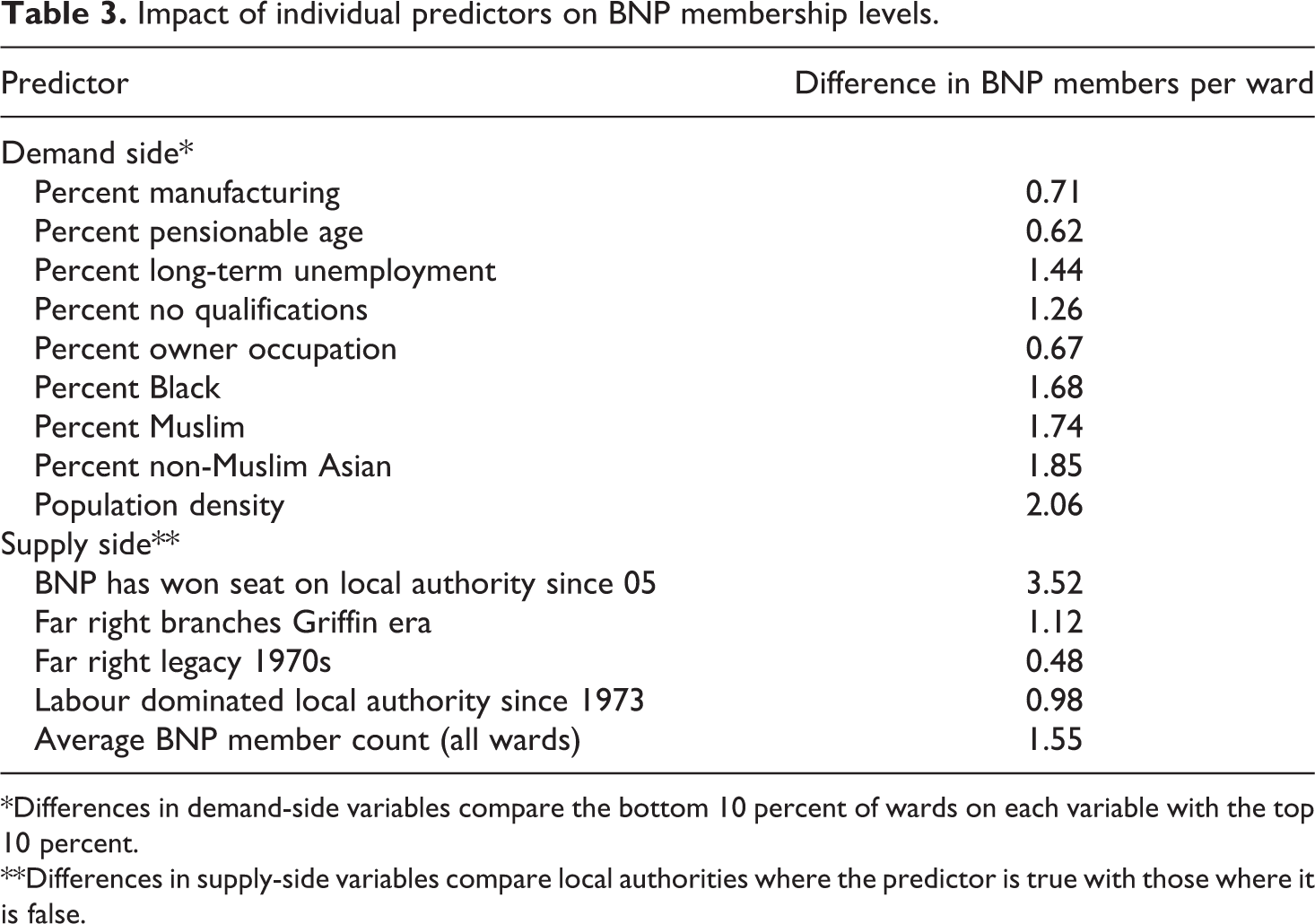
*Differences in demand-side variables compare the bottom 10 percent of wards on each variable with the top 10 percent.
**Differences in supply-side variables compare local authorities where the predictor is true with those where it is false.
Modelling BNP membership: Zero inflated negative binomial regression
Regression analysis allows us to determine the impact of the above variables more systematically. The discrete and non-negative properties of the dependent variable suggest using a count procedure to model underlying BNP membership. Although count variables are often treated as continuous and a linear regression technique is applied, this can result in inefficient and biased estimates (Hilbe, 2007; Long, 1997). For this reason, a count model like a Poisson model is the most appropriate modelling strategy. However, two major characteristics of our data preclude the employment of a standard Poisson model. First, this particular model assumes an equal distribution of data, where the conditional variance is assumed to equal the conditional mean (King, 1989). However, as is the case with our data, there is overdispersion in that the unconditional variance of the count variable – BNP membership – exceeds the mean. 14 In other words, there are more wards with higher numbers of members and more with zero members than would be predicted by a Poisson model (Long, 1997). One method of combating this is to employ a negative binomial regression model, which accounts for overdispersion by introducing an unobserved heterogeneity term for observation. 15 This modelling approach assumes that observations differ randomly in a way that is not fully accounted for by the observed covariates in the model. 16 As evident in Table 2, our descriptive findings reveal significant overdispersion in our data, which means that a negative binomial model is preferable to a Poisson model (Long, 1997). 17
The second characteristic of our data is that they are characterized by a very high incidence of zeros. In fact, over 40 percent of wards in our dataset have no BNP members at all. One weakness with a standard negative binomial model is that it can under-predict zeros, which is problematic when there is a high number of zeros in the distribution. 18 Therefore, we model zeros from two different processes: the binomial process and the count process (Long and Freese, 2006). In summary, this two-step process predicts, first, the membership in two groups (‘always zero’ and ‘not always zero’) and, second, the count in the ‘not always zero’ group. 19 It is also important to note that the unobserved heterogeneity that can result in overdispersion can also lead to excess zeros (Cameron and Trivedi, 1998). 20 However, because we suspect between-subject heterogeneity, a zero inflated negative binomial model is preferred over a standard zero inflated model. 21 The former incorporates a model of the zero incidence as well as a negative binomial count model. 22
The logit equation accounts for the first source of overdispersion by predicting the probability that a ward has no members. The negative binomial predicts the expected number (including zero) of members and accounts for the second source of overdispersion (heterogeneity) by including a Gamma-distributed error term within the conditional mean of the Poisson distribution (Long and Freese, 2006; Lubell et al., 2002). The equation for our zero inflated binomial regression model is written as follows (Hilbe, 2007; Lubell et al., 2002):


where

Here f(.) is the probability function for the negative binomial distribution and G(.) the cumulative logistic distribution (Hilbe, 2007). In our model, two sets of parameters are estimated. The first set (β parameters) is interpreted in the same way as a Poisson model. Therefore, a positive coefficient indicates an increase in ward membership, while a negative coefficient indicates a decrease. The second set (γ parameters) indicates changes in the probability of being in the ‘always zero’ group. Such coefficients are interpreted as parameters in a binary logit model and, therefore, one unit change in a predictor variable increases the probability of being in the group that always has zero counts (Long, 1997).
While we report these raw coefficients, it is also important to interpret the size of these effects. For the β parameters, this can be interpreted in the form of 100*(exp (β) – 1) as the percentage change in ward membership per one unit change increase in the predictor variable, holding other variables constant. For the γ parameters, they can also be interpreted using 100*(exp(β) – 1) but as the percentage change in the likelihood of belonging to the always zero group. In order to specify this model, we use all of our variables as predictors of high zero incidence given that we would expect the factors which reduce the counts of members in a ward to also increase the likelihood that each ward has zero members (Long and Freese, 2006). Given our reasons for including these variables in both equations, we would expect this to make substantive sense.
Analysis of results
Table 4 presents the results from our zero inflated negative binomial models of BNP membership. Model 1 includes only the demand-side predictors of membership, while Model 2 incorporates the supply-side. As we can see from Model 1, BNP membership is strongly correlated with several neighbourhood characteristics.23 Consistent with our expectations, members concentrate in urban areas, where education levels are low and there are large numbers of residents employed in manufacturing. For every one unit increase in wards of those who are employed in manufacturing, there is a 43 percent increase in membership (while holding other socio-economic variables constant). While membership is also more likely in wards where there are fewer pensioners, we find that an important measure of deprivation – long-term unemployment – does not emerge as a key driver of membership. Also, unlike findings on electoral support for the BNP we find that home-ownership is correlated with membership (although for every unit change increase there is only a 1 percent increase in membership).
Contextual predictors of BNP membership.
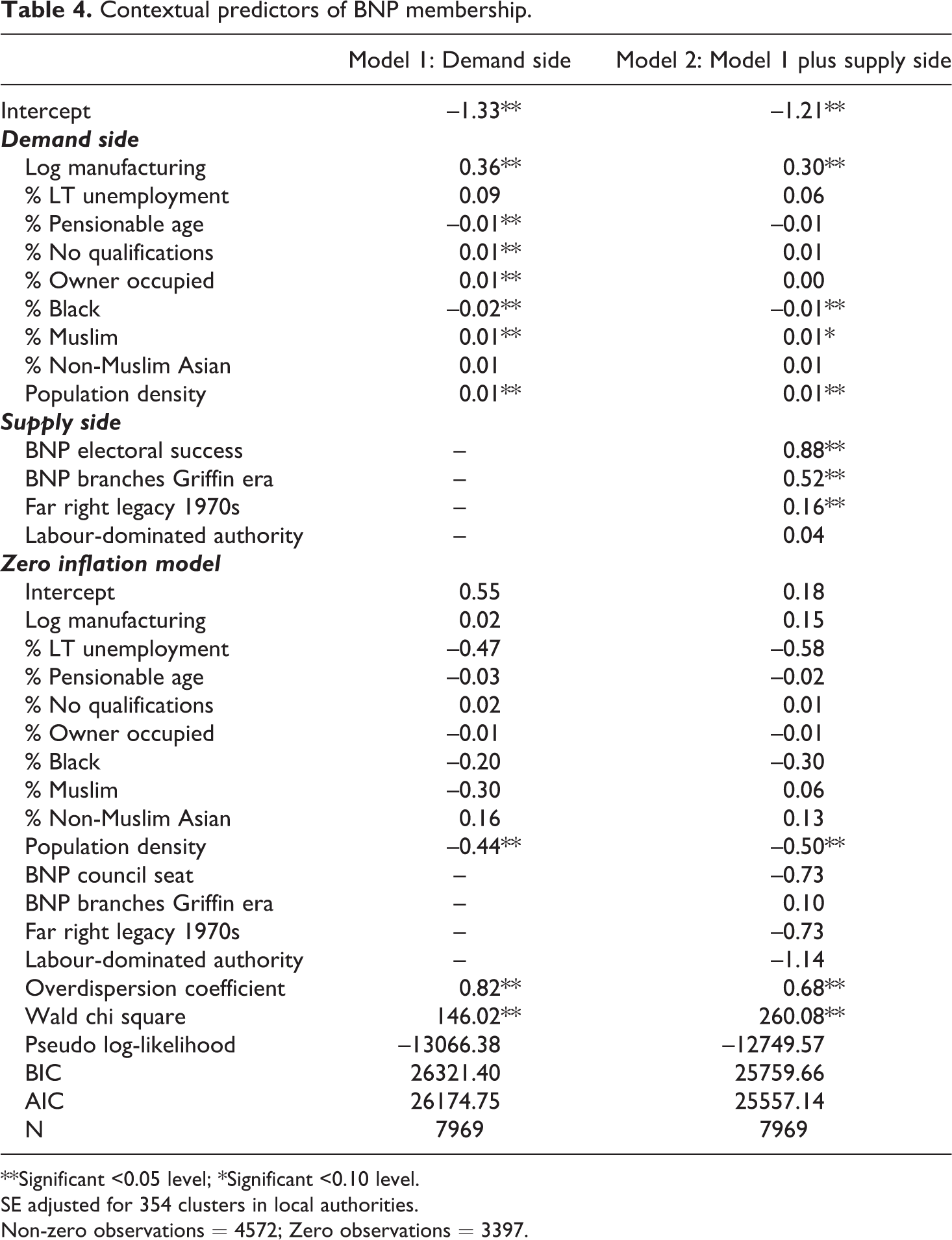
**Significant <0.05 level; *Significant <0.10 level.
SE adjusted for 354 clusters in local authorities.
Non-zero observations = 4572; Zero observations = 3397.
Turning to the effects of ethnic diversity, membership of the BNP is correlated with the presence of large Muslim communities in the local area. This suggests that citizens who are predisposed to endorse the extreme right’s ethno-nationalist stance may be stimulated to enrol as dues-paying members by living in close proximity to Muslim communities, which may enhance perceptions of threat. The significance of this relationship is underscored by the finding that the presence of non-Muslim Asians has no significant effect on membership, while membership is 2 percent lower in wards that have large numbers of Black Britons, holding other socio-economic variables constant. These findings confirm those produced in studies of BNP voting (Bowyer, 2008; Ford and Goodwin, 2010), further suggesting that while the appeal of the BNP is more subtle than the crude biological racism of its predecessor, the party’s embrace of anti-Muslim sentiment is important to explaining its recent support. More broadly, these results also highlight the importance of disaggregating different ethnic groups when examining support for contemporary ERPs, and lend further support to the argument that Black minority groups have become more accepted as part of British society and do not suffer as much from white hostility (Ford, 2008).
The second set of coefficients is from the equation that predicts the ‘always zero group’ and reveals only population density as significant. Urban metropolitan areas are less likely to be in the ‘always zero group’, while the odds of local authorities in rural areas having no members are 35 percent higher than urban authorities.
Model 2 adds the supply-side variables that measure local political context at the level of local authorities. The combined model is a significantly better fit to the data, revealing that the supply side adds significantly to our understanding of membership. Interestingly, once other factors are controlled we find little evidence to support the hypothesis that Labour domination at the local level has facilitated recruitment to the BNP. However, membership is significantly higher in authorities where the BNP has succeeded in winning a council seat, and has established branches since 2000.
These results point toward an important relationship between membership of the extreme right, local electoral success and activism, although the precise nature of this relationship requires further research. One possible explanation is that the party’s shift toward a community-based strategy and greater investment in recruitment has improved electoral prospects. Further evidence for this interpretation is found in qualitative research on the internal organization of the BNP. Since 2005, the party has developed a ‘voting membership scheme’ that incentivizes local activism by rewarding the most active members with influence over policy and strategy (Goodwin, 2011). An alternative explanation, however, is that election success attracts publicity, heightens perceptions of party credibility and encourages passive supporters to enrol as members. Clearly, it might also be that both effects are operating as part of a ‘virtuous circle’, whereby activism encourages success, fosters an image of legitimacy and encourages electoral dividends.
Our most important finding, however, is that in the combined model our measure of a ‘legacy effect’ is statistically significant. Membership of the modern BNP is significantly elevated (17 percent higher) in authorities where the old NF was active in the 1970s, holding other socio-economic and supply-side variables constant. This finding is especially intriguing given the fact that the earlier cycle of activism by the NF was markedly different from the BNP. Aside from offering Britons a toxic formula of biological racism, anti-Semitism and anti-democratic appeals, the NF also pursued a more violent strategy. Its emphasis on ‘march and grow’ prioritized provocative rallies and confrontation with left-wing opponents as a means of attracting publicity and recruiting new followers. While the BNP has actively sought to downplay this legacy, our findings suggest that its members continue to congregate in areas where the NF was active some 35 years ago, even after we control for ward-level characteristics.
Two mechanisms might account for this correlation. The first is that, within certain locales, the BNP has continued to depend heavily on long-standing networks of extreme right supporters. Following a change of leader and shift toward a vote-seeking strategy, the party may have recruited or reactivated individuals who share a longer history of involvement with right-wing extremist politics. This is supported by qualitative research on BNP members, which suggests that significant numbers have an extensive lineage within the extreme right. For example, Goodwin (2011) finds evidence that at least two-fifths of BNP candidates who contested the general election in 1983 had previously represented the NF at the general election in 1979. It may be that the post-2001 electoral rise of the BNP has attracted more of these activists back into the fold of ERP politics. This might also explain why the party has suffered recent electoral setbacks, after failing to convince large majorities of Britons who are concerned over immigration and dissatisfied with the performance of the main parties on this issue that it has fully abandoned its organizational origins (see below). An alternative interpretation is that certain contexts present an environment that is supportive of exclusionary and anti-immigrant campaigns. For example, both Husbands (1983) and Whiteley (1979) pointed toward local cultural and economic factors as explanations for disproportionately high levels of support for the NF in the East End of London, pointing toward the legacy of earlier movements such as the British Brothers League (BBL) and British Union of Fascists (BUF). It may be that our finding of a legacy effect is similarly a reflection of local cultural traditions, which render some areas especially susceptible to an exclusionary brand of politics.
Finally, it is worth noting that the significance of several of the demand-side coefficients changes once we control for supply-side factors. The impact of low education levels and living in wards with large numbers of pensioners is insignificant, which suggests that part of the impact of these variables may be mediated by differential patterns of past and present BNP mobilization. Yet ERP membership in Britain remains mainly an urban phenomenon within economically insecure areas. The ethnic context of local wards also remains significant: membership of the BNP is higher in wards with large Muslim populations, but is much lower in wards with large Black populations. This provides further evidence that anti-Muslim sentiment is a particularly strong motive for supporters of the modern extreme right, while the BNP recruits less support within areas where there are large numbers of Black Britons. However, notwithstanding these demand-side influences, our model suggests that membership of the BNP is driven principally by supply-side factors.
Conclusions
Over the past three decades, support for populist radical right and extreme right-wing parties across Europe has grown considerably. However, despite this trend, few studies investigate the factors that encourage membership of these types of parties. In this article, we have begun to address this gap by drawing on a unique dataset to investigate contextual predictors of membership of the BNP.
On the demand-side, and consistent with research on the electoral sociology of ERP support, we find that membership of the BNP is correlated with the socio-economic and political context of local neighbourhoods. Like BNP voters, members concentrate heavily in particular types of areas: they are urban, economically deprived, with large numbers of poorly educated voters and ethnically homogeneous wards. Our findings on the relationship between membership and ethnic diversity also corroborate those of existing studies revealing how the party has recruited members from similar contexts as voters. While members cluster in areas where there are large Muslim communities, there is a negative correlation between non-Muslim diversity and membership. As at elections (Ford and Goodwin, 2010), the BNP does not recruit more effectively in areas where non-Muslim South Asians congregate, while the presence of Black Britons is associated with lower membership. This suggests that the nature of ethnic threat is more nuanced than during earlier cycles of ERP mobilization, and that while other minority groups are becoming more accepted by the white majority, there remain more specific anxieties about the presence and perceived threat of settled Muslim communities.
On the supply side, and underscoring the importance of agency, membership is positively correlated with ERP activism in both the past and present. Membership levels are higher within local authorities where, in recent years, the BNP has contested local elections. The precise causality of this relationship remains unclear. While the party may be achieving success in areas where it has recruited local memberships, it might also be that electoral gains heighten an image of credibility and encourage recruitment. Alternatively, it is possible that both of these mechanisms are operating and contributing to a virtuous circle through which the party has gradually built local memberships, electoral support and legitimacy.
Our most important finding is evidence of a ‘legacy effect’, whereby an earlier cycle of activism by the NF emerges as a strong and significant predictor of modern membership of the BNP. In path-dependent fashion, the BNP has recruited strongest in areas where a more violent and confrontational party was active some four decades previously. While the BNP has actively sought to downplay this historic legacy and emulate the more successful populist radical right formula (Mudde, 2007), there remains strong continuity between its membership and the old NF. This finding offers one explanation for why the BNP has suffered recent electoral setbacks and has struggled to convince Britons it is an electorally credible and legitimate alternative. While in some areas the BNP has improved its electoral prospects by establishing a strong community-based presence, its heavy dependence on activists who are linked to a highly stigmatized tradition in British politics has arguably been a major contributory factor to the way in which majorities of Britons remain deeply hostile toward the party (Goodwin, 2011). More generally, our findings suggest that future research would be well advised to examine more closely the local political and social context in which ERPs operate, in particular the feedback dynamics that may gradually build membership and electoral representation and local conditions associated with repeated waves of ERP activism
Footnotes
Notes
Acknowledgements
The authors are grateful to Dr Paul Norman from the University of Leeds for his generous assistance with data collection, and also the anonymous referees for their helpful comments on an earlier version of the paper.
Funding
This research received no specific grant from any funding agency in the public, commercial or not-for-profit sectors.