




Abstract
The rise of Islamist movements in the Muslim world has been the subject of heated debate among scholars and policymakers. One group of scholars argues that Islamists use elections as a façade and warn against their political ascendency via electoral democracy. Another group of scholars, however, points to the moderating effects democracy has on views held by Islamists. This article does not present a novel theory but rather attempts to improve on existing studies by providing a test for the inclusion-moderation hypothesis using the data on Turkey collected by the World Values Survey. The findings from the Ordinary Least Squares (OLS) regression analysis, as well as in-depth face-to-face interviews with ranking members of the Islamist parties and communities in Turkey, show that Islamists develop positive attitudes toward electoral democracy to the extent that they are allowed to share power. Islamists’ support for democracy, however, seems to be fragmented, provisional and driven by pragmatism more than a principled commitment to democratic norms and values.
Keywords
Introduction
Scholars and observers have proposed alternative policies ranging from outright repression to participatory practices to address the demands from Islamists. The latter approach stems from the inclusion-moderation hypothesis, which contends that as Islamists interact with democratic institutions they experience a transformation and adopt a more moderate stance toward democracy. This incentive-based approach builds upon the premise that the emergence of political opportunities can provide for shifts in Islamists’ perspectives on democracy. Participation in democratic systems, as Tepe (2005) argues, causes religious parties to undergo ‘internal secularization’ by redefining and reinterpreting religious ideas and practices to accommodate secular ideas. As they participate in the democratic process they evolve and thereby experience a transformation, with previous ideals and goals becoming subject to the internal logic of the game of democratic bargaining (Mufti, 1999: 114). This process leads to changes in discourse and, as Nasr (1995: 283) argues, leads Islamist parties (even those with revolutionary goals and discourses such as Jama’at-i Islami of Pakistan) to become a part of the system they seek to replace. In a similar vein, Wickham (2004), in her analysis of a splinter group from the Muslim Brotherhood, Wasat Party, concludes that despite some inherent tensions between the party’s democratic and Islamic commitment the party has moderated its core values and beliefs. For example, Wickham (2004: 219) states that, ‘in the campaign for democracy and human rights, issues that were initially of only instrumental importance metamorphosed into matters of principle. For example, what began as opposition to the torture of suspected Islamic militants became opposition to torture as a basic violation of human rights, regardless of the identity of the perpetrators or the victim’.
The critics have countered with several arguments; they state that there is lack of a normative commitment to democracy among Islamists (Baran, 2008; Tibi, 2008); that there is a lack of empirical evidence and clearly specified causal mechanisms for change (Schwedler, 2006); and, finally, that there is no consensus for what moderation entails. While some (Schwedler, 2006, 2011) conceptualize moderation as a process of moving away from a rigid world-view to a more tolerant and open one, others distinguish ideological moderation from behavioural moderation. The former, according to Tezcur (2010a: 10), refers to a process that results in ideas that do not contradict the principle of popular sovereignty, political pluralism and limits on arbitrary rule. Behavioural moderation, on the other hand, concerns the adaptation of electoral strategies aimed at seeking compromise and non-violent settlement of disputes (Tezcur, 2010a: 10; also see Ashour, 2009; Wickham, 2004).
Further, the causal mechanisms for how moderation occurs are yet to be specified. Wickham (2004: 207) ascribes the ‘change in leaders’ core values and beliefs’ to factors such as strategic calculations, institutional opportunities and interactions with secular oppositional groups that pursue common goals. Albrecht (2005), in a similar vein, stresses authoritarian regimes’ survival strategies ranging from coercion to co-optation as important explanatory factors in shaping political opposition. Tezcur (2010a) challenges the assumed direct and linear causal relationship between participation in an electoral system and ideological moderation. Drawing distinctions between ideological and behavioural moderation, Tezcur (2010a: 15) argues that ideological moderation may not necessarily be a product of political inclusion; rather it can take place in diverse political settings and be conditioned by country-specific features.
Despite the lack of consensus on the link between inclusion and moderation, scholars have used this thesis to explain the emergence and evolution of Islamist groups in countries with such diverse socio-economic and political trajectories as Turkey (Dagi, 2008; Kuru, 2007; Tepe, 2005; Tezcur, 2010a; Turam, 2006; Yavuz, 1997, 2003), Jordan (Clark, 2006; Mufti, 1999; Robinson, 1997; Schwedler, 2006), Egypt (Albrecht, 2005; Wickham, 2004), Pakistan (Nasr, 1995) and Yemen (Schwedler, 2002, 2006). This article does not offer a novel theory but rather provides a stringent test for the inclusion-moderation hypothesis using the data on Turkey collected by the World Values Survey (WVS). I focus on Turkey for several reasons. Turkey, as the first Muslim-majority democracy, has a history of democratic practices (Somer, 2011) along with an industrial market economy – two components which current studies identify as being key to favourable attitudes toward democracy. The emergence and evolution of Islamists in Turkey has also been the subject of numerous scholarly works. The Islamist transformation from Necmettin Erbakan’s conservative National Salvation Party (Milli Selamet) in the 1970s to a more moderate Justice and Development Party (Adalet ve Kalkinma Partisi, AKP), led by Recep Tayyip Erdogan, represents a prime example in these existing studies (An-Naim, 2008; Dagi, 2008; Kuru, 2005; Sakallioglu, 1996; Tepe, 2005; Tezcur, 2010a, b; Turam, 2006; Yavuz, 1997, 2003, 2009). During the popular uprising that started in Tunisia and later spread to the largest Arab country, Egypt, in January 2011, several observers pointed to the ‘Turkish Model’ as a way of incorporating Islamist groups into the new regime (Cagaptay, 2011; Thomas, 2011). The Turkish model therefore merits analysis in that it ‘sets an example of what is possible for the integration of Islamic movements into a relatively democratic political system’ (Yavuz, 1997: 63).
Model specification and data
The interaction between the staunchly secularist elite and the Islamists in Turkey has gone through important changes since the 1970s. The Islamists have faced serious challenges from the powerful secularist elite yet have been able to survive and emerge stronger over time. The resolutely secularist/military elite forced the Islamist Welfare Party (Refah Partisi)-dominated coalition government to resign in 1997. Erdogan’s AKP, however, has succeeded in winning three consecutive elections and forming majority governments since 2002. With a focus on Turkey, this study addresses the important question of whether Islamist groups are actually transformed by democratic inclusion.
To accomplish this I utilize data collected by the WVS for Turkey in 2000 and 2007. The surveys were conducted following parliamentary elections in 1999 and 2007. The data are based on national probability samples of 3,401 and 1,346, respectively. More specifically, I analyse attitudes toward democracy among the supporters of the Virtue Party (Fazilet) and those that support the AKP. Rooted in political Islam, these two parties were formed and led by the same cadres. The leadership formed the Virtue Party (Fazilet) following the closure of the Welfare Party (Refah), the main partner in the 1997 coalition government that the Constitutional Court outlawed in 1998 for violating secularist principles. Nonetheless, this party too came under pressure after the 1999 elections and was later declared unconstitutional based on similar grounds. Following their closure, two parties emerged to represent this movement. Islamists that remained loyal to Erbakan – the leader of the movement since the 1970s – formed Saadet (Felicity Party), while Tayyip Erdogan formed the reformist AKP. Saadet, however, has failed to garner enough voter support to win any seats in the parliament, while the AKP has won the last three elections and formed majority governments.
Dependent variable
Moderation, as Ashour (2009) argues, often refers to developing positive attitudes toward democracy and democratization; with the acceptance of political pluralism as an important indicator of ideological moderation and participation in electoral politics as a sign of behavioural moderation. Therefore, in this article, I opt to utilize these two components to measure if and to what extent Islamists have moderated their views as a function of participation/inclusion.
To gauge behavioural moderation, I rely on the most recent data from the World Values Survey. The respondents’ attitudes toward democracy are measured with a set of statements. I utilized the data on two items from the 2000 survey to gauge attitudes toward democracy. The respondents were asked to rank democratic political systems on a scale ranging from 1 to 4, where 1 means ‘very good’ and 4 indicates ‘very bad’. The responses to the second statement (‘democracy may have problems but is better’) take values from 1 (strongly agree) to 4 (strongly disagree).
In 2007 the WVS invited respondents to express agreement or disagreement with two statements (‘democracy: people choose their leaders in free elections’ and ‘democracy: civil rights protect people’s liberty against oppression’), with the responses based on values ranging from ‘1’ (not an essential characteristic of democracy) to ‘10’ (an essential characteristic of democracy).
Ideological moderation, according to Wickham (2004: 205), entails ‘change in core values and beliefs’; hence it is difficult to observe and put to a test against large-N data. To measure this aspect of moderation, I present the data from in-depth face-to-face interviews with members of the AKP; Saadet, the smaller and arguably more conservative Islamist political party; and members of Islamists communities in Turkey.
Independent variables
I use the term Islamist to refer to those parties (e.g. Fazilet and AKP of Turkey) rooted in political Islam. It should be noted that it is difficult to compare the constituency of the Fazilet with those supporting the AKP. The latter’s voter base has expanded significantly including non-Islamists such as the liberal democrats, who lend support to the AKP for the economic and political reforms it has undertaken since 2002 (see, for instance, Baran, 2008). Nonetheless, despite the AKP’s denial of being an Islamist party, it has been described as Islamist (Baran, 2008; Tibi, 2008) or at least a party with roots in political Islam (Cavdar, 2006; Yavuz, 2009).
The WVS does not directly identify Islamists, but it does provide crucial information about respondents’ political preferences. Keeping these issues in mind, I used responses for ‘which party would you vote: first choice’ to encode answers provided by those who voted for Islamists. The Islamist variable was set at ‘1’ if the respondent voted for Fazilet in 1999 and AKP in 2007, and ‘0’ if otherwise. Of the 1,346 respondents that participated in the survey in 2007, 456 of them voted or expressed their support for Islamist political parties. 1 The remainder of the sample voted or expressed support for other parties, such as the Republican People’s Party (CHP), the True Path Party (DYP) or the Motherland Party (ANAP). While these parties differ on several important issues, they are all known for their strong support for secularism, and they had all dominated Turkish politics until the AKP’s rise to power in 2002. 2
Control variables
I utilized the data provided by the WVS for each respondent to measure income and education variables. The income variable is measured using the social class indicator as reported by the WVS. This is based on each respondent’s subjective evaluation and ranges from ‘1’ (upper class) to ‘5’ (lower class). The education variable ranges from ‘1’ (no formal education) to ‘9’ (university with degree) in the 2000 survey. This variable for the year 2007 is measured on a scale of 1–8, where ‘1’ means inadequately completed elementary school and ‘8’ indicates university with degree. Following the literature (Norris and Inglehart, 2004; Tessler, 2002) I utilized measures for age and gender as controls. The age variable is measured in years and gender is dichotomized (1=Male and 2=Female). In addition to these controls, I included a measure of religiosity to the model in order to distinguish Islamists from those who identified themselves as religious, yet may not have voted for the Islamist parties. A simple analysis of the data confirms this expectation; about 80 percent of the respondents identified themselves as ‘religious’ in both 2000 and 2007, a number that does not match the actual support for the Islamist parties. This variable takes values of ‘1’ (religious), ‘2’ (non-religious) or ‘3’ (atheist). Due to the focus of this study and a very low percentage of atheists in the sample, I recoded this variable by generating a dichotomous variable, with (1) representing a religious person, (0) a non-religious person. 3 The descriptive statistics are presented in Table I.
Summary statistics for the independent variables.
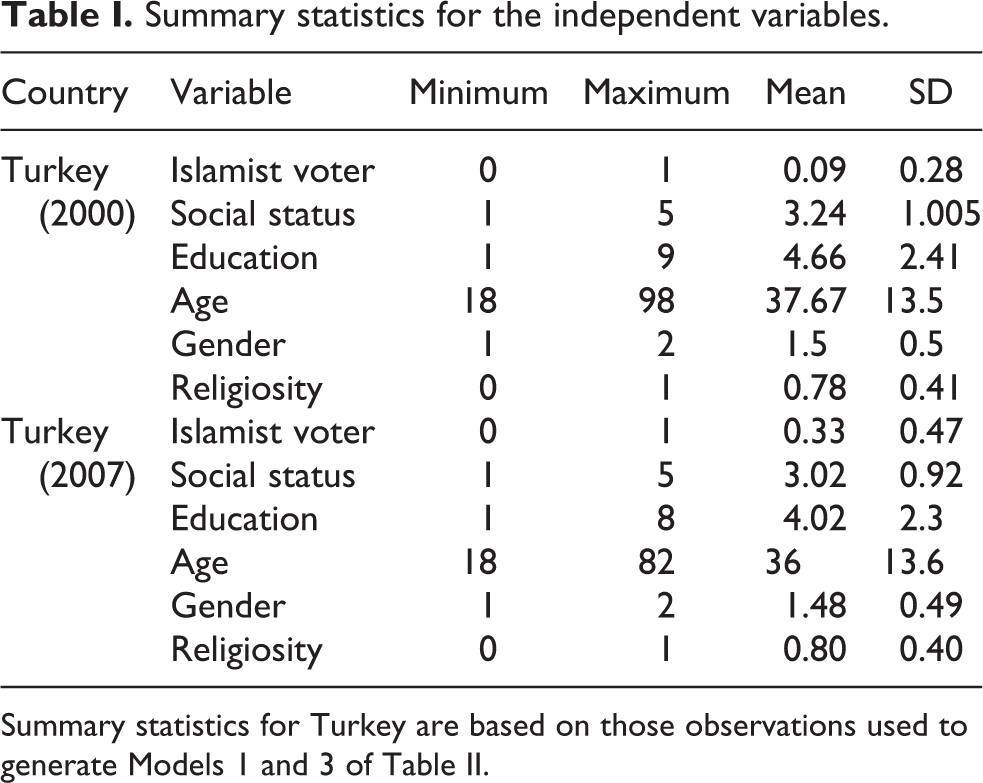
Summary statistics for Turkey are based on those observations used to generate Models 1 and 3 of Table II.
Analysis
To discern the relationship between the outcome variable and sets of explanatory variables, I employ a series of Ordinary Least Squares (OLS) multiple regressions. 4 Before presenting the results from these regressions, however, I provide a simpler analysis that sheds a preliminary light on the linkage.
The data from the WVS conducted in 2000 show that support for democracy in Turkey is significantly lower among Fazilet supporters. When asked to rank democratic political systems on a scale ranging from very good (1), fairly good (2), bad (3) and very bad (4), the mean for those who expressed support for the Fazilet was significantly higher than that of those who voted for other parties (1.74 vs. 1.60; Pr T < t = 0.003). The use of an alternative statement (‘democracy may have problems but is better’) with values spanning from strongly agree (1), agree (2), disagree (3) and strongly disagree (4) to gauge attitudes toward democracy yielded a similar result.
Next, I employed an OLS regression to illuminate what factors account for the variation in attitudes toward democracy. The results are displayed in Table II. The outcome variable in Models 1 and 2 is measured on a scale from 1 to 4, with lower numbers indicating a higher level of support for democracy. The OLS regression results show that those who expressed support for Islamist Fazilet of Turkey are significantly less supportive of democracy than those who expressed support for other political parties. This finding holds regardless of what measure is utilized to gauge attitudes toward democracy.
Multiple regression results for attitudes toward democracy in Turkey.
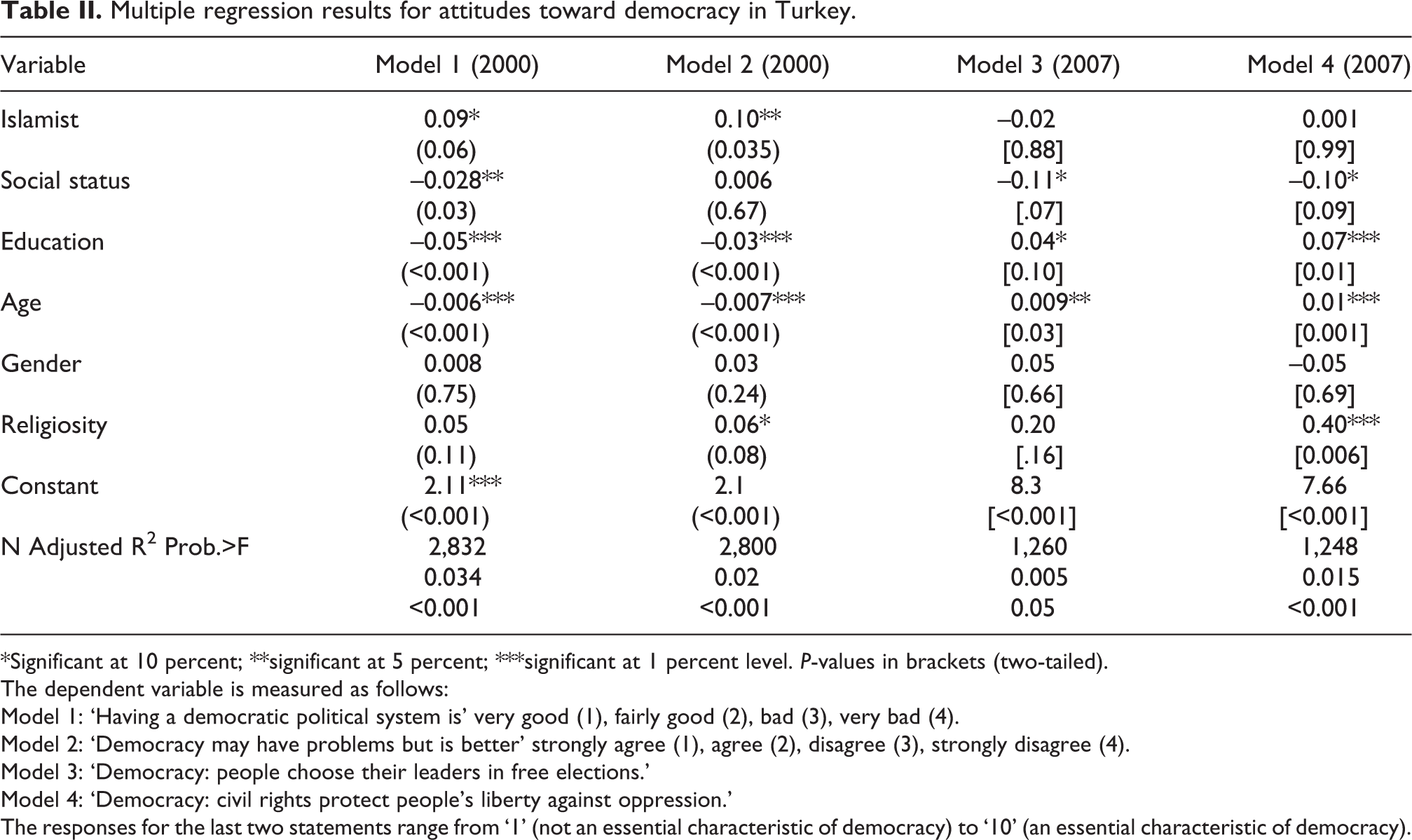
*Significant at 10 percent; **significant at 5 percent; ***significant at 1 percent level. P-values in brackets (two-tailed).
The dependent variable is measured as follows:
Model 1: ‘Having a democratic political system is’ very good (1), fairly good (2), bad (3), very bad (4).
Model 2: ‘Democracy may have problems but is better’ strongly agree (1), agree (2), disagree (3), strongly disagree (4).
Model 3: ‘Democracy: people choose their leaders in free elections.’
Model 4: ‘Democracy: civil rights protect people’s liberty against oppression.’
The responses for the last two statements range from ‘1’ (not an essential characteristic of democracy) to ‘10’ (an essential characteristic of democracy).
Following a similar strategy, I analysed the data from the survey conducted in 2007. The tabulation analysis shows that an overwhelming majority of the respondents express significant levels of support for democracy, as measured by the WVS in 2007. The outcome variable (‘democracy: people choose their leaders in free elections’) ranges from ‘1’ to ‘10’ with a mean of 8.6 and a standard deviation of 1.89. Of the total sample that was used to generate Model 3 of Table II, less than 10 percent scored 5 or lower on the scale of ‘1’ to ‘10’, with higher numbers indicating greater support for democracy. This high mean, however, does not necessarily reflect Islamist attitudes toward democracy as it includes all respondents regardless of political preference. The question, therefore, remains: Do Islamists in Turkey differ in their attitudes toward democracy than secularists?
The results from the t-test reveal the mean score for the dependent variable (‘democracy: people choose their leaders in free elections’) for Islamists is slightly lower (9.07) than that of secularists (9.08). The difference, however, is statistically insignificant (Pr T>t=0.27). An analysis of ‘democracy: civil rights protect people’s liberty against oppression’ yields similar results. The mean for this variable for Islamists is almost exactly the same as the mean for secularists (8.353 vs. 8.358, respectively). Controlling for the effects of other variables produces similar results. As presented in Models 3 and 4 of Table II, the difference between the attitudes toward democracy among Islamists and secularists is not significant.
The findings show that participation does assist in the adoption of favourable attitudes toward democracy, a conclusion that lends some support to the inclusion-moderation thesis. Nevertheless, Islamist demands also appear to be shaped by the quality of democratic participation (i.e. whether there is a real chance of winning elections) and by whether they are in the opposition or in government.
The 2000 survey was conducted under a political atmosphere in which the military orchestrated a series of measures against the Islamist-dominated coalition government, which was forced to resign. Additionally, the political party Refah was shut down a year later. Fazilet, as the successor to Refah, participated in the 1999 elections and entered parliament as the third largest party. The military and its allies in the media, however, warned against Fazilet’s victory and stated that it would not be given a chance to form a government even if it emerged victorious (Yavuz, 2009: 71). Furthermore, Fazilet was closed shortly after the elections based on it being the continuation of the Refah.
Some have pointed to the secularist elites’ pressure as a force behind changing attitudes toward democracy among Islamists (Dagi, 2008; Tezcur, 2010b). Nevertheless, Islamists under the AKP have for the first time been given a real opportunity to govern without military interruption of electoral politics. The comparison of attitudes toward democracy among AKP supporters to those held by the Fazilet supporters provides an important basis for testing.
The questions/statements used by the WVS, however, may not capture the changes, if any, in Islamists’ views of democratic norms and values (see, for instance, Tezcur et al., 2012). Ideological moderation, as discussed earlier, involves ‘change in core values and beliefs’ (Wickham, 2004: 205), an element that is difficult to observe and put to a test against large-N data. To provide a better test for this change, I conducted interviews with dozens of members of Islamists parties and communities in the summers of 2009 and 2010.
To make the sample as representative as possible, I selected the interviewees from Istanbul, the largest and most diverse city in the country; Izmir, the third largest city, which is historically known for its support for the Republican People’s Party and other secularist parties; and Diyarbakir, the largest city in the southeastern part of the country with an important amount of support for the Kurdish insurgency. The sample includes six members of the governing Justice and Development Party, including members of parliament, mayors and chairman of local branches, 5 and one member of the smaller yet more conservative Islamist party, Felicity (Saadet).
In addition, to better capture the ongoing internal debates within Islamist circles and communities, I conducted interviews with 16 members of the influential Nurcus (the single most influential religious social movement in Turkey) and other Islamist communities. 6 These interviewees include medical doctors, teachers, businessmen, judges and journalists; representing well-educated and accomplished members of the booming new middle class. Most of these interviews were held in either the interviewees’ offices or at a public place of their choice, and lasted about an hour. On one occasion, the author attended a meeting held by over 20 members of Zehra, a smaller Nurcu group, with a lively and heated debate on democracy, human rights and minorities.
These interviews revealed that the support for democracy seems to be fragmented and provisional. Those interviewed shared somewhat paradoxical viewpoints in regard to democracy and potential threats to it. Many of their conflicting opinions seemed conditioned by the unique politics of Turkey, especially in the realm of minority politics, although this could also be a symptom of the Islamists’ self-professed blindness toward ethnic identity and their unwillingness to address issues of ethnicity.
By and large, the respondents viewed democracy in terms of holding free and fair elections. The interviewees stressed the importance of people’s participation and the respect for the people’s choice as the key components of democracy. Responses to ‘to what extent do you agree with the following statement: There can be democracy without political parties’ were invariably ‘strongly disagree’, vindicating the statistical results and the support for electoral democracy. When they were asked ‘in a few words, what does democracy mean to you?’ responses centred around such concepts as ‘people’s participation’, ‘justice’ and ‘equality’. They also revealed their distaste for military intervention in electoral politics. When asked, for instance, ‘in your opinion, what is the most serious problem the country faces in regard to democracy?’ several respondents identified ‘military intervention’ as the most serious obstacle against democracy.
Beyond these simple opinions on democracy, it is difficult to ascertain whether Islamists possess a substantial normative commitment to democratic norms and values. Their attitudes toward minorities, as some scholars (Clark, 2006; Brown and Hamzawy, 2010; Schwedler 2006) have argued, can work as a litmus test for Islamists’ commitment to liberal values. The responses to questions regarding ethnic and religious minorities in Turkey reveal some clues. The same interviewees, who were eager to criticize military intervention into electoral politics on the grounds of self-determination, became vague and hesitant when answering the questions regarding ethnic (e.g. Kurdish) and religious (e.g. Christian and Jewish) minorities. When asked ‘some people argue that the Kurds, Alawites, and the Christians do not enjoy the same amount of political, religious, and cultural freedom as the majority ethnicities and religions. Others argue that these minorities are as free as the majority. With which point of view do you agree more?’ the answers were noticeably curt and centred around ‘in principle we believe all citizens should have the same rights’ without elaborating on the subject. One of the interviewees, a member of the AKP, argued vehemently that democracy was about what the people want; yet when he was asked about the grievances of the Kurdish minority in Turkey he simply said that ‘it is a separate issue’, essentially avoiding the question.
The common practice within the Islamist parties, especially Islamist circles, such as the aforementioned Nurcus, is to avoid such vital issues. Within these circles it is quite common to hear that ethnic nationalism is simply not compatible with Islam, and in this way undermine the demands for political and civil liberties for minorities. The extension of cultural rights to the Kurdish minority, for example, is dealt with by Islamists within the broader Islamic identity. Islamists in Turkey tend to emphasize Islamic identity over the Kurdish ethnic identity without compromising their Turkish national identity. Similarly, Islamists in Turkey like to advocate themselves as the champion of women’s rights; yet, similar to what Brown and Hamzawy (2010) argue regarding the Muslim Brotherhood in Egypt, they tend to give priority to the religious rights of Muslim women, such as the right to veil, and fail to offer principled support for women’s rights in Turkish society.
That said, it would be a mistake to associate the lack of a pluralist culture among the Islamists in Turkey to Islam per se. Secularists, for that matter, do not differ much. The Kemalist revolution attempted to create an alternative value system for the masses (Mardin, 2006). It has been much more successful than its counterparts in the Muslim-majority countries to penetrate into its society and achieve social and cultural transformation. Nonetheless, there are strong anti-democratic elements in the Turkish political system. Therefore, just as it is inappropriate to treat modern Turkey in isolation from its past, it is equally inappropriate to assume that Islamists in modern Turkey and elsewhere can fully escape the social, economic and political environment in which they operate. Thus, the Islamists’ views and attitudes toward democracy, to an important extent, are influenced by the Kemalist state institutions and tamed by the prevalent norms and values associated with them. 7 For instance, Islamists’ views toward the Kurdish minority’s demands for greater political and civil liberties, an issue that Tezcur (2010a: 193) argues to be ‘a litmus test of democratic consolidation in Turkey’, are treated within the context of the nation-state, which is foreign to Islam. Islamists treat the national borders that were, to some extent, imposed upon Turkey following the collapse of the Ottoman Empire in the aftermath of World War I as sacred. 8 They do not hesitate to treat the fight against the Muslim Kurdish insurgents as a holy war and treat the soldiers who are killed in the fight against the Kurdish insurgents as martyrs.
As such, support for democracy seems to be provisional and conditioned by whether Islamists are in power or what issue is at stake. As one of the interviewees, a member of the smaller and arguably more conservative Islamist party Saadet said, support for democracy is a function of whether one agrees with or is opposed to the party in power. The results from this study show that Islamists have internalized institutional democracy, an outcome that appears to be a function of participatory politics and Islamists’ position within the system. Whether this participation will generate a pluralist culture among Islamists is yet to be seen. Islamists’ views and attitudes toward a culture of tolerance and political pluralism are still evolving with important contradictions and ruptures. This vindicates Somer’s (2011: 511) conclusion that moderation ‘is not a linear and inexorable process’ that results from ‘participation or socioeconomic development’, but ‘occurs through ruptures, such as conflicts with secular actors, and interdependently through the interactions of secular and religious actors’.
The findings derived from the social status and education variables support those scholars who argue that socio-economic factors are better predictors of democratic attitudes, even among Muslim populations (Norris and Inglehart, 2004; Tessler, 2002). These two variables are significant in the expected direction regardless of how the outcome variable is measured.
The finding on the religiosity variable is significant in Models 2 and 4, indicating a negative relationship between this variable and attitudes toward democracy in 2000 and a positive one in 2007. This variable, as explained earlier, does not necessarily reflect support for the Islamists. Nevertheless, it furnishes evidence that points to the dissatisfaction of those who identify themselves as ‘religious’ with the democratic system in 2000. In 2007, however, it indicates that a positive relationship exists between being a religious person and having a favourable attitude toward democracy, defined in terms of protecting people’s liberties against oppression (Model 4). The findings on the age variable indicate that older respondents seem to have more positive attitudes toward democracy than younger respondents.
Conclusions
This study seeks to contribute to the ongoing debate on Islamists by subjecting the inclusion-moderation thesis to a large random sample from Turkey. Therefore, it aims to bridge the rich qualitative studies with the large-N quantitative studies. There are a few cautionary notes that the reader should bear in mind while interpreting the findings from this study. First, large-N quantitative studies may fare poorly in mapping out the dynamic relationship between the Islamists and the state. Therefore, one should interpret the results from this study within the context of the large number of rich qualitative studies on the issue.
Second, the Turkish case might be unique ‘with little chance to emulate’ (Cavdar, 2006: 497). The Kemalist state and revolution from its outset has been more of a cultural and social revolution. Modern Turkey, in addition to the republican elites’ conscious efforts to transform cultural, social and political life, also inherited an estimated 93 percent of the Ottoman military officers and 85 percent of the empire’s trained civil servants (Rustow, 1964: 388). Turkey as the heir of the centuries-old Ottoman state legacy shows important qualitative differences from the typical Muslim-majority states, most of which came into being in the mid-20th century (Anderson, 1987).
Third, participation of the Islamist groups/parties in the electoral system, i.e. moderation of them, as some studies (e.g. Albrecht, 2005; Tezcur, 2010a, b; Wegner and Pellicer, 2009) have noted, may not be the harbinger of democratization and/or consolidation of democracy. Albrecht (2005), for instance in his analysis of the Islamist movement in Egypt, concludes that the authoritarian regime’s survival strategies have turned these groups into tools to stabilize and/or legitimize the regime. Wegner and Pellicer (2009) conclude that the participation of Morocco’s Party of Justice and Development in the limited electoral process has not resulted in a notable increase in civil and political liberties. Rather ‘liberalization in Morocco has been partially reversed, partly as a result of the rising Islamist strength’ (Wegner and Pellicer, 2009: 157). Tezcur (2010a: 176) warns against the timid and conciliatory approach adopted by Islamists as an important obstacle to successful democratization as democratization often requires decisive, risk-taking and confrontational actions. 9
Lastly, it should be noted that the results from the statistical analysis might fail to capture the change in Islamist parties’ attitudes toward democracy as the AKP’s constituency has become broader and more diverse. The AKP’s support base is not limited to Islamists; it also includes many of those known as liberal democrats. The Islamists and devout Muslims back the AKP with the expectation that it can deliver on ‘unstated and unfulfilled’ promises. The liberal democrats, on the other hand, have lent their support to the AKP for the economic and political reforms it has undertaken since 2002 (Baran, 2008: 56). The change might be a product of changes in the size and composition of the voters. 10 Thus, this study might be measuring changes in the values of voters since 2000, which may not necessarily provide a direct test for moderating effects of participation. That said, political parties tend to move away from rigid ideological world-views as they compete for public support in elections. In other words, constituency values can become a critical factor in shaping party orientations as electoral considerations provide incentives to abandon radical views and embrace more moderate views in order to appeal to a larger segment of voters (see, for instance, Tezcur, 2010a). Thus, despite some theoretical and empirical limitations which can weaken the validity of the findings, the results from this study suggest the possibility of a value change as Islamists interact with democratic institutions and practices.
Footnotes
Funding
This research received no specific grant from any funding agency in the public, commercial or not-for-profit sectors.