



Abstract
Previous research claims that there is a significant relationship between party systems and democracy. Although party system institutionalization is seen as a necessity for democratic consolidation, the effects of different party system characteristics on democracy are sharply contested. This study contributes to this debate through a systematic analysis of the relationship between two party system characteristics (party fractionalization and party polarization) and level of democracy. It is found that party polarization is positively related to the level of democracy in a country, i.e. the higher level of party polarization can produce the higher level of democracy. It is found, however, that there is no significant relationship between party fractionalization and level of democracy in a country.
Introduction
Political parties are regarded as being necessary for the effective functioning of democracy. They play an important role in the selection of official personnel, formulation of public policies, conductors or critics of government, political education and intermediation between individual and government (Scarrow, 1967). All are conducive to democracy and therefore democracy without parties is difficult to imagine. Similarly, the institutionalization of the party system has been widely viewed as a prerequisite for the consolidation of democracy. However, the effects of different party system characteristics on democracy have been sharply contested. For instance, some scholars argue that multiparty systems decrease the clarity of choices before voters; they undermine governmental accountability and responsibility and polarize the political landscape. Others contend that multiparty systems enhance the quality of democracy in a polity by increasing the choices before voters, augmenting the representation of different groups and mitigating the likelihood of civil strife (Kuenzi and Lambright, 2005). As a result, this study attempts to clarify the relationship between party system characteristics and democracy.
One of the most widely examined characteristics of party systems is the counting of political parties. It is not hard to imagine why scholars pay more attention to the number of political parties, because a party system consists of regular and recurring interactions among its component parties, which implies the importance of the number of political parties within a party system. However, Dalton (2008) argues that instead of counting the number of parties, a more important characteristic of party systems is the quality of party competition, i.e. the polarization of political parties within a party system. Although the number of political parties has proved to be one of the more powerful theoretical and empirical concepts in explaining the workings of democratic process (Klingemann, 2005; Lijphart, 1999), there is no empirical test by which to simultaneously examine the effects of the number and polarization of political parties on democracy. Therefore, this study attempts to investigate the relationships between these two party system characteristics and the level of democracy.
The study proceeds as follows. I begin by discussing the relationship between party system and democracy in the research literature and introduce the measurement of variables as well as methodology before presenting the empirical analysis and discussing the results. Finally, I summarize my findings and list some implications of the study.
Party system and democracy
Sartori’s influential study (1976) suggests that party systems be compared in terms of the number of their parties and their degree of polarization. In other words, it is known that party fractionalization and party polarization are two of the most important party system characteristics. According to Powell (1982: 80), party fractionalization can be defined as the degree to which electoral support or legislative representation is divided among various political parties, and the effective number of parties provides a measure of party fractionalization by counting parties weighted by their shares of votes or seats. In contrast, the concept of polarization has developed from the spatial model, and party polarization reflects the distribution of parties along an ideological dimension (Dalton, 2008). Although some scholars argue that there is a high correlation between party polarization and party fractionalization based on the assumption that the number of parties reflects the degree of polarization within a party system, Sartori has reiterated that polarization is not a positive, linear function of fragmentation. Low levels of polarization can be found in highly fragmented party systems; meanwhile high levels of polarization can be found in non-fragmented party systems (see Pelizzo and Babones, 2007). Besides, Dalton (2008) finds that these two party system characteristics can vary almost independently of one another and that there are empirical differences in the correlates of party fractionalization and party polarization. As a result, it is obvious that party fractionalization and party polarization are two different and distinctive dimensions for discriminating among party systems. To use Dalton’s words, party fractionalization tells us about the quantity of party systems; however, party polarization shows us about the quality of party systems.
As said above, party fractionalization reflects the effective number of political parties in a party system and empirical researchers have often adopted two different methods to count the number of political parties to give weight to the relative size of political parties, rather than just their absolute numbers. The first method is the Herfindahl index that is calculated from statistics on the relative size of political parties, and can be interpreted as the probability that two deputies picked at random from among the legislative parties will be of different parties, with higher values indicating a less fractionalized party system (Dalton, 2008). 1 The alternative method is the Laasko–Taagepera index measuring the effective number of political parties (Laakso and Taagepera, 1979). The Laasko–Taagepera index is simply the inverse of the Herfindahl index, counting the number of political parties weighted by size to discount the relevance of small parties (Dalton, 2008). 2 In other words, these two measures are essentially interchangeable. On the other hand, party polarization reflects the degree of ideological differentiation among political parties in a system (Dalton, 2008). The number of parties may be equivalent in two party systems, but it does not mean that they must have the same degree of polarization. In other words, party polarization in two party systems with the same number of parties can vary substantially.
The purpose of this study is to examine the effects of party fractionalization and party polarization on the level of democracy in a country, and previous studies have provided us with some ideas to build the theoretical framework to explain their relationships. First of all, with regard to party fractionalization, Lijphart (1999: 62) believes that the difference between single-party majority governments and multiparty coalition governments is the most important difference between his two competing visions of the democratic ideal – majoritarian and consensus democracies. Majoritarian democracy emphasizes the principle of majority rule and the concentration of power, creating sharp divisions between those who hold power and those who do not, and it does not allow the opposition to have much influence over government policy. Consensus democracy, on the other hand, attempts to represent as many citizens as possible and emphasizes that a simple majority should not govern in an unfettered fashion. To put it another way, consensus democracy disperses power so that there are multiple poles of decision-making and multiple checks and balances, thus limiting the power of the central government while providing for the representation of a broader array of interests. According to Lijphart, consensus democracy performs better than majoritarian democracy on all his quantitative and qualitative indicators of democratic qualities. In Lijphart’s view, the existence of multiple political parties lays the foundation for consensus democracy, because it provides citizens with a choice as to who will govern their country, and enables minorities to attain meaningful representation and to participate in governing coalition. Specifically, Lijphart argues that in ‘plural’ societies with sharp cultural, ethnic, religious or linguistic cleavages, multiparty systems could be more propitious in promoting stable democracy. Carey (1997: 67-68) also argues that a broader range of winning parties leads to greater representation of diverse values. Besides, Kuenzi and Lambright (2005) examine the relationship between party system characteristics and the level of democracy in 33 African countries, and find that party system competitiveness, measured by the effective number of parties, has a positive association with democracy. Consequently, it is expected that a country with more political parties will be more democratic by representing more of the public’s views. Although Powell (1982: 108) finds that multiparty systems tend to have less stable government, he argues that this is due to their association with extremism, rather than party fractionalization that leads to lack of executive stability. As the theorists of representational party systems contend, party fractionalization does not necessarily lead to instability, as long as extremism is inhibited. Based on the above discussion, this study expects that party fractionalization can exert a positive effect on the level of democracy in a country, and the hypothesis can be derived as follows:
Second, with regard to party polarization, Sartori (1976) distinguishes electoral competition between centripetal and centrifugal party systems. In the former, political parties look towards the centre to build majorities; in the latter, political parties look to the extremes to build majorities. More importantly, Sartori (1976: 131–145) argues that the centrifugal competition will produce a pattern of polarized pluralism that is likely to occur in party systems characterized by fairly large numbers of relevant parties and by high levels of ideological polarization, and these characteristics, in turn, are believed to reflect the number and depth of the political cleavages. Consequently, a high level of party polarization can intensify ideological debates, weaken the legitimacy of the regime and destabilize the political system. According to Sartori’s perspective, party polarization is expected to have a deleterious influence on democracy. Nonetheless, some scholars investigate the effects of party polarization on individual behaviour, revealing the helpfulness of party polarization for individual citizens in a variety of ways. That is, greater party polarization can help voters to use ideology in making electoral choices (Dalton, 2011), to increase electoral engagement (Kittilson and Anderson, 2011) and to facilitate the application of government performance assessments (Hellwig, 2011). As a result, a higher level of party polarization is expected to be conducive to individual political evaluation and engagement, making the responsible government possible, which is the fundamental condition for the working of democracy.
In terms of the direct relationship between party polarization and democracy, Huntington (1991) argues that party polarization is one of the greatest hazards to democratization; likewise, Lijphart (1984) and Powell (1982) contend that extremely polarized party systems typically experience higher levels of political conflict and popular protest of the democratic process. Nonetheless, party polarization may enhance the degree of policy representation in the political process and provide clearer policy differences between the parties and their candidates so that citizens are better able to distinguish between candidates’ issue stands and thus to cast policy-oriented ballots (Levendusky, 2010). This means that those candidates who are elected are more likely to represent the views of their constituencies. Furthermore, the greater ideological cohesion and discipline within the parties in government means that the winning is more likely to act in a coherent way to enact the policy programmes that it presents to voters during campaigns, which makes it easier for voters to hold the majority accountable (Layman et al., 2006). Some empirical studies have suggested that greater party polarization is healthy for democracy. Baumer and Gold (2009) examine the effects of party polarization in the United States by using American National Election Studies from 1952 through 2008, and argue that party polarization provides voters with the kind of choice and accountability that was not always present in earlier periods of American political history. They find that greater party polarization is conducive to democratic performance in America. Similarly, Maoz and Somer-Topcu (2010) investigate the relationship between party polarization and cabinet stability in West European democracies from 1945 to 1998, offering the evidence that party polarization has a positive effect on democratic political stability. Besides, some studies have indicated that polarization can increase people’s political engagement (Abramowitz, 2006, 2010; Hetherington, 2007). Based on the idea that without public involvement in the process, democracy lacks both its legitimacy and its guiding force, it is inferred that polarization is conducive to the functioning of democracy.
In short, this study argues that a certain degree of party polarization is healthy for democracy, because it clarifies the choices people have in elections and it helps voters to hold the parties accountable for their performance. As a result, it is expected that party polarization is positively associated with the level of democracy in a country. The second hypothesis of this study can be derived as follows:
To sum up, this study argues that a high level of party fractionalization provides citizens with multiple alternatives so that they are able to choose the party which best reflects their policy preferences and that a high level of party polarization enables citizens to have clearer cues about each party’s policy position and consequently take consistent and correct political action (Levendusky, 2010). As a result, this study expects to find that both party fractionalization and party polarization have positive effects on the level of democracy in a country.
Research design
The primary goal of this study is to test the relationships between party system characteristics – party fractionalization and party polarization and the level of democracy in a country. To do so, I first examine the relationships between party system characteristics and the level of democracy by controlling for the effect of democratic experience, and then look at models that combine party system variables with main competing theories of democracy individually. In the final analysis, the study provides two statistical models for estimating the effects of party fractionalization and party polarization on the level of democracy in a country. One of them includes all observations with party system variables and all control variables, the other one only includes part of observations. The purpose is to examine whether the results of my analysis are robust or affected by the observations. With regard to the analytic approach, the study utilizes the OLS regression analysis to model the relationship between party systems and democracy.
With regard to selection of cases, because this study employs Dalton’s scheme to measure party polarization that is based on the perceptions of the electorate about ideological positions of parties in their country, it needs a common questionnaire to ask respondents to position the parties in their country when we conduct a cross-national comparative study. As Dalton says, the CSES offers an unparalleled resource to compare partisan images across countries and he uses the CSES data to calculate the party polarization index for all the democracies in the two modules of the CSES (Dalton, 2008). Due to data limitation, this study simply focuses on those countries whose party polarization scores can be found according to Dalton’s measurement of party polarization. Dalton (2008) and Dalton and Anderson (2011) report party polarization scores of 37 countries, respectively, in the two modules of the CSES, 3 and consequently the effective number of observations is 65. Table 1 reports the list of observations in this study.
The list of observations.

In the present study, the dependent variable is the level of democracy that is measured using the combined polity scores from the Polity IV dataset. 4 The conceptual scheme of the Polity IV Project is unique because it examines concomitant qualities of democratic and autocratic authority in governing institutions, rather than discreet and mutually exclusive forms of governance. This perspective envisions a spectrum of governing authority that spans from fully institutionalized autocracies to fully institutionalized democracies, and the polity score captures the regime authority spectrum on a 21-point scale ranging from –10 (hereditary monarchy) to +10 (consolidated democracy). It is important to select appropriate measures of democracy that do not incorporate indicators that are closely related to the party system variables in order to avoid problems of endogeneity. Kuenzi and Lambright (2005) think that although a few of the component indicators of the polity scores mention that more than one party should be allowed to organize and compete, these indicators are quite different from the party system variables. Therefore, the problems of endogeneity should not be an issue in this study.
The key independent variables of this study are party fractionalization and party polarization. Party fractionalization is measured by the effective number of parliamentary parties calculated by the Laakso and Taagepera (1979) formula, and a higher value means that a country has a higher level of party fractionalization. The data on party fractionalization are gained through Dalton and Anderson (2011) and Pippa Norris’s Democracy Time-series Dataset.
5
In addition, as mentioned earlier, this study uses Dalton’s scheme to measure party polarization. Dalton’s conceptual measure of party polarization included two elements: (1) the relatively position of each party along the Left–Right scale and (2) the party’s position weighted by party size. Moreover, the party polarization index developed by Dalton can be expressed as follows:
where i represents individual parties. It has a value of 0 when all parties occupy the same position on the Left–Right scale and 10 when all the parties are spilt between the two extremes of the scale. Therefore, a higher value means that a country has a higher level of party polarization. 6
Although this study mainly concentrates on the effects of party fractionalization and party polarization on the level of democracy in a country, it is known that party institutionalization has been traditionally viewed as a necessary, but not sufficient, condition for the healthy functioning of democracy (Mainwaring, 1998; Mainwaring and Scully, 1995). Consequently, this study takes party institutionalization into consideration when examining the relationships between party fractionalization and party polarization and democracy. In the present study, party age is seen as a proxy for party institutionalization (Kuenzi and Lambright, 2001, 2005; Mainwaring, 1998), though it may not be a perfect measure for the concept of party institutionalization. The data on party age measured by average age of political parties in a country are collected from the Database of Political Institutions. 7
With the exception of the party system variables, previous studies have found that some factors can affect the level of democracy in a country, and therefore this study includes some control variables in the model. The first set of control variables focuses on economic factors that have been linked to democracy. Previous studies have found that there is a strong relationship between economic development and the establishment and stability of democracy (Boix and Stokes, 2003; Lipset, 1981; Przeworski and Limongi, 1997; Przeworski et al., 2000; Robinson, 2006). That is, economic growth is conducive to democratic development. Economic characteristics are measured using the following variables: GDP per capita, GDP growth rate and inflation rate. The economic data are taken from the World Bank. 8
The second set of control variables focuses on cultural and social factors that have been associated with democracy. Ethnic diversity is often seen as predisposing a society to civil conflict and thus undermining democracy. For instance, Powell (1982: 44–46) conducts a cross-national multivariate analysis of factors affecting democratic prospects by utilizing data from 29 democracies, and finds a positive relationship between ethnic fractionalization and government instability. That is, greater levels of instability are correlated with higher levels of ethnic fractionalization. Moreover, he also finds a strong positive relationship between increasing ethnic fractionalization and high rates of death by violence. Besides, Lane and Ersson (1990: 138) and Hadenius (1992: 116-117) also find a negative correlation between ethnic diversity and democratic persistence. In general, higher levels of ethnic fractionalization are expected to exert a deteriorating influence on democracy. On the other hand, religious diversity is regarded as adding value to a healthy democracy, because it can reduce the potential for serious religious-based political conflict. Akdede (2010) finds that religious fractionalization does affect democratization: countries with higher religious diversity experienced more democratization in the 1990s. This study uses the fractionalization index created by Alesina et al. (2003) to measure the degrees of ethnic and religious fractionalization. The higher scores of ethnic and religious fractionalization indicate multi-ethnic and multi-religious societies. In addition, population has also been found to be correlated with democracy, with small countries being more likely to be democratic than large countries (Diamond, 1999). Hence, this study also includes the log of the population in the model. The data on ethnic and religious fractionalization and the log of the population are also taken from Norris’s Democracy Time-series Dataset.
The final set of control variables focuses on institutional factors that have been theorized to be important for democracy. First of all, this study looks at the effects of electoral systems on the level of democracy. Two dummy variables are created to indicate whether or not the electoral system in a country belongs to a proportional representation (PR) system or mixed system, and coded as 1 for countries with a proportional representation system or mixed system and 0 otherwise. That is, the majority system is treated as the reference group. Second, presidentialism is regarded as being adverse to democratic development compared with parliamentarism (Linz, 1990), and therefore in this study a dummy variable is created to indicate whether or not a country’s political system is presidential. Countries with a presidential system are coded 1 and countries with other political systems are coded 0.
Lastly, this study controls for years of democracy because a country with a long history of democracy is expected to be more likely to have a high level of democracy. Years of democracy are measured by the number of years since 1955 a country has scored at +6 or above on Polity IV’s democracy scale. Table 2 reports the descriptive statistics for all variables.
Descriptive for party system, democracy and control variables.

1. The number of observations is 65.
2. The unit for GDP per capita is one thousand US dollars.
Results
Before conducting the multivariate analyses, this study first examines whether there is a significant association between party fractionalization and party polarization, and their bivariate relationships with democracy, respectively. Figure 1 shows the bivariate relationship between party fractionalization and party polarization. It is found that the correlation coefficient between party fractionalization and party polarization is equal to 0.108, and does not achieve the statistical significance at the conventional level. Therefore, it is confirmed that party fractionalization and party polarization are different dimensions of party system characteristics, and are expected to have independent effects on the level of democracy. 9

Correlation between party fractionalization and party polarization.
Second, Figures 2 and 3 present the bivariate relationships between party fractionalization and party polarization, on the one hand, and the level of democracy, on the other. Party fractionalization is found to be very weakly associated with the level of democracy (i.e. the correlation coefficient is equal to 0.045), and their relationship does not achieve the conventional level of statistical significance. However, it is found that there is a significant positive correlation between party polarization and the level of democracy (i.e. the correlation coefficient is equal to 0.354). Therefore, these preliminary analyses suggest that party polarization should exert more influence than party fractionalization on the level of democracy in a country. 10 Next, I start to look at multivariate analyses of the effects of party fractionalization and party polarization on the level of democracy.
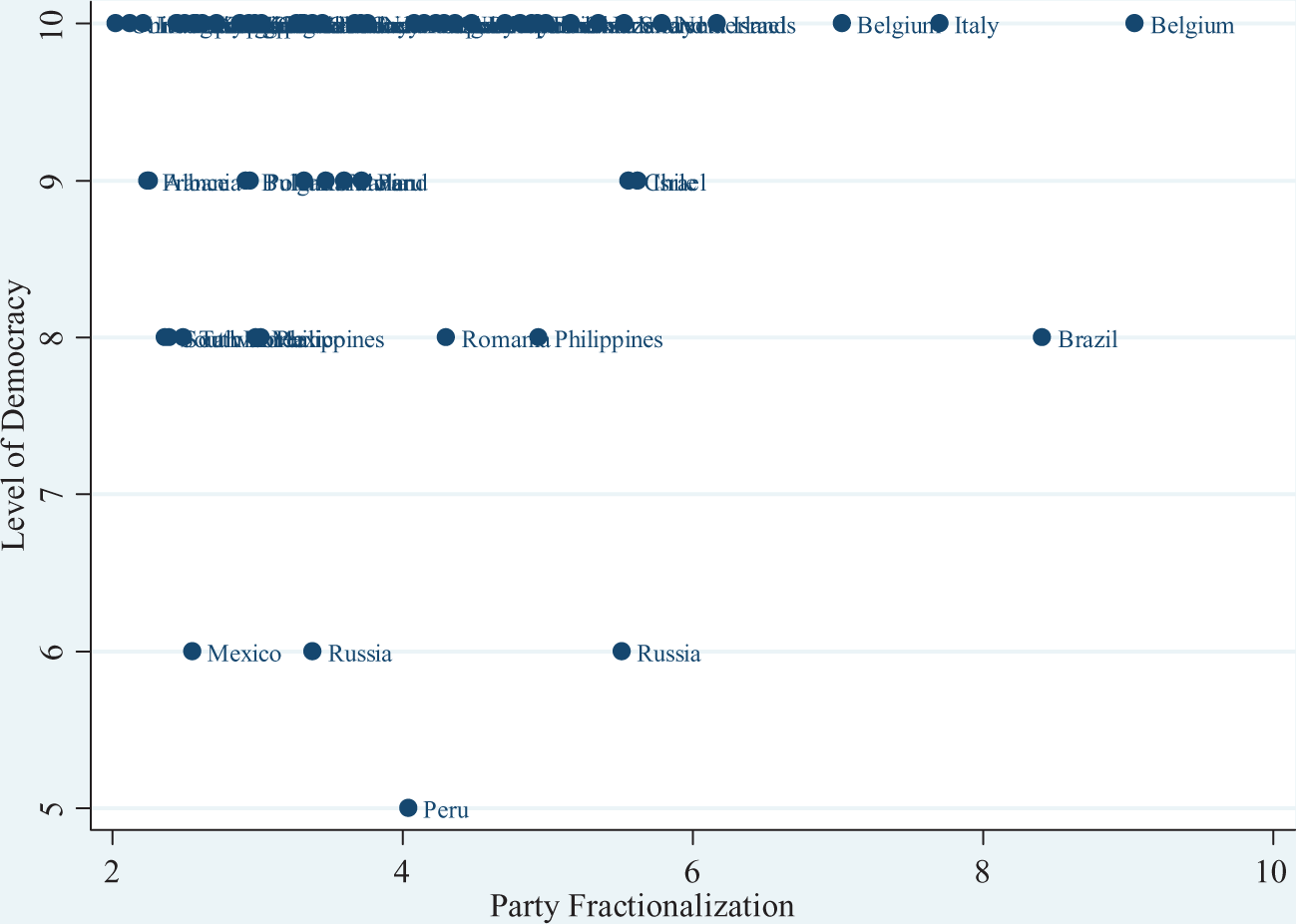
Correlation between party fractionalization and the level of democracy.

Correlation between party polarization and the level of democracy.
First of all, the level of democracy is regressed on party fractionalization, party polarization, party age and years of democracy. One of my hypotheses is supported by the results. As can be seen in Table 3, the coefficient for party polarization is significant at the 0.01 level and, moreover, this study finds that party polarization has a positive effect on democracy. One unit increase in party polarization is associated with a 0.308 score increase in the level of democracy, on average. The influential direction of party fractionalization is negative, but its coefficient is not significant at the conventional significant level. Likewise, there is no significant relationship between party age and level of democracy. Not surprisingly, a country with more democratic experience is found to have a high level of democracy. The results provide us with a preliminary picture about the effects of party fractionalization and party polarization on democracy. That is, the higher level of party polarization is conducive to democratic development, and the higher level of party fractionalization may have a negative effect on democracy, though the coefficient for party fractionalization is not significant in the present analysis.
OLS estimates of level of democracy models.

1. Standard errors are reported in parentheses below the coefficients and robust standard errors in the parentheses below them.
2. For two-tailed test: *** is significant at p < 0.01; ** is significant at p < 0.05; * is significant at p < 0.10.
Given the relationship between party systems and democracy, this study suspects that other variables may help specify this relationship, and therefore it is required to control for the effects of potentially confounding variables. The next step of my analysis is to look at the models of democracy emanating from the most prominent schools of thought on the subject with party system variables respectively. Scholars of modernization theory have provided a great deal of empirical evidence supporting the link between economic development and level of democracy. As a result, I estimate a model of democracy with GDP per capita, GDP growth rate and inflation rate as explanatory variables with party system variables and years of democracy. As can been seen in Model 2 in Table 3, the coefficients for party polarization only change slightly, and it still retains statistical significance at the 0.01 level, even after controlling for economic variables. Similarly, party fractionalization and party age are still statistically insignificant. Besides, with regard to the effects of economic variables, both coefficients for GDP per capita and inflation rate are significant respectively at the 0.10 and 0.01 levels in the expected direction, but the coefficient for GDP growth rate is not statistically significant. The result seems consistent with previous studies (Boix and Stokes, 2003; Epstein et al., 2006; Przeworski and Limongi, 1997) that there is a strong relationship between economic development and the stability of democracy. Furthermore, after controlling for the influence of economic variables, years of democracy turns out to be statistically insignificant. 11
Ethnic and religious diversity and population are also thought to affect democratic development in a country (Akdede, 2010; Diamond, 1999; Powell, 1982). Therefore, I estimate a model of democracy that includes the degrees of ethnic and religious fractionalization and the log of the population with party system variables and years of democracy. The results reported as Model 3 in Table 3 show that the coefficients for party fractionalization and party age still fail to achieve statistical significance. Nonetheless, the coefficient for party polarization is still statistically significant at the 0.05 level in the expected direction. Again, years of democracy is found to have a significant positive effect on the level of democracy. Besides, the coefficients for religious fractionalization and population are statistically significant at the conventional significant level. That is, religious fractionalization is positively associated with the level of democracy, which supports the argument that religious diversity is healthy for democracy. In contrast, population exerts a negative influence on the level of democracy, which implies that the increase of population is adverse to democratic development. Nonetheless, there is no significant relationship between ethnic fractionalization and the level of democracy in a country. Overall, this model presents that cultural and social factors would reduce the explanatory power of party system characteristics related to the level of democracy.
Finally, electoral systems are assumed to have a significant effect on democracy, i.e. countries with proportional electoral systems have a higher level of democracy (Hoffman, 2005). Besides, scholars of democratization contend that whether a regime has a parliamentary or presidential system affects the likelihood a democracy will survive (Cheibub and Limongi, 2002; Linz, 1990). Therefore, I estimate an institutional model of democracy that includes three dummy variables for whether a proportional representation electoral system or a mixed system is adopted or not, and whether a regime is presidential or not with party system variables and years of democracy. As Model 4 in Table 3 shows, both coefficients for party fractionalization and party age turn out to be statistically insignificant. Furthermore, party polarization is still found to have a positive effect on the level of democracy, though it achieves statistical significance only at the 0.10 level. Similarly, the coefficient for years of democracy is marginally statistically significant in the expected direction. With regard to the effects of electoral systems, the results completely contradict previous studies showing that compared to the majority system the proportional representation electoral system and the mixed system are found to have negative effects on the level of democracy, though the coefficient for proportional representation system is only statistically significant with standard error. On the other hand, the coefficient for presidential system is statistically significant and presidential system is negatively associated with the level of democracy. Overall, this model shows that institutional factors seem to play a more important role than party system characteristics in affecting the level of democracy in a country. 12
Next, I create a full model of democracy. As can be seen in Table 4, party fractionalization is still found to have no significant relationship with the level of democracy; however, party polarization has a positive significant effect on the level of democracy. On average, one unit increase in party polarization is associated with a 0.218 score increase in the level of democracy, controlling for all other variables in the model. As a result, only the second hypothesis is confirmed that greater party polarization increases the level of democracy in a country. With regard to the effects of control variables, inflation rate and presidential system still register significant relationships with the level of democracy at the conventional statistical level. On the one hand, inflation rate is negatively associated with the level of democracy, which supports the idea that economic growth is conducive to democracy. On the other hand, presidential system is found to be adverse to democracy in comparison with the other political systems, which confirms Linz’s argument about the perils of presidentialism. Besides, the coefficient for years of democracy becomes statistically insignificant, which implies that democratic experience does not play an important role in affecting the level of democracy when the other more critical factors are taken into consideration. 13 Similarly, the coefficients for religious fractionalization and population turn out to be statistically insignificant. It seems that social and cultural factors do not matter for democratic development after taking other factors into consideration. The full model accounts for nearly 70 percent of the variance in the level of democracy, and thus it accounts for substantially more of the variance in level of democracy than any of the simple models.
OLS estimates of democracy, full model (N=65).

1. Standard errors are reported in parentheses below the coefficients and robust standard errors in the parentheses below them.
2. For two-tailed test: *** is significant at p < 0.01; ** is significant at p < 0.05; * is significant at p < 0.10.
Some may suspect that the selection of cases is likely to produce biased estimates of the relationship between party system characteristics and the level of democracy, because some countries are counted twice. Therefore, I drop some cases to make sure that every country is only counted once in the sample, which reduces the number of observations from 65 to 37. Then I estimate a full model to see whether the selection of cases makes a significant difference in my findings. As can be seen in Table 5, the results are similar to the findings in Table 4, except that the coefficients for party fractionalization and PR system turn out to be statistically significant respectively at the 0.05 and 0.10 levels. However, the statistical significance of party fractionalization should not be overemphasized, because it is suggested that the selection of cases could lead to different findings about the effect of party fractionalization on the level of democracy. On the contrary, it is known that party polarization exerts a positive influence over the level of democracy regardless of the selection of cases. As a result, it could be concluded that the relationship between party polarization and level of democracy is robust. To sum up, the findings lend strong support to the hypothesis about party polarization and fail to confirm the hypothesis about party fractionalization. Furthermore, although party age is always statistically insignificant in my empirical analysis, it does not mean that party institutionalization is not important for democracy. What it suggests is that party age may not be a good proxy for party institutionalization.
OLS estimates of democracy, full model (N=37).

1. Standard errors are reported in parentheses below the coefficients and robust standard errors in the parentheses below them.
2. For two-tailed test: *** is significant at p < 0.01; ** is significant at p < 0.05; * is significant at p < 0.10.
Conclusions
The purpose of this study is to examine the effects of party systems on democracy, focusing especially on two most important party system characteristics – party fractionalization and party polarization. The results of the OLS regression analyses present that party polarization is related to the level of democracy in a country. Specifically, the higher level of party polarization can produce the higher level of democracy, which reflects the argument that a polarized party system can provide people with clear information about policy positions of different parties, making people vote for the party whose policy position is close to them more easily. As a consequence, people are able to make sure that the party for which they vote can really represent them. When the public’s true preferences can be expressed by representatives or parties, we expect that democracy will function well. On the other hand, some scholars argue that greater party fractionalization would lead to a significant deterioration of democracy based on the idea that as the number of political parties increases, it becomes more difficult for political parties to cooperate with each other and make compromises, which then may impact adversely on the functioning of democracy. In contrast to the above argument, this study finds that there is no significant relationship between party fractionalization and the level of democracy in a country. That is, high level of party fractionalization exerts neither positive nor negative influence on democracy.
In light of my findings, it is implied that the quantity of party systems does not matter for the functioning of democracy, and what matters most is the quality of party systems. Although some may argue that multiparty systems can accommodate cultural, ethnic or religious cleavages in a country so as to make a democracy function well, this study reveals that there is no necessary relationship between multiparty systems and democracy. In contrast, the key is whether the existing parties can effectively reflect different social values and reconcile conflicting groups in a country. Besides, it is contended that competing parties with too divergent ideologies may make it difficult to find the common ground so that cooperation between the parties is unlikely. Nonetheless, I would argue that if competing parties have the same or similar ideology, then it will be hard to come up with policy change and innovation. On the contrary, ideological divergence is likely to be transformed into the power to change so as to improve democratic governance. That is, when people are dissatisfied with the government policies, they are able to have alternative parties to choose. Furthermore, as long as competing parties can abide by democratic rules, it is not dangerous for them to have different ideologies, even extreme ideologies. In a nutshell, the big ideological differences between political parties do not necessarily mean a bad thing for a democracy.
In addition, although the results of this study suggest that greater party polarization can be healthy for democracy, and party fractionalization has no effect on democracy, it is still too early to come to any conclusion about the effects of party polarization and party fractionalization. It must be kept in mind that because of my measurement of party polarization, this study can only focus on those countries with high levels of democracy, because most CSES countries have achieved high levels of democracy. The average combined polity score for all observations is 9.34 (i.e. the maximum of combined polity score is 10). Consequently, the results of this study can only be generalized to countries with high levels of democracy, and it is possible that the effects of party fractionalization and party polarization may be different in less democratic countries. Because Dalton’s measure of party polarization needs respondents to place each party’s ideological position on the Left–Right scale that is not always available in the survey, it is slightly difficult to apply such measure to the other countries. As a result, data availability poses a limitation on generalization from this study, and I am conservative about the findings of this study. On the other hand, there are many alternative methods to measure party fractionalization and party polarization. For instance, Maoz and Somer-Topcu (2010) introduce a new approach to the measurement of political polarization that draws on Social Network Analysis and combines information about party ideology, inter-party distance and party size. Therefore, studies will be needed to examine whether the use of different measurements will lead to different results on the relationships between party fractionalization and party polarization, and democracy. To sum up, this study is simply a preliminary analysis of the effects of party fractionalization and party polarization on democracy, and additional cross-national inquiries with different measurements of party fractionalization and party polarization are required for the future.
Footnotes
Funding
This research received no specific grant from any funding agency in the public, commercial or not-for-profit sectors.