Abstract
Social democratic parties have changed their electoral appeals substantially to cater to new voter segments. This article examines social democracy’s fortunes in attracting new voters among the salaried middle class across different electoral systems. Previous research ignored the importance of electoral systems and was inconclusive as to whether social democratic parties succeeded in mobilizing new constituencies. I argue that electoral systems play a crucial role since proportional systems enhance the electoral competiveness of left-libertarian parties, social democracy’s most serious challengers among the salaried middle class. In contrast, majoritarian systems allow social democratic parties to gain a foothold among these voters as left-libertarians remain marginalized. Using ISSP data for 11 Western democracies, the findings demonstrate that social democratic parties were outperformed by their left-libertarian challengers among the salaried middle class under highly proportional systems, but not under majoritarian systems.
Introduction
Not least since Kitschelt’s seminal book from 1994 have there been attempts to conceptualize new electoral coalitions in times of intensifying globalization, ongoing welfare state recalibration, educational upgrading and service sector expansion (e.g. Häusermann, 2010; Kitschelt, 1994, 1999; Kriesi et al., 2008). It is argued that these processes have shaped new patterns of employment stratification as well as new divisions within the workforce and among the electorate in general (Kriesi et al., 2008; Oesch, 2006a, b; Van de Werfhorst and de Graaf, 2004). In particular, it has been claimed that the increasing heterogeneity of the middle class and the rising importance of high-skilled labour have forced major parties such as social democrats to incorporate the political attitudes and preferences of these voter groups in their electoral appeals (Giddens, 1998; Kitschelt, 1994, 1999).
This should be realized by moderating social democracy’s position on the socio-economic dimension of political competition towards more market-oriented policies and by adopting a more libertarian position on the socio-cultural dimension to cater to these voter groups (Giddens, 1998; Häusermann, 2010; Kitschelt, 1994: ch. 7). In political praxis, many social democratic parties have transformed both their electoral appeals and their policies since the early 1990s under the Third Way (e.g. Bonoli and Powell, 2004; Green-Pedersen et al., 2001; Huo, 2009; Keman, 2011; Merkel et al., 2008). Several recent studies have shed light on whether social democracy’s changed electoral appeal has actually influenced its voter alignments (Güveli, 2006; Güveli et al., 2007; Häusermann, 2010; Oesch, 2006a, 2008; Oesch and Rennwald, 2010; Rennwald, 2011; Van de Werfhorst and de Graaf, 2004). However, considerable cross-national variation has been found since some social democratic parties have been able to forge electoral coalitions with the target constituencies from the salaried middle class, whereas others have failed to do so.
Paradoxically, these contributions neglected the role of one important structural and also path-dependent aspect – the electoral system – which was to account for cross-national variation in social democracy’s prospects of mobilizing new target constituencies. This is striking, because from early on the electoral system has been pointed at as an important institution for the transformation of social democracy and its electoral implications (Kitschelt, 1994; Rohrschneider, 1993). This article therefore seeks both to analyse the effect of electoral systems on social democracy’s prospects of attracting new voter groups and to account for cross-national variation systematically. I argue that support for social democracy among the new target constituencies is structured by electoral rules. Specifically, the mobilization of new voter groups has been less successful under proportional representation (PR), since social democracy faces competitive social liberal, left-libertarian or green contenders. Under majoritarian systems, these competitors are marginalized and social democracy more readily reaches the new target constituencies. PR systems are also expected to differ by thresholds, as lower thresholds lead to less mobilization of new target constituencies for social democracy. The respective analyses are contrasted with the competition between social democratic and bourgeois parties.
Conducting a cross-national analysis, the study uses the ISSP datasets of 1992 to 2006 for eleven Western countries exhibiting substantial variation over their electoral systems. The ISSP allows application of Oesch’s recently developed class scheme distinguishing groups identified as social democracy’s new target constituencies, i.e. technical specialists, managers and socio-cultural professionals (Kitschelt, 1994: 301; Oesch, 2006a, b). The article is structured as follows. The next two sections review social democracy’s transformation since the 1970s and under the Third Way. Afterwards, I discuss the role of electoral systems to develop the article’s arguments and present the data, the variables, the analytical strategy and the empirical results. In the last section I discuss the findings.
Transformation of social democracy in the 1970s and 1980s
Kitschelt’s seminal book The Transformation of European Social Democracy (1994) was written against the background of intensifying deindustrialization, the tertiarization of employment structure, welfare state expansion, occupational upskilling and the increasing heterogeneity of Western electorates. It has been argued that these processes have changed the political preferences and attitudes of citizens and have non-trivial implications for major political parties such as social democrats and their programmatic and electoral messages. To cope electorally with these challenges, social democracy is forced to engage in programmatic and strategic realignment, especially because the working class core constituency is shrinking and the electorate is becoming more heterogeneous.
Notwithstanding the concrete objectives of a given social democratic party, Kitschelt spelt out severable generalizations for the future political success of social democratic parties, generalizations that account for economic and social change in post-industrial societies. First, social democratic parties have to adapt their appeal on the socio-cultural dimension to more libertarian positions if they are to attract the rising share of the salaried middle class. Second, increasing international competition and further processes of economic change require moderation of social democracy’s position on the socio-economic dimension if social democratic parties want to remain electable for broader segments of the electorate. This may also come at the expense of a clear distinction between social democracy and mainstream bourgeois parties on this dimension of political competition. Third, as the distinction between social democracy and its bourgeois opponents becomes less visible on the socio-economic dimension, social democracy needs to distinguish itself from bourgeois competitors on the socio-cultural dimension by accentuating issues such as quality of life, cultural diversity and communitarianism in its electoral appeal. In sum, Kitschelt (1994: 301) stated that:
In order to be electorally successful and remain viable as government coalition partners, social democrats must reach out to an electoral constituency built around sophisticated industrial technicians and engineers, white-collar employees and middle managers, and the large sector of professionals in personal services.
The other two groups in the new middle class that ought to be incorporated in social democracy’s electoral appeal are technical specialists and (higher-grade and associate) managers (Kitschelt, 1994; Oesch, 2008). By acknowledging the virtues of market efficiency, social democrats can reach out to these two groups that have typically been part of the electoral coalition of bourgeois or centre parties. Especially technical specialists holding moderately libertarian views reflect another promising target group for renewed social democracy, whereas managers can be attracted by the more moderate economic appeal.
The Third Way as social democratic response to societal change
The claim for a transformation of social democracy found its distinct expression in the early 1990s and afterwards when many social democratic parties adopted a Third Way agenda (Bonoli and Powell, 2004; Green-Pedersen et al., 2001; Huo, 2009; Keman, 2011; Merkel et al., 2008). The Third Way has typically been used as a buzzword to characterize social democracy’s modernization inspired by Giddens’ writings (1998, 2000). I use the term to subsume the transformation of social democratic parties in the 1990s and 2000, although not every party explicitly referred to this term and others modernized with a similar change of policies before it became ubiquitous (cf. Green-Pedersen et al., 2001).
Under the Third Way, social democracy indeed moderated its policy in many areas (Bonoli and Powell, 2004; Green-Pedersen et al., 2001; Huo, 2009; Merkel et al., 2008; Randall and Sloam, 2009). Many old economic, fiscal and social policy instruments were replaced by policy instruments typically assigned to centre-right parties (Green-Pedersen et al., 2001; Green-Pedersen and van Kersbergen, 2002; Merkel et al., 2008). In line with Kitschelt’s claims, social democracy abandoned many distinct traditional leftist positions and became less egalitarian, and focused more on the equality of opportunity rather than outcome.
Concerning the socio-cultural dimension, analyses of party manifesto data have shown that social democratic parties have become more centrist on the conventional left–right dimension and also put less emphasis on those issues. In contrast, Third Way issues such as environment and European integration have been increasingly accentuated by Western social democratic parties (Green-Pedersen, 2007; Keman et al., 2006; Volkens, 2004). Häusermann (2010) has demonstrated that welfare state reforms under social democratic reign were also targeted to the demands of the left-libertarian segments of the electorate. In terms of programmatic change and actual policies, social democratic parties have responded to the changed environments by intensifying the competition on the socio-cultural dimension and moderating the competition on the socio-economic dimension under the Third Way. This should have opened social democracy’s chances to reach out to new constituencies.
Empirical studies of social democracy’s current electoral coalition
Notwithstanding the enormous scholarly interest in the Third Way in general, only a few studies have tapped into the problematique of whether social democracy’s transformation has altered electoral alignments substantially. Moreover, the focus was often on New Labour, as the electoral successful role model of Third Way social democracy since the party was able to forge new electoral coalitions with the middle class over a long period (e.g. Denver and Fisher, 2009; Evans and Norris, 1999). In their assessment of New Labour’s policy outcomes, Randall and Sloam (2009) state that the Third Way transformation has obviously been a more successful strategy for New Labour than for its Continental European sister parties. The latter were not electorally rewarded for their ideological change and suffered higher political costs afterwards. However, the authors do not provide a more in-depth analysis of this puzzle that shows why New Labour was more successful in combining vote and office-seeking motivations.
Other studies examining whether social democratic parties gained a foothold among technical and socio-cultural specialists also found considerable cross-national variation (Güveli, 2006; Güveli et al., 2007; Häusermann, 2010; Oesch, 2006a, b; Oesch and Rennwald, 2010; Rennwald, 2011; Van de Werfhorst and de Graaf, 2004). In general, the evidence is mixed regarding mobilization of new target constituencies. For instance, Rennwald’s (2011) study shows that while the Austrian SPÖ was not able to gain over proportional support among technical specialists between the early 1970s and the 2000s, its German sister party SPD managed to mobilize this group of voters as technical specialists were underrepresented in the 1970s but overrepresented in the 2000s. However, both parties failed to attract the socio-cultural specialists as they are still underrepresented in their electorates. Güveli’s (2006) analysis shows that while socio-cultural specialists have leaned towards leftist attitudes in both countries, only in The Netherlands has this materialized as electoral support for the new left, whereas these voters stuck to Labour in Britain. Knutsen (2005) found a similar pattern for public sector employees in his eight country study. Public sector employees disproportionately supported left-libertarian parties in countries applying PR systems, but were affiliated with social democratic parties in countries with majoritarian systems even though the author did not explicitly refer to electoral systems as one likely cause. The next section develops some arguments by incorporating the role of electoral systems to account for cross-national variation.
Electoral rules and social democracy’s prospects of mobilizing new constituencies
The politics of electoral systems has been a traditional object of investigation in the study of political parties and electoral behaviour (e.g Gallagher and Mitchell, 2005; Lijphart, 1994; Sartori, 1997, 2005; Taagepera and Shugart, 1989; Willey, 1998). Among other things, it has been argued that electoral systems structure party systems and party competition. Majoritarian systems limit the number of parties to a few if not two, as foreseen by Duverger (1959). Moreover, they constrain the number of effective parties, have a lower degree of proportionality and produce high entry costs for new parties. In contrast, proportional representation systems typically lead to multiparty systems, more proportional outcomes and have lower entry costs for new parties (Gallagher, 2005: 543 f.; Sartori, 1997, 2005). Additionally, electoral thresholds and district magnitudes need to be taken into account for the actual proportionality and chances of new competitors in PR systems. Countless studies have demonstrated that these facts also matter in terms of electoral alignments, as voters and voting behaviour are influenced by electoral systems (cf. Shugart (2005) for a review of the arguments).
These stylized features and arguments have been used to outline the importance of electoral rules for the transformation of social democracy and its electoral implications (Kitschelt, 1994; Rohrschneider, 1993). The political opportunity structure was seen as a crucial determinant for social democracy’s future strategies and the potential to reshape its electoral coalition: ‘The extent to which social democratic parties may wish to pursue such strategies and to reorganize their internal structures depends on the particular parameters of a country’s electoral market place and political competition’ (Kitschelt, 1994: 301). In the empirical analysis, Kitschelt understands electoral systems and party competition as structural and therefore path-dependent conditions for social democracy’s strategic decisions (e.g. vote or office-seeking) and the prospects to reach out to new middle-class constituencies.
Similar logics apply in Rohrschneider’s study (1993) of New Politics realignments and old versus new left parties. Rohrschneider identified electoral systems as crucial determinants of whether New Politics issues would lead to realignments with new left competitors (e.g. green parties) or with social democracy. Social democratic parties would lose voter groups concerned with New Politics issues to competitors on the left under proportional systems, especially if social democracy does not respond to New Politics issues from early on to counteract the emergence of competitors. Under majoritarian systems, possible new challengers have too high entry costs to forge realignments. This is true even if New Politics issues are salient and the only question is whether the social democratic party forges a new politics realignment or fails to do so (Rohrschneider, 1993: 684 ff.).
In the following, I refine Kitschelt’s and Rohrschneider’s arguments to develop a theoretical framework that captures the effect of electoral laws for social democracy’s capability to forge alliances with the new middle-class target constituencies. In line with the literature (e.g. Kitschelt, 1994, 1999; Rohrschneider, 1993; Van de Werfhorst and de Graaf, 2004; Weakliem, 1991), I consider left-libertarian parties the most serious challengers for the target constituencies, in particular for the socio-cultural professionals, since these parties offer a particularly attractive policy mix for these groups. They typically run under social liberal and green labels or constitute former left-socialist parties that have transformed into left-libertarian parties. I also focus on bourgeois parties as challengers for the new target constituencies, since Third Way social democracy is said to be closer to parties on the centre-right on economic matters and thus may appeal to some bourgeois voter segments. This should be a more general aspect and more independent of the electoral system, although a division of the centre-right under highly proportional systems may mean harsher electoral trade-offs for social democracy in competing for these groups.
First, I argue that proportional representation systems with no or low thresholds constitute open electoral market places for left-libertarian parties. Here, the target constituencies might already have aligned with left-libertarian parties before social democracy appealed to them, since the electoral system facilitated their early emergence. The low threshold also prevents challengers on the libertarian left from extinction in the event of a poor electoral performance. Often, PR systems with no or low thresholds allow for the existence and survival of more than one challenger on the libertarian left. This increases the strategic trade-offs for social democratic parties as the challengers may cherry-pick distinct voter groups. Under such circumstances, social democratic parties face difficulties in mobilizing these voter groups when at the same time trying to secure broader support and keeping the old core constituency. In this case, challengers on the libertarian left can use a more explicit appeal and outperform the social democrats. Voters do not waste their votes by casting a ballot for such a party under proportional systems with low thresholds (Taagepera and Shugart, 1989).
PR systems with higher thresholds still confront social democrats with challengers on the libertarian left, but some qualifications apply here. Under such circumstances, challengers need a better organizational capability and may require a broader electoral appeal. This is because social democrats can more efficiently use an oligopolistic strategy to squeeze out the competitor(s) on their left by exploiting the virtues of a higher threshold (Kitschelt, 1994: 128 ff.). If the challenger responds with a broader appeal beyond the salaried middle class, social democracy may find it easier to attract these voters, as the differences are not as clear as under PR with low thresholds. Similarly, the trade-off in attracting the new target constituencies and keeping the old working-class loyalties is still prevalent, but less pronounced if higher electoral thresholds apply, as the competition is more restricted under these circumstances.
By contrast, majoritarian electoral systems typically marginalize left-libertarian challengers and it is easier for social democracy to reach out to new constituencies while keeping parts of the old core constituency. The former voter group may waste its votes if it votes for a party located on the libertarian left which has no chance of winning parliamentary representation in most electoral districts (Taagepera and Shugart, 1989; Willey, 1998: 654 f.). Nevertheless, in some countries with majoritarian systems, third parties have run under social liberal labels and gained support among middle-class constituencies (e.g. Australia and New Zealand). 1 Social democracy can try to squeeze them out at some point, as the electoral system works against left-libertarians if social democratic parties are increasingly competing on their grounds. This has been labelled oligopolistic competition in Kitschelt (1994) and works better the more disproportional an electoral system is. Hence, majoritarian systems should provide the most favourable context for social democratic parties in terms of mobilizing the groups Kitschelt and later authors identified as target constituencies.
Thus, I expect social democratic parties to be more successful in forging electoral alliances with the new target constituencies under majoritarian electoral systems and less successful under proportional systems. The success in the latter is contingent on the respective electoral threshold, as low thresholds lead to severe competition with libertarian left parties, whereas higher formal or informal thresholds (such as small district magnitudes) constrain the libertarian left’s competitiveness.
Data, variables and method
Data
The article uses the International Social Survey Programme (ISSP) datasets 2 1992 to 2006 for 11 Western countries: Australia, Austria, Denmark, Finland, Germany, Great Britain, The Netherlands, New Zealand, Norway, Spain and Sweden. All are Western OECD countries with a large social democratic party that has either been the largest or second-largest party throughout the second half of the 20th century under democratic rule. Moreover, their substantial variation over electoral systems allows testing my arguments from the previous section. A more pragmatic third reason is that ISSP data are available for these 11 countries over a longer period, as they joined the programme at an early stage. 3 The datasets have been harmonized and merged into a pooled dataset covering the period 1992–2006 and 46 elections in the countries altogether.
The ISSP is the only cross-national survey programme that covers such a long time span for so many Western nations and provides sufficient and detailed information about the respondents’ occupational status. The ISSP contains the International Standard Classification of Occupation (ISCO) (see ISCO, 2010) in its 1968 or 1988 versions or national classifications of occupations that can easily be transformed into an ISCO code. This information is necessary to construct Oesch’s class scheme (Oesch, 2006a, b) that is used as operationalization of class to identify the social democratic target constituencies. This is described further below.
Operationalization of variables
Electoral system
The distinction of electoral systems follows Kitschelt’s (1994: 144 ff.) fourfold classification. First, I differentiate between plurality voting systems such as ‘First-Past-the-Post’ (FPTP) or ‘Alternative Vote’ (AV) and proportional voting systems. Second, I classify proportional systems (PR) by their thresholds for gaining parliamentary representation. Table 1 distinguishes the countries covered in this article by their electoral systems.
Classification of countries into electoral systems according to Kitschelt (1994).
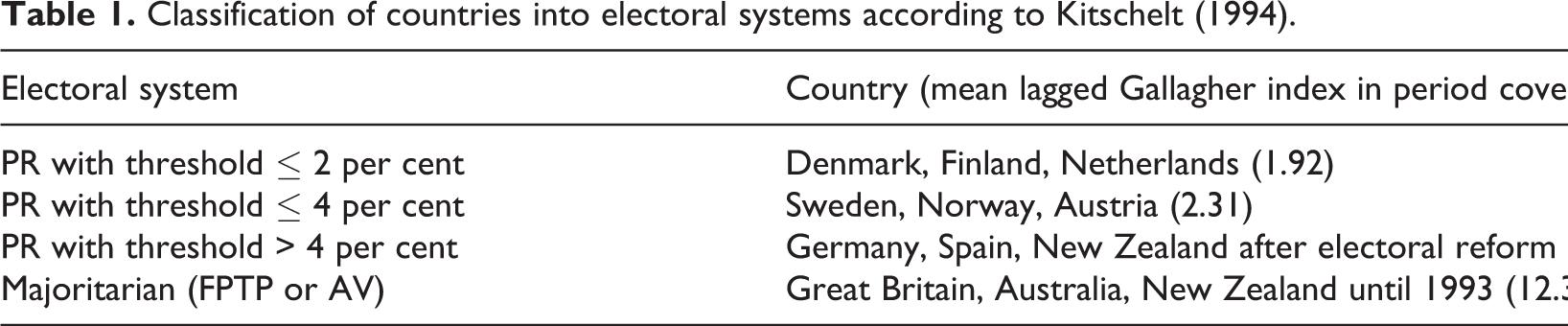
Note that Spain is classified as having PR with a high threshold even though the legal threshold is 3 percent. However, the small district magnitudes in Spain work like a PR system with a rather high threshold for small third parties (Haas, 2006; Hopkin, 2005; cf. also Willey, 1998: 655). 4 The result is two large parties and marginalized third parties on the national level and regional strongholds for nationalist and regionalist parties gaining few mandates for the national parliament. Kitschelt’s classification labels Spain as a country with PR and a high threshold, too. The classification also captures the electoral reform in New Zealand in 1996 when the country adopted a PR system with a 5 percent threshold and abolished the hitherto used FPTP system. Furthermore, I did a robustness check of the qualitative distinction of electoral systems using the Gallagher index of disproportionality, which yields higher scores the more disproportional an electoral system is (Gallagher, 1991). 5 Using this quantitative index allows corroborating the findings from the analysis using the qualitative distinction of electoral systems with a quantitative measure that varies systematically across electoral systems and their features, since the index correlates over years in a given country. It also captures major change such as the electoral reform in New Zealand. I used a lagged value from the previous election to avoid endogeneity.
Party affiliation
To operationalize the respondents’ party affiliation, I relied on the party affiliation items in the ISSP datasets. One has to be aware that the party affiliation variables vary between countries as the respective national research institutions have applied different measures for party affiliation. Moreover, some countries have not always used the same measure over the years and some datasets have more than one measure for party affiliation. I tried to operationalize party affiliation for each country as consistently as possible by using the same or a sufficiently similar wording to construct the measure for party affiliation. If a given party affiliation variable was apparently divergent in its content the information was disregarded.
For instance, ISSP participants in New Zealand and Spain were typically asked which party they voted for in the last general election, but in some years respondents were only asked to which party they felt closest. In these cases, only the years where the vote recall question was applied have been used to construct the party affiliation measure. I am aware that this procedure has its limitations, but it detects systematic differences in choosing particular party families among occupational groups; the main objective of the analysis. Unless the differences have no clear and systematic bias in favour or disfavour of particular parties, this approach is tolerable, since I see no reason for a systematic bias when the applied measures differ between some countries, but not considerably within countries. The respective national parties have been grouped into party families, and dummies distinguishing social democratic parties from their left-libertarian respectively bourgeois competitors were constructed (see Appendix).
Class
The analysis employs Oesch’s class scheme (Oesch, 2006a, b). This is by far the best operationalization of social democracy’s new target constituencies as conceptualized by Kitschelt (1994) because technical specialists, socio-cultural specialists and managers are distinguished. The class scheme’s point of departure has been the tertiarization of employment structure, the expansion of the welfare state, occupational upskilling and the increasing heterogeneity of middle-class professions. Its basic rationale is to account for the nature of the work logic (horizontal dimension) and the amount of marketable skills (vertical dimension) as crucial factors for the formation of political preferences (Kitschelt, 1994: 17; Oesch, 2006a: 61 ff.; Oesch, 2008: 336). The horizontal dimension differentiates between independent work logic, organizational work logic, technical work logic and interpersonal work logic. The vertical dimension captures the endowment and actual utilization of human capital and thus the marketability of a wageearner’s skills. Accordingly, an individual’s class location is mapped on the electoral marketplace according to its position on the socio-economic as well as on the socio-cultural dimension.
Given the article’s endeavour, the analysis focuses on the party affiliations of technical specialists, socio-cultural specialists and managers vis-à-vis production workers as social democracy’s old core voter base. This captures the relative extent of the electoral dilemma between keeping old loyalties and winning new voter groups. I apply the collapsed 8-class version rather than the extended 17-class version, since the latter requires additional information for its operationalization which not all countries in the ISSP provide for each year (cf. Oesch (2006a) for the detailed operationalization of the different versions). This keeps the analysis more parsimonious and its developer has suggested that using the 8-class version for the analysis of political attitudes and electoral behaviour is more promising (Oesch, 2008: 336 ff.).
Method
Multi-level logistic regression models are the statistical technique used in the following analysis. These are considered adequate for analysing hierarchical or nested data in order to provide accurate estimates of standard errors and taking intra-class correlations into account (e.g. Gelman and Hill, 2007; Rabe-Hesketh and Skrondal, 2008). In my case this concerns individuals nested in countries (or elections) with different electoral systems, which requires modelling of contextual and individual determinants. Since the dependent variables are dichotomous, distinguishing social democratic parties (coded 1) from left-libertarian respectively bourgeois parties (coded 0), logit models are applied. This operationalization is admittedly a relative measure. However, its main virtue is that it keeps the coefficients of the logistic models described below directly comparable to above-cited studies addressing similar research questions while accounting for cross-national variation in a systematic manner by using a multi-level design. The main explanatory variable on the individual level is class as operationalized by Oesch’s class scheme described above and included as dummy variables in the models, with production workers serving as reference category. Following the setup in Oesch’s single country analyses, further individual-level control variables are age, gender, union membership and public sector employment (Oesch, 2006a: 121).
Analysis
Beginning with simple descriptive evidence, Figure 1 presents the vote-shares for the three party families distinguished for three selected classes across the four electoral systems. The clearest relationship between electoral systems and vote-shares for social democrats and their left-libertarian competitors occurs among the socio-cultural specialists. Social democracy’s share decreases the more proportional the electoral systems is, whereas left-libertarians perform best in systems with thresholds of 4 percent and below. Among production workers, the pattern is less clear, as social democrats have the lowest (highest) share in the most proportional (majoritarian) systems, whereas left-libertarians do not differ strongly here. Among the group of managers, social democrats perform relatively less well in the most open electoral system. This gives us a first indication that the competition between social democrats and left-libertarians is fiercest in highly proportional systems and occurs particularly among the socio-cultural specialists. Similarly, the electoral trade-off in keeping old loyalties and winning new middle-class voters is strongest in the most proportional systems.
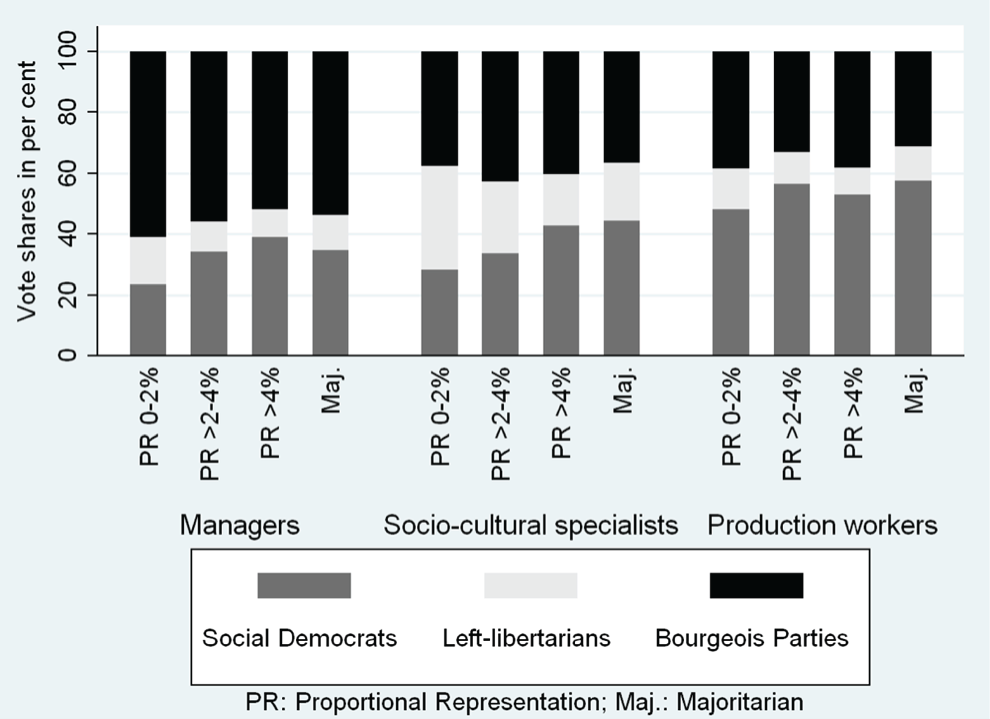
Vote shares among selected classes for three party families.
The next step is to run a simple logistic regression with robust clustered standard errors adjusted for the countries as clusters. Then, I run multi-level logistic regression models that account for the nested data structure and subsequently introduce cross-level interactions to test the above-stated propositions on the role of the electoral system. Conducting a robustness check, a fourth model substitutes the Gallagher index for the electoral system dummies. The models appear in Table 2. The logistic regression with robust standard errors (Model 1) reveals that social democratic parties still received the highest support among production workers. The coefficients for all other classes are negative and highly significant compared to the reference category and this holds true for both the contrast to left-libertarian and bourgeois competitors. In the period investigated, there were still remarkable differences between occupational groups in their party affiliations. Left-libertarians drew their strongest support from socio-cultural specialists and centre-right parties from the two segments of the bourgeoisie and managers in contrast to social democrats, who had a strong backing among production workers, but also service workers.
Party affiliation for social democrats relative to left-libertarian and bourgeois parties, 1992–2006 in 11 Western countries.

Model 1 is a logistic regression model, Models 2–4 are random effects logistic regressions. Standard errors are given in parentheses. ! p < 0.1, *p < 0.05, **p < 0.01, ***p < 0.001. PR2: PR system with threshold ≤ 2%, PR4: PR system with threshold ≤ 4%, PR>4: PR system with threshold > 4%.
This is not surprising as left-libertarian parties do not offer the policy mix that matches the political attitudes of working-class voters and most bourgeois parties appeal to middle-class constituencies. However, it is striking that social democratic parties have been generally outperformed among the new target constituencies despite their supposed new electoral appeal. This is especially true for the socio-cultural specialists, who constitute a stronghold for the category of left-libertarian parties. The controls in Model 1 and Model 2 largely confirm findings from various other studies: social democrats are disproportionately supported by females, union members and public sector employees compared to bourgeois parties, whereas they sometimes lose ground in competition with left-libertarians among females and public sector employees.
Next, Model 2 introduces a random intercept to control for considerable variation between nations for these alignments. On the individual level, the coefficients for Model 2 do not differ strongly from those of the simple logistic regression after introduction of the electoral system dummies. Still, compared with the other classes, production workers prefer social democratic parties to left-libertarian parties and bourgeois parties. However, the likelihood ratio test shows that there is significant between-cluster variance for both dependent variables. This suggests that the statistical model needs to account for the data’s multi-level structure (Rabe-Hesketh and Skrondal, 2008: 254). The same goes for Models 3 and 4. Thus, social democracy’s electoral prospects among old core and new target constituencies vary significantly not just between individuals, but also between countries.
To see how social democracy’s capability to attract the new target voters vis-à-vis its left-libertarian and bourgeois competitors differs by electoral systems, Model 3 introduces the relevant cross-level interactions generated by interacting the respective dummies of the class variable with the categories of the electoral system variable. The class dummies for the target constituencies now contrast social democrats and their competitors under majoritarian electoral systems (that is AV or FPTP). Compared to Model 2 containing no cross-level interactions, the constitutive terms for the technical and socio-cultural specialists in Model 3 yield weaker effects. This suggests that a notable degree of variation has been explained by the cross-level interactions and thus the effects of the electoral systems. Substantially, the constitutive terms reveal that majoritarian systems produce milder trade-offs for social democratic parties that want to reach out to new voter groups.
The estimates for the cross-level interactions yield the strongest results for social democracy’s competition with left-libertarians under electoral systems with low thresholds in general and the competition among the socio-cultural specialists in particular. Left-libertarians outperform the social democrats among all three target groups if the threshold is low or intermediate, though not significant for the managers. Left-libertarian parties also outperform social democrats among socio-cultural specialists in all three proportional electoral systems and the coefficients become more negative the more proportional the electoral system is; however, not significant under the 5 percent threshold. Thus, in line with expectations, social democratic parties did not significantly out-rival the left-libertarians among the target constituencies under highly proportional electoral systems.
The contrasts to bourgeois parties reflect less systematic results for managers and socio-cultural specialists, whereas technicians prefer bourgeois parties to social democrats under the two most proportional electoral systems. Only among managers in PR systems with higher thresholds did social democratic parties outperform their centre-right opponents (seen in contrast to production workers). More generally, the results for the high threshold imply that high thresholds shield social democrats from tough competition almost as effectively as majoritarian systems.
These findings are corroborated in Model 4, which substitutes the Gallagher index for the electoral system dummies as well as the respective interactions. 6 Among the technical and socio-cultural specialists, social democratic parties get stronger support vis-à-vis their left-libertarian opponents the more disproportional a country’s electoral system is, as the respective interactions are positive and significant. The robustness check with the Gallagher index demonstrates, again, that social democracy’s relative electoral success among the salaried middle class increases (decreases) the more disproportional (proportional) votes are translated into seats. In highly proportional systems, left-libertarian parties beat social democrats among these occupational groups and social democrats face sharp electoral trade-offs in keeping old loyalties and winning new voters in the salaried middle class.
In contrast, there is only a weakly significant effect for the technicians for the contrast social democratic versus bourgeois parties among the target constituencies if the Gallagher index is used as quantitative proxy for electoral systems. This reveals fewer systematic effects of electoral rules for the competition between social democrats and bourgeois parties compared to the competition within the left camp.
Discussion
The aim of the article was to account for cross-national variation in social democracy’s success in mobilizing new electoral constituencies with a new policy mix realized under the Third Way. I argued and demonstrated empirically that the electoral system conditions social democracy’s prospects of reaching out to new middle-class target constituencies conceptualized by Kitschelt (1994) and operationalized by Oesch’s class scheme. Electoral systems being highly proportional through no or low thresholds confront social democratic parties with highly competitive left-libertarian challengers. Since the latter parties appeal distinctly to the salaried middle class, social democracy has considerable difficulties winning support among these voter segments and is typically outperformed by challengers on the libertarian left. Specifically, socio-cultural specialists are less inclined to vote for social democratic parties if left-libertarians are competitive. This effect increases the more proportional an electoral system is.
In contrast, under PR systems with high thresholds, and even more so under majoritarian electoral systems, social democrats face less competitive challengers and thus have better prospects of gaining a foothold among the new target constituencies after an ideological realignment, as happened under the Third Way in the 1990s. Similarly, the electoral trade-off between keeping traditional working-class constituencies and attracting new voters from the salaried middle class is much less pronounced under majoritarian systems compared to PR systems that have low thresholds. This article’s findings thus systemize the cross-national variation found by previous studies that have analysed the party alignments of those occupational groups (Güveli, 2006; Güveli et al., 2007; Häusermann, 2010; Oesch, 2008; Oesch and Rennwald, 2010). The competition with bourgeois parties is less affected by the electoral system, although technical professions were more inclined to vote for centre-right parties in PR systems applying thresholds of 4 percent and below.
This brings us to the implications for policy-makers and electoral researchers. Parties that wish to adapt their political strategy and electoral appeal need to account for the electoral system and its mode of operation. This has been exemplified here by social democracy’s transformation in the last two decades under the Third Way. A strategic move to attract new constituencies may be relatively ineffective because the electoral system enhances the competiveness of dangerous challengers. Under such circumstances, a party may sacrifice its old loyalties but is not sufficiently rewarded by gaining considerable support among new target constituencies.
This could have been a likely effect of the Third Way in countries with highly proportional systems (e.g. Denmark, Finland or The Netherlands). Here, the support among the traditional working-class voter base has declined, whereas voter groups from the salaried middle class have already aligned with challengers on the libertarian left. Thus the original motivation of vote-seeking did not materialize as new electoral alignments under highly proportional systems.
In contrast, strategic moves under majoritarian systems (or PR with sufficiently high thresholds) seem to be more promising. Here, challengers are ineffective and can be squeezed out if necessary since the electoral system works against them, eventually. This allowed the Labour Party to stay in office for more than one decade after it adopted a Third Way platform and sacrificed parts of its working-class constituency (Arndt, 2011). In this respect, Randall and Sloam (2009) have speculated whether the Third Way produced far higher political costs for continental European social democratic parties than for Labour in Britain. Under majoritarian systems, the median voter in a crucial number of constituencies is first won and then kept despite the loss of old working-class loyalties. The results of this article point in this direction and demonstrate that the differences are likely rooted in the different electoral systems.
Moreover, changes on the macro level in recent decades, such as the manifestation of new cleavages (for instance around globalization or authoritarian-libertarian values) may have materialized differently when it comes to party alignments on the national level. Some left-libertarian parties may have benefited substantially from new political divisions such as globalization or the rising share of highly educated voters, whereas others have remained marginalized as their social democratic opponents had been better at handling the trade-off between attracting new and keeping traditional voters as the electoral system has shielded them from left-libertarian competitors. Further research should therefore focus on how identical political attitudes and values translate into diverging party affiliations as political opportunity structures and openness of the electoral competition constrain the voters’ decisions and party alignments. Moreover, how have these relationships materialized over time and how strategic decisions of social democrats and left-libertarians have shaped a national electoral landscape?
Another thing for future investigations is to conduct a more fine-grained analysis of multiple electoral dilemmas for social democracy in those contexts where social democracy competes with left-libertarian, bourgeois, new right parties or nationalist/regionalist parties. 7 Especially, the joined presence of competitive left-libertarians and new right parties could have caused a double backlash for Third Way social democracy as left-libertarians have already mobilized new middle-class voters beforehand, whereas the new right (or nationalists as well) have soaked up substantial parts of the old core constituency of production workers as a consequence of the Third Way.
Footnotes
Acknowledgements
Earlier versions of this article were presented in the Research Section on Danish and Comparative Politics at the Department of Political Science, Aarhus University and the XVI Nordic Political Science Congress (NOPSA), Vaasa, 9–12 August 2011. I am grateful to the participants at both, and also to Line Rennwald and the two anonymous reviewers for their helpful comments.
Funding
This research received no specific grant from any funding agency in the public, commercial or not-for-profit sectors.
Notes
Appendix
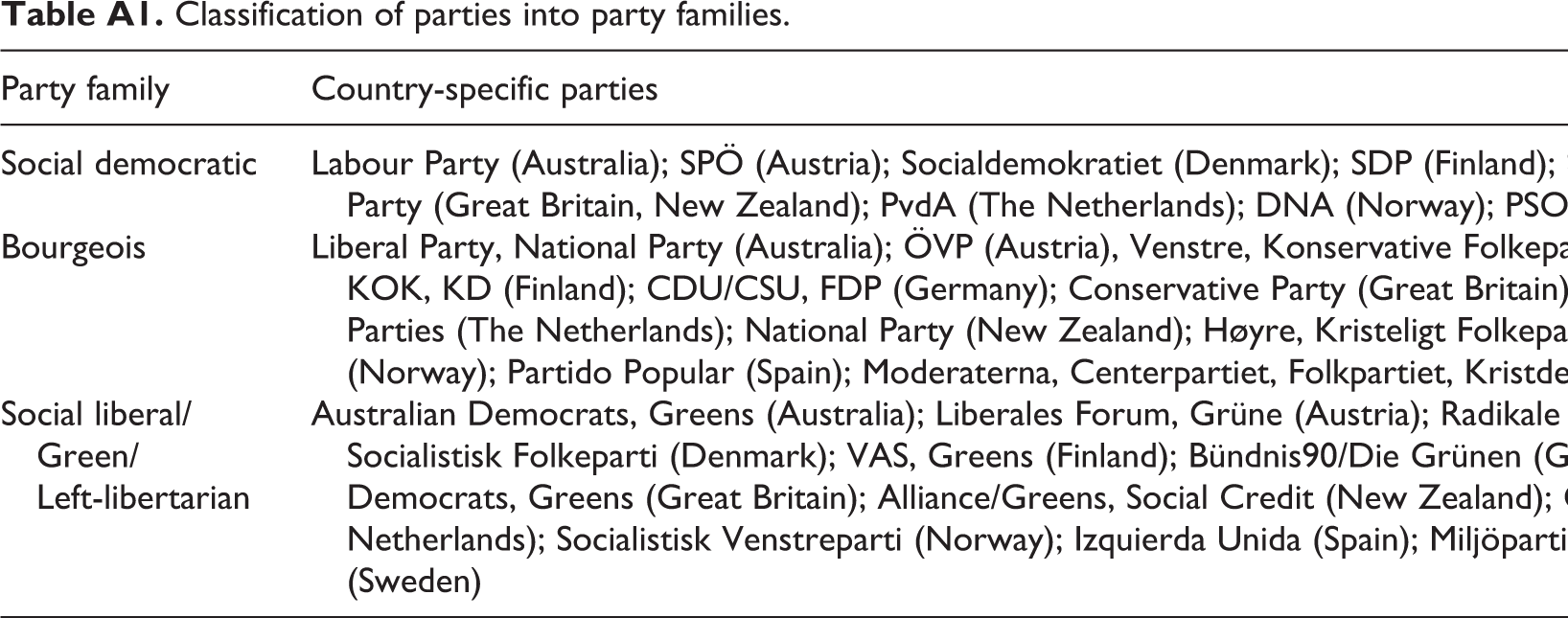
Classification of parties into party families.
| Party family | Country-specific parties |
|---|---|
| Social democratic | Labour Party (Australia); SPÖ (Austria); Socialdemokratiet (Denmark); SDP (Finland); SPD (Germany); Labour Party (Great Britain, New Zealand); PvdA (The Netherlands); DNA (Norway); PSOE (Spain); SAP (Sweden) |
| Bourgeois | Liberal Party, National Party (Australia); ÖVP (Austria), Venstre, Konservative Folkeparti (Denmark); KESK, KOK, KD (Finland); CDU/CSU, FDP (Germany); Conservative Party (Great Britain); VVD, CDA, Calvinist Parties (The Netherlands); National Party (New Zealand); Høyre, Kristeligt Folkeparti, Senterpartiet (Norway); Partido Popular (Spain); Moderaterna, Centerpartiet, Folkpartiet, Kristdemokraterna (Sweden) |
| Social liberal/ Green/Left-libertarian | Australian Democrats, Greens (Australia); Liberales Forum, Grüne (Austria); Radikale Venstre, Enhedslisten, Socialistisk Folkeparti (Denmark); VAS, Greens (Finland); Bündnis90/Die Grünen (Germany); Liberal Democrats, Greens (Great Britain); Alliance/Greens, Social Credit (New Zealand); GroenLinks, D’66 (The Netherlands); Socialistisk Venstreparti (Norway); Izquierda Unida (Spain); Miljöpartiet, Vänsterpartiet (Sweden) |