



Abstract
Most analyses of policy outcomes from coalition-bargaining have hitherto been conducted within a spatial framework that requires the aggregation of coalition policy into a small number of point estimates. Such an approach, however, is limited in terms of the level of specificity at which it can operate. This article therefore draws on the methodology from the pledge fulfilment literature in order to provide a more in-depth examination of coalition-bargaining outcomes. We are thus able to take advantage of the fact that contemporary coalition agreements provide a wealth of detailed information on the government’s prospective course of policy action. Based on a quantitative text analysis of election manifestos, a dataset of over 1,000 election pledges is used to test a number of hypotheses on the adoption of policies in Austrian coalition agreements between 2002 and 2008. The multivariate models yield strong support for the hypotheses and suggest that the methodological approach has the potential to enhance our understanding of coalition-bargaining.
Introduction
Coalition governments are a regular feature of parliamentary democracies with electoral systems of proportional representation. In order to set up a viable coalition government, the parties involved need to strike a deal not only over the distribution of offices but also over the shape of future government policy. In most West European democracies, it has become a common procedure to put down and publish the result of these negotiations in written form (Müller and Strøm, 2008; Strøm and Müller, 1999). Recent studies indicate substantial agenda-setting power of such coalition agreements (Moury, 2009, 2011; Timmermans, 2003, 2006). Thus, for the general public they provide an outlook of the prospective government’s intended course of action for a wide range of policy areas. In addition, for researchers focusing on negotiation outcomes they represent one of the most detailed and comprehensive data sources. Taking advantage of this wealth of information, this article uses coalition agreements to examine bargaining outcomes.
Our study is embedded in the broader theoretical context of the literature on policy payoffs in coalition bargaining (Budge and Laver, 1992; Debus, 2008; Warwick, 2001). These analyses typically adopt a spatial framework and operationalize bargaining outcomes as the stated policy position of the coalition, thus following an approach that allows for the testing of hypotheses derived from policy-related theories of coalition formation (Axelrod, 1970; de Swaan, 1973; Schofield, 1995) and payoff distribution (Laver and Shepsle, 1990, 1996). Yet, while the literature on policy payoffs provides us with important insights on the overall ideological direction of stated government policy, it can contribute little to understanding the specifics of the policy deals struck between the coalition parties.
The present article aims at explaining coalition-bargaining outcomes at a more detailed level. In so doing, we examine the link between specific election promises and coalition-bargaining outcomes by drawing on studies of pledge fulfilment and party mandates (Costello and Thomson, 2008; Royed, 1996; Thomson, 2001). We examine the coalition-bargaining outcome in terms of the adoption of parties’ policy pledges in the coalition agreement.
Given the impetus of our research, we opt for an in-depth examination of a few instances of government formation rather than a broad and comparative design that would necessarily remain superficial in terms of policy detail. We conduct a quantitative content analysis of election manifestos in Austria between 2002 and 2008 to extract a dataset of over 1,000 pledges from the government parties’ election manifestos and compare them to the bargaining outcome as written down in the coalition agreement. Using single pledges as our units of analysis, we are able to explain in a particularly detailed manner the three most recent coalition formations in Austria.
Theory and hypotheses
Over past decades, coalition-bargaining has drawn considerable interest from scholars across the discipline of political science. In terms of bargaining outcomes, much attention has been devoted to the distribution of ministerial portfolios in terms of both quantity (Browne and Franklin, 1973; Browne and Frendreis, 1980; Carroll and Cox, 2007; Druckman and Warwick, 2005; Laver and Schofield, 1990: 164-194; Schofield and Laver, 1985; Warwick and Druckman, 2001; 2006) and quality (Bäck et al., 2011; Browne and Feste, 1975; Budge and Keman, 1990: 89–131). Some scholars have even examined the allocation of portfolios within parties (Ennser-Jedenastik, 2013; Leiserson, 1968; Mershon, 2001a, b).
While considerably more difficult to measure than the allocation of ministerial posts to parties, some studies have taken on the task of examining the outcome of coalition-bargaining in terms of (stated or effected) government policy.
Budge and Keman (1990: 132–158), for instance, find that the partisan composition of a cabinet goes some way towards explaining variation in government policy, with socialist governments pursuing a more dirigiste fiscal policy and producing higher welfare expenditures than conservative governments.
Budge and Laver (1992, 1993) follow a spatial approach and rely on manifesto data to assess the relationship between the policy positions of coalition parties and governments. While they find that, in a few countries, a party by entering cabinet can move the government’s policy position towards its own, ‘the policy payoffs of going into government are not at all clear’ (1992: 424) in places such as Germany, Italy or Sweden.
However, a re-examination of the same data showed that, once other factors (e.g. formateur status, supporting parties or the weighted mean position of all parties in parliament) are accounted for in a multivariate design, the cabinet-weighted mean of the party positions is a significant predictor of the government’s policy position (Warwick, 2001). While there thus seems to be a robust link between party and government policy, the exact nature of the relationship is not as clear as the one-to-one association between parliamentary seat-shares and cabinet ministers found in studies of quantitative portfolio allocation.
One of the most recent analyses of policy in coalition-bargaining is Debus’s (2007, 2008) study of coalition formation in five European countries during the past three decades. Also, it is the first systematic account to use coalition agreements as a data source on the policy position of coalitions (for a recent case study, see Quinn et al., 2011). Based on positional data generated through the automated content analysis of manifestos and coalition agreements (Laver et al., 2003), he finds that multidimensional models of government formation (Laver and Shepsle, 1990, 1996; Schofield, 1993, 1995), once they are adapted to account for institutional and political constraints on bargaining, do a reasonably good job in predicting which party will be closest to the government policy position among the coalition partners.
Judging from these studies, there is good empirical evidence that coalition-bargaining outcomes vary systematically with the policy preferences of the parties involved. Beyond that, however, we have very little understanding about how specific policy outcomes come about in coalition-bargaining. This is largely due to the fact that spatial models of coalition-formation – which form the theoretical basis of most analyses – are limited in terms of the level of specificity at which they can operate. The myriad of policies that parties cover in coalition negotiations is typically aggregated into a small number of point estimates on some policy dimension. Much of the complexity and detail of policy bargaining in coalition-formation is therefore lost. Neither hand-coding nor automated estimation techniques take into account the level of abstraction at which a statement in a political document is made. Whether a party pledges to its voters ‘greater social justice’ or ‘a raise in unemployment benefits’ may technically not make a difference for the estimation of that party’s policy position (both statements move its ideal point to the left), yet the latter statement commits the party to deliver an objective change in policy whereas the former statement does not. We contend that such differences between statements need to be considered in any analysis of policy-bargaining that intends to draw inferences beyond the broad conclusions that have emerged from the studies of policy payoffs. We therefore suggest drawing on the methodological approach adopted by the party mandate literature (e.g. Costello and Thomson, 2008; Royed, 1996; Thomson, 2001) when examining coalition-bargaining outcomes in more detail. Instead of using abstract policy positions that allow for inferences only at a very aggregate level, we propose a more in-depth approach by identifying every single pledge in the coalition parties’ manifestos and compare these data to the bargaining outcome written down in the coalition agreement.
Changing the unit of analysis from the instance of government formation to the single pledge made by a party also requires us to transfer some of the existing theoretical assumptions from the party level to the pledge level. While this approach is less conducive to large-scale comparative analyses, it enables us to gain a better understanding of the micro-mechanisms that are at work in inter-party coalition-bargaining, thus allowing for the testing of more specific hypotheses.
Our first hypothesis relates to the fact that new governments do not start from a tabula rasa. Rather, they find themselves confronted with a myriad of policies that are already in place at the time they enter office. A substantial part of governing is therefore to make decisions about whether to keep or alter the status quo in a specific policy area. Warwick (2001: 1217) terms the influence of former governments the ‘dead weight of past policy’. He understands this as restrictions of new governments to substantially change the status quo, because they fear confusion or adaptive difficulties. Also, studies of pledge fulfilment have found consistent support for the persistence of the status quo (Costello and Thomson, 2008: 250; Mansergh and Thomson, 2007: 319; Royed, 1996; Thomson et al., 2010: 18).
Probably the most intuitive way of looking at this argument is from a veto player perspective (Tsebelis, 1995, 2002). The all-important implication of veto player theory is that the stability of the status quo is higher the more veto players there are. In coalition-bargaining, each party – to the extent that its parliamentary support is crucial – is a veto player and can therefore impede any change to the policy status quo. If a party in its manifesto actively supports the status quo, it should thus be more likely that such a pledge is adopted, since the consent of all actors is needed to move away from the status quo. Also, one could put forward two more pragmatic arguments relating to the bargaining advantage that comes with advocating the status quo: first, there is virtually no policy uncertainty attached to the status quo since it has already been implemented and its technical feasibility thus demonstrated. The second argument refers to an asymmetry in costs induced by the status quo: The damage to one’s image among supporters (or the general public) may, ceteris paribus, be smaller for a party that favours policy change but fails to enact it than for a party that favours the status quo but bows to its opponents’ pressure for change. This is because a party leader may, for instance, find it much easier to explain to her followers why change was impossible given the coalition partners’ objections than to sell her giving ground against her own preferences.
One could of course argue that the maintenance of the status quo need not be written down in the coalition agreement at all, thus making it more likely that non-status quo pledges are adopted. Yet, we assume that coalition agreements are comprehensive accounts of the bargaining outcome and that a party pledging to keep up the status quo has every incentive to use its veto player advantage to have such a pledge adopted, e.g. to avoid moral hazard (i.e. future attempts by its coalition partners to bring about change in the respective policy area). Our first hypothesis thus reads:
Next, we take into account the fact that parties differ not only in terms of the positions they take on specific issues but also in the importance they ascribe to certain policies (Baumgartner et al., 2006; Green-Pedersen, 2007). In fact, a whole line of research has been developed around the idea that parties compete not by taking diverging positions in the policy space but by emphasizing different policy areas (Budge, 2001; Budge and Farlie, 1983a, b). Our second hypothesis is thus a very simple transfer of this saliency logic to the level of policy pledges: the more important a specific policy to a party, the more likely it is to find its way into the coalition agreement. Again, the rationale behind this argument lies in the asymmetric distribution of costs between the parties involved in the negotiation. Putting great emphasis on one specific pledge drives up the costs of failing to implement it for the pledge-making party, whereas the other actors’ calculus remains unaffected. Since we expect parties to stress those policies where they are perceived as being especially competent or credible, we can safely assume that it is of particular (electoral) importance for a party to deliver on those core issues when entering government. We aim to account for this with Hypothesis 2.
Our third hypothesis is a test of the ministerial discretion assumption that is at the heart of the portfolio allocation model. Laver and Shepsle (1990, 1996) theorize that cabinet ministers are policy dictators within their jurisdictions, and will therefore implement their party’s ideal policy in the policy area under their control. In other words, the portfolio allocation approach is based on the notion that policy payoffs correspond closely to office payoffs. We therefore hypothesize:
To be sure, causality in H3 might very well run in the reverse direction, since it is quite common in Western Europe that policy bargaining precedes the allocation of portfolios (Budge and Laver, 1992: 415). What H3 therefore does is to test one major observable implication of the assumption that parties align policy and office benefits. From a theoretical perspective, however, it is important to stress that we do not assume the inter-party allocation of portfolios to directly cause certain pledges to be adopted. Rather, we expect the alignment of office and policy payoffs to become observable as a correlation between the adoption of pledges and the distribution of ministerial posts.
Our next hypothesis accounts for the fact that policy disagreement is a major factor in coalition bargaining. The significance of policy disagreement in coalition formation has been acknowledged since the seminal works of Axelrod (1970) and de Swaan (1973). More recent approaches have transferred this logic into a multidimensional policy space where policy distances between parties may vary considerably across dimensions (Laver and Shepsle, 1990; 1996; Schofield, 1993; 1995; Sened, 1996). Ideally, in our research design, this would mean measuring policy disagreement at the pledge level. However, this is possible only where parties’ pledges overlap and therefore positions are clearly known; in other words, for consensual pledges (see H5) and the tiny fraction of pledges that are in explicit disagreement with each other.
1
Since we thus do not have a perfect measure of policy disagreement at the pledge level, we resort to a proxy variable: policy distances. As stated in the Introduction, such aggregate measures can only crudely capture the policy detail at which coalition-bargaining takes place. Yet, we believe that the theoretical importance of policy disagreement justifies the inclusion of this one imperfect measure. Substantively, we assume that compromise can be reached more easily in those areas where the policy distance between parties is small. A socialist and a liberal party, for instance, may find it easy to agree on the introduction of same-sex marriage, but at the same time struggle to implement a coherent economic policy. We thus conjecture:
The fifth hypothesis is based on the notion that, contrary to office payoffs, policy payoffs are not necessarily distributed according to zero-sum logic. Whereas each ministerial post acquired by one party cannot be held by another party, the implementation of a specific pledge may increase the policy payoff for all parties in the coalition. More specifically, we should expect that pledges made by all coalition parties in their election manifestos have a very high probability of being adopted in the coalition agreement. This is also supported by the party mandate literature which finds that pledges are more likely to be acted upon if there is consensus between the coalition parties (Thomson, 2001: 191).
A number of studies have also examined the role of opposition parties in forming government policy. Warwick (2001: 1228), for instance, found that the government’s policy position is significantly influenced by the weighted policy position of all parliamentary parties. In a similar vein, the party mandate literature has produced evidence suggesting that ‘pledges made by government parties are also more likely to be fulfilled when they are in consensus with pledges made by opposition parties’ (Costello and Thomson, 2008: 254). The underlying rationale here is that majority support in parliament increases the bargaining power of the pledge-making party vis-à-vis its prospective coalition partners. In addition, some policies, such as constitutional changes, may even require qualified majorities and thus the support of opposition parties. We therefore conjecture:
The hypotheses put forward above provide the analytical guidelines for our analysis. After presenting the case selection, the next section outlines our mode of operationalization for the six hypotheses.
Case selection and data
We test our expectations about the adoption of policy pledges on data from Austrian election manifestos and coalition agreements between 2002 and 2008. By most accounts, Austria represents a typical case among West European democracies with a long-standing tradition of multiparty governments. The period of observation covers two instances of the emblematic grand coalition (Gusenbauer, Faymann) between the Social Democrats (SPÖ) and the People’s Party (ÖVP) as well as the centre-right cabinet formed between the ÖVP and the former ‘pariah’ Freedom Party (FPÖ) in 2003 (Schüssel II). In focusing on the three most recent government formations we take advantage of the fact that the manifestos and coalition agreements produced in the past decade are considerably more extensive than those in earlier periods (Dolezal et al., 2012). This is beneficial in two respects: First, it indicates that the documents we use as data sources are taken seriously by the parties themselves. If, on the contrary, election manifestos were just cheap talk and coalition agreements were inconsequential in terms of government policy output, our analysis would be pointless. Second, since the documents that constitute the prime sources for this study are not only relevant but also comprehensive and rich in detail, they yield a wealth of observations on which we can base our inferences.
Coalition agreements are, of course, not equal to the concrete policies implemented by the government. However, there is good indication in the literature that these documents severely constrain the actions of government ministers (Moury, 2009, 2011) and thus help translate party pledges into government policy. While they can hardly ever be all-encompassing, they clearly limit politicians’ room for manoeuvre and thus serve as a control mechanism that reduces agency problems between parties and cabinet ministers (Müller and Meyer, 2010: 1074; Strøm and Müller, 1999: 271 f.). Also, Timmermans (2006: 280) finds in his study of Belgian and Dutch cabinets that coalition agreements ‘formed a major part of the coalition agenda in all cases’ (see also Timmermans, 2003). Likewise, Müller and Strøm (2008: 176) show that most coalition agreements in Western Europe contain comprehensive policy programmes. We therefore argue that the analysis of coalition agreements is a reasonably good approximation to measuring coalition-bargaining outcomes.
Our dataset contains over 1,000 policy pledges made before the last three parliamentary elections in Austria. We identify concrete pledges in the party manifestos and then check whether they have been adopted in the coalition agreement. Following Terry Royed’s (1996: 79) definition, a pledge is ‘a commitment to carry out some action or produce some outcome, where an objective estimation can be made as to whether or not the action was indeed taken or the outcome produced’.
In accordance with this definition, several studies concerning the fulfilment of election promises have been conducted (e.g. Artés, 2013; Costello and Thomson, 2008; Moury, 2009; Thomson, 2001) showing that the restriction to testable statements is not only useful but necessary for such analyses. Thus, the criterion for coding a statement as a pledge is its testability, that is, whether it is possible to verify the fulfilment of that pledge.
The identification of pledges in the manifestos is based on the unitizing procedure developed by the manifesto coding project within the framework of the Austrian National Election Study (AUTNES). This approach requires coders to extract from each grammatical sentence one or more statements that capture the core policy content of the sentence. These statements are then coded into a multi-level categorical scheme that contains several hundred specific issues that can then be subsumed into a range of broader issue categories. For example, if a party promises to introduce a needs-based minimum benefit system, the coder would select the appropriate issue ‘basic income’, which itself is assigned to the issue category ‘welfare’.
As to the pledge variable, each statement is coded into one of three categories: no pledge, soft pledge and hard pledge. Statements without pledges are mostly descriptions of the current state of politics or the economy, or criticisms of the political opponent. Soft pledges are promised actions whose fulfilment cannot be verified objectively (e.g. because verification requires some value judgment to be made). 3 We therefore use only hard pledges for our analysis. The argument here is that only the adoption of a hard and objectively testable pledge in the coalition agreement can be considered a real policy gain in coalition-bargaining.
The first three columns in Table 1 report the number of different hard pledges extracted from each manifesto per party and year (i.e. counting only once pledges that are made several times in a manifesto). The rightmost column presents the total number of different pledges per year. Since there are some pledges in every election year that are made by both coalition parties, the total number of pledges is lower than the party sums across rows. For example, in 2002 the ÖVP made 321 and the FPÖ 264 pledges, thus yielding 585 pledges overall. However, since 58 of those pledges are identical across parties, the total number of pledges in 2002 is 527.
All coding was done by the authors with the support of two trained graduate students. The inter-coder reliability measured on a sentence basis and the percentage agreement regarding the identification of hard pledges are reported in Table 2. Applying a benchmark of α ≥ 0.8 it can be concluded that the method applied yields highly reliable results, with two close outliers. Our average percentage agreement concerning the identification of hard pledges is 90, which compares well with existing studies using a similar data-collection method that reach percentage agreements between 80 and 88 (Costello and Thomson, 2008: 255; Royed, 1996: 79; Thomson, 2001: 194).
Number of hard pledges in the election manifestos.

Inter-coder reliability.

Figures represent Krippendorff’s alphas and percentage agreements. Due to the suboptimal reliability of the coding, the extraction of pledges from the 2006 FPÖ manifesto has been given extra scrutiny by the authors.
Having extracted hard pledges from the party manifestos, the second part of the data-generating process consists of relating these to the policies put down in the coalition agreement. Here, we code each pledge as being fully adopted, partly adopted or not adopted. In order to be considered fully adopted, the action outlined in the pledge needs to be manifestly written down in the coalition agreement. We allocate a pledge to the ‘partly adopted’ category when we find a limited version of the proposed action in the agreement (e.g. a tax cut of only half the size that was originally promised). In case no policy action relating to the pledge was mentioned in the coalition agreement, the category ‘not adopted’ was used. All cases that do not clearly fit in either extreme category were coded as partly adopted. Empirically, however, full adoption and non-adoption are the dominant outcomes. The figures in Table 3 indicate that in 2002 both parties managed to put down an equal part of their pledges. In 2006 and 2008 the ÖVP was more successful compared to the SPÖ. The People’s Party enforced almost two-thirds of its pledges in either coalition agreement. However, since the parties’ manifestos differ in length and subsequently in the total number of hard pledges, overall conclusions concerning the ‘winners’ or ‘losers’ of the coalition negotiations are not easy to draw. 4
Number of pledges in coalition agreements.

We now turn to the independent variables in our analysis. For the first hypothesis, we specify a dummy variable indicating whether a pledge represents the policy status quo at the time of coalition-bargaining. Whereas, for instance, all pledges to alter levels of public spending or to bring down unemployment, inflation or crime are easy to identify as non-status quo pledges, other policy measures may be formulated in such ambiguous terms that they require additional research in media archives or legal databases to determine whether these measures had already been in place at the time of writing the manifesto.
To measure the importance of single pledges during an electoral campaign (H2), we count the times a pledge was made by the coalition parties in their manifestos. Log-transformation is applied to mitigate the right-skewness of this variable.
A dummy variable indicates whether the pledge-making party received the portfolio responsible for implementing the pledge (e.g. when the party promising a tax cut receives the finance portfolio, see H3). Yet, a small number of pledges do not fall under a specific ministerial jurisdiction (e.g. promises to hold a referendum on EU-related matters or to expand parliamentary minority rights). These pledges were assigned a value of zero.
In order to test H4, each pledge was allocated to one of 13 policy dimensions created by the AUTNES manifesto coding project (taxes and services, regulation, labour vs. capital, security, social values, multiculturalism, education, environment, urban–rural, Europe, foreign policy, defence and constitutional issues relating to the diffusion vs. concentration of power within the state). The dimensions range from –1 to +1 and capture the core policy conflict within a specific policy area, e.g. left vs. right-wing economic policy, liberal vs. conservative social values, pro- vs. anti-immigration. 5 Each statement in a manifesto that refers to a specific dimension (e.g. Europe) was assigned to either pole of the scale (e.g. –1: Eurosceptic vs. +1: Pro-European). The mean value across all statements on a dimension represents a party’s policy position. The policy distance between two parties was then measured as the absolute difference between the policy positions of the two coalition partners in the respective year. In the multivariate model, the log of the policy distance variable is used to make it conform to the normality assumption.
Finally, we specify dummy variables pertaining to H5 and H6. The ‘consensus’ variable takes on the value 1 for all pledges that are made by both coalition parties, and 0 otherwise. Since consensual pledges are, per definition, supported by a parliamentary majority, we draw on content analyses of opposition party manifestos to specify two different predictors to indicate (1) all pledges that have majority support in parliament and (2) all majority-supported pledges excluding the consensual pledges. This allows us to better disentangle the effects of the consensual and majority-supported pledges.
The summary statistics for the independent variables are presented in Table 4.
Summary statistics of the independent variables (n=1071).

Statistical analysis
In order to examine whether our hypotheses hold up in a multivariate test, we specify three regression models with adoption in the coalition agreement as the dependent variable (0: not adopted, 1: partly adopted, 2: fully adopted). Due to the high correlation of the consensus and the majority variables (r = 0.69), we run separate models including only one of the two predictors at a time (Models 1 and 2). The third model includes consensual pledges as well as non-consensual pledges that have the backing of a parliamentary majority. Since the dependent variable ‘adoption in the coalition agreement’ is ordinal, an ordered logistic regression model seems to be an appropriate choice for the statistical analysis. Yet, a Brant test (Brant, 1990) reveals that the policy distance variable violates the parallel regression assumption that posits an equal effect of the predictors across all values of the dependent variable (Orme and Combs-Orme, 2009: 129).
We therefore estimate a partial proportional odds model that constrains all variables except for the policy distance variable to impact equally on all values of the dependent variable (for a more detailed account of the procedure used, see Williams, 2006). 6 Therefore, Table 5 reports two odds ratios for the policy distance variable and one for all other predictors.
Partial proportional odds model: Pledge adoption in the coalition agreement.
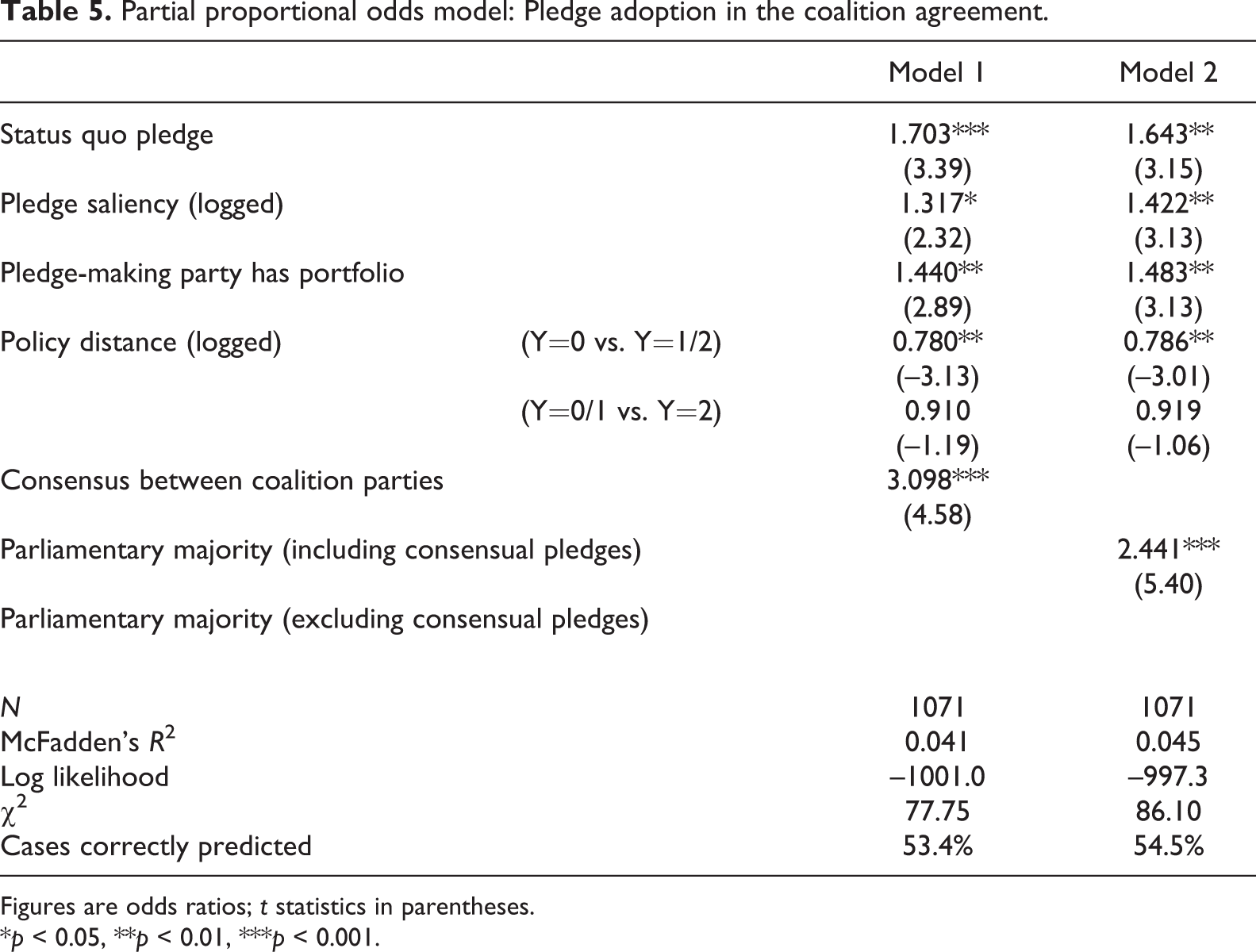
Figures are odds ratios; t statistics in parentheses.
*p < 0.05, **p < 0.01, ***p < 0.001.
From the results in Table 5 we can see that all of our six hypotheses are borne out by the data. Odds ratios above 1 indicate a positive effect of the independent variable on the likelihood of adoption, whereas odds ratios below 1 suggest the opposite. Policy pledges are thus more likely to be adopted if they represent the status quo, if they have a high saliency for the pledge-making party, if they correspond to the distribution of portfolios, if they were made by both coalition parties, if they have majority support among parties in parliament, and – with some caveats – if parties are closer together on the respective policy dimension. Although the pseudo R2s are small, all models predict the correct category for over half of the cases. Individual checks on all variables (not reported) reveal that the consensus and majority predictors have the largest explanatory power.
Looking at the results in more detail, we find a strong positive effect on pledge adoption for the status quo variable. The odds ratios indicate that status quo pledges are between 64 and 70 percent more likely to be in a higher category of adoption than pledges that refer to an alteration of the status quo. This finding is of great relevance not only for coalition researchers but also for students of government policy change. It gives support to the notion that, aside from economic factors and external shocks, government policy is not only influenced by the partisan composition of the present cabinet, but also by that of its predecessors (see, for instance, Bräuninger, 2005).
We also find that the saliency of each individual pledge is positively associated with its chances of adoption. In their manifestos, parties put more emphasis on some policies than on others and this variation is clearly reflected in the bargaining outcome. While this is hardly surprising, it corroborates the assertion that election manifestos are valid representations of parties’ policy preferences (Volkens, 2001: 94).
The odds ratio for the portfolio variable suggests that there is a substantial correlation between the allocation of portfolios and the policy package that coalition parties agree upon. There are thus good reasons to believe that policy and office payoffs correspond to a certain degree. In theoretical terms, this supports Linhart and Pappi’s (2009: 26) assumption of a mutually reinforcing relationship between office and policy benefits. It also highlights the need for integrating models of office and policy payoff distribution.
As to the policy distance variable, both odds ratios in Table 5 take on values smaller than zero, thus conforming to the assumptions outlined in H4. Yet, only the coefficient that differentiates between ‘not adopted’ and ‘partly’ or ‘fully adopted’ is statistically significant. The coefficient that contrasts the two lower categories combined against ‘full adoption’ fails to reach conventional levels of statistical significance. Relative to the category ‘not adopted’, a pledge is thus more likely to be in either of the two higher categories of adoption if the coalition parties are located closer to each other on the respective policy dimension. Yet, this effect weakens considerably when comparing only the ‘fully adopted’ category against the two lower values of the dependent variable combined. Whereas smaller policy distances thus do not necessarily account for pledges being fully adopted, they go at least some way towards explaining coalition-bargaining outcomes. This may be unsurprising given the strong expectations that can be derived from policy-related theories of coalition-formation. However, it is still noteworthy that an aggregate – and therefore imperfect for the present purpose – measure of policy disagreement, namely policy distances on a number of pre-defined dimensions, partly explains pledge adoption in the coalition agreement. Yet, one can safely assume that the explanatory power of this variable could be greatly enhanced if it were possible to derive information on policy disagreement for each individual pledge.
Finally, the consensus and majority variables yield large odds ratios at high levels of statistical significance. This is because, to some degree, these two predictors capture a similar empirical phenomenon, namely that parties agree on a substantial part of the policy agenda. Yet, it should be noted that the effect for the majority variable holds up even when controlling for consensual pledges (Model 3). This means that policy pledges that have majority support are more likely to enter the coalition agreement even if they are not actively promoted by one of the government parties.
In order to illustrate some of our findings, Figure 1 plots the effect of the four dichotomous independent variables on the probability of a pledge being in the ‘fully adopted’ category, with all other variables held constant at their means or modes, respectively.
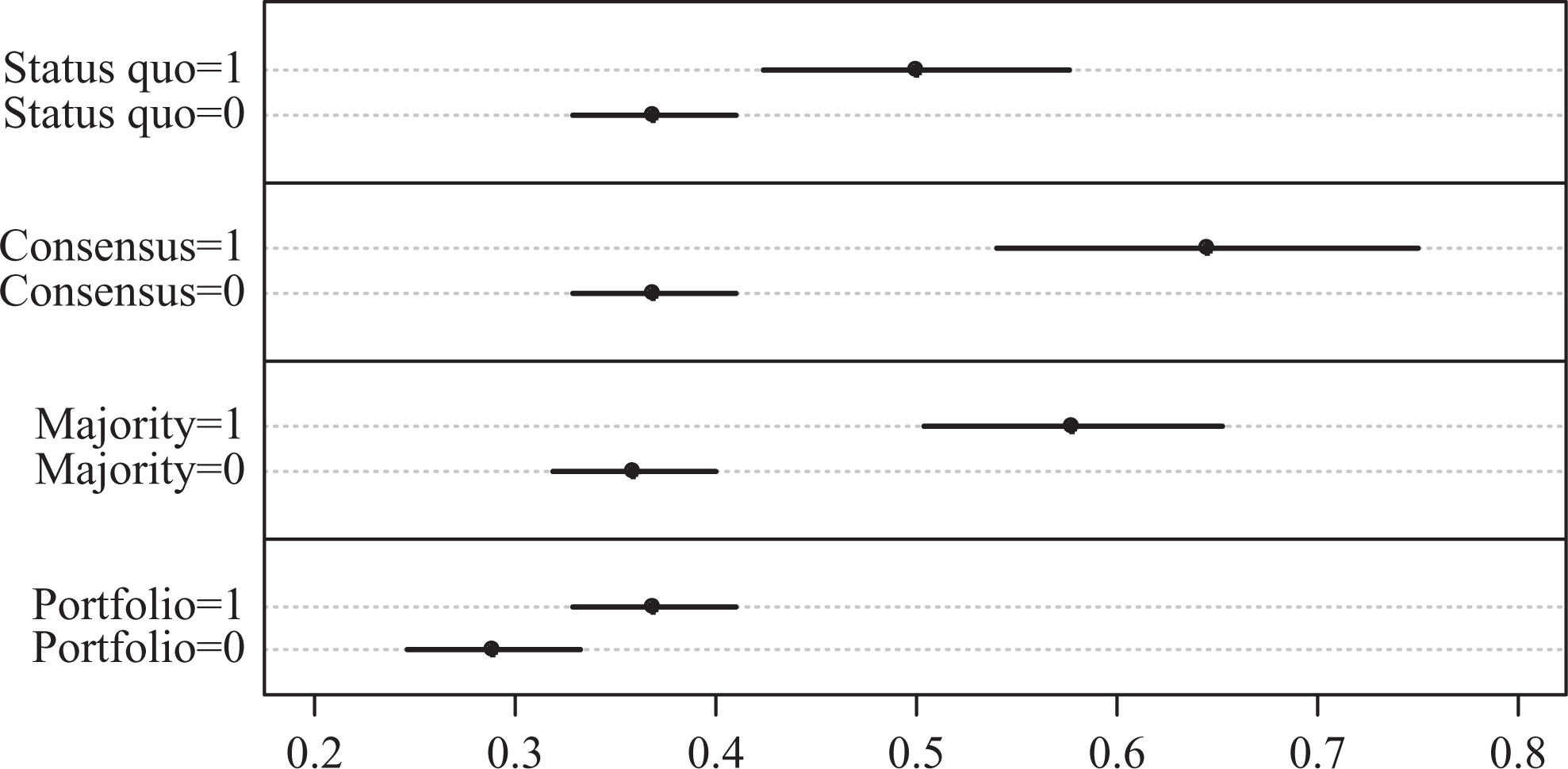
Effects of four dichotomous variables on probability of full adoption.
The graph shows that there are substantial effects associated with these four variables. Consensual and majority-supported pledges, especially, are much more likely to be fully adopted in the coalition agreement than pledges that have less support among parties. We can see that, ceteris paribus, changing the value from 0 to 1 on the consensus variable raises the probability of full adoption by 28 percent. Likewise, majority-supported pledges have a 22 percent higher probability of being contained in the coalition agreement.
The influence of the other dichotomous independent variables is similar, but not quite as strong. The probability of full adoption increases from 37 to 50 percent for pledges that embrace the status quo; it rises from 29 to 37 percent if the pledge-making party receives the corresponding ministerial portfolio.
Conclusion
In the present article we have attempted to explain coalition-bargaining outcomes through examining the adoption of policy pledges from party manifestos in the coalition agreement. As with all studies that are confined to a single country, we need to be cautious about the extent to which our results generalize beyond the case of contemporary Austria. There is thus without question room for further analysis to test the general validity of our findings in a more comprehensive research design. However, we can offer some contextual information to demonstrate that the outcomes of the above analysis are empirically plausible.
First, it is quite easy to explain why status quo pledges should be relevant in the Austrian context. While government stability is not extremely high (early elections are a well-known scenario), the partisan turnover in cabinet is very low. In 2008, the ÖVP had been in government for 22 consecutive years. From 2000 to 2007 it held the dominant position in cabinet, which enabled it to move the policy status quo even closer to its ideal point. The return of the grand coalition in 2007 thus basically institutionalized a permanent conflict between an SPÖ striving to overturn many of the reforms enacted by the Schüssel I and II cabinets and an ÖVP eager to defend its political heritage. Since the ÖVP made good use of its veto power in many areas, major policy change was not expected to arise from the 2006/7 and 2008 coalition negotiations. 7
Second, the finding that the portfolio allocation is relevant for the adoption of policy pledges is very much in line with previous research emphasizing the relevance of ministerial autonomy in the Austrian cabinet. As Müller (1994: 31) points out, ministerial government ‘in quantitative terms must be seen as the dominant [model of government]’ in Austria.
Third, the policy distance variable accounts for the fact that, despite the country’s long-standing tradition of consensual decision-making, Austrian parties are still markedly different when it comes to economic or social policy, as well as attitudes towards European integration. By most accounts, Austrian politics has grown more conflict-laden since the early 1990s (e.g. Müller and Jenny, 2004), which is reflected in the adoption of very distinct policy profiles by the political parties. It is therefore unsurprising to find policy distances having some effect on coalition-bargaining outcomes.
The results for the consensus and majority variables can be contextualized in a different manner: While some issues in these categories are contentious (e.g. comprehensive schools, referendums on EU treaties), the bulk of these pledges represent either valence issues (Stokes, 1963) such as the reduction of unemployment, inflation and crime, or areas of ‘national consensus’, such as opposition to nuclear energy or the use of genetic engineering (Preglau, 1994; Seifert, 2009). Thus, it is unsurprising that policies embraced by both coalition parties and/or a parliamentary majority have a higher chance of adoption in the coalition agreement.
To sum up, our study constitutes an attempt in applying the methodology developed by the party mandate literature to a central aspect of coalition research. To the best of our knowledge, it represents the most detailed account of the determinants of policy outcomes from coalition-bargaining to date. While numerous studies exist about policy payoffs in coalition formation at a very general level, little attention has been devoted to examining coalition-bargaining outcomes in more detail, thus leaving the ‘information depth’ in election manifestos and coalition agreements under-utilized. We therefore conclude that measuring coalition policy at the level of concrete pledges is worthwhile, as it is closer to actual coalition-bargaining over specific issues and allows for analytical insights that more abstract models might miss.
Footnotes
Acknowledgements
Excellent research assistance was provided by Andreas Frössel and Anita Bodlos. The authors would also like to thank Markus Wagner, the participants of Wolfgang C. Müller’s research seminar at the Department of Government, University of Vienna, and three anonymous reviewers for their helpful comments.
Funding
This research was carried out under the auspices of the Austrian National Election Study (AUTNES), a National Research Network (NFN) sponsored by the Austrian Science Fund (FWF) (S10903-G11), as well as the project ‘Political Economy of Reforms’ (SFB 884: C1) financed by the German Research Foundation (DFG).