



Abstract
The role of members of political parties is ambiguous because it entails both benefits and costs. In order to shed light on the question of whether members are an asset or a liability for parties, I examine whether parties use their ideology on a left–right dimension as a collective incentive for the appeal to actual and potential party members. A quantitative analysis of the effects of changes in membership on partisan ideological change, covering 61 parties in 11 Western democracies from the 1950s to the early 1990s, shows that there is a weak, but statistically significant, effect. An additional analysis of two mechanisms by which membership has an effect refutes the alternative explanation that positional changes of the median member account for partisan ideological change. In total, the results indicate that members are both an asset and a liability and that parties try to keep the two in balance.
Introduction
Party members form the backbone of political parties in both normative and empirical respects. From a normative point of view, members are the carriers of intra-party democracy and hold the party leadership accountable for its actions in party competition (Strøm, 1990). Empirically, party members perform multiple and vital functions, such as the provision of capital and labour (Katz, 1990). The literature on party members indicates a broad consensus on their normative importance and also the advantages and disadvantages for partisan action in party competition, which are briefly reviewed below. At the same time, there is disagreement on the ways in which parties value the advantages and disadvantages. On the one hand, some are of the opinion that parties increasingly perceive the costs of membership since the 1960s (Katz, 1990; Katz and Mair, 1995). On the other, it has been asserted and shown in case studies that parties value members and respond to membership change (Scarrow, 1994). Though the case studies are insightful, a cross-national analysis covering multiple parties over time has not been undertaken so far. It is important that such a study be carried out because it is still an open question whether parties have reacted to altering party membership or have remained unresponsive.
The present study aims to shed light on this issue by analysing whether parties use their ideology on a left–right dimension as a collective incentive for the appeal to actual and potential party members. The underlying line of reasoning is developed below along with hypotheses. Taking research on the effects of election results as the basis, I formulate two competing hypotheses on the precise nature of the effects of changes in party membership. The effects of membership shifts on party ideology are scrutinized later in a quantitative analysis of 61 parties in 11 Western democracies in the period of analysis from the 1960s to the early 1990s, a period in which parties were most likely concerned about changes in their membership (Scarrow, 2007). The empirical results show that there is a statistically significant, yet substantively very small, effect of membership changes. This finding, which is robust to various alternative model specifications, indicates that members are valued by parties, but not to any large degree owing to the costs of attracting by ideological means.
I therefore examine two mechanisms that could account for this finding. First, the availability of state subsidies for parties can diminish partisan interest in members (Katz and Mair, 1995; Pierre et al., 2000). Second, by distinguishing between niche and mainstream parties, I analyse whether party members impose a constraint on a party’s room for manoeuvre. Both mechanisms receive empirical support and refute the alternative hypothesis that changing membership leads to a shift in position of the median member, which, in turn, accounts for a change in the party ideology. These results have important implications for research on party members and party competition. Although the significant effect shows that parties do not entirely ignore changes in their membership base, the small substantive effect implies that they are reluctant to use their most precious incentive, their ideology, to appeal to party members. The consequences of the findings for future research are addressed in the last section of the article.
Benefits and costs of party members
The role of members is ambiguous because they entail both benefits and costs to parties. There are at least six reasons for the assertion that party members are beneficial from the perspective of parties (Katz, 1990; Scarrow, 1994; Strøm, 1990). 1 First, members provide capital in the form of fees and, second, of labour through active involvement in party activities. Both resources are integral to the everyday business of parties and during election campaigns in particular. Third, members promote the linkage between the party elite and the electorate in both directions. 2 The rank and file are multipliers because each member communicates the party’s policies to multiple voters (Scarrow, 1994). At the same time, members represent a communication channel through which voters articulate their (dis)content with the party’s course of action vis-à-vis the leadership. Fourth, broad membership is beneficial because they are loyal voters, at least until recently (Dalton and Wattenberg, 2000). Fifth, the party membership constitutes the pool from which campaign candidates are recruited. Sixth, and finally, a broad membership is valuable if voters perceive the leaders of large parties as more legitimate and suitable for public office than their counterparts in smaller parties. These six factors are not equally salient for all countries and parties and over time, but it can reasonably be argued that at least some of them apply to every country at any given point in time.
For two reasons, however, party members are not without costs. First, members create opportunity costs because the means a party employs to attract members may be invested more efficiently for purposes such as media campaigns. Second, a range of case studies suggests that party members are policy-seekers, whereas party leaderships are more office-oriented (Müller and Strøm, 1999). Regardless of whether members are more or less extreme than the party leadership (Kitschelt, 1989), it is likely that the ideological position demanded by the members is not the optimal one from an office-seeking perspective (Schofield, 2003; Strøm, 1990). Consequently, members tend to be a hindrance in party competition.
In relation to the latter point, only a few quantitative studies have focused on the influence of members, and activists in particular, on party ideologies (e.g. Schofield, 2003). As elaborated in detail below, however, my analysis is not based on any argument about the ideological preferences of members (beyond the plausible assumption that they are different from the preferences of the elite; see Kitschelt, 1989), but instead on the importance of members for parties regardless of their preferences. The theoretical differences between the two arguments become apparent in the following sections, where they are subjected to empirical analysis.
Party ideology as a collective incentive
Given the assumption that parties aim to gain new members and keep the current ones inside the party, it is important to know why individuals become interested in joining a party in the first place. Available surveys of party members show that a variety of factors account for the decision to enter a party. One prominent variable is an individual’s ideology and ideological commitment (Katz, 1990). People join parties particularly because of the expectation that the party pursues this ideology as well (Pierre, 1986).
From the perspective of parties, the ideological commitment of actual and potential members entails that they can use their ideology as a collective incentive (Panebianco, 1988: 9–13). One direct implication that follows from this is that party ideology should be responsive to changes in the party membership. This general argument receives empirical support in several case studies showing that parties formulate and adjust their ideology with an eye to how it is perceived by the members (Müller and Strøm, 1999; Scarrow, 1994). One goal of my study is to determine whether the qualitative evidence reflects a general pattern of ideological adaptation toward party membership change.
This research focus does not mean that party ideology is the only incentive that parties can employ. In principle, parties can offer their members a range of private and collective incentives and it is likely that they use multiple incentives in order to attract citizens with different interests. On the basis of two case studies, Scarrow (1994) shows that German and British parties employed different instruments to gain members, including increased influence on candidate selection or enhanced dissemination of information through official party magazines.
While parties have a repertoire of incentives at their disposal, two speak up for focusing on party ideology as a collective incentive. First, this incentive is available to all parties and allows analysis of a comprehensive set of parties over time. Other incentives may be available to a selected group of parties only, which would yield a narrower and possibly distorted picture of the value of members for parties. Second, the potentially more important downside of party membership – the imposition of constraints on the party’s scope of action in party competition – can only be tested by focusing on ideology. If one finds evidence that parties use their ideology as a collective incentive, it can be seen that the ideological room for manoeuvre is limited because it is likely the optimal ideological adaptation to membership change is not the electorally optimal strategy (Schofield, 2003; Strøm, 1990). On the other hand, the absence of an effect of membership shift on ideological change allows the conclusion that the party leadership does not employ its ideology as a means by which to attract members. Such a finding would still allow for the possibility that parties rely on other incentives, but it would nevertheless qualify the importance of members for parties.
Membership change and ideological change: Hypotheses
The ambiguous ramifications of members for parties have two general implications for the effect of membership shifts on ideological change. When the party leadership perceives members as a liability, there is no reason to incur the opportunity costs and to use ideology as a collective incentive. The liability hypothesis pertaining to this line of reasoning then simply reads: Membership change does not have an effect on ideological change.
The second general expectation builds on the claim that parties perceive members as an asset and utilize their ideology for attracting members. In order to elaborate on two different hypotheses on possible links between membership shifts and ideological change, I build on research on the influence of the vote share on partisan ideological behaviour. Research on electoral changes is the appropriate point of reference for the present analysis because, for reasons detailed here, the basic logic of the argument is similar for changes in the vote share and membership base. 3
Adams et al. (2004) were first to systematically test the argument that parties respond to changes in election results (see also Budge, 1994). They theorized that parties move their ideology at t in the same direction as at t – 1 if the vote-share increases. Correspondingly, parties at least partially reverse their last ideological move if they lose votes, because this is taken as a signal that the ideological shift was in the wrong direction. Although this is a compelling line of reasoning, Adams et al. do not find corroborative evidence. In a recent study, Somer-Topcu (2009) develops an alternative link between vote-share changes and ideological behaviour. Her argument is that the extent of partisan ideological change, but not its direction, is affected by changes in the vote share. It is this assertion on which the following analysis is built and which therefore receives more scrutiny in the context of effects of membership change on ideological change.
It might seem surprising that the direction of ideological change does not depend on whether party membership increases or decreases. Correspondence between the direction of membership change and the change of party ideology is important when arguing about the responsiveness of partisan ideologies. However, partisan decision-making is characterized by uncertainty (Budge, 1994) and this might pertain to the direction in which the ideology should be altered in response to the direction in which the party membership develops. This means that some member-winning parties believe they should make a move at t in the same direction as at t – 1 because the past ideological shift was rewarding. At the same time, other member-winning parties would be infer that membership would have developed even better if the last ideological shift had been smaller; consequently they take a step in the opposite direction. Altogether, then, the behaviour of member-winning parties would be inconsistent with respect to the direction of current ideological change. A similar argument can be made for member-losing parties, a subset of which at least partially reversed their last ideological shift because of the belief that it was too large. In contrast, other parties experiencing declining size conclude that the move was not large enough and take an additional step in the same direction.
If one considers that this type of uncertainty characterizes partisan reactions to changes in the vote-share (Somer-Topcu, 2009), it could be reasonably argued that it extends to the realm of changes in party membership. For some time now, there has been an abundance of voter surveys offering parties information about voter attitudes, voter movements on ballot day, and so on. If this rich body of data still produces inconsistent behaviour regarding the proper direction of current ideological change, it is even more likely that uncertainty characterizes decision-making in reaction to membership changes. Parties can collect and analyse data about their actual members and new members, but it is difficult for them to gather information about the reasons members leave a party. It is even more difficult to acquire knowledge about why potential party members hesitate to join the party. As this is essential information on which to base a decision about the proper direction in which the party ideology should be changed, it is reasonable to hypothesize that uncertainty is pervasive and that the direction in which ideology shifts in response to increasing and decreasing party members is non-systematic.
The assertion about the irrelevance of the direction of membership shifts is complemented by the claim that it has an effect on the magnitude of ideological change. The argument about the relevance of the magnitude is based on the assumption that parties are risk-averse actors (Somer-Topcu, 2009). Two different consequences of risk-averse behaviour are conceivable. First, it is possible that membership shifts have a negative effect on ideological change. A large decline in membership figures signals to the party leadership that it needs to make an ideological leap because big problems call for big responses. An empirical example falling under this reasoning is the German Social Democratic Party (SPD) in the mid-2000s. In 2003, German Chancellor Schröder announced the so-called Agenda 2010, a major effort at retrenching the welfare state. Agenda 2010 was a major departure from traditional SPD policy and marked a shift to the right of the political spectrum. One consequence of this departure was an extraordinary decline in party membership due to the exit of frustrated members. At least partly because of this development, the SPD again made a move to the left in the mid and late 2000s. 4 This implies that the more positive membership change becomes, the less a party is prepared to shift ideologically. Again, uncertainty can explain this behaviour because the consequences of ideological changes are unknown. The better party membership develops, the smaller ideological responsiveness becomes because there is no reason for taking risks. Taking the two previous arguments together, the decreasing-effect hypothesis is as follows: The absolute magnitude of ideological change decreases with increasing membership change.
The line of reasoning behind this proposition is plausible, but one could equally well theorize the opposite effect of altered membership. A membership gain is a positive signal that may motivate the party leadership to make another bold ideological move because the last one was rewarding. An empirical example of this constellation is the German Pirate Party, which became increasingly popular after the federal election of 2009. The gain in popularity became manifest in several successful elections in the German Länder and in an enormous increase in party membership. The party had about 1,000 members in mid-2009 and almost 35,000 in late 2012. The increase was reassuring for the Pirate Party and contributed to its confidence in the current ideological course. Moreover, declining membership might have discouraged the party elite from taking a large step precisely because its last ideological move proved to be fallacious. Since the party is acting in an uncertain environment, the leadership lacks confidence about how to react to shrinking party membership. As a consequence of this uncertainty, it seeks to regain its orientation about the proper course of action by evaluating the effects of small ideological changes. In this view, the relationship between membership shifts and ideological change would be positive. This argumentation is captured in the positive-effect hypothesis: The absolute magnitude of ideological change increases with increasing membership change.
Before proceeding with the empirical analysis, it is necessary to discuss an alternative explanation, which I refer to as the median member hypothesis. According to this hypothesis, the gain and loss of members leads to a change in the ideological position of the median member. The party leadership must acknowledge this change if it is to maintain sufficient intra-party support, because this is the prerequisite for the pursuit of office-related benefits in party competition (Laver and Schofield, 1998: ch. 2). A shift in the median member position due to an altering membership base then prompts partisan ideological change, potentially giving rise to the same patterns as were previously hypothesized. Ideally, one would use survey data for measurement of the median member position and test whether changes lead to an altered party ideology. Some empirical studies point to an influence of the ideology of activists as a subgroup of members on partisan ideology (Rohrschneider, 1994). However, the available data for measurement of member ideologies are limited in terms of countries and time. Consequently, a direct empirical assessment of this alternative explanation is forestalled. After having elaborated the design and presented the empirical results for the previous hypotheses, however, I formulate two hypotheses on mechanisms that are uniquely linked to my hypotheses and that help to discriminate between the competing explanations.
Model specification
The baseline model testing the positive and negative effect hypotheses is:

Where:
|ΔPJ(t)|: Absolute ideological change of party J between t – 1 and t;
ΔMJ(t): Change in party membership of party J between t – 1 and t;
|ΔPJ(t – 1)|: Absolute ideological change of party J between t – 2 and t – 1;
|ΔPOK(t)|: Absolute public opinion change in country K between t – 1 and t.
The dependent variable is the absolute ideological change of a specific party between two consecutive elections. Measuring the outcome in absolute terms is necessary because of the assumption that the extent, but not the direction, of current ideological moves depends on membership shifts (Somer-Topcu, 2009). According to the negative-effect hypothesis, the marginal effect of ΔMJ(t) is significantly negative. If the positive-effect hypothesis holds true, the marginal effect of this variable should be significantly positive.
The other two variables are included for purposes of control. The lagged absolute ideological change is included because of the policy alternation hypothesis according to which the current ideological shift is in the opposite direction of the previous one (Budge, 1994; Budge et al., 2010). Since the dependent variable is measured in absolute terms, it is necessary to add the absolute lag of the dependent variable. Hence, the marginal effect of |ΔPJ(t – 1)| should be significantly positive. The variable |ΔPOK(t)| is a control capturing the marginal effect of public opinion changes. In light of recent empirical research, party ideology moves in the direction of public opinion (Adams et al., 2004, 2006), which means that the marginal effect should be significantly positive.
Data
The dependent variable is measured as the change of party ideology on a left–right dimension between two consecutive elections. The empirical analysis is based on the position data offered by Franzmann and Kaiser (2006). 5 The estimation procedure, described in detail by Franzmann and Kaiser, builds on the raw codings of the Comparative Manifesto Project (CMP, see Budge et al., 2001; Klingemann et al., 2006) and therefore has the same spatio-temporal coverage. Conceptually, the Franzmann–Kaiser data rest on the plausible assumption that the meaning of ‘left’ and ‘right’ varies between countries and over time within the same country. Empirical studies on the meaning of ‘left’ and ‘right’ in party competition indicate that this assumption is warranted (Benoit and Laver, 2006; Corbetta et al., 2009; Pelizzo, 2003). A comparative validity assessment of several left–right measures for the case of Greece further reveals that the Franzmann–Kaiser data perform better than does the CMP left–right measure (Dinas and Gemenis, 2010), which is based on the hard-to-defend assumption that, since World War II, ‘left’ and ‘right’ always had and still have the same meaning across countries. For these reasons, the Franzmann–Kaiser data are taken for measuring the dependent variable as well as the lagged dependent variable. 6
Public opinion changes are measured as the shift of the median voter position from one election to the next. The Kim–Fording procedure (2001) is employed to estimate the position of the median voter on the basis of the Franzmann–Kaiser party position estimates. There is ongoing debate about the validity of the Kim–Fording approach and survey data for the measurement of public opinion (McDonald and Budge, 2005; Warwick, 2010). With respect to spatio-temporal coverage, the Kim–Fording measure is preferable because use of Eurobarometer data for the survey-based measurement of public opinion would impose tight constraints in addition to the limited availability of membership data. However, spatio-temporal coverage should not be the main criterion for the choice of data, so I run the models once with the Kim–Fording estimates and once with a mean voter position derived from the Eurobarometer. This allows it to test the robustness of the results for the employed public opinion measure. Concluding the discussion of position data, it should be noted that the Franzmann–Kaiser estimates and the median voter estimates range from 0 to 10, 0 being the left-most position, 5 the middle of the spectrum and 10 the right end.
Data on party membership are only available from Katz and Mair (1992) and range from the 1960s to 1992 (for a small number of parties the data series starts in the 1950s). However, the virtue of the present period of analysis is that it covers the ‘golden age’ of parties as well as the beginning of declining membership (Mair and van Biezen, 2001). If parties ever employ their ideology for the attraction of party members, it should be in the selected period in which the link between parties and their members is relatively close (Katz and Mair, 1995). Changes in party size are measured as the relative change in total membership in pre-election years. 7 Data on government and opposition party membership (see below) have been taken from Woldendorp et al. and (2000) and Müller and Strom (2000). In total, the analysis includes 61 parties in 11 Western democracies and ranges from 1952 to 1992. 8
Model estimation
The structure of the data has a time-series cross-section (TSCS) element because the dataset pools multiple ideological shifts of parties from different countries. 9 Multiple tests were performed in order to deal with the specific issues attached to TSCS data (Beck, 2001). White’s M test for serial autocorrelation rejects the null of no autocorrelation at 0.10 (p=0.06). 10 The baseline model was estimated with standard errors clustered by party, which Monte Carlo simulations show to be a proper method of addressing serial correlation (Petersen, 2009). The requirement is that the number of clusters is greater than 50, which holds true for the present analysis that includes 61 parties. F-tests for unobserved country-specific and period-specific effects fail to reject the null of no unobserved heterogeneity for elections, but reject it for countries. Estimation of the baseline model with country dummies produces identical results (see supplementary paper). Because of the estimation problems attached to fixed-effects models (Kittel and Winner, 2005), country fixed-effects are not included in the following models.
Empirical results
Table 2 presents the quantitative results. In the baseline model, membership changes have a positive and highly statistically significant, but substantively small, effect. This is robust to the estimation of alternative specifications; the four most important ones are presented in Table 2. 11 First, I additionally estimated a model using a standardized measure of party membership. Party membership is standardized with the size of the electorate in order to have a comparable measure across time and countries (Mair and van Biezen, 2001). The baseline estimate is unaffected by the use of standardized membership figures. 12 Second, I use Eurobarometer data for the measurement of public opinion by calculating change in the mean position of the respondents’ self-placement on a left–right dimension. The effect of membership changes remains unaltered, showing that use of the Kim–Fording estimates is justified. Third, I additionally control for a party’s change in the vote-share between two consecutive elections, receiving the same estimates as for the baseline model. Fourth, I estimated a model with the natural log of the dependent variable in order to test for a non-linear effect of membership change (see Somer-Topcu, 2009). Estimation of a non-linear effect again produces results in line with the baseline model. Furthermore, a model tests for differences between opposition and government parties because government parties draw on the benefits of party membership to a lesser degree than opposition parties do (see supplementary paper for details). I expect a marginal effect of membership change for opposition parties and no effect for government parties, which is the result of the empirical analysis. 13 To summarize, all the models show that membership change has a statistically significant and positive, yet substantively small, effect on a party’s ideology.
Descriptive statistics.

Regression estimates.
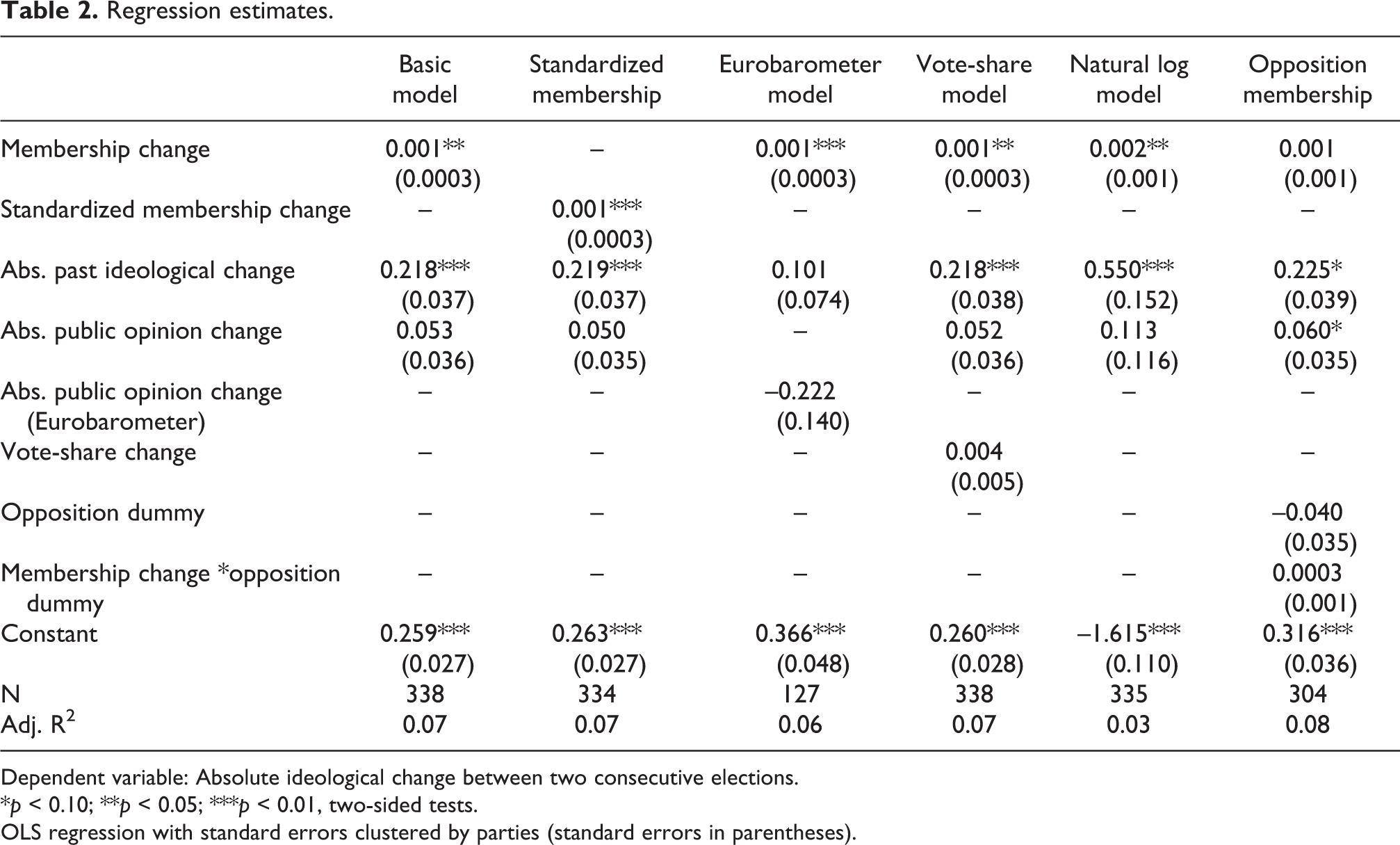
Dependent variable: Absolute ideological change between two consecutive elections.
*p < 0.10; **p < 0.05; ***p < 0.01, two-sided tests.
OLS regression with standard errors clustered by parties (standard errors in parentheses).
From the viewpoint of statistical significance, this means that the positive-effect hypothesis receives empirical support, whereas the negative-effect hypothesis is invalidated. An increase in party membership seems to send a positive signal to the party leadership, which then makes another move at the next election. On the other hand, a membership loss puts a party in a state of uncertainty that discourages ideological change at the present election. However, the fact that the effects are small across all models has to be taken into account as well. Statistical significance indicates that membership change matters, whereas the substantively small effect suggests that members barely matter. The empirical results lend credence to the argument that parties are an asset – because of statistical significance – as well as a liability – because of the small substantive relevance.
As unsatisfactory as this finding may seem because of the conventional desire to derive highly significant and substantively large effects, these results might simply reflect the dilemma in which parties find themselves. Broad membership implies certain benefits that parties want to realize, but they can only do so by incurring costs. The empirical results indicate that parties position themselves at the midpoint of this dilemma by adjusting their ideology to changes in party membership, but only at a very low level.
An extension of the analysis into the 1990s indicates that the dilemma no longer existed after the early 1990s (see supplementary paper for details). Incorporating the membership data provided by Mair and van Biezen (2001) yields 41 additional observations for the late 1990s. 14 Using a dummy to distinguish between the late 1990s and the previous period, membership change has a significant effect for the first three decades, but not for party behaviour in the late 1990s. This suggests that parties stopped using their ideology as a collective incentive and freed themselves from navigating between the attraction of party members and the appeal to voters.
Recalling that the median member argument constitutes a rival explanation to mine, it is important to note that the ambiguous results extend to the former because they yield the same predictions for the baseline model. Change in the median member position occurs to have an effect on partisan ideological change, but only barely so.
Assessing two mechanisms of membership effects on party ideology
On the basis of the previous results, I now take a closer look at two mechanisms that may underlie them. The inquiry into mechanisms increases the theoretical leverage of my argument and, additionally, derives implications from my explanation that do not follow from the median member argument. The first mechanism relates to the availability of state subsidies for parties. On the one hand, there is empirical evidence refuting a weakening link between parties and members due to the invention of state subsidies (Hofnung, 1996; Pierre et al., 2000). Cross-national data on membership development after the introduction of state subsidies show that membership figures do not decline, which can be taken as indirect evidence that members still mattered for parties. On the other hand, it can be argued that state subsidies diminish the relevance of members because they can substitute for the capital and labour provided by party members (Katz and Mair, 1995). While capital and labour are only two reasons why parties may care about members, state subsidies may suffice for at least reducing the extent to which parties provide incentives for attracting potential and current members. With respect to my study, I take the existing research for the formulation of the state subsidies hypothesis stating that if subsidies diminish the importance of members there should be an effect of membership change for parties that does not receive subsidies and no effect for parties in countries granting financial support.
The competing hypothesis about the effects of a changing median member position on party ideology does not permit it to derive this hypothesis. If the median member has an influence on the party position, it should do so regardless of the availability of party finance. It might be that the party leadership wants to become independent of its members and therefore seeks the conferral of state subsidies. However, the intra-partisan control of the party leadership is independent of changes in the party finance regime and it is not obvious why members, and the median member in particular, should relinquish this control.
The second mechanism potentially interfering with the tie between members and ideology is linked to the distinction between niche and mainstream parties (Adams et al., 2006; Ezrow, 2008; Ezrow et al., 2011; Meguid, 2005). A niche party is defined as one that occupies a niche in ideological space, while mainstream parties appeal to the electorate at large (Adams et al., 2006: 513). Niche parties have been found to be less responsive to public opinion than mainstream parties and more responsive to their constituencies (Adams et al., 2006: 513; Budge et al., 2010). An explanation is that their members are strongly policy-motivated and oppose the subordination of party ideology to what the public wants. In contrast, mainstream parties are ideologically more flexible because their supporters and members appreciate, at least within limits, that the instrumental use of party ideology is necessary for purposes of vote-seeking and office-seeking. This line of reasoning can be transferred to the present study. The above-mentioned reasons why parties should value party membership all conceive of members as a utility in party competition. If parties use their ideology as a means to attracting members, one should observe an effect of membership change for mainstream parties and no effect for niche parties. This is summarized in the mainstream party hypothesis: There is an effect of membership change on ideological change for mainstream parties and no effect for niche parties.
The distinction between niche and mainstream parties is arguably an ambiguous one, because one could also consider the opposite hypothesis. Because of the broad appeal of mainstream parties, they might not care about changes in party membership. On the other hand, niche parties might value members because of their ideological commitment (Katz, 1990; Kitschelt, 1988). However, based on the premise that party members are assets in party competition, the mainstream party hypothesis is more plausible than a niche party hypothesis. Regardless of this issue, the mainstream party hypothesis cannot be derived from the median member hypothesis. If at all, coupling of the party elite and the party members is tighter in niche than in mainstream parties (Kitschelt, 1988, 1989). If partisan ideological change is due to a changing median member position, one should observe a significant effect of membership change for niche parties and none for mainstream parties.
Empirical results for mechanisms
The state subsidies hypothesis is tested using a multiplicative interaction term between a party finance dummy and the membership change variable. The dummy is coded 1 when a country introduced subsidies for political parties according to the information on public party finance provided by Pierre et al. (2000). 15 According to the state subsidies hypothesis, the marginal effect of the membership change should be statistically significant and positive. At the same time, the marginal effect of membership shifts in the presence of state subsidies should be statistically indistinguishable from zero. The results are presented in the left column of Table 3 showing that there is a statistically significant, but substantively small effect of membership change when subsidies are not granted. The marginal effect for parties operating in a country granting state subsidies cannot be directly inferred from the table because an interaction effect is involved. The marginal effect is 0.001 with a standard error of 0.001 and lacks statistical significance (t = –0.190). The state subsidies hypothesis therefore receives empirical support, keeping in mind that the effect of alterations in party membership is small.
Estimates for hypotheses on mechanisms.

Dependent variable: Absolute ideological change between consecutive elections.
*p < 0.10; **p < 0.05; ***p < 0.01, two-sided tests.
OLS regression with standard errors clustered by parties (standard errors in parentheses).
Assessment of the mainstream party hypothesis is based on a multiplicative interaction between a niche party dummy and the membership change variable. 16 The latter should be statistically significant and positive because it captures the effect for mainstream parties. Correspondingly, the estimated marginal effect for niche parties should not be different from zero. The middle column of Table 3 points to a statistically significant and substantively small effect of membership change on the ideological behaviour of mainstream parties. The marginal effect for niche parties is –0.0001 with a standard error of 0.0004, missing the conventional levels of statistical significance by a wide margin (t = –0.190). The mainstream party hypothesis thus confirms the previous findings. 17 The third column demonstrates that these findings still hold true when estimating a combined model including the party finance and niche dummies and corresponding interaction terms.
Taking these findings together, I first conclude that the median member hypothesis lacks empirical resonance because it is not compatible with the results. The results of the party finance analysis are particularly relevant to the argument that party members represent capital and labour (Katz and Mair, 1995). The absence of a significant effect when state subsidies are granted indeed indicates that parties substitute the input of party members with public money. Whether parties deliberately introduce a state subsidies system in order to diminish reliance on party members cannot be decided here. However, it seems that parties turn away from their members given that, for whatever reason, parties are at least partially financed by the state.
According to the results, the second mechanism by which party membership change operates is attached to the ideological orientation of a party. Mainstream parties adapt their ideology to changes in party membership, while niche parties do not. This finding supports the claim that mainstream parties perceive members as an electoral asset in their appeal to the public at large. On the other hand, the ignorance of membership shifts by niche parties suggests that they conceive of members as liabilities in their attempts at reaching out to supporters. This might seem puzzling at first glance, because it is not apparent why members should promote the broad electoral appeal of mainstream parties and hinder the narrower electoral appeal of niche parties. However, two lines of reasoning substantiate this claim. First, party members perform multiple functions that are not all equally compatible with gathering votes from the electorate at large and the core constituency. The provision of capital and labour and the multiplier function of members should be equally valuable for niche and mainstream parties. This is different for the legitimacy-enhancing function of a broad party membership because mainstream parties reaching out to the public should be more concerned about legitimacy than niche parties. Similarly, mainstream parties need to recruit more members as candidates for elections than niche parties, which in turn explains why the former seek a broad party membership and the latter don’t.
Second, it is plausible that the members of niche parties have a stronger ideological commitment than their counterparts in mainstream parties (Adams et al., 2006). Moreover, there is case study evidence that the members of niche parties exert more control over the leadership than their counterparts in mainstream parties (Kitschelt, 1988). Both issues together imply that the leadership of a niche party is more constrained in manoeuvring the party in party competition. One might counter that it is easier to appeal to the core electorate than the electorate at large, so the constraining effect of party members would put niche parties and mainstream parties on similar ground. However, survey data show that the mean left–right shifts of the constituency and the public are of similar size (Ezrow et al., 2011). The leadership of a niche party is thus more constrained than the leader of a mainstream party. This in turn explains why changes in party membership have a significant effect for mainstream parties, but not for niche parties. All the preceding arguments on the two mechanisms are in line with the results presented, but they too are based on the finding of a statistically significant, yet substantively small, effect. This is an issue that is considered in the concluding section.
Conclusion
The aim of this analysis was to discern whether members are an asset or a liability for parties. In light of the empirical results, the most appropriate answer is that they are both. On the one hand, it can be inferred that members are an asset because of a statistically significant effect of membership change. On the other, the effect is small in substantive terms. The inference that members are an asset therefore has to be qualified with the conclusion that they are hardly that. In the social sciences, negative findings, taking the substantively small effect as the negative finding here, are usually deemed less interesting than positive ones. However, a degradation of this finding would be misleading because there is an explanation behind it, namely the argument that parties are not prepared to use their arguably most precious tool, their ideology, for attracting party members. Keeping actual members in the party and gaining new ones does not seem worth the price, because party members constrain the party leadership and ideological flexibility is needed for the collection of votes in party competition.
The results presented in this study can form a twofold basis for future research. First, the quantitative analysis should be complemented with in-depth case studies in order to substantiate the findings that members barely matter. The case studies should aim to deliver evidence that parties do not use their ideology in order not to overly constrain themselves in party competition and avoid more generally the opportunity costs of appealing to members. Second, the inference that ideology hardly represents a collective incentive does not mean that parties do not care about members at all. It is possible that parties employ other collective and private incentives for maintaining their membership base. Scarrow (1994) delivers case study evidence that the German Christian-Conservative Party (CDU) and the British Labour Party relied on a battery of instruments. These insightful case studies should form the basis for longitudinal and cross-national research yielding more comprehensive insights. The pursuit of research on party members along these two lines would give a more complete picture of the normatively and empirically important relation between parties and their members.
Footnotes
Funding
This work was supported by the Deutsche Forschungsgemeinschaft (DFG) [grant numbers KA 1741/5-1 and KA 1741/5-2].