




Abstract
Unlike existing approaches to the study of ethnic politics, this article argues that the political competition for ethnic votes in modern democracies is programmatic (i.e. distinguishable by its focus on issues and policies), much like the competition for voting blocs defined as based on class or gender. Analysing ethnic appeals in this manner makes them suitable for the type of quantification and comparative analyses now standard in the estimations of policy positions on a range of other issues. Once the policy concerns of ethnic communities are known, scaling and scoring them becomes possible, paving the way for quantification and rigorous comparative work. Drawing on content analysis of speeches and manifestos delivered in democracies over the past decades, the article identifies a list of political positions reflective of appeals made to ethnic communities. Further, it derives and validates two indices of ethnic campaigning using data from the Comparative Manifestos Project. The measures are shown to be more robust and sensitive to nuance than existing classifications and can be readily applied to testing various hypotheses regarding the political competition for ethnic votes in democracies.
Introduction
Ethnic identifications remain among the most significant aspects of politics. They are also ubiquitous and shown to matter regardless of countries’ levels of economic development or political sophistication. Understanding how and why ethnicity is politicized is important for a number of other outcomes of interest, such as democratization, public goods provision, economic growth and inter-group relations (Cederman et al., 2010; Easterly and Levine, 1997; Fearon and Laitin, 2003; Reilly, 2001). It has now become common to view identities as socially constructed, often by political entrepreneurs seeking access to power and resources (Brass, 1991; Fearon and Laitin, 2000b; Laitin, 1998; Posner, 2005). Ethno-political appeals – politicians’ urge to electorates to assume the obligations of membership in a certain group and support positions reflective of this membership – are also common in political campaigns.
Ethnic outbidding, or the political competition for ethnic groups’ votes is feared for its propensity to cause violence and the long-term deterioration of inter-group trust and cooperation (Horowitz, 1985, 2003; Rabushka and Shepsle, 1972). Yet, ethnic campaign messages have remained largely outside mainstream analyses of party platforms, which have explored policies as estimations of positions on a range of other issues and dimensions: left–right, domestic–international, liberal–conservative, etc. With a few recent exceptions, scholars have tended to distinguish ethnic parties based on the distribution of (electoral) support alone (Horowitz, 1985; Mozaffar and Scarritt, 2003).
Nevertheless, certain policies have long been recognized as reflective of ethno-political demands within the comparative politics literature. These include regionalism and decentralization (Brancati, 2006), secessionism (Sorens, 2005), nationalism (Cederman and Girardin, 2007). Scholars often define ethnic parties as ones which ‘typically represent the interests of one group alone’ (Reilly, 2006: 811), ‘[are] the champion of the particular interests of one ethnic category or set of categories’ (Chandra, 2011: 155) and ‘seek political power to impinge on the relative power or position of ethnic groups’ (Ishiyama and Breuning, 1998: 4). There is, however, little specification of how the interests of groups defined by common descent-based traits are championed in political platforms. This is even more surprising in light of decades of research on how parties compete for the support of voting blocs defined by gender, class or religion (Harris, 1994; Kahn, 1996; Wahrman, 1995; Weatherford, 1978). The latter commonly consider policies as proxies for making appeals to voting groups.
Further, the literature on the political inclusion of minorities in more centrist or otherwise non-aligned parties in democracies has looked at the signals the latter send to their constituencies when nominating a minority candidate for office or putting their name on a ballot. 1 While this type of strategy does not rely on the communication of a policy message per se, it is shown that voters react to it by weighing the consequences of minority inclusion precisely because the potential shift in the party’s overall policies matters. Research from social psychology draws attention to the effect of implicit racial or ethnic prejudice on vote choice and support for policies exhibiting ‘learned association’ to ethnic or racial categories. 2 For issues that have been successfully framed as benefiting or targeting a particular group (a process which may be done implicitly), group predispositions shape behaviour for associated policies by serving as useful heuristics in evaluating even unfamiliar notions (Nelson and Kinder, 1996). Thus, certain issues are clearly reflective and consequential for ethnic communities’ demands for power and representation. It can be expected that ethnic appeals in campaigns focus on these issues. The challenge becomes to identify what they are and in what ways they can be combined within measures allowing meaningful comparison across cases.
The analysis of ethnic messages in democracies has much to gain from including a taxonomy of explicit positions to existing classifications of ‘inclusive’ or ‘exclusive’ appeals (Chandra, 2009, 2011). Such incorporation would aid comparison and open ethnic campaigns to the types of analysis which have now become standard in studies of party competition in democracies. Within research on ethnic politics, much anecdotal evidence and a number of case studies suggest that a party moderates its position not only by toning down its rhetoric against other groups, but by redefining the policy it sees as the best fit for guaranteeing the rights of the community it represents (Hale, 2008; Mitchell et al., 2009). This is clearly demonstrated in political actors’ shift from demanding secession to agreeing to various arrangements guaranteeing regional autonomy, for example (Brancati, 2009; Roeder, 1991).
What does it mean for a political party to represent and appeal to an ethnic community? What policies are likely to feature in such messages? In attempting to provide an answer, this article proceeds in three parts. The following section derives a set of political issues relevant to ethnic communities in multicultural democracies using theoretical sampling and content analysis of texts recognized as carrying an ethnic message across countries. A number of approaches for formalizing these are discussed and I suggest that modelling policy positions as the conclusions of pragmatic arguments about ethnic communities’ rights and representation best captures the insights of existing work. Section three derives and validates two indices of ethno-politics in party platforms using data from the Comparative Manifestos project. Section four examines some of the characteristics of the indices, suggests how they could be applied and discusses ways to further tailor and improve them.
Specifying issues and policies central to ethnic appeals across cases
Formal political communication has long been studied for its ability to provide information regarding political competition and its effects (Budge, 1982a, b; Diani, 1996; Laver et al., 2003; Volkens, 2001). The literature on the empirical analysis of political texts suggests a number of mechanisms for capturing and measuring constructs of interest. These often combine qualitative with quantitative work and invariably rely on deriving a conceptual vocabulary of the terms relevant to the construct being studied, scoring the concepts within this vocabulary, and mapping and quantifying their relations (Monroe and Schrodt, 2008). A large number of purely quantitative approaches 3 also rely on pre-defined dictionaries – ‘bags of words’ – to calculate policy estimates on particular dimensions. Scholars have noted a trade-off between the internal (semantic) and external validity of models relying on computer-generated concepts as opposed to more traditional content analysis (Lowe, 2008; Monroe and Schrodt, 2008). The issues of feature selection, feature evaluation and lexical cohesion are not trivial and should therefore be addressed first. Figure 1 summarizes the process of deriving the measures of ethno-politics in parties’ campaign messages presented here through a combination of qualitative and quantitative analysis.
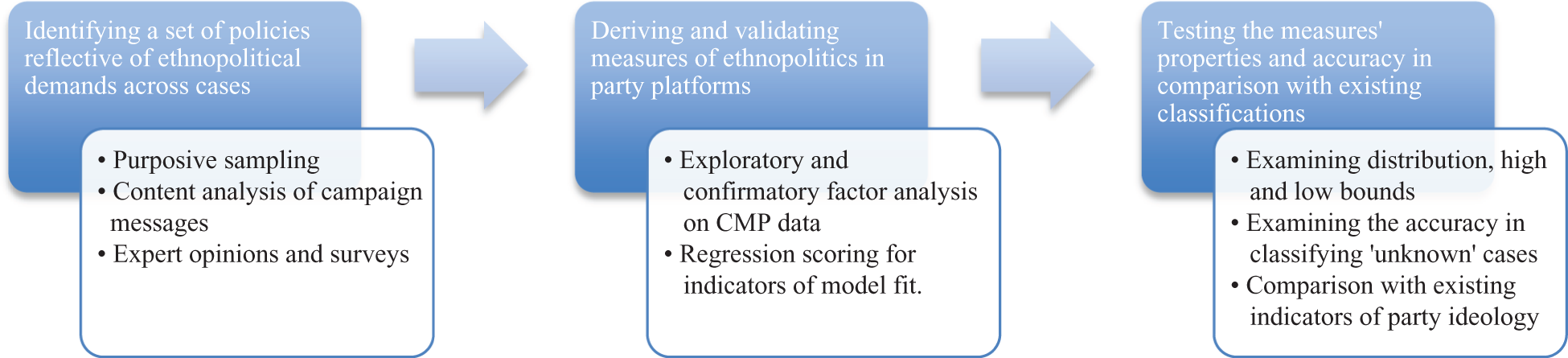
Steps in deriving measures of ethno-politics in campaign messages.
The above correspond to the stages in Cronbach and Meehl’s classic formula for construct validity: (a) defining a set of theoretical concepts and hypothesizing the links between them; (b) measuring these links and concepts; (c) examining the relations among the constructs, measures and their observed manifestations empirically (Cronbach and Meehl, 1955).
Several literatures support the notion that the political competition for ethnic votes is likely to revolve around redistributive or expressive policies with the strong potential to ‘ethnicize’ issues. Research on the political salience of race and ethnicity has consistently found that as public expressions of overly exclusive attitudes or racial prejudice have become less acceptable, there has been a shift towards a focus on policies and issues ‘tinted’ in ethnic or racial terms (Hurwitz and Peffley, 2005; Mendelberg, 2001). Both politicians and voters have become constrained in tapping onto ethnic attitudes, which has led to campaign strategies’ focus on issues instead. Certain policies have gradually been transformed into symbols for ethnicity or race during the spread of the norm of equality (Sears, 1993). We can thus expect parties to appeal to ethnicity by privileging policies likely to be directly relevant to the targeted communities.
In an effort to map the nature and scope of political demands made on behalf of ethnic communities across cases, I carried out content analysis of political messages put forward during electoral campaigns in democracies from four different continents over the past decade (see the Appendix). In line with existing work on ethnicity, the community the policies were addressed to was defined as based on language, common history or any other descent-based (ancestral) attribute, such as ethnicity or race (Fearon and Laitin, 2000b; Wimmer, 2008b). The initial text selection was done by relevance (purposive) sampling whereby the party platforms and speeches chosen were known to include an ethnic appeal. I subsequently expanded the sample to include cases where no ethnic appeal was made to further validate the emerging set of political issues as reliably reflective of ethnic demands (Charmaz, 2006; Glaser, 1992; Strauss et al., 1990). The policies derived using content analysis were triangulated by examining media sources for each country, looking specifically at how particular campaign messages were interpreted and consulting expert opinions and surveys. This aspect is key to the process of deriving a list of issues expected to resonate with ethnic communities. Previous work on political communication has stipulated that messages need to be resonant with the community appealed to and meaningful within the structure of political cleavages locally (Desrosiers, 2012; Winter, 2008). A certain level of recognition within the public space must therefore be present for these appeals to be classified as ethnic. Cues for this recognition can be gathered by examining how these messages are interpreted in the local media, by experts and by competing politicians (see Table 1 in the Appendix).
Effects of the ethno-politics indices on parties’ support for Europe and European integration.1
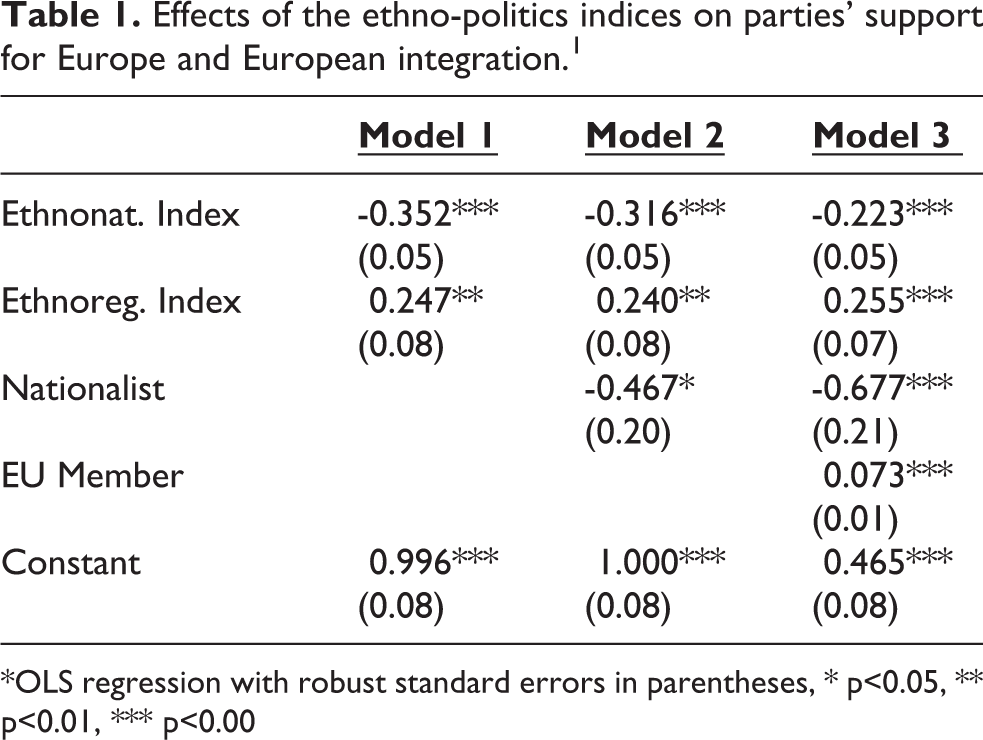
*OLS regression with robust standard errors in parentheses, * p<0.05, ** p<0.01, *** p<0.00
The following political issues were consistently being prioritized within appeals to ethnic communities and recognized as having ethnic undertones: language rights, minority rights, multiculturalism, political autonomy, territorial rights, quotas for (political) representation, affirmative action, local self-government, devolution, decentralization, secession, respect for traditions/heritage, commemoration of the past and reconciliation with other groups. They were invariably presented as pragmatic solutions and practices intended to safeguard communal rights to authenticity and representation across cases and over time. The media, experts and local commentators agreed in their interpretation of these issues as politicians’ attempts to appeal to ethnic communities. This level of agreement is necessary when constructing measures suitable for broader comparative work. Such measures should be able to balance between scope and content. One danger is to misconstrue a policy as ‘ethnic’ by transposing it from a different context without agreement that the issue does indeed correspond to an ethnic claim locally – the equivalent of what Sartori (1970: 1034) identified as the danger of ‘conceptual straining’. A good strategy reflecting the concern with broader applicability over time is to design the measures conservatively and allow for their augmentation on a case-by-case basis. The choice of scaling model described below also reflects this reasoning and aim for narrower yet meaningful universals.
The above list of policies can be used as the basis for constructing measures of ethnic appeals within campaign messages suitable for large-scale comparison. In addition, a number of issues were occasionally linked to the rights and well-being of ethnic communities, such as industry protection or general economic development, crime prevention and immigration. The latter were, however, also present in the appeals of political actors not interpreted as referring to an ethnic issue, so we cannot claim they have become reliably ethnicized across countries. Nevertheless, the above could augment and modify the broader measures as described in Section 5 below.
Much secondary literature can be cited in support of highlighting the first set of policies above as reflective of ethnic issues: studies of regionalism (Crook, 1997; Diani, 1996; Herrera, 2005), secessionism (Brancati, 2006; Hale, 2000; Lustick et al., 2004; Sorens, 2005), federalism and minority parties (Evans and Need, 2002; Jenne, 2004, 2009; Ortakovski, 2001; Watson, 1990), nationalist demands (Cederman and Girardin, 2007; Giuliano, 2011; Lijphart, 1969; Sidanius and Petrocik, 2001), decades of research on the gradual racialization of crime in the US (Entman, 2004; Mendelberg, 1997, 2008), and the growing scholarly attention to the intersection of migration and ethnicity (Brubaker, 2001; Green et al., 2011; Lee, 2008; Pagnini and Morgan, 1990; Pehrson and Green, 2010; Winter, 2011).
In order to address issues of concept selection and semantic validity in deriving measures of ethnic appeals based on policy positions, we can draw on studies of political communication. Framing theory in particular suggests various ways of giving structure to political arguments and shedding light on how frames conveying urgency and necessity culminate in policies designed to address the problem at hand (Kahneman and Tversky, 1984; Snow et al., 1986; Snow and Benford, 1988). Scholars have recently analysed the discursive construction of social problems and the means to remedy them, with diversity, integration and pluralism as key components within these constructions (Corstange, 2012). What is important for the development of the measures of ethno-political appeals here is to stipulate that the issues above are conclusions of specific, context-sensitive, pragmatic arguments about policies or actions portrayed as best serving the needs of the community. It is in this sense that ethnic appeals can be seen as programmatic, i.e. voicing support for issues and policies, and not just focusing on ethnic categories or emotions. We are thus able to link the categorical concepts of ethnic groups common in the literature and accepted as meaningful colloquially (Fearon and Laitin, 2000a) to the list of issues expected to dominate the political appeals to these groups. This allows us to see policy positions as metonymies for ethnic categories in campaign rhetoric and paves the way for quantification and large-scale comparative work.
Deriving measures of ethno-political appeals using data from the Comparative Manifestos Project
The Comparative Manifestos Project (CMP) is the largest and perhaps best known database of official party positions on a wide range of issues across countries. The coding scheme specifies the unit of textual analysis as the quasi-sentence and defines it as ‘an argument which is the verbal expression of one political idea or issue’ (Volkens, 2001) (emphasis mine). These ‘quasi-arguments’ are then transformed into variables and aggregated to provide a picture of manifestos' focus on topics and issues (a total of 56 categories over 7 domains). The CMP variables score virtually all issues of concern to ethnic communities identified as applicable comparatively. 4 Recoding would in this case be both impractical and unnecessary. The ratio data within the CMP lends itself well to certain statistical techniques, such as factor analysis. Factoring ‘quasi-arguments’ based on an inductively derived vocabulary of the relevant policy issues related to group identity in political campaigns such as the one described in the previous section ensures that lexical cohesion is inherent within the measures of ethnic appeals (Klebanov et al., 2008).
Criticisms of the CMP data gathering effort should be taken seriously in any effort to derive policy scores on a new composite dimension. Problematic aspects are shown to have less to do with the classification scheme and the rules for categorizing policies, and more to do with the way these rules are applied by the multiple coders across cases (Benoit et al., 2009). Statistical techniques can be used to correct for these ‘random errors’, as discussed below. Studies do show that CMP measures are very highly correlated with estimates derived through pure computation (using Wordscores) (Klemmensen et al., 2007; Laver et al., 2003). Research has also demonstrated the robustness of the CMP measures as compared to expert surveys (McDonald and Mendes, 2001).
Confirmatory Factor Analysis (CFA) is appropriate when substantive theory guides the selection of variables to be included in the analysis, while Principal Component Factoring (PCF) is preferred for the development of measures and indexes retaining the original variance among the included variables. Based on the list of policies singled out as having ethnic connotations presented in the first part of the article, we could hypothesise that certain quasi-sentences related to ethnic politics within manifestos would co-vary. These would have to do with support for decentralization, multiculturalism, cultural autonomy, on the one hand, and support for a national way of life, traditional morality and rejection of multiculturalism, on the other (Figure 2).
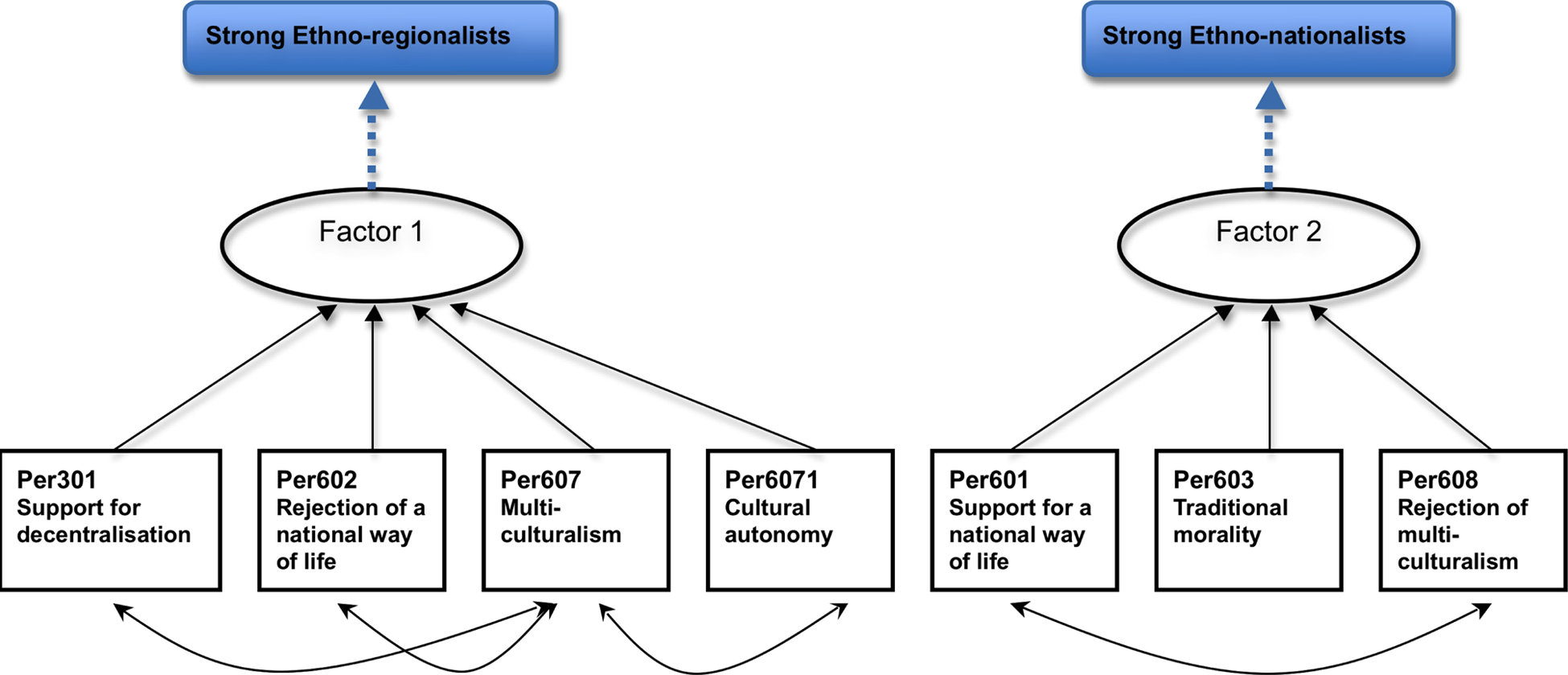
A model of parties ethno-political appeals using CMP variables 1
The combination of these policies and the latent constructs they are hypothesized to indicate are of particular interest because of their potential to have consequences for countries’ political systems, post-electoral governance and group relations. Ethnic appeals are often studies for their capacity to signal policies and interests incompatible with the symbolic or material concerns of other groups (Hale, 2008; Horowitz, 1985; Rabushka and Shepsle, 1972). Ethnic intransigence is often cited as a major factor behind government decision-making gridlock, state dissolution through secessionism, conflict, saber-rattling abroad and various ‘rally around the flag’ attempts by nationalist governments. By focusing on the policies featuring in their campaign messages and likely to have destabilizing effects and designing measures of their strength, we could begin to anticipate the consequences of ethnic appeals for post-electoral governance and inter-group relations.
Note also that various combinations of arguments regarding group identity are theoretically possible: a party could combine appeals for decentralization with calls for economic support, or support for a national way of life with calls for strong ‘law and order’. While these could be considered as being about ethnicity, they can be thought of as falling within an ethno-politics issue space, the bounds of which would be defined by mutually exclusive constructs. A party may also support decentralization, multiculturalism or increased minority rights without explicitly linking these to (ethnic) community self-expression or re-distribution. However, if a particular combination of these policies is present, and if it amounts to a non-negligible percentage of the party’s platform, it could be expected that an ethnic appeal is being made. There is much existing theory in support of this conjecture, and empirical evidence is discussed towards the end of this section.
A question may arise as to why demands for centralization are not included among the ethno-nationalism variables, or rejection of traditional morality among the ethno-regionalism ones. There is little evidence from the comparative content analysis of platforms and from existing studies that state centralization is the purview of nationalists or rejection of traditional morality an important issue for ethnic minority parties. While the former is often cited in relation to authoritarianism and the latter is common for progressives, the ethnic link is not very clear. Empirically, the model presented in Figure 2 better fits the data and is more parsimonious than alternative ones including support for centralization and rejection of traditional morality (discussed in Appendix 2).
Finally, it has been argued that the data aggregation method of the Manifestos Project (counting mentions of policies assigned to a particular topic and summing them up) is a more accurate measure of the saliency of this topic than the party’s positions on the issue per se (Hug and Schulz, 2007). This is not problematic for the development of the ethno-politics measures, as much research on the politicization of identity suggests that political entrepreneurs engaged in ethnic appeals aim to raise the saliency of a preferred identity by selectively privileging aspects of it (Beall and Ngonyama, 2009; Bhavnani and Miodownik, 2009; Edwards and Doucette, 1987; Mullen et al., 1992; Posner, 2004). A high aggregate of references to traditional morality or multiculturalism within a political platform (and conversely a high percentage of the platform dedicated to these issues) can be interpreted as an attempt to raise the saliency of the issue – another proxy for an ethnic appeal.
To carry out the analysis, I split the CMP dataset randomly into two groups of about 1700 observations each (commonly referred to as split-half validation). To obtain factor loadings on the variables appropriate for the creation of measures scoring the latent constructs in Figure 2, I used principal component factoring (PCF) with oblique rotation on the first of the subgroups. The factor loadings obtained in this manner were tested for statistical significance and measures were obtained to assess the overall model fit using the second group (the remainder of the dataset). Tables 2 and 3 in the Appendix summarize the results from PCF.
The ethno-regionalism factor (Factor 1) is influenced mostly by rejection of a national way of life and support for decentralization (with support for multiculturalism being a close third). The ethno-nationalism factor is driven by support for a national way of life and traditional morality. Demands for cultural autonomy and rejection of multiculturalism load less heavily for the two factors respectively, but there are strong theoretical reasons for their inclusion (as discussed in Section 2). They also load consistently across the two factors (high on one and low or negative on the other), and their KMO scores are acceptable. Further, large sample sizes justify the inclusion of variables loading over 0.30 for each factor.
Much is written about issues of measurement within the CMP data. 5 These can affect the goodness of fit of the confirmatory model above in two ways: First, it is possible that the variables may actually be different ways to measure the same position (errors of specification). Second, if the categories are semantically close, it is possible that the various coders have interpreted them differently and assigned different codes to the same underlying construct (errors of interpretation and category classification). This issue is compounded given the ‘quasi-sentence’ structure of the data where longer compound sentences are broken down and their parts scored separately, even if they address the same policy. The possibility of such errors can be reflected in the model by allowing for the errors of the corresponding measures to be correlated after checking whether some of the variables hypothesized to influence the same construct are more highly correlated than others (Kolenikov, 2009). I thus re-estimate the model by allowing for the errors of per607 to co-vary with those of per6071, per301 and per602 for Factor 1, and the errors of per601 and per608 to co-vary for Factor 2. As expected, the model fit improves dramatically (see Table 5 in the Appendix). The two factors are also uncorrelated, pointing to high discriminant validity – it can be claimed that they capture different constructs relatively well. 6 Once the PCF factor loadings were estimated, parties' scores were normalized to an index of 0 to 10 on each factor. 7 We thus obtain normalized measures for party positions on Ethno-regionalism (Ethnoreg Index) and Ethno-nationalism (Ethnonat Index).
I then examined how adequately the two measures predict the categorization of a party platform as either ‘nationalist’ or ‘ethnic-regional’ by CMP coders. 8 Additionally, the literature suggests that the ideology of nationalism influences parties’ positions vis-à-vis European integration (Hooghe et al., 2002; Marks et al., 2002, 2006). As attitudes towards European integration were not included within the factoring used to derive the ethno-politics measures discussed above, examining whether the former have significant effects on the latter would be an additional validity check for how well the Ethno-nationalism measure captures the latent construct of interest (Table 1). As expected, higher values on the Ethno-nationalism index are associated with higher percentages of parties’ manifestos dedicated to voicing anti-European positions. Ethno-regionalism, on the other hand, is associated with support for Europe and European integration. The results remain significant with the inclusion of dummies for parties classified as Nationalist within the CM data and when controlling for EU member status.
Based on these tests, it can be argued that indices are suitable for studying appeals to ethnic communities across cases. The two measures are not intended to account for the entire range of policy positions within the CMP data, hence the relatively low, although acceptable, cumulative proportion of explained total variance and (occasional) high uniqueness for each variable. There are both theoretical and measurement reasons for this noise. It can be expected that parties combine support of any of the variables above with a number of other issues for each electoral round, or that they campaign on only one policy and do not mention the rest. The intuition behind the two indices is that the co-variance between the variables quantifying support for certain policies above would be statistically significant and that the latent constructs revealed would be indicative of extreme positions on ethno-politics. The estimations support the first assertion and I will attempt to demonstrate the second below.
Properties and potential applications of the ethno-politics measures
This section outlines some of the properties of the newly derived Ethno-regionalism and Ethno-nationalism indices, discusses how they relate to existing categorizations and suggests some potential applications.
As Figure 3 demonstrates, the extremes on the two measures are rare, the vast majority of platforms are centred around the small values (moderate expressions or no discernible ethno-political appeals). This can be expected considering the composition of the CMP data (mostly Western Democracies) and is in line with results reported from other categorizations of ethnic appeals (Chandra, 2011). Considering the nature of the data (documents summarizing parties’ positions on a number of dimensions), the method of deriving the measures (scoring the co-variance of policies) and the measures’ distributions (Figure 3), scores higher than 1 on each denote attention to the issue, and higher than 2 a targeted ethnic appeal. Examining the distribution by party family is instructive as well (Figure 4).
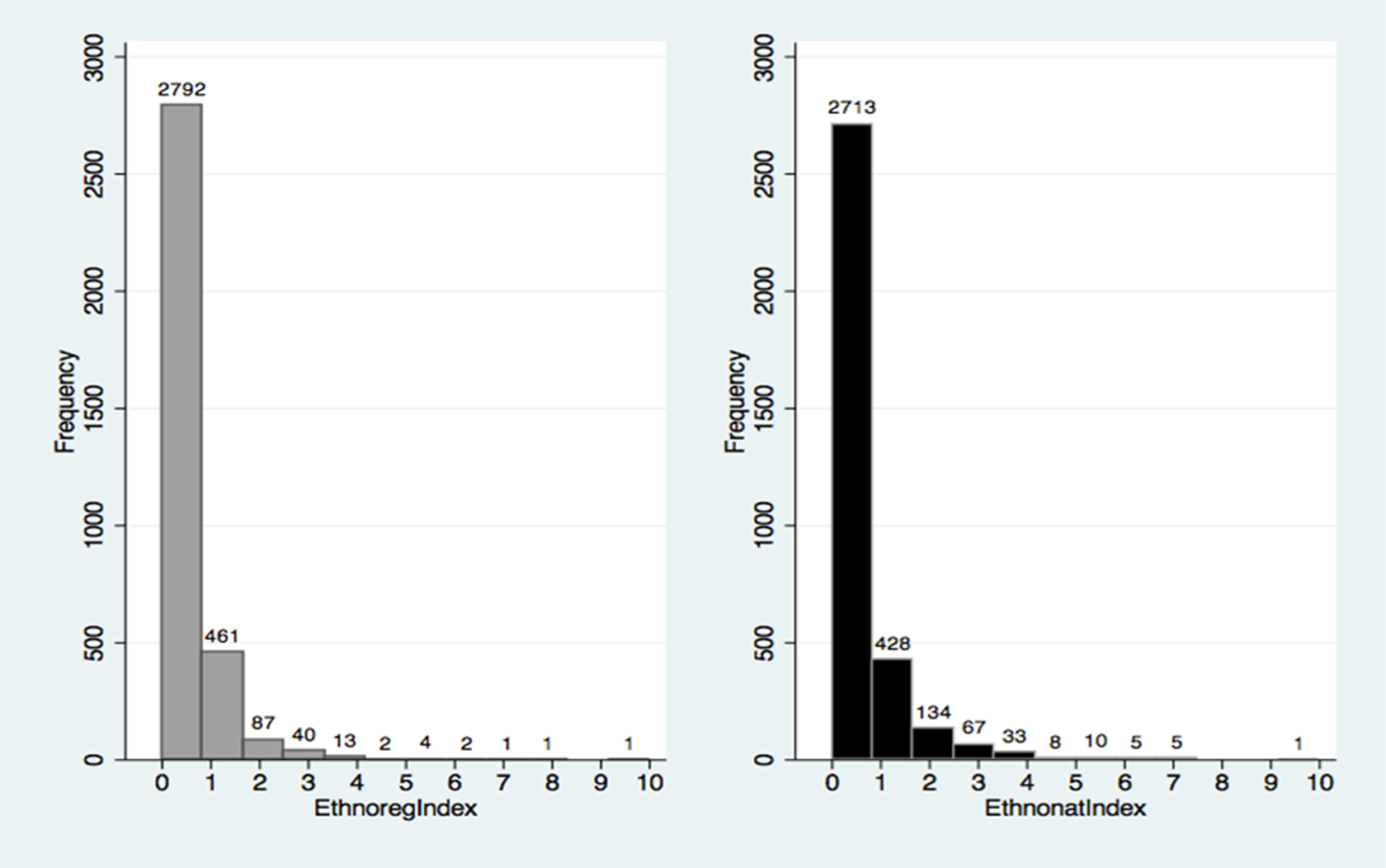
Distribution of party manifestos on the indices of Ethno-nationalism and Ethno-regionalism.
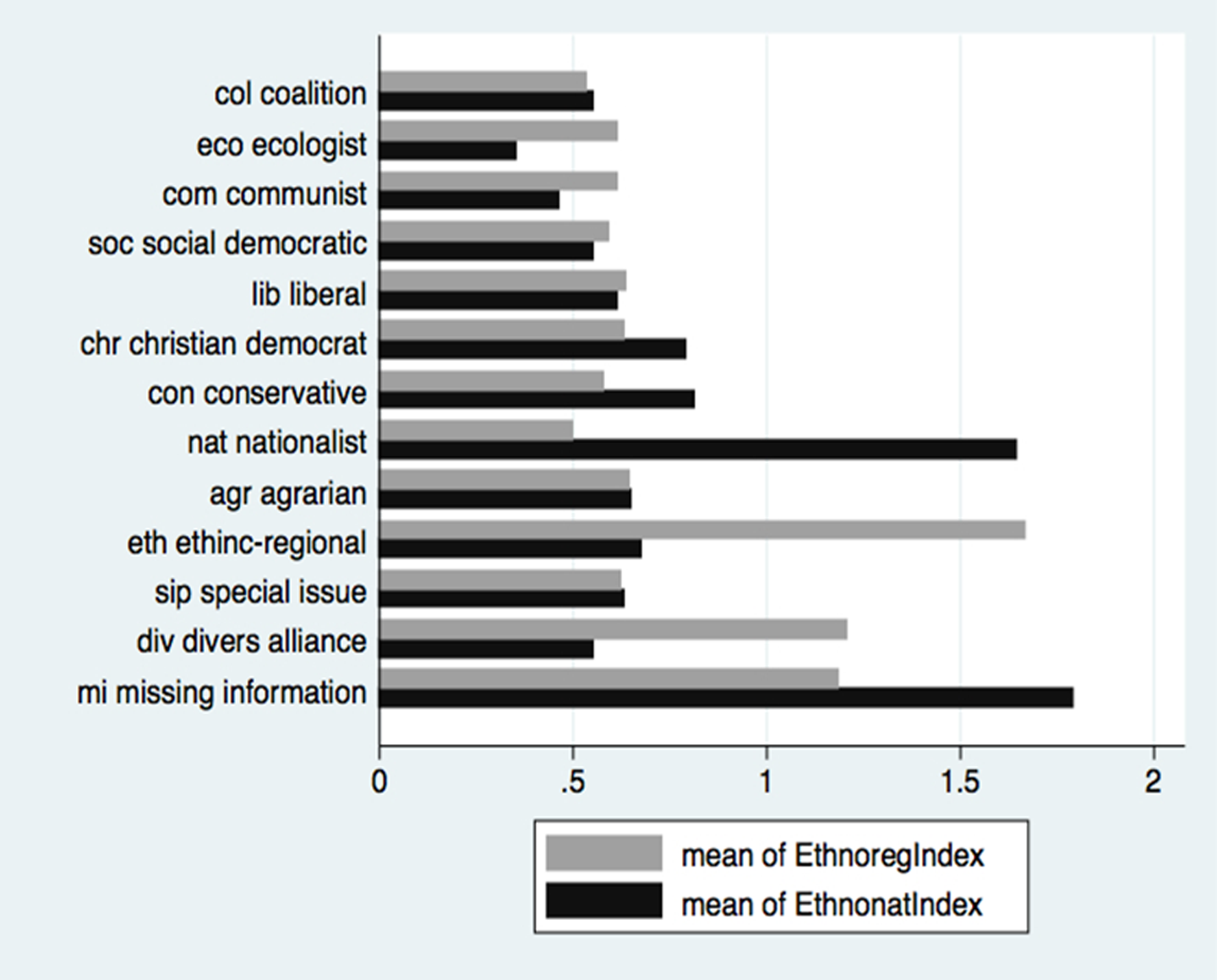
(Mean) Scores on ethno-politics by broader party family within the CMP data.
As expected, we find nationalist and ethnic-regional parties score high on the two indices. Two groups not classified explicitly also receive high values – the ‘diverse alliance’ and the unknown cases (‘missing information’). As we have no prior information on their ideological leanings, examining them closely is a good additional test of the indices’ validity. The four parties of the ‘diverse alliance’ are the Macedonian RSM/LP-MDPSM-SPM joint candidates, Bulgaria’s Union of National Salvation (UNS) and Moldova’s Peasants and Intellectual Bloc. The former contested Macedonia’s 1990 election as a coalition of ethnic Macedonian and ethnic Albanian parties noted for its socialist outlook and conciliatory agenda (Friedman, 2005). Bulgaria’s UNS was a coalition contesting the 1997 parliamentary election dominated by the DPS, a party known as representing the ethnic Turkish minority in Bulgaria. Moldova’s 1994 referendum on independence dominated the election the same year and the Peasants and Intellectuals Bloc (PIB) was one of the political formations favouring ‘ethnic Moldovanism: a set of policies designed to foster Moldovian cultural distinctiveness’ (Protsyk, 2007). The ‘missing’ cases are Bosnia’s KzCD, Georgia’s Burjadnaze Democrats and Bloc ‘For a New Georgia’ and Croatia’s HS-HSLS Alliance. All have been described as moderately nationalist in various analyses and media outlets. Therefore, the two indices do well in classifying party platforms according to the dimensions of interest here.
How well are the extreme cases classified? While the party ranked highest on the Ethno-nationalism index (Croatia’s HSP) is classified as Nationalist within the CM, the following two are categorized as Conservative. Among the high values on the Ethno-regionalism index we find a Social Democratic and a Communist party (Table 2).
Selected parties scoring high on the EP indices by party family.
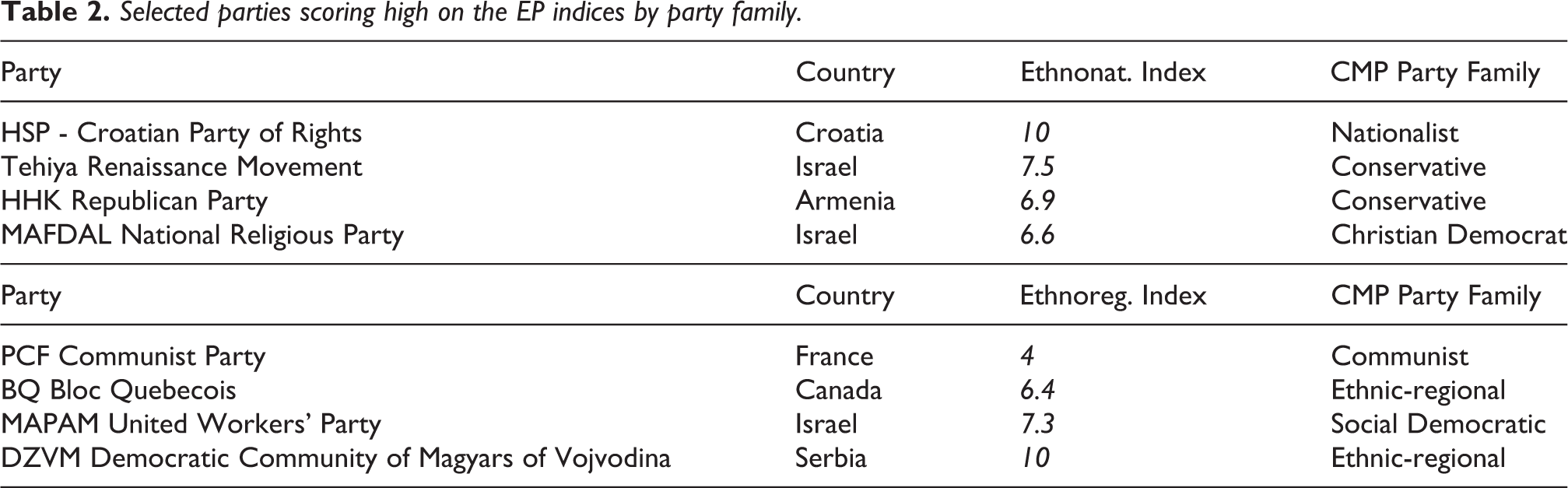
Other than being a proponent of collectivization, Israel’s MAPAM is also known for being the leader in the movement for Arab–Jewish rapprochement. 9 And examination of Armenia’s HHK platform reveals themes and claims typical of nationalist rhetoric across cases: community valorization and traditionalism linked with ownership of the state. 10 The above suggests that the two indices presented here do better in capturing parties’ ethno-nationalist and ethno-regionalist platforms than the CMP’s party family classification.
Party names are often a poor indicator of the types of group appeals advanced within manifestos. Broader classifications of ideology fare better overall, but are likely to miss some expressions, particularly at the extremes, where an accurate classification arguably matters most. Put differently, parties of all ideological orientations could (and do!) make identity appeals and modify them over time. This is in line with the constructivist understanding of identity politics (Barth, 1969; Brubaker and Cooper, 2000; Fearon and Laitin, 2000b; Smith, 1981, 2003; Wimmer, 2008a) and underscores the need for time-sensitive measures of ethnic appeals more flexible than broader political ideologies.
The two indices allow for within and between-case comparisons of platforms over time. They shed light on the structure of nationalist and ethnic regional appeals – two categories used widely within the comparative politics literature. Scholars have noted the propensity of regionalist parties to resemble ethno-nationalists in their appeals and have termed the phenomenon ‘minority nationalism’ (Jenne, 2004; Kymlicka, 2001). This is most evident in the case of secessionists or irredentists (Sorens, 2005). Much like nationalism can become institutionalized and ‘banal’ (Billig, 1995) over time, so can other types of group identity appeals, such as those aimed at the integration of minorities. The banality is reflected in the gradual acceptance of certain social, economic and political expressions of group identities as signifiers for those same identities. I have argued that decentralization, multiculturalism and traditional morality are all examples of such policies. It is thus possible to interpret rhetoric evoking them as being about group identity, even in the absence of overt mentions of the latter.
The indices also allow for the determinants of the various appeals to group identity to be studied systematically – something which has so far remained unexplored for lack of appropriate measures. Students of ideology would be able to compare existing measures of ideological leanings to stances on issues related to group identity and hence trace the evolution of current broad ideologies. Nationalism, for example, has long been noted for its proclivity to be ‘thin’ (Freeden, 1998) or to be able to fit under various ‘host’ ideologies. The analysis presented here demonstrates that this is indeed the case – and not only for the high scores on ethno-nationalism, but the high-scores of ethno-regionalism as well (which currently finds expression within more left-leaning ideologies). It is also shown that while overall self-declared ideology is a good predictor of a party’s ethno-political messages, at the extremes it fares poorly: parties scoring high on the Ethno-nationalism index may be classified neither as ‘nationalist’ nor ‘ethnic regional’. Researchers with interest in intra-party dynamics and factionalism could use the measures to probe the influence of various party elements on the composition of the final campaign message.
It would also be possible to explore how ethnic parties compete for votes. An application of Downs’ model of party competition (1957) to ethnic politics has led researchers to hypothesize that ethnic parties attempt to mobilize minimum winning coalitions by privileging common (ethnic) attributes among their constituents often without prejudice to the actual policy preferences of these constituents. 11 If this is the case, we would expect to see ethnic outbidding and high scores on the Ethnopolitics measures for the votes of majorities in places where ethnicity is a recognized political cleavage as modified by the type of electoral system (Taagepera and Shugart, 1989a, b) and district size (Ordeshook and Shvetsova, 1994).
Another approach to studying how parties compete for votes assumes that politicians emphasize certain topics during campaigns, which they view as a combination of being (a) relevant to their electorates, and (b) favourable to themselves. Broadly known as ‘saliency theory’ (Budge, 1982a, b, 2001), this approach has not yet been explicitly applied to the comparative study of ethnic politics. Following its reasoning, we would expect to see the high scores of the Ethnopolitics measures either in places where ethnicity is salient overall, or for groups, for which ethnicity is salient irrespective of relative group size.
The time-sensitive measures introduced in this article allow us to examine when there is a substantial change in parties’ ethno-regionalist or ethno-nationalist focus for the purposes of theory generation and hypothesis testing. For example, two factors stand out about the timing of ethnic minority parties’ moderation (seen as a drop of two or more points on the ethno-regionalism index) across a number of cases: (a) a settlement of the issue(s) of relevance to the community through negotiation or an institutional overhaul (albeit temporary), and (b) the formation of a political coalition. Thus, parties in Bosnia moderated under pressure from the international community after the Dayton Peace Agreement in the late 1990s, the Party Quebecois’ drop on the index coincides with the 1995 referendum on independence (and the Canadian Supreme Court’s judgement), 12 and the Hungarian minority parties in Romania shifted to less ethno-regionalist focus after the country signed a Basic Treaty with Hungary guaranteeing the rights of minorities in 1996. In the case of the Basque Nationalist Party, we can observe a gradual decrease on the index coinciding with Spain’s decentralization and the introduction of federalism since 1978. Belgium’s Flemish bloc’s drop on the Ethno-regionalist index after 1960 coincides with its entering into a coalition with more moderate Flemish parties. The Bulgarian Movement for Rights and Freedoms (DPS) moderated and consolidated its position after forming a coalition government with the Union of Democratic Forces in 1991 and has maintained the same ethno-political agenda since. The Czech Society for Moravia and Silesia saw the issues it was campaigning on effectively resolved with Czech decentralization in 1992.
In contrast, the Hungarian parties in Slovakia have maintained similar demands since the break-up of Czechoslovakia despite forming a coalition and participating in government. The latter has been attributed to the lack of satisfactory resolution and the continued relevance of the ethno-political issue over time (Ishiyama and Breuning, 1998: 51–78). The above analysis underscores the importance of issue salience over demographics in accounting for moderation versus intransigence in ethnic demands. The causal link from issue settlement and coalition formation to moderation was corroborated using historical analyses and country case studies for each of the examples given above. 13
The discussion does not intend to overstate the durability of moderation or disregard the significance of additional factors: while temporary settlement often resulted in a drop on the ethno-regionalism index, this drop was not always permanent. And coalition formation is itself a function of institutional and electoral incentives (Strøm, 1990). The case studies show that additional developments, such as parties’ splintering and factionalism as well as changes in electoral support coincided with the redefinition of ethnic agendas. These are commonly cited as determinants of party strategies in democracies (Bouissou, 2001; Druckman, 1996a). Issue settlement and entering into coalitions are often concurrent with internal leadership changes and while the case studies suggest the former are causally prior, further analysis could test this mechanism empirically.
Overall, the above suggests that parties scoring high on Ethno-regionalism resemble ‘single issue’ parties (Mudde, 1999; Osborne and Tourky, 2008) in important respects and may follow the same development trajectory: moderate either when the issue is resolved or when a mainstream party reacts to it (Meguid, 2005). This possibility has not yet been explored by scholars of ethnopolitics and is indicative of how the measures can be applied to long-standing debates on the determinants of ethnic campaigning across cases.
Scholars might also like to know whether ethnic or nationalist rhetoric is an isolated phenomenon within a state undertaken by a few radical or fringe parties only, or whether it is a prominent feature of the political discourse overall. One way to assess this would be to compare the mean EP indices for a state with the scores for parties scoring highest or lowest on each and examine the outliers.
Figure 5 shows that there are outliers (isolated extremes) on the indices in Armenia, Croatia, Canada, Slovenia, Poland, while ethnopolitics is a wider feature of the political discourse in Bosnia-Herzegovina, Israel, Serbia, Slovakia and Spain. Note also that the issue is almost non-existent in Malta, the former German Democratic Republic (GDR) and South Korea. The results above are consistent with much case-study research on the nature and presence of ethno-politics for the countries above, attesting to the overall validity of the measures.
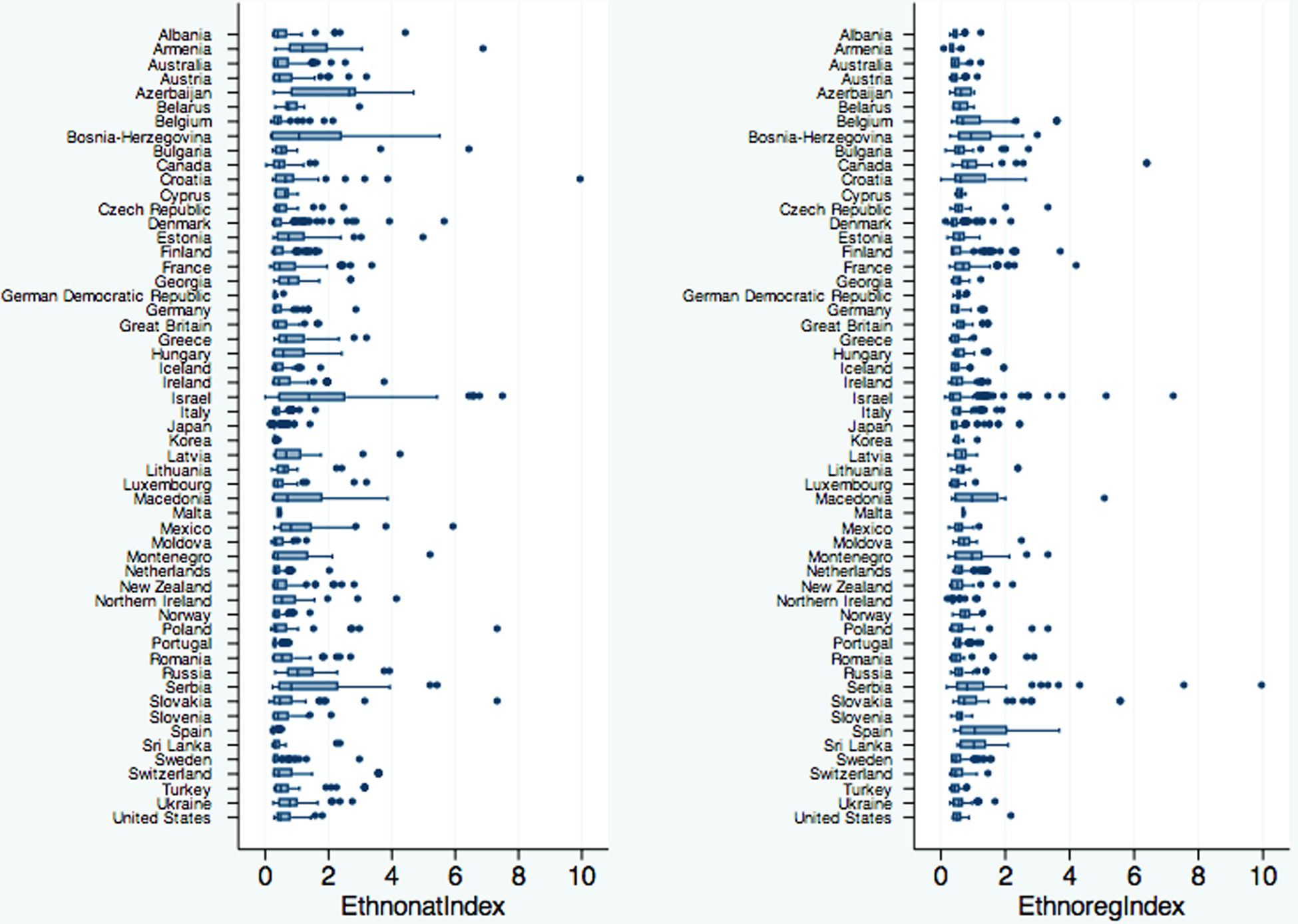
Distribution of scores on the ethno-politics indices by country.
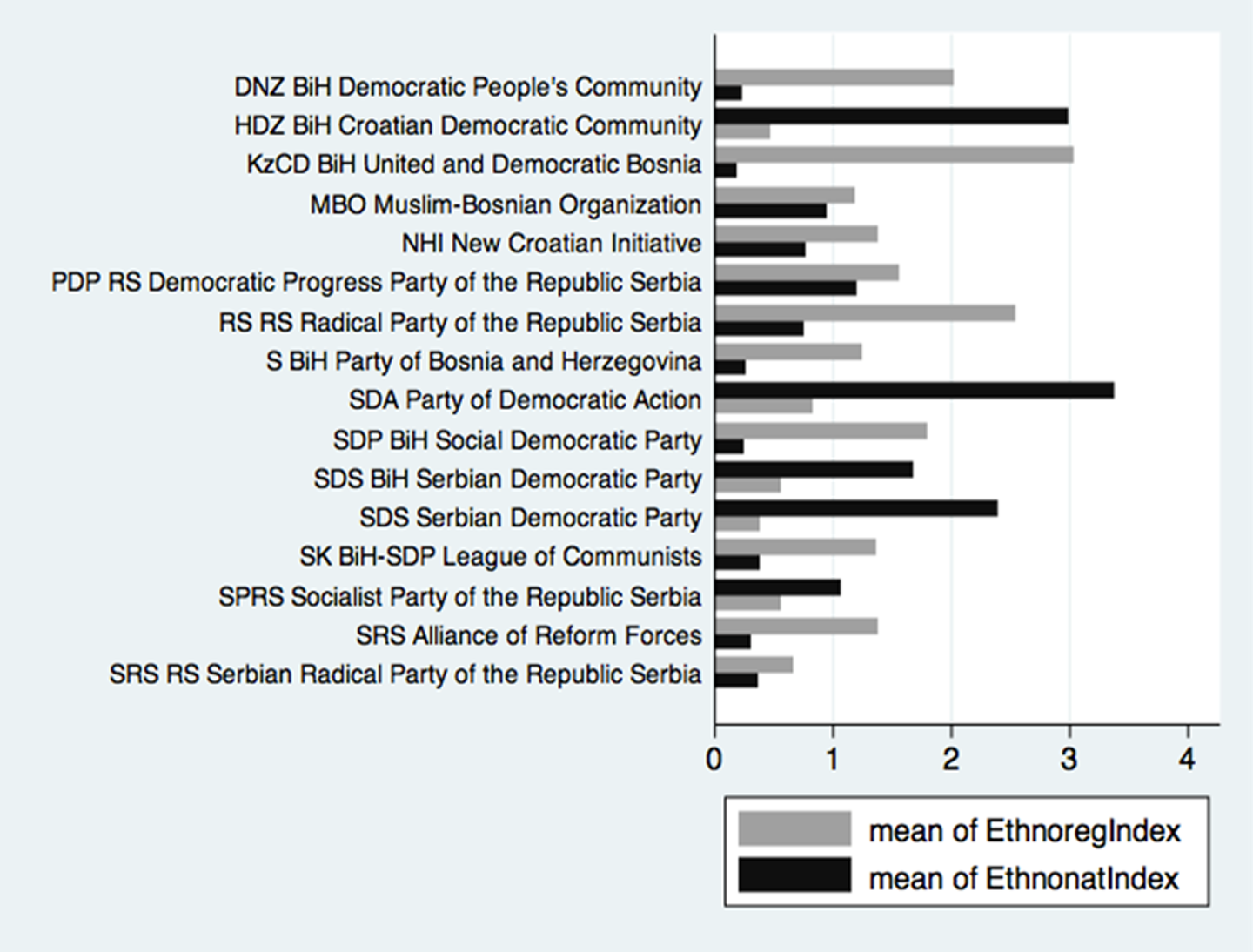
(Mean) Scores of Bosnian parties on the ethno-politics indices.
The only other large-index effort to categorize parties’ explicit appeals to ethnicity is the one undertaken by Chandra (2009). While the Constructivist Dataset on Ethnicity and Institutions (CDEI) reports many additional variables of interest to scholars of ethnic politics, its coding of party platforms sees parties divided into three broad categories: ‘ethnic’, ‘multi-ethnic’ and ‘non-ethnic’. Also, it currently covers the year 1996 or the closest previous election year only. 14 Thus, it does not allow for comparison of the appeals within the three categories of parties or over time. Further, the various coding manuals and reported findings of the project make some other differences noticeable. The authors stress that they do not consider the explicit policy position parties defend when making ethnic appeals as significant for categorization. The approach taken here is the opposite: the (combination) of positions parties put forward in official statements of policies are taken as indicative of the strength and type of their ethnic message, and given priority over the categories used to differentiate between groups. The differences in constructing the measures would be particularly significant in cases when ethnicity is among the major cleavages and most political actors make ethnic appeals to various communities. In the case of Bosnia, for example, most parties draw support from a single ethnic group and use exclusive ethnic categories in their appeals. They could all be classified as ‘ethnic’ or ‘multi-ethnic’ within the coding of the Constructivist Dataset, but their scores on the ethno-politics indices presented here vary.
The scores above show Bosnian parties’ variation relative to each other averaged over all years considered within the CMP data. The absolute differences would be even bigger and more significant for particular years with heavily contested and politicized elections (such as 1996/1998 – the first electoral round after the conflict).
The difference between the SDA and the SDP is particularly revealing: both are parties vying for the support of Bosniaks in the Federation; the SDA was noted for its extremist position in the 1996 election, while the SDP was seen as considerably more moderate (Caspersen, 2004; Manning, 2008). The Bosnian case is worth singling out for another reason: the country experienced one of the bloodiest and most protracted ethnic conflicts in the 20th century. Its parties are often cited as making strong and divisive ethnic appeals in electoral campaigns (particularly in the early post-Dayton years) and given as cautionary tales for the pitfalls of ethnic outbidding (Brubaker and Laitin, 1998; Chandler, 2000). Yet, their positions are truthfully captured in measures of Ethno-politics constructed by taking into account a combination of formal policies alone. This suggests that ethnic parties can be distinguished by their policy positions. And while the ethno-political agenda of Bosnian parties is well known and the above scores would hardly surprise specialists, the discussion is intended to demonstrate the reliability of the measures. The broader argument made here is to take policy positions seriously even when dealing with such seemingly unquantifiable, largely symbolic and value-laden issues as appeals to personal identities.
Once party positions are classified in the manner suggested above, we could explore the relations between scores on the Ethno-politics measures with a number of existing classifications. For example, an examination of Rile scores by type reveals that modern-day (European) nationalism is a predominantly right-wing phenomenon, while communitarianism and minority politics tend to be the purview of the left. 15 Also, there is evidence of clustering by country on the highest values of the indices (Israeli, Serbian and Bosnian parties; see Figure 5 above), which could be interpreted as giving some preliminary support to hypotheses of outbidding or cleavage politics. Other determinants of parties’ measure of ethno-political appeals which could also be examined in a relatively straightforward manner include ideology, election timing and membership of international organizations.
The research can be augmented in a number of ways: focusing on single countries would allow for a more complete understanding of the myriad of policies emphasized when appealing to communities and a fuller picture of the ethno-political competition space. Negative attitudes towards immigration are one obvious example and should be watched closely when attempting to codify ethnic appeals. While anti-immigration rhetoric could be interpreted as indicative of ethno-nationalism across most European democracies, 16 recent analyses suggest that support for immigration can also be construed as an implicit appeal to ethnic communities (Leal et al., 2005; Lee, 2008; Stokes-Brown, 2006; Tolbert and Hero, 1996). In addition, attitudes to crime and welfare are often cited as having ethnic undertones most prominently in the United States (Hero and Tolbert, 1996; Peffley et al., 1997) and increasingly in Great Britain, Germany and The Netherlands (Weldon, 2006). Empirically, an increase on the Ethno-nationalism index presented here is associated with a drop in support for welfare within party manifestos. 17 And although these issues have not been included in the measures for the reasons elaborated above, they could be related more explicitly to the Ethno-nationalism index on a case by case basis. Research shows that parties reacting to extreme nationalist demands do so by modifying their positions on traditional morality and multiculturalism specifically (Meguid, 2005). Empirically, removing support for decentralization or cultural autonomy from the ethno-regionalism index formula should highlight such parties. In sum, it is paramount that the list of policies scored in calculating the indices be updated constantly to reflect ideological shifts across countries and the emergence of new issues relevant to ethnic groups.
Conclusion
Various models of policy processes within comparative politics rely on having valid measures of the positions of political actors across cases. The ethno-political dimension of party competition in democracies is significant for a number of outcomes and is related to several substantive fields of empirical and theoretical research. Yet, it has remained relatively unexplored comparatively, hindering the formulation and testing of hypotheses of the determinants and consequences of ethnic appeals. Upon review of existing approaches, it has become obvious that ethno-politics has not been subjected to the kinds of rigorous analysis focused on policies as proxies for issues of relevance to other voting blocs. This goes against research on the mechanisms and channels of political communication, as well as theories of political competition in democracies. Emotionalism and the politics of exclusion notwithstanding, this article has argued for a refocusing of attention from ethnic categories to ethnic political practices. I show that indices of ethno-politics calculated based on a list of pre-defined political practices alone are valid, accurate and suitable for comparative analyses. I have suggested ways the measures can be used to test hypotheses of outbidding and moderation and how they can be modified to improve their sensitivity to country specifics. Scholars engaged in the empirical research of ethno-politics would thus be able to employ the measures in testing hypotheses of the determinants of extremisms and moderation in ethnic appeals.
A related issue concerns whether the political rhetoric of (ethnic) identity focuses on ascriptive characteristics or on ethnic political practices. Within the literature on the comparative study of ethnicity, the former understanding tends to be privileged. This article suggests that there is certainly need and space for the analyses of practices within the study of ethnic politics, particularly in Western democracies. Moreover, neglecting to take the policies ethnic parties advocate in electoral campaigns runs the risk of leaving analysts unable to anticipate these parties’ post-electoral behaviour and its effects on countries’ political systems. The latter are among the major reasons scholars are interested in the politicization of ethnicity in the first place. This article is thus a call for demystifying ethnicity and its political expressions through a pragmatic policy-centred approach and an urge for taking these policies seriously when devising models of ethnicity’s effects on other outcomes of interest.
Footnotes
Appendix
A selection of parties whose messages were considered in deriving the list of ethnic policies across countries*
| Region | Country | Party making an ethnic appeal | Compared to | Triangulated using (local sources) | Timeline |
|---|---|---|---|---|---|
| Africa | Ghana | NDC National Democratic Congress | NPP National Patriotic Party CPP Convention People’s Party | The Chronicle, Public Agenda election coverage and commentary. | 2008–2009 |
| Africa | Kenya | ODM Orange Democratic Movement | DPK Democratic Party of Kenya ODM-Kenya | The Standard, Daily Nation on the Web, Kenya Reconciliation Commission reports. | 2000–2007 |
| Africa | South Africa | IFP Inkatha Freedom Party | ANC African National Congress | Mail and Guardian election coverage and commentary; allafrica.com media searches. | 2000–2007 |
| Africa | Zambia | Linyungandambo (Barotseland) | MMD Movement for Multiparty Democracy PF Patriotic Front | Zambia reports and Zambian watchdog election coverage. Checked against allafrica.com and lexis-nexis searches. | 2000–2011 |
| Asia | India | BJP Bharatiya Janata Party | Indian National Congress Nationalist Congress Party | The Times of India election coverage and commentary. | 2000–2007 |
| Europe | Belgium | Flemish Bloc | Flemish Socialist Party | Independent analyses, case studies, lexis-nexis searches. | 2000–2007 |
| Europe | Bosnia | SDA Party of Democratic Action SRS Serbian Radical Party | SDP Social Democratic Party | UNDP Early Warning System reports, Balkan watch media roundup. | 1996–2004 |
| Europe | Bulgaria | Ataka DPS Movement for Rights and Freedoms | GERB Union of Democratic Forces | Capital and Dnevnik election coverage. | 2000–2011 |
| Europe | England | BNP British Nationalist Party | Labour Party Conservative Party | The Guardian, The Times election reports and campaign coverage. | 2000–2007 |
| Europe | France | Front National Action Française | Parti Socialiste Union pour un mouvement populaire | Le Temps campaign coverage and commentaries. | 2007 |
| Europe | Macedonia | CAP Coalition of Albanian Parties VMRO–DPMNE | Social Democratic Union of Macedonia | Dnevnik Balkan watch and Balkan insight media roundup election coverage. | 2000–2005 |
| Europe | Scotland | SNP Scottish National Party | Scottish Labour | The Guardian, The Times Election reports and campaign coverage. | 2007–2011 |
| Europe | Slovakia | ESWS Coexistence-Christian Democratic Movement Slovak National Party | Party of the Hungarian Coalition | Independent analyses, Lexis-nexis searches. | 2000–2007 |
| Europe | Spain | BNP Basque Nationalist Party | Socialist Party of the Basque Country Spain People’s Party | Local commentaries, Lexis-nexis searches. | 2000–2007 |
| Europe | Switzerland | SPP/SVP Swiss People’s Party | Parti Socialiste | Tribune de Geneve election coverage and commentaries. | 2000–2007 |
| Europe | Wales | Plaid Cymru | Labour Party Conservative Party | The Guardian, The Times Election reports and campaign coverage. | 2000–2007 |
| North America | Canada | Bloc Quebecois | Liberal party | Toronto Star, La Presse (Montreal) election coverage and commentaries. | 1995–2007 |
| South America | Bolivia | MAS Movement for Socialism | Revolutionary Nationalist Movement | Lexis-nexis searches of local and foreign media sources. | 2000–2001 |

* Academic research and country case studies were also consulted for each country and time-period listed. I sought to establish agreement between at least two sources when categorizing parties’ appeals as targeting an ethnic group. In deriving the list of ‘ethnicized’ policies, I compared the positions of parties considered to have made an ethnic appeal with those not seen as making ethnic claims within the same country. I then compared the list of ethnic policies across countries and distinguished the ones, which appeared frequently from the ones which were limited to a few cases only. The former were scaled to derive the indices, while the latter can serve to augment the measures for specific countries based on researchers’ needs.
Acknowledgements
I thank Will Lowe, John Huber, David Sylvan, and two anonymous reviewers for their helpful comments and feedback on previous versions of this article.
Funding
This research was supported by the Swiss National Science Foundation individual fellowship Nr. PBGEP1_139868.