




Abstract
The literature on authoritarianism and exclusive forms of nationalism often implies that authoritarian and exclusive-nationalist individuals will prefer radical right-wing populist parties such as Austria's FPÖ. The theoretical case for such implications appears sound as party programmes for radical right-wing populist parties invoke rhetoric that should appeal to individuals with either of these characteristics. To date, these implications have not been examined. This article examines quantitative survey data from five Western European countries with electorally viable radical right-wing populist parties to determine whether radical right-wing populist parties are preferred by authoritarians and/or exclusive-nationalists. Analyses indicate that the radical right-wing populist parties studied here are consistently preferred by exclusive-nationalist individuals, though not necessarily to all other parties, but only inconsistently preferred by authoritarian individuals. While more nuanced investigation is still needed, it is clear that, contrary to the assumptions in the authoritarianism literature, radical right-wing populist parties cannot always rely on authoritarian individuals for support.
Introduction
A substantial volume of research aims to uncover the causes of support for Radical Right-wing Populist (RRP) Parties. Much of this scholarship looks at macro-level causes such as unemployment levels (Knigge, 1998), immigration levels (Knigge, 1998; Lubbers et al., 2002), a combination of these (Bowyer, 2008; Golder, 2003; Jesuit et al., 2009; Rydgren and Ruth, 2011) and/or an increase in aggregate levels of political disaffection (Knigge, 1998). Individual-level analyses have largely focused on individual manifestations of macro-level theses (Ivarsflaten, 2008). More nuanced analyses examine moderating and/or mediating factors such as social capital/cohesion (Fitzgerald and Lawrence, 2011; Jesuit et al., 2009), the expansiveness of the welfare state (Arzheimer, 2009; Jesuit et al., 2009; Swank and Betz, 2003), political opportunity structure (Spies and Franzmann, 2011), or the permissiveness of the electoral system (Carter, 2002; Golder, 2003; Norris, 2005).
While much of this research implies psychological mechanisms, such as threat or insecurity, are at work, direct examination of psychological factors in the RRP party support literature is underdeveloped, with most of this research focused on attitudinal correlates rather than deep-rooted psychological motivations (Billiet and De Witte, 1995; Goodwin et al., 2012; Ivaldi, 1996; Mudde, 2010; Van Der Brug and Meindert, 2003). Though psychological analyses of RRP party support are by no means absent from the literature (Biggs and Knauss, 2012; Blee, 2007; Ford and Goodwin, 2010; Goodwin, 2010; Lucassen and Lubbers, 2012; Mayer, 2011), the dearth of such is curious given that the foundational authoritarianism research sought to explain the psychological roots of support for the Nazi party previous to and during World War II. And though Hitler's Nazi party is the quintessential example of an extreme, rather than a radical, right-wing populist party (cf. Rydgren, 2007), this is more a matter of ideological degree than difference (cf. Mudde, 2010). It is implicit in the authoritarianism literature that those who prefer extreme or RRP parties possess an authoritarian predisposition (character, personality, etc.) or vice versa (Adorno et al., 1950; Altemeyer, 1996; Arendt, 1973; Fromm, 1969). Similarly, the literature on exclusive forms of individual-level nationalism (i.e. cultural/ethnic nationalism (cf. Anderson, 1991; Calhoun, 1993; Verdery, 1993)) suggests that such individuals will also be drawn to RRP parties. It is these suggestions that motivate this research.
The intent of this article is not to explain RRP party preference. Nor is it aimed at predicting, across countries, specific party families that authoritarians or exclusive-nationalists are likely to prefer – though some sense of this can be derived from the analyses. Rather, the article aims to examine the accuracy of the theses, implicit in the literature, that authoritarianism and exclusive-nationalism will reliably predict RRP party preference; whether authoritarians and exclusive-nationalists prefer RRP parties to all others in all cases. I therefore do not fully delve into the evolution of party systems that gave rise to RRP parties nor do I rely on the full population of political parties (were that even possible) in a fully representative sample of countries. In examining RRP parties in five established democracies with relatively stable party systems, this article serves as an initial examination of whether authoritarians and exclusive-nationalists prefer RRP parties to all other electorally viable options. The analyses reveal that while exclusive-nationalism is a consistent predictor of preference for an RRP party in the five countries studied, authoritarianism is not.
These findings raise a number of questions regarding the relationship between authoritarianism and RRP party preference. The absence of a consistent relationship between these variables does not dismiss the possibility of a relationship altogether. The authoritarianism literature can be extrapolated to hypothesize that authoritarians will be more likely to prefer RRP parties when societal unity and uniformity is threatened and prefer less radical parties otherwise. Regardless of the actual reason for the disconnect, there is a disconnect; there is no consistent relationship between authoritarianism and RRP party preference as is often assumed.
Authoritarianism
The overthrow of the Weimar Republic and support for the Nazi party in Germany previous to and during World War II spawned considerable academic interest in those who supported the Nazi party and regime. One facet of this research agenda resulted in the description of a certain type of individual: the authoritarian. Over the past half-century, the description of the psychological constitution of these individuals shifted from a Freudian perspective (e.g. Adorno et al., 1950; Fromm, 1969), through a behavioural perspective (e.g. Altemeyer, 1981, 1988, 1996), and has recently settled into a social-psychological interactive perspective, referred to as the authoritarian dynamic (Feldman and Stenner, 1997; Stenner, 2005, 2009). Stenner (2005) argues that authoritarians are cognitively or psychologically incapable of coping with diversity and are thereby averse to such. As a result of this aversion, authoritarians are predisposed to express intolerant and punitive attitudes when threatened with the fragmentation of society.
More recent research, elaborating on the ‘cognitive incapacity’ aspect of Stenner’s (2005) conceptualization of the authoritarian predisposition, conceptualizes authoritarianism as a coping strategy (Jost, 2006; Nagoshi et al., 2007; Van Hiel and De Clercq, 2009). Unlike Oesterreich (2005), who considers authoritarianism a result of failed attempts to develop successful coping mechanisms during personal development (and thereby to default to authorities to cope for them), the authoritarianism-as-coping-mechanism thesis suggests that authoritarians possess a normative identity style (Duriez and Soenens, 2006) and are prone to coping with stress via withdrawal and wishful thinking (Berzonsky, 1992); authoritarians default to the use of strategies that require the least amount of cognitive resources (Lavine et al., 2002, 2005). As authoritarians failed to develop more socially adaptive responses to threatening situations, they respond instead by rejecting, and possibly aggressing against, that which they find threatening.
Combining Oesterreich's (2005) insights into the reasons for authoritarian submission to authorities (which mesh well with a substantial volume of theory in the authoritarianism literature (e.g. Arendt, 1973; Fromm, 1969)) with scholars who consider authoritarianism to be a coping strategy yields the image of an individual who, when threatened with the perception of a fragmenting society, is likely to withdraw unless presented with a dominating authority figure exhorting ideals of social unity and homogeneity. Such an image is consistent with current research (Altemeyer, 2003, 2004).
Social homogeneity and unity are key rallying points of RRP parties and their leaders. It is no surprise, then, that Oesch (2008) argues the working class are the ‘core clientele’ of RRP parties as research has long found the working class to be particularly authoritarian (de Regt et al., 2012; Houtman, 2003; Lipset, 1959), especially in those aspects that predict intolerance of difference (e.g. Napier and Jost, 2008). The bottom line is that when authoritarians are threatened with the perception of a fragmenting society, their inherent response is to rally behind a strong ingroup leader that similarly rejects anything perceived to be foreign. While cries for national purity and/or unity are not solely the province of RRP parties, these parties generally express such messages louder than most. On this basis, one would therefore expect authoritarians to rally to RRP parties above all others.
There is, however, reason to argue against this expectation. As noted above, authoritarians only become markedly more intolerant and punitive than average when they perceive threat to the unity and uniformity of their society. Further, most conceptualizations of authoritarianism strongly emphasize what Altemeyer (1981, 1988, 1996) refers to as conventionalism, or ‘behavioral and attitudinal conformity with ingroup norms and rules of conduct’ (Duckitt, 1989). Authoritarians are highly norm-adherent, often adjusting their attitudes to conform to group norms (Altemeyer, 1996; Oyamot Jr et al., 2012). Stenner (2005) similarly stresses the importance of group norms in her discussion of normative threat. Authoritarians desire uniformity and unity around the norms and values of their society (cf. Oyamot Jr et al., 2006). This aspect of authoritarian psychology suggests that authoritarians will only prefer RRP parties when they perceive threat to the normative order and where RRP parties are perceived as norm-congruent and mainstream.
Nationalism
A number of divisions exist in the nationalism literature which make a general discussion of nationalism difficult. For the purposes of this discussion, I focus on a more exclusive sense of nationalism, what may be referred to as ‘ethnic/cultural nationalism’, as opposed to a more inclusive ‘civic nationalism’: ‘Hobsbawm [(1992)] identifies the two principal senses of nation in modern times as: a relation known as citizenship, in which the nation consists of collective sovereignty based in common political participation, and a relation known as ethnicity, in which the nation comprises all those of supposedly common language, history, or broader cultural identity’ (Verdery, 1993: 38). An ethnic/cultural conception of nationalism is similar to what Mudde (2007: 19) refers to as nativism: i.e. ‘an ideology, which holds that states should be inhabited exclusively by members of the native group (“the nation”) and that nonnative elements (persons and ideas) are fundamentally threatening to the homogenous nation-state’. An ethnic/cultural conceptualization of nationalism largely follows from a ‘primordial’ belief regarding the nature of the nation – the belief that nations have existed since the dawn of human history. This sense of nationalism is narrow, traditional and unchanging (Calhoun, 1993). The opposing viewpoint, ‘constructivism’, captured in the concept of civic nationalism, is more inclusive, modern and adaptive (Calhoun, 1993) and considers nations to be ‘imagined communities’ created for economic and political purposes (Anderson, 1991). Of primary importance here, ethnic/cultural nationalism is a more exclusive concept, whereas civic nationalism is more inclusive.
This distinction between exclusive and inclusive conceptions of nationalism also parallels the distinction in the political psychology literature between nationalism and patriotism (Kosterman and Feshbach, 1989). As Blank and Schmidt (2003: 305 f.) note: Nationalism supports homogeneity within society, blind obedience, and idealized excessive valuation of one’s own nation, whereas patriotism supports heterogeneous structures within the society and a critical distance to the state and the regime. They are linked to different attitudes toward objects that are strange and different: Nationalism leads to the denigration of such outgroups and minorities, whereas patriotism strengthens tolerance toward such groups.
Much of the modern psychology literature on nationalism attributes exclusive-nationalistic sentiment to those with an insecure self-identity. Kinnvall (2004: 742) argues that in our modern age ‘[w]e live in a world that is for many a world devoid of certainty.… It is a world where many people feel intensified levels of insecurity as the life they once led is being contested and changed at the same time. Globalization challenges simple definitions of who we are and where we come from’. Nationalism, she argues: [supplies] particularly powerful stories and beliefs (discourses) through [the] ability to convey a picture of security, of a ‘home’ safe from intruders.… The world, in this view, ‘really’ consists of a direct primordial relationship to a certain territory (a ‘home’).… In this way nationalism …, as [an] identity-signifier, increase[s] ontological security while minimizing existential anxiety. (p. 763)
Similarly, Dekker at al. (2003: 353) argue that those with a low sense of positive identity or those suffering from an identity crisis, will be most attracted to ideas relating to ‘a common origin, ancestry, or consanguinity, a wish to keep the “nation” as pure as possible’. Threatened by a world that appears to be ever-increasingly complex, nationalists embrace dogmatic and exclusive national myths of common origin as a way of providing a sense of stability and identity.
Nationalism and authoritarianism share a similar response to similar normative threat; individuals with either of these characteristics react negatively in the face of a diverse and fragmented society. However, nationalism and authoritarianism are theorized to derive from differing psychological conditions. Whereas authoritarians react to the perception of a pluralized society due to developing a socially maladaptive method of coping with diversity, nationalists aggress against ethnic/cultural pluralism due to insecurity over identity, over who they are and how they relate to the world. This divergence in particulars notwithstanding, similar agendas are likely to appeal to each group. Nationalists are likely to respond most favourably to those who will affirm a concrete and stable identity. While this goal in and of itself appears fairly benign, overcoming such insecurity appears to require more than simple ingroup affirmation. The evidence gathered thus far points to the additional necessity of denigrating any and all outgroups that appear to undermine the identity of the ingroup (Blank and Schmidt, 2003; Coenders and Scheepers, 2003; Davies et al., 2008). The insecurity of nationalists will respond to identity development through outgroup derogation and exclusion.
Authoritarians, on the other hand, possess a stable identity. These individuals will respond to those who aim to homogenize society based on their ingroup by excluding all those who prevent or threaten such homogenization. Both of these agendas focus on reducing diversity and securing the ingroup from outgroup threat. This agenda is most clearly associated with radical right-wing populist parties, parties that are currently gaining ground across Europe.
Radical right-wing populist parties
Rydgren (2007: 242 f.) argues that RRP parties ‘share a core of ethno-nationalist xenophobia and antiestablishment populism’ and although these parties are often ‘hostile to representative democracy and the way existing democratic institutions actually work’, they nevertheless ‘[participate] in public elections and [aspire] to win representation within democratic political institutions’. This parliamentarianism differentiates RRP from ERP (extreme right-wing populist) parties – those parties often associated with fascism. RRP parties are classified as right-wing largely based on their stances on socio-cultural, rather than socio-economic, policy. RRP parties vary considerably when it comes to socio-economic issues with many of these parties strongly supporting numerous aspects of a comprehensive welfare state (though only insofar as such provisions apply to nationals).
The socio-cultural aspects of RRP parties are likely to have substantial appeal among nationalist and authoritarian voters. These parties frequently reference the impending loss of national culture and identity as a result of mass immigration and argue that immigration should be curtailed, if not stopped outright, in order to preserve the national culture. Where RRP parties do concede to the necessity of immigration, which many of these parties do, they nevertheless insist on assimilation and argue vehemently against multiculturalism. In Austria, the Freiheitliche Partei Österreichs (Freedom Party of Austria) argues that ‘Austria is not a country of immigration. This is why we pursue a family policy centred around births. Legal and legitimate immigrants who are already integrated, who can speak the German language, who fully acknowledge our values and laws and have set down cultural roots should be given the right to stay and obtain citizenship.’ 1 In Belgium, Vlaams Belang (Flemish Interest), argue that ‘[f]oreigners who want to settle down in Flanders need to respect our laws. They have to adapt to our culture, our standards and values, our way of life.… For foreigners and immigrants who refuse, neglect or dispute these principles, a remigration policy needs to be developed’. 2 In Denmark, the Dansk Folkeparti (Danish People's Party) argues that ‘[t]he country is founded on the Danish cultural heritage and therefore Danish culture must be preserved and strengthened.… Denmark is not an immigrant-country and never has been. Thus we will not accept transformation to a multiethnic society’. 3
This somewhat moderated exclusionist sentiment often yields to more blatant scapegoating when socio-cultural concerns are at issue. Regardless of the socio-economic orientation of the RRP party, many of these parties explicitly fault immigrants and/or foreign residents and visitors for increased crime and economic decline. In Switzerland, the Schweizerische Volkspartei (Swiss People's Party) argues that ‘[m]any Swiss people no longer feel safe in their own country. Almost half of the crimes committed in Switzerland are carried out by foreigners. This situation is the consequence of uncontrolled mass immigration and lax punishment’. Furthermore, ‘[j]obless foreigners often find that the welfare benefits on offer here are more attractive than working back home. Many Swiss people are unable to find work or are forced to take unpopular jobs. Our infrastructure is creaking under the strain: congested roads, overcrowded public transport and school classes made up primarily of foreign children are the result’. 4 These parties focus on the exclusion of outgroups as a remedy to many social and economic ills. As Klusmeyer (1993: 105 f.) notes ‘[t]he presence of a permanent caste of outsiders affords right-wing radicals a conspicuously visible target for their demagoguery as well as a readily available scapegoat for grievances during times of social and economic distress’.
Following Rydgren's (2005, 2007) characterization of RRP parties as championing intolerant and punitive policy stances on issues such as immigration and law and order, Dunn and Singh (2011: 317) argue that ‘RRP parties are the institutional equivalent of authoritarian individuals; as a group, they are markedly more intolerant and punitive toward outgroups than other party families’. Mudde (2007) argues that RRP parties share a core of ideological authoritarianism, nativism (i.e. exclusive-nationalism) and populism. The content of RRP party programmes certainly demonstrates a tendency toward intolerance and punitiveness as well as a powerfully exclusive-nationalistic theme (Betz and Johnson, 2004; Blee, 2007). Restriction on immigration and outright hostility toward any semblance of a multicultural and/or multi-ethnic society are themes that will resonate with both nationalists and authoritarians. The focus on and affirmation of a shared history and identity in combination with the derogation of ‘criminal’ foreign groups appeals perfectly to the needs of exclusive-nationalists. This suggests that authoritarians and exclusive-nationalists will be particularly drawn to RRP parties where they are electorally viable.
Data and analysis
The data for the following analyses come from the 2008 European Values Survey (EVS) 5 as this particular survey is the only one, to my knowledge, that provides the three measures essential for an analysis of whether those who prefer RRP parties are more likely to be authoritarian and/or exclusive-nationalist: a measure of authoritarianism, a measure of exclusive-nationalism and a broad measure of party preference.
A number of restrictions are applied to the data in order to minimize biased or spurious results. Only established democracies are considered to ensure that the results of the analyses are not confounded with party-system instability. To ensure an acceptable level of variation in the data, only the parties that are preferred by 50 individuals or 5 percent of the sample (which turn out to be parallel requirements) are included in the study. This also results in the inclusion of only electorally viable parties in the data, as those parties which are not electorally viable are mostly not inquired about on survey instruments and those few that are do not receive enough support, if any, to be included under the above requirement. The following analyses therefore focus on five Western European countries that have electorally viable, radical right-wing populist parties: Austria, Belgium, Denmark, The Netherlands and Switzerland. These countries parallel those studied in previous research on RRP parties (e.g. Heinisch, 2003; Ivarsflaten, 2008; Knigge, 1998; Minkenberg, 2001; Oesch, 2008).
Table 1 lists the parties I classify as RRP parties in this study along with data from the EVS regarding the location of the party on the Left–Right scale (according to the EVS method reports) and the percentage of individuals who report support for the party. Each of these parties falls on the right or extreme right based on the methodological reports of the EVS, 6 a classification that clearly accounts for far more than just socio-economic policy – as noted by Rydgren (2007), RRP parties are more often classified in terms of socio-cultural rather than socio-economic policy stances.
Radical right-wing populist party data from the CMP and the EVS.

Further, I include the vote percentage each party achieved in the previous parliamentary election. This allows for comparison between the percentage of party support in the sample and the percentage of party support in terms of recent electoral history. As is apparent from the table, RRP parties in Austria, Belgium and Denmark all under report their electoral support in the most recent parliamentary election. While there are myriad possible reasons for this, it is still a fact that should be kept in mind when considering the conclusions to this study.
I follow Feldman and Stenner's (1997) technique for measuring an authoritarian predisposition (see also, Dunn and Singh, 2011; Dunn and Singh, forthcoming; Federico et al., 2011; Hetherington and Suhay, 2011; Hetherington and Weiler, 2009; Oyamot Jr et al., 2012; Singh and Dunn, forthcoming; Stenner, 2005, 2009). This measure separates an authoritarian predisposition, the tendency to become more intolerant and punitive under conditions of normative threat (threat to group unity and uniformity), from intolerant and punitive attitudes. The measure comprises four items inquiring into a respondent's belief as to appropriate qualities to teach children at home (‘Here is a list of qualities which children can be encouraged to learn at home. Which, if any, do you consider to be especially important? Please choose up to five!’): independence, imagination, tolerance and respect for others and obedience. The first three items were coded so that a 1 indicates the quality is not considered important and 0 indicates that it is. The fourth item, obedience, was coded in reverse fashion. The items were then summed to create a formative scale ranging from 0 to 4 (cf. Diamantopoulos et al., 2008; Singh and Dunn, forthcoming).
The exclusive-nationalism scale is created from three items inquiring into whether or not the respondent believes certain characteristics are necessary in order to be classified as a national (‘Some people say the following things are important for being truly [NATIONALITY]. Others say they are not important. How important do you think each of the following is?’): to have been born in [COUNTRY], to have [COUNTRY]’s ancestry, and to have lived for a long time in [COUNTRY]. All items load on a single factor and were combined to form a reflective summated rating scale. Country-by-country, the alpha varies slightly and drops slightly below the standard level of acceptability (0.70) in Switzerland: Austria, 0.77; Belgium, 0.75; Denmark, 0.77; The Netherlands, 0.74; and Switzerland, 0.69.
Party preference is determined via reference to two variables in the EVS. The lead up question asks: ‘If there was a general election tomorrow, can you tell me if you would vote?’ A ‘yes’ is followed up with: ‘which party would you vote for?’ A ‘no’ with: ‘which party appeals to you most?’ Those who did not provide a party to either inquiry were dropped from the analyses. Of those who provided a party, 95 percent of respondents answered ‘yes’ (Austria, 94 percent; Belgium, 100 percent; Denmark, 99 percent; The Netherlands, 92 percent; Switzerland, 85 percent) with the remainder answering in the negative. These two variables are combined to create the party preference variable. As noted in Table 1, those who prefer electorally viable RRP parties ranges from 5.71 percent for Flemish Interest in Belgium to 24.47 percent for the Swiss People's Party in Switzerland. In terms of basic demographics, the median individual who prefers an RRP party in Austria is a 50-year-old male with a secondary education and an average income; in Belgium, a 46-year-old male with a secondary education and an average income; in Denmark, a 53-year-old male with a secondary education and an average income; in The Netherlands, a 55-year-old male with a secondary education and an average income; and, in Switzerland, a 48-year-old female with a secondary education and an average income.
Figures 1 to 5 plot the percentage of party supporters who score in roughly the top quartile of the authoritarianism and exclusive-nationalism measures for each country. 7 In every country, RRP parties boast a higher percentage of individuals who score in the top quartile of the exclusive-nationalism scale for each country. This ranges from a low of 32.10 percent for Denmark’s Danish People’s Party to 60 percent for Belgium’s Flemish Interest.

The percentage of party supporters who score in the top quartile of the exclusive-nationalism and authoritarianism measures in Austria.

The percentage of party supporters who score in the top quartile of the exclusive-nationalism and authoritarianism measures in Belgium.

The percentage of party supporters who score in the top quartile of the exclusive-nationalism and authoritarianism measures in Denmark.

The percentage of party supporters who score in the top quartile of the exclusive-nationalism and authoritarianism measures in The Netherlands.
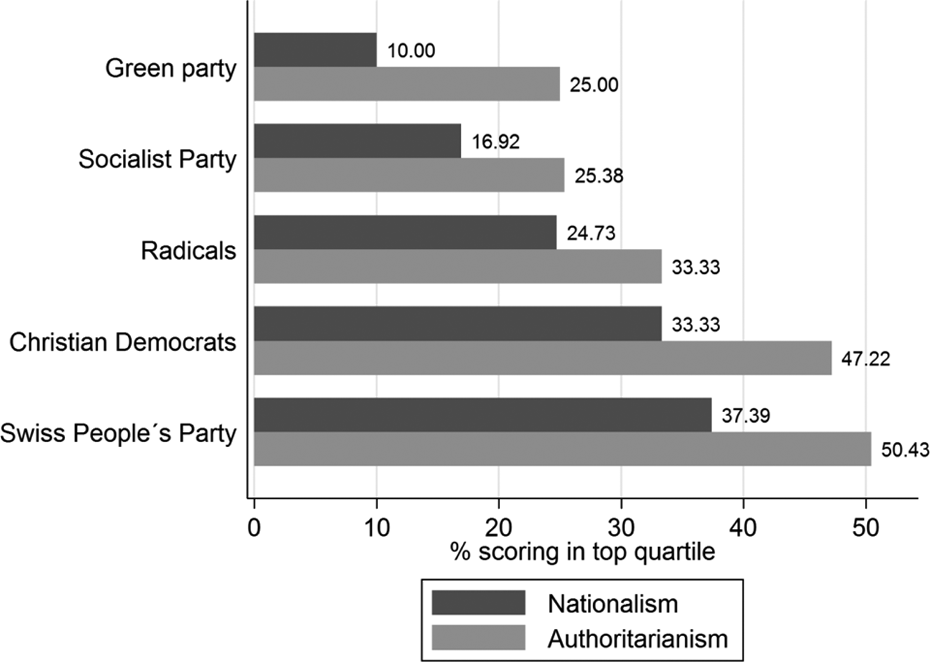
The percentage of party supporters who score in the top quartile of the exclusive-nationalism and authoritarianism measures in Switzerland.
This pattern is not as consistent for the authoritarianism scale. The same pattern holds true for Belgium, Denmark and Switzerland; however, in Austria, the larger Social Democratic Party of Austria and the Austrian People's Party, and in The Netherlands the considerably larger Christian Democratic Party all report higher numbers of supporters in the top quartile of the authoritarianism scale than do the RRP parties.
Analyses of means reveal identical patterns to those revealed in Figures 1 to 5; in each country, those who prefer RRP parties report a higher mean level of exclusive nationalism than any other party – though there is no statistical difference between the mean level of exclusive nationalism of those who prefer RRP parties and many of those who prefer other parties within each country. However, in all countries, the difference between the mean level of exclusive nationalism for those who prefer RRP parties is significantly and substantially different from the parties preferred by the least exclusive-nationalistic individuals.
Again, following the pattern revealed in Figures 1 to 5, the highest mean level of authoritarianism is not always reported by those who prefer RRP parties. Though in Belgium, Denmark and Switzerland those who prefer RRP parties do report the highest mean level of authoritarianism, in Austria, those who prefer the Social Democratic Party of Austria and the Austrian People's Party report higher levels of authoritarianism than do those who prefer the Austrian Freedom Party and the Alliance for the Future of Austria, and in The Netherlands those who prefer the Christian Democratic Party report higher levels of authoritarianism than do those who prefer Proud of The Netherlands.
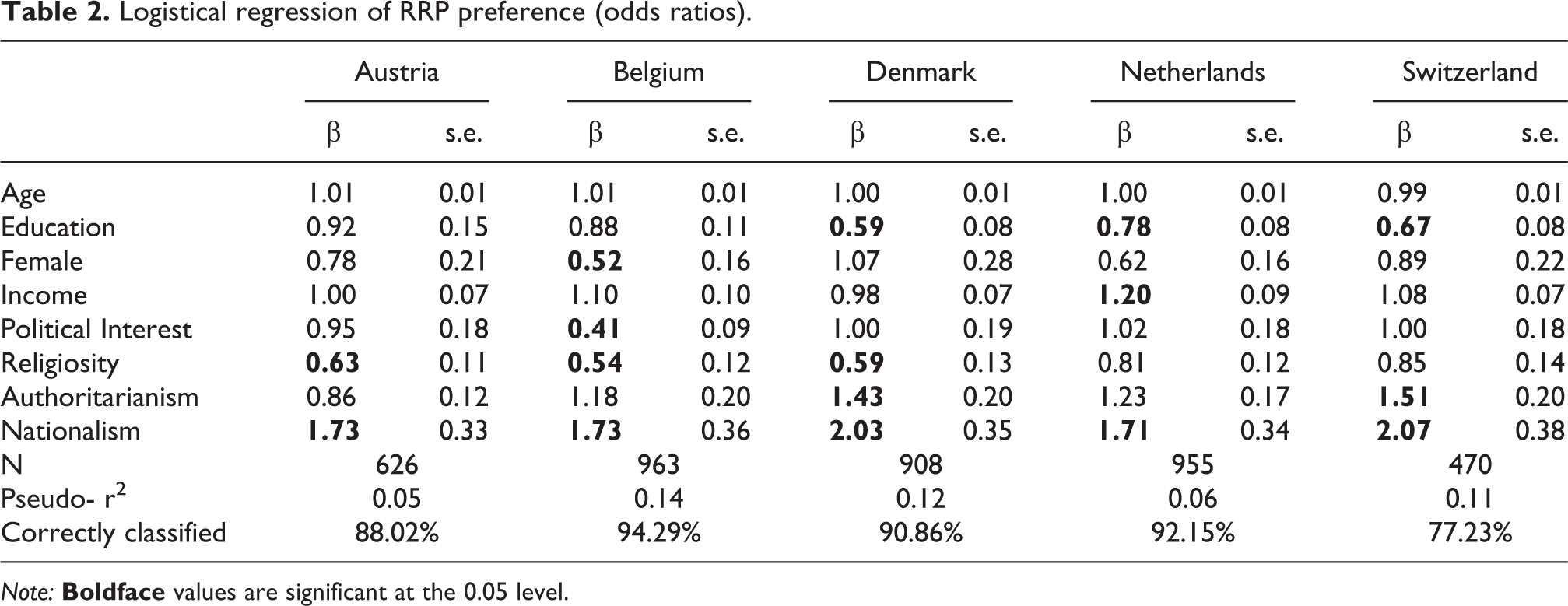
Moving away from descriptive analyses, Table 2 displays the output for country-by-country logistical analysis of preference for RRP parties. The dependent variable in these analyses is whether or not an individual prefers an RRP party; 1 if an RRP party is preferred, 0 if not (see above for party preference coding details). The coding of the two primary independent variables, exclusive-nationalism and authoritarianism, is described above. The models also control for a number of demographic variables – age, education, female, income – as well as political interest and religiosity. Age is a simple measure of the respondent's age in years. Education is a measure of a respondent’s reported level of education ranging from 0 to 6, coded using UNESCO’s International Standard Classification of Education (ISCED97) (0: Pre-primary education or no education, 1: Primary education or first stage of basic education, 2: Lower secondary or second stage of basic education, 3: Upper secondary education, 4: Post-secondary non-tertiary education, 5: First stage of tertiary education, 6: Second stage of tertiary education). Female is a simple binary indicator of a respondent's gender; 1 indicating female, 0 indicating male. Income is a self-report of one’s household income on a 10-point scale; 1 being the lowest and 10 the highest income level. Political interest is a reflective, standardized scale comprising four items indicating interest in politics: how important is politics in your life, how often do you discuss politics with friends, how interested are you in politics, and how often do you follow politics in media. Pooling the items across countries, all items load moderately to strongly on a single factor and produce a scale reliability coefficient of 0.78; a higher value indicates a higher level of political interest. Religiosity is a reflective, standardized scale comprising five items indicating a respondent’s degree of religiosity: how important is religion in your life, how often do you attend religious services, are you a religious person, how important is God in your life, and how often do you pray to God outside religious services. Pooling the items across countries, all items load strongly on a single factor and produce a scale reliability coefficient of 0.88; a higher value indicates a higher level of religiosity.
Logistical regression of RRP preference (odds ratios).
Note:
Table 2 provides further evidence that exclusive-nationalism consistently predicts RRP party support, whereas authoritarianism does so only in the cases of Denmark and Switzerland. More detailed analyses demonstrate that, with all other variables set to their mean, the predicted probabilities for preferring a RRP party over all others increases substantially for exclusive-nationalists in each country in these analyses: in Austria, the probability increases from 0.04 at the lowest level of exclusive-nationalism to 0.19 at the highest; in Belgium this increases from 0.01 to 0.07; in Denmark, from 0.02 to 0.16; in The Netherlands, from 0.03 to 0.15; and, in Switzerland, from 0.07 to 0.41.
Aligning with the descriptive evidence above, authoritarianism is a less consistent predictor of RRP party support. Most intriguingly, in Austria the relationship, though statistically insignificant, is reversed, with the probability of preferring an RRP party decreasing from a probability of 0.13 at the lowest level of authoritarianism to 0.08 at the highest, all else equal. For Denmark and Switzerland, the two countries where authoritarianism is a significant predictor of RRP party preference, an increase from the lowest to the highest level of authoritarianism increases the probability of preferring an RRP party from 0.04 to 0.15 and 0.14 to 0.45, respectively.
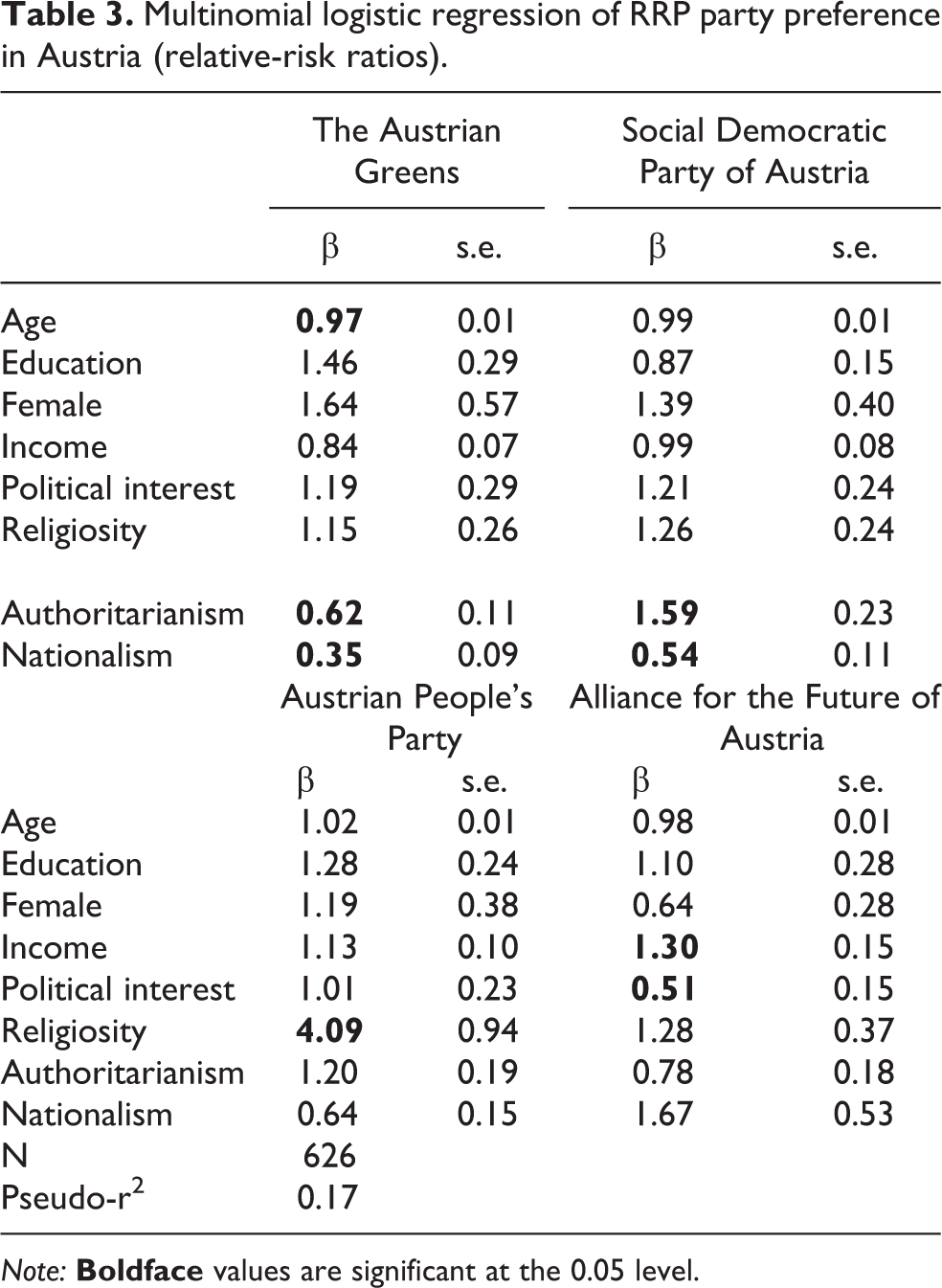
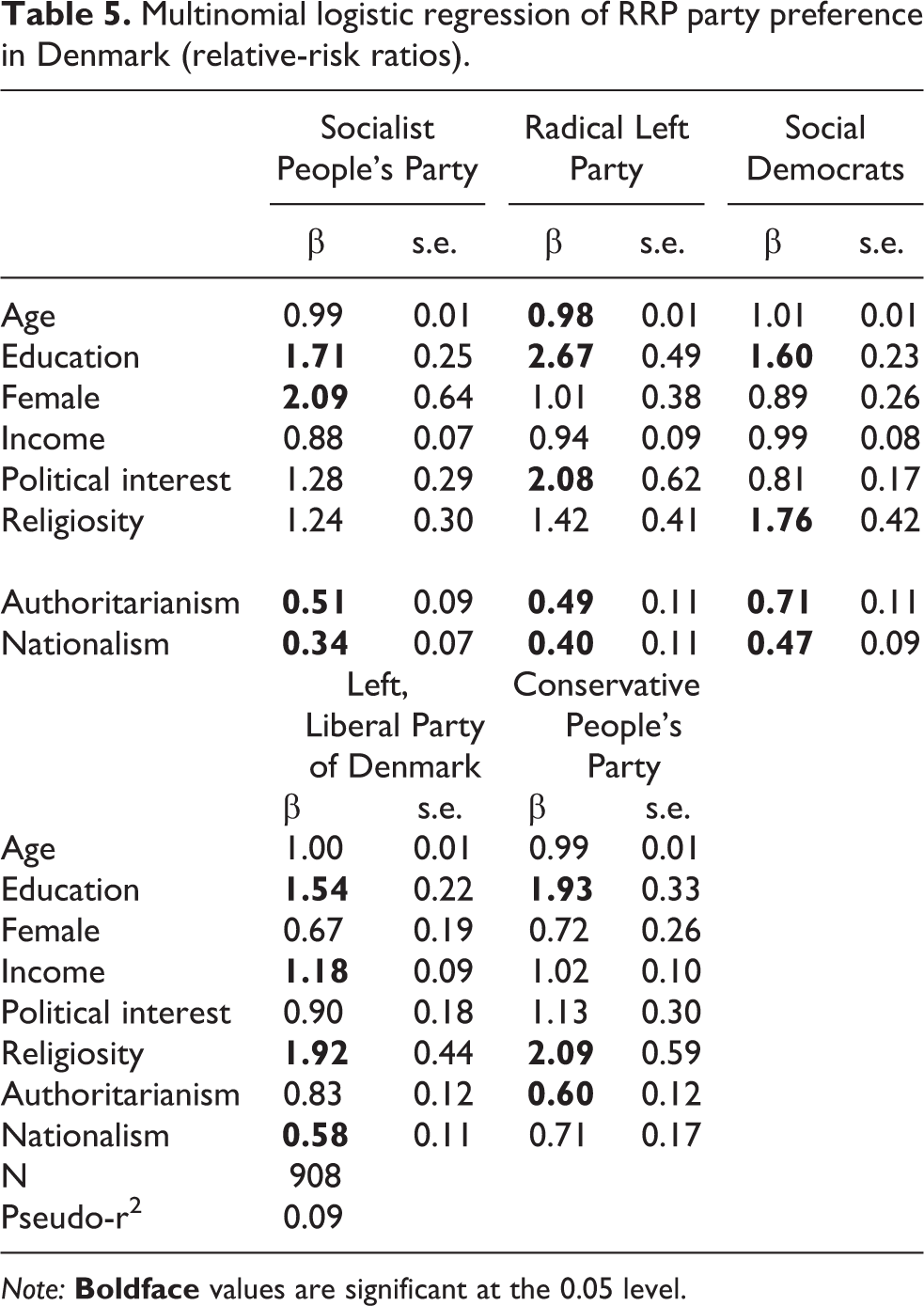
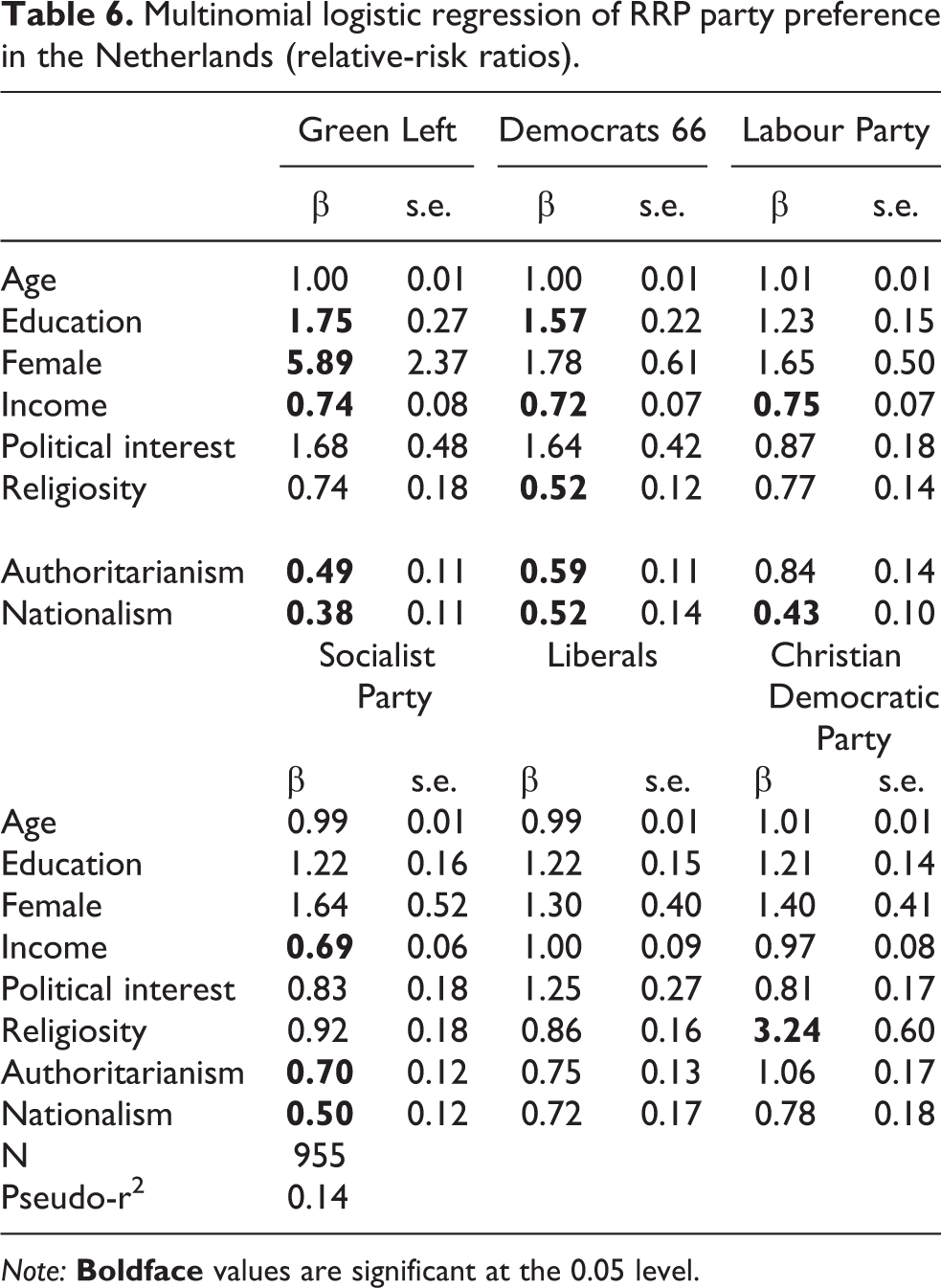
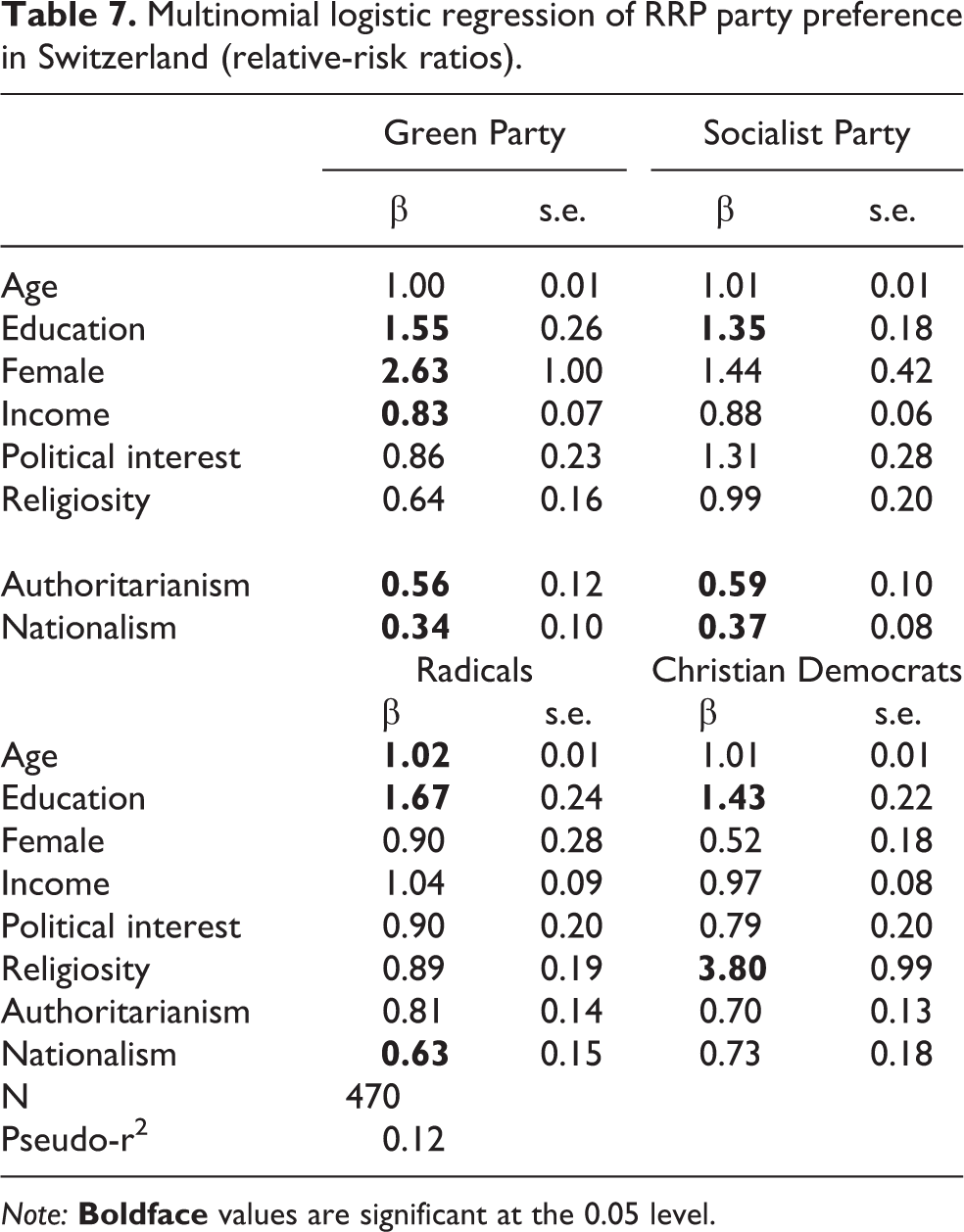
More detailed between-party differences are shown in Tables 3 to 7, which display the results of country-by-country multinomial logistic regressions using RRP party preference (the Austrian Freedom Party in Austria) as the base outcome category. These models display the odds of choosing the listed party over the base category RRP party. The parties are organized according to their mean nationalism scores; parties with lower mean scores are listed first.
Multinomial logistic regression of RRP party preference in Austria (relative-risk ratios).
Note:
Multinomial logistic regression of RRP party preference in Belgium (relative-risk ratios).

Note:
Multinomial logistic regression of RRP party preference in Denmark (relative-risk ratios).
Note:
Multinomial logistic regression of RRP party preference in the Netherlands (relative-risk ratios).
Note:
Multinomial logistic regression of RRP party preference in Switzerland (relative-risk ratios).
Note:
Tables 3 to 7 indicate that in each country the base category RRP party is more likely to be preferred to all other parties (except the RRP Alliance for the Future of Austria) by more exclusive-nationalistic individuals. This relationship is statistically significant in 18 of the 24 (RRP to non-RRP) comparisons. Even in those cases where standard levels of statistical significance are not met, the relative-risk ratio is substantially less than 1 (which would indicate equal odds).
The relationship between authoritarianism and RRP party preference, again, is considerably less consistent. In only 11 of the 24 (RRP to non-RRP) comparisons are authoritarian individuals statistically more or less likely to prefer RRP parties. In Belgium, authoritarianism does not attain statistical significance in a single comparison. Further, in three cases (though only one is statistically significant), authoritarian individuals are more likely to prefer a non-RRP party (the Social Democratic Party of Austria and the Austrian People’s Party in Austria and the Christian Democratic Party in The Netherlands).
Table 8 details the change in the predicted probability from the minimum to the maximum values of exclusive-nationalism and authoritarianism, based on the corresponding multinomial logistic regression model output. In all five countries, RRP parties benefit relatively substantially from an increase in exclusive-nationalism. In three of five countries, RRP parties gain the most from an increase from the minimum to the maximum level of nationalism; in Belgium, Flemish Interest comes second to the Socialist Party and in The Netherlands, Proud of The Netherlands comes second to the Christian Democratic Party.
Change in the predicted probability of voting for any given party over the range of exclusive nationalism and authoritarianism.
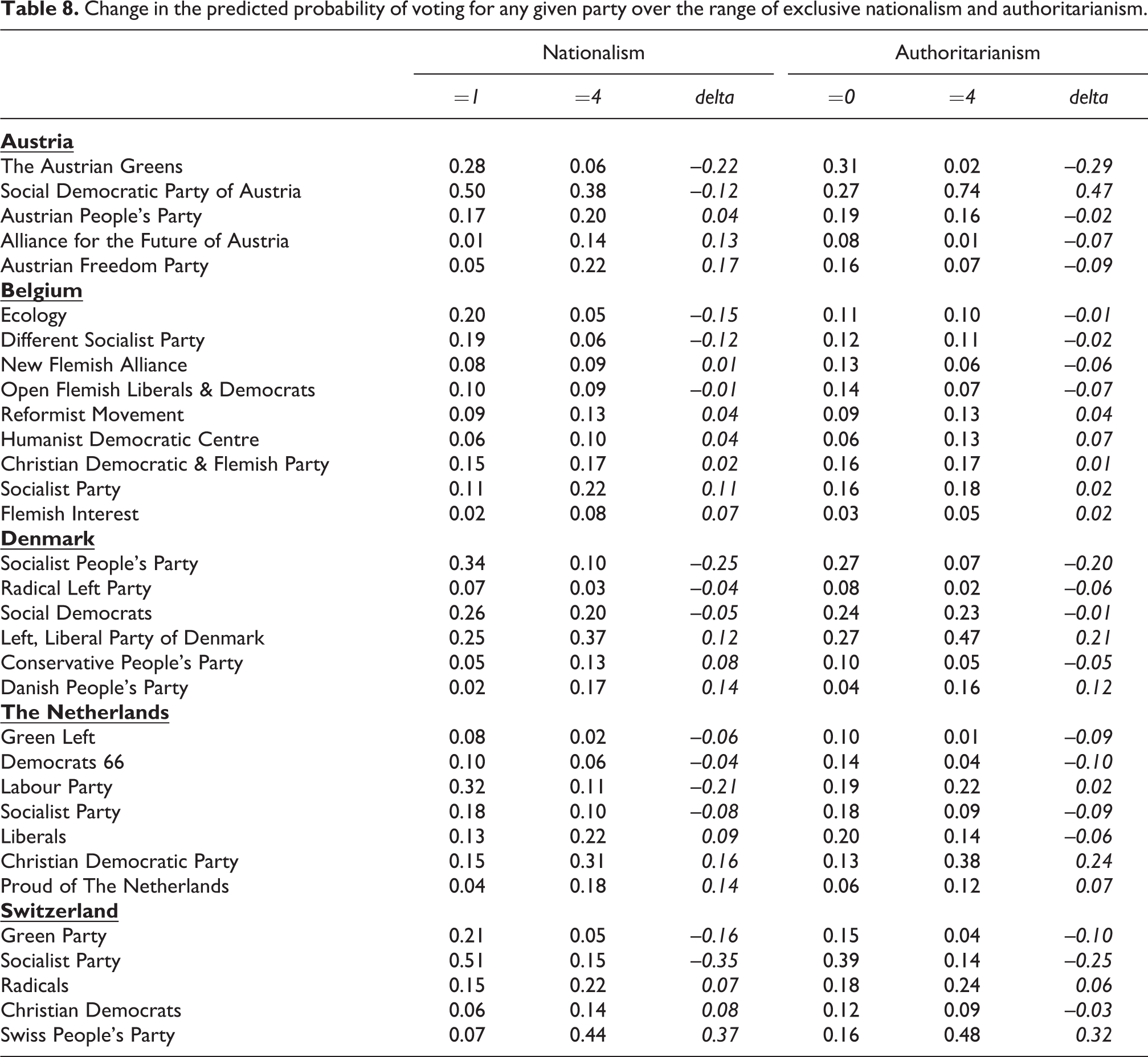
Authoritarianism, again, does not repeat this pattern. In Austria, the two RRP parties suffer from an individual’s increase in authoritarianism. In Belgium, the change in probability is practically zero. In Demark, the Danish People’s Party benefits fairly substantially from an increase in authoritarianism, but this benefit is eclipsed by the benefit gained by the Left, Liberal Party. In The Netherlands, a change from the minimum to the maximum value on the authoritarianism scale increases the probability of preferring an RRP party, but only slightly and this benefit is massively overshadowed by the benefit gained by the Christian Democratic Party. Only in Switzerland does the RRP party, the Swiss People’s Party, gain a primary and substantial benefit from authoritarian voters.
Discussion
The authoritarianism literature arose from the attempt to understand those who supported the Nazi party previous to and during World War II Germany. Though the aims of the authoritarianism literature are now much more diverse and no longer explicitly aim to answer this question, there is often the implication, if not the explicit suggestion, that in the established democracies authoritarians prefer radical right-wing populist parties. While this assumption appears reasonable, there has been little, if any, cross-national research that directly tests this. This article is a first step in resolving this deficiency.
The primary intent of this article is to examine whether the suggestion that authoritarians will always prefer RRP parties holds. I also examine whether this thesis holds for exclusive-nationalists. While early research (Adorno et al., 1950), and even some more modern research (e.g. Kitschelt, 1992), in the authoritarianism literature closely associates exclusive-nationalism with authoritarianism, the psychological research suggests that although both characteristics motivate intolerant and punitive attitudes toward outgroups, they derive from differing psychological foundations. This research shows that while these variables are correlated, it is to a very modest degree (r = 0.24, p < 0.05, for the pooled sample). As such, and as the programmes of RRP parties are likely to appeal as much to exclusive-nationalists as authoritarians, exclusive-nationalism is also examined.
Beginning with simple descriptive analyses and then moving on to logistical and multinomial logistical analyses of RRP parties in five West European countries (Austria, Belgium, Denmark, The Netherlands and Switzerland), I present evidence which indicates that authoritarianism only inconsistently predicts preference for RRP parties. In Austria and The Netherlands, non-RRP parties (in Austria, the Social Democratic Party and the Austrian People's Party; in The Netherlands, the Christian Democratic Party) boast a higher proportion of supporters who score in the top-quartile of the authoritarianism scale as well as a higher mean authoritarianism score. In logistic regression analyses, authoritarianism only predicts preference for RRP parties over all other parties in Demark and Switzerland. In multinomial logistic regression analyses, authoritarian individuals are more likely to prefer RRP parties in only 46 percent (11 of 24) of the party-to-party comparisons. In Belgium, authoritarianism does not significantly predict the preference of the RRP over a single other party. In Austria, the probability of preferring a RRP party actually declines as authoritarianism increases. Authoritarianism is clearly not a consistent predictor of preference for RRP parties across countries.
The story for exclusive-nationalism is quite different. In all five countries, RRP parties boast a higher proportion of individuals who score in the top quartile of the exclusive-nationalism measure and report a higher mean level of exclusive-nationalism among their supporters. Logistic regression models indicate that RRP parties are preferred by exclusive-nationalists to all other parties in all five countries. Multinomial logistic regression models indicate that exclusive-nationalist individuals are more likely to prefer RRP parties in 75 percent (18 of 24) of the party-to-party comparisons. In all five countries, RRP parties benefit from higher levels of exclusive-nationalism, and in three of those five, RRP parties benefit more than any other party (they come in second in the remaining two countries). Exclusive-nationalism is a strong predictor of preference for a RRP party but can also serve to predict support for other parties which espouse exclusive-nationalist rhetoric.
While RRP party supporters do possess more authoritarian (intolerant and punitive) attitudes (Billiet and De Witte, 1995; Van Hiel and Mervielde, 2002), the evidence provided here effectively repudiates the idea that authoritarians will unconditionally support electorally viable radical right-wing populist parties. It is perhaps the distinction between authoritarian attitudes and authoritarianism (or an authoritarian predisposition) that spawns confusion over the relationship between RRP parties and authoritarian individuals. This confusion is certainly understandable given that the previous conceptualization of authoritarianism focused on attitudes rather than a psychological (pre) disposition. Altemeyer (1981, 1988, 1996), perhaps the most influential scholar in authoritarianism research over the past few decades, considers authoritarianism to be a learned syndrome, a collection of attitudes that cluster into three facets: submission, aggression and conventionalism. As RRP party supporters hold more authoritarian attitudes than others, and as Altemeyer’s conception of authoritarianism classifies those with the most authoritarian attitudes to be the most authoritarian, RRP party supporters are, therefore, the most authoritarian. However, this conception of authoritarianism has largely been abandoned in favour of a more dynamic approach (cf. Feldman and Stenner, 1997; Stenner, 2005, 2009), as authoritarian attitudes can even be evoked among non-authoritarian individuals under conditions of existential threat (Hetherington and Suhay, 2011; Hetherington and Weiler, 2009). Our preconceived notions regarding the relationship between these parties and authoritarians, then, need rethinking; authoritarians, as currently conceptualized, do not necessarily prefer RRP parties to all others.
Current theory on authoritarianism does not predict an unconditional relationship between authoritarianism and RRP party support. Support for RRP parties among authoritarians may be conditional as recent work reveals authoritarianism to be a dynamic characteristic that responds to environmental conditions; authoritarians become more intolerant under conditions of social and political fragmentation (Dunn and Singh, 2011; Dunn and Singh, forthcoming; Feldman and Stenner, 1997; Singh and Dunn, forthcoming; Stenner, 2005, 2009). Further, authoritarians are highly norm adherent and concerned with maintaining congruence with their ingroup (Altemeyer, 1996; Oyamot Jr et al., 2012). It may well be that authoritarians are more likely to respond to RRP party rhetoric to unify and homogenize the nation when they perceive an increase in social and political fragmentation and when these parties are legitimized as within the mainstream. Supporting this supposition, research in the RRP party literature often reveals a positive correlation between RRP party support and cultural and economic insecurity and/or threat (Biggs and Knauss, 2012; Bowyer, 2008; Goodwin et al., 2012; Lucassen and Lubbers, 2012; Rydgren and Ruth, 2011); and the political fortune of RRP parties increases when they are legitimatized by mainstream parties (Dahlström and Sundell, 2012) and/or the media (Koopmans and Muis, 2009; Vliegenthart et al., 2012). Direct examination of such a proposal, however, requires considerably broader and more detailed data than that used in this article and is therefore left for future research. The next step for authoritarianism research in this line of questioning, then, is to uncover why authoritarians support the parties they do when they do, or conversely, why authoritarians do not support RRP parties when they do not.
For those more interested in the correlates or causes of RRP party support rather than the political-behavioural profile of authoritarians, the take home message here is that authoritarianism is not unconditionally related to such while exclusive-nationalism appears to be. It is nevertheless important that considerations of authoritarianism do not fall by the wayside in the RRP party literature. Some of the more recent research in the RRP party literature noted above considers threat a mediating factor for RRP party support. This meshes well with the emerging research paradigm in the authoritarianism literature which not only suggests that RRP parties may be more appealing to normatively threatened authoritarians, but also that such parties may be more appealing to non-authoritarians who are existentially threatened (cf. Hetherington and Suhay, 2011; Hetherington and Weiler, 2009). The RRP party literature has already opened the door to the idea that different forms of threat (normative versus existential) may influence RRP party support in differing fashion (e.g. Lucassen and Lubbers, 2012). Consideration of authoritarianism alongside diverse forms of threat, then, may provide additional leverage over the question of RRP party support.
Footnotes
Funding
This research received no specific grant from any funding agency in the public, commercial or not-for-profit sectors.