



Abstract
I argue that political parties oriented towards particularistic goods affect coalition government in presidential systems. Particularistic parties hire out their support on some item(s) of the presidential agenda in exchange for locally targeted policies or resources under the control of presidents. They are relatively cheap coalition partners for presidents in policy terms and their representation in the legislature provides presidents with coalitional flexibility. My empirical analysis of cabinets in 10 Latin American countries shows that when particularistic parties hold a larger share of the legislative seats minority presidents are less likely to form majority governments and more likely to change the party composition of their cabinets.
Introduction
Political parties oriented toward the distribution of particularistic benefits are common in democracies around the globe, where patronage-based, as opposed to programmatic, party-voter linkages predominate (Kitschelt and Wilkinson, 2007). These parties respond to voters’ demands in the kinds of goods they distribute and help legislators gain access to resources that can be channelled to their supporters in the electorate. They also can be useful to presidents who often need their votes to secure passage of legislation that more programmatic parties oppose. Scholars demonstrate that presidents in various countries distribute pork and patronage to gain support in multiparty legislatures and some argue that party leaders act as intermediaries in this exchange (Ames, 2001; Amorim Neto and Santos, 2001; Figueiredo and Limongi, 2000; Geddes, 1994; Gibson and Calvo, 2000; Lyne, 2008; Mejía Acosta, 2006; Pereira and Mueller, 2004; Raile et al., 2011; Shugart and Carey, 1992; Taylor, 1996; Zucco Jr., 2009). When U.S. presidents are without programmatic majorities backing them, they too turn to pork-barrel benefits to ‘grease the wheels’ of policy-making (Evans, 2004).
The question typically framed by scholarly debate is whether, and how, presidents can maintain stable majorities and ensure disciplined voting if legislators seek particularistic benefits. However, for Juan Linz (1994: 34–35):
[O]ne of the paradoxes of presidential regimes in many Latin American democracies (and the Philippines) is the complaint that parties are weak and lack discipline and that representatives behave in parochial and self-interested ways. I say paradox because these characteristics of parties and their representatives make it possible in multiparty systems (in particular) for presidencies to work.
Shugart and Carey (1992: Ch. 9) see this as the inefficient secret: in a multiparty system, a moderately strong president can succeed in passing a national policy agenda despite, or because of, the localistic rather than ideological basis of parties in the assembly. Prominent scholars of comparative presidentialism agree that particularistic representation in the legislature is an important factor in allowing multiparty presidentialism to function; yet the role of particularistic parties in presidential coalitions has not received systematic, cross-national examination. The influence of particularistic-oriented parties on coalition government in presidential systems cannot be understood using the standard theoretical framework of presidential coalition-building that structures politics in left–right terms and focuses on public policy (Aleman and Tsebelis, 2011; Amorim Neto, 2006; Cheibub et al., 2004; Martinez-Gallardo, 2012; Negretto, 2006).
This article explains how parties with particularistic orientations affect presidents’ governing strategies in multiparty systems. I argue that particularistic parties provide presidents with coalitional flexibility. Presidents face potentially high policy costs if they make the compromises that would be necessary to build and maintain majority support for each item of their policy agendas. Since presidents often have considerable control over highly valued resources, they can increase their support in the legislature by distributing government largesse. Political parties that will trade their support for some item(s) on the presidential agenda in exchange for targeted benefits under the control of presidents provide an alternative source of votes when other parties with stronger ideological commitments balk.
By putting their votes up for hire, particularistic-oriented parties make for relatively cheap coalition partners for presidents in policy terms. When parties-for-hire are represented in the legislature, presidents are more likely to decide that the benefits of a stable governing coalition are not worth the costs of the policy compromises required to maintain stability. Yet, hiring the support of particularistic parties across the entire presidential agenda is unlikely to be cost effective either. Presidents will, instead, govern through shifting coalitions because it provides a cheaper strategy for accomplishing their policy goals. Thus, coalitional instability may actually indicate that the legislative arenas in some cases allow presidents to find the votes that they need to pass legislation without making major concessions on the policy content of their reform agendas.
Latin America is a good place to study how particularistic interests in the legislature influence coalition-building strategies of presidents. Minority presidents are common in the region and Latin American presidents control extensive resources that legislators depend on for political survival. Latin America also provides considerable variation within party systems, with some political parties that cultivate programmatic reputations and others that adhere to particularistic orientations. I test implications of the parties-for-hire argument through an empirical analysis of both the majority status and duration of presidential cabinets in 10 Latin American countries with considerable democratic experience. My findings suggest that, all else equal, minority presidents are less likely to form majority cabinets when particularistic parties hold a larger share of the legislative seats. My analysis also indicates that these parties’ legislative representation reduces stability in the party composition of presidential cabinets, after taking into account majority status and other factors thought to influence cabinet duration. In light of these findings, the conclusion of the article returns to the governability debate in Latin America.
Governability in presidential systems
Since presidents need majorities (and sometimes super-majorities) to pass their legislative agendas, minority government and coalitional instability have typically raised concern about governability. The conventional wisdom once predicted insurmountable conflict between minority presidents and multiparty legislatures because scholars assumed that presidentialism provides few incentives for coalition-building. The standard argument was that fragile coalitions in these presidential democracies would lead to, at best, ineffective governments unable to address social and economic problems and, at worst, democratic breakdown (Linz, 1994; Mainwaring, 1993; Stepan and Skach, 1993).
Minority government
Recent work challenges this conventional wisdom by demonstrating that under some circumstances minority presidents have strong policy incentives to form coalition governments, and that in other circumstances presidents may succeed in passing their legislative agendas without forming majority cabinets.
If parties have policy positions close to the president’s, a minority president should be able to govern adequately through multiparty coalitions in the legislature (Cheibub et al., 2004; Negretto, 2006). When the president’s party is the median party, the situation will be equivalent to single-party minority government in parliamentary systems that operate with majority support from the legislature; in other minority situations, the extent of executive–legislative conflict will depend on whether or not the president can sustain a veto and the position of the status quo relative to pivotal parties in the legislature. When large policy differences exist between the president and legislative parties, the government may remain a minority in both the portfolio and legislative arenas. According to these models of executive–legislative relations, the probability of presidents governing with minority cabinets should thus have a non-linear relationship with the policy distance between the president and parties in the legislature. When policy distances are small, or when they are large, minority governments should be more common.
Constitutional powers that affect presidents’ abilities to set the legislative agenda, including decree authorities and vetos, also affect their incentives to form and maintain majority coalitions (Aleman and Tsebelis, 2011; Amorim Neto, 2006; Mainwaring and Shugart, 1997; Shugart and Carey, 1992). When they possess substantial institutional powers, presidents are less dependent on a majority coalition government with parties that will support their preferred policies.
When presidents control substantial material resources, including discretionary funds and budget appropriations, they have greater ability to entice cooperation in government (Amorim Neto and Santos, 2001; Mejía Acosta and Polga-Hecimovich, 2011; Pereira and Mueller, 2004). At the same time, majority governing coalitions may be less valuable to presidents where parties cannot routinely deliver the votes of their legislative contingents (Mainwaring and Shugart, 1997). Where electoral rules encourage politicians to cultivate personal, as opposed to party, reputations and generate intra-party competition, individual legislators are likely to press for resources to meet the pork and patronage demands of local municipalities and/or constituent groups critical to their own re-election (Ames, 1995; Carey and Shugart, 1995). Presidents may negotiate with individual legislators in these situations, funding their pet projects in exchange for their individual votes. If parties are less disciplined in personal vote electoral systems, majority government may be less common in these systems. It is also possible that presidents respond to weak or less disciplined parties by forming supermajorities.
Coalitional instability
The conventional wisdom has also been challenged by the empirical record demonstrating that multipartism does not always cause instability; some coalitions survive until the end of the president’s term and some even last into the next presidency. To account for variations in coalition stability across presidential systems, recent research emphasizes the relative institutional and political powers of the president and the legislature. Presidential decree authority reduces the incentive of presidents to engage in coalition-maintenance, while strong, effective legislatures increase presidents’ incentives to compromise with their coalition partners (Martinez-Gallardo, 2012). Recent research also explains how pork expenditures can substitute for cabinet positions, such that presidents’ use of discretionary spending influences coalitional stability over time (Mejía Acosta and Polga-Hecimovich, 2011; Raile et al., 2011).
Attributes of the cabinet itself, such as majority status and party composition, should affect the stability of presidential coalitions (Deheza, 1997; Martinez-Gallardo, 2012), much like they affect cabinet duration in parliamentary systems (Warwick, 1994). Internal policy conflict increases when cabinets include more parties and are more ideologically polarized, raising the risk of cabinet collapse. In more ideologically polarized legislatures as well, bargaining is more complex and the incentives to renegotiate coalitions increase (King et al., 1990; Laver and Schofield, 1990; Martinez-Gallardo, 2012).
It also may be more difficult for presidents to broker stable coalition arrangements when electoral institutions make deputies less beholden to party leaders and more beholden to special interests in their district. As Mainwaring (1997: 80) sees it: ‘Party indiscipline is inimical to stable coalition building.’ In her cross-national analysis, Martinez-Gallardo (2012) finds that cabinets last longer in systems with electoral rules thought to produce greater party discipline. However, if the organization of legislatures empowers party leadership to act as ‘brokers’ for the government resources critical to legislators’ own re-election, then governing parties should be able to ensure loyal voting on presidents’ legislative agendas most of the time, even where electoral rules weaken parties’ influence over legislators’ careers (Figueiredo and Limongi, 2000; Lyne, 2008).
Finally, the stability of governing coalitions varies over the course of the presidential term, and with changes in the approval rating of the president and economic performance (Altman, 2000; Mainwaring, 1993; Martinez-Gallardo, 2012; Mejía Acosta and Polga-Hecimovich, 2011; Raile et al., 2011). Where incumbency tends to be a liability, presidents struggle to maintain a workable coalition as their terms in office draw to a close.
Parties for hire: Another explanation for why presidents govern with shifting coalitions
Coalition-building and governing strategies of minority presidents depend on the bargaining circumstances they face. Previous research demonstrates that minority presidents, under some circumstances, have incentives to build stable majority coalitions. For presidents who lack such incentives, however, the question remains why their coalitions change – or why they change their coalitions. To account for coalition instability, I argue, we must consider the institutional and material resources of presidents and the kinds of interests, both programmatic and particularistic, that gain representation in the legislature. In this section, I explain how presidential resources and partisan interests in the legislature that cannot be ordered from left to right affect presidents’ proclivities to govern through shifting coalitions.
Presidents are always under pressure to govern adequately, improve economic conditions and maintain political stability; otherwise they may find themselves out of a job (and out of the country) sooner than they expected (Hochstetler, 2006). Presidents usually include macro-economic policy in their agendas, and are often constrained by other actors, such as international lenders and financial institutions, in setting economic policy. Yet programmatic parties in the legislature may not support the presidential agenda. Presidents therefore face potentially high policy costs if they make the compromises that may be required to build and maintain a majority coalition across each piece of legislation. Along with their institutional resources, presidents often possess material resources. Where presidents control vast resources of government, parties that seek narrowly targeted benefits will compete for places in the presidential coalition, along with programmatic parties. These particularistic-oriented parties can sometimes be cheaper coalition partners for presidents who prefer not to compromise their positions on key policies upon which their reputations depend.
While most of the literature on executive-legislative relations in presidential systems treats parties as programmatic organizations and attributes particularistic goals to individual legislators, I claim that the combination of strong presidents who control the bulk of government resources with regionalized and particularistic interest representation alters the behaviour of some parties in the legislature and the strategies of president-formateurs. Particularistic-oriented parties of the past and present exploit a common niche: many Latin American voters want jobs, other individual benefits and local pork delivered to their towns or neighbourhoods; ideological promises do not win their votes. Particularistic party representation also occurs when specifically regional and sometimes ‘off-dimensional’ interests dominate local politics such that the political careers of politicians in regional parties depend on their advocacy for narrowly targeted policies/benefits and are not tied to position-taking on the national left–right policy dimension. In Latin America, the electoral connection means that regional and particularistic interests sometimes and in some places give rise to parties that seek particularistic benefits from the government because that is what their supporters seek from them. These particularistic-oriented parties cultivate reputations as providers of patronage and pork and help legislators gain access to influence and resources that can be channelled to their supporters in the electorate. For example, in Ecuador’s fragmented legislature, party leaders are key intermediaries between the president and rank-and-file legislators:
When negotiating with the president, party leaders were often interested in obtaining bulk entitlements (also known as collective contracts) to sectors of the government or ‘asked for [control of] entire provinces’ in which they considered to have their strongholds. Leaders, in turn, used these baskets of goodies to discipline and reward their party members. (Majía Acosta, 2009: 123)
Particularistic parties put their votes up for hire in presidential coalition-bargaining.
1
They are eager to reach a compromise with the president in order to access patronage, pork and targeted benefits. The former Radical Party in Chile is an example:
Only the successful alliances formed by the party, obviously because they provided easy access to governmental jobs, kept it together and even led to a broadening of its base. After 1932, the Radical party became the symbol of patronage for public employees, and in political circles its members were known as masters of opportunism and compromise. (Caviedes, 1979: 69)
Similarly, since re-democratization in Brazil, every president has hired the support of the Party of the Brazilian Democratic Movement (PMDB); in exchange, the PMDB accomplishes its primary objective: ‘to fill as many posts in federal agencies with its people and make sure it has a deciding role in how budgets are spent’ (Brazil Report 9/30/03).
Given budget constraints, the demands of particularistic parties have consequences for macro-economic policy-making, but their specific demands target a particular group or local area and tend to be less contentious to other actors. Examples of benefits that particularistic-oriented parties in the legislature seek from presidents include: radio transmitter licences for local communities; local ambulance service; rural electrification in a particular area; government transfers to specific provinces or municipalities; recognition of indigenous nationalities, languages of instruction in schools, and forms of justice; natural resource protection in the Amazon; management of state-run regional development banks; ambassadorships and domestic political appointments; and government jobs for the party to distribute (e.g. by controlling government ministries). As these examples indicate, not all particularistic parties seek resources for pork or patronage; some particularistic parties are oriented toward particularistic policies. Although less common in Latin America, single-issue parties, such as green parties or indigenous parties, trade their support for locally targeted or group-specific policy concessions that run orthogonal to the primary macro-economic policy dimension, which is most relevant to presidents and to programmatic parties that do take Left–Right positions regarding the redistribution of wealth. In other words, by definition, all particularistic parties lie off the standard left–right ideological dimension. These parties are willing to support the policy proposals put forth by the president without demanding major concessions in the content of the legislation.
Presidents weigh the costs of policy compromise against the costs of particularism. The attractiveness of this outside option depends not only on the availability of parties-for-hire, but also on what the president could achieve by bargaining strictly along the main policy dimension. The president can either move policy away from her ideal position on, say, structural adjustment reform, or she can replace an ideologically based coalition with a temporary alliance based on an off-dimensional bargain. The president might, for example, augment budgetary allocations for health resources in a certain province represented by a strong provincial party, agree to weaker restrictions on traditional coca growing in a region dominated by an indigenous party, or distribute goods to areas controlled by a clientelistic party in exchange for the votes she needs to pass national economic reform, rather than compromise the reform in order to get the votes of legislators from more programmatic parties. The presence of alternative policy dimensions, to which different parties give varying degrees of salience, widens the scope of policy change available to a presidential agenda-setter (Londregan, 2000).
Particularistic parties themselves are unlikely to provide a basis for a stable presidential coalition. First, hiring the continual support of particularistic parties across the entire presidential agenda is unlikely to be cost-effective, since many of these parties would continue to demand a steady stream of particularistic benefits. In the middle of Brazilian President Lula’s first term, for example, PMDB governors led one faction of the party out of Lula’s coalition and would reconsider their support for the government only if the finance ministry released about 2.5 billion dollars to their states (Latinnews Daily 6/28/05). Facing these expensive hiring costs, President Lula instead reshuffled his cabinet to shore up support, bringing in the Progressive Party (PP) and increasing the PMDB’s portfolios so as to keep the other wing of the PMDB on board.
Second, when there are multiple political dimensions, social choice theory suggests that an agenda-setter sometimes will achieve her ideal policies, or get closer to them, by changing coalition partners from one issue to the next (McKelvey, 1976). For instance, after Ecuadorian President Mahuad lost programmatic support from the right-wing Social Christian Party (PSC) for legislation critical to securing an IMF loan, he turned to short-lived alliances, first with the indigenous Pachakutik party and the Democratic Left (ID) to pass banking reform and later to the personalist/populist Ecuadorian Roldosista Party (PRE) to get his budget approved; Ecuadorian presidents also at times turn to individual legislators-for-hire (Mejía Acosta, 2009). Brazilian presidents govern with shifting coalitional strategies as well: ‘an executive can compensate, at least in the short term, for an ideologically narrower or less proportional cabinet through increased pork expenditures. Similarly, an executive can get by with expending less pork when the cabinet is ideologically broader or the cabinet is more proportional’ (Raile et al., 2011: 7 f.). A similar dynamic was observed in the electoral and governing coalition strategies employed by former Argentine President Menem, such that ‘the coalitions that guarantee the political survival of a governing party may not be the same coalitions that are direct protagonists in its economic policy-making process’ (Gibson and Calvo, 2000: 33).
To summarize, where a high demand for particularistic benefits creates legislative parties for hire – as in several Latin American countries – presidents can govern with shifting coalitions and it is likely that it will be in their interests to do so.
Testable implications of the parties-for-hire argument
The theoretical mechanism I describe above links the representation of particularistic parties to presidents’ coalitional strategies. I argue that these ‘parties-for-hire’ give presidents greater flexibility in finding coalition partners to support their legislative agendas.
Minority government is one implication of such flexibility. If parties seek pork in exchange for their votes, with no regard for programmatic agreement, then presidents could govern with minority cabinets and pass their policy agendas with ad hoc legislative majorities. Presidents could also allocate government jobs outside of government ministries, such as positions on the boards of state-owned businesses, to hire legislative support as needed (Diermeier and Merlo, 2000). Where more seats are held by parties that will hire out their support for these types of particularistic benefits, presidents’ legislative coalitions will be more likely to change between one vote and the next. Under these circumstances, shifting legislative coalitions will not necessarily translate into shifting cabinet coalitions. But, legislative voting coalitions are not observable in my dataset and, in general, evidence based on roll-call votes is difficult to compare cross-nationally. However, minority cabinets should be more common where this type of legislative strategy is available to presidents, and we can observe the majority/minority status of cabinets. Thus, one testable hypothesis of the parties-for-hire argument is that all else equal, the greater the legislative representation of particularistic parties, the lower the probability of majority cabinets in presidential systems.
Coalitional flexibility may also appear in more frequent cabinet changes. Commitment problems could arise if presidents promise to reward political parties with perks and other government resources that require the involvement of a cabinet minister who is not a co-partisan. While some particularistic parties may be satisfied with the transfer of resources that are under the president’s control, other particularistic parties may demand cabinet portfolios with large budgets to ensure that the disbursement of perks is under their control. If so, competition among parties should increase cabinet flux as parties jockey for places in the cabinet and presidents seek the cheapest coalition partners across different votes on their agendas. But even without joining the government, particularistic parties may influence cabinet stability. By giving a president an outside option for the votes she needs to pass particular legislation, the presence of these parties strengthens a president’s bargaining position vis-à-vis her coalition partners. In these situations, a president can demand legislative outcomes closer to her own ideal policy positions. If a president demands more than her coalition partners are willing to concede on that issue, the coalition is likely to break down and the president can instead hire the votes of particularistic parties. If presidents dismiss cabinet ministers when their parties refuse their support or if parties resign as a result of programmatic disagreements, we will see more cabinet change in these situations. If we define presidential cabinets by their partisan composition, then the parties-for-hire argument outlined above implies that, all else equal, the greater the legislative representation of particularistic parties, the shorter the tenure of presidential cabinets.
Empirical analysis
I test empirical implications of the ‘parties-for-hire’ argument with presidential cabinet data from 10 Latin American counties. 2 In the first analysis, I predict the probability of majority governments. In the second, I model the duration of presidential cabinets. Both are pooled analyses across countries, in which the unit of observation is the cabinet. I define new cabinets as a change in party composition or a change in the president.
I examine cabinets from the beginning of the current democratic period in each country through the most recent completed presidential term as of 31 December 2005. I also examine earlier periods of democracy in Brazil and Chile. 3 I exclude cabinets that served during presidential terms that lasted less than one year and cabinets that lasted less than one month. I restrict my analysis to cabinets formed by minority presidents only, resulting in 136 cabinets across 62 presidencies.
Coding particularistic parties
The primary explanatory variable in both analyses is the Seat Share of Particularistic Parties in the legislature. Although most – if not all – Latin American parties seek patronage, pork or other office benefits, this does not mean that they are particularistic parties, as I use the term here. In classifying parties, I treat particularistic parties as a residual category. In other words, I classify particularistic parties by identifying those parties that are not programmatic.
A party does not have a particularistic orientation if it takes a position along the standard left–right policy dimension. This standard left–right classification refers to parties’ positions regarding the redistribution of wealth and the interests of social classes which parties represent. Even if personalism, populism or clientelism make their ideological purity questionable, Coppedge (1997) asserts that most parties are roughly classifiable as Left, Center-Left, Center, Center-Right or Right.
Yet, some political parties are not classifiable in left–right terms, even by country experts. Some political parties promote a single issue or the interests of a particular region or social group. They are parties which represent voters that care most, or exclusively, about regional or group benefits that are not relevant to other voters. The careers of politicians in these parties, consequently, are not tied to government performance on left–right public policy-making. (Political parties can, of course, be ideologically oriented and still reflect different responses across regions or social groups to national policy debates, and thus can clearly be placed on the left or the right.) While these kinds of political parties are not programmatic in standard macro-economic policy terms, this does not mean that they are opportunistic or unprincipled. These parties take positions along orthogonal dimensions, but not along the primary policy dimension relevant to the presidential agenda. Thus, in terms of the presidential agenda, the principle or interest that they represent can be seen as particularistic. Also, classifying a party as particularistic is not the same thing as classifying a party as clientelist. Parties can serve special interests and provide particularistic goods in a non-clientelist manner (Kitschelt, 2000: 850).
Other political parties cultivate reputations solely as providers of particularistic benefits, instead of advancing policy platforms or ideological reputations. They represent voters who want jobs and benefits delivered to their neighbourhoods or villages. The delivery of individual benefits (from t-shirts to jobs) and local pork (like roads or bilingual education) can be thought of as an orthogonal policy dimension in Latin America. For some parties, this is the dimension of politics that matters most. Some particularistic political parties are electoral vehicles that offer vague principles or inconsistent platforms, but they cannot plausibly be classified in left–right terms. What ties members of these parties together is simply an interest in getting into government to access particularistic benefits. Often these kinds of parties have reputations of pragmatism or political opportunism.
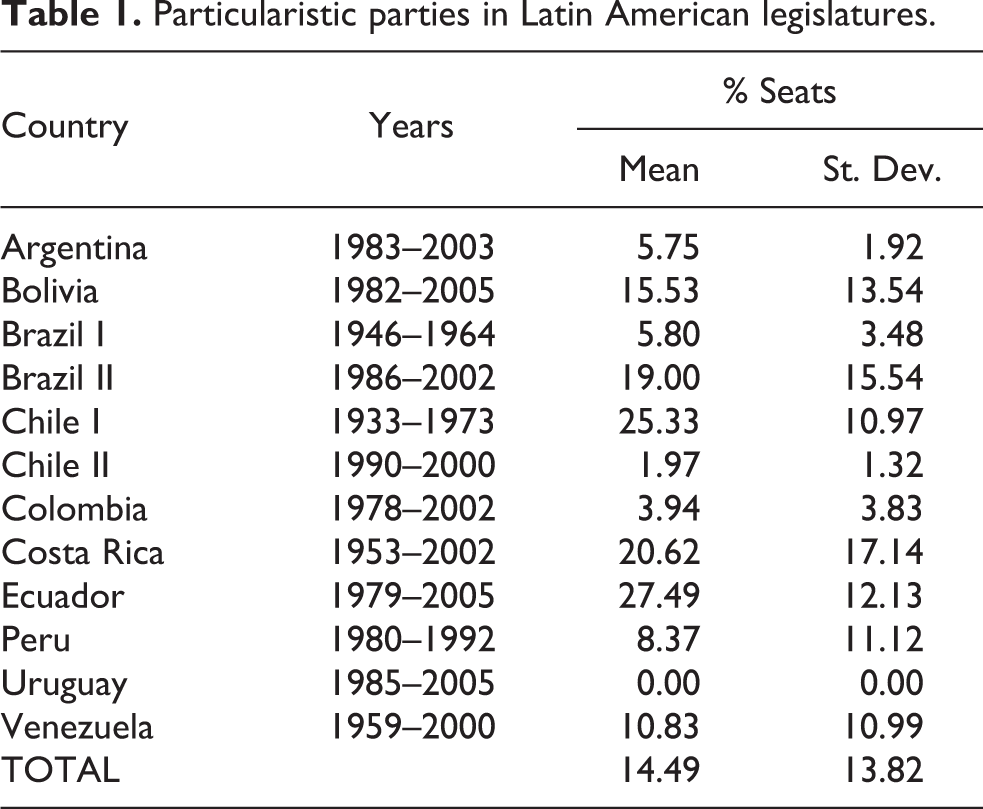
To identify parties’ positions, and those parties that cannot be classified in left–right terms, I primarily used Coppedge’s (1997) classification of Latin American parties and Pop-Eleches’s (2009) updates to these data. 4 Table 1 gives averages by country for the percentage of seats won by particularistic-oriented parties in the lower chamber.
Particularistic parties in Latin American legislatures.
Majority government
The latent dependent variable of interest in testing the first implication of my argument is the underlying propensity of minority presidents to form majority cabinets. The observed dependent variable codes whether the combined legislative contingents of parties with ministerial appointments constitute a majority (1) in the lower chamber or not (0). When I examine presidential parties and cabinets across the 10 countries, I find that minority and majority governments are both common under minority presidents. Of the 75 percent who were minority presidents, 27 percent maintained majority cabinets throughout their terms. An additional 21 percent governed with majority cabinets during some portion of their administration, while 52 percent of these minority presidents consistently had minority governments.
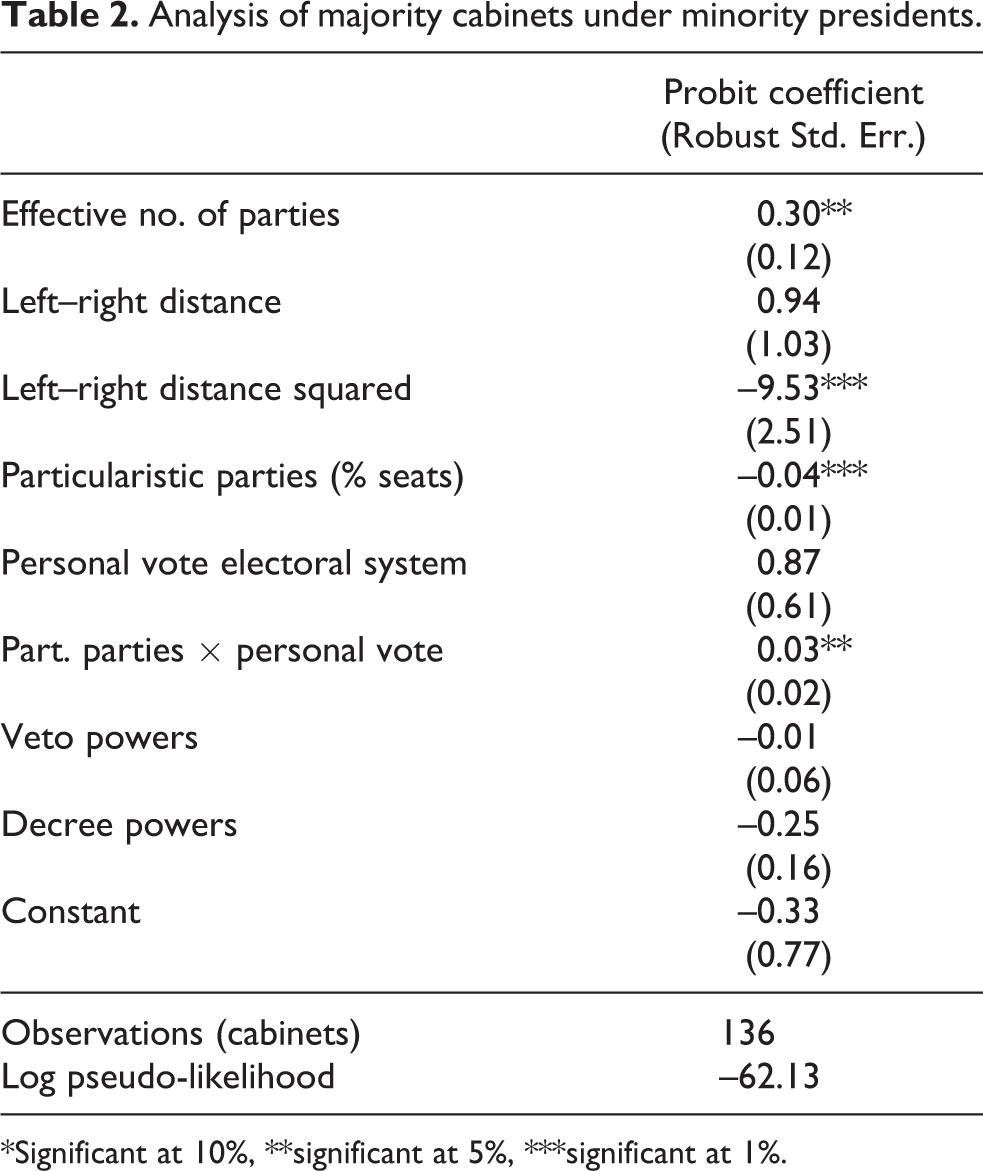
Using a probit model, I predict the probability of majority governments based on the Seat Share of Particularistic Parties and other variables discussed in the literature review above. 5 I include the Left–Right Distance (and Distance Squared) between the position of the president’s party and the mean position in the legislature, and the Effective Number of Parties in the legislature. I also control for the Veto Powers and Decree Powers held by the president. Additionally, I include a dummy variable indicating Personal Vote electoral systems, which I interact with the seat-share held by particularistic parties. The interaction allows for the possibility that particularistic parties have different or smaller effects under electoral rules that tend to produce less disciplined parties.
As presented in Table 2, the percent of seats held by particularistic parties has a significant negative effect on the probability of majority cabinets under minority presidents. 6 The interaction with the personal vote electoral system is also significant, but in an opposing direction. These results suggest that particularistic party representation influences majority cabinet formation only in non-personal vote systems. In non-personal vote systems, when all other variables are held at their means, an increase in the legislative representation of particularistic parties from 6 percent (1 standard deviation below the mean) to 21 percent (the mean) reduces the predicted probability of a majority cabinet by 22 percent (with a 95 percent confidence interval of –36 to –1). The left panel of Figure 1 shows how the probability of majority cabinets declines with increases in the share of seats held by particularistic parties in partisan (as opposed to personal) vote systems for mean levels of all other covariates.

The probability of majority cabinets under minority presidents.
Analysis of majority cabinets under minority presidents.
*Significant at 10%, **significant at 5%, ***significant at 1%.
The distance between the Left–Right position of the president (operationalized by the position of her party) and the mean Left–Right position in the legislature, also affects the probability of majority cabinets under minority presidents. Consistent with the literature on coalition strategies of minority presidents, I find that majority cabinets are less likely when there are either small or large policy distances between the president’s party and the mean position in the legislature. The right panel of Figure 1 shows how increases in the absolute value of this Left–Right distance affect the probability of majority cabinets when all other covariates are held at their means.
The results show that greater party fragmentation in the legislature increases the probability of majority cabinets. Given mean levels on all other variables, an increase of 2 effective parties in the legislature (about 1 standard deviation) from 3 to the mean of 5 increases the probability of majority government by about 12 percent (with a 95 percent confidence interval of 4 to 19). Other control variables do not have statistical significant effects.
Cabinet duration
In testing the second implication of my argument, I analyse the duration of presidential cabinets cross-nationally under different legislative circumstances using event history analysis. Changes in the party composition of the cabinet or the end of the presidential term (as a result of elections, resignation, impeachment or death) define the end of one cabinet and the beginning of another. However, given the fixed terms in office (that vary by country and time), it does not make sense to treat the change in the president brought about by an exogenous election or other event in the same way as an endogenous change in party composition of the cabinet during the president’s term. When a cabinet ends because the presidential term ends, I consider the cabinet as ‘censored’. Had the president’s term continued, it is possible that the cabinet would have lasted for a longer period than we actually observe. On the other hand, when a president alters the party composition of her cabinet during the course of her term, I consider the cabinet under the previous party composition to have ‘failed’. Of the 136 cabinets that were formed by minority presidents in my dataset, 75 ‘failed’ and 67 were ‘censored’. Table 3 lists average cabinet duration for each country-period, along with the fraction of cabinets that included a particularistic party. The table also indicates whether cabinet ‘failures’ resulted from adding or dropping programmatic and/or particularistic parties.
Cabinet change under minority presidents in Latin America.
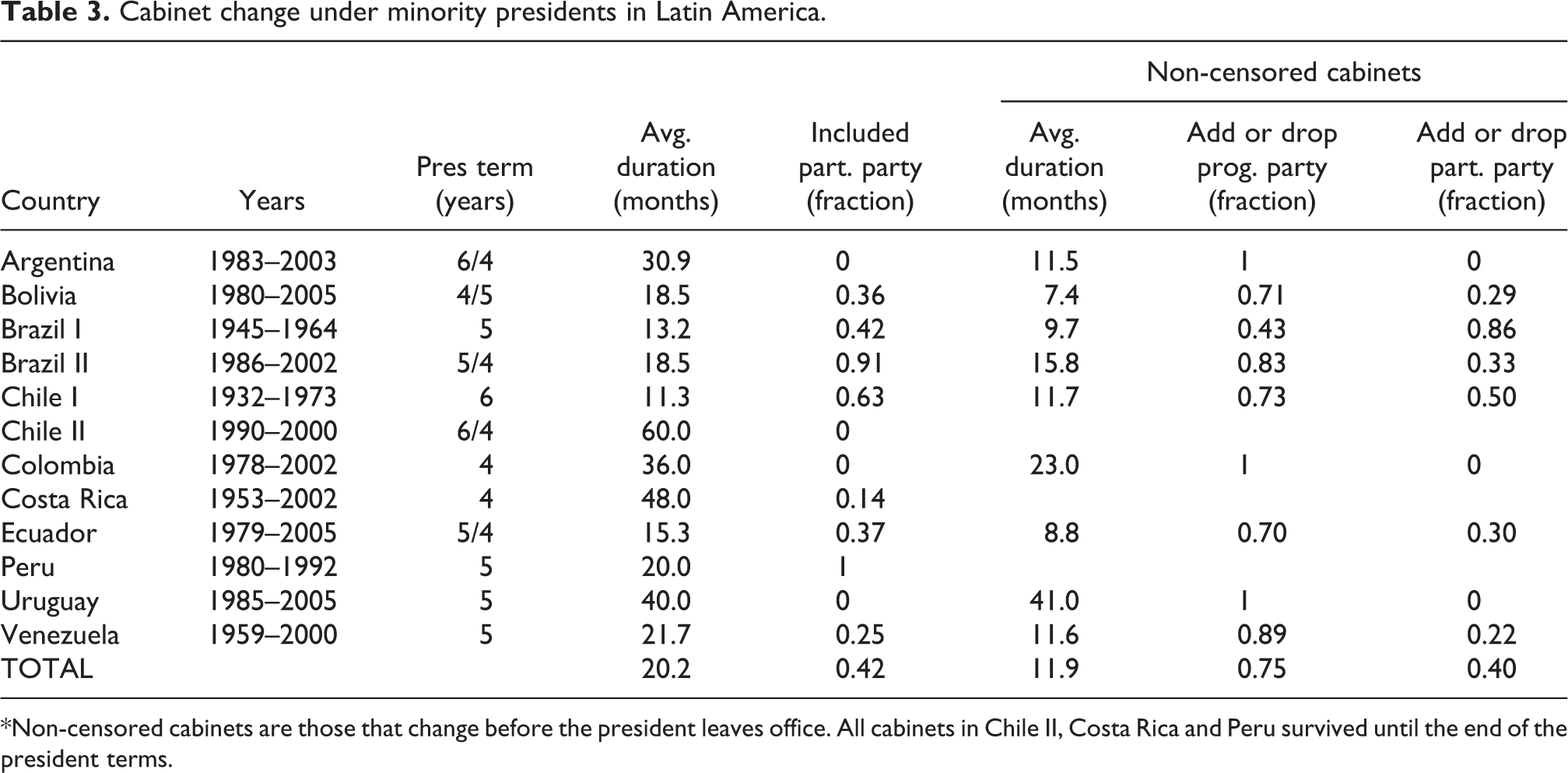
*Non-censored cabinets are those that change before the president leaves office. All cabinets in Chile II, Costa Rica and Peru survived until the end of the president terms.
I estimate a Cox proportional hazards model. I model the hazard rate of cabinets as a function of the Seat Share of Particularistic Parties and several other covariates that capture the bargaining environment faced by presidents, as discussed in the literature review above. Again, I control for the effect of the Personal Vote electoral systems, and its interactive effect with particularistic party representation. In this model, I control for the Majority Status of the cabinet. I also include Ideological Polarization and the Effective Number of Parties in both the legislature and the cabinet. I again take into account Veto Powers and Decree Powers. In addition, I control for Economic Growth and a linear spline function that measures the Months Until the Term Ends, with yearly subintervals. Many of these factors depend on institutional arrangements that remain constant over the life of a government. However, mid-term and non-concurrent legislative elections in some countries alter the bargaining context of governments while in office. Party-switching by individual legislators can affect attributes of the cabinet prior to an intervening election if deputies switch in or out of parties in the cabinet once it has formed. 7 Other external factors also change over the course of the presidential term. Such ‘time-varying covariates’ are easily incorporated into the duration model.
The critical assumption of the Cox proportional hazard model is precisely that the hazard ratios are proportional over time (Box-Steffensmeier and Zorn, 2001). Tests for non-proportionality indicate deviation from this assumption for the majority cabinet indicator; this variable makes less of a difference for the cabinet’s chances of survival the longer that a cabinet is in office. Thus, I follow common procedure and include an interaction between the non-proportional variable and the natural log of duration time. 8
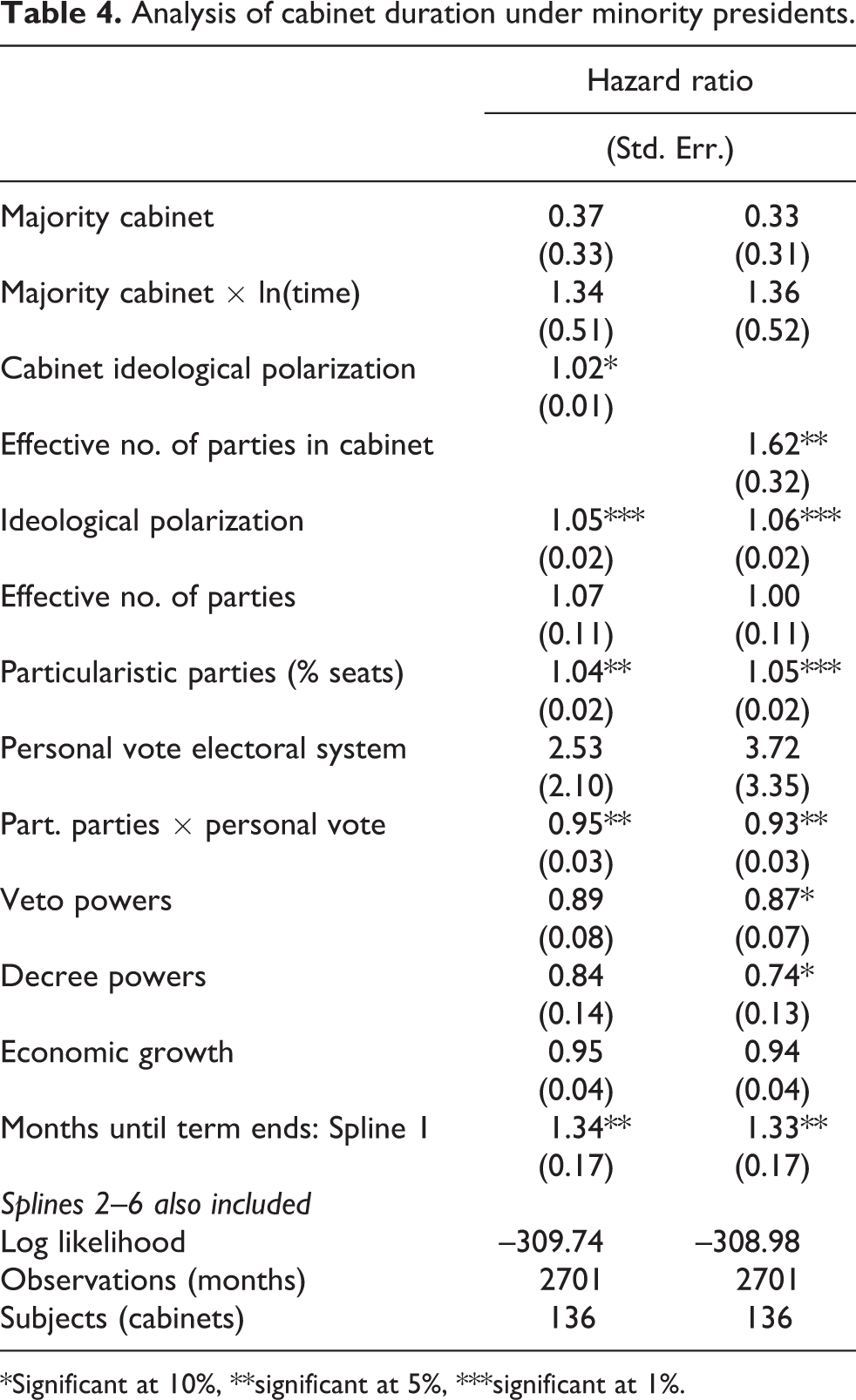
The results in Table 4 are reported as hazard ratios. They show that the legislative presence of particularistic parties is destabilizing for cabinets, and that this effect is conditional on the type of electoral system. In non-personal vote systems, the model indicates that the effect of a 1 percent increase in the share of seats held by these parties is a 4 percent increase in the odds of cabinet change. If particularistic parties hold 10 percent of the seats in such systems, the party composition of a cabinet is about 1.5 times more likely to change in any given month than a cabinet of the same duration in a system where such parties are not represented. 9 Cabinets may not be particularly long-lived on average in personal vote systems; the results simply indicate that in these systems particularistic party representation does not make much of a difference.
Analysis of cabinet duration under minority presidents.
*Significant at 10%, **significant at 5%, ***significant at 1%.
Additionally, the results show that ideological polarization in the legislature has a destabilizing effect on presidential cabinets. A 10-point increase in ideological polarization is associated with a 60 percent increase in the odds of cabinet change. Greater ideological polarization within the cabinet itself is also destabilizing. A 20-point increase in the index (representing just over 1 standard deviation) would make cabinet change almost two times more likely. When I include the effective number of parties in the cabinet in place of ideological polarization in the cabinet, I find that the addition of one effective party to the cabinet leads to a 62 percent increase in the odds of cabinet change. Note that cabinet ideological polarization is correlated with the effective number of parties in the cabinet (0.75); neither coefficient is significant when included together.
Consistent with previous research, I find that presidents with greater decree and veto powers tend to have more stable cabinets. According to the model estimates, even weak decree power (a score of 1 on the index) reduces the odds of cabinet change by 26 percent, as compared to systems that do not give presidents any decree power. The strongest level of decree authority (a score of 4) would reduce the odds by 70 percent. A 3-point (1 standard deviation) increase in the presidential veto powers index reduces the odds of cabinet change by 34 percent. The analysis also suggests that presidential coalitions are more likely to change as the end of the presidential term approaches. Presumably, parties weigh electoral concerns more heavily during the final year in office and begin thinking about their chances of securing a place in the future administration. The first spline indicates that cabinets are less stable during the final 12 months of the presidential term. However, a joint test indicates that we cannot reject the null hypothesis of no effect for all the splines.
Conclusion
This article explains how parties with particularistic orientations influence coalitional politics in presidential systems. These parties put their blocs of votes up for hire on presidents’ initiatives in exchange for the pork, patronage and/or approval of local-oriented policies requested by their constituents. This makes them relatively cheap coalition partners in policy terms when presidents face programmatic disagreements with other parties. The result of particularistic party representation in the legislature is greater flexibility in presidents’ choices of coalition partners and their governing strategies. The parties-for-hire argument identifies conditions that increase the likelihood that minority presidents will govern without forming majority cabinets and that shorten the lifespan of presidential cabinets.
While the empirical evidence indicates that the presence of particularistic parties encourages minority government in presidential systems, the theoretical mechanism I offer to link such parties to this outcome does not imply legislative immobilism or democratic breakdown. Particularistic parties may allow presidents to build majorities in the legislature without corresponding majority governments. If so, minority government should appear neither abnormal nor necessarily problematic in Latin America once we take into account the types of interests represented within these countries’ party systems.
Likewise, by re-characterizing coalition instability as flexibility, we challenge the conclusion that presidential systems face a trade-off between governability and representation (Cheibub, 2002: 305 f.). Perhaps more easily than prime ministers, presidents are free to form and change government coalitions. As Faundez (1997: 307) argues in the case of Chile’s previous democratic period:
These coalitions were often short-lived, but – contrary to Linz and Valenzuela’s model of presidentialism – the president of the day always managed to form another coalition to replace the old one. The winner-takes-all factor does not seem to have affected the capacity of political parties to make the system work in a flexible and fairly efficient manner.
I argue that it is particularistic party representation that generates such flexibility in presidential coalition dynamics.
Latin Americanists have long recognized that party systems in some countries are more inclined to articulate particularistic interests than they are to aggregate interests into broader ideologies, and that legislative majorities often arise out of opportunism and pragmatism, rather than organizing around policy programmes. To be sure, shared ideologies and policy accords do generate legislative cooperation in Latin America (Morgenstern, 2004). But minority presidents also rule successfully by cobbling together one agreement after another based on single, transient issues or regional log-rolls with various parochial and particularistic interests (McDonald, 1971; Shugart and Carey, 1992). It is not that presidents face either a ‘workable’ legislature or a ‘parochial/venal’ legislature, as Cox and Morgenstern (2001) have suggested, but rather that Latin American presidents often face a multiplicity of interests represented by different parties. Where some partisan interests focus on policy and others on parochial payoffs, coalitional presidentialism is workable. Consistent with the parties-for-hire argument presented in this article, the combination of particularistic party representation and presidentialism can lead to coherent policy-making in which coalitional flexibility prevails over immobilism.
Footnotes
Acknowledgements
A much earlier version of this paper won the ‘Best Student Paper’ award from the Latin American Political Institutions Section of the Latin American Studies Association. For assistance and comments at various stages of this research project, I thank Barbara Geddes, Jeff Lewis, Mike Thies, Liz Stein, Cesar Zucco, Mar Martínez Rosón, Manuel Alcántara, Thiago Mattos, Acir Almeida, Octavio Amorim Neto, Andrés Mejía Acosta, Tom Mustillo, Jorge Domínguez, Gabriel Negretto, Maria Escobar-Lemmon, Misha Taylor-Robinson and Kim Yi Dionne. For helpful feedback, I also thank participants of the Regional Latin Americanist Conference at Texas A&M University, the Latin Americanist Workshop of the Department of Political Science at the University of Houston, and the Comparative Politics seminar at the School of Political Science and Economics at Waseda University and anonymous reviewers. I am grateful that Michael Coppedge makes his party classifications publicly available and I thank Acir Almeida and Grigore Pop Eleches for kindly sharing data with me.
Funding
This research received no specific grant from any funding agency in the public, commercial or not-for-profit sectors.