




Abstract
Are the effects of candidate selection through party primaries largely disruptive for political parties or do they have some redeeming features? Icelandic parties have used inclusive nomination procedures since the early 1970s on a scale that is without parallel in other parliamentary democracies. The Icelandic primaries thus offer a unique opportunity to study the effects of primaries in a context that is quite distinct from the most studied primary election system, i.e. the United States, which is characterized by federalism, presidential government and two-party competition. Our findings indicate that, despite four decades of primaries, the Icelandic parties remain strong and cohesive organizations, suffering almost none of the ailments predicted by critics of primary elections. We are careful to point out, however, that context matters and the way parties have adapted also plays a role.
Introduction
The literature on political parties reflects a growing sense of crisis brought on by lower rates of turnout, decline in party identification, a reduced number of registered party members and loss of confidence in parties and politicians (Dalton, 2004; Mair, 2008; Stoker, 2006; Whiteley, 2011). At the same time, and partly in response to this, there is a growing interest in alternative forms of participation, including the use of referenda (Setäla and Schiller, 2009) and other democratic innovations (Smith, 2009) that partially or wholly bypass the established parties (Cain et al., 2003). In some cases the parties have responded to the crisis by democratizing their internal processes through more inclusive procedures for leadership and candidate selection (Cross and Blais, 2012; Bille, 2001; Kittilson and Scarrow, 2003).
The trend towards greater personalization of electoral systems is a noteworthy form of participatory reform (Colomer, 2011; Pilet and Renwick, 2011). Such reforms are generally popular among voters as greater personalization offers greater opportunities to hold individual politicians accountable. They may also be attractive to the political parties in times in which parties have fallen into disrepute and politics have become increasingly more focused on personalities (Pilet and Renwick, 2011; Poguntke and Webb, 2005). This trend is interesting for, at least, two reasons. First, while greater choice and accountability sounds attractive, the literature has shown that some consequences of personalization are negative (McAllister, 2007). While personalized electoral systems have pros and cons, it is fair to say that the verdict is not yet in. Second, the move towards greater institutionalization of personalization has primarily been made through electoral reform. Many of the same goals could, however, be achieved by adopting party primaries.
Party primaries have attracted far less attention as a method of participatory reform, especially in proportional representation systems. In part, the reason may be that primaries have a rather poor reputation that to a considerable degree derives from the US experience with primaries. US primaries are seen, for example, as giving privileged position to organized interests because of their costliness, as leading to the selection of more extreme candidates (Gerber and Morton, 1998) and as attracting weaker candidates to primary contests (Banks and Kiewiet, 1989). Drawing on the US experience, parties are understandably reluctant to adopt primary elections as these might have detrimental effects on electoral performance. Carey and Polga-Hecimovich (2006) argue, however, that the US experience may be a poor guide. They argue that some of the negative effects may no longer be present in multiparty contests and find that Latin American parties reap an electoral benefit from adopting primaries. Bruhn (2012) similarly finds that candidates selected via primaries in Mexico are ideologically more moderate than those selected internally by the party. Overall, the consequences of primaries are generally not well understood outside the US context. In addition to being a two-party system, the generalizability of the US experience is limited, as the US is a presidential system. In parliamentary systems, which are based on the fusion rather than separation of powers, political parties have an important role that parties in presidential systems do not perform, i.e. to protect the government against votes of no confidence.
There are, thus, sound theoretical and empirical reasons for examining whether primaries have similar effects elsewhere. Hazan and Rahat (2010) present the most comprehensive analysis of candidate selection methods to date, but in terms of systematic analysis they rely primarily on data from Israel. Iceland offers a unique opportunity to study the effects of primaries. Although other instances of inclusive primaries in parliamentary systems may be found, none have comparable experience over time and across parties. Even among the Nordic countries, which also use a relatively decentralized system of nominations, Iceland stands out as far more inclusive (Naarud, 2008). The Icelandic parties have selected parliamentary candidates using primaries for over four decades and are, thus, prime candidates for examining the effects of primary elections. Importantly, the use of primaries has varied over time, parties and even between the district organizations of the same parties.
We argue that primary elections need not exhibit many of the negative effects that critics have maintained they have. Instead, inclusive primary elections are likely to work in the manner that the proponents of participatory reforms maintain. This is not to deny that primary elections possibly create perverse incentives by increasing intra-party competition and the importance of the personal vote that could be detrimental to the parties and the political system. Those incentives have undoubtedly shaped politics in Iceland, but they have also been kept in check by the political parties. In part, the parties have been able to weather the change because loyalty to the parties is crucial – because it is the key for the parties to control the executive branch and for the MPs to gain higher office. In addition, the parties have learned to tailor the primary system so as to minimize their negative effects for the party organization.
We start by describing the Icelandic primaries and how the unique electoral system employed by the parties works. We then turn to a theoretical consideration of the effects of party primaries and focus on the four main types of consequences highlighted in Hazan and Rahat’s study, namely participation, representation, competition and responsiveness, and develop hypotheses about each of them. The hypotheses are examined using data on the Icelandic primaries in 1970–2009. Finally, we discuss how the Icelandic parties have dealt with the potentially harmful effects of the primaries.
Development of party primaries in Iceland
Modern political parties emerged in Iceland during the inter-war period as class parties with a strong clientelist orientation. Access to clientelist resources was to a considerable extent controlled by the parties but individual members of the Alþingi played a linkage role with the clientele on a face-to-face basis (Kristinsson, 1996). This task became more complicated after a change in the electoral system in 1959, when proportional representation replaced a hybrid system of plurality and proportional methods (Hardarson and Kristinsson, 2010). The new system allowed little scope for preferential voting and although it was ex-panded in 2000 it has not affected which candidates were elected to parliament in recent history. 1
Prior to 1959, candidate selection was in practice relatively decentralized (i.e. made by the constituency party), although party leaders on rare occasions used their formal powers to intervene. The left-socialist People’s Alliance was an exception in this respect, being an electoral alliance of two or three factions and hence had a more centralized system of nominations. After 1959 the nominations were formally decentralized in all the main parties, including eventually the People’s Alliance (Kristjánsson, 1994).
After 1959, frictions over nominations became more common, partly through competition between different localities within the enlarged constituencies. Demands for representation made by young people, women and in some cases occupational groups added to the unrest surrounding nominations. The introduction of PR also made unrest in the constituency parties potentially more harmful than before because of a lower electoral threshold that made splinter candidacies more likely. The parties responded by introducing inclusive party primaries around 1970 in an attempt to increase the legitimacy of the candidate selection process. Since then party primaries have been an equally common as selection by party organs.
We define primaries as a selection process which includes a selectorate beyond the representative organs and committees of the party. The way they are carried out differs in several respects. A closed primary is confined to registered members of the party and effectively bars ordinary party supporters and voters from participating. A partially open primary is one in which anyone who is willing to give a formal declaration of support for the party or hand in an application for membership is allowed to vote. An open primary is one where anyone eligible to vote in the upcoming election can take part.
In some cases the primaries are merely consultative and the final list is determined by the party organs. In others the outcome is binding under certain conditions, e.g. with regard to the number of votes obtained by a candidate or the gender balance of the list. Finally, the results may be unconditionally binding for a certain number of the top seats on the list. In practice, the parties tend not to depart much from the primary results, whatever their formal status, at least with regard to places with a fair chance of yielding seats in the legislature. The use of gender quotas and ‘zipper’ lists in left-leaning parties, however, can affect the order of candidates.
In the early primaries the most common method of election was limited voting, where voters distribute a fixed number of votes among their favoured candidates without ranking them. Limited voting tends to punish controversial candidates and could in cases of internal disputes lead to unpredictable results (in 1983 Independence Party leader Hallgrímsson won 7th place on the party list and lost his seat in parliament; see Jóhannesson, 2010: 537–538). Limited voting was replaced by a system in which voters rank-order the candidates and places are awarded on the basis of the number of votes for each seat and higher.
To explain how the electoral system functions, Table 1 presents the results of the SDA primary in the South-West district in 2009. The second column shows the number of votes each candidate received for the first seat. The third column shows the total votes received for the first and the second seat. For example, Júlíusdóttir received 93 votes for the first seat and 1322 votes for the second seat for a total of 1415 votes. The remaining columns similarly show the total votes for all seats above the seat in question.
Result of the Social Democratic Alliance primary in South-West District, 2009.
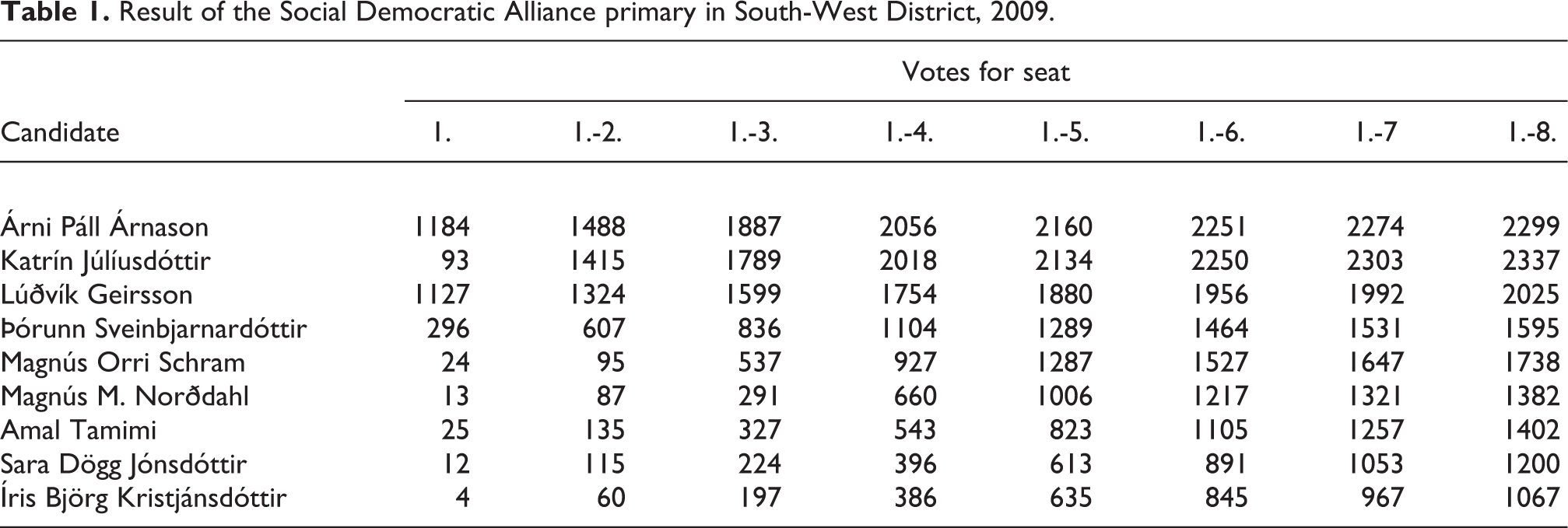
In the example, Árnason wins the first seat with a plurality of votes (1184). Júlíusdóttir wins the second seat on the basis of plurality for first and second place (93+1322 = 1415). Geirsson wins third place on the basis of plurality for first, second and third place (1127+197+275 = 1599) and so on. The fact that Geirsson received a significant number of votes for the top seat on the party list while Júlíusdóttir received very few such votes did not increase Geirsson’s chances of securing the second seat. In allocating the second seat, no distinction is made between a vote for the first seat and vote for the second seat. Thus, if the voters that wanted Sveinbj-arnardottir, the fourth placed candidate, to lead the party preferred Geirsson to Árnason, they could have achieved that outcome by switching their ranking of Sveinbjarnardóttir and Geirsson without affecting Sveinbjarnardóttir’s chances of holding on to the fourth seat.
The candidates typically indicate which seats they are aiming at (e.g. 3rd to 5th place). The candidates often form informal alliances with candidates that seek other seats on the party list with each candidate encouraging ‘their’ voters to support the other candidate as well.
An important feature of this electoral formula – which might be termed rank-ordered plurality – is its majoritarian nature. A bare majority can obtain all the seats on the lists although in practice factional competition is not that well organized. Consider a primary where 5,000 voters choose between 10 candidates for 5 seats. If 2,501 voters rank order the same five candidates in the same way they are guaranteed all five seats. As with other plurality systems, even smaller coalitions of voters may be required as the number of candidates increases and the votes are distributed more widely. The majoritarian nature of the system provides an incentive for candidates not to stray too far from accepted party policies.
Our data cover candidate nominations in each constituency for the four main parties in Iceland between 1971 and 2009, i.e. the conservative Independence Party, the rural Progressive Party, the Social Democrats (first the Social Democratic Party and, later, the Social Democratic Alliance) and Left-Greens (which replaced the People’s Alliance as the most left-leaning party in 1999). The Icelandic electoral system consists of six constituencies with a district magnitude of 9–11 members. 2 Our sample consists of 348 party lists. Table 2 shows the nomination method used for establishing each party list.
Nominations in the Icelandic parties 1971–2009.
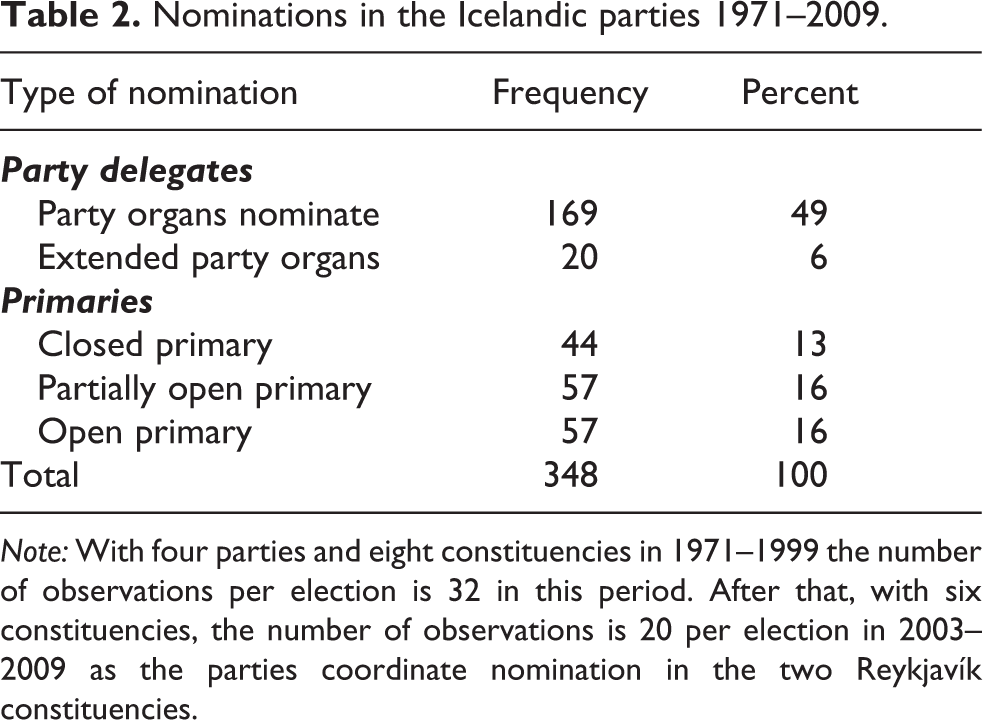
Note: With four parties and eight constituencies in 1971–1999 the number of observations per election is 32 in this period. After that, with six constituencies, the number of observations is 20 per election in 2003–2009 as the parties coordinate nomination in the two Reykjavík constituencies.
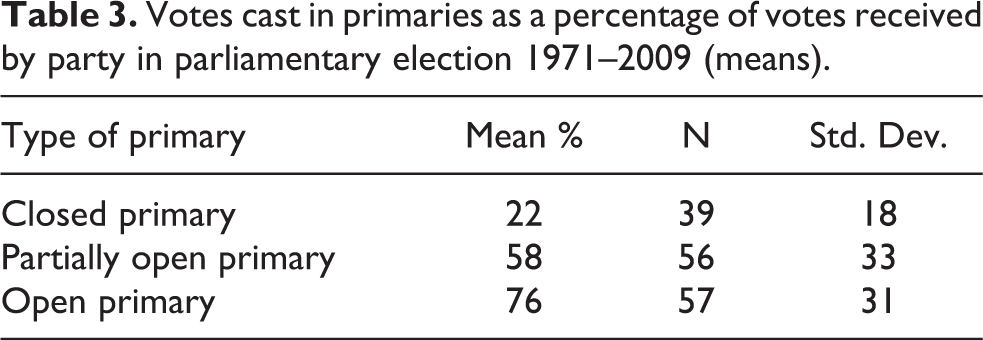
Inclusiveness of the Icelandic party primaries is very high but depends on the type of primary used. In the closed primaries the number of voters participating is on average 22 percent of the votes received by the party in the subsequent election. In the case of partially open primaries the corresponding figure is 58 percent and in the open primaries it is an impressive 76 percent. Figure 1 shows that the use of open primaries has declined while party institutions remain common until the last two elections. The use of closed or partially open primaries has become the standard method of candidates.
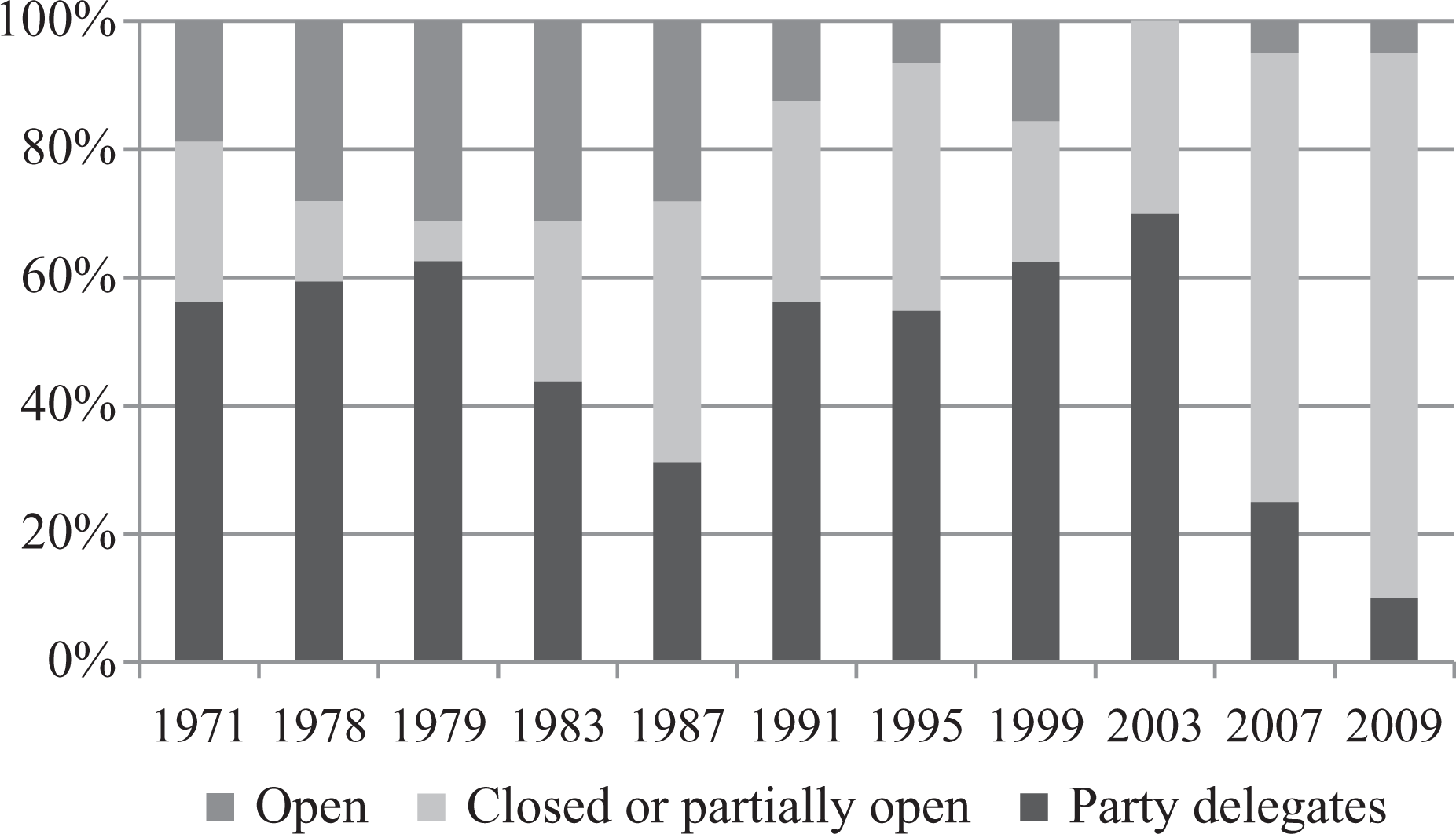
Types of nominations in the Icelandic parties 1971–2009 (%).
The Social Democrats and the Independence Party use primaries most frequently, while the party furthest to the left, the Left-Greens (and previously the People’s Alliance) uses them least. In 1971–2009 the Social Democrats used primaries in 58 percent of their nominations and the Independence Party in 55 percent. The Progressive Party used primaries 37 percent of the time and the Left-Greens in 32 percent of cases.
Political consequences
Parties, presumably, adopt primaries to deal with problems or gain competitive advantage, but the consequences of adopting them can be either beneficial or harmful. Hence, some parties adopt primaries and others do not, depending on their evaluation of the overall balance. There seems to be increasing interest in adding a personal element to representation, which primaries are essentially only one manifestation of (Colomer, 2011). On the plus side is the belief that primaries offer an electoral advantage. The comparative literature seems quite ambivalent on this point. According to Carey and Enten (2011) the standard proposition about the US is that ‘primaries mobilise ideologically extreme electorates which, in turn, choose candidates unappealing to the general electorate’ (p. 83). Very little research has been done outside the US on the electoral effects of primaries even if a growing number of parties in Latin America and Africa have adopted such nomination procedures (Ichino and Nathan, 2012). Carey and Enten’s conclusions with regard to Latin American elections is that candidates selected by primaries ‘win higher vote shares, other things being equal, than do candidates selected by less inclusive methods’ (2011: 97). In the Icelandic case, the belief that primaries provide an electoral bonus is clearly prevalent among their adherents. Indridason and Kristinsson (2012) find that primaries yield slightly higher vote-shares.
Other reasons for adopting primaries may be based on a belief in their positive effects within the party organization. Katz (2001) suggests that the empowerment of ordinary party members or even a broader group of supporters may be used by party leaders to gain autonomy from middle level activists, who might resist the pragmatism that is necessary for effective participation in cross-party cartels. In the Icelandic case the adoption of the primaries was partly intended to enhance the democratic legitimacy of the nomination process and calm different claimants for representation.
The case can be made, however, that the consequences of adopting the primaries are more harmful than anticipated. Adherents of institutionalized mass parties and responsible party organizations would certainly regard the introduction of primaries with suspicion. For example, Hazan and Rahat (2010) argue that democracy within parties does not necessarily serve the broader goals of democracy. The case against inclusive primaries seems generally to be based on a de-institutionalization thesis, according to which primaries lead to haphazard external intervention in the life of parties, undermining their organizational boundaries, making them less representative of the party base and less responsive to it, in the sense of losing some of its capacity to act cohesively.
The case for primaries is not necessarily based on refuting the de-institutionalizing effects of primaries but rather on a more organic perspective that excessive institutionalization may be dysfunctional for political parties operating in a dynamic environment. Scarrow et al. (2000) point out that the ‘electoralist’ parties which have in some cases developed in place of the older mass parties may still need the democratic legitimacy of a membership organization. To the extent that members need incentives to join, they point out ‘political rights within the party are among the least costly’ (p. 132). Primaries may provide both legitimacy and potentially the corrective mechanism of a linkage to the party base. In a parliamentary democracy this does not necessarily happen at the expense of party cohesion since, as we shall show, there are other mechanisms to encourage or force cooperative behaviour in the parliamentary party groups.
Following Hazan and Rahat (2010), we consider the effects of inclusive party primaries on participation, representativeness, intra-party competition and responsiveness. Below we address each of these and present pairs of hypotheses about the effects on each of the four areas. The first hypothesis, labelled HR, from each pair is derived from Hazan and Rahat’s (2010) theory, while the second derives from our theoretical perspective that gives greater weight, e.g. to how primaries enable parties to engage with voters and the institutional context. 3 Both theoretical perspectives offer valuable insights into the effects of inclusive primary elections, which often run in opposite directions. The empirical analysis that follows evaluates whether one effect dominates the other with the aim of providing a more nuanced view of the effects of inclusive primaries.
Participation
In the context of candidate selection, participation can refer to both the inclusiveness of the selection process and turnout. Party membership, on the whole, is declining in most well-established democracies (Dalton and Wattenberg, 2000). The share of self-reported active members pooled across 36 countries in 2004 was 3.4 percent, while an additional 7.2 percent reported inactive membership (Whiteley, 2011).
According to Hazan and Rahat (2010: ch. 6) inclusive nomination procedures fail in the long run to increase the number of party members significantly. Moreover, the ‘quality’ of participation declines with inclusiveness leading to several ‘pathologies’ of participation, such as the enlisting of weakly committed and uninformed members or even completely non-attached.
On the other hand, inclusive primaries do establish contacts between parties and their supporters, creating opportunities for the development of ‘weak ties’, which in some cases may be an important resource (Granovetter, 1973). Whiteley (2011) notes that membership in most European parties is defined in terms of paying a membership fee, whereas no fully comparable demarcation between members and non-members exists in the US. Consequently, self-reported membership in the US is higher than elsewhere, but the meaning of such membership in organizational terms is unclear.
Representativeness
Representativeness is empirically often taken to mean descriptive representation. The representativeness of a group of candidates, in this limited sense, can be studied on the basis of its demographic composition. Primaries are sometimes cited as an obstacle to the representation of women in Iceland. Primary elections, the argument goes, impede the representation of women because primary success depends on access to financial resources as well as a developed network of supporters. Men are in an advantageous position with regard to both factors. There is a well-established gender gap in income in Iceland and it seems likely that men are wealthier than women although there is no concrete evidence to that effect. Men are also better connected than women within and outside the parties. Party politics have long been male-dominated – men, on average, therefore, have greater experience within the political parties and a stronger network of connections that they can call upon. Hazan and Rahat argue that selection by a party oligarchy increases the chances different social groups (e.g. women and minorities) will capture ‘realistic positions on the party list, or realistic constituency seats’ (p. 114). More inclusive candidate selection methods, on the other hand, produce less representative candidates.
Hazan and Rahat’s argument assumes that party oligarchs care more about representative issues than primary voters, but the barriers to entry may well be higher when party lists are decided by party organs. When candidate selection is not open to the party membership, party lists are likely to be chosen by a more close-knit network of party insiders who, historically, have predominantly been male. Primaries may have an important role in breaking down such barriers and opening up an avenue of mobilization for women to achieve greater representation. 4
Intra-party competition
Intra-party competition may be approached in a number of ways, e.g. by studying renewal of leading candidates and elected MPs. Competition, in this sense, is a positive value in that it makes incumbents less secure and more responsive, although excessive competition may also be destructive. There is no consensus among researchers on the effects of party primaries on intra-party competition. A few authors, such as Kristjánsson (1998) in the Icelandic case, maintain that inclusiveness increases intra-party competition, making incumbents less secure in their seats. Others (e.g. Rahat and Hazan, 2010; Rahat et al., 2008) suggest a more complicated relationship. Selection by party delegates, they suggest, is the most competitive selection method, with selection by party members less competitive and selection open to the entire electorate quite uncompetitive.
On the other hand it may well be that the effects of inclusiveness are smaller than these authors suggest. In the case of selection by party delegates, selection by party members or open primaries, incumbency advantages may be expected to be quite strong under normal circumstances, although for different reasons. Incumbents are likely to cultivate party delegates if they depend on them for re-selection and stand a fair chance of winning against non-incumbent challengers. In a more inclusive scenario incumbents may face greater uncertainty and hence have greater difficulties in securing their positions, although probably they enjoy an advantage there as well.
Responsiveness
The important question with regard to responsiveness is ‘to whom’ candidates are responsive. Rahat and Hazan suggest that if party lists are assembled ‘not by the party organs, but, for example by a more inclusive selectorate, such as the party members’, this may seriously weaken the parties and hamper their ‘ability to aggregate policies and to present a cohesive ideological image. … The result could be a drastic weakening of partisan discipline and cohesiveness, leading to a decline in the ability of the parties to function as a stable basis for the political process and to operate effectively in the parliamentary arena’ (2001: 312–313). Hence ‘there is a trade-off between democracy within parties and responsiveness to a party’s voters’ (p. 156).
Intuitively, primary contestants have an incentive to cultivate a personal vote to improve their chances of being elected. Deviating from the party line may be a way of doing this. Carey and Shugart point out, however, that other factors affect the value of individual attention for candidates, including the structure of the executive. ‘Generally’, they point out, ‘if an assembly’s primary function is to select and maintain in office an executive dependent on parliamentary confidence, we can expect party cohesion to be more important, and personal reputation thereby less, than when the origin and survival of the executive is independent of the assembly’ (1995: 432).
In line with this argument, we expect party primaries to have little or no effect on party cohesion in parliamentary systems. Moreover, party leaders reward loyal party members and punish dissenters in order to maintain party discipline (Kam, 2009). Such incentive structures are likely to be highly effective in parliamentary systems where party leaders control a number of valued positions, including those of junior ministers, committee chairs and even positions to be held after exiting from politics in addition to cabinet positions. 5
Data
Our data on party primaries were gathered from primary and secondary sources. Data on party membership come from the national election studies and party headquarters (Icenes, 2012; Kristinsson, 2010). Data on party cohesion are based on voting records in the Alþingi (Kristinsson, 2011). In general, we analyse the data for the parties together rather than for each party separately, as the party constitutions are similar – they are all decentralized membership organizations with a similar structure of internal representation and similar status of elected representatives.
Inclusiveness and party members
As membership fees are collected only on an irregular basis by the Icelandic parties and in many cases not at all, party membership in Iceland resembles US parties more than the European ones. Mobilization by primary candidates, combined with more or less free membership, inflates the membership, while there is no corresponding mechanism for tidying up after the primaries. This is the case especially in partially open primaries where voters need not be current party members but must apply for membership. According to figures from party headquarters, 42.5 percent of the electorate were members of the Icelandic parties in 2009–2010 (Kristinsson, 2010). However, self-reported membership in a survey conducted in 2009 amounted to 27.3 percent of respondents while only 12 percent claimed to be ‘active’ party members. While this indicates that less than half the party members are active, it may be noted for comparison that in neighbouring Denmark and Norway between 43 percent and 52 percent of party members never attend local party meetings (Scarrow, 2007: 649).
The Icelandic election study provides an opportunity to examine self-reported membership over time. Figure 2 shows the proportion of respondents reporting membership of a political party in 1983–2009 and who claim to have voted in party primaries.

Self-reported membership in the Icelandic parties and voters in primaries (percent of all respondents).
There is a strong correlation between party membership and voting in the primaries (r 2 = 0.42). The move from open primaries to closed or partially open ones – which has become the norm in recent elections – likely served to boost the membership figures.
Inflated membership files are not necessarily regarded negatively by party headquarters. Party managers often find it convenient to have access to membership files for disseminating information and propaganda. As the parties are largely financed by methods other than membership subscriptions, access to contact information for large numbers of potential supporters is mainly seen as an asset.
It is clear that there is no evidence of declining membership levels in the long run – contrary to hypothesis HR1. On the contrary, the membership figures in 2007 and 2009 are the highest ever. The question is whether a large bulk of the party members consists of weak supporters or even non-supporters, which we examine using the 2009 National Election Study.
While the fit between party membership and party identification is not perfect, party membership is by no means meaningless or accidental. Most of the party members identify with their own parties (74–80 percent) and among those who don’t the largest group normally identifies with no party (10–14 percent). Importantly, the party with the least inclusive nomination method, the Left-Greens, does not have a higher proportion of identifiers among its registered members than the other parties. 6 Overall, there is slight indication that more inclusive methods of candidate selection increase the share of party members that regard themselves as party supporters (hypothesis 2). In contrast, if the second part of hypothesis 1 were true, lower levels of party support would have been expected in the parties, e.g. the Independence Party and Social Democrats, which have used more inclusive methods.
Inclusiveness and candidate representativeness
We now consider how primaries affect representation, focusing on gender and age. Women’s representation in Alþingi was approximately 30–35 percent over the last three electoral terms and reached 43 percent following the last election. There are, of course, two problems with drawing inferences about the effects of the primaries on the basis of the number of female MPs. To show that primaries adversely affect female representation it must be demonstrated that they somehow advantage men over women. It is certainly true that party lists are populated by men to a greater degree, but one would only expect gender parity if an equal number of men and women ran in the primaries. Sigurjónsdóttir and Indriðason (2008) show that this is not the case – in the past couple of decades women have only accounted for about 35 percent of the candidates. However, it appears women are more likely to be successful in achieving their goals in primaries except when it comes to the top seats on the party list. 7
Those claiming that primaries have detrimental effects on female representation have also failed to consider the counterfactual – what the situation would be like without primaries. Because primaries have not been adopted uniformly across parties and districts in Iceland, we can address this question. To do so, we compare whether the number of women on the party lists where primaries were held with those where no primaries were held. We focus on the last three elections; a total of 60 party lists; 39 established via primaries and 21 by party nomination.
Each party list includes 18–22 candidates. We measure the representation of women in three ways. First, we consider the number of women as a share of the total number of candidates on the list. A limitation of this measure is that where parties have employed primaries, they often only use the primaries to select the first places on the party list with party institutions filling out the list, usually, with recognizable faces. Second, we consider the share of women among the candidates that ended up winning a seat in parliament (Winners). There is a qualitative difference between occupying one of the top seats of the list as opposed to any place further down the list that makes winning a seat virtually impossible. Finally, we consider the share of women among the competitive candidates, i.e. candidates that either won a seat or were the first or second runner-up on the party list (Winners+2). In other words, we focus on the runners-up on the party lists that can be considered to have had a chance of winning a seat in parliament. 8
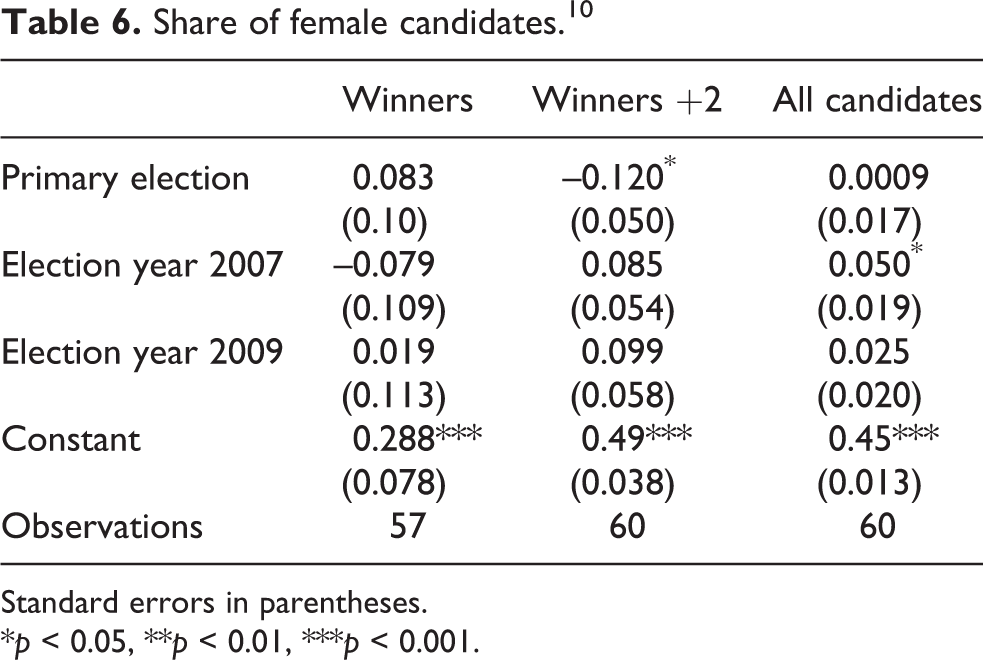
As shown in Table 5, there are some notable differences between party lists depending on nomination method. First, focusing on candidates that won seats in parliament, primaries do better in terms of female representation – the share of women is almost eight percentage points higher where primaries were employed. The opposite is true when the competitive seats are considered where selection by party organization outperforms primaries by about six percentage points. There is little difference between the two methods of nomination when all the candidates are considered. However, the differences fail to reach conventional levels of statistical significance, which is not all that surprising given the limited number of observations. Table 6 presents the results of regression models which control for election year.
Votes cast in primaries as a percentage of votes received by party in parliamentary election 1971–2009 (means).
Party identification of party members 2009.
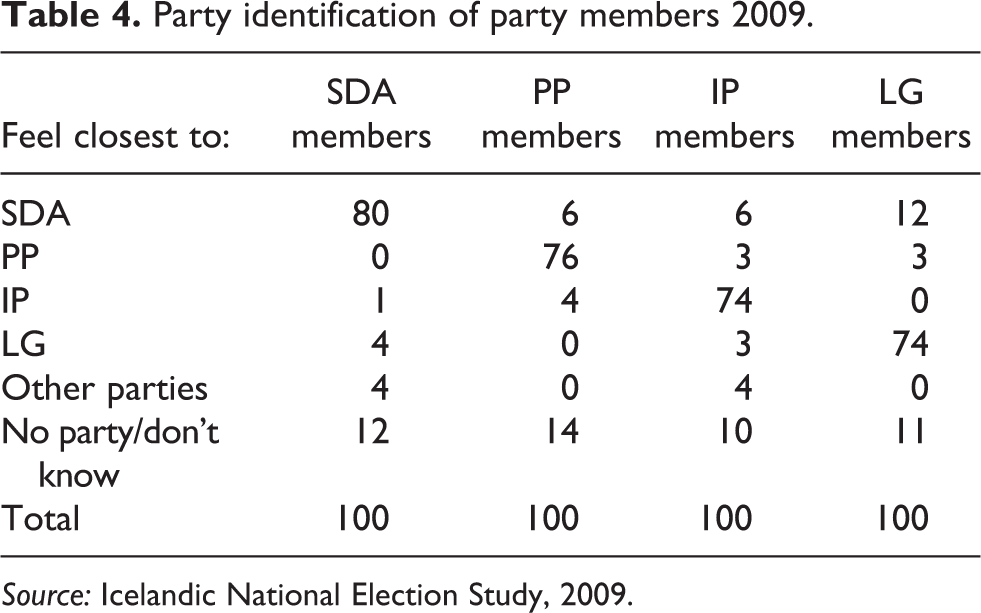
Source: Icelandic National Election Study, 2009.
Share of female candidates.

Share of female candidates. 10
Standard errors in parentheses.
*p < 0.05, **p < 0.01, ***p < 0.001.
The regression results reflect the findings in Table 5. Primary elections appear to provide a slight, albeit statistically insignificant, advantage to women in terms of winning seats in the legislature, while it reduces significantly – substantively and statistically – the share of women when competitive seats are considered. One interpretation of this finding is that where party institutions are responsible for nominations, women are less likely to be awarded places on the list that are likely to result in a seat in parliament, but instead are more likely to receive places on the list that place them just out of reach of parliament (except if the party makes unanticipated electoral gains). The effect is quite big in substantive terms; the difference in the share of women depending on nomination method is 12 percentage points.
Selection within party institutions also favours older, more experienced candidates. Primaries open up the possibility for younger candidates to mobilize support more easily, e.g. calls for fresh new blood may resonate better with primary voters than party insiders who are invested in the party organization.
Table 7 shows that the elected candidates that win a seat are on average five years younger where primaries are held but when we expand the set of candidates to include the two or more runners-up the difference is insignificant.
Age of candidates.
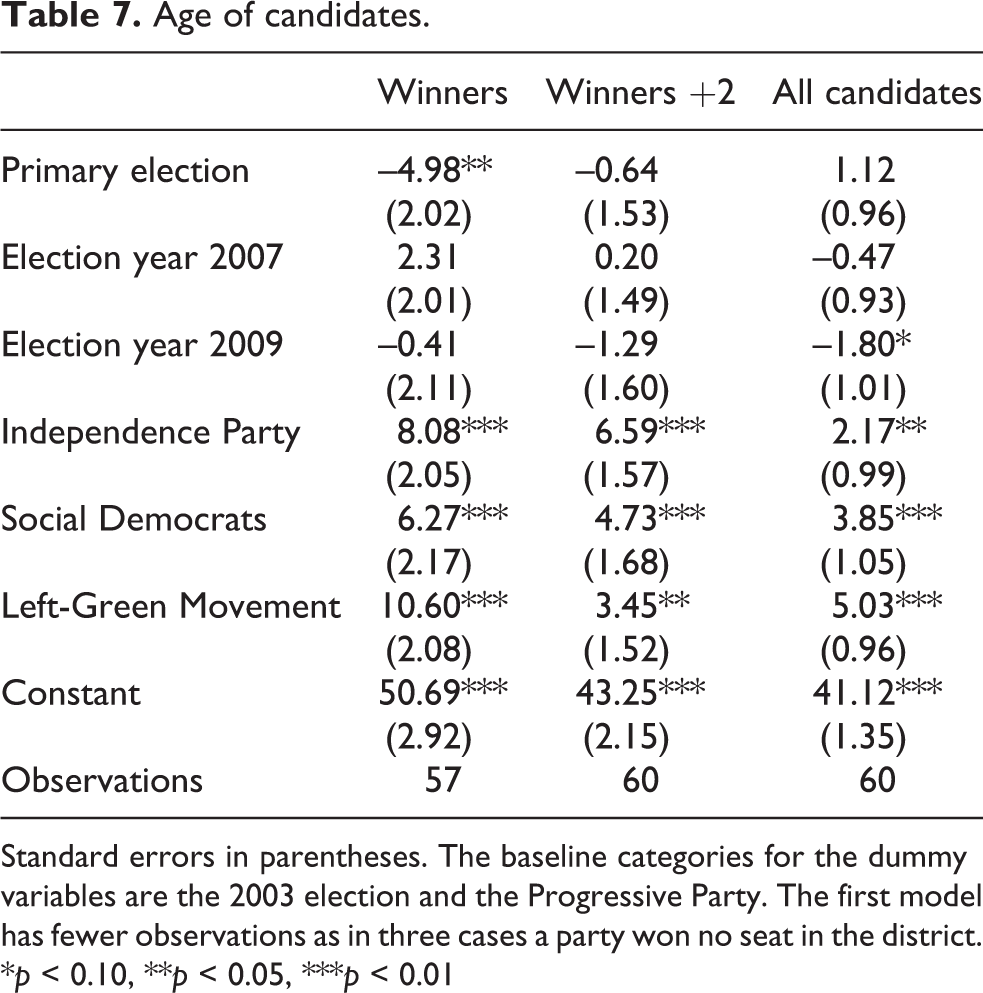
Standard errors in parentheses. The baseline categories for the dummy variables are the 2003 election and the Progressive Party. The first model has fewer observations as in three cases a party won no seat in the district.
*p < 0.10, **p < 0.05, ***p < 0.01
To summarize, overall we find some evidence that women are disadvantaged where primary elections are used, but that younger candidates are favoured. Restricting our attention to those that are elected, the evidence is in favour of the primaries – women fare no worse than men and the young are better represented.
Inclusiveness and intra-party competition
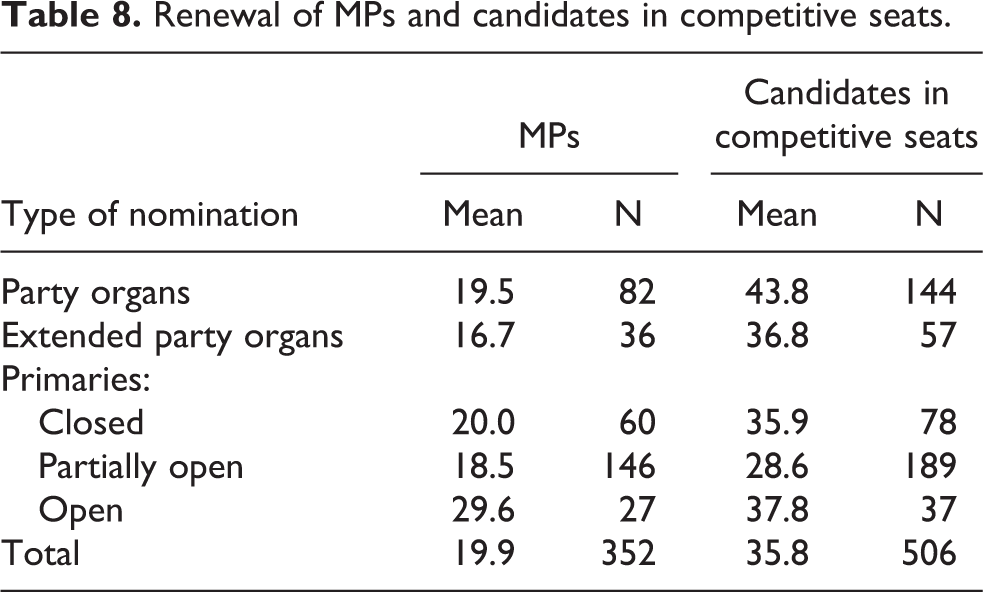
Above we argued that inclusiveness of candidate selection might be expected to affect intra-party competition. We examine data on the renewal in competitive seats on party lists in each constituency and the renewal of elected MPs. Competitive seats are defined as the number of seats the party won last time plus one. Renewal of MPs is the share of non-incumbents among new members. Table 8 shows that the average renewal rate for MPs is close to 20 percent for all nomination methods except open primaries, where it is close to 30 percent. The renewal rates for the competitive seats are higher and decline as inclusiveness increases, except that moving from partially open to open primaries increases the renewal rate by 10 percentage points – this pattern is the exact opposite of that posited by hypothesis HR5, which predicts that inclusive nominations increase incumbency advantage. It must be kept in mind, of course, that the decision to hold a primary (which is taken by the district party organization) may in some cases reflect a weakness in the position of leading incumbents. However, there are no strong indications that MPs are very successful in avoiding challenges to their positions in this way – the renewal rates in primaries, especially open primaries, among MPs suggest that there are clearly limits to how well incumbents are able to protect themselves in this manner. Hypothesis 6 fares only slightly better. It is consistent with the renewal rates among MPs but the high renewal rates where party organs are in charge contradict our predictions. 9
Renewal of MPs and candidates in competitive seats.
Party cohesion: Index of agreement for final votes 1991–2010.
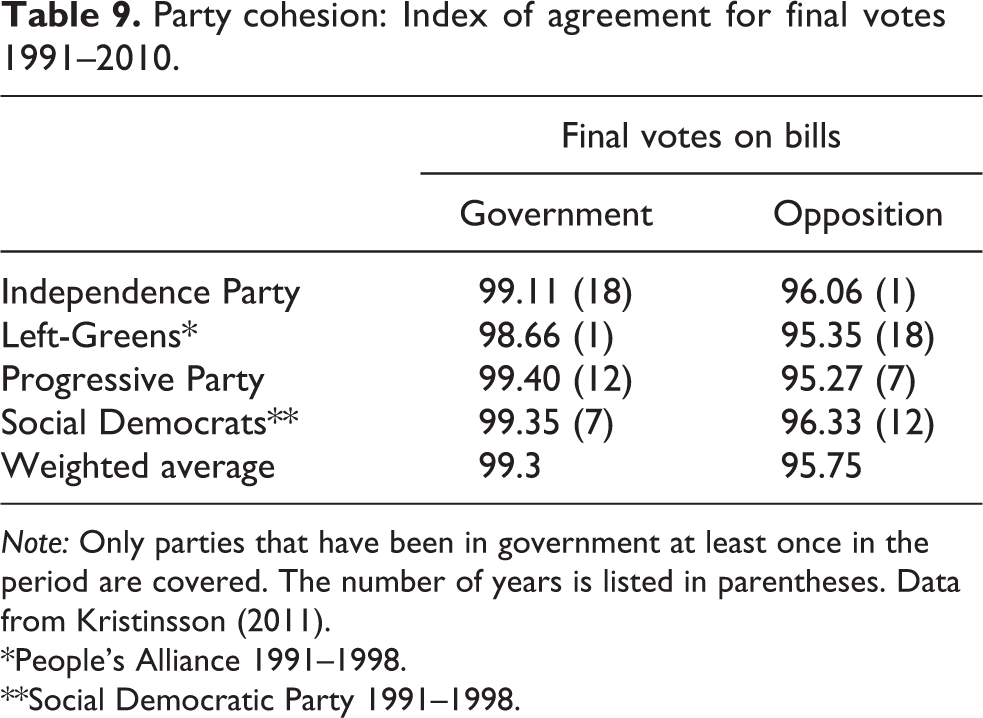
Note: Only parties that have been in government at least once in the period are covered. The number of years is listed in parentheses. Data from Kristinsson (2011).
*People’s Alliance 1991–1998.
**Social Democratic Party 1991–1998.
Inclusiveness and party cohesion
If inclusive primaries reduce party cohesion we should expect party cohesion in Iceland to be lower than in other parliamentary systems, lower after the introduction of the primaries in Iceland than before, and lower in the parties which have adopted inclusive nomination methods.
Party cohesion is usually measured using the Rice index, where 100 represents perfect cohesion (Rice, 1925). We use a variant of the Rice index that accounts for abstentions (Hix et al., 2005: 215).
All the major parties in Iceland show high levels of cohesion despite holding primaries. Parties using more inclusive forms of nominations (i.e. Independence Party and Social Democrats) don’t suffer from a lower degree of cohesion. Government participation, however, affects cohesion. In parliamentary democracies, governing parties must demonstrate that they enjoy the confidence of parliament. In line with Ozbudun (1970) and Owens (2006), our findings suggest that parliamentary government rather than the form of nominations is the main factor influencing party cohesion in Alþingi. Party cohesion in Iceland is similar to that in other Northern European parliamentary democracies, despite more inclusive nomination processes (Kristinsson, 2011). Kristinsson’s analysis of roll-call data indicates that party cohesion was higher in the 1990s and 2000s than in the 1960s, 1970s and 1980s. Hypothesis HR7 may thus be rejected while the results are consistent with hypothesis 8.
Primaries and learning
The introduction of primaries may have unintended consequences, which parties gradually learn about and seek ways of minimizing when harmful to them. The Icelandic parties have strategically adapted to such challenges in several ways.
First, all the parties seem to prefer closed or partially open primaries over open primaries. In the closed or partially open primaries, voters leave contact information with the parties that helps the parties in their campaigns and in identifying likely supporters. In addition, incumbents are likely to prefer less inclusive forms of primaries as the open primaries resulted in greater turnover of candidates and MPs.
Second, the parties all adopted a similar voting formula, which tends to structure the competition by encouraging candidates to announce what seat they aim for. Moreover, the system’s majoritarian nature reduces the temptation of candidates to depart from the party line. Under a more proportional system, e.g. the single transferable vote, it might be feasible for candidates to cultivate a personal following composed of a minority within the party. In fact, the primaries have proved less risky in getting rid of unpopular cabinet ministers than sacking by party leaders, which invites disunity and party splinters (Kristinsson, 2009).
Third, there is some evidence that although access to finance may affect the performance of candidates in the primaries, this may be restrained by regulation. Legislation enacted prior to the 2009 election placed strong restrictions on campaign spending in the primaries and introduced a disclosure requirement. The evidence suggests that much less spending took place in the 2009 election and that it had less effect on the results (Indriðason and Kristinsson, 2012).
Fourth, the party leaders have developed new ways, since the 1980s, to encourage cohesion within the parliamentary groups, ways that counteract whatever destabilizing effects competition in the primaries has. Party leaders have taken much firmer control of the appointments of ministers and committee chairs than before, rewarding loyalty and punishing disobedience. Increasing control over such patronage has strengthened the hand of the party leaders and contributed to party cohesion (Kristinsson, 2009).
Finally, the parties have learned to minimize the disruptive electoral effects of the primaries. In Iceland, the primaries are often thought of as a warm-up for the ‘real’ contest with the other parties. The problem is that wounds inflicted during the primaries have not always healed before the election. There are instances where dissatisfied candidates have split from their parties. The parties have responded to the threat of disunity by conducting the primaries earlier, so that hostility created by infighting may dissipate. The average number of days between primaries and elections was 90 in 1983 but 171 in 2007.
Conclusions
The Icelandic primaries are a unique opportunity for studying the effects of inclusive nomination processes outside the more familiar US context. The de-institutionalization thesis suggests that primaries should have a disruptive effect on party politics, undermining participation, representation, intra-party competition and responsiveness. By contrast, a more organic perspective on party organization argues that they inject parties with healthy dynamism, extend the network of supporters and provide more opportunities for standing up to established power structures.
We have sought to compare the two perspectives by drawing on a variety of data sources available for the parliamentary system with the longest and the most extensive primary experience. Each of the four consequences of inclusive selection methods identified by Hazan and Rahat (2010) deserves extensive treatment, but the approach we have taken here is to re-examine some of the basic claims made in the literature. The available data do not always allow us to delve as deeply into each question as we would have liked, but, even so, we are able to evaluate some of the basic implications of the theories.
In short, we find little support for the de-institutiona-lization thesis in Iceland. The parties have more members than before, even if some of them are weak supporters, intra-party competition is not reduced and party cohesion remains unaffected. In other words, the Iceland parties have remained strong despite the primaries and may even have grown healthier in some ways, e.g. women and younger people are better represented now than they used to be.
Thus, the organic perspective seems to do better. It correctly predicts the development of party membership, descriptive representation and party cohesion. However, limited support was found for the hypothesis that intra-party competitiveness would increase with greater inclusiveness. Part of the reason for this may be that the parties have learned ways of dealing with the potentially disruptive qualities of the primaries, e.g. through the adoption of a majoritarian electoral formula.
The effects of primaries should not be assumed to be independent of the context in which they take place – the different ills primaries have been adopted as a cure for suggests as much. In the US, the introduction of primaries at the beginning of the 20th century has been seen as an attempt at institutionalizing the parties (Ware, 2002), whereas for many contemporary West European parties the effect would probably be de-institutionalization. In the Icelandic case the primaries developed in the context of struggling clientelist political organizations and provided a way to enhance their democratic legitimacy. Among the factors contributing to their relative success in the Icelandic context were not only growing criticism of the old party methods but also the fact that parliamentary government and an improved electoral formula in the primaries have helped party cohesion.
Footnotes
Funding
This research was supported by Jafnréttissjóður (The Equality Fund, Iceland).