



Abstract
In this study, I propose a more differentiated conceptualization of party novelty that shifts from the age of party, and viewing newness in terms of organizational youthfulness (how close to birth, how far removed from death), to something more complex, i.e. the ‘newness’ of party leaders, programmes, names, etc. Thus, this concept supplements the understanding of novelty in strictly organizational terms proposing to consider also other elements. I call it a ‘thick’ conceptualization of party novelty. I argue that, in a given electoral cycle, any party is new to some degree. I propose to measure party novelty considering changes of party attributes and changes of party structural affiliation. I present the Party Novelty Database, which records changes in national parties participating in the EU parliamentary elections from 1989 to 2009. I show that party novelty exists and varies. In more than 80 percent of cases, parties changed themselves in various ways and to varying degree, with Italy and France showing the highest levels of novelty and Finland and Sweden the lowest over the period considered. In conclusion, I suggest the ways in which the concept and the measure of party novelty can be used to explain political phenomena.
Introduction
Parties are like living organisms. They emerge, breath, grow, change, go through ups and downs in their lives, and die, often leaving lasting legacies and pedigrees. The array of changes parties go through during their lives is vast and diverse. Take for instance Belgium’s Green party, Groen! In 2003 the party renewed its political profile by changing its name, replacing its leader and noticeably altering its programme, while staying structurally intact. In particular, following the defeat in federal elections in May 2003, the leader of the party, Jos Geysels, passed the torch to Dirk Holemans, who in turn yielded it to Vera Dua that summer. 1 Later that year the party changed its name from ‘Agalev’ 2 to ‘Groen!’ and altered its programme, significantly shifting towards the libertarian end of the spectrum and giving even greater support to multiculturalism, EU integration, and free enterprise (Schmitt and Wüst, 2012).
Parties do not only change their attributes, they also change their structural affiliations. For instance, a French party ‘Union for French Democracy’ (Union pour la Démocratie Française, UDF) underwent drastic changes over its life. Founded in 1978 from a merger of several centrist parties, it experienced multiple splits, defections and another major merger when some of the former splinters joined yet again in the New UDF (Nouvelle UDF). Ultimately the UDF had effectively ceased to exist by the end of 2007, and its membership and assets were transferred to its successor party, the Democratic Movement (Mouvement Democrateor, MoDem).
These cases show that both changes in party attributes (name, leader and programme) and changes in party structural affiliation (mergers, splits, alliances, etc.) are important elements of party life and its renewal. Yet these dimensions have never been brought together in a single measure reflecting a thick conceptualization of party system change. Instead, what we have are thin and fragmentary measures, which are focused on one aspect of change or on a certain group of parties. 3 The most broadly positioned research projects (such as volumes edited by Katz and Mair (1995), Day (2002) or Sagar (2009)), while providing great accounts of various party changes across multiple countries, do not quantify these changes in a systematic manner.
To address this gap, this study explores a thicker concept of party change – party novelty. It proposes a way to measure party novelty by incorporating the two dimensions of party change – the changes in party attributes and the changes in party structural affiliations within each electoral cycle. Such indicators would give a broad comparative picture, or a map, of party change across a large number of countries over time. They would allow researchers to study causes and effects of party changes in a systematic manner. This would allow us to produce studies with more generalizable conclusions and broader implications. Moreover, it would expand the possibilities for quantitative comparative research in party development, complementing the flourishing array of comprehensive case studies in the field.
The first section of this article discusses the thin and thick conceptions of party novelty, pointing to the theoretical and empirical benefits of the latter. The second section elaborates on the two dimensions of party novelty, operationalizing the key elements of each. The third section formulates expectations about the distribution of party novelty. The fourth section elaborates on the elements of the research design, describing the scope of the research, the case selection, and the data collection procedure. A fifth section presents key #findings mapping party change in various ways: in aggregate form, by region, by country and by electoral cycle. It shows that few parties in real politics remain completely unchanged from one election to the next and highlights a high level of party novelty in Italy and France and a low level of novelty in Sweden and Finland. In conclusion, I summarize the arguments presented in this article and suggest ways in which the concept of party novelty and the collected data can be used in future research.
Thin and thick conceptions of novelty
Party novelty is an umbrella concept that captures the evolution of a political party. In this section, I suggest that it can be defined in thin or thick terms. While thin conceptualization rests on defining party age, thick conceptualization emphasizes the continuous party transformation making its age less relevant.
I start with the discussion of the ‘thin’ conception of party novelty. Much of the existing literature links novelty to the formation of new parties (also known as ‘brand new’ or ‘start-up’ parties). In doing so, it ends up defining novelty in terms of parties’ age. Here, party novelty is defined by a singular starting point – party birth – and a singular end point – its death. As specified in earlier studies, party birth occurs when it appears on the ballot for the first time. Specifically, Hug (2001) defines a new party as a ‘genuinely new organization that appoints, for the first time, candidates at a general election to the system's representative assembly’ (Hug, 2001: 14). A party loses its newness after its first participation in a general election (Harmel and Robertson, 1985; Hug, 2001; Lucardie, 2000; Mair, 1999, 2002; Sikk, 2005; Tavits, 2008).
Moreover, in terms of party origin, it is generally accepted that parties that emerge from splitting are ‘new’ parties, while parties that emerge from mergers are not ‘new’ (Hug, 2001; Kreuzer and Pettai, 2003; Sikk, 2005; Tavits, 2008). In the latter case, parties are less likely to lose their brand and identity, while in the former case parties have to come up with a completely new political brand. Thus, in the party development literature, researchers have to draw a line dichotomizing party novelty and making it a rather shallow and thin concept.
All of the literature mentioned so far views party novelty as an outcome of the new party formation. In this view, infant parties have novelty, while all the others (young, mid-aged, and the old ones) do not. Such age-driven conceptualization of party novelty is inadequate because parties are multidimensional entities that vary in their propensity to change (or not to change) some of their elements. While most of the literature accepts the fact that parties are fluid entities that change continuously (Katz, 1990; Katz and Mair, 1995), they do not incorporate this feature in their understanding of party novelty. Thus they operate with a rather ‘thin’ conception of novelty, as age reduces the transformation of parties to its organizational survival, which is an insufficient proxy for their novelty.
The ‘thick’ conception of party novelty, proposed in this article, addresses this issue by assuming that parties are multidimensional and fluid entities. They not only change their attributes, such as name, leader and programme, but also their structural affiliation, suffering splits, mergers, joining electoral alliances, and other fluctuations (see more discussion further on in this and the next section).
Recently, there have been attempts to ‘thicken’ the concept of party novelty (e.g. Barnea and Rahat, 2011). This study can be seen as an attempt to further these calls for a thicker concept. Yet, in contrast to those attempts, this study (1) gives up the idea of dichotomy between the old and new parties and (2) suggests capturing the fluidity of party change through electoral cycles. In other words, this study argues that parties change in different ways and degrees from one election to the next. It assumes that Party A in one electoral cycle is not necessarily the same Party A in the next electoral cycle, given possible changes of leadership, programme, name and structural affiliation. This assumption makes party age less relevant.
Thus, instead of conceptualizing a party as an entity that has an age (the thin conception of party novelty), this study suggests considering each party as an entity that is bound time-wise by one electoral cycle. Within this cycle a party may change in various ways and in varying degrees, becoming more or less new (the thick conception of party novelty). 4 So party novelty is a quality that the party acquires within one electoral cycle. Once a party participates in nationwide elections, its novelty is annulled. In other words, all changes a given party underwent in the previous electoral cycle have ‘used up’ their effect in the election that followed that cycle. Thus, according to the thick conception, party novelty is a non-cumulative quality that reflects the degree of change within a party in terms of its structural affiliation and its trademark attributes within one electoral cycle.
I suggest mapping party novelty in a two-dimensional space (Figure 1). The first dimension represents the change or combination of changes of party attributes such as party name, leader and programme (Figure 1, X axis). 5 The values on this continuum are ordered according to the ordinal scale. The ordering is theory-based, reflecting how a certain party attribute potentially should make a party more or less recognizable to the ordinary voters. For instance, the change of programme is assumed to have less impact on party recognition than the change of leader or name, since, for the most part, voters are not knowledgeable, interested or equipped to understand political information in general (Bartels, 1996; Converse, 1964; and others). Thus, the maximum on this continuum constitutes a case when a party changed all three attributes (name, leader and programme). Changes in all three attributes should make a party much less recognizable to voters, perhaps even not recognizable at all. The minimum on this continuum occurs when a party changes no attributes. In this case, the party is more likely to be recognized by voters. The second dimension of party novelty represents changes in party structural affiliation (Figure 1, Y axis). It depicts various ways in which a party can be structurally related to other parties. This continuum is ordered in an ordinal fashion: from staying completely intact to changing their structure completely. The criterion for ordering categories on this axis is the same as those for the ‘attribute change’ axis. The more potential a certain change has to affect a party’s ability to be recognized by ordinary voters, the further it is from the zero point.
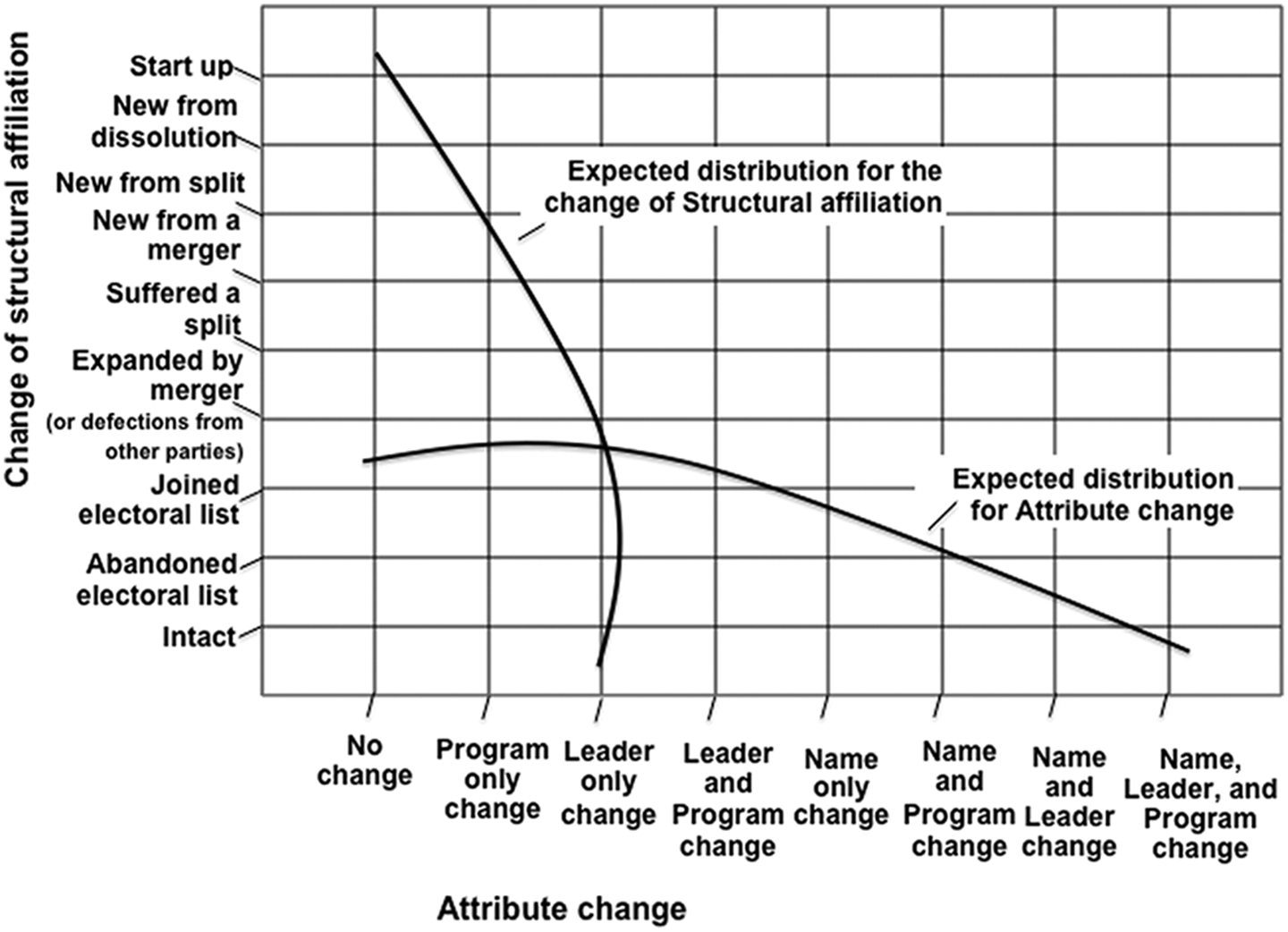
The presumed distribution of party novelty.
The exact order on this dimension is as follows: (1) a party stayed intact; (2) a party abandoned the electoral list; (3) a party joined an electoral list; (4) a party expanded by merger or elite defections from other parties; (5) a party suffered a split or elite defection; (6) a new party emerged from the merger of previously existing parties; (7) a new party emerged from the split of a previously existing party; (8) a new party emerged from the dissolution of a previously existing party; (9) a start-up party emerged from scratch. Only parties that alter the conventional pattern of party politics and ‘break the party-cartel circle’ will be included in the last group (Sikk, 2005: 399).
The party novelty plane should be viewed as a whole. Neither of the two continuums can be considered separately from one another. For instance, it would be difficult to claim that parties that suffered a split have necessarily more novelty than the parties that have expanded by merger without knowing if those parties changed any of their attributes in the process. And vice versa: the notion of party novelty would be incomplete if we looked only at the attribute change, say the change of party leader and programme versus the change of party name only, without considering changes in structural affiliation.
Thus, in the bottom left-hand corner of the plane there would be parties that have not changed any of their attributes and kept their structural affiliation intact – those parties have zero novelty. Conversely, in the upper right-hand corner of the plane there would be parties with the highest degree of novelty – start-up parties with completely new attributes (name, leader and programme). The lines in Figure 1 represent the expected distribution of cases in each dimension, where parties change their attributes and/or structural affiliation. The expectation about this distribution is discussed in greater detail further in the article. The next section elaborates on how each of the two dimensions and its composites are defined.
The two dimensions of party novelty
In this article, I attempt to bring together different strands of party change under one roof, called party novelty. In the theoretical section above, I mapped party novelty in two-dimensional space. This section operationalizes the two dimensions of party novelty – the change of party attributes and the change of party structural affiliation, defining their essential elements.
Change of party attributes
I define party attributes as features that a party is recognized by – party name, leadership position and the programme. Collectively, these features constitute party identity. They are essential and present in every party. The following section defines each of the three attributes.
Party name is the official name of a party as defined in its manifesto or on the official website at the time of the elections in question. In the database, party name is recorded in the three separate variables. The first records the party name in its native language and alphabet. The second records the party abbreviation, and the third the English translation of the party name.
Party leader is defined as an official spokesman for the party who is announced as such and acts as a party leader in public, delivering speeches and conducting public relations on behalf of a party. This figure officially can carry one of the following titles: ‘leader’, ‘spokesman’ or ‘chairman’. If a party has separate positions for each of those titles, then I record the person who has the most exposure in the mass media. The extent of the exposure is determined by tracking the number of news articles that come up when the name of the person in question is put as a keyword in the Lexis Nexus Academic search engine. Regarding the timing of leader change, if a leader is elected during a multi-day convention, the last day of the convention is recorded as the date on which a leader started his or her service.
Party programme is defined as a party manifesto or a party platform published by a party ahead of the election to the European Parliament. Election programmes are taken as indicators of a party’s issue and policy positions at a certain point in time. The conceptualization and operationalization of a party programme variable is taken from the Euromanifestos project (Braun et al., 2010; Schmitt and Wüst, 2012).
Change of party structural affiliation
The Party Novelty Dataset measures not only the change of party attributes (name, leader and programme) but also organizational changes within parties. Organizational change is recorded using eight categories: (1) a party abandoned its electoral list, (2) a party joined an electoral list, (3) a party was expanded by merger or elite defections from other parties, (4) a party suffered a split or a defection, (5) a party emerged anew from a merger, (6) a party emerged anew from a split, (7) a party emerged anew from a defection, (8) a party emerged anew from a scratch (or a start-up party). The following section defines each group.
A party is coded as ‘abandoned electoral list’ if it is listed as a separate entity on the election ballot for the EU Parliamentary elections and if it was part of an electoral coalition in the previous EU elections. Conversely, a party is coded as ‘joined electoral list’ if it is part of an electoral coalition in the current EU elections and if it was listed as a separate entity on the election ballot for the previous EU Parliamentary elections.
A party is coded as ‘expanded by merger’ or ‘expanded by defections from other parties’ if one party absorbs another one in whole or in part (absorbing only some of its key elites) without changing its structural affiliation. Theoretically, parties in this group can change their name as a result of such changes in their structural affiliation, but it is not expected to happen often in practice.
Conversely, a party is defined as one that suffered a split or a defection of its key elites if a party loses a considerable proportion of its membership or if one (or more) prominent member of the party defects to another party.
A party is defined as anew from merger if two parties of any size joined their efforts to create a new party. A new political entity would involve creation of a new leadership scheme, membership rules and organizational apparatus. Recycling of old party names, leaders and programmes is theoretically accepted, although this is not common in this group.
When new parties emerge from mergers between non-partisan organizations and existing parties, the database records the largest of the parties as the previously existing entity, rather than the non-partisan group. This is the case even if the majority of members in the newly emerged party come from non-partisan organizations. The reasoning behind this logic is that parties are likely to transfer their identity to the new party and contaminate the political ‘purity’ of non-partisan organizations.
An example is the Italian party ‘I Democratici’ in the 1994–1999 EU electoral cycle. I Democratici was created on 27 February 1999 from a merger of grassroots organizations and parties supporting a former prime minister of Italy, Romano Prodi. The founding organizations were Movement of Mayors (not a party), Italia dei valori party (founded shortly before, in 1998), Movimento per la Democrazia – La Rete (founded in 1991), and a Democratic Union party (founded in 1996). The later party is a former member of the Olive Tree Coalition, which was created for the 1996 national elections and did not exist in 1994 when the EU elections were held. Prodi, having entered politics in August 1994, was a key figure in the Olive Tree Coalition, but did not seem to belong to any of the parties composing the coalition. The only party among those comprising ‘I Democratici’ that existed and ran in the 1994 EU elections is Movimento per la Democrazia – La Rete. Therefore, this party was recorded as the previously existing party, which the current status of the I Democratici party is compared to.
A party is considered emerged anew from a split if it is formed from members who left another party. Parties in this group may be formed either by prominent elites, who defected from another party, or by a large portion of defecting rank-and-file members.
A party is coded as emerged anew from dissolution if a new party is established from the previously existing one which has been dissolved de jure with an official announcement or de facto by not meeting party registration rules. A group of parties that emerged as new from the dissolution of a previously existing party is a very valuable group. It highlights cases in which a party dies and is resurrected, often with a new name, leader and programme. Yet often the party elites stay the same. These are important cases that can be used for testing if elites carry the party identity. In these cases, voters punish the newly created party for the economic downturn, which this party organization has nothing to do with, yet party elites possibly do.
One of the challenges of coding parties in this category includes the fact that there is a very thin line between groups of parties that stay intact with new names, leaders and programmes, and groups of parties which emerge anew from dissolution with leadership changes.
For example, the Belgian Flemish party Vlaams Block announced its dissolution on 14 November 2004. The reason for dissolution was the court ruling against the xenophobic activity of the Vlaams Block. The same announcement, however, contained the introduction of a new party formed on the basis of the dissolved Vlaams Block, called Vlaams Belang. The latter was coded as a new party formed from dissolution, instead of simply a party that changed its name, because in addition to the official wording of the announcement that includes the word ‘dissolution’, the new party website does not provide any archival information on its affiliation with Vlaams Block and its history before 2004.
Finally, a party that is created from an NGO or an organization that is not registered as a party (and therefore does not have aspirations to be in the government) is considered as created anew from scratch or a start-up party. There are difficult cases to code in this group as well. For instance, a party that did not exist for two elections is considered dead and, if re-established, is recorded as created anew from scratch. Sikk (2005) has similar criteria for distinguishing genuinely new parties. He writes: ‘Several parties in Eastern Europe that have re-entered parliament after spending one electoral cycle outside will not be considered genuinely new; however, parties missing from more than one parliament will be regarded as new’ (p. 399).
For instance, the Estonian green party ‘Erakond Eestimaa Rohelised’ was established in December 1991. When in 1998 the Estonian government changed registration rules for parties, setting the membership minimum to 1,000 members, the party was forced to dissolve. However, in 2006 the party re-established itself after recruiting over 1,000 members in an organized effort. Since it missed two EU parliamentary elections, in 1999 and 2004, the party was coded as emerged anew from scratch.
These definitions serve as a guide in collecting data on party novelty used further in this study. The next section discusses data collection procedures and the design of the dataset itself.
Expectations about the distribution of party novelty
In relation to the general distribution of cases, we can hypothesize that there will be some parties that change a lot, and others that do not change much. Not all parties would want to change from one electoral cycle to another. In other words, we can expect a variation of party novelty. At the same time, while a variation in party novelty is expected, it is likely that the majority of parties would avoid severe changes (see Figure 1, with lines representing the expected distribution on both dimensions of party novelty). Changing party name or breaking its structural affiliation is costly in financial terms, defined by such expenses as reprinting propaganda materials and managing the PR campaign. Such costs would vary, depending on the type of change. What is more important, the change might be costly in terms of losing the electorate base. For instance, niche parties have been shown to lose votes as a result of moderating their programmes (e.g. Adams et al., 2006). The risk of losing votes comes with any kind of party change – including party name, leader, programme or structural affiliation.
We should also consider regional differences in the level of the observed party novelty, given variation in the ages of democratic systems in European countries. In the literature, the age of democracy is associated with the perceived level of electoral viability (Cox, 1997; Tavits, 2008). Its level is high in new democracies, where the uncertainty about who wins prevents voters from voting strategically. The absence of strong strategic voting tendencies increases the likelihood of voters voting for new and often small third parties. This should enable not only new party entry but also other party transformations in new democracies.
One of the ways to capture the whole variation in party novelty is to record the changes of party attributes and party structural affiliation across various electoral contexts. The following section gives the operational definitions used for recording party changes.
Research design
The scope: EU parliamentary elections
In this study, party novelty is bound by electoral cycles. Once a party participates in nationwide elections its novelty is annulled and, at the beginning of the next electoral cycle, the novelty starts to tally again. Thus, in order to measure party novelty in a systematic way it is important to pay great attention to the choice of the electoral context. The chosen elections should provide a standardized basis for comparison in terms of time and procedures used. The reduction of the background noise (e.g. coming from the campaign scandals) is also desirable.
Based on these criteria, the EU parliamentary elections should serve the research well. First, EU elections allow for a uniform and consistent comparison, as parties across many countries can be considered at one point in time. The elections are conducted at the same time in all of the EU states every five years, which should control for general trends in EU politics. Second, EU members are bound to follow certain common electoral rules. The relative standardization of the electoral rules across national contexts makes the comparison of party novelty more meaningful. Third, since the EU elections are considered to be secondary to the national ones, the presence of the pre-election scandals is not likely to interfere with the results. Typically, pre-election scandals create a background noise, swaying voters’ party preferences in unpredictable ways.
Finally, the EU region provides an opportunity to test the regional differences in party novelty which reinforce the differences between new and established democracies. The EU includes countries where we expect to see a low level of party novelty (Western Europe) as well as countries where we would expect a high level of party novelty (Eastern Europe). Thus, for the four reasons listed above, the EU parliamentary elections provide common ground that allows systematic comparison across various electoral contexts.
I designed a database of Party Novelty in order to record its observed presence. This entailed data collection on change-of-party trademark attributes and party structural affiliation in EU countries within each EU electoral cycle between 1989 and 2009. The countries and years included in the dataset are provided in Table 1.
Electoral contexts.
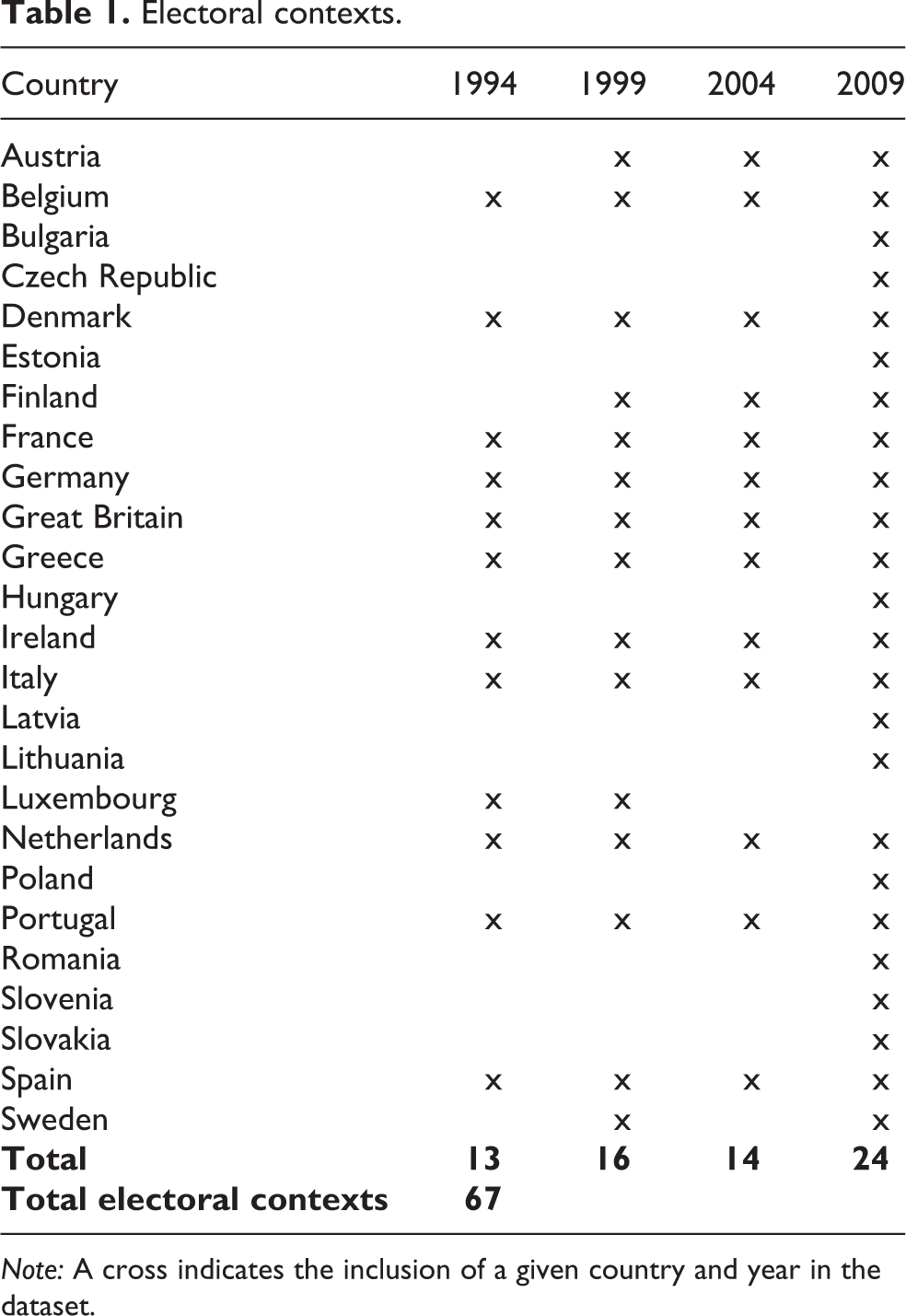
Note: A cross indicates the inclusion of a given country and year in the dataset.
Case selection
As far as case selection at the party level is concerned, some authors argued that only winning parties are worth being studied (e.g. Janda (1980) suggested considering only parties winning 5 percent of the legislative seats). But as Harmel and Robertson put it, ‘one cannot adequately consider the circumstances surrounding success without examining failures’ (1985: 508). In addition, the all-inclusive approach broadens the empirical base, allowing using party novelty data not only for studying the reasons for party success but also for studying the reasons for party entry (e.g. Tavits 2006, 2008). This study thus includes all parties contesting European elections regardless of whether they won seats. This approach is also beneficial, since the data are intended to be linkable to PIREDEU European Elections Study (EES) data, providing many research opportunities. The EES was also the primary source for the list of parties contesting in each election.
The study was designed in such a way that each case represents a party per electoral cycle, that is, a party existing between two specific elections. The same party in a different electoral cycle is considered to be a separate unit. The nature and the combination of changes within a specific electoral cycle give a party a certain degree of novelty. The base, to which party changes are compared to, is the state of party structural affiliation and party trademark attributes at the previous general election. Once a party participates in the next general election, its novelty level drops to zero and the cycle starts again. Thus, for instance, Danish social liberal party Det Radikale Venstres (RV) between 1999 and 2004 EU elections is a separate case in the database from the same party in the 2004–2009 EU electoral cycle. In the former case, the party has a certain degree of novelty. It suffered two splits, in May 2007 with the formation of the New Alliance (later called Liberal Alliance) and in October 2008 with the formation of the Borgerligt Centrum. In the latter case, the party has not changed any of its attributes and has preserved its structural affiliation. Therefore, it had zero novelty.
Data collection
The data for the study were collected between December 2009 and March 2011 and came from several sources. All data except for the change of party programme came from the official party websites and newspaper articles. The data collection procedure for the change of party names, leaders, structural affiliation, as well as for the dates on which these changes occurred, is as follows (Figure 2). The first stage includes collection of unconfirmed data through the Wikipedia website, as it provides information in the most organized fashion. The second stage includes conformation, clarification and completion of the collected data. It involves searching for the relevant information on the official party websites. Websites were roughly translated using the Google Translate service. The quality of the translation was sufficient for the purpose of finding names of party leaders, announcements about changes in party structural affiliation, and the dates they occurred. If no information was found on the official website, the search turned to news articles, which were accessed through the Lexis Nexis Academic database. The keywords used for searches were names of party leaders and/or party names. When needed, searches were limited to the years of presumed change.
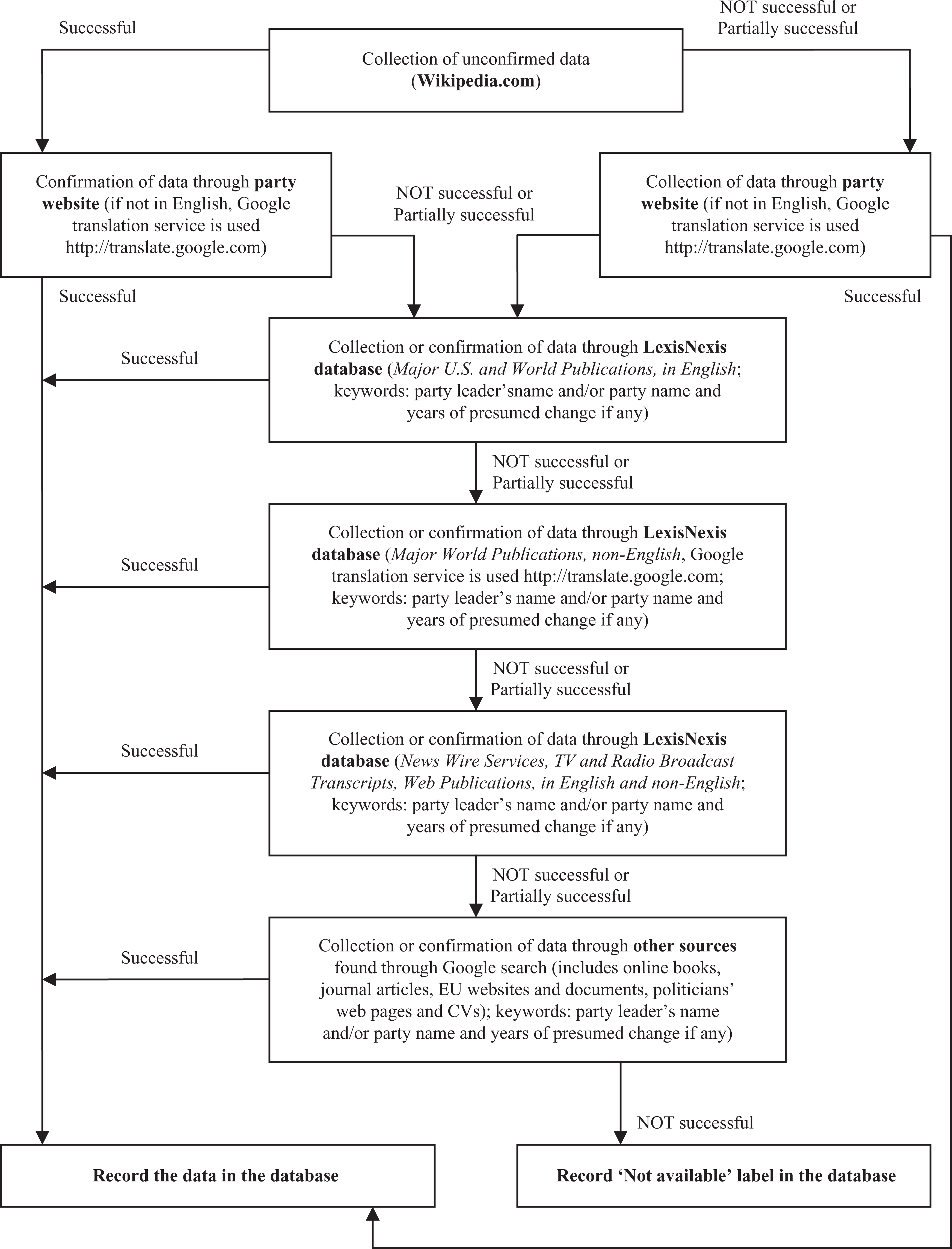
Algorithm of data collection.
Findings
This section reports on the variation in party novelty across various countries and electoral cycles in the EU. It shows that party novelty, if coded and quantified in the way described in the earlier sections, is a very useful broad measure of party system dynamics. One of the greatest values it brings to the research community is the ability to map party change in various ways. Below, I present an aggregate map of party novelty in the EU from 1989 to 2009, compare party novelty maps for Western and Eastern Europe for the 2004–2009 electoral cycle, contrast country-specific maps highlighting countries with the most and the least party change, and discuss the mapping of party novelty across time.
Aggregate map of party novelty
First, let us look at the aggregate map of party novelty that includes all countries and all electoral cycles involved in this comparative study. One of the intuitive expectations is that even though party novelty varies across party per electoral cycle cases, the distribution of party novelty is skewed towards ‘less novelty’. Indeed, the aggregate picture is what we largely expect and it merely confirms the durability of party systems. Figure 3 represents the variation of party novelty in EU countries between 1989 and 2009. The axes stand for the two dimensions of party novelty described earlier – change of party attribute (the X-axis) and change of party structural affiliation (the Y-axis).
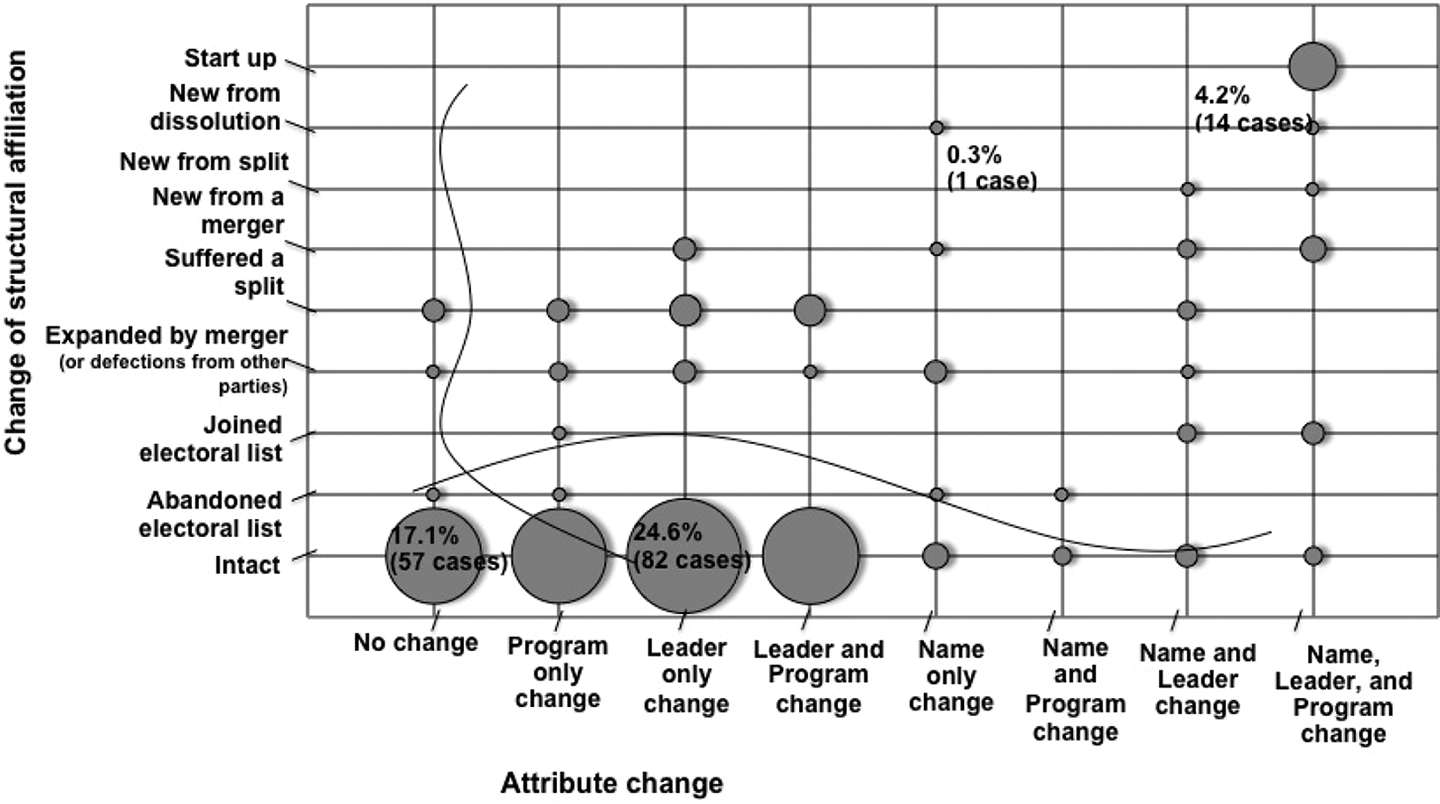
Distribution of party novelty along the two continua – structural affiliation and attribute change.
Based on Figure 3 (X-axis), the distribution of cases along the change of party attributes continuum is skewed towards less change as expected, although the peaking tail on the right hints that the complete change of party attributes is not the rarest occurrence (solid line along the X-axis). It is important to note, however, that about a half of the cases in the ‘complete attribute change’ category (the last category) are start-up parties for which the ‘change’ of attribute was recorded by default. This accounts for the peaking tail at the end. Furthermore, the distribution of cases along the change of party structural affiliation continuum has an even greater skew towards less change than we see in the distribution along the change of party attributes continuum (Figure 3, solid line along the Y-axis). Thus, it is apparent that parties change their attributes more readily than they change their structural affiliation. More specifically, the change of programme and the change of party leader are the most common changes parties undergo. The change of name is rare even with parties that change their structure. The prevalence of party programme and leader change, can perhaps be explained by the fact that parties choose transformations that would adapt them to the current economic or political circumstances. At the same time that would be least costly in terms of both votes and money. Most importantly, the change of name carries the risk of losing votes (or at least a greater uncertainty about this risk). In addition, it involves rebranding, which could be costly from a marketing standpoint.
Finally, when we combine the two dimensions of party novelty, we see that few parties in real politics remain completely unchanged from one election to another. This is mostly due to the fact that 78 percent of those parties that stayed intact changed at least one attribute. The results show that there are 57 cases out of 333 (or 17.1 percent) in which parties preserved their structural affiliation and have not changed any of their attributes (name, leader and programme). This finding is crucial as it shows the importance of studying party novelty and its effects. In more than 80 percent of cases parties changed themselves in various ways and to varying degree, but we do not know if and how this change affected voters’ party preferences.
Regional maps of party novelty – Western and Eastern Europe
The value of the party novelty concept for the cross-national analysis can be shown more effectively through looking at the regional differences. One of the expectations about the distribution of party novelty was that we should see more frequent and diverse party change in Eastern Europe since party systems are more dynamic there.
The party novelty map in Figure 4 confirms this expectation. The map depicts the difference in party novelty distribution for Eastern Europe (light grey bubbles) and Western Europe (black bubbles). For Eastern European countries, the data were collected only for the 2004–2009 cycle of the EU parliamentary elections. Therefore, to make the comparison meaningful, the figure reflects party novelty across Western Europe for the same electoral cycle. According to Figure 4, changes in structural affiliation are more common in Eastern Europe. This is expected as party systems are more dynamic in new democracies and splits or mergers are more common there. Yet, from Figure 4 it is clear that Western European parties changed more in terms of their programmes and leaders than Eastern European parties (at least for the 2004–2009 electoral cycle). This finding conforms to claims that Eastern European politics are more personalized. Party appeal is often tied to a certain persona, who also serves as a party leader almost by default. In this case, the change of a leader would shake up party structural affiliation or even party existence. Western European parties, on the other hand, are more stable in this sense. When party leader or programme changes, these parties are more likely to keep their structural affiliation intact. A change of leader is less of an ad hoc event for Western European parties and more of a regularly occurring procedure.
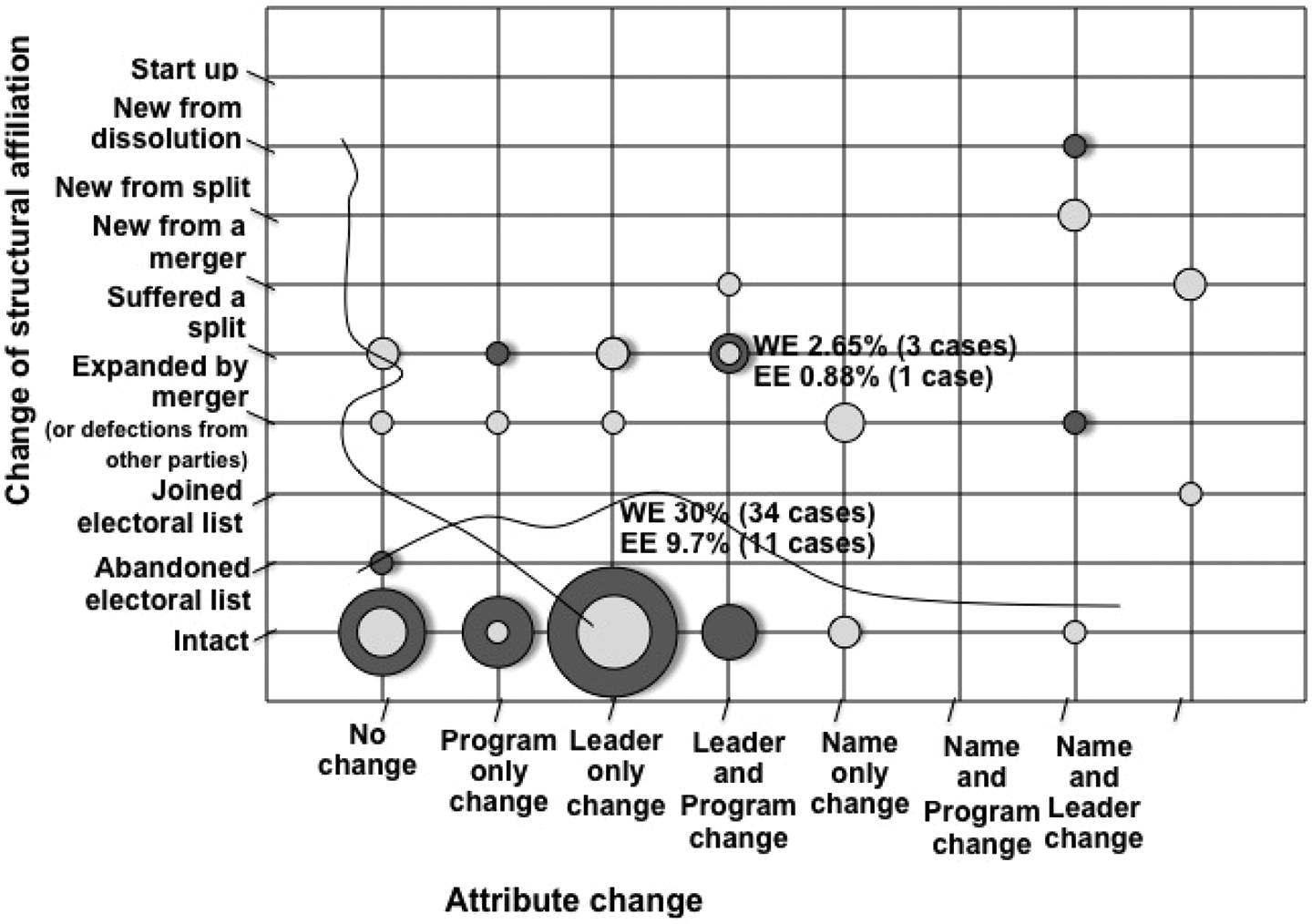
Party novelty distribution for Eastern Europe (light grey bubbles) and Western Europe (black bubbles) for the 2004–2009 EU electoral cycle. The figure reflects the party novelty distribution for a total of 113 Eastern and Western European parties in the 2004–2009 electoral cycle of the EU elections. Percentage is taken of the total number of those cases (out of 113).
Country-specific mapping of party novelty
If we look at the distribution of party novelty across countries, the contrast between party systems with the most novelty and the least novelty is clearly evident. Figure 5 presents party novelty maps for Finland, Sweden, France and Italy. The maps represent party change within those countries for the period between 1989 and 2009, which encompass four electoral cycles to the EU parliament. Owing to the fact that the Eastern European countries joined the EU much later – and hence were not included in the data collection pool for the first three of four EU electoral cycles – they were not considered for this comparison.

Party novelty distribution for selected European countries for the period 1989–2009.
Figure 5 shows that the least dynamic systems among the EU states (Western and Southern Europe) are Finland and Sweden. Finish parties have not changed their structural affiliation for the considered period, staying intact. In 41 percent of Finnish cases, parties stayed intact and have not changed any of their attributes. In another 45 percent, parties stayed intact but changed party leader. Only in one case did a party change its name. On 25 May 2001, the Finnish Christian Democratic party changed its name from Suomen Kristillinen Liitto (Christian League of Finland) to Kristillisdemokraatit (Christian Democrats). The party has lost some of its key members to other parties. MP Lyly Rajala and MEP Eija-Riitta Korhola defected to the National Coalition in 2003, and Annika Kokko defected to the same party in 2007. But the party did not split and has preserved its structural affiliation.
Another Scandinavian country, Sweden, has shown limited party changes as well, although there was one start-up party case. The first and well-publicized pirate politics party – Piratpartiet (Pirate Party) – was founded on 1 January 2006 under the leadership of Rickard Falkvinge.
The most dynamic party systems for the period from 1989 to 2009 were France and Italy with only 20 and 22 percent of cases, respectively, in which parties stayed intact without changing any of their attributes. The party novelty map for France shows a distinct number of splits with some or all of the party attributes changed. Within this group are the two parties that emerged from the split of the Nouvelle Union pour la Democratie Francaise (UDF) in 2007. The first party is the Mouvement Democrate (MoDem), which, as decided at the congress on 10 May 2007, took statutes, banner and most of the members of the UDF, including its leader Francois Bayrou. The second party is Nouveau Centre (NC), which was created on 29 May 2007 by drawing together those who refused to join the MoDem. Other new splinter parties in this group include Mouvement des Citoyens (split from Parti Socialiste on 2 May 1993), Democratie Liberale (split from UDF on 24 June 1997), Mouvement National (split from Front National on 24 January 1999), Rassemblement pour la France (split from Jacques Chirac’s Le Rassemblement pour la Republique on 10 April 1999), and Le Parti de Gauche (split from Parti Socialiste on 12 November 2008).
Italy is another party system that has experienced a high level of party novelty in the period from 1989 to 2009, specifically having a high number of cases in which parties changed all of their attributes – name, programme and leader. Figure 5 also shows a high number of mergers during that time. To highlight a few, Silvio Berlusconi’s Il Popolo della Liberta was launched on 18 November 2007 and was officially founded as a party when Forza Italia merged with National Alliance on 27 March 2009. Another big merger occurred on 14 October 2007, when Democratici di Sinistra (Democrats of the Left) and Democrazia è Libertà – La Margherita (Democracy is Freedom – The Daisy), along with various smaller left-wing and centrist parties, united their forces and formed Partito Democratico (Democratic Party).
This section has shown that both qualitative and quantitative data could be synthesized together in the form of a map, visualizing party change across various party systems. Mapping party novelty for each country in this way can provide us with a useful tool for the comparative study of party dynamics. We can ask a whole range of questions as to why we see a difference in the level of party novelty across countries. We can also test possible explanations offered in the literature, such as cost of entry and spoils of office, which facilitate the formation of new parties (Tavits, 2008). However, institutional factors may not account for the variation of novelty in the same country over time. The next section looks briefly into the variation of party novelty in Italy over the four EU electoral cycles.
Mapping party novelty across time
Mapping party novelty across time could help us understand parties’ responses to various environmental stimuli – economic, political or social. Moreover, we could study not only the reaction of individual parties but also the response of the entire party system as a whole. Mapping party novelty could help define periods of turmoil in the political system.
Figure 6 shows the variation of party novelty in Italy over the four EU electoral cycles. It is clear from the figure that the 1989–1994 electoral cycle had the highest level of novelty. Not a single party out of the six major parties included in the analysis survived without substantially changing through split or merger, if it survived at all. This period saw a complete dissolution of the dominant Democrazia Cristiana (Christian Democracy) party and its allies, as well as the emergence of new players which define political competition to this day, such as Silvio Berlusconi, then a leader of Forza Italia.

Party novelty distribution in Italy for the period 1989–2009.
This period signified voters’ disenchantment with the old political players and the political system as a whole. The reasons for such political paralysis were systemic (i.e. the collapse of the old communist order and ideology in Europe) and homegrown (i.e. massive government debt and extensive corruption, highlighted in the infamous Tangentopoli scandal). Thus, the party novelty map for Italy in 1989–1994 signifies a period of turmoil in the country’s politics. It shows that it is more than just a single party crisis brought about by a corruption scandal, but rather a crisis that involved the entire party system.
Conclusion and application
In this study, I propose a more differentiated conceptualization of party novelty that shifts from the party age, i.e. viewing newness in terms of organizational youthfulness (how close to birth, how far removed from death), to something more complex, i.e. the ‘newness’ of party leaders, programmes, names and structural affiliation. I define party novelty as the quality that reflects the degree of change within a party in terms of its structure and attributes within one electoral cycle. This concept supplements the understanding of novelty in strictly organizational terms proposing additional consideration of other elements (what I call a ‘thick’ conceptualization of party novelty).
This article not only proposes a theoretical concept, but also suggests a way to operationalize it and attempts to measure it. In this effort, I recorded and mapped 502 cases of party change over four EU electoral cycles from 1989 to 2009.
Moreover, this study shows that party novelty, if coded and quantified in a way described in the earlier sections, is a very useful broad measure of party system dynamics. One of the greatest values it brings to the research community is the ability to map party change in various ways: in aggregate form, by region, by country and by electoral cycle.
The aggregate map showed that few parties in real politics remain completely unchanged from one election to the next. In more than 80 percent of cases, parties changed in various ways and to varying degree. Furthermore, while aggregate maps show us the general tendency, regional or country-specific maps give us a valuable tool for comparative analysis, in which we could test institutional and other national level explanations of party change. For instance, I found that in Eastern Europe the level of party novelty is higher than in Western Europe, which confirms earlier findings about more dynamic party systems in the new democracies in the East. Also the uncovered contrast between the high level of party novelty in Italy or France and the low level of novelty in Sweden or Finland would be a great subject for testing some of those explanations. In addition, mapping party novelty across time could help us understand parties’ responses to various environmental stimuli as well help us define periods of turmoil in the political system as a whole. As shown, the Italian party system had an extremely high level of novelty in 1994, signifying a period of major political turmoil and rebirth.
These findings are crucial as they show the importance of studying party novelty, as well as its causes and effects. The concept is useful for studying not only patterns of party development, but also for accessing the degree of democratic accountability in a given democracy. For instance, currently there is research under way to uncover whether party novelty has a moderating effect on economic voting.
In sum, this work incorporates all of the party transformations within a single indicator, giving a broad comparative picture of party change across a large number of countries. Such an indicator would empower researchers to study the causes and effects of party changes in a systematic manner and allow us to produce studies with more generalizable conclusions and broader implications. Moreover, it would expand the possibilities for quantitative comparative research in party development, complementing the flourishing comprehensive case studies talking shape in the field.
Footnotes
Funding
This research received no specific grant from any funding agency in the public, commercial or not-for-profit sectors.