




Abstract
Political parties are essential linkage mechanisms between citizens and the political system. We know less, however, about the question how this mechanism operates. While some authors assume it is sufficient that parties offer citizens ideological options about the way society should be governed, others indicate that parties provide strong ties to the political system by offering stable identities like party membership. In this analysis of the European Social Survey cumulative file (five waves, 2002–2010), we investigate the relation between party membership, closeness to a political party and trust in political institutions. While party membership is declining, its relation with political trust is limited. We do not find any indication that the decline of party membership could have a substantial effect on levels of political trust. Feeling close to a political party is more strongly related to political trust, even controlling for political interest. Results indicate that in most European societies levels of party closeness are stable. We conclude that political parties function as a linkage mechanism between citizens and the state, but that there is no reason to attribute a privileged role to formal party membership, as feeling close to a political party has a stronger linkage effect.
Introduction
Traditionally, political parties have served as one of the main linkage mechanisms between citizens and the state. Parties socialize citizens into politics, they aggregate their preferences and they provide a mechanism for identification with the political system and the role citizens can play in that system (Panebianco, 1988). Political parties also function as an ideological linkage mechanism, enabling citizens to identify relevant policy issues and their positions on those issues. By offering a set of ideologically inspired policy solutions and political agenda items, parties structure the political debate, rendering it easier for individual citizens to make sense of politics. It has been claimed, therefore, that political parties effectively ‘organize democracy’ (Dalton et al., 2011). Increasingly, however, the functioning of political parties has been changing as the emphasis has shifted from the party as an ideologically inspired political movement and a member organization toward ‘the party in office’. This professionalization of party politics implies that an important linkage mechanism available to citizens has weakened (Katz and Mair, 2009). The rank and file of ordinary party members to a large extent has become obsolete and professional parties are reluctant to give members too much say in the way the party is being run (Whiteley, 2011). While party membership used to be a main venue for social and political integration, this form of political linkage has been weakened in recent decades and party politics has increasingly been professionalized (Scarrow et al., 2002). If citizens interact with political parties, this is mainly in the context of elections and electoral campaigns at a moment when political parties offer voters a set of ideologically structured options.
This process toward the professionalization of party politics has been described as a trend toward cartel parties or toward electoral–professional parties (Katz and Mair, 1995; Panebianco, 1988). What we do not know, however, is what this process implies for the attitudinal linkage between citizens and the state. Two hypotheses stand out in this regard. First, if party membership is the most powerful causal mechanism, declining levels of party membership would imply that parties are less effective in this regard. Second, feeling close to a political party in terms of ideology or party manifesto might play the same role, and if this were the case there is no reason to assume a negative trend. Research has consistently shown that political parties play a number of important roles in this regard, as they socialize members into the functioning of the political system (Lawson, 1980). In this article we test whether party membership or party closeness is mainly responsible for this linkage mechanism by using political trust as a dependent variable. Political trust can be considered as a blanket judgment, covering the functioning of the political system in general (Hooghe, 2011; Rudolph and Evans, 2005). Going back to the framework developed by Easton (1965), political trust can be considered as the most basic form of diffuse support for a political system. Political trust refers to diffuse support for the fundamental values and institutions of a political system, and it is not related to the attitude on or the evaluation of current office–holders. Previous research has shown that political trust matters, as high levels of political trust are associated with the willingness to give authority to the state to organize a larger part of societal arrangements (Hetherington, 1998). If that is the case, we can assume that either party members or those who identify with a political party should have a more trusting outlook toward the political system compared to those who do not relate to the party system at all. If political parties really fulfil all the important political integration functions that are being attributed to them, party members and/or supporters should have a more positive outlook toward the political system as a whole (Anderson et al., 2005), and this should reflect itself in higher levels of political trust. Fewer members of political parties and lower levels of closeness to a political party, therefore, might imply lower levels of political trust in general. The goal of the current article is to explore the impact of party membership and closeness on levels of political trust in Europe.
In this article, we first briefly review the literature on political parties as a political linkage mechanism. Subsequently, we present the data and methods we use, before commenting on what this implies for the evolution of political trust in Europe and the role of political parties in these democracies.
Literature
There is little doubt that the structure of political parties is changing rapidly in Western societies. The most prominent description of this trend has been developed by Katz and Mair (1995), as they have put forward the thesis that political parties are rapidly adopting a cartel model, since their main goal is to gain elections. This enables parties to gain access to government power and resources, while they are downplaying their ideological message or their relation to their membership basis. In professionalized political parties, a small party elite decides on tactics and campaign strategies. This professionalization process has important consequences for the traditional functions of political parties in a political system (Gunther et al., 2002). Party members are increasingly being considered as an obsolete feature, as parties no longer are financially dependent on members’ contributions. Considering the fact that party members will be ideologically motivated, they might obstruct the preferences of the party elite for maximizing votes and power. Members are no longer expected to participate actively in all kinds of activities of local party chapters, or to contribute to election campaigns that have become highly professionalized and are now focused almost exclusively on mass media and new information technologies (Gibson and Rommele, 2009). Party supporters, on the other hand, are still important. Political parties serve as an ideological sorting tool for voters and citizens. Confronted with a huge number of potentially important issues and different policy options, citizens routinely rely on the ideological cues provided by political parties to develop their own preferences and ideas. The question is whether this function of political parties, too, has been weakened (Clarke and Stewart, 1998; Green, 2007; Key, 1964). It has been argued that party identification has become a malleable attitude, determined by the voter’s own evaluations and preferences (Carsey and Layman, 2006; Highton and Kam, 2011).
Traditionally, it has been assumed that one can distinguish concentric circles in the relation between citizens and political parties. In the centre we find the party membership base. They are loyal party supporters and on average highly active and interested in politics (Selle and Svåsand, 1991). Party members can be considered as the core constituency of a political party. It is assumed that party members strongly identify with their party, and that there is not all that much volatility among this group. Party membership is interpreted as a formal form of support and engagement for the political party and its ideology. Party membership is exclusive and members are expected to adhere to only one party (Cross and Young, 2002; Seyd and Whiteley, 2004). A wider circle is formed by those who have a sense of party identification, whether or not they are a party member. Those with higher levels of party identification are assumed to be more inclined to vote, to support the political system and to have higher levels of political efficacy (Clarke and Stewart, 1984). Non–members have also been shown to be active supporters of political parties during election campaigns (Fisher et al., 2014). A sense of party identification, however, is less formal than party membership and it is also more open to changes throughout the life–cycle. Rosema (2006) has made the point that in European multiparty systems the concept of party identity is less applicable, and should be replaced by a party preference, or the notion of feeling close to a political party. It has to be noted, however, that there is an ongoing debate about the exact nature of the concept of party identity. In two–party systems, like that of the United States, the concept of party identity is routinely used, as it is assumed that citizens have a stable preference for one of the two main political parties. In multiparty systems, on the other hand, this kind of preference is less clearly defined and citizens can even hold different preferences simultaneously (Rosema, 2006). We can still assume, however, that some citizens feel ‘close’ to a political party, without necessarily having a strong sense of party identity. Following this reasoning, feeling close to a political party most likely is a weaker linkage mechanism than party identity. In most European political surveys, the concept of ‘party identity’ as such is not included, and the questionnaire only includes questions on how ‘close’ one feels to a political party (Dassonneville et al., 2012).
The available empirical evidence suggests that both party membership and party identification have weakened in recent decades. First, we know that there is a strong decline in levels of party membership (Van Biezen et al., 2012). The trend is general in all major democracies, and has also been documented for the various party families. While more ‘recent’ political parties like for example the Green parties or more populist parties still experience an increase in their membership base, the overall pattern is that parties are losing members. Especially young age groups refrain from joining political parties, with as a result that the average age of the party membership base is rapidly increasing (Hooghe et al., 2004). The end result of this process is that the membership base of political parties has become much more distinct from the general population than it was some decades ago (Whiteley, 2009). While in the past too, party members tended to be older, higher educated, male and have more prestigeous jobs, the erosion of party membership figures has also intensified this process, with the result that party membership has become less representative of citizenry in general. Despite the fact that Dalton (2007) has argued how cognitive mobilization is one of the driving forces behind the erosion of party membership, in practice party members are highly distinctive with high levels of political interest, political knowledge and involvement.
Party identification, too, however, has weakened in a number of democracies. A smaller proportion of citizens feels close to a political party or develops a psychological identification with a political party and the ideology it espouses (Dalton, 1984). While there is some discussion about the individual–level stability of party identity, or the degree to which this concept can be used in different party systems, there is consensus that party identity enables citizens to get a grasp on electoral decision–making, while it has a strong impact on their political attitudes and behaviour (Nie et al., 1979). Recent research on German panel data suggests that the loss of party identity is being characterized by strong period effects, while those with the lowest levels of political sophistication are more vulnerable to the loss of party identity or stable party preference (Dassonneville et al., 2012).
If both party membership and party identification have eroded, as this review of the literature suggests, this implies that for a large group of citizens these tools are no longer readily available to allow them to relate in an effective manner to the political system. In the current analysis, we rely on a measurement of political trust to capture this form of attachment to the political system as a whole. Political trust can be conceptualized as a general assessment by citizens whether actors within the political system behave according to the expectations being raised by citizens (Hooghe, 2011). While trust levels are different according to the specific institution being questioned, in all of the research we observe a strong internal coherence of political trust batteries. The judgement on whether the courts can be considered as trustworthy in practice is very closely related to the judgement on, for example, Parliament or politicians. An assessment of the quality and fairness of the government process can be seen as the basis on which political trust judgements are being formed and expressed (Rothstein, 2011). Political trust can also be seen as an important source of diffuse support for the political system, and downward trends in political trust will make it more difficult for government institutions to govern in an effective manner (Hetherington, 1998; Marien and Hooghe, 2011).
The relation between party membership and identification, on the one hand, and political trust, on the other, is not self–evident. Especially for supporters of opposition parties, there may be very few incentives by which to express trust in office–holders that have won the elections (Anderson et al., 2005). However, the object of trust is important in this regard. It might indeed be expected that opposition supporters will have a negative evaluation of office–holders, or even about the way democracy is currently functioning in their country. But the question about trust in political institutions taps a much more general and diffuse form of political support that is not dependent on whoever is in office at the time. In principle, political trust levels do not depend on the composition of the government that is in power for the moment (Marien, 2011). Furthermore, even if this phenomenon of ‘loser’s consent’ was very important for the development of political trust, in a proportional electoral system it can still be assumed that supporters of government parties in most countries will be more numerous than supporters of opposition parties, and the overall effect of party membership and identification therefore should still be positive.
Our hypothesis, therefore, is that both party membership and feeling close to a political party contribute to the development of political trust, as these ties with political parties provide citizens with an opportunity to express their opinions in a more effective manner and allow them to relate to democratic procedures in general. What has not been studied in depth thus far, however, is how the observed decline in party membership affects political trust levels in Western societies. Given the literature on the system functions of political parties, it can be expected that the erosion of party membership has a negative impact on levels of political trust. This expectation will be investigated using the repeated cross measures of the first five waves of the European Social Survey (ESS, 2002–2010).
Data and methods
The European Social Survey (ESS) is a representative and comparative survey conducted in more than 20 European countries. The biannual survey rounds started in 2002 and in 2010 the fifth round was conducted. We use the cumulative file of the ESS (Rounds 1–5), which implies that we have five observation points covering an eight–year observation period. Given the rapid decline in party membership figures we can assume that such a period is sufficient to detect any meaningful trends. Using these data allows us to compare the effects in 30 countries and all of them can be included in the analysis: Austria, Belgium, Bulgaria, Croatia, Cyprus, Czech Republic, Denmark, Estonia, Finland, France, Germany, Greece, Hungary, Ireland, Israel, Italy, Luxembourg, The Netherlands, Norway, Poland, Portugal, Russian Federation, Slovakia, Slovenia, Spain, Sweden, Switzerland, Turkey, Ukraine and the United Kingdom are included in this dataset. Many of these countries were not included in each ESS wave of the ESS: For 16 countries, data are available for all five rounds; four countries were observed in two waves only; and for the remaining 10 countries we have data from three or four waves. The data structure is clearly hierarchical containing three distinct levels: individuals are nested within waves (or country–years) and these again are clustered within countries. Multilevel models are appropriate for the analysis of data with such a complex structure (Snijders and Bosker, 1999). Such data require a Multilevel model, which allows us to determine the direct effects of individual as well as group–level explanatory variables and, furthermore, enables us to explore whether group–level variables moderate individual–level relationships. Ignoring the hierarchical nature of the data structure would result in underestimated standard errors, which underlines the appropriateness of a multilevel analysis. As our dependent variable is continuous, we use a linear multilevel model. First we offer a description of the main variables in our analysis before we proceed with construction of the multivariate model.
Results
First, we report on party membership. Previous studies on the decline of party membership were mostly based on membership figures obtained from the political parties themselves. In the ESS, we rely on self–reported membership figures, as the ESS questionnaire includes the question ‘are you a member of any political party?’. Although such self–reported measurements should always be approached with caution, we can observe a clear trend in those countries that participated in all five ESS rounds. To avoid any misunderstanding: while all of the analyses in this article were conducted on the full sample of 30 countries, in this descriptive section we include only the 16 countries for which we have five observations. In the five ESS waves the percentage of respondents reporting such a membership gradually declines from 5.0 to 4.0 percent of all respondents (Figure 1). Although this trend at first is not very spectacular, it does mean a reduction in the party membership base of one–fifth in just eight years (Table Appendix A.1). The downward trend that was already apparent in previous studies based on party figures is clearly confirmed if we look at the figures from the ESS.
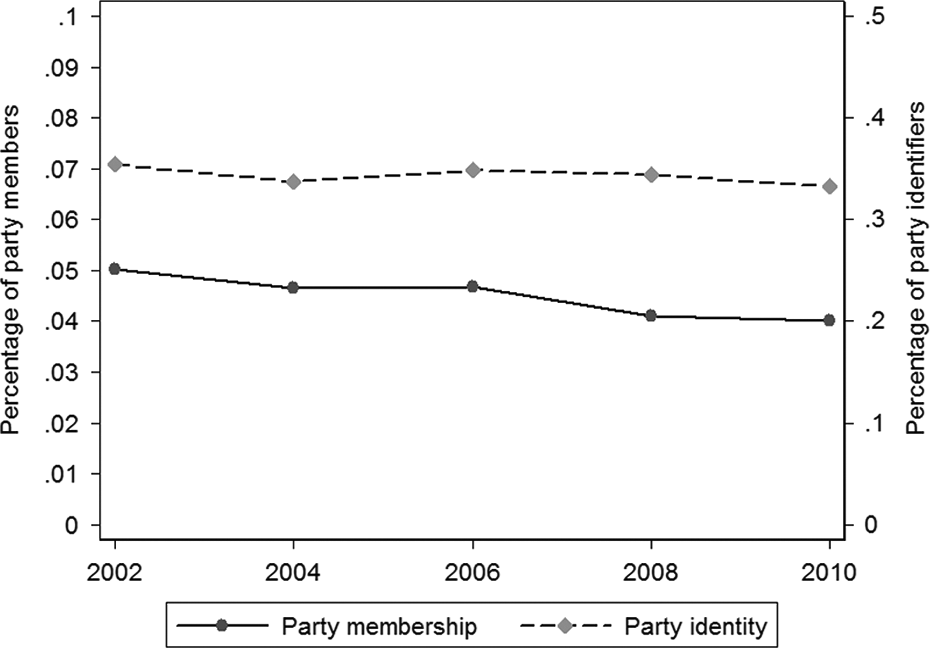
Percentage of party members and party identifiers in European countries, ESS, 2002–2010.
The general figures, however, already make clear that the decline in party membership is most likely not an important cause of the alleged changes in political trust levels. The percentage of respondents reporting such a membership is low to start with, and declines with 1.0 percent of all respondents over the observation period. All in all, this limited trend in absolute numbers cannot be the cause of major shifts with regard to political trust, and therefore it is important to look at the wider circle of citizens feeling close to a political party.
In the ESS, respondents are asked: ‘Is there a particular political party you feel closer to than all the other parties?’. Although this question does not respond to the party identity question that is included in US election studies, it is closely related to the ‘feeling close to a political party’ question that is included in European surveys such as the German Socio–Economic Panel survey (Dassonneville et al., 2012). Those who replied they felt closer to a specific political party received a follow–up question on how closely related they felt with that specific party. A small proportion of the respondents indicated here that they did not even feel close to that specific party. These respondents were excluded, so as party identifiers we keep only the respondents who first say they feel closer to a specific political party compared to all the other parties, and subsequently that they feel ‘very’ or ‘quite’ close to that specific party. In contrast to party membership, the survey data show that party closeness remains fairly stable, with a slight decline from 35 percent in the first wave to 33 percent in the fifth wave in 2010 (Figure 1). The figures per country show a very strong drop in the proportion of party identifiers in 2010 in Greece and Cyprus, countries that are hit very hard by the economic and financial crisis. While Dalton (2002: 25) could still argue a decline in levels of party identification during the last quarter of the 20th century, in the first decade of the 21st century, the level of party identification is stable during most of the observation period. 1
Constructing the model
Following this brief presentation of the data, we can now start the construction of our multilevel model – based on data from all 30 countries. For the dependent variable, political trust, we rely on a battery measuring trust in political institutions, as from an Eastonian perspective this is the most fundamental and persistent kind of support for the functioning of the political system. Institutional trust is also more stable than survey questions on satisfaction with the way democracy is functioning in the country of the respondent (Marien, 2011). Six institutions have been included in every single ESS round and these six items form a strong and one–dimensional scale on political trust. However, due to the high item non–response concerning trust in the European parliament and trust in the United Nations we use four of those items to conduct a principle component analysis (Table 1). While in some previous research a distinction was made between representative institutions and law–and–order institutions (Rothstein, 2011), the factor solution does not warrant such a distinction in this case. It is important to note here that ‘trust in political parties’ was not included in every ESS round in this battery, and therefore parties themselves are not included in the scale. This also strengthens our argument, as it would be a rather tautological finding that members of parties have more trust in parties. In line with previous research, we find the highest levels of political trust in Denmark and Finland, and the lowest levels in Ukraine, Bulgaria and Croatia. Given the strong one–dimensional character of political trust and its internal coherence, this variable can be used as a dependent variable in the analysis.
Factor analysis for political trust.

Note: Entries are the results of a principal component analysis, ESS, 2002–2010 cumulative file. 1 component extracted, eigen value 2.810, 70.25 percent explained variance.
As independent variables, we use party membership and feeling close to a political party and subsequently we can also allow these variables to interact with the ESS rounds (1 to 5) to ascertain whether effects of membership and closeness are stable over time. This allows us to test the assumption that membership and closeness not only decline in purely quantitative terms, but also that they could become weaker linkage mechanisms themselves.
When investigating the impact of party membership and closeness, it is important to control for other elements that according to previous research have an effect on political trust levels (Schoon and Cheng, 2011; Zmerli and Hooghe, 2011). Age and gender are obvious control variables, while previous research has consistently shown that those with a high socio–economic status are more likely to trust political institutions (Hakhverdian and Mayne, 2012). Socio–economic status is operationalized here as education level and satisfaction with family income. We include this admittedly more subjective measurement because the direct question on family income is plagued by high levels of item non–response, and furthermore is difficult to compare across the 30 countries. Given the ongoing concern about the effect of media use on political trust, we also include measurements on the time spent watching television and the frequency of reading newspapers (Avery, 2009; Schmitt–Beck and Wolsing, 2010). As religious people on average are more trusting (Newton, 2007), we also include a question on how important religion is to the respondent. As immigrants and non–nationals in numerous countries are being confronted with discriminatory practices, we also assume that these groups will have lower levels of political trust. Furthermore, we include a linear time variable to control for the possibility that party membership and party closeness as well as political trust show a trend over time (Fairbrother and Martin, 2013).
The last control variable is introduced at the country level. More than 20 years after the transition to democracy, many countries in Eastern and Central Europe are still characterized by relatively low levels of political trust (Dimitrova–Grajzl and Simon, 2010). In order to account for this fact, we introduce a dummy for countries that have a legacy of an authoritarian regime until the early 1990s.
As already mentioned, the data underlying this analysis are clustered. Respondents are grouped within country–years (or waves) of the ESS and these country–years are nested within countries. Therefore, we construct a three–level random intercept model in which we include characteristics of respondents as well as country–specific features as independent variables.
Model 0 (Table 2) represents the null model in which the variance is decomposed into three independent components: the variance within the respondents from each country–year from each country (individual–level variance), the variance between different country–years within each country (country–year variance) and the variance between different countries (country–level variance). As this model contains no independent variables but only an intercept and random effects it serves as baseline model evaluating the model fit of the following models. Looking at the size of the random effects, Model 0 shows that most of the variance of political trust is found at the individual level (roughly 73.8 percent of the entire variance), while the variance between different waves within each country is rather limited (2.7 percent). About 23.5 percent of the variance of political trust is found between the different countries. This indicates clear differences between countries, while the evolution over time is present but does remain limited.
The effect of party membership and closeness on political trust.

Note: Entries are parameter estimates and standard errors (in parentheses) of a multilevel linear regression. All models include 199,160 individuals on the first level, 121 country-years on the second level and 30 countries on the third level. Sign.: * < 0.05, ** < 0.01, *** < 0.001.
In the first model we enter the individual–level independent variables and time as second–level independent variable. Rather strikingly, almost all of the variables, except for gender, are highly significant, partly because of the large number of respondents. Satisfaction with family income is positively related to political trust, confirming what Newton (2007) already wrote about the ‘winners in society’, who have more reasons to trust the system that rewards them so generously. Also the level of education is positively correlated with political trust indicating trust rises with the level of education. In line with previous research, religious people are more trusting toward the political system, while we also observe significantly lower levels of trust among those who are born in the country or are a citizen of the country. Immigrants and non–nationals are thus unexpectedly more trusting than nationals. Also somewhat contrary to expectations, we can observe that there is a positive relation between the year of birth and political trust levels. On closer inspection, especially the youngest age groups seem to express more trust in political institutions than the rest of the population does.
Interpreting our independent variables of interest, we can conclude that party members are more trusting toward political institutions, as there is a strong positive association between both variables. If, in an additional control, we divide the entire sample into samples for every country, we can observe that in some countries there is no significant relation between membership and political trust (in Austria, Croatia, Czech Republic, Estonia, France, Greece, Hungary, Israel, Luxembourg, Poland, Portugal, Slovakia, Spain, Turkey and Ukraine).
The model, furthermore, shows that feeling close to a political party is just as strongly associated with political trust, and if again we divide the analysis per country this significant positive relationship is found in every country, with the sole exceptions of Israel, where the relationship is not significant, and Turkey, where the effect is significant but negative. 2 The positive relation between closeness to a party and political trust, is thus much more of a general phenomenon than the positive relation between party membership and political trust.
Overall, this model allows for 5.9 percent of explained variance on the individual level, 24.4 percent explained variance on the country–year level and about 26.7 percent of explained variance on the country level. We also notice a small effect of the ESS round, indicating that political trust levels tend to decline in these 30 democracies; a trend which is – when examining the countries one by one – valid for 8 out of the 30 countries. 3
In Model II we introduce the dummy variable at the country level which controls for an authoritarian historical legacy in Eastern and Central Europe. This variable has a significant negative effect on political trust, confirming earlier studies which found lower levels of political trust in the countries of Central and Eastern Europe. Introducing this country–level variable does not have an effect on the individual–level effects that were found in Model I.
The fact that feeling close to a political party has such a strong effect on political trust almost automatically leads to the question how this relation could be explained. As it is rather easy for a respondent to claim that s/he feels ‘close’ to a political party, this might as well serve as a proxy for political interest. The problem with this attitude, however, is that it is has only limited measurements in the ESS questionnaire. The measurement of political interest is based on a single item on ‘how interested are you in politics’. Nevertheless, if the statement that one feels close to a political party was just the expression of a more general interested attitude toward the political system, this item might capture most of those feelings, and therefore it is added in Model III. What we can observe is that, despite the limited measurement, political interest takes away about half of the effect that was attributed to education level in Model II. Also the effect of newspaper reading remains less than half as strong after the introduction of political interest. Compared with Model II, political interest also takes up some of the effect that was attributed to party membership and party closeness, but not all that much. The conclusion therefore can remain that party closeness does remain associated with political trust, even controlling for political interest. Reporting that one feels ‘close’ to a political party is not just a vague statement showing that one is politically interested.
As we are interested in changes over time, in Model IV, we include two interaction effects: party membership and party closeness with time. The interaction effect between party membership and time is not significant, which means that the effect of party membership remains the same over time. Or, put differently, while the number of party members might decline, for those who are members there is no change in the relation with political trust levels. On the other hand, we find that the interaction between party closeness and time has a significant positive effect on political trust, indicating that the effect of party closeness became slightly stronger over the observation period of eight years. Not only have we observed that party closeness is positively associated with political trust, this association seems to grow stronger over time. This increase does remain modest, as we can observe that the explained variance of Model IV is only slightly higher than that of Model III. Model IV explains about 6.8 percent of the individual level, 25.6 percent of the country–year level and roughly 60 percent of the country–level variance. 4
Both variables of interest, party membership as well as party closeness, have a positive effect on political trust, and the effect of party closeness becomes even stronger over time. However, based on this analysis, we cannot directly compare the strength of the two effects as the coefficients are not standardized. In the current operationalization, it thus remains unclear which of these variables is the more important. In order to make the strength of the two effects comparable, it has to be kept in mind that party membership is almost by definition a dummy variable: one is a member or one is not. Standardizing the coefficients thus makes little sense (Kohler and Kreuter, 2008: 206). Therefore, in order to conduct this control, we coded the closeness variable categorically using ‘Feeling not at all close to a political party’ as reference category. Subsequently we introduced three dummies for ‘feeling very close’, ‘feeling quite close’ and ‘feeling not close to a political party’ into the analysis (for a description of these dummies see Table B.1 in the Appendix).
Hence, Model III is repeated, but instead of using the continuous variable for feeling close to a political party we use the categorical variable. The results of this Model V (Table 3) show that the effect of feeling ‘very close’ as well as the effect of feeling ‘quite close’ to a political party has a significant positive effect on political trust, which in both cases is considerably larger than the effect of party membership. This is true even if we consider only those that feel ‘very close to a political party’ as identifiers. The conclusion therefore has to be that formal party membership does not play a privileged role with regard to the development of political trust, as feeling close to a political party clearly has a considerably stronger effect. 5
Comparing the effect of party membership and identification on political trust.
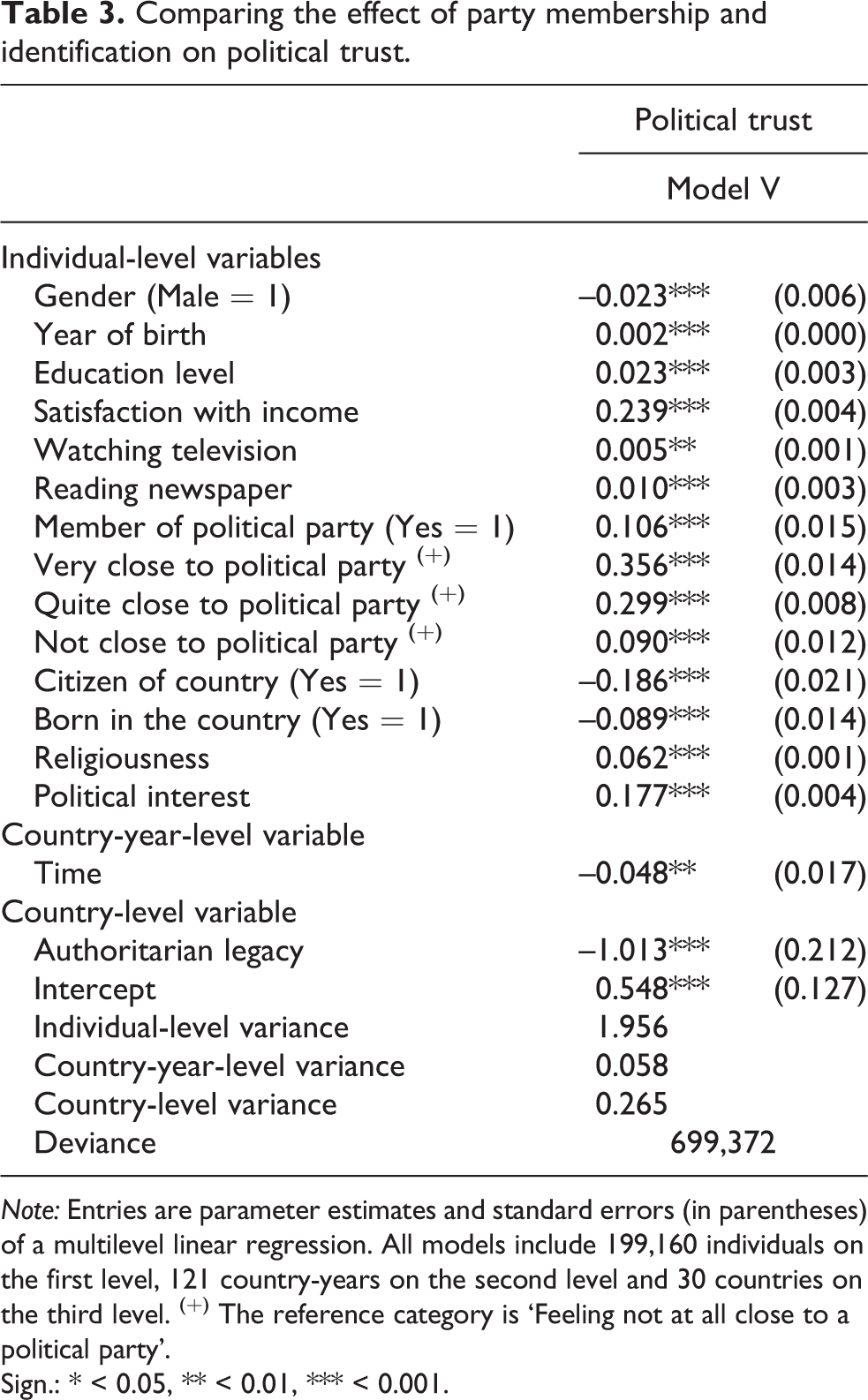
Note: Entries are parameter estimates and standard errors (in parentheses) of a multilevel linear regression. All models include 199,160 individuals on the first level, 121 country-years on the second level and 30 countries on the third level. (+) The reference category is ‘Feeling not at all close to a political party’.
Sign.: * < 0.05, ** < 0.01, *** < 0.001.
Discussion
We started this analysis based on the assumption that political parties provide a structural linkage mechanism between citizens and the political system. Political parties are attributed with numerous functions within a political system, and as parties lose members it can be expected that these functions are no longer being taken up to the same extent. Whiteley (2011: 22) has even argued that the decline in membership might lead to negative outcomes for the stability of democratic regimes: ‘Such a decline is likely to weaken civil society by undermining key relationships between citizens and the state, many of which are sustained by political parties.’ The current analysis allows us to qualify this pessimistic outlook to some extent. Not party membership, as such, seems to be the strongest linkage mechanism between citizens and the state. In countries with low levels of political trust like Poland or Hungary, but also Austria and Luxembourg, there is not even a positive relation between party membership and trust. In those countries, it is apparently possible to combine a rather cynical outlook toward the political system with being active inside political parties. Party membership clearly can have numerous motivations, including instrumental ones, and not all of them are necessarily oriented toward the general functioning of the political system.
While there is of course ample evidence about the decline of party membership, it is hard to imagine how this process could have had a massive impact on mass attitudes toward the political system. Even in the heyday of mass parties, more than 90 percent of citizens have never been a member of a political party. While concern about the decline of party membership is of course legitimate, numbers and trends are simply too small to have had any impact on the attitudes of the general population. Therefore, the decline in party membership cannot have been a direct driving factor in the evolution of political trust in liberal democracies.
The pessimistic outlook of Whiteley is confirmed, however, if we interpret commitment to a political party much more broadly, and also take into account feeling close to a political party. Party closeness is more strongly related to political trust, and this relation furthermore becomes stronger over time. This does not solve the problem, however, as party closeness is not eroding across European societies. While it might have been eroding during the 20th century, as Dalton argues, current trends are stable. While in a limited number of countries party closeness seems to have lost some of its appeal, there is no general trend in this regard. Given the fact that party closeness is stable, it cannot be held responsible for trends in levels of political trust either.
An important caveat in interpreting our findings is that we only have access to cross–sectional observations, so we can only demonstrate associations, and there is not all that much we can say about the direction of causality. What we do know is that citizens who feel close to a political party clearly have higher levels of political trust. It is difficult to imagine, however, that those who would be trusting toward the political system therefore would be more inclined to state that they feel close to one specific party. If one is satisfied with the functioning of the political system as a whole, there is no apparent reason to develop a close relation with one specific party within that system. The other relation, from party closeness to the development of political trust, is much more clearly founded in the literature on party identity and preference. Having a clear preference for a specific political party allows citizens to make choices in the political decision–making process; it provides them with ideological cues and party closeness can often serve as a kind of road–map in following current political affairs.
The theoretical relevance of these results is that in the literature there is a tendency to pay too much attention to formal party membership. Self–evidently, membership is an attractive category to work with, as it is a discrete option (member or not a member), figures are registered, and one can obtain historical data from party organizations. Despite these obvious advantages of the data, from a political science perspective we are less interested in whether citizens are actually card–carrying members or not. What we do want to know is whether citizens use political parties as a device to gain entrance to the political system. The question whether this requires an official membership card or not is of less importance in this regard. It is a likely assumption that the importance of formal membership has become weakened because political parties themselves have stopped their investment in actively recruiting members, as they no longer fit in the model of a professional electoral party. This means that, to a lesser extent than in the past, party membership is a privileged instrument to remaining connected to party politics. Less formalized modes of party alignment do remain prevalent and powerful, however.
The current analysis suggests that party closeness in this regard is much more important. Those who do not feel close to any specific political party are most likely to develop a less trusting outlook toward the political system in general. We started this analysis with the apparent puzzle that while party membership is in decline in Europe, levels of political trust remain stable. A likely solution to this puzzle is that party membership is in no way essential, as party closeness serves as an ever stronger linkage mechanism to the political system. The trend toward professionalized party politics, eroding the need for party members, might have a number of negative side effects, but it does not mean that political parties have lost touch with society. Even if they are no longer needed as members or as campaign volunteers, citizens still identify with political parties, and this feeling of identification and closeness apparently is more than sufficient to be able to connect to the political system as a whole. While political parties might lose members, at least in Western Europe they still seem to hold on to their partisan supporters.
Footnotes
Appendix
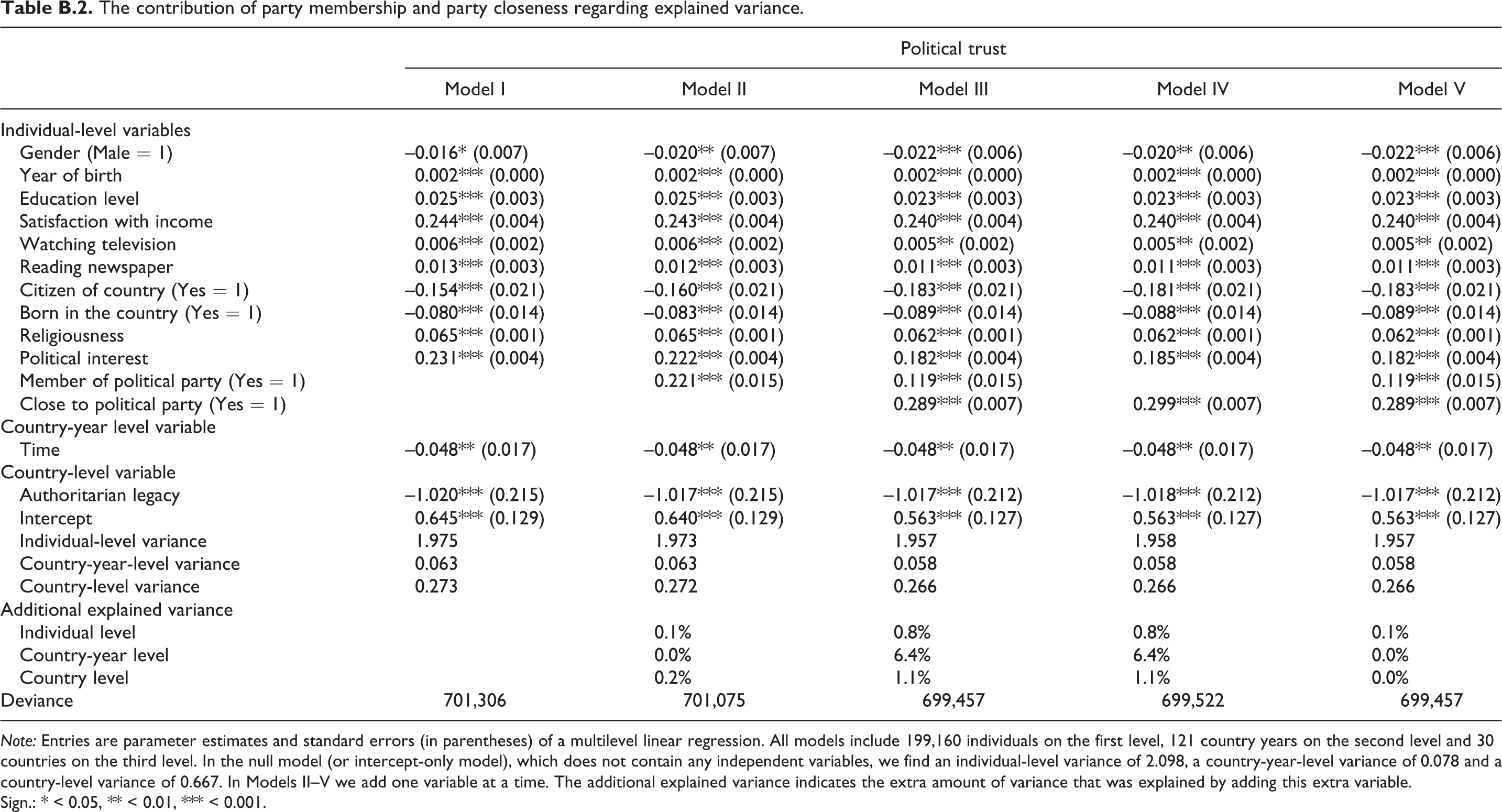
The contribution of party membership and party closeness regarding explained variance.
| Political trust | |||||
|---|---|---|---|---|---|
| Model I | Model II | Model III | Model IV | Model V | |
| Individual-level variables | |||||
| Gender (Male = 1) | –0.016* (0.007) | –0.020** (0.007) | –0.022*** (0.006) | –0.020** (0.006) | –0.022*** (0.006) |
| Year of birth | 0.002*** (0.000) | 0.002*** (0.000) | 0.002*** (0.000) | 0.002*** (0.000) | 0.002*** (0.000) |
| Education level | 0.025*** (0.003) | 0.025*** (0.003) | 0.023*** (0.003) | 0.023*** (0.003) | 0.023*** (0.003) |
| Satisfaction with income | 0.244*** (0.004) | 0.243*** (0.004) | 0.240*** (0.004) | 0.240*** (0.004) | 0.240*** (0.004) |
| Watching television | 0.006*** (0.002) | 0.006*** (0.002) | 0.005** (0.002) | 0.005** (0.002) | 0.005** (0.002) |
| Reading newspaper | 0.013*** (0.003) | 0.012*** (0.003) | 0.011*** (0.003) | 0.011*** (0.003) | 0.011*** (0.003) |
| Citizen of country (Yes = 1) | –0.154*** (0.021) | –0.160*** (0.021) | –0.183*** (0.021) | –0.181*** (0.021) | –0.183*** (0.021) |
| Born in the country (Yes = 1) | –0.080*** (0.014) | –0.083*** (0.014) | –0.089*** (0.014) | –0.088*** (0.014) | –0.089*** (0.014) |
| Religiousness | 0.065*** (0.001) | 0.065*** (0.001) | 0.062*** (0.001) | 0.062*** (0.001) | 0.062*** (0.001) |
| Political interest | 0.231*** (0.004) | 0.222*** (0.004) | 0.182*** (0.004) | 0.185*** (0.004) | 0.182*** (0.004) |
| Member of political party (Yes = 1) | 0.221*** (0.015) | 0.119*** (0.015) | 0.119*** (0.015) | ||
| Close to political party (Yes = 1) | 0.289*** (0.007) | 0.299*** (0.007) | 0.289*** (0.007) | ||
| Country-year level variable | |||||
| Time | –0.048** (0.017) | –0.048** (0.017) | –0.048** (0.017) | –0.048** (0.017) | –0.048** (0.017) |
| Country-level variable | |||||
| Authoritarian legacy | –1.020*** (0.215) | –1.017*** (0.215) | –1.017*** (0.212) | –1.018*** (0.212) | –1.017*** (0.212) |
| Intercept | 0.645*** (0.129) | 0.640*** (0.129) | 0.563*** (0.127) | 0.563*** (0.127) | 0.563*** (0.127) |
| Individual-level variance | 1.975 | 1.973 | 1.957 | 1.958 | 1.957 |
| Country-year-level variance | 0.063 | 0.063 | 0.058 | 0.058 | 0.058 |
| Country-level variance | 0.273 | 0.272 | 0.266 | 0.266 | 0.266 |
| Additional explained variance | |||||
| Individual level | 0.1% | 0.8% | 0.8% | 0.1% | |
| Country-year level | 0.0% | 6.4% | 6.4% | 0.0% | |
| Country level | 0.2% | 1.1% | 1.1% | 0.0% | |
| Deviance | 701,306 | 701,075 | 699,457 | 699,522 | 699,457 |
Note: Entries are parameter estimates and standard errors (in parentheses) of a multilevel linear regression. All models include 199,160 individuals on the first level, 121 country years on the second level and 30 countries on the third level. In the null model (or intercept-only model), which does not contain any independent variables, we find an individual-level variance of 2.098, a country-year-level variance of 0.078 and a country-level variance of 0.667. In Models II–V we add one variable at a time. The additional explained variance indicates the extra amount of variance that was explained by adding this extra variable.
Sign.: * < 0.05, ** < 0.01, *** < 0.001.
Funding
The author(s) disclosed receipt of the following financial support for the research, authorship, and/or publication of this article: The research leading to these results has received funding from the European Research Council under the European Union’s Seventh Framework Programme (FP7/2007-2013) / ERC grant agreement n° 295920.