




Abstract
In multi-level systems, state-wide parties are faced with particular challenges. Competing in elections on multiple levels of the polity, such parties juggle the desire for national recognizability and the need to be responsive to regional particularities. In this paper, I reflect on the delegation model of multi-level party politics, which is a theoretical perspective of great importance in the literature, arguing that the accuracy of the model depends on two critical assumptions. Based on these theoretical considerations, I develop the model further and apply it to the case of the two main Spanish state-wide parties, the Partido Socialista Obrero Español (PSOE) and the Partido Popular (PP). More specifically, the programmatic positions of their regional branches are analyzed, and it is shown that the framework manifestos issued by the national party organizations shape these to a large extent. While this case is used to illustrate the illuminating potential of the extended delegation model, the paper is similarly attentive to the limitations of the model and also hints at the implications for our conception of democracy in multi-level systems.
Keywords
Introduction
Challenging a so-called “national bias” (Deschouwer, 2006: 291–292; Fabre and Swenden, 2013: 344–345; Swenden and Maddens, 2009: 4–6) in the literature, scholars of party politics today consider the effects of the multi-level nature of some political systems much more explicitly than in the past – e.g. when it comes to coalition formation (Bäck et al., 2013) or portfolio allocation (Falcó-Gimeno, 2014). Essentially, there are more intricate ways for parties to fulfill their representative and governmental functions in a multi-level system compared to a uni-level system (Deschouwer, 2003: 220). The various levels of such a system contain distinct political arenas, which simultaneously interact within and across levels.
The most extensive theoretical framework for understanding party politics in such systems has been presented by van Houten (2009a, 2009b). Conceiving national party organizations as principals and their respective regional party branches as agents, he employs a delegation perspective to illuminate their relationship. His model is of tremendous importance and is (implicitly) invoked in a great variety of studies on regional coalition formation and programmatic positioning.
In this paper, I revisit van Houten’s theory in an attempt to reveal exactly how strongly its interpretations hinge on two critical assumptions, namely that regional branches have an incentive to deviate from the (national) party line in order to maximize votes in regional elections and that the national party organizations have incentives to control and minimize such deviation in order to maximize votes in national elections. Based on this theoretical analysis, I develop the model further by explicitly integrating a spatial component. I then show the illuminative potential of the extended model by analyzing the determinants of regional party branch programmatic positioning using election manifestos of the two main Spanish state-wide parties, the Partido Socialista Obrero Español (PSOE) and the Partido Popular (PP). Accordingly, I interpret the so-called framework manifestos issued by the national organizations of both parties in advance of regional elections as ex ante control mechanisms aimed at minimizing agency slack.
The next section reviews the delegation model of multi-level party politics, illustrates its relevance in the literature and stresses the centrality of some of its assumptions. Next, the model is extended with recourse to the economic theory of party competition (Downs, 1957). The fourth section justifies the selection of the two main Spanish state-wide parties as cases to gauge the empirical power of the extended delegation model and describes the data and strategy utilized in doing so. Subsequent to the analysis section, the conclusion summarizes the main points of the paper, emphasizing the implications for further theoretical development, empirical research and our conception of democracy in multi-level systems.
The delegation model of multi-level party politics
The basic set-up
Models relating to principal-agent theory (delegation models) commence with the assumption that a principal delegates tasks to an agent. In his delegation model, van Houten (2009a: 139–140) conceptualizes the national party as the principal and its regional branches as agents. The model presumes that the national party is primarily interested in maximizing votes in national elections, whereas the regional branches are most concerned with maximizing votes in regional elections (van Houten, 2009a: 140–141).
The task delegated to the regional branches is that of organizing the election campaigns for national and regional elections in their respective regions. For the national party, the necessary relinquishment of some autonomy to its regional branches is outweighed by a number of advantages. In addition to easing the workload, delegation can help the national party succeed in a region in national elections (van Houten, 2009a: 141): First, a regional branch has better information and more experience with the voters in a region and consequently knows best how to tailor the message of the party to the needs of the regional voters. Second, it has a special degree of credibility with respect to the regional electorate. Accordingly, the amount of autonomy granted to a regional branch by its national party organization should correlate with region-specific demands for information, expertise and credibility. This demand should be greatest in regions which differ from other regions with regard to ethnic, cultural and political-administrative competencies (Swenden and Maddens, 2009: 17; van Houten, 2009a: 141).
As in every delegation model, there are not only benefits accruing for the principal but also costs through so-called agency slack. The most relevant problem here, conflict of interest, refers to the situation whereby the authority granted by the national party may not be used by the agent to satisfy the interests of its principal but to follow its own interests. Conflict of interest emerges from the strategically advantageous position the agent has in the delegation relationship (Kiewit and McCubbins, 1991: 25–26). In order to receive good results in regional elections, the regional branch may try to tailor its program as accurately as possible to the preferences of the regional voters (van Houten, 2009a: 144). According to the model, the resulting divergence may induce costs for the national party. If the programs of the various regional branches diverge too much from each other, the credibility of the national program of the party is undermined (Swenden and Maddens, 2009: 13; van Houten, 2009a: 143). This is the key dilemma for the national party: on the one hand, they have to grant their regional branches autonomy in order to profit from the hidden information they have about the regional electorates. On the other hand, the national party has to be careful not to get too programmatically incoherent because this would be electorally disadvantageous (van Houten, 2009a: 143–144).
One of the most central implications of delegation models is that the principal has ample incentives to minimize agency costs and thereby maintain the delegation’s profitability. It tries to do so by employing control mechanisms (cf. Kiewit and McCubbins, 1991: 27–34). Van Houten (2009b: 170) lists a variety of formal and informal rules and conventions of multi-level parties which could be “hypothesized to be mechanisms controlling the actions and policies of regional branches” (van Houten, 2009a: 151).
Relevance of the model for the literature
Even though the delegation model is not always explicitly invoked, it is directly relevant to large parts of the literature. First and foremost, its main explanandum, regional party branch autonomy, is a concept that is almost universally used in research on multi-level parties (cf. Fabre and Swenden, 2013: 345). Autonomy describes the freedom of a regional branch to conduct its affairs without intervention from the national party (Fabre and Méndez-Lago, 2009: 103; Thorlakson, 2009: 162). Autonomy has so far been operationalized by the degree of interference of the national level with regard to the organizational structures of the branches, the selection of regional party leaders as well as candidates for regional elections, the funding of regional branches and the question of who is involved in the drafting of regional election manifestos (Deschouwer, 2006: 294; Fabre, 2011: 347; Fabre and Méndez-Lago, 2009: 102–103). Interestingly, these indicators closely correspond to what van Houten (2009a: 145–147, 2009b: 170) hypothesizes to be control mechanisms used by the national party. One could thus say that he provides an elaborate theoretical foundation for the operationalization of multi-level party measures.
Second and related, the model’s central contention that national party organizations want to limit the autonomy of their regional branches when they fear disadvantages for themselves is a more generic version of congruence theory. This perspective enjoys wide recognition in scholarship on regional government formation (e.g. Bäck et al., 2013; Downs, 1998; Ştefuriuc, 2013). The central hypothesis of this approach is that the composition of government coalitions is likely to be congruent across levels of a political system insofar as election results allow this (Roberts, 1989; Ştefuriuc, 2013: 27–28). Even though the primary mechanism that is thought to drive this tendency is the threat of the otherwise resulting stalemate in systems that require a high level of intergovernmental coordination (Ştefuriuc, 2013: 27–28; Thorlakson, 2006), the delegation model is closely linked to congruence theory. The latter explicitly stresses that party organization is an intermediate variable, as regional coalition formation can be considered a nested game (Ştefuriuc, 2013: 22; Tsebelis, 1990), in which “subnational parties negotiate simultaneously with their local rivals and with their own central party leaders” (Downs, 1998: 55; emphasis in original). The salience of building congruent coalitions diminishes as the autonomy of regional party branches increases (Ştefuriuc, 2013: 30). Even more pertinent, both theories follow a very similar line of reasoning on a higher level of abstraction. This becomes evident when one considers the contention that congruence accounts for the multi-level party’s challenge of “maintaining a coherent and well-coordinated party line across levels of government, while at the same time responding to what might prove to be highly dissimilar political and electoral cross-level dynamics” (Ştefuriuc, 2009: 4). It is the national party organization that needs to “assess the trade-offs between dictating their will and diffusing internal dissent” (Downs, 1998: 55).
Third, an important strand of research with respect to multi-level party politics takes the electoral strategies of regional party branches in general and their programmatic positioning in particular as the dependent variable (e.g. Giger et al., 2011; Libbrecht et al., 2013; Müller, 2009). With explicit reference to van Houten’s (2009a) delegation model, Müller assumes …that a similar logic [to the one of congruence theory] can be applied to policy positions: sub-national parties’ freedom to adjust their policy positions according to the regional context is limited by the positions preferred by their counterpart at the national level. (Müller, 2013: 179)
In sum, the concept of party branch autonomy as well as congruence theoretical approaches in the literature on regional government formation and regional party positioning explicitly or implicitly build on the interpretation of multi-level party politics suggested by van Houten’s (2009a, 2009b) principal-agent model. In this paper, I scrutinize the plausibility of this interpretation by problematizing two assumptions on which the model relies. The following subsection attempts to illustrate just how critical these premises are for the understanding of the internal life of multi-level parties advanced in the model itself, but also in the scholarship that builds on it: generally speaking, an alternative theoretical conclusion would raise alternative interpretations of the very same empirical material.
Critical assumptions: incentives to deviate and consistency benefits
The first assumption of the delegation model is that regional party branches have incentives to deviate from the (national) party line. To reiterate, the logic behind this is that regional electorates are (more or less) distinct from the national electorate. A regional party branch thus needs to adapt the party’s message. Incentives are likely to be stronger when the party branch campaigns in a regional election compared to when it campaigns on behalf of the national party in a national election because, by definition, its foremost motivation is to win regional elections. More or less implicit, this refers to the presumption that regional party branches believe that the regional political level matters for regional voting behavior. This may not necessarily be the case. According to the second-order-elections perspective (Reif and Schmitt, 1980), we would expect voters to use the national political level in order to make up their minds about which parties to vote for in regional elections. Accordingly, regional party branches would not have incentives to actively differentiate themselves from the national party because voters do not pay attention to their activities anyway. Without incentives to deviate, equating behavioral overlap of the regional branches and the national party with the lack of autonomy of the former would be questionable.
Whether this assumption holds is not an either–or question. Rather, it is probably more accurate to speak of a degree to which voters perceive regional elections as a part of a nation-wide or as a genuinely regional electoral battle (cf. Hopkin, 2003: 231). The delegation model should then be most accurate at one end of this continuum and gradually become less accurate the more we shift to the other end. In any case, it seems necessary to model such incentives explicitly. Studies on regional government formation include, for instance, variables relating to the regional political arenas in conjunction with congruence variables (e.g. Bäck et al., 2013). Similarly, Müller (2013) explains programmatic shifts of regional party branches with the regional context.
The second assumption of the delegation model is that there are benefits to consistency. The national party organizations’ supposed motivation for utilizing control mechanisms on and thereby reducing the autonomy of their regional branches is their belief that inconsistent behavior across levels hinders their electoral chances in the ensuing national elections. 1 The “consistency benefits assumption” can be justified with recourse to an informational perspective on voting behavior. Parties essentially function as brands (Snyder and Ting, 2002; see also Carty, 2004: 10–11). They supply low-cost information about the preferences of candidates for the voters. Yet, “the message conveyed by a party label is determined by the sets of candidates who run under it. As a result, a party’s label is informative only if the types of candidates who run under it are limited” (Snyder and Ting, 2002: 91). As programmatic heterogeneity increases, the party label provides less guidance to voters, who are usually risk averse and incompletely informed (Snyder and Ting, 2002: 90). However, this assumption may equally be open to challenge: indeed, one could claim that voters do not suffer from decreased brand effects under programmatic heterogeneity because they only care about the issues important, and the positions taken, in their own constituency at any given time. Indeed, it is hardly conceivable that average voters go to the trouble of informing themselves not only about the election in their own region but also the elections in other regions, and actively compare the positions of a party across regions. It is therefore highly unlikely that they even notice “special treatment for one region” (van Houten, 2009a: 143), unless it is strikingly outrageous and thus given great media coverage. In this light, programmatic heterogeneity is probably even encouraged for regional elections – if we relax the assumption that the national party only cares about its performance in national elections – and may even be an electorally advantageous strategy in national election campaigns, depending partly on the electoral system (Katz, 1980).
Seen from this angle, the conclusions of the delegation model invert. Its main claim, that the rules and conventions regulating multi-level interaction represent control mechanisms (van Houten, 2009a: 151), is merely a hypothesis. Without consistency benefits – that is, without a reason for the national party to exert control on its regional branches – interpreting said rules and conventions in such a way is in all likelihood erroneous. And if this is so, then it is not correct to equate behavioral divergence of regional branches with autonomy.
In any case, it seems essential to at least identify the supposed control mechanisms at work. Without this, conclusions are on shaky grounds. Divergence could mean autonomy, but it need not. Overlap could be a product of successful control, but it could also be genuine. Studies on regional government formation and regional positioning have thus far not been able to explicitly model the control mechanisms. For example, Müller (2013) indicates that he can only “assume that the national parties set guidelines for the regional branches’ positions [… because] it is rather unclear which control mechanisms are employed by the national party and how they ultimately influence party positions” (185; emphasis added) and he interprets the empirical result that German regional party branches shift their programmatic positions towards the party mean accordingly (192).
Extending the delegation model
The previous section elaborated on the importance of two assumptions of the delegation model of multi-level party politics. This discussion is used as a starting point for enriching the model. While the “incentives-to-deviate assumption” is modeled theoretically in the next section, the consequence of the “consistency benefits assumption” is modeled empirically in the case study below.
Explanatory factors of regional party policy
The delegation model assumes that regional party branches aim at vote maximization, which means that they will engage in behavior that they believe makes the voters of their electorate more likely to vote for them. In that way, they are not significantly different from national party organizations and, consequently, the theories that have been developed for the latter should similarly apply.
The conclusion of the literature is that the factors which have been identified by spatial theories of party competition carry great empirical weight (for an overview, see Adams, 2012). With respect to the applicability of these spatial theories to the regional context, Müller (2013) has shown that the shifts of German regional party branches are partly responses to shifts of the regional median voters.
Apart from spatial theories of party competition, there is also a socio-structural perspective. In this strand of literature, the divergence of a party’s policy program across regions is attributed to the differential territorial salience of cleavages (Lipset and Rokkan, 1967) in these regions. It has been shown that the policy positions of (some) German regional party branches differ according to socio-economic variables such as the share of Catholics, the share of people living in rural areas and the share of unemployed in a Bundesland (Müller, 2009). Similarly, there is evidence that the policy positions of Swiss regional party branches correspond to cantonal population density and the share of unemployed (Giger et al., 2011).
What both approaches to explaining regional policy positions have in common is that they attribute differences between branches of the same party to the different compositions of the respective target electorates. And while both sets of factors are potentially relevant in modeling an incentive for regional party branches to deviate from the national party organization (assuming that the regions differ in population composition to the overall population), I will here commence with the “logical starting point for analyzing the ideological linkages between parties and the mass public” (Adams et al., 2004: 592), which is that parties orient themselves towards the position of the median voter.
Spatial modeling of regional party competition
Spatial theories of party competition in general and the hypothesis of median voter orientation in particular stem from the economic theory of politics (Downs, 1957). According to this theory, it is possible to order the ideological positions of the parties sensibly on a line. If one now distributes the voters according to their own ideal positions on that line, it follows – assuming that voters are rational policy-seekers and that their preferences are single-peaked – that every voter votes for the party which occupies the position closest to her own position (Downs, 1957: 138, 142). If parties are rational office-seekers and the positions of the voters are normally distributed around the median voter, it follows that both parties in a two-party system with majority voting will position themselves close to the median voter. This way, they can gain more votes in the middle than they lose at the extremes – e.g. through abstention triggered by disappointment. The final consequence is programmatic convergence (Downs, 1957: 137, 142–143).
Adams and Somer-Topcu (2009: 679–680) argue that this logic extends to multi-party systems as well. While parties may never actually converge, almost any party would be expected to win votes when shifting its position towards the median voter, no matter how many parties exist and which electoral law is used, provided that the voter distribution is single-peaked.
Integrating a Downsian spatial component into the delegation model, I hypothesize that the regional party branches orient their programmatic position towards the position of the median voter in their specific regional electorate, just as national party organizations orient their programmatic positions towards the position of the national median voter.
Multi-level party relations in Spain as an empirical illustration
Reasons for studying the two main Spanish state-wide parties
Below, I probe the illuminative potential of the extended delegation model by analyzing the determinants of programmatic positioning of regional party branches in regional elections in the case of the social democratic Partido Socialista Obrero Español (PSOE) and the conservative Partido Popular (PP). These are the two main state-wide parties in Spain around which the national as well as most regional party systems have bipolarized (Wilson, 2012). Taken together, both parties regularly receive between 70% and 90% of all votes in national as well as most regional elections (Wilson, 2012: 127–128). They can be regarded as an appropriate sample for the following reasons:
First, I argue that it is possible to identify a control mechanism employed by the PSOE and the PP, which the theoretical section argued to be a central precondition if we want to draw conclusions about regional branch autonomy. Both national party organizations issued so-called framework manifestos (programas marcos) for the concurrent regional election campaigns of their branches in 2003, 2007 and 2011. 2 Though the literature has noted that the framework manifestos contain general policy proposals and guidelines for the 13 coinciding regional election campaigns, their status remains largely unclear (Libbrecht et al., 2009: 78; but see Alonso et al., 2013: 204–206). 3 Why do the national party organizations even draft them? If one compares the regional party manifestos of one and the same party with the associate framework manifesto, similarities as well as differences concerning structure, layout and content become apparent. The manifestos of some regional branches closely mirror the framework program while others do not, though none explicitly refer to it as a source of inspiration. With the extended delegation model in mind, I suspect that these differences reflect the diverging levels of autonomy enjoyed by the various regional branches. Accordingly, I interpret the framework manifestos as ex ante control mechanisms employed by the national party (cf. Alonso and Gómez, 2011: 199). Given that the positions of the regional electorates differ – that is, that there are incentives to deviate from the national party line – the control mechanism is effective when the position of a regional party branch manifesto is close to the position of the respective framework manifesto and ineffective if this does not hold. The latter type of election manifestos then belong to more autonomous regional branches.
Second and related, the PSOE and the PP constitute “easy” cases. The assumptions that regional party branches have incentives to deviate and that national party organizations have incentives to maintain programmatic consistency are both a matter of degree. I would argue that the effect of state decentralization on party organization works through these two assumptions: the more decentralized the system, the more voters recognize the regional level as a political sphere distinct enough from the national context so that they make their regional electoral choice according to regional criteria (cf. León, 2014), but, at the same time, so entangled with it that regional party branch behavior enters the evaluation of the credibility of the national party. Because Spain displays high levels of regional authority (Hooghe et al., 2010), it should be more likely that the extended delegation model is an accurate description of intra-party relations compared to less decentralized states like Britain or France. It should be a valuable strategy to start with such a most-likely case. If the model does not seem helpful for empirical investigation, we can be fairly certain that it will not be helpful in other cases as well. If it does produce interesting results then future research can take the extended delegation model as a point of contrast, evaluating how cases in which the assumptions do not hold to the same extent diverge from its predictions.
Finally, the PSOE and the PP are good cases to study because there is already significant scholarship on their programmatic strategies in regional elections (Alonso and Gómez, 2011; Alonso et al., 2013; Libbrecht et al., 2009, 2013; Maddens and Libbrecht, 2009). The results of the study below will complement this previous research, which is rooted in salience theory (e.g. Budge and Farlie, 1983), directional theory (e.g. Rabinowitz and Macdonald, 1989) as well as salience ownership theory (Meguid, 2008). Correspondingly, its methodology was inspired by the Comparative Manifesto Project (CMP) (e.g. Budge et al., 2001), which divides election manifestos into quasi sentences and then lets human coders categorize them according to an a priori coding scheme. In the adaptation of the Regional Manifesto Project (Alonso et al., 2013: 195), it is additionally identified whether a quasi-sentence relates to issues specific to regional elections and whether it includes a demand for more (or less) authority for the respective level of government.
Regional programmatic positioning of the PSOE and the PP
The integrated delegation model suggests that we should observe the following: the more right the position of the regional median voter, the more right the position of the regional election manifesto. The more right the position or the respective framework manifesto, the more right the position of the regional election manifesto.
In order to test whether the model provides a useful interpretation of Spanish multi-level intra-party politics, one requires data on the programmatic positions of regional party branches as expressed in regional election manifestos, and of the national party line as expressed in the framework manifestos on both relevant policy dimensions. In addition to a general left–right dimension, a decentralization–centralization dimension seems necessary to describe party competition in the Spanish regions (cf. Alonso and Gómez, 2011). In total, 60 out of 78 manifestos for the coinciding regional elections and all six framework manifestos were collected. 4 The positions of these on both relevant dimensions were derived using the Wordscores technique (Laver et al., 2003). The major presumption of this technique is that “particular words do, empirically, tend to have policy-laden content” (Laver et al., 2003: 330). It extracts word frequencies from texts whose position is known – so-called reference texts – and uses these frequencies to estimate the positions of texts about which we know nothing – so-called virgin texts (Laver et al., 2003: 312). The advantages and disadvantages of this technique compared to other (content-analytic) approaches have been extensively debated elsewhere (see e.g. Volkens, 2007). The most important reason for choosing this technique here is that it produces data on regional party positions which is directly useful for the test of spatial theoretical considerations and which complements the salience theory-driven measures dominating the literature (cf. Libbrecht et al., 2009: 77).
I estimated the position of the collected manifestos using the 2004 national election manifestos of the PSOE and the PP as well as, to span and differentiate the dimensions, the socialist Izquierda Unida, the Catalan Convergència i Unió as well as the Basque Eusko Alderi Jeltzalea-Partido Nacionalista Vasca as reference texts. As reference values, I used the positions of these parties on both relevant political dimensions provided by the time-wise proximate expert survey of Benoit and Laver (2006). More detailed information can be found in the Online Appendix. For the subsequent analysis, I follow the advice of Benoit and Laver (2008: 109–110) and refrain from employing scaling techniques, which all have problems, and instead use the raw scores. 5
Figure 1 plots the positions of the regional party branches on both dimensions. 6 The picture is roughly consistent with what we know about the arrangement of the national parties: The PP is more to the right and more in favor of centralization, whereas the PSOE is more to the left and more in favor of decentralization. Figure 1 also shows that the regional branches of a party take different positions and deviate from the framework manifestos. Interestingly, the PP does not seem to compete more cohesively than the PSOE as earlier research has concluded (Libbrecht et al., 2009: 75–76; Maddens and Libbrecht, 2009: 228).
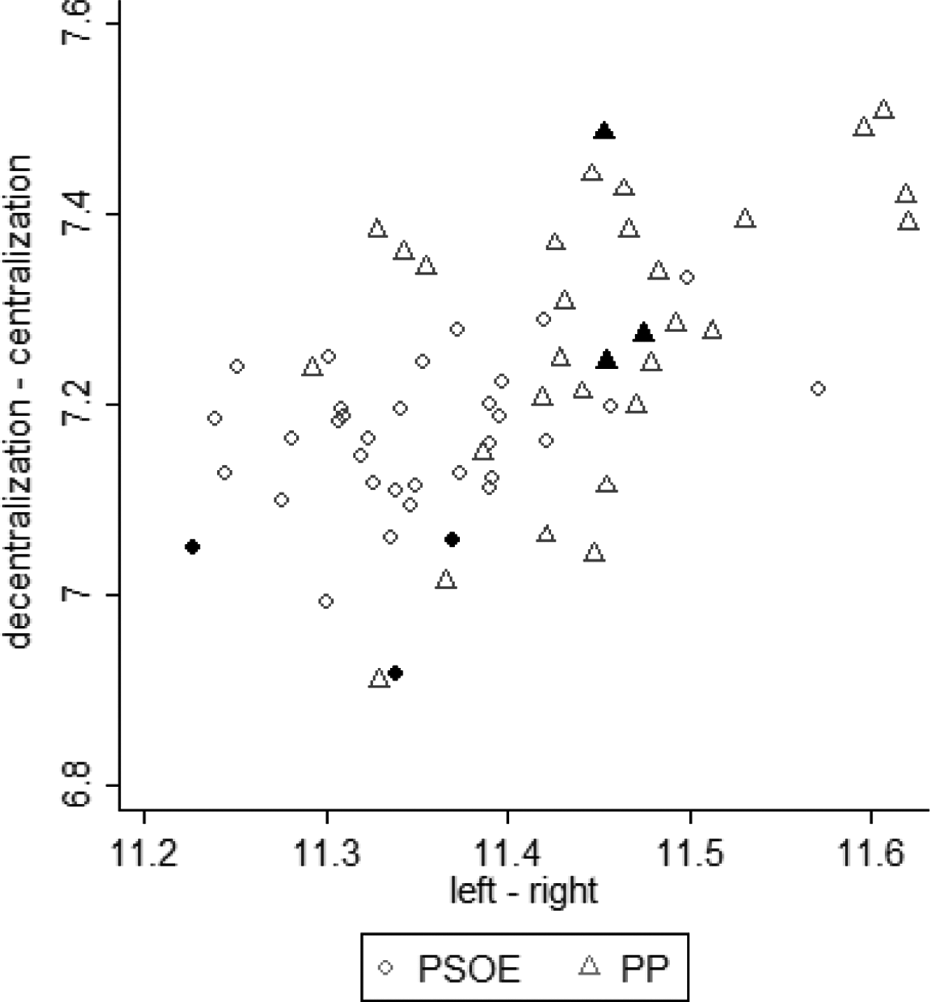
Programmatic positions of the manifestos.
Some of the values seem quite extreme, and there are two potential explanations for this. The first is that the respective manifesto is comparatively short. Further inspection shows that this is the case, for instance, for the most left PSOE framework manifesto and the most right PSOE regional manifesto (the latter contains less than 2000 words). The second is that the respective manifestos resemble the reference texts too strongly. Further inspection shows that this is the case, for instance, for the 2007 PP framework manifesto. Of all PP framework manifestos, it ranks highest with respect to centralization as more than 98% of its words were scored using the 2004 national manifestos as reference texts. In general, the number of scored words is higher for the framework manifestos compared to the regional election manifestos. This is in line with the impression of Alonso and colleagues (2013: 205–206) that the framework manifestos (especially of the PP) heavily refer to the national context.
Further, I cross-validated the values derived for the decentralization–centralization dimension with the center–periphery position values of the Regional Manifestos Project data set (Alonso et al., 2013). The correlation for the values of the 32 manifestos for the concurring regional elections that are present in both data sets is weak but in the right direction (–0.29). When using only the values referring to the competential dimension, as is probably more apt because Alonso and coauthors (2013: 192–193) argue that the Benoit and Laver (2006) values, which were used as reference values in the Wordscores estimation, do not include identitarian issues, the correlation rises slightly to –0.30 and reaches statistical significance at the 10% level.
Strategy of analysis
The dependent variable in the models below is the raw score of the position of the regional election manifesto on the general left–right dimension and on the decentralization–centralization dimension respectively. 7 The first independent variable is the position of the median voter on the corresponding dimension. The variable has been generated by relying on data from the three big surveys which have been conducted by the Spanish research institute Centro de Investigaciones Sociológicas (CIS) in the Autonomous Communities in 2002, 2005 and 2010. 8 In these studies, the respondents were explicitly asked to place themselves on a left–right policy dimension. For every region, the average value was generated and matched with the regional party branch manifestos of the PP and the PSOE. An equivalent item relating to the decentralization–centralization dimension has not been considered explicitly. Therefore, the position of the voters on this dimension was operationalized as follows. The respondents were asked which organizational design of Spain they preferred. The optional answers ranged from demands for a weakening of the Autonomous Communities, demands for sustaining the status quo to demands for a strengthening of the Autonomous Communities. I added up the percentages of all respondents who spoke out for a strengthening of the Autonomous Communities, transformed the scale so that it ranged from 0 to 1 and matched each value with the respective regional party branch manifestos of the PP and the PSOE. I always used the respective CIS study which had been conducted before election day. Although the length of time between the polls and the elections is problematic, it is acceptable on the whole, because the differences between the regions should be meaningful. An important argument for using these studies is that even in the smallest regions there are at least 300 respondents. Alternative surveys which were closer to election day either did not contain the questions of interest or only had a very small number of respondents in some Autonomous Communities, which prohibited the calculation of an average value. The specific texts of the referenced items as well as other illustrations are printed in the Online Appendix. The second independent variable is the position of the respective framework manifesto of the same party.
The statistical technique applied is OLS regression with robust standard errors clustered by election used for the significance tests. This is done to control for unobserved election-specific factors, which influence the position and the deviation of the regional parties which compete in the same election and which would otherwise lead to correlated errors (Adams et al., 2006: 518). The data structure at hand shares some of the typical characteristics of hierarchical and times-series data. Due to the very small number of units, cases and years under investigation, the application of more appropriate statistical techniques is unfortunately not feasible.
Determinants of the programmatic positioning of regional party branches
Table 1 shows the results of the OLS regression models which try to explain the programmatic positions of the regional party branches on the left–right and on the decentralization–centralization dimension. The results are mixed with respect to the median voter. On the left–right dimension, its position has no significant effect on the position of a regional party branch. On the decentralization–centralization dimension, a different picture emerges: the more voters of a region prefer decentralization, the more a regional party branch will prefer decentralization as well. The associate coefficient is highly statistically significant. The position of the framework manifesto influences the position of the regional election manifestos on both dimensions. The coefficients in model 2a and model 2b both tend in the expected direction and are highly significant. This strongly corroborates the expectations derived from the integrated delegation model. Despite the certain programmatic leeway the regional party branches apparently have (cf. Figure 1), they are still massively influenced by the nationally given programmatic position. This finding is corroborated in a couple of robustness checks. First, as can be seen from the R 2 of the third and sixth column in Table 1, models replacing the framework manifesto variable with a party dummy have a worse fit.
Determinants of the position of regional election manifestos.

Note: The dependent variable in the a models is the position of a regional election manifesto on the left-right dimension. The dependent variable in the b models is the position of a regional election manifesto on the decentralization–centralization dimension. The values of the dependent variable and of the independent variable referring to the position of the respective framework manifesto were generated using the Wordscores technique (reference texts: national election manifestos, 2004; reference values: Benoit and Laver, 2006). Robust standard errors clustered by election in parentheses; *p < 0.10, **p < 0.05, ***p < 0.01.
Second, the positions of the framework manifestos provide a better explanation than the positions of national election manifestos. In order to analyze both types of documents comparatively, I repeat the Wordscores technique, this time using the national election manifestos of 2011 as reference texts and the left–right and decentralization–centralization values which can be estimated using the 2010 Chapel Hill Expert Survey (Bakker et al., 2015) as reference values. In that way, I am able to score the regional manifestos, the framework manifestos as well as the temporally close national manifestos simultaneously and on the same basis. I then matched the value of the national manifesto for the year 2000 with the regional manifestos of 2003, 2004 with 2007 and 2008 with 2011. Table 2 largely replicates the results of Table 1. In addition, the table shows that the models including the position of the framework manifesto have a better fit than the ones substituting it for the position of the previous national manifesto.
Robustness check (framework manifestos vs. national manifestos).
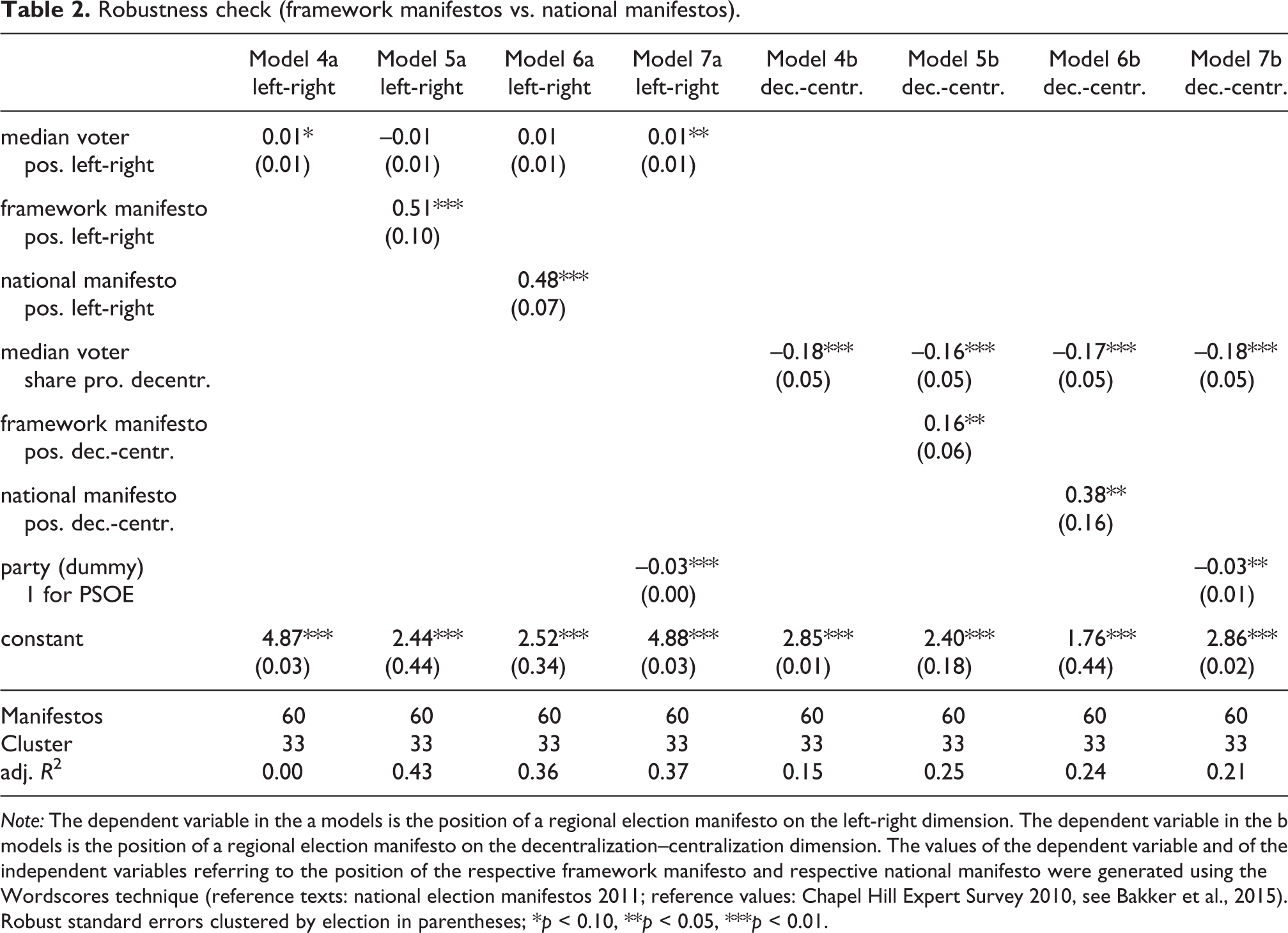
Note: The dependent variable in the a models is the position of a regional election manifesto on the left-right dimension. The dependent variable in the b models is the position of a regional election manifesto on the decentralization–centralization dimension. The values of the dependent variable and of the independent variables referring to the position of the respective framework manifesto and respective national manifesto were generated using the Wordscores technique (reference texts: national election manifestos 2011; reference values: Chapel Hill Expert Survey 2010, see Bakker et al., 2015). Robust standard errors clustered by election in parentheses; *p < 0.10, **p < 0.05, ***p < 0.01.
What can be concluded from these analyses? They show a strong correlation between the regional election manifestos and the framework manifestos. At first glance, this is not particularly surprising, given that we are dealing with one and the same party who intuitively should share the same basic program. Some party branches, due to the specific composition of their regional electorates, have a larger incentive to deviate from the national party line (with respect to decentralization issues) than other branches. We can see evidence for the interpretation suggested by the integrated delegation model: the framework manifestos are issued as control mechanisms by the national party which aims at minimizing the extent of programmatic heterogeneity in the party overall. The framework manifestos matter for regional party positioning. We can draw the tentative conclusion that those branches which diverge more from the framework manifesto enjoy a larger degree of autonomy. Those branches which do not diverge strongly, even though they have a reason to (because the regional median voter diverges strongly from the national median voter) are, in contrast, the ones that are effectively controlled. 9
What should we make of the result that the position of the median voter does not seem to impact the position of the regional election manifestos on the left–right policy dimension? Tavits (2007) distinguishes principled and pragmatic policy dimensions and is able to show that an orientation of the parties towards voters leads only to maximization of votes with regard to pragmatic dimensions. Consequently, the parties should only orient towards voters on such dimensions. In this respect, decentralization–centralization would be a pragmatic and left–right a principled dimension in the case at hand. 10 While this is not incompatible with the integrated delegation model, it reveals a serious shortcoming: we can observe that regional party branches diverge from the position of the framework manifesto (Figure 1) even though, according to our results, they have on the left–right dimension no incentive to do so (Table 1). Empirical evidence thus advises us to re-think some of the assumptions of the integrated delegation model and suggests, for instance, the simultaneous inclusion of factors identified by the spatial and the socio-structural approach. In such a unified model of regional party competition (cf. Adams et al., 2005), the positioning of regional party branches could consequently be better explained.
However, there is definitively a limit to how much we will be able to explain the variance in manifesto positions by general theories. Policy in (regional) government is highly specific and constrained by history and the situation of that region regardless of what the voters or the national party prefer. A party, anticipating that it will be electorally punished should its manifesto and what it is actually able to implement in government prove to be incompatible, will take such external constraints into account. In that light, the amount of explained variance in the models above looks quite acceptable.
Conclusion
According to the delegation model of multi-level party politics (van Houten, 2009a, 2009b), the national party organization achieves a balance between the potentially conflicting goals of regional adaptation and national identity by delegating campaigning to the regional branches of the party. While these might use their strategically advantageous position to further their own interests, the national party organization tries to restrict this threat by employing control mechanisms.
In this paper, my main argument is that the delegation model is an incredibly useful theoretical perspective, but it only approximates reality under certain conditions. The paper started by illustrating that the interpretations of the model underlie the conceptualizations of regional party branch autonomy, the congruence-theoretic approach to regional government formation and considerations regarding the programmatic positioning of regional party branches. The paper then showed that these interpretations critically hinge on (a) the assumption that regional party branches have a desire to deviate from the national party line because they believe they can maximize their votes in regional elections in that way and (b) the assumption that the national party organization has an incentive to control its branches because it believes that overemphasized attention to regional specificities is harmful for its electoral success in the national arena. Without the fulfillment of both assumptions, we are not able to attribute autonomy to diverging regional branches or posit that convergence is the product of successful control.
Based on this theoretical analysis, I explicitly modeled incentives to deviate theoretically by integrating a spatial component in the manner of Downs (1957) into the delegation model. This component posits that regional party branches (believe they can) gain votes by tailoring their programs toward the regional median voter. Subsequently, I circumvented the need to model incentives to control by arguing that the framework manifestos of the PSOE and the PP represent directly observable control mechanisms. Indeed, the empirical analysis of regional programmatic positioning shows that the interpretations of the delegation model can be substantiated in the case under scrutiny.
A number of questions for further research arose while this paper progressed. Do voters indeed punish parties for programmatic inconsistency across different levels of the political system? Which other incentives to deviate from the national party line apart from the orientation towards the regional median voter can be found empirically? Is it true that the stratarchical interpretations of the (integrated) delegation model tend to be accurate only in situations where both assumptions are fulfilled? If so, in which constellations and under which conditions provide hierarchical or federal models of party organization a better description of reality (cf. Bolleyer, 2012)?
In the common party government model, democracy is thought to be realized by the delegation of voters to parties (Castles and Wildenmann, 1986; Strøm et al., 2003). This intuitive conception of democracy is challenged in multi-level systems, where regional party branches have to balance the desires of the regional electorate and of the national party organization. Tensions inside of political parties exist essentially because there is no unified principal delegating to a unified agent (cf. Katz, 2014). This suggests a serious reflection of the party government model for multi-level systems.
Footnotes
Acknowledgements
I am highly indebted to Jan W van Deth, Sean Carey, Kavi Joseph Abraham, Elizabeth A Mendenhall as well as Jochen Müller, Christian Stecker and all participants of their panel at the ECPR Graduate Student Conference 2012 in Bremen for their valuable suggestions. I would also like to thank Richard S Katz, Marc Debus and the anonymous reviewers of Party Politics whose input has tremendously benefitted the paper. All remaining errors and misinterpretations are, of course, my own.
Declaration of Conflicting Interests
The author(s) declared no potential conflicts of interest with respect to the research, authorship, and/or publication of this article.
Funding
The author(s) disclosed receipt of the following financial support for the research, authorship, and/or publication of this article: This article emanated from the project Party Competition in Multi-Level Systems at the Mannheim Centre for European Social Research (MZES). Grant support from the Ministry of Science, Research and the Arts of the state of Baden-Württemberg and the University of Mannheim is gratefully acknowledged. The author would also like to thank the Center for Doctoral Studies in Social and Behavioral Sciences (CDSS) of the Graduate School of Economic & Social Sciences (GESS) at the University of Mannheim for its generous financial support during his associate membership.

Notes
References
Supplementary Material
Please find the following supplemental material available below.
For Open Access articles published under a Creative Commons License, all supplemental material carries the same license as the article it is associated with.
For non-Open Access articles published, all supplemental material carries a non-exclusive license, and permission requests for re-use of supplemental material or any part of supplemental material shall be sent directly to the copyright owner as specified in the copyright notice associated with the article.
