




Abstract
When elections are free and fair, why do some political parties rule for prolonged periods of time? Most explanations for single-party dominance focus on the dominant party’s origins, resources, or strategies. In this article, we show how opposition parties can undermine or sustain single-party dominance. Specifically, opposition parties should be central in explaining single-party dominance in countries with highly disproportional electoral systems and a dominant party whose vote share falls short of a popular majority. Employing a quantitative analysis of Indian legislative elections as well as a paired case study, we show that opposition coordination plays a crucial part in undermining single-party dominance.
Scholars have long argued that alternation in power is a defining feature of democracy. However, even in countries with free and fair elections, a single party can remain in power for a prolonged period of time. Most scholarly accounts explain prolonged dominance by a single party by focusing on the dominant party’s characteristics, such as its nationalist legitimacy (Arian and Barnes, 1974); effective use of public policy (Pontusson, 1990); coalition of support (Slater, 2010); embodiment of a national consensus (Kothari, 1964; Tudor, 2013); ability to manage internal factional conflict (Boucek, 2012); or use of patronage, targeted public spending, and outright vote-buying (Chubb, 1982; Magaloni, 2006; Scheiner, 2006). Others pay greater attention to the opposition, pointing to ways in which the dominant party stigmatizes the opposition (Ferree, 2010; Levite and Tarrow, 1983), keeps it ideologically divided (Riker, 1976), or forces it to take up ideologically extreme positions (Greene, 2007). Still others explain how political institutions, such as fiscal centralization (Scheiner, 2006) or electoral rules (Cox, 1997), diminish the opposition’s ability to unseat the dominant party. However, even explanations involving opposition parties tend to focus on the dominant party’s missteps or events beyond the opposition’s control: economic crises (Magaloni, 2006) or liberalization (Arriola, 2012; Greene, 2007); economic growth favoring opposition constituencies (DasGupta, 2015); a leveling of the electoral playing field (Greene, 2007); or institutional change (Cox, 1997). 1
In this article, we argue that when dominant party electoral support regularly falls short of a majority in disproportional electoral systems, the behavior of opposition parties largely determines whether single-party dominance ends or endures. In the sections that follow, we use qualitative and quantitative evidence from India’s states to show that opposition parties’ coordination decisions played a key role in sustaining or undermining the dominance of the Indian National Congress (hereafter, Congress) after independence. In India as elsewhere, the tactics of the dominant party played an important part in engineering its continued success, but opposition coordination also played a critical role in ending Congress dominance earlier in some states than in others.
The argument and evidence advanced here are significant for several reasons. Theoretically, we underline how the decisions taken by opposition parties in dominant-party systems impact the prospects for continued single-party dominance. Prior research has noted the importance of opposition coordination failures in sustaining single-party dominance (Magaloni, 2006; Pempel, 1990; Riker, 1976) and indicated that some contexts generate particularly difficult coordination problems for opposition parties (Cox, 1997: Chapter 13; Diaz-Cayeros and Magaloni, 2001; Greene, 2007); but, such work does not document whether resolving such coordination failures actually ends single-party dominance. For example, Cox (1997) shows that opposition parties in single non-transferable vote (SNTV) electoral systems face very difficult coordination problems in fielding the optimal number of candidates, thereby underpinning single-party dominance; however, his analysis does not demonstrate the actual impact of opposition coordination on single-party dominance. We advance the literature by explicitly identifying the conditions under which successful opposition coordination should be most likely to explain the persistence or demise of single-party dominance and then offering evidence that such coordination, in fact, undermines single-party dominance. While space considerations preclude us from systematically identifying when and why opposition parties successfully coordinate, this article lays the groundwork for such future research by highlighting not just the linkage between opposition coordination and single-party dominance, but also the pivotal role of opposition choices.
This study is also the first, of which we are aware, to bring systematic data to bear on the question of whether opposition coordination matters for the maintenance or demise of single-party dominance. It does so by comparing instances of successful and failed opposition coordination, underscoring a consistent empirical pattern in which coordinated oppositions better translate votes into seats, resulting in a greater probability of opposition government. Our analysis also provides a new perspective on single-party dominance in India. As with research on dominant parties in many countries, studies of India have overwhelmingly emphasized Congress’ role in engineering its own dominance and then its subsequent decline. 2 Our results suggest that standard accounts need to pay greater heed to the opposition’s success or failure in coordination prior to elections.
1. Theory
When a dominant party, first, operates in the context of highly disproportional electoral rules and, second, habitually fails to win a popular majority, then opposition coordination significantly impacts whether dominant parties win elections or not. Under these two conditions, we hypothesize that the opposition’s success in coordinating should crucially influence the dominant party’s ability to win a legislative majority and, by extension, its ability to remain in power.
By definition, dominant parties are more electorally successful than their competitors. However, dominant parties can vary considerably in the extent of their electoral support. Some, such as the African National Congress in South Africa or SWAPO in Namibia, routinely win 60% or more of the popular vote in legislative elections. 3 Other dominant parties only sometimes win a popular majority and more frequently come close to, but fall short of, the 50% mark, such as Japan’s LDP or the Swedish Social Democrats. Still others always win less than a popular majority: Israel’s Mapai/Labor, Italy’s Christian Democracy, and India’s Congress.
Where dominant parties win large popular majorities, they nearly always win legislative majorities, regardless of the electoral rules. Highly proportional electoral rules accurately translate the party’s popular majority into a legislative majority, while disproportional electoral rules tend to award it a seat share much larger than its vote share. However, when a dominant party routinely falls short of a popularity majority, its legislative position depends on the electoral system. In a highly proportional electoral system, a dominant party’s failure to win a popular majority usually means that it also fails to win a legislative majority. Nevertheless, it typically remains the most important actor in the legislature. Since dominant-party systems tend to feature highly fragmented oppositions (Pempel, 1990), a dominant party in a highly proportional system is by far the largest legislative party, even when it falls short of a majority. Forming a government without the dominant party usually entails forming a coalition of virtually every other party in the legislature. Such coalitions rarely take shape because of the vast ideological and programmatic differences typically separating opposition parties. For instance, in 1958, Christian Democracy (DC) won 273 of the 596 seats in the Italian Chamber of Deputies. Forming a government without the DC would have required a coalition including the communists (PCI) and either the neo-fascist MSI or the two right-wing monarchist parties. In a case such as this, opposition cooperation to form a coalition without the dominant party is possible, but exceedingly difficult. Furthermore, although parties can coordinate ahead of the election to maximize their seat shares in highly proportional systems (Golder, 2006), the impact of such coordination is limited. For instance, parties can form joint lists to ensure that they surpass the electoral threshold. But, doing so usually does not dramatically alter the overall proportionality of the translation of votes into seats. In short, in the context of proportional electoral rules, there is often little that the opposition parties can feasibly do to unseat the dominant party from power.
By contrast, in disproportional electoral systems—where the largest party typically benefits handsomely in the translation of votes into seats—opposition parties can play a significant role in undermining single-party dominance. When a dominant party faces a highly fragmented opposition in a disproportional electoral system, its popular pluralities can translate into substantial legislative majorities, as frequently happened in India at the national level between 1951 and 1984; Congress habitually won legislative majorities with between 40% and 45% of the popular vote. However, when the opposition is coordinated it can prevent the dominant party from benefiting from the electoral system, instead taking advantage of the disproportional electoral rules for itself.
In the context of a disproportional electoral system, opposition parties can coordinate to undermine the dominant party through pre-election alliances in which opposition parties agree on common candidates to field against the dominant party. Imagine an election using single-member district plurality (SMDP) rules in which a dominant party wins 40% of the vote. Its three rivals are opposition parties A, B, and C, which win 25%, 20%, and 15% of the vote, respectively. All parties field candidates in every electoral district. For simplicity, imagine that the parties all win the same vote shares in each district. Under SMDP rules, the dominant party wins 100% of the seats, since it is the largest party in each district. Now, imagine instead that the three opposition parties agree to field a single opposition candidate in each seat and ask their supporters to vote for the common opposition candidate. Assuming that voters do so, the opposition parties win 100% of the seats (since 60% of the vote goes to the opposition candidate in each district), and they can easily form a government without the dominant party. Indeed, they can even potentially exclude one of the opposition parties, opening up the possibility of a more ideologically cohesive coalition that excludes the most ideologically distant party. This highly stylized example highlights how the opposition can, through pre-election coordination, use the distorting effects of a disproportional electoral system to its advantage, securing an outsize legislative majority. Importantly, this claim is not about the severity of the coordination problem facing opposition parties, as discussed in Cox (1997), but about the substantive impact of coordination. Irrespective of how easy or hard it is for the opposition to coordinate, opposition parties’ success or failure to coordinate should have a large impact on single-party dominance in the context of disproportional electoral rules and a dominant party that fails to win popular majorities.
In sum, when dominant parties win popular majorities, the opposition can do little to defeat a dominant party in any type of electoral system. But, when the dominant party regularly fails to win popular majorities in the context of a disproportional electoral system, then opposition coordination can determine whether single-party dominance endures or ends. When the opposition fails to coordinate before elections, then the dominant party can usually maintain its dominance by winning outsize legislative majorities. But, where the opposition successfully coordinates before elections, the opposition can profit from the distorting effects of the electoral system to gain its own majority and form governments. Thus, opposition coordination plays a crucial role in the maintenance or decline of single-party dominance by influencing the share of legislative seats won by the dominant party and, by extension, the dominant party’s ability to remain in power. Under certain scope conditions, therefore, this hypothesis suggests a crucial role for the opposition in independently determining whether single-party dominance persists or ends.
2. Case selection
We test our hypothesis about the importance of opposition coordination in explaining whether dominant parties win elections through both regression and case-study analysis of subnational elections in India. We focus on India for two reasons. First, it fulfills the scope conditions outlined in the previous section. India employs a highly disproportional electoral system. Since 1960, India has elected all its national and state legislators using SMDP rules. 4 Additionally, India’s dominant political party, Congress, never won a popular majority at the national level and rarely won popular majorities in state elections. Congress failed to win a majority in 88% (or 115 of 131) of the state elections included in our data. Second, focusing on variation across Indian states provides us a large number of observations that vary in both our independent and dependent variables but effectively control for the many confounding variables present when comparing across countries. India’s states have identical political institutions; they share many common economic and cultural traits; and Congress was the largest party across all major states immediately after independence.
Although single-party dominance at a subnational level is not perfectly analogous to single-party dominance at the national level, subnational comparisons are nevertheless useful for generating broader insights about single-party dominance. 5 One key respect in which subnational politics would seem to differ from national politics is that the party in power at the national level can intervene in subnational politics to either buttress or undermine single-party dominance at the subnational level. However, just as a party in power nationally can intervene in subnational politics, so too can other forces intervene to support or undermine a dominant party in national-level politics. Non-legislative institutions, such as the judiciary or the military, or international forces can intervene to influence national politics to the benefit or detriment of a dominant party, meaning that the subnational experiences of single-party dominance may not be all that different from single-party dominance at the national level.
We limit our study to the period from Indian independence in 1947 through 1989 because this is historically understood to be the period of Congress dominance. 6 During this period, opposition coordination should have been pivotal in ending single-party dominance. As the largest single party, Congress could expect to benefit from the disproportional electoral system and win seat shares far greater than its vote shares unless opposition coordination took place. After 1989, Congress was no longer the largest party in many states. Consequently, the largest non-Congress party in a state could have been in a position to benefit from the disproportional electoral system and plausibly hoped to come to power on its own without cooperating with other opposition parties. Furthermore, with Congress no longer firmly ensconced at the national level, Congress would not necessarily have been all other parties’ main political adversary. In short, after 1989, we would not necessarily expect coordination of non-Congress parties to be as important in determining Congress’ fate. In the analysis below, we examine the opposition parties’ seat shares and the formation of opposition governments. After 1989, it is not clear that these are necessarily dependent variables of interest since coordination was not always aimed at Congress and Congress frequently sat in the opposition.
3. The Indian context
In India’s first post-independence elections, held in late 1951 and early 1952, Congress won a legislative majority at the national level and was the largest party in every state legislature. In most states, Congress was the largest party—in terms of both votes and seats—for the first 30 post-independence years (1947–1977). In state elections held in 1977 and 1978, Congress decisively lost for the first time in eight states, winning smaller vote shares than those won by the Janata Party, which had been founded in 1977 through the merger of several opposition parties. By 1980, the Janata Party had split, and its short-lived national-level government had collapsed. In subsequent elections, Congress easily returned to power at the national level and in most states. For much of the next decade, the “Janata interregnum” appeared to have been an aberration. In 1989, however, Congress again lost power at the national level, ushering in a period of electoral decline and increasing competitiveness both in national politics and in most states. By the early 1990s, virtually all states had competitive parties systems and had had multiple spells of non-Congress state government.
Traditionally, explanations for India’s dominant party system have focused on Congress’ role in the anti-colonial nationalist movement (Tudor, 2013), ideologically centrist positioning as the party of national consensus (Kothari, 1964; Riker, 1976), incorporation of broad swathes of society into its ranks (Kothari, 1964; Chandra, 2004), recruitment of local notables (Bayly, 1975; Sisson, 1972), and strategic use of patronage (Weiner, 1967). A few studies, focused on specific states (Barnett, 1976; Kohli, 1990a; Subramanian, 1999), have paid greater attention to opposition parties; however, the opposition’s role in most research on Congress dominance is limited. Similarly, research on Congress’ decline focuses primarily on the party’s institutional decay (Kohli, 1990b) and unwillingness or inability to incorporate rising social groups (Hasan, 1998; Chandra, 2004). Others have noted changes to the economy that ultimately undermined Congress’ dominance (Hasan, 1998; DasGupta, 2015), but such large-scale changes are hardly within the opposition’s control, suggesting little opposition agency in undoing Congress dominance.
India’s SMDP electoral system has been credited with benefiting Congress and disadvantaging the fragmented opposition (da Costa, 1967; Heath et al., 2005). Although Duverger’s Law would predict that India’s SMDP electoral system should produce a two-party system, most Indian states—particularly during the period under consideration—had multiparty systems. Moreover, at the district-level, deviations from the expected two-party competition have been frequent (Chhibber and Kollman, 2004; Chhibber and Murali, 2006; Diwakar, 2007). Scholars have advanced a number of explanations for India’s fragmented party system including weak party organization (Chhibber et al., 2014) and, more recently, India’s Anti-Defection Law (Nikolenyi, 2008) or coalition government (Ziegfeld, 2012). Whatever the cause, opposition fragmentation has meant that India’s opposition was at a natural disadvantage in converting its sizeable share of the vote into a comparable share of seats.
What has, however, been far less widely appreciated is that Congress did not necessarily have to benefit from the electoral system. Opposition parties in India periodically engaged in pre-election alliances in which they agreed to field a single candidate in each electoral district so as to avoid splitting votes between the allied parties. In other words, they sought to create—through coordination—the two-party system that Duverger expected. By amassing votes behind a common candidate, parties in an alliance increase the likelihood that their candidate will win a plurality of votes and therefore the seat. In India, such pre-election alliances are typically negotiated on a state-by-state basis. Decisions over which specific candidates will contest are usually left to the party to which the seat has been allocated. In some cases, allied parties unofficially adopt a name for the alliance, but these agreements do not constitute party mergers or even fusion party labels. In most instances, parties do not agree to a common manifesto or governing program, and pre-election alliances do not always translate into post-election coalitions. When all major parties are part of a pre-election alliance, then competition within electoral districts (or constituencies, as they are known in India) approximates two-party competition, in this case between the dominant party, Congress, and a single opposition party. Given the possibility of pre-election alliances, fragmented oppositions in India did not necessarily have to be divided oppositions. Since Congress routinely failed to win popular majorities in most elections in most states, a coordinated opposition was potentially in a position to benefit from the electoral system’s disproportionalities.
4. Data analysis
We test our hypothesis about the role of the opposition in defeating a dominant party on data from 131 state-level elections held in major Indian states during the 1951–1989 period. 7 Election results come from the Election Commission of India. Our unit of analysis is the state-level election and the associated legislative period. To test whether opposition electoral coordination is associated with Congress winning or losing power, we also need state-level data on electoral alliances. Since no such data previously existed, we employed dozens of secondary sources—mainly scholarly books and journal articles—to compile an original dataset of all 131 subnational elections in major states during the period under consideration. Because of the limited availability of information on small parties, we focus only on election alliances brokered between parties winning 5% or more of the state-level vote. 8 Of the 131 elections in our data, 24 elections (18%) had only one opposition party winning more than 5% of the vote. In 33 elections (25%) some form of major-party alliance occurred. In 20 of the elections (15%), all major parties were part of a single alliance, while in the remaining 13 (10%), only some parties were included. Finally, 74 elections (56%) featured multiple major opposition parties but no electoral coordination.
Our quantitative analysis features two dependent variables. The first is Opposition Seats, which is the share of seats won by the opposition, that is, all non-Congress parties. If opposition coordination influences the dominant party’s position in the legislature, then such an effect should be evident in the share of seats won by opposition parties, which necessarily goes up or down in inverse relation to Congress’ seat share. However, since understanding when dominant parties lose power is the ultimate outcome of interest, we examine a second dependent variable, Opposition Government. This binary variable takes a value of 1 if an opposition government held power at some point during an election’s legislative mandate; it takes a value of 0 if Congress held power during the entire period. Opposition Seats and Opposition Government are highly correlated (correlation coefficient = 0.79), but not perfectly so. In a few instances, defections from Congress permitted the opposition to form a government even when Congress won a legislative majority. Similarly, when the opposition won a legislative majority, Congress sometimes prevented opposition governments from ever taking office.
Our main independent variable of interest is Coordinated, which takes a value of 1 if a major-party alliance was brokered, and 0 otherwise. We expect Coordinated to be positively associated with Opposition Seats and Opposition Government. Additionally, in 24 (18%) elections, there was only one major opposition party. Coordination between major parties is therefore impossible. However, the opposition is, in effect, coordinated behind a single party, meaning that these states should also be more likely to produce opposition governments as well. Single-Party Opposition is a binary variable taking a value of 1 if there is only one major opposition party, and 0 otherwise. Again, we expect a positive association between Single-Party Opposition and our dependent variables. Because independent candidates are rarely included in opposition electoral alliances, large independent vote shares also divide the opposition. We therefore include Independent Vote, which is the vote share won by independent candidates, which we expect to be negatively associated with our dependent variables. As controls, we take account of Congress’ vote share, INC Vote, and include Year, a linear time trend.
Table 1 presents the results of our quantitative analysis. We begin by examining Opposition Seats as our dependent variable. Model 1 estimates regression coefficients using ordinary least squares (OLS) and reports panel-corrected standard errors. As expected, we observe very large, statistically significant positive coefficients on Coordinated and Single-Party Opposition. Controlling for Congress’ vote share, coordinated oppositions win 11.6% more seats than uncoordinated ones, while single-party oppositions win 7.0% more. Unsurprisingly, higher Congress vote shares correlate with fewer opposition seats. The magnitude of the coefficient on Coordinated is substantively very significant, highlighting the importance of opposition coordination. The predicted increase in the opposition seat share when the opposition is coordinated is roughly equivalent to the predicted increase associated with a 6% decline in Congress’ vote share, or about two-thirds of a standard deviation in Congress’ vote. The coefficient on Independent Vote is negative, as expected, but falls short of conventional levels of statistical significance. Throughout the OLS models presented in Table 1, this variable never achieves statistical significance; however, the p-values for the coefficients are often less than 0.15.
Opposition coordination and electoral outcomes.
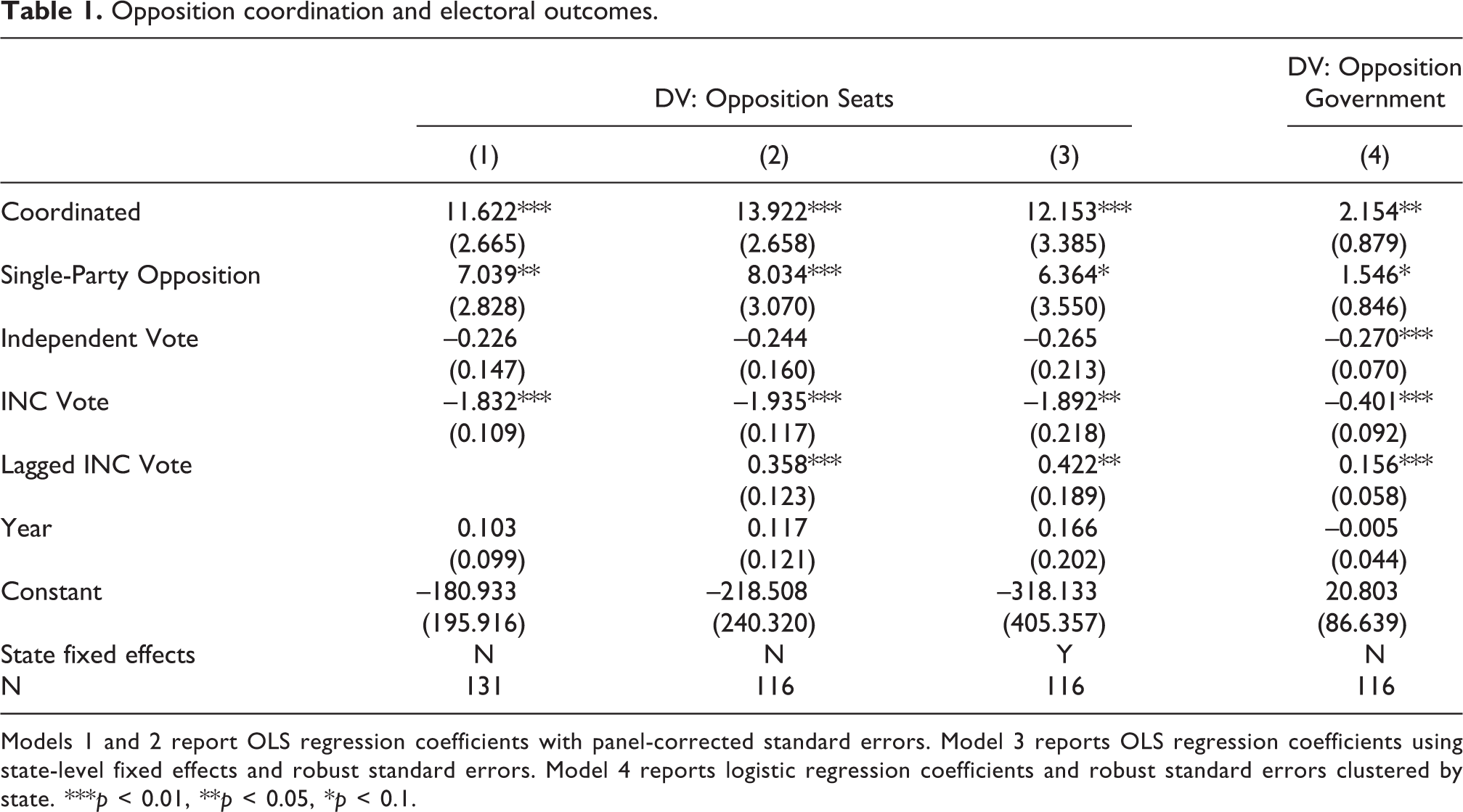
Models 1 and 2 report OLS regression coefficients with panel-corrected standard errors. Model 3 reports OLS regression coefficients using state-level fixed effects and robust standard errors. Model 4 reports logistic regression coefficients and robust standard errors clustered by state. ***p < 0.01, **p < 0.05, *p < 0.1.
The results from model 1 suggest considerable support for the claim that opposition coordination has a substantive impact on a dominant party’s ability to remain in power by significantly enhancing the opposition’s seat share. However, it is important to establish that opposition coordination is not purely a function of Congress’ actions. Otherwise, it is not really the opposition that is responsible for coordination but the dominant party, harking back to existing arguments in the literature about the dominant party’s strategy toward opposition parties. In fact, Congress exerted almost no influence over opposition decisions about whether to engage in pre-election alliances. This was not because Congress was averse to meddling in opposition politics. In cases when oppositions won legislative majorities, Congress adopted many strategies to divide its opponents. To prevent opposition governments from taking power, Congress promised ministerial berths and sometimes bribes to opposition legislators to defect from their parties or merge with Congress. When opposition governments came to power, Congress similarly sought to lure opposition parties into withdrawing from and thereby toppling the governing coalitions. Congress also sowed dissension in opposition ranks by offering to support an alternative coalition led by a junior partner in the opposition coalition. Having brought down one opposition government and then propped up a new one, Congress would withdraw its support from the new opposition, forcing fresh elections. 9
However, though Congress frequently hindered sustained post-election opposition cooperation, it did little to divide the opposition before elections. Had Congress wished to diminish the likelihood of a united opposition alliance, it could have engaged in its own electoral coordination with a major opposition party. If Congress were to ally with a major opposition party, it could have diminished the size of the opposition alliance and enhanced its chances of sweeping the election (along with its ally). But, Congress did not adopt this strategy. In the 131 elections in our data, Congress engaged in electoral coordination with another major party (defined as one winning more than 5% of the vote) in only 13 instances (10%), fielding candidates in 94% of all seats contested during this period. Moreover, most instances of coordination (9 of 13) took place in states where Congress had already lost its dominant position. Of the 121 elections held under conditions of clear state-level Congress dominance, the party coordinated with a major party in only four elections (3% of cases), fielding candidates in nearly 98% of the seats contested in these elections. Thus, Congress engaged in seat-sharing only after it had lost its dominant position, not as a pre-emptive tactic to diminish the opposition’s ability to coordinate. Moreover, even when Congress formed pre-election alliances, it was usually with a relatively small party. Thus, when pre-electoral coordination did not occur among opposition parties, it was not because of Congress.
Nevertheless, to rule out the possibility that Congress’ actions drove opposition coordination, we adopt a number of strategies. First, we test whether Congress electoral vulnerability drives our findings about the association between coordination and opposition seats, as it is possible that oppositions only coordinated when they believed that Congress was vulnerable. To test whether this is the case, model 2 includes Lagged INC Vote, Congress’ vote share in the prior election. Since there was no prior Congress vote share in India’s first round of state elections, we lose some observations. If oppositions only coordinated when Congress was vulnerable, then we would expect that Lagged INC Vote would be large and negative (as high Congress vote shares deter coordination which then depresses opposition seat shares) and the coefficient on Coordinated should diminish in size. In fact, the coefficient on Lagged INC Vote is positive and the coefficient on Coordinated is actually larger, suggesting that oppositions are not simply coordinating in response to perceived Congress weakness. We further test the robustness of this finding in model 3 by estimating model 2 with state-level fixed effects. The results are very similar. Furthermore, if we look at Congress’ vote share in an election by the type of opposition, there are no noticeable differences. The average Congress vote when the opposition consists of a single major party is 41%; it is 39% when the opposition is fully coordinated, 38% when it is partly coordinated (that is, some but not all major parties are coordinated), and 40% when the opposition is not coordinated. In other words, there are no systematic differences in the type of opposition based on Congress’ electoral strength. 10
As a further robustness check that ensures our results are not driven by cases when the opposition was influenced by Congress’ own tactics, we run the analysis presented in Table 1 excluding instances when Congress formed an alliance with another party. We also run the same models excluding the state of Kerala, elections in Tamil Nadu after 1967, and elections in West Bengal after 1977—which are all cases in which Congress was arguably no longer dominant. Lastly, we exclude cases in which an opposition government held power in the prior legislative period. All of the results in Table 1 still hold. The coefficients on Coordinated are, in all models, large and statistically significant. Moreover, the coefficient on Lagged INC Vote is always positive, though often imprecisely estimated. Furthermore, we run our analysis including measures of ethnic heterogeneity as well as a measure for the number of consecutive times that Congress formed the government prior to the election in question and a dummy variable for whether the opposition formed a government in the prior legislative period. None of these additional variables are statistically significant, nor do they alter our results, which can be found in the article’s online appendix.
Finally, turning to model 4, we examine whether opposition coordination is associated with the probability of the opposition forming a government at some point in the subsequent legislative mandate. Here, we run the same model as in model 2; however, because our dependent variable is a binary variable, the model is estimated using logistic regression. As expected, the coefficient on Coordinated is statistically significant. Figure 1 illustrates the substantive meaning of the coefficient by plotting the predicted probability of an opposition government being formed as Congress’ vote share varies. The line with black circles presents the predicted probabilities for an uncoordinated opposition (that comprises multiple parties, for the year 1969, and with mean values for Independent Vote and Lagged INC Vote). The gray diamonds represent a coordinated opposition. At very low and very high levels of Congress vote shares, the two lines are, unsurprisingly, similar. When Congress’ vote share is very low, it is very likely that the opposition will form a government as Congress will likely fall well short of a legislative majority. At the same time, when Congress’ vote share is very high, there is little that the opposition can do to prevent Congress from winning a legislative majority. However, at vote shares in between—where Congress fails to win a majority but is still the largest party by far—opposition coordination dramatically enhances the likelihood of the opposition forming a government after elections. Thus, the opposition’s lack of consistent coordination diminished the number of seats that the opposition won and, as a consequence, its likelihood of forming a government without Congress.

Predicted probability of opposition government.
5. Case studies: Tamil Nadu and Uttar Pradesh, 1967–1972
Having established that our argument holds across India, we take a closer look at the experiences of Tamil Nadu and Uttar Pradesh (UP). 11 Tamil Nadu is located on India’s southern tip and is the country’s sixth most populous state; UP, located in the north Indian area known as the Hindi belt, is India’s most populous state. Congress governed both states from 1947 through 1967, but whereas Congress lost power decisively in Tamil Nadu in 1967 and has not returned to power since, Congress very briefly lost power in UP, only to return to power for much of the subsequent two decades.
Conventional wisdom suggests an important role for the actions of the dominant party in explaining these states’ divergent trajectories. Already in the colonial period, Congress faced considerable challenges to establishing dominance in Tamil Nadu because it relied heavily on the demographically small Brahmin caste. Congress also suffered from important organizational weaknesses, such that “Congress dominance was more fragile in Tamil Nadu than in many other states” (Subramanian, 1999: 133). Additionally, after independence, the party underestimated opposition to Hindi as a national language; it responded poorly to a food crisis in the state in the mid-1960s; and Congress’ most popular leader, K Kamaraj, left state politics for national politics in 1963 only to be replaced by an unpopular figure (Subramanian, 1999: 192–197). Congress was thus ill-equipped to respond to the challenges posed by its primary rival, the Dravida Munnetra Kazhagam (DMK), which mobilized new voters by capitalizing on Congress’ failures and energizing the electorate behind the cause of Tamil nationalism (Barnett, 1976: Chapter 6; Subramanian, 1999: Chapter 5; Wyatt, 2010: 58–64). Meanwhile, UP formed the nerve center of Congress’ anti-colonial mobilization, and Congress benefited from a stable ethnic coalition of Brahmins, Scheduled Castes, and Muslims. Congress’ ability to sweep UP in national elections was crucial in keeping the party in power at the national level.
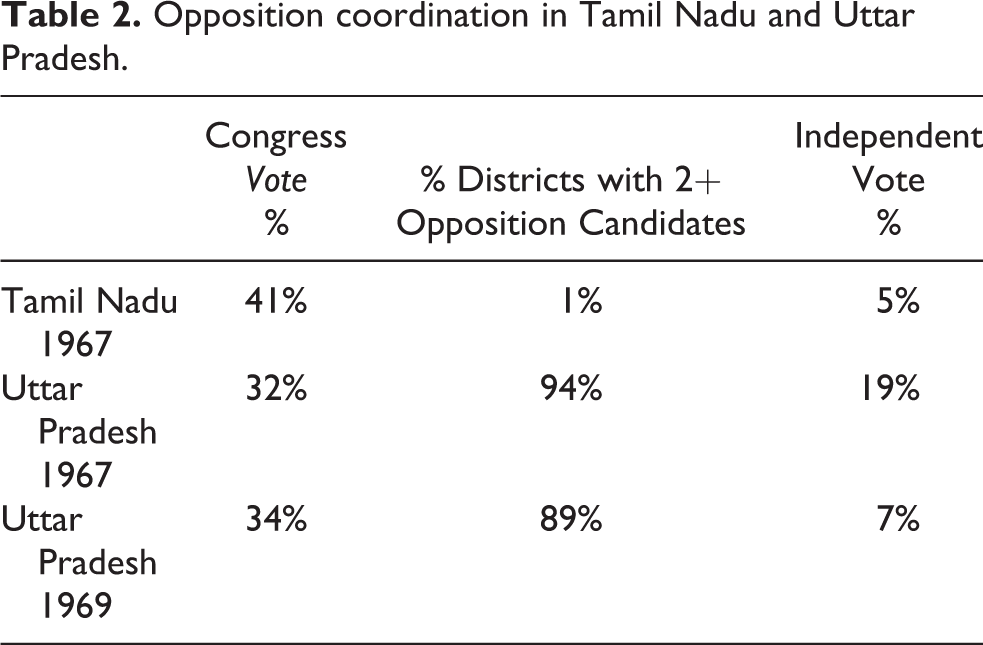
Upon closer inspection, however, conventional wisdom proves incomplete. From the late 1950s onward, Congress was more popular in Tamil Nadu than in UP. In the 1967 state elections, Congress won 41% of the vote in Tamil Nadu as compared to only 32% in UP. Whatever the weaknesses of Congress in Tamil Nadu and its strengths in UP, for three consecutive elections (1957, 1962, and 1967), Congress was far more effective in winning votes in Tamil Nadu than in UP. Why then did Congress rule end definitively in Tamil Nadu in 1967 but endure in UP until 1989? The answer lies in opposition coordination. Whereas Congress’ opposition in Tamil Nadu coordinated in fielding candidates, enabling it to translate its popular majority into a convincing legislative majority, the opposition did not engage in pre-election coordination in UP.
In Tamil Nadu in 1967, the DMK, Swatantra, Communist Party of India (Marxist) (CPM), Praja Socialist Party (PSP), and Samyukta Socialist Party (SSP) came together into an electoral alliance known as the United Front. Furthermore, as Table 2 indicates, only a modest share of the vote (5%) went to independent candidates, meaning that the United Front accounted for the overwhelming majority of opposition votes. With all of the major opposition parties in a single alliance, the opposition vote was not split amongst several different candidates, and most districts in the state witnessed a straight fight between a Congress candidate and a United Front candidate. Only 1% of electoral districts featured multiple opposition candidates from parties winning more than 3% of the vote. Although Congress won a respectable 41% of the vote, more than in about half of India’s major states in 1967, the parties of the United Front together won more than 51% of the vote. As a result, in most districts, the United Front candidates easily defeated their Congress rivals.
Opposition coordination in Tamil Nadu and Uttar Pradesh.
The fact that the opposition coordinated before elections in Tamil Nadu in 1967 was crucial to its success. A counterfactual thought experiment underscores the importance of this coordination. In 1967, the five United Front parties won 174 seats, or 78% of all seats. Suppose instead that each party had contested separately. To hypothesize what district-level election results might have looked like in 1967 in the absence of electoral coordination, we use the 1962 election results, when coordination did not occur. First, in each electoral district in 1962 we combine the district-level vote shares of the parties (or their predecessors) that would later be part of the 1967 United Front: DMK, Swatantra, PSP, Socialist Party, and CPI. 12 Next, we calculate the share of that five-party total won by the largest of the five parties in each district, whichever party that might be. Thus, in a district in which the DMK was the largest party, we calculate the share of the combined DMK-Swatantra-PSP-Socialist-CPI vote won by the DMK. On average, the largest party won 84% of the total five-party opposition vote in 1962. We then suppose that, had the opposition parties all fielded their own candidates in the 1967 election, the largest opposition candidate in each district in 1967 would also have won 84% of the total won by the actual United Front candidate. Finally, using these new hypothetical vote shares for 1967, we compare the counterfactual vote shares in each district to determine how many seats the opposition would have won. In this hypothetical, opposition candidates would have won 63% of seats—still a majority, but a 15% reduction in seats over the actual election results in 1967.
Consider a second counterfactual wherein the main hypothetical opposition candidate in each district in 1967 won less than 84% of the total vote won by the actual United Front candidate. In 1967, the DMK’s vote share of about 41% constituted 79% of the United Front’s total vote share. If we suppose that the most successful opposition candidate in each district won 79% of the total won by each United Front candidate, then the opposition would have won only 51% of seats. Had the opposition won only 51% of the legislative seats, forming an opposition government would have required the participation of all members of the United Front, with absolutely no defections—a tall order in India at the time. Finally, had the average opposition candidate won less than 79% of the 1967 total in each district, then Congress would have won a legislative majority. Importantly, none of these counterfactuals changed the overall vote share won by Congress or the combined opposition. Rather, these counterfactuals highlight that in the absence of opposition coordination in fielding candidates, the Tamil Nadu opposition would have won a much smaller share of legislative seats—and perhaps less than a majority. A smaller opposition legislative majority would have made the opposition government vulnerable to the same defection-driven dynamics that plagued the failed experiments in opposition government in many other states during the same time period.
Unlike in Tamil Nadu, Congress’ opposition in UP did nothing to coordinate ahead of elections. UP saw very few two-horse races. As Table 2 indicates, Congress faced more than one major-party opposition candidate in 94% of districts. Furthermore, 18% of votes cast went to independent candidates, which further split the opposition vote. With the non-Congress vote spread across multiple parties, Congress won many seats with relatively modest vote shares. Indeed, 30% of Congress legislators elected in 1967 won their seats with less than a third of the vote in their districts. The opposition was similarly fragmented when UP again went to the polls in 1969.
Through a similar hypothetical exercise, we estimate the potential impact of these coordination failures in UP. If we suppose that all parties winning more than 3% of the vote formed an electoral alliance as they did in Tamil Nadu, this alliance in UP would have included six parties in 1967 and five in 1969. As Table 3 indicates, the six parties together won 44% of seats in the 1967 election. 13 Had a hypothetical opposition alliance fielded one opposition candidate per district and had all voters who voted for a member of that alliance cast their vote for whichever opposition candidate was fielded, then the parties representing the opposition alliance would have won 72% of the seats in UP. Of course, the formation of such a pre-election alliance may have alienated some voters who would not have wished to vote for allied parties. If we assume that 10% of the combined opposition vote instead went Congress, the opposition alliance would still have won 67% of seats. In other words, we calculate the combined vote share for the opposition parties in a district. We then subtract 10% of that total and add it to Congress’ vote share and determine whether a Congress candidate, a candidate from the coordinated opposition, or a small-party or independent candidate would have had the most votes in the district. Even if the hypothetical opposition alliance lost 25% of opposition votes, then the opposition would still have won a clear majority of seats. A similar pattern is evident for 1969. Both simulations suggest that comprehensive coordination, even assuming a reasonable level of drop-off in electoral support, would have resulted in a clear legislative majority for the opposition. Even if only the two largest parties, the Bharatiya Jana Sangh (BJS) and Bharatiya Kranti Dal (BKD), had allied in 1969, their combined vote shares would have been sufficient to win an absolute majority of seats (243 of 425), creating the possibility of an opposition government that only required the participation of two parties.
Hypothetical election outcomes with opposition coordination in Uttar Pradesh.

BJS = Bharatiya Jana Sangh, BKD = Bharatiya Kranti Dal, CPI = Communist Party of India, PSP = Praja Socialist Party, RPI = Republican Party of India, SSP = Samyukta Socialist Party, SWA = Swatantra Party.
What is particularly striking about these two cases is that opposition coordination was not a function of Congress’ strength or weakness. If coordination only occurred in instances when Congress was electorally vulnerable, then coordination should have occurred in Uttar Pradesh rather than Tamil Nadu. Moreover, Congress played no role at all in influencing pre-election coordination. Although Congress machinations were instrumental in bringing down a short-lived opposition government that took office in UP—thereby precipitating the 1969 election—Congress did little to undermine pre-electoral coordination. Indeed, there was little that Congress could do apart from trying to engineer an alliance with one of the opposition parties, which it did not do. In sum, this section illustrates just how important opposition coordination can be in unseating a dominant party. In Tamil Nadu, electoral coordination provided the opposition with a comfortable majority that it might not have had otherwise. Meanwhile, in UP, the failure to coordinate prevented the opposition from garnering a comfortable majority that could potentially have enabled it to durably displace Congress.
6. Conclusion
When countries employ disproportional electoral systems and their dominant parties routinely fail to win popular majorities, opposition coordination significantly impacts whether the opposition defeats the dominant party. When the opposition coordinated before elections in India, it won a substantially larger seat share and was consequently more likely to come to power. In demonstrating this, we have shown that, under certain conditions, the opposition can exert an important and independent role in undermining or sustaining single-party dominance. Our attention to opposition parties differs from most previous contributions that have accorded opposition parties little agency in shaping the fate of dominant parties. Whereas much prior research has identified the many ways in which the dominant party weakens opposition parties (Ferree, 2010; Greene, 2007; Levite and Tarrow, 1983), we have shown that, under certain scope conditions, the opposition can put the dominant party at a considerable disadvantage. Furthermore, we provide new evidence on the importance of opposition coordination by explicitly comparing comparable cases in which the opposition did and did not coordinate and demonstrating how that variation influenced the dominant party’s fate.
To be sure, we recognize the pivotal role of the dominant party in securing its own dominance. Indeed, during the period we consider in India, Congress lost a number of elections but only truly lost its dominant position in three states. In other states, it largely retained its dominance thorough post-election machinations—engineering defections and party splits among the opposition and toppling opposition state governments. Moreover, Congress continued to be the largest vote-winner in most states, ensuring that it could often govern alone. Thus, this article aims to complement the conventional understanding of single-party dominance by demonstrating that in some instances, opposition coordination was critical to ending single-party dominance. Thus, we aim to more fully “bring the opposition back in” to studies of single-party dominance.
If this article has drawn attention to the opposition’s role in ending single-party dominance, it also begs the important question of why coordination was relatively rare. Existing research on opposition parties in dominant-party systems emphasizes the ideological impediments to coordination, particularly when the dominant party occupies a centrist position on the left-right policy spectrum (Greene, 2007; Pempel, 1990; Riker, 1976). While ideological differences within the opposition likely make cooperation more difficult, these differences alone are not sufficient to preclude cooperation. After all, in Tamil Nadu, the 1967 election that toppled the sitting Congress government featured cooperation between an ethno-nationalist party (DMK) and several national parties, as well as cooperation between socialists and free-market conservatives. What enabled cooperation between ideological adversaries in Tamil Nadu but not in Uttar Pradesh? A growing literature on pre-election alliances has begun to investigate the conditions under which political parties cooperate prior to elections (Ferrara and Herron, 2005; Gandhi and Reuter, 2013; Golder, 2006; Wahman, 2011). The lessons from these studies and from future research provide promise in shedding greater light on the conditions sustaining or undermining single-party dominance.
Footnotes
Acknowledgements
The authors thank Kentaro Maeda, Rachel Beatty Riedl, and several anonymous reviewers for help feedback on previous versions of this manuscript.
Declaration of conflicting interests
The author(s) declared no potential conflicts of interest with respect to the research, authorship, and/or publication of this article.
Funding
The author(s) received no financial support for the research, authorship, and/or publication of this article.

Notes
References
Supplementary Material
Please find the following supplemental material available below.
For Open Access articles published under a Creative Commons License, all supplemental material carries the same license as the article it is associated with.
For non-Open Access articles published, all supplemental material carries a non-exclusive license, and permission requests for re-use of supplemental material or any part of supplemental material shall be sent directly to the copyright owner as specified in the copyright notice associated with the article.
