




Abstract
Despite a great flourishing of studies about Latin America and Central and Eastern Europe, the issue of party system institutionalization has been widely neglected in Western Europe, where the presence of stable and predictable patterns of interactions among political actors has been generally taken for granted for a long time. Nevertheless, party system institutionalization is not something that can be gained once and for all. This article proposes a theoretical reconceptualization and a new empirical operationalization of party system (de-)institutionalization. Furthermore, it tests the presence of patterns of de-institutionalization in Western Europe from 1945 to (March) 2015 (336 elections in 19 countries) by using an original database of electoral volatility and of its internal components (regeneration and alteration). Data analysis shows that Western Europe is facing great electoral instability and party system regeneration and that many countries have experienced sequences of party system de-institutionalization, especially in the last two decades.
Keywords
Introduction
In the last years the issue of party system institutionalization has been widely studied in Latin American (Mainwaring and Scully, 1995; Sanchez, 2009) and in Central and Eastern European countries (Casal Bértoa, 2014a; Rose and Munro, 2009; Tavits, 2005; Toka, 1997), that is, in contexts of unstable or newly-formed democracies where the progressive institutionalization of the party system has been associated with the consolidation of the democratic regime. Conversely, with a few exceptions in the late democratizing countries (Morlino, 1998; Pridham 1990), there has been a lack of systematic studies regarding Western Europe, where the presence of stable and predictable patterns of interactions among political actors has been generally taken for granted for a long time. Nevertheless, party system institutionalization is not something that can be gained once and for all. It is a process and therefore it can undergo trend reversals.
Indeed, recent elections in Western Europe have been characterized by a growing instability, and in some cases by record high levels of electoral volatility and by the emergence of new successful political parties. Hence, it is worth asking whether the party systems of Western European countries are going through a gradual process of de-institutionalization and whether they are showing increasing levels of instability and unpredictability that make them closer to their Eastern European counterparts.
In doing so, we make three contributions in this article. First, we propose a theoretical reconceptualization and develop a new empirical operationalization of party system (de-)institutionalization. Second, through the use of our original database of electoral volatility and its internal components – covering the entire universe of Western European elections held since 1945 (336 cases in 19 countries) – we provide descriptive information about total volatility and party system regeneration across time and space. Third, by using the new operationalization and relying on this new database, we test the occurrence of patterns of de-institutionalization in Western European countries over the last 70 years.
More specifically, the first section of this article briefly reviews the literature on party system institutionalization, discusses its weaknesses, and presents a new conceptualization. The operationalization of the concept is carried out in the second section, where the widely-known Pedersen’s index of aggregate volatility is disentangled, so as to single out the vote switching across existing parties (alteration) from that caused by new party entry and old party exit from the party system (regeneration). 1 The third section analyzes the levels of volatility and regeneration in Western European countries and their national and temporal variation. The fourth section finally discusses whether, when, and where Western European party systems have experienced sequences of de-institutionalization. A concluding section follows.
Re-conceptualizing party system (de-)institutionalization
The most common conceptualization of ‘party system institutionalization’ is the one proposed by Mainwaring and Scully (1995), whereby an institutionalized party system relies upon four conditions: 1) stability in the rules and nature of inter-party competition; 2) parties are rooted in society and have a stable ideological position; 3) legitimacy is accorded to parties and the electoral process; 4) party organizations matter. The indicators used there and in subsequent works (Mainwaring, 1998; Mainwaring and Torcal, 2006) to detect party system institutionalization are either electoral volatility on its own or electoral volatility and various measures of parties’ rootedness in society (for instance ‘party age’ or ‘identification with parties’). These indicators refer to the first two out of the four dimensions of the concept, on the assumption that the four dimensions are strongly correlated, both conceptually and empirically. However, as demonstrated by Luna (2014), they are not. Moreover, on one side, mono-operationalization of the concept based exclusively on electoral volatility would not be able to capture the complexity of party system (de-)institutionalization, this latter being reduced to electoral (in)stability; on the other side, ‘high rootedness and strong party organizations could very well be conceived as causes of high institutionalization’ (Luna, 2014: 410), thus posing a problem of endogeneity.
A more parsimonious and rigorous definition of party system institutionalization is therefore needed. Following the concept of institutionalization introduced by Huntington (1968), Casal Bértoa refers to party system institutionalization as ‘the process by which the patterns of interactions between political parties become routine, predictable and stable over time’ (2014a: 17; italics in original). This definition has the merit of emphasizing predictability of inter-party competition as the key element of the concept and stressing the need to take the temporal dimension into account. Relying on Mair’s (1996) approach on party system closure, Casal Bértoa and Enyedi look at the predictability of party relations by focusing exclusively on the governmental arena, since ‘the seizure of governmental power is the principal, even if not the only, prize of party competition’ (Casal Bértoa and Enyedi, 2014: 2). By doing so, however, they implicitly assume that all parties are office-seeking, which is questionable, and, even more importantly, that the inter-party competition to win the support of voters is almost of no importance. 2 On the contrary, we believe that – starting from Sartori’s definition of party system 3 and following the original framework by Mainwaring and Scully 4 (1995) – the electoral arena is still crucial to detect whether a party system is institutionalized or not, for two main reasons. First, the electoral arena is the only one where the interactions between parties and voters can be taken into account; second, from an empirical point of view, the electoral ground comes first with respect to other arenas (parliamentary, governmental or policy-making ones): if electoral competition becomes unpredictable, it is very likely that this unpredictability will be reproduced in the other arenas, while the other way round would be much more difficult to conceive.
Once we have emphasized the importance of the electoral arena for the detection of party system (de-)institutionalization, we still need to deal with the inherent multi-dimensionality of the concept. In order to do so, following Luna (2014), we rely on a necessary and sufficient conditions’ structure. We argue that an unstable electoral environment is the first necessary condition for party system de-institutionalization to occur. Since Pedersen’s seminal contribution (1979), the index of electoral volatility 5 has become the most widely used indicator of party system instability and a useful proxy to gauge voters’ electoral availability (Bartolini and Mair, 1990), but it fails to distinguish between vote transfers among existing parties and vote shifts caused by the entry or exit of parties from the party system. Both of them are components of electoral volatility, the former phenomenon being an indicator of alteration in the balance of power among established parties of the system, the latter being instead an indicator of regeneration in the party system, due either to the emergence of new challengers or to the disappearance of old political forces. The difference between the two components is relevant as far as the issue of party system institutionalization is taken into account.
Przeworski (1975) argues that low levels of volatility imply strong institutionalization, while high levels indicate decay in established patterns of behavior. Although he is certainly right when he links electoral stability to strong institutionalization, 6 he fails when he generically associates all cases of high volatility to the opposite process. Indeed, if the high level of volatility is due only to vote shifts among established parties (i.e. to alteration), it means that voters have punished some parties and have rewarded other ones; this situation can be perfectly compatible with positive phenomena that reinforce the democratic process, like an alternation in government (vote transfers from governmental parties to opposition ones) or a realignment within an electoral bloc or a coalition (vote transfers from major to minor coalition parties, and vice versa). These vote transfers are a sign of an alteration in the balance of power among established parties, but may not significantly change the overall structure of the competition and may not put the predictability of interactions among parties at serious risk. Conversely, there is a direct link between the occurrence of high rates of party system regeneration and the loss of that ‘predictability of interactions’ that makes a party system institutionalized. The entry of a new relevant challenger immediately produces a significant change in the interactions among the political actors and so does the exit of a formerly relevant party.
We therefore argue that a high level of electoral volatility is not a sufficient condition for a decay of party system institutionalization. Indeed, we assume that a significant rate of party system regeneration is a second necessary – even though not yet sufficient – condition of party system de-institutionalization.
Nevertheless, when high electoral volatility driven by party system regeneration occurs only as a one-off election, the interactions among parties in the long run remain stable and predictable, and the nature of the inter-party competition does not significantly change: a single, isolated, ‘critical’ election 7 (Key, 1955) is not sufficient to produce patterns of de-institutionalization 8 . In other words, time plays a decisive role. Therefore, a third necessary condition implies that unstable elections with significant regeneration are sequential or at least tend to cluster in a certain period of time. Only when high electoral volatility is driven by regeneration and this condition recurs over time does party system instability foster patterns of de-institutionalization.
To sum up, party system de-institutionalization is an empirical outcome that can be reached if three conditions occur: first, the presence of an unstable electoral environment (high levels of electoral volatility); second, a significant part of this electoral instability consists of party system regeneration (old parties disappear and new parties successfully emerge); third, unstable elections with significant regeneration are not a one-off, but tend to be sequential or at least to cluster within a certain period of time.
Our argument is schematically summarized in Figure 1.
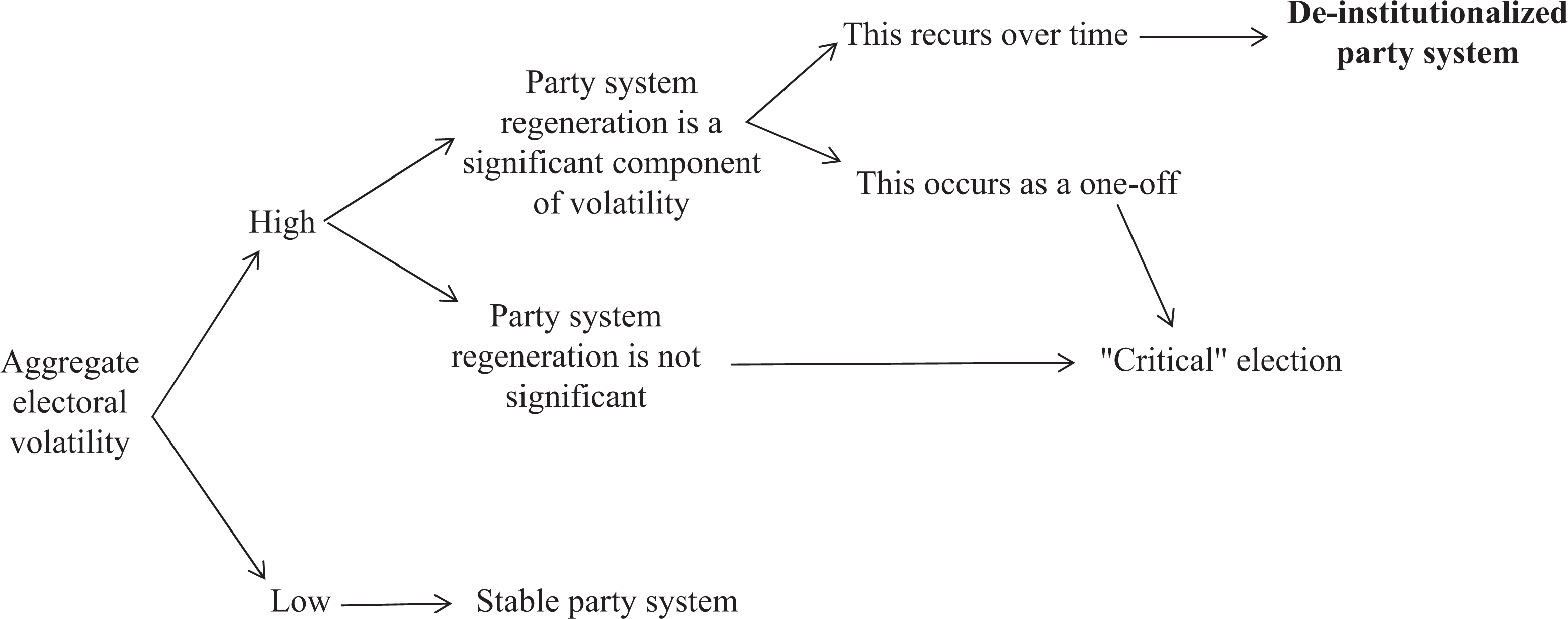
Electoral volatility, party system regeneration and (de-)institutionalization: Synthetic scheme of relations.
Disentangling volatility: Data and measures
Given the rationale behind the abovementioned argument and in order to assess the extent to which Western European party systems have experienced or have been experiencing sequences of de-institutionalization, we need to disentangle the index of electoral volatility and to explore the patterns of regeneration and alteration in 19 Western European countries since 1945. This kind of effort has been carried out by Birch (2003), Powell and Tucker (2014), and by Rose and Munro (2009) on post-communist countries. 9 Powell and Tucker call Type A Volatility those vote shifts caused by the entry and exit of parties from the political system and Type B Volatility those vote shifts occurring when voters switch their votes between existing parties. 10 The authors set a 2% threshold for parties in order to be included in the calculation of both indices. A party that is below this threshold is considered out of the political system. This methodological choice implies that if a party receives 1.9% of the votes in the election at time t and 2.1% at time t+1, this vote shift enters in the calculation of Type A Volatility, since it is considered as a new party that enters the political system. As a consequence, Type B Volatility is composed of vote shifts among parties that cast more than 2% of the votes both at time t and t+1. We argue that a threshold of 2% is too tight a criterion if applied to Western Europe and would fail to consider many small parties that exert an important role in their respective party systems. That is why we have decided to reduce the threshold to 1% of the national share 11 and rename Type A as Volatility by Regeneration 12 (now and further, RegV) and Type B Volatility as Volatility by Alteration 13 (now and further, AltV). This choice has the empirical consequence of reducing the size of electoral volatility due to the ‘other parties’ category, 14 namely those parties which fall below 1% in both the elections at time t and t+1 (now, and further, OthV). 15
On the basis of these methodological choices, our effort has been that of calculating Pedersen’s aggregate index of electoral volatility for all the elections occurred in Western Europe since 1945, for a total of 336 elections of the Lower House (or, more precisely, 336 electoral periods). For each election we have calculated four measures: 1) Volatility by Regeneration; 2) Volatility by Alteration; 3) Volatility derived by parties below 1%; 4) Total Volatility. The formula is therefore the following:

To our knowledge, this is the first systematic attempt to build a comprehensive database about volatility and its internal components for Western Europe. This goal has been accomplished by using reliable data sources and consistent methodological criteria.
The main source followed to collect electoral data has been the work by Nohlen and Stöver (2010) for elections until 2008. For the elections held since 2009, we have relied on official data provided by the pertinent electoral authority for each country. Nohlen and Stöver also disentangle, for most of the elections, 16 the ‘other parties’ category and provide electoral results of parties down to 0.1%. The availability of data up to a specification of 0.1% has allowed us to compute the index of Total Volatility and its components in a more precise way than previous studies (Bartolini and Mair, 1990; Mair et al., 2004).
As far as the methodological criteria are concerned, the most important question has been that of understanding when a party can be considered as ‘new’ and included in the calculation of RegV. On this point we have relied on the classic criteria set by Bartolini and Mair (1990: 311–312) regarding mergers and splits of existing parties, 17 which have been included in the calculation of AltV, while when a party leader or deputy is expelled or simply exits from a party and then launches a new party 18 this has been included in the calculation of RegV. 19 As underlined by Sikk (2005: 393–394), this approach is conservative, in the sense that it underestimates voters’ mobility but it ‘seems to better balance shortcomings and merits’ with respect to alternative approaches. 20
Patterns of volatility and regeneration since 1945
The starting point of our empirical analysis is to present an overall picture of the patterns of electoral instability across the universe of 336 general elections held in 19 Western European countries 21 from 1945 to 2015, distinguishing between variance in TV on one side and variance in its RegV component on the other side. 22
As for the variance in TV, Figure 2 shows that elections clearly tend to cluster around lower levels of TV, as confirmed by the positive skewness and by the fact that the mean value (10.25) of the distribution is significantly higher than the median value (8.83). In 312 out of 336 elections (92.9%) the value of TV is lower than 20, and in 273 (81.3%) elections TV is lower than 15. Furthermore, 200 (59.5%) elections have values of TV falling below the mean of the distribution. On the contrary, elections with a significantly high level of TV – say, higher than 20, to recall the threshold set by Mair (2011) – are quite infrequent (24 out of 336; 7.1%), though they even reach a value of TV as high as 48.5.

Frequency distribution of elections by interval values of TV.
Given that, by definition, RegV is a component of TV, and that we have just detected generally low levels of TV across the 1945–2015 elections in Western Europe, the values of RegV across the same elections can be anything but lower. Indeed they are much lower. As can be seen from the frequency distribution in Figure 3, the values of RegV are very positively skewed, the mean and median values of the distribution being only 1.41 and 0.55 respectively. In as many as 123 elections (36.6%) RegV equals zero and in other 124 elections (36.9%) ranges from 0.01 to 1.5. Only 21 elections are characterized by values of RegV above 6, with a maximum value of 18.7.

Frequency distribution of elections by interval values of RegV.
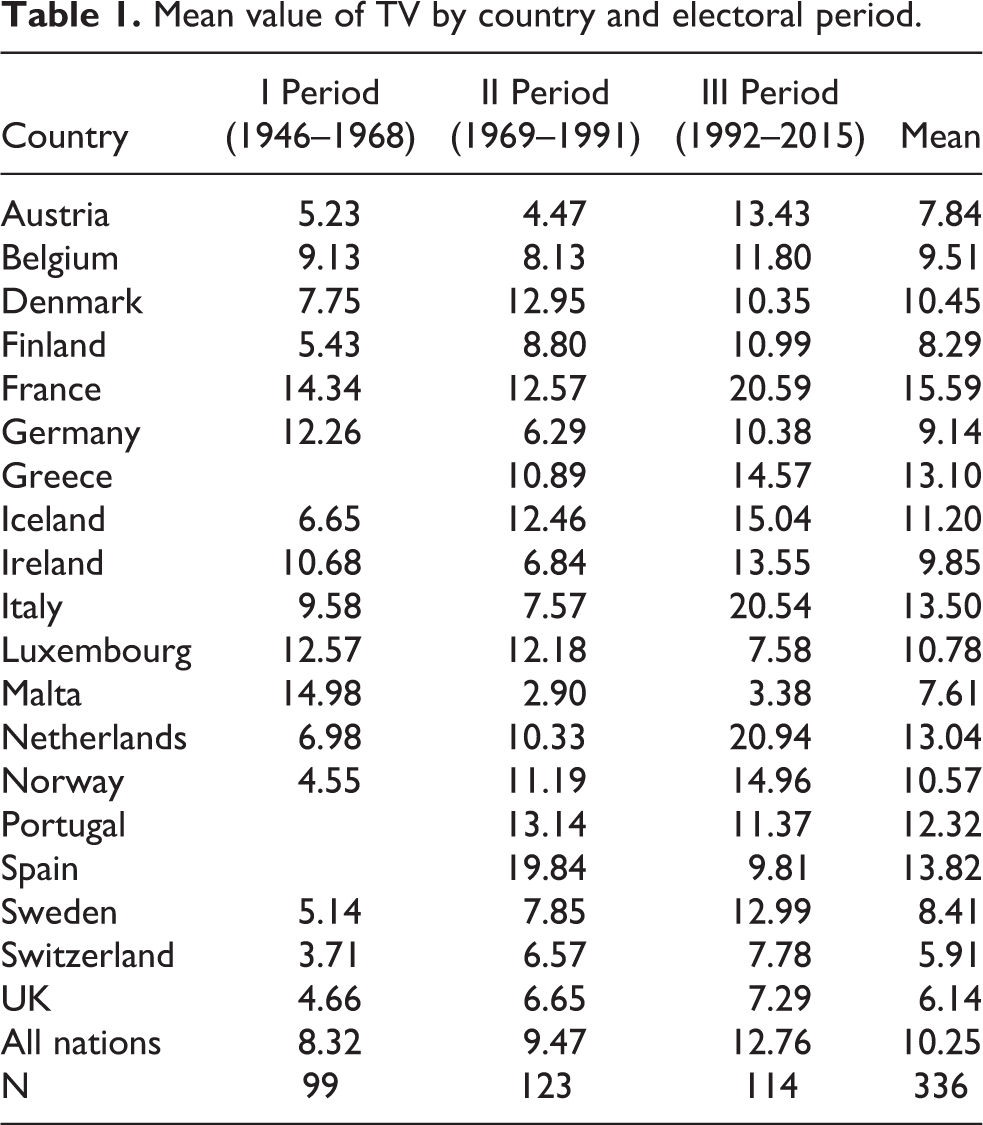
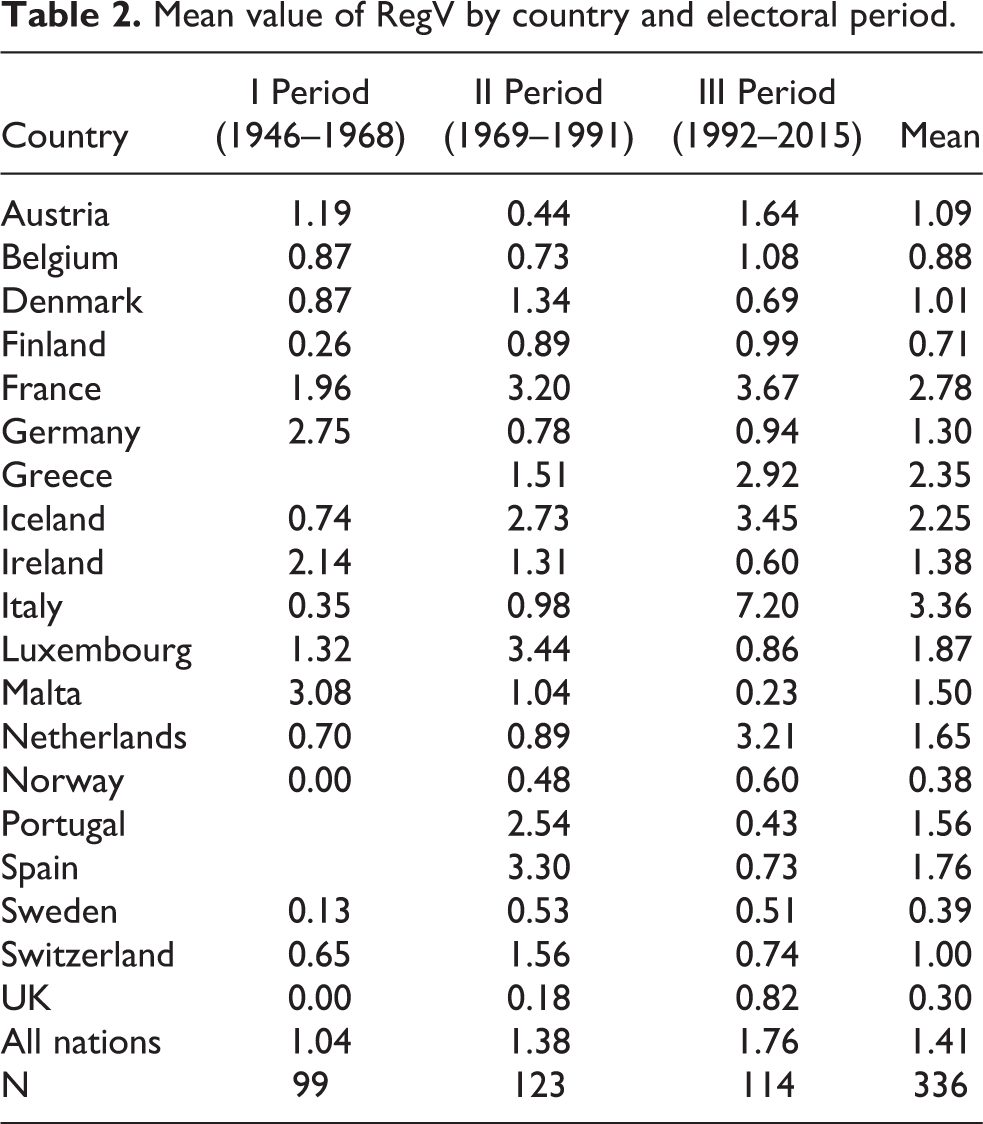
Putting together the evidence from Figures 2 and 3, the ‘fundamental bias towards stability’ in the 1885–1985 Western European elections emphasized by Bartolini and Mair (1990: 68) appears confirmed in the aggregate for the 1945–2015 period of time, not only with reference to total volatility, but also for party system regeneration. However, we still have to analyze the variance in TV and in RegV in space and time, therefore controlling for the possible existence of different patterns of variation across countries and/or in successive electoral periods. This is what we do in Tables 1, 2, 3, and 4. Tables 1 and 2 show the mean values, respectively, of TV and RegV in each country and for three electoral periods: 1946–1968, 1969–1991, and 1992–2015, each of them lasting about 23 years. 23 As a consequence, the elections held in the late democratizing countries – Greece, Spain, and Portugal – fall into the second and the third period.
Mean value of TV by country and electoral period.
Mean value of RegV by country and electoral period.
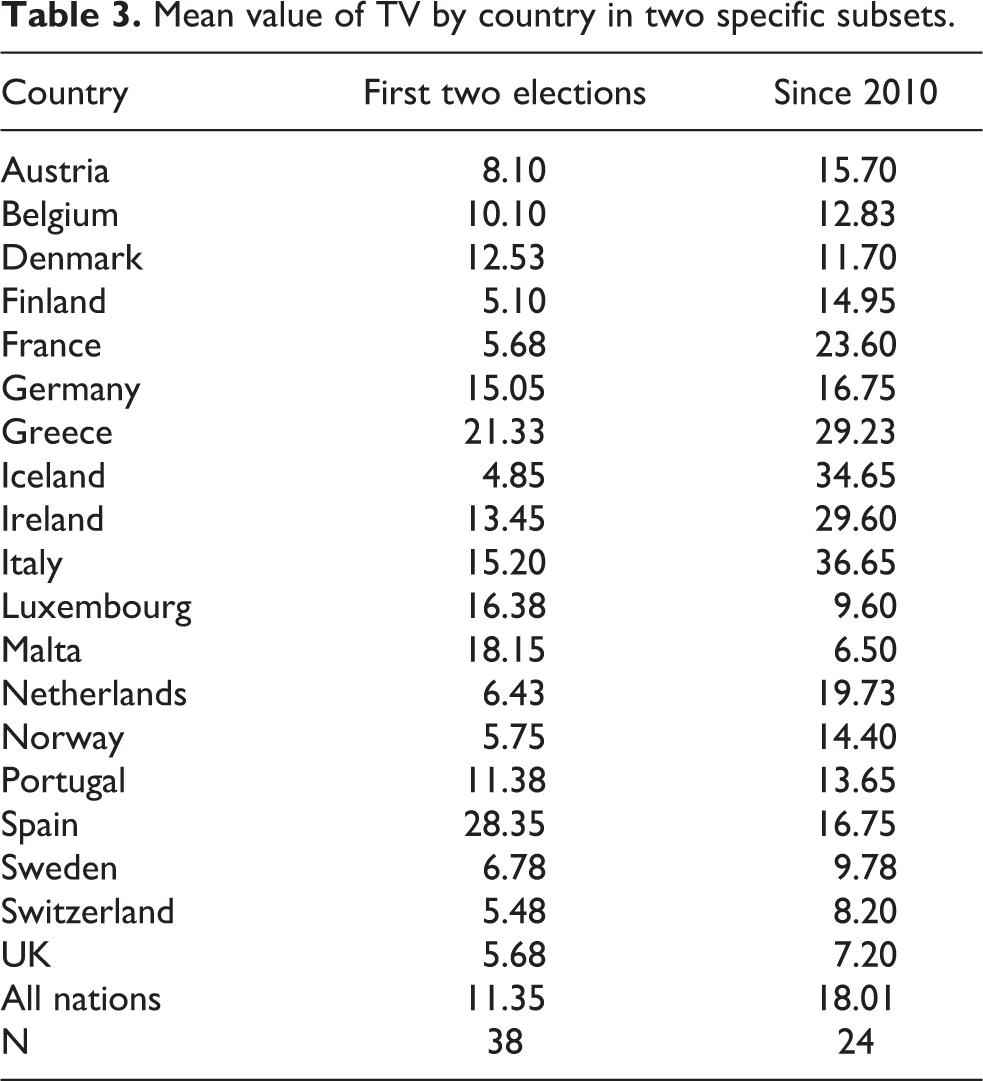
Mean value of TV by country in two specific subsets.
Mean value of RegV by country in two specific subsets.

The mean value of TV for the countries under scrutiny ranges from a minimum of 5.91 (Switzerland) to a maximum of 15.59 (France) (see Table 1), with an overall mean of 10.25.
More interestingly, in most countries (Austria, Belgium, Finland, France, Germany, Iceland, Ireland, Italy, The Netherlands, Norway, Sweden, Switzerland, the UK) TV is higher in Period 3 than in the previous periods of time, thus signaling a trend of growing party system instability in the last two decades, as confirmed by the fact that the overall mean of TV in Period 3 (12.76) is significantly higher than in Periods 1 and 2 (8.32 and 9.47 respectively). Three countries with mean values of TV above 20 emerge in this latter period of time: France, Italy, and The Netherlands. They differ, however, in that they had divergent trends and levels of TV in the previous periods. In France the mean value of TV for each electoral period has always been very high, and even one of the highest among the 19 countries for both Periods 1 and 2. In Italy TV was 9.58 in the first period after the end of the Second World War and the instauration of democracy, then it went down to 7.57 between 1969 and 1991, and has eventually jumped up to 20.54 in the period of the so-called Second Republic. The Netherlands show, instead, a linear trend: TV increases from 6.98 in Period 1 to 10.33 in Period 2, and doubles to 20.94 in Period 3.
As for RegV, its mean values are quite low in almost all countries and for each electoral period (see Table 2). However, it is worth noting that RegV reaches considerably higher levels during Period 3 in France (3.67), Italy (7.20), and The Netherlands (3.21), i.e. in the same countries with higher values of TV, and also in Iceland (3.45).
Table 3 and 4 group together two distinctive subsets of elections, namely the first two post-war (or democratic) elections, and the elections held since 2010. The first two post-war (or democratic) elections overlap, for most of the countries, with the regime (re-)democratization, where the new party system is not yet consolidated. For this reason they are expected to be characterized by higher levels of instability and regeneration with respect to the following elections regardless to the specific historical period in which the (re-)democratization has taken place (the mid-1940s or the mid-1970s). At the same time, the elections held since 2010 are also expected to show greater instability and regeneration than in the past, due to the impact of the harshest economic crisis since 1929 that has led, in many countries, to the rise of new and in some cases extreme parties (Mudde, 2014) and to the systematic defeat of governing parties (Kriesi and Hernández, 2013).
As regards the subset including the first two elections held in each country, the expectation of greater instability and regeneration is confirmed: the overall mean of TV and RegV in this subset is higher than the average (respectively, 11.35 against 10.25; 1.76 against 1.41). As TV is concerned, we note the presence of particularly unstable frameworks displayed by countries that were coming out from an authoritarian regime: Germany, Greece, Italy, and, above all, Spain, where TV during the first two elections is more than twice the country’s average. A similar trend is showed by RegV in newly democratic regimes like Austria, Germany, Greece, and Spain, but cases of particularly high regeneration have occurred also in long-term democratic polities like Ireland and Malta.
The expectation concerning the elections held since 2010 is also totally confirmed: the electoral environment of Western European polities has been facing accelerating rates of change, both on the side of overall electoral instability (the mean of TV since 2010 is 18.01) and on the side of the rise of new parties and the disappearance of old ones (the mean of RegV is 3.00, more than twice the average). If the overall picture of Figures 2 and 3 shows a fundamental bias towards stability, the last six years reveal a general shift towards instability: 24 in 17 countries out of 19 (the exceptions being Luxembourg and Malta), in the elections held since 2010, TV is higher than the country’s average during the whole period and in 11 countries out of 19 the same trend is also detectable as regards RegV. While the increase of TV virtually involves all countries, 25 that of RegV is more differentiated, with impressive peaks in Italy (18.7, about six times the country’s average) and Iceland (10.85).
Detecting patterns of de-institutionalization in Western Europe
Resorting to the theoretical and methodological framework discussed in the first two sections, we now test the presence of patterns of de-institutionalization in Western Europe across time and space. In order to do that, it is necessary to introduce a further variable which derives from the ones we have presented in the last section: the Salience of Regeneration, that is, the ratio between RegV and TV, 26 which represents the proportion of total electoral mobility accounted for by party system regeneration. The index ranges from 0 per cent (total volatility is accompanied by a complete absence of regeneration) to 100 per cent (total volatility is entirely caused by party system regeneration). By using this variable, we are able to fulfill our second condition, that is, to verify when party system regeneration is a significant component of volatility. Therefore, what is really important is not how much party system regeneration is present but how salient it is. The simple use of RegV could lead to misinterpretations. Indeed, given that – as shown in the previous section – RegV is very low compared with AltV and, empirically, high levels of the former are always accompanied by high levels of the latter but not vice versa, to think in terms of proportions rather than absolute values seems more appropriate. 27
By combining the two key indices of Salience of RegV and Total Volatility we gain a clearer picture about the patterns of party system instability and de-institutionalization in Western Europe. 28 Figure 4 sorts the 336 elections of our sample into four ‘types’ according to their level of electoral volatility and to the salience of party system regeneration. The cutoffs are represented by the two mean values, respectively 10.25 for TV and 12.14% for Salience of RegV. 29

Typology of elections by level of electoral instability and salience of party system regeneration.
Many interesting findings emerge from Figure 4. First of all, during the last 70 years of democratic experience, for the most part Western Europe has been a stable electoral environment: 200 out of 336 elections fall below the mean value of TV. The great bulk of these 200 elections are not significantly affected by regeneration if one observes that about 40% of the elections fall in the lower left quadrant, the one characterized by electoral stability and closure of the party system (lack of regeneration). Furthermore, 99 out of 135 elections falling into this quadrant (Stability) have no regeneration at all (RegV = 0). Notwithstanding the emphasis on the overall stability of the Western European landscape, the effect of time in the lower left quadrant reveals that the story is changing. More specifically, the number of elections with low volatility and without salient regeneration has diminished: if during the first electoral period (1946–1968) almost a half of elections showed these features, only 30% have fallen into this quadrant since 1992.
Second, it is interesting to note that in the upper left quadrant (Regeneration within stability) the second electoral period (1969–1991) is the most populated one because it corresponds to the time where new party families emerge (for example, green or extreme-right parties), but still in a context of overall electoral stability.
Third, moving onto the right of Figure 4, among the subset composed by the 136 unstable elections, we note that in both quadrants an upward trend is easily detectable. Elections where instability is not significantly affected by regeneration (Instability without regeneration) increase from 17% to 31% between the first and the third electoral period. At the same time, in the upper right quadrant (Instability with regeneration) – the area of potential de-institutionalization – elections characterized by high volatility and salient regeneration represent 13% of the sample during the first period and go up to 23% after 1991.
Overall, the amount of unstable elections has remained more or less steady until the end of the second period and then has rocketed: unstable elections (those with a TV higher than the mean) represented roughly one third of the cases until 1991 (75 elections out of 222) and about 54% from then on (61 cases out of 114). Moreover, not only has instability strikingly increased, but it has also tended to be increasingly associated with significant regeneration: while during the first two periods party system regeneration was salient mainly in contexts of electoral stability, since the beginning of the 1990s the relationship is reversed: RegV has become salient more frequently in cases of high levels of electoral instability. Obviously, when TV is high, it becomes much more difficult to have a salient RegV and, therefore, this finding is meaningful: during the last period the occurrence of high volatility elections characterized by salient regeneration has become a more common outcome.
If Western Europe has slowly moved from a long-term pattern of pervasive stability to a growing trend of instability characterized by higher rates of party system regeneration, the 62 elections falling in the upper right quadrant of Figure 4 should be considered as a warning bell, especially for those countries where many of these elections have taken place. It is worth investigating those 62 elections, in order to identify where and when they have occurred. Table 5 lists these elections, distinguishing them according to whether they occurred in sequence or as a one-off instance.
List of elections with high volatility and salient regeneration.
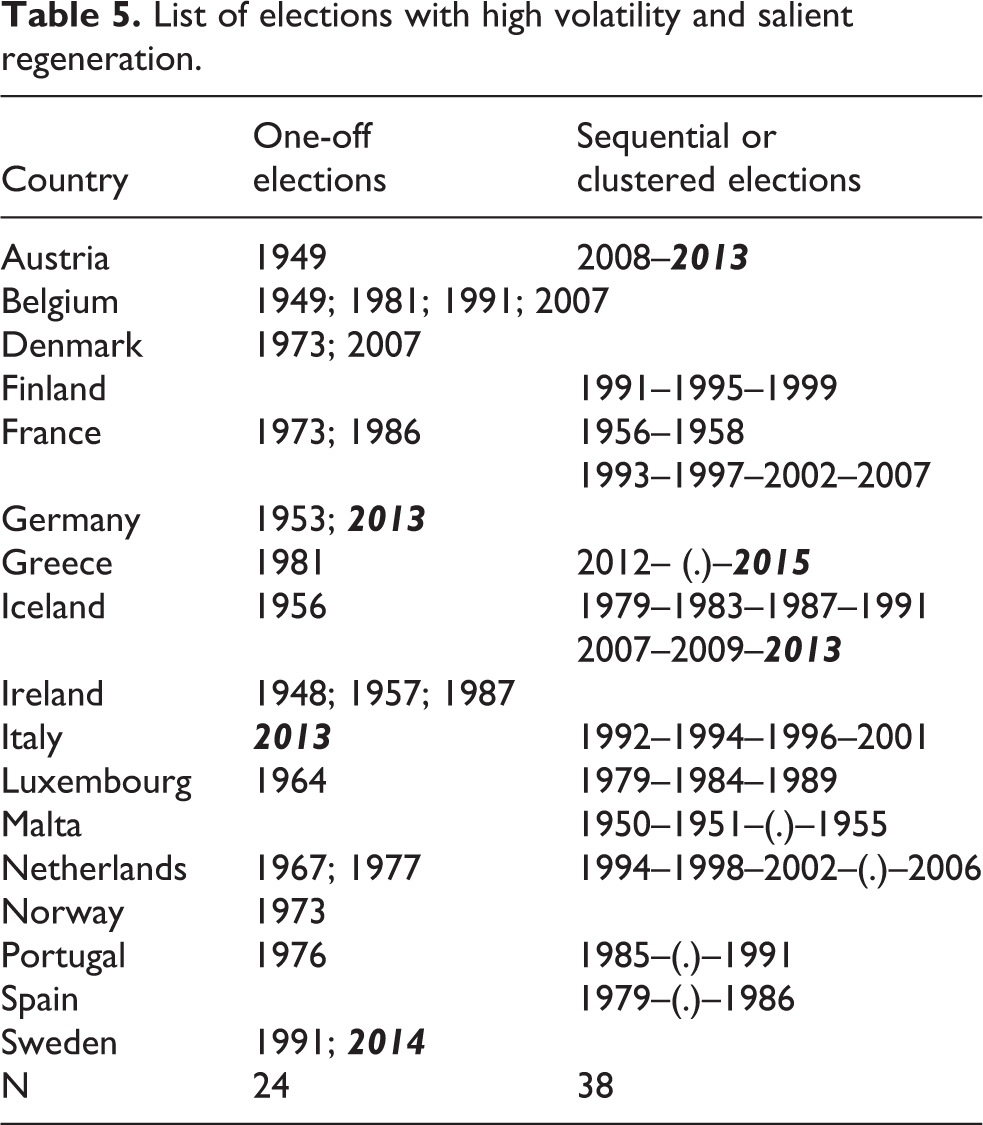
The distinction is crucial in order to detect possible patterns of de-institutionalization, since the third necessary condition for having de-institutionalization is the occurrence of waves of high volatile elections associated with high rates of party system regeneration which cluster in a consecutive or quasi-consecutive period of time. The finding emerging from Table 5 is remarkable: about 61% (38 out of 62) of the elections characterized by high TV and salient RegV occur in sequence or cluster in a quasi-consecutive period of time, 30 and many countries have been involved in this process of somewhat prolonged electoral change. Moreover, among the one-off elections, there are three potentially harbinger cases of new sequences, since they concern the last general election of the respective countries (Italy and Germany in 2013, Sweden in 2014).
One-off elections are certainly critical elections, causing a sudden shock to the party system, but they do not have the potential to produce a pattern of de-institutionalization per se, since the necessary dimension of time is lacking. Many of these elections occur at the very beginning of the democratic period, and the initial period of instability and regeneration is explained by the lack of consolidation of the new party system. This outcome involves seven countries (Austria, Belgium, Germany, Greece, Ireland, Italy, and Portugal). Another common pattern concerning one-off elections is clearly discernible: these critical elections often occur when a new relevant party enters the electoral arena, thus changing the former balance of the party system; this happens when populist radical right parties emerge in Scandinavia (Denmark and Norway in 1973, Sweden in 1991) or when the centrist Democraten 66 and Partido Renovador Democrático emerge respectively in The Netherlands (1967) and Portugal (1985).
The sequential elections pointed out in Table 5 represent – to different extents – periods of party system de-institutionalization experienced by Western European countries over the past 70 years. Thirteen sequences are identified, belonging to 11 countries. Two countries show the presence of two different sequences of de-institutionalization: France and Iceland. France lived a short period of deep change during the second half of the 1950s, namely the transition between the Fourth and the Fifth Republic and, later, a very long period of instability with party system regeneration during the 1990s and the 2000s, involving four consecutive elections. Iceland experienced a first period of de-institutionalization during the 1980s and has faced a new one during the last years (2007–2013) where, especially in the general election of 2013, there has been an astonishing amount of electoral change, with a RegV of 10.85 and a TV of 34.65. The remaining nine countries show one sequence, composed of two (Austria, Greece, Portugal, and Spain), three (Luxembourg, Malta, and Finland), or even four consecutive elections (Italy and The Netherlands between the 1990s and the 2000s). Two of these sequences have occurred during particularly long periods of party system re-structuring: in Spain, after the end of the authoritarian rule (1979–1986) and in Malta where the original multi-party system has been progressively replaced by the actual two-party system. The other sequences have occurred during the 1980s (Luxembourg and Portugal) and especially since the 1990s up to very recent years (Austria, Finland, Greece, Italy, and The Netherlands). In Italy, the prolonged period of electoral change (1992–2001) has corresponded to the turbulent transition from the so-called ‘First’ to the ‘Second’ Republic and the almost complete replacement of the post-WWII parties. The starting and crucial point of this protracted process of electoral change has been the 1994 election, when TV has reached the level of 39.25 with a RegV of 15.85. There is only one case of higher party system regeneration in the whole sample and it involves, again, Italy: in the last general election of 2013 (a one-off election at the moment) the extent of RegV has risen up to the dramatic level of 18.7, due to the fact that about 35% of the total vote has been cast for new parties.
Concluding remarks: On the eve of a wave of de-institutionalization?
Starting from the path-breaking contribution by Mainwaring and Scully (1995), there has been a flourishing of studies about party system institutionalization. Despite a widespread agreement on its definition, scholars have still not provided a consistent and generalizable way to empirically detect when a party system is institutionalized or, conversely, when it is undergoing a phase of de-institutionalization. Furthermore, these studies have generally focused on Latin America or on Central and Eastern Europe, while little attention has been paid to the Western European context.
This article has provided a theoretical clarification and has developed a new empirical operationalization of the somewhat ungraspable concept of party system (de-)institutionalization. We have identified three necessary – although not sufficient if taken separately – conditions a party system needs to achieve in order to become ‘de-institutionalized’: the first condition is the presence of an unstable electoral environment (high levels of electoral volatility); the second condition requires that a significant part of this electoral instability consists of party system regeneration (old parties disappear and new parties successfully emerge); finally, the third condition implies that unstable elections with significant regeneration are not a one-off, but tend to be sequential or at least to cluster within a certain period of time.
The identification of these three necessary conditions to reach party system de-institutionalization is the first important contribution of this article. It has allowed us to make some clarifications with respect to different terms used in the literature such as electoral instability, ‘critical election’, dealignment/realignment, and, more specifically, party system (de-)institutionalization.
In order to verify the occurrence of these three conditions in Western Europe over the last 70 years, we have built an original database of total volatility and its internal components of alteration and regeneration. This database covers the universe of Western European elections since 1945. This new database is the second important contribution provided by this article and it has allowed us to shift the argument from a theoretical to an empirical viewpoint.
The descriptive data analysis of total volatility and party system regeneration in Western Europe has revealed some important findings. While the overall picture of the levels of party system volatility and regeneration across time and space shows that the ‘fundamental bias towards stability’ emphasized by Bartolini and Mair (1990: 68) appears confirmed, there is a clear increase of both variables during the last electoral period (1992–2015), with further acceleration since 2010 that reveals a general shift towards instability in the last years.
The most interesting finding of our analysis is reached, however, when we single out – through a four-fold typology – those elections that fit both the first and the second necessary condition to achieve a de-institutionalized party system from those only showing instability without regeneration, regeneration within stability, or complete stability. About 61% of elections with high total volatility and salient party system regeneration cluster in a consecutive or quasi-consecutive period of time. These sequential elections represent – to different extents – periods of party system de-institutionalization experienced by Western European countries over the past 70 years, since they fulfill each of the three necessary conditions highlighted above. Thirteen sequences are identified, occurring in 11 countries. The majority of these sequences have taken place during the last electoral period and three ‘one-off’ elections with high volatility and salient party system regeneration are potentially harbingers of new sequences, since they concern the last general election of the respective countries (Italy and Germany in 2013, Sweden in 2014).
In conclusion, empirical evidence seems to suggest that symptoms of an ongoing process of de-institutionalization are spreading across many countries in Western Europe – although not to an extent comparable to that of Central and Eastern Europe (Casal Bértoa, 2013) – and they could infect other party systems in the years to come, thus affecting the functioning and the quality of democracy.
This evidence suggests that further research on this topic is needed in order to properly understand the notable processes of electoral change and party system de-institutionalization in Western Europe. In particular, three distinct but interrelated lines of research appear to be promising: the first line deals with a deeper study of party system regeneration through the use of a variety of indicators in order to catch different degrees and aspects of the ‘newness’ of a party; the second line concerns the investigation of the macro-constellation of factors (socio-structural, economic, or political-institutional ones) that are able to explain party system de-institutionalization and its national and temporal variations in Western Europe; finally, the third line of research relates to the consequences of party system de-institutionalization on the democratic process, both in terms of its legitimacy and effectiveness.
Footnotes
Acknowledgements
The authors thank Stefano Bartolini, Roberto D’Alimonte, Lorenzo De Sio, and Pierangelo Isernia, and the two anonymous reviewers, for their useful comments on earlier drafts of this article.
Declaration of Conflicting Interests
The author(s) declared no potential conflicts of interest with respect to the research, authorship, and/or publication of this article.
Funding
The author(s) disclosed receipt of the following financial support for the research, authorship, and/or publication of this article: The research received grants from the University of Florence and from LUISS Guido Carli in Rome.
