




Abstract
Recent research has indicated that social heterogeneity impacts party system size, even in restrictive settings. This research as yet has not established whether it is minority or majority voters who are behaving outside Duvergerian expectations. This study argues that it is ethnic voters that seem to defect from their parties at lower rates, which explains why small parties proliferate and persist in heterogeneous states. This hypothesis is tested on party-in-district level election returns in the German lander Schleswig-Holstein. The results show that small ethnic parties suffer notably less defection than small non-ethnic parties. The study proposes a number of potential causal mechanisms that could be driving ethnic voters, as a group, to defect at lower rates than non-ethnic voters.
The problem
Ethnic heterogeneity has long been recognized as an important factor in understanding the size and scope of national party systems (Duverger, 1951; Lipset and Rokkan, 1967). Conventional wisdom has held that the impact of ethnic heterogeneity is particularly felt in less restrictive electoral systems (Clark and Golder, 2006; Cox and Neto, 1997; Ordeshook and Shvetsova, 1994). Working with traditional conceptions of the strategic voting model, these works argue that more restrictive settings, such as single member district plurality, induce voters to vote less based upon their first preferences and instead based upon a strategic calculation of possible winning parties (Cox, 1997).
In their recent book, Robert Moser and Ethan Scheiner (2012) challenge this hypothesis. They find that ethnic heterogeneity has a substantively important impact on party system size even in restrictive electoral settings, despite the strategic pressures that should be at play (Moser and Scheiner, 2012: 185–187). This finding, noted at the electoral district level, holds across numerous countries, regions, and institutional settings. It echoes earlier findings from Madrid (2005), Singer (2012), and Stoll (2013), all of which concur that the impact of ethnic heterogeneity is felt even in heavily restrictive settings, such as presidential elections.
A problem that Moser and Scheiner identify in their own findings is that they lack a clear understanding of which group of voters is behaving outside of strategic voting expectations (Moser and Scheiner, 2012: 252–254). Their findings show only that ethnic heterogeneity causes some groups of voters to behave outside of Duvergerian expectations. They propose that future research should focus on attempting to establish whether it is ethnic minority voters or ethnic majority voters that are behaving differently in the face of ethnic heterogeneity.
In this study, I set out to answer the question of which group of voters is defying Duvergerian expectations. I propose a new, party-in-district based approach to testing strategic defection in mixed-member electoral systems, which allows for the isolation of party-specific defection rates. This approach is tested on sub-national election returns for small parties in the German lander Schleswig-Holstein in 2005 and 2009. With this approach, I am able to test whether the defection rate from small ethnic parties is substantively different from the defection rate of other small parties. The result should be a tentative indication of which group of voters is behaving outside of Duvergerian expectations.
The hypothesis
In keeping with the broader literature on ethnic parties and ethnic voting, I argue that we should expect ethnic minority voters to be less likely to defect from their first choice party than ethnic majority voters (Birnir, 2007; Chandra, 2007). This literature has generally noted the bloc-like nature of minority voters in a number of different political and social contexts. This unwillingness of group members to defect from their first choice, identity-based party explains why ethnic heterogeneity leads to more parties in a party system, ceteris paribus.
The literature on ethnicity, elections, and public goods provision has proposed three potential explanations for this phenomenon. First is the possibility that geographical concentration induces ethnic minority voters to behave differently (Moser and Scheiner, 2012). This could have two causal pathways: 1) geographic, and thus social concentration causes voters to misperceive the strength of ethnic parties, which introduces an information problem that makes strategic voting unlikely; 2) the geographic concentration of ethnic minorities means that their parties actually are more competitive in certain districts than other small parties, which should lead them to be less impacted by strategic defection (Cox, 1997; Horowitz, 1985; Toft, 2006).
The second explanation is that ethnic voters have little incentive to change their vote choice because their dominant issue, the ethnic identity issue, is unrepresented among the mainstream party options. In the face of strategic pressures, scholars have surmised that voters have an incentive to continue their support of a small party if to do nothing more than signal the credibility of their constituency to larger parties, hoping to sway those parties’ policy positions (Clough, 2007; Cox, 1997; Herrmann, 2012). Particularly for small ethnic minority parties, this seems like a strong hypothesis, as mainstream parties would not have large incentives to target the minority group.
The third and final explanation can be taken from the literature on ethnic fractionalization and public goods provision. In this literature, broadly speaking, ethnicity is seen as a type of informal signaling between members of a network. Fearon and Laitin (1996) argue that this informal networking allows coethnics to better police defection from group interests, a proposition echoed empirically by Lyall (2010), who finds that coethnics are able to credibly threaten punishment for the misbehavior of members of their group. Habyarimana et al. (2007) find that coethnicity is a good indicator of the likelihood an individual will maintain and protect public goods institutions, and argue that the mechanism at work is a fear of in-group policing of defectors. As ethnic parties are widely seen as sources of public goods for small ethnic minority groups (Chandra, 2007), it is reasonable to assume that defection from such an organization would face the same fears of in-group policing that prevent defection from more specific public goods provision arrangements.
The research design
To test the hypothesis that ethnic parties are less likely to suffer strategic defection than other small parties, I analyze district-level electoral returns for small political parties in the German lander Schleswig-Holstein. This lander was selected because it fits three criteria: it has a consistently elected ethnic minority party that represents a relatively sizeable ethnic minority; it makes use of a mixed-member electoral system; and it has electoral returns for each tier that are available at the district level. With the exception of New Zealand, these characteristics are not found at the national level, which necessitates the use of sub-national elections. 1
Of utmost importance for this approach are the latter two criteria. In order to identify specific instances of strategic defection, researchers require data on the first preference party of voters, which can then be compared to their actual votes. Usually this requires survey data. By analyzing a mixed-member electoral system, however, I am able to focus on parties at the district level as the unit of analysis, and look at the behavior of their supporters in the face of strategic pressures. In this study, I operationalize first preference votes as votes cast for a party in the proportional representation tier of the election, following relatively common practice (Moser and Scheiner, 2012; Stoll, 2008). I use this as the key independent variable in an ordinary least-squares (OLS) regression with clustered standard errors to predict the number of votes a party receives in the single-member district tier. When the coefficient on the PR vote share of a party is less than 1, it indicates that this party has lost vote share between the two tiers. I assume this is an indication that a party has suffered from strategic defection. The other potential explanation, that it indicates strategic ticket splitting decisions by the supporters of larger parties looking for potential coalition partners, cannot be definitively disproven, but as the results will show, the magnitude of difference between ethnic and non-ethnic parties is likely too large to be explained by ticket-splitting alone (Herrmann and Pappi, 2007; Shikano et al., 2009). The model controls for district size, turnout, and the number of candidates competing in the SMD tier.
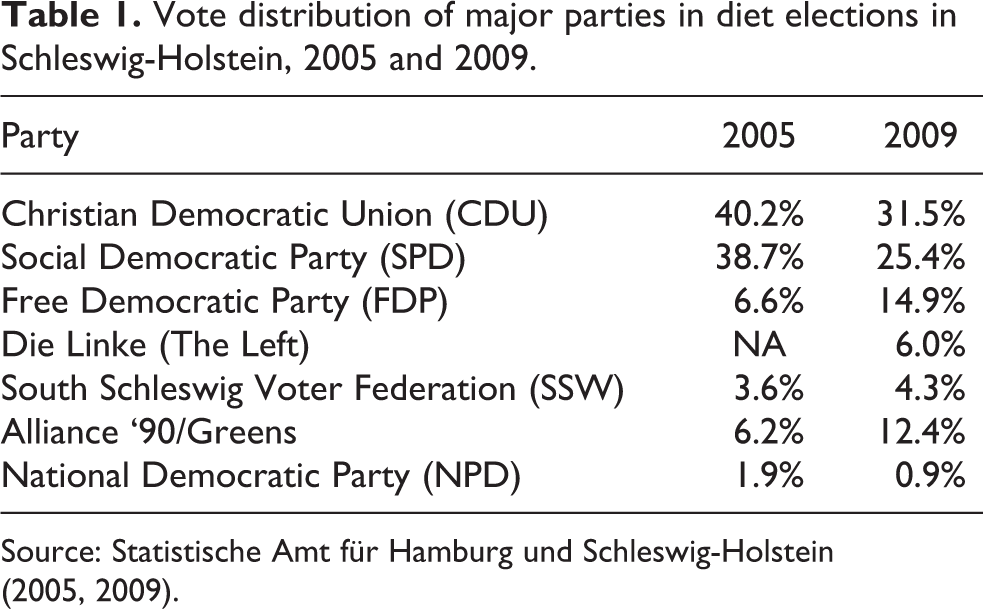
The model compares the district-level electoral returns of small parties in the Schleswig-Holstein elections. For the purposes of this study, small parties were designated as those who did not finish in the top two in the overall regional election. Large parties were left out of the analysis because they should face a net benefit from strategic defection, unlike small parties. This is important because the ethnic party in question, the South Schleswig Voters’ Federation, has not in recent memory exceeded 6% of the vote share in the regional elections. 2 The election results are shown in Table 1 below; the parties that will be analyzed are bolded, those excluded are italicized.
Vote distribution of major parties in diet elections in Schleswig-Holstein, 2005 and 2009.
Election year models for Schleswig-Holstein, 2005 and 2009.
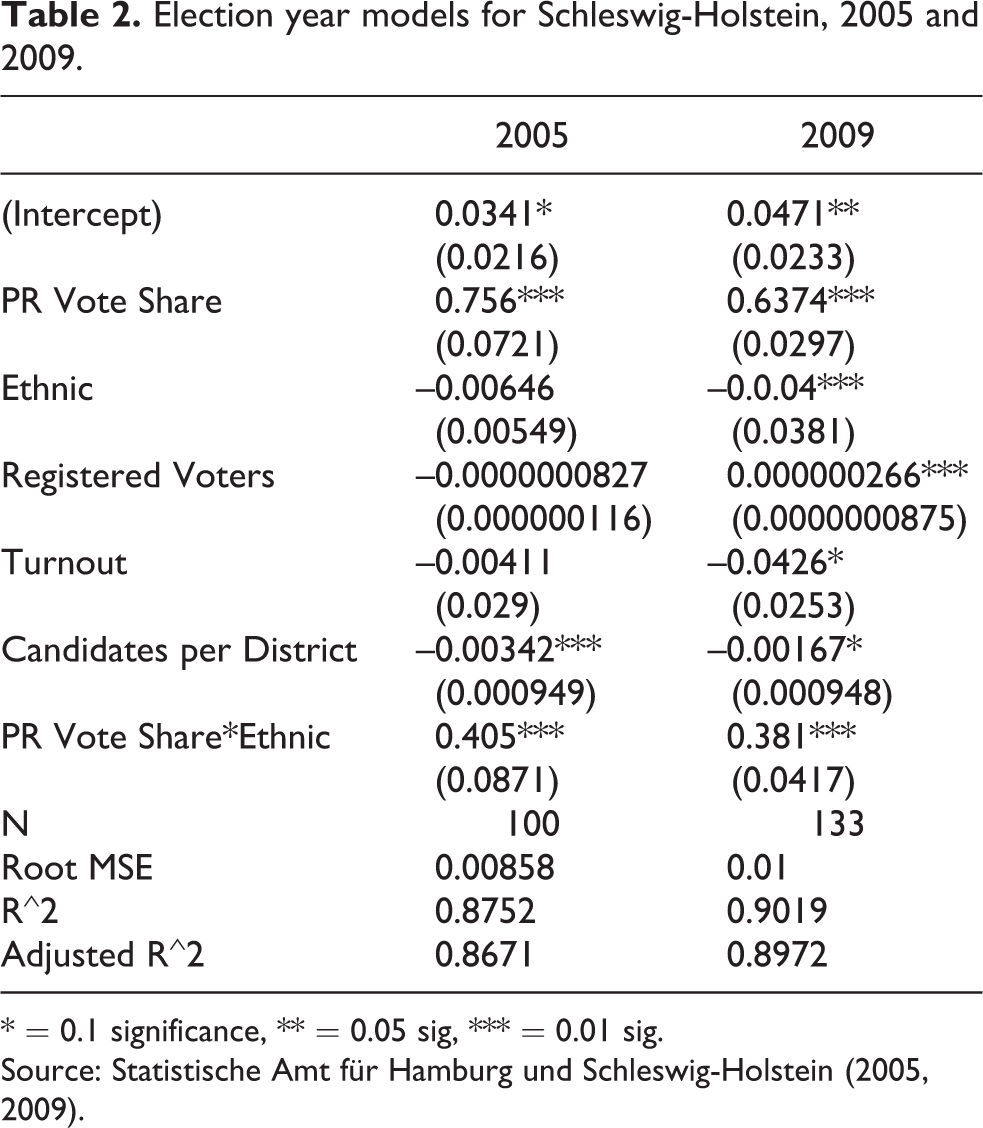
* = 0.1 significance, ** = 0.05 sig, *** = 0.01 sig.
Party specific models for Schleswig-Holstein, pooled elections.

* = 0.1 significance, ** = 0.05 sig, *** = 0.01 sig.
There are two potential problems with this research design. The first is contamination. As Ferrara et al. (2005) note, contamination is an ever present problem when attempting to model strategic behavior in mixed-member systems. It is difficult for any study to credibly say that the dynamics of one tier of the electoral system are not impacting the results in the other tier. This poses a problem for the assumption of independence that is crucial to regression analysis. For this study, the problem would come from situations where a party does not receive votes in the SMD tier because they do not run a candidate, as all parties are represented in the PR tier. To help mitigate this problem, I list-wise delete any party-in-district that does not nominate a candidate in the SMD tier. While this creates situations where specific parties and their voters may not be accounted for in a given district, this should not adversely affect outcomes, as the data being used are not compositional. 3
The second problem is the level of inference produced by this research design. Moser and Scheiner (2012: 254) note that almost any study attempting to establish if ethnic voters are behaving differently would encounter the ecological fallacy. The problem for my approach is that the level of analysis is meso, focused on parties and their supporters. Interpretation of the results, then, must focus on the supporters of the ethnic party as a bloc rather than attributing voting behavior to individual minority members. This should not diminish any findings; group behavior in this instance is still of interest, particularly if it is reasonable to assume that supporters of the SSW are overwhelmingly members of the Danish minority. Given the close convergence between the estimated size of the Danish minority (estimates usually hover around 5%) and the share of the vote received by the SSW, this assumption seems reasonable.
Clustered standard errors are used, with districts used as clusters, to correct for any district-specific factors that may lead to different rates of strategic defection for all parties in said district. This has little substantive effect on the results. The parties are analyzed for the 2005 and 2009 elections. Two types of models are estimated. The first approach is an aggregate model, and compares cases of the SSW-in-district to cases of the other parties-in-district. The variable of interest with this approach is an interaction term between PR vote share and an ethnic party dummy variable. If the hypothesis is correct and supporters of ethnic parties are less likely to defect, the coefficient on the interaction term should be positive and significant. With the second approach, I run a party-specific regression, still using parties-in-district as the unit of analysis. This approach allows for a narrower focus on whether party-specific characteristics may be leading to differences in strategic defection rates. For the party specific models, the analysis is focused on the FDP, the Greens, the Left, and the SSW. Election years are pooled in these models; analysis that disaggregated the years produced no substantive differences. The Left did not run candidates in the 2005 election, and as such the party specific model includes just the 2009 data. The NPD is excluded from the party specific models due to a lack of cases.
The results
The most important result is the difference between the PR Vote Share variable and the interaction between PR Vote Share and the Ethnic Party dummy variable. While on average an increase of one percent in PR Vote Share will lead to a 0.756% or 0.6374% increase in SMD Vote Share for a non-ethnic party, this relationship is much closer to a one to one for ethnic parties. In 2005, for an ethnic party a one percent increase in PR Vote Share in a district translated to a 1.16 percentage point increase in SMD Vote Share. In 2009, that number was 1.02 percentage points. In both elections, the ethnic SSW seems to have faced little strategic defection as compared to other parties in the system.
The model’s control variables also tell an interesting story. Turnout is consistently significant and negative, indicating that increased turnout levels negatively impact the vote shares of small parties in the SMD tier. This runs counter to expectations. 4 The size of the district comes back insignificant and negative in 2005, and significant and positive in 2009, rendering substantive interpretation somewhat unhelpful. The number of candidates per district, interestingly, comes back negative and strongly significant in both 2005 and 2009. This would seem to indicate that Ferrara et al. (2005) have legitimate concerns about the potentially confounding nature of SMD candidate proliferation. The model fit statistics are fairly robust, though this should probably be expected when using vote share in one tier to predict vote share in another.
These models, while interesting, also have problems. First, while the fit of the model is strong, this doesn’t necessarily mean that the hypothesis helps us explain more of the variation. In fact, comparing the adjusted R⁁2 of a model that uses only PR Vote Share as an independent variable to the model that accounts for the conditional nature of the hypothesis with the ethnic party interaction variable, there is only a roughly 5% increase in the fit of the model. This is not a substantively uninteresting change in variation, but neither should its importance be overstated. The second problem is that election specific models do not allow us to adequately address whether party-specific factors may be influencing the results. Party specific models should help to address these problems.
The results for the party-specific models largely confirm the findings of the election-specific models. While the relationship between PR Vote Share and SMD Vote Share for the SSW is just slightly greater than one to one, for all three of the more ideologically based parties the relationship is much less than one to one. Given the assumptions established earlier in the paper hold true, these findings indicate that the SSW suffers from lower levels of defection than non-ethnic parties.
Discussion of findings and conclusion
This study started out with two questions. Are ethnic voters more likely to defect than majority voters? If so, what drives them to behave in ways that defy strategic voting theories? The data analyzed here show rather strongly that it is ethnic minority voters, as supporters of ethnic minority parties, who are less likely to defect than other voters, who seemingly vote for more ideological reasons and are more likely to defect in the face of strategic pressures. Tests were conducted with pooled election models that highlighted the differential impact of ethnic parties, as well as party specific models that looked to identify parties that behaved outside of the hypothesized pathways. All tests pointed in the same direction: ethnic party supporters are not behaving as short term, instrumentally rational voters who defect in the face of strategic pressures.
These results lead directly into the second question. Why? What causes ethnic voters to behave differently than non-ethnic voters? Three causal mechanisms were proposed. First, geographic concentration of minority voters could be causing misperceptions, which could be leading ethnic voters to not have accurate enough information to behave strategically at the local level. While this mechanism has the most theoretical support, it should be noted that the SSW never receives more than 20%, and usually far less of the vote in any given district, which runs counter to the idea that geographic concentration is the driving mechanism in this case.
Second, minority issue space monopolization by ethnic minority parties could theoretically make defection a much less preferable option by forcing those voters to effectively abandon their first order preferences for minority public goods. Without individual-level data this cannot be definitively shown. However, the fact that the SSW is not generally considered a possible coalition partner in Schleswig-Holstein, despite its very stable vote share, seems to grant some credibility to this hypothesis.
Finally, in-group policing mechanisms within minority groups make defection more easily punished, as Habyarimana et al. (2007) argue. The result of this is that coethnics are more likely to cooperate than individuals who do not identify as coethnics, like ideologically oriented voters. At this point, this study cannot speak credibly to whether this mechanism is at play. It remains a fruitful area for future research.
However, both the relationship identified and the mechanisms posited require further research. While the results point to the idea that ethnic voters are the ones behaving outside of strategic expectations, the ecological fallacy limits the depth of the finding. Future research would ideally rely on experiments or survey research to establish the propensity of ethnic minority voters to defect as opposed to non-ethnic minority voters. This would provide a more concrete identification of the relationship and grant much greater levels of internal validity.
It is also important to recognize the limitations of these findings. These results cannot, for instance, inform researchers about why ethnic heterogeneity after a certain point seems to correlate with a decrease in parties in the system (Stoll, 2013). If Moser and Scheiner’s (2012) intuition is correct and this is a result of increasing numbers of multi-ethnic parties, the in-group policing mechanism identified in this study could still have much to say about why the number of parties may decrease after a certain threshold. A second limitation of this finding is that it assumes that there is no meaningful competition for ethnic voters in a state. While this may be a very valid assumption for smaller minorities, as group size increases the in-group policing required to prevent group splits grows.
The implications of this research should not be underestimated. While the actual tests were conducted at subnational levels, the proposed mechanisms would operate at all political levels and in all electoral systems. If the findings are generalizable, they could meaningfully contribute to a fuller theory of the persistence of ethnic minority parties in restrictive settings.
Footnotes
Acknowledgements
This paper benefitted tremendously from comments from the participants of the Southern California Comparative Political Institutions group, particularly Mike Thies, Benjamin Nyblade, and Shaun Bowler. I owe a debt of gratitude to my advisor, Heather Stoll, for her constant encouragement, and of course to my two anonymous reviewers, who offered invaluable critique. All remaining errors are my own.
Declaration of conflicting interests
The author(s) declared no potential conflicts of interest with respect to the research, authorship, and/or publication of this article.
Funding
The author(s) received no financial support for the research, authorship, and/or publication of this article.