




Abstract
Using data from the Electoral Integrity Project, we measure the level of gerrymandering according to country expert surveys in Lower House elections in 54 democracies from the second half of 2012 until the first half of 2015. We show that majoritarian systems are more prone to gerrymandering than mixed-member and above all in Proportional Representation (PR) systems. When majoritarian systems are employed in large countries, gerrymandering is exacerbated. Per capita GDP and the age of electoral systems do not significantly affect gerrymandering.
Introduction
Gerrymandering—the practice of redrawing district lines to achieve partisan or other advantage (Cox and Katz: 2002: 3)—is a long-standing practice in electoral democracies with very well-known normative and political implications see (Grofman and Handley, 2008). A vast literature, particularly in the United States, has focused on the effects of gerrymandering, more specifically on how redistricting affects partisan bias and the responsiveness of the legislature to changes in voter preferences (Chen and Rodden, 2013; Cox and Katz, 2002; King, 1990; Gelman and King, 1990, 1994a, 1994b).
To the best of our knowledge, however, there are no cross-national, comparative studies of the determinants of gerrymandering. The literature lacks a method for measuring gerrymandering in different types of electoral systems. As explained by Grofman and Handley (2008: 4), determining whether redistricting is biased in favor of specific parties in a given country requires looking at the nitty-gritty of political geography, such as the overlaps among boundaries of different types of political and administrative jurisdictions and the distribution of racial and ethnic groups and partisan voting strength across the territory. In multiparty systems, measuring gerrymandering is particularly problematic. On the one hand, it demands a very long panel of elections in the same country, which makes the exercise essentially meaningless for most systems because of changes in the party system. On the other hand, it produces estimates that are hardly comparable across elections (Borisyuk et al, 2008).
In this article, we seek to fill this gap by providing a measure of gerrymandering based on the data collected by the Electoral Integrity Project (EIP) for 54 Lower House elections held from the second half of 2012 until the first half of 2015. Relying on country expert surveys, the measure captures whether district boundaries are considered impartial on a scale going from 1 (strongly agree, that is, no gerrymandering at all) to 5 (strongly disagree, i.e. maximum gerrymandering). We explore three simple questions: whether majoritarian systems are more prone to gerrymandering than PR and mixed systems; to what extent a large legislature, whose proxy is country size, matters for gerrymandering; and whether the age of the electoral system affects gerrymandering.
Data and arguments
Our measure of gerrymandering is based on data collected by the EIP for 54 democratic Lower House elections held from the second half of 2012 until the first half of 2015 (www.electoralintegrity.com). A country is deemed to be democratic when it obtains a score of at least 6 in the Polity IV database (see the Appendix 1 for a description of countries included in the sample).
1
Domestic and international experts
2
were asked to evaluate whether national parliamentary elections met international standards during the preelection period, the campaign, polling day, and its aftermath (see Norris, 2013
3
). When analyzing voting district boundaries, the following question was asked to experts
4
: Do you agree or disagree with the following statement: District boundaries were impartial Strongly disagree 5, Disagree 4, Neither agree nor disagree 3, Agree 2, Strongly agree 1, Not applicable 9.
The values of gerrymandering in our sample of countries are shown in Figure 1. As can be seen, there are significant differences across countries: the standard deviation is 0.84. Not surprisingly, countries using PR with large or single national districts, Israel, the Netherlands, or Norway, have the lowest scores 7 , while the United States and Malaysia, using majoritarian electoral system, are, by far, the countries with the least impartial district boundaries 8 .

Gerrymandering in 54 democracies.
Not all electoral systems are equally prone to gerrymandering. The problem is inherent in the system of one-seat districts, while it is less serious in PR multimember districts for two reasons. First, in PR systems, it is much more difficult to predict the exact seat distribution in every district due to the higher number of parties entering the race and the smaller percentages separating winners from losers (Cox, 1997, Grofman and Selb, 2009). Second, in PR systems, districts often coincide with well-known local government units or groups of these (Coakley, 2008: 155, see also Popescu and Toka, 2008: 262). As shown by Handley (2008), those countries that do not specifically delimit districts use PR almost without exception. In post-communist countries, for instance, nearly all countries with PR and multimember districts employ the existing administrative-territorial divisions as electoral districts (Popescu and Toka, 2008).
When comparing majoritarian systems and mixed-member systems, our expectation is that gerrymandering is more likely to be generated in the latter than in the former. In majoritarian systems, all districts are single member, while in mixed member, a varying number of seats are allocated in a tier using PR. In those mixed-member system using compensatory mechanisms guaranteeing that total seat share will be proportional to vote shares, partisan gerrymandering should be a less relevant issue than in parallel mixed-member systems. 9
The partisan advantage that can be achieved through gerrymandering when using majoritarian institutions should be greater in larger countries (in thousands of km2) for at least two reasons. First, assembly sizes are positively correlated with the size of the country. As shown by Taagepera and Shugart (1989: 173–183), the size of legislatures is approximately equal to the cube root of population because this size minimizes the workload of representatives. Second, heterogeneity of preferences increases with size: as countries become larger, diversity of preferences, culture, language, and identity of their population increases (Alesina, 2003: 304, see also Alesina and Spolaore, 2003). A large legislature and diverse preferences within countries give greater potential for gerrymandering. As a result, we expect a statistically significant interaction, between majoritarian institutions and country size, that is, between the institutional opportunity for gerrymandering and the expected electoral advantage generated by gerrymandering.
Additionally, we test whether the age of the electoral system conditions the capacity of ruling parties to create partisan biases. The margin of maneuver for ruling parties when drawing electoral boundaries to their advantage crucially depends on their capacity to anticipate the results under different rules of the game. According to Popescu and Toka (2008: 262), gerrymandering was not a prominent feature of any delimitation in the 1990s in Eastern and Central Europe, due to the shifting partisan alliances and the uncertainty about the geographic distribution of electoral support for the various parties. Therefore, it can be hypothesized that the more time a country has been using the same electoral system, the less impartial the district boundaries will be. However, as electoral democracy is an iterated game in which parties alternate in government, a plausible focal point for parties is a non-gerrymandered electoral system. Accordingly, partisan gerrymandering should be less relevant as times goes by. To test the two arguments, the age of the current electoral system (i.e. the number of years using the current electoral system—PR, majoritarian, or mixed—under democracy since 1946) ant its square are included in the models. The source is mainly Bormann and Golder (2013). Finally, we control for good governance, whose proxy is per capita gross domestic product (GDP; in constant dollars based on the 2011 ICP round). The source is the World Bank.
Results
In Figure 2, the relationship between gerrymandering and the electoral system employed in every country is displayed. As expected, countries using PR systems score lower (2.27) than those with mixed-member (2.83) and majoritarian (2.84) systems. The differences between PR and mixed and majoritarian systems are statistically significant at the 0.05 level.
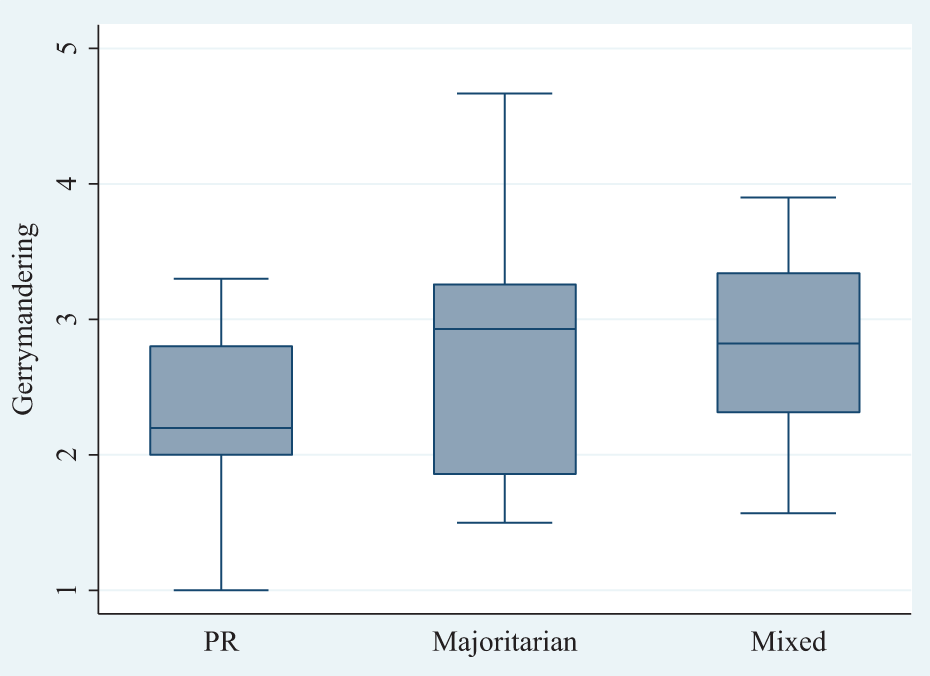
Gerrymandering across electoral systems in 54 democracies.
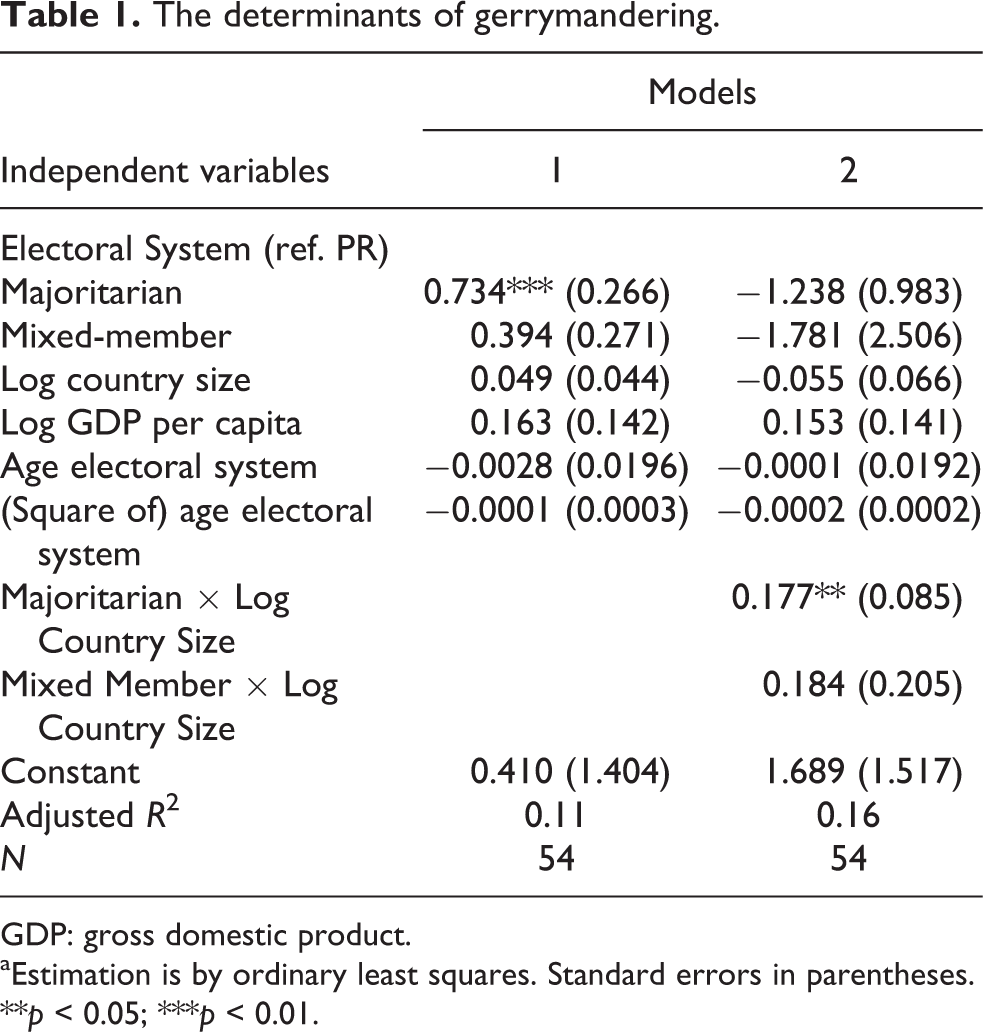
The combined effect of the electoral system, the size of the country, the per capita GDP, and the age of the current electoral system is examined in Table 1. We have run two models: an additive model with the four independent variables and an interactive model in which an interaction term between electoral system and country size is added to the previous specification. Estimation is by Ordinary Least Squares (OLS). 10
The determinants of gerrymandering.
GDP: gross domestic product.
aEstimation is by ordinary least squares. Standard errors in parentheses.
**p < 0.05; ***p < 0.01.
The first model explains about 11% of the variance of gerrymandering in the 5-point scale. As expected, district boundaries are less impartial in majoritarian electoral systems than in mixed-member and, above all, PR systems. Only the dummy for the majoritarian systems is statistically significant (at the 0.01) level. That is, there are statistically significant differences between majoritarian and PR systems but not between mixed-member and PR systems. Countries using majoritarian systems score on average about 0.7 and 0.3 points higher, respectively, than countries using PR and mixed-member electoral systems. Larger and poorer countries are more prone to partisan gerrymandering, but the two variables are not statistically significant. Finally, there is not a robust relationship between the age of the electoral system and gerrymandering.
The interactive specification produces a larger adjusted R 2, 0.16. Only the interactive terms Majoritarian × Log Country Size is positive and statistically significant (at the 0.05 level). That is, majoritrian institutions in large countries exacerbate gerrymandering.
Conclusion
In all electoral democracies using small districts, ruling parties face an incentive to redraw district lines to achieve partisan advantage. Are there differences in gerrymandering across countries? If yes, what accounts for them? Unfortunately, comparative studies about the levels and determinants of gerrymandering are virtually nonexistent due to the lack of an aggregated measure travelling cross-nationally.
In this research note, we have contributed to fill this gap. Relying of data from the EIP, we have measured the level of gerrymandering in all democracies that have held Lower House elections from the second half of 2012 until the first half of 2015. Our measure captures on a 5-point scale to what extent district boundaries were impartial according to country experts. Using this measure, we have first established the phenomenon of gerrymandering in a sample of 54 countries. Through regression analysis, we have shown that majoritarian systems are more prone to gerrymandering than mixed-member and PR systems. When majoritarian systems are employed in large countries, gerrymandering is exacerbated. Per capita GDP and the age of the electoral systems do not significantly affect gerrymandering.
Finally, this article should be taken as a first step in investigating the determinants of gerrymandering. Gerrymandering derives from the strategic decisions made by ruling parties to maximize their parliamentary representation. In Monroe and Rose’s terms (2002), gerrymandering is a “second-moment” effect in which partisan bias comes into play. The “first-moment” concerns how many parties or candidates enter the race and depends on the selection of an electoral system among three main options: PR, majoritarian, or mixed-member systems. Once the electoral system is selected, the extent to which the ruling parties are able to shape district boundaries to their own advantage depends on three conditions: whether parties have the opportunity to do it, the strength of the incentive for gerrymandering (i.e. the partisan advantage in seats they can achieve) and the information political actors have about the expected consequences of (re)drawing district lines. The combined impact of these three elements clearly deserves more research. More generally, Norris (2015: Ch. 5) finds that PR systems perform higher than majoritarian systems in electoral integrity terms. It remains to be further theorized and explored the specific relationship between such concrete item and electoral integrity.
Footnotes
Acknowledgements
Authors would like to thank Daniel Bochsler, Tom Brunell, Hilde Coffè, Andrei Gheorghita, Marcelo Jenny, Karen Nero, Pippa Norris, Bogdan Popescu, Pablo Simón, Pedro Riera, Hermann Schiavone, Klaus Schoenbach, Julio Teehankee, Minh Trinh, and two referees for their helpful comments. Ignacio Lago gratefully acknowledges the fellowship provided by The Electoral Integrity Project, University of Sydney (February-May 2014). The dataset can be found at  .
.
Declaration of Conflicting Interests
The author(s) declared no potential conflicts of interest with respect to the research, authorship, and/or publication of this article.
Funding
The author(s) received no financial support for the research, authorship, and/or publication of this article.
Notes
Appendix 1
Elections in 2012: Georgia, Lithuania, Montenegro, The Netherlands, Romania.
Elections in 2013: Albania, Argentina, Australia, Austria, Barbados, Bulgaria, Czech Republic, Germany, Grenada, Iceland, Italy, Japan, Malaysia, Malta, Micronesia, Nepal, Norway, Pakistan, Philippines.
Elections in 2014: Belgium, Botswana, Colombia, Hungary, India, Indonesia, Latvia, Mauritius, Moldova, New Zealand, Sao Tome and Principe, Serbia, Slovenia, Solomon Islands, South Africa, Sweden, Tonga, Ukraine, United States.
Elections in 2015: Denmark, El Salvador, Estonia, Finland, Greece, Guyana, Israel, Lesotho, Mexico, Turkey, United Kingdom.