




Abstract
In a recent contribution to Party Politics, Kostadinova and Mikulska analyze women’s political representation by populist parties in Poland and Bulgaria. The presented findings for Poland suggest that the main right-wing populist party PiS (1) elected more women to parliament, (2) nominated more women to promising ballot positions, and (3) that voters of PiS were more likely to support women in the elections compared to leftists parties. We disagree with all three findings. While the first finding is due to an error in the descriptive statistics, we argue that the other two findings are the result of an inappropriate research design. We replicate the analysis based on an altered research design and show that PiS did not elect more women to parliament, did not nominate more women to promising ballot positions and that voters of PiS were not more likely to vote for female candidates.
Introduction
The rise of populist parties in Europe is a well-studied phenomenon in political science literature (e.g. Kriesi and Pappas, 2015; Mudde, 2007). Almost all European countries have witnessed the emergence (and sometimes decline) of populist parties in the last 20 years. Countries from Central and Eastern Europe are no exception. In Poland, the populist party “Law and Justice” (PiS) has been one of two major parties dominating Polish politics since 2005. With respect to questions of gender equality, (right-wing) populist parties are often characterized by their rather misogynistic opinions. Therefore, it is interesting to analyze how women’s political representation differs between populist and nonpopulist parties. In a recent contribution to Party Politics, Kostadinova and Mikulska (2015) offer an analysis of this issue for Poland and Bulgaria. In this article, we provide a comment on their analysis of women’s representation in Poland with a focus on PiS.
PiS was founded in 2001 by twin brothers Jarosław and Lech Kaczyński, drawing on the popularity of the latter as minister of justice in the cabinet of Jerzy Buzek. The party focused initially on law and order issues. It became prominent due to its advocacy of more severe penalties, including the re-introduction of the death penalty, and denouncing “hidden networks of influence and corruption” (Tworzecki, 2012: 617). The profile of PiS started expanding during the fifth legislative period (2005–2007), when it entered a coalition with two other populist parties, the far-right League of the Polish Families (LPR) and the agrarian protest party Self-Defense (Samoobrona). PiS gradually took over some of the issues advocated by these two parties, and was thus able to attract large sections of their electorate at the parliamentary election of 2007. During both parliamentary elections of 2005 and 2007, PiS “exploited populist themes and slogans” (Jasiewicz, 2008: 8), but in 2007 it moved even further to the right and “abandoned any attempts to coax the political middle” (Jasiewicz, 2008, 23). The development most relevant to the question raised by Kostadinova and Mikulska (2015) was the emergence of an alliance between PiS and the fundamentalist Catholic groups, which previously supported the LPR (Gwiazda, 2008: 761). In exchange for obtaining their endorsement, PiS started strongly promoting a conservative moral policy platform. PiS took a stance critical of gender equality, which developed into open hostility at the height of the party’s campaign directed against the so-called “gender-ideology.” The party’s position on that issue can be exemplified by a speech held in parliament by MP Artur Górski, who said that the concept of “gender is a cultural temptation, changing a human into a slave” and that it “is more dangerous than Marxism.” 1
Both male and female representatives of PiS spoke in the plenary sessions of the Sejm against the promotion of gender equality in schools. 2 Members of PiS lobbied strongly against the ratification of the “Convention on Preventing and Combating Violence against Women and domestic Violence.” The convention was denounced by speakers representing PiS as “pathological,” “unnatural,” and “stripping demoralized children of their dignity.” 3 Furthermore, all 129 legislators of PiS voted against the amendment to election law introducing gender quotas to the Polish Sejm elections in 2011. 4
In view of the aforementioned facts regarding PiS’ position on gender equality, the results reported in Kostadinova and Mikulska (2015, hereafter KM) appear to be completely counterintuitive. PiS is strongly opposed to gender equality and one would not expect this party to particularly foster the political representation of women. Yet, according to KM, PiS is an example of the “puzzling success of populist parties in post-Communist Europe in electing women to public office” (Kostadinova and Mikulska, 2015: 2). In particular, KM argue that PiS “managed to elect more women to the national legislature than the main leftist parties,” because they “did much better in ranking women high on the list” and because “PiS voters, along with those of the PO, invest more in female candidates by ranking them higher on the list than do leftists’ supporters” (Kostadinova and Mikulska, 2015: 10) in the Polish open-list PR system.
These conclusions do not only contrast with the intuitive expectations about the position of right-wing populist parties on gender equality, they are also contradictory to existing studies discussing the problem of women’s political representation in Poland. Gwiazda (2015) shows that the introduction of gender quotas for the Polish Sejm election was possible due to the actions taken by the centrist Civic Platform (PO), supported by the Democratic Left Alliance (SLD) and also, reluctantly, by its coalition partner, the Polish People’s Party (PSL). PiS rejected the reform. In a similar vein, Dubrow (2011) shows that the support of gender quotas by Polish candidates strongly depends on their party ideology. Conservative candidates opposed the introduction of gender quotas, whereas more liberal candidates supported the reform. Most importantly, and in contradiction to the results presented in KM, Górecki and Kukołowicz (2014) provide a comprehensive analysis of the electoral success of women in the Polish parliamentary elections of 2007 and 2011. Górecki and Kukołowicz (2014) demonstrate that in the election of 2011, female candidates of the socially conservative parties, PiS and the PSL, were in fact the most disadvantaged. They conclude that perhaps “female candidates running on behalf of such parties encounter severe difficulties finding enough niches in the electorate where votes based on gender can be sought” (Górecki and Kukołowicz, 2014: 75). Therefore, the findings of KM are also puzzling with respect to existing research on this topic.
In this article, we argue that the results of KM regarding PiS’ promotion of women’s political representation are untenable. We show that PiS did not elect particularly more women to parliament, and that this finding by KM results from an error in descriptive statistics. More importantly, however, we argue that the employed regression analyses are inappropriate for analyzing party and voter preferences regarding women. We conduct a replication of the results based on the same data, but offer an improved research design and show that PiS did not nominate more women to promising ballot positions compared to more liberal parties. Additionally, our analysis of voter preferences shows that PiS voters were not more likely to vote for female candidates. Instead, our results suggest that the gender of a candidate did not play an important role in voter’s decision-making process. In short, we come to the conclusion that PiS is not particularly supportive of women in politics and that more liberal parties, the PO and the SLD, often perform better regarding women’s political representation. Accordingly, we find no evidence for a “puzzling success of populist parties in promoting women’s political representation” in Poland.
The article is structured as follows: In the next section, we correct the results reported in Table 2 from KM regarding the percentages of women elected to parliament by each party. We show that PiS elected fewer women than the PO and the SLD in at least three out of four elections under consideration. We then intensively discuss the research design employed in KM to analyze party and voter preferences regarding women in the Polish open-list PR system. We highlight the inappropriateness of using the predicted ballot position of women as an indicator of women’s successful political representation. After describing our own research design, we present our results and highlight how they differ compared to the findings presented in KM.
Women Elected to Parliament in Poland
As the first step of their analysis, KM analyze the percentage of women elected to parliament by four major Polish parties (PiS, PO, SLD, PSL) in the elections of 2001, 2005, 2007, and 2011. The results are presented in Table 2 of KM (Kostadinova and Mikulska, 2015: 6). However, the table contains an error. The reported numbers of the total seats won and the number of women elected to parliament by each party are correct. 5 Yet, the resulting percentages of women elected to parliament by each party are wrong. They are the percentages of female legislators of the Bulgarian parties, which were already reported in Table 1 of KM (Kostadinova and Mikulska, 2015: 5).
Women elected to parliament in Poland by party and election year.
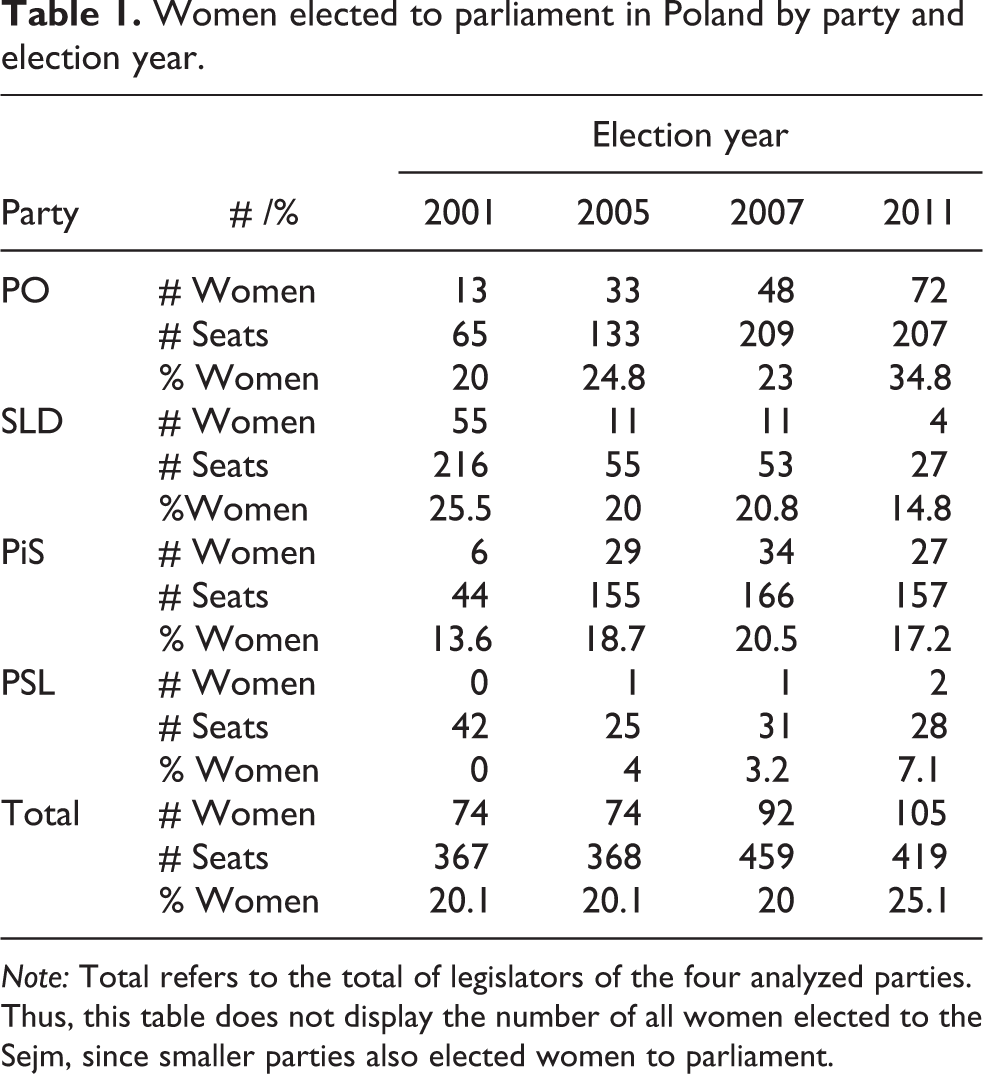
Note: Total refers to the total of legislators of the four analyzed parties. Thus, this table does not display the number of all women elected to the Sejm, since smaller parties also elected women to parliament.
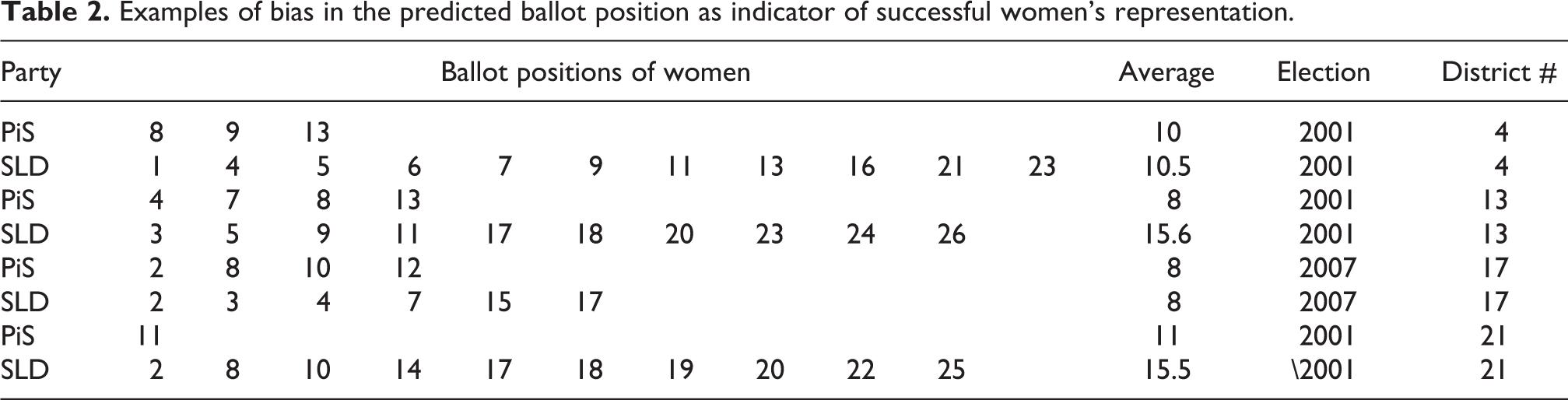
Examples of bias in the predicted ballot position as indicator of successful women’s representation.
In Table 1 of this article, we report the corrected results. They clearly show that in all four elections the PO elected a higher proportion of women to parliament than PiS. Also the leftist SLD, compared to PiS, elected more women to parliament in three out of four elections. The only exception is the election of 2011. PiS only performs better compared to the PSL, which elected almost no women to parliament in all of the four elections. Yet, since the PSL is a conservative agrarian party, the claim that PiS “managed to elect more women to the national legislature than the main leftist parties” (Kostadinova and Mikulska, 2015: 10) is not supported by the data. 6
Analyzing women’s representation in Poland
KM’s research design
In addition to the descriptive statistics of how many women were nominated and elected to parliament by each party, KM offer a more detailed analysis of women’s representation in the Polish open-list PR system. KM analyze the chances of women to be nominated to a promising ballot position and voters’ preferences regarding women, by employing two different regression analyses (Kostadinova and Mikulska, 2015: 7–8). The first is the “party preference model,” as shown in Figure 2 and it is used to answer the question of whether male or female candidates are placed generally lower or higher 7 on the ballot paper by parties. The second model, the “voter preference model,” is employed to analyze the preferences of voters regarding candidates. Thus, this model answers the question whether voters generally prefer to vote for female or male candidates. Both models use the same set of independent variables, including the gender, age, occupation, and party affiliation of a candidate, election year, party and district magnitude, and a measure for the urbanization of the electoral district. Additionally, the voter preference model controls for the initial position of a candidate on the ballot paper. Of course, the main interest of the analysis lies in the effect of the gender variable, which is additionally interacted with several of the other independent variables, most importantly with party affiliation and the election year.
There is a slight variation in dependent variables between the two models. The party preference model uses the initial ballot position of a candidate as the dependent variable. In contrast, the dependent variable in the voter preference model is the ranking of the candidates based on their received votes in the election. Since the dependent variables are treated as being similar to count data, KM use negative binomial regression for their analysis.
Problems in KM’s research design
We doubt that the research design in KM can be used to answer the aforementioned research questions. Our critique focuses primarily on the validity of the employed research design in KM. In particular, we demonstrate that the predicted (average) rank of female candidates on the party list, which is the quantity estimated in KM, is an invalid indicator of women’s successful representation. However, we also highlight two aspects that question the validity of the findings, even if the dependent variable were suitable for the analysis. In short, we believe that not only the general research design employed in KM, but also the interpretation of their regression analysis has shortcomings. In the following two sections we will discuss these problems separately.
Interpretation of interaction effects
The negative binomial regression model 8 employed in KM includes several interaction terms. The gender variable is interacted with district magnitude, party magnitude, urbanization, party membership, and election year. While the inclusion of interaction terms allows for a more fine-grained analysis of the gender effect, the interpretation of these effects becomes more challenging (Brambor et al., 2006; Kam and Franzese, 2007). KM’s analysis includes two shortcomings in this regard, which hinder the correct interpretation of the gender effect.
First, KM analyze only some of the coefficients of the several interactions of the gender variable. Moreover, KM analyze these effects in isolation. That is to say, KM analyze in a first step the coefficient of the gender variable, without taking into account the effect of all constitutive terms of the interaction. Based on this interpretation of the gender variable coefficient, it is argued that “even after controlling for individual-, district-, and party-level factors, a bias against women persists; all else equal, women are systematically listed (by parties) and ranked (by voters) lower than their male counterparts” (Kostadinova and Mikulska, 2015: 8–9). While this might be true, this conclusion cannot be drawn from simply analyzing the effect of the gender variable which is interacted with several other independent variables. In this case, the effect of the gender variable only describes the effect of gender when all of the interacted independent variables equal zero, which is not possible in KM’s analysis as variables such as district magnitude cannot be zero. This interpretation of the interaction effects contrasts with the advice by Brambor et al. (2006: 71) that “scholars should refrain from interpreting the constitutive elements of interaction terms as unconditional or average effects—they are not.”
Second, the interpretation of interaction effects in nonlinear models, which includes negative binomial regression, is even more challenging. As demonstrated by Ai and Norton (2003), one cannot simply interpret the sign of the interaction coefficient in order to determine the form of the interaction effect in nonlinear models. Meaning that “the interaction effect […] cannot be evaluated simply by looking at the sign, magnitude, or statistical significance of the coefficient on the interaction term when the model is nonlinear” (Ai and Norton, 2003: 129), most importantly as the interaction coefficient can be of the opposite sign compared to the marginal effect. Thus, when only the regression coefficients in nonlinear models are interpreted, it is almost impossible to determine whether the observed effects confirm the theoretical expectations.
Given these shortcomings in the interpretation of the regression analysis, we actually know only very little about how the gender of a candidate influences women’s nomination chances by parties and how voters evaluate candidates based on their gender. Unfortunately, these questions cannot be answered by simply improving the interpretation of the regression models in KM, since the research design suffers from a more general shortcoming. We will discuss this point in the next section.
Dependent variables
As described above, KM employ the regression models in order to explain the position of a candidate on the party list either before (party preference model) or after the election (voter preference model). Regression models are designed to predict values of the dependent variable based on a set of independent variables. KM use negative binomial regression in order to predict the expected rank of a candidate based on his or her gender and several other factors. 9 Put differently, KM use the predicted position of women on the ballot paper as an indicator for successful women’s representation, where lower values indicate a more promising placement of women on the ballot paper.
The problem with this approach is, that we cannot draw any substantive conclusions from the predicted rank of female (or male) candidates, simply because the predicted position of women can be the result of several different distributions of women on the list. To illustrate this point, Table 2 provides four examples of party lists from PiS and the leftist SLD from the same elections and same electoral districts. 10 For each of these lists we display the ballot positions held by female candidates and estimate their average (i.e. predicted) ballot position, just like it would be done by a regression analysis. It is obvious that in each of the four examples, the lists of the SLD offer more favorable ballot positions to women compared to the competing PiS lists. Yet, the predicted ballot position does not reflect this. In fact, the opposite is the case: the average position of women is higher (or on par) for the lists of the SLD, falsely implying that these lists are less supportive for female candidates. The bias also becomes obvious if we compare the predicted position of men and women on the same list. For example, PiS only nominated three women in total for its ballot in district number 4 during the election of 2001. They were placed on positions 8, 9, and 13 (see row 1 in Table 2). This results in a predicted (average) ballot position of 10 for women. Of course, all other candidates are men, seven of which were placed at the top of the ballot. Yet, the predicted ballot position for men would be 12.9 (there were 24 candidates in total on the list), and thus less favorable compared to women.
The bias in the predicted values for women between the lists occurs due to the fact that the SLD did not just nominate more women for promising ballot positions than PiS, but also more women at lower ballot positions. As a consequence, the lower placed women increase (i.e. deteriorate) the predicted ballot position of women. An extreme example of this might be the lists for the SLD and PiS in district 21 during the 2001 election. PiS nominated only one woman, occupying position 11. In contrast, the SLD nominated 10 women—3 of which were placed above the eleventh ballot position, with the rest below it. As a consequence, the average position of the SLD is 15.5 and thus suggests a less promising average position of female candidates compared to PiS.
Therefore, the predicted ballot position is a strongly biased indicator of women’s successful representation and not suitable for a valid analysis. The examples presented in Table 2 are not cherry-picked, one can find several more lists in the data which reflect this bias. 11 Consequently, KM’s research design can result in misleading conclusions. Of course, the problem applies to both the party preference model and the voter preference model. We think that a different research design is necessary to evaluate women’s political representation by parties in Poland. Our approach is described in the following section.
Alternative Research Design
In this section we develop an improved research design for the analysis of women’s representation on party lists. We alter the party preference model as well as the voter preference model in order to get a more robust understanding of women’s representation in Poland.
Party preference model
Our research design for the party preference model is based on a logistic regression, where the gender of a candidate denotes the dependent variable. In other words, we flip the independent and dependent variable from the KM model. That is, we analyze the probability of a candidate to be female as a function of party membership, ballot position, age, and district magnitude. 12 To allow for a more flexible relationship between the ballot position and the probability of a female candidate, we include a squared term in the model. 13 Additionally, we let the effect of the ballot position vary by party. Our model takes the following form, which we estimate separately for all four elections with cluster corrected standard errors at the level of each district party list:
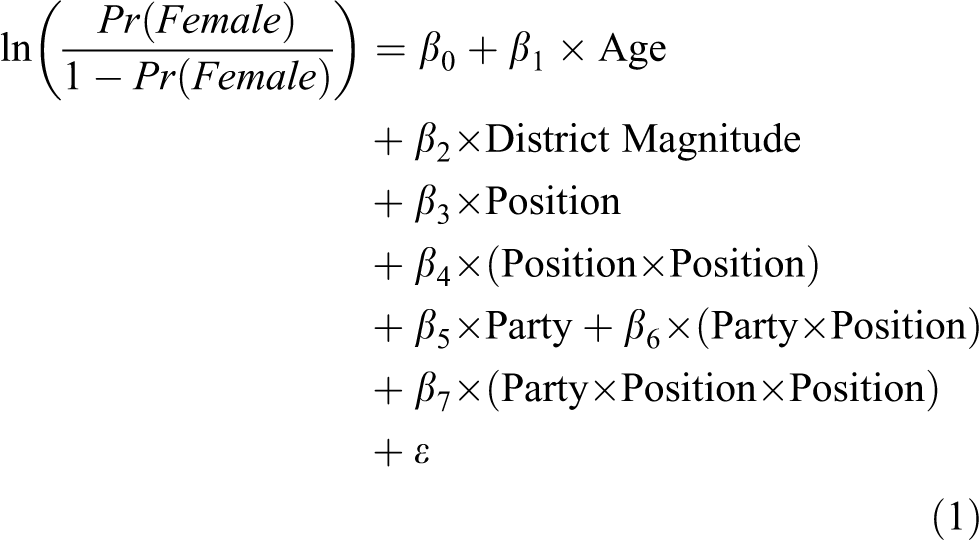
The advantage of this approach is the possibility of a direct comparison of the probability of placing a female candidate at a more favorable ballot position between parties. In other words, we can obtain an estimated probability of each individual ballot position being held by a female candidate. From our perspective, this is the main quantity of interest when we want to analyze whether women are systematically placed at lower or higher ballot positions. Finally, the approach is in line with other studies about the determinants of nominating women to party lists (Cheng and Tavits, 2011). It should be noted that this research design comes close to a replication of Table 3 in KM, which displays the proportion of women on the first five and below the fifth ballot position by each party in each election (Kostadinova and Mikulska, 2015: 7). Our approach simply analyzes the expected proportion of women on each ballot position more generally.
Voter preference model
We also alter the voter preference model. First, the same problem described for the party nomination model applies here, and thus one could consider fitting a logistic regression analysis as described above, and simply exchange the ballot position by the rank of a candidate after the election. However, we chose a different approach for analyzing voter preferences, as we do not think that the rank order of candidates after an election is the best way to analyze voter preferences. In the Polish open-list PR system, each voter has to cast a vote for one candidate (Marcinkiewicz and Stegmaier, 2015). Hence, the number of preference votes a candidate received can be seen as a quite accurate reflection of voter preferences. However, the final rank order of candidates is only an indirect reflection of these preferences. Most importantly, this rank order does not take into account that the distribution of votes among candidates is usually strongly skewed. Particularly, top placed candidates receive a large surplus of votes in open-list PR systems (see e.g. Faas and Schoen, 2006; Lutz 2010; Marcinkiewicz, 2014). The rank order of candidates does not control for these large differences in the number of votes received by candidates. Therefore, a position change from the second to the first position is weighted equally to a position change from position 21 to 20—although in the latter case much fewer votes are usually needed to cause such a position change. In short, position changes occur much more frequently at lower (less relevant) ballot positions and the underlying differences in the number of votes between candidates might not be large enough to evaluate them as substantive.
Therefore, we think it is more accurate to analyze the number of votes for a candidate, instead of losing important information about voter preferences by using the final rank order of candidates. 14 Our research design relies extensively on the existing literature about candidates’ electoral success in open-list PR systems. In particular, we use an approach comparable to two analyses about candidates’ election results in Poland (Marcinkiewicz, 2014; Marcinkiewicz and Stegmaier, 2015). In these analyses, the dependent variable is defined as the proportion of votes a candidate received compared to the total number of votes which were cast for the list. Therefore, the dependent variable is computed for each candidate i on list k as:

Taking the results of the aforementioned analyses of a candidate’s electoral success in open-list PR systems into consideration, we model this variable as a function of candidate and party characteristics. The main quantity of interest in our analysis is the effect of the variable gender, which we allow to vary by party membership, election year, and ballot position. In this analysis, we treat the ballot position as a categorical variable and compute the effect for gender at each ballot position. That is, we compare for each party at each election at each ballot position whether women received significantly more (or fewer) votes than male candidates on the same position. However, to reduce the complexity of the model and due to the fact that ballot position effects occur predominantly at top positions, we focus only on the first 10 ballot positions and treat all other positions as higher than the tenth position. 15 Age, age-squared, and district magnitude are included in the model as control variables. Hence, the final model we estimate for each election separately takes the following form: 16
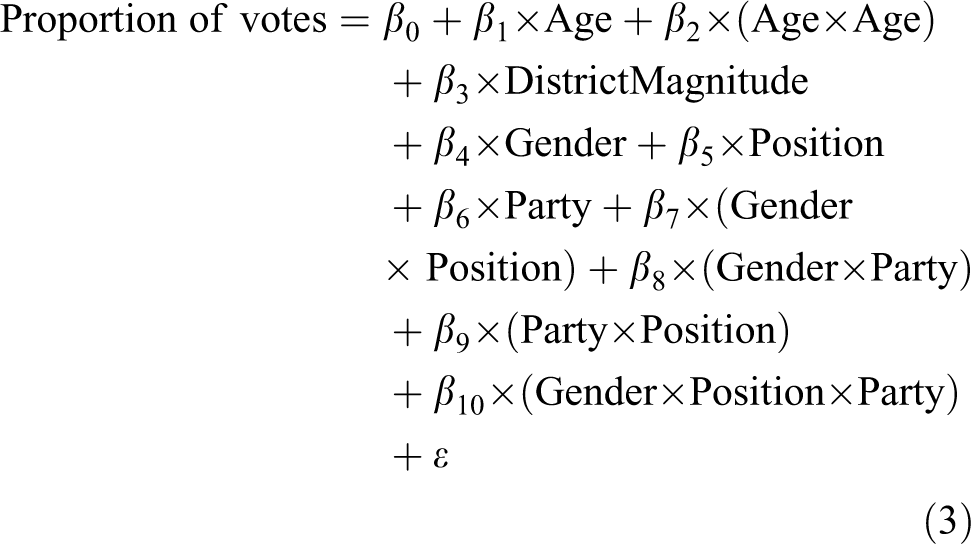
This approach is comparable to previous studies in which the electoral success of candidates in open-list PR systems is analyzed (Faas and Schoen, 2006; Marcinkiewicz, 2014; Marcinkiewicz and Stegmaier, 2015; Marcinkiewicz and Jankowski, 2014). However, there are also other ways to model the observed relationship. Particularly, the approach selected in Górecki and Kukołowicz (2014), who also analyze voter preferences in the Polish open-list PR system, is of relevance in this context. Our approach differs in two ways from that study. First, Górecki and Kukołowicz (2014) use the absolute number of votes a candidate received as the dependent variable. In our model the dependent variable is standardized between the lists, whereas with the raw number of votes one has to control for the different number of votes cast in each district. Second, Górecki and Kukołowicz (2014) include a wide range of additional independent variables mostly related to the political experience of candidates, but focus less on the effect of ballot positions. In this article, we put more emphasis on the role of the ballot position, which is one of the most important explanatory variables in open-list PR systems (Marcinkiewicz, 2014; Marcinkiewicz and Stegmaier, 2015). Despite these differences, we would like to emphasize that we acknowledge both approaches and perceive neither of them as superior. However, differences in the observed results between our analysis and the study by Górecki and Kukołowicz (2014) are likely due to these diverse modeling strategies.
Results
Party preference model
Before we turn to the results of the logistic regression, we present a much simpler analysis of women’s nomination to promising ballot positions. We divide the ballot positions into four categories based on a candidate’s chances of entering the parliament and then compute the proportion of female candidates in these categories for each party at each election. The categories are defined as follows: 17 A “very promising” position refers to the first four ballot positions. The ballot positions from the fifth to the ninth position are labeled as “promising” and ballot positions from the tenth to the fourteenth position are “less promising.” All remaining ballot positions are categorized as “unpromising.” The results of this analysis are presented in Figure 1 and clearly speak against the hypothesis that PiS is particularly fostering women’s political representation by nominating them higher on the ballot paper than other parties. There is not a single category, including the unpromising ballot positions, in which PiS nominated a higher percentage of women than all of the other three parties. More importantly, PiS is most often outperformed by at least one of the more liberal parties, the PO or the SLD.

Proportion of female candidates at different ballot positions.
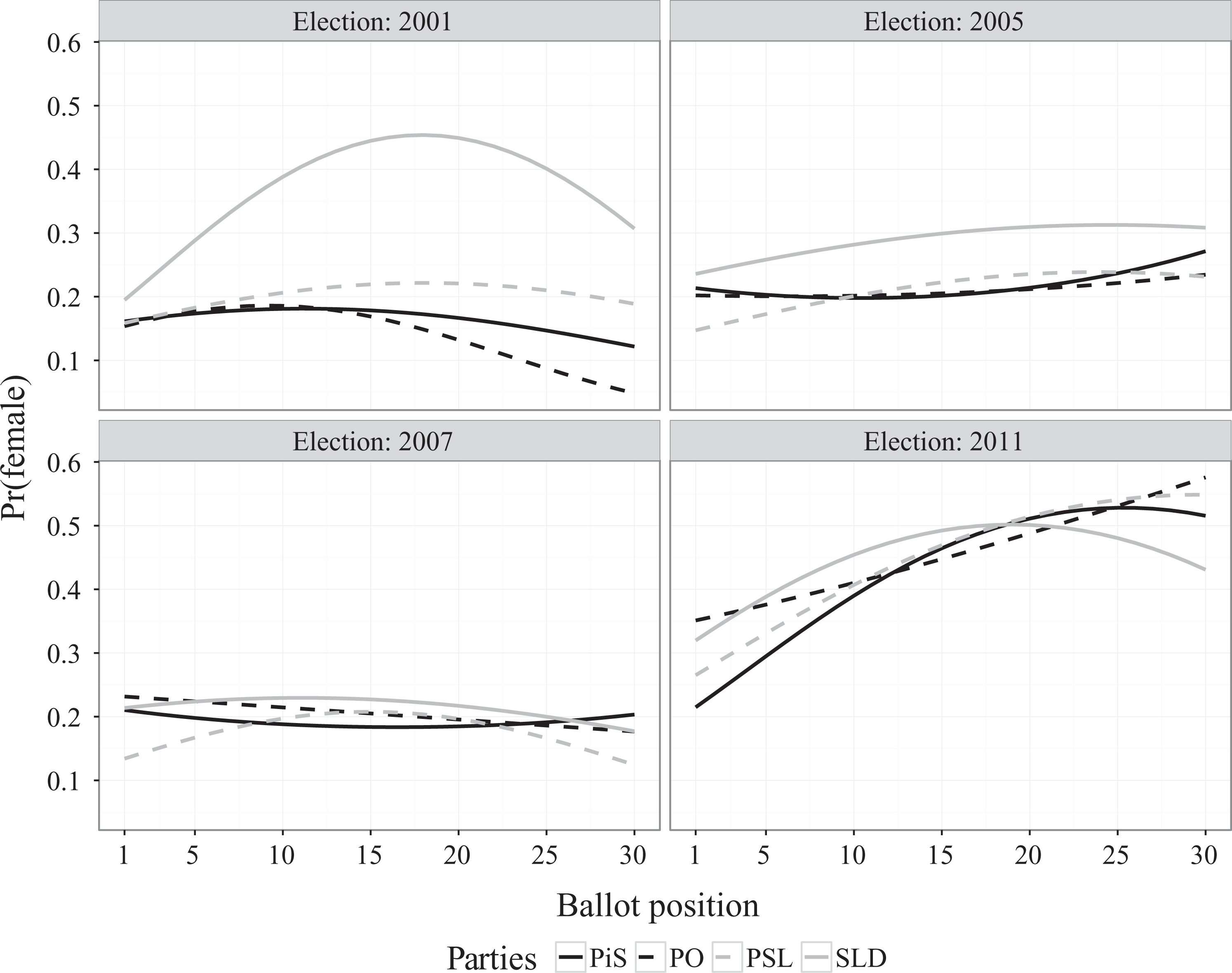
Predicted probability of female candidates conditional on the ballot position, election year and party affiliation (party preference model).
We now turn to the results of the logistic regression in order to examine the determinants of female candidate nomination in more detail. The exact results can be found in the online appendix. Here we summarize the findings by plotting the predicted probabilities of a candidate to be female, controlling for the election year, party membership, the ballot position, and the interactions between these variables. 18 Again, the results lead to a different conclusion about the political representation of women in Poland compared to the findings presented in KM. The results of PiS are often not much different from those observed for the more liberal PO and the socially conservative PSL. However, the leftist SLD shows, at least in the elections of 2001 and 2005, a higher probability of nominating female candidates. This also holds true for favorable ballot positions, although differences to the other parties are smaller here. 19
The figure also demonstrates that in the election of 2011, when parties were required to nominate at least 35% female candidates on their lists, the overall probability for female candidates to appear on the party lists rose. The probability of a candidate to be female was highest in lower (less promising) sections of the ballot paper. This indicates that all parties, irrespective of their political ideology, filled up their lists with female candidates in order to fulfill the quota.
To summarize our results from these analyses, we cannot find any evidence that PiS is particularly supportive of women’s political representation by nominating them more often than other parties to more promising ballot positions. Instead, the leftist SLD is the only party for which we can find substantive deviance from pattern observed for other parties. In line with the intuitive expectations, this party shows the highest probability of placing female candidates at relevant ballot positions. This finding speaks against the observation by KM that “the PiS does not differ from the leftist SLD in the positioning of women candidates” (Kostadinova and Mikulska, 2015: 9). In fact, they do differ substantially at least in two elections. Of course, it should be noted that the probability for a candidate to be female is far below 0.5 for almost all ballot positions and for all parties, showing that women are generally underrepresented in Polish politics.
Voter preference model
The results of our voter preference model are described in Figure 3. The figure displays the marginal effect for female candidates conditional on party membership, election year, and ballot position. Meaning that, negative values indicate that women received fewer votes compared to men on the same ballot position and vice versa. The results are obviously close to a null result. We cannot witness any systematic differences in the electoral success between men and women for any party in all four elections. The results for PiS suggest that women at the first ballot position were evaluated more negatively compared to men on the first ballot position. The results for the elections of 2005 and 2007 point into this direction. Comparable effects can be observed for the conservative PSL in the elections of 2007 and 2011. In contrast, the SLD shows positive effects for women on promising ballot positions during the elections of 2001 and 2007. In general, however, we do not think that the described effects allow us to speak of systematic differences in voter preferences regarding the gender of a candidate, as the observed effects appear only in some of the elections and are not always statistically significant.

Marginal effect of female conditional on election year, party membership, and ballot position (voter preference model).
The results differ slightly from the findings in Górecki and Kukołowicz (2014), who argue that in the election of 2011 female candidates of the PiS received significantly fewer votes than their male counterparts. As described above, these discrepancies are likely caused by the differences in the employed research designs. Moreover, in our analysis, we focus on the interaction between gender and ballot positions as, typically, only candidates appearing at the top of the ballot have a realistic chance of being elected to the parliament. When we do not include this interaction and focus only on the effect of gender conditional on party membership and election year, our results are more in line with the analysis of Górecki and Kukołowicz (2014). 20 That is, we observe negative effects for female candidates from all parties in the election of 2011, when the gender quota was applied for the first time. 21 This confirms the findings of Górecki and Kukołowicz (2014) that the gender quota had a paradoxical effect on the political representation of women. On the one hand, it increased the number of women running for parliament. The average number of votes cast for a female candidate is, nevertheless, now lower, possibly due to the fact that voters who prefer to vote for women can now choose from a wider range of female candidates. We do not find significant effects for gender, regardless of party, during the elections of 2005 and 2007. For 2001, however, both the PO and PiS show positive effects for female candidates. Yet, except for the elections of 2001, neither our nor Górecki and Kukołowicz’s results can confirm the findings presented by KM.
Conclusion
KM offer a valuable discussion of women’s political representation in Poland and Bulgaria. In this comment, we demonstrated, however, that their statistical analysis of the Polish open-list PR system is inappropriate to draw substantive conclusions about party or voter preferences regarding female candidates. By using an improved research design, we came to different conclusions with regard to women’s political representation in Poland. PiS does not perform better than more liberal parties in fostering women’s political representation. On the contrary, the SLD nominated more female candidates compared to other parties in the elections of 2001 and 2005. Similarly, we cannot observe systematic effects of a candidate’s gender when it comes to voter preferences. In each election, both men and women received a comparable proportion of votes, with only a few instances of women occupying the first ballot position. If one wants to find any pattern here, it is that top placed women on the lists of the PSL and PiS received fewer votes compared to male candidates occupying the first ballot position. Yet, as we noted above, we do not necessarily think that this finding reflects a systematic pattern regarding voter preferences against women, as it only occurred in two of four elections, but future research might examine this aspect in more detail.
We think that the results of the voter preference model, with the exception of the negative effect at the first ballot position, are in general good news regarding the political representation of women, as they suggest that voters rely on other information shortcuts than gender when choosing a candidate. Thus, women are apparently not strongly disadvantaged by voters at the ballot box. However, this puts even more emphasis on the important role of parties when it comes to the promotion of women’s political representation. Women’s representation has to be fostered by political parties since they decide which candidates are placed at promising ballot positions. Therefore, parties remain the most important gate-keepers, even in candidate-centered electoral systems such as open-list PR. Consequently, future research should analyze in more detail which factors influence women’s success in party nomination processes.
Footnotes
Authors’ note
Author Kamil Marcinkiewicz is now affiliated with the University of Hamburg, Germany.
Acknowledgements
We are thankful to Maximilian Lutz, Markus Tepe, Steffen Zittlau, and the two anonymous reviewers for helpful comments. Replication materials will be made publicly available.
Declaration of Conflicting Interests
The author(s) declared no potential conflicts of interest with respect to the research, authorship, and/or publication of this article.
Funding
The author(s) received no financial support for the research, authorship, and/or publication of this article.
Supplemental material
Supplementary material for this article is available online.