



Abstract
The recent finding that right-wing parties increasingly make efforts to integrate women’s concerns raises questions as to whether ideology still counts as a reliable indicator for women’s substantive representation and how different party contexts shape opportunities for the articulation of women’s interests. This article therefore critically reassesses how ideology defines the opportunities for women’s substantive representation, based on a comparative study of legislators’ acting on behalf of women in 14 European countries. We argue that ideology still offers an important explanation for women’s substantive representation, but that the link between the two should be conceptualized as complex rather than straightforward. The role of ideology is best understood if scholars (1) adopt an understanding of ‘ideology’ that allows for more variation and is conceptually different from ‘party’, (2) differentiate between gendered interests and feminist interests and (3) understand the impact of ideology as both direct and mediated.
Keywords
Introduction
This article critically reassesses a general assumption present in many studies of gender and party politics, notably that left-right ideology is an important explanation for women’s political representation and that left-wing parties are more successful than right-wing parties in ‘feminizing’ the party. Left-wing ideologies traditionally attach more importance to guaranteeing social justice, which has encouraged left-wing parties to be the first to recruit female candidates, to connect with (progressive) women’s movements and to support women-friendly policies (Ewig and Ferree, 2013; Kittilson, 2006; Lovenduski and Norris, 1993). However, studies suggest that right-wing parties are now also ‘catching up’ (Celis and Erzeel, 2015; Childs and Webb, 2012; Wiliarty, 2010). Already in 1993, Lovenduski and Norris found indications that various parties across the ideological spectrum made efforts to integrate women and their concerns, and their findings have only been corroborated ever since. Recent studies show that right-wing feminization efforts have at least in some parties reached beyond the symbolic level and have facilitated right-wing women’s access to elected assemblies and the articulation of (conservative) women’s interests (Childs and Webb, 2012; Hien, 2014; Piccio, 2014; Piscopo, 2014; Rashkova and Zankina, 2014; Schreiber, 2008; Wiliarty, 2010). Because these studies are often case studies of one particular right-wing party at a time (Childs and Webb, 2012; Evans, 2011; Piccio, 2014; Wiliarty, 2010), we do not know yet how widespread right-wing feminization efforts really are. The few existing comparative studies reveal considerable variation between parties that traditionally fall under the banner of ‘right-wing’ parties, such as Christian democratic, liberal, conservative and radical right parties (Bashevkin, 1994; Celis and Childs, 2014; Celis and Erzeel, 2015), both in terms of how often they raise women’s concerns and the type of claims they make.
The increased activity of right-wing parties nonetheless raises questions as to the validity of the original claim that the left offers a more favourable ideological venue for the articulation of women’s interests and on the continuing impact of ideology on women’s substantive representation. Studying the impact of ideology clearly becomes more complicated in such a context. When parties’ efforts to represent women’s interests spread across the ideological spectrum, it is important to scrutinize existing notions of ideology and to rethink the mechanisms through which ideology impacts upon women’s substantive representation. At the same time, it also raises the need to identify additional factors that might in the end encourage (or discourage) left-wing as well as right-wing parties to articulate women’s concerns, such as the presence of active women in the party and electoral considerations (Childs and Webb, 2012; Wiliarty, 2010).
This article therefore proposes a new explanatory model for assessing the role of ideology in women’s substantive representation. This model starts from the premise that ideology still functions as an important indicator for women’s substantive representation, but that both the notion of ideology and its expected impact should be conceptualized as complex rather than straightforward. This can be done by (1) adopting a more refined measurement of ‘ideology’ distinguishing between economic and post-materialist divisions, which allows for more variation between parties and which is conceptually different from party labels, (2) making a distinction within the broad category of women’s substantive representation between the representation of feminist and gendered interests and (3) understanding the impact of ideology as both direct and mediated. We test this model by analysing new and original data from the comparative PARTIREP survey among legislators in 14 European countries. The comparative design of the survey allows us to examine the consistency and contingency of left-right differences in women’s substantive representation across a variety of institutional settings.
In what follows, we first present the theoretical underpinnings of the proposed model. Then, we describe the methodology and the PARTIREP survey. Next, we present the results of our cross-national empirical study in 14 European countries, which confirm the new model. Finally, we discuss our findings in the conclusion.
Ideology and women’s substantive representation: Towards a new model
If differences between left-wing and right-wing parties are disappearing, one might be tempted to conclude that the role of ideology as an indicator for women’s substantive representation is in decline. Such conclusions, however, should not be drawn too hastily. At the heart of many findings lies a complex relationship between political parties, ideology and women’s interests. This complexity relates to how scholars conceptualize the notion of ideology, the concept of women’s substantive representation and the relationship between the two. We argue that (left-right) ideology might still offer an important explanation for women’s substantive representation, but that a new theoretical model for assessing the role of ideology in women’s substantive representation is needed (see Figure 1). This model is based on three premises, which we explain more in detail below.

Impact of ideology on women’s substantive representation: theoretical model.
The first premise is that any understanding of ideology should be conceptually differentiated from ‘party’ and should take different dimensions of ideology into account. Empirical studies of women’s substantive representation often use party families as proxies for ideology (e.g. Celis and Erzeel, 2015; Kantola and Saari, 2014). This elision between ideology and party, however, is potentially tenuous. Ideologies are belief systems that are shared by members of a particular group (Van Dijk, 2006: 116). Although parties are often based on ideologies, ideologies as such do not include the societal structures that accommodate them (Van Dijk, 2006: 116). Whereas party labels can sometimes function as proxies for ideology in case-study research, they are often too crude indicators in comparative (either cross-national or longitudinal) studies. Party labels obscure a lot of ideological variation between parties and ignore the varying stance that parties might take on different ideological left-right scales.
Furthermore, a unidimensional account of ideology measured on a left-right continuum might not be enough to understand how ideology really influences women’s political representation (Kittilson, 2006). More useful is a distinction between parties’ positions on two ideological left-right dimensions. The first dimension relates to parties’ stance on socio-economic issues and on the role of the government in these issues; the second scale relates to the post-materialist dimension and positions parties on ethical issues (abortion, euthanasia) and law and order issues. Both dimensions have a ‘left’ end and a ‘right’ end, and from here onwards, we differentiate in that respect between ‘economic left/right’ and ‘post-materialist left/right’ ideologies. Parties towards the ‘economic left’ support an active role for the government in the economy, whereas parties towards the ‘economic right’ argue in favour of a reduced economic role for government. Parties towards the ‘post-materialist’ left in addition promote the expansion of individual freedoms on post-materialist issues, whereas parties on the ‘post-materialist right’ value order and tradition. We can expect that, in general, left-wing ideologies offer a more favourable context for the expression of women’s interests than right-wing ideologies, but especially the post-materialist left-right dimension might steer parties’ engagement with women’s substantive representation. The reason for this is that gender issues appeared on the agenda as part of the post-materialist agenda in the 1970s (Hayes et al., 2000; Inglehart and Norris, 2003). The shift from materialist to post-materialist values led to a decline in class politics and brought new social movements concerned with egalitarianism, women’s rights and feminism to the political arena. Left-wing parties that developed as part of this post-materialist agenda, such as green parties, have traditionally also devoted more attention to women’s concerns than economic (‘old’) left parties, such as socialist parties (Kittilson, 2006). We therefore hypothesize that:
The impact of ideology might furthermore not only depend on how scholars understand ideology but also on their understanding of ‘women’s substantive representation’. In that regard, Celis and Childs (2014) make an important distinction between the substantive representation of feminist interests and of gendered interests. The first category consists of claims that aim to transform existing gender roles in support of gender equality and social justice. It includes liberal/progressive feminist as well as conservative feminist viewpoints, which is relevant in a European context where women’s movements have historically included both narratives (Offen, 1988). The second category includes claims that are about and for women, but are however not feminist in intent, and concern, for instance, material interests and non-feminist traditional women’s interests and gender roles.
1
Feminist and gendered interests are thus the two subsets of women’s interests and are both part of the substantive representation of women. This conception of women’s substantive representation as including both feminist and gendered women’s interests allows for a better understanding of the impact of ideology, and this is the second premise of the theoretical model in Figure 1. Parties after all often differ in how they frame their representative claims. The egalitarian character of left-wing ideologies seems to offer a better fit with feminist ideologies, meaning that left-wing parties more often support feminist reforms, develop feminist legislation and endorse government intervention as a means for guaranteeing (gender) equality in social and welfare issues (Ewig and Ferree, 2013). Right-wing claims for women are less likely to be feminist in nature (Bashevkin, 1994), but can be gendered nonetheless (Celis and Childs, 2012; Childs and Webb, 2012; Curtin, 2014; Kantola and Saari, 2014; Murray and Sénac, 2014; Piscopo, 2014; Swers, 2002). In that sense, left-wing parties, and especially those adopting post-materialist leftist positions, might contribute to a feminist substantive representation of women, because of the closer ideological link between post-materialism and feminism (Hayes et al., 2000; Inglehart and Norris, 2003). We hypothesize that:
The third premise has to do with the (causal) link between ideology and women’s substantive representation. Studies often assume that a direct link exists between ideology and women’s substantive representation, but, as mentioned, ideology is not the only factor that encourages parties and legislators to represent women’s interest. Other factors that play a role are the level of descriptive party feminization and parties’ electoral considerations. These additional factors might themselves exert a direct impact on women’s substantive representation, thereby mediating the effect of ideology.
First, we assume that women’s substantive representation depends on the level of descriptive party feminization (Childs and Webb, 2012), that is, the organizational presence of a women’s group and the percentage of female MPs in the parliamentary party group (PPG). Intra-party women’s organizations have feminist/gender expertise and offer useful, accurate and ‘first-hand’ policy information on women’s issues in their respective parties. When they are strong, they put pressure on parties to adopt women’s interests (Kittilson, 2006; Lovenduski and Norris, 1993; Wiliarty, 2010). The numerical presence of elected women in addition sometimes gives leverage to women’s case. Higher levels of left-wing activity on behalf of women found in many studies are at least partially related to the fact that left-wing parties were the first to witness an increase in the number of female MPs who are generally considered to be the most active defenders of women’s case (Phillips, 1995). Efforts to increase the number of women MPs have been made by right-wing parties as well (Kittilson, 2006; Lovenduski and Norris, 1993) and the increased presence of women can also create a favourable condition for the expression of women’s interests in right-wing contexts (see for instance Bashevkin’s (1994) study of Canada). We hypothesize that:
Finally, electoral competition might explain why parties represent women’s interests. The electoral system determines how parties and individual MPs understand representation and define their constituencies (Norris, 2004), and holds cues on which electoral and legislative strategies representatives have to use. Electoral concerns can create possibilities or constraints for both left-wing parties and right-wing parties to represent women’s interests. Relevant here is the distinction between majority/plurality systems and proportional systems. Representatives in the first group tend to be elected in small single-member districts, which encourage them to define constituents’ interests primarily in geographical terms and not in social terms (Norris, 2004). In proportional systems, electoral districts are usually larger and more heterogeneous, leaving representatives with more room to promote (non-territorial) social groups’ interests (Tremblay, 2006). We hypothesize that the following:
Methodology
The analyses are based on new and original data from the 2008–2012 PARTIREP comparative MP survey (Deschouwer and Depauw, 2014). The survey was conducted among legislators in 14 national/federal parliaments (and 90 political parties) in Europe: Austria, Belgium, Germany, France, Hungary, Italy, the Netherlands, Norway, Poland, Portugal, Spain, Switzerland and the United Kingdom. A team of international scholars from the 14 countries organized the survey. The questionnaire was kept constant across the different languages. Legislators typically received an introduction letter and email inviting them to fill in the questionnaire online. They were re-contacted at least twice, except for those who had explicitly stated that they refused to participate in the project. In the cases where response rates where disappointing, additional strategies were adopted, such as the use of telephone reminders or face-to-face interviews, to increase the general response rates (Online Appendix 1). The use of a variety of methods depended on the international partners’ estimation of ‘best practices’ in the past. There are no significant differences as to the percentage of male and female legislators responding to the survey. Because some left-wing parties are slightly over-represented in the data set, we apply a weighting to correct for party differences. We furthermore removed outliers (very small PPGs with less than three members) from the analyses.
The parliaments and parties in the survey were selected to represent a wide institutional variation in terms of electoral systems (proportional list systems, majority/plurality systems and mixed-member systems), party systems (parliaments with strong and weak left-wing parties) and variation in gender regimes (countries with varying levels of descriptive representation of women). The legislators in the survey also belong to a variety of party families, including socialist/social democratic, Christian democratic, liberal, conservative, green, populist, communist, agrarian, religious and single-issue parties. Several multilevel countries also include regionalist parties. The international experts who were involved in the organization of the survey were in charge of the categorization of parties according to party family.
Measuring women’s substantive representation
Our operationalization of women’s substantive representation makes a distinction between the substantive representation of gendered interests and the substantive representation of feminist interests as described above. In order to account for these issues, we use two different survey questions. The first question asks legislators how often they speak during meetings with your PPG “in order to signal/resolve a situation that they consider disadvantageous for women.” Legislators could indicate on a 4-point ordinal scale whether they do this ‘at least once every month’ (score = 1), ‘at least once every 3 months’, ‘at least once a year’ or ‘(almost) never’ (score = 4). The wording of the question does not favour a feminist orientation of women’s interests, and is therefore appropriate to measure the substantive representation of gendered interests.
A second survey question consists of a number of attitudinal items measuring legislators’ views on statements regarding gender equality. Two items ask about whether women are equal to men: ‘On the whole, women and men enjoy real equality today’ and ‘Women’s organizations are no longer necessary today’. Two items ask about whether the government should promote gender equality: ‘Government should ensure that women and men have equal opportunities’ and ‘Affirmative action is a legitimate measure to address the under-representation of women in politics’. The respondents’ positions with regard to these items, indicating whether they think gender equality is and should be realized, are used as an indication of whether legislators have the propensity to represent women’s interests in a feminist way. The underlying rationale is that establishing gender equality is key and common to all kinds of feminisms. Using this minimal criterion to identify feminist attitudes, they are open to various kinds of feminisms. Legislators were asked to indicate on a 5-point scale to what extent they agree with these items. The items were recoded so that high scores indicate a more feminist stance. Because the four items load on a single dimension, we bring them together in an additive 5-point ‘feminist scale’ (see Online Appendix 2).
Independent variables
In order to measure the left-right ideological stance of parties, we use a direct measurement of ideology based on data from the 2010 Chapel Hill expert survey (CHES) (Bakker et al., 2015). The CHES includes questions on parties’ ideological positioning on two different left/right scales: parties’ stance on economic issues and parties’ stance on post-materialist issues (‘democratic freedoms and rights’ or ‘GAL-TAN’). The first classifies parties based on whether ‘parties want government to play an active role in the economy’ (left) or ‘parties emphasize a reduced economic role for government: privatization, lower taxes, less regulation, less government spending and a leaner welfare state’ (right). The second classifies parties based on whether they ‘favour expanded personal freedoms, for example, access to abortion, active euthanasia, same-sex marriage or greater democratic participation’ (left) or whether they ‘reject these ideas, they value order, tradition, and stability, and believe that the government should be a firm moral authority on social and cultural issues’ (right) (Bakker et al., 2015: 144). For each question, country experts were asked to position each party in their country on a 11-point left-right scale with ‘0’ implying an extreme left position, ‘5’ a centre position and ‘10’ an extreme right position. The correlation between the two ideological scales is only moderately strong (Pearson’s r = 0.564, p < 0.001). Online Appendix 3 shows the descriptives for the two scales.
The operationalization of other variables included in the analyses is relatively straightforward. In order to measure descriptive party feminization, we use the percentage of women in the PPG and we dummy-coded whether or not a party has a women’s section. 2 For the variable electoral competition, we make a distinction between ‘proportional’ electoral systems (score ‘1’) and ‘majority/plurality’ systems (score ‘0’). The descriptives of the variables are also shown in Online Appendix 3.
Substantive representation of women, party families and left-right blocks
We now take a closer look at the empirical findings. Before testing our hypotheses, we first investigate whether our claim that the traditional groupings of parties in left or right blocks and in party families are too broad categories to fully understand the relationship between ideology and the substantive representation of women. Put differently, we first test whether we indeed need a more sophisticated operationalization of ideology to explain its relation to women’s representation.
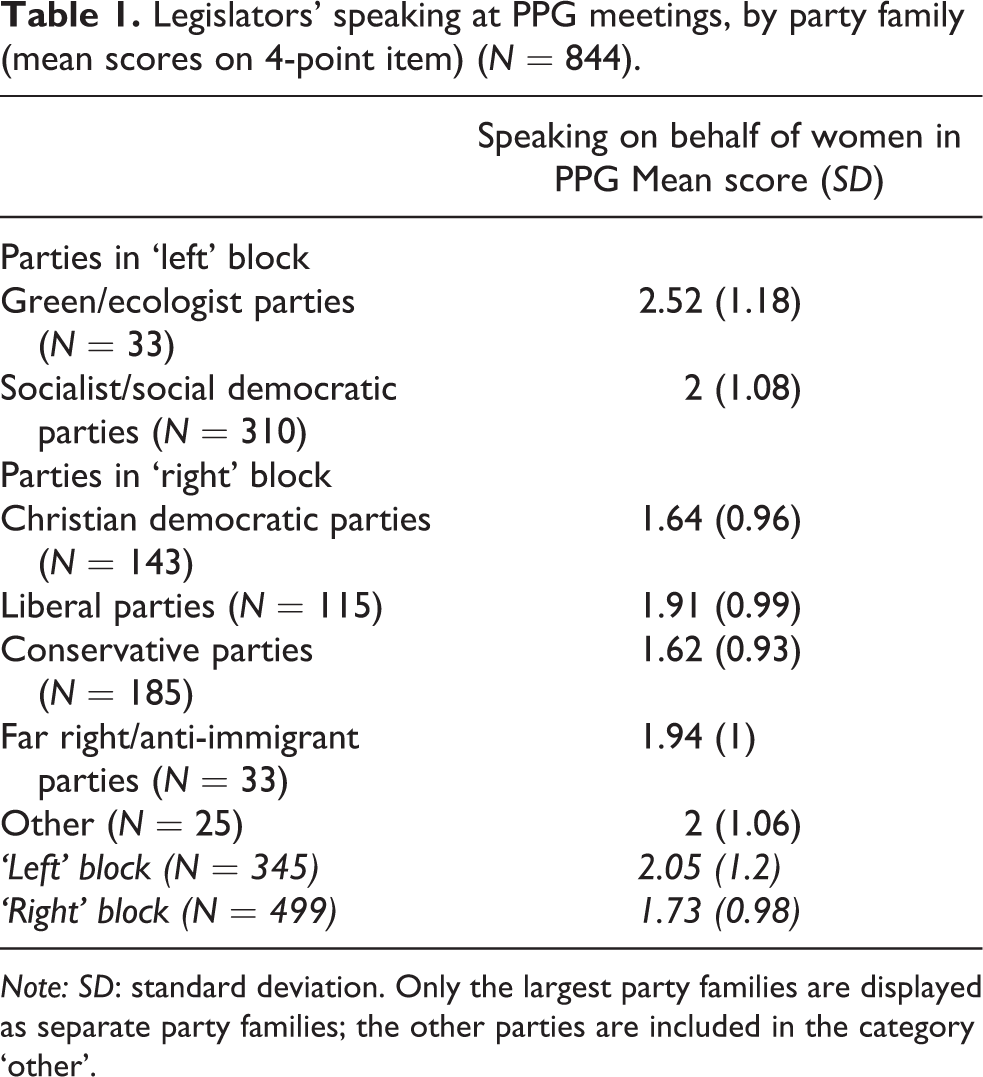
The PARTIREP survey first asked respondents to indicate how often they speak at meetings of their PPGs to signal a situation in society that they consider disadvantageous for women (see Table 1). A second question focused on legislators’ position on four feminist items (combined in a feminist scale; see Table 2).
Legislators’ speaking at PPG meetings, by party family (mean scores on 4-point item) (N = 844).
Note: SD: standard deviation. Only the largest party families are displayed as separate party families; the other parties are included in the category ‘other’.
Legislators’ mean scores on gender equality items, by party family (5-point items).
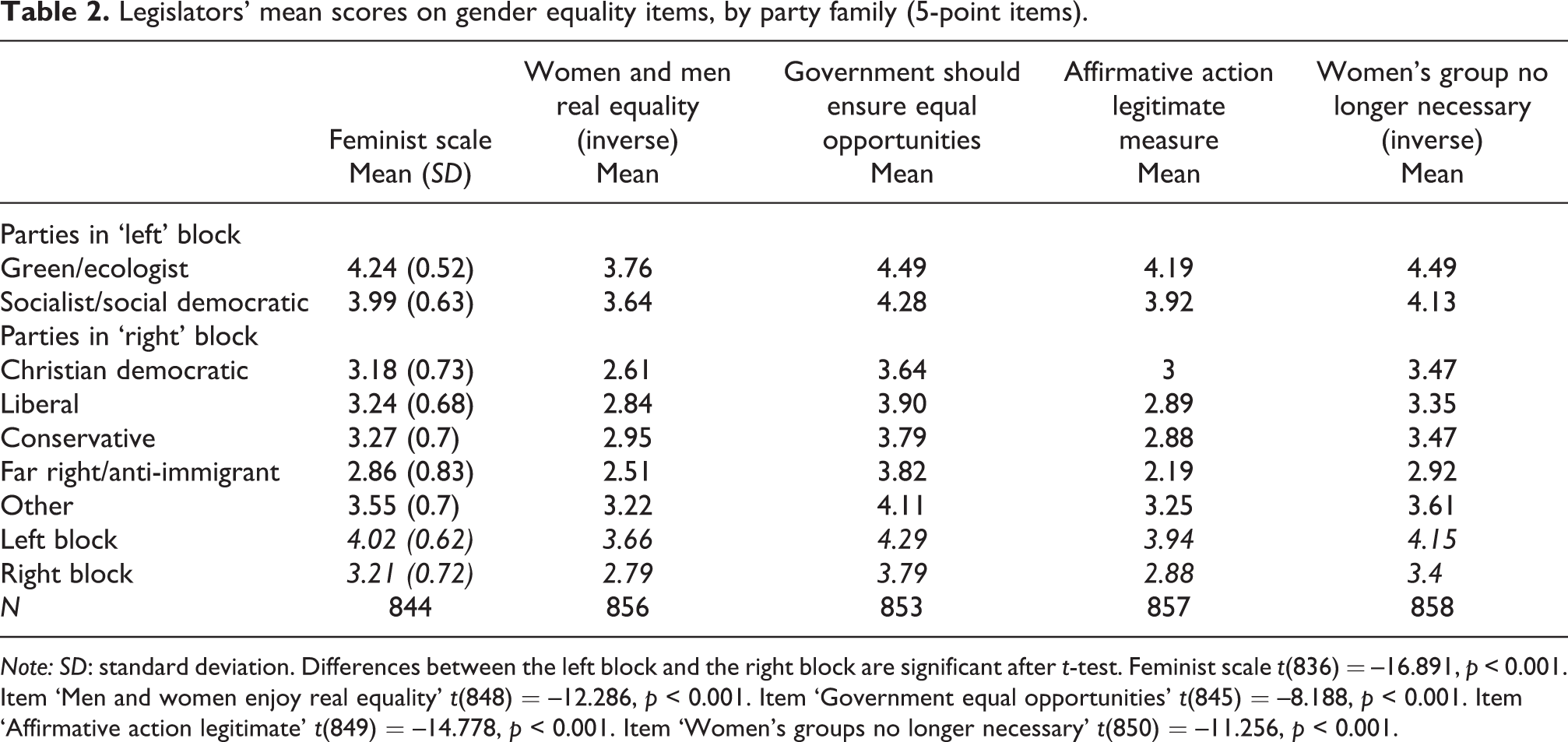
Note: SD: standard deviation. Differences between the left block and the right block are significant after t-test. Feminist scale t(836) = –16.891, p < 0.001. Item ‘Men and women enjoy real equality’ t(848) = –12.286, p < 0.001. Item ‘Government equal opportunities’ t(845) = –8.188, p < 0.001. Item ‘Affirmative action legitimate’ t(849) = –14.778, p < 0.001. Item ‘Women’s groups no longer necessary’ t(850) = –11.256, p < 0.001.
When asked about their speaking at PPG meetings on behalf of women, half of the group of legislators in our survey (52.3%) state that they (almost) never speak on behalf of women. In addition, 18.8% of the legislators indicate to speak at least once a year, 19.5% to speak at least once every 3 months and 9.4% to speak at least once a month. Respondents score on average 1.86 on this 4-point scale. Table 1 presents the mean scores and standard deviations by party family. At the bottom of the table, party families are used as proxies to group parties together in a ‘left block’ (i.e. green, socialist, communist and smaller leftist parties) and a ‘right block’ (i.e. Christian democratic, liberal, conservative, far right and smaller rightist parties). It is clear that the left block offers a more favourable platform for the articulation of gendered interests than the right holds. On average, legislators from parties in the left block speak more frequently on behalf of women in the PPG (M = 2.05) than legislators from parties in the right block (M = 1.73). These differences are significant after t test (t[836] = –4.496, p < 0.001).
However, considerable variation also exists within the left block and within the right block. A one-way analysis of variance revealed significant differences between party families (F[6, 836] = 6.38, p < 0.001). Legislators in green parties are distinctly more likely to speak for women than legislators of any other party family. Important variation exists between party families traditionally positioned in the right block: respondents from liberal and far right parties are reportedly more active than those in Christian democratic and conservative parties. Moreover, post hoc comparisons using the Tukey honest significant difference (HSD) 3 revealed no significant differences between socialist parties and liberal and far right parties. Although we have to be careful not to overestimate the results, the results show that important variation exists between and within parties traditionally positioned in the left block and parties traditionally positioned in the right block. 4
Turning to the second survey question measuring legislators’ attitudes on feminist items, Table 2 shows very strong and significant differences between party families (after one-way analysis of variance, F[6, 837] = 49.97, p < 0.001). The green parties again show the highest mean scores, closely followed by the socialist parties. Post hoc comparisons using the Tukey HSD showed that, for each of the items in Table 2, green and socialist legislators present significantly higher mean scores than the other parties: they are less convinced that men and women enjoy real equality and that women’s organizations are no longer necessary, and they are more convinced that government should ensure that women and men experience equal opportunities and that affirmative action is a legitimate measure to address the under-representation of women. Legislators in parties traditionally positioned in the left block are thus clearly more attitudinally predisposed to represent feminist concerns than those in the right block.
Contrary to the findings in Table 1, differences between the left block and the right block are far more clear-cut in Table 2. Green and socialist parties differ most from other parties in their opinion on the affirmative action item. This is in line with findings that affirmative action is an issue that is deeply entrenched in the left-right divide in Europe (Erzeel and Caluwaerts, 2013): right-wing parties favour slow track solutions and individual efforts to end gender inequalities in politics, whereas left-wing parties support fast track and collective solutions improving the status of women as a group. Intra-block differences clearly also exist (far right parties are for instance less feminist than other parties on the right), but contrary to the results in Table 1, these are less important than differences between ideological blocks.
Based on this first analysis, we conclude that if we want to understand how ideology influences women’s representation, the traditional grouping of parties in families and left-right blocks is not entirely satisfying. The inter-family and intra-block variation illustrated by the two tables above indicates that in order to fully understand the relationship between ideology and women’s substantive representation, we need a more sophisticated measurement of ideology. To that end, the next section tests the hypotheses formulated in the theoretical framework.
Testing the model
In the theoretical framework, we hypothesized that legislators’ engagement with women’s substantive representation might be related to a number of factors, including parties’ ideological environment, levels of party feminization and electoral incentives. As a first test of the hypotheses, Table 3 presents the bivariate relationships between the (explanatory) factors on the one hand and legislators’ speaking on behalf of women in the PPG and legislators’ feminist attitudes (based on their attitudes concerning gender equality) on the other hand. The two ideological scales (the economic left-right scale and the post-materialist left-right scale) show significant correlations with legislators’ speaking on behalf of women in the PPG and their feminist attitudes (H1a). The correlations are negative, indicating that when parties’ scores move to the right, legislators are less encouraged to represent women’s interests. Our related hypothesis (H1b) was that parties’ stance on post-materialist issues would be more strongly linked to women’s substantive representation than parties’ stance on economic issues. This hypothesis is only weakly confirmed in this first bivariate analysis. The correlation coefficients for the post-materialist scale are only slightly higher than the correlation coefficients for the economic scale. Comparing the two dependent variables, we do see that the correlations are clearly stronger for the feminist scale, and this finding is in accordance with our second hypothesis (H2a), namely that left-wing ideologies especially contribute to a feminist substantive representation.
Bivariate correlations between the dependent variables and the hypothesized explanatory factors.
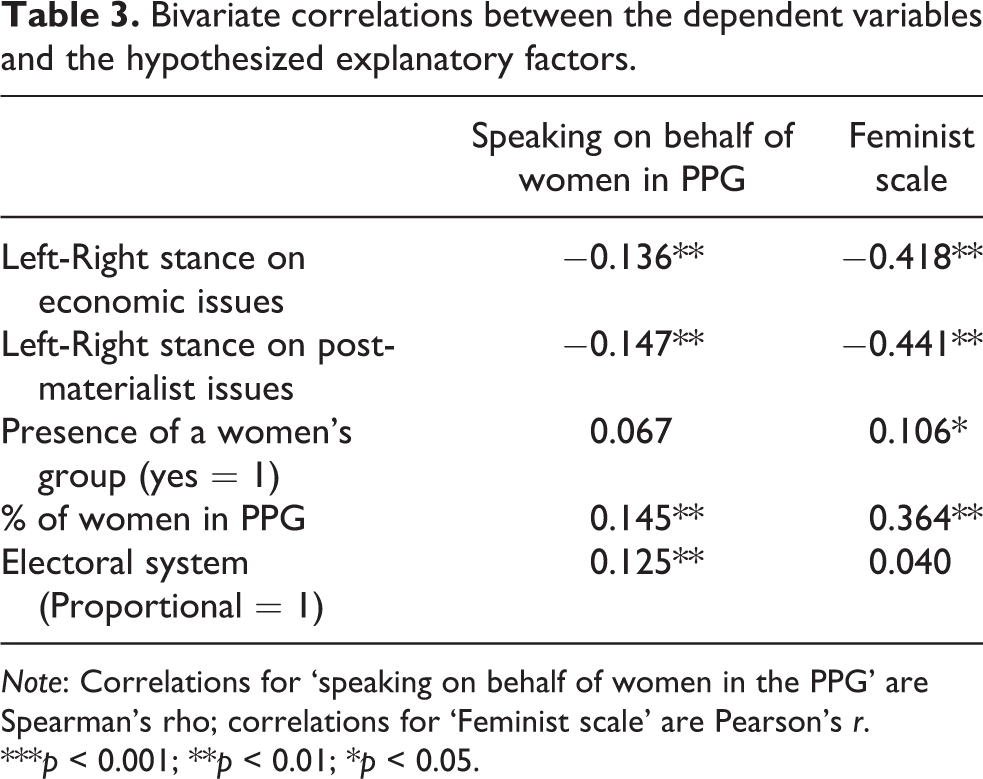
Note: Correlations for ‘speaking on behalf of women in the PPG’ are Spearman’s rho; correlations for ‘Feminist scale’ are Pearson’s r.
***p < 0.001; **p < 0.01; *p < 0.05.
Regarding the influence of descriptive party feminization, we expected that the presence of a women’s group and an increase in the percentage of women in the PPG would be associated with higher levels of women’s substantive representation. Higher percentages of women in the PPG indeed go hand in hand with higher levels of speaking for women in the PPG and with feminist attitudes (H4). However, parties with a women’s group do not overall appear to be more hospitable to women’s substantive representation than parties without such women’s groups (although there is a weak positive correlation between the presence of a women’s group and more feminist attitudes; H3). Finally, in terms of electoral considerations, we find that legislators’ belonging to a proportional electoral system is associated with higher levels of speaking for women in the PPG, but not with a display of more feminist attitudes (H5).
Next, we test whether these bivariate correlations hold in a multivariate model. Tables 4 shows the results for the analysis with legislators speaking in the PPG as a dependent variable. We conduct a multinomial logistic regression analysis, for which we recoded the original variable with four categories into a new variable with three categories: ‘frequent actors’ (i.e. those who speak ‘at least once every three months’ or ‘at least once every month’ on behalf of women), ‘occasional actors’ (i.e. those who speak ‘at least once a year’) and ‘non-actors’ (those who speak ‘almost never’). This was done because the category of respondents who ‘speak at least once every month’ was too small to keep it as a separate category and would produce unstable results in a logistic regression. Of all respondents (N = 844), 244 (28.9%) were identified as frequent actors, 159 (18.8%) as occasional actors and 441 (52.3%) as non-actors. The category of non-actors functions as a reference category.
Multinomial logistic regression explaining legislators’ speaking on behalf of women, with clustered robust standard errors (Reference category = Non-actors; N = 811).

***p < 0.001; **p < 0.01; *p < 0.05.
The results in Table 4 are presented in a stepwise model. The first model tests the impact of ideology and includes only two independent variables – the economic left-right scale and the post-materialist left-right scale – and a number of control variables. The control variables are the following: legislators’ sex (dummy), age 5 (in years) and seniority 6 (in years, log transformed), and a dummy variable distinguishing between majority and opposition parties. In the second model, we include the other three independent variables: the percentage of women in the PPG, a dummy for whether or not a party has a women’s group and a dummy distinguishing between PR and majority/plurality electoral systems. This second model allows us on the one hand to test whether these three variables exert a direct and independent impact. On the other hand, it permits us to test whether the inclusion of the variables changes the regression coefficients for the two ideological scales. If the B-coefficients of the two ideological scales diminish or disappear, we can say that ideological differences between parties are partly or entirely the result of differences in feminization levels or electoral considerations of parties, and that the impact of ideology is mostly indirect. If the B-coefficients of the two ideological scales remain strong and significant, we can conclude that ideology has a direct influence on women’s substantive representation.
Because individual MPs are nested in PPGs and in parliaments, the data are (potentially) hierarchically clustered, which is why we calculated the robust standard errors. Ideally, we would have performed a multilevel logistic analysis to account for the (potential) hierarchical clustering of the data, but this was not possible because of the small number of cases at the highest level (N = 14).
The results in models 1 and 2 show that ideological differences exist in women’s substantive representation, but that only the post-materialist left-right scale has a significant effect (and only for the category of frequent actors). The odds of speaking frequently on behalf of women decrease when parties hold more right-wing views on post-materialist issues. The economic left-right scale has no direct independent effect: legislators’ odds of speaking for women do not increase in parties with economically leftist ideologies once we control for other variables. This finding confirms the hypothesis that it is especially the post-materialist left-right divide that informs parties’ opportunities to represent women’s interests (H1b).
The explanatory power of model 1 is not very high (R 2 of 0.113) and the two ideological scales alone account only for 2.8% of the variation in the dependent variable, which is not surprising given that only a small number of independent variables are included and given that the left-right gap was not that strong to begin with (see Table 3). The variable ‘MPs sex’, and not ideology, has the strongest effect in model 1. When we include the other three independent variables in model 2, we find that the R 2 increases only marginally (to 0.135). Party feminization and electoral system design account for a very small part of the variation in the dependent variable. The electoral system has the strongest direct effect, but only for frequent actors: legislators under PR rules are more likely than their colleagues under majority rules to frequently raise women’s concerns in the PPG (H5).
The independent effect of the post-materialist left-right scale, furthermore, hardly decreases in model 2 when we include the other three independent variables. As mentioned above this means that post-materialist left-right ideology influences legislators’ acting on behalf of women in a direct manner. The effect of economic left-right ideology is on the other hand mediated by legislators’ gender, as the interaction effect in Table 5 points out. A move towards the right on the economic scale leads to a decrease in the odds of speaking for women, but only for female legislators. The behaviour of male legislators remains unaffected by the parties’ positioning on the economic left-right scale. These findings thus only partially confirm the findings briefly discussed in the introduction that right-wing parties also substantively represent women. The inclusion of women and gendered concerns in rightist parties does not put them at the same level of more leftist parties when it comes to the substantive representation of women.
Interaction effect between left-right economic scale and MPs’ sex, with clustered robust standard errors (Reference category = Non-actors; N = 811).
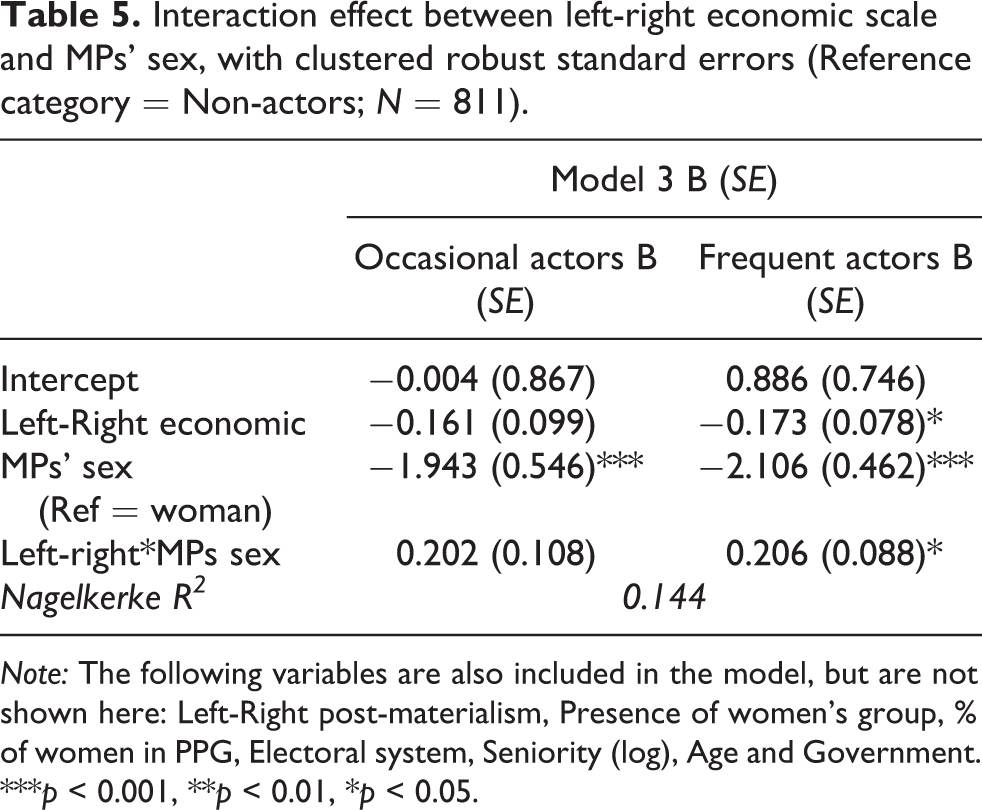
Note: The following variables are also included in the model, but are not shown here: Left-Right post-materialism, Presence of women’s group, % of women in PPG, Electoral system, Seniority (log), Age and Government.
***p < 0.001, **p < 0.01, *p < 0.05.
Because several of the independent variables correlate (weakly) in model 2, we run a test for multi-collinearity by calculating the VIF scores and tolerance scores. In general, it is assumed that there is evidence of multi-collinearity when the lowest tolerance is less than 0.10 and the highest VIF score is more than 10 (Hair et al., 1995). In our analyses, we found that the highest VIF score is 1.994, and the lowest tolerance score is 0.502 (‘% women in PPG’), so multi-collinearity does not pose a problem.
We now turn to the analysis with the feminist scale as a dependent variable. Table 6 shows the results of a stepwise Ordinary Least Squares (OLS) regression analysis. Model 1 is again the model of reference with the two left-right ideological scales as independent variables and legislators’ sex, age, seniority and parties in government/opposition as control variables. In model 2, we add the independent variables measuring party feminization and electoral considerations. We again clustered the standard errors to account for the fact that individuals are nested in PPGs and in parliaments.
OLS regression explaining legislators’ position on the feminist scale, with clustered robust standard errors (N = 813).
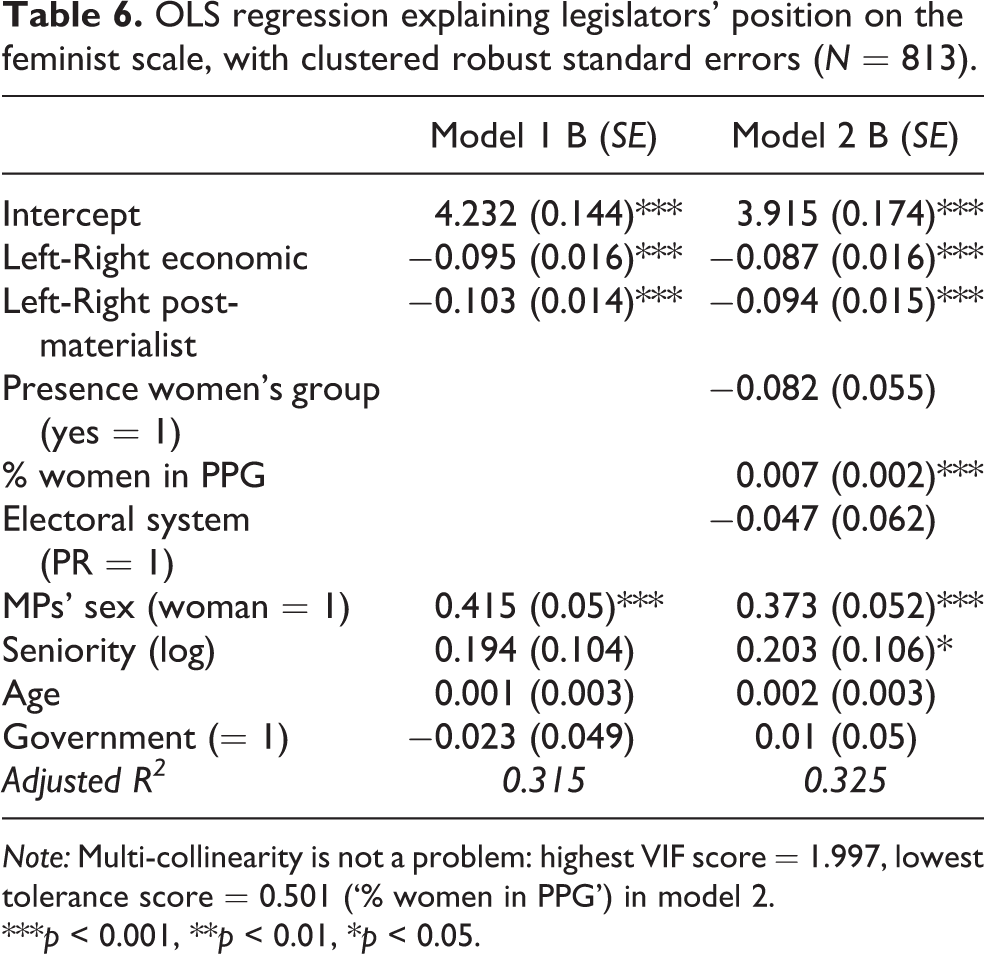
Note: Multi-collinearity is not a problem: highest VIF score = 1.997, lowest tolerance score = 0.501 (‘% women in PPG’) in model 2.
***p < 0.001, **p < 0.01, *p < 0.05.
A couple of observations stand out. First, the R 2 of the first model in Table 6 is already quite high: 31.5% of the variation in legislators’ feminist attitudes can be explained by the variables included in the first model, and 26.3% by the two ideological scales alone. This is in sharp contrast to the relatively low R 2 of the first model in Table 4, where the ideological scales accounted for less than 3% of the variation in legislators’ speaking for women in the PPG. In line with our hypotheses, we find that a positioning towards the left on the two ideological scales leads legislators to adopt more feminist attitudes (H2a). This confirms that left-right ideology is a very good indicator for a feminist substantive representation of women. Contrary to the analysis in Table 4, we furthermore see that both ideological scales have an independent impact on the feminist scale, although the effect of parties’ positioning on the post-materialist left-right scale is again somewhat stronger than parties’ positioning on the economic left-right scale (H2b). Female legislators present a higher score on the feminist scale than men and an increase in the numerical presence of women also encourages legislators to take a more feminist stance on gender issues. Compared to model 1 in Table 6, the R 2 in model 2 increases, but the independent effects of the two ideological scales do not disappear (although they diminish). Differences in ideology continue to exist, and these are only partially attributable to differences in party feminization and electoral competition.
Conclusion
Already in 1993, Joni Lovenduski and Pippa Norris noted in their seminal work on ‘Gender and Party Politics’ that various parties across the ideological spectrum had started to make efforts to integrate women’s concerns. Now, 20 years later, this article studied whether ideology (still) offers an important and strong explanation for women’s substantive representation across Europe and how different party contexts shape opportunities for the representation of women’s interests. Based on a comparative study of legislators’ acting on behalf of women in 14 European countries, we found that left-wing ideologies in general still offer more favourable venues for the representation of women’s interests than right-wing ideologies, but not in every country. A lot of variation nevertheless exists within the ‘left-wing’ and ‘right-wing’ block. In order to understand this variation, we proposed a new theoretical model. We first of all maintained a clear distinction between party and ideology, and found that an ideological positioning towards the left led to higher levels of substantive representation of women only when we measured parties’ positioning on post-materialist issues. Ideology thus still explains variation between parties in women’s substantive representation, but the impact depends on which dimension of ideology is studied. In addition, we differentiated between the substantive representation of gendered and feminist interests and showed that ideology offers a strong explanation for a feminist substantive representation but loses importance when applied to broader conceptions of women’s substantive representation. This is in line with previous results that left-wing and right-wing parties do not so much differ in how often they raise women’s concerns, but especially in how they frame their representative claims (see Celis and Childs, 2012).
Ideology is thus still of great importance for women’s substantive representation. Our study however shows that the picture is at the same time also more contingent and complex: ideology does not neatly map onto parties; whether ideology has an impact differs in terms of what kind of women’s representation one has in mind; and only specific features of an ideology impacts on women’s representation. Our study furthermore shows that ideology is not the only thing that matters. Legislators’ acting on behalf of women is also influenced by legislators’ individual characteristics, electoral strategies and (to a lesser extent) political opportunities. Legislators in both left-wing and right-wing parties receive incentives under proportional electoral rules, and disincentives under majority/plurality rules, to represent women’s interests. The level of feminist substantive representation increased when the percentage of women in the PPG increased (but the presence of an intra-party women’s organization had no effect).
Footnotes
Declaration of Conflicting Interests
The author(s) declared no potential conflicts of interest with respect to the research, authorship, and/or publication of this article.
Funding
The author(s) disclosed receipt of the following financial support for the research, authorship, and/or publication of this article: Silvia Erzeel wishes to thank the Fonds de la Recherche Scientifique – FNRS for its financial support.
