



Abstract
The political representation of women and ethnic minorities has received growing attention among political parties around the world. Focusing on the British case, we map data and debates concerning the selection of female and minority candidates, highlighting the simultaneous and interactive role of gender and race in shaping citizens’ opportunities to stand for and win election. Utilizing data from the Labour Party, our analysis illustrates the implications of distinct strategies to include members of politically marginalized groups—as well as provides evidence for the potential of “tandem quotas” to result in positive outcomes for minority women. Taken together, these findings suggest the need for stronger measures on the part of Labour to encourage the selection of minority candidates; a shift from “single-axis” to “multiple-axis” thinking when devising strategies to enhance group representation; and rejection of a “zero-sum” mentality regarding the nomination of female and minority candidates.
In recent elections, the political representation of women and black, Asian, and minority ethnic (BAME) communities has received growing attention among the three major British political parties. Both groups won a record number of seats in the House of Commons in 2010, resulting in 22.8% female members of parliament (MPs) and 4.2% BAME MPs. These numbers grew again in 2015 to 29.4% women and 6.3% BAME parliamentarians. However, these figures remain far from proportional to these groups’ share of the population, standing at 50.9% and 12.9%, respectively. 1 Ethnic minority women have been even more underrepresented, at 1.5% of all MPs in 2010 and 3.1% of MPs in 2015. Such patterns are replicated elsewhere: a global study calculates that minority women comprise a mere 2.1% of national legislators, compared to their 11.2% share of the population (Hughes, 2013: 501). 2
Experiences of minority women have inspired the concept of “intersectionality,” describing the ways in which oppressions are interrelated (Crenshaw, 1991; Hancock, 2007). Research and activism on diversity and political representation, however, often does not adopt an intersectional approach, instead addressing sex discrimination separately from racial discrimination, and vice versa. Such “single-axis thinking” tends to privilege the interests of advantaged subgroups, namely white women and ethnic minority men (Holmsten et al., 2010). Improving the political representation of ethnic minority women thus suffers from what Spelman (1988) calls the “ampersand problem,” falling between efforts to promote members of these two categories separately. Single-axis thinking, moreover, can foster a sense of hierarchy or competition among marginalized groups—in turn diverting attention from the dynamics of advantage privileging dominant groups (McCall, 2005).
Advocating a shift to “multiple-axis thinking,” this article examines the British case, applying an intersectional perspective to compare patterns of election, debates for inclusion, and the impact of distinct measures to enhance the political representation of women and BAME groups. The first section presents data illustrating the gendered and raced dimensions of access to parliament, as well as the simultaneous and interactive role of gender and race in shaping citizens’ opportunities to stand for and win election. Combining intersectionality with the insights of feminist institutionalism (Kenny, 2013; Krook, 2009), we argue that the formal and informal rules, practices, and norms of candidate selection are both gendered and raced (cf. Hawkesworth, 2003). We propose that attention to “intersectional institutions” is vital for forging new paths in research as well as for underscoring the need to devise party strategies tackling multiple axes of discrimination.
The second section turns to the current state of research and action taken to address the underrepresentation of women and BAME groups in British politics. Single-axis thinking predominates in both areas. A review of the academic literature reveals that gender scholars rarely engage with questions of race, while race scholars generally overlook issues of gender. A similar separation is reflected in political practice, in at least two respects. First, the legal status of positive action for these groups differs: parties may restrict candidacies in a constituency to women (a strategy known as “all-women shortlists” (AWS)) but may not do so in the case of ethnic minorities (a so-called “all-black shortlist” (ABS)). Second, the Labour Party—which has adopted stronger measures to promote the selection of more diverse candidates than the other parties—applies distinct provisions to these two groups. This separation not only renders invisible the specific challenges faced by BAME women but has also resulted in debates that frame women and ethnic minorities as competitors in the struggle for increased political representation.
The third section utilizes a unique dataset obtained from the Labour Party, 3 tracking the sex and race of individuals participating in the four stages of the selection process for prospective parliamentary candidates in the run-up to the 2015 elections. We observe the implications of distinct strategies to include members of politically marginalized groups, with the share of women and BAME aspirants at each stage revealing weaker results in terms of selecting and electing BAME candidates. The data also provide intriguing evidence regarding the potential of “tandem quotas”—attention to both sex and race in selection decisions—to result in positive outcomes for minority women. The article concludes by reflecting on implications for future initiatives to enhance political inclusiveness in Britain, highlighting the need for stronger measures to encourage the selection of BAME candidates and the importance of reframing the representation of women and minorities as a positive- rather than a negative-sum game.
Intersectional institutions
Recent elections in the United Kingdom have resulted in greater diversity among the members of the House of Commons. Between 2010 and 2015, the share of women increased from 22.8% to 29.4%, while the proportion of BAME members rose from 4.2% to 6.3%. The number of BAME women has also climbed over time, although their presence remains disproportionate. Prior to 2010, there had only been two Black and no Asian female MPs. The total increased to 10 in 2010 and to 20 in 2015, doubling from 1.5% to 3.1% of all MPs. Yet, this still reflects less than half of BAME women’s share of the population. Nonetheless, recent increases do better capture intra-category diversity: minority women now constitute 10.5% of female MPs, slightly less than the BAME share of the population, and 48.7% of BAME MPs, compared to half of the population which is female.
These aggregate figures obscure important differences across parties, however. In comparison to the Conservatives and Liberal Democrats, Labour has long elected the largest proportion of women and ethnic minority MPs in both relative and absolute terms (see Table 1). Although the Conservatives elected more women in 2015 than ever before, rising from 47 to 68 female MPs, this amounted to only 20.6% of the party’s total MPs—less than half of women’s share of Labour MPs at 42.7%, as women’s numbers grew from 87 to 99 even as the party lost 24 seats. Similar patterns appear for BAME MPs. At first glance, this is surprising, given that in the run-up to the 2015 elections, the Conservatives led all parties in selecting 10% candidates from non-White backgrounds, compared to 8% by Labour and the Liberal Democrats, respectively. Yet, the three parties differed substantially in terms of where these candidates were selected. Labour placed its BAME candidates in more winnable and marginal seats, resulting in 9.9% minority MPs, versus 5.1% BAME MPs among the Conservatives and 0% among the Liberal Democrats. 4 Labour similarly leads when it comes to the representation of BAME women, electing 14 of the 20 minority women MPs in 2015 and 8 of the 10 minority women MPs in 2010. Together, these patterns point to both gendered and raced dimensions of political exclusion.
Percentage of women and ethnic minorities, parliamentary party delegations.
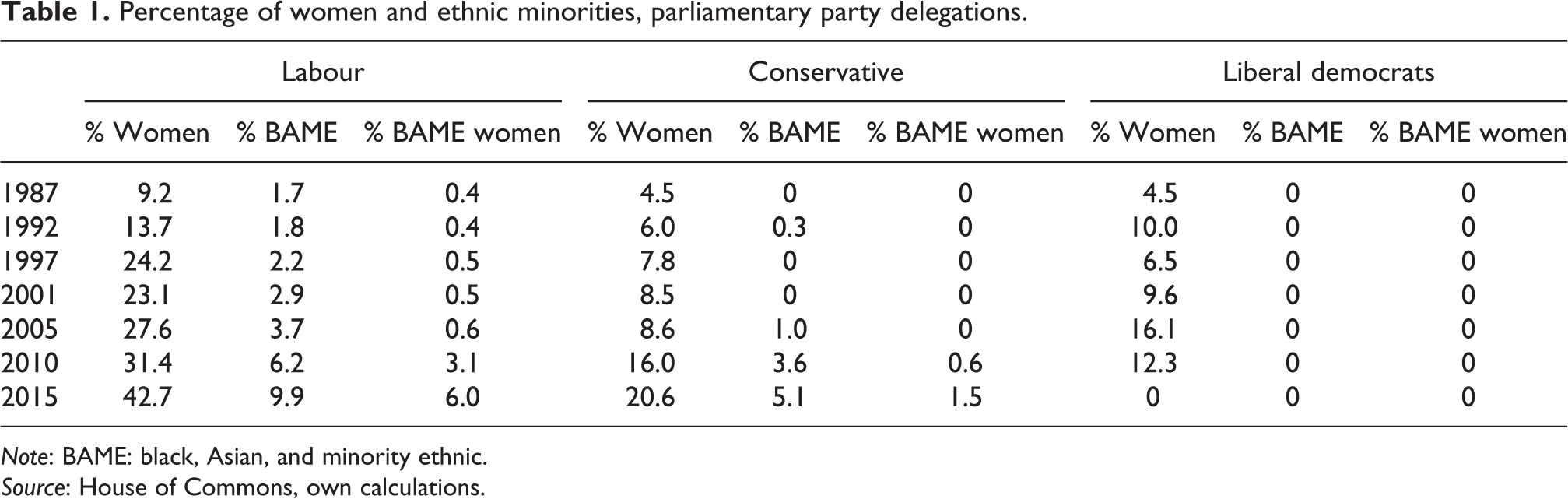
Note: BAME: black, Asian, and minority ethnic.
Source: House of Commons, own calculations.
The data also reveal that these dynamics work together, with BAME women being even more underrepresented than white women and minority men. Consequently, opportunities to stand for and win election are subject to simultaneous as well as interactive processes of gender and race. 5 The concept of “intersectionality” highlights these interrelations (Hancock, 2007), illustrating that “the intersectional experience is greater than the sum of racism and sexism” (Crenshaw, 1989: 140). Single-axis analyses of sexism and racism may thus unwittingly incorporate racist and sexist assumptions, respectively, into their theoretical frames. An intersectional perspective is thus vital for analyzing patterns of candidate selection as well as for devising effective solutions to tackle multiple inequalities.
Over the years, research on intersectionality has moved increasingly toward more structural approaches, calling for greater attention to structures and institutions that give meaning to politicized identities (Smooth, 2013). This view, importantly, says nothing about the effects of these structures on particular individuals, who may have differing views and experiences even as they are socially positioned in similar ways (Weldon, 2006). A similar shift toward focusing on structures has also been seen in the literature on political recruitment. Traditional approaches propose that the share of women and ethnic minorities elected is the combined result of the qualifications of group members to run for political office (“supply”) and the desire or willingness of party elites to select these aspirants (“demand”) (Norris and Lovenduski, 1995). More recent contributions build on these frameworks using institutionalist theory, conceptualizing human behavior as being shaped by various types of “institutions,” namely “formal constraints—such as the rules that human beings devise—and informal constraints—such as conventions and codes of behavior” (North, 1990: 3–4).
Combining feminist theory with an institutionalist perspective, Krook (2009) theorizes candidate selection in terms of three types of gendered institutions: formal rules, formal and informal practices, and formal and informal norms, which together shape the likelihood that women will be selected (cf. Bjarnegård, 2013; Kenny, 2013). Feminist institutionalism attends to the ways that institutions not only endure (informed by traditional institutionalism) but can also be changed through deliberate political strategies (taken from feminist political science) (Krook and Mackay, 2011). Despite its focus on gender, we argue that feminist institutionalism can be accommodated with an intersectional perspective, and moreover, that the core intuitions behind feminist institutionalism can and should be applied to the study of other groups. We thus propose focusing on intersectional institutions of candidate selection. Data from the British case provides initial validation of this approach. First, variations in the election of women and ethnic minorities indicate differences in rules, practices, and norms of candidate selection across political parties. Second, changes witnessed over time, as parties have come to rethink how they select candidates, suggest that rules, practices, and norms can be re-gendered and/or re-raced.
Focusing on intersectional institutions builds upon recent efforts to expand the theoretical and empirical remit of prior work on diversity and political representation. Although most research analyzes the experiences of a single group, emerging studies have begun to address different groups together. New studies, for example, map the ways in which multiple groups make claims for—or are identified by party elites as requiring—measures to ensure their representation (Bjarnegård and Zetterberg, 2014; Celis and Erzeel, 2013; Krook and O’Brien, 2010; Reiser, 2014). Yet analyses exploring inequalities within these categories remain rare, especially in cases outside the United States. One exception is the work of Hughes (2011), finding that quotas for women tend to favor women from dominant ethnicities, while provisions for minorities tend to benefit minority men. Compellingly, however, her data also show that where quotas for women and minorities—or “tandem quotas”—are applied, minority women are more proportionately represented.
Based on evidence from more than 80 countries, Hughes (2011) thus points to the dynamics of exclusion at work within single-group strategies to enhance political representation—as well as lends support to the intuition that a multigroup lens may achieve greater diversity among those elected. The latter approach may appear in both formal and informal guises. An example of an explicit intersectional approach is the policy in Uganda requiring that women be included within the other groups guaranteed representation: women must occupy 2 of the 10 seats reserved for the military, 1 of the 5 seats set aside for youth, 1 of the 5 seats for people with disabilities, and 1 of the 5 seats reserved for workers. A more informal tactic is the pragmatic “intersectional puzzling” that occurs in Belgium and the Netherlands as parties seek to increase the diversity of their electoral slates. In these processes, minority women may enjoy a “complementarity advantage” because their identity features maximally complement those of incumbents (Celis and Erzeel, 2015; Celis et al., 2014).
Attention to multiple facets of identity, moreover, is consistent with the lived experiences of minority women. Submissions to the 2009 Speaker’s Conference on Parliamentary Representation 6 indicate a clear awareness regarding multiple forms of discrimination on the part of BAME women. The National Muslim Women’s Advisory Group referred to the barriers that Muslim women face in terms of sexual discrimination and cultural prejudice, affecting their ability to develop the networks and skills necessary to be successful in politics. 7 FATIMA Women’s Network described the need for “a very high level of courage almost bordering on the masochistic” for ethnic minority women to come forward as candidates, due to experiences with “multiple disadvantage and discrimination.” 8 A shift from single-axis to multiple-axis thinking is thus required in order to combat potential exclusions within efforts to enhance the political representation of different groups.
Gender, race, and British politics
Apart from a few exceptional cases, women and ethnic minorities are underrepresented in electoral politics around the world (Hughes, 2011). Many commentators thus offer parallel arguments for these groups, arguing that their enhanced political presence is necessary for the sake of justice, the promotion of group interests, and the broader legitimacy of the polity (Mansbridge, 1999; Phillips, 1995). Despite awareness that both women and ethnic minorities face barriers to election, academic studies and political practices have tended to focus on one of these groups to the exclusion of the other (Krook, 2014). These global trends are evident in the United Kingdom, where single-axis thinking characterizes both research and action taken to address the underrepresentation of women and BAME groups. This “logic of separation,” in the words of Bassel and Emejulu (2010), has the effect of placing demands for these groups on distinct trajectories and framing these groups as competitors for increased representation, in turn rendering invisible the specific challenges faced by minority women.
The academic literature on women and ethnic minorities in British politics is impressively large, expanding rapidly over the last 15 years. Yet research on these two topics has proceeded more or less independently from one another. Studies on women in politics in the United Kingdom make little or no mention of race (among others, see Childs, 2004; Lovenduski, 2012; Mackay, 2004). At the same time, key texts on race and ethnicity in British politics offer few or no references to gender (among others, see Garbaye, 2005; Heath et al., 2013; Saggar, 1998; Sobolewska, 2013). When gender is mentioned by race scholars, the focus is not on their interaction but on how policies for women might serve as an example for ethnic minorities (Hampshire, 2012). Across both literatures, challenges faced by BAME women are rarely discussed, apart from observing the paucity of non-white women elected (Childs, 2010).
A rare exception is Norris and Lovenduski’s (1995) study of political recruitment, examining the role of gender, race, and class in shaping paths to a parliamentary career. Yet their analysis treats these identities as largely independent: In the quantitative work, the variables for gender and race are never interacted, and in the discussion, gender and race appear in separate subsections. 9 Their conclusions include statements like “black applicants seem to suffer greater disadvantage than women” (1995: 142), with no reference to diversity within either group. Although never explicitly expressed, however, their work is “protointersectional” in the sense of deeming gender, race, and class to be essential elements for understanding the processes and outcomes of candidate selection. 10 Some parts of the analysis also hint at the simultaneous nature of axes of oppression. For example, Norris and Lovenduski identify the “insider strategy” as the most common path to the House of Commons, with the ability of candidates to tap into existing elite networks and present themselves as “one of us” as the key to success. While the authors do not discuss the gender and racial dimensions of these networks, white male dominance of these networks opens the way—implicitly—to a more intersectional approach.
In a parallel fashion, campaigns to enhance the political inclusion of these groups have taken different paths. In contrast to group-based quotas elsewhere, reserving seats or mandating a certain proportion of group members on candidate lists (Krook and O’Brien, 2010), the British electoral system—organized around single-member districts—has led parties to focus on the composition of the aspirant shortlists considered before a single candidate is chosen. A strong version of this strategy is to require that final shortlists include only members of a certain group, thereby ensuring that someone from that group is selected. A milder form is to require that shortlists include some members of the group, with no further restrictions, thereby permitting members of any group to be the party’s nominee. During the 1990s, the Labour Party was sued by male and minority members on grounds that it had violated the Sex Discrimination Act (SDA, passed in 1975) and Race Relations Act (RRA, approved in 1965 and revised in 1968 and 1976). Following these court challenges, the SDA was reformed to allow parties to use AWS, while the RRA has remained intact, introducing ambiguities regarding the legality of ABS as a measure to enhance BAME representation. 11
The origins of AWS can be traced back to the compulsory shortlisting rules introduced by the Social Democratic Party (later the Liberal Democrats) and the Labour Party in the 1980s. These policies mandated that at least one woman (later two women) be included on every shortlist (Lovenduski and Randall, 1993). After Labour lost the 1992 elections, Labour women argued that enhancing women’s representation might help close gender gaps in voter support (Perrigo, 1996). They proposed that AWS be used in half of vacant seats the party was likely to win, a policy that was approved at the 1993 party conference. As the AWS policy was put into motion, the party was sued in 1995 by two male members, Peter Jepson and Roger Dyas-Elliott. Bringing the case to an industrial tribunal, they argued that their exclusion from candidate selection in AWS districts violated the SDA, which in section 13 prohibited sex discrimination in judging qualifications for employment. 12 The party’s lawyer responded that candidates were office holders, not employees. Rather, candidate regulations fell under section 33, which allowed parties to make special provisions for one sex.
In giving its judgment, the tribunal agreed that MPs did not have employment contracts, but argued that candidate selection did constitute a qualification for becoming an MP. For that reason, it found that the AWS policy violated the employment provisions of the SDA, as it did not allow men to be considered as candidates in certain districts (Jepson and Dyas-Elliott v. The Labour Party and Others). Although supporters of the policy urged the party to appeal the decision, and there were good legal grounds for doing so, 13 leaders decided that an appeal was not worth the risk, as the judgment did not affect the 35 women who had already been selected via AWS in other districts, but an appeal might cast all of these selections into doubt (Russell, 2000). Keeping these women on as candidates contributed to a doubling in the proportion of women in parliament from 9% in 1992 to 18% in 1997. 14
After the number of female MPs fell in 2001, the Labour government proposed a bill to reform the SDA to exclude from its purview acts taken by parties to reduce inequalities in the numbers of men and women elected. Opposition parties did not object to the bill, enabling it to pass all stages without a vote in 2002. A key reason was the bill’s permissive nature: it did not compel but simply allowed positive action (Childs, 2003). It also contained a “sunset clause” stating that the reform would expire in 2015 unless otherwise extended. Labour responded by reinstituting its AWS policy. The Liberal Democrats considered but rejected AWS at the 2001 party conference. They retained the compulsory shortlisting policy and established a Gender Balance Taskforce. 15 In 2009, party leader Nick Clegg stated that while he “did not see [AWS] as a panacea,” he would consider them if the party’s number of female MPs did not improve in the next election. 16 The party did not subsequently change its politics (Evans, 2011) but did launch a leadership program to identify and train female candidates. 17
The Conservatives were slower to take up the issue, but this changed in 2005 with the election of David Cameron as the party leader. In his first speeches, he pledged to “end the scandal of women’s underrepresentation,” declaring that “the sound of modern Britain is a complex harmony, not a male voice choir.” 18 One week later, he proposed a “priority list” consisting of at least 50% women from which Conservative-held and target constituencies would be required to select their candidates (Campbell et al., 2006). He dropped this policy several months later in favor of requiring local parties to consider gender-balanced shortlists at every stage. In 2009, he committed to AWS in districts where candidates had not yet been selected for the 2010 elections, but this was never implemented. 19 Conservative voters, party officials, and MPs remain hostile to “quotas” (Childs and Webb, 2011), 20 and when some female MPs expressed support for AWS in 2014, their statements were rebuked by party members and senior officials. The party has instead relied on the Women2Win campaign to encourage women to stand as candidates. 21
Over the last 20 years, the issue of women’s representation has thus reached the agenda of all three major parties. While only Labour has adopted AWS, Liberal Democrat and Conservative leaders have both acknowledged to some degree their validity as a strategy to secure the nomination of female candidates. The idea of applying ABS, in contrast, has found relatively little traction, including within the Labour Party—despite the fact that the party has elected the vast majority of BAME MPs (Ali and O’Cinneide, 2002). Although the first South Asian MP was elected in 1892, most MPs with BAME backgrounds arrived more recently: the first four Black MPs were elected in 1987 (including the first Black female MP) and the first Muslim MP was elected in 1997 (followed in 2010 by the first two female Muslim MPs). ABS were briefly debated in 1993, but party leaders decided to take more time to consider this proposal (Norris, 1997). After the 1997 elections, Labour changed its selection procedures to require that shortlists in each district be gender balanced and include at least one ethnic minority candidate. Introducing this rule, however, did not lead to a major increase in the number of minority candidates selected and elected in 2001 (Ali and O’Cinneide, 2002).
Further, despite Labour’s record on minority representation, problems with discrimination were rife in a number of constituencies (Shukra, 1998; Solomos and Back, 1995). Events in the Sparkhill Ward of Birmingham, a district with a large Pakistani population, led party member Raghib Ahsan to file a case with the industrial tribunal, claiming that the party had discriminated against him on racial grounds, contrary to section 12 of the RRA. Between 1991 and 1998, he was the ward’s representative on the local council and hoped to be re-selected. The Sparkhill branch had been suspended for nearly 3 years by the central leadership, however, along with three other constituency parties with the highest concentration of ethnic minority groups, stemming from accusations of corruption. An inquiry found no evidence to this effect, but the candidate chosen for Sparkhill without involvement of the local branch was a white man. Despite the fact that the white man did not qualify as a candidate under party rules related to time as a party member, the panel argued that he was “best placed to counter some of the problems which had arisen in the ward … closely associated with the Pakistani community.”
Like Jepson, Ahsan argued that being a councilor was a profession and that party authorization to stand as a candidate was necessary for him to be elected. 22 The Labour Party responded that section 12 did not apply because a political career was not the same as employment. As the question was pending, a list of approved candidates was circulated from which Ahsan’s name was removed on the grounds that he had brought proceedings against the party. This incident was the subject of his second complaint to the tribunal in September 1998, this time alleging victimization contrary to section 2 (1) of the RRA. When the tribunal found against the party on the question of employment, the party appealed the decision but had the appeal dismissed (Sawyer v. Ahsan). In 2000, Ahsan made yet a third complaint of racial discrimination, again under section 12, in connection with the selection of candidates that year and his candidature for the local party executive committee.
Meanwhile, in an unrelated case (Ali v. McDonagh), the Court of Appeals found that Labour was not the type of body to which section 12 applied. Yet the Employment Appeals Tribunal decided it was bound by the unappealed decision in Ahsan’s first case, finding in his favor on all three counts. The Court of Appeals then decided that Ahsan had not been discriminated against on racial grounds, deeming the party’s wish not to have a Pakistani candidate to be a “legitimate objective” if acts of corruption were in fact associated with this community. Ahsan next turned to the House of Lords, which allowed the appeal because racial makeup was what enabled it to be described as a “Pakistani community.” In 2007, the Lords restored the initial decision that the party had engaged in racial discrimination but argued that the grounds for this decision law lay in section 25, dealing with discrimination by associations against their members or prospective members (Watt [Carter] v. Ahsan). In other words, proper jurisdiction for claims of discrimination was the county court, not the industrial tribunal—returning to the pre-Jepson status quo (Morris, 2012).
These legal ambiguities led to brief discussions at the 2001 party conference of including race when reforming the SDA, but this was later dropped. At the time, the reigning interpretation from Sawyer v. Ahsan was that section 12 did apply to candidate selection and forbid discrimination, positive or negative (Russell, 2001). Following the 2001 elections, the Labour National Executive Committee (NEC) suggested openly that some local parties might be asked to use ABS, especially in areas with high BAME populations. If that failed, they stated, they would consider proposing a bill to reform the RRA in a similar way to the SDA. 23 Party leaders issued calls 5 years later for districts with high BAME populations to use ABS, 24 while also holding meetings with a leading Black pressure group, Operation Black Vote. Several prominent Labour politicians came out in favor of ABS, but a private member’s bill introduced in 2008 by Keith Vaz, an Asian Labour MP, to reform the RRA did not garner widespread support. 25
The result of these debates has been a continued distinction between the legality of measures to promote the political representation of women and BAME groups. Notably, the 2010 Equality Act, consolidating more than 100 pieces of antidiscrimination legislation, extends the use of AWS until 2030. In contrast, it does not permit shortlists comprised solely of people selected on grounds of race or disability, although it does allow parties to reserve places on shortlists for such groups (Kelly and White, 2009). While the final report of the Speakers’ Conference urged reform of the RRA to allow parties to use strategies to promote the representation of BAME candidates similar to those in effect for women, legal reform to permit ABS has not been forthcoming—even as top party leaders recognized it was “wrong” not to have more ethnic minority MPs. 26
Although the Conservatives and Liberal Democrats have joined Labour in instituting measures and programs to stimulate minority representation, all three approaches fall short of the guarantees offered by AWS in winnable districts. When Cameron became party leader in 2005, he promised to increase diversity by selecting a “significant” proportion of BAME candidates in Conservative held and target constituencies (Campbell et al., 2006). Due to this “A-list” strategy, a record share of BAME candidates were nominated for the 2010 elections, with the result that the number of minority Conservative MPs grew from 2 to 11, although this represented only 3.6% of Conservative MPs overall (Wood and Cracknell, 2013: 4). The Liberal Democrats—with no BAME MPs—considered, but rejected, a motion at their 2010 conference to require at least one BAME person on candidate shortlists. Instead, a weaker provision was approved, establishing targets for BAME representation and training opportunities for BAME aspirants.
Frustration at the lack of BAME candidates for the 2015 elections generated new calls among some Labour activists and MPs to institute ABS, with the Labour Black Network launching a “manifesto for change” at the 2014 party conference to “right the wrong of poor representation of Black members.” Data in December 2014 revealed that Labour had selected the fewest BAME candidates for the seats of retiring MPs, generally the parties’ safest seats: only 2.9%, compared to 15.6% for the Conservatives and 10% for the Liberal Democrats. 27 BAME groups have been critical of AWS, framing the representation of women and ethnic minorities in zero-sum terms. 28 One approach is to condemn AWS on intersectional grounds, noting that AWS have been “all-white-women-shortlists,” in the words of Diane Abbott, the first Black female MP. 29 Similarly, in 2007, Asian MP Keith Vaz expressed frustration that “whenever there’s a chance of getting another ethnic minority candidate in, an all-women shortlist is imposed … no black or Asian person has ever been selected from an all-woman shortlist.” 30 Until 2005, the empirical evidence shows this to be true: between 1997 and 2005, not a single BAME woman was nominated or elected via an AWS. Yet the picture began to change in 2010, when BAME women comprised 14.3% of candidates selected and 12.7% of those elected via AWS, roughly equivalent to the BAME share of the population.
A second mode of criticism, however, is by far the more common. Setting up an opposition between the representation of white women and black men, some BAME activists and politicians have suggested that the use of AWS comes at the cost of black men being represented. For example, after a white woman was selected in West Ham, a seat with a 60% BAME population, on an AWS in 2005, Simon Woolley of Operation Black Vote stated that “black Britain will be asking what must we do to get selected for a Labour Party seat.” 31 Similar arguments have also been voiced where AWS have not been applied and BAME women have been selected. Frustrated at not being chosen in Edmonton in 2015, a local Labour councilor resigned from the party, claiming that it had “actively undermined possibilities for African Caribbean men to have the opportunity to stand for parliament by virtue of the way that it has implemented its policy on all-women shortlists.” 32 Taken together, party policies and such statements point to the ongoing prevalence of single-axis thinking in British party politics.
Candidate selection in the UK Labour party
The final report of the Speaker’s Conference concluded that parties should publish diversity data on their candidate selections. Details on female, BAME, disabled, and lesbian, gay, bisexual, and transgender (LGBT) candidates were posted on both the Labour and Liberal Democrat websites, 33 while the Conservatives simply listed the names and constituencies of their candidates. In addition to this publicly available data, the Labour Party tracked the sex, race, disability, and sexual identity and orientation of individuals participating in the selection process. The data set that we obtained in May 2015 includes all 414 seats that Labour contested, with complete data on all four stages—applicants, longlists, shortlists, and winners—for 130 open seats and 35 AWS seats.
Consistent with a single-axis mentality, the data report the total number of women and BAME candidates at each stage, but not whether any of these women were non-white or if any of the minority applicants were female. As such, it is not possible to know exactly how many BAME men versus women participated in the open selections. Yet, because the data for AWS constituencies only includes women by definition, it is possible to compare the fates of white versus BAME women. Figure 1 shows the share of BAME aspirants at each stage, tracking the percentage of BAME candidates across open and AWS seats. This mapping reveals that more BAME individuals apply to be candidates in open districts. Slightly more BAME aspirants reach the longlisting and shortlisting stages in AWS districts. At the final stage, however, these numbers diverge sharply: BAME women constituted 17.6% of those selected via AWS, while BAME aspirants—male and female together—comprised only 5.4% of open selections. This pattern similarly holds when examining data from all 414 selections: 8.7% of all constituencies chose a BAME candidate, but this share increases to 11.5% in AWS districts.

Proportion of BAME aspirants in Labour Party selections, open and AWS seats. BAME: Black, Asian, and minority ethnic. Source: Labour Party, own calculations.
These patterns contradict the expectations, already dispelled for the 2010 elections, that AWS block the selection of BAME candidates. Instead, evidence from the 2015 elections indicates that BAME women fare much better in these selections than in the open seats. There is also a close correspondence between their proportion on final shortlists and among the candidates ultimately selected. Using figures from the last census, we explored whether these differing fates were the result of the demographics of the constituencies in question, but find that AWS seats have a lower proportion of BAME voters than open seats. The greater success rate of minority women in AWS districts thus is not due to the presence of a high BAME population.
We argue that the distinct selection rules governing female and minority candidates offers clues to explain these trends. The party’s official procedures mandate that BAME candidates be longlisted where BAME aspirants submit applications and urge “due consideration” to BAME candidates over the course of the selection process. However, there is no requirement to select BAME aspirants at the final stage, the moment at which there is a dramatic decline in the BAME share. Interviews with female MPs and activists from the three major parties, 34 all of which have compulsory shortlisting rules for women, provide some insight into why this drop-off occurs. Interviewees noted that, while compulsory shortlisting may expand access to members of underrepresented groups, it may be potentially counterproductive. This is because, while selection panels must consider female and minority aspirants, they are not obliged to pick them, thus allowing officials to “tick a box” before going on to choose white men. Evidence to this effect can be seen in the results of the 2001 elections, when the Labour Party only applied gender-balanced shortlists and fewer women were nominated or elected (Krook, 2009).
In combination with the policy of AWS, however, the compulsory shortlisting rule for BAME aspirants appears to benefit BAME women, along the lines of a “tandem quota.” Two sets of dynamics might set in motion “multiple-axis” thinking. The first has to do with what types of districts volunteer for AWS. The process by which Labour decides which seats will employ AWS is opaque at best. 35 It does, however, involve the chance for constituencies to volunteer and for regional bodies to consider which seats would be best suited to an AWS (Cutts et al., 2008). According to a party insider, it is vital to know “where people were positive” as well as “where the resistance was.” 36 Reasons for volunteering are not always clear, but it may be that those seats that are more open to women may also be more open to selecting a non-white candidate, given that this choice reflects an awareness—and a desire to mitigate—the underrepresentation of a politically excluded group.
A second possibility relates to the candidate selection process itself. Once districts for AWS are assigned, constituencies with open contests may feel that the task of diversifying the party’s candidates has already been taken care of in other seats. Evidence on policy representation lends some support to this intuition: redistricting in the United States to ensure the presence of blacks and Latinos in Congress has been shown to reduce support for minority-sponsored legislation on the part of legislators from now majority white districts, who no longer feel obliged to respond to minority community concerns (Cameron et al., 1996). At the same time, gaining an AWS may instill a greater sense of responsibility among selectors to pick candidates who do not look like the vast majority of the party—what one interviewee described as “developing a genuine commitment” to select more diverse candidates. 37
Black MPs and pressure groups may have contributed to this trend through their vocal concerns that AWS come at the cost of BAME representation: while there were no non-white AWS candidates through 2005, the selection of minority women increased for the 2010 and 2015 elections—suggesting awareness-rising or learning among selectors to more seriously consider BAME women. Calls for AWS and ABS, in other words, may mutually reinforce one another akin to a tandem quota. These dynamics can be seen in a selection that took place in early 2015 in Edmonton, a relatively safe Labour seat that is also one of the most ethnically diverse, with 67% of constituents having a BAME background. The local party had been “divided on the issue” of AWS, and ultimately, the NEC designated the district as “open” because many female candidates had been selected elsewhere. 38 Attracting more than 100 applicants, the longlist of 12 included both men and women and BAME and non-BAME aspirants. As the shortlist was being decided, BAME Labour wrote a letter to the local party chair, urging him to apply an ABS. Possibly influenced by calls for AWS and ABS, the committee selected a shortlist of three BAME women.
Although minority women typically lose out in efforts to promote the election of women and/or ethnic minorities, dynamics such as these point to evolving practices and norms regarding the political recruitment of minority women, facilitated by the existence of rules—while disparate—for women and ethnic minorities in candidate selection processes. Despite the small sample size, the stronger outcomes for BAME women in 2015, moreover, appear to be linked to the more robust guarantees inherent in the AWS policy. More specifically, one-fifth (20%) of the BAME women elected to parliament were selected in open seats, compared to nearly one-half (43%) of the white women. Six of the eight new BAME MPs elected by Labour were female—four of these in AWS districts. AWS thus appear to be crucial in helping to close gaps in representation for minority women, albeit in conjunction with calls for greater BAME representation overall.
Implications and conclusions
Women and ethnic minorities face challenges to being elected to national parliaments around the world. In the British case, both groups have been recognized as requiring specific measures to help level the political playing field, with all three major parties taking some steps to recruit and select more female and BAME candidates. These debates have been by far the most extensive in the Labour Party, which has also elected the most female and ethnic minority members in both relative and absolute terms. Yet, the party has introduced distinct policies regarding these groups in its candidate selection procedures. Through the policy of AWS, the party guarantees that female candidates will be selected in at least some of the districts that the party is likely to win. BAME applicants, in contrast, must be included in the longlisting and shortlisting stages, but there is no requirement to choose a minority candidate. The result has been weaker results in terms of selecting and electing BAME candidates.
The relative success of AWS in achieving greater levels of female representation is rooted in greater clarity regarding the legality of positive action in candidate selection as it concerns women. While they remain controversial, AWS have delivered for Labour in terms of reducing barriers for well-prepared women to stand as candidates, maintaining or attracting party vote shares, and producing diligent and active MPs (Nugent and Krook, 2015). Similar policies for BAME candidates stand on more ambiguous legal grounds. Many observers believe that reforming the RRA would be necessary before ABS could be introduced—restricting the field to BAME candidates from the start, rather than de facto after non-BAME candidates have been considered but then eliminated. Frustration at the lack of BAME candidates has led some to blame the policy of AWS as a factor blocking BAME representation. Yet, the data examined in this article indicates that minority women have greater chances to be selected in AWS as compared to open seats.
The evidence examined in this article—derived from interviews, court cases, and quantitative selection data—together generate three conclusions for the future. First, disparate outcomes suggest the need for stronger measures on the part of Labour to encourage the selection of BAME candidates, especially in districts with large minority populations. In addition to ABS, these might include stronger targets for selecting BAME candidates in particular regions of the country. Second, single-axis thinking is both inaccurate and exclusionary, as it overlooks the experiences—and indeed, existence—of minority women. Tandem quotas, in contrast, appear to enhance the electoral prospects of BAME women, in the United Kingdom as elsewhere. Third, shifting away from a zero-sum mentality is vitally important for moving debates ahead in a productive way. Framing the issue as women gaining at the expense of ethnic minorities, or vice versa, misses the mark in terms of tackling their shared target of white male dominance—thereby allowing it to persist while marginalized groups struggle among each other for a small share of seats. As Bjarnegård (2013) points out, asking not why some groups are underrepresented, but why other groups are overrepresented, can open up for examination the dynamics preserving existing relations of power.
Footnotes
Acknowledgements
We would like to thank the editors and anonymous reviewers at Party Politics for their helpful comments. Previous iterations were presented at the World Congress of the International Political Science Association, Montreal, Canada, July 2014, and the European Conference on Politics and Gender, Uppsala, Sweden, June 2015.
Declaration of Conflicting Interests
The author(s) declared no potential conflicts of interest with respect to the research, authorship, and/or publication of this article.
Funding
The author(s) disclosed receipt of the following financial support for the research, authorship, and/or publication of this article: The research and writing of this article received financial support from the National Science Foundation’s Early Career Development (CAREER) Program (Award SES-1341129).