




Abstract
Party members across European democracies exercise increasing influence on parties’ policy platforms or personnel choices. This article investigates ideological (in)congruence on the left–right spectrum between members and their parties by drawing on a party membership survey of more than 10,000 individuals across seven political parties in Sweden. The results show that around two-thirds of members are not perfectly congruent with their party. In a two-step analysis, the article argues that emancipated members, with higher political interest and with a more independent self-conception, are more comfortable being ideologically incongruent with their party. We also provide evidence that ideological incongruence matters for members’ exit, voice and loyalty behaviour. It is associated with a more negative evaluation of the party leader (voice) and with a higher probability to either vote for another party (loyalty) or even to leave the current one (exit). The findings indicate that ideological incongruence within parties is not a trivial matter, but is rather substantial in size with potentially important consequences for party competition.
Political parties and their members are often seen as the political linkage between those in power and ordinary citizens (e.g. Dalton et al., 2011; Kitschelt, 2000; Müller and Katz, 1997). Party success in the electoral market hinges on the relationships between these groups. However, what happens within parties is no less important, since it is the precursor to the party’s hopefully cohesive public profile. Within parties, controversy over personnel or policy is almost unavoidable, and the literature acknowledges that ‘factionalism is a fact of life within most political parties’ (Harmel et al., 1995: 7). The study of ideological disagreement within parties has become more important due to recent intra-organizational trends. With increasing demands of democratization within political parties, members have gained influence as suppliers of and veto players on policies, candidates and leaders (Krouwel, 2012;Scarrow and Gezgor, 2010; Scarrow et al., 2000). Party members in today’s (primarily) internally democratic parties have a direct influence on policy output, which emphasizes their crucial role for the ideological profile of a party. However, despite the increasing power granted to members, scholarly research on ideological congruence between party members and party positions is still scarce.
Two recent examples illustrate the relevance of ideological incongruence within parties for contemporary politics. The first is the controversy over the December Agreement within the Swedish Christian Democrats (KD). The leadership struck a deal with the other parliamentary parties in the wake of a governmental budgetary crisis provoked by the Sweden Democrats (SD) in December 2014. It allowed the newly elected red-green minority government to govern with its own budget. At the next national conference of the KD in October 2015, the delegates voted to leave the December Agreement against the leadership’s proposal. The second example is the competition for the leadership position of the British Labour Party. As the prospects of Jeremy Corbyn – the most left wing of the contenders for the leadership post – continued to rise over the summer of 2015 New Labour centrists like Tony Blair and John McTernan attributed it, at least in part, to ideological extremity and rigidity within the party’s rank-and-file membership.1,2 The concern from this perspective is that a party with an ideological and strong membership base could produce a leader that would be less viable in a general election.
Scholars of party politics are recently acquiring the information necessary to study this and related issues in contemporary societies. For example, a survey of 1180 Labour Party members conducted in May of 2015 found these members to be quite left wing in their self-reported left–right placement, 3 whereas earlier research had found that British sub-leaders are not extreme (Norris, 1995). Our article looks at the question of ideological incongruence between party members and party positions within Sweden, providing information on this important political relationship in a multiparty, proportional electoral system, which could produce substantially different findings than those reported in Britain. The analysis is based on a high-quality survey of more than 10,000 party members conducted with the support of seven Swedish political parties in May and June of 2015. Building on previous research on the socio-economic correlates of ideological incongruence within parties (see Van Haute and Carty, 2012), the article offers a theory-driven analysis of potential attitudinal causes and behavioural consequences.
The results show that emancipated party members with higher levels of political interest and with a more independent self-conception are more incongruent with their party’s ideological position. Moreover, we find that ideological incongruence matters for members’ exit, voice and loyalty behaviour (Hirschman, 1970). Ideological incongruence is associated with a more negative evaluation of the party leader and with a higher probability to either vote for another party or to even leave the current one.
Intra-party politics and ideological incongruence
The perspective holding that parties are composed of diverse views and preferences (for instance, Green and Haber, 2014; Katz and Mair, 1992; Panebianco, 1988; van de Wardt, 2014) has been driving empirical research in several settings, focusing on various units of observation and using different methods. Although existing studies use different terms, such as ‘intra-party heterogeneity’ (Greene and Haber, 2014), ‘cohesion’ (Bowler et al., 1999), ‘unity’ (Panebianco, 1988), ‘ideological misfit’ (Van Haute and Carty, 2012) or ‘internal division’ (van de Wardt, 2014), they all refer to the same phenomenon of internal party (dis)agreement regarding a specific policy issue or ideology more broadly. To this end, previous research has often focused on disagreement between parties and voters (Adams et al., 2006; Rohlfing, 2015) or parties and their supporters (Ezrow et al., 2011; van der Wardt, 2014). Within parties, studies have investigated disagreement through parliamentary roll calls (Bowler et al., 1999; Sieberer, 2006), national congress speeches (Greene and Haber, 2014, 2017) or social media content (Ceron, 2017). Only some studies so far used party members as their units of observation (see Narud and Skare,1999; Scarrow and Gezgor, 2010; Van Haute and Carty, 2012; Widfeldt, 1999). The results of these studies indicate that internal party disagreement is frequent and that a party’s official policy or ideological position is often the product of such internal competition.
Even though the frequent movement from mass parties to catchall or cartel forms of organizational structure has empowered party leadership relative to rank-and-file activists (Katz and Mair, 1995; Kirchheimer, 1965), increasing demands for democratization within parties often entail more decision-making power transferred to ordinary members. Partially in response to enduring membership decline, political parties nowadays grant their members more influence over policy and personnel decisions (Krouwel, 2012; Scarrow and Gezgor, 2010; Scarrow et al., 2000). Although this power is sometimes more cosmetic than substantial (Katz and Mair, 2009: 759), questions of ideological congruence within parties have still become more important. The contemporary view of parties puts an emphasis on members as ‘individuals rather than as an organized body’ with ‘heterogeneous preferences’ (Bolleyer, 2009: 561, 563). This internal heterogeneity or incongruence in preferences is not without consequences as research shows that ‘intra-party divisions frequently constrain party leaders’ (Greene and Haber, 2014: 3).
Due to data limitations, so far less is known about the factors that potentially spur ideological incongruence among party members and what its implications might be for party leaders, party competition or the party as a membership organization (see Van Haute and Carty, 2012 for an exception). Which party members are more likely to be incongruent with their party? And what are the ramifications of having ideologically incongruent members for parties?
A number of potential motivations for incongruence seem plausible. For example, May’s law of curvilinear disparity (May, 1973) famously stated that members’ levels of activism or rank within the party correlates with their ideological extremity, where ordinary members and the party elite hold more moderate positions and the mid-level elite holds the more extreme views. Tests of the theory are generally mixed across parties and national contexts (see, e.g. Dahl, 2010; Kitschelt, 1989; Narud and Skare, 1999; Norris, 1995; Van Haute and Carty, 2012; Widfeldt, 1999).
In a study of ‘ideological misfits’ among party members in Belgium and Canada Van Haute and Carty (2012) found some support for May’s Law. The authors also tested a number of other individual-level correlates of ideological incongruence, such as gender, religious belief, religious practice, age, education, employment, union membership, member-party linkage and members’ reported reasons for initially joining. They find that ‘none of the variables significantly identifies misfits’ across all nine parties and that ‘none is significant in more than four cases’ (Van Haute and Carty, 2012: 892). The authors interpret this finding as confirmation for the diverse character of the members that do not see themselves as ideologically congruent with the party.
In further search for potential causes of individual-level incongruence, we propose members’ attitudes as important correlates. In general, we suggest that members explicitly state ideological incongruence with their party when they are less in need of cue-taking and more comfortable with a critical position towards their own party (see Baras et al., 2012 for a related discussion for Spanish party delegates). In line with cognitive mobilization theory (see Dalton, 1984), we expect that more politically sophisticated and interested individuals are less in need of cognitive shortcuts from the party and thus more inclined to take on a different ideological position. Conversely, the less efficacious see a limited personal impact on the party and are in higher need of cues from the party. They will thus be more likely to place themselves close to the party’s ideological position. Likewise, we expect to find less incongruence among members that perceive their role within the party to be marginal. If a party member believes that she has a weaker voice and/or role within her party, this member should be more inclined to follow signals sent from the party and more likely to see herself as ideologically close to the party.
Ideological incongruence within parties is not necessarily a disadvantage for a party’s success in the electoral market or as a membership organization. After all, disagreement and a discourse over policy or ideology with and among party members can also be beneficial, as it provides the party with new input from the units of the party closest to the electorate: the members (Budge et al, 2012; Rohrschneider and Whitefield, 2012). In fact, one of the often-cited benefits of party membership for political parties is that members are the eyes and ears of the party in the electorate (Katz and Mair, 1992; Rohlfing, 2015; Scarrow, 1994); they bring in new policy ideas that are close to what the electorate needs or want. If, on the other hand, ideological incongruence is part of a larger disagreement within the party over the course of action, members’ newly gained verbal and behavioural power might be a constraint for party leaders and party competition.
Hirschman (1970) famously hypothesized that perceived organizational decline could lead to exit, voice or loyalty behaviour. While several studies already support this hypothesis from a variety of electoral perspectives (see, e.g. Karreth et al, 2013; Weber, 2011), there is much less empirical work on party members (Van Haute, 2011, 2015). However, it is plausible that ideological disagreement within parties would have similar behavioural consequences. These might be found in particular in the members’ satisfaction with the party and the party leadership (voice), their propensity to vote for another party (loyalty), or even to terminate membership (exit). From the individual- and party-level perspective, we can also rank order these consequences in terms of their severity. Voice is a first means for members to signal disagreement. It is also manageable for party elites and perhaps even beneficial to discuss for the attractiveness of the party’s profile to non-members. Exit and loyalty, in turn, represent much stronger signals and are more problematic for the party. They can be expressed through either short-term vote choice (loyalty) or long-term party membership (exit). A change in party membership is arguably the strongest sign of disagreement, but even casting a defecting vote can potentially yield powerful consequences in a multiparty proportional system.
Note that the proposed consequences could also be causes. For example, satisfaction with the party’s ideology could also easily be a cause of ideological incongruence rather than a consequence. Our goal is first and foremost to offer a theory-driven analysis of correlates in search for potential causes and consequences of ideological incongruence with high-quality data.
Surveying party members and data
Party members are not the focus of general public opinion and election data, and because of this existing studies that take party members as the unit of observation are limited to a small group of people and few survey items about party members (see, e.g. Scarrow and Gezgor, 2010; Widfeldt, 1995, 1999). 4 As a response to these constraints, scholarship has recently turned to harmonizing existing and future party membership surveys across countries (see Van Haute and Gauja, 2015). 5 The 2015 Swedish Party Membership survey contributes to this endeavour and addresses some of the existing methodological concerns.
In the early part of 2015, the party secretaries of six of the eight Swedish Riksdag parties (plus the Feminist Initiative as the only other Swedish party represented in the European Parliament) 6 agreed to take part in a web-survey, administered and conducted by the Laboratory of Opinion Research. 7 In May, these party secretaries received individualized links to an otherwise identical web-survey alongside a cover letter, which they then distributed to their members via email. 8 All parties, except for the Social Democrats, sent out the survey to the entire membership list, which means that the full population of members with email addresses was invited to participate in the survey. The Social Democrats sent the survey to a large randomly drawn sample from their membership list. The Swedish membership survey is therefore based on an official sample of registered members. When it was closed on 3 July, a total of 10,392 Swedish party members had completed the survey. This corresponds to response rates ranging between 9.52% and 17.59% across parties. The data were weighted for gender. 9 Table 1 provides an overview of the parties’ own reported total membership sizes and the number of completed interviews. 10
Overview of survey populations and completed interviews per party.
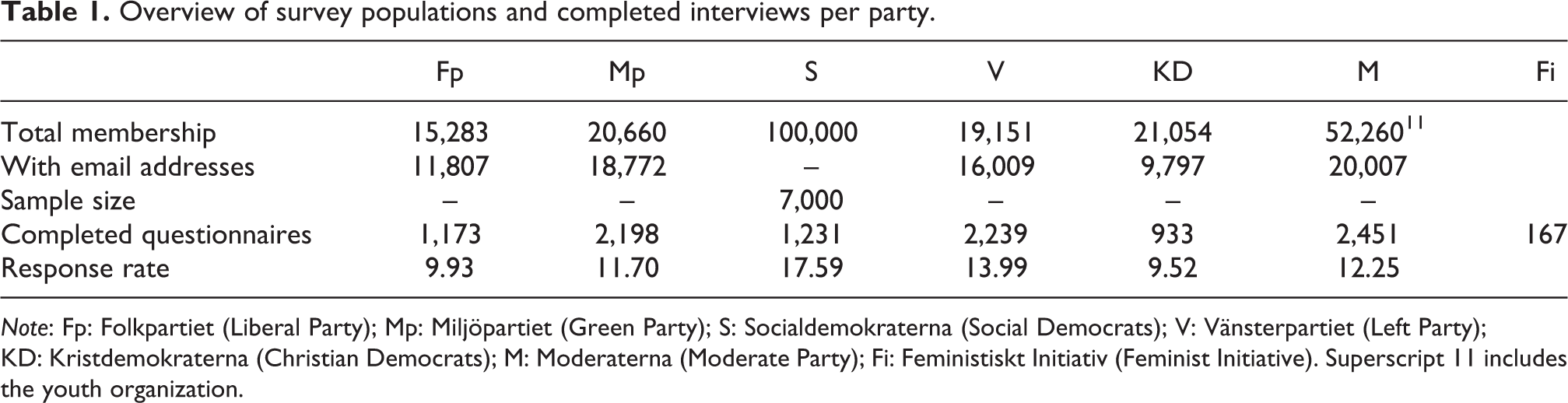
Note: Fp: Folkpartiet (Liberal Party); Mp: Miljöpartiet (Green Party); S: Socialdemokraterna (Social Democrats); V: Vänsterpartiet (Left Party); KD: Kristdemokraterna (Christian Democrats); M: Moderaterna (Moderate Party); Fi: Feministiskt Initiativ (Feminist Initiative). Superscript 11 includes the youth organization.
The data generated from our survey of members of parties in Sweden expand the number of observations, target the entire membership of the parties and include a more extensive range of questions specific to party membership. However, since we cannot say to what extent non-respondents are missing at random, the sampling design, process and result suggest limited generalizability of our results to the wider membership population. The survey is structured to maximize comparability with similar surveys to be conducted in other economically advanced democracies, such as the multi-country membership surveys as part of the MAPP project at the Université Libre de Bruxelles (e.g. Van Haute and Gauja, 2015).
Measures
Ideological incongruence is measured as the absolute distance between a party member’s self-placement on a 0–10 general left–right scale (Q34) and that member’s placement of the party on the same 0–10 general left–right scale (Q35). 11 Smaller values on this variable therefore represent more member-party congruence, and higher values equal more member-party incongruence. This measure depends entirely on party members’ perceptions of parties’ positions, which do not necessarily reflect the ‘true’ position of the party. However, the use of mass-based survey placements of parties in congruence scholarship is not without precedent (cf. Powell, 2009), 12 and for now we are more interested in what makes individual members believe they are close or far from a party – and the consequences of this – rather than if they actually are as close or far from the position of the party as they think they are. Our operationalization therefore captures the difference respondents see between their own ideological position and the party’s.
Respondents’ interest in politics is directly measured on a 4-point scale whose coding has been reversed to run from ‘Not at all interested’ to ‘Very much interested’ (Q48). We measure political efficacy with a survey item asking respondents to indicate their level of agreement (5-point scale from ‘Strongly disagree’ to ‘Strongly agree’) 13 to the statement: ‘I feel that I have a pretty good understanding of the important political issues discussed in <PARTY>‘ (Q95_2). Members’ perceptions about their own role in the party are measured with the following survey item (5-point scale from ‘Strongly disagree’ to ‘Strongly agree’): ‘My role as a member is to support decisions made by the party leadership’ (Q93_5). Based on our hypothesis, we expect that political interest and efficacy have a positive relationship with incongruence, whereas perceptions of the membership role should show a negative association.
In addition to those potential causes of ideological incongruence, we also perform preliminary tests for four consequences. Firstly, we anticipate that ideological incongruence will be associated with lower levels of satisfaction, in particular for satisfaction with ‘the ideological orientation/project of the party’ (Q91_1) and ‘with the leadership’ (Q91_2). Both are measured on a 5-point scale, where 1 refers to ‘Not At All Satisfied’ and 5 to ‘Very Satisfied’. Secondly, respondents were asked about their voting behaviour in the last general election in September 2014 (Q79). Individuals that chose the response option ‘Yes, and I voted for another party’ are coded as 1, everyone else as 0. Finally, we measure termination of membership through the survey item ‘How frequently have you considered joining another party’ (with response options ‘never’, ‘rarely, ‘sometimes’ and ‘often’; Q97_1). 14 The descriptive statistics of all individual-level variables are summarized in Supplementary Table 1 in the supplementary material. 15
Results
A substantial number of party members are not perfectly congruent with their party. Across parties, on average, only around 33% of members reported the exact same ideological position for themselves as for their party. This means that two-thirds of Swedish party members reported some level of ideological incongruence. Although many members reported low levels of incongruence, a 1-point difference on an 11-point scale still represents a conscious choice to differentiate oneself from the party, and some party members also reported larger differences between themselves and their party. Figure 1 shows the distribution of ideological incongruence across all parties.

Distribution of ideological incongruence among Swedish party members.
Although most party members are either congruent or only 1 point off, roughly 36% of respondents report a distance of at least 2 points on the 11-point scale. This provides further indication that ideological incongruence is not a trivial matter among Swedish members. Defining the cut-off point for incongruence as beginning with either a 1- or 2-point difference remains an arbitrary. 16 However, since the questions were asked back-to-back on the same screen, we contend that even a 1-point difference indicates that respondents made a conscious choice to differentiate themselves from their party and proceed with our analysis using this continuous definition of incongruence.
Considering the party level, the share of at least somewhat incongruent members is highest for the Social Democrats with 80% and lowest for the Christian Democrats with around 61%. Moreover, the data also show that ideological incongruence comes in degrees across political parties. For this, we focus on absolute incongruence that is sensitive to the magnitude but not to the direction. Although we believe that information on direction could be valuably integrated with the directional voting literature (Rabinowitz and Macdonald, 1989), this analysis lies beyond the scope of the present article. Figure 2 summarizes the means in absolute incongruence across parties.

Absolute ideological distance of party members to their own party, by party with confidence intervals.
The Social Democrats not only have the largest share of ideological incongruence among members, its members also report the largest differences on average compared to members of other parties. The average absolute distance for Social Democrat members is 2 on an 11-point scale. Members of the Left Party have the smallest absolute distance. These figures illustrate that some ideological incongruence within Swedish parties is the norm rather than the exception. The differences between parties are striking and could be due to party size, party family or party organizational types. Yet, systematic explorations into these potential party-level causes are beyond the scope of this analysis with only seven parties. Instead, our theoretical framework suggests that individual-level factors may play a role, and we leave party-level explanations for future comparative research.
Potential causes of incongruence
Although we resist making claims of causality at this stage, we nevertheless present multiple regressions for two reasons: first, to examine the added value of attitudinal factors compared to the previously found socio-demographic correlates of incongruence (see Van Haute and Carty, 2012); second, to investigate the relative merit of each of the attitudinal factors, controlling for the others, as they might be correlated.
The first model of Table 2 only includes socio-demographic variables and midlevel activism identified by Van Haute and Carty (2012) as correlating with ideological incongruence. 17 The categories ‘elementary school not finished’ and ‘unemployed’ are taken as the base for the education and employment variables, respectively. In line with the authors’ findings, a curvilinear relationship is assumed for age and the duration of membership. 18 Our results applying Ordinary Least Square (OLS) regressions largely mirror previous findings. 19 Generally, men, older people and those who have been party members for a long time show greater incongruence. Finally, those with a university degree and the mid-level elite show lower incongruence or more congruence.
Regression results for absolute congruence. Entries are unstandardized coefficients with standard errors in parentheses.

Note: Sqd: Squared. *p < 0.1; **p < 0.05.
Models 2–4 include additional variables related to the hypotheses developed within this article. Note, that the coefficients on gender, university degree and length of membership remain statistically significant and in the same direction across all models. The coefficient on midlevel elite position strengthens slightly across models but generally indicates – and contrary to some findings from other national contexts – that parties’ midlevel elite are less incongruent. Model 2 in Table 2 suggests that more politically interested members are more likely to be more incongruent with their parties. The statistical significance and direction of the relationship holds across models. A one-unit increase in political interest increases the level of ideological incongruence by an estimated average of around 0.1 among the sampled party members, which corresponds to a tenth of a unit. This finding is also in line with H1.
Model 3 reports that efficacy does not seem to play a role for ideological incongruence. However, members’ perceived role within the party shows the predicted association with incongruence: the more marginal members see their role, the more congruent they are. A one-category increase in members’ self-conception towards being a ‘party foot-soldier’ is associated with a decrease in incongruence of an estimated 0.26 units, which corresponds to around a quarter of a unit. This is also the strongest effect among the attitudes tested here even when considering standardized coefficients. It documents that members’ perceived role within the party is associated with how closely they align ideologically with their party. These results partially support H1. Both, high levels of political interest and a self-ascribed independent role tend to increase ideological incongruence among the sampled Swedish party members. Efficacy, however, does not seem to affect incongruence.
Taken on the whole, the aforementioned analysis suggests that political attitudes are associated with ideological congruence. Compared to model 1 that only includes socio-demographic variables, the combination with attitudinal variables in model 5 explains more of the variance in ideological incongruence. However, R2 values remain low across models, which also highlight the need for further research in this area. It is above all members’ perceived role within the party and political interest that showed up as stronger and significant factors related to higher incongruence. Both represent suggestive evidence for how emancipated party members with higher levels of political interest and with a more independent self-conception might be less in need of cue taking from the party. Those emancipated members are not necessarily better or more correct in placing the party; they are, however, comfortable explicitly disagreeing with their party’s position.
The idea of emancipation being one of the factors behind incongruence is further supported by additional analyses. Firstly, in an additional model (see Supplementary Table 2 in supplementary material) support for the statement that regular members should play a greater role in developing the party’s national election platform (Q115_2) was positively associated with incongruence and quite strongly so (0.177). Secondly, there seem to be no systematic differences between more and less congruent members in the kinds of reported material or career benefits they obtain from their membership (Q65; see Supplementary Table 3 in supplementary material). 20 This means that incongruence is less likely to be affected by different material or occupational benefits members think they have and more likely to be driven by members’ self-conception as emancipated citizens that want to actively influence the party platform.
Correlations with absolute congruence.

**p < 0.05.
Potential consequences of incongruence
Turning to the consequences and the test of H2, Table 3 reports simple correlation coefficients, because the cross-sectional data complicates causal inferences, particularly if one conceptualizes the exit, voice and loyalty relationship as a process developing over time. The correlations for this collection of variables are quite strong and all in the direction anticipated. Higher perceived ideological incongruence between member and party is associated with decreased satisfaction with the ideological project of the party as well as with the party leadership. Moving on to ‘loyalty’ and ‘exit’ behaviour, ideological incongruence is positively associated with a party member having voted for a different party in the most recent election as well as with party members contemplating joining a different party. For example, a total of 7.8% (n = 803) respondents said they voted for a different party than their own in the last election. Of those, around 82% (n = 657) are ideologically somewhat incongruent with their party. Although it is not surprising to see higher ideological incongruence associated with choosing exit rather than voice options within these political organizations, it should be noted that in party members we are discussing individuals with a formal connection to a given political party that nevertheless vote for and sometimes consider joining a different organization.
Figure 3 displays the percentage of defecting votes by party. As one would expect, the vast majority of party members cast loyal votes in the previous election. At the same time, it is quite striking how many members reported having defected in the last general election, especially since the literature usually assumes that members are the most loyal voters (see Scarrow, 2015). For example, just over 10% of Green Party voters defected in the September 2014 election. After polling over 10% in the run-up to the September general election, the party’s 6.9% vote share was somewhat unexpected. Given the speculation about former Green Party voters switching to the Feminist Initiative, subsequently supported by exit poll data, 21 the 10% defection rate among Green members is provocative.
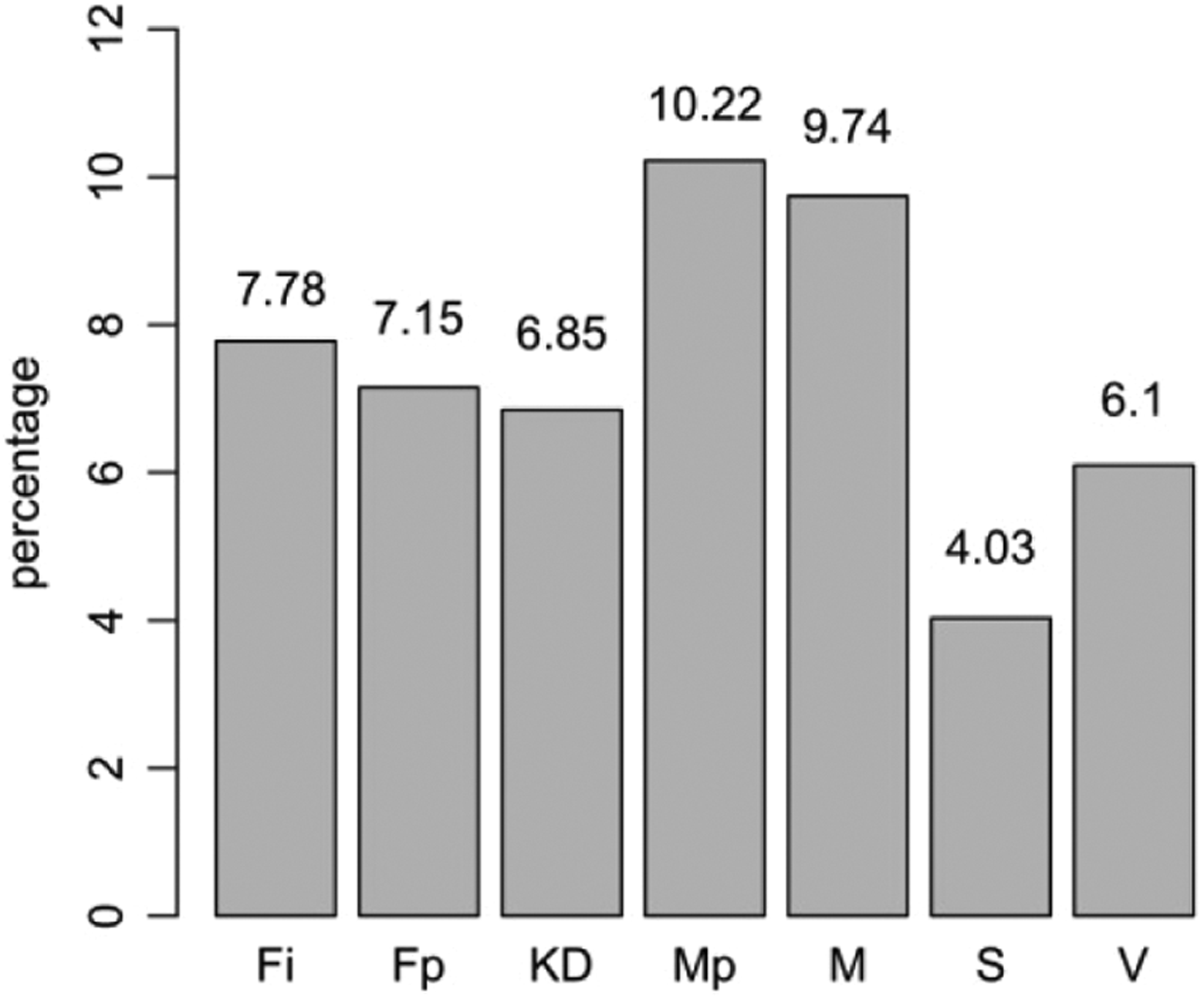
Shares of reported defecting votes in the September 2014 elections, by party.
Additionally, it is worth pointing out that the Social Democrats appear to have the most loyal members on Election Day. At the same time, the results showed the highest share of more incongruent members for this party, which suggests that even those members who are ideologically at odds feel sufficiently loyal to cast a vote for their party. Mild empirical support for this idea can be found in a weak negative correlation between the level of party attachment and levels of incongruence for the Social Democrats only: Members being closer to the Social Democrats tend to have lower ideological incongruence (Pearson’s r = –0.123; p < 0.001).
On the other side of the ideological continuum, over 9% of Moderate members voted for another party in 2014. Having previously led the bourgeois Alliance coalition government, the Moderates lost 23 seats in the Riksdag and experienced a nearly 7% drop in total vote share between 2010 and 2014. What is more, this took place as the anti-immigration Sweden Democrats gained over 7% between the two elections. No doubt the Moderates lost voters to both the Social and Sweden Democrats, but probing the almost 10% of their party members that defected in 2014 will provide important information on the nature of these losses. It is also worth pointing out that defection rates at the local election, held on the same day, were substantially lower and only ranged between 3.54% and 6.94% per party. This speaks against second-order effects and in favour of strategic voting at the national level.
Figure 4 makes it clear that a substantial portion of party members in Sweden at least consider joining a different party. In the entire sample more than 18% at least ‘sometimes’ consider joining another party; among the less congruent members, the share is even higher with more than 22%. For two parties, the Christian Democrats and Greens, the number of their members that consider joining another party – at least rarely – is actually larger than the group of members that never consider leaving these parties.
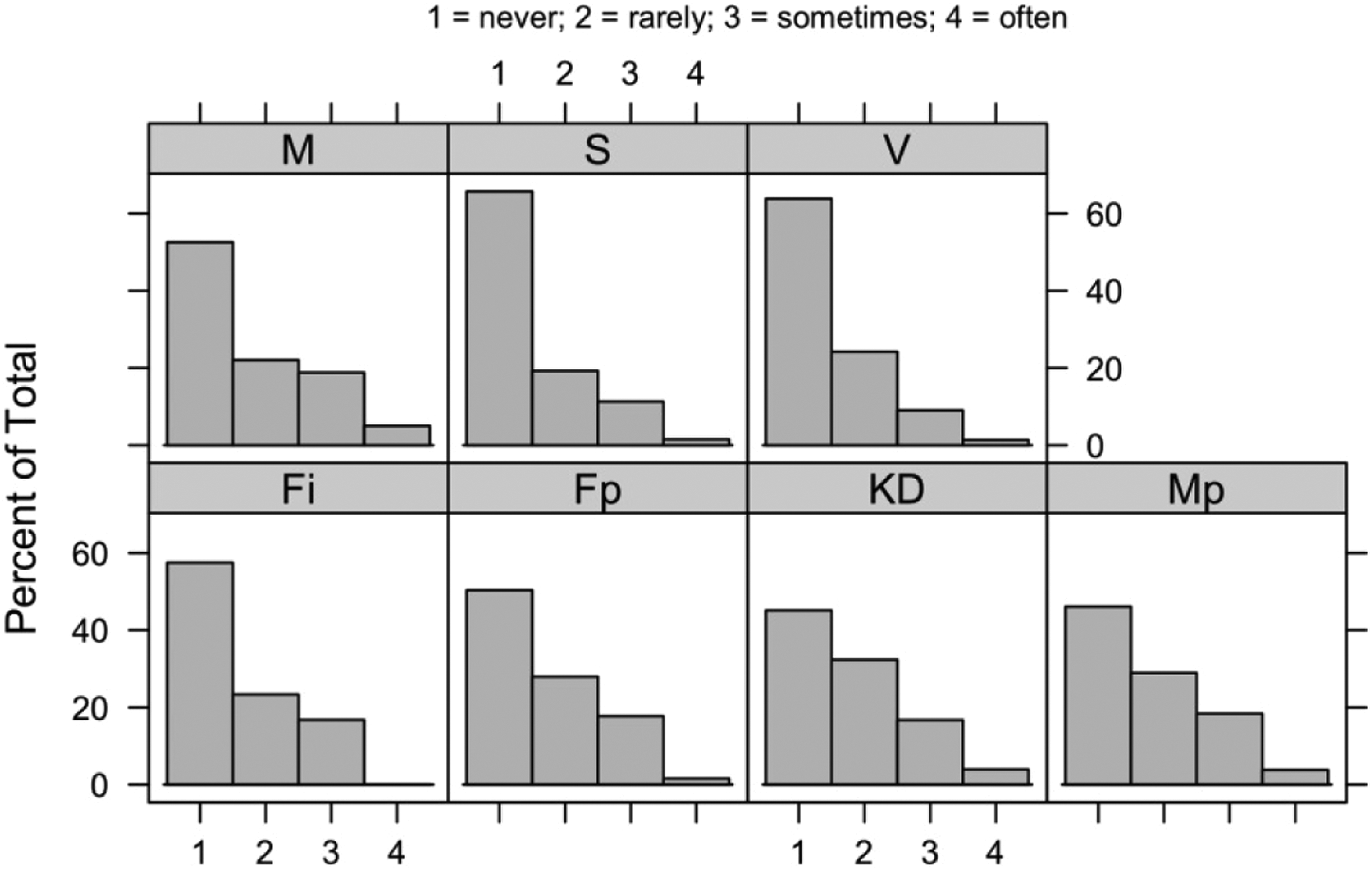
Thoughts of joining another party, by party.
As discussed above, the Feminist Initiative represents a new left-liberal competitor for Green Party members and voters, particularly for the young. 22 Additionally, following the 2014 election, the Green Party is part of a minority governing coalition with the Social Democrats and no longer defines itself as a party of opposition. It is likely that this transition would create tension and dissatisfaction within some Green Party members. The relatively large number of Christian Democrats that consider joining another party also makes sense. The party was dangerously close to falling below the 4% threshold necessary for parliamentary representation in the September 2014 election and went through a leadership change in the spring of 2015. It is reasonable to expect both events would destabilize members’ commitment to the party. In contrast, the Social Democrat members appear to be the most loyal. Just over 66% of the party’s members never consider joining another party, the largest percentage among all seven parties included in the survey.
In order to get a better understanding of the potential exit behaviour of members as a consequence of ideological incongruence, we modelled members’ thoughts of joining another party with an ordered logistic regression. We only included respondents’ age and gender as basic control variables, and in a second model also include a variable pertaining to attitudes towards immigration, an issue area of heightened salience to Swedish politics today (see, e.g. Dahlström and Sundell, 2012; Loxbo, 2014). It will show to what extent thoughts of joining another party are associated with general ideological incongruence after controlling for a salient and potentially divisive issue area. Table 4 summarizes the results.
Ordered logistic regression model for thoughts on joining another party.a

Note: Entries are log odds. AIC: Akaike information criterion.
**p < 0.05.
Model 1 shows that younger and female members are less likely to consider joining another party but also that higher incongruence increases the probability of considering another party. According to the predicted probabilities (Figure 5), increases in absolute incongruence are clearly associated with a higher frequency of considering joining another party, if all other values are held constant. Substantively, the results of calculating first differences show that moving from one standard deviation below the mean (= 0) in absolute incongruence to one standard deviation above the mean (= 2.75) decreases the probability of respondents answering with ‘never’ by 0.24 and it increases the probabilities of the other three categories (‘rarely’, ‘sometimes’ and ‘often’) by 0.10, 0.11 and 0.02, respectively. This is also in line with the expectations that more ideologically incongruent members are more likely to exit the party. Model 2 in Table 4 estimates the effects of immigration attitudes on considerations for leaving the party. 23 According to the results, the effects of general incongruence remain largely the same, but a more conservative stance on immigration also has a substantial effect on members’ thoughts on joining another party. These results mean that ideological incongruence is a potentially important factor for members’ exit behaviour, but by no means the only one, and specifically that Swedish party members’ attitudes about migration and immigrant integration should be further explored in future work.

Predicted probabilities and confidence intervals for thoughts on joining another party for different values of absolute ideological incongruence (model 1). Note: ‘thoughts: 1’ = ‘never’; ‘thoughts: 2’ = ‘rarely’; ‘thoughts: 3’ = ‘sometimes’; ‘thoughts: 4’ = ‘often’.
Summary and conclusion
This article set out to study ideological incongruence between party members and their parties more closely. Drawing on a large survey of more than 10,000 party members in Sweden, we found that some amount of ideological incongruence is not an exception, but rather the norm. Across parties, on average, two-thirds of party members described themselves as ideologically different than their party. Although at times, these differences can be rather small, it remains striking that well over half of party members perceive there to be at least some meaningful difference between their ideological preferences and the position of their chosen party. With expanding democratic structures and procedures within parties, these members have the potential to push their parties in new directions. Beyond possible consequences for voicing ideological differences, this large share of Swedish party members is also the group most likely to exit and to defect from the party – either temporarily through vote choice or more permanently through membership exit.
We investigated important attitudinal and behavioural correlates of ideological incongruence on the individual level, derived from existing theories, with the goal of understanding some of its causes and consequences. Some individual-level factors provide first hints as to the roots and effects of ideological incongruence. The results indicated above all how emancipated party members with higher levels of political interest and with a more independent self-conception might be less in need of cues from the party. Those emancipated members appear to be more comfortable being more incongruent with their party’s ideological position.
Our findings also suggest that ideological incongruence might matter for members’ exit, voice and loyalty behaviour. Specifically, we found that higher ideological incongruence is associated with a more negative evaluation of the party leader (voice) and with a higher probability to either vote for another party (loyalty) or to even leave the current one (exit). Incongruent members can be benign for the party when they simply voice their concerns, but they may also be more dangerous for a party’s electoral strategy when those members defect or terminate their membership. A total of 18.75% of sampled members consider at least ‘sometimes’ joining another party. In addition, across Swedish parties between 4% and 10% of members defected in the last general election in 2014. This non-trivial share of members can potentially be pivotal for electoral victories, especially in Swedish elections of ‘bloc politics’. It is also interesting from the perspective of party member benefit. Members are often cited as loyal voters and a multiplier of votes (Dalton and Wattenberg, 2000; Scarrow, 2015). The above findings qualify this assumption.
These are first steps towards theorizing and testing potential causes and consequences of ideological incongruence among party members in a time when direct membership involvement is growing across Western democracies. Future research could disaggregate ideological incongruence in not only its magnitude, but also its direction. For, it could be that members that are more ideologically extreme than their party differ in important ways from those that are ideologically more moderate. Additionally, we hope to more directly connect our findings with those of other membership surveys, because one potential cause of incongruence could also lay in party-specific factors such as party size, party organizational types or ideology. Therefore, comparative work involving more parties is a logical next step.
Footnotes
Acknowledgements
Earlier versions of the manuscript were presented at workshops and seminars at Aarhus University and the University of Gothenburg in 2015 as well as at EPOP in 2015. We thank all participants for their valuable comments and suggestions. In particular, we are grateful to Raimondas Ibenskas, Seth Jolly and Ryan Bakker for their advice and critical remarks. The Laboratory for Opinion Research (LORE) was essential to collecting the data for this project, and Marcus Samanni and Elias Markstedt provided excellent research assistance.
Declaration of Conflicting Interests
The author(s) declared no potential conflicts of interest with respect to the research, authorship, and/or publication of this article.
Funding
The author(s) disclosed receipt of the following financial support for the research, authorship, and/or publication of this article: We also acknowledge generous funding from the Centre for European Research at the University of Gothenburg (CERGU), Forte co-funded by the European Commission (2013-2692), Riksbankens Jubileumsfonden (P13-1090:1), the Swedish Research Council (2015-00196) and the Swedish Network for European Studies in Political Science.