



Abstract
This article explores the determinants of the allocation of parliamentary posts to specific legislators. Using an original data set of biographical information and committee assignments for almost 10,000 legislators in five non-presidential democracies (i.e. Finland, Luxembourg, Norway, Portugal, and Spain), we provide evidence that distributive posts are more likely to be allocated to electorally vulnerable members of parliament, mainly under candidate-centered electoral rules. We also show that posts in high-policy committees are usually assigned to prominent legislators within the parties. Contrary to what one could expect based on the literature on candidates’ incentives to cultivate a personal vote, we find that the effect of district magnitude on the distribution of legislative posts does not depend on the type of list.
Introduction
The posts that members of parliament (MPs) occupy shape not only the laws that parliaments adopt but also the way legislators represent their constituencies. Understanding this process is, thus, vital in contemporary democracies. Moreover, if legislative organization is affected by electoral incentives, the posts assignment process should, in turn, be linked to the electoral features of a legislator. To what extent, and in what ways, do electoral rules shape how parties use the process of posts assignment within parliaments to make connections between representatives and constituencies? What is the impact of legislators’ electoral vulnerability on how parties assign their elected candidates to parliamentary posts across different electoral systems? This article investigates these important questions by taking three closed-list systems (Norway, Portugal, and Spain) and two open-list systems (Finland and Luxembourg) as its case studies.
The comparative analysis of legislative committee assignments is largely country-specific or descriptive in ambition mainly as a consequence of the scarcity of comparable data (Martin, 2014; Shugart, 2008 [2005]). Although considerable literature exists to explain the allocation of legislative posts under presidentialism, and, in particular, to examine the composition of committees in the case of the US Congress (Cox and McCubbins, 1993; Krehbiel, 1991; Weingast and Marshall, 1988), the literature focused on parliamentary and semi-presidential democracies is still in its infancy. In an effort to advance scholarly knowledge of the operation of legislatures across the world, we use an original data set of biographical information and committee allocation for almost 10,000 elected representatives to explain patterns of legislative assignment in institutional contexts where the electoral incentives of legislators fundamentally diverge from the typical portrayal of the American Congress.
Theoretically speaking, our contribution lies in the intersection of the literatures on electoral systems and legislative organization. We start by depicting legislators as perfect reelection seekers (Strøm, 1997). However, we go slightly beyond the standard explanation based on candidates’ incentives to cultivate a personal vote (Cain et al., 1987) and suggest that other potential forces affect the link between personal ambition and allocation of legislative posts (André et al., 2015; Heitshusen et al., 2005). In a nutshell, we argue that parties distribute committee memberships among their elected candidates according to their different levels of electoral vulnerability. Electorally vulnerable legislators have more incentives to be attentive to their constituency and be allocated to a committee that generates opportunities to cultivate a personal vote—that is, the so-called distributive committees (Pekkanen et al., 2006). This relationship is moderated by the type of electoral system.
Our findings demonstrate that legislators’ vulnerability to an electoral defeat shapes the incentives of party leaders to allocate some of their elected candidates to particular legislative committees. Hence, we offer empirical evidence that provides a more nuanced picture about the allocation of legislative posts to representatives elected in multimember districts. To our knowledge, little effort has been previously made to study these relationships. Our research fills this gap by showing that electoral systems are systematically connected to the types of assigned legislators to specific legislative posts. Such patterns of distribution may in turn have considerable implications for representation and policymaking if they affect the types of policies parties and legislators adopt, as well as the level of responsiveness and accountability to voters these MPs exhibit.
The rest of the article proceeds as follows. The section “Legislative committee assignments and the personal vote” presents theoretical arguments in the literature on committees’ assignment and the personal vote, and the third proposes hypotheses regarding the impact of several explanatory factors on the organization of the five legislative chambers under consideration. The fourth section describes the data and methods that are used in the analysis. The fifth section summarizes the main results provided by the econometric models. Finally, the sixth section concludes.
Legislative committee assignments and the personal vote
Since Woodrow Wilson (1885) equated congressional government with committee government, there is a consensus about the importance of committees for parliamentary works. From all the substructures and bodies stemming from the internal organization of the parliament, committees are usually deemed to be the most important for the work of the legislature. The “committee stage” has been considered as “the basic moment in the workings of parliaments throughout the world” (Longley and Davidson, 1998: 2). In fact, it has been claimed that parliament is not much more than a “collection of committees that come together periodically to approve one another’s actions.” 1
As laws are negotiated and largely agreed upon at the committee stage of the legislative process, committee assignments have become a main subject of interest for several political actors. On the one hand, committee membership shapes parties’ ability to fulfill their basic policy goals. In fact, party leaders can indirectly control the party’s long-range policy positions through the strategic allocation of committee memberships and chairmanships. On the other, the distribution of committee seats is an important resource in the hands of the party leaders to reward loyal and hardworking MPs (Damgaard, 1995; Mattson and Strøm, 1995; Strøm, 1998).
We explore an additional consideration defining committee assignments from the literature in the US Congress: the electoral prospective (Mayhew, 1974). According to this approach, elected representatives are interested in belonging to committees that allow them to deliver benefits to their constituencies and, hence, facilitate their reelection. The key question for comparative work to tackle is whether the assumptions that drive Mayhew-type arguments for the US case are appropriate to understand how electoral incentives also shape the organization of parliaments. In principle, non-US politicians are as strategic in their actions as their US counterparts. However, the political institutions that shape legislators’ incentives vary across countries; career structure, electoral laws, and party rules can be very different outside the United States. For example, the institutional framework in closed-list systems does not seem to aid MPs in adjusting to what Searing (1994: 121) identifies as the role and the behavior of a “good constituency member.” By contrast, in open-list systems, MPs are perfectly able to develop “personal reputations distinct from those of their party” (Carey and Shugart, 1995: 418–419).
The seminal article by Carey and Shugart (1995) provides the dominant theoretical framework to analyze the trade-off between electoral systems that foster collective accountability, wherein legislators’ incentives tend to be aligned with the collective goals of their parties, and systems that facilitate individual accountability because they ensure a direct relationship between representatives and constituents. In these scholars’ view, candidates’ incentives to cultivate a personal vote depend on three particular features of electoral systems: (1) the degree of party leadership’s control over access to and ranking on ballots, (2) the degree to which candidates are elected on individual votes independent of co-partisans, and (3) the fact that voters cast a single intraparty vote instead of multiple votes or a party-level vote. In addition, Carey and Shugart note that district magnitude has a modifying effect on the incentives to cultivate a personal vote depending on the nature of the electoral system. On the one hand, as magnitude increases in electoral systems that foster personal vote-seeking behaviors, so also does the importance of these kinds of strategies. On the other, increases in district magnitude decrease the value of the personal reputation of individual candidates in party-centered electoral systems.
The evidence in favor of Carey and Shugart’s (1995) theory is mixed. On the one hand, some authors have shown that legislators in preferential systems are more likely to possess a local background (Shugart et al., 2005), introduce legislation privileging local interests (Crisp et al., 2004), or engage in corrupt behavior (Chang and Golden, 2007). Similarly, several works posit that the extent of intraparty competition can be expected to shape MP’s constituency focus (Heitshusen et al., 2005), party unity within the legislature (Carey, 2009), trade protection (Nielson, 2003), budget discipline (Hallerberg and Marier, 2004), and efficacy in education spending (Hicken and Simmons, 2008).
Other authors have found, by contrast, only limited evidence regarding the impact of electoral systems on the existence of a personal vote (Morgenstern and Swindle, 2005); and still others have shown that members of the European Parliament elected from open lists emphasize traditional activities within the legislature (Scully and Farrell, 2003). These last results, which could be initially considered counterintuitive, make sense when considering the fact that a district magnitude greater than 1 in preferential electoral systems dilutes the opportunities for voters to reward incumbents for “bringing home the bacon” (Samuels, 2002: 845). From this perspective, cultivating a personal vote and engaging in constituency service should not be conflated.
Very recently, a fruitful avenue of research in the literature on personal vote has been the analysis of committee assignments among legislators. To our knowledge, there is at least one piece that considers committee assignments according to the tier—nominal or list—by which a MP is elected in Germany (Stratmann and Baur, 2002). Pekkanen et al. (2006) also show that the electoral incentives of members of the Japanese Parliament depend on whether they are elected in proportional representation (PR) or single-member districts and, for this reason, they receive different types of posts. Jones et al. (2002) provide the only study on committee assignment under party-centered electoral rules that we are aware of by examining the Argentinean Congress, but they do not use district magnitude as an explanatory factor.
Finally, there are numerous works that focus on the legislative organization of the contemporary US Congress (e.g. Shepsle and Weingast, 1995). Unfortunately, it is yet untested how voter interests match with the committee system with a comparative approach (Shugart, 2008 [2005]). To the best of our knowledge, the only published study to date on this topic examines the allocation of legislative committees within the European Parliament (Yordanova, 2013). Moreover, Shugart et al. (2013) show, similar to our analysis, that closer margins of the district contest are associated with a higher probability that candidates from that district will be assigned to a distributive committee in a majoritarian system but not in a proportional setting. However, the evidence on this regard is still very preliminary and focused on the differences in the interparty dimension of electoral systems. Hence, we do not yet have a body of theoretically driven comparative work on patterns of distribution of parliamentary committees at the national level based on differences in the intraparty dimension.
Theory and hypotheses
As theorized by Strøm (1990), individual politicians, like parties, are interested in maximizing votes, office, and policy. In the case of legislators, maximizing votes becomes crucial to obtain reelection; and, according to some authors (e.g. Mayhew, 1974; Strøm, 1997), reelection must be logically considered the paramount aim, as it usually constitutes a precondition for attaining the other two goals. Hence, it is safe to assume that legislators do not equally value these three objectives and that they have a “hierarchy of goals” (Heitshusen et al., 2005: 37).
However, although all MPs are office seekers and prioritize the reelection goal, some legislators need to exert more effort than others to win reelection because they are more likely to lose their seat after the next election, being thus more electorally vulnerable. Party leaders have in mind MPs’ level of electoral vulnerability when distributing posts within the parliament and assign the incumbents with a riskier position to committees that will maximize their chances of reelection. In contrast, the party leadership grants safe incumbents positions with other type of rewards such as prestige and policy influence, either at the parliamentary—committees—or the government—portfolios—level (Deering and Smith, 1997; Fenno, 1977). Moreover, party switching by legislators is not common in these countries. For this reason, party leaders do not usually risk defection from the safe politicians when denying them particular (distributive) posts.
When examining electoral vulnerability, several issues emerge. On the one hand, we have the level at which electoral vulnerability operates. In this sense, the sources of electoral vulnerability can be national, partisan, or individual. With respect to the first one, it is argued that party identifications are weaker and party systems are less institutionalized in new democracies. As a consequence, election results become more volatile and current MPs happen to be more susceptible to electoral defeat in these countries.
Secondly, electoral vulnerability can also operate at the party level. For example, parties in government are expected to perform badly in the next election if the economy has deteriorated during their time in office. In this context, the electoral vulnerability of the legislators of these parties grows as well.
Finally, the most frequently researched sources of electoral vulnerability operate at the individual level. In this view, legislators elected by narrow margins in the past election present a higher likelihood of being defeated in the near future (Jacobson, 1987). In preferential electoral systems, reelection of current legislators can be threatened by their co-partisans or by candidates of other parties (Katz, 1986). Under non-preferential rules, by contrast, incumbents can only be vulnerable to interparty defeat.
Given the difficulties of finding a valid cross-national measure of legislators’ vulnerability operationalized as electoral marginality or electoral competitiveness (Kayser and Lindstädt, 2015), most studies have only considered single-member districts systems practically focusing as a result on the US case (André et al., 2015). Along these lines, electoral marginality has been found to increase American legislators’ ideological congruence with their constituents (Ansolabehere et al., 2001), responsiveness to voters’ preferences and accountability (Canes-Wrone et al., 2002), as well as to lead representatives to procure more pork and engage in more constituency service (Lazarus, 2009). However, the evidence presented in comparative studies does not consistently support these arguments. For example, whereas Powell (2000) shows that politicians elected in competitive settings better represent their median voter and Solé-Ollé (2006) demonstrates that they moderate their partisan preferences in fiscal policy, Adserà et al. (2003) claim that they provide better, more and more timely public goods.
The relationship between a legislator’s electoral vulnerability and the allocation of parliamentary committees constitutes the basis of our first hypothesis. Legislators who are likely to be defeated in the next election risk most by being inattentive to their constituency. For this reason, they should devote relatively more resources to keep their seat in the next election. The allocation to a distributive committee provides the opportunity to invest more effort in pursuing their reelection goal. By being assigned to one of these committees, legislators that are in danger of losing their seat will be able to pay more attention to their constituents. Moreover, unlike in high-policy committees, they will be granted more discretion in taking policy positions (André et al., 2015; Heitshusen et al., 2005).
This relationship, however, is conditioned by the incentives electoral rules generate to cultivate a personal vote. Closed-list systems affect MP’s reelection through the power of party bosses rather than the interests of each legislator’s constituents. This is why electoral vulnerability should not be a very important factor determining committee membership in party-centered systems. Moreover, elections are contested on the basis of policy when closed lists are used; assigning a vulnerable legislator to a committee that generates opportunities to cultivate a personal vote does not appear as the obvious path to maximize her chances of reelection. Hence, electorally vulnerable legislators are more likely to be assigned to a distributive committee in preferential electoral systems. By contrast, electoral vulnerability does not affect the likelihood of being assigned to a distributive committee in nonpreferential electoral systems (
Before testing the impact of electoral vulnerability, we first turn to other arguments that may also explain the allocation of committee posts and that could be formulated as alternative hypotheses. First of all, distributive policy provides an inherent opportunity for “pork barreling” by the legislators who sit on committees responsible for such policy and the parties to which they belong. The idea is that, by placing a legislator on a committee that has a role in a distributive policy area, a party gives that legislator an opportunity to lobby the committee and, by extension, the responsible ministry on behalf of her constituency. Considering the classic sort of “pork barrel approach,” these legislators have the potential to “claim credit” for delivered services. While we do not have direct evidence of actual personal vote-seeking behavior, we expect membership in committees that generate potential for such actions to be systematically related to such activities.
Similar to the first hypothesis, the type of electoral system is predicted to modify the aforementioned relationship. Carey and Shugart (1995: 430) argue that the importance of personal reputation increases as districts become larger in those systems in which intraparty competition already exists (i.e. under candidate-centered rules). By contrast, incentives to cultivate a personal vote decrease as district magnitude increases in non-preferential systems (i.e. under party-centered rules). These ideas are the basis for our second hypothesis. For closed-list electoral systems, our expectation is that posts that offer the potential for credit-claiming should tend to go to those MPs elected in the smallest districts. In preferential systems, by contrast, Carey and Shugart (1995) would argue that the effect of district magnitude should be the opposite. Therefore, we expect that legislators who hold a position in a distributive committee are more likely to come from (a) low-magnitude districts in non-preferential systems, and (b) high-magnitude districts in preferential systems (
Within this framework, we might also expect that high-policy committee posts, being critical to the image of the party and to its performance in parliament, would tend to go to the most important members of the party. There are two main reasons to think that relevant figures within each party are allocated to this type of legislative committees. First, when a party is assembling its team of legislators to attend to the most policy-oriented committees, it should largely draw them from the party leadership since these are the members that actually decide the ideological orientation of the party. Second, members of high-policy committees often receive more media and national visibility than the holders of positions in other committees, which give them an opportunity to explain their policy positions to all voters—and not only the ones in their constituencies (Fenno, 1977).
We argue that electoral institutions condition the effect that political leadership has on the allocation of posts in high-policy committees. In other words, the impact of legislators’ political relevance and the electoral system on committee allocation is interactive. In open-list systems, voters can indicate a preference among candidates and the order in which they are elected is not prefixed. Even if a legislator is a party notable, the electoral system generates opportunities for voters to individually punish her. By contrast, in systems where dependence on the party brand for reelection is more pronounced and where the party reputation is expected to yield electoral gains, the actions of the party leaders are particularly visible and constituents’ ability to monitor them is increased. With these considerations in mind, we hypothesize that the positive effect of party leadership on the allocation of posts in high-policy committees becomes stronger in party-centered systems (
Data and methods
Data and case selection
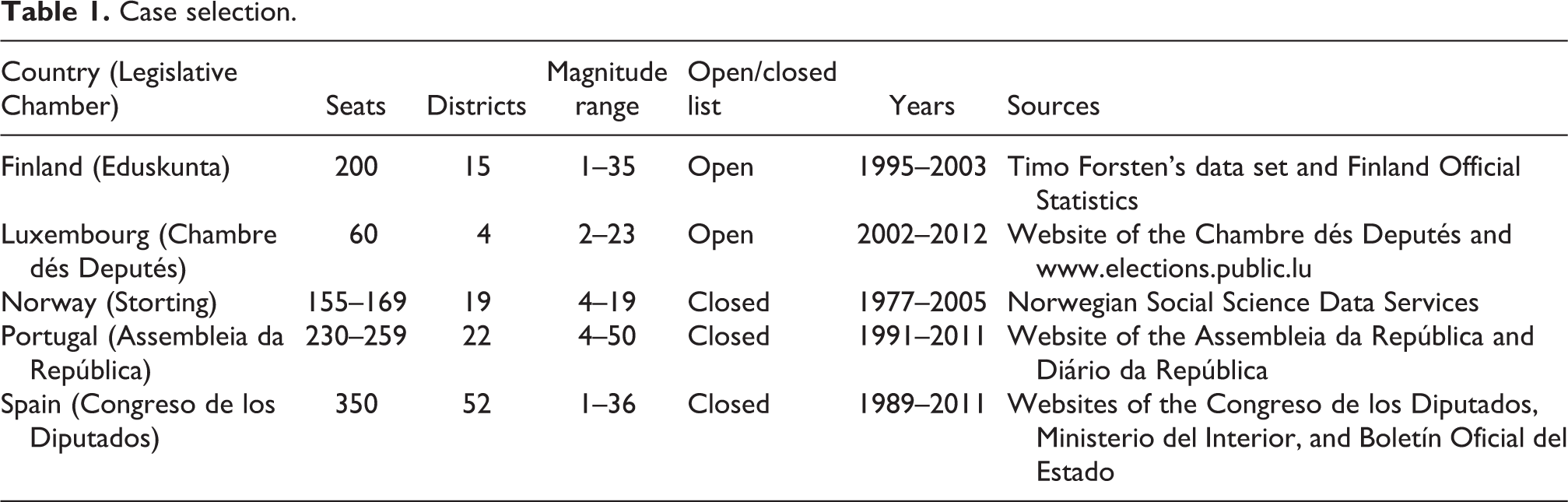
Our empirical analysis presents a novel database of legislators’ biographies and committee membership in five advanced industrial democracies: three closed-list PR systems (Norway, 2 Portugal, and Spain) and two open-list PR systems (Finland and Luxembourg). Moreover, magnitude significantly varies across districts within each country in our sample, providing a wide variety of institutional contexts in which the legislators operate. The number of parliamentary terms under consideration is 49, totaling 9788 legislator/period observations. Table 1 provides the main features of the legislative chambers included in our analysis and the list of employed sources.
Case selection.
Variables and estimation technique
To categorize the legislative committees, we use the classification of Pekkanen et al. (2006) based on their relation to territorial constituencies. We operationalize the dependent variable, Committee Assignment, as a set of dichotomous variables coded 1 if the legislator serves on a committee of a given category (“distributive,” “high policy,” “public goods,” or “others”), and 0 otherwise. Distributive committees are those involved with policy areas for which the benefits can be disaggregated to specific geographic constituencies. The classic example would be the sorts of benefits provided by agricultural policy. However, a distributive policy is not limited to rural interests, and it may include any of several additional policy areas that can be territorially disaggregated, such as transport, construction, and public works. The key feature for a post to be coded as such is to be generally used in the distribution of particularistic benefits to constituencies. High-policy committees, by contrast, are those that are tasked with the consideration of policy areas that concern management of the economy, foreign and defense affairs, and the broad functioning of the legal and constitutional systems. These posts are those with the greatest media profile and press coverage, contributing hence the most to the value of the party label.
Our hypotheses focus on the two types of committees mentioned above. However, Online Appendix 1 shows the full analyses including the results for two additional committee types (Online Appendix Tables A2 and A3). First, public goods committees deal with policy areas that allocate benefits to broad categories of citizens, such as health care, education, and environmental protection. Finally, several types of committees do not clearly fit any of our three categories. We, therefore, use these more ambiguous policy areas as a base for comparison to the policy sectors in our three other committee types. Any committees not indicated in Table 2 are assigned to the base category. A full list of committees by country and category appears in Online Appendix Table A1. 3
Committee functions by category.
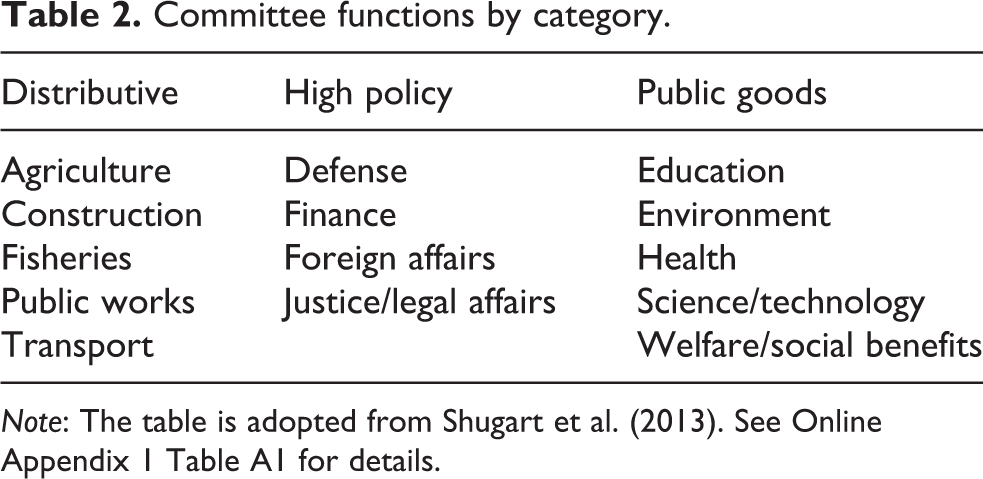
Note: The table is adopted from Shugart et al. (2013). See Online Appendix 1 Table A1 for details.
Our main independent variables are electoral vulnerability, district magnitude, and political importance. 4 Vulnerability is a continuous variable that weighs the order in which the legislator obtained her seat by the number of seats each party won in a given district. 5 The order in which seats are allocated to candidates reflects the legislator’s position on the party list in closed-list systems or her ranking on the basis of the preference vote tallies in open-list systems (André et al., 2015). Once we have established the order in which seats are allocated to candidates, we divide it by the party’s seat total in the district. That is, the vulnerability of a legislator decreases and approaches 0, the higher her position ranks on the (actual or virtual) party list and the higher her party’s seat total in the district. For example, the legislator winning the first seat of the largest party delegation at the district level in the 2011 Spanish election was Mariano Rajoy, the Popular Party (PP) candidate for prime minister. Since the list that includes Rajoy had 19 elected candidates, his value for Vulnerability is 0.05 (i.e. 1/19), and he becomes the least vulnerable legislator in that particular occasion. In principle, vulnerability should equal at most one for the legislators winning the last party seat in the district. However, seats that become vacant between general elections are filled by the next candidate either on the party list or the order according to the preference votes obtained, and values for Vulnerability in these cases are above 1.
Secondly, Log Magnitude is a continuous variable indicating the number of seats allocated to each district. As discussed above, this variable ranges widely across the districts of each country. We take the natural logarithm in order to account for potential nonlinear effects. Finally, similar to our operationalization of Vulnerability, Position is a continuous variable that accounts for a legislator’s order of election, either due to her position on the party list (in case of closed-list systems) or the number of individual votes she obtains (in case of open-list systems). Unlike vulnerability, this variable is not weighted by the number of seats won by the party in the district. As we already know, the top candidate of the PP on the Madrid list in the 2011 Spanish election was Mariano Rajoy; so Position takes value 1 in this case. We gave the same value to Timo Soini, from the True Finns Party, who was the most voted candidate of the most voted party at his district in the 2011 Finnish election and received as a result the first seat at stake.
With respect to the other independent variables, Closed is a dichotomous variable that identifies those systems where MPs are elected according to closed lists. We also specify three interaction terms—Closed × Vulnerability, Closed × Log magnitude, and Closed × Position—in order to test the main hypotheses of the article. We also include different individual-level control variables to capture the potential effect of MPs’ characteristics. The variable Government takes value 1 if the MP belongs to a party that is in the cabinet during that term, and 0 otherwise. The variable Minister takes value 1 if the MP has served (or is currently serving) as a member of the national cabinet, and 0 otherwise. Seniority is a continuous variable that measures the number of consecutive terms the MP has served in the parliamentary chamber under consideration. According to Mattson and Strøm (1995: 276), having parliamentary experience should increase the likelihood of being assigned to a high-policy committee. Finally, we control for MP’s Age, even though we confine the specifications that include this predictor to Online Appendix 1 because of the high number of missing cases for this variable (Online Appendix Table A4).
To test our hypotheses, we use multilevel linear probability models that combine fixed effects at the legislative-term level and account for random variation across districts and political parties. This model specification then helps us to account for the particular party rules and practices for committee nomination that we cannot account for with our data. Since parties compete in different districts, a hierarchical analysis would produce spurious precision in our estimated effects because it would assume that the effects for legislators elected in different districts are independent despite their partisan affiliation (Leckie, 2013). Therefore, we specify cross-nested effects for parties and districts, where parties are allowed to run in different districts without imposing an ordering condition between these two levels (Hess et al., 2012). 6
Results
If our arguments were valid, we would expect the evidence to support three empirical regularities. First, electoral vulnerability should be positively correlated with the probability of an MP to get a distributive post under open-list systems. Since distributive posts provide greater incentives for personal credit claiming, parties will assign distributive posts to those MPs who were elected by a narrow margin, so they are rewarded by voters in the next election. Second, the relationship between district magnitude and distributive posts should be positive in open-list systems and negative in closed-list systems. Third, top-ranked MPs in their party lists or elected candidates with the largest amounts of preference votes should be more likely to be assigned to high-policy committees.
Table 4 tests the relationships between electoral vulnerability and district magnitude (logged) and the probability of being assigned either to a distributive or a high-policy post. First, some interesting patterns emerge regarding the effect of vulnerability on the probability of obtaining a distributive post when distinguishing different types of ballot. In open-list systems, distributive posts are more likely to be assigned to those MPs who obtained the fewest numbers of votes. By contrast, the positive relationship between vulnerability and distributive posts is canceled out in closed-list systems, suggesting that the lack of incentives to cultivate a personal vote characteristic of these electoral rules does not lead parties to allocate vulnerable legislators to distributive posts. These effects are robust to the inclusion of several controls. To illustrate the substantive size of these relationships, Figure 1 displays the marginal effects of electoral vulnerability on the probabilities for an MP to be assigned to a distributive post by type of electoral system. The most vulnerable compared to the least vulnerable MPs are three times more likely to obtain a distributive post in open-list systems. By contrast, this probability in closed-list systems does not vary across the different values of Vulnerability.
Descriptive statistics.
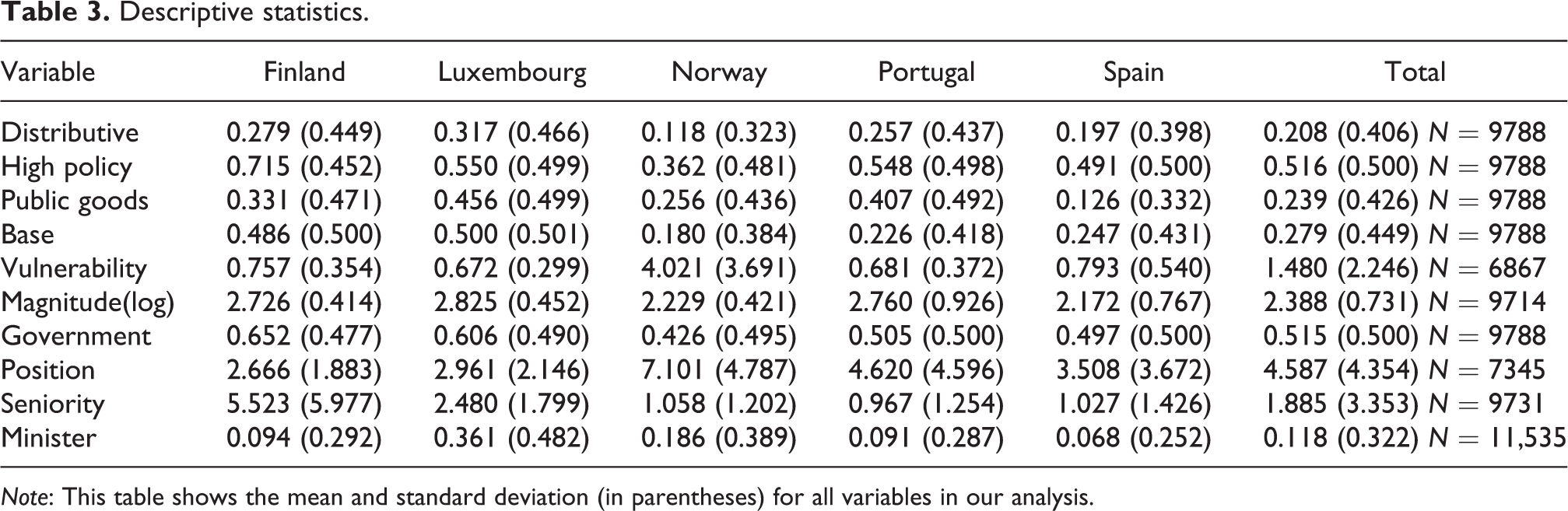
Note: This table shows the mean and standard deviation (in parentheses) for all variables in our analysis.
Effects of electoral vulnerability and electoral institutions on distributive and high-policy posts assignments.

Note: AIC: Akaike information criterion; BIC: Bayesian information criterion. Standard errors in parentheses.
***p < 0.001; **p < 0.01; *p < 0.05 (two-tailed tests).
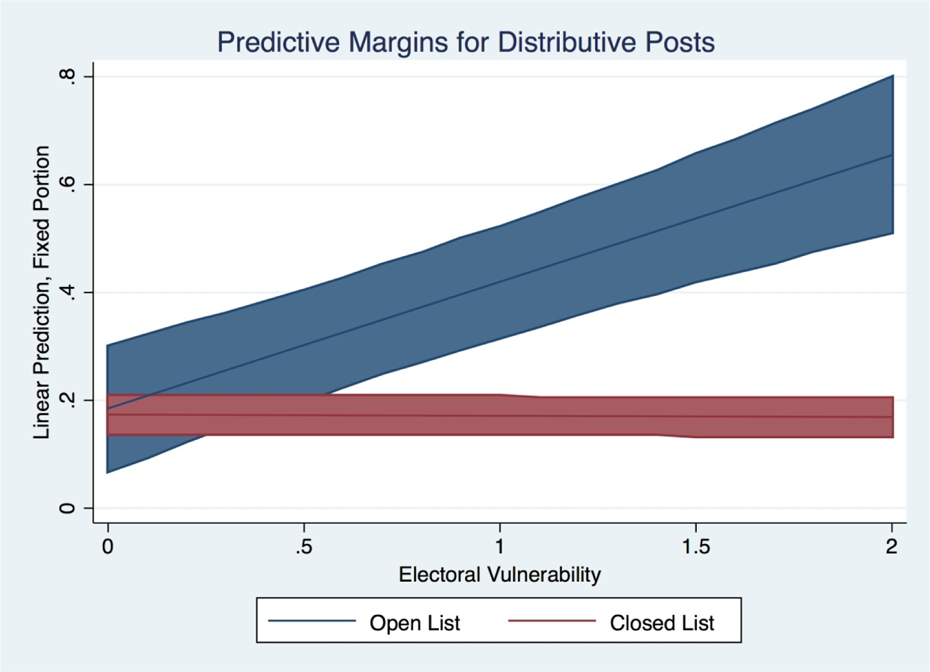
Marginal effect of electoral vulnerability on distributive posts assignments by type of list. The lines show the marginal effects and the shaded areas the 95% confidence intervals based on the estimates reported in model 2 of Table 4.
The results for district magnitude provide weak evidence for our second hypothesis, and we cannot categorically conclude that the relationship between district magnitude and legislative posts is conditioned by the list type. While legislators elected in large districts are less likely to receive a distributive post, the effect is not moderated by the ballot structure. Moreover, whereas the effect of Log Magnitude on receiving a high-policy post is statistically indistinguishable from 0 in all specifications, vulnerable legislators are less likely to be allocated to a high-policy committee when controlling for district magnitude (model 3).
Finally, consistent with our third hypothesis, MPs’ electoral importance matters for being assigned to a high-policy post. As model 1 of Table 5 shows, the effect of position is negative suggesting that the probability of being assigned to a high-policy committee decreases as the MP is further from the first elected candidate in the district-level delegation of a party. Figure 2 illustrates the magnitude of this effect, wherein the probability for an MP to be assigned to a high-policy committee goes from 58% when she is elected first in the district to 22% when she is listed 12th, holding everything else equal.
Effects of electoral importance on high-policy posts assignments.
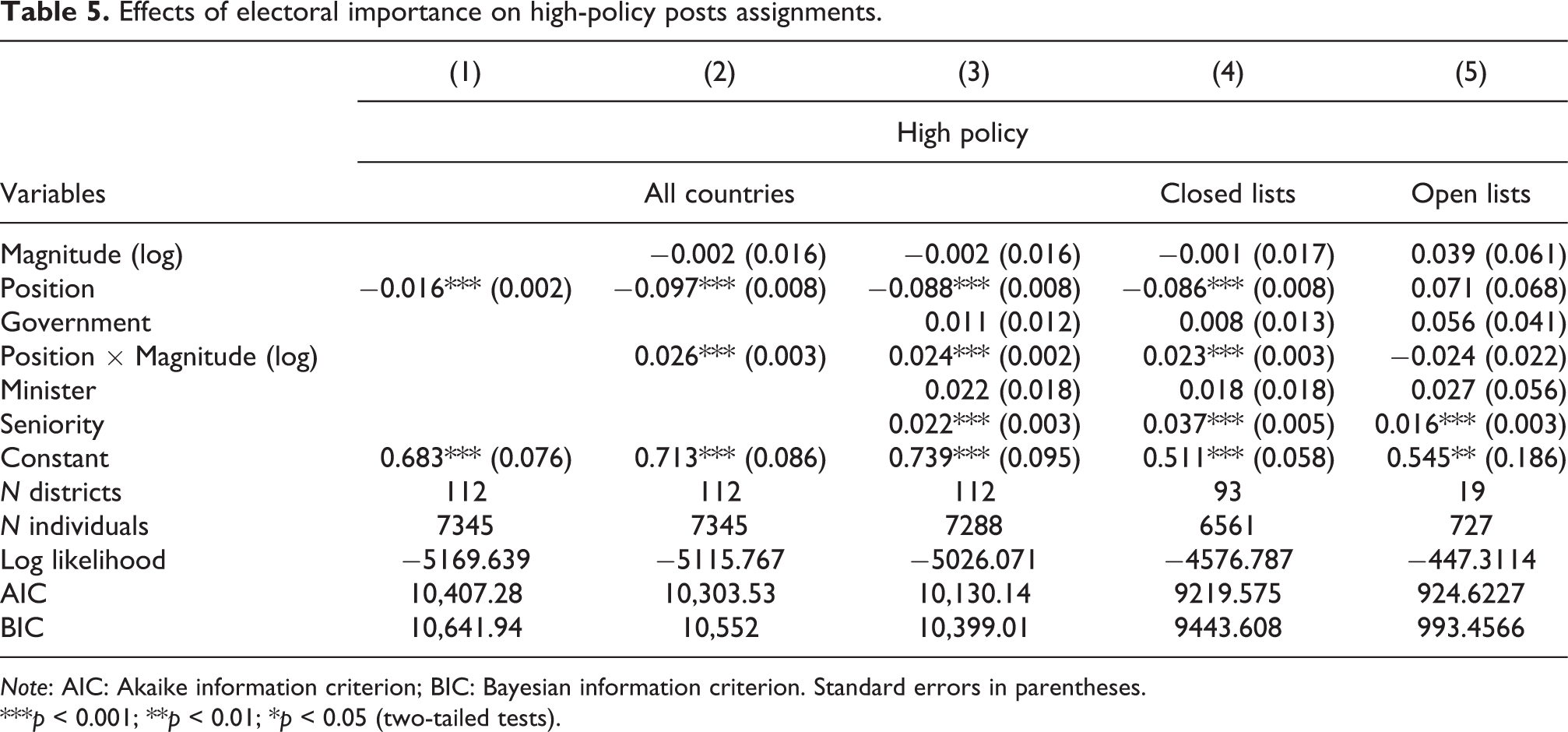
Note: AIC: Akaike information criterion; BIC: Bayesian information criterion. Standard errors in parentheses.
***p < 0.001; **p < 0.01; *p < 0.05 (two-tailed tests).

Marginal effect of electoral importance on high-policy posts assignments. The dots show the marginal effect and the spikes the 95% confidence intervals based on the estimates reported in model 1 of Table 5.
The theory suggests that the relationship between position and high-policy posts should be contingent on two factors. First, the probability of receiving a high-policy post given the MP’s list position should depend on the magnitude of the district in which the elected candidate was running—in this case, lower ranked MPs should be more likely to receive this type of posts when they run in high-magnitude districts. The positive and statistically significant interaction between the order in which the candidate is elected and district magnitude suggests that the probability for a low-ranked MP to get a high-policy post depends on the number of seats allocated in the district in which she was elected (model 2). This relationship holds after controlling for other MP’s characteristics, such as her parliamentary seniority, whether she serves or has served in the past as minister, and if she belongs to a government party (model 3).
The second factor that conditions the relationship between list position and receiving a high-policy post is the ballot structure. As models (4) and (5) show, this relationship is statistically significant only in legislatures elected under a closed-list system. By contrast, the relationship is indistinguishable from 0 in open-list systems, suggesting that this type of posts is not connected to candidates’ incentives to cultivate a personal vote.
Conclusion
Electoral systems shape the strategies political parties and their candidates must pursue in order to win office (Carey and Shugart, 1995). Following this logic, electoral rules also affect how parties organize their “staff,” including the allocation of their elected representatives to legislative committees. Yet, this latter process is not well understood beyond the American case. This study has produced considerable evidence supporting the claim that the impact of legislators’ electoral vulnerability on their allocation into a distributive committee is mediated by electoral institutions. In principle, all vulnerable legislators—that is, those most in danger of not being returned to parliament—should be particularly attentive to their district’s needs, since losing even a small part of their vote share in the next election can lead them to lose their seat. By contrast, legislators with a comfortable electoral position are not similarly constrained by the need to maximize votes. We expected that this relationship would be particularly strong in the context of candidate-centered systems.
By collecting data on almost 10,000 legislators from 49 parliamentary terms in 5 non-presidential democracies, and theoretically developing and empirically operationalizing a typology of committees in accordance with the opportunities they generate to cultivate a personal vote, this study has suggested that the allocation of posts in distributive committees to electorally vulnerable legislators under candidate-centered rules can serve as an effective way of minimizing risk of defeat in the next election. If these benefits carry into the next election, the strategic allocation of committee posts may become an additional source of incumbency advantage for precarious legislators. Within this logic, becoming a member of a distributive committee may help incumbents who hold a marginal seat reinforce their position vis-à-vis their electoral competitors who either cannot enter the parliament or are assigned other types of legislative posts.
Contrary to previous works (e.g. Shugart et al., 2005), the effects of district magnitude do not depend on the type of ballot structure. As expected, district magnitude decreases the likelihood of being assigned to a distributive committee in non-preferential systems. However, district magnitude fails to have any distinguishably different effect on committee allocation in preferential systems. Finally, the likelihood of being assigned to a high-policy committee is higher when legislators are either on the top of the list or obtain high numbers of votes (mostly, in large districts and party-centered systems).
These findings carry at least three important implications for the fields of both electoral and legislative studies. First, we contribute to the analysis of legislators’ attempts to cultivate a personal vote in non-presidential established democracies. Broadly speaking, previous studies of representatives’ pork barreling have compared several presidential countries (e.g. Crisp et al., 2004) or have confined their scope to a single country, mostly using a preferential electoral system (Golden and Picci, 2008; Nemoto and Shugart, 2013; Samuels, 2002). As a result, we know little about the representatives’ efforts to attend to constituents’ demands across different non-presidential democracies. This gap in the literature is particularly troublesome in the case of non-preferential systems. This study has suggested that vulnerable legislators will not pay special attention to their constituents in closed-lists systems by not being more likely to be assigned to distributive committees. Hence, our conclusions add to the comparative study of the consequences of electoral systems by showing that the common assumption of treating institutional incentives as invariant for all legislators representing the same district is inaccurate (André et al., 2015).
Secondly, we further our understanding of legislative organization by extending a previous typology of parliamentary committees (Pekkanen et al., 2006), and providing it with empirical content. Our contribution adds significantly to previous research about the operation of committees within legislatures, which has been almost totally confined to the US context. This comparable typology enables us to go beyond the American case and includes a wider variety of legislative chambers. Our robustness tests indicate that the validity of most of our hypotheses holds across slightly different specifications of the dependent variable.
Finally, we add to the research on the consequences of electoral marginality, investigating the potential connection between this variable and the distribution of parliamentary committees among elected candidates. Previous research on electoral marginality has almost completely focused on First-past-the-post (FPTP) systems (for some exceptions, see Blais and Lago, 2009; Grofman and Selb, 2009), and has extensively explained patterns of variation of district-level or national-level variables (for an exception, see André et al., 2015). We present evidence providing support for the idea that electoral vulnerability interacts with the type of electoral rules that are in use; in those systems where personal reputations have been commonly considered to be important, the uncertain electoral fate of some legislators leads parties to allocate them to distributive committees.
Even though our investigation has highlighted the importance of electoral vulnerability for the allocation of legislative committees, several questions still need to be addressed in order to better understand the workings of this relationship. First of all, future studies should look more into the electoral returns of legislators’ behaviors that cultivate a personal vote. Representatives (and parties) feel that individual credit-claiming is worthwhile at the polls, and that is why they allocate electorally vulnerable legislators to distributive committees. However, they know little—as we do as scholars—about the potential link between legislators’ variation in parliamentary activity and its electoral payoffs.
Also, future studies should take into account the fact that not all members of parliaments are interested in reelection to the same degree: whether the legislator is a career politician or not may be associated with more or fewer incentives to cultivate a personal vote and, hence, a higher or lower likelihood of being allocated to a distributive committee. Within this framework, a third question regarding causality emerges. Importantly, since electoral vulnerability is not randomly assigned, it is difficult to assess its real impact on committee allocation due to unobserved heterogeneity. Future research should dig deeper into this issue and come up with a research design to isolate the causal effect of marginal seats, circumventing selection problems associated with the ideology or other personal characteristics of vulnerable legislators.
Lastly, are these findings applicable to other national contexts? Legislative rules can be expected to affect the allocation process by constraining parties’ opportunities to distribute committee posts among their MPs. Moreover, the analysis of only two open-list countries yields only little variation regarding preferential electoral systems. An expansion of the empirical scope could provide the results with bigger room for generalization.
Supplemental Material
Supplemental Material, pp-2015-0232-File005 - Determinants of legislative committee membership in proportional representation systems
Supplemental Material, pp-2015-0232-File005 for Determinants of legislative committee membership in proportional representation systems by Pedro Riera, and Francisco Cantú in Party Politics
Footnotes
Authors' note
Any underlying research materials related to our article (i.e. datasets and dofiles) will be made publicly available in our personal websites.
Acknowledgements
The authors are grateful for comments to previous versions of this article by Eduardo Alemán and David Fortunato. We would also like to thank Timo Forsten for sharing with us his data set on Finnish legislative committees, and Richard Matland for helping us with the collection of data for Norway. The usual disclaimer applies.
Declaration of Conflicting Interests
The author(s) declared no potential conflicts of interest with respect to the research, authorship, and/or publication of this article.
Funding
The author(s) disclosed receipt of the following financial support for the research, authorship, and/or publication of this article: We are grateful to the Spanish Ministry of Science and Innovation for research support through Grant CSO2013- 40870-R.
Supplemental Material
Supplemental material for this article is available online.
Notes
References
Supplementary Material
Please find the following supplemental material available below.
For Open Access articles published under a Creative Commons License, all supplemental material carries the same license as the article it is associated with.
For non-Open Access articles published, all supplemental material carries a non-exclusive license, and permission requests for re-use of supplemental material or any part of supplemental material shall be sent directly to the copyright owner as specified in the copyright notice associated with the article.
